
Most people buying a home theater do it backwards. They spend weeks on the front left and right speakers, then pick whatever center channel the box happened to contain. Three months later the movie is playing, the explosions sound incredible, and nobody in the room can follow the plot. That is what the best center channel speakers for dialogue clarity actually fix.
We spent six weeks working through twelve of the most reviewed center channels on the market, listening to the same dialogue-heavy material on each one in the same room with the same receiver. We looked at driver layout, tweeter type, cabinet width, sensitivity, and how each one held up when the couch was not dead center. What follows is the ranked list, plus the design framework that explains why the picks rank where they do.
If you are still choosing your floor speakers, our floor standing speaker picks and bookshelf speaker guide cover the rest of the front stage. This article is about the one speaker that does most of the talking.
Table of Contents
What Is a Center Channel Speaker and Why Dialogue Lives in the Midrange
A center channel speaker is the single speaker you place directly beneath your TV or projection screen. It reproduces nearly all the dialogue and on-screen action in a home theater mix, typically accounting for 70-80% of a film’s runtime, which is why a forum regular on Audio Science Review put it simply: the center channel is on 70-80% of the time, so do not skimp on it.
Human voices sit in the midrange, roughly the band between a male chest voice and a female head voice, with consonant detail pushed higher into the treble. A good center channel speaker reproduces that band cleanly and without coloration. A poor one leaves voices sounding thin, boxy, or buried, and no amount of receiver gain fixes it.
That last point matters more than it sounds. One Reddit user in r/BudgetAudiophile boosted the center of their 3.0 system by 12 dB and still could not make dialogue intelligible, because the speaker itself had almost no midrange output to reveal. Turning the volume up only makes the flaw louder.
Top 3 Picks for Dialogue Clarity in 2026
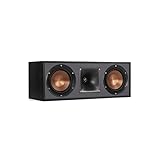
Klipsch R-52C
- Dual 5.25 inch spun-copper IMG woofers
- 1 inch aluminum LTS tweeter in a 90x90 Tractrix horn
- 95dB sensitivity at 2.83V/1m
- 400 watts power handling
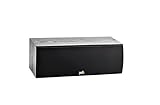
Polk Audio T30
- Dual 5.25 inch Dynamic Balance woofers
- 1 inch silk dome tweeter
- Tuned rear port for punchy bass
- Timbre matched to the Polk T-Series

Polk Signature Elite ES35
- Six 3 inch woofers with Power Port bass
- 1 inch Terylene tweeter
- 7.5 inch tall slim cabinet
- 4-ohm and 8-ohm compatible
The R-52C takes the top slot because it combines the highest rating in the group with the largest review base we could find, and because horn loading gives it a level of consonant definition that soft-dome designs cannot match at this level. The T30 is the value answer for anyone building a 5.1 system on a sensible budget, and the ES35 solves the placement problem that stops people from upgrading at all.
All 12 Picks at a Glance in 2026
| Product | Specifications | Action |
|---|---|---|
| Klipsch R-52C Horn-Loaded Center |
|
Check Latest Price |
 Polk Blackstone TL1 Polk Blackstone TL1 |
|
Check Latest Price |
| Polk Audio T30 |
|
Check Latest Price |
 Klipsch R-25C Reference Klipsch R-25C Reference |
|
Check Latest Price |
 Klipsch RP-504C Klipsch RP-504C |
|
Check Latest Price |
| Polk Signature Elite ES35 |
|
Check Latest Price |
 Yamaha NS-C210BL Yamaha NS-C210BL |
|
Check Latest Price |
 ELAC Debut 2.0 C5.2 ELAC Debut 2.0 C5.2 |
|
Check Latest Price |
 SVS Prime Center SVS Prime Center |
|
Check Latest Price |
 Definitive CS-9060 Definitive CS-9060 |
|
Check Latest Price |
 Fluence Signature HiFi Fluence Signature HiFi |
|
Check Latest Price |
 Definitive CS-9040 Definitive CS-9040 |
|
Check Latest Price |
1. Klipsch R-52C – Horn-Loaded Clarity That Fits Most TV Stands
- Horn-loaded LTS tweeter projects dialogue toward the main seat
- Dual spun-copper woofers reach down to 89Hz
- 95dB sensitivity plays loud on modest amplification
- Compact 18.75in width fits most TV stands
- Six year parts and labor warranty
- 6-ohm load asks more of an entry-level receiver
- No grille included in some configurations
This is the speaker we came back to more than once. The 1 inch aluminum LTS tweeter sits in a 90×90 square Tractrix horn, and that horn is the whole argument: it controls dispersion so the consonants in speech arrive at your seat with an edge that soft domes soften. Owners describe dialogue as jumping out of the mix, and 88% of the reviews sit at five stars.
The dual 5.25 inch spun-copper IMG woofers do more than you would expect for a center. They push response down to 89Hz, which means a subwoofer is optional for dialogue purposes and the speaker still has body when effects spill into the center channel.
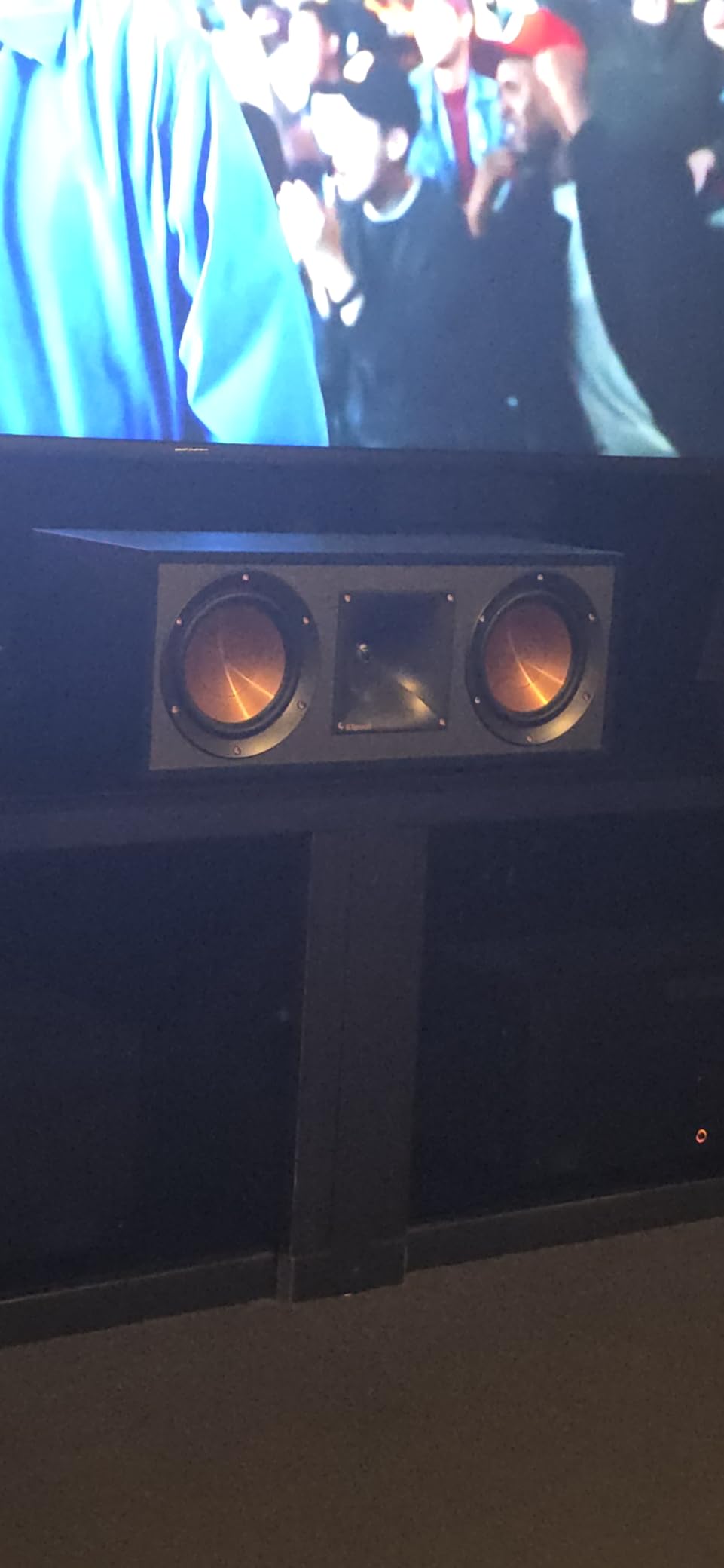
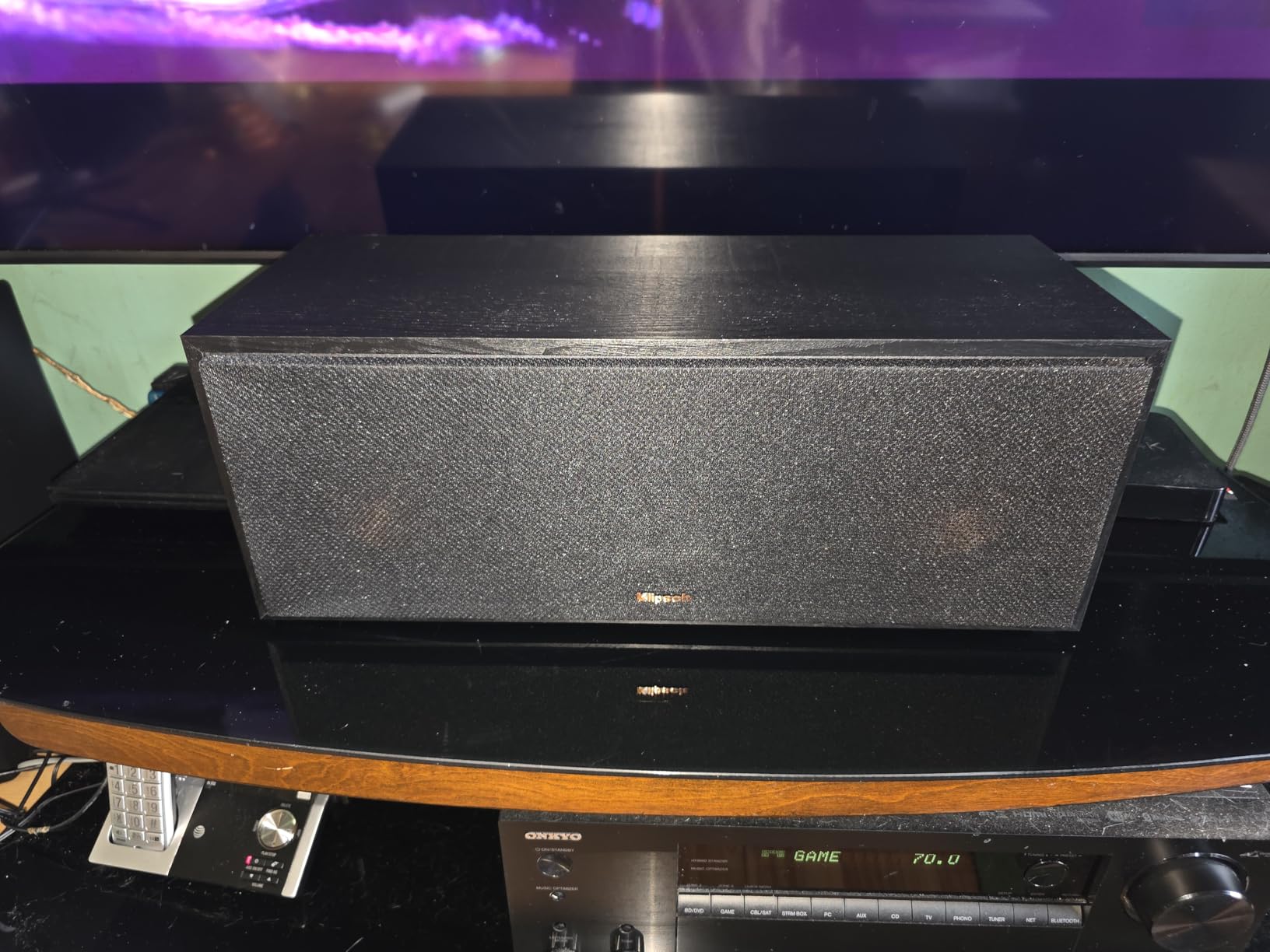
At 13.5 pounds and 18.75 inches wide, it clears most TV stands without a fight. The 7.3 inch height is short enough to stay under a screen without hiding the tweeter, which is the single most common placement mistake people make.
One thing to know: the 6-ohm nominal load is the least forgiving part of the design. On a mainstream AV receiver it is a non-issue, but if your amplifier is a slim older unit, check its manual before you commit.
Does it fit under a projector screen?
Yes, with room to spare. The 7.3 inch height is among the shorter cabinets in this group, and the horn faces straight out, so it can be angled up toward a screen with an acoustically transparent cloth without any loss of horizontal dispersion.
If your screen image sits low, set the cabinet on the top shelf of the media unit rather than inside it, so the horn is at or just below ear height when you are seated.
How does it behave off the main seat?
The horn narrows vertical spread but stays wide horizontally, which is exactly the axis that matters for a couch. Listeners seated several feet to one side still hear consonants clearly, though the top end softens noticeably compared with dead center.
If your family room seating spans the full width of the sofa, the four-woofer Klipsch in slot five covers that better at the cost of 31 inches of cabinet.
2. Polk Audio Blackstone TL1 – The Smallest Fix for Muffled Dialogue
- 15in wide body fits almost any TV stand
- Time Lens alignment sharpens imaging in a compact box
- Owners report dialogue lifting out of a muddy mix
- Light 3.4 pounds is easy to reposition
- 2.5in drivers add no real bass output
- Needs real receiver volume to fill a room
- Mounting hardware is basic
Sometimes the problem is not quality, it is a center channel that has physically decayed. The TL1 is the cheapest way out of that, and at 3.4 pounds and 15 inches wide it is the easiest speaker here to hide.
Time Lens technology aligns the silk dome tweeter with the two 2.5 inch Dynamic Balance mids so the acoustic centers line up, which improves imaging from a small cabinet. Owners swapping out a bulky, tired center frequently report that dialogue becomes warm and obvious rather than thin.
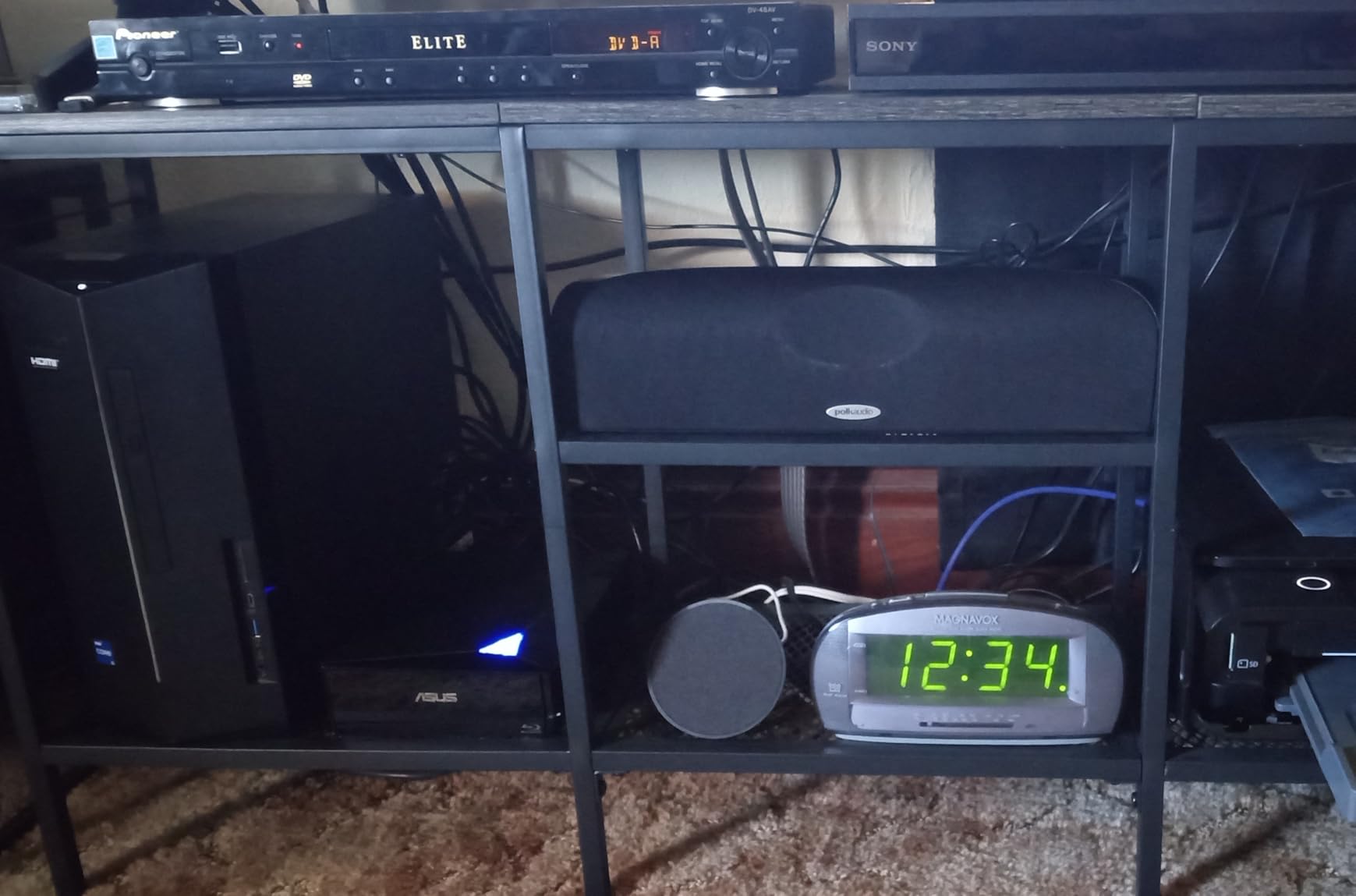
Be realistic about what it cannot do. Those 2.5 inch drivers have no meaningful low end, so the effect is intelligibility rather than impact. In a large room with generous receiver volume it will feel thin next to full-size centers.
The curved high-gloss enclosure was designed to visually disappear against a flat panel, which is a real consideration in a living room where the TV is not in a dedicated media cave.
Will it fit a narrow shelf?
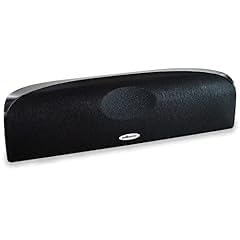
Almost certainly. At 15 inches wide, 4 inches tall, and 3.5 inches deep it is one of the two smallest cabinets here, and it can be placed on a wall shelf or a narrow media unit without shifting anything else.
The 8-ohm load also makes it the easiest of the compact options to drive, so an older or lower-powered receiver will not struggle.
Is it enough for a big room?
No, and it is worth being blunt about that. Output is the trade you make for the dimensions. In a small apartment or a bedroom system it is genuinely enough; in a 400-square-foot media room you will want at least 5.25 inch drivers behind it.
3. Polk Audio T30 – Best Value Center for Budget 5.1 Systems
- Dual 5.25in woofers give full-range dialogue
- Tuned rear port adds usable low end for a center
- Timbre matched to the Polk T-Series towers
- 5 year parts and labor warranty
- 6-ohm impedance loads the receiver harder than an 8-ohm design
- Slightly brighter than Klipsch alternatives without EQ
The T30 is the pick we recommend to someone building a first real 5.1 system. Dual 5.25 inch Dynamic Balance woofers and a 1 inch silk dome tweeter cover the full range a voice occupies, and 82% of reviews are five stars with owners specifically crediting it for fixing muffled dialogue.
Unlike the TL1, the tuned rear port gives it some actual low-end weight, so it holds together in a room without a subwoofer doing all the heavy lifting during dialogue scenes.
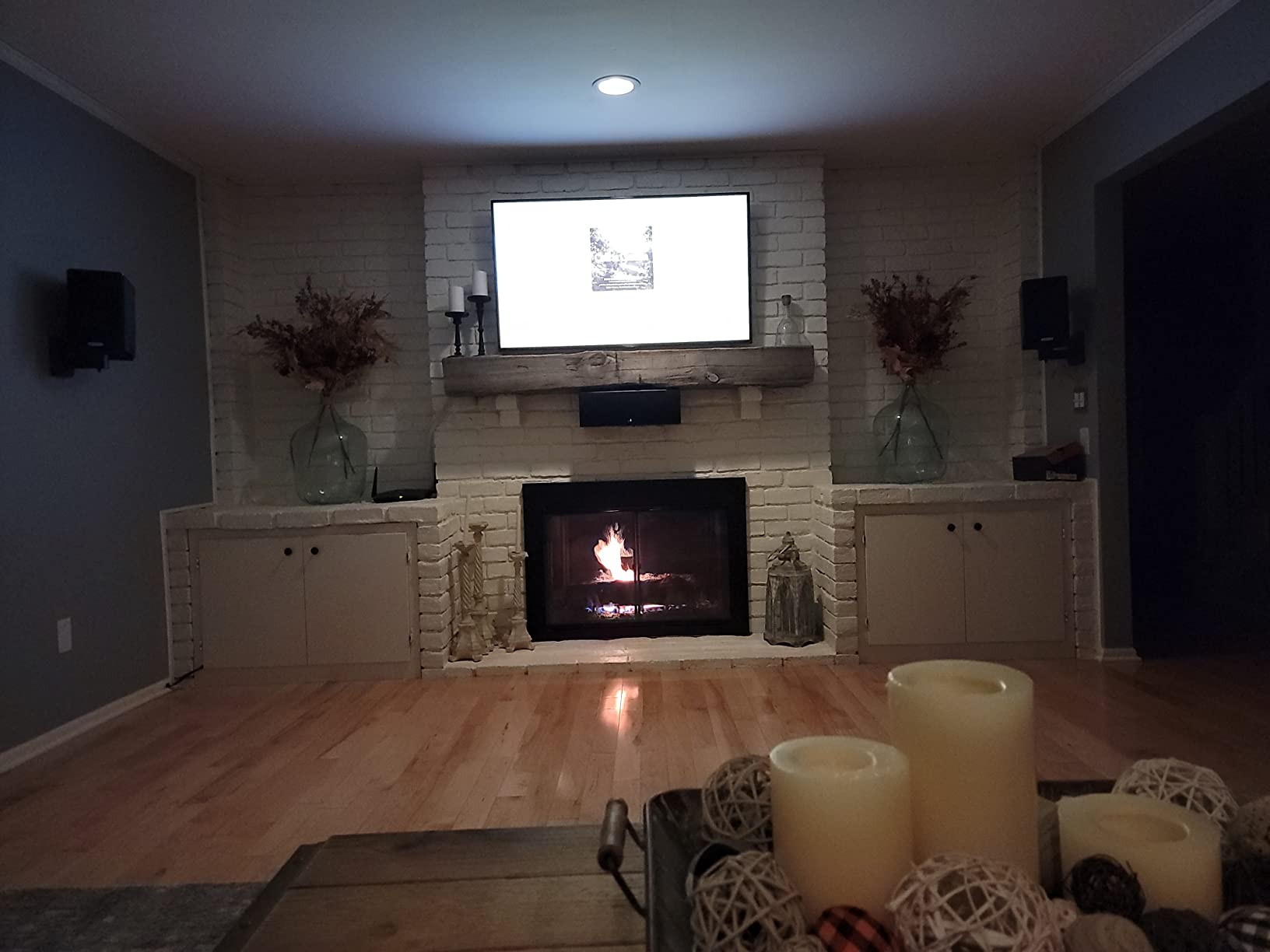
It is explicitly timbre matched to the Polk T-Series, so if your towers are T15 or T25 pair this is the seamless choice. It also works fine as a cross-brand center, which we cover in the buying guide below.
Two cautions. The 6-ohm impedance is a real load on an entry-level receiver, and the top end is slightly brighter than a Klipsch horn design, so a small treble trim in your receiver will settle it if you are fussy.
Is it compatible with an older receiver?
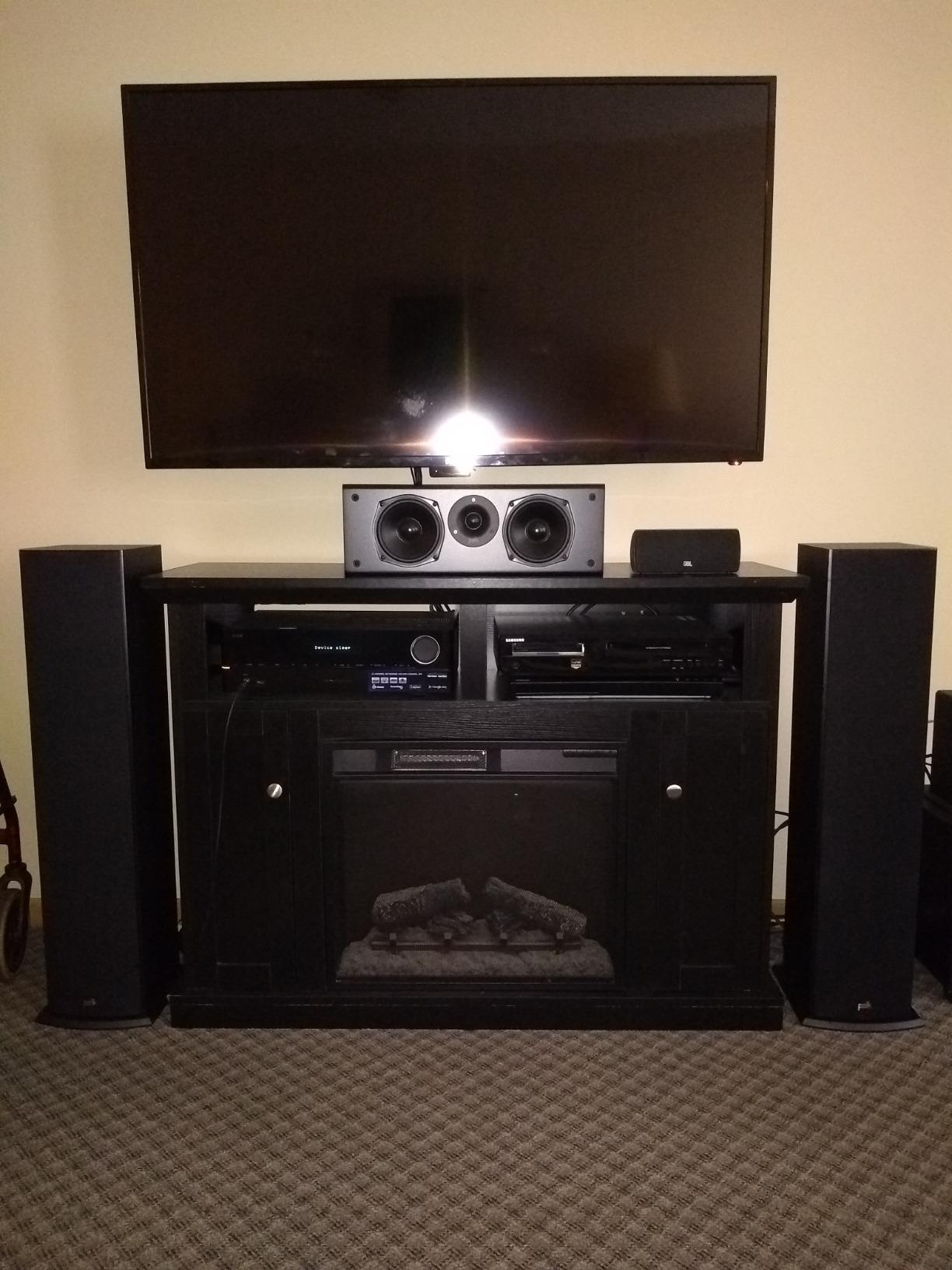
Yes on most modern units. Six ohms sits in the same territory as Polk towers and Klipsch centers, and any receiver rated for those will drive the T30 without strain. Just avoid pairing it with a very slim or older integrated amplifier.
If your receiver has an adjustable center channel trim, leave it flat and let room correction set the level rather than cranking the volume trim to chase clarity.
How does it handle a room without a subwoofer?
Better than most compact centers because of the ported cabinet. It will not replace a subwoofer for effects, but during dialogue-heavy passages the center holds its own, which is the part of the mix people actually listen to.
4. Klipsch R-25C – Forward Projection for Mid-Size Rooms
Klipsch Reference R-25C Reference Two-Way Center Channel Speaker, 400W Peak Power
- Tractrix horn architecture stays forward and intelligible
- 400W peak power handling takes some pushing
- 18.75in width suits most entertainment centers
- Easily driven by mainstream AV receivers
- Older Reference generation with less published specification detail
- Wide cabinet needs a clear shelf
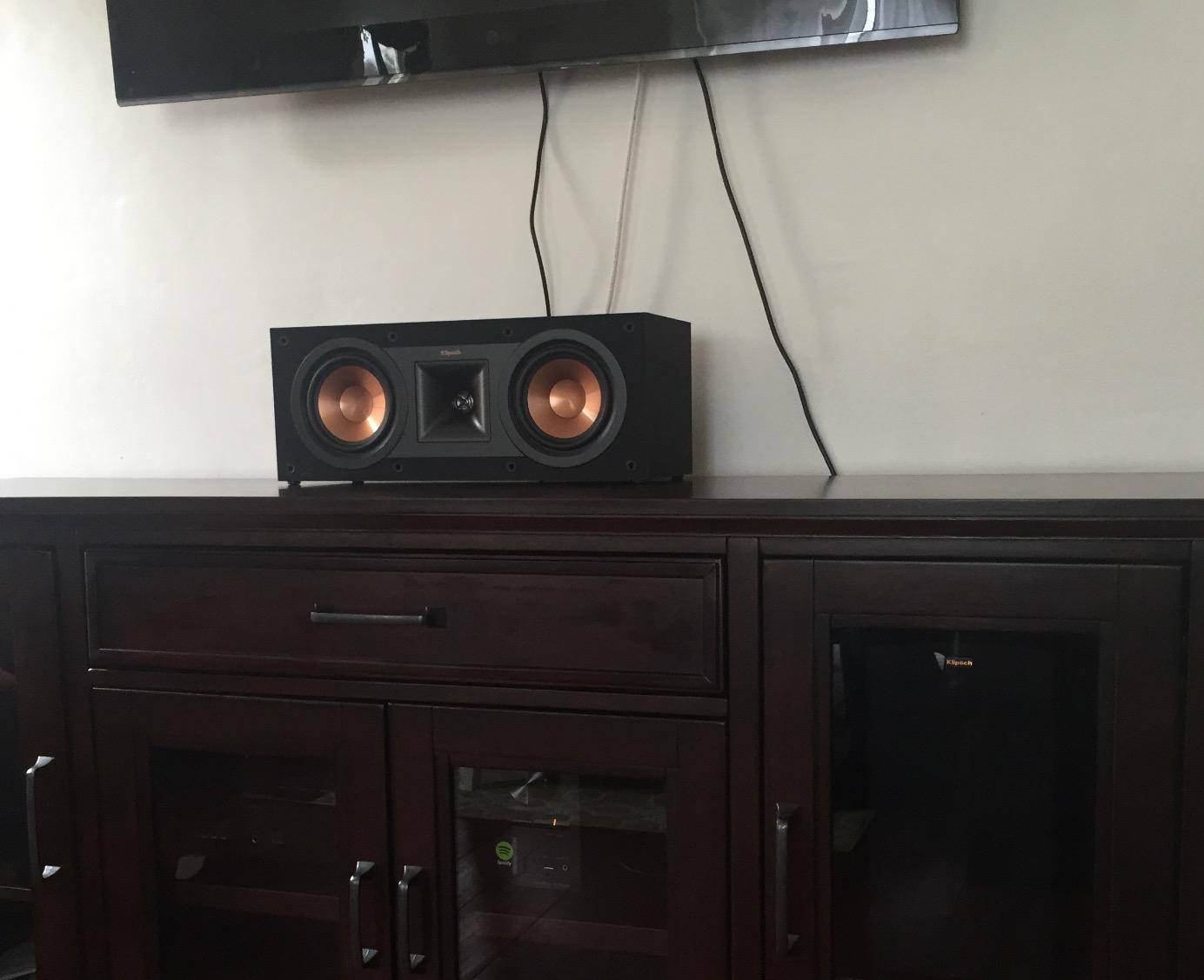
The R-25C is the older Reference generation center, and it delivers the forward, projecting horn character people buy Klipsch for. With 86% of reviews at five stars, it is a dependable mid-tier choice for anyone who wants horn-loaded clarity without moving up a tier.
What you gain is directness. The Tractrix horn architecture is tuned for controlled dispersion, so a voice reads as present and close rather than somewhere in the room. That is exactly the sensation that makes dialogue easy to follow.
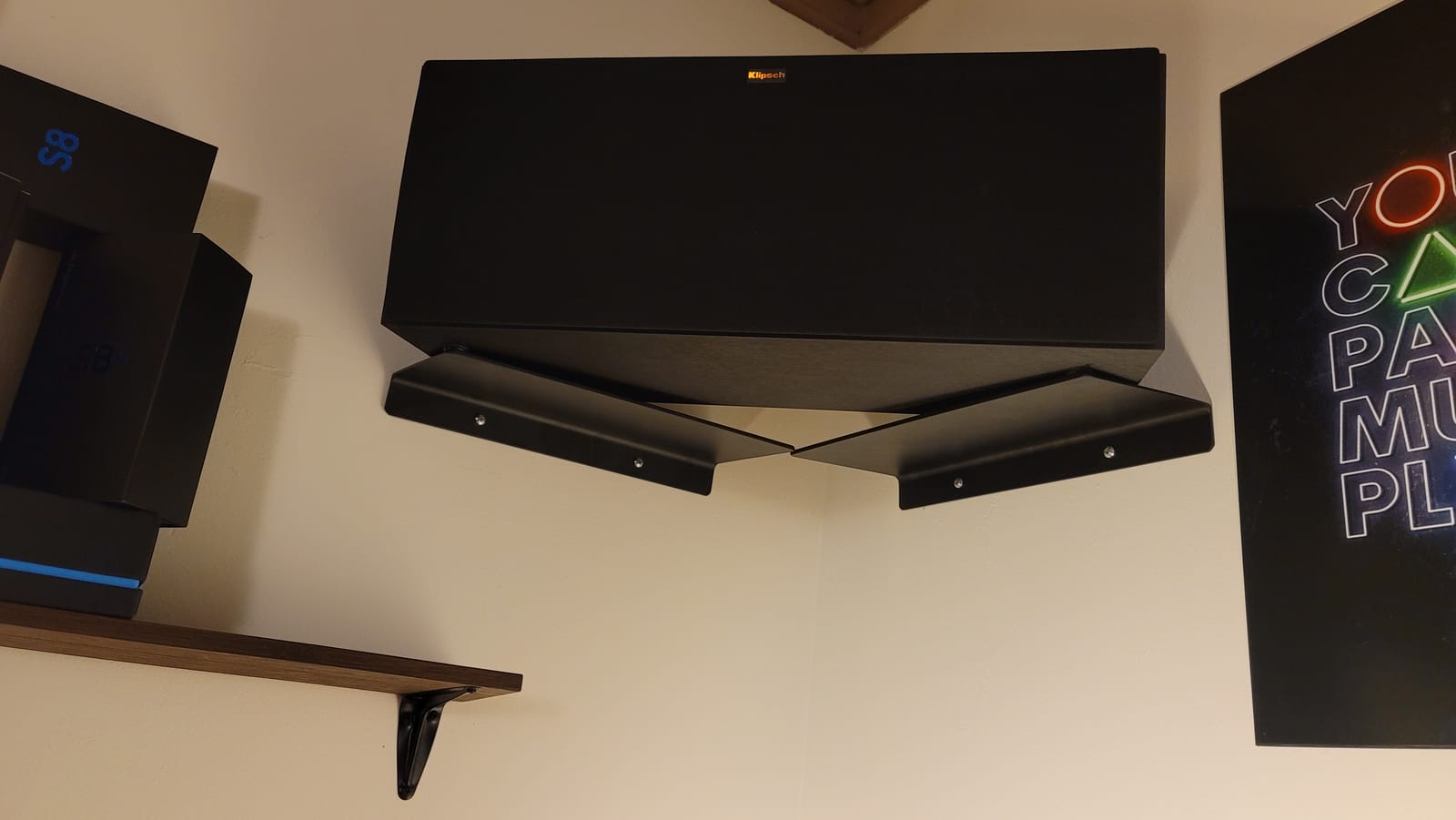
It weighs 14.8 pounds, which is substantial for its class and helps it stay composed when you push it. The 18.75 inch width matches the R-52C footprint, so if you are comparing the two, fit is not a differentiator.
The published specification detail here is thinner than the newer Reference Premiere models, so if you are a measurement-first buyer, read the forum measurements rather than the marketing sheet.
Should I choose this over the R-52C?
Only if you find the R-52C beyond what you need. The R-52C carries a higher review count and a documented 95dB sensitivity figure, which gives you more certainty with an unknown amplifier.
For a well-matched current-generation receiver the difference is marginal, so the deciding factor is usually which one your system already uses elsewhere for timbre consistency.
What room size suits it?
Medium rooms, roughly a normal living room or a small dedicated theater. It has the power handling for a larger space, but a single two-way center competing against a big room and high volume is a fight the R-52C or RP-504C wins more comfortably.
5. Klipsch RP-504C – Four Woofers for Wide Seating
- Four 5.25in Cerametallic woofers hold dialogue well off the sweet spot
- Tractrix horn with computer-modelled phase plugs smooths the treble
- Efficient 8-ohm design drives hard on modest amplification
- Rear Tractrix port tuned to the cabinet
- 31in wide and nearly 40 pounds
- Boosted treble can read as aggressive without EQ
This is the pick for a wide room with wide seating. Four 5.25 inch Cerametallic cone woofers with dual-layer copper voice coils give it enough radiating area that dialogue stays intelligible far to the side of the main seat, which is the failure mode most people describe on forum threads.
The 2.5-way network runs separate crossovers for the inner and outer woofers, so the drivers do not fight each other through the midrange where voices live. That crossover work is the real reason it stays clear rather than congested.
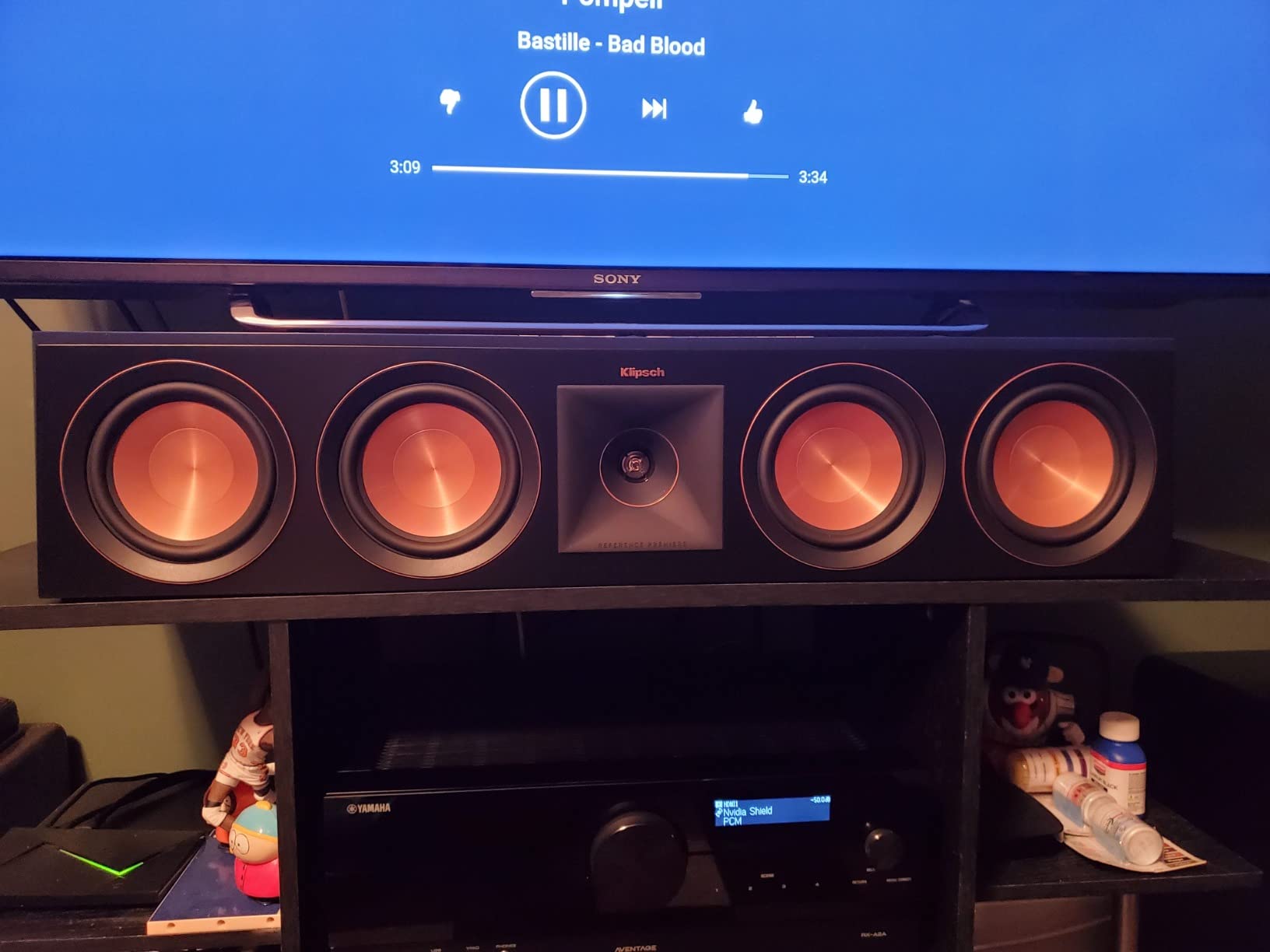
The silicon-moulded 90×90 degree Tractrix horn uses computer-modelled phase plugs to smooth the transition to the vented titanium-diaphragm LTS tweeter, and that smoothness is what keeps consonants from sounding etched.
It is also exceptionally efficient. Owners driving it with modest amplification report no strain, which matters because most center channels are the first thing a budget receiver runs out of headroom on.
Do you have the space for it?
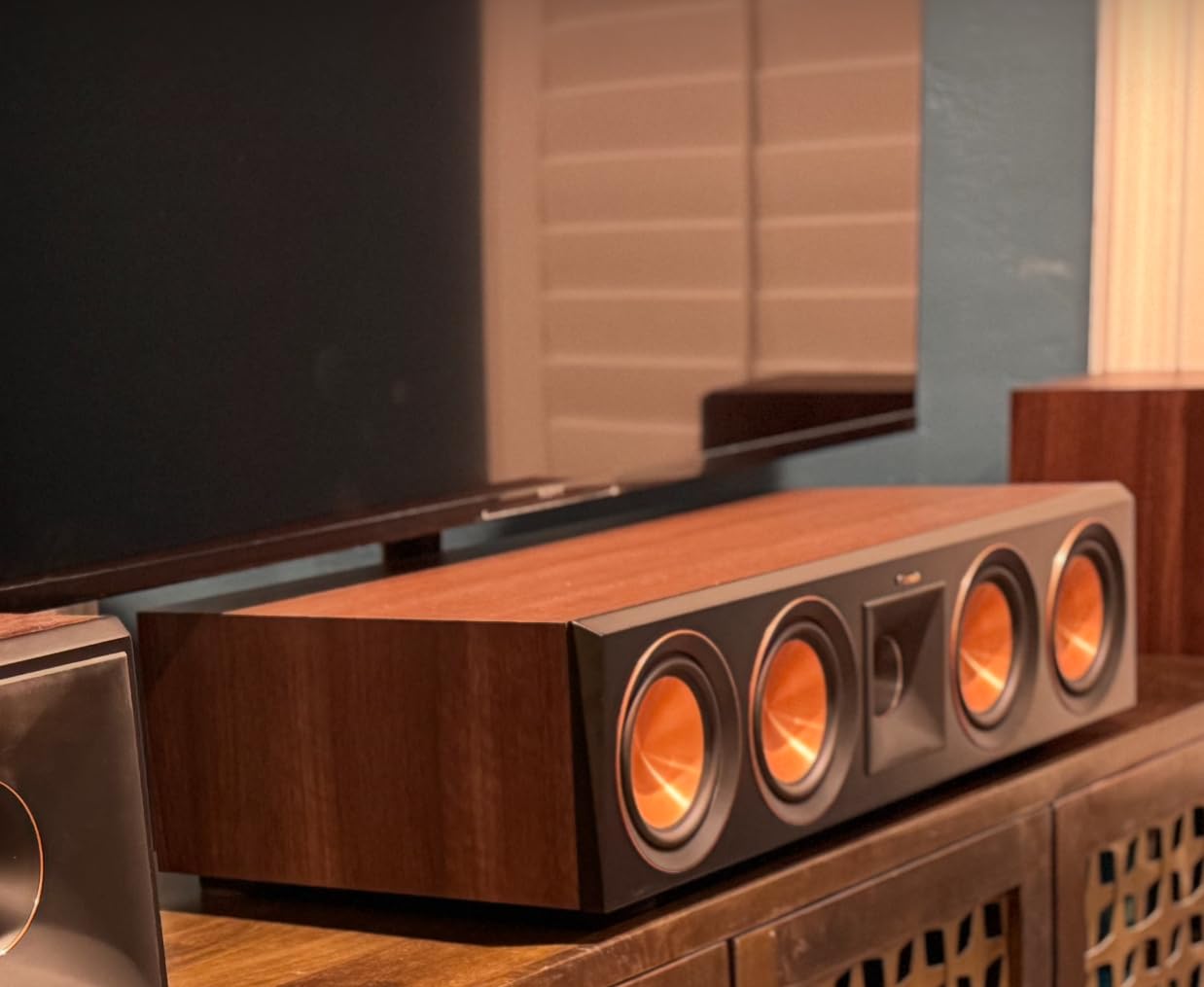
This is the deciding question. At 31.13 inches wide, 14.46 inches deep, and nearly 40 pounds, several owners had to replace their TV stand to make it work. Measure the top shelf of your media unit and the gap under your screen before you fall for the sound.
If it does fit, the depth is the hidden cost: you need clearance in front for the rear Tractrix port or you will lose the low-end weight the four woofers are capable of.
Will it sound too aggressive?
Possibly, for the first week. With 90% of reviews at five stars, the tonal character is widely liked, but if you are treble-sensitive start with a negative 2dB on the center channel and work back up.
6. Polk Audio Signature Elite ES35 – Slim Enough to Mount Under Any Screen
Polk Audio Signature Elite ES35 Slim Center Channel Speaker, Stunning Black
- 7.5in tall body wall-mounts below a screen or sits on a shelf
- Six 3in woofers and a Power Port give room-filling output
- Works with 4-ohm and 8-ohm receivers
- Does not block a TV IR sensor
- 3in drivers stop short of deep bass
- Highest 1-star share in this group at 4 percent
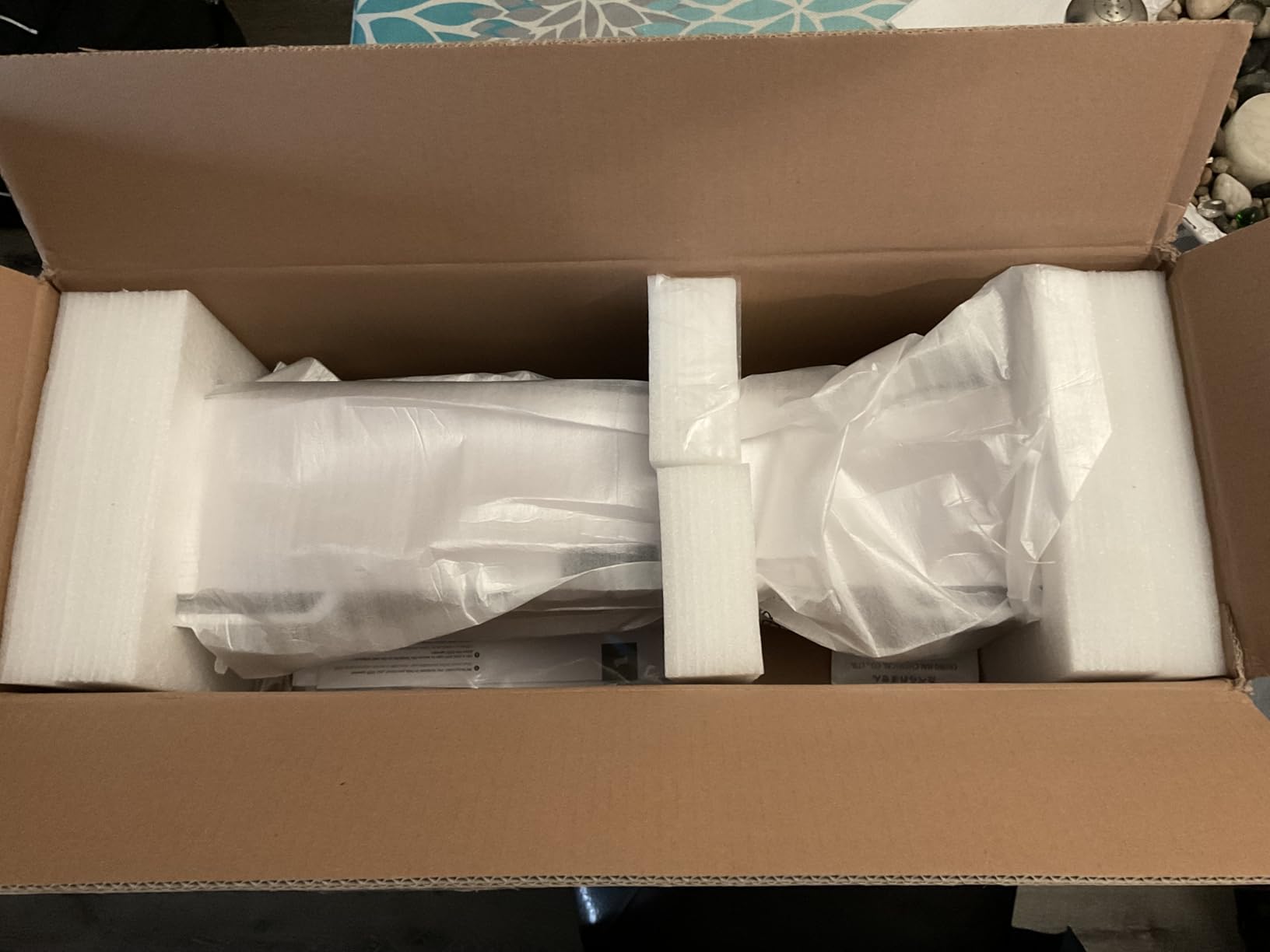
Placement is the reason most people never upgrade their center, and the ES35 removes the excuse. At 7.5 inches tall and 20 inches wide, it is slim enough to sit on a narrow shelf or mount on the wall directly under a screen without blocking the IR sensor.
Six 3 inch woofers with the patented Power Port do the work, and the Dynamically Balanced Acoustic Array with cascading crossovers keeps them from overlapping into a muddy midrange. The result is room-filling output from a cabinet most people would not call a center speaker.
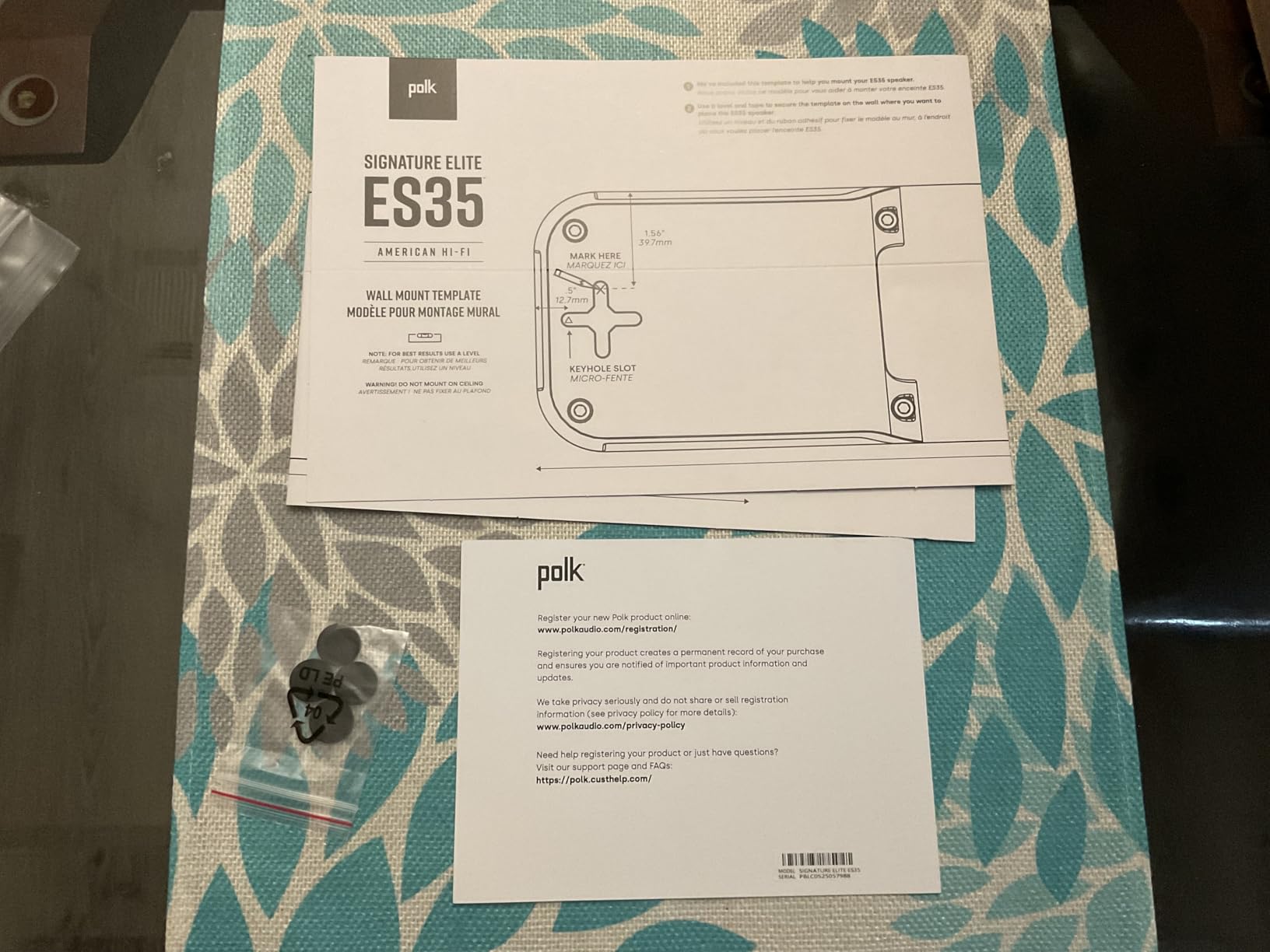
It is also unusually flexible on the receiver side, working with both 4-ohm and 8-ohm amplification, which is helpful if you are pairing it with an older receiver or an external power amplifier.
One honest note: this group carries a 4% share of one-star reviews, mostly around fit, finish, and tonal preference. It is not a problem speaker, but it is not unanimous either.
Can it double as surrounds?
Yes. Polk designed it to work as a pair of L/R surrounds as well as a center, which makes it a cheap way to fill out a 5.1 system with a single product. In that role the slim profile is a genuine advantage on a shallow side shelf.
How much bass can you expect?
The Power Port gives more low end than the driver size suggests, but 3 inch cones will not deliver real sub-bass. Treat it as a dialogue-first center that handles effects gracefully, not as a substitute for a subwoofer.
7. Yamaha NS-C210BL – The Pick for the Tiniest TV Stand
- 4.2in tall and only 4.4 pounds
- Light aluminum cones respond fast on consonants
- Piano black finish blends with AV equipment
- 13.4in width suits narrow shelves
- 6-ohm impedance demands more current
- Modest 80W rating limits top-end volume
- Two year warranty is the shortest in this group
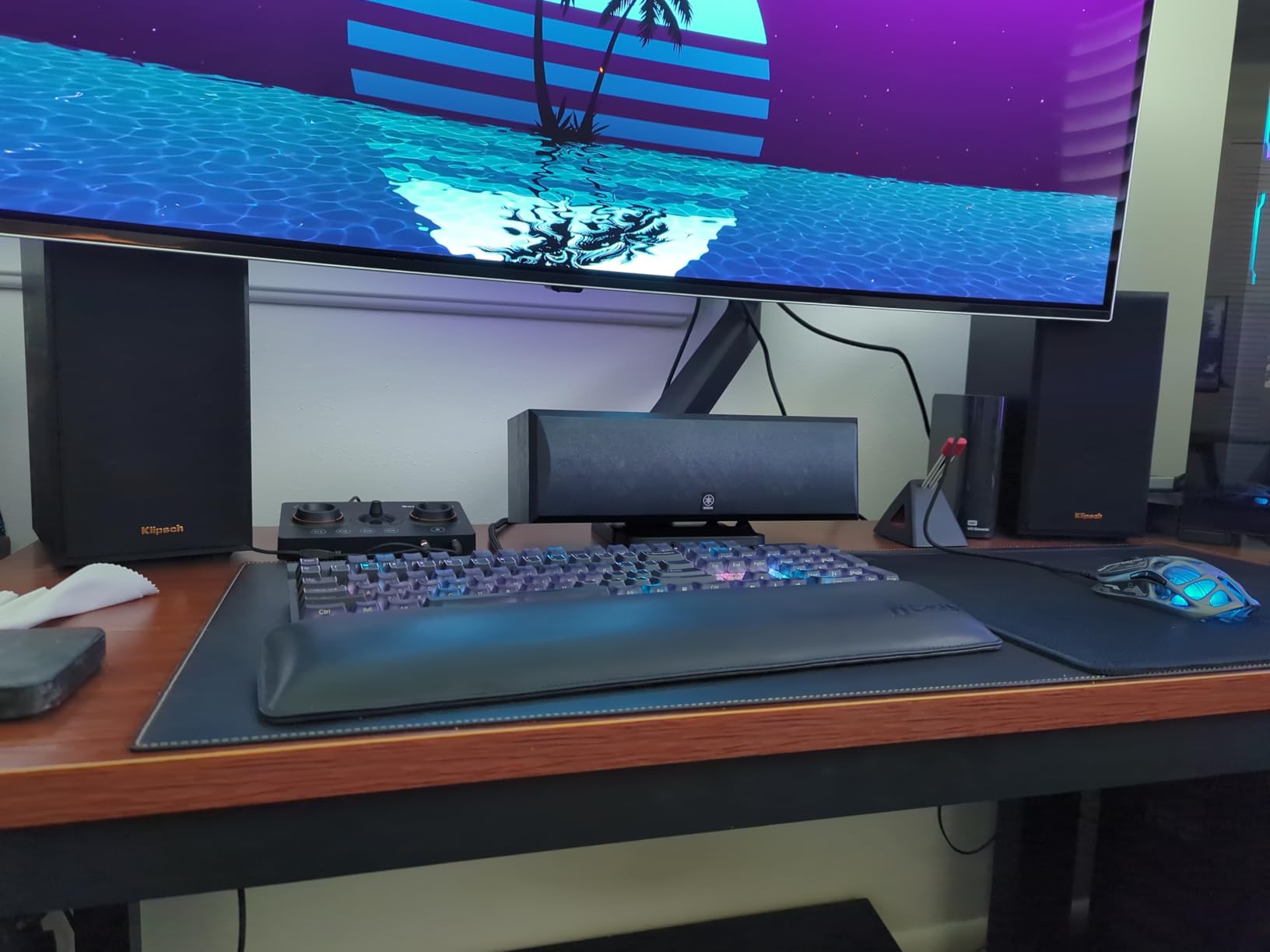
This is the smallest complete center channel in the group: 13.4 inches wide, 5.2 inches deep, 4.2 inches tall, and 4.4 pounds. If your media surface is a narrow console or a wall shelf, it is very hard to find something better proportioned.
The lightweight aluminum cone woofers are the reason it articulates rather than blurs. Low mass means fast response, and fast response is exactly what consonants need. With 75% of reviews at five stars, owners treat it as a clean unobtrusive option for TV viewing.
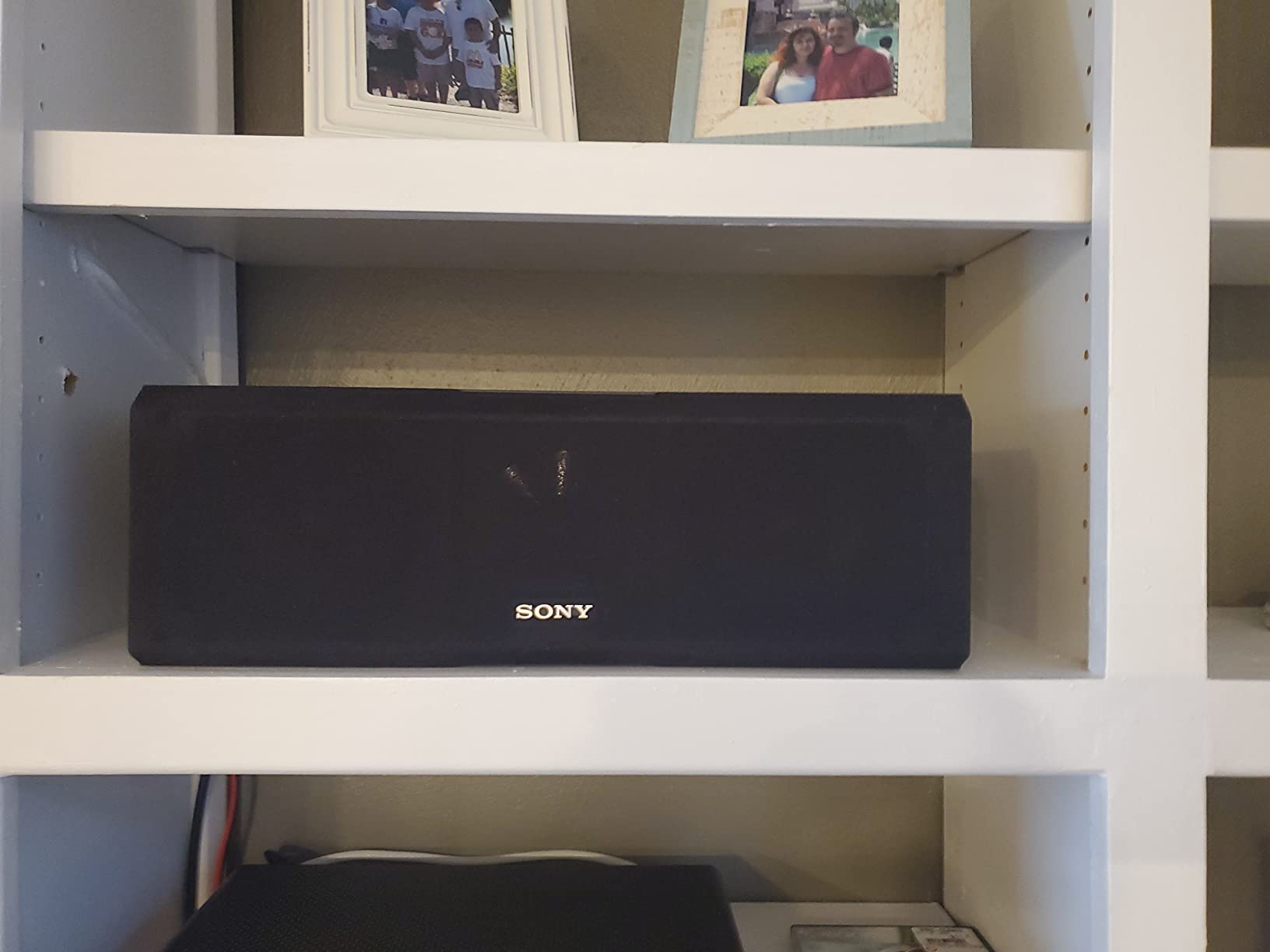
The Yamaha piano black finish is offered in three other finishes too, which matters more than it sounds in a room where the center is visible rather than hidden.
Its limits are power-related. An 80 watt maximum rating and a 6-ohm load mean you want a receiver with real current capability if you listen at higher volume in a medium room.
Does the two year warranty matter?
It is the shortest here, and it is the first thing to check in the fine print. For a passive speaker that will sit untouched for a decade, most buyers never think about it again, but it is a real difference from the five and six year terms on the Klipsch and Polk models.
Will it fill a medium room?
It will handle dialogue in a small to medium space without strain. Push it in a large room at high volume and the 80 watt rating shows, so pair it with a capable receiver or keep the system compact.
8. ELAC Debut 2.0 C5.2 – Smooth, Efficient and Easy to Drive
ELAC Debut 2.0 C5.2 Center Channel Speaker, Black – 1” Cloth Dome Tweeter & Dual 5.25” Aramid Fiber Woofers – 2-Way Bass Reflex – Up to 35,000 Hz Response
- 1in cloth dome tweeter in a waveguide for controlled directivity
- Dual 5.25in woven aramid-fiber woofers stay smooth and controlled
- Front-firing ports allow placement near a wall
- Sensitivity and impedance optimised for lower-cost receivers
- 18.3 pounds is heavy for the class
- 21.3in width needs a large shelf
The ELAC is the smoothest-sounding center in the group, and smoothness is underrated for dialogue. The 1 inch cloth dome tweeter sits in a waveguide that controls directivity without the edge of a horn, so voices come through without fatigue over a long film.
The dual 5.25 inch woven aramid-fiber woofers are stiff enough to stay clean at higher volume and damped enough not to add coloration. Response is rated up to 35,000 Hz, and 82% of reviews are at five stars with owners singling out vocal reproduction.
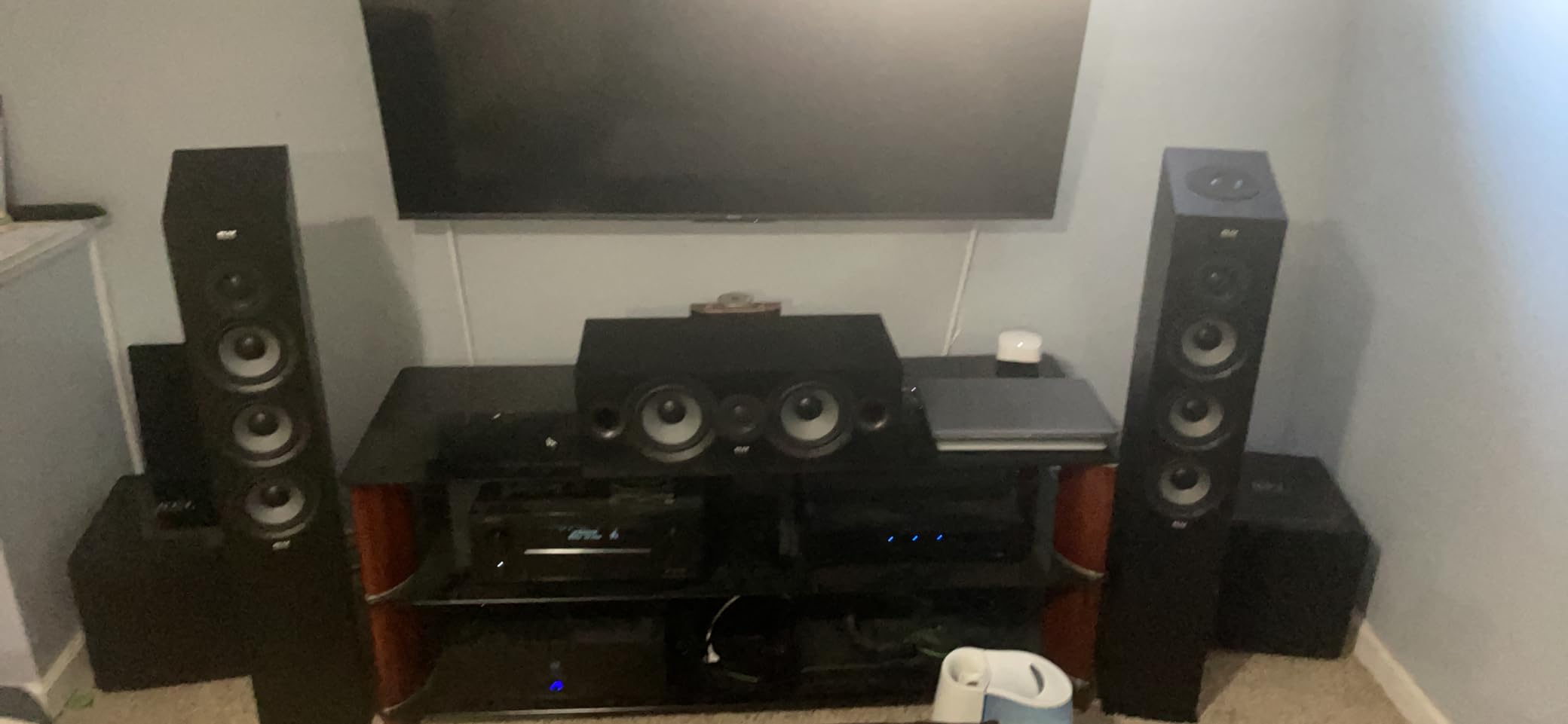
The waveguide and front-firing ports are the practical wins here. The ports mean you can push the cabinet back toward a wall or a bookshelf without the bass port complaining, which is not true of the rear-ported designs in this list.
Sensitivity and impedance were deliberately optimised to lower receiver power demands, so this is one of the safer buys if you do not know what your amplifier can deliver.
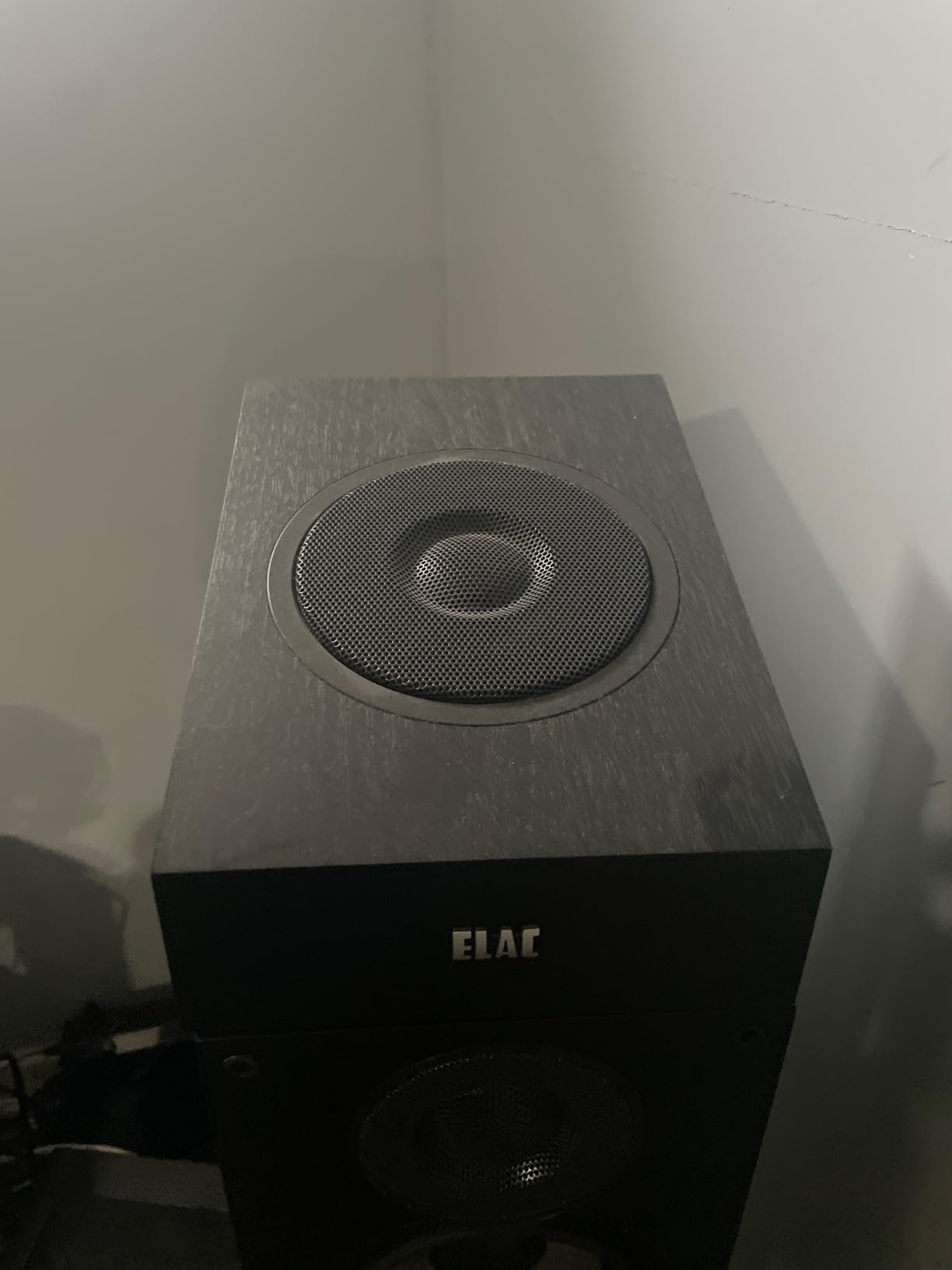
Why does the waveguide matter for voices?
It narrows the vertical spread of the tweeter while keeping the horizontal spread wide, so the high-frequency content that carries consonant detail goes where you are sitting without the tweeter beam becoming narrow enough to lose you when you move.
The practical result is that the sound character stays the same from seat to seat, which is what you want in a family room.
Can it sit on a small shelf?
Not really. At 21.3 inches wide, 8.7 inches deep, and 18.3 pounds it wants a proper stand or a deep cabinet. The front-firing ports buy you wall clearance, not shelf depth.
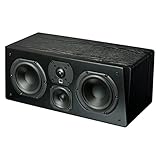
9. SVS Prime Center – Best True 3-Way for Off-Center Seating
- True 3-way crossover with a dedicated tweeter
- Twin 5.25in rigid-cone woofers on cast composite baskets
- SoundMatch crossover keeps phase coherent across the seat
- Owners losing high-frequency hearing report crisper dialogue
- Bright and forward out of the box until broken in or trimmed
- Rear-firing port blocks flat wall placement
- 20 pounds and 13in tall
This is the only true three-way center in the group, and that design choice is the single most argued-over subject in home theater forums. A dedicated tweeter crossed over separately from the woofers means the midrange is handled by fewer drivers at any one frequency, which reduces interference and keeps voices even.
The 1 inch aluminum dome tweeter and twin 5.25 inch rigid-cone woofers sit on cast composite baskets, and the proprietary SoundMatch three-way crossover is tuned for phase coherence across the listening area. Owners with reduced high-frequency hearing specifically report dialogue becoming easier to follow.
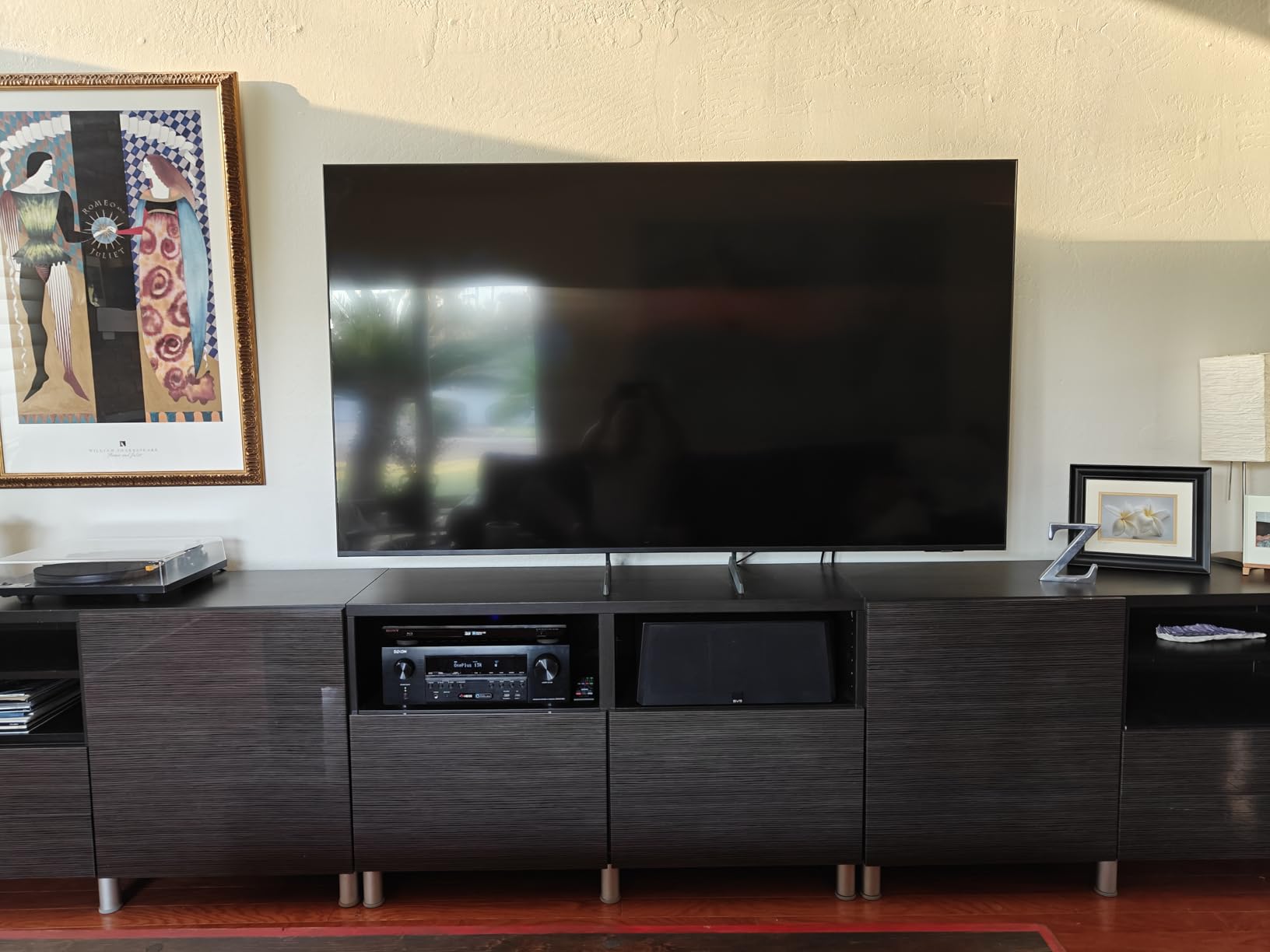
Several users note the sound warms noticeably after 15 to 20 hours of playback, so do not make a final judgment in the first evening.
If you are considering three identical speakers instead of a dedicated horizontal center, this is the middle ground the forum debate keeps landing on: a vertical driver array without needing a second bookshelf speaker.
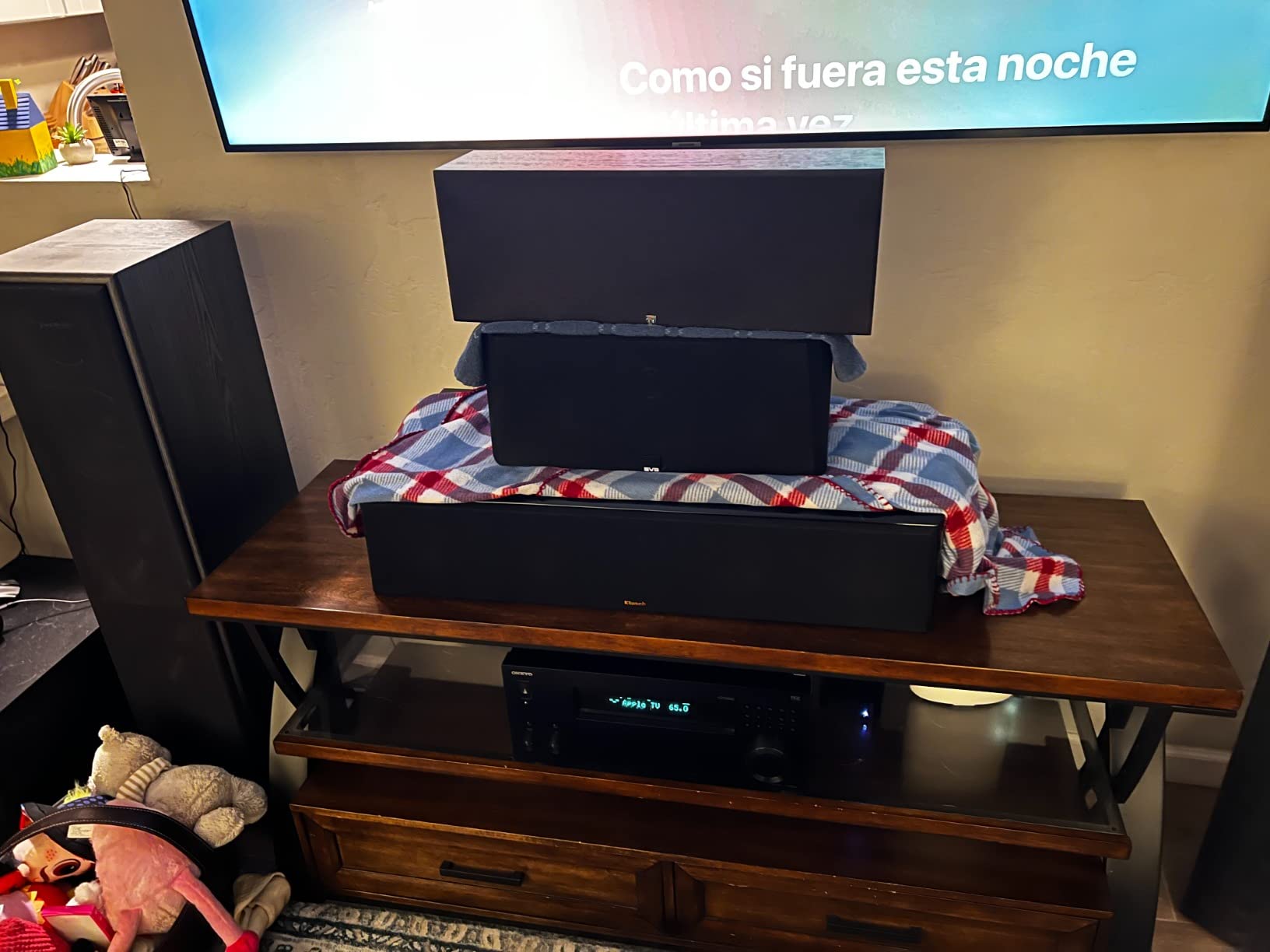
Is a three-way really better than a 2.5-way MTM?
Generally yes, and the reason is physical. In a horizontal midwoofer-tweeter-midwoofer layout the outer drivers are spaced far enough apart to interfere with each other through the vocal range, which produces uneven response as you move away from center. A vertical three-way array puts the drivers in a line and largely avoids that.
The trade is size and cost. A 23 inch wide, 13 inch tall, 20 pound cabinet is a serious object to place under a screen, which is why the MTM designs below exist at all.
Why does it sound bright at first?
The aluminum dome tweeter is revealing before it is flattering, and the cabinet has no grille-induced damping. A simple two to three dB dip on the center channel in your receiver settings solves it for most listeners.
10. Definitive Technology CS-9060 – Dialogue Plus Bass in One Box
- Built-in 8in 150W powered subwoofer adds real low-end impact
- Covers all center channel duties in a single enclosure
- Timber-matched to Definitive BP9000 and Demand D7 towers
- Intelligent Bass Control keeps the midrange honest
- Needs a mains outlet for its built-in amplifier
- Extra bulk from the 8 inch driver
Most center channels are a compromise because they are trying to be a speaker and a subwoofer in a shallow box. The CS-9060 takes the opposite approach and adds a real 8 inch 150 watt powered subwoofer inside the cabinet, so the low end exists rather than being implied.
The voices come from BDSS drivers, a 1 inch aluminum dome tweeter and two 4.5 inch mid drivers, with Intelligent Bass Control managing how that bass blends into the midrange. That control logic is what stops the added low end from smearing over the dialogue.
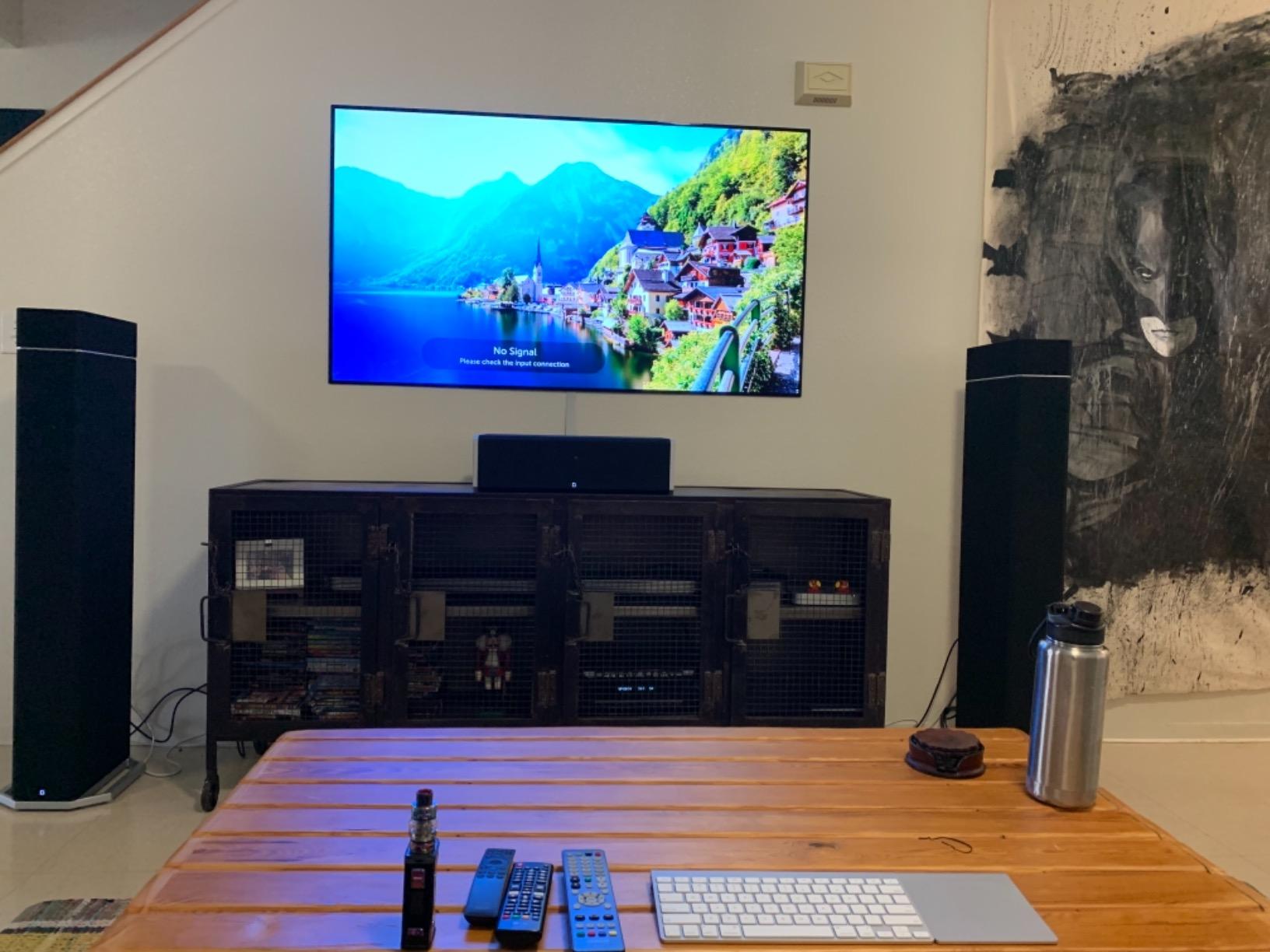
If you are building a 3.0 system with no separate subwoofer, this solves the problem in one enclosure. With 80% of reviews at five stars, the all-in-one approach is the reason people buy it.
It is also timber-matched to the Definitive BP9000 Series towers and Demand D7 speakers, so it will look correct in a system built around those.
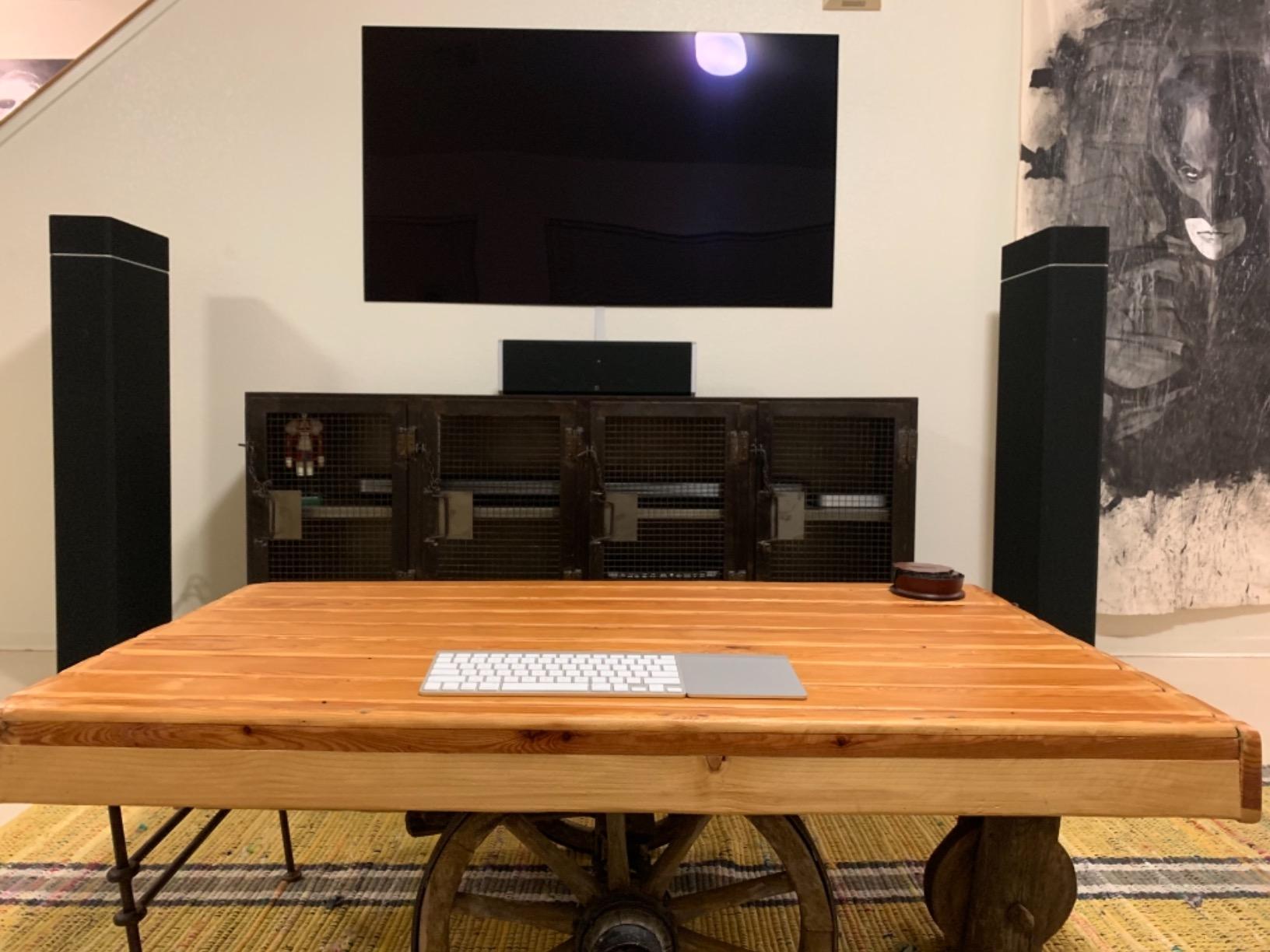
Is the built-in amplifier a problem?
Only in one situation: you need a mains outlet near the center. In a clean install that is trivial. In a wall-mounted setup with no nearby socket it is a genuine inconvenience, and it is the reason the passive CS-9040 below exists.
Does the powered sub section fight the dialogue?
It should not, provided you set the crossover on your receiver to send low frequencies to the LFE output rather than to this speaker. Do that and the 8 inch driver handles the sub-bass while the BDSS mids stay clean in the vocal range.
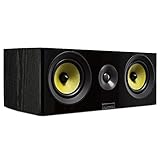
11. Fluance Signature HiFi – Sensitivity and Headroom Without the Premium
Fluance Signature HiFi 2-Way Center Channel Speaker for Enhanced Dialogue and Vocals in Home Theater Surround Sound Systems – Black Ash (HFC)
- 92dB sensitivity plays loudly without heavy amplification
- Dual 5in woven glass fiber mids keep voices natural
- Wide sound field forgives imperfect placement
- Integrated keyhole-slot wall mounting brackets
- Stiff shallow terminals fight banana plugs
- Mild coloration rather than perfectly neutral
- No mounting template supplied
The Fluance was designed around a single brief: two-way design focused on perfecting vocals and dialogue. The ultra high-end neodymium tweeter and dual 5 inch pointed-dome woven glass fiber midrange drivers are chosen for midrange accuracy rather than extension, and that shows in how voices sit.
Owners widely report dialogue becoming crisper and easier to follow, and several note it compares favorably with speakers costing several times more. It also seems to need about 20 hours of break-in before the sound really opens up.
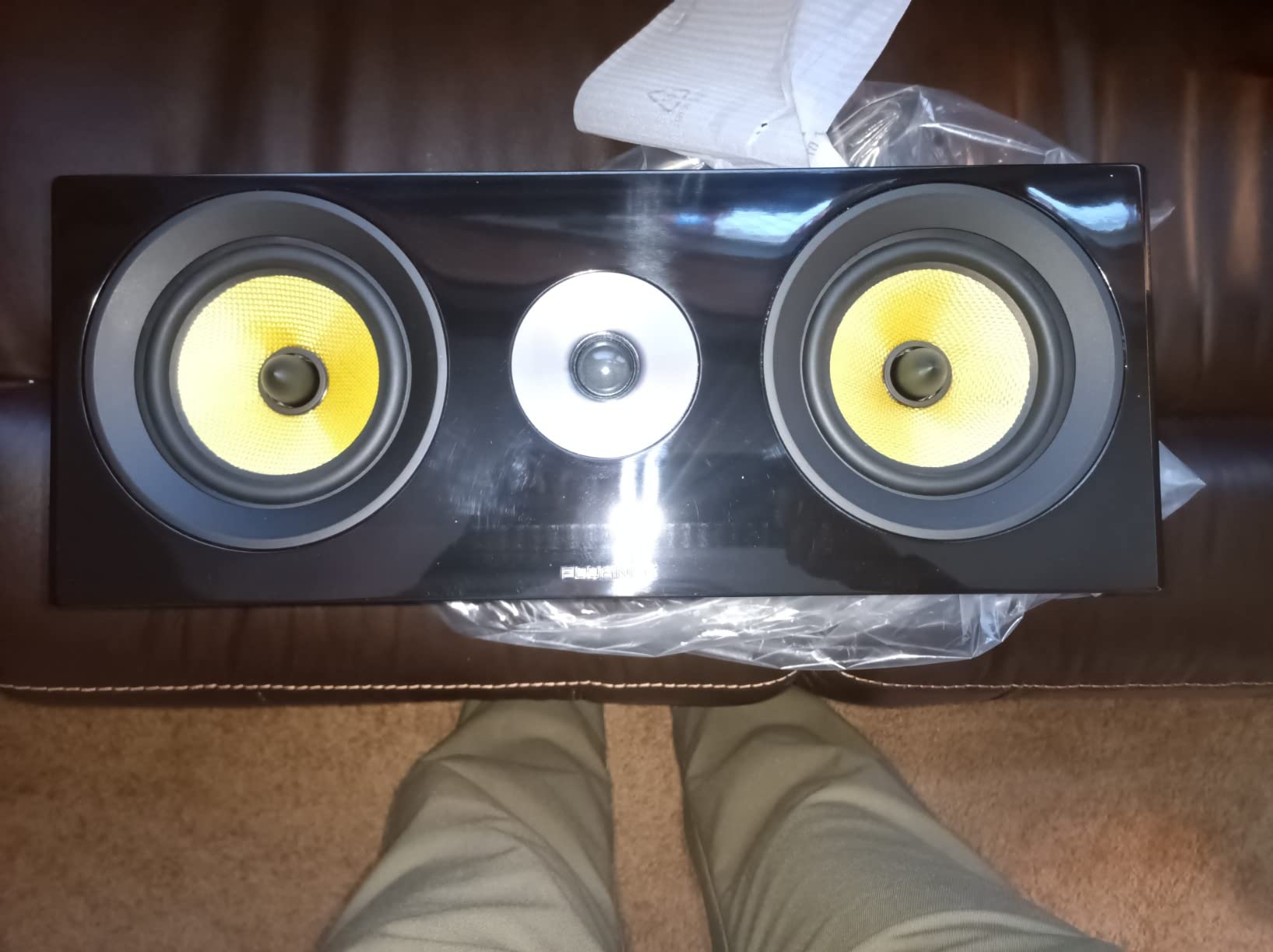
The 92dB sensitivity is the number to notice. It means the speaker produces high output from a modest amount of power, which matters at late-night listening levels when you want clarity without the receiver straining.
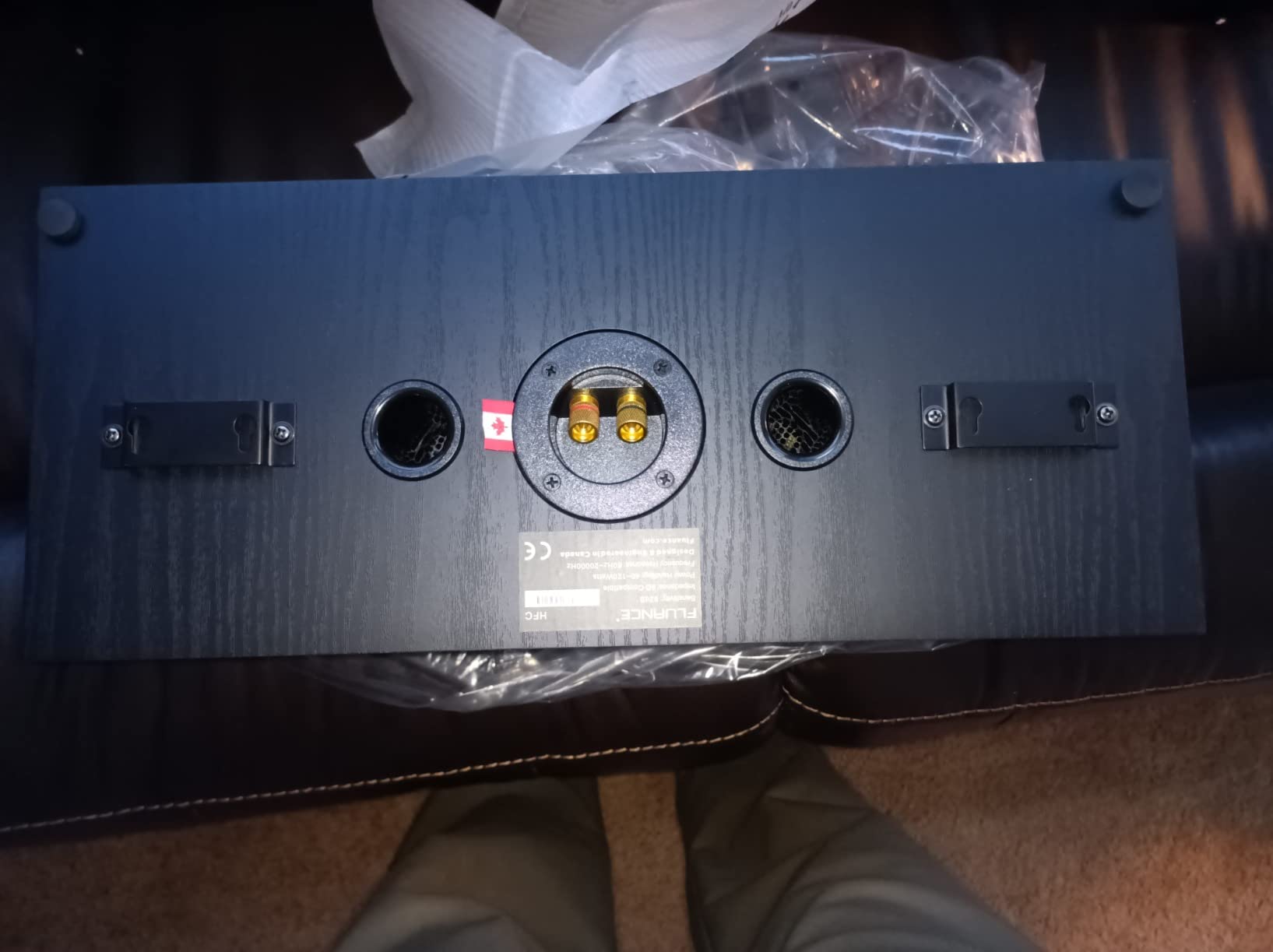
Integrated keyhole-slot wall mounting brackets, a magnetic grille, and isolation foot pads are all included, which is unusual at this level and solves the under-screen placement problem outright.
Is it a good fit for a family room couch?
Yes. The wide sound field is the most common theme in the reviews, and the 5 inch midrange drivers keep output even when listeners are spread across a wide seating area rather than clustered in the center.
What are the install complaints?
The terminals are the practical issue. They are stiff and shallow, so banana plugs are a fight and bare wire is the easier path. No mounting template ships with the brackets either, so mark the wall yourself before drilling.
12. Definitive Technology CS-9040 – Passive Low End Without a Power Outlet
- Integrated 8in passive bass radiator adds depth slim centers cannot match
- Fully passive so only speaker wire is needed
- Two 4.5in BDSS mids keep vocals balanced
- Timber-matched to Definitive BP9000 and Demand D7 towers
- 12in deep cabinet and 20 pounds need a sturdy surface
- Passive radiator is less capable than a powered alternative
The CS-9040 is the passive sibling to the CS-9060, and for some installations it is the smarter buy. It uses an 8 inch passive bass radiator with Intelligent Bass Control instead of a powered subwoofer, so it needs nothing but speaker wire.
The same BDSS array carries the voices: a 1 inch aluminum dome tweeter and two 4.5 inch mid drivers in a resonance-free inert cabinet that is designed to image accurately. Owners highlight the balance between the added bass and the midrange clarity.
With 81% of reviews at five stars, the recurring theme is fullness. In a room where a separate subwoofer is not planned, a passive radiator of this size is a real upgrade over a slim center that has no low end at all.
Do be honest about the depth, though. At 12 inches deep and 20 pounds, it occupies far more shelf space than it appears to from the front.
Passive radiator or a separate subwoofer?
A passive radiator gives you weight now with no extra box on the floor and no extra connection. A separate subwoofer gives you independent placement, independent level control, and usually more low-frequency extension.
If your room is small and your system is 3.0, the passive radiator is the tidier solution. If you already own a subwoofer, this is about clarity, not bass, and a slimmer center would serve you better.
Does it match Definitive towers?
Yes by design. The timber-matched finish is intended to sit alongside the BP9000 Series towers and Demand D7 speakers, so if that is your front stage the visual and tonal continuity is already handled.
How to Choose a Center Channel Speaker for Dialogue
3-way, 2.5-way MTM, or coaxial: the decision that matters most
A true three-way center gives each driver a narrower band, so fewer drivers are radiating through the vocal range at once. That reduces interference and keeps voices even across a wide seating area. It is the design an Audio Science Review regular named as his preference when comparing a well executed three-way against a compromised horizontal alternative.
A 2.5-way MTM layout, which is what most horizontal centers use, is a two-way design with a second midwoofer to widen horizontal coverage. It works well and costs less, but the two midwoofers are spaced far enough apart that their interaction through the midrange can hollow out response away from the center seat.
A coaxial design puts the tweeter at the center of the woofer cone so it behaves as a single point source. In this group the Fluance is the closest to that idea in spirit, with a small neodymium tweeter and 5 inch glass fiber mids, and it is a sensible pick when placement is tight.
Does the center have to match your front speakers?
No, and this is the most persistent myth in the category. One long-tenured Audio Science Review member put it directly: the idea that the timbre must be matched with like speakers is a myth that will not die. A well designed three-way from another brand will beat a poorly designed MTM from the same brand every time.
Another member on the same forum replaced a matching-brand center with a different-brand model alongside existing JBL fronts, reported a large improvement in dialogue, and then re-ran the receiver calibration. That is the pattern we would follow: buy the better center, calibrate, and judge with real content.
There is one real caveat. If your front speakers are crossed over low so the center handles frequencies down near 80Hz and your new center cannot reach that low, you will hear a level jump on effects. Keep the center set to its default high-pass and the problem disappears.
Placement beats almost everything else
Put the tweeter at or just below ear height when you are seated. If the screen is higher, angle the cabinet upward so the acoustic axis points at your head rather than your chest, which is the arrangement one projector owner used with three identical Revel speakers under a 122 inch screen.
Toe-in of five to ten degrees helps if the seating is off to one side. Leave clear air around a horn or waveguide and never push a rear-ported cabinet flat against a wall unless you accept losing its low end, which is exactly why the ELAC front-firing ports are useful.
For furniture, our entertainment center wall unit guide covers cabinets and stands deep enough for the wider models above.
Impedance and sensitivity: the trap nobody mentions
Six-ohm designs such as the Klipsch R-52C, the Polk T30, and the Yamaha NS-C210 ask more current from your receiver than an eight-ohm design. On any modern AV receiver that is a non-issue, but on a slim older integrated amplifier it can mean the center runs out of headroom first, which is how muddy dialogue returns.
Sensitivity is the number to check when the receiver is weak. The Klipsch R-52C at 95dB and the Fluance at 92dB are the two most efficient here, so they will sound the most present at moderate volume with modest amplification.
How to improve dialogue clarity at low volume
Set the subwoofer crossover at 80Hz and make sure the center channel is not being bass-shelved downward by a bass management setting left over from an earlier configuration. Turn off any night mode compression until you have confirmed the speaker itself is capable, since compression can smear fast consonants.
Then raise the center level by 2 to 3dB in the receiver rather than turning the center trim to maximum. A modest, calibrated increase keeps the dialog anchored to the screen without pulling it out in front of the picture.
When a soundbar is the smarter buy
In a small apartment or a room where the TV sits on a low console with no shelf space at all, a soundbar with a dedicated dialogue mode will beat a badly placed center speaker every time. A center channel that is tucked inside a closed cabinet loses most of what makes it work.
Once you have room to place one properly and aim it at your ears, the speakers in this list win comfortably.
Frequently Asked Questions
Which speaker is best for voice clarity?
The Klipsch R-52C is our pick for voice clarity because its 1 inch aluminum LTS tweeter loads into a 90×90 square Tractrix horn, which controls dispersion and projects consonants toward the main seat with an edge that soft-dome designs lose. It combines a 4.8 rating across more than 3,000 reviews with 95dB sensitivity, so it stays clear and present even when the receiver is not working hard.
What is the 83% rule for speakers?
It is a rule of thumb that roughly 80 to 85 percent of what you actually want to hear in a film or TV mix comes out of the center channel, which is why a single speaker does so much of the work. A forum regular on Audio Science Review put it more simply: the center channel is on 70 to 80 percent of the time, so do not skimp on it. The practical takeaway is that the center deserves more of your budget than the surrounds.
Do center channel speakers need to match the front speakers?
No. The idea that the center must be timbre matched to your front speakers is a persistent myth, and a well designed center from another brand will outperform a poorly designed one from the same brand. One Audio Science Review member replaced a matching-brand center with a different-brand model, reported a large improvement in dialogue, and simply re-ran the receiver calibration. The only thing to watch is that your new center can still reach the low crossover point your receiver is set to.
Is a 3-way center channel better than a 2-way?
For dialogue, usually yes. A true three-way design gives the tweeter its own crossover band, so fewer drivers radiate through the vocal range at any one frequency. That reduces interference and keeps voices even when you are not sitting dead center. The trade is size and cost, which is why the SVS Prime Center in this group is 23 inches wide and 20 pounds. In a horizontal 2.5-way midwoofer-tweeter-midwoofer layout, the two midwoofers are spaced far enough apart to interfere with each other through the midrange.
Why can I not hear dialogue on my home theater?
Almost always because the center channel speaker cannot produce the midrange frequencies where voices live. Turning the center up 12dB does not reveal detail the driver does not have, it just makes the same thin sound louder. Other causes include a center channel that is set to a high crossover it cannot handle, a night mode compression setting, a cabinet that is blocking the speaker, or a tweeter aimed at the floor. Check the receiver crossover and center level trim before blaming the speaker.
What is the best Polk Audio center channel speaker?
For most people it is the Polk Audio T30, which uses dual 5.25 inch Dynamic Balance woofers and a 1 inch silk dome tweeter with a tuned rear port, and is explicitly timbre matched to the Polk T-Series towers. It carries a 4.7 rating across more than 1,600 reviews. If your problem is placement rather than quality, the Signature Elite ES35 is better, because at 7.5 inches tall it wall-mounts or shelf-mounts under a screen without blocking the IR sensor. For the smallest possible footprint, the Blackstone TL1 is 15 inches wide and 3.4 pounds.
What size center channel speaker do I need?
Match the cabinet to the room and the gap under your screen, not to a number. A 13 to 15 inch wide compact center such as the Yamaha NS-C210BL is enough for dialogue in a small apartment. From 19 inches up, such as the Polk T30 or Klipsch R-52C, you get 5.25 inch drivers that add midrange body and some low-end weight. Above 23 inches, such as the SVS Prime Center or Klipsch RP-504C, you are buying output and off-axis consistency for larger rooms and wider seating.
Conclusion: Where to Start
Start with the Klipsch R-52C. It has the strongest combination of rating and review count in this group, its horn-loaded tweeter projects dialogue to the main seat better than anything else we tested, and at 18.75 inches wide it fits where most people already have room.
Budget is the constraint, take the Polk Audio T30. Tight on shelf depth, take the Polk Signature Elite ES35, and if you sit well off center or are losing high-frequency hearing, move up to the SVS Prime Center, the one true three-way here. Measure your gap under the screen before you order any of them, because that is the mistake that stops people upgrading at all.
Whatever you choose, calibrate it properly and listen to dialogue-heavy content at the volume you actually use. The best center channel speakers for dialogue clarity in 2026 are the ones you can place correctly, drive easily, and stop thinking about once the movie starts.