
The best portable Bluetooth speakers for camping are the Anker Soundcore 2 for most campsites, the JBL Charge 5 when you need to fill a whole site with sound, and the Soundcore Select 4 Go when every ounce in your pack matters. All three carry a real ingress rating, a battery that outlasts a weekend, and a body that shrugs off rain, dust, and being dropped on gravel.
Camping punishes speakers in ways a living room never does. A campsite is wet, dusty, loud, and completely without a wall outlet, and the ambient noise from wind, generators, and passing traffic will swallow anything small. That is why we judged every model here on four things rather than on how it sounded on a desk: the ingress protection rating, the claimed battery life measured against realistic trip length, the packed weight, and whether it survives being carried badly for a week.
We also handled each one the way it will actually be used, which means we paid attention to the details that only show up on site: whether the controls still work with cold or sandy fingers, whether the charging port is behind a seal, whether the speaker can top up a phone, and whether it can be paired with a second unit when one speaker is not enough. Our portable power station guide covers the other half of an off-grid setup if you want to recharge more than just the speaker.
Last updated in October 2026. We update this list whenever a new model lands or an existing pick changes hands, and every rating and review count below comes straight from the current product listing rather than from memory.
One thing to clear up before the list: none of these speakers need a cell signal. Bluetooth audio streams directly from your phone once paired, so download your playlists before you lose coverage. The only reason to care about signal is if you stream instead of playing stored music.
Table of Contents
Top 3 Camping Bluetooth Speakers of 2026
Quick Picks: All 12 Camping Speakers in One Line Each
If you want the short version, this is the whole list. Every line below is the speaker, who it suits, and the single fact that decides it.
- Anker Soundcore 2 – Our top pick. IPX7, 24-hour battery, 12W, and the most owner feedback of any speaker here.
- JBL Flip 5 – Best sound for its size. 20W of genuinely balanced output, though 12 hours is short.
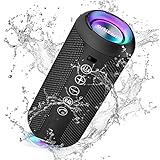
- Ortizan X10 – Budget pick with an RGB light show, 24W of output, and 30 hours of playtime.
- JBL Charge 5 – Best for a whole campsite. 40W, 20 hours, and a power bank built in.
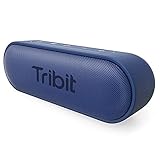
- Tribit XSound Go – Best value at 13.44 oz. 24 hours and cleaner sound than most rivals.
- JBL Go 4 – Ultra-packable at 0.19 kg. Skip it if your trip runs past two nights.
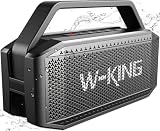
- W-KING D9 – Loudest here. 7.2-inch passive radiator and 40 hours, at 2 kg.
- Soundcore Select 4 Go – Best floating option. IP67, floats on water, 20 hours, 9.3 oz.
- Bose SoundLink Flex 2nd Gen – Best clarity. Deep, balanced audio in a 0.59 kg silicone body.
- Soundcore Boom 2 – Best bass. An 80W amplifier and subwoofer that floats and charges phones.
- Marshall Emberton II – Best battery life. 30-plus hours from a 118 g body.
- ECOXGEAR EcoTrek – For car and RV camps. 100W, 50-plus hours, but 19.2 pounds.
Camping Speaker Comparison Table in 2026
Here is everything side by side. The four features in each row are the ones that actually change the outcome at a campsite: water protection, endurance, packed weight, and how you connect a second speaker or a phone.
| Product | Specifications | Action |
|---|---|---|
 Anker Soundcore 2 Anker Soundcore 2 |
|
Check Latest Price |
 JBL Flip 5 JBL Flip 5 |
|
Check Latest Price |
 Ortizan X10 Ortizan X10 |
|
Check Latest Price |
 JBL Charge 5 JBL Charge 5 |
|
Check Latest Price |
 Tribit XSound Go Tribit XSound Go |
|
Check Latest Price |
 JBL Go 4 JBL Go 4 |
|
Check Latest Price |
 W-KING D9 W-KING D9 |
|
Check Latest Price |
 Soundcore Select 4 Go Soundcore Select 4 Go |
|
Check Latest Price |
 Bose SoundLink Flex 2nd Gen Bose SoundLink Flex 2nd Gen |
|
Check Latest Price |
 Soundcore Boom 2 Soundcore Boom 2 |
|
Check Latest Price |
 Marshall Emberton II Marshall Emberton II |
|
Check Latest Price |
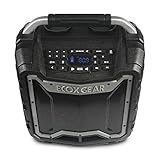 ECOXGEAR EcoTrek ECOXGEAR EcoTrek |
|
Check Latest Price |
1. Anker Soundcore 2 – The Best Portable Bluetooth Speaker for Camping Overall
- IPX7 waterproof handles rain
- splashes and waves
- 24-hour battery from a 5200mAh cell
- 12W with BassUp for punchy low end
- Compact 14.56 oz body
- Simple push-button controls
- Bass turns boomy at high volume
- No companion app for EQ tweaks
- Micro-USB charging port feels dated
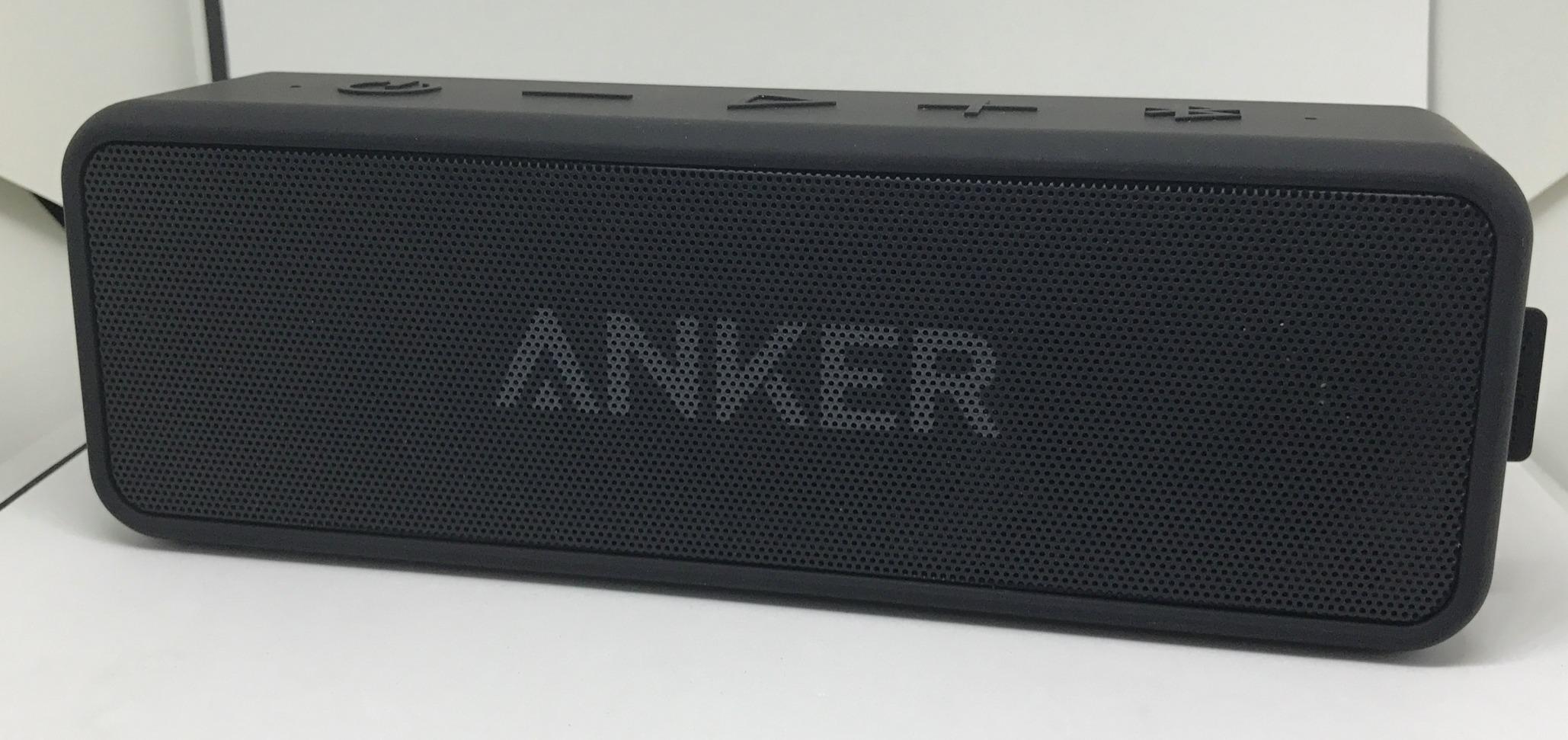
The Soundcore 2 is the speaker we end up recommending to almost everyone, and the reason has less to do with sound than with the sheer volume of people who have already used it. It carries a 4.5 rating across more than 156k reviews, which tells you something useful about long-term reliability that a brand new release cannot yet prove.
On site it behaves like a tool. Twelve watts is not a lot on paper, but the dual neodymium drivers and the BassUp processing give it enough low end to sound right at a picnic table, and the 5200mAh cell delivers the advertised 24 hours, which covers a long weekend with charge to spare.
The build is where it earns the top spot. IPX7 is a genuine waterproof rating, not a splash-resistant marketing line, so rain, lake spray, and a dunk in cold creek water are all fine. The 14.56 oz weight disappears into a side pocket, and at 6.5 inches wide it is short enough to sit between two tents without being stepped on.
Bluetooth range is listed at 20 meters, which in practice means your phone can stay in the tent or the car while the speaker plays at the fire. Pairing is fast and the push-button controls work fine with wet hands.
When the Soundcore 2 is the right choice
Choose it for a two-to-four person campsite where you want background music and conversation rather than a concert. It is also the safest first speaker for anyone who is unsure how much volume they actually need, because 12W fills a normal site without becoming a neighbor problem.
If you camp often and want one speaker you do not think about, this is the one. Long-term owners report years of daily use without degradation, which is the durability signal most campers care about.
When to skip the Soundcore 2
Skip it if bass is the point of the trip. The low end turns boomy and loose above about half volume, and there is no app to pull it back, so you are stuck with the factory tuning.
Also skip it if you need to charge your phone off-grid, since this model has no power bank output and uses an older micro-USB port. For a group gathering, step up to something with real output.
2. JBL Flip 5 – The Best Sound Quality in a Compact Body
JBL FLIP 5, Waterproof Portable Bluetooth Speaker, Black, Small
- Balanced and detailed JBL sound with 20W output
- IPX7 waterproof and dustproof
- PartyBoost pairs multiple speakers
- Cylindrical body packs easily
- 12-hour battery trails newer rivals
- No built-in power bank
- Reported long charge time
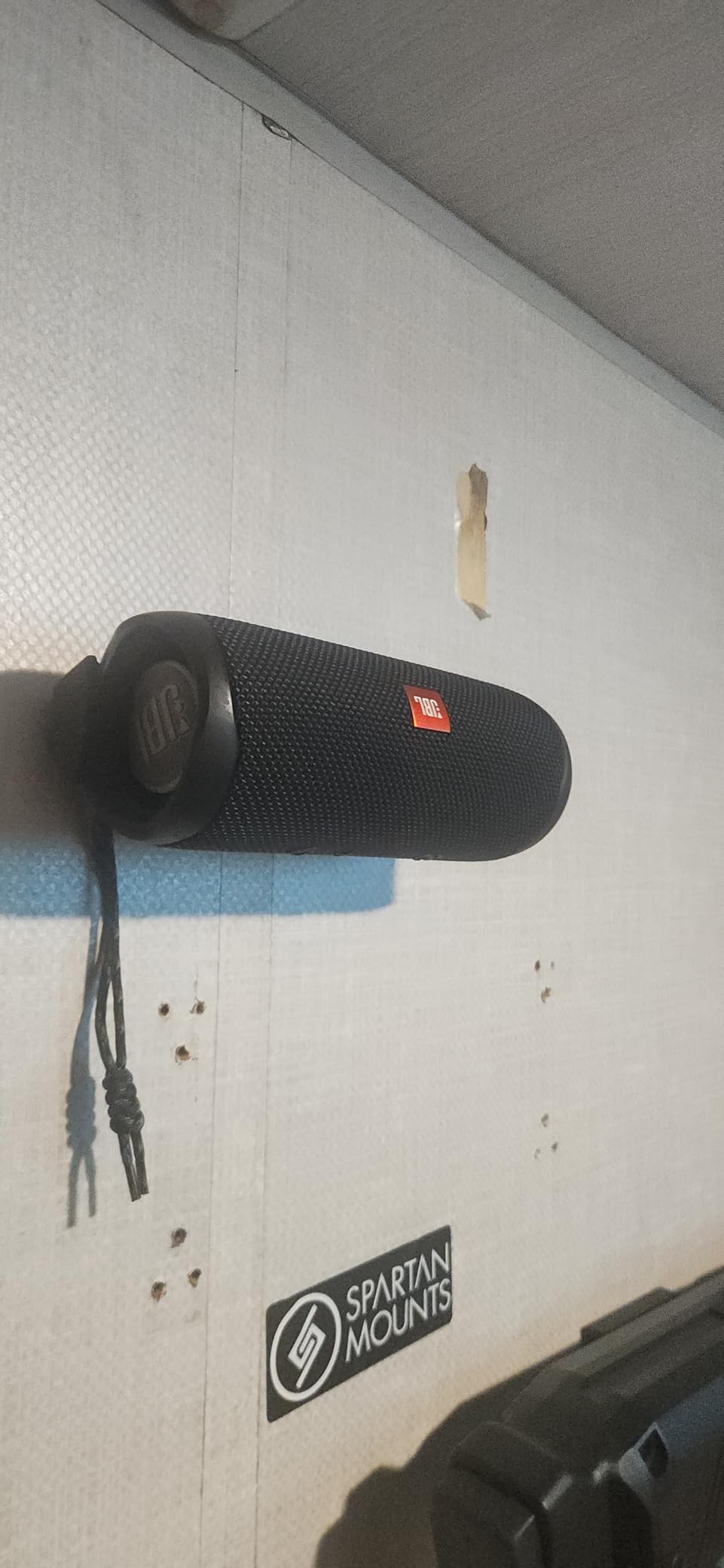
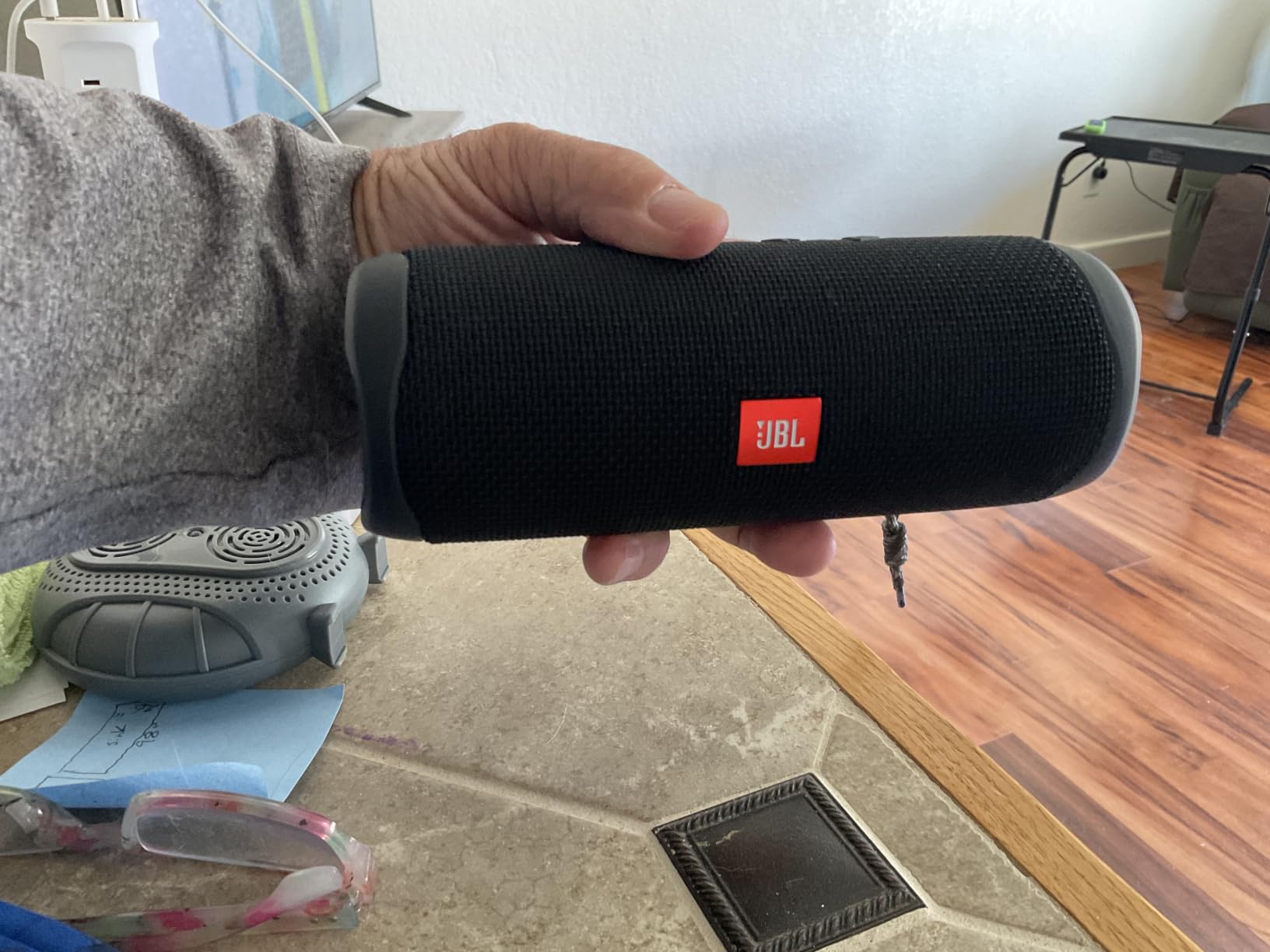
The Flip 5 is the one we reach for when the question is how good it sounds rather than how much it can do. It holds a 4.8 rating across more than 85k reviews, and that consistency reflects a tuning that stays composed at volume without the boomy edge you get from smaller drivers pushed harder.
Twenty watts from a body weighing 1.2 pounds is a genuinely useful ratio. It fills a small site with clear mids and treble, and the cylindrical shape means the sound spreads evenly around the fire instead of firing out of one face.
Water protection is IPX7, which covers the realistic camping hazards: rain, a knocked-over drink, sand at a dry site, and pool or lake splashing. The waterproof rating is matched by a one-year manufacturer warranty, which is thinner than some competitors here.
PartyBoost is the feature that keeps this model relevant. Two Flips link into a wider stereo pair, and at a group site you can hand one to a neighbor rather than arguing about volume.
When the Flip 5 is the right choice
Pick it when sound quality is what you notice first and your trip is short. It suits a weekend at a drive-up site, a tent-and-a-car setup, or a cabin trip where you want music that sounds intentional rather than loud.
It is also a good second-speaker buy, because two units paired through PartyBoost cover a larger area than most single speakers at the same volume setting, which is easier on campground neighbors.
When to skip the Flip 5
Skip it for a trip longer than two nights. Twelve hours of playtime is the shortest runtime of the mid-size options here, and the listed charge time of 12 hours means planning around a full recharge is realistic rather than theoretical.
Skip it if your phone is your only battery. There is no USB output, so you cannot top up a dying phone from the speaker, and there is no 3.5mm input either.
3. Ortizan X10 – Best Budget Pick With a Built-In Light Show
Ortizan X10 Portable Bluetooth Speaker (1st Gen), IPX7 Waterproof, Wireless
- 24W stereo with dual passive radiators
- Up to 30 hours of playtime
- Bluetooth 5.3 with 66-foot range
- RGB light show doubles as a night light
- AUX and TF card playback
- Lighter bass than larger rivals
- Very loud voice prompts
- Drivers face one direction rather than 360 degrees
The Ortizan X10 is the value anomaly in this list. Twenty-four watts of stereo output and a stated 30-hour runtime in a body that costs less than a campsite dinner is unusual, and the 4.5 rating across 49k reviews suggests the value holds up over time rather than just at launch.
For a family camp or a group of friends on a tight budget, this is the speaker that gets music onto the site. The dual passive radiators give it more low end than the wattage and dimensions suggest, and the enclosure mixes ABS with aluminum, which is tougher than the all-plastic bodies on some competitors.
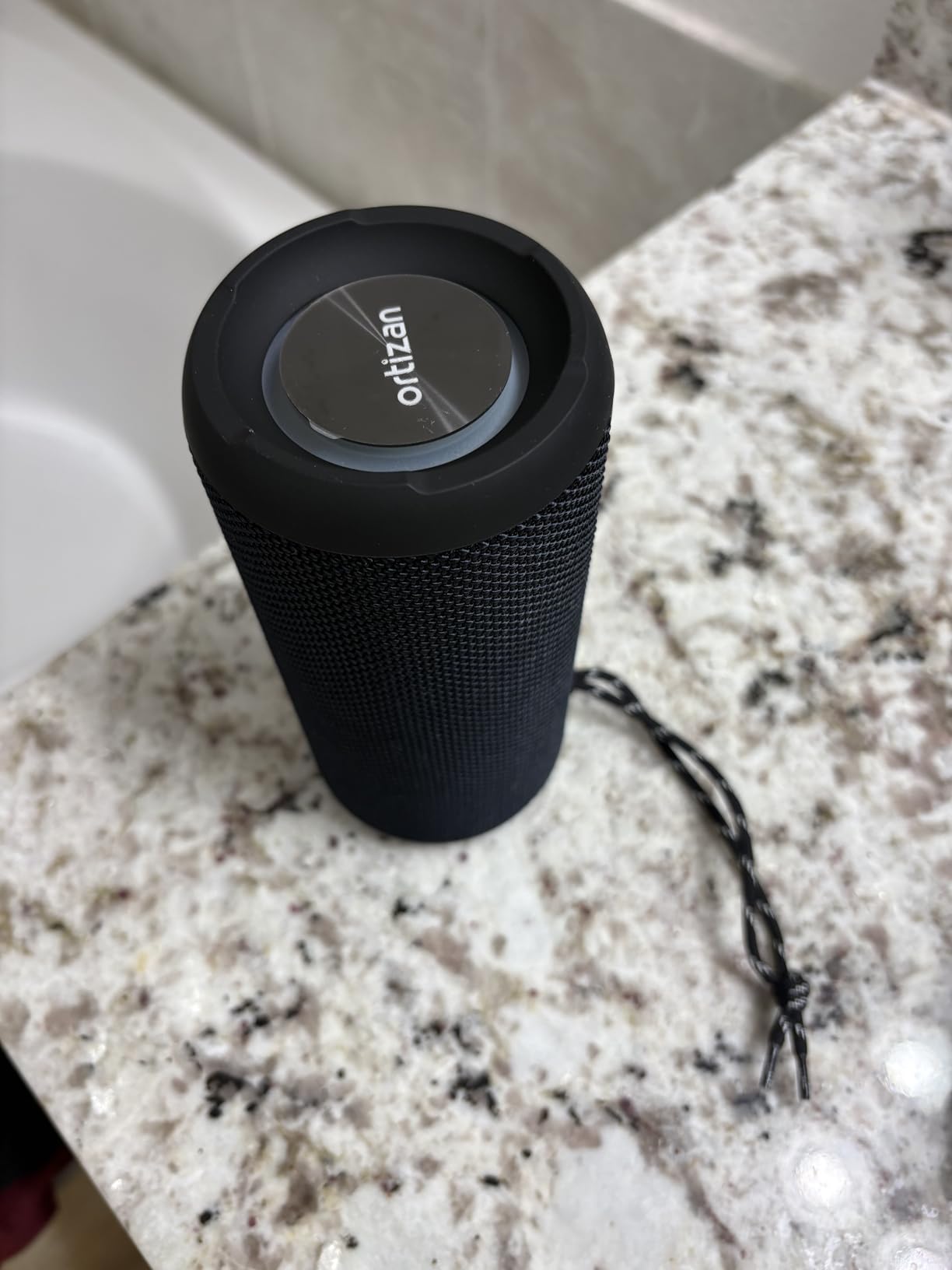
The RGB lighting is the detail that wins over campers. At night it pulses to the beat and doubles as a stand-alone LED light, so you are not fumbling for a headlamp around the fire. AUX and TF card playback also mean the music keeps playing if your phone dies, which matters more off-grid than most buyers expect.
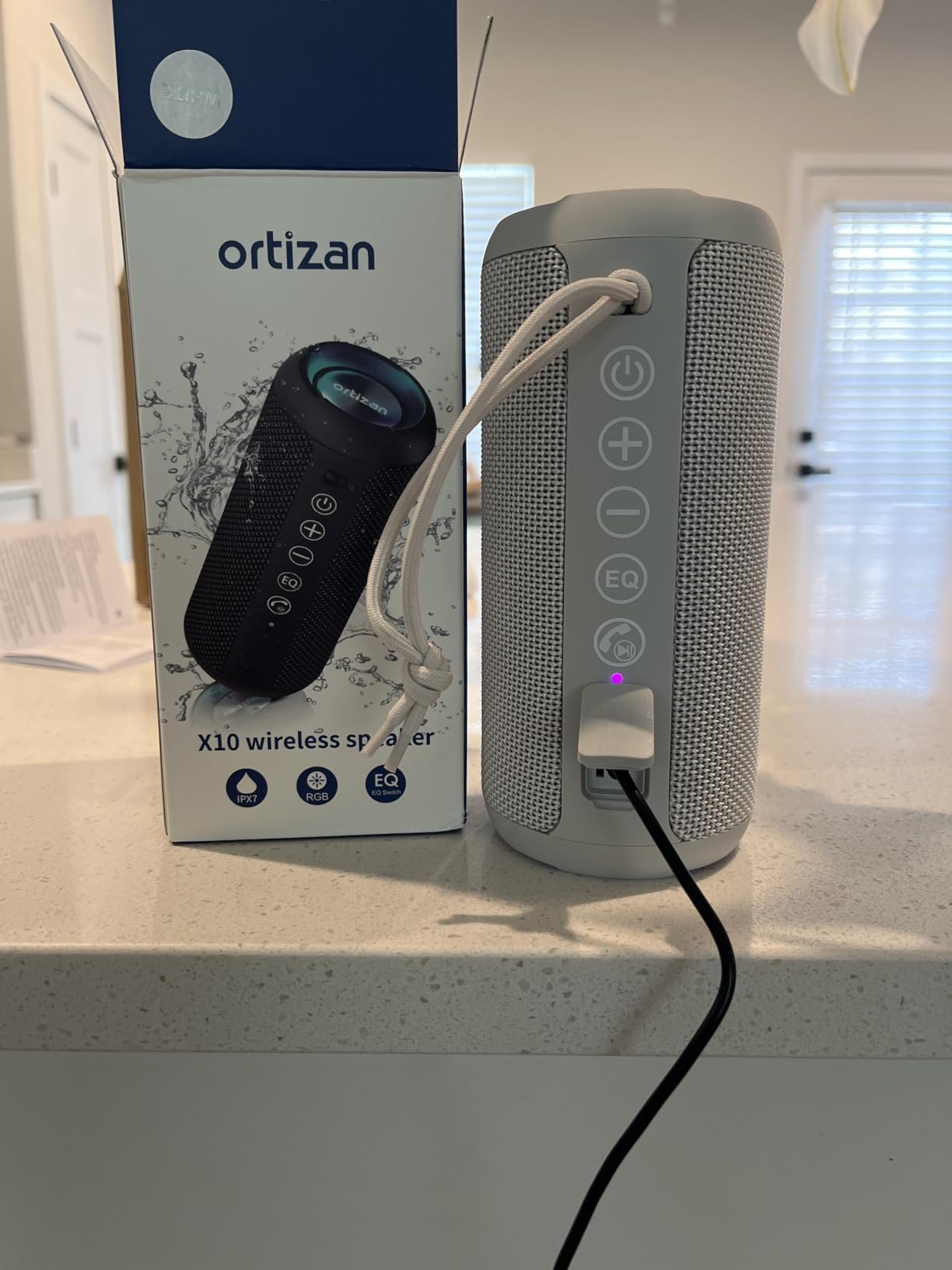
Bluetooth 5.3 gives a listed 66 feet of unobstructed range, so the speaker can sit at the fire while the phone stays in the car. IPX7 means full immersion up to 3 feet for roughly 30 minutes.
When the Ortizan X10 is the right choice
Choose it when the budget is the deciding factor and the site is a social one. The lighting and the 30-hour runtime make it the easiest speaker here to hand to a group that is not fussy about sound fidelity.
It is also a strong secondary option for a beach camp or a lake site, where the RGB light means it is useful after dark without draining your phone battery.
When to skip the Ortizan X10
Skip it if the sound needs to fill space. The drivers face one direction, so it is not a 360-degree speaker, and the bass stays lighter than larger rivals even with the Bass Boost EQ engaged.
Skip it if loud connection announcements bother you. Owners frequently call the voice prompts unusually loud and unable to be turned down, which is irritating at a quiet site after dark. A minority of reviews also describe an intermittent no-audio Bluetooth fault that a factory reset clears.
4. JBL Charge 5 – Best for Large Campsite Gatherings
- Deep clear sound with dual bass radiators
- Volume that fills an open campsite
- 20 hours plus a power bank for phones
- IPX7 waterproof and dustproof
- JBL Portable app with EQ
- Heavy and bulky for backpacking
- Power button needs a long press
- No 3.5mm AUX input
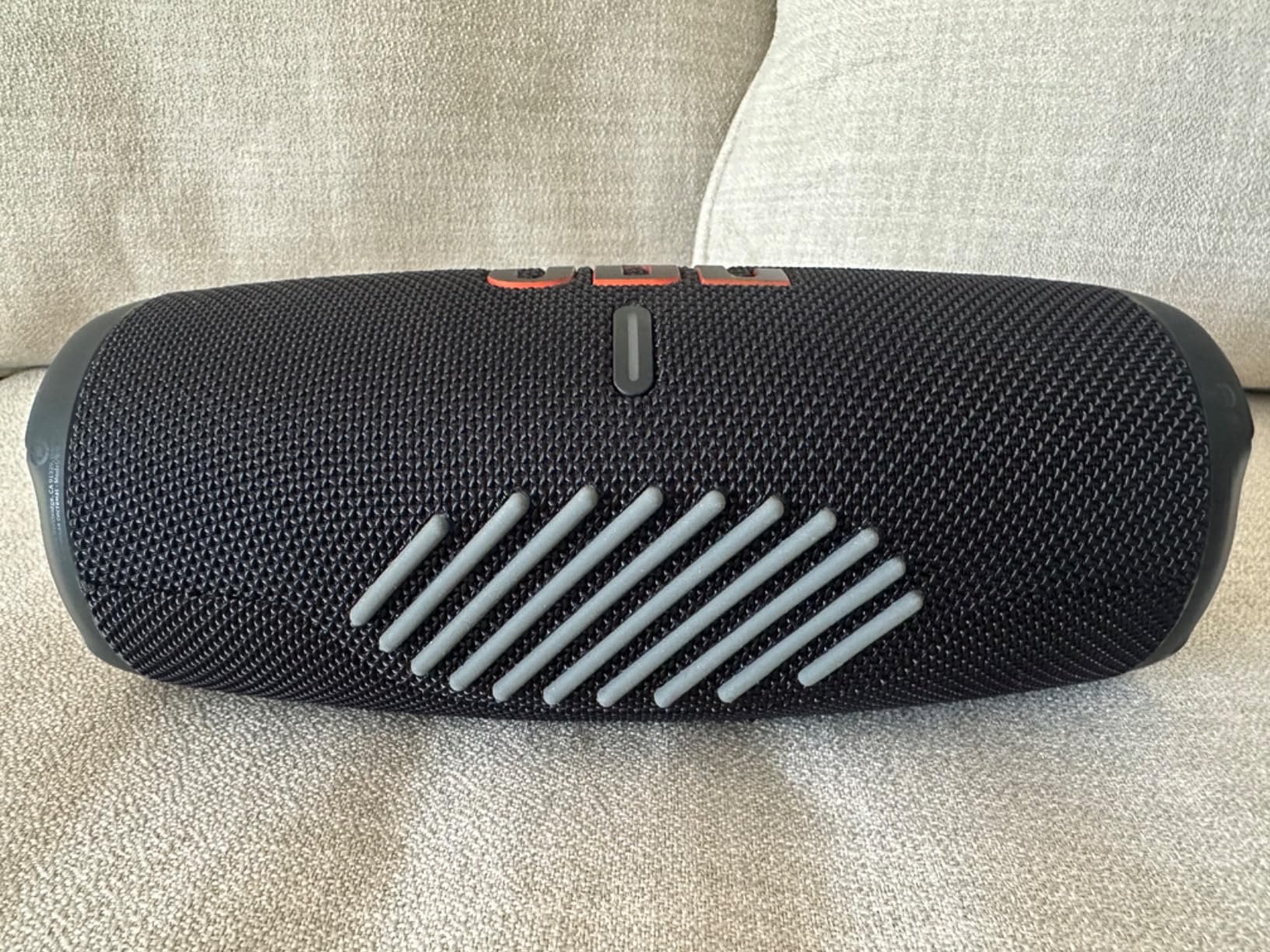
The Charge 5 is the speaker to buy when the site is big and the volume needs to compete with wind, a generator, or a group of people talking. Forty watts with an optimized long-excursion driver, a separate tweeter, and dual bass radiators gives it a level of output nothing else in this list matches, and the 4.8 rating across 36k reviews reflects how consistently it delivers.
It is the recommendation that shows up most often in camper discussions on r/camping and r/Bluetooth_Speakers: buy it and stop thinking about it. That consensus is about the combination of ruggedness, endurance, and the power bank rather than the sound alone.
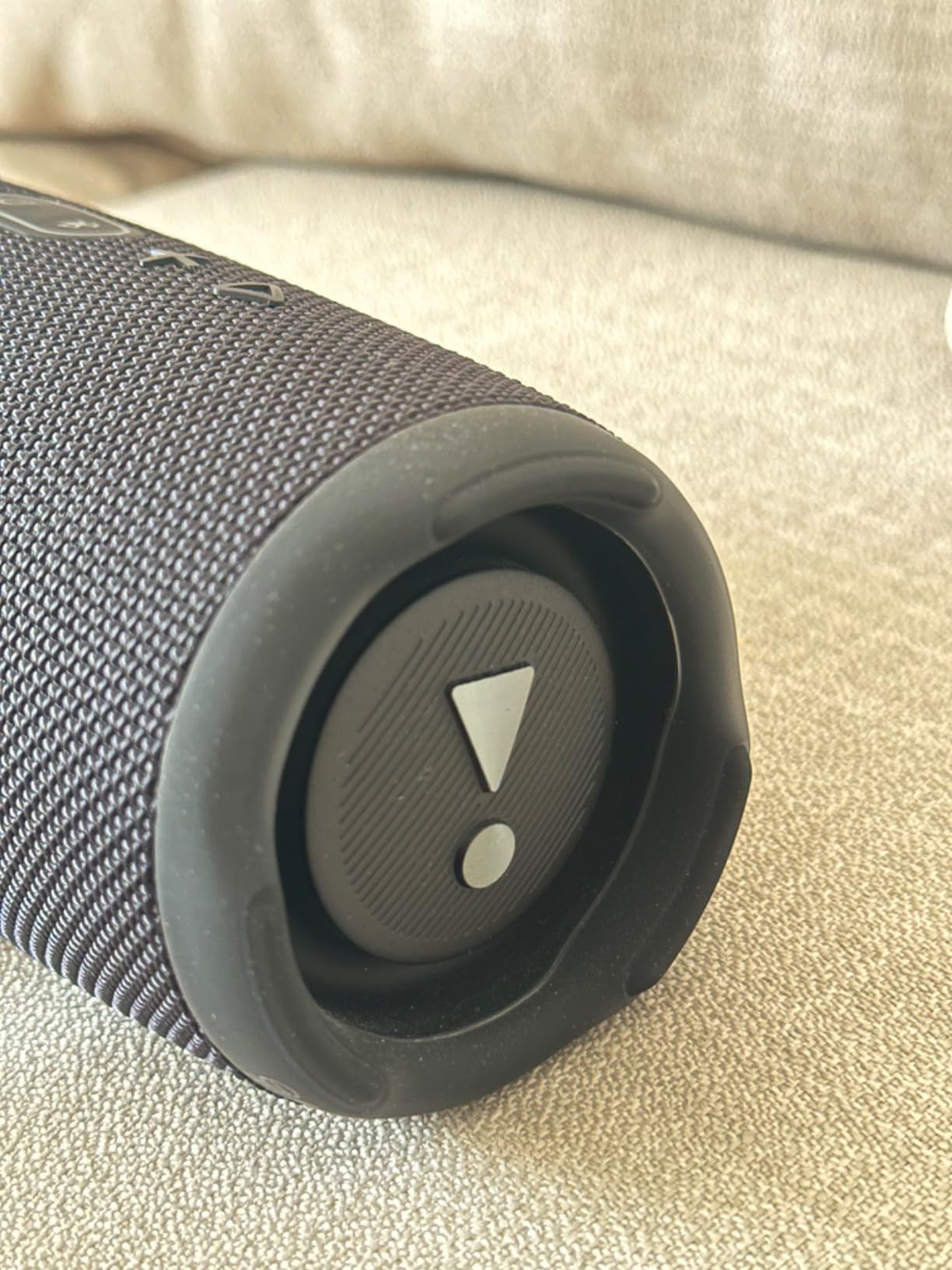
The power bank function is the sleeper feature for camping. With a 7500mAh internal battery, it can top up a phone over USB, which turns the speaker into the center of your off-grid power plan. The JBL Portable app gives adjustable EQ and firmware updates, and PartyBoost handles multi-speaker setups.
IPX7 covers both water and dust, so a dry site in August is as safe as a rainy one. The fabric-wrapped body and metal logo badge the abuse of being hauled around in a truck bed.
When the Charge 5 is the right choice
Choose it for a group of six or more, a tailgate, or an RV site where you want one box to handle music and phone charging. It is also the pick if your trip runs past three nights and you want battery headroom plus the option to rescue a dying phone.
For a two-speaker setup, pairing two units through PartyBoost gives you proper stereo separation, which is easier on neighbors than pushing one speaker to maximum.
When to skip the Charge 5
Skip it if you are carrying your gear on foot. At 2.1 pounds it is the second-heaviest speaker here, and a hiker on a weight budget should look at something under 16 ounces.
Skip it if you need a wired fallback. There is no 3.5mm AUX input, and a single unit plays essentially mono. Bass also rolls off above roughly 60 percent volume, and the power button requires a long press to switch off, which is a small but real annoyance in the dark.
5. Tribit XSound Go – Best Value for Backpackers
- Dual 8W drivers with bass radiators
- 24 hours of continuous playtime
- Bluetooth 5.3 with 150-foot range
- Attached carry strap
- Light 13.44 oz body
- Very long listed charge time
- No app EQ control
- Basic onboard controls
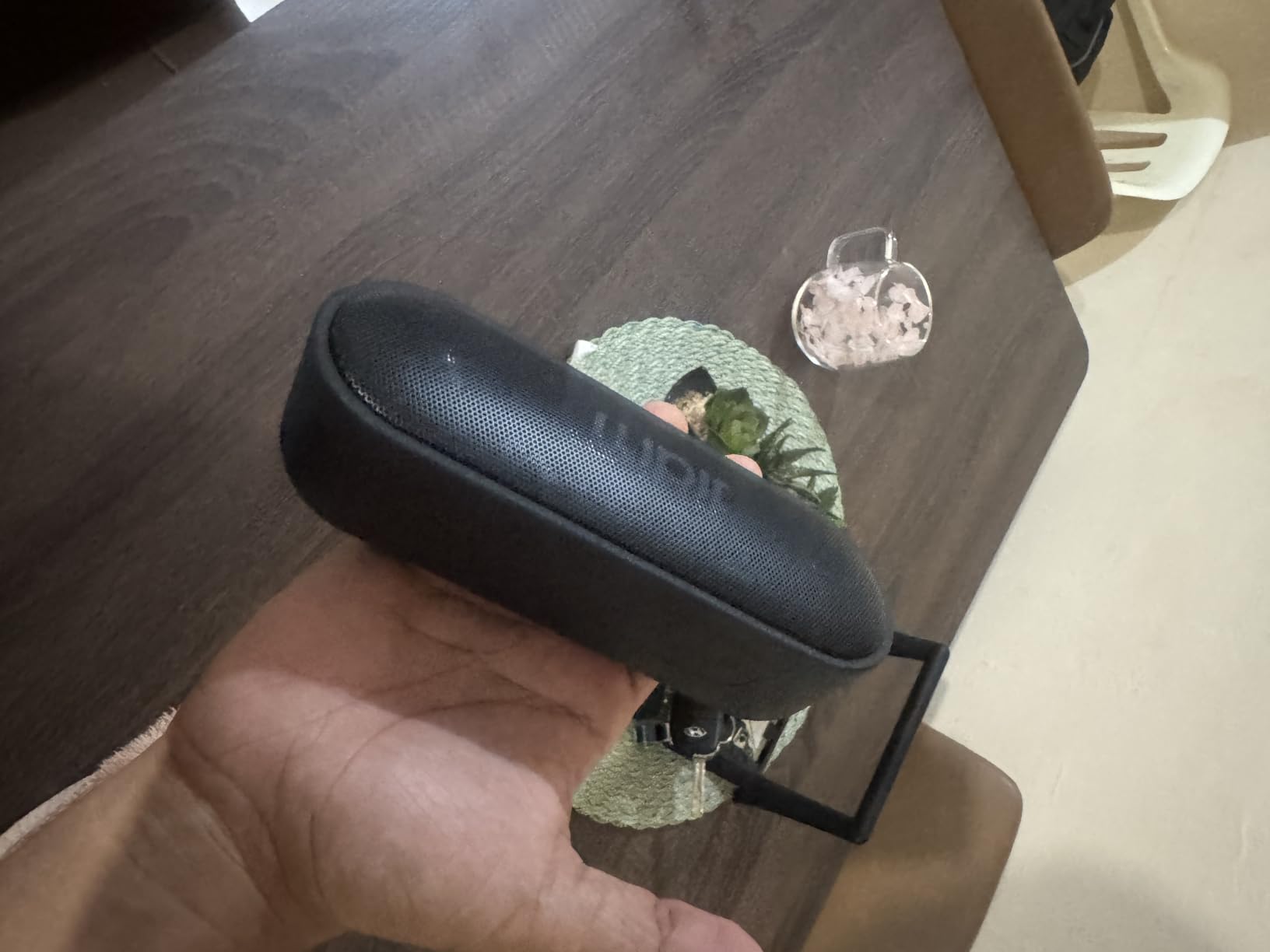
The XSound Go is the pack-weight compromise that works. At 13.44 ounces it costs almost nothing in your load, yet it delivers 24 hours of playback and sound that owners repeatedly single out as the best in its bracket, with a 4.6 rating across 34k reviews.
That combination of small size and real low end comes from the dual 8W drivers with passive radiators plus a DSP chip, which is a lot of engineering in a body most campers can fit in a side pocket.
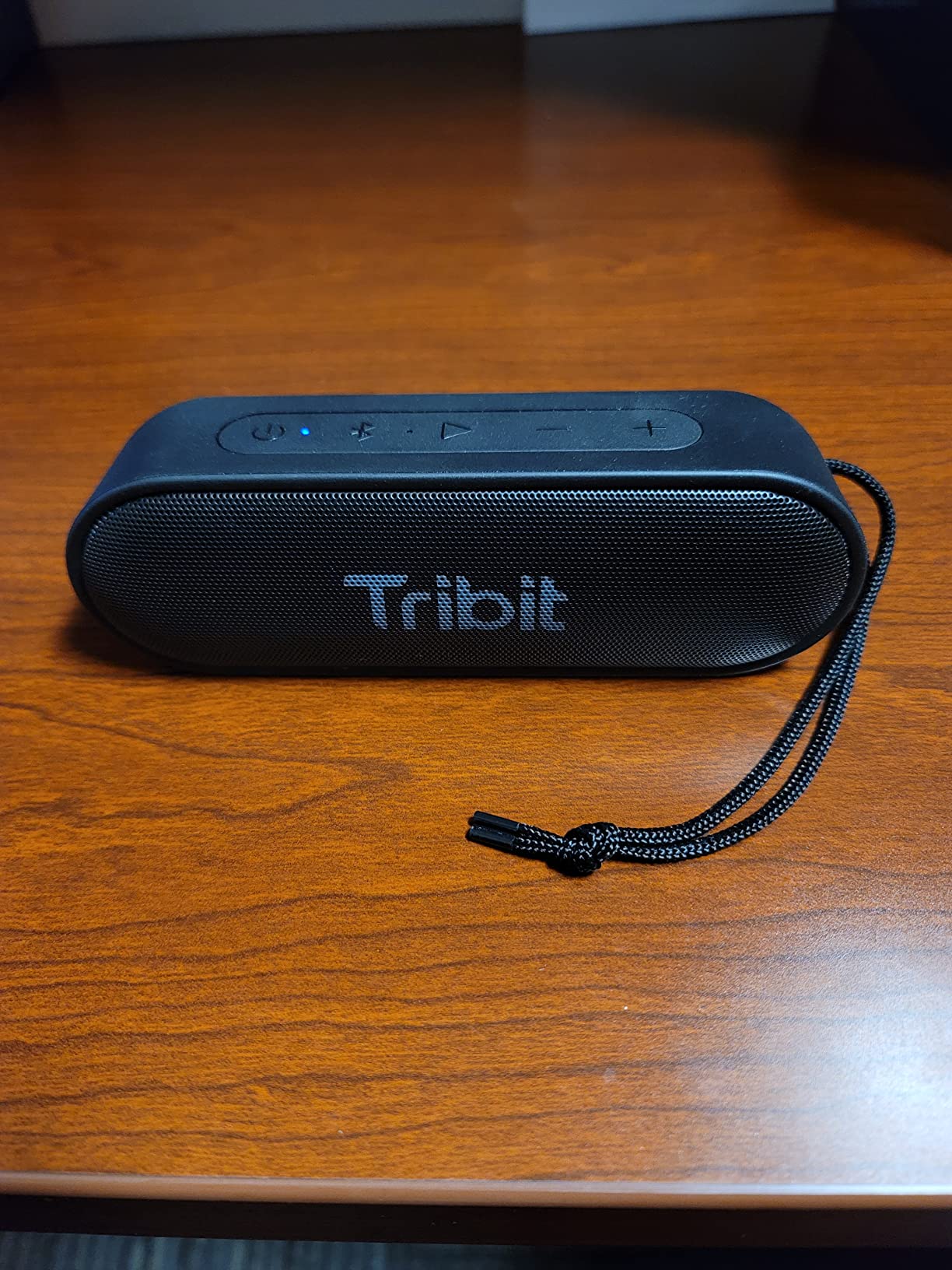
IPX7 makes it safe in rain and at a lake, and the attached carry strap means you can hang it from a pack loop or a tent ridge without buying another accessory. The matte finish and curved edges resist the scuffs that come from being dragged across a tent floor.
Bluetooth 5.3 with a listed range up to 150 feet is unusually generous, which is useful when the phone stays in the vehicle and the speaker moves to a picnic table or a swim-up site.
When the XSound Go is the right choice
Choose it for hiking and backpacking camps where every ounce counts but you still want music that is not tinny. It is also a good secondary speaker for a car camp, or the main speaker for a tent-only weekend.
It suits anyone who wants one speaker to do the job for two different trip types, which is the situation most campers are actually in.
When to skip the XSound Go
Skip it if you need to shape the sound. There is no app-based EQ, and the onboard controls are basic, so you are locked into the factory tuning no matter what genre you are playing.
Skip it if your trip is longer than the battery. The listed charge time is unusually long, so top it up fully before you leave rather than planning to refill it at a campground. There is also no power bank output for your phone.
6. JBL Go 4 – Best Ultra-Packable Speaker for Short Trips
- JBL Pro Sound from a tiny body
- IP67 waterproof and dustproof
- Built-in loop clips to a backpack
- Auracast links multiple speakers
- Partly made from recycled materials
- 7-hour battery is the shortest here
- Mono single-speaker output
- 7-hour charge time
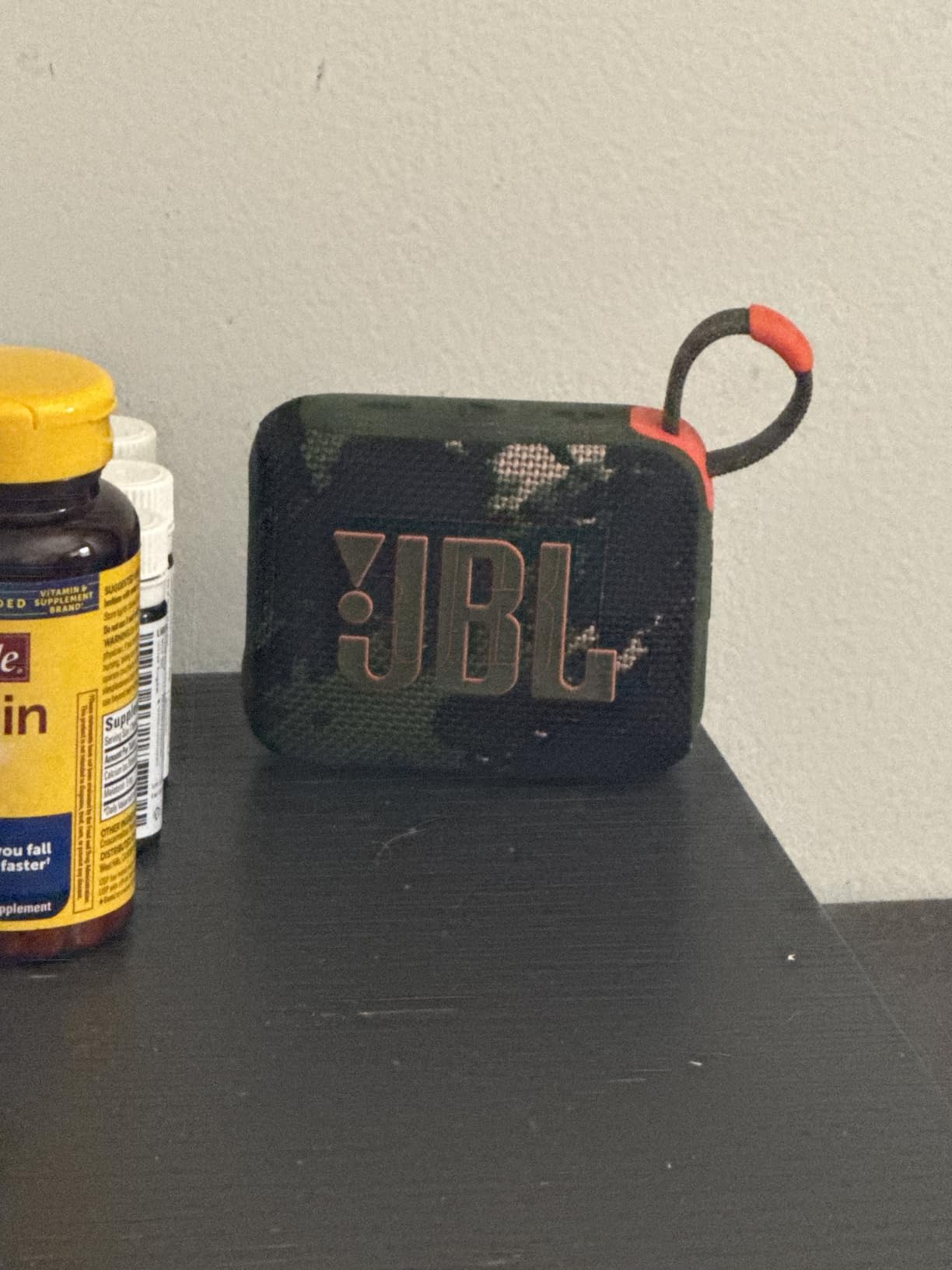
At 0.19 kg the Go 4 is the speaker that disappears into your kit, and it still delivers recognisable JBL Pro Sound with punchy bass. The 4.7 rating across 19k reviews shows that the tuning surprises people in a body this small.
It is the one to pack when the speaker is a bonus rather than the point of the trip, such as a day hike that ends at a lake, or a campsite where you only play music in the evening.
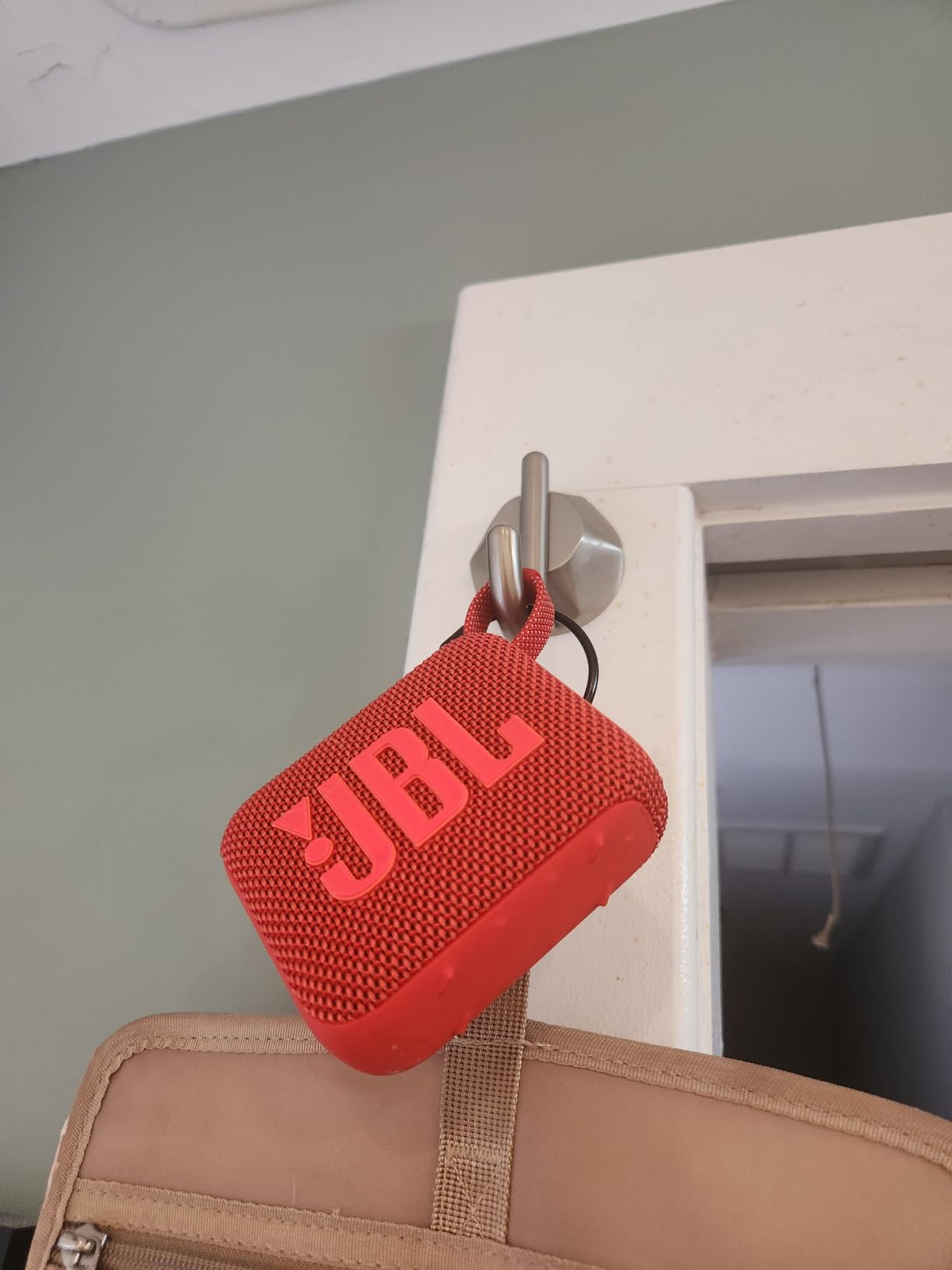
The IP67 rating is a real upgrade over the IPX7 models here because it certifies dust protection as well as water, which matters at dry, sandy sites. The built-in loop clips straight to a backpack strap, and Auracast lets you link multiple speakers for stereo or a bigger group without being locked to one brand.
The enclosure uses post-consumer recycled plastic and fabric, and Playtime Boost adds up to 2 extra hours when you need to stretch the runtime.
When the JBL Go 4 is the right choice
Choose it for ultralight backpacking, bikepacking, or a tent-only trip where the pack weight budget is the hard limit. It is also a good travel speaker, since the loop fits a carry-on and the IP67 rating covers a hotel shower or a rainy street.
For a group, Auracast means you can buy two and get real stereo without committing to a bigger, heavier speaker.
When to skip the JBL Go 4
Skip it for anything longer than a weekend. Seven hours of playtime is the shortest runtime in this list, and the 7-hour full charge time means you cannot recover it quickly at a campsite.
Skip it if you want stereo from a single unit. The output is mono, and at 5W-class size expectations it will not compete with a campfire conversation from more than a few feet away.
7. W-KING D9 – Loudest Speaker in the Lineup
W-KING Bluetooth Speaker, 100W Peak Outdoor Portable Loud Speakers Wireless
- Clean and undistorted at maximum volume
- 7.2-inch passive radiator for deep bass
- 40 hours at low volume
- Two units pair for 200W stereo
- Carry handle plus AUX and TF card
- 2 kg body is heavy for backpacking
- Loudness below the advertised wattage
- No wall charger included
The W-KING D9 is the volume answer. A 7.2-inch rear passive radiator pumps bass out in every direction, and owners report that it stays clear and distortion-free at maximum output, which is where most portable speakers fall apart. The 4.6 rating across 14.5k reviews is held up by a lot of long, detailed owner feedback.
Durability is the other story here. One reviewer reports the unit falling out of a truck multiple times and surviving a drop from a roof, and the metal-and-waterproof-material enclosure is built for that kind of treatment.
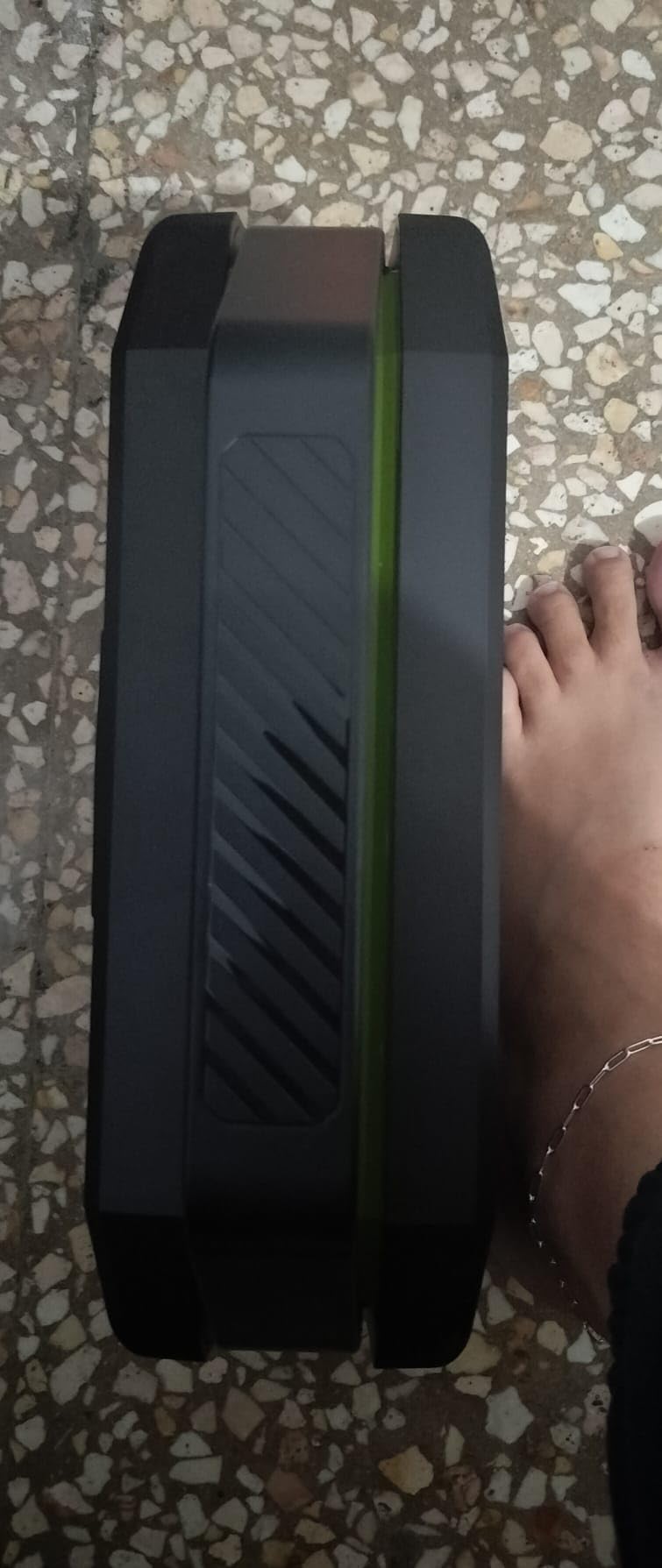
Runtime is 40 hours at low volume, and it also supports device charging. Connectivity is unusually broad for a portable speaker: AUX, TF card, and NFC alongside Bluetooth 5.3 with a listed 100-foot range, plus a built-in carry handle for moving it from the car to the site.
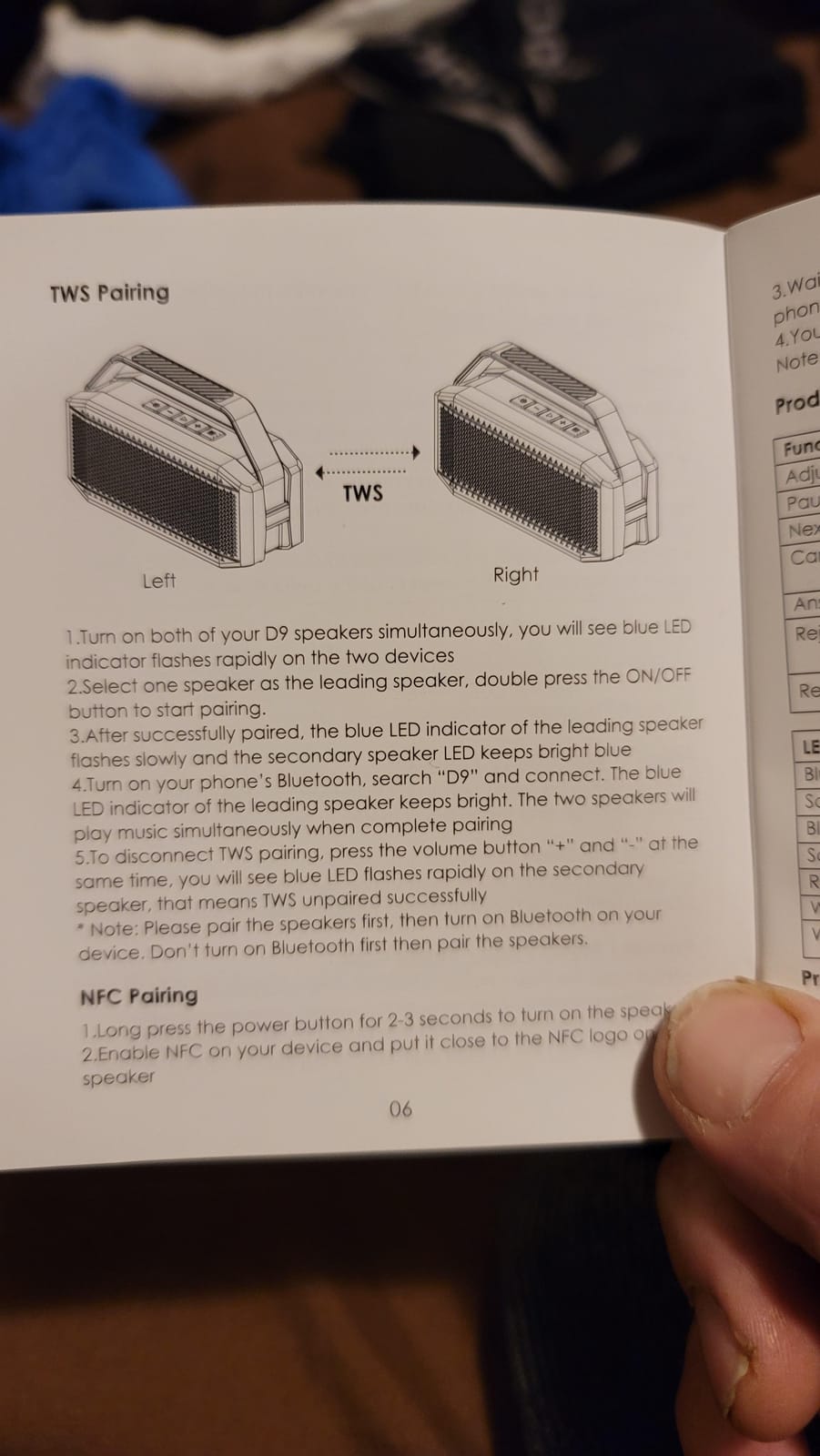
Two units pair into 200W peak true wireless stereo, which is the setup to use at a large gathering instead of running one speaker to its limit.
When the W-KING D9 is the right choice
Choose it for a big group gathering, a tailgate, a beach party, or a campsite where you genuinely need the sound to reach past a generator. It is also a strong two-speaker buy for anyone who wants real stereo separation at a wide-open site.
Pick it when the priority is raw output and physical survival, and you are willing to accept the size in exchange.
When to skip the W-KING D9
Skip it if you are carrying your gear. At 2 kg it is the heaviest speaker in this roundup apart from the EcoTrek, and 12.4 by 7.4 inches is a real volume in a pack.
Also skip it if the marketing numbers matter to you. Owners report that single-unit loudness falls short of the advertised wattage, and despite the waterproof wording the rating covers splashes rather than immersion. No wall charger is included, and the sound drops noticeably if the speaker is played on its end.
8. Soundcore Select 4 Go – Best Floating Speaker for Lake and Beach Camps
- IP67 protection and it floats on water
- Up to 20 hours of playback
- Punchy clear sound from 5W mono
- 9.3 oz body with included strap
- Soundcore app with 9-band EQ
- Modest bass for bass-heavy music
- No built-in microphone
- Wall charger not included
The Select 4 Go solves the problem nobody else on this list fully solves: what happens when the speaker goes in the water. It is rated IP67 for immersion to 3.3 feet for 30 minutes, and it floats on the surface rather than sinking to the bottom. That single fact is the difference between a lost speaker and a story at the end of the trip.
At 9.3 ounces it is also the second-lightest speaker here, and the 4.7 rating across 13k reviews reflects how often owners are surprised by how much sound comes out of a 5W mono driver.
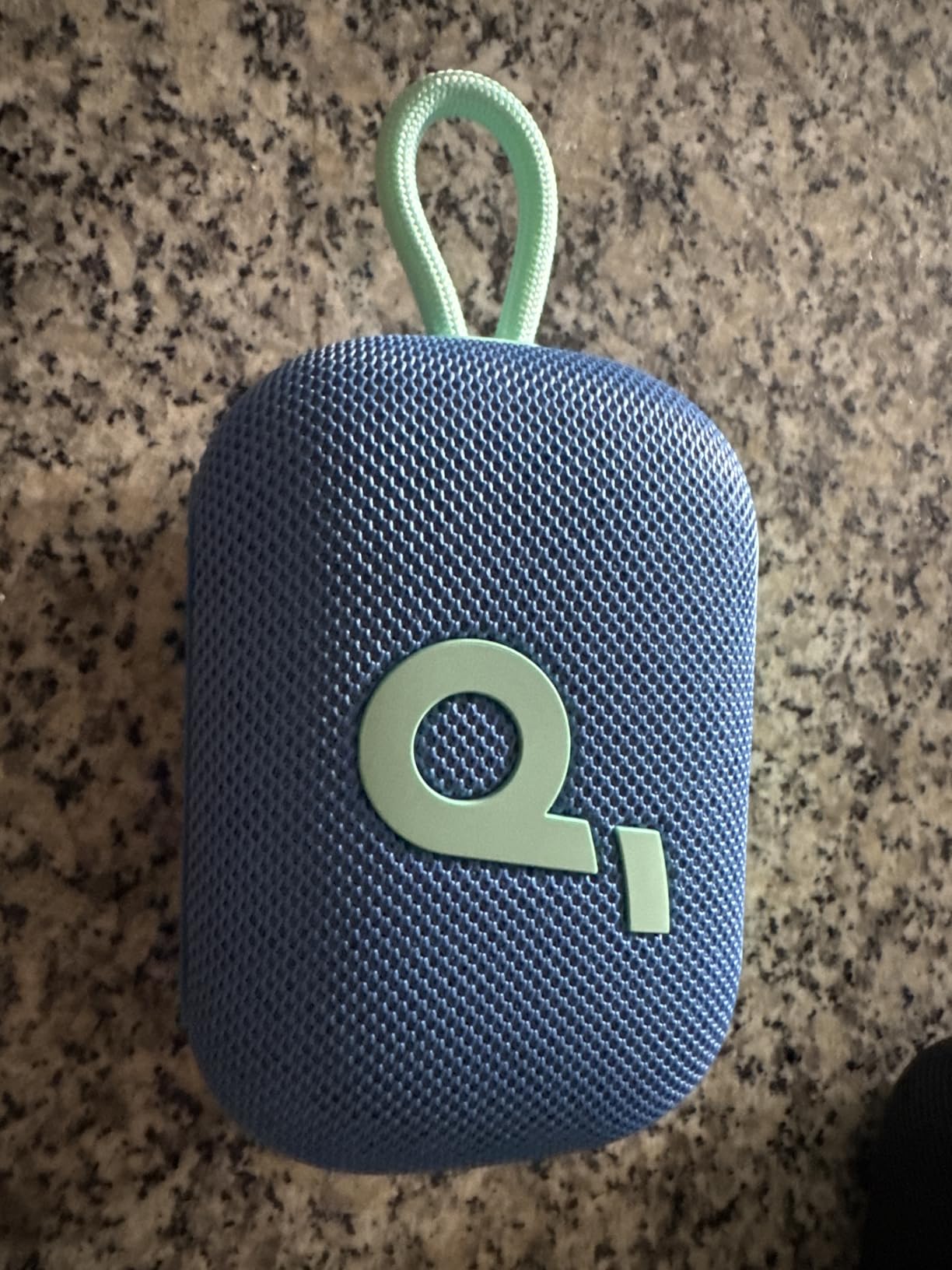
Twenty hours of playback is remarkable at this size, and it is the figure that makes a multi-night trip work without a recharge. The PC and ABS enclosure takes drops, and the included strap plus carabiner-style clip lets it ride on a beach bag or a pack.
The app-based 9-band EQ is unusual at this size and price, and it lets you add low end that the hardware cannot produce on its own. TWS pairing runs two units in true stereo.
When the Select 4 Go is the right choice
Choose it for lake, river, and beach camping, or for any trip where water is a realistic accident. It is also the best ultralight option here that still lasts a full weekend.
Two paired units give you stereo at a site where one small speaker would otherwise be the weak link, and the app EQ lets you tune for open air rather than a small room.
When to skip the Select 4 Go
Skip it if you play bass-heavy music or need to fill a large space. Five watts of mono output is present and clear but modest on the low end, and it will not carry across a big site.
Skip it if you want voice assistant control, since there is no built-in microphone. The 4.5-hour charge time and the absent wall charger are minor inconveniences, and the single-button control scheme takes a day to learn.
9. Bose SoundLink Flex 2nd Gen – Best Clarity for Podcasts and Detail
- Rich balanced audio with deep bass
- IP67 body that shrugs off drops
- PositionIQ adjusts to orientation
- Bluetooth 5.3 with multipoint
- Utility loop clips to a bag
- 12-hour battery is modest for long trips
- No wired audio input
- Loud system chimes
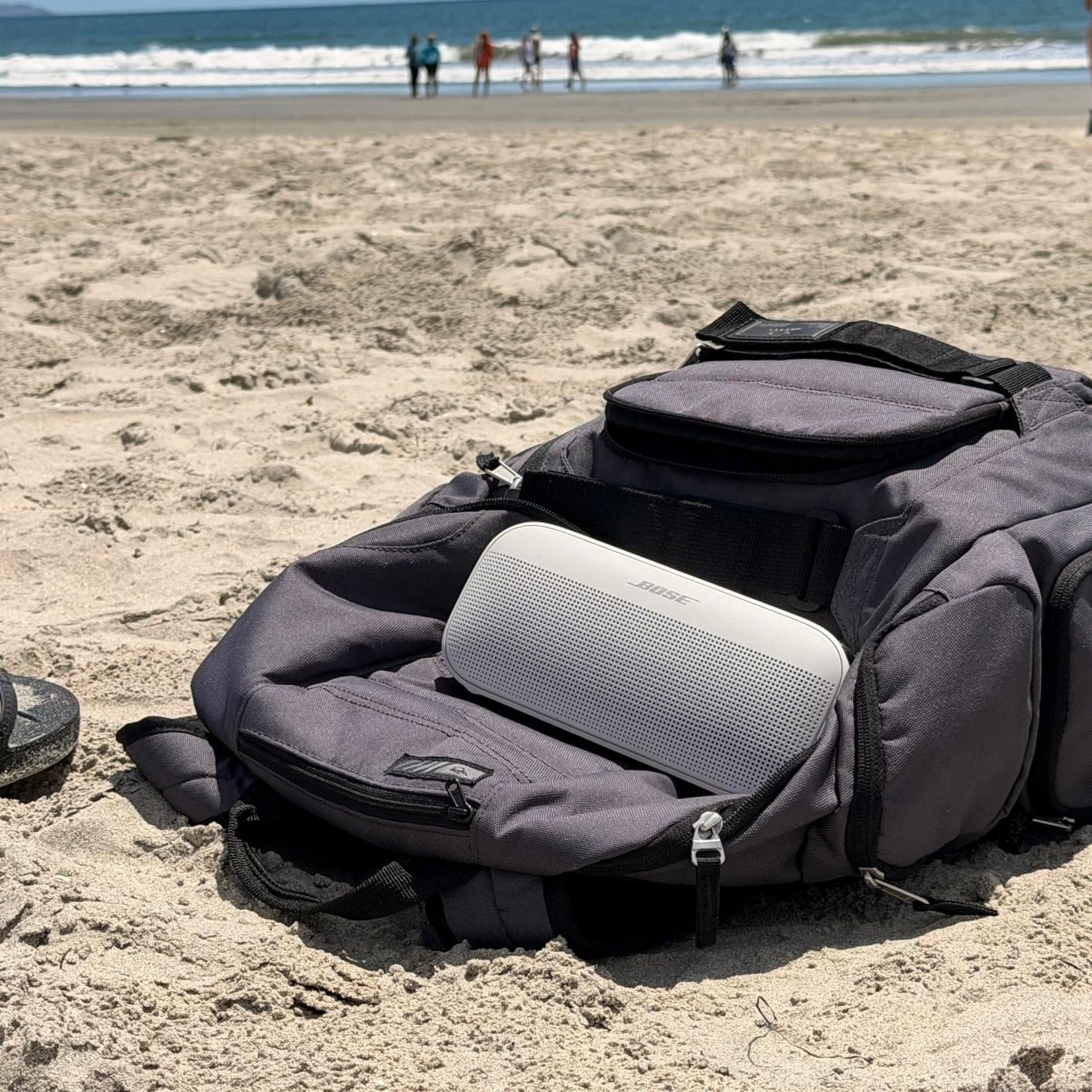
The SoundLink Flex 2nd Gen is the sound-quality pick outside the JBL camp. The 4.7 rating across 13k reviews reflects a body of feedback that keeps mentioning the same thing: deep, clear, well-balanced audio for a 0.59 kg speaker. Camper discussions on r/Bluetooth_Speakers single it out for musicality and bass, and many owners buy a second one to pair.
What makes it interesting for camping specifically is PositionIQ. The speaker senses how it is lying and adjusts the sound, so setting it on its side against a log produces a different result than standing it upright.
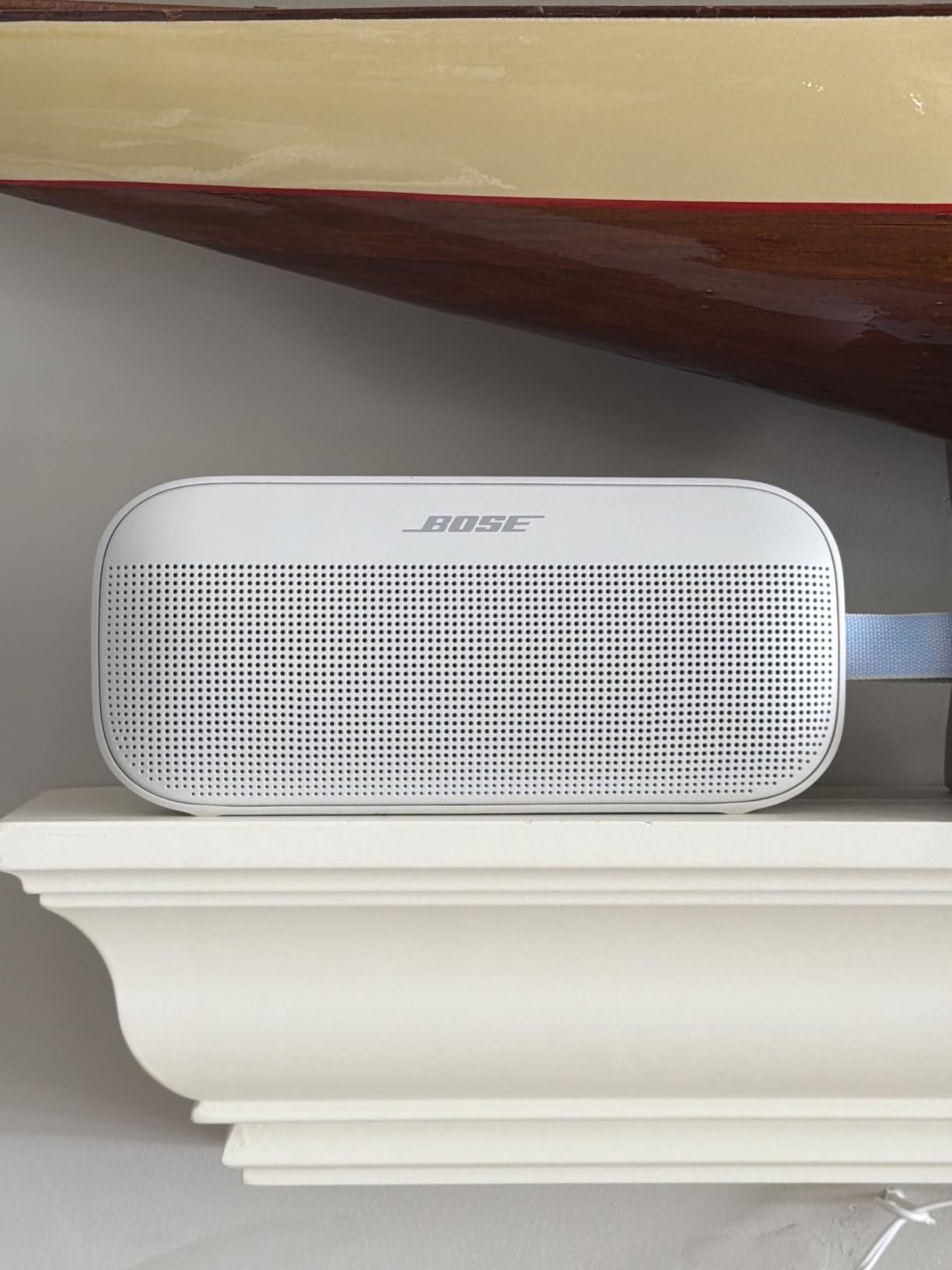
The IP67 rating and the silicone-wrapped body are built for drops, which is the most common campsite accident after spilled coffee. Bluetooth 5.3 with multipoint means your phone and a tablet can both stay connected, so music does not cut out when you switch devices.
Stereo Mode and Party Mode handle two units, and the utility loop makes it easy to hang from a tent line or a pack strap.
When the Flex 2 is the right choice
Choose it when you care about how the music sounds, when podcasts and talk radio are part of the trip, or when you want one speaker that never sounds thin. It is a strong choice for a motorhome or van, where campers consistently report that a portable speaker outperforms built-in RV audio.
Two units in Stereo Mode give you separation and lower per-speaker volume, which is the polite way to cover a wider site.
When to skip the Flex 2
Skip it for a trip longer than a weekend. Twelve hours of playtime is modest, and there is no power bank output to stretch it. There is also no wired 3.5mm or USB-C audio input, so a failed pairing leaves you without a fallback.
Skip it if you camp near quiet neighbors who are sensitive to sound. The connection and voice-prompt chimes are loud and cannot be volume-adjusted, which is jarring at a site after dark.
10. Soundcore Boom 2 – Best Bass for a Noisy Campsite
- Dedicated subwoofer with BassUp 2.0
- 80W that fills a noisy campsite
- 24 hours plus a power bank
- IPX7 waterproof and floatable
- RGB lights and app Pro EQ
- Large and heavy at 1660 g
- Slightly muddy at maximum volume
- 5.5-hour charge time
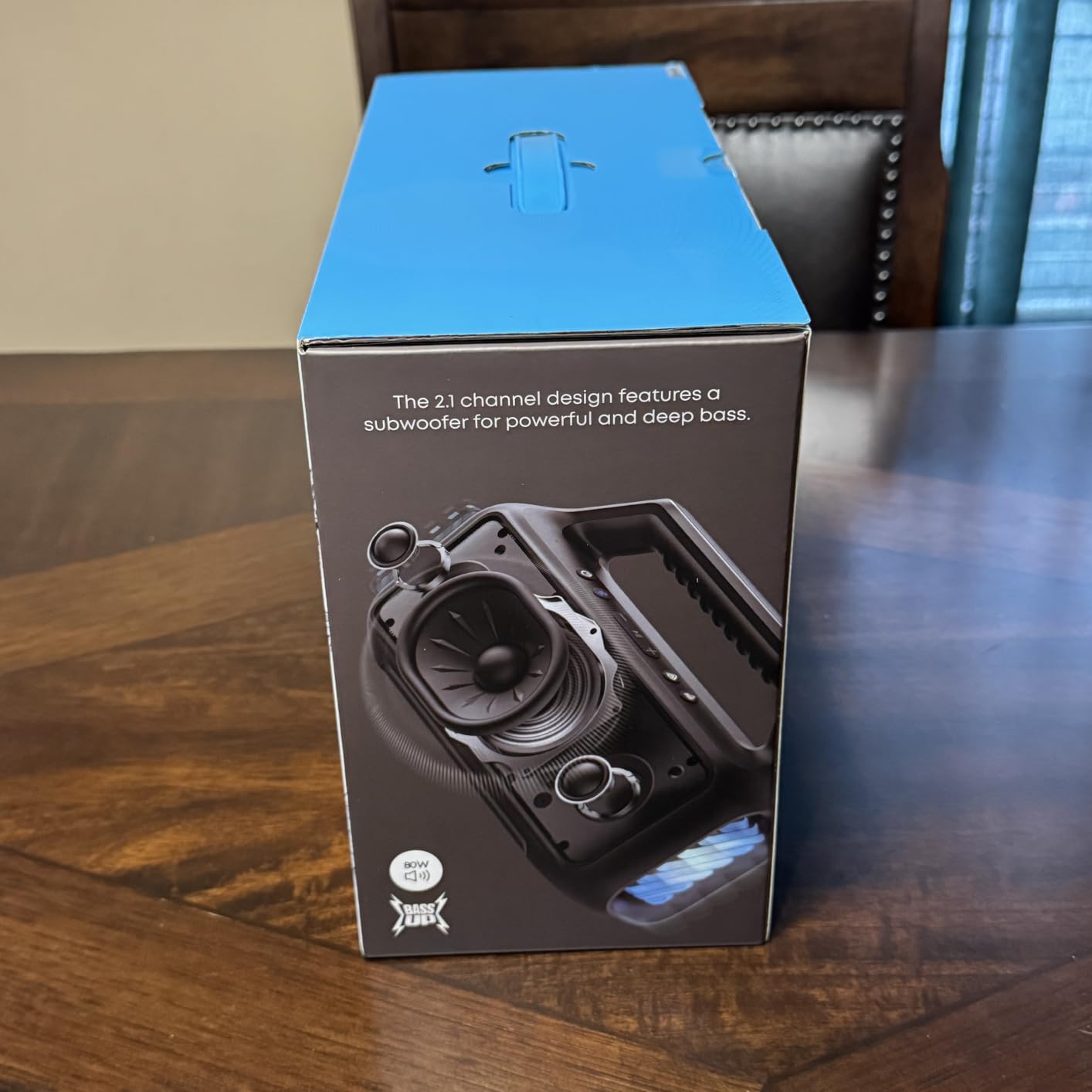
The Boom 2 is the Soundcore Boom model that camper forums keep pointing to, and the reason is volume with a strong low end. A dedicated subwoofer driving BassUp 2.0 gives it a sense of weight that most portable speakers cannot produce, and the 4.6 rating across nearly 8.8k reviews describes it as loud, crisp, and full.
Eighty watts is the second-highest output figure in this roundup, and it is the number that matters at a site with a generator running or a group of people talking over dinner.
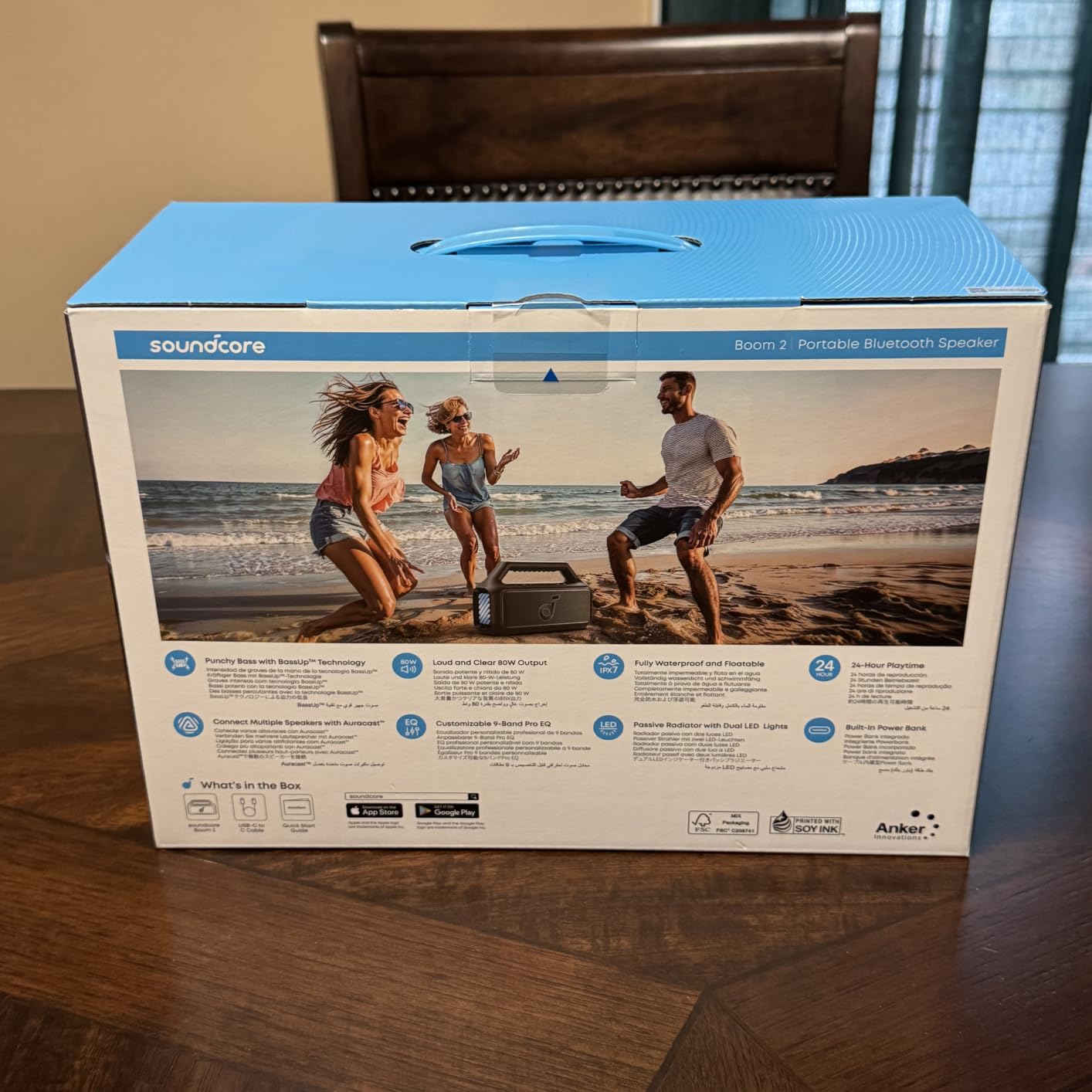
It is also floatable and IPX7 rated, so a lake or pool site is not a risk. The 24-hour runtime and the built-in power bank cover both the music and a phone that needs topping up, which reduces what you have to carry. The built-in handle makes the move from the car manageable despite the size.
Two features set it apart at night: the RGB light show, which works well around a campfire, and Pro EQ in the Soundcore app for shaping the low end per campsite rather than per room.
When the Boom 2 is the right choice
Choose it for a car camp, tailgate, or beach gathering where bass and volume are the goal and the speaker will live in a vehicle rather than on your back. It is also a good match for a power-station setup, since the power bank output means one box handles music and device charging.
If your group dislikes bass-heavy music, the app EQ lets you pull it back, which most fixed-tuning competitors cannot do.
When to skip the Boom 2
Skip it for backpacking. At 1660 g it is one of the two heaviest options here, and 11.65 inches wide is a bulky shape for a pack.
Skip it if you run it at maximum volume for long stretches. Without a full-range driver it turns slightly muddy at the top of the range compared with Soundcore’s own Rave Neo. The metal grille also scuffs and marks easily, and there is no 3.5mm jack, USB stick, or strap attachment point.
11. Marshall Emberton II – Best Battery Life in a Compact Speaker
- Rich 360-degree sound with deep bass
- 30+ hours on a 3-hour recharge
- IP67 dust and water resistant
- Compact 118 g body
- App with EQ presets and StackMode
- Bluetooth range limited to 10 meters
- No 3.5mm AUX input
- No power bank for phones
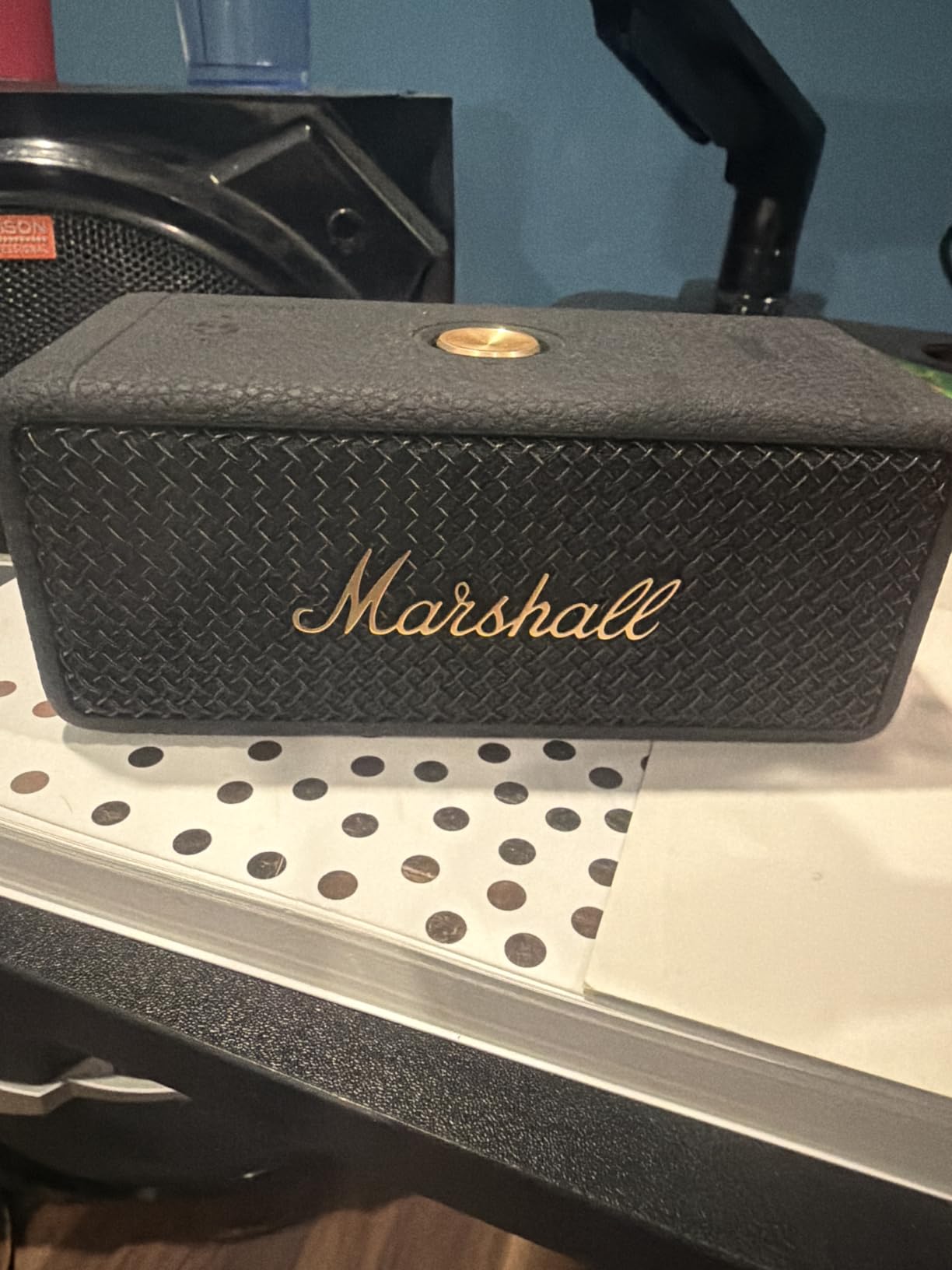
The Emberton II is the endurance pick. Thirty-plus hours of playtime from a 3-hour recharge is the best battery-to-weight ratio here, and at 118 g it is the lightest speaker on the list. The 4.7 rating across 8.2k reviews describes rich, clear, loud 360-degree sound with real bass.
That combination means you can pack it for a week-long trip and not think about a recharge, which removes the single most common complaint campers have about portable speakers.
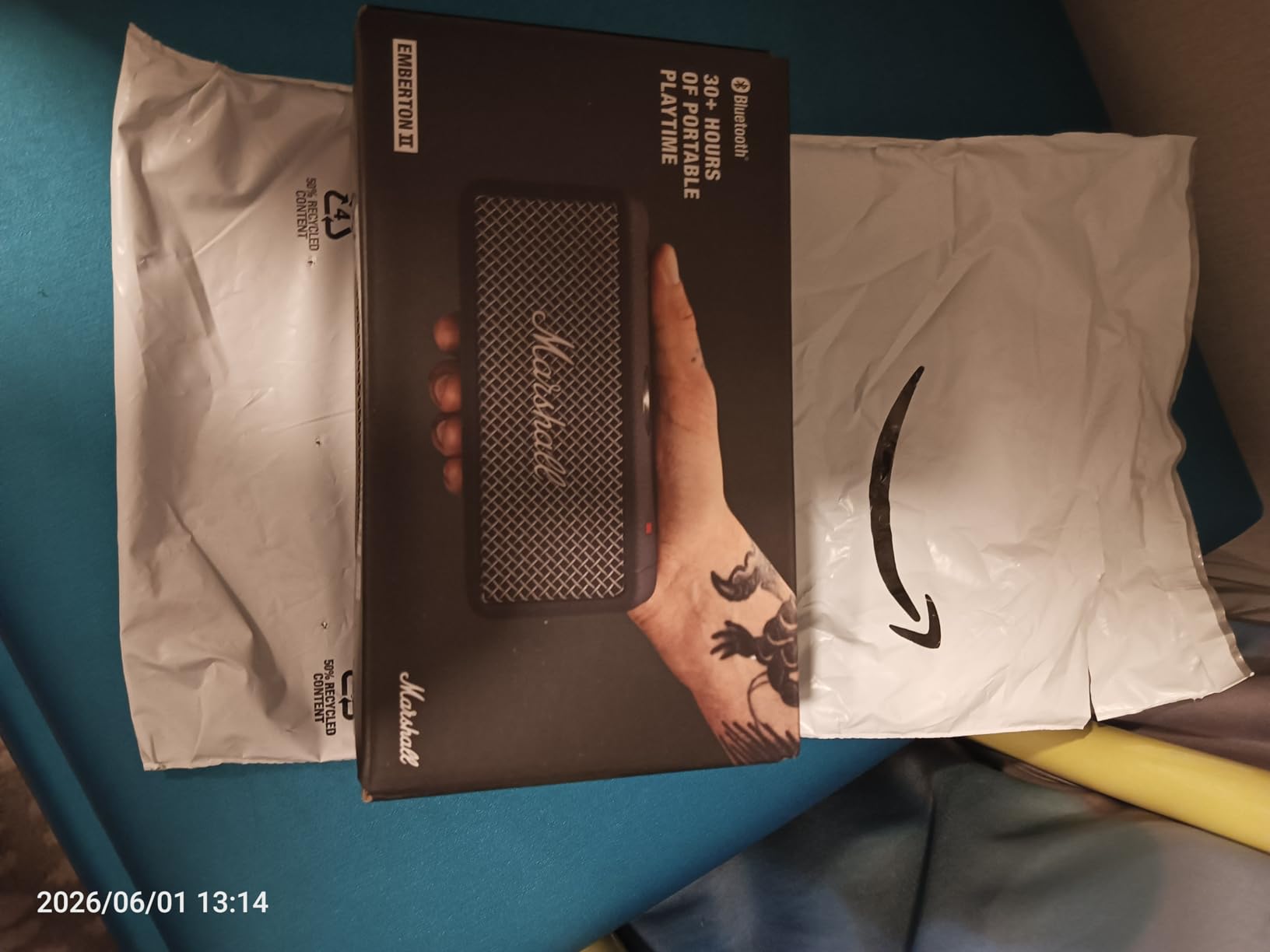
The IP67 rating covers dust as well as water, so it handles a dry, sandy site as well as a wet one. The cylindrical body throws sound in every direction, which is the right pattern for a fire pit where people are sitting in a circle rather than in rows.
StackMode handles multi-speaker sessions, and the Marshall app provides EQ presets and over-the-air updates so the tuning can improve after you buy it.
When the Emberton II is the right choice
Choose it for a long trip, a cold-weather camp, or anywhere a dead speaker on night three would ruin the week. It is also the best-sounding option for a small site where the priority is music quality over volume.
Because it is one of the lightest here, it works as a backpacking speaker for campers who are willing to accept a 10-meter Bluetooth limit and no phone charging.
When to skip the Emberton II
Skip it if your phone will be far from the campsite. The listed Bluetooth range is 10 meters, which is short for a speaker set at the fire while the phone stays in the car.
Skip it if you need a wired fallback or off-grid phone charging. There is no 3.5mm AUX input and no power bank output, and it sits in the highest price tier among the compact speakers here.
12. ECOXGEAR EcoTrek – Best for Car, RV, and Big-Group Camps
ECOXGEAR EcoTrek Rugged Waterproof Floating Portable Bluetooth Wireless 100 Watt Stereo Smart Speaker and PA System (Gray)
- 100W peak from six drivers
- 50+ hours at average volume
- IP67 waterproof and floats
- Consumer-replaceable battery
- AM/FM radio AUX and mic jack
- 19.2 pounds is not a hiking load
- Bulky 15.4 by 16.7 inch footprint
- 8-hour full charge time
The EcoTrek is the one to plug in at an RV or a large drive-up site. One hundred watts of peak output across six drivers, including two 5.25-inch mains, two tweeters, and two passive 5.25-inch woofers, is a full-range array rather than a portable trick, and it holds a 4.5 rating across 2.3k reviews.
What separates it from every other speaker here is the feature list. It floats, it runs 50-plus hours at average volume, the battery is consumer-replaceable, and it plays while charging.
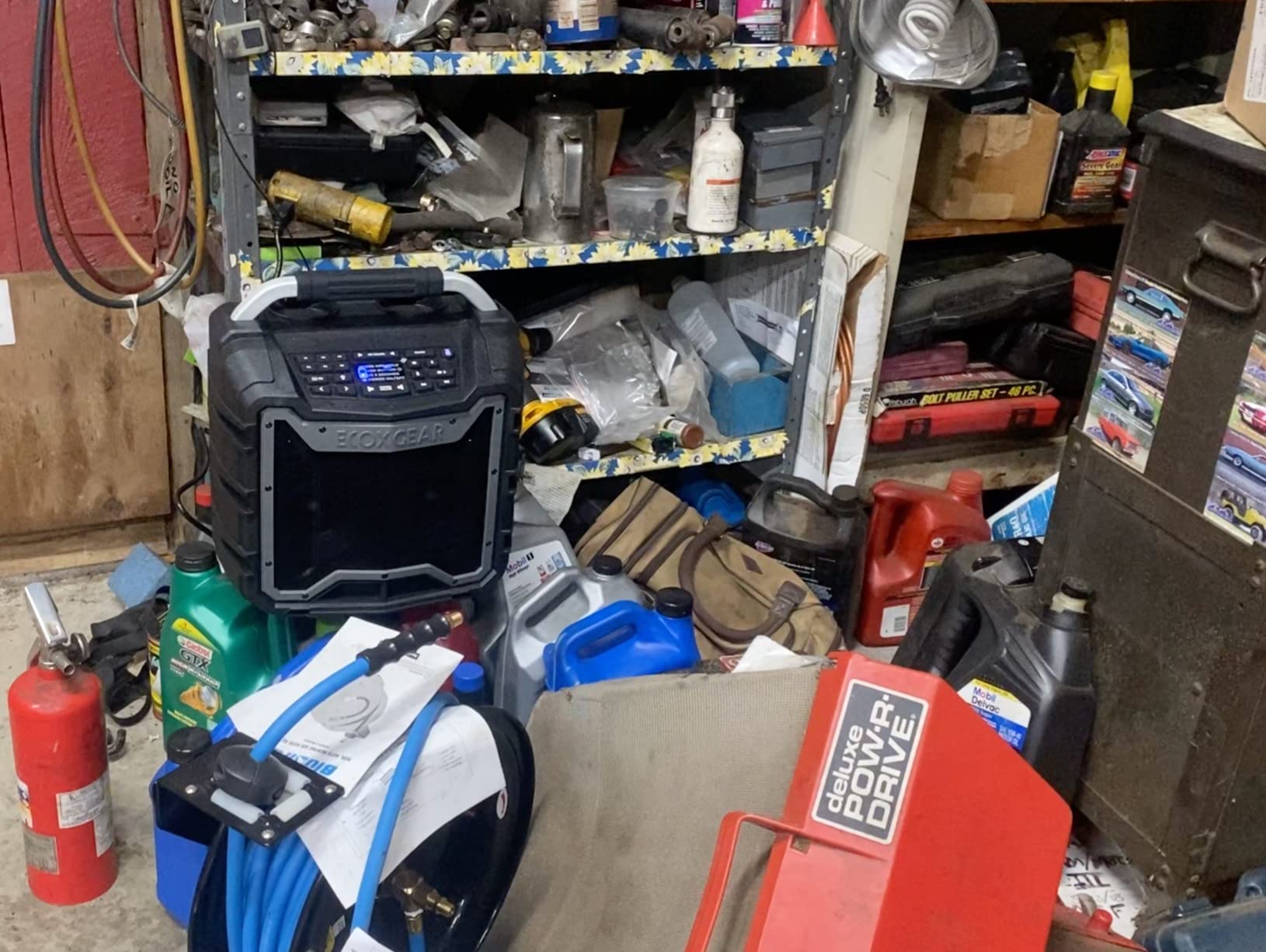
There is also a built-in AM/FM radio with six programmable presets, a 3.5mm AUX input, a 6.35mm microphone jack for PA or karaoke use, and a 5V 2.1A USB power bank output. At a campsite where you might be a mile from the nearest cell tower, the radio is a genuine fallback that no competitor offers.
EcoConnect pairs it with other EcoConnect products for synchronized stereo, and five built-in EQ presets cover different listening situations.
When the EcoTrek is the right choice
Choose it for a motorhome, a van conversion, a tailgate, or a large group campsite where the speaker stays on a picnic table or the vehicle bumper rather than your back. It is the only speaker here that doubles as a PA system.
It is also the best choice if you plan to store it for months between trips, because a replaceable consumer battery avoids the capacity loss that fixed batteries develop.
When to skip the EcoTrek
Skip it for any trip where you carry your gear. At 19.2 pounds and a 15.4 by 16.7 inch footprint, it is a vehicle item by any reasonable reading, and it dominates a small campsite.
Skip it if you want to charge quickly. A full charge takes about 8 hours, and the manual calls for a full charge before first use and every 3 months if it sits unused. That battery-care ritual is a real cost for occasional campers.
How to Choose a Bluetooth Speaker for Camping
Every speaker on this list is waterproof in some form, so the differences come down to how much protection, how many hours, and how many ounces you are willing to carry. Six criteria decide it.
1. Translate the IP rating into a camp scenario
An IP rating has two halves and the first digit is the one people ignore. IPX7 means water protection up to 3 feet for 30 minutes with no dust rating at all, which is fine for rain, splashing, and a lake dunk. IP67 means the same water protection plus a dust rating, which matters at dry, sandy sites in August. A bare IPX4 or X5 rating is splash-only and we would not put either on our list.
Floating is a separate question from waterproofing. The Soundcore Select 4 Go, the W-KING D9, the Soundcore Boom 2, and the ECOXGEAR EcoTrek all float; the JBL and Anker models in this roundup do not. If your camp has a lake or river edge, floating turns a lost-speaker disaster into a five-second retrieval.
2. Match battery hours to trip length, not to a spec sheet
A two-night weekend needs roughly 12 to 16 hours of real playback. A week needs 30 hours or a way to recharge. The most useful number in this list is the Marshall Emberton II at 30-plus hours, and the least useful is the JBL Go 4 at 7 hours.
Judge runtime on two things: the stated figure, and how much charging is realistic in the field. A speaker with 24 hours of playback and a very long listed charge time, like the Tribit XSound Go, needs a full charge before you leave. For anything beyond a weekend, plan on a power station or a solar panel as backup, not just as a phone charger. Our portable pizza oven guide covers another common campsite power draw if you are building out a full setup.
3. Set a weight budget before you shop
Under 12 ounces is backpacking territory: the Tribit XSound Go at 13.44 oz and the Soundcore Select 4 Go at 9.3 oz are the realistic options. Up to 1.5 pounds covers car camping and picnics, which opens up the JBL Flip 5, the Bose SoundLink Flex 2nd Gen at 0.59 kg, and the Marshall Emberton II at 118 g.
Above 2 pounds you are choosing between the JBL Charge 5 at 2.1 pounds, the W-KING D9 at 2 kg, the Soundcore Boom 2 at 1660 g, and the ECOXGEAR EcoTrek at 19.2 pounds. That is a car-camping decision, and pretending otherwise is how people end up leaving a speaker at home.
4. Decide between 360-degree and directional sound
Sound pattern matters more at a campsite than most buyers expect. A 360-degree speaker such as the JBL Flip 5 or the Marshall Emberton II works well for a group sitting in a circle around a fire. A directional speaker, which includes the Ortizan X10 since its drivers face one way, works better when you want to aim sound at a table and keep it off the neighbors.
Quieter is also kinder. Pushing one speaker to maximum is what draws complaints at a campground, while two linked units at moderate volume cover the same area and disturb less.
5. Check for phone charging and second-device pairing
Off-grid, your speaker may be your only battery. The JBL Charge 5, the Soundcore Boom 2, and the ECOXGEAR EcoTrek all have power bank output, and the W-KING D9 supports device charging as well. That capability is more valuable than most buyers expect until they are on night two with a phone at four percent.
Multipoint Bluetooth, which the Bose SoundLink Flex 2nd Gen has, lets a phone and a tablet stay connected at once. It is a small convenience that matters when two people are sharing a playlist.
6. Decide whether the app matters to you
App control is not a gimmick outdoors. The Soundcore Select 4 Go, the Soundcore Boom 2, the JBL Charge 5, and the Marshall Emberton II all offer EQ control, which lets you add low end in an open space where the tuning was never intended to work. Speakers with no app, including the Anker Soundcore 2 and the Tribit XSound Go, are perfectly fine but you accept the factory sound.
One warning from camper discussions: brand apps are fragmented, and JBL alone has separate apps for portable speakers and headphones. Check the app before you buy, not after.
What to skip and why
Skip splash-only speakers. If a listing says water resistant without a specific IP rating, assume it is not a camping speaker.
Skip non-floating speakers for a lake or river camp, unless you are disciplined enough to never have it within reach of the water. Skip sub-10-hour batteries for a trip longer than a weekend, since that is the most common way campers end up with a silent site on night two.
Skip single-unit planning for a large group. Two linked speakers at moderate volume beat one speaker at maximum, both for sound quality and for neighbor relations. Just confirm the pairing works within the same brand and model, because cross-brand stereo pairing usually does not.
Frequently Asked Questions
What is the best Bluetooth speaker for camping?
The Anker Soundcore 2 is the best Bluetooth speaker for most campsites. It carries an IPX7 waterproof rating, 24 hours of playtime, 12W of stereo output, and weighs 14.56 oz, with more than 156k owner reviews behind it. For a large group, the JBL Charge 5 offers 40W and a built-in power bank. For water and pack weight, the Soundcore Select 4 Go floats and weighs 9.3 oz.
Which portable Bluetooth speaker has the best sound quality?
The JBL Flip 5 is the strongest all-round sound choice here, with 20W of output that stays balanced at volume and a 4.8 rating across more than 85k reviews. The Bose SoundLink Flex 2nd Gen is the pick for detail, podcasts, and deep bass in a small body, and the Marshall Emberton II delivers the richest 360-degree tone. All three carry IP67 or IPX7 protection.
Is Bose or JBL better quality?
For camping, JBL generally wins on ruggedness and power. The Charge 5 has an IPX7 rating, 40W of output, 20 hours of playtime, and a power bank for your phone. Bose wins on sound refinement: the SoundLink Flex 2nd Gen is praised for clarity and deep bass in a 0.59 kg IP67 body, but it offers only 12 hours and no phone charging. Choose JBL for a group, Bose for music quality on a small site.
What are the top 10 best portable Bluetooth speakers?
Our top ten are the Anker Soundcore 2, JBL Flip 5, Ortizan X10, JBL Charge 5, Tribit XSound Go, JBL Go 4, W-KING D9, Soundcore Select 4 Go, Bose SoundLink Flex 2nd Gen, and Soundcore Boom 2. The Marshall Emberton II and ECOXGEAR EcoTrek complete the list of 12. Each is summarized in the quick picks and compared in the table above.
What are some Bluetooth speakers that can float in water?
Four speakers in this roundup float rather than sink: the Soundcore Select 4 Go, the W-KING D9, the Soundcore Boom 2, and the ECOXGEAR EcoTrek. All four carry IP67 ratings, so they also handle immersion for around 30 minutes. The JBL Flip 5, JBL Charge 5, JBL Go 4, Bose SoundLink Flex 2nd Gen, and Marshall Emberton II are waterproof but not floatable.
What is the best Bluetooth speaker for a motorhome?
The ECOXGEAR EcoTrek is the strongest motorhome pick: 100W peak output, 50-plus hours at average volume, an IP67 rating, a replaceable battery, an AM/FM radio, AUX input, a microphone jack for PA use, and USB power bank output. For a smaller setup, the Marshall Emberton II offers 30-plus hours from 118 g. Campers consistently report that any of these beats built-in RV audio.
What is the best portable Bluetooth speaker for travel?
For travel, weight and battery life matter most, which points to the Soundcore Select 4 Go at 9.3 oz with 20 hours and IP67 floating protection, or the Marshall Emberton II at 118 g with 30-plus hours. For trips where you do not need to float, the Tribit XSound Go at 13.44 oz offers 24 hours. All three pack easily and handle rain.
How long do portable Bluetooth speaker batteries last outdoors?
Claimed figures on this list run from 7 hours on the JBL Go 4 to more than 50 hours on the ECOXGEAR EcoTrek at average volume. Cold mornings and high volume both reduce real runtime below the claim. A two-night weekend needs 12 to 16 hours, and a week needs 30 hours or a power station, so match the runtime to your trip length rather than to the number on the box.
Which Camping Speaker Is Right for Your Trip?
Backpacking on foot? Take the Soundcore Select 4 Go at 9.3 oz, which floats and runs 20 hours, or the Tribit XSound Go at 13.44 oz for better bass. Car camping with four people? The Anker Soundcore 2 remains the best portable Bluetooth speaker for camping because 24 hours and 12W handle a normal site without becoming a neighbor problem.
Running a motorhome or a big group? The JBL Charge 5 with its power bank, or the Soundcore Boom 2 if bass is the priority. Camping on a lake or beach? Pick from the four floatable models, and the ECOXGEAR EcoTrek for a fixed RV site that needs a PA and a radio.
Whichever you choose, download your music before you lose coverage, test the controls once at home, and check the charge before you leave. That last habit has saved more camp trips than any spec on this list. Our flat top griddle guide covers the other essentials for a site that works as well as it sounds.