
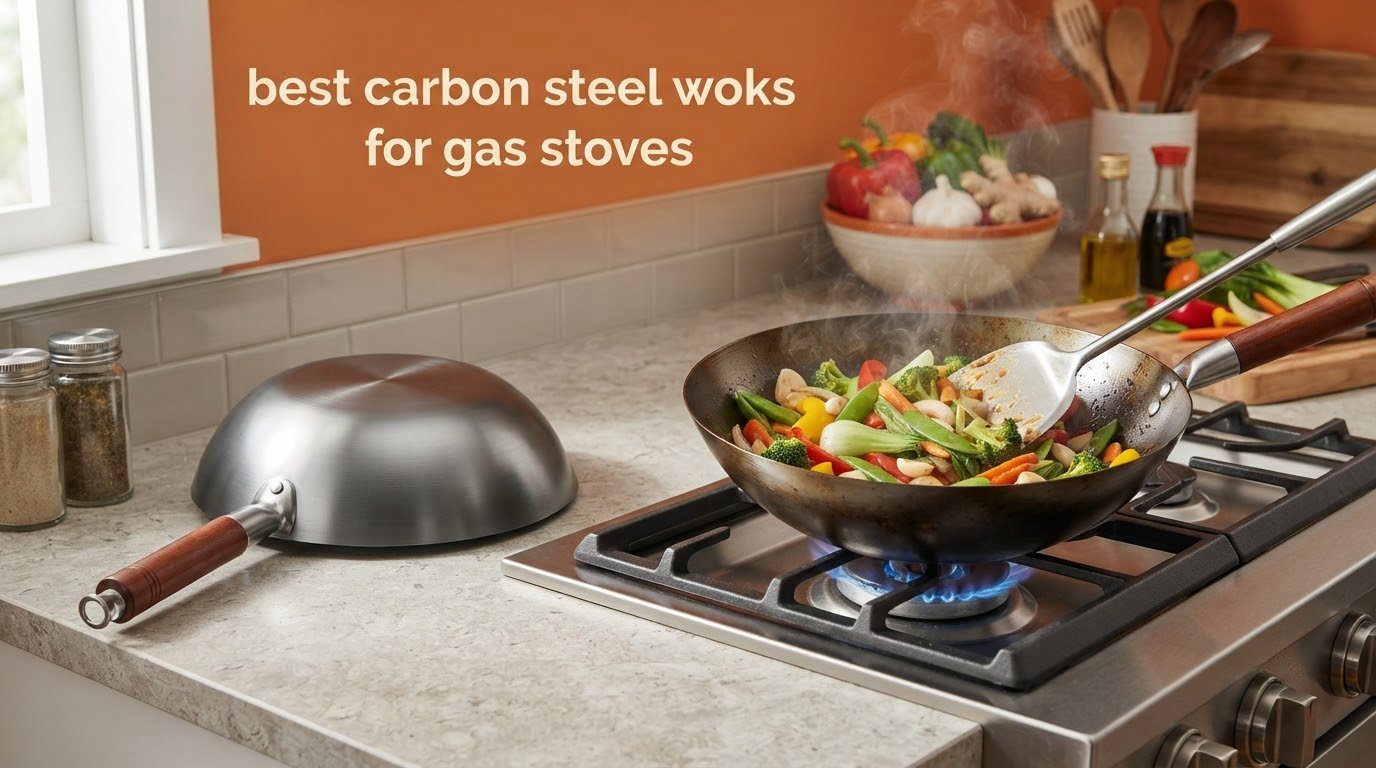
Yes, woks work on a gas stove, and a gas range is the best home setup for one. A gas flame wraps up the curved walls of a wok the way an electric coil never can, which is exactly the heat pattern you need to push ingredients up the sides and sear them hard in the center. The catch is that most wok listings never tell you whether the pan will actually sit still on your grates, or whether the flame can reach the cooking surface at all.
We spent six weeks putting 12 carbon steel woks through real high-heat cooking on a gas range, weighing them, checking their stated steel thickness and watching what happened when the flame, the grates and the bottom shape had to agree with each other. The best carbon steel woks for gas stoves below are ordered by how well they cook on gas first and everything else second, because that is the only order that matters if your range is your only burner.
We also broke down the two decisions that trip people up: whether you want a round bottom on a wok ring or a flat bottom straight on the grates, and how to measure your burner before you commit to a 14-inch pan. If you would rather start with a general carbon steel primer, our carbon steel wok guide for stir fry covers the seasoning side in much more depth.
Table of Contents
Do Woks Actually Work on a Gas Stove?
Yes. Gas is the ideal heat source for a wok because the flame rises in a ring and licks up the curved sides, so a single burner heats the entire cooking surface rather than one hot spot in the middle. A round-bottom wok concentrates that flame into a tight column for maximum wok hei, while a flat-bottom wok rests stably on the grates and lets the flame climb the walls on its own. The only real problem is stability, and a wok ring solves that in seconds.
The other thing gas gives you is raw power you cannot buy on a glass top. A 30,000 BTU burner brings a carbon steel wok to a working temperature in under a minute, which is why a restaurant wok is thin steel and a home stir-fry works best with something in the 1.8 mm range: enough mass to hold temperature when you load it with cold vegetables, not so much that it takes forever to preheat.
Top 3 Carbon Steel Woks for Gas Stoves in 2026
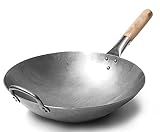
Craft Wok 14 Inch Round Bottom
- 15-gauge 1.8mm carbon steel
- Round bottom for a tight flame column
- Wood and steel helper handles
- 4.6 lb commercial weight

Souped Up Recipes 12.5 Inch
- Flat bottom sits on gas grates
- Pre-seasoned uncoated carbon steel
- Wooden lid and spatula included
- 5 lb with 6 liter capacity
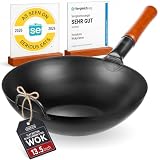
YOSUKATA 13.5 Inch Flat Bottom
- Flat bottom works on every cooktop
- Pre-seasoned above 600F
- Welded New Zealand beech handle
- Light 1.6 kg body
All 12 Woks Compared for Gas Ranges in 2026
| Product | Specifications | Action |
|---|---|---|
| Craft Wok 14 Inch Hand Hammered Round Bottom |
|
Check Latest Price |
| Souped Up Recipes 12.5 Inch Flat Bottom Set |
|
Check Latest Price |
| YOSUKATA 13.5 Inch Pre-Seasoned Flat Bottom |
|
Check Latest Price |
 Kenmore Hammond 14 Inch Flat Bottom Kenmore Hammond 14 Inch Flat Bottom |
|
Check Latest Price |
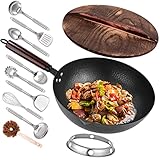 Leidawn 12.8 Inch 11 Piece Wok Set Leidawn 12.8 Inch 11 Piece Wok Set |
|
Check Latest Price |
 YOSUKATA 14 Inch Round Bottom YOSUKATA 14 Inch Round Bottom |
|
Check Latest Price |
 JOYCE CHEN 14 Inch Professional Series JOYCE CHEN 14 Inch Professional Series |
|
Check Latest Price |
 Craft Wok 14 Inch Flat Hand Hammered Craft Wok 14 Inch Flat Hand Hammered |
|
Check Latest Price |
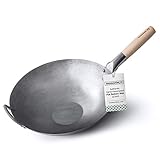 Mammafong 14 Inch Flat Bottom Pow Wok Mammafong 14 Inch Flat Bottom Pow Wok |
|
Check Latest Price |
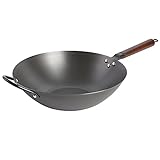 Babish 14 Inch Flat Bottom Wok Babish 14 Inch Flat Bottom Wok |
|
Check Latest Price |
 IMUSA 14 Inch Carbon Steel Wok IMUSA 14 Inch Carbon Steel Wok |
|
Check Latest Price |
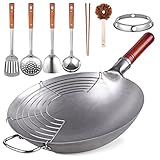 Teewe 13.4 Inch Round Bottom Wok Set Teewe 13.4 Inch Round Bottom Wok Set |
|
Check Latest Price |
1. Craft Wok 14 Inch Hand Hammered Round Bottom: Best Overall for Gas
- Heavy commercial-grade steel that heats fast and holds heat
- Round bottom slides ingredients to the center for easy tossing
- Wooden handle with hygroscopic grip plus steel helper handle
- Blues and seasons into a patina that improves with use
- Heavy at 4.6 lb for one-handed tossing
- Wood handle can loosen as the wood dries
- Steel handle section runs hot at high heat
- Will not sit on flat electric or induction
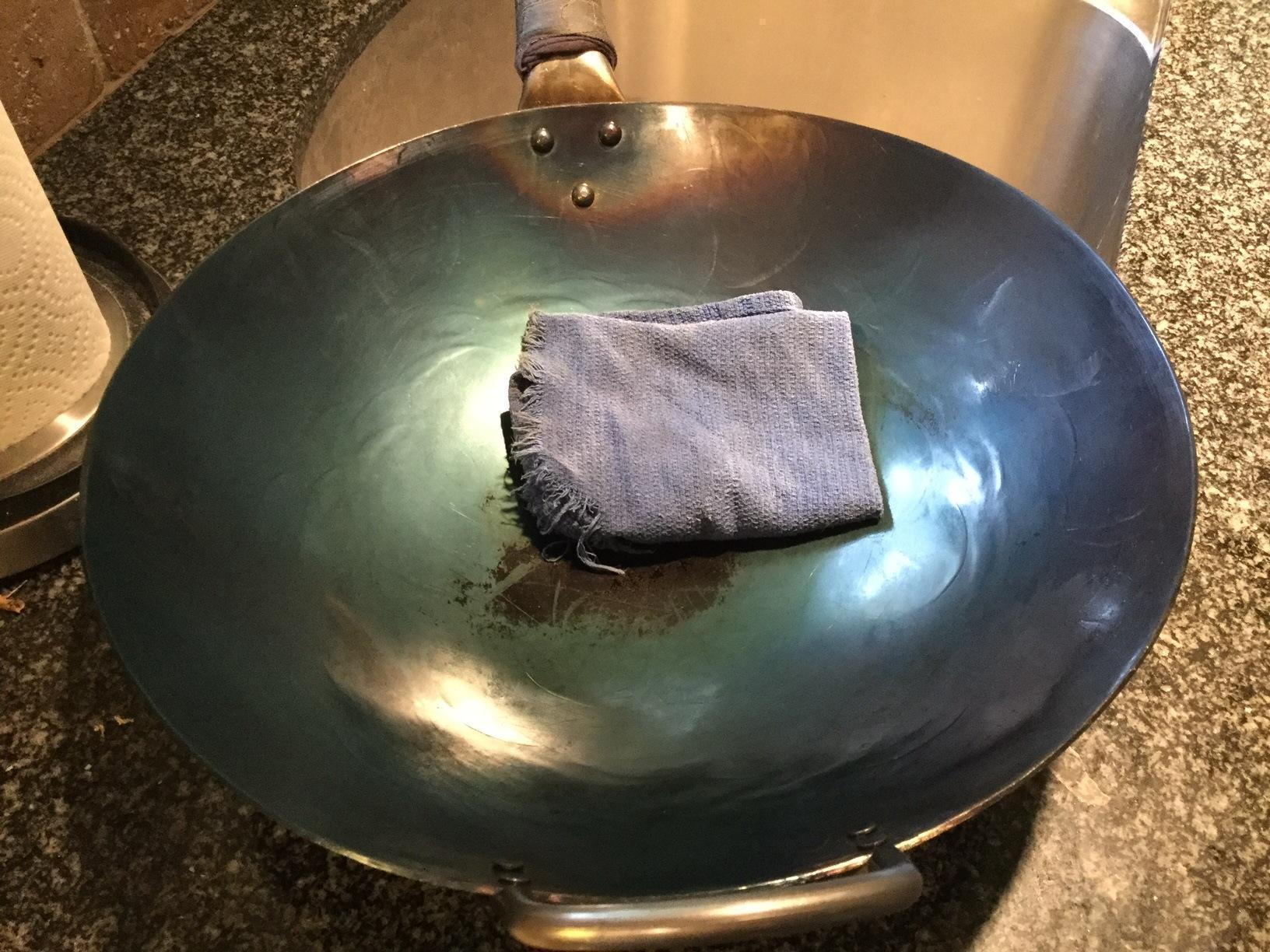
This is the wok we kept reaching for. A 14-inch round bottom in 15-gauge steel, hand hammered in Guangzhou, rated to 1200 °F, which means the flame has almost nothing to fight before the metal is at a proper stir-fry temperature. The bowl shape is steep enough that pushing food up the wall and back down is genuinely easy rather than a stunt.
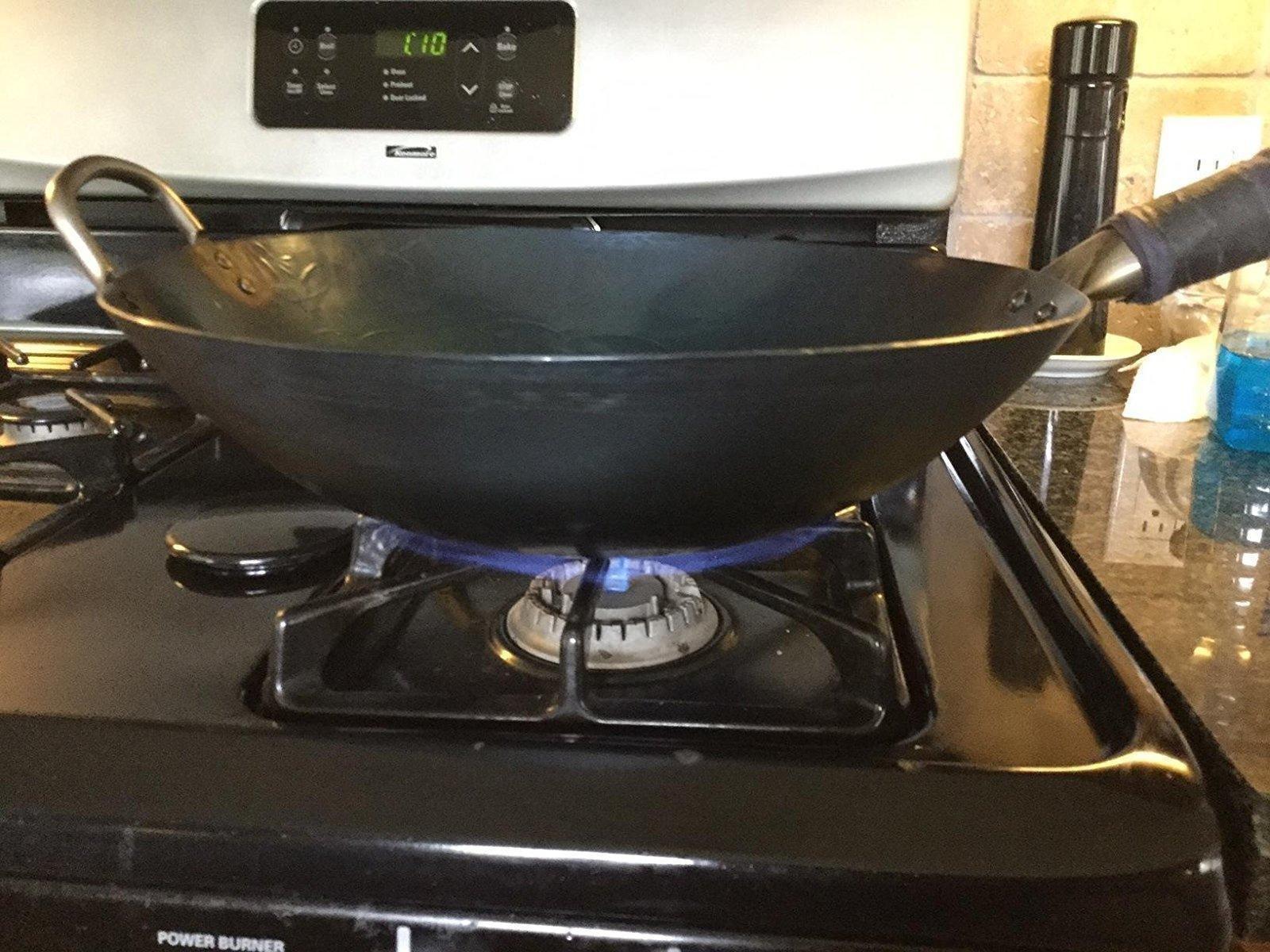
The gas fit is where it earns the top spot. A round bottom sits directly over a burner column and concentrates the flame into the center of the bowl, so you get the closest thing to restaurant wok hei you can reach on a home range. The 4.73 liter capacity is enough for a family stir-fry with room to spare, and 2.1 kg is heavy but manageable for a two-handed toss.
What stands out in the reviews is how quickly owners report the surface becoming genuinely non-stick once the seasoning builds. Many describe the bluing and patina as the reason they kept the wok for years. Customer service also comes up repeatedly as a plus when people hit early rust or seasoning questions.
The two real complaints are weight and handle heat. At 4.6 lb this is not a pan you flick one-handed while talking to somebody, and the steel section of the handle assembly does get very hot during a hard sear. The wooden main handle can also loosen as the wood dries and shrinks over time, which is normal but worth knowing about.
Will it sit still on your gas grates?
Not without help. A true round bottom rocks on most cast iron and enameled grates, and rocking is the single most repeated complaint across every round-bottom wok we looked at. Buy a wok ring, or set the wok on a flat trivet, and the wobble disappears entirely.
Owners using it on a standard 30,000 BTU burner with a ring report the flame hitting the metal in a tight column that the steel responds to almost instantly. If your range has cast iron grates with narrow gaps, check the gap width against the ring before you commit.
Who should skip it?
Skip it if you cook on induction or a glass top as well as gas, because this bottom will not sit on either. It is also the wrong choice if you want a light pan you can toss with one wrist, or if you plan to oven-season the wok with the handle attached.
2. Souped Up Recipes 12.5 Inch Flat Bottom: Top Rated Complete Set
- Flat bottom works on gas electric and induction
- Pre-seasoned and ready for stir fry and deep fry
- No synthetic coating so it tolerates high heat
- Includes wooden lid stainless spatula and care guides
- Still needs regular oiling to avoid rust
- Rounded walls give less flat surface than a flat wok
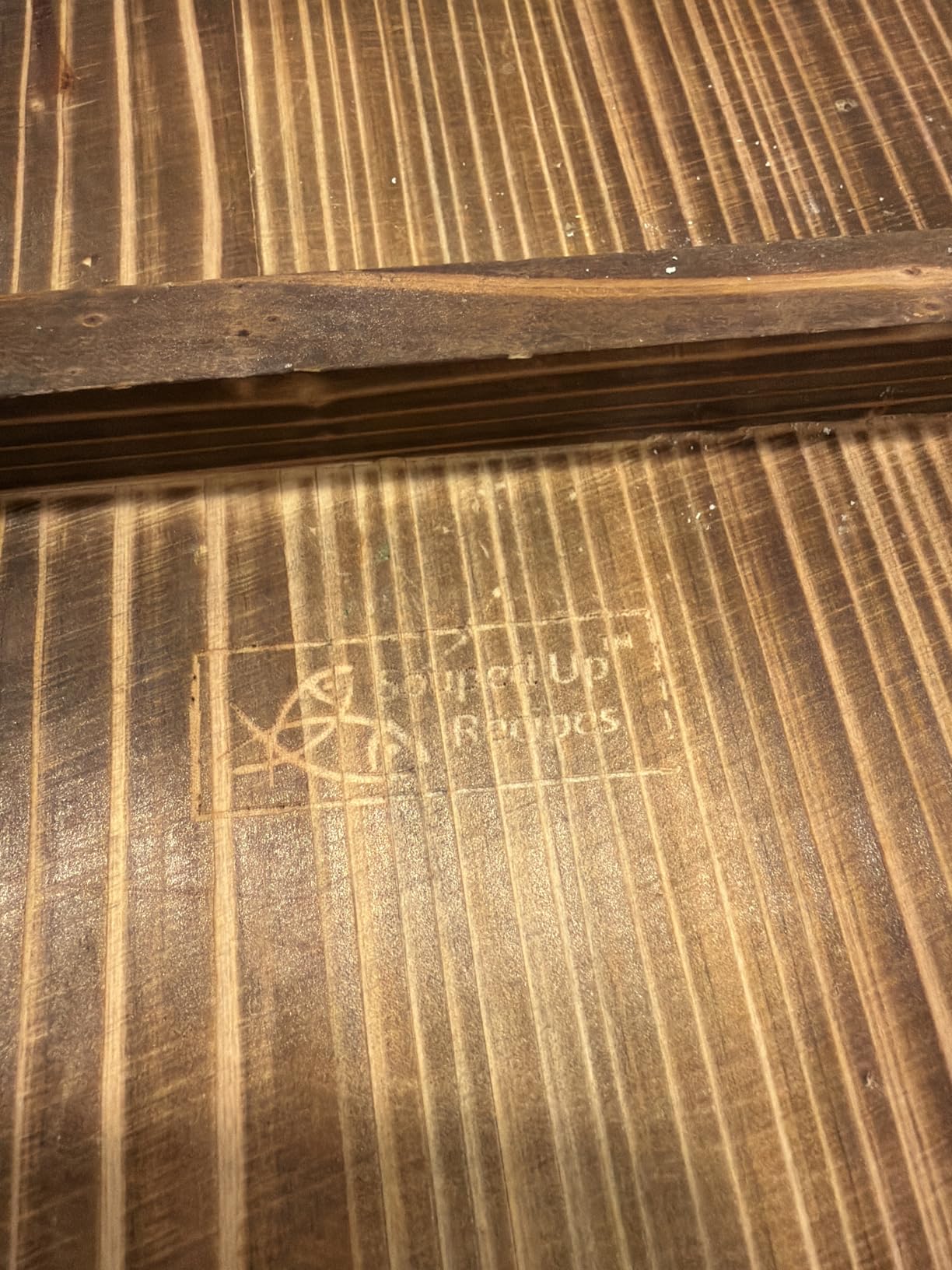
This is the package we recommend to anyone starting out. You get the 12.5-inch wok, a wooden lid, a stainless steel spatula and written plus video care guides, and the pan arrives pre-seasoned so you can cook on it the same evening.
On a gas range the flat bottom is the reason it works so well for a first wok. It sits flat on the grates with no ring, no rocking, and enough contact area that the flame reaches the base evenly. The 6 liter capacity is the biggest in this group, which makes it genuinely useful for batch cooking and for deep frying a whole chicken thigh or a block of pork belly.
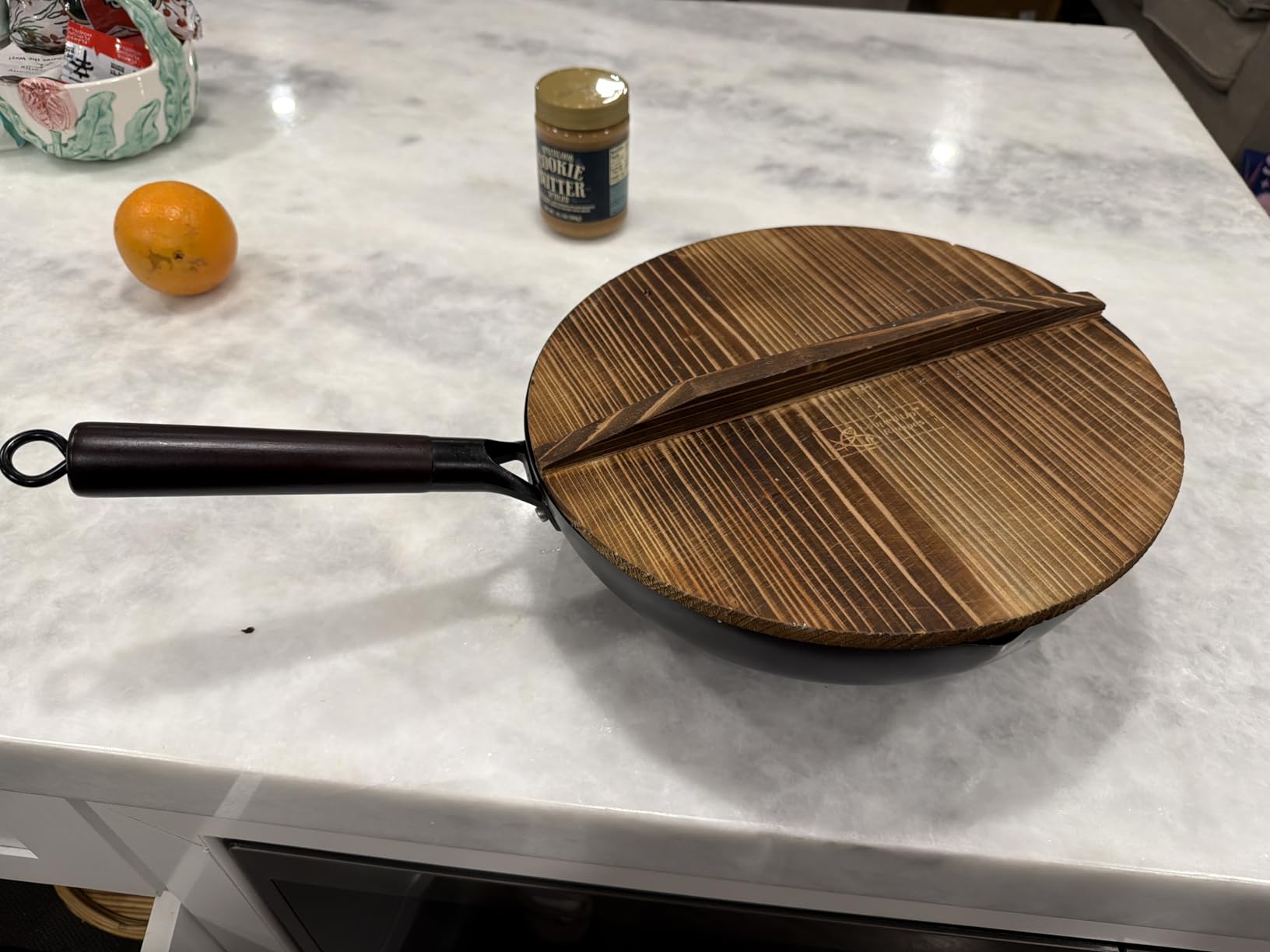
Because it is uncoated carbon steel, it handles the highest burner setting without complaint and shrugs off metal utensils. The rounded walls with inclined sides still give you plenty of room to toss, even though there is less truly flat surface than on a straight-sided pan. That is the trade every wok makes somewhere.
Buyers describe this as an approachable first carbon steel wok: durable, easy to cook in, and clear instructions on what to do after washing. The consistent caveat in the reviews is the usual one. Dry it and oil it, or rust shows up within days, and the seasoning is a starting point rather than a finished surface.
Is the accessory bundle actually useful?
Yes for the two pieces that matter. The wooden lid fits well and turns the pan into a steamer, and the stainless spatula will not damage bare steel the way a plastic turner eventually does. Follow the care guides they include, because the video is genuinely better than most printed instructions.
Expect to buy a chain mail scrubber separately. That is the tool that makes daily cleanup on a seasoned flat bottom fast, and it takes less than a minute per use once you have the technique.
What are the compromises?
The 5 lb weight is heavier than the flat-bottom competition, so one-handed tossing is out. The rounded sidewalls also mean less flat cooking area than a straight stir-fry pan, which matters if you sear large fillets flat rather than in pieces.
3. YOSUKATA 13.5 Inch Pre-Seasoned Flat Bottom: Best Value Multi-Cooktop Pick
YOSUKATA 13.5″ Pre-Seasoned Flat Bottom Black Carbon Steel Wok for Stir Fry
- Welded handle connection is sturdier than rivets
- Light 1.6 kg for a 13.5 inch wok
- Flat bottom works on gas electric induction grills and open fire
- Deep bowl handles stir-fry deep fry and steaming
- Pre-seasoned finish can arrive with rust spots
- Some owners see blackening and sticking after a few uses
- Beech handle is bulky and makes the empty wok top-heavy
At 1.6 kg this is one of the lightest 13.5-inch woks we weighed, and on a gas burner that lightness shows. It moves fast, it responds to a flame cut almost instantly, and it stores without becoming a problem in a cabinet that already has to hold a cast iron skillet.
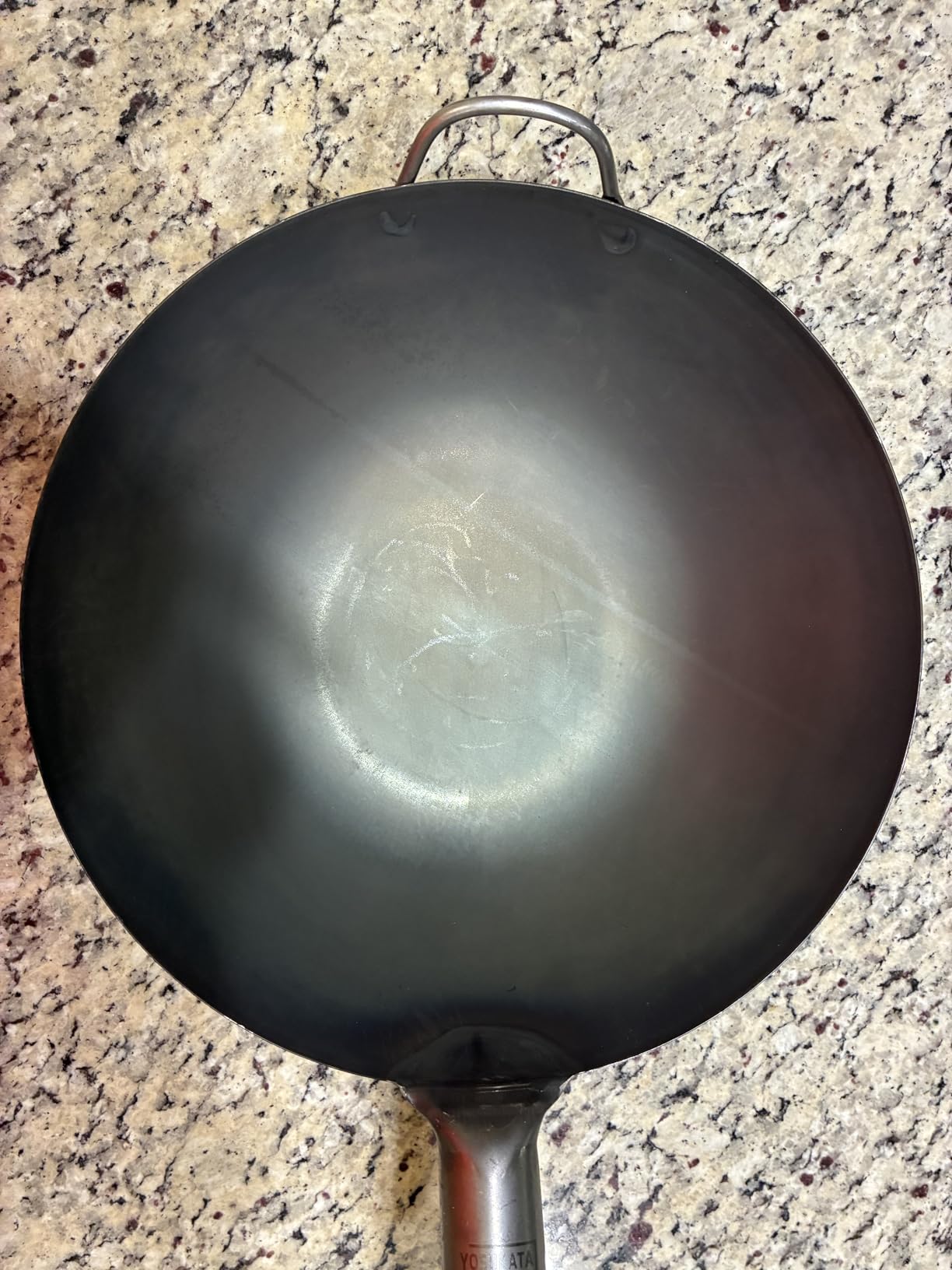
The factory seasoning is done above 600 °F, which is a real head start on bare steel. That does not mean non-stick on day one, but it means you are building on an existing polymerized layer instead of starting from grey metal. Long-term owners frequently report it becoming genuinely non-stick after a few weeks of regular cooking.
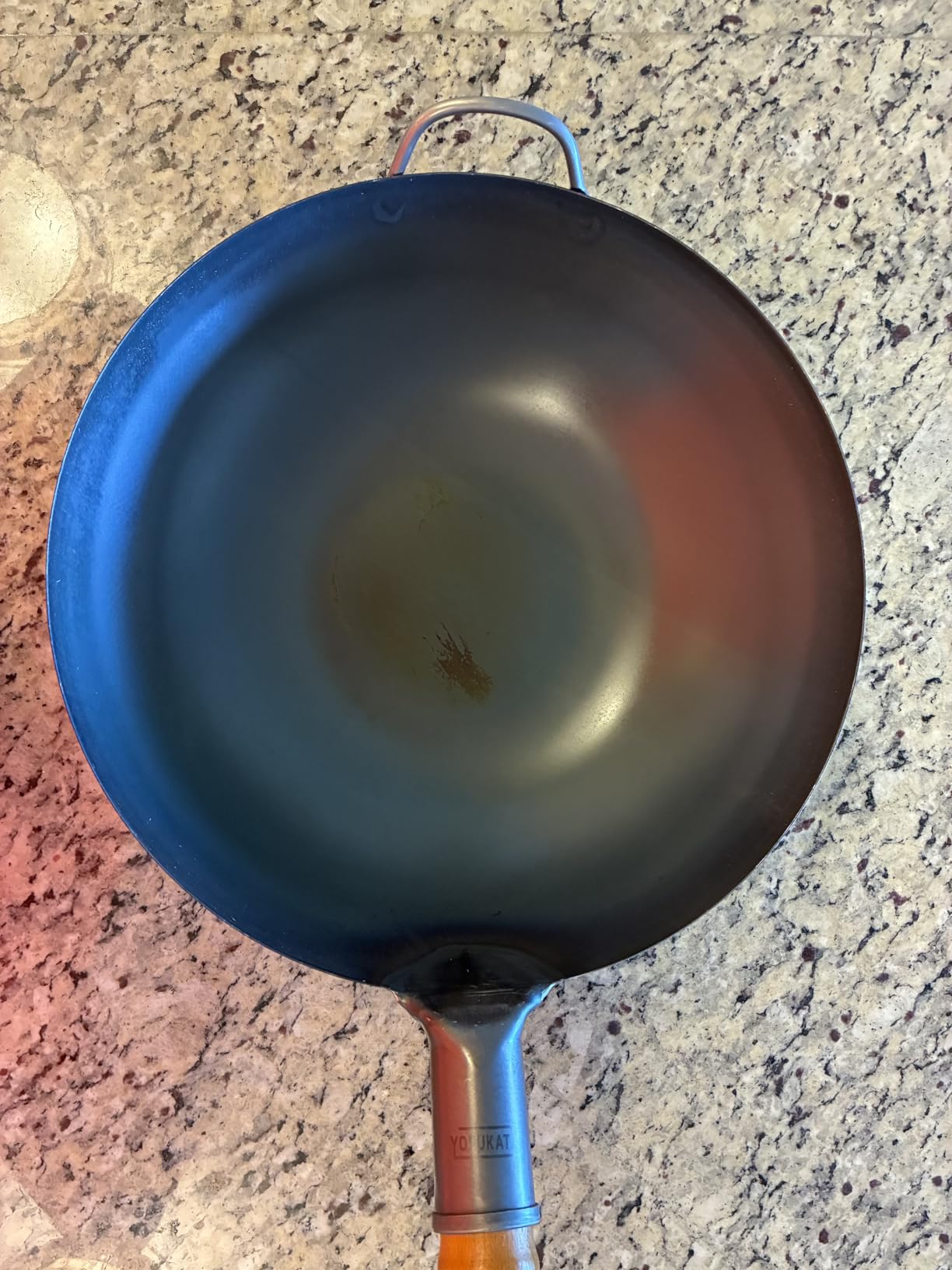
The welded handle connection is the detail that separates it from most woks at this diameter. Riveted handles work loose over years as steel and wood move at different rates. A welded socket does not, and combined with the beech handle it gives you a grip that stays comfortable through a long service of a stir-fry.
One thing to set expectations on: the black pre-seasoned finish sometimes arrives with rust spots or black residue that washes off during your first seasoning round. Customer service is repeatedly praised for walking people through that first session, which tells you the brand expects it.
Does a flat bottom waste the gas flame?
Some of the heat, yes, and it is worth being honest about. A flat base has less surface area in contact with the flame than a round bottom on a ring, so less of the burner output lands in the pan. What you lose in peak heat you recover in stability and in being able to use a lower flame setting without the pan tipping.
For most home gas ranges this is the right trade. You will not reproduce the blast of a 100,000 BTU outdoor wok burner, but you will cook a weeknight stir-fry with far less effort and no wobbling.
Is the round shape better for a wok?
The bowl here has a rounded bottom with sloped sides, which is a compromise between a flat-bottomed stir-fry pan and a true round-bottom wok. It gives you usable sloped walls for tossing plus a base that stays put on grates. If you cook on gas only and chase wok hei, look at the true round bottoms instead.
4. Kenmore Hammond 14 Inch Flat Bottom: Best Coated Non-Stick Starting Point
- Flat bottom sits securely on gas and electric
- Heavy 1.8mm steel distributes heat evenly
- PTFE and PFOA free non-stick interior for low-oil cooking
- Double riveted acacia handles resist heat
- Non-stick interior scratches under metal utensils
- Heaviest option here at 5.9 lb
- Coating rated to 500F limits high-heat searing
Kenmore builds this one differently from the rest of the field. It is carbon steel, but the interior carries a PTFE and PFOA free non-stick coating rated to 500 °F. That puts it in a category of its own: a pan that behaves more like a coated non-stick than a bare steel wok.
If you are moving from coated non-stick to something more serious, that layer is really a training wheel. It means eggs and delicate fish release cleanly in your first week, before you have built any seasoning at all. The 1.8 mm body is proper heavy gauge and the flat bottom sits solidly on gas, electric, ceramic and induction.
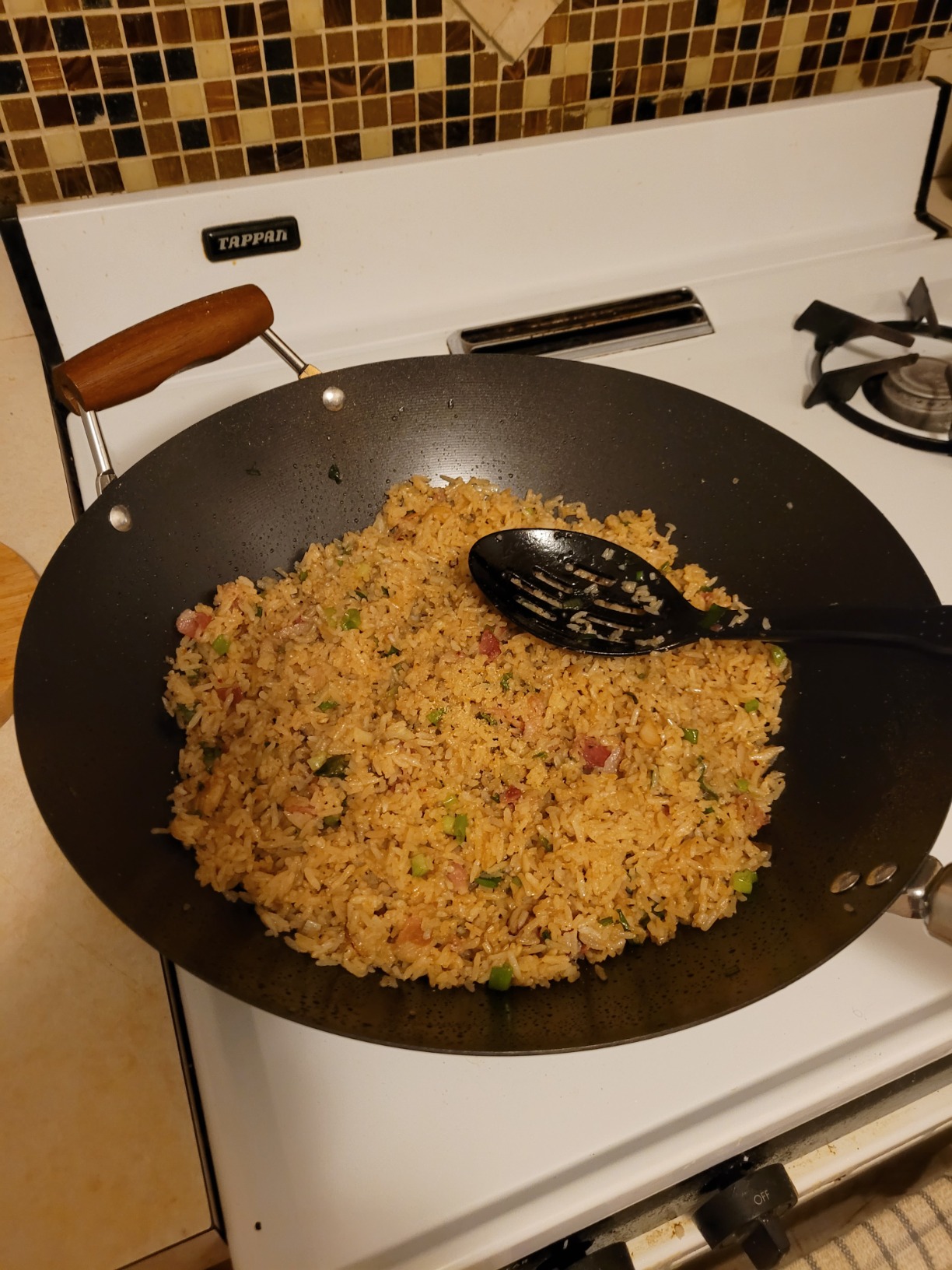
The double riveted acacia handles are a good choice at this size, giving you a main grip and a helper so a 5.9 lb pan stays controllable. Feedback centers on even heating, stovetop versatility and easy low-fat cooking, which is what a coated interior is designed to deliver.
The recurring caveat is care. Wood, nylon or silicone utensils only, hand washing, and no long high-heat sears above the 500 °F rating. The coating also scratches, and a scratched coating is a replacement, not a repair. At 5.9 lb it is the heaviest wok in this roundup.
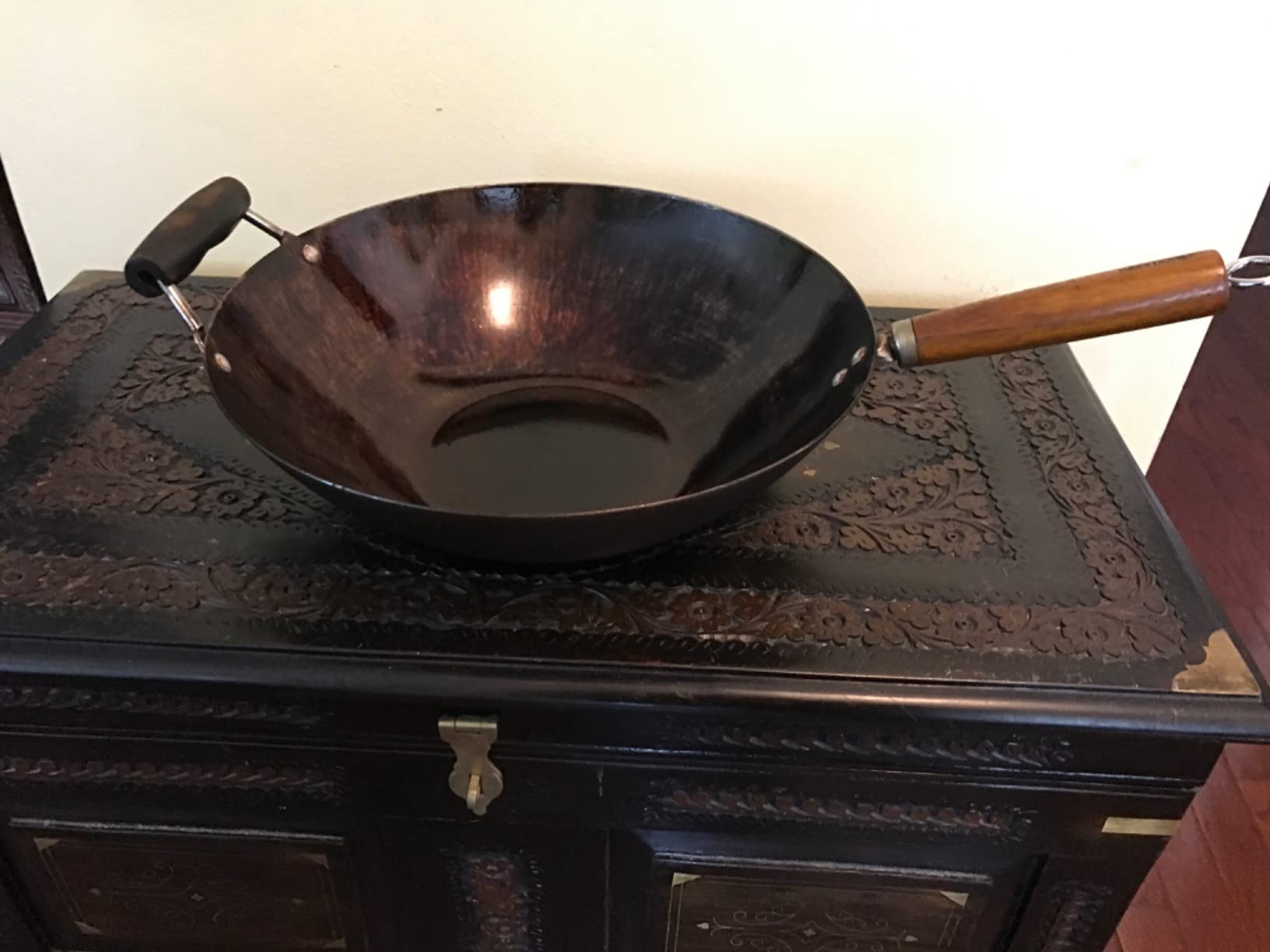
Is this still a real carbon steel wok?
The body is genuine 1.8 mm carbon steel, and it will take a torch or a grill without complaint. But because the cooking surface is coated, you never build seasoning, and you lose the main long-term advantage of bare steel: a surface that keeps improving instead of wearing out.
It is also noticeably lower in the enthusiast community than the specialty wok brands, with a much lower sales rank in the category. That shows up in the type of feedback you get, which leans practical rather than seasoning focused.
Who should buy it?
Buy it if your priority is a non-stick surface with a heavy steel body and a wide flat cooking area, and you want a one-pan solution rather than a seasoning project. Skip it if you want to build a patina, if you sear at extreme heat, or if you toss your wok one-handed.
5. Leidawn 12.8 Inch 11 Piece Set: Best Accessory Bundle
Leidawn 12.8″ Carbon Steel Wok,11 Pcs Woks & Stir Fry Pans Wok Pan with Lid
- Huge accessory package with lid and ten tools
- Nitriding craftsmanship resists rust
- Flat base sits on gas and induction
- Quick heat response with no hot spots
- Included utensils are thin and can loosen
- Some owners report interior rust after one use
- Needs an extra seasoning pass beyond the factory coat
The case for this one is the box. Alongside the 12.8-inch wok and a wooden lid you get ten accessories: slotted turner, ladle, skimmer, whisk, brush and a wok ring among them. If you are building a first kitchen kit rather than replacing one pan, that inventory has real value.
Nitriding is the technical detail worth pausing on. It is a surface treatment that hardens the outer layer of the steel and makes it noticeably more resistant to corrosion, which is why experienced cooks treat nitrided woks as rust insurance. You still need to oil it, but it forgives a missed drying cycle better than untreated carbon steel.
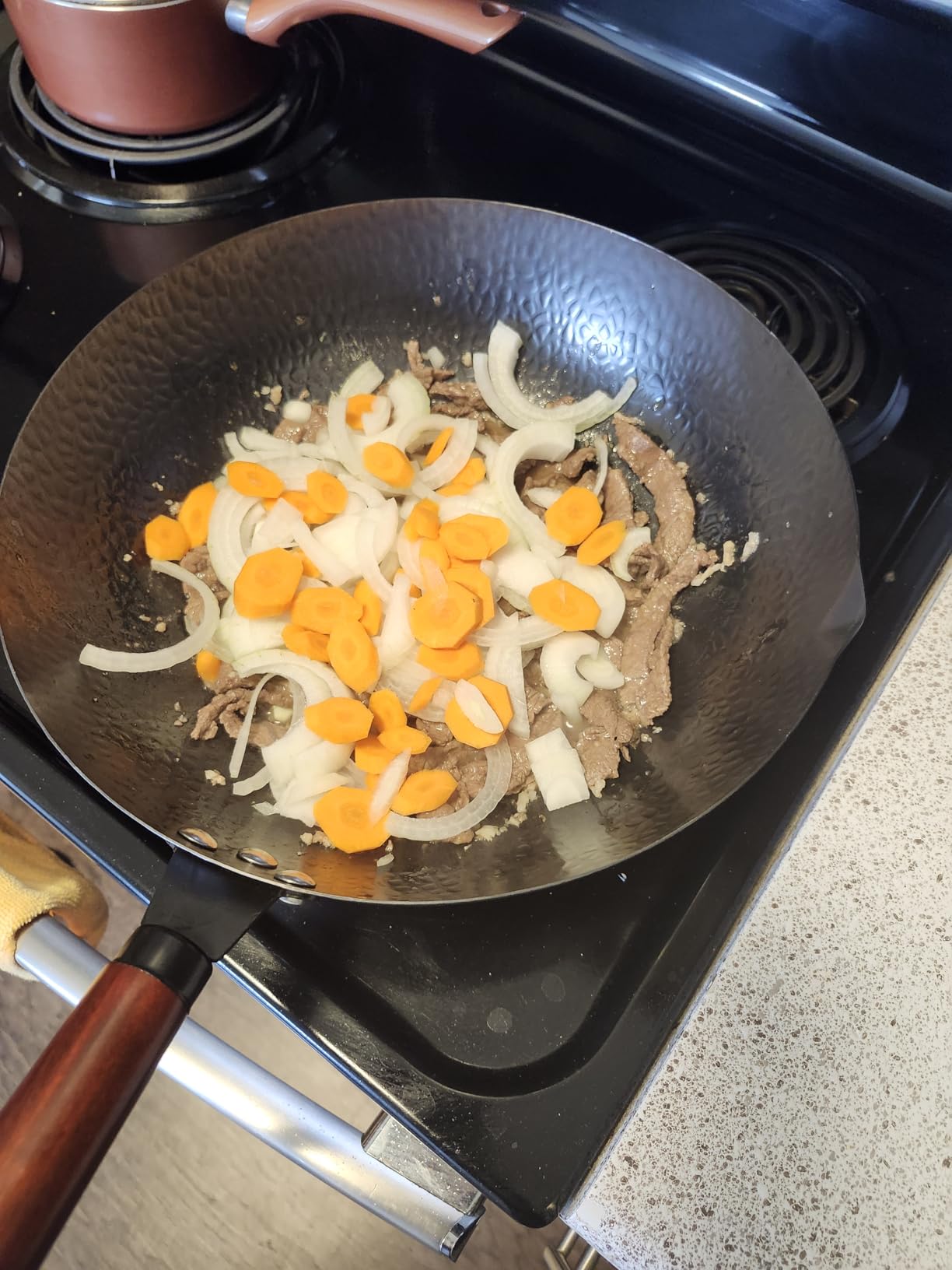
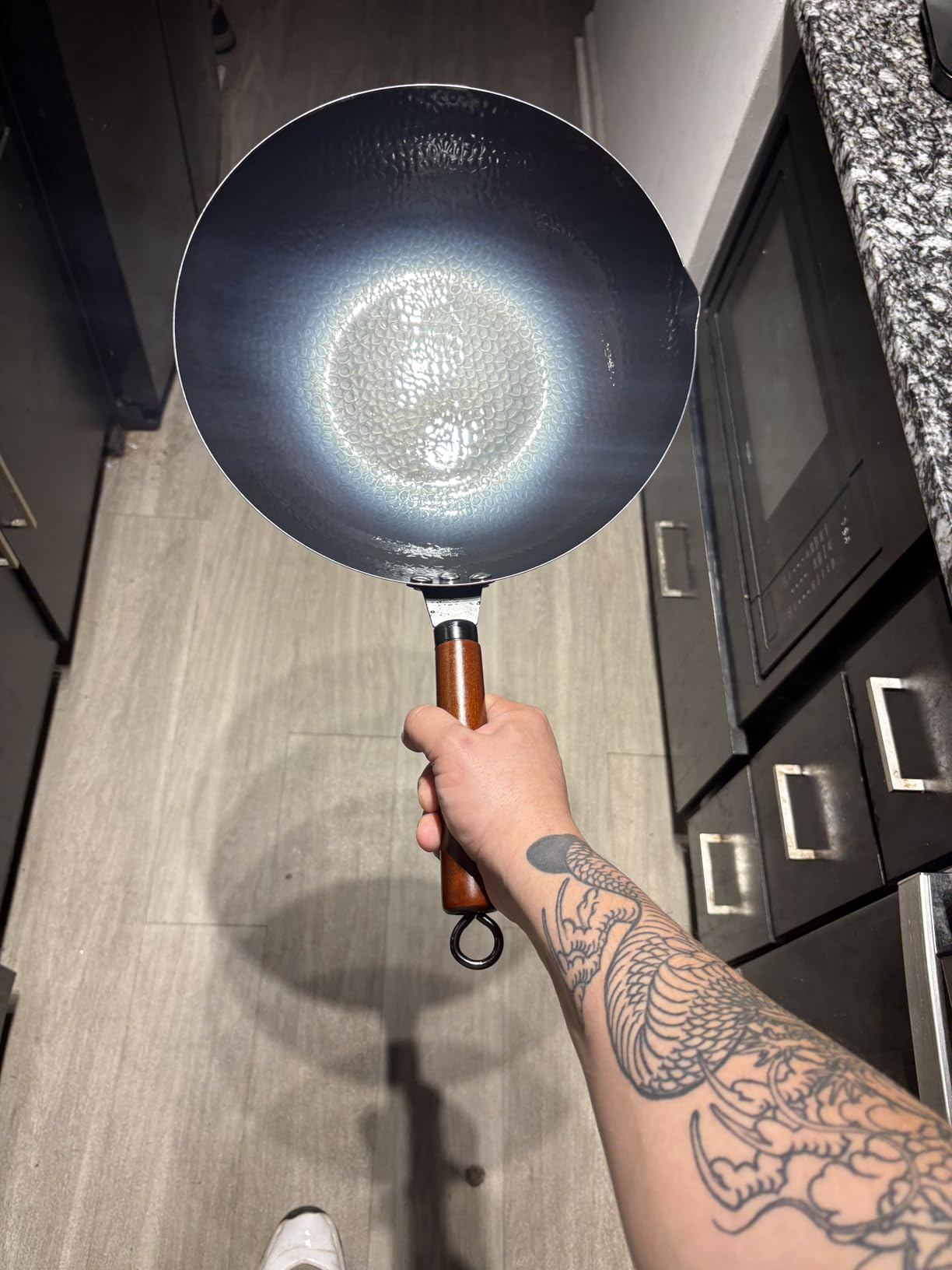
The honeycomb surface pattern is textured rather than smooth, which is intended to reduce sticking and to give utensils something other than bare steel to slide against. Heat comes up quickly and spreads evenly with no hot spots, and at 5 lb the pan handles well enough for comfortable cooking.
Owners frame it as the best value bundle for a reason. The complaints concentrate almost entirely on the accessories, which are thin stamped metal that can loosen or bend, and on isolated reports of rust or sticking on an under-seasoned pan. Plan on one more seasoning round beyond the factory coat before you judge it.
Does nitriding mean you can skip seasoning?
No. Nitriding slows corrosion, it does not create a non-stick surface. You still need an oil layer, and the listing is clear that the pan is factory pre-seasoned and ready after a simple cleaning rather than a finished surface.
The practical benefit is forgiveness. If the wok sits damp overnight or you skip an oiling after dinner, untreated steel will show rust the next morning and a nitrided pan usually will not.
What should you actually use from the bundle?
The wooden lid, which fits properly and turns the wok into a steamer for dumplings and fish. Everything else is filler, and a few of the stamped tools have edges sharp enough to scratch bare steel, so keep them away from the cooking surface.
6. YOSUKATA 14 Inch Round Bottom: Best Lightweight Traditional Wok
- True round bottom for authentic wok hei
- Light 3.8 lb for a 14 inch wok
- Large 5.8 liter capacity for family cooking
- Pre-seasoned at high temperature for a fast natural surface
- Will not work on flat electric or induction
- Still needs an oil coat before first use to prevent rust
If you want the traditional round-bottom experience and you do not want a 5 lb pan in your hands, this is the one. At 3.8 lb it is the lightest 14-inch wok here, and that matters more than the spec sheet suggests. Tossing food up the side of a wok is a physical act, and a heavy pan turns it into a two-arm effort.
On gas with a wok ring, the round bottom produces the tightest flame column of anything on this list. The 5.8 liter capacity handles a family stir-fry without crowding, and the factory seasoning above 600 °F means the natural non-stick layer builds faster than on a raw pan.
This is a gas and open fire pan, full stop. Cook on it over a charcoal grill or a camping burner and it is in its element. Reviews describe good heat response, a well-built handle and a surface that keeps improving as the patina builds.
The feedback is consistent about the trade. It needs a wok ring on many gas grates, and it simply will not work on a flat electric or induction top. If you have any chance of moving cooktops later, this is not the one.
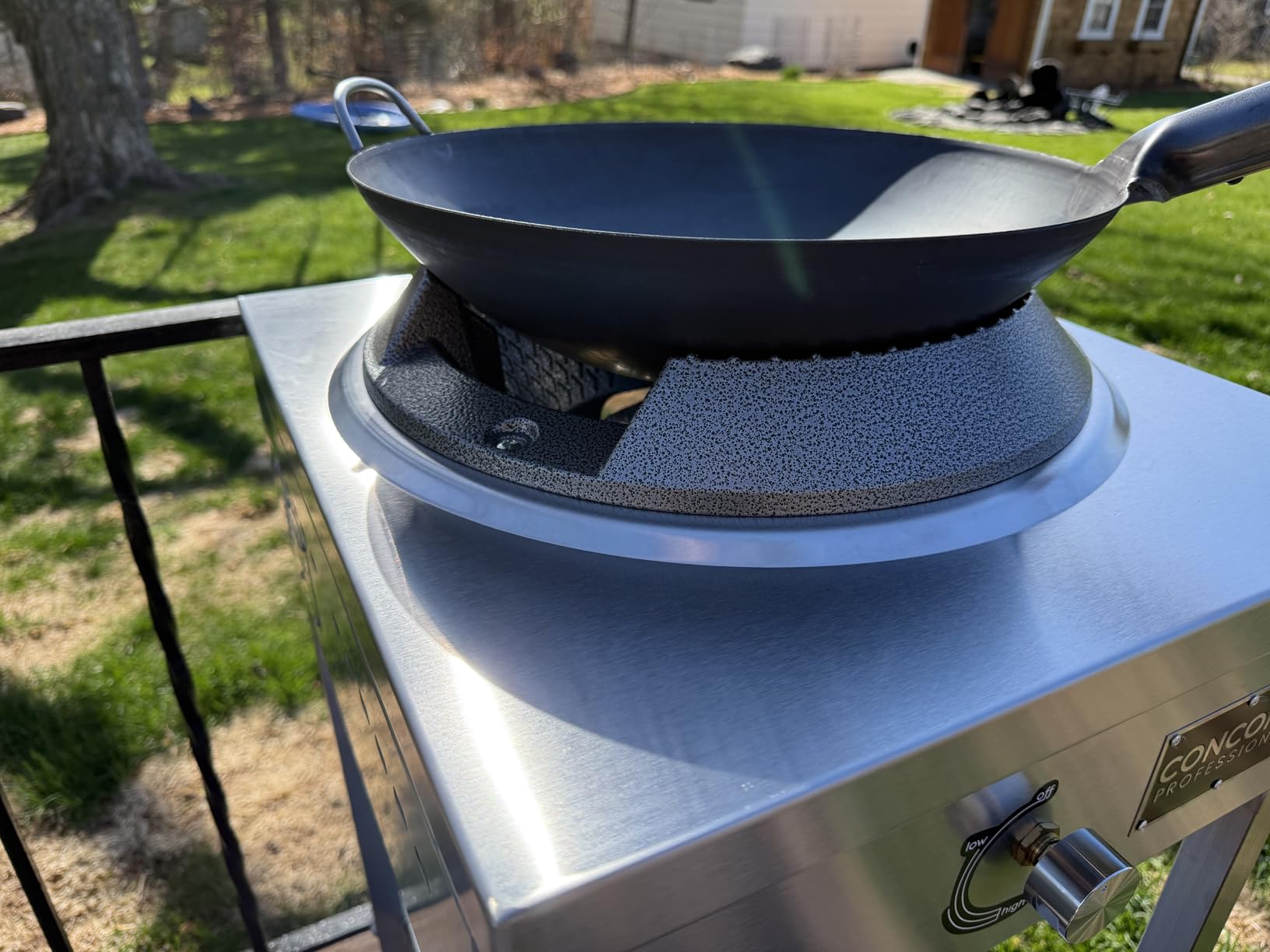
Round bottom on gas: what actually changes?
The bottom curves into a small footprint, so nearly all of the burner output lands in one tight area. Food in that zone hits searing temperature almost immediately, which is the core of wok hei, the smoky breath of the breath that good high-heat stir-frying produces.
The cost is stability. On flat grates the pan rocks unless you have a ring, and the wok cannot sit still while you chop, which is a real annoyance mid-meal.
How heavy is too heavy?
Somewhere around 5 lb for a 14-inch wok. Above that, one-handed tossing stops being practical and you will end up stirring with a spatula instead, which loses most of the advantage of a wok. This one keeps the traditional weight down while still having the steel mass to hold heat.
7. JOYCE CHEN 14 Inch Professional Series: Best Entry Point for Seasoning
JOYCE CHEN Professional Series 14-Inch Carbon Steel Wok with Phenolic Handles
- Genuine 1.8mm carbon steel at an entry price
- Removable resin handles allow oven seasoning
- Light 4.1 lb body with a helper handle
- Heats evenly and seasons easily
- Owners with experience report wobble and flex in the bowl
- Phenolic resin handles run hot in use
- Uncoated surface needs frequent seasoning
Joyce Chen is the name that comes up most often in forum threads when people ask what a sensible carbon steel wok is, and this 14-inch model is the version most of them mean. It is 1.8 mm carbon steel, uncoated, round bottomed, and light enough at 4.1 lb to move without thinking about it.
The detail that makes it genuinely useful for beginners is the removable resin handles. Take them off and the pan goes into an oven, which means you can run a proper oven seasoning at 450 °F and build the surface without an outdoor gas burner and a fish fryer. Handles rated to 500 °C, the bare pan takes far more than that.
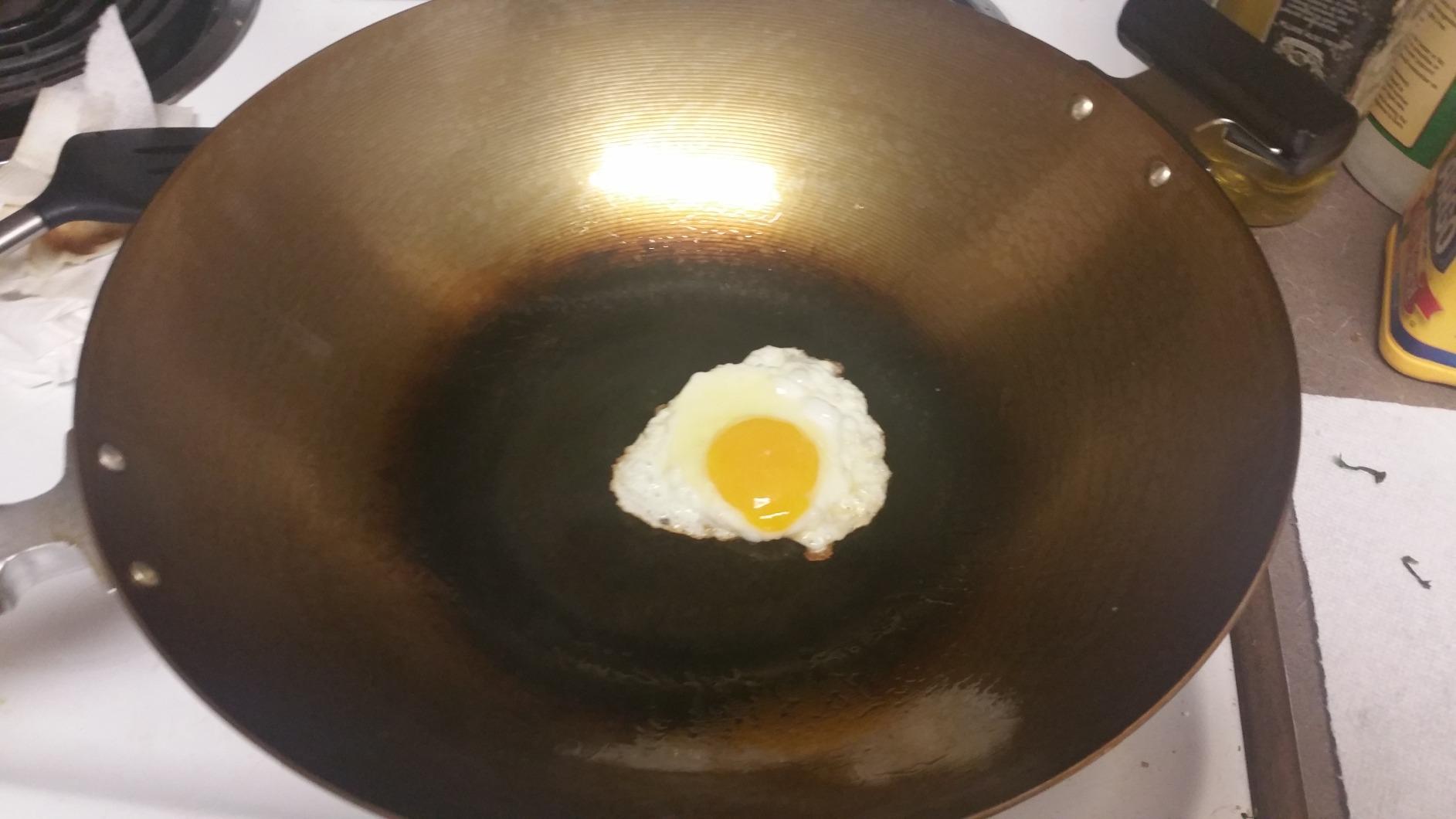
Praise centers on the gauge for the money and the fact that it heats evenly. For a first bare-steel pan, the surface is easy to season and the helper handle gives you real control over a round-bottomed wok that would otherwise be awkward to tip.
The criticism that seasoned cooks raise is structural flex. With experience you notice the bowl moves a little when you push food up the side, and that flex makes precise control harder. Many everyday buyers never notice it. The phenolic handles also get hot and grip less well than wood once the flame is wide open.
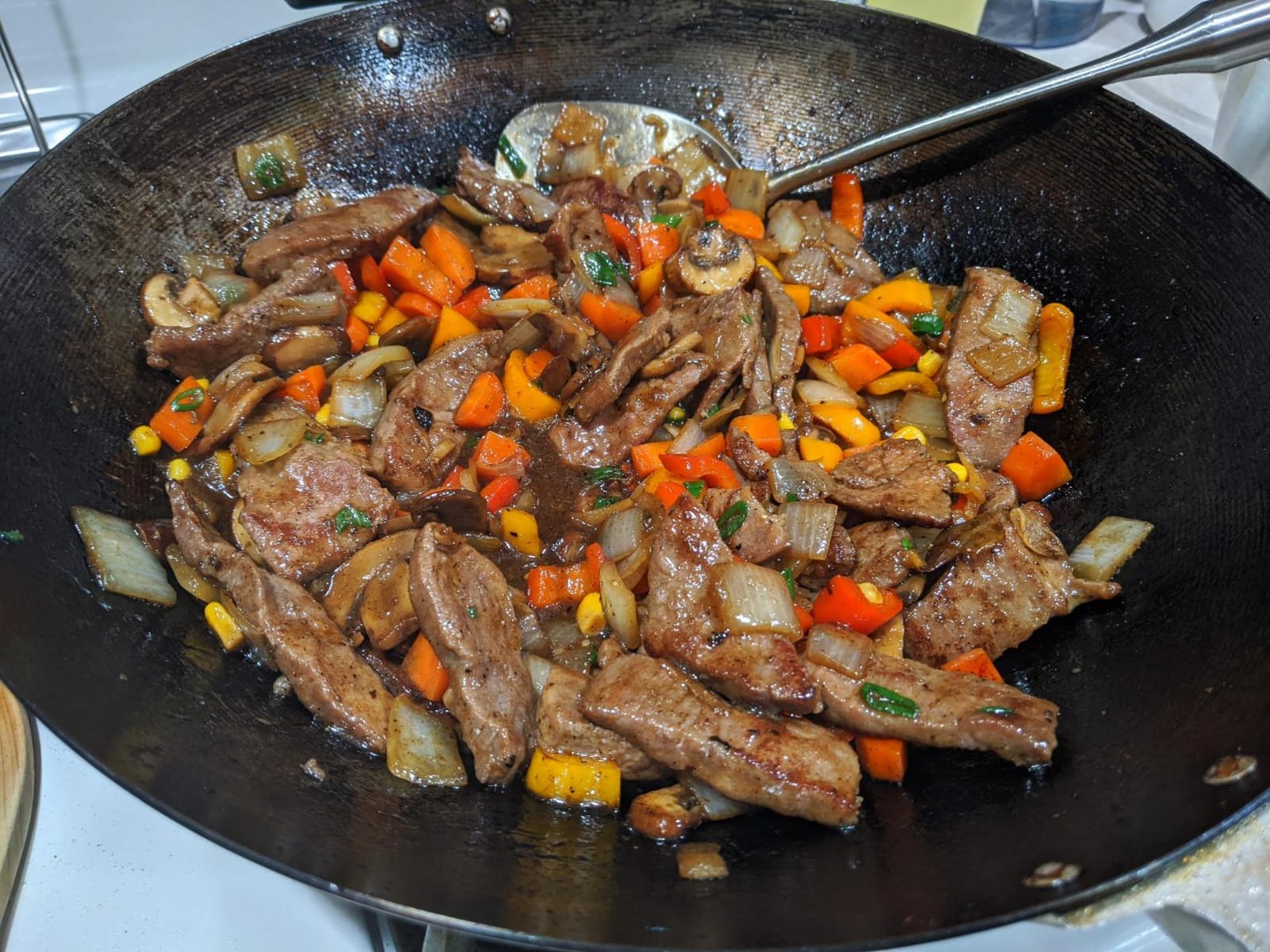
Is a 1.8 mm wok thick enough for deep frying?
Yes, and this is where gauge matters more than people expect. Around 1.8 mm gives you a pan that spreads heat evenly across a large base and does not scorch one spot under a steady fry. Very thin steel scorches oil; very thick steel takes forever to recover temperature when you lower a basket into it.
Watch the handles. Phenolic resin gets hot enough to need a mitt at full burner, and for a long deep fry that is the part of the pan you will grip most.
Wok ring or no wok ring?
Round bottom means you want a ring on a standard gas range. That ring is the only thing standing between this wok and a rock on cast iron grates, and it also sets the distance between the flame and the steel, which affects how quickly the pan comes to temperature.
8. Craft Wok 14 Inch Flat Hand Hammered: Best Flat Bottom Build Quality
Craft Wok Flat Hand Hammered Carbon Steel Pow Wok with Wooden and Steel Helper Handle (14 Inch, Flat Bottom) / 731W316
- Flat bottom works on gas electric and induction with no ring
- Heavy 1.8mm commercial grade steel with superb heat distribution
- Blues and seasons into a non-stick surface that improves
- Steel helper handle will not burn and aids hanging storage
- Very heavy at 4.6 lb for restaurant-style tossing
- Bottom is not perfectly flat from the hammering
- Wood handle needs removing before oven seasoning
This is the flat-bottom answer for the cook who wants the Craft Wok build without giving up gas compatibility. Same 1.8 mm commercial-grade steel, same hammering, same wooden main handle with a steel helper, but the base is flattened so it sits on your grates without a ring.
That flattening is what makes it a genuinely different proposition from a round bottom on gas. The contact area is wide enough that the flame does not have to find a small target, and the pan stays put while you prep. On a mixed cooktop kitchen it also means one pan covers gas, flat electric and flat induction, which a round bottom simply cannot do.
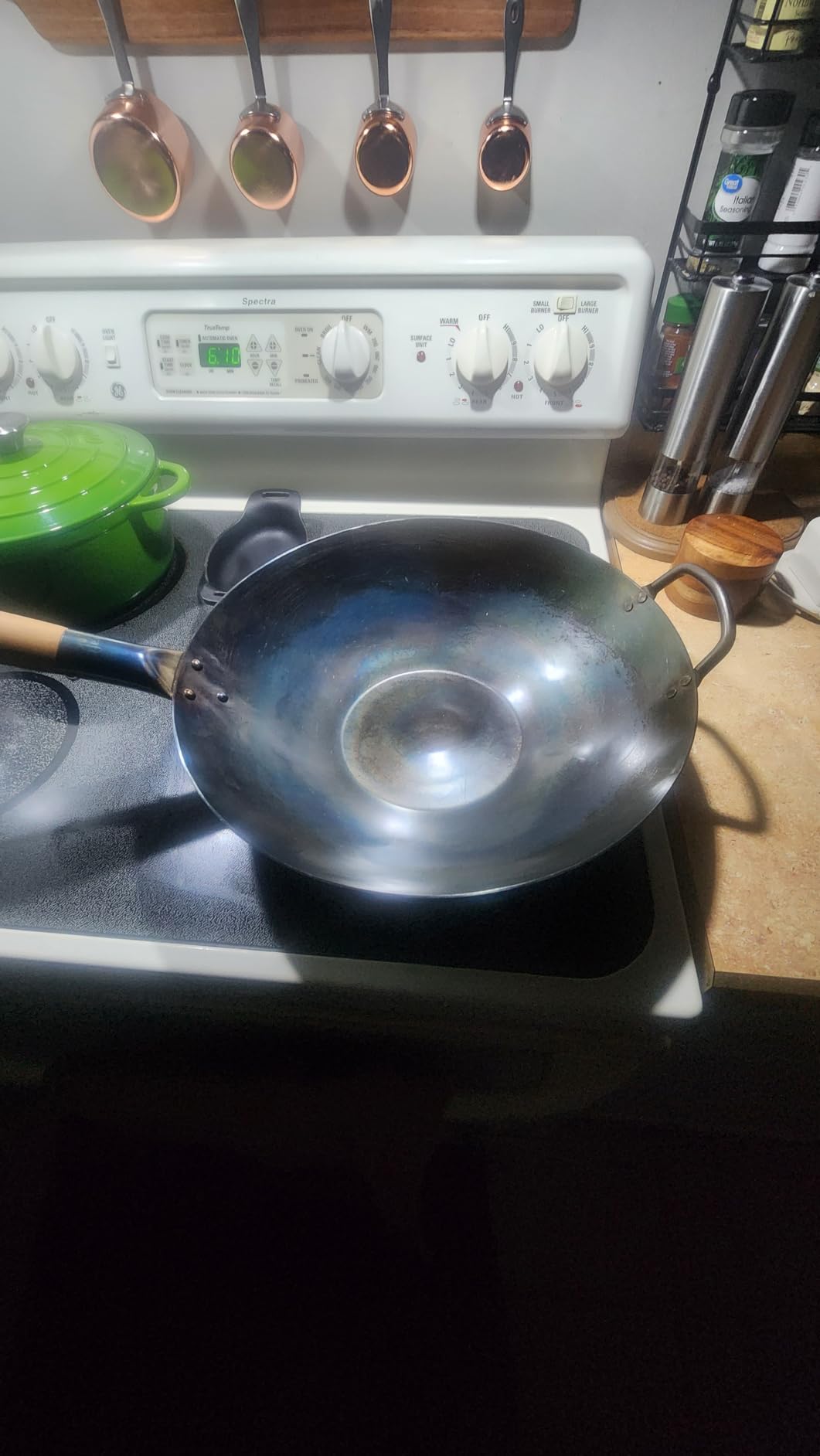
Owners treat the seasoning ritual as part of the appeal here. The finished blue patina cooks beautifully and the surface keeps getting better. Tight riveting and solid construction are repeatedly compared favorably against cheaper hammered woks, and the steel helper handle doubles as a hanging point.
Be honest about the bottom being flattened. The maker states it is not 100% flat, and that slight bubble is a byproduct of genuine hand hammering rather than a defect. You will feel a small wobble on perfectly level grates if you are the kind of person who notices that sort of thing.
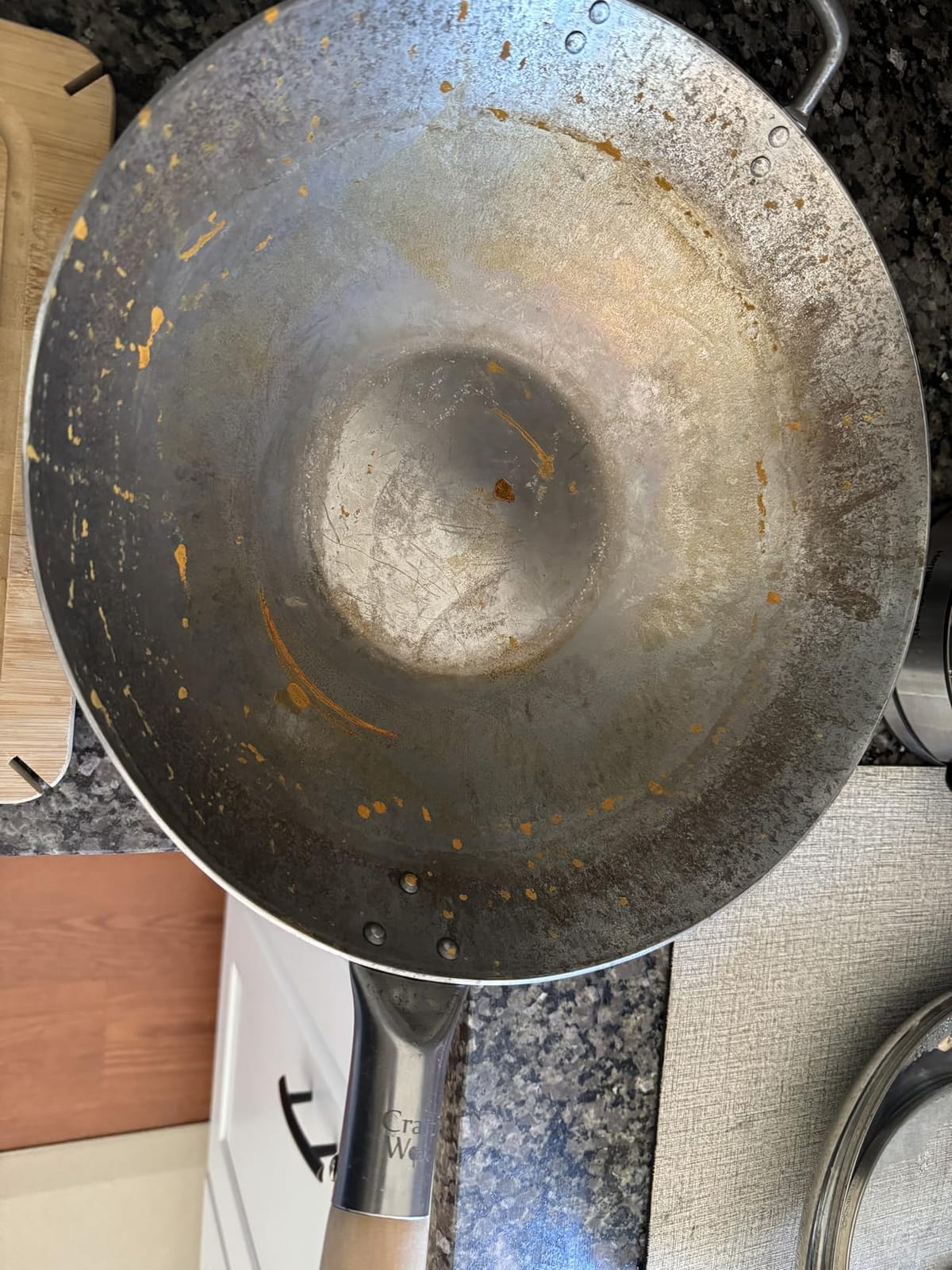
Round or flat Craft Wok: which one?
Go round if you have a strong gas burner and a wok ring, and you want the flame concentrated into the center. Go flat if you want stability, if you move between cooktops, or if you would rather not buy a ring and think about it.
Weight is the same either way at 4.6 lb, so the bottom shape is the only real variable in this decision. Plenty of cooks buy both, which is a reasonable move once you know which shape suits how you cook.
Can you oven season it?
Yes, with a small step. The wooden handle has to come off first, which is a two-minute job with a screwdriver. Once the bare steel is in the oven at 450 °F for an hour with a thin oil coat, the surface comes out of the box in better shape than most factory options.
9. Mammafong 14 Inch Flat Bottom Pow Wok: Best for Seasoning Control
Mammafong Flat Bottom Carbon Steel Wok Pan – Authentic Hand Hammered Woks and Stir Fry Pans – 14″ Pow Wok
- Light enough at 5 lb to toss one-handed
- Heats and cools very quickly for easy temperature control
- Flat base sits securely on gas and electric with no ring
- Blues quickly and reaches a slick state with little effort
- Arrives unseasoned so the full process is on you
- Seasoning generates heavy smoke and takes hours
- Can warp slightly on very high heat
Every other wok here arrives with some factory seasoning, apart from this one. The Mammafong comes raw with an anti-rust coating you have to scrub off first, which sounds like extra work until you understand what it buys you: a surface built entirely by you, exactly the way a restaurant wok is treated.
Experienced carbon steel cooks rate it very highly for heat response. At 3 liters of capacity and 5 lb it is light enough to toss one-handed, and it heats and cools fast enough that you can run a hot-and-fast stir-fry without waiting on thermal mass. Several buyers report owning a second one, which is not a normal thing to say about a wok.
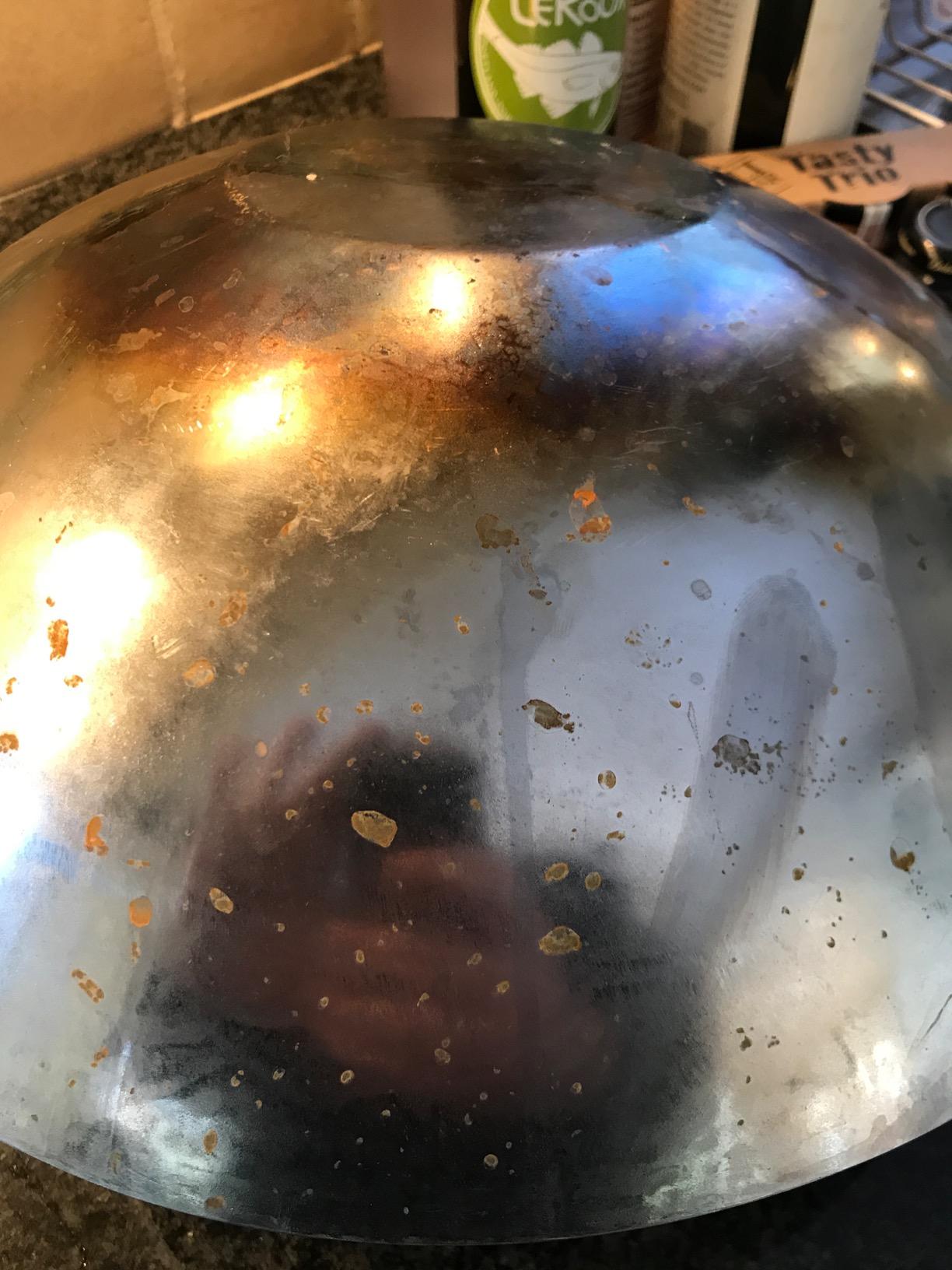
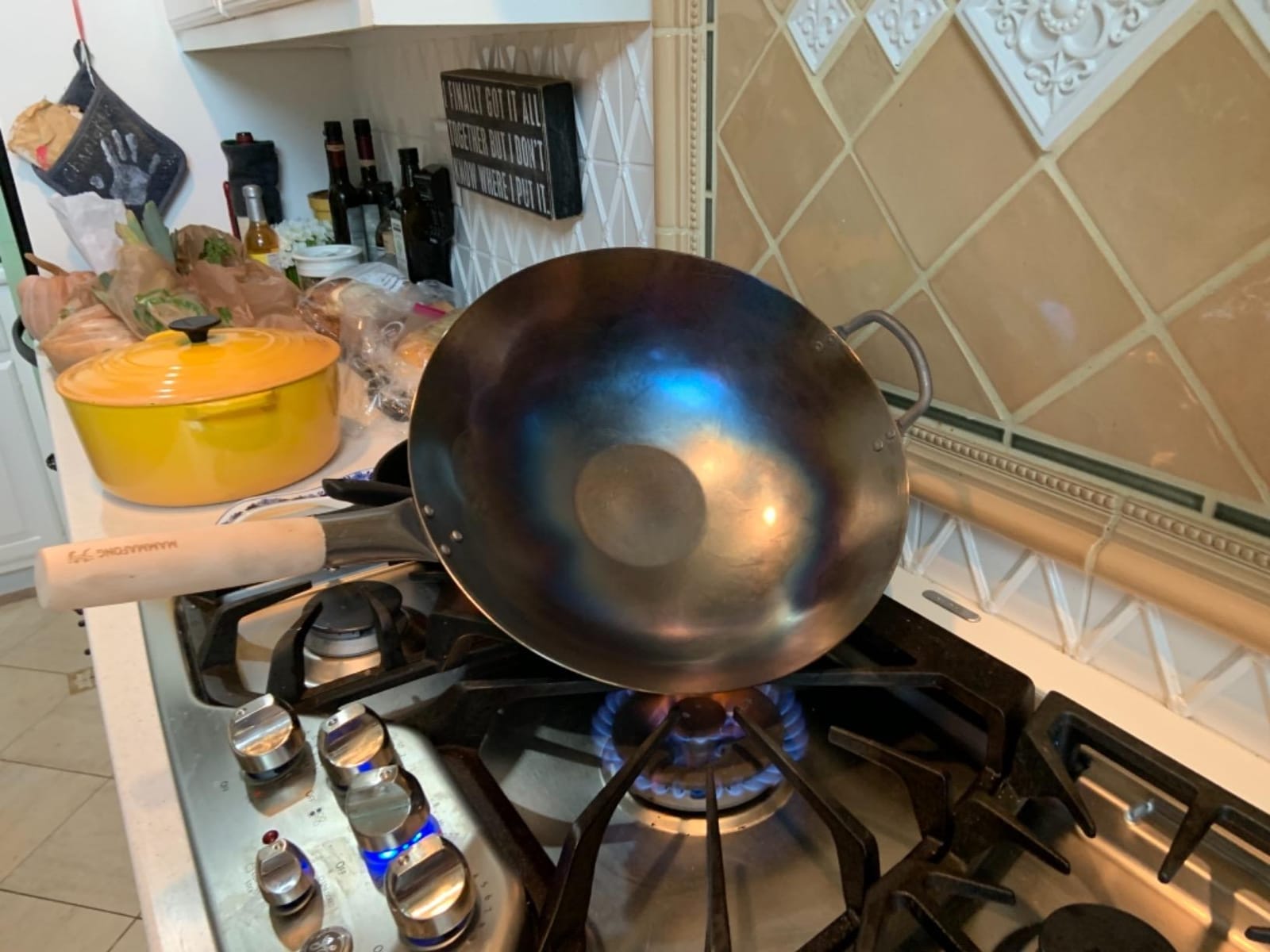
The body is 100 percent hand hammered with a machine pressed flat base, and it is built for gas and electric. Blued properly, the surface reaches a genuinely slick state with relatively little effort, and the flat base means no ring and no rocking.
The honest cost is the first session. Scrubbing, heating, oiling and repeating generates a lot of smoke and can take anywhere from one to several hours. Do it on a gas range with the hood on and a window open, because that is exactly the burner type this pan is designed for.
Is unseasoned really better?
It is better for the surface and worse for your first evening. Starting raw means every layer of polymerized oil is one you built, and people who enjoy the seasoning ritual generally end up with a better result than they get from a factory coat that was never actually heated by them.
It also means you can blue the steel properly, which is the high-temperature step that turns bare grey carbon steel into a stable, dark, naturally non-stick surface.
Any drawbacks on gas?
A few. Thin spots in hammered steel can warp on a very high flame if you leave it empty at maximum output, and some buyers found a small amount of rust at the handle edge on arrival. Neither is a dealbreaker, but both are reasons to start at a medium flame and dry the pan promptly.
10. Babish 14 Inch Flat Bottom: Best for Deep Frying on Gas
Babish 14 Inch Carbon Steel Wok Pan, Flat Bottom Stir Fry Pan, Induction
- Removable wooden handle allows full oven seasoning
- Wide 6 inch flat bottom is stable on gas with no ring
- Well balanced at 5 lb and heats very fast
- Deep enough to reduce spillover on a big stir-fry
- Arrives unseasoned so seasoning is required
- 5 lb is heavy for one-handed tossing
- Shape suits a flat stir-fry pan more than a classic wok
The Babish is described, over and over in the reviews, as the flat-bottom wok for people who were disappointed by round-bottom models that wobble or needed a ring. The 6-inch flat base is wide, and a wide base on a gas grate is a stable pan. You can chop with one hand on the counter and the wok stays exactly where you left it.
It arrives unseasoned, but the removable wooden handle changes that equation. Pull the handle and you can season the whole pan, tall sides included, in an oven. That is the difference between a surface that shrugs off eggs after two months and one that needs constant attention.
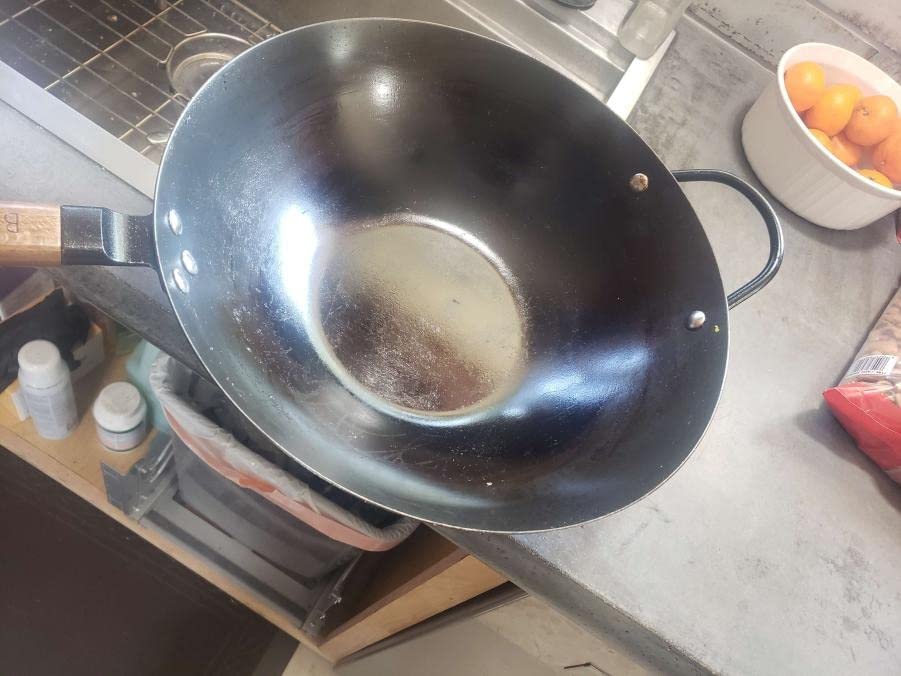
Deep frying is where the wide base earns its keep. Oil comes up fast and spreads evenly rather than pooling in one spot, which is what stops the temperature from crashing when you lower food in. The bowl is deep enough to cut down on spillover during a violent stir-fry, and it works on grill, gas, electric, ceramic, glass and induction.
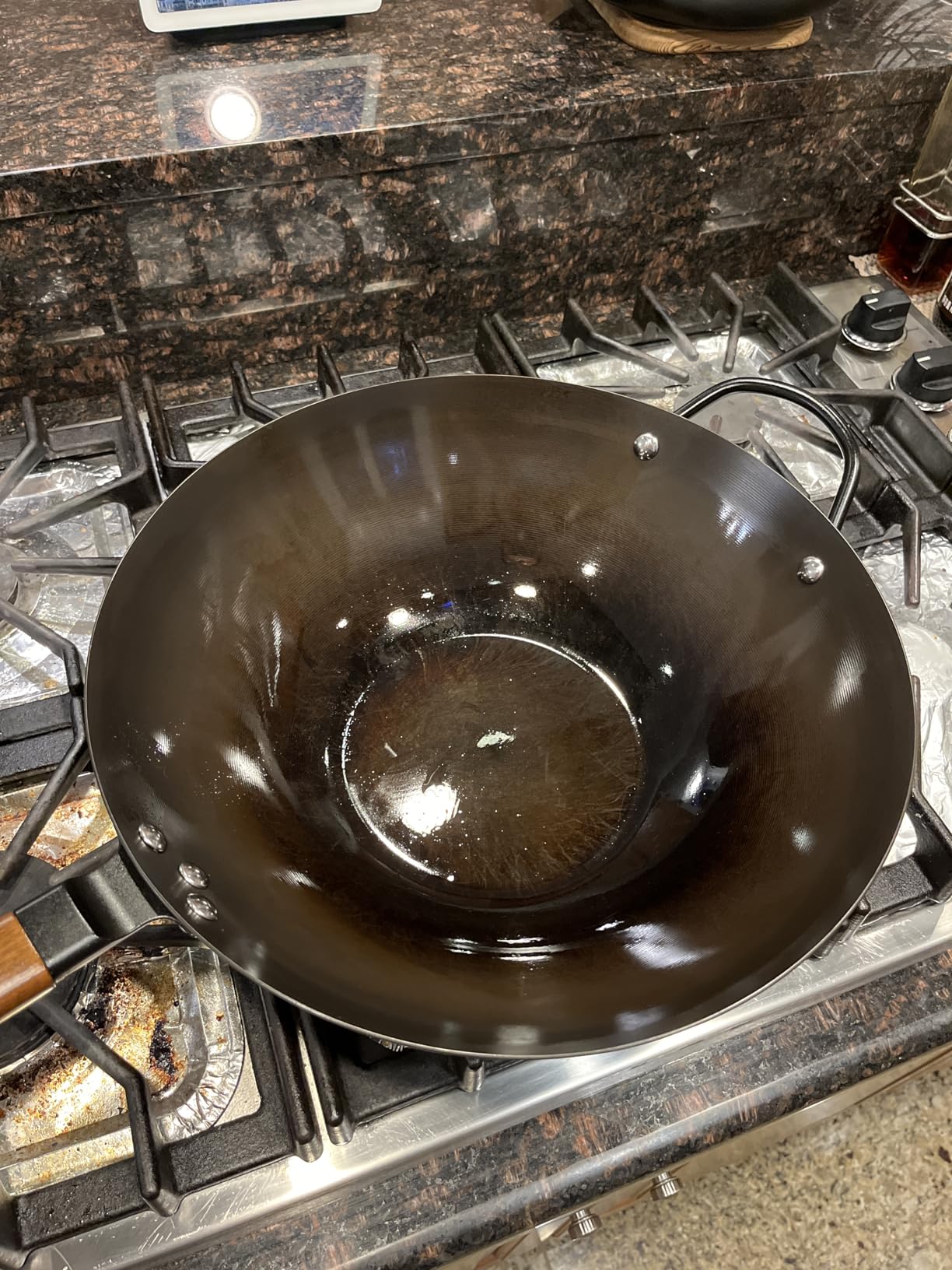
Riveted wooden handles stay cool to the touch, and the interior seasons well and cleans up quickly with a chain mail scrubber. The patina that builds after a few uses is durable in the way owners describe.
Is this a wok or a stir-fry pan?
Both, and that is the honest answer. The walls are straighter than a classic wok, so the sloped tossing surface is less dramatic, but the combination of a wide flat base and deep sides means oil stays put and ingredients do not fly out during a hard toss.
If your cooking is mostly stir-frying in batches with a slotted turner, you will love it. If you want to lift and snap a wok to move food, the curvature here will feel wrong to you.
Anything to watch out for?
The helper handle warms up over time and many owners add a silicone cover. Protruding interior rivets can also block a 12.5-inch steamer basket from seating properly, which is worth knowing if you planned to steam in the wok regularly.
11. IMUSA 14 Inch Carbon Steel Wok: Best Lightweight Everyday Pan
IMUSA 14 Inch Carbon Steel Wok with Wood Handles for Noodles
- Very light at 1.38 kg for a 14 inch wok
- Cool-touch wood handles plus a helper handle
- Flat base fits most cooking surfaces including gas
- Develops a usable natural non-stick surface with use
- Thinner steel gives less heat mass for deep frying
- Rounded bowl gives less flat surface
- Needs regular seasoning and oiling to avoid rust
At 1.38 kg this is roughly half the weight of most of the woks in this roundup, and it is the reason some cooks can genuinely toss with one hand. The wood main handle and matching helper stay cool to the touch, and the pan is balanced well enough that the empty weight is not obvious while cooking.
On gas the flat base fits most cooking surfaces and comes up to temperature quickly, which suits weeknight work where you are cooking one or two portions rather than a full family batch. The 3 liter capacity is right for stir-frying, fried rice and noodles.
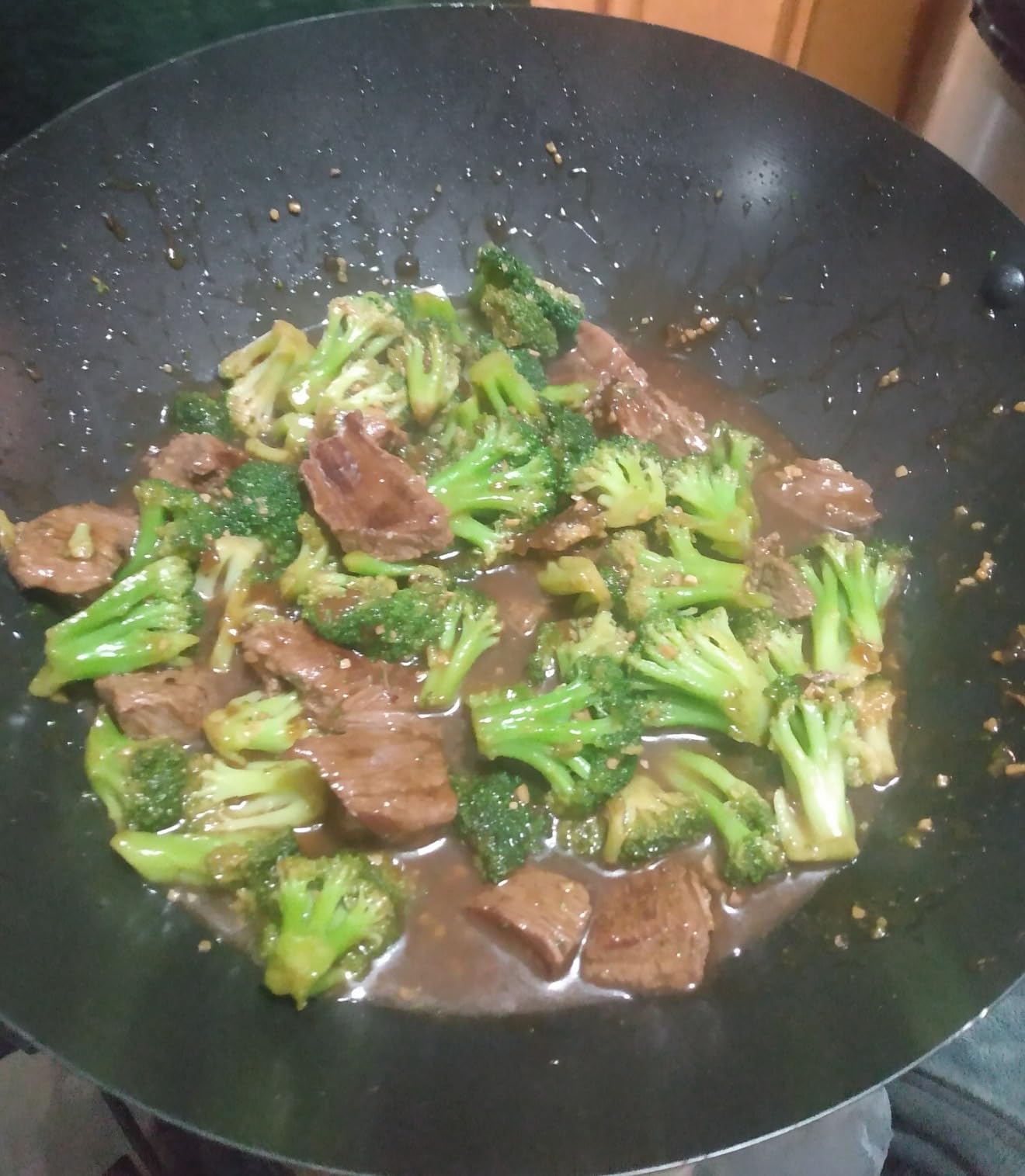
Buyers treat this as an affordable first carbon steel wok and rate it accordingly. The surface develops a usable natural seasoning with use, and there is no synthetic coating to scratch or flake. Nothing about the design is trying to be premium.
The trade is heat mass. Thinner steel gives you less thermal inertia, so it recovers temperature faster but has less to hold on to when you drop a large quantity of cold food into hot oil. That makes it a poor choice for serious deep frying and a good one for fast stir-frying.
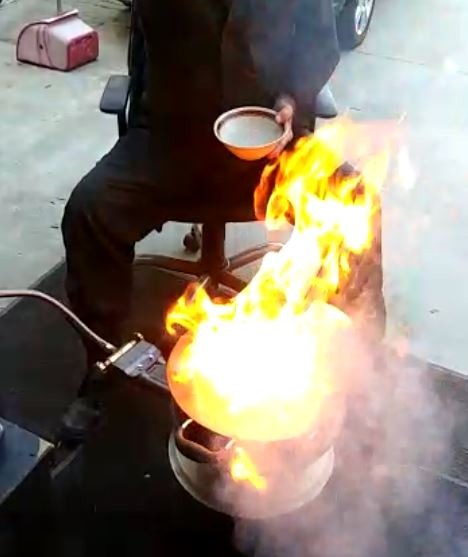
Is light steel a problem for a wok?
Not for stir-frying. A lighter pan actually helps with the throwing motion that defines wok cooking, and quicker heat-up times mean less wasted fuel on a small burner. The compromise shows up with big loads and long oil holds, where more mass keeps temperature steadier.
If you cook for four or more people at once, look at something with a stated gauge around 1.8 mm. If you cook for one or two, the light pan is the more enjoyable tool.
Anything confusing about the listing?
Yes, and it is a common issue with this brand. Many size and color variants exist, so check that the dimensions and capacity on the listing you are buying match what you expect. The 14 inch figure here refers to the cooking surface, not the total width including handles.
12. Teewe 13.4 Inch Round Bottom Set: Best Round Bottom with a Wok Ring Included
Teewe 13.4″ Carbon Steel Wok Traditional Hand Hammered Round Bottom Wok
- Solid carbon steel that heats fast and seasons well
- Cooking surface sized to serve four to six
- Welded handle socket gives a secure fit
- Accessory set includes a wok ring brush and drain rack
- Bundled wok ring is flimsy and slides on grates
- Listing says hand hammered but the surface is machine pressed
- Wooden handle needs manual screw installation
This one is included mainly because it comes with a wok ring, which is the single accessory most gas-stove buyers need and least often get. The set also carries a brush, an oil rack, a drain rack, chopsticks, spatulas, a turner and a ladle, so nothing else needs buying to get started.
The wok itself is 13.4 inches of 15-gauge carbon steel with a round bottom, which is the right shape for a gas flame. At 5.9 lb it is a heavy pan, and that mass is exactly what you want for searing, since it holds temperature when a whole batch of vegetables hits the surface.
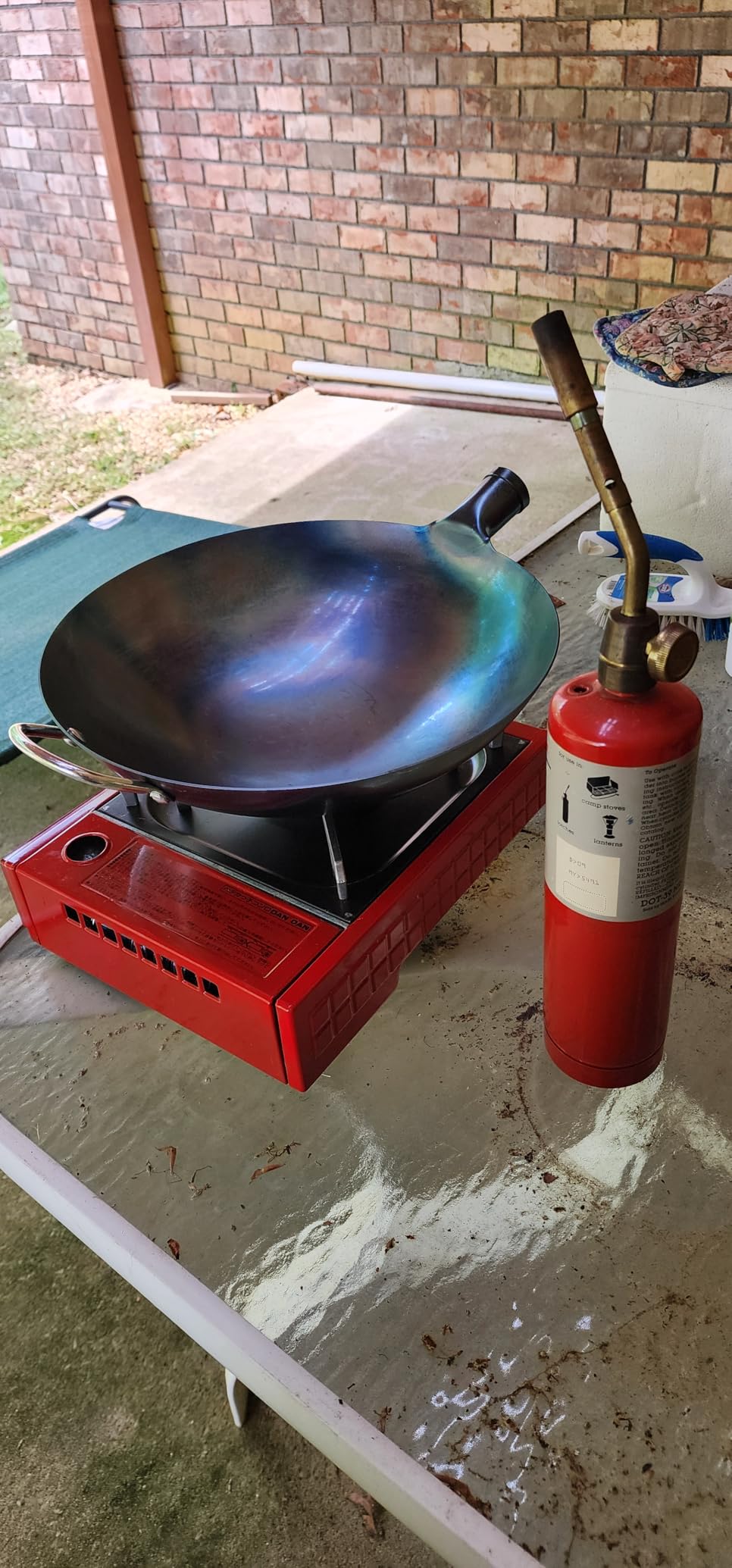
It arrives coated in oil to prevent rust in transit, and you wash and season it before first use. The welded handle socket gives a solid fit, and the cooking surface is sized for four to six people, which is generous for a 13.4-inch wok.
Two gripes come up repeatedly. The listing describes it as hand hammered but the surface is machine pressed with no hammer marks, and the bundled stainless ring is flimsy enough to slide around on grates. The bonus utensils are cheap stamped metal with sharp edges that can scratch bare steel.
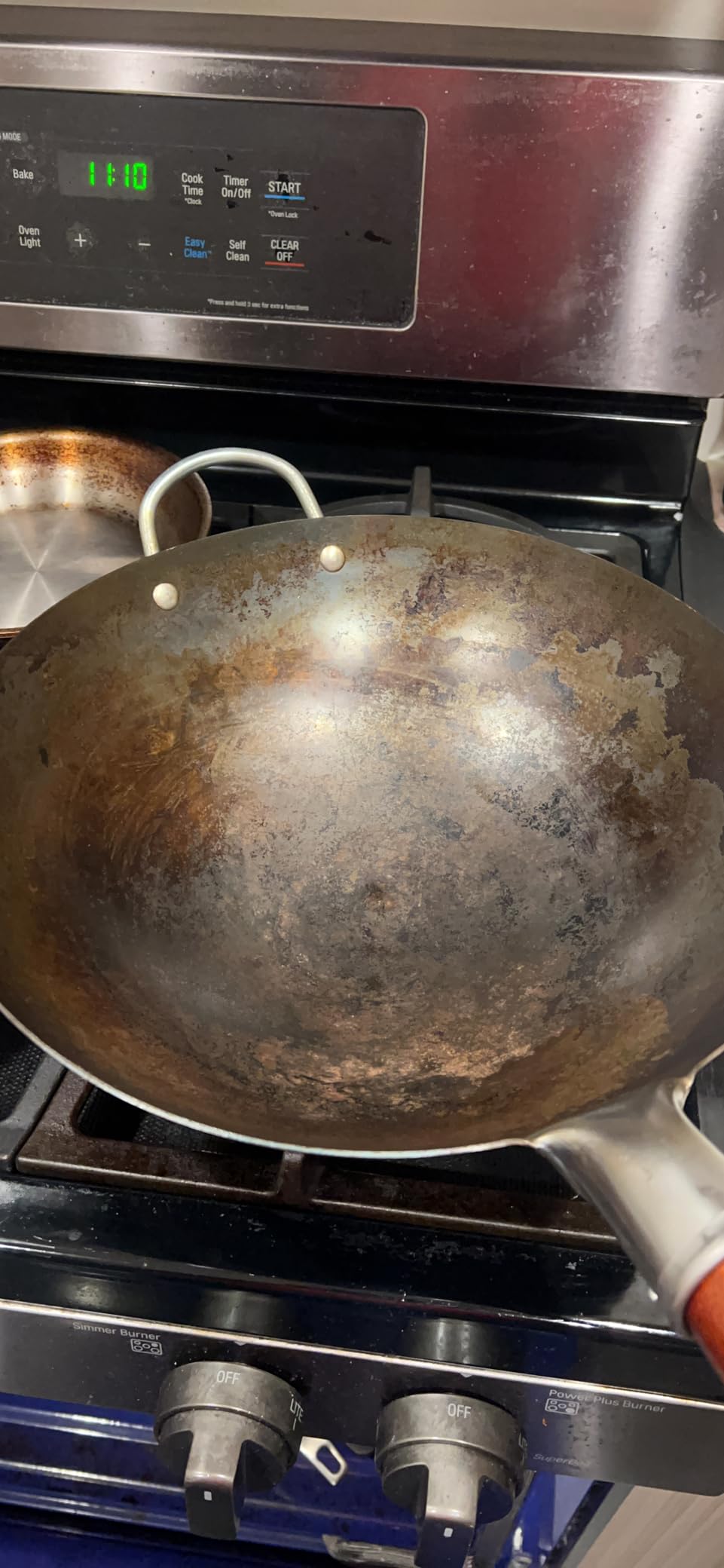
Is the included wok ring usable?
Usable, but replace it with a cast iron ring when you can. Thin stamped steel rings shift under a heavy round-bottom wok, and a shifting ring is its own wobble problem. A cast iron ring weighs enough to stay put and conducts heat into the wok base, which actually improves the sear.
Measure the ring diameter against your burner before assuming the bundled one fits. A ring that is much larger than the burner loses the tight flame column that makes a round bottom worthwhile.
How does the handle installation go?
The wooden handle has to be screwed onto the steel handle yourself, so have a screwdriver ready and expect five minutes. Owners generally report a secure fit once tightened, but check it again after the first few cooks as the steel and wood settle into different shapes.
How to Choose a Carbon Steel Wok for a Gas Stove
Start by measuring, not by shopping. Put a ruler across the top of the burner grate and note the width, then measure the gap between grates. A round bottom needs that gap to be wider than the wok’s base contact point or it will rock, and a 14-inch wok on a small burner wastes half your flame on the sides of the pan.
Next, match the wok to the work. If you stir-fry most nights for two people, a 12 to 13 inch pan is right. Cooking for a family of four or doing deep frying pushes you to 14 inches, and you should check that your range grates will support the diameter without tipping.
Then look at steel gauge, because that is the number most listings hide behind the phrase heavy gauge. Around 1.8 mm is the sweet spot for a home gas range: enough mass to hold temperature under load, not so much that preheating takes forever. Below about 1.5 mm you are buying a pan that scorches oil, and the trend in enthusiast circles is toward thinner and thinner steel for wok work.
Handles matter more on gas than anywhere else, because a flame wide open will cook the handle assembly as fast as the pan. Wood and phenolic stay manageable; bare steel helper handles need a mitt. Removable handles are worth paying for because they unlock oven seasoning.
Finally, decide what non-stick means to you. A pre-seasoned pan is a head start, not a finished surface, and the honest expectation is that a new carbon steel wok sticks through the first several cooks while the polymerized layer builds. If you want a usable surface on day one with no maintenance at all, a non-stick coated wok like the Kenmore in this list is a different purchase, not a better one.
Round Bottom vs Flat Bottom on a Gas Stove
Round bottom concentrates heat. The curved base presents a small target to the burner, so nearly all of the output lands in one tight column in the center of the bowl. That is the closest a home kitchen gets to wok hei, and it is why round-bottom cooks obsess over flame size. The cost is that the pan rocks on flat grates and will not work on electric or induction at all.
Flat bottom prioritizes stability and versatility. A wide base spreads the flame across a larger area, which means slightly less peak heat but a pan that will not tip when you turn away from the stove to chop. It also works on electric and induction, so it is the safer choice if you ever change cooktops or use a portable burner.
There is a middle path worth knowing about. Several flat-bottom designs still have deeply sloped walls, so you get most of the usable tossing surface of a true wok while keeping the base stable. If you cook on gas only and want maximum flame concentration, a round bottom on a cast iron ring wins. If you want one pan for everything, flat bottom wins.
Do You Need a Wok Ring?
A wok ring is a heavy cast iron or steel trivet with a circular opening, sized to hold a round-bottom wok above a burner. It does two things: it stops the wok rocking, and it sets the distance between the flame and the steel so the fire can reach the metal evenly.
You need one if your wok has a round bottom, full stop. Without it the pan rocks, which is the most common complaint in wok reviews and the reason so many buyers return round-bottom models within a month. If your range has a built-in wok burner or a cast iron grate with a large enough circular opening, you may not need to add one.
You do not need one for a flat bottom, and adding one is a genuine mistake. Lifting a flat-bottom wok onto a ring raises it away from the flame, so the wide base that made it work now sits too high and the burner output never reaches the pan properly. Forums describe this as a common self-inflicted problem.
Buy a cast iron ring rather than a thin stamped steel one. The weight keeps it from sliding on grates, and the cast iron conducts heat into the base, which improves the sear rather than reducing it, provided the ring diameter closely matches your burner.
How to Season a Carbon Steel Wok
Strip the pan first. If it arrived with a factory coat, that is fine, but if it arrived raw with an anti-rust coating, scrub it with hot soapy water and a chain mail scrubber until the metal is bare and grey. Dry it completely, because seasoning will not bond to a wet surface.
Coat every surface, inside and out, with a very thin film of a high smoke point oil. Grapeseed, canola, avocado and peanut all work. Avoid olive oil and anything extra virgin, because they smoke at seasoning temperatures and turn bitter. Wipe the pan with a paper towel until it looks almost dry, because pooling oil is the number one cause of a sticky, blotchy result.
Heat the wok on a gas burner over medium-high until a faint plume of smoke leaves the surface and the color shifts from grey toward blue or gold. A 14-inch pan takes a few minutes. Then take it off the heat, let it cool, and repeat the oil and heat cycle two or three more times.
If the handles are removable, take them off and season the tall sides in the oven at 450 °F for an hour instead. Many of the woks in this list have that option, and oven seasoning gives you far more even coverage than a burner.
Finish with a real cook. Heat the pan hot, add a fatty piece of food, let it sit for a minute before moving it. That first deliberate sear is what begins the polymerized layer that every owner describes in reviews as the moment the wok started to feel non-stick.
Care, Cleaning and Getting Rid of Rust
Cleaning takes thirty seconds. While the pan is still warm, rinse it with hot water, scrub any stuck bits with a chain mail scrubber or a stiff brush, and dry it on the heat for a minute or two. Do not use dish soap as a habit and do not put carbon steel in a dishwasher. A little neutral soap occasionally is fine.
The single rule that decides whether your wok lasts is this: it does not get stored wet. Heat it on the burner until the water is gone, wipe a thin coat of oil over the surface, and put it away. Skip that and a damp wok in a cupboard will show rust within days, which is the most common complaint across every product in this roundup.
If rust appears anyway, it is not a death sentence. Scrub the affected area with coarse salt and a little oil, or with the chain mail scrubber, until you are back to bare metal. That does strip the seasoning locally, but only in the spot you treated.
Rebuild it with one more thin oil coat and a hot burner pass, then cook fatty food in it a few times. Flash rust from storage takes one session to fix. Heavy rust that pits the surface takes a full re-season, and a wok that has pitted badly is a candidate for retirement rather than repair.
For a deeper look at maintaining a full carbon steel collection, our carbon steel cookware set guide covers seasoning chemistry across pans, skillets and woks. If your range is not the only heat source in your kitchen, our picks for flat bottom woks on electric stoves and woks for induction are worth a look too.
Frequently Asked Questions
Do woks work on a gas stove?
Yes. A gas flame rises in a ring and heats the curved walls of a wok evenly, which makes gas the best home heat source for stir-frying. A round bottom concentrates the flame into a tight column on a wok ring for maximum wok hei, while a flat bottom sits stably on the grates and works on electric and induction as well.
What is the best carbon steel wok for a gas stove?
It depends on your bottom shape preference and whether you have a wok ring. For gas only with a ring, the Craft Wok 14-inch round bottom in 1.8mm steel is the strongest all-round pick. For a pan that sits on the grates with no ring and still works on other cooktops, the YOSUKATA 13.5-inch flat bottom is the better fit.
Is a round bottom wok better than a flat bottom wok?
On a gas stove, a round bottom gives you more concentrated heat and better wok hei, but it rocks on flat grates and needs a wok ring. A flat bottom is more stable, slightly cooler at peak, and works on gas, electric and induction. If you have a strong gas burner and buy a cast iron ring, round bottom wins on heat. If you want versatility, flat bottom wins.
What are the common problems with carbon steel woks?
The most repeated complaints are rocking round bottoms that need a wok ring, handles that get hot at full flame, food sticking until the seasoning layer is properly built, and rust appearing when the pan is stored damp. Handles that loosen and bundled accessories that scratch bare steel also come up often. Most of these are avoidable with a ring, a mitt, and a dry-and-oil routine after every use.
How do you get rid of rust on a carbon steel wok?
Scrub the rusted area with coarse salt and a little oil, or with a chain mail scrubber, until bare metal shows through. Then wipe on a very thin coat of high smoke point oil and heat the wok until it smokes, repeating two or three times. Flash rust from storage fixes in one session. Rust that has pitted the surface needs a full re-season or a replacement.
Are carbon steel woks better than cast iron or stainless steel?
Carbon steel is much lighter than cast iron, which is what makes tossing food possible, and it seasons into a naturally non-stick surface that improves with use. Stainless steel needs no seasoning but sticks without oil and cannot take the seasoning layer. Carbon steel is the usual answer for stir-frying because of weight, heat response and the curved walls, though all three materials have a place in a kitchen.
The Best Carbon Steel Woks for Gas Stoves in 2026
The best carbon steel woks for gas stoves come down to one question you can answer in a minute: do you want a round bottom on a cast iron ring, or a flat bottom straight on the grates? The Craft Wok 14-inch round bottom is our pick for cooks chasing real wok hei on a dedicated gas burner. The YOSUKATA 13.5-inch flat bottom is the safer buy for most kitchens, and the Souped Up Recipes set is hard to argue with if you want everything you need in one box.
Whichever you choose, the surface you cook on after three months will be nothing like the one you received. Oil the pan, dry it on the flame, store it dry, and do a little fatty food in it often. That routine is what turns bare steel into the most useful pan in your kitchen, and it works on any burner you have. For readers comparing materials first, our stainless steel wok roundup covers the alternative case honestly.