
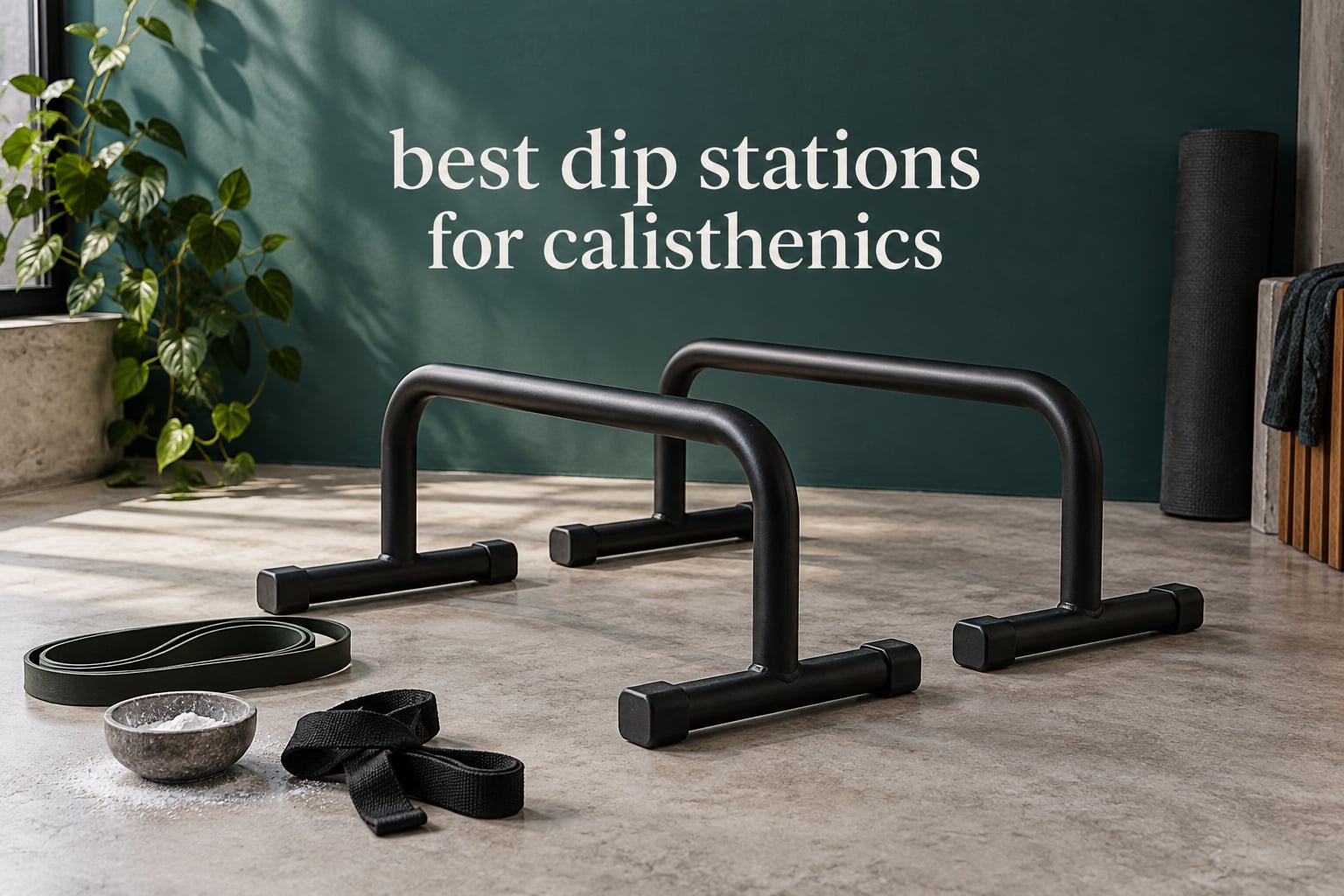
A dip station is a pair of parallel bars set shoulder-width apart, either freestanding on the floor, wall-mounted, or built into an all-in-one power tower. A dip bar usually means the portable freestanding version you can carry between rooms. Both give you dips, rows, L-sits and leg raises; the tower simply adds pull-ups and push-ups to the same frame.
Picking the best dip stations for calisthenics comes down to three numbers: bar height, bar spacing and rated load. Get those right and the frame wobbles less, your shoulders stay comfortable, and you have room to progress from assisted dips to weighted dips with a belt. Get them wrong and you are stuck shimming a short stand or loading a frame that was never rated for your bodyweight.
Here is how we chose the ten units below. We compared manufacturer specifications against thousands of published owner reviews, focusing on stability complaints, sizing fit for different heights, real-world load limits, and how much floor space each one eats. We did not physically test these frames, so every verdict below is a spec-and-review comparison rather than a first-hand trial. We say so plainly because plenty of gear roundups do not.
One honest note before we start. A dip station is a later-stage purchase for most beginners. If you cannot yet do five strict bodyweight dips, a sturdy pull-up bar plus a floor routine will carry you further for far less money. The stations here make sense once dips are already part of your week.
Table of Contents
Top 3 Dip Stations for Calisthenics in 2026

ProSourceFit Power Dip Station
- Adjustable 31-35 in height
- 7 width settings
- Rated to 400 lb
- Connector-locked bars
Amazon Basics Dip Bar Station
- Rated to 661 lb
- Foam grips and floor pads
- Compact steel frame

Lebert EQualizer Strengthener
- Two independent stainless bars
- 28 in height
- Includes band and videos
Quick Overview: All 10 Dip Stations Compared
The table below lists every station in this roundup with the specs that actually decide performance. Ratings and review counts are copied straight from the current listings.
| Product | Specifications | Action |
|---|---|---|
| ProSourceFit Power Dip Station |
|
Check Latest Price |
| Amazon Basics Dip Bar Station |
|
Check Latest Price |
 RELIFE Dip Bar 400 lb RELIFE Dip Bar 400 lb |
|
Check Latest Price |
 BalanceFrom Steel Frame Dip Station BalanceFrom Steel Frame Dip Station |
|
Check Latest Price |
 Sportsroyals Adjustable Dip Bar Sportsroyals Adjustable Dip Bar |
|
Check Latest Price |
| Lebert EQualizer Strengthener |
|
Check Latest Price |
 Ultimate Body Press Folding Dip Station Ultimate Body Press Folding Dip Station |
|
Check Latest Price |
 Dripex Heavy Duty Dip Station Dripex Heavy Duty Dip Station |
|
Check Latest Price |
 Bongkim 7 Height Dip Station Bongkim 7 Height Dip Station |
|
Check Latest Price |
 Sportsroyals Power Tower Sportsroyals Power Tower |
|
Check Latest Price |
1. ProSourceFit Power Dip Station: The Best All-Rounder With Real Adjustment
- Connector locks the bars and kills movement
- Height and width both adjustable
- Fast assembly with the included tool
- Padded grips
- Limited lifetime warranty
- Grip foam is thin on some variants
- Light residual wobble can remain
- Paint scratches easily
Our pick for most home gyms. The ProSourceFit adjusts bar height from 31 to 35 inches and offers seven width settings from 19.5 to 26.5 inches in one-inch steps, which is more width positions than any other adjustable stand here. That range matters more than it sounds, because it lets one station fit a 5’4″ teenager and a 6’2″ adult in the same household.
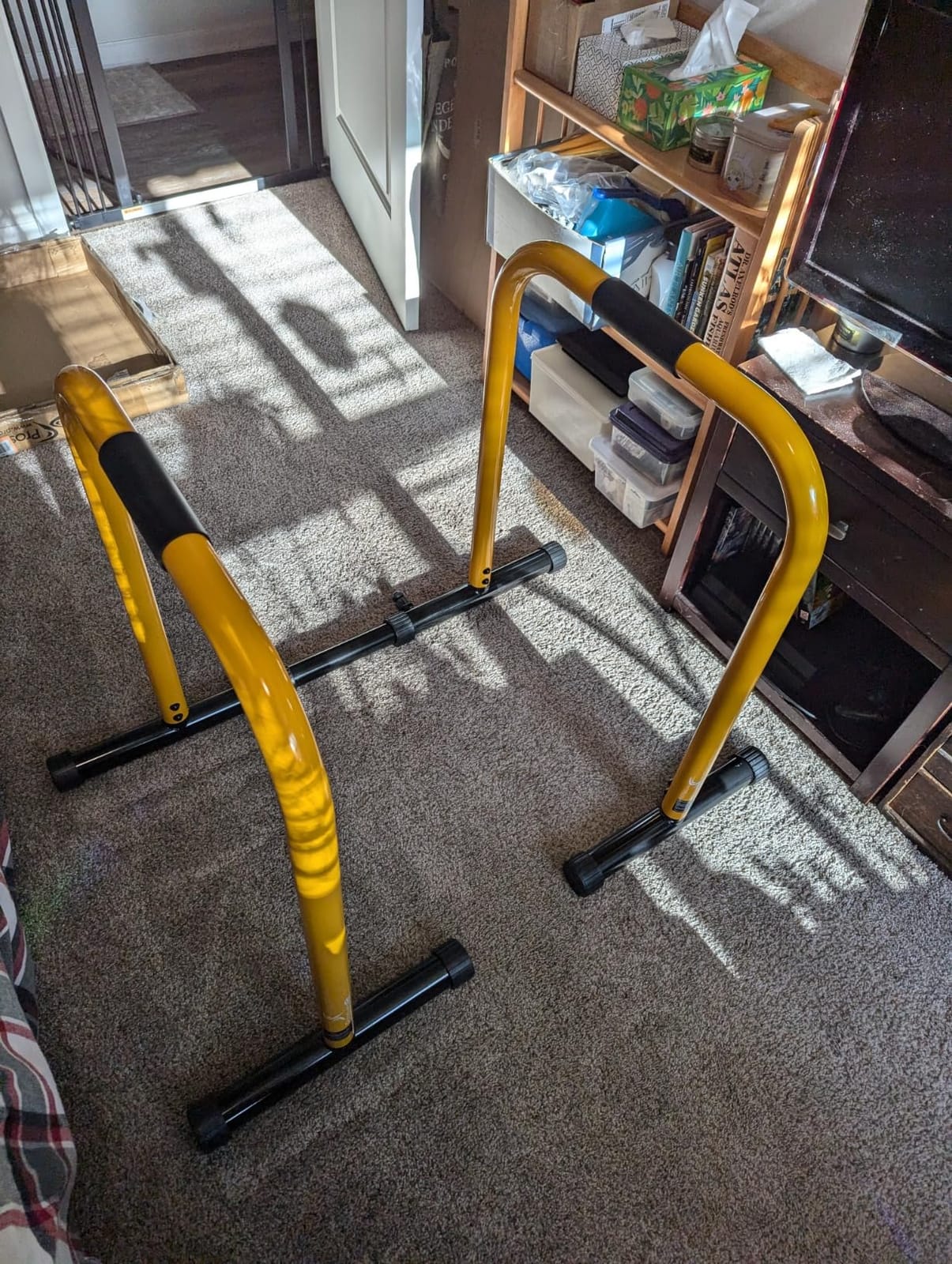
The detail that separates it from cheaper parallettes is the safety connector. A U-shaped locking bar ties the two uprights together near the floor, so the frame behaves like one rigid unit instead of two independent posts that rock against each other. Owners consistently credit that connector, not the tubing gauge, with the stability they experience.
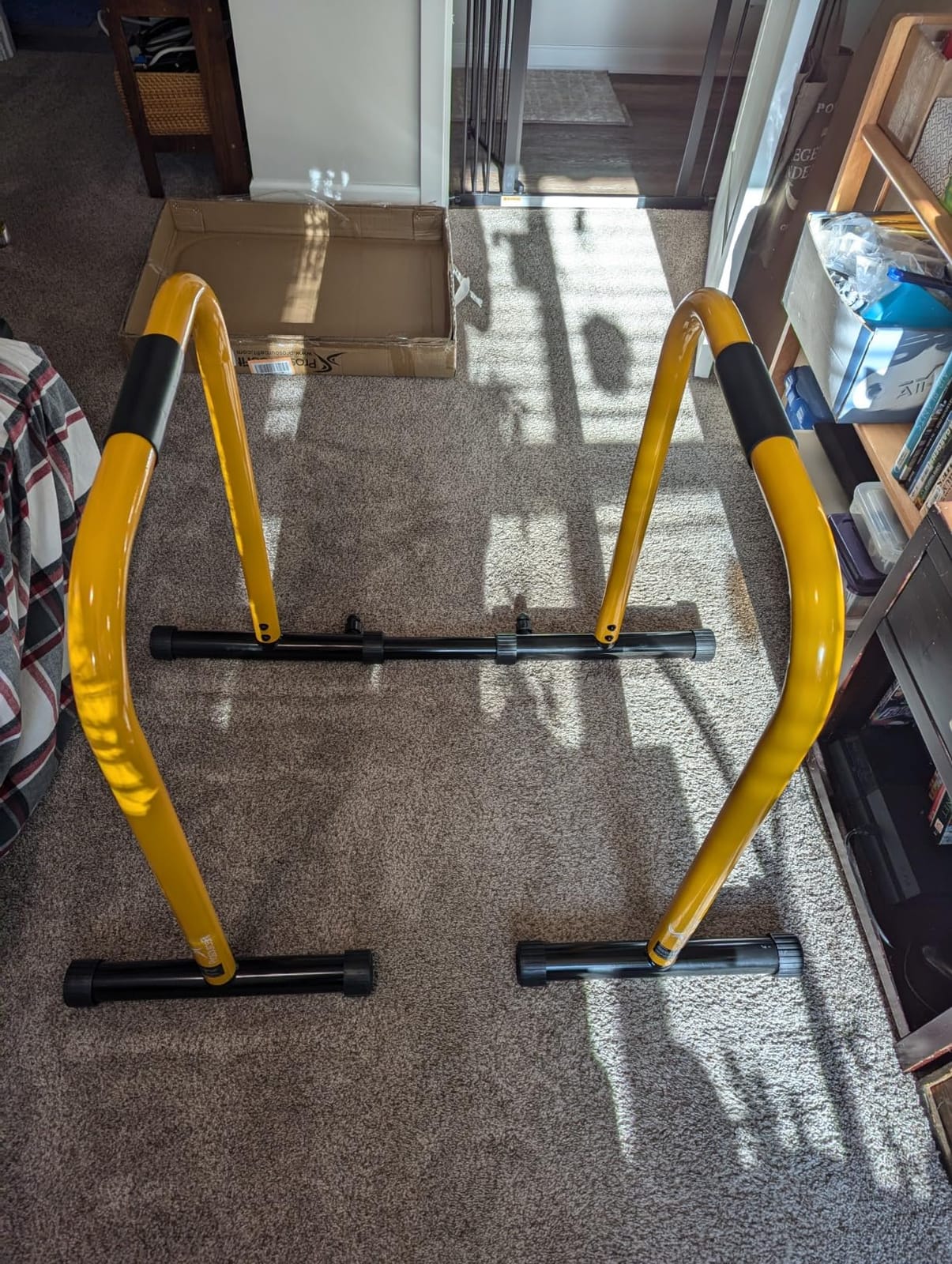
Rated to 400 lb on iron construction with a rust-resistant coating, the frame is heavy enough to feel planted and light enough at 10.57 kg to move between the garage and a spare room. Assembly takes about 15 minutes with the single included tool, and it ranks #41 in Strength Training Dip Stands on Amazon.
The honest complaints are small but real. Grip foam is thin enough that some owners wrap the handles in tape for long sessions, a slight side-to-side play can persist even with the connector fitted, and the paint marks easily if the frame is dragged across concrete. A few buyers also report bent tubing or misaligned feet arriving out of the box.
Whether the Adjustment Range Is Worth It
If your height is uncertain, or if two people share the equipment, this is the strongest argument for the ProSourceFit. Seven width positions at one-inch spacing let you dial the bars to roughly shoulder width rather than guessing with a fixed frame, which is the difference between a clean dip path and elbows flaring out under load. Combined with the floor connector, it also holds up better for rows and L-sits than most stands at this level.
Where It Falls Short
The 400 lb rating is the first limit to note. For a 90 kg athlete plus a dip belt, you are close to the ceiling before you add a dynamic movement like a muscle-up transition. The grip padding is also a step below the Lebert EQualizer, and anyone training serious lean planche holds may prefer a bar with a longer grip surface.
2. Amazon Basics Dip Bar Station: The Default Stand for Most Apartments
- 661 lb rated capacity in alloy steel
- Foam grips and pads
- Compact footprint
- Easy to relocate indoors and out
- Works with rings or straps
- Fixed handle with no adjustment
- Best for average and shorter users
- Floor pads wear on hard surfaces
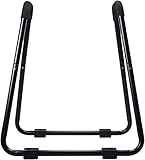
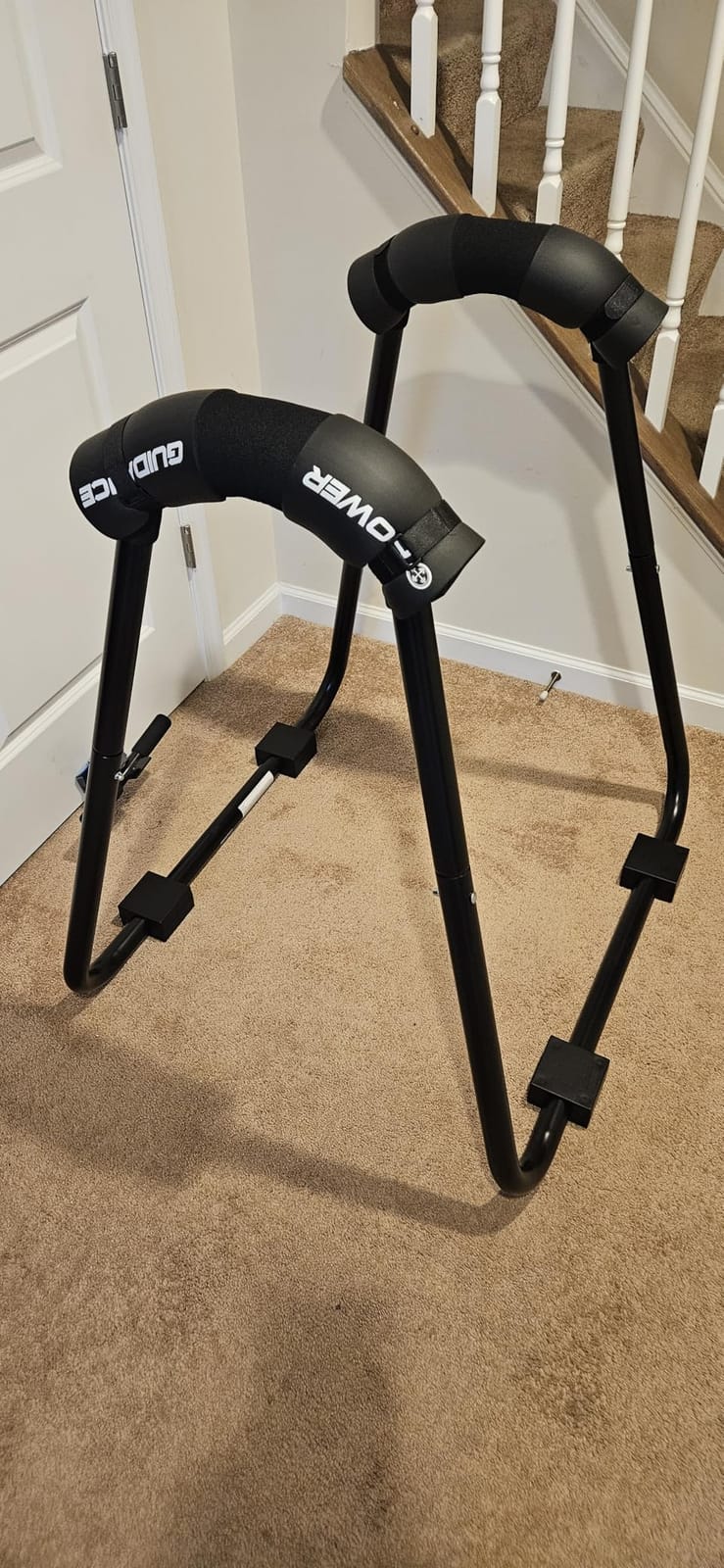
This is a common default choice among home gym builders, and published owner reviews back that up. It is a straight steel parallette bar with foam slip-free grips, foam floor pads and a 661 lb rating in alloy steel, which is more headroom than most bodies of around 85 kg will ever need. At 34.25 by 32.5 by 38.4 inches and 22 lb, it is compact and light enough to carry down a flight of stairs.
Foam on both the grips and the base is the quiet advantage. The base pads spread the load across tile and hardwood and stop the frame from skating when you lower fast, which is the single most common complaint about cheaper steel bars. There is also a healthy accessory ecosystem around it, since push-up rings and straps fit the frame.
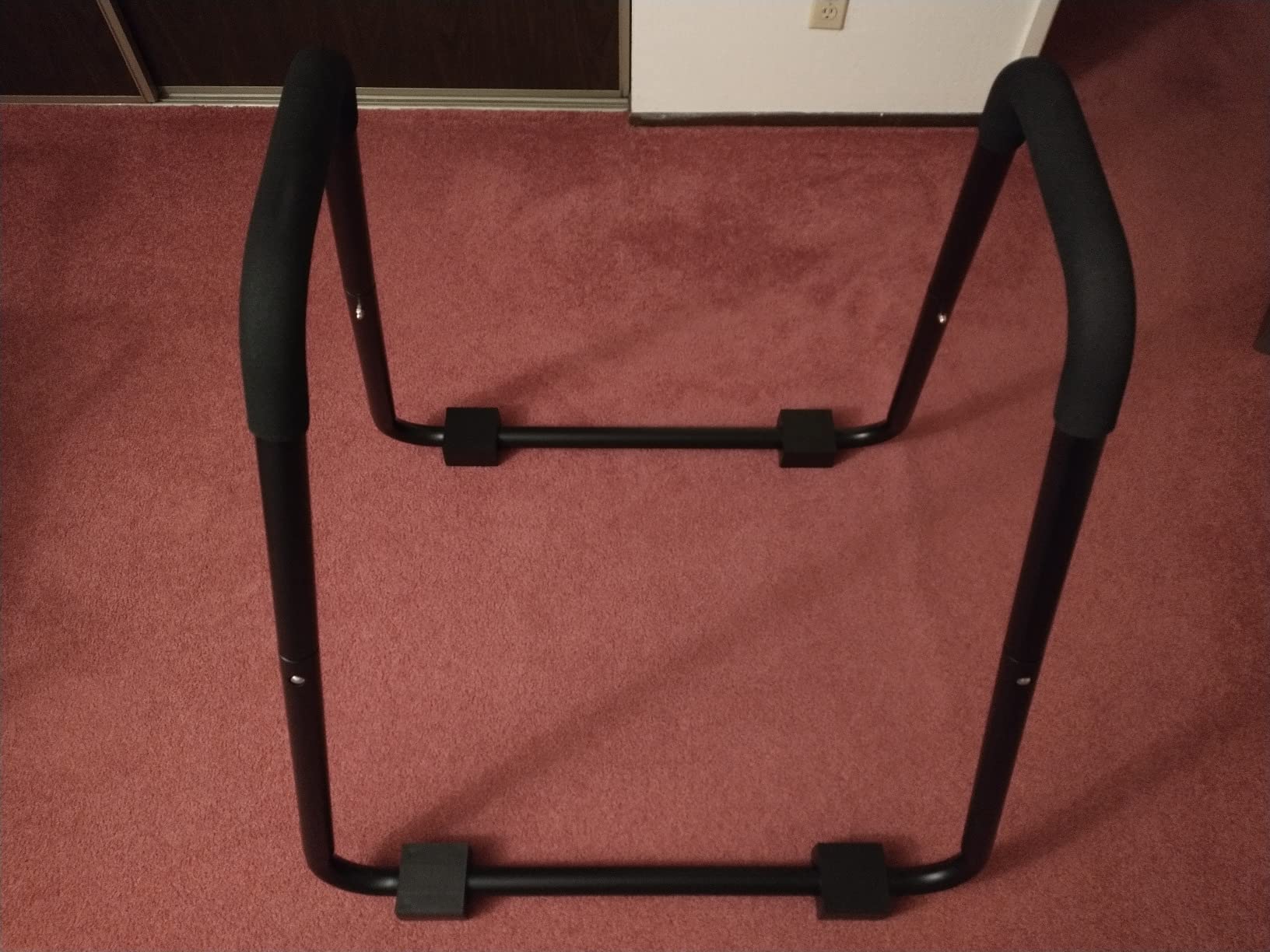
The limitation is geometry, and it is not adjustable. Because the handle is fixed, the bar height and spacing are whatever the manufacturer chose, which means tall users doing straight-leg work or L-sits may feel cramped at the 38-inch bar height. Owners who train alongside a taller partner frequently report outgrowing it, and the foam floor pads do eventually compress on hard flooring.
Calisthenics forum threads over the years have leaned on this unit for sturdiness at its size, usually pairing dips with a neutral-grip inverted row under the bars. If you want one station that works for bodyweight and moderate loading, with no moving parts to adjust, it stays hard to argue with.
Where This Stand Wins on Capacity and Footprint
Two numbers make it stand out: the 661 lb rating and the 32.5-inch width. In a studio apartment or a converted closet, footprint matters as much as strength, and this frame needs very little floor. The foam pads also mean it behaves on smooth indoor floors where bare steel feet slide, so it is a safe first dip station for anyone training indoors.
Where the Fixed Geometry Hurts
Taller athletes are the ones who notice. With no height or width adjustment, you cannot raise the bars for full-range dips or widen them for advanced calisthenics, and you are stuck with the spacing as shipped. If you are around 6’1″ or taller and planning to add a dip belt, look at the adjustable ProSourceFit or the height-heavy Bongkim instead.
3. RELIFE Dip Bar: Most Versatile With Four Height Positions
RELIFE REBUILD YOUR LIFE Dip Bar for Home Gym Training 400LBS Parallel Bars
- Four height and four width settings
- Light and easy to carry outdoors
- Gloss finish resists scratches and rust
- Soft foam handles
- Limited lifetime warranty
- Feels light and rocky at heavy body weights
- Spring pins can block the joining tube
- Unstable without the connecting rod
- Not as wide as rivals
The RELIFE sits at #2 in Strength Training Dip Stands with 5000+ owner reviews, and the appeal is straightforward: four height positions from 30.7 to 35.04 inches plus four width positions from 20.08 to 26.77 inches, with four holes per side for the joining tube. That is a genuinely useful adjustment range for one of the more affordable frames on the market.
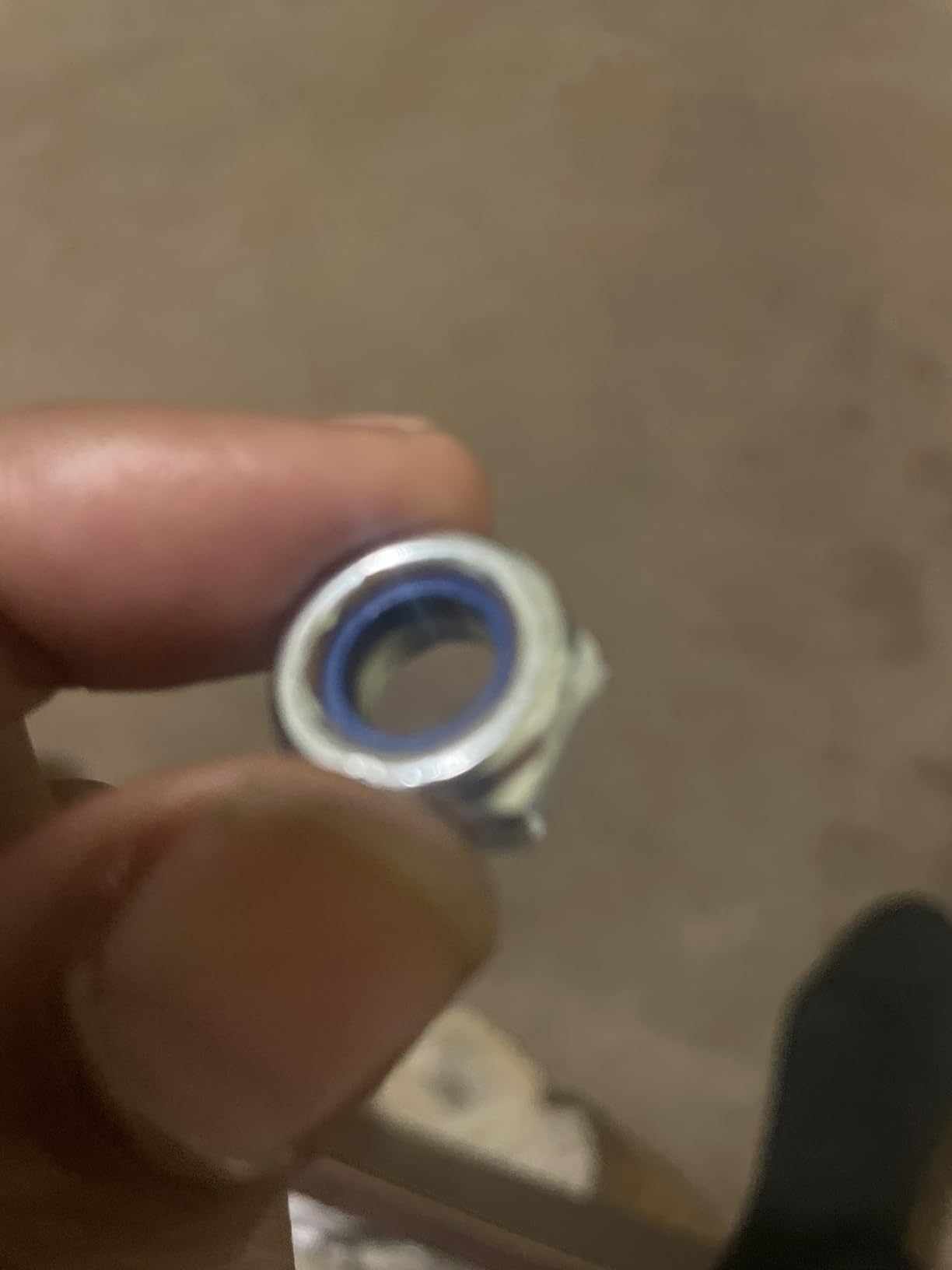
Two build details set it apart from bargain stands. Anti-loosening nuts are fitted on both sides of the handlebar, so the width setting holds through long sessions instead of creeping, and the gloss paint coating is described as scratch and rust resistant, which matters if you train on a patio or in an uncovered garage.
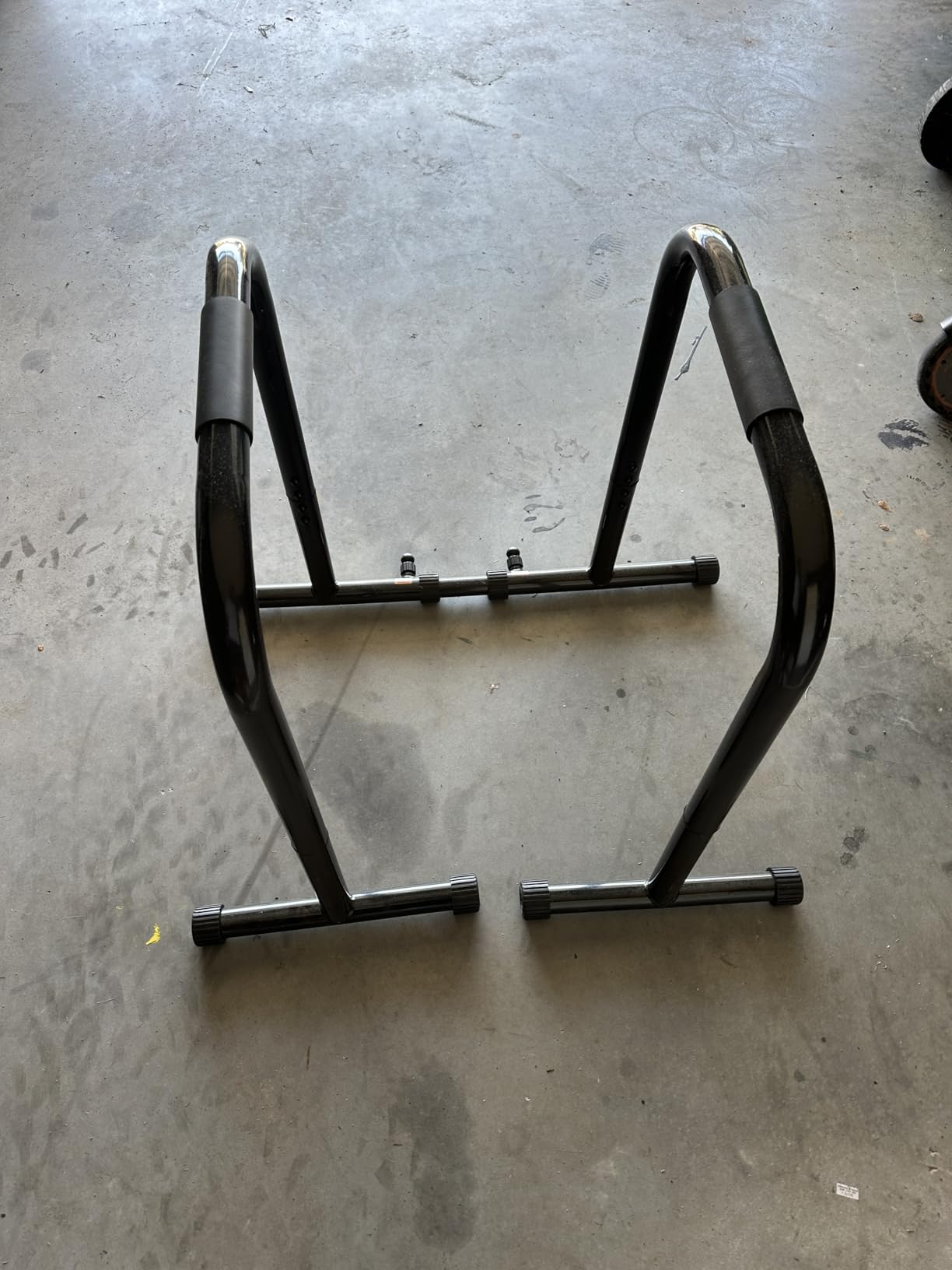
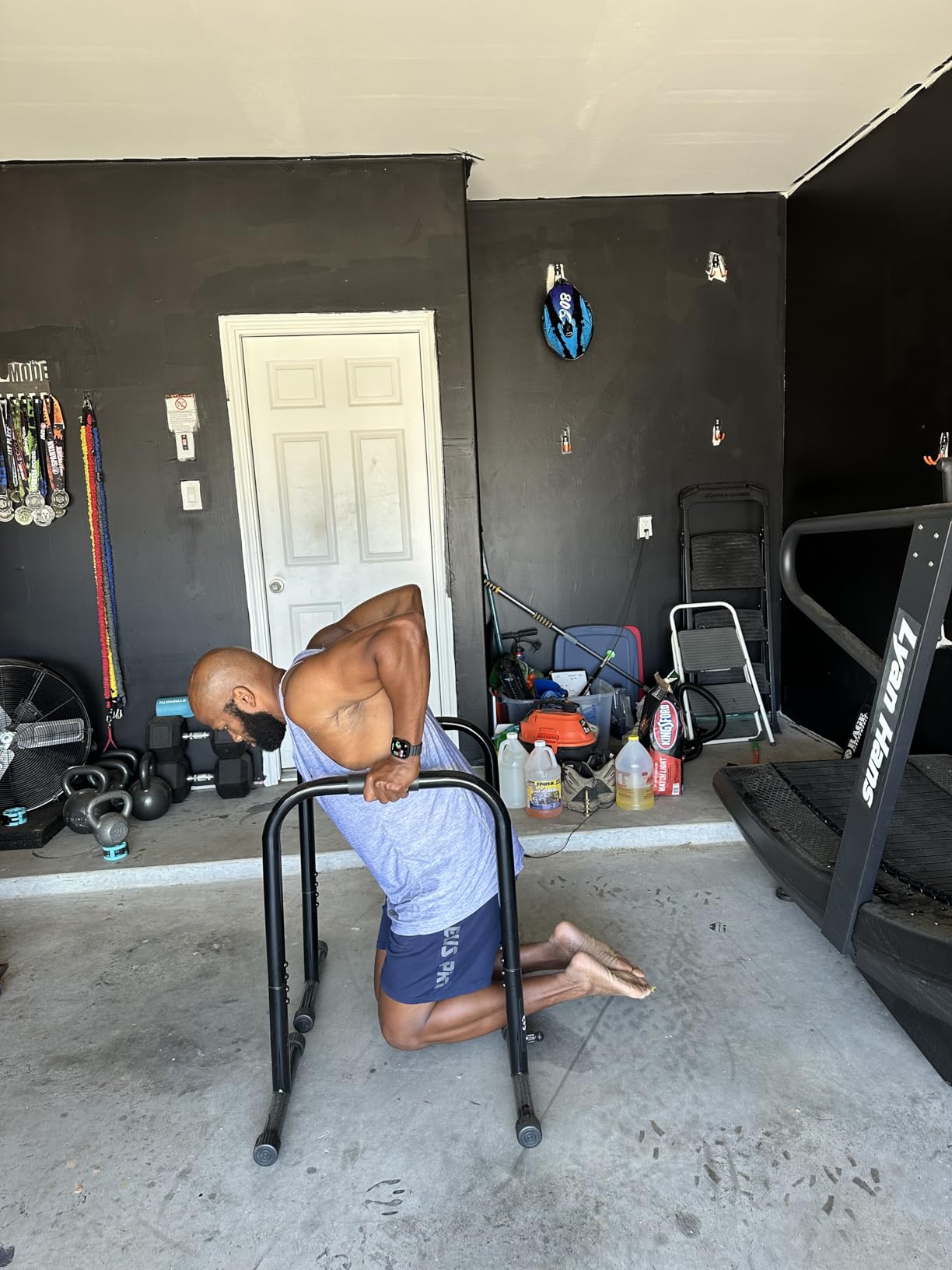
Owners like the high-density foam handles and the adjustable-thickness rubber foot covers, and the whole unit is light enough to move between a home gym and outdoor training without drama. Assembly is self-serve with all hardware included.
The recurring criticism is stability under load. A number of reviewers describe the frame as light and rocky at higher body weights, and several point out that it feels noticeably steadier once the connecting rod is actually installed rather than sitting unused in the packaging. There is also a specific assembly trap: over-tightened spring pins can block the joining tube, and that is the most common reason buyers report a loose-feeling bar.
Why This One Sells So Well for Beginners
Four height and width settings is rare at this level of spend, and it covers the two adjustments beginners actually need: getting the bars to a height where the feet do not hit the floor, and bringing them in to roughly shoulder width. Add the limited lifetime warranty and the #2 category rank, and this is a low-risk first dip station for someone building dip strength for the first time.
What Heavy Users Report
At 90 kg and above, the frame’s light feel starts to show. Owners who added weight with a belt or vest report more side-to-side movement than they expected, and the narrower width range means wide-grip work is limited compared with the Dripex. For advanced loading, the connecting rod is not optional.
4. BalanceFrom Steel Frame Dip Station: Tall, Adjustable and Without Warranty
BalanceFrom Multi-Function Dip Stand Dip Station Dip bar with Improved Structure Design, 500-Pound Capacity, White
- 500 lb rating at a low price
- Adjustable height broadens the exercise list
- Foam handles cut grip fatigue
- Multiple colour options
- No manufacturer warranty
- One-star reviews cite wobble and weld paint
- A lighter build than the rating implies
At 51.18 inches overall, this frame is one of the taller standalone frames here, and that height is why it earns a spot despite middling owner feedback. Leg raises and hanging knee raises need vertical clearance between the bars and the floor, and that extra height gives the movement room to happen instead of clipping your knees. The listing also frames it for pull-ups, push-ups, bench press and triceps work.
On paper the basics are sound: a 500 lb maximum weight recommendation, alloy steel construction, adjustable height and foam-covered handles, in five colourways so it does not look like a garage project. That combination covers dips and lower-body work well for most people training at home.
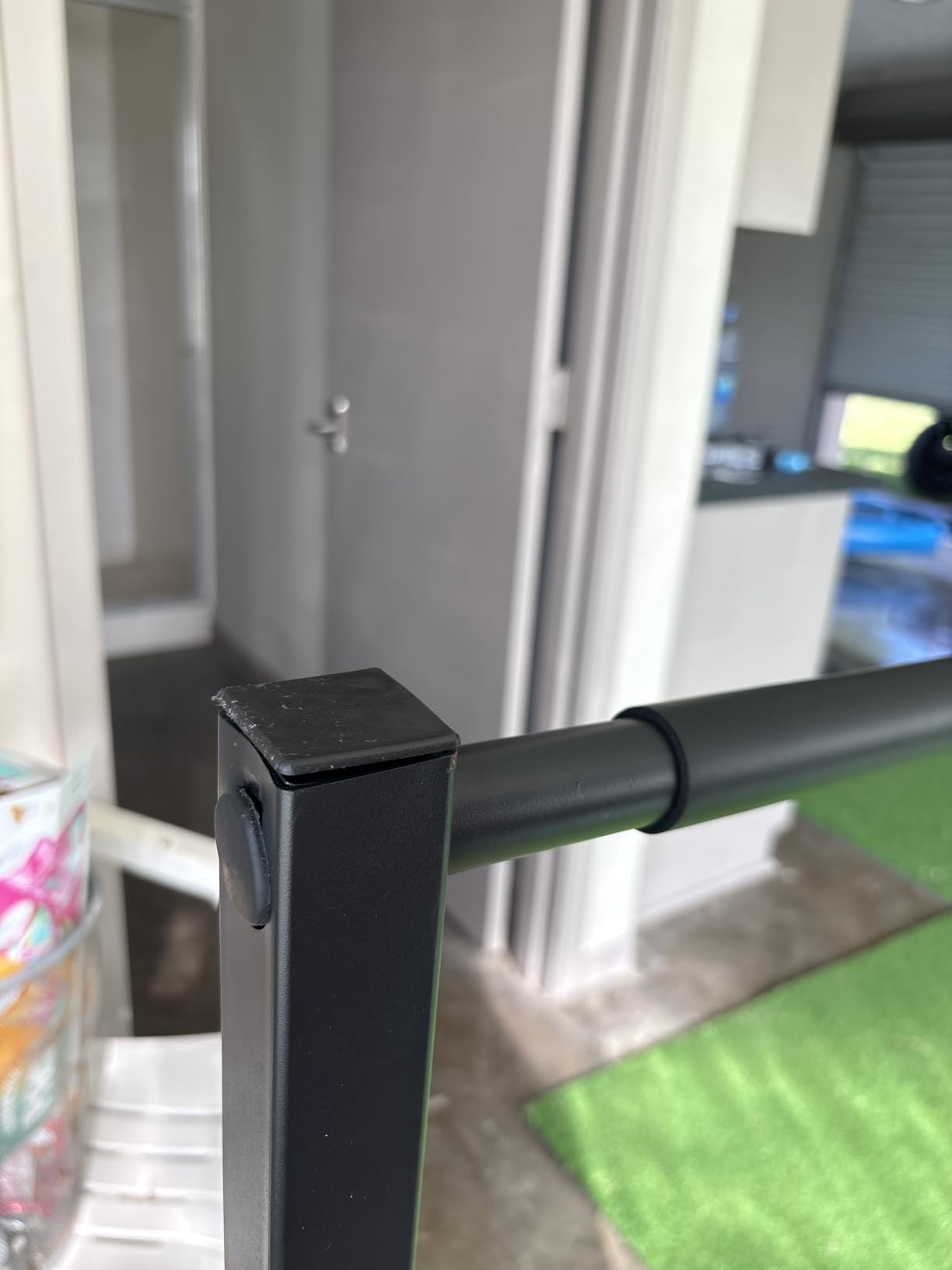
What gives owners pause is the warranty, or rather its absence. This listing carries no warranty at all, and buyers flag that as a real risk on a piece of welded steel that will take repeated impact. The weaker reviews concentrate on two things: frame wobble and paint chipping near the welds, both consistent with a lighter gauge than the 500 lb figure implies.
Foam grips also compress over time, which is normal for foam but worth knowing if you train daily. Treat it as a solid entry station for home use rather than equipment for weighted dips, and check the welds periodically if you keep it loaded.
Height Is the Selling Point Here
If your priority is hanging leg raises, L-sits and any movement that needs your body to travel below the bars, this frame’s 51-inch overall height is the feature you are paying for. It also handles push-up and bench variations that shorter parallettes make awkward. For bodyweight athletes in a basement or garage, that is a reasonable trade against the mixed stability reports.
The Warranty Gap Is Worth Weighing
No manufacturer warranty means a bent weld or cracked joint is your problem, and the low-rating reviews already describe exactly that kind of failure mode. If you intend to add weight with a belt, or if you train daily on the same frame, pick a station with a stated warranty such as the Ultimate Body Press or the ProSourceFit instead.
5. Sportsroyals Adjustable Dip Bar: Best Budget Station That Stops Wobbling
Sportsroyals Adjustable Dip Bar for Home,400lbs Cap Calisthenics Equipment
- Adjustable safety connection bar
- Thicker 2mm steel than most budget bars
- Four height and four width settings
- Sweat-wicking foam armrests
- Fast 3-step assembly
- Adjustment knobs can loosen under load
- Foam armrests compress with use
- Not ideal for very wide grip work
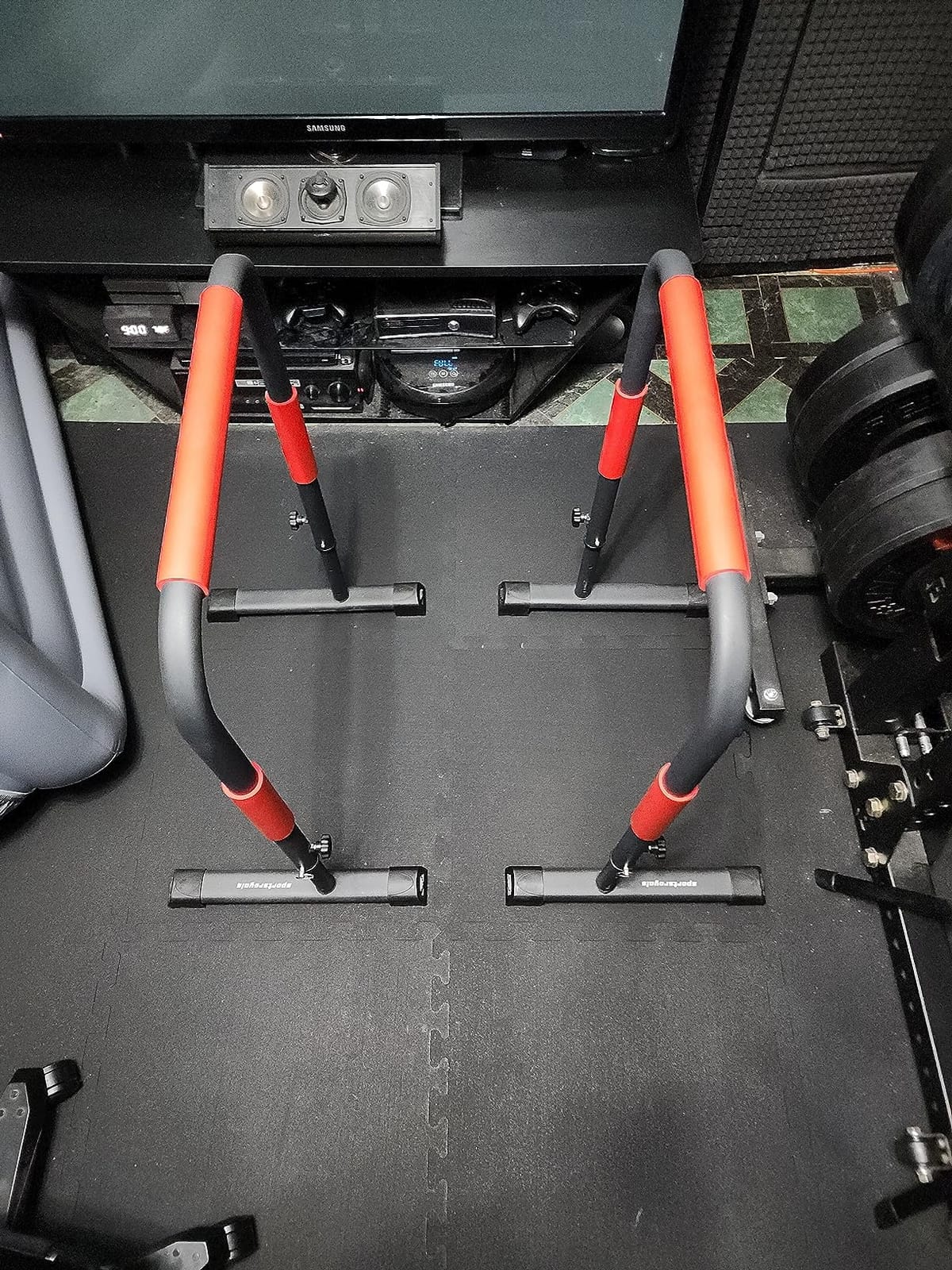
Stability is the number one complaint in the dip station category, and this is the budget frame that best addresses it. The adjustable safety connection bar is included in the box rather than sold as an accessory, and it ties the two uprights together so the frame stops rocking as two independent posts. On top of that, the tubing is 2 mm thick, which is genuinely heavier than most stands at this level.
Adjustment comes in four height and four width positions, with non-slip foot sleeves at the base. The foam armrests are sweat-wicking, which matters more than it sounds during long sessions, and the whole unit assembles in three steps and stacks for compact storage. It ranks #4 in Strength Training Dip Stands.
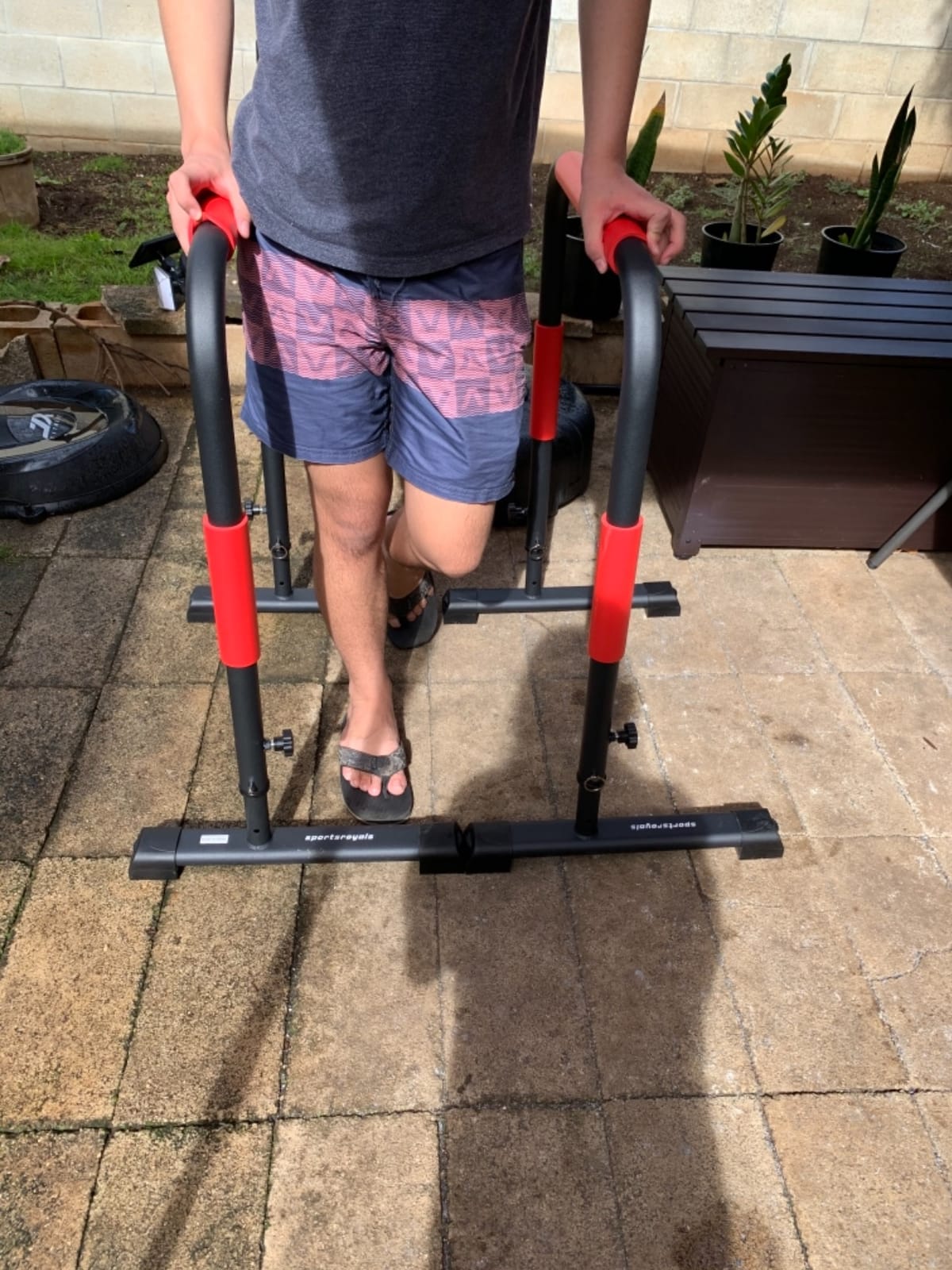
Owners consistently credit the combination of the stabiliser bar and thicker steel for making this feel more solid than other frames in the same bracket. Assembly is straightforward, and the frame works for dips, push-ups, leg raises and stretching.
The weakness is the adjustment hardware. Knob-based settings can loosen during heavy static holds such as L-sits or planche leans, which is exactly the moment you cannot afford a shifting bar. The grip width is also narrower than some competitors, so advanced wide-grip work is limited, and the foam armrests compress with extended use.
Why the Connecting Bar Matters More Than Tube Gauge
Across thousands of owner reviews for budget stands, one pattern repeats: frames that include a floor-level connector feel planted, and frames without one feel like they are balancing on a boat. This model ships with the connector and adjusts in length, so you can tension it properly. That combination is part of why it holds a 4.4 rating, above several frames that sit lower in the price range.
Watch the Knobs Under Static Holds
Dynamic dips are fine. Hold an L-sit for 45 seconds and any loose knob hardware becomes obvious, because the sustained load creeps the setting. Check the adjustment before static work and re-tighten periodically, and keep in mind this frame is not built for very wide grip positions.
6. Lebert EQualizer Total Body Strengthener: Best Rated and Best for Form
Lebert Fitness Equalizer with Resistance Band – Calisthenics Equipment ✓ Dip Station ✓ Push Up Stand Bar ✓ Pull Up Dip Bar ✓ Bodyweight Equipment ✓ For Intensive Use
- Highest average rating among these ten
- Rock solid stainless tubing that is easy to move
- Two independent bars train stabilizers
- Works for rows and L-sits
- Videos and band included
- 28 in height is short above 5ft 10in
- Some arrive out of square
- Costs well above budget parallettes
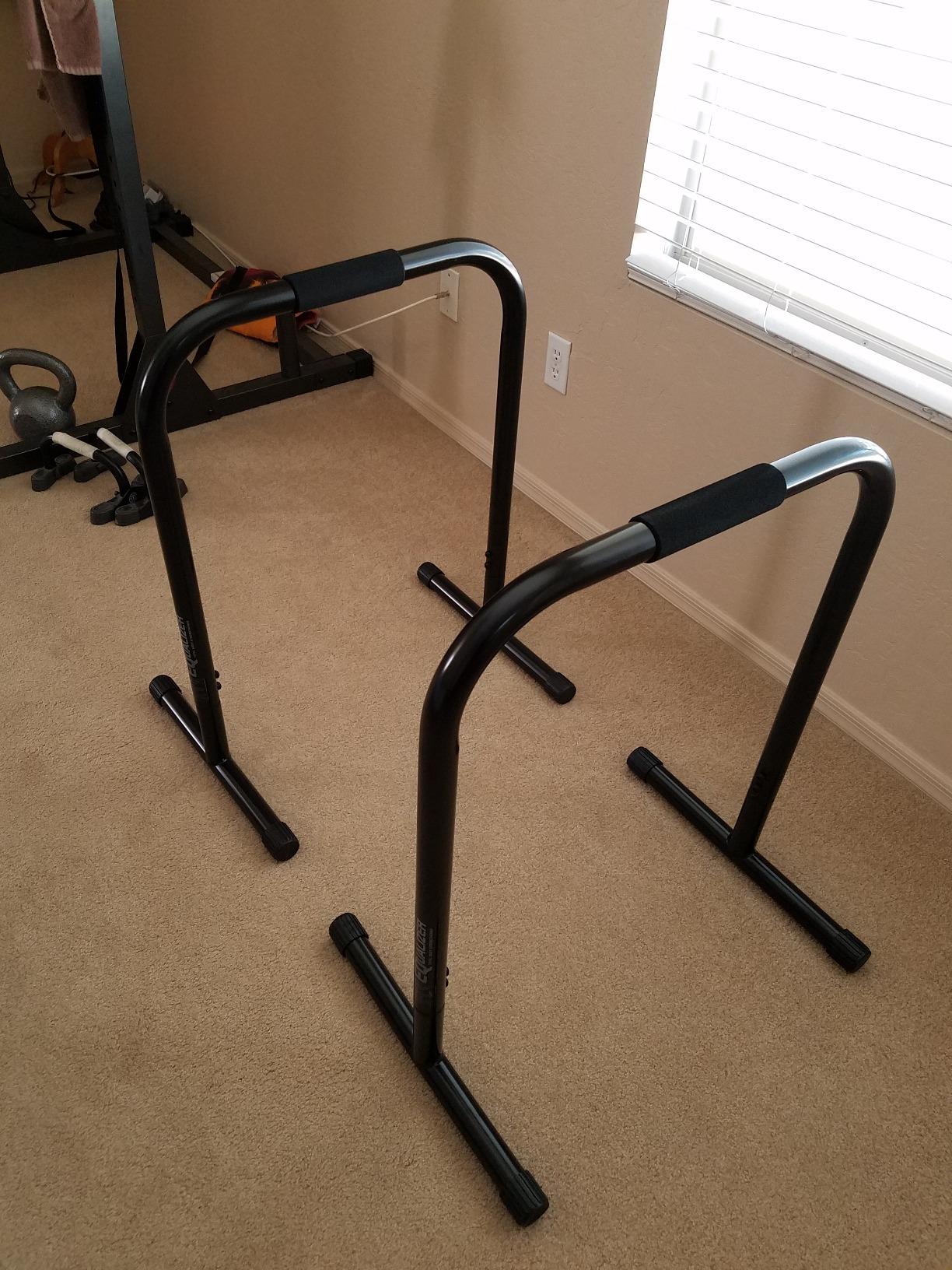
The Lebert EQualizer holds the highest average rating in this roundup at 4.7 stars, and the reason is that it is two genuinely independent stainless bars rather than one welded parallette frame. Each bar has a 28-inch height, a 21-inch base and weighs 7.5 lb, so the frame is stable without feeling welded to the floor, and it moves between rooms trivially.
Two independent bars change how you train. Because each side can move a little, your stabilisers have to work on every rep, which tends to fix the flared-elbow dip path that people pick up on fixed-width stands. Owners rate the high-density foam grips well, and the set covers push-ups, dips, rows, L-sits, knee raises and stretching, with a hip resistance band and nearly 40 exercise videos in the box.
It is rated to 400 lb, or 180 kg, which covers bodyweight work and moderate loading for most people. The wide foot-to-height ratio is doing the work here, since a wide base relative to the bar height resists tipping during rows and leg raises.
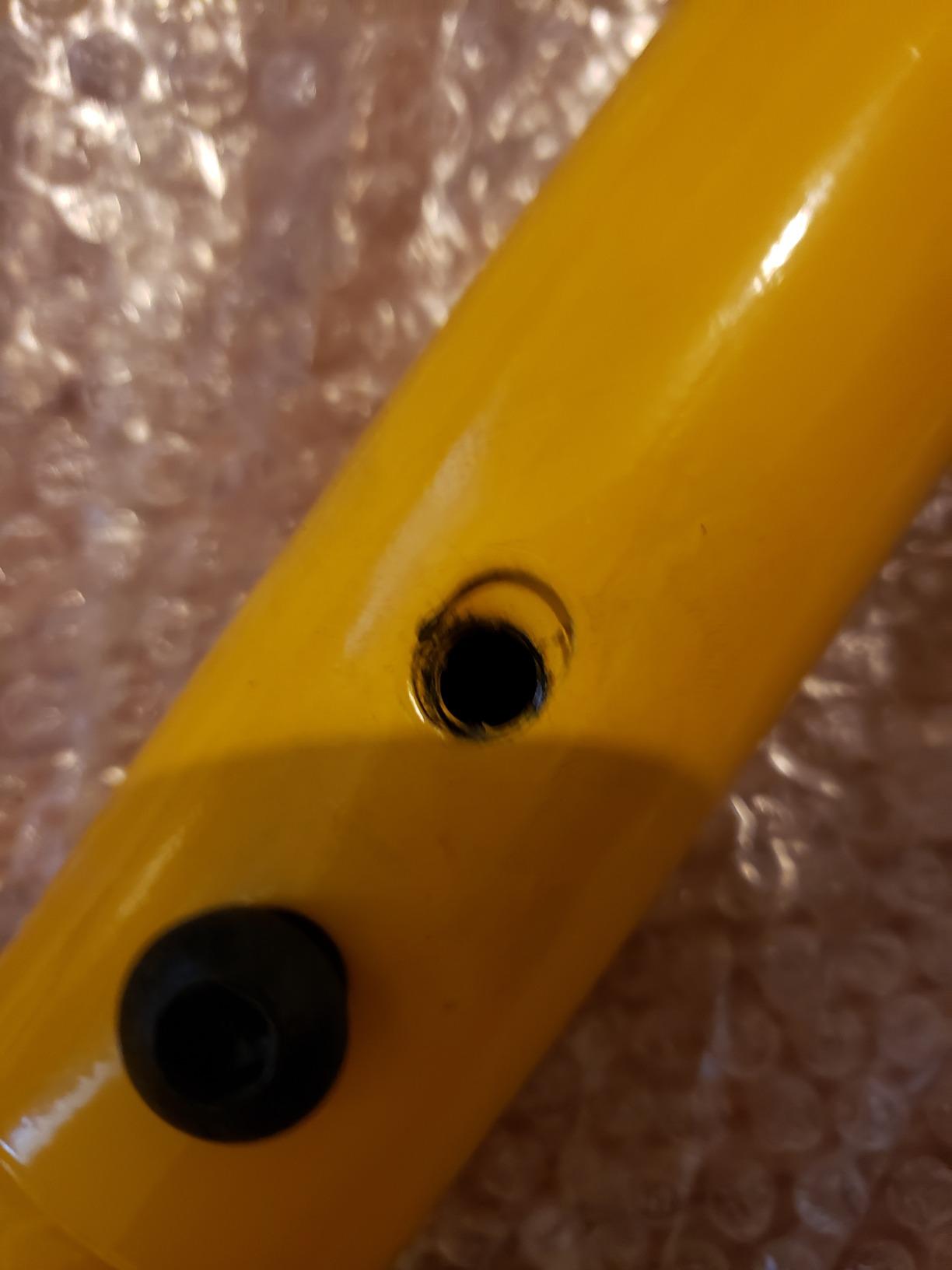
The sizing caveat is the main thing to check. At 28 inches, the standard model suits users up to roughly 5’9″, and anyone taller will want the XL version; owners frequently report the standard model feeling tight for full-range dips. A small number of these arrive out of square and need truing, and the price sits well above budget parallettes.
Why Independent Bars Improve Your Dip Path
If your elbows flare and your shoulders pinch at the bottom of a dip, the cause is often a bar too wide or too rigid. The independent-bar design lets you find a narrower, more controlled shoulder position by feel, and the high-density foam means you can hold a grip through long sets without tape. It is also the only set here that includes structured exercise video guidance rather than just assembly help, which makes it easier to use for more than dips.
Height Is the Limiting Factor
Twenty-eight inches is short. Tall athletes doing straight-leg dips, L-sits with extended legs, or dip belt work will want the taller XL model or a higher frame such as the ProSourceFit. Also measure your ceiling clearance before buying, since nothing here helps if the bars cannot be raised past your head comfortably.
7. Ultimate Body Press Folding Dip Station: Best for Small Spaces
Ultimate Body Press Dip Bar Fitness Station – Adjustable Width Folding Dip Stand with Angled Grips, Stable Leveling and Easy Storage
- Folds flat for storage or transport
- Angled grips reduce wrist and shoulder strain
- Leveling feet hold on uneven floors
- Two width positions
- 10 year manufacturer defect warranty
- Lowest stated capacity of these ten at 350 lb
- Only two width positions
- Padding and frame edges need tightening
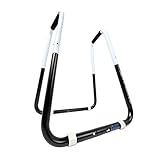
This is the station to buy if floor space is the constraint. It folds down for storage or transport using tool-free, colour-coded spring tabs, and the colour coding also guides assembly, where aligning the dots on each frame section gets the handles centred and even. At 24 by 36 by 36 inches and 18.5 lb it also moves between rooms without a fight.
The ergonomics are the quiet selling point. The angled grips position your wrists in a more neutral line and support a better dip position, which matters for anyone who feels wrist pressure on straight steel bars. Quick-adjust leveling feet keep the frame firm on uneven floors, and the station stands 3 feet tall, which the manufacturer rates for users up to 6’5″.
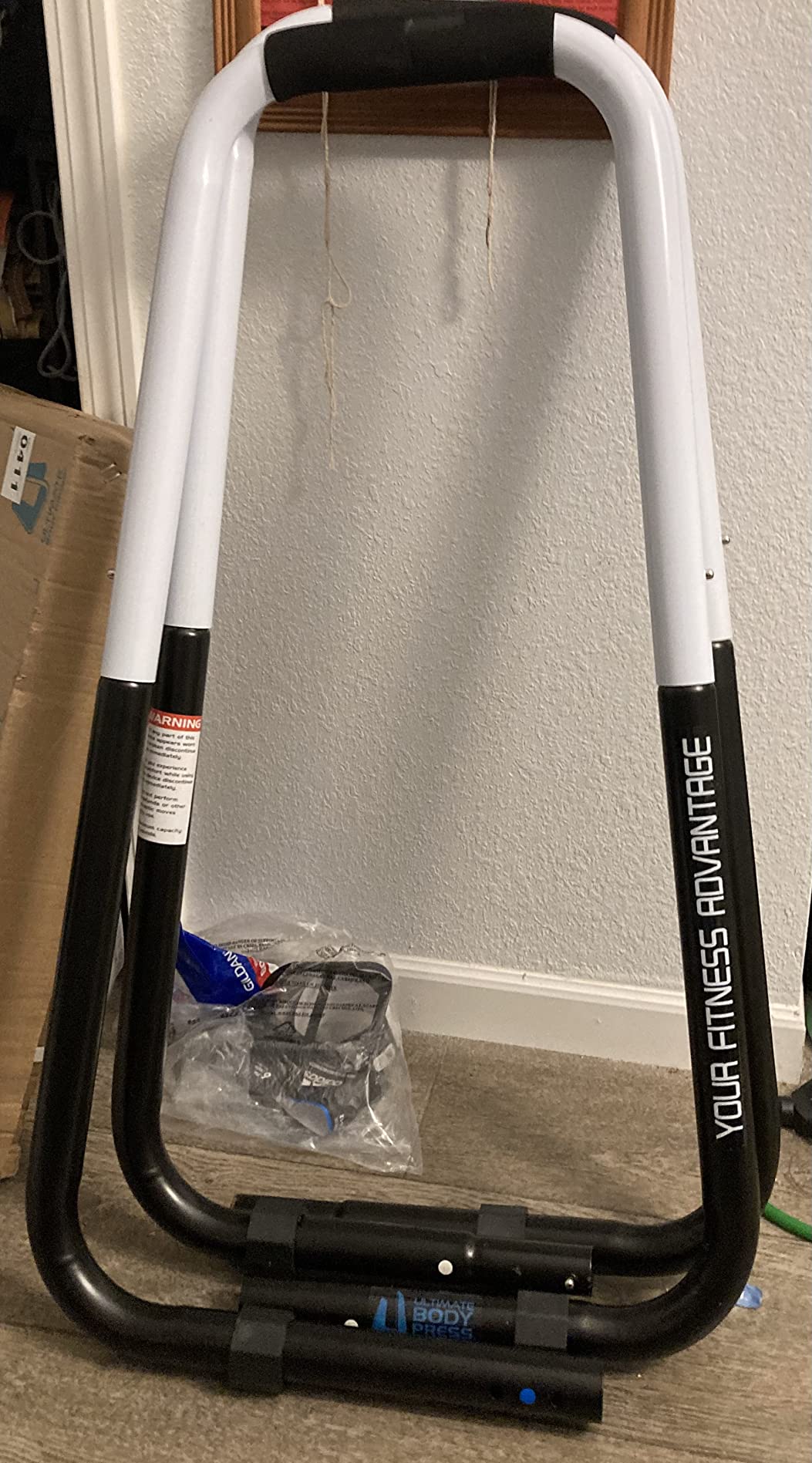
It also supports bodyweight rows, and resistance trainers can be added separately. A 10-year manufacturer defect warranty and USA-based support give it the longest stated warranty in the group, which is meaningful on a welded frame you plan to keep for years.
Two numbers hold it back. The 350 lb rating is the lowest published capacity among these ten, so it is not the station for serious weighted dips, and only two width positions give you less setup freedom than four-position models. Foam padding and frame edges can also need tightening after heavy use.
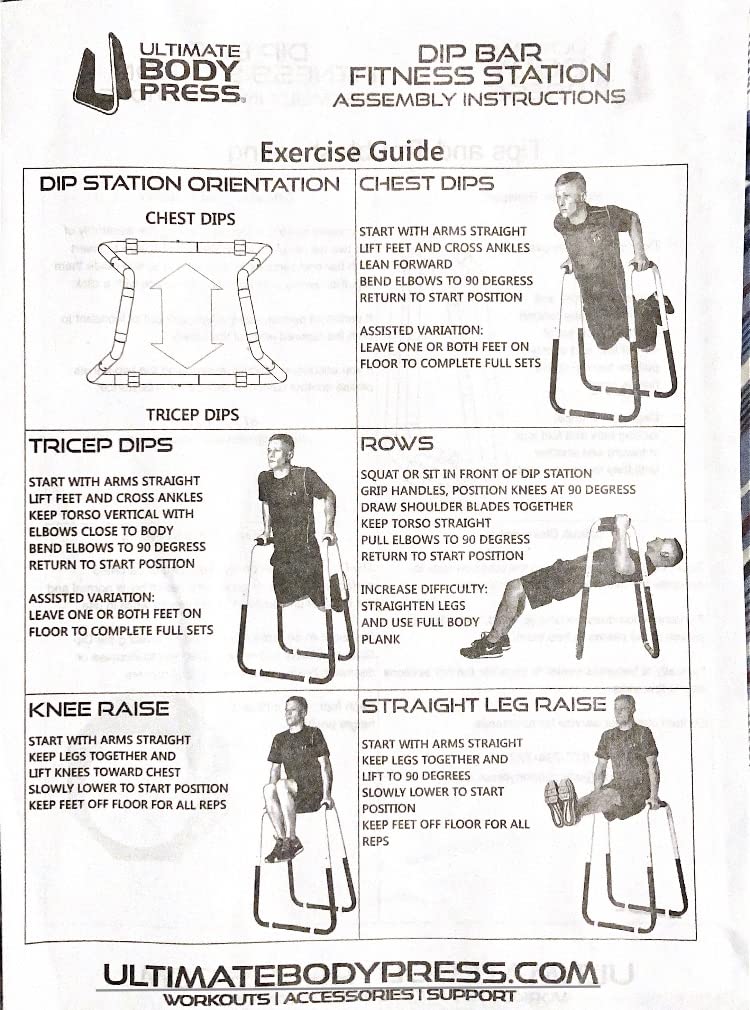
The Only True Folding Option in the Roundup
Apartment living is where this earns its place. When the training area doubles as a living space or a hallway, a station that collapses to a flat bundle changes what is possible, and this is the only frame here that genuinely folds rather than just breaking down into loose tubes. The leveling feet matter just as much, because rental floors are rarely flat.
Where the Capacity Ceiling Bites
At 350 lb, this is a bodyweight station with room for a light vest, not a weighted-dip station. It suits beginners and intermediates who want dips, rows and support work, and it suits tall users up to 6’5″ because of the 3-foot height. Plan to load with a dip belt and you should be looking at the Dripex or ProSourceFit instead.
8. Dripex Heavy Duty Dip Station: Best Rated Load for Weighted Dips
- Very high published capacity in heavy steel
- Two floor-level connectors stop the rocking
- Adjustable width and height
- Quick assembly and flat storage
- Widest bar spacing of these ten
- Two connectors add bulk to carry
- Listed weight figure is inconsistent
- Smaller review base than rivals
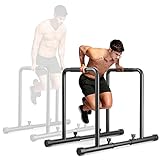
If your goal is weighted dips, start with the rating. This frame carries a published 1100 lb maximum weight recommendation in heavy duty steel, which leaves generous headroom above bodyweight plus a dip belt. That figure is a manufacturer number rather than a lab-tested limit, but it is the highest stated capacity of anything in this comparison.
The structural feature worth paying attention to is the pair of safety connectors, one on each bar at floor level. They tie the bars together along the base so the station stops behaving like two independent posts, and they are the direct answer to the wobble complaint that dominates reviews of budget stands. Width adjusts from 35 to 41 inches, height from 30.7 to 35.43 inches, and the frame is built for chest dips, pull-ups and hanging leg raises.
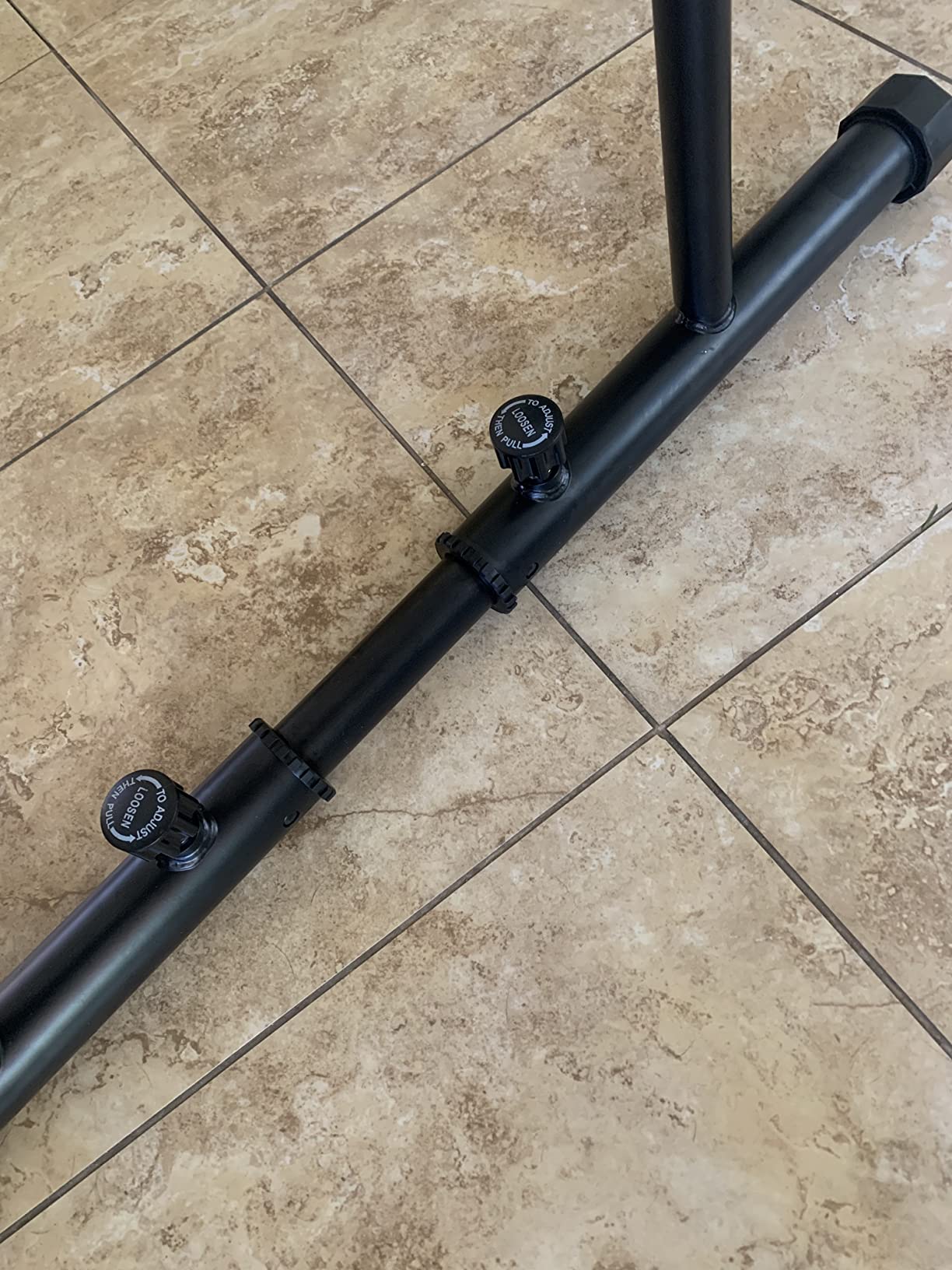
Owners like that assembly takes only a couple of minutes and that the frame stores flat. Two connectors also allow a wider bar spacing than the other frames here, opening up wider grip positions for chest-focused work and for advanced calisthenics progressions.
The trade-offs are weight and bulk. Carrying two connector bars adds heft to something you may want to move between rooms, and the listing shows its item weight inconsistently, so do not rely on that figure for transport planning. It also has a smaller review base than the budget tier, at 550 reviews, so long-term durability data is thinner here than elsewhere.
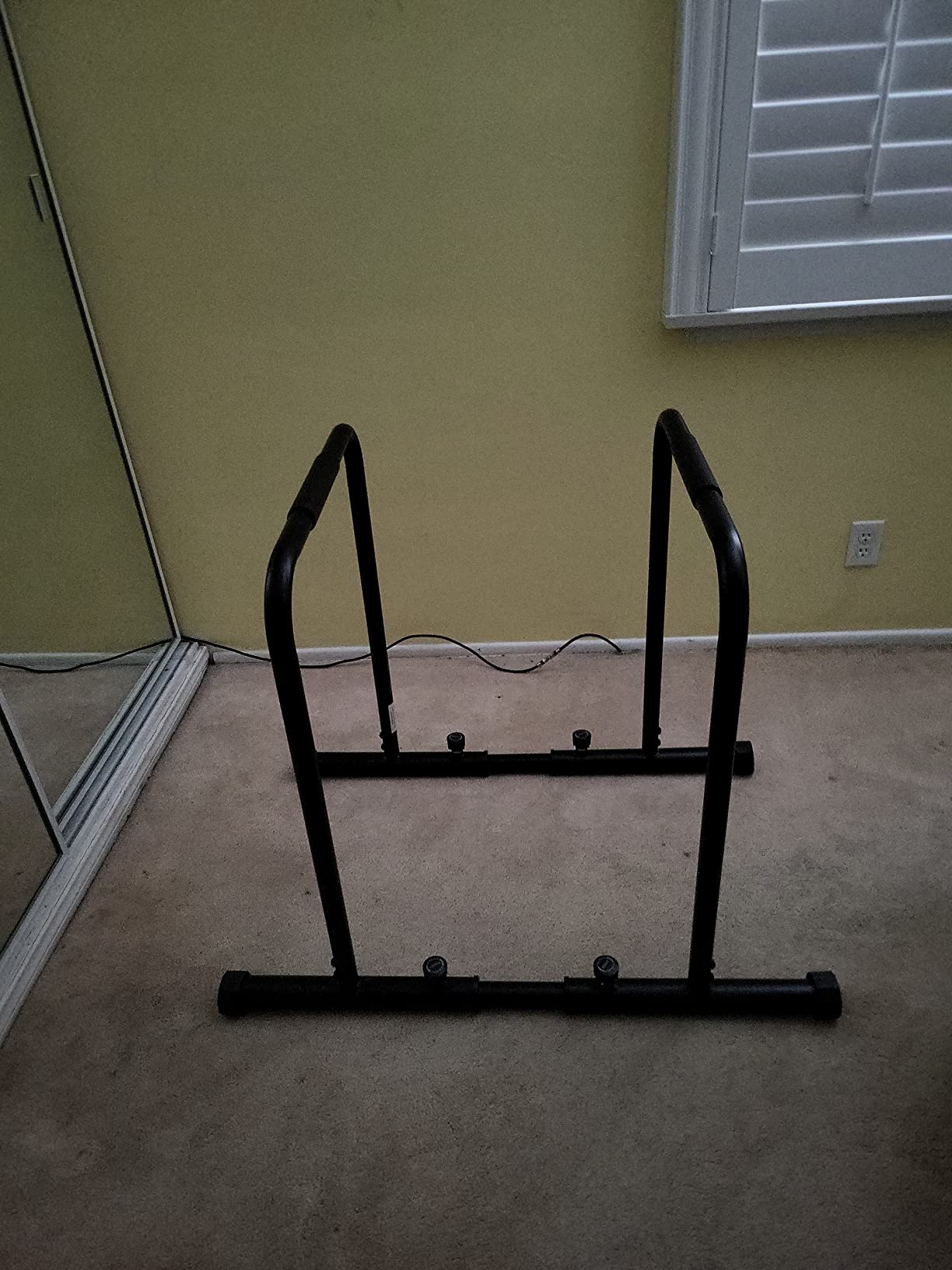
Why a Dual Connector Frame Handles a Dip Belt
Weighted dips push load straight down through your hands into the bars and out through the base. Two floor-level connectors spread that force across the whole frame instead of concentrating it at the top of two thin posts, which is why heavy loading and stability complaints tend to appear together on lighter stands. At 40.5 by 24 by 35 inches, the base is also wide, which resists tipping when you swing slightly off vertical.
Watch the Bulk and the Listing Details
Two connectors are only a feature until you try to carry the unit through a doorway. Plan the route and the floor surface before you buy, and check the actual weight yourself since the listing figure is unreliable. Anyone buying for a permanent garage setup will not mind the bulk at all.
9. Bongkim Dip Station: Best for Height, L-Sits and Tall Athletes
- Height options topping out at 48 in
- Seven height levels in 2 in steps
- 800 lb rating with triangular base supports
- Very long grip surface
- Second highest average rating
- Top of the price range in the roundup
- No manufacturer warranty
- Bulky footprint for small rooms
Height is the entire argument here. Seven height levels run from 37 to 48 inches in 2-inch increments, and 48 inches leaves far more room under the bars than the 28 to 38 inch range most of the shorter frames cover. If your dips end with your knees or shins hitting the floor, or if straight-leg work is off the table because there is no room, this frame removes that ceiling.
Capacity is the second argument. At 800 lb in heavy duty steel with triangular support structures at the base of each bar and rubber feet underneath, it is rated for weighted work and still carries a 4.6 star average. Seven fine-grained height positions also beat four-step models for matching a specific athlete rather than settling for the nearest notch.
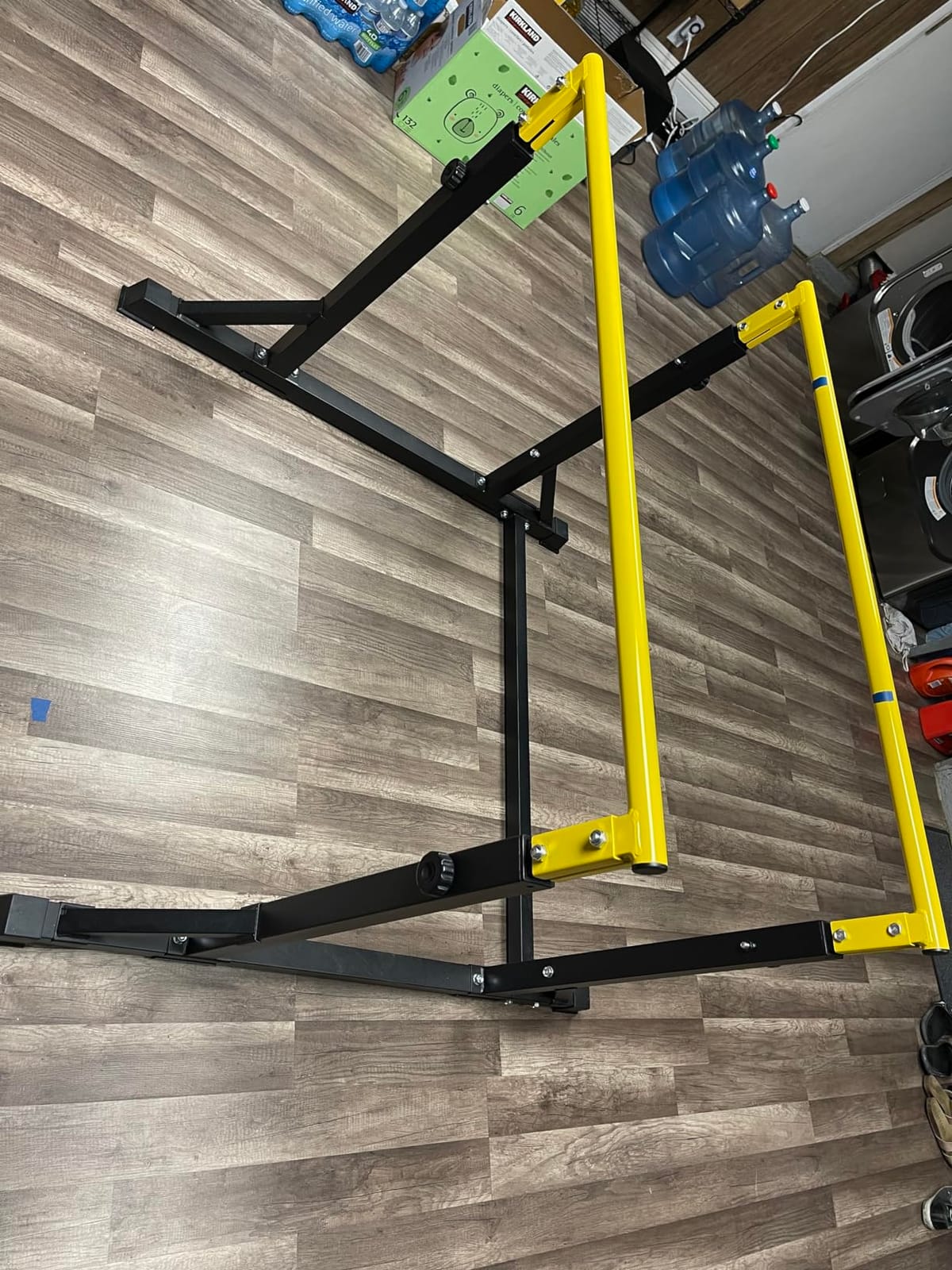
The grip runs nearly 48 inches. That extra length is not marketing: it lets you move your hands anywhere along the bar to change grip width for chest versus triceps emphasis, and it gives ring-style or support work somewhere to sit.
The costs are real. This sits at the top of the price range for this roundup and it carries no manufacturer warranty, which is a poor pairing for heavy steel equipment. The frame is also bulky, and a 48-inch bar height is a lot of structure to have in a small room. With 322 reviews, it has one of the smallest owner bases here, so there is less long-term data to lean on.
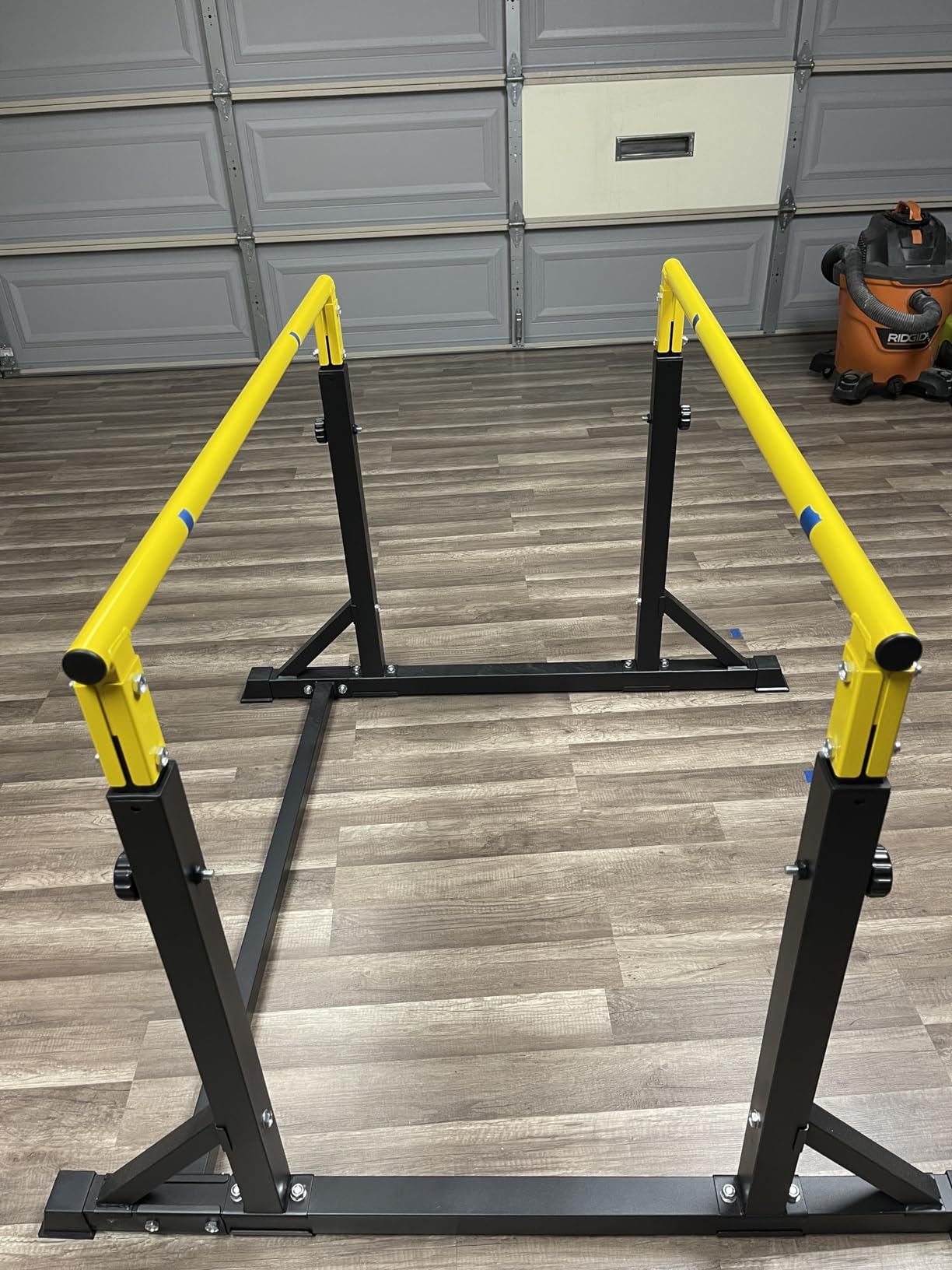
What the Extra 10 Inches of Height Buys You
Bar height sets the depth of the dip you can perform. Below about 31 inches, taller athletes cannot reach a full range. At 37 to 48 inches you get straight-leg dips, L-sits with extended legs, front lever entries and hanging leg raises, plus room for a dip belt to hang clear of the floor. For anyone above roughly 6 feet, that headroom is worth more than extra capacity you will never use.
Price and Warranty Are the Trade-offs
You are paying a premium for height and capacity together, and the listing carries no manufacturer warranty, so a weld or hardware failure is on you. If your space is small or you want warranty cover, this is the wrong pick. If you are a tall athlete who will genuinely use 48 inches of clearance, nothing else here covers you.
10. Sportsroyals Free Standing Power Tower: The Best All-in-One Dip Station
SPORTSROYALS Power Tower, Multi-Function Pull up Bar Dip Station with Upgraded Adjustable Foot Cover Equipment for Home Gym,360LBS
- Ranks #1 in Strength Training Dip Stands
- 8 height levels plus 5 backrest positions
- Two point pull-up bar for rings or straps
- Covers pull-ups dips rows and push-ups
- Compact footprint for the size
- Written instructions and video disagree
- Unlabelled bolts and a ratchet needed
- Close grip pull-ups hard for larger users
This is the dip station category in its most literal form: a free-standing tower where the dip bars are one station among several. It ranks #1 in Strength Training Dip Stands with 18000+ owner reviews, by a wide margin the most reviewed frame here. The pitch is a single frame covering pull-ups, dips, inverted rows, leg raises and push-ups, so you do not need separate bars anywhere in the room.
Adjustment is unusually thorough: eight height levels from 57.09 to 83.07 inches plus five backrest positions, thick and wide backrest pads, and 10-degree inclined armrests that take pressure off the elbows during assisted or negative work. The Pi-shaped base with adjustable foot covers is what keeps it planted, and the pull-up bar mounts at two points, so rings, TRX and neutral grips hang securely rather than from a single bracket.
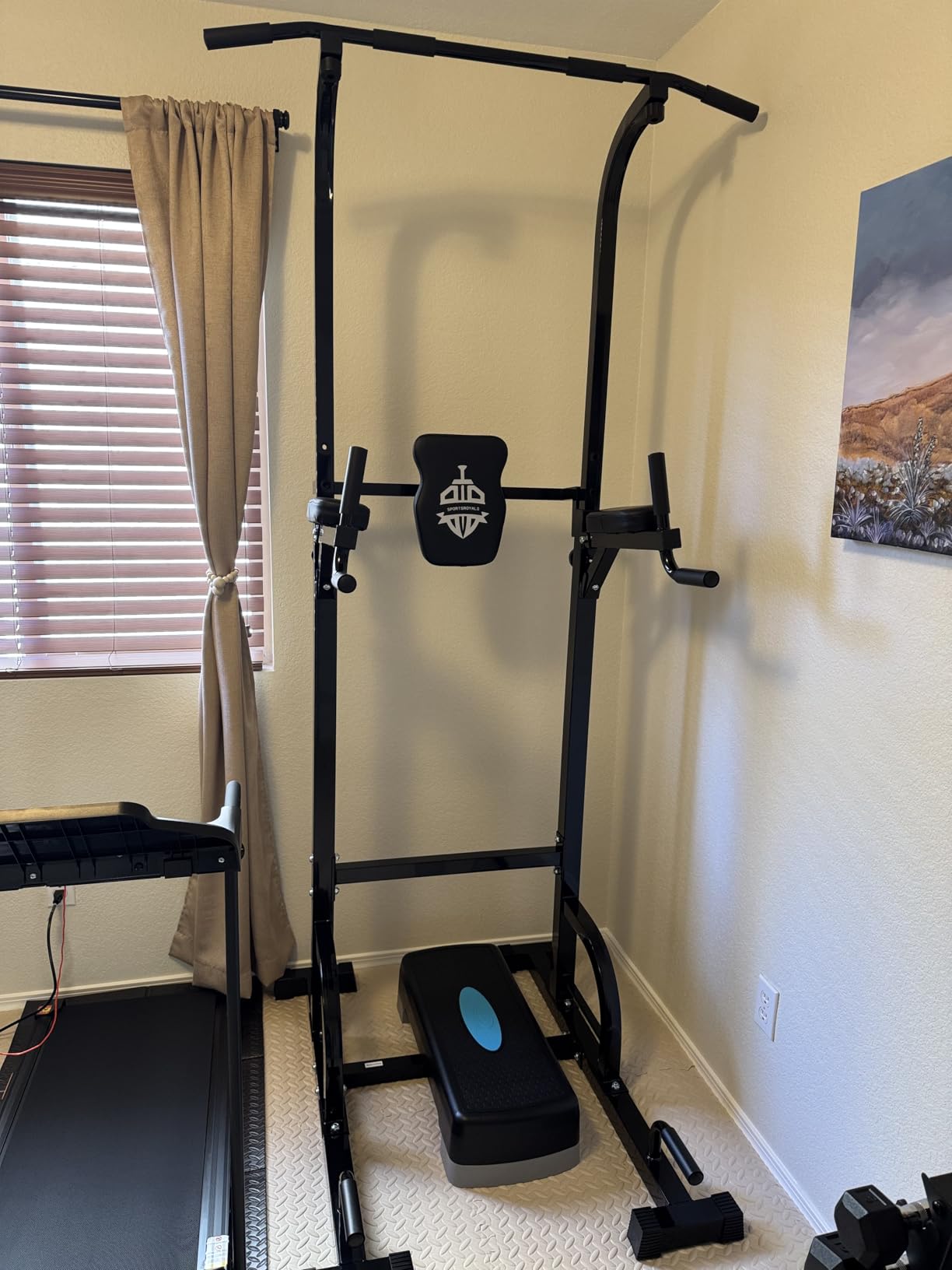
Owners generally report no wobble once the base bolts are fully tightened, and a 360 lb load capacity on thickened steel suits bodyweight work for most people. At 44 by 38 by 83 inches and 21.4 kg it is the tallest and one of the largest footprints in this roundup, so measure the room before committing.
Assembly is the weak point. Buyers repeatedly report that the written instructions contradict the assembly video, that the bolts are unlabelled, and that a ratchet is strongly recommended rather than optional. Owners of the assisted-dip versions describe a jerky assist travel with a seat poorly positioned for dips, and close-grip pull-ups are difficult for larger users because the uprights sit close together.
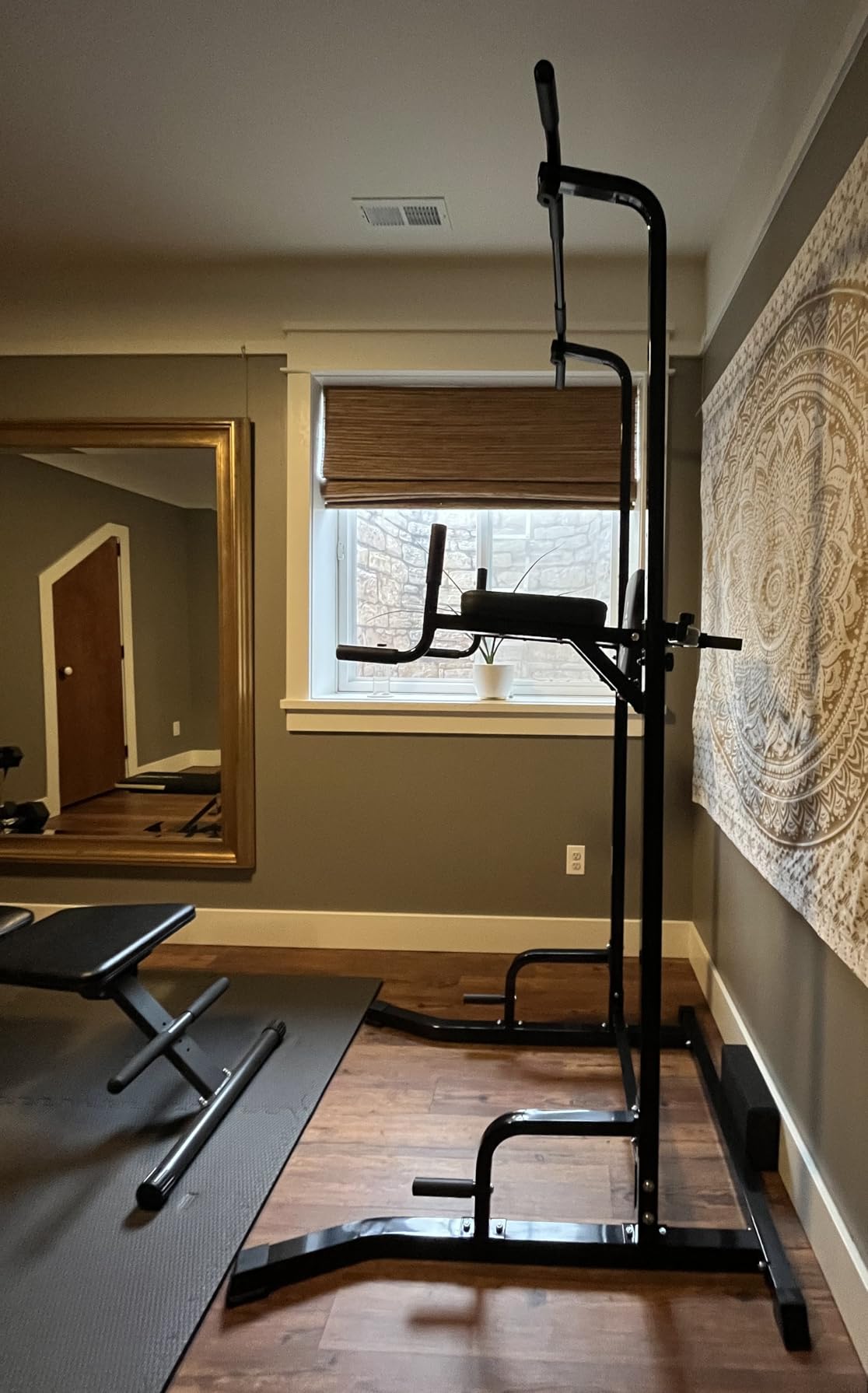
When a Tower Beats Standalone Dip Bars
A tower makes sense when your home gym is starting from nothing. One frame covers pull-ups, dips, rows and push-ups, which removes the need for a separate pull-up bar and saves floor space compared with buying stations individually. The eight height levels and adjustable backrest also let the whole household share it, and the two-point pull-up mounting is genuinely useful for ring work.
Budget for Assembly Time and the Footprint
Set aside an afternoon and borrow a ratchet. The instruction-to-video mismatch is the single most repeated complaint across thousands of reviews, and it is fixable but not quick. If your space is small or you already own a pull-up bar, a standalone parallette like the ProSourceFit or Lebert pair gives you a better station for less assembly.
Dip Station vs Dip Bars vs Power Tower: Which One Do You Actually Need?
The words get used interchangeably online and they describe different products. A dip bar is the small freestanding parallette: two uprights, two bars, sometimes a connecting rod. A dip station is the broader category, covering everything from those bars up to wall-mounted units and all-in-one towers. A dip bar attachment bolts onto an existing squat rack or pull-up frame, which is the sturdiest setup available if you already own a rack.
Where each one wins is straightforward. Freestanding dip bars take up the least floor space, cost the least and move between rooms easily, and they are what most people mean when they search for dip bars. Wall-mounted units save floor space entirely but cost you flexibility in bar height and need a load-bearing wall and real anchors. Power towers give you dips plus everything else in one frame at the price of a large footprint and a longer assembly.
Rack attachments are the value pick for anyone with existing equipment. Bolting dip bars to a steel rack makes them sturdier than any freestanding option, since the rack frame is already designed to take heavy loads in multiple directions. The trade-off is that you are now training inside the rack uprights, which limits lateral movement and can restrict overhead work.
Community recommendations in bodyweight training forums lean the same way. Long-term ownership reports favour a well-built freestanding unit over a bulky tower, and the usual upgrade path is starting on a portable bar and moving to a higher-capacity frame once weighted dips are on the programme. Buy the tower when you have nothing else, not because it is a dip station specifically.
What You Can Actually Do on Each Type of Dip Station
The list of movements is longer than most people use. Dips are the obvious one, and rows are second: an L-shaped or straight bar set slightly below shoulder height turns bodyweight rows and inverted rows into a genuine back-development movement. Vertical knee raises, hanging leg raises and L-sits all depend on the height and spacing of the bars rather than on the frame itself.
Static work is where frame quality starts to matter more. Support holds at the top of a dip, tucked L-sits and planche leans load the bars continuously with no dynamic movement to absorb the force, which is when loose adjustment hardware and a narrow base become obvious. Skin-the-cat rotations and back lever entries need enough width between the bars to move your shoulders through, and they need a bar low enough that your body clears it at the top of the arc.
Forward-leaning dips shift emphasis toward the shoulders and are the standard bridge to handstand push-up work, but they need the bars set far enough back and high enough that you are not fighting the frame for space. Muscle-up transitions need clearance in front of the bars and a frame that will not shift while you swing, which is the strongest argument for a floor connector or a rack-mounted bar.
How We Picked: The Dip Station Buying Checklist
Stability is the one criterion you cannot compromise on
Wobble is the single most common complaint across thousands of owner reviews for budget stands, and it is the most cited reason people replace equipment within a year. Look for a floor-level connecting bar or rod between the uprights, since that is what turns two posts into one frame. Wider bases help too, and rubber feet matter on smooth indoor floors where bare steel slides.
Test it before loading it. Get on the frame and shift your weight hard in every direction, then hang from the bars and swing gently. If you feel movement at the base joints with your bodyweight alone, it will feel worse with 45 kg hanging from a dip belt. Floor surface counts too: concrete, hardwood and rubber matting all behave better under a dip station than thick carpet, which lets the feet sink and roll.
Bar height and leg clearance decide which skills unlock
Roughly 80 cm of bar height is enough for basic dips and knee raises but nothing more. Around 91 to 94 cm clears skin-the-cat rotations and back lever work. Between 110 and 115 cm opens up straight-leg dips and comfortable L-sits, and 120 cm or more gives you the clearance for extended leg work and a hanging dip belt. Below that, tall athletes hit their knees on the floor on every rep.
Note the practical caveat: taller units need more ceiling height, and wall-mounted bars cannot be raised later. Measure from floor to your ceiling clearance and your own height before ordering, and remember that most manufacturers list overall frame height rather than bar height.
Bar spacing and shoulder health
Set your bars at roughly shoulder width, so the spacing between them measures about 45 to 55 cm. Too wide and your shoulders end in internal rotation at the bottom of the dip, which is how you end up with impingement symptoms in the front of the shoulder and aching rotator cuff. Too narrow and the movement turns into a triceps-only press with nowhere to go.
Adjustable width is worth paying for here. With fixed bars you have one shot at getting the spacing right, and if it is wrong you end up adapting your technique to the equipment rather than the other way around. Anyone with existing shoulder trouble should narrow the bars slightly below shoulder width and lean forward less.
Weight capacity: 150% of bodyweight as a floor
Use at least 150% of your bodyweight as the minimum rated capacity, which covers your bodyweight plus enough load for a dip belt or vest without loading the frame to its limit. For serious weighted calisthenics and streetlifting, 250 to 300 kg is the working range, and anything below that should be treated as a bodyweight station. Remember these are manufacturer ratings, so leave headroom rather than testing the ceiling.
Bodyweight only versus weighted also changes the right answer. If you are still building your first ten strict dips, capacity barely matters and height, spacing and grip comfort should drive the decision. Once a dip belt enters the picture, capacity and frame rigidity move to the top of the list.
Grip diameter, finish and wrist comfort
Most steel bars land somewhere around 38 to 45 mm, which suits most hands. Below 35 mm gets uncomfortable in long sessions, and a knurled or textured coating gives you something to hold when hands get chalky or sweaty. Foam grips help with comfort but compress over time, and they wear faster than bare textured steel.
Angled grips are a genuine upgrade where wrists are a weak point, since they bring the wrist into a more neutral line. If your dip station doubles as a row station, keep in mind that a rotating or neutral grip changes how the bar feels, and foam handles are easier on the hands during that kind of session.
Footprint, portability and apartment living
Standalone parallettes occupy roughly a 32 to 41 inch square and weigh between 7 and 22 lb a piece, so they move between rooms easily. Power towers are a different proposition: the Sportsroyals tower in this roundup measures 44 by 38 by 83 inches and weighs 21.4 kg, which makes it a permanent fixture rather than portable equipment.
Portable dip bars are worth buying for apartment or travel use, with two caveats. Carpet is the enemy of stability, so expect to train on a mat or a hard floor section, and check whether the unit comes apart into pieces you can carry through a doorway. The folding Ultimate Body Press is the clearest answer here if storage after training matters as much as training itself.
Floor surface and safe setup
Set up on concrete, hardwood or rubber matting, and avoid thick carpet where the feet can sink and roll. For wall-mounted bars, use proper structural anchors in a load-bearing wall rather than drywall alone, and a floor-level connection between the two bars matters more than anything else on that install. After moving any station, re-check the bolts, because the shaking that travels through a frame loosens fittings.
A last practical note on training next to food. If your workout spot shares a room with your kitchen, keeping the setup out of food prep areas matters more than it sounds, so if you need a few easy high-protein snacks within reach after a weighted session, our whipped cottage cheese dips and chicken shawarma dip are quick high-protein options that keep well in the fridge. Planning a pre-session snack spread with friends? Our buffalo chicken dip recipes and quick homemade queso dip both hold up well on a counter between sets.
Frequently Asked Questions
Are dip bars good for calisthenics?
Yes. Dip bars are one of the three foundational calisthenics movements alongside push-ups and pull-ups, and no machine replicates the same shoulder and torso loading. A pair of parallel bars also supports rows, L-sits and leg raises, so the same frame covers a full calisthenics session.
Are dip bars worth it?
They are worth it once you can do about five strict bodyweight dips, since that is where the equipment starts paying for itself. Buy a station rated to at least 150 percent of your bodyweight, with a floor connector for stability and adjustable width so your shoulders stay comfortable.
How far apart should dip bars be?
Aim for roughly shoulder width, which usually means about 45 to 55 cm between the bars. Bars that sit too wide force your shoulders into internal rotation at the bottom of a dip, which is a common cause of front-of-shoulder impingement and rotator cuff aching.
How high should a dip bar be?
Around 110 to 115 cm is the sweet spot. That height clears straight-leg dips and comfortable L-sits, while 120 cm or more gives extra room for extended leg work and a hanging dip belt. Below 90 cm, tall athletes hit the floor with their knees on every repetition.
Is it better to do dips with bodyweight or weighted weights?
Build to bodyweight first: aim for a set of 10 to 15 strict reps with a full lockout at the top and control at the bottom. Add weight only when bodyweight reps stop progressing, and size the station to at least 150 percent of bodyweight so belt or vest loading stays well inside the frame’s rated capacity.
Which is better for me, weighted dips or dip machines?
A dip machine wins if you want a simple, low-skill loading path with no balance demand. Free-standing dip bars or a dip station win for calisthenics, because they train your stabilisers, allow forward-leaning shoulder work and support rows, L-sits and levers. Pick the machine for bodybuilding, the bars for skill and core work.
Will dips build mass?
Yes, for the chest, triceps and front deltoids. Dips are one of the best bodyweight pressing movements for mass, and they respond well to loading once your bodyweight reps are solid. Keep a shoulder-friendly grip width and lean forward more when you want to bias the shoulders.
Do dip stations wobble?
Budget models often do, which is the most common complaint in owner reviews. Look for a floor-level connecting rod or U-shaped locking bar between the uprights, wide rubber feet, and a base that resists tipping. Test the frame with a hard weight shift before you add any load.
The Verdict: Which Dip Station Should You Buy?
The ProSourceFit Power Dip Station is our pick for the best dip stations for calisthenics because it combines the most width settings of any adjustable stand here with a floor connector that removes the wobble most budget stands are known for. At 400 lb it covers bodyweight work and moderate loading, and the seven width settings keep your shoulders comfortable across a wide range of body sizes.
Pick something else if your situation is specific. The Amazon Basics bar is the sensible default for a small room and anyone near average height who wants no adjustment to think about. The Lebert EQualizer pair is the best-rated option and the one that trains your stabilisers hardest. The Ultimate Body Press folds flat for apartment living, the Dripex carries the highest stated capacity for weighted dips, and the Bongkim is the answer if you are tall and need 48 inches of clearance for L-sits and straight-leg work.
For the all-in-one route, the Sportsroyals power tower covers pull-ups, dips, rows and push-ups in one frame, though give the assembly an afternoon and borrow a ratchet. Whatever you choose, check the bar spacing against your shoulder width and do the weight-shift test before you hang a belt from it. Those two five-minute checks prevent most of the disappointment we see in reviews.
We may earn a commission from purchases made through the links on this page, at no extra cost to you. That does not change how we rank these stations.