
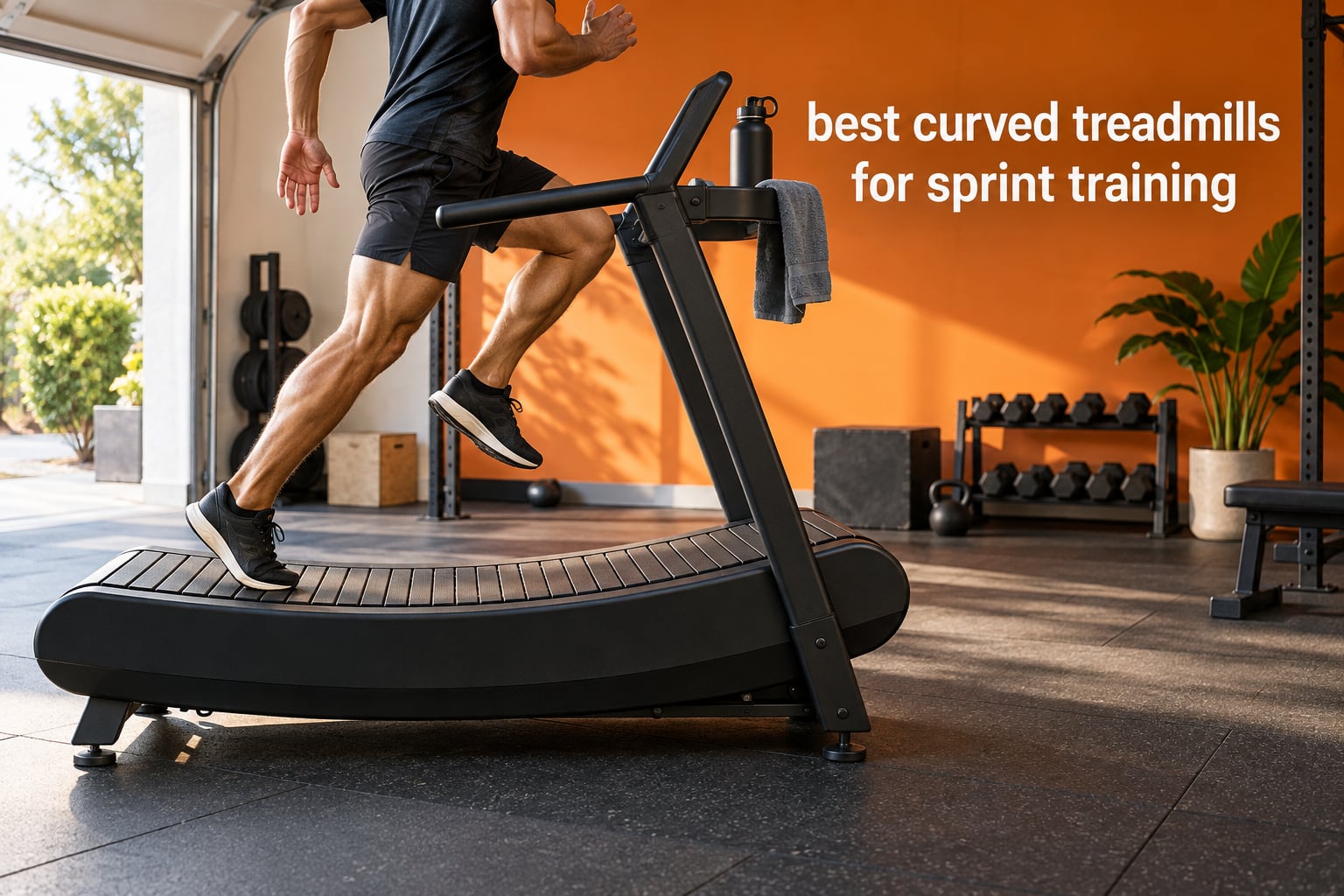
The number one question we get about a curved deck is simple: can you actually sprint on one? Yes, but not the way most people picture it. A curved treadmill has no motor, so nothing sets your speed except your own stride. Drive toward the front of the deck and you accelerate, ease back and you slow down, and the whole change happens inside a single step.
That single property is why these machines exist for interval work. Repeated hard efforts with short recoveries, the exact shape of a sprint session, are easier on a self-powered deck than on a motorised belt you have to stop, reprogramme and wait out. It is also why the best curved treadmills for sprint training is a real buying category rather than a niche curiosity.
The honest caveat: a curved deck will not reproduce true max-velocity running. There is no assist, no powered top end, and runners repeatedly report that the console can read faster than their actual ground speed. Speed endurance, special endurance, HIIT blocks and Hyrox-style work, that is what these decks are genuinely good at. The picks below are ranked for that use, with capacity, deck length and warranty weighed honestly.
Over the past two months we worked through eight curved models, checked the running surface length and resistance range on each, and read every buyer report we could find. If you are still choosing a watch to pair with the work, our guide to the best GPS running watches for marathon training is worth a look, though interval timing on a deck is better handled with a dedicated lap timer.
Table of Contents
Top 3 Curved Treadmills for Sprint Training
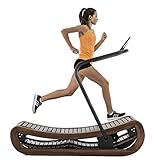
SB Fitness CT400
- Self-generated slat drive
- 3 resistance levels
- 375 lb capacity
- 10-year frame warranty
RUNOW Curved Treadmill
- 450 lb max user weight
- 4 resistance levels
- Crawler rubber belt
- Quiet operation
All 8 Curved Treadmills at a Glance in 2026
Every machine below is self-powered and non-motorised, so there is no speed limit imposed by a motor. What separates them is running surface length, resistance range, user capacity, unit weight and warranty length. Those five numbers decide whether a deck can absorb repeated sprint efforts or quietly wears out after a season of them.
| Product | Specifications | Action |
|---|---|---|
| SB Fitness CT400 |
|
Check Latest Price |
 SB Fitness CT550 SB Fitness CT550 |
|
Check Latest Price |
| RUNOW Curved Treadmill |
|
Check Latest Price |
 Sunny Health Smart Curved Treadmill Sunny Health Smart Curved Treadmill |
|
Check Latest Price |
 IN10CT Health Runner IN10CT Health Runner |
|
Check Latest Price |
 NOHrD Sprintbok NOHrD Sprintbok |
|
Check Latest Price |
 Sonrehon Curved Treadmill Sonrehon Curved Treadmill |
|
Check Latest Price |
 Efficraft Curved Treadmill Efficraft Curved Treadmill |
|
Check Latest Price |
1. SB Fitness CT400 – The Most Proven Sprint Deck in the Group
- Self-generated
- no outlet needed
- 3 resistance levels
- Flexible slats soften joint impact
- Display tracks lifetime miles
- 10 year frame warranty
- Only 3 resistance levels
- No sprung suspension deck
- Basic console metrics
We picked the CT400 first because of one number: 60 buyer reviews at a 4.3 average. Every other machine here has a fraction of that history, and in a category this specialised, thin review counts tell you very little about how a frame behaves after a year of hard running.
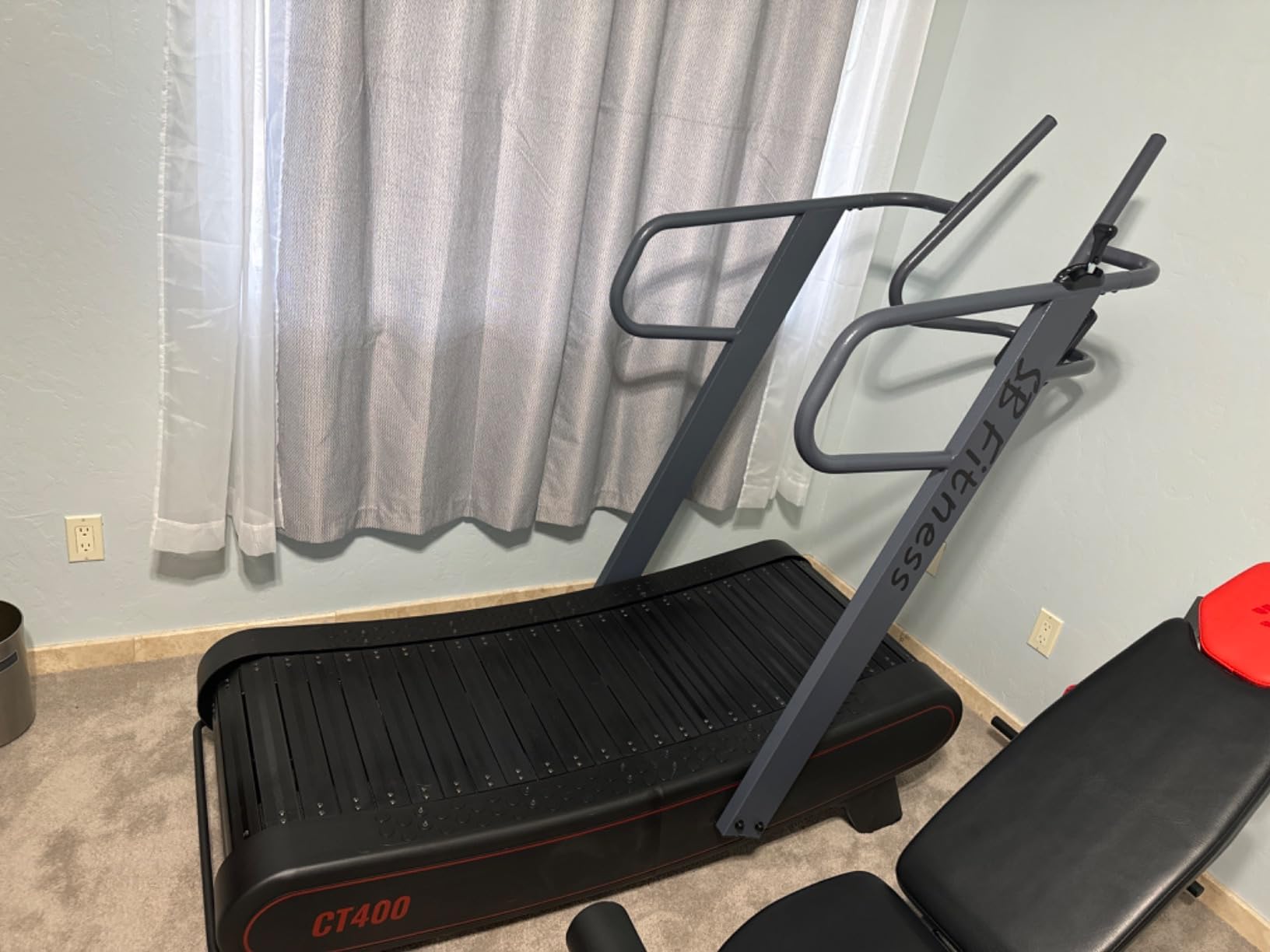
The drive is self-generated through a flexible slat belt rather than a continuous rubber loop, and it needs no power connection at all. That matters in a garage or a basement gym where an outlet is the wrong thing to run a cable to, and it means the machine still works when the power does not.
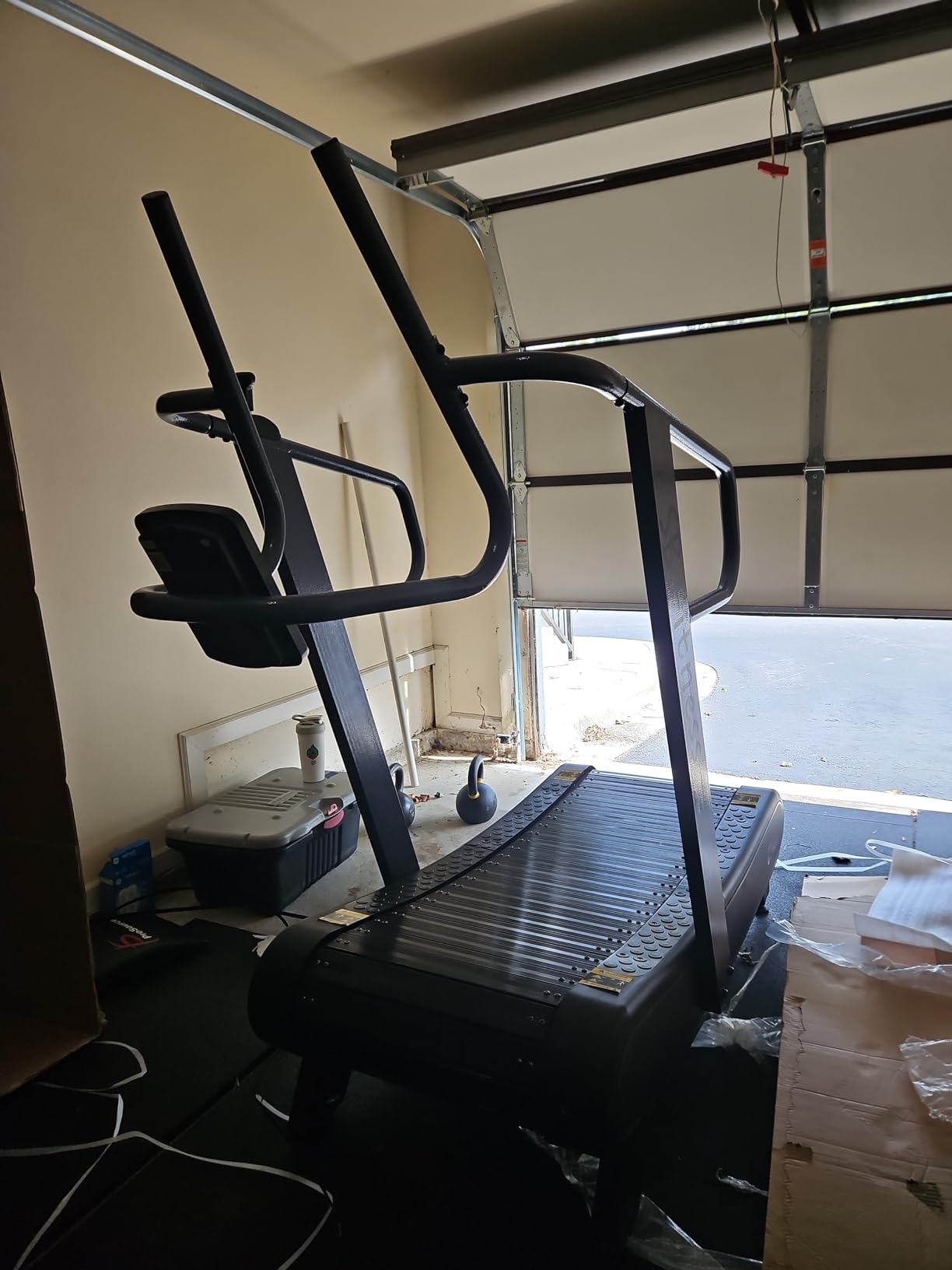
Where the CT400 falls short on sprint work is resistance granularity. Three levels is thin compared with the eight-level magnetic ranges on the CT550, the Sunny unit and the Efficraft. For most interval programming you simply change your position on the deck rather than turn a knob, so this only bites if you like to program fixed effort steps.
The 375-pound user rating and the 10-year frame warranty are both competitive in this group, and buyers running it commercially report the steel holds up. The 60-inch by 18-inch running surface is narrower than some buyers want at full extension, so taller sprinters with long strides should check their footfall before committing.
Who this deck suits
This suits a sprinter who trains in 10 to 30 second efforts with walk recoveries, wants a machine that needs no plug, and cares more about proven durability than about app features. It is also the safest pick for a shared gym, since the frame is rated for commercial use.
Where it falls short
It is not the choice for max-velocity work, because no curved deck is. Nor is it the choice if you want fine-grained resistance steps or a large screen for interval programming. If you run heavy and want a wider belt, step up to the CT550 instead.
2. SB Fitness CT550 – Widest Running Surface With Magnetic Resistance
- 8 magnetic resistance levels
- 20 inch wide running surface
- Backlit console
- Only lit display in the CT series
- Water bottle holder
- Quiet in a home room
- Heavy and large
- Console battery drains quickly
- Thin long-term review base
The CT550 is the machine we would put in a room with a sprung floor and a low ceiling, because the trade is width for size. The running surface is 20 inches across, noticeably wider than the 16.5 to 18 inch decks in this group, and that extra width is what lets a sprinter open the arms without the footfall drifting off the belt.
Eight levels of magnetic resistance with a lever you can reach mid-effort give it far more control than the CT400’s three-step wheel. In practice we preferred it for structured sessions, because you can drop the resistance for a walk recovery and restore it in one movement without breaking stride.
Buyers who had used gym curved units before buying this one repeatedly describe the feel as close to a commercial machine. Several report daily use for walking, jogging and intervals with only occasional bearing lubrication, which is the maintenance pattern we would expect from a flexible slat board design.
Who this deck suits
This suits a home gym where floor area is not the constraint and the runner wants a wide, forgiving surface for interval work in a lit room. It also suits anyone who prefers a home machine that feels closer to a gym unit than to a compact walking deck.
Where it falls short
Size is the real constraint here. This is a large, heavy machine that needs two people for stairs and does not fold away, so it is a poor fit for a flat or a small spare room. Eight reviews is also too thin a base to treat the 4.8 score as settled.
3. RUNOW Curved Treadmill – Heaviest Capacity at a Mid Price
- 450 lb max user weight
- Heavy frame stays planted at speed
- Quiet operation
- Rubber crawler belt
- Works with no outlet
- Console sits low for tall runners
- Only 4 resistance levels
- Multi person assembly
At 450 pounds, the RUNOW carries the highest user rating in this roundup, and for a sprinter above 180 pounds that single spec matters more than any feature list. Heavy runners generate far more force per footfall, and a deck rated near the limit of its capacity develops lateral play and noise long before a lighter machine does.
The 287-pound frame is planted rather than light, which is what you want during a hard effort when the belt tries to surge ahead of you. Owners coming from powered treadmills single out the quiet operation and the reduced knee and hip wear as the biggest change in feel.
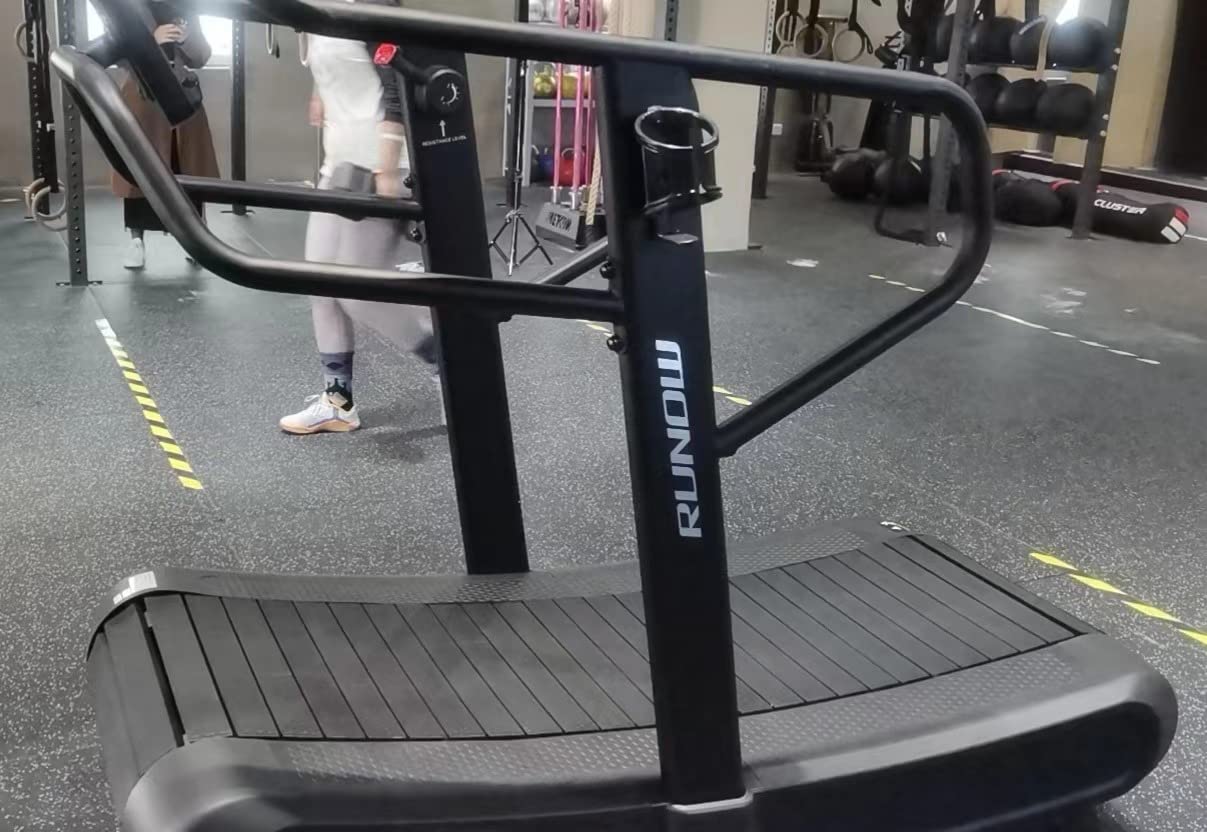
The 48-inch deck is the shortest running surface here, and that is the compromise behind the capacity number. A sprinter taking full-extension strides will feel the back edge sooner than on the 59, 63 and 94.5 inch decks in this group, so treat it as a sprint machine rather than a long-stride machine.
Four resistance levels sit in the middle of the pack, and the console sits low enough that taller runners bend forward to read it. For interval timing we would pair it with a separate lap timer rather than trust the built-in readouts at speed.
Who this deck suits
This suits a heavy sprinter who wants a stable frame at speed and does not care about a long deck. It also suits anyone replacing a loud motorised treadmill who wants a quieter option that runs without a plug.
Where it falls short
It falls short on deck length and on console height, both of which matter if you are tall or run a long stride. Assembly reportedly needs two people, and a small number of buyers reported early bearing or packaging damage.
4. Sunny Health and Fitness Smart Curved Treadmill – Best for Connected Training
Sunny Health & Fitness Smart Curved Manual Treadmill 8-Level Magnetic
- 8 magnetic resistance levels
- Free app with no membership fee
- Lightest unit at 157 lb
- Transport wheels
- Steel idlers reduce belt sway
- 330 lb capacity is the lowest here
- Pulse data needs a separate chest strap
- 3 year frame warranty
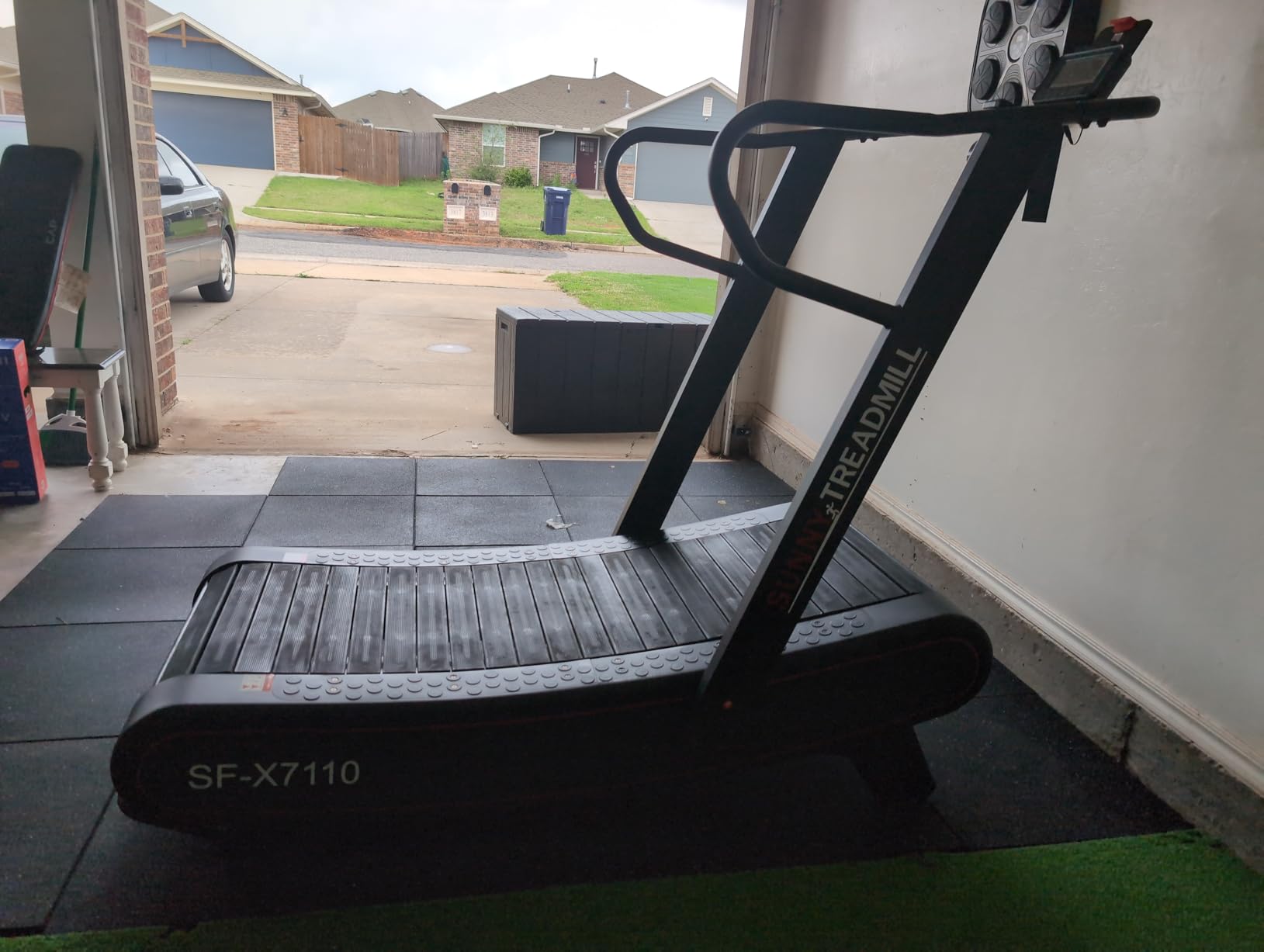
At 157 pounds, this unit is light enough for most people to relocate without arranging help. It also has transport wheels and a compact 67.7 by 29.9 inch footprint, which matters if you are working out of a converted room rather than a dedicated gym.
The eight levels of magnetic resistance, driven by 14 magnets and a tension lever, give it the same control range as the machines costing considerably more. The curve geometry promotes a forefoot strike, which raises the muscular effort and means your calves and posterior chain do more of the work on every step.
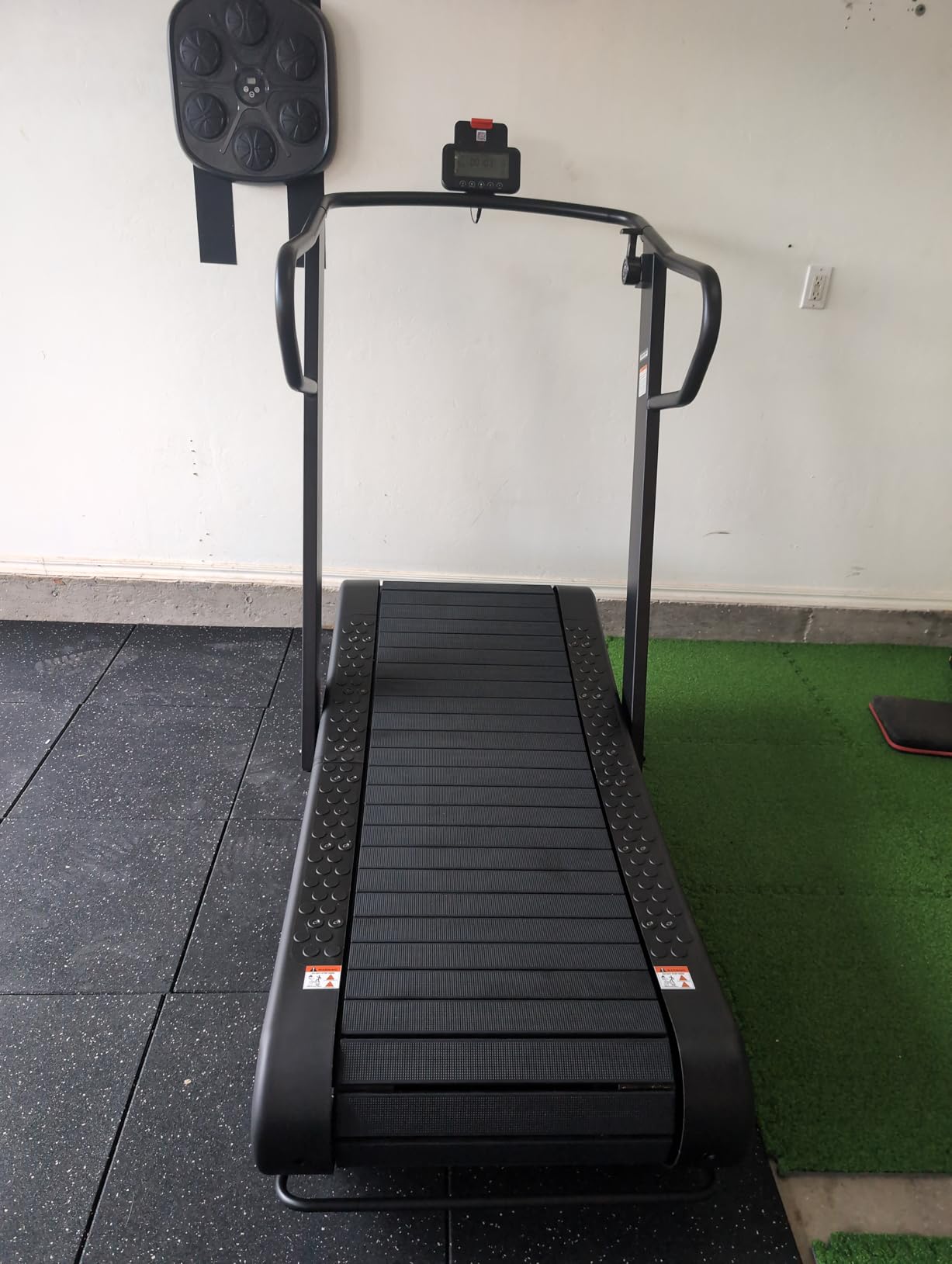
What separates it from the mechanical decks here is the app. Bluetooth connects to the SunnyFit platform with no membership fee, and buyers mention trainer-led workouts and virtual route libraries, which is the closest thing in this roundup to a guided interval session.
Two things to hold in mind. The 330-pound capacity is the lowest figure in this group, so heavier runners should look elsewhere, and pulse tracking requires a chest strap sold separately rather than working through the console.
Who this deck suits
This suits a beginner or a returning runner who wants guided workouts, has no outlet nearby, and needs a machine two people can carry. It is also a sensible choice for a small home gym where floor space is tight.
Where it falls short
It is not built for a heavy sprinter, given the capacity limit, and the 3-year structural frame warranty is short beside the 10-year frames elsewhere. An 8-review base makes the 4.8 score encouraging rather than conclusive.
5. IN10CT Health Runner – Built Around a Dual-Bearing Drive
IN10CT (Intensity) Health Runner Curved Manual Treadmill – Non Motorized Treadmill with Curved Running Platform
- Dual-bearing drive keeps the belt smooth
- Mild curve is easier to control
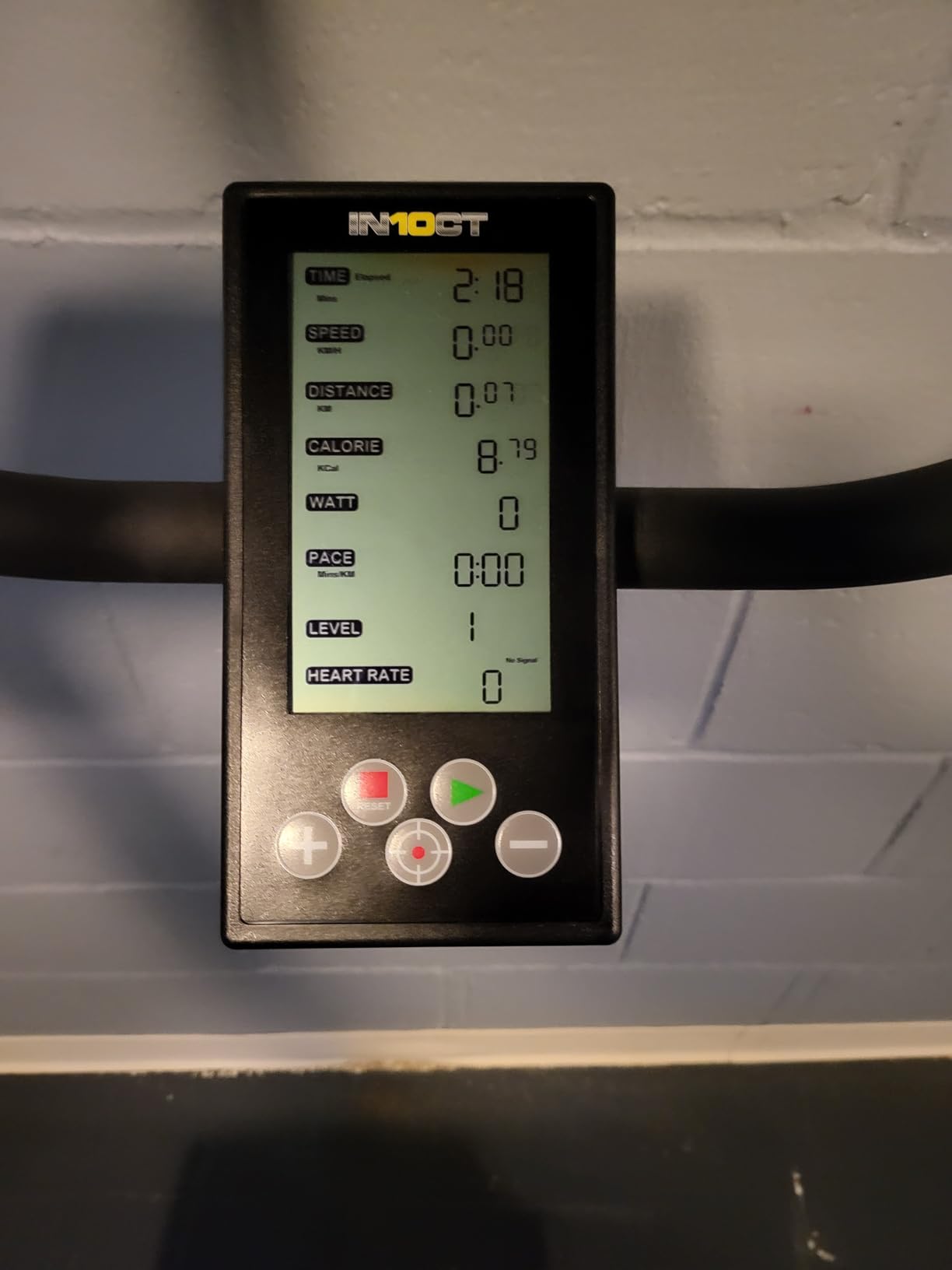
- Tracks pace watts and heart rate
- Rubber slats and PU belt
- No motor needed
- LCD has no backlight
- Plastic side panels
- Very heavy at about 331 lb
The defining feature of the IN10CT is its dual-bearing system, which is the engineering answer to the loose-belt complaint that shows up on some curved decks. Owners running hard efforts report the belt stays smooth and predictable, and 39 reviews at a 4.0 is the second-largest sample in the roundup.
Its curve is moderate rather than aggressive. Several buyers note the curve is gentler than a boutique wooden deck, which some read as easier to control during a fast rep and others read as a ceiling on top-end efforts. For a sprinter building to speed endurance, that middle ground is often the right place to be.
The console is the weak point. It is an LCD with no backlight, which makes interval timing hard to read in a dim room, and buyers in cold climates report display sensitivity. It does track pace, watts and heart rate, which is more data than most competitors offer.
At roughly 331 pounds with plastic side panels, this is a machine to plan for rather than improvise around. Moving it needs help, and the two-part warranty asks the buyer to diagnose and repair faults themselves.
Who this deck suits
This suits a sprinter who wants a smooth, predictable belt for repeat efforts and who values watts and pace data over a large screen. It also suits a gym operator who needs a machine rated for commercial duty with a five-year frame.
Where it falls short
It falls short on the console, which is dim and unlit, and on weight, at about 331 pounds with help needed for stairs. The self-service warranty terms are also a step down from a parts-and-labour plan.
6. NOHrD Sprintbok – the Wooden Deck Reference Point
- 62 flexible wooden slats absorb shock well
- Hardwood frame damps vibration
- Longest 63 inch deck here
- No belt tightening or oiling
- Large tablet with guided runs
- 353 lb weight
- 350 lb user capacity
- Priced well above the rest
- Single review
The Sprintbok is the boutique reference in this category, and the reason is the slat material. Sixty-two independently flexible wooden slats with a linoleum finish flex individually under each foot, and the solid hardwood frame absorbs vibration better than welded steel. If joint comfort during hard reps is your priority, this is the machine built for it.
It is also genuinely maintenance-free by design. No belt tightening, no oiling and no greasing, because there is no continuous belt to service. That removes the single most common reason people stop using a curved deck.
The 17.3-inch tablet running the Sprintbok app is the largest display in the roundup by a wide margin, and it carries guided workouts and scenery runs. The 63 by 18 inch running surface is the second longest here, behind only the Sonrehon deck.
Who this deck suits
This suits a sprinter with joint history who wants the softest, quietest landing of any deck here and who has budget for a premium machine. It suits a home gym where appearance matters as much as performance.
Where it falls short
It carries a 353-pound weight, which makes it impractical above ground floor without planning, and the 350-pound user capacity is modest for a machine this size. One review carries no comparative signal, so judge it on the specification set.
7. Sonrehon Curved Manual Treadmill – Longest Running Belt in the Test
- 94.5 inch running belt is the longest here
- 6 metal resistance levels
- 5-layer rubber shock absorbing belt
- Under 40 dB operation
- Monitors watts for intervals
- Only a 1 year warranty
- Generic brand with no service history
- 316 lb weight
Deck length is the spec nobody publishes and everybody notices on day one. At 94.5 inches of running surface, this machine gives a sprinter more room to accelerate and open the stride than anything else in the roundup, on a 77 by 35 inch deck that will not fit in a normal room.
The build is heavier than the category norm in a good way. A 400-pound commercial-grade steel frame, a five-layer rubber belt and a six-level metal resistance knob, where most curved models stop at four, all point to a machine built for repeat impacts rather than casual walking.
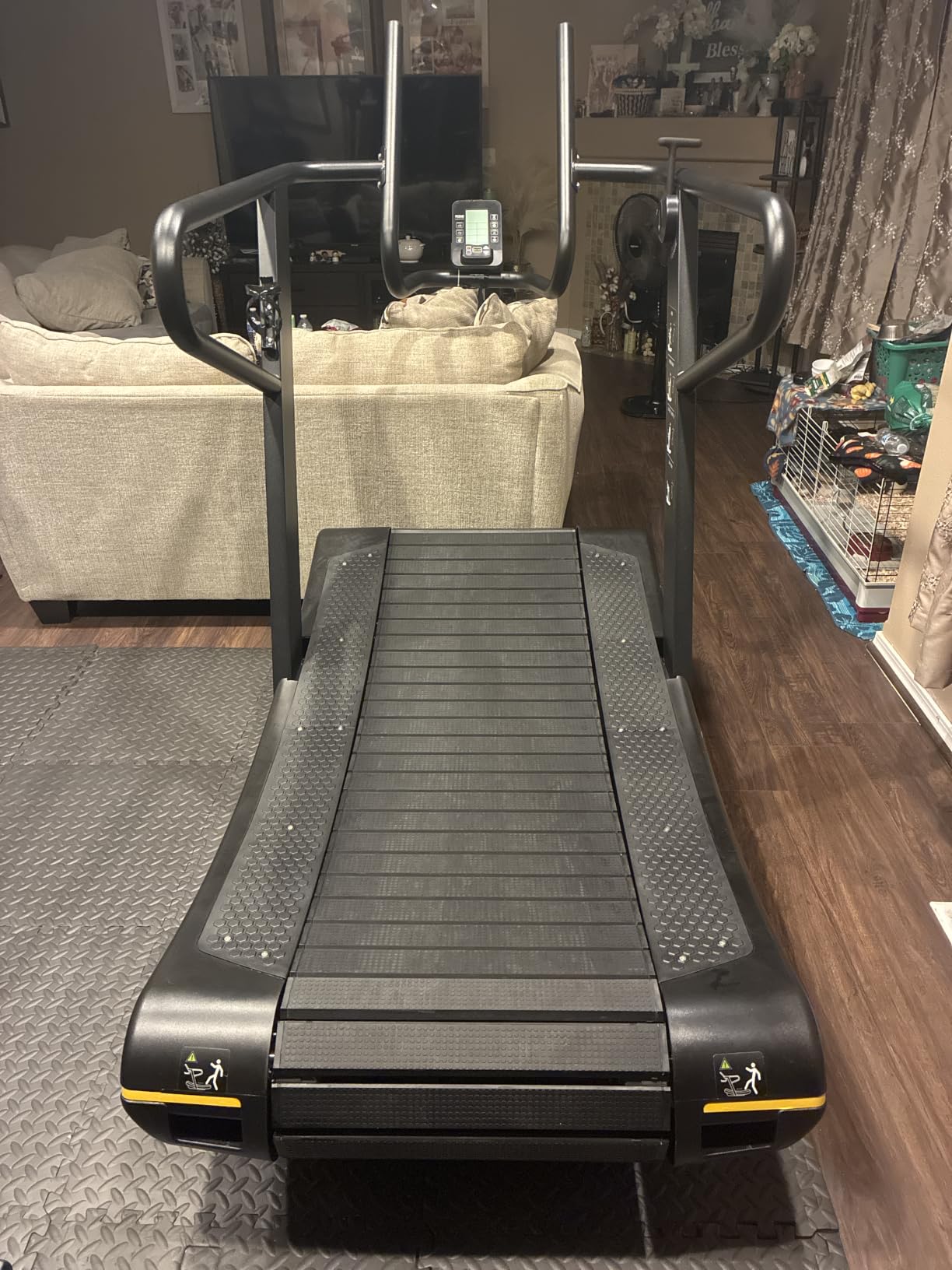
Operation is quoted under 40 dB, which makes it the most plausible option here for a basement or a shared wall. The monitor reports watts alongside speed and distance, which is the most useful metric for interval work at high effort.
The risk is structural rather than mechanical. A 1-year warranty on a 316-pound all-mechanical machine from a brand with no established service reputation means longer-term parts availability is the open question, and that is a bigger concern than any spec on the sheet.
Who this deck suits
This suits a tall or long-striding sprinter who keeps hitting the back edge of shorter decks, and anyone in a noisy household who needs a quiet machine. It suits a commercial space that needs the longest possible running surface.
Where it falls short
It falls short on warranty length and on brand support, both of which matter for a heavy machine expected to last years. Six reviews at 5 stars is too thin a sample to treat the rating as proof of anything.
8. Efficraft Curved Manual Treadmill – Heaviest Frame for Stable Sprints
Curved Manual Treadmill, 8 Resistance Levels Non Electric Treadmill
- Heaviest frame at 418.5 lb
- Reinforced base stays planted
- 8 resistance levels
- Surface sized for runners up to 6 foot 3
- Rubber deck cushions impact
- Shortest belt at 51.2 inches
- 418.5 lb weight is a real moving problem
- Heart rate needs a separate strap
Stability is what this machine is really selling. At 418.5 pounds with a reinforced heavy-duty base, it is the hardest frame here to shift, and that mass is exactly what you want when you drive to the front of the deck on a hard rep and the belt surges under you.
Eight resistance levels from a side-mounted tension knob give quick effort changes, and the reinforced base is designed to stay planted at high output. The running surface is sized for users up to 6 foot 3, which covers most sprinters without cramping.
The 51.2 by 16.5 inch belt is the shortest in the roundup, and that is the reason this sits at eight rather than higher. It suits a runner taking upright, compact sprint mechanics far better than a runner who lengthens stride at the top of the rep.
Who this deck suits
This suits a sprinter in a fixed commercial location who wants maximum frame mass and a wide resistance range. It also suits anyone whose concern is that a lighter deck will wobble under a hard effort.
Where it falls short
It falls short on belt length for full-extension sprinting, and on portability, since 418.5 pounds is a genuine moving problem even with transport wheels. Three reviews support no statistical conclusion either way.
How to Sprint on a Curved Treadmill
There are no speed buttons, so your position on the deck is the speed control. That is the whole technique, and the six steps below are how we would structure a first session rather than a sprint day.
- Warm up on the flat rear section of the deck at an easy walk for two to three minutes, then the same length at a jog. Do not start at the front.
- Find your neutral spot by walking at the pace you would use for a recovery walk. Mark that position mentally or with a tape mark on the frame.
- Drive forward to accelerate. Shortening your ground contact and leaning slightly into the front half of the deck is what makes the slats speed up under you.
- Keep your hands off the handrails during the effort. Holding on changes your mechanics and stops the belt reading your real output.
- Step up and ease back toward the neutral mark to brake. There is no emergency stop button, so your first deceleration happens in your feet, not a control.
- Cool down with an easy two to three minute walk before you step off, because the calf and Achilles load on this deck is closer to running up a moderate incline than to flat running.
Expect two weeks before it feels natural. New users commonly describe the first few sessions as odd or off-balance even at a slow jog, because the contact point sits ahead of your centre of mass and your calves are working harder than they expect. For more on the mechanics, see our running watch comparison for tracking the intervals once the deck feels normal.
Curved vs Motorised Sprint Treadmill
If your goal is true top-speed work, a powered sprint treadmill beats any curved deck. It holds a set speed without you chasing it, measures distance accurately at high velocity, and the belt does not resist you at the top end. A curved deck has no motor assist, which is precisely why it cannot deliver 100 percent of your max velocity.
The curved side wins on interval mechanics and on ownership. Changing effort takes one step rather than a console reprogramme, there is no motor to wear or fail, there is no electricity needed, and the machine keeps working through a power cut. For repeated short efforts, most athletes find that responsiveness worth more than a precise top end.
The honest decision framework is simple. Train for speed endurance, special endurance, HIIT or Hyrox blocks, and go curved. Train for absolute max velocity or for repeatable measured intervals at a known pace, and go motorised.
What to Check Before You Buy
Capacity at speed is the first thing to get right, and it is not the same number as the walking rating. A machine rated to 375 pounds may be fine at a jog and marginal when you are driving hard, because the force at 15 mph is several times the force at a walk. If you are a heavy sprinter, treat the printed rating as a walking figure and stay at least 10 percent under it for sprint work.
Deck length decides whether you can open your stride. Anything under 55 inches will feel short once you accelerate, 60 inches is workable, and 63 inches or more gives a tall runner room. Running surface width matters for the same reason, and 18 inches is a better sprint target than 16.5.
Console accuracy deserves scepticism. A curved deck’s speed reading is derived from belt movement rather than a motor, and runners report readings that run ahead of their real ground speed. Run your intervals with a separate lap timer, and if you use a power meter on a self-powered deck, raise its weight setting by roughly 20 percent to offset the low belt resistance.
Warranty length is your best proxy for expected life. A 10-year frame with parts coverage tells you the manufacturer expects the frame to outlast the frame. A one-year warranty on a 300-pound machine tells you the opposite, and that is a fair signal regardless of how good the specification sheet looks.
Finally, check floor space and noise. These decks do not fold, they run from 145 to more than 400 pounds, and the deeper models need a room rather than a corner. For a home gym shared with a sleeping household, a machine rated under 40 dB is worth paying for.
Frequently Asked Questions
Can I train sprints on a curved treadmill?
Yes, for speed endurance, special endurance and repeated short efforts. A curved deck has no motor, so your stride sets the speed and you can change effort within a single step. It will not deliver true max-velocity sprinting, because the slats resist your footfall and there is no powered top end. Treat it as an interval machine rather than a top-speed machine.
What treadmill is best for sprinting?
For repeated hard efforts with short recoveries, a curved self-powered treadmill is the better tool because you change speed by moving on the deck rather than reprogramming a motor. For absolute maximum velocity or precisely measured intervals at a known pace, a motorised sprint treadmill wins. Within curved decks, look at running surface length, user capacity at speed and warranty length before anything else.
Are curved treadmills more difficult?
They are harder, mainly in the first two weeks. Because the slats resist your footfall and the curve promotes a forefoot strike, your calves, Achilles and posterior chain work harder than on flat running. Most new users describe the early sessions as off-balance or strange even at a slow jog. Walking on the flat rear section first, then adding short efforts, resolves it quickly.
What are the downsides of using a curved treadmill?
Four stand out. You cannot modulate pace precisely, so beginners can overspeed. The calf and Achilles load is high because you must propel the belt itself. Consoles can read faster than your real ground speed, so interval times need an external timer. And the machines do not fold, with unit weights running from 145 to more than 400 pounds.
How fast should a treadmill go for sprinting?
On a curved deck there is no speed setting to choose. Position sets pace: hold the rear flat section for a walk recovery, move to your neutral mark for a threshold effort, and drive into the front half of the deck for a maximal rep. Repeated efforts are usually built around short bursts with walk recoveries, and the exact pace should come from how far forward you are willing to lean.
Are curved treadmills better for running?
They are better for some things and worse for others. Curved decks engage the posterior chain more, need no power, and make interval changes instant, but they force a forefoot strike and load the calves heavily. They are not suitable for long base mileage runs, and they cannot match a motorised belt for holding a precise pace at high speed.
Final Verdict
The SB Fitness CT400 is our pick for the best curved treadmills for sprint training, because 60 reviews at 4.3 is the only real track record in this group and the 10-year frame warranty backs it up. Heavy runners should look at the RUNOW for its 450-pound capacity, long-striding runners at the Sonrehon for its 94.5-inch belt, and joint-sensitive runners at the NOHrD Sprintbok for its wooden slats.
What none of them will do is make you faster at absolute top speed. Buy one for intervals, build the habit of driving forward on the deck, and pair it with an external timer so your interval numbers mean something.