
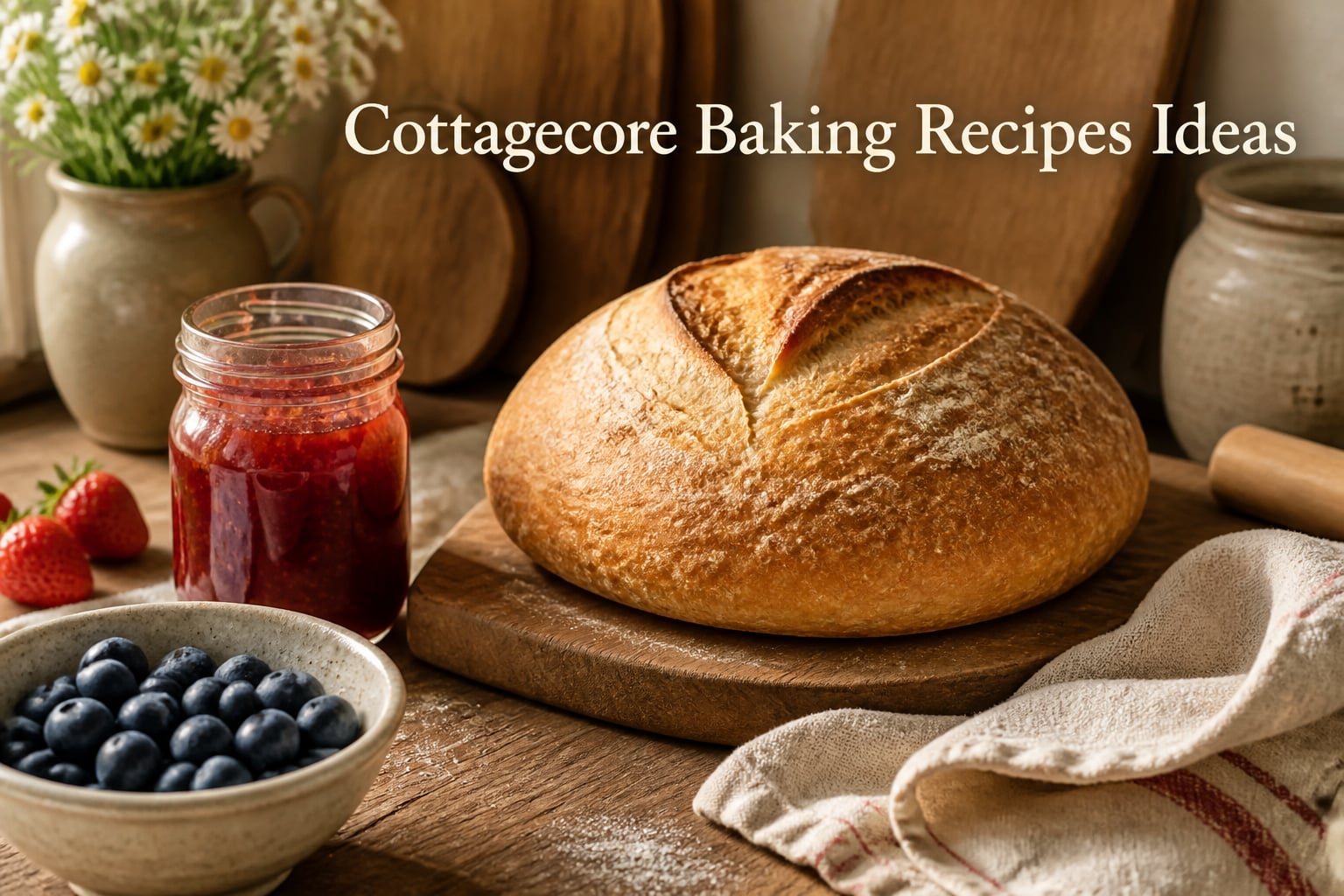
I reach for cottagecore baking recipes ideas when I want the kitchen to feel slower but still need instructions that work in a real oven. This collection moves from bread and breakfast bakes to fruit pastry, cookies, and simple cakes, with exact quantities and doneness cues for every project.
The look comes from flour-dusted crusts, seasonal fruit, seeds, and unfussy pans—not from leaving out practical details. These rustic from-scratch bakes tell you how long dough should rise, how full pastry can be, and what the finished center should look or feel like.
Table of Contents
13 Cottagecore Baking Recipes Ideas with Complete Methods
Begin with Bread or a Simple Cake
1. No-Knead Crusty Loaf
A long, quiet rise develops flavor without a mixer, and a covered pot traps the steam that gives the loaf its crackling crust.
Serves: 10 | Makes: 1 loaf (10 slices) | Time: 14 hours | Method: Dutch oven
Ingredients
- 3 1/4 cups (390 g) bread flour
- 1 1/2 cups room-temperature water
- 1/2 teaspoon instant yeast
- 1 1/2 teaspoons kosher salt
- 1 tablespoon olive oil for the bowl
- 2 tablespoons cornmeal for the parchment
Instructions
- Stir the flour, water, yeast, and salt in a large bowl until no dry patches remain; the dough will be sticky.
- Oil a clean bowl, add the dough, cover, and leave at room temperature for 12 to 18 hours, until doubled and covered with bubbles.
- Turn onto a floured surface, fold the four edges toward the center, and rest seam-side down for 45 minutes.
- Set a lidded Dutch oven in the oven and preheat to 450°F for 30 minutes. Move the dough to cornmeal-dusted parchment and score the top.
- Lower the dough into the hot pot. Bake covered for 30 minutes, then uncovered for 12 to 18 minutes, until deep brown and 205°F inside; cool for 1 hour before slicing.
Substitutions: All-purpose flour can replace bread flour, although the loaf will be slightly less chewy. Keep the same weight and hold back 2 tablespoons of water until the dough texture is clear.
Storage: Keep the cooled loaf cut-side down on a board for one day or wrapped at room temperature for three days. Freeze individual slices for up to two months and toast from frozen.
Tip: A pale crust will soften quickly. Let it reach a deep chestnut brown before removing the pot.
2. Honey Oat Sandwich Bread
Honey softens this everyday loaf while rolled oats give the crumb a gentle chew. It slices neatly enough for toast or packed sandwiches.
Serves: 10 | Makes: 1 loaf (12 slices) | Time: 2 hours 45 minutes | Method: Yeast bread
Ingredients
- 3 cups bread flour, plus more if needed
- 1 cup old-fashioned rolled oats
- 1 cup warm whole milk, 105–110°F
- 1/4 cup warm water
- 2 1/4 teaspoons active dry yeast
- 1/3 cup honey
- 2 tablespoons softened butter
- 1 1/2 teaspoons kosher salt
- 1 tablespoon oats for the top
Instructions
- Stir the milk, water, yeast, and 1 teaspoon honey together; wait 5 to 10 minutes, until a foamy cap forms.
- Add the remaining honey, flour, 1 cup oats, butter, and salt. Knead for 8 minutes, until smooth and only slightly tacky.
- Cover in a greased bowl and rise for 60 to 75 minutes, until doubled.
- Shape into a tight 9-inch log, place in a greased 9-by-5-inch loaf pan, brush lightly with water, add the topping oats, and proof for 35 to 50 minutes, until the crown sits 1 inch above the rim.
- Bake at 375°F for 32 to 38 minutes, until golden and 190°F inside. Turn out of the pan and cool completely before cutting.
Substitutions: Unsweetened oat milk can replace dairy milk. If using all-purpose flour, begin with 2 tablespoons less liquid and add it only if the dough feels stiff.
Storage: Wrap the completely cooled loaf at room temperature for up to four days. Freeze sliced bread with parchment between portions for up to two months.
Tip: Do not add extra flour just because the dough clings during the first minute; oats absorb more moisture as kneading continues.
3. Rustic Honey Cake
This single-layer cake is lightly sweet, buttery, and sturdy enough to serve without frosting. A thin honey glaze keeps the top fragrant and glossy.
Serves: 10 | Time: 1 hour 10 minutes | Method: 9-inch cake pan
Ingredients
- 2 cups all-purpose flour
- 2 teaspoons baking powder
- 1/2 teaspoon fine salt
- 1/2 teaspoon ground cinnamon
- 2 large eggs
- 1/2 cup packed light brown sugar
- 1/2 cup unsalted butter, melted and cooled
- 3/4 cup buttermilk
- 1/3 cup honey, divided
- 1 teaspoon vanilla extract
Instructions
- Heat the oven to 350°F. Grease a 9-inch round pan and line the bottom with parchment.
- Whisk the flour, baking powder, salt, and cinnamon in one bowl.
- In another bowl, whisk the eggs, brown sugar, melted butter, buttermilk, 1/4 cup honey, and vanilla until smooth.
- Fold the wet mixture into the dry just until no flour streaks remain. Spread in the pan and bake for 34 to 40 minutes, until the center springs back and a tester has moist crumbs.
- Cool for 10 minutes, turn onto a rack, and brush the warm top with the remaining honey. Cool before slicing.
Substitutions: Plain yogurt thinned with 2 tablespoons milk can replace buttermilk. Maple syrup works in the glaze, but keep honey in the batter for its moisture.
Storage: Cover at room temperature for two days or refrigerate for up to five days. Bring chilled slices to room temperature before serving.
Tip: Measure honey in a cup lightly coated with oil so the full amount slides into the bowl.
If I am baking for a full weekend rather than one afternoon, I pair the loaf with a cake and save the cookies for last. The techniques in these old-fashioned cakes made from scratch offer more choices when a sturdy sliced dessert is the priority.
Fruit Pastry for a Seasonal Basket
4. Blueberry Lemon Hand Pies
A thick, lemony berry filling stays inside flaky half-moons instead of leaking across the pan. The sealed pastries are easy to carry outdoors.
Serves: 8 | Makes: 8 hand pies | Time: 1 hour 10 minutes | Method: Oven
Ingredients
- 2 refrigerated pie crusts
- 1 1/2 cups blueberries
- 1/3 cup granulated sugar
- 2 tablespoons cornstarch
- 1 tablespoon fresh lemon juice
- 1 tablespoon finely grated lemon zest
- 1/4 teaspoon fine salt
- 1 large egg, beaten
- 1 tablespoon coarse sugar
Instructions
- Heat the oven to 400°F and line a baking sheet. Cut eight 5-inch circles from the crusts, rerolling scraps once.
- Combine blueberries, granulated sugar, cornstarch, lemon juice, zest, and salt. Let stand for 5 minutes.
- Spoon 2 tablespoons filling onto one side of each circle, leaving a 1/2-inch border. Fold over and press out trapped air.
- Crimp with a fork, cut two steam vents in every top, brush with egg, and sprinkle with coarse sugar. Chill on the pan for 10 minutes.
- Bake for 24 to 29 minutes, until deep golden and the filling bubbles through the vents. Cool for at least 20 minutes.
Substitutions: Use an equal amount of small raspberries or chopped strawberries; frozen berries can go in frozen but may need 1 extra teaspoon cornstarch.
Storage: Keep cooled pies loosely covered at room temperature for one day or refrigerated for three days. Re-crisp at 350°F for 7 minutes.
Tip: If the filling reaches the edge, wipe it away before crimping; juice on the seam prevents a secure seal.
5. Buttermilk Pound Cake
Creamed butter gives this loaf a close, tender crumb, while buttermilk keeps it from feeling dry. Lemon zest is optional but brightens the rich batter.
Serves: 10 | Time: 1 hour 25 minutes | Method: Loaf pan
Ingredients
- 1 3/4 cups all-purpose flour
- 1/2 teaspoon baking powder
- 1/2 teaspoon fine salt
- 3/4 cup unsalted butter, softened
- 1 cup granulated sugar
- 3 large eggs, room temperature
- 1/2 cup buttermilk, room temperature
- 1 teaspoon vanilla extract
- 1 teaspoon finely grated lemon zest
Instructions
- Heat the oven to 325°F. Grease a 9-by-5-inch loaf pan and line the long sides with parchment.
- Whisk flour, baking powder, and salt. In a separate bowl, beat butter and sugar for 3 to 4 minutes, until pale and fluffy.
- Beat in eggs one at a time, scraping the bowl after each. Mix in vanilla and lemon zest.
- Fold in one-third of the flour, half the buttermilk, another third of flour, remaining buttermilk, and final flour. Stop as soon as the batter is even.
- Bake for 55 to 65 minutes, until split and golden on top and a tester from the center has a few moist crumbs. Cool 15 minutes in the pan, then move to a rack.
Substitutions: For homemade buttermilk, stir 1 1/2 teaspoons lemon juice into enough whole milk to make 1/2 cup and rest 5 minutes. Do not replace butter with liquid oil in this creaming method.
Storage: Wrap the cooled loaf at room temperature for three days or freeze slices for two months. Refrigeration makes the crumb firm, so let it warm before serving.
Tip: Room-temperature eggs emulsify into the butter instead of curdling it, which creates a finer crumb.
6. Strawberry Jam Thumbprint Cookies
A buttery vanilla dough surrounds just enough thick jam to stay chewy without gluing the cookies to the pan.
Serves: 12 | Makes: 24 cookies | Time: 50 minutes | Method: Oven
Ingredients
- 2 cups all-purpose flour
- 1/2 teaspoon fine salt
- 3/4 cup unsalted butter, softened
- 2/3 cup granulated sugar
- 1 large egg yolk
- 1 teaspoon vanilla extract
- 1/2 cup thick strawberry jam
- 2 tablespoons coarse sugar, optional
Instructions
- Heat the oven to 350°F and line two pans. Whisk flour and salt together.
- Beat butter and sugar for 2 minutes, until creamy but not airy. Beat in the yolk and vanilla.
- Mix in the flour just until the dough holds together. Roll level tablespoon portions into balls and coat lightly in coarse sugar if using.
- Space 2 inches apart and press a 1/2-teaspoon well into each center. Fill every well with about 1/2 teaspoon jam.
- Bake for 12 to 15 minutes, until the edges are pale gold. Refill any sunken centers with a dot of jam while warm, then cool on the pan for 5 minutes.
Substitutions: Apricot, raspberry, or blackberry preserves work if they are thick and seedless. A whole egg makes the dough softer, so use only the yolk listed.
Storage: Layer completely cooled cookies between parchment in an airtight tin for five days. Freeze unfilled dough balls for one month and add jam before baking.
Tip: Use the rounded handle of a wooden spoon for even wells, but stop before the dough cracks all the way to the pan.
Fruit pastry should taste like the fruit, not a pile of decorations. For another small-batch direction, the method in this lemon cheesecake tart explains how to keep a rich filling balanced with a crisp base.
7. Apple Rose Tart
Paper-thin apple slices curl into rosettes over an almond-lined crust. Briefly softening the fruit makes the petals bend rather than snap.
Serves: 8 | Time: 1 hour 25 minutes | Method: 9-inch tart pan
Ingredients
- 1 refrigerated pie crust
- 3 firm red apples, cored and halved
- 2 tablespoons fresh lemon juice
- 1/3 cup granulated sugar, divided
- 1 teaspoon ground cinnamon
- 1/3 cup almond flour
- 1 tablespoon cornstarch
- 1 tablespoon melted butter
- 2 tablespoons apricot jam
Instructions
- Heat the oven to 375°F. Fit the crust into a 9-inch tart pan, prick the base, line with parchment and weights, and bake for 12 minutes.
- Slice apples crosswise about 1/16 inch thick. Toss with lemon juice, 2 tablespoons sugar, and cinnamon, then microwave covered for 2 to 3 minutes, until flexible; drain.
- Mix almond flour, cornstarch, and remaining sugar and scatter it over the warm crust.
- Overlap 6 to 8 apple slices in a row, roll into a rose, and set it upright in the crust. Repeat, filling gaps with single curved slices. Brush with butter.
- Bake for 32 to 38 minutes, until the crust is brown and apples are tender. Warm the jam with 1 teaspoon water and brush over the warm fruit.
Substitutions: Pears can replace apples if they are firm and need only 30 to 60 seconds of softening. Ground hazelnuts can replace almond flour.
Storage: Refrigerate covered for up to three days. Warm slices at 325°F for 8 minutes; the microwave will soften the crust.
Tip: Keep the apple skin on for a rosy edge, but use a mandoline guard or a very sharp knife for safe, even slices.
I use cottagecore baking recipes ideas as a practical project list, not a decorating rulebook. The pan, season, and time available decide what I bake; the handmade appearance follows naturally from a sound method.
Cookies, Scones, and Farmhouse Baking Recipes
8. Brown Sugar Rye Cookies
Rye flour adds a toasty, slightly earthy note behind caramel-like brown sugar. Pulling the cookies while the centers look soft keeps them pleasantly chewy.
Serves: 12 | Makes: 24 cookies | Time: 45 minutes | Method: Oven
Ingredients
- 1 1/4 cups all-purpose flour
- 1 cup light rye flour
- 1/2 teaspoon baking soda
- 1/2 teaspoon fine salt
- 3/4 cup unsalted butter, softened
- 1 cup packed dark brown sugar
- 1 large egg
- 1 teaspoon vanilla extract
- 1/3 cup granulated sugar for rolling
Instructions
- Heat the oven to 350°F and line two baking sheets. Whisk both flours, baking soda, and salt.
- Beat butter and brown sugar for 2 minutes. Mix in the egg and vanilla until smooth.
- Add the dry ingredients and mix only until no flour remains. Chill for 15 minutes if the dough feels very soft.
- Roll level tablespoon portions into balls, coat in granulated sugar, and space them 2 inches apart.
- Bake for 10 to 12 minutes, until the edges are set and the centers still look slightly underdone. Cool on the pan for 7 minutes before moving.
Substitutions: Whole-wheat flour can replace rye, though the cookies lose some maltiness. Light brown sugar works but produces a milder flavor.
Storage: Store airtight for five days with a small piece of bread in the container to maintain chewiness. Freeze dough balls for six weeks and bake from frozen with 2 extra minutes.
Tip: Weighing the two flours prevents a dry, crumbly dough; rye compacts easily in a measuring cup.
9. Blackberry Scones
Cold butter creates flaky pockets while whole berries leave tart streaks through the crumb. Chilling the wedges controls spread in the hot oven.
Serves: 8 | Makes: 8 scones | Time: 50 minutes | Method: Oven
Ingredients
- 2 cups all-purpose flour
- 1/3 cup granulated sugar
- 1 tablespoon baking powder
- 1/2 teaspoon fine salt
- 1/2 cup cold unsalted butter, cubed
- 2/3 cup cold buttermilk
- 1 large egg
- 1 teaspoon vanilla extract
- 1 1/4 cups blackberries
- 2 tablespoons coarse sugar
Instructions
- Heat the oven to 400°F and line a sheet pan. Whisk flour, sugar, baking powder, and salt.
- Cut in cold butter until most pieces are pea-size. Toss the blackberries through the flour mixture with a gentle hand.
- Whisk buttermilk, egg, and vanilla, then fold into the bowl just until a shaggy dough forms.
- Pat on a floured surface into a 1-inch-thick, 7-inch round. Cut eight wedges, move them 2 inches apart, add coarse sugar, and chill for 10 minutes.
- Bake for 18 to 23 minutes, until risen, golden at the edges, and firm underneath. Cool 10 minutes before serving.
Substitutions: Blueberries or raspberries work in the same volume. Frozen berries should stay frozen until folded in so they do not dye the dough.
Storage: Scones are best the first day. Keep leftovers covered for two days and reheat at 325°F for 6 minutes; freeze unbaked wedges for one month.
Tip: Press straight down with the knife rather than sawing, which seals the cut edge and limits the rise.
These seasonal fruit pastries are easiest when cold butter stays cold and wet filling stays away from unsealed edges. I also keep the flour bag closed between measurements; the FDA notes that raw flour is not ready-to-eat food, so I wait for the baked batch instead of tasting dough.
10. Rosemary Pear Galette
Juicy pears, a restrained amount of rosemary, and a free-form crust make a rustic centerpiece without fussy decoration.
Serves: 8 | Time: 1 hour 15 minutes | Method: Sheet pan
Ingredients
- 1 refrigerated pie crust
- 3 firm pears, cored and thinly sliced
- 1/3 cup granulated sugar
- 2 tablespoons cornstarch
- 1 tablespoon fresh lemon juice
- 1 teaspoon finely chopped fresh rosemary
- 1/4 teaspoon fine salt
- 1 beaten egg
- 1 tablespoon coarse sugar
Instructions
- Heat the oven to 400°F and line a sheet pan. Roll the crust to a 12-inch circle on a lightly floured surface.
- Toss pears with granulated sugar, cornstarch, lemon juice, rosemary, and salt. Let stand 5 minutes.
- Arrange fruit in the center, leaving a 2-inch border and leaving excess juice in the bowl.
- Fold the border over the pears in loose pleats. Brush the crust with egg, add coarse sugar, and chill for 10 minutes.
- Bake for 35 to 42 minutes, until the bottom is brown and the juices bubble thickly. Cool 25 minutes before cutting.
Substitutions: Firm apples can replace pears and may need 5 additional minutes. Thyme can replace rosemary at the same amount for a softer herbal note.
Storage: Refrigerate covered for three days. Reheat uncovered at 350°F for 8 to 10 minutes to restore the pastry edge.
Tip: Finely chop the rosemary; long needles overwhelm individual bites even when the total amount is small.
11. Lemon Lavender Shortbread
Lemon keeps the floral note bright, and a small measured amount of culinary lavender prevents the cookies from tasting perfumed.
Serves: 12 | Makes: 24 wedges | Time: 1 hour 20 minutes | Method: Oven
Ingredients
- 2 cups all-purpose flour
- 1 cup unsalted butter, softened
- 2/3 cup powdered sugar
- 1/2 teaspoon fine salt
- 1 teaspoon vanilla extract
- 1 tablespoon finely grated lemon zest
- 1 teaspoon culinary lavender, finely crushed
Instructions
- Beat butter and powdered sugar for 2 minutes, until smooth but not fluffy. Mix in vanilla, zest, and lavender.
- Add flour and salt and mix on low only until the dough holds when pressed.
- Press evenly into a parchment-lined 9-inch square pan. Prick all over with a fork and chill for 30 minutes.
- Heat the oven to 325°F. Bake for 30 to 36 minutes, until the edges are pale gold and the center is matte.
- Cut into 24 fingers or wedges while warm, then leave in the pan until completely cool and firm.
Substitutions: Orange zest can replace lemon. If culinary lavender is unavailable, omit it rather than using decorative or fragranced flowers not sold for food.
Storage: Keep airtight at room temperature for one week. Freeze baked pieces between parchment for two months.
Tip: Crush the lavender with a little of the measured sugar so it disperses evenly instead of collecting in bitter pockets.
For a second cookie tin with a different texture, these chewy and crisp old-fashioned cookies make a useful companion without repeating the lavender flavor.
Yeasted Rolls and an Old-Fashioned Fruit Cake
12. Seeded Farmhouse Rolls
A mix of sunflower, sesame, and pumpkin seeds gives these soft pull-apart rolls a hearty surface and nutty flavor.
Serves: 8 | Makes: 12 rolls | Time: 2 hours 40 minutes | Method: Yeast bread
Ingredients
- 3 1/2 cups bread flour
- 1 cup warm whole milk, 105–110°F
- 1/4 cup warm water
- 2 1/4 teaspoons active dry yeast
- 1 tablespoon granulated sugar
- 2 tablespoons softened butter
- 1 1/2 teaspoons kosher salt
- 1/2 cup mixed sunflower, sesame, and pumpkin seeds, divided
- 1 beaten egg
Instructions
- Stir milk, water, yeast, and sugar and wait 5 to 10 minutes, until foamy.
- Add flour, butter, salt, and half the seeds. Knead for 8 minutes, until elastic and slightly tacky.
- Cover and rise for 60 to 75 minutes, until doubled. Divide into 12 equal pieces and shape each into a taut ball.
- Arrange in a greased 9-by-13-inch pan, cover, and proof for 35 to 50 minutes, until touching and puffy. Heat the oven to 375°F.
- Brush with egg, add remaining seeds, and bake for 20 to 24 minutes, until golden and 190°F inside. Cool 15 minutes before pulling apart.
Substitutions: Use any unsalted seed blend in the same volume. Unsweetened plant milk works, though the tops may brown a little less.
Storage: Keep covered at room temperature for three days. Freeze separated rolls for two months and warm at 325°F for 8 minutes.
Tip: Press seeds on gently after the egg wash so they remain attached when the rolls are split.
13. Rhubarb Almond Cake
Tart rhubarb sinks slightly into an almond-topped buttermilk crumb. The cake is simple enough for an afternoon bake but sturdy enough to travel.
Serves: 10 | Time: 1 hour 15 minutes | Method: 9-inch cake pan
Ingredients
- 1 3/4 cups all-purpose flour
- 1/2 cup almond flour
- 2 teaspoons baking powder
- 1/2 teaspoon fine salt
- 3/4 cup granulated sugar, divided
- 2 large eggs
- 1/2 cup unsalted butter, melted and cooled
- 3/4 cup buttermilk
- 1 teaspoon vanilla extract
- 2 cups rhubarb cut into 1/2-inch pieces
- 1/2 cup sliced almonds
Instructions
- Heat the oven to 350°F. Grease and line a 9-inch round pan. Toss rhubarb with 2 tablespoons of the sugar.
- Whisk all-purpose flour, almond flour, baking powder, salt, and the remaining sugar.
- Whisk eggs, butter, buttermilk, and vanilla separately, then fold wet into dry just until combined.
- Spread in the pan, scatter rhubarb evenly over the batter, and finish with sliced almonds.
- Bake for 42 to 50 minutes, until the center springs back and a tester has moist crumbs but no wet batter. Cool 15 minutes in the pan, then transfer to a rack.
Substitutions: Firm tart apples can replace rhubarb; omit the 2 tablespoons sugar used to coat the fruit. For nut-free baking, replace almond flour with all-purpose flour and omit the topping almonds.
Storage: Cover at room temperature for two days or refrigerate for five. Freeze individual slices for two months and thaw while wrapped.
Tip: Dry washed rhubarb before cutting so extra surface water does not make the center gummy.
How I Keep a Rustic Bake Practical
I choose one visual detail that also improves the food: seeds add crunch, scored bread releases steam, coarse sugar protects pastry, and visible fruit signals the filling. A linen towel or vintage plate can wait until the bake is cool; texture matters more than styling.
When timing several projects, I start the yeasted dough first, chill shaped pastry while the oven heats, and bake cookies after a cake comes out. That sequence gives the oven time to change temperature without leaving a delicate batter on the counter. For a broader bread day, these rustic bread ideas can help use the same flour and yeast.
Frequently Asked Questions
What makes baking feel cottagecore rather than simply old-fashioned?
The most convincing choices use familiar ingredients, seasonal fruit, hand-shaped dough, and simple finishes that reveal how the food was made. The method still needs modern measurements and reliable temperature cues.
Which project should a beginner try first?
The thumbprint cookies or honey cake are forgiving places to begin because neither needs yeast or laminated dough. Read the complete method, measure everything, and prepare the pan before mixing.
Can I prepare any of these a day ahead?
Shortbread, rye cookies, honey cake, sandwich bread, and rolls all keep well overnight. Hand pies and galettes taste best re-crisped briefly in the oven, while scones are most tender on the day they are baked.
How do I stop fruit pastry from becoming soggy?
Use firm fruit, include the measured starch, leave excess bowl juices behind, and bake until the filling bubbles thickly. Cool on a rack so steam does not collect beneath the crust.
Do I need vintage baking equipment?
No. A sheet pan, loaf pan, round cake pan, scale or measuring cups, thermometer, and one heavy covered pot handle nearly everything here. Old cookware is decorative only if it is not food-safe or oven-safe.
Final Thoughts Before the Flour Comes Out
The best cottagecore baking recipes ideas earn their charm through a crisp crust, a tender crumb, ripe fruit, and instructions you can trust. I would pick one bake that matches the time available, make it exactly once, and write down only the adjustment the next batch truly needs. That is how an old-fashioned bread and cake afternoon becomes a tradition instead of a photo project.