
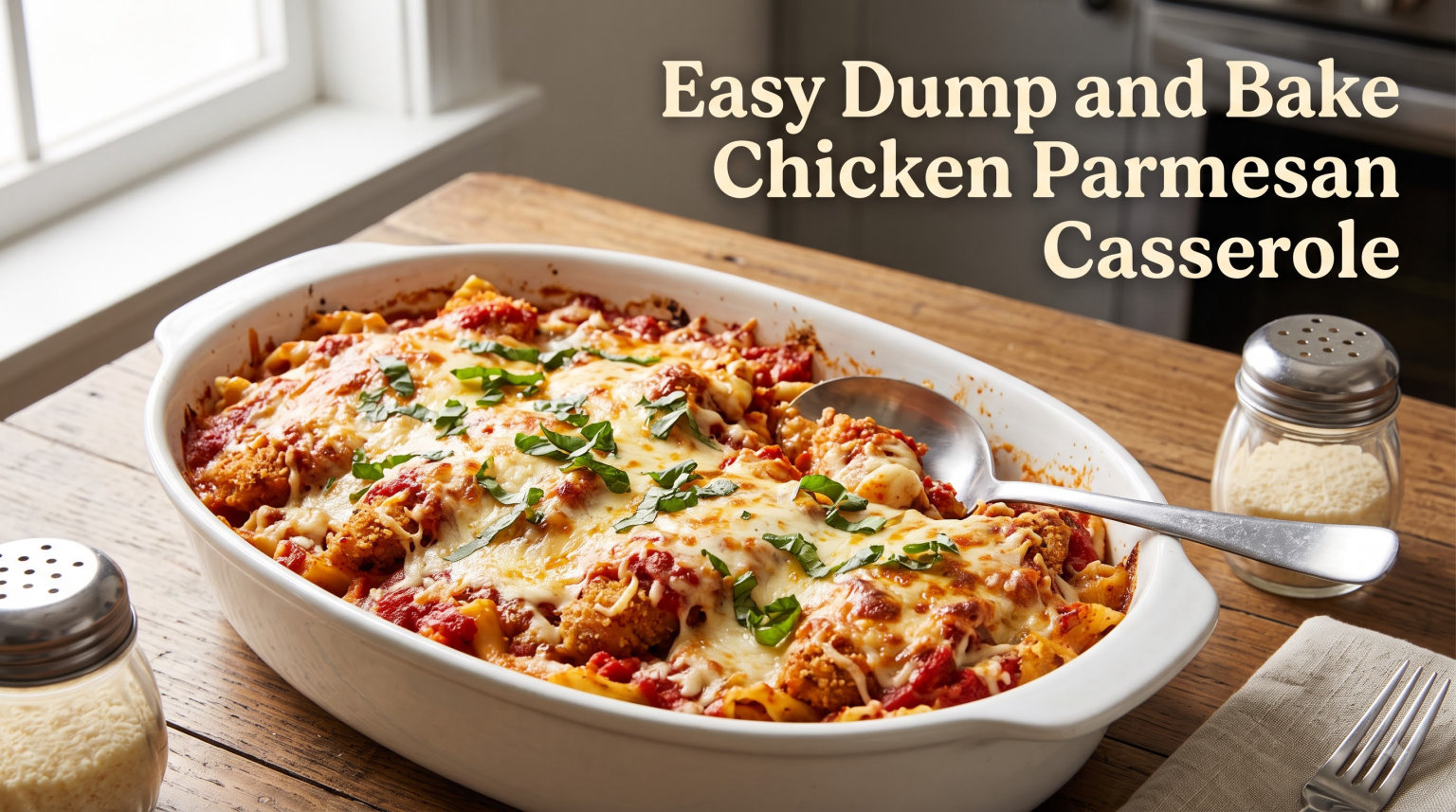
For dump and bake chicken parmesan casserole, my quickest answer is simple: uncooked pasta, sauce, broth, chicken, mozzarella, and a crisp Parmesan topping become a complete oven dinner in one dish. The method stays reliable when you keep every pasta piece under liquid during the covered bake and add the crumb topping only after the noodles are nearly tender.
I have also included chicken Parmesan pasta casserole guidance for the exact moments that decide the result, from prep and doneness to storage. For another practical dinner, browse these chicken casserole recipes.
Table of Contents
A reliable plan for Easy dump and bake chicken parmesan casserole
What Is a Dump and Bake Chicken Parmesan Casserole?
A dump-and-bake chicken Parmesan casserole is a one-pan dinner where uncooked pasta, raw diced chicken, marinara sauce, and water are combined in a baking dish and baked together. The pasta absorbs the sauce and liquid as it cooks, and the chicken cooks through in the same amount of time. There is no need to pre-boil pasta, pre-cook the chicken, or dirty extra pots.
The method works because dry pasta slowly absorbs hot liquid in a covered dish, softening to a perfect al dente finish over about 30 to 45 minutes. The steam trapped under aluminum foil cooks everything evenly while keeping the chicken juicy.
Yes, it is safe to bake raw chicken with dry pasta. The chicken reaches a safe internal temperature of 165 degrees F well before the pasta is done, and the acidic marinara and trapped steam create an environment that cooks the chicken gently and evenly. You can verify chicken safety guidelines directly at FoodSafety. gov.
Why You Will Love This Recipe
For dependable dump and bake chicken parmesan casserole, keep every pasta piece under liquid during the covered bake and add the crumb topping only after the noodles are nearly tender. The same rule keeps chicken Parmesan pasta casserole focused and balanced instead of crunchy pasta or a soggy topping. You may also want to save these easy chicken recipes for your next meal plan.
Here is why this dump-and-bake method has become my go-to weeknight dinner.
-
One dish, one pan. No boiling pot for pasta, no skillet for chicken, no colander to wash.
-
Ten minutes of hands-on time. Most of the work is the oven doing its thing.
-
Kid-approved. The cheesy, saucy, bready flavors of chicken parmesan in an easy scoop-and-serve form.
-
Meal-prep friendly. Leftovers reheat beautifully for lunch the next day.
-
Budget-friendly. Pasta, chicken, jarred sauce, and cheese keep the grocery bill reasonable.
-
Potluck-perfect. A 9×13 pan feeds six to eight people and travels well.
Easy Dump and Bake Chicken Parmesan Casserole Ingredients
Here is exactly what I use, with a few notes on why each ingredient matters.
-
1 pound boneless skinless chicken breasts , diced into bite-size pieces. You can substitute boneless skinless chicken thighs if you prefer darker meat.
-
2 and 1/2 cups dry penne pasta (about 10 ounces). Measured dry, straight from the box, no boiling required.
-
1 jar (24 ounces) marinara sauce . Use a good-quality jarred sauce here since it carries most of the flavor. Rao’s, Victoria, and Classico are solid picks.
-
1 cup water . This is what helps the dry pasta cook evenly in the oven. Do not skip it.
-
1 and 1/2 cups shredded mozzarella cheese , divided. Use whole-milk mozzarella for the best melt.
-
1/2 cup grated parmesan cheese , divided. Freshly grated melts better than the green-can variety.
-
1/2 cup panko breadcrumbs . Panko stays crispier than regular breadcrumbs under the broiler.
-
1 teaspoon Italian seasoning .
-
1/2 teaspoon garlic powder .
-
1/2 teaspoon kosher salt and 1/4 teaspoon black pepper .
-
1 tablespoon olive oil . A light drizzle over the breadcrumb topping helps it crisp.
-
Fresh basil or parsley , optional, for serving.
Equipment You Will Need
You do not need anything fancy, but the right pan does make a difference.
-
9×13 inch baking dish (3 quart). Glass, ceramic, or metal all work.
-
Aluminum foil . This is non-negotiable for the covered baking step.
-
Large spoon or spatula for stirring.
-
Cheese grater if you are grating your own.
-
Instant-read meat thermometer . The single best way to confirm the chicken is safe to eat.
Pan material matters for timing. Glass and ceramic dishes bake a little slower but hold heat beautifully. Metal pans bake faster and brown the edges more. If you use a metal pan, check the casserole about 5 minutes earlier than the recipe says. A dark metal pan may bake up to 10 minutes faster than a glass one.
How to Make an Easy Dump and Bake Chicken Parmesan Casserole
For food-safety temperatures and handling limits, I follow the USDA food-safety guidance and use an instant-read thermometer whenever doneness is uncertain.
-
Prep and Preheat: Preheat your oven to 425 degrees F. Spray a 9×13 baking dish with nonstick cooking spray or rub it lightly with olive oil. This keeps the pasta from sticking to the corners.
-
Combine the Base Ingredients: Add the diced raw chicken, dry penne pasta, marinara sauce, water, Italian seasoning, garlic powder, kosher salt, and black pepper directly to the baking dish. Stir everything together until the pasta is fully submerged in the sauce and the chicken pieces are distributed throughout. Use your spoon to make sure the dry pasta is tucked under the liquid, especially the pieces near the edges and corners. This is the most important step for even cooking. Any pasta sticking up above the liquid line will stay crunchy, so push it down.
-
Add Half the Cheese: Sprinkle 1 cup of the mozzarella and 1/4 cup of the parmesan evenly over the top. Do not stir it in. The cheese will melt into the sauce during baking and create a creamy layer on top.
-
Cover and Bake: Cover the dish tightly with aluminum foil. Do your best to seal the edges so steam does not escape. Bake at 425 degrees F for 30 minutes. Why foil? The trapped steam is what softens the dry pasta and cooks the chicken through gently. Without foil, the top layer dries out and stays crunchy.
-
Stir and Check the Pasta: Carefully remove the foil (watch out for the steam). Stir the casserole gently to redistribute the pasta and check the tenderness. The pasta should be almost al dente at this point but not fully done. If the dish looks dry, add another 2 to 3 tablespoons of water and stir it in.
-
Add the Crispy Topping: In a small bowl, toss the panko breadcrumbs with the remaining 1/4 cup parmesan cheese, the olive oil, and a pinch of salt. Sprinkle this mixture evenly over the casserole, then top with the remaining 1/2 cup mozzarella.
-
Final Bake Uncovered: Return the dish to the oven uncovered for another 10 to 15 minutes. You are looking for a bubbly, golden top with crispy browned edges. If you want extra browning, hit it under the broiler for 1 to 2 minutes at the very end, but watch closely because panko goes from golden to burnt quickly.
-
Rest and Serve: Let the casserole rest for 5 to 10 minutes before serving. This helps the sauce thicken up so it is not soupy when you scoop it. Garnish with fresh basil or parsley if you have it.
This is the part where you actually get to do almost nothing. Here is my tested step-by-step method.
How to Tell When the Casserole Is Done
Do not guess on this one. Here is how I confirm doneness every time.
Check the chicken temperature. The thickest piece of chicken should read 165 degrees F on an instant-read thermometer inserted into the center of the pan. This is the only way to be 100 percent sure the chicken is safe.
Test the pasta. Fish out a piece of penne and bite into it. It should be tender with a slight bite, not crunchy and not mushy. If the pasta is still hard in the center, cover and bake another 5 minutes.
Look for visual cues. The sauce should be bubbling around the edges, the cheese should be fully melted and starting to brown, and the top should look crispy and golden.
Tips for the Best Dump and Bake Chicken Parmesan Casserole
I judge dump and bake chicken parmesan casserole by the finished texture and temperature, not by the clock alone. With chicken Parmesan pasta casserole, The chicken must reach 165°F, the pasta should be tender, and the topping should be golden after the uncovered finish. For a useful companion guide, see these pasta side dishes.
After making this recipe dozens of times, here are the tips that make the biggest difference.
Use a sauce you actually like. The marinara is the dominant flavor, so do not cheap out here. A mediocre sauce gives you a mediocre casserole.
Do not skimp on the water. The full cup is necessary for the dry pasta to cook properly. If your sauce is on the thick side, you can even add an extra splash.
Tuck every noodle under liquid. Any dry pasta exposed above the sauce line will stay crunchy. Push everything down with your spoon before covering.
Always stir at the halfway mark. This redistributes the pasta so the bottom does not overcook and the top does not dry out.
Do not overbake. Once the cheese is golden and bubbly, pull it out. Overbaked pasta turns gummy.
Use whole-milk mozzarella. Low-fat and part-skim mozzarella do not melt as well and tend to weep liquid into the casserole.
Fresh herbs at the end, dried herbs in the bake. Dried Italian seasoning goes into the bake. Save fresh basil or parsley for the garnish so it does not turn black in the oven.
This recipe shares a lot of technique with my other one pot pasta recipes, where the same liquid-to-pasta ratio rule applies.
Common Mistakes and How to Fix Them
-
Mushy or Gummy Pasta: This usually means you baked it too long or added too much liquid. Next time, pull the dish out as soon as the pasta is al dente. To fix a current batch, you cannot un-mush the pasta, but you can serve it over a slice of toasted garlic bread to add texture back.
-
Dry or Crunchy Pasta: You either skipped the water, the foil was not sealed tight, or the pasta was not pushed under the sauce. To fix, add 1/4 cup of hot water or extra marinara around the edges, re-cover with foil, and bake another 10 minutes.
-
Chicken Not Fully Cooked: This happens when the chicken pieces are cut too large. The fix is simple: re-cover with foil and bake another 5 to 10 minutes, then temp-test again. Always dice chicken into pieces no bigger than an inch.
-
Soupy Casserole: Let it rest uncovered for 10 minutes before serving. The pasta will keep absorbing liquid and the sauce will thicken as it cools. If it is still soupy, you can scoop servings onto a slotted spoon to drain the excess.
-
Burnt Cheese or Breadcrumbs: Your oven runs hot or you walked away during the broil step. Scrape off the burnt layer and add fresh cheese and panko, then bake just until melted. Next time, check 5 minutes earlier.
-
Bland Flavor: Bump up the seasonings. Add an extra 1/2 teaspoon of garlic powder, a pinch of red pepper flakes, or a splash of balsamic vinegar to brighten the sauce.
This is the section I wish more recipe blogs included. Here is how to rescue a casserole gone wrong.
Pasta Shape Substitutions and Timing
You can absolutely use pasta shapes other than penne, but the timing changes. Here is what I have tested.
-
Penne or ziti : Use the recipe as written, 30 minutes covered plus 10 to 15 minutes uncovered.
-
Rotini or fusilli : Same timing as penne. These hold sauce really well.
-
Rigatoni : Add 5 extra minutes to the covered bake time since the tubes are larger.
-
Farfalle (bowties) : Same timing as penne, but check at 25 minutes covered because the thin edges cook fast.
-
Elbow macaroni : Reduce covered bake time to 25 minutes. Smaller pasta cooks faster.
-
Spaghetti, broken into pieces : Reduce covered bake time to 20 minutes. Long thin pasta cooks the fastest and turns mushy quickly, so check early.
-
Gluten-free pasta : Most brands work, but check at 25 minutes covered. GF pasta can go from perfect to mush fast.
Do not use lasagna noodles, orzo, or tiny pastina for this method. They do not hold up to the long liquid bake.
Recipe Variations to Try
-
Add Vegetables: Toss in 1 cup of fresh spinach, 1/2 cup of diced bell peppers, or 1/2 cup of sliced mushrooms at the start. Frozen vegetables work too, but add them in the last 15 minutes of baking so they do not turn to mush. Broccoli florets should be par-cooked first or they will not soften enough.
-
Use Rotisserie Chicken Shortcut: Swap the raw chicken for 3 cups of shredded rotisserie chicken. Reduce the covered bake time to 20 minutes since the chicken is already cooked. This is a fantastic way to use up leftover chicken. You can find more ideas in my easy chicken breast recipes collection.
-
Make It Spicy: Add 1/2 teaspoon of red pepper flakes to the sauce, or use a jar of arrabbiata sauce instead of plain marinara.
-
Three-Ingredient Version: For the absolute simplest version, combine raw diced chicken, dry pasta, and a jar of marinara plus the required water. Top with whatever cheese you have. Skip the breadcrumbs and extra seasonings. It is not as flavorful, but it gets dinner on the table with minimal ingredients.
-
Five-Ingredient Version: Raw chicken, dry penne, marinara sauce, water, and mozzarella. Add a pinch of salt and pepper. This is the version I make when I am tired and just need dinner to happen.
-
Gluten-Free Version: Use gluten-free pasta (barilla or jovial work well) and gluten-free panko. Check the bake at 25 minutes because GF pasta softens faster. Leftovers of any variation pack up perfectly for lunch recipes for work the next day.
How to Store and Reheat Leftovers
This casserole stores and reheats well, with one honest caveat about freezing.
Refrigerator Storage
Let the casserole cool to room temperature, then cover tightly or transfer leftovers to an airtight container. Store in the fridge for up to 4 days. The flavor actually improves overnight as the pasta absorbs more sauce.
How to Reheat
For single servings, microwave on high for 60 to 90 seconds, stirring halfway. For a larger portion, cover with foil and bake at 350 degrees F for 15 to 20 minutes until warmed through. Add a splash of water or marinara before reheating if the pasta looks dry.
Can You Freeze It?
Here is the honest answer most recipe blogs skip: you can freeze this casserole, but the pasta texture will suffer. Pasta baked in sauce tends to go soft and slightly gummy after freezing and reheating. If you want to freeze it anyway, do it before baking. Assemble the dish, wrap tightly in foil and plastic wrap, and freeze for up to 2 months. Thaw overnight in the fridge, then bake as directed, adding 10 extra minutes to the covered bake time.
If freezing after baking, know that the texture will be softer but still perfectly edible. For more freezer-tested recipes that actually hold up, check out my collection of freezer meal recipes for busy families.
Make-Ahead Instructions
This recipe is a great candidate for assembling ahead. Here is the timeline I follow.
Assemble up to 24 hours ahead. Combine everything in the baking dish, cover tightly with foil, and refrigerate. When ready to bake, add 5 extra minutes to the covered bake time since the dish starts cold.
Do not assemble more than 24 hours ahead. The pasta will start absorbing the sauce and turn mushy before it even hits the oven.
Shortcut version. Mix the sauce, water, and seasonings in a jar up to 3 days ahead. Dice the chicken and store separately. When ready, dump everything in the dish and bake.
What to Serve With Chicken Parmesan Casserole
This is a complete meal on its own, but a few sides make it feel like a proper dinner.
-
Garlic bread or cheesy bread for soaking up extra sauce.
-
A simple green salad with vinaigrette to cut through the richness.
-
Roasted broccoli or asparagus . Toss with olive oil and roast at 425 degrees F alongside the casserole.
-
Steamed green beans for a quick vegetable side.
-
A light red wine like Chianti or Sangiovese if you want to lean into the Italian theme.
For more easy sides that cook at the same temperature, browse my sheet pan dinner recipes. If you want to switch up the protein next time, my chicken thigh recipes are a great starting point.
Frequently Asked Questions
How do I know when dump-and-bake chicken Parmesan casserole is ready?
The chicken must reach 165°F, the pasta should be tender, and the topping should be golden after the uncovered finish.
How do I prevent crunchy pasta or a soggy topping?
Keep every pasta piece under liquid during the covered bake and add the crumb topping only after the noodles are nearly tender.
Can I substitute rotisserie chicken for raw chicken?
Yes. Bake the pasta and sauce first, then fold in cooked shredded chicken before adding cheese and the final topping.
What should I serve with dump-and-bake chicken Parmesan casserole?
A Caesar-style salad, roasted broccoli, green beans, or garlic bread rounds out the tomato-and-cheese casserole.
Conclusion
For dump and bake chicken parmesan casserole, the most important move is to keep every pasta piece under liquid during the covered bake and add the crumb topping only after the noodles are nearly tender. That same discipline makes chicken Parmesan pasta casserole useful on a busy day without sacrificing flavor or texture.
I recommend reading the method once, preparing every ingredient, and using the doneness cues above as the final authority. Uncooked pasta, sauce, broth, chicken, mozzarella, and a crisp Parmesan topping become a complete oven dinner in one dish.