
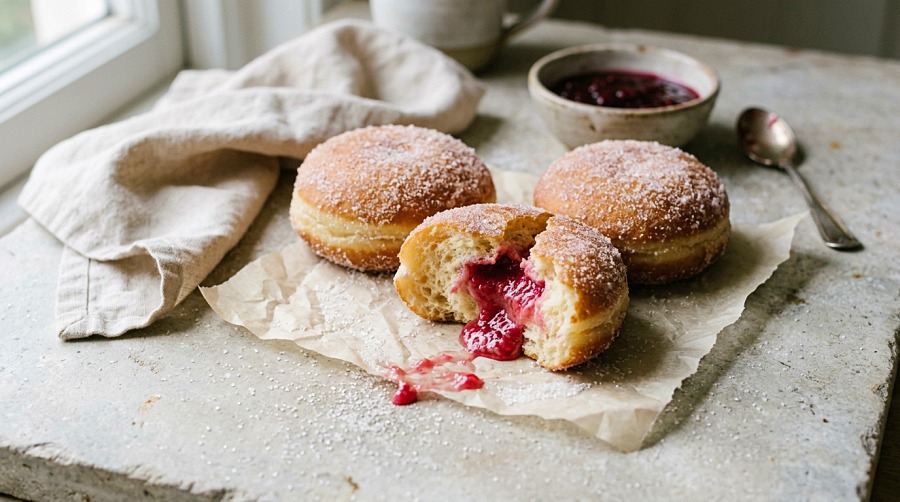
There is a very specific kind of joy in pulling a tray of warm, sugar-rolled raspberry jam filled donuts out of the kitchen on a slow Sunday morning. The first time I made them, I had put off yeasted donuts for years because the dough felt intimidating, and honestly, I ate about six of them straight off the cooling rack before they were even properly filled. After making this recipe more times than I can count, I am ready to swear off store-bought jelly donuts for good, the kind where you bite in hoping for a flood of jam and get one apologetic teaspoon. These are the opposite of that.
Table of Contents
What Are Raspberry Jam Filled Donuts?
Raspberry jam filled donuts are soft, yeasted fried dough rounds tossed in vanilla sugar and piped full of bright, tart raspberry jam. The dough is enriched with milk, egg yolks, and butter for a tender, pillowy crumb, and the filling provides a sweet-tart contrast to the crisp sugar shell. Most home cooks make a dozen at a time using a 2 to 3 inch round cutter.
Recipe At A Glance
| Recipe Detail | Info |
|---|---|
| Prep Time | 30 minutes |
| Rise Time | 2 hours 15 minutes |
| Cook Time | 15 minutes |
| Total Time | 3 hours |
| Servings | 12 to 18 donuts |
| Difficulty | Intermediate |
| Approx. Calories | 280 per donut |
| Cuisine | American / European |
In this guide, you will get the full recipe with troubleshooting, a quick homemade raspberry jam option, and the exact tricks I use to keep the dough soft and the filling generous.
Why This Raspberry Jam Filled Donuts Recipe Works
The dough is enriched but not overly rich, which is the sweet spot for a donut that fries up fluffy instead of dense. Three egg yolks (not whole eggs) keep the crumb tender without making the dough heavy, and a touch of cinnamon in the dough is the small detail that pushes these past every store-bought version I have ever tried.
A two-stage rise, bulk plus shaped proof, develops flavor without overworking the yeast. And piping the jam in after frying instead of trying to enclose it in raw dough is what gives you that overstuffed, jam-everywhere bite. According to King Arthur Baking’s yeast guide, warm liquid between 105°F and 115°F is the temperature window where yeast activates fastest without dying, which is why I am picky about milk temperature in step one.
Ingredients You’ll Need
For the donut dough:
- 1 packet (2¼ tsp) active dry yeast
- 1 cup whole milk, warmed to 110°F
- ⅓ cup granulated sugar, divided
- 3 large egg yolks, room temperature
- ¼ cup unsalted butter, softened
- 3¼ to 3½ cups all-purpose flour, spoon and leveled
- ½ tsp ground cinnamon
- ½ tsp fine sea salt
- Neutral oil for frying (canola, sunflower, or vegetable, about 6 cups)
For the vanilla sugar coating:
- 1½ cups granulated sugar
- 1 tsp pure vanilla extract (or scrape one vanilla bean for a flecked finish)
For the filling:
- 1½ cups raspberry jam (your favorite brand, or use the quick homemade version below)
Ingredient notes:
- Whole milk gives the best texture. 2% works fine. Skim makes a noticeably less tender donut and I would skip it if possible.
- Egg yolks only. Using whole eggs makes the crumb tighter. The whites are not a compromise here, they actively make a different (and worse) donut.
- Active dry yeast is what the recipe is written for. Instant yeast works too and you can skip the foaming step, just whisk it straight in.
- Cinnamon in the dough is optional but I would not skip it. It adds warmth without making the donut taste like a cinnamon roll.
- All-purpose flour is the easiest choice. Bread flour gives a chewier bite if that is what you prefer.
Equipment Needed
- Stand mixer with dough hook (handheld electric mixer works for the first stage, but you will need to knead by hand for 8 to 10 minutes after)
- Heavy-bottomed saucepan or Dutch oven for frying
- Instant-read or candy thermometer (this is non-negotiable for frying, I tried winging it once and regretted it)
- 2 to 3 inch round cutter
- Wooden skewer or chopstick
- Piping bag fitted with a long filling tip (or a Bismarck tip)
- Wire cooling rack
How To Make Raspberry Jam Filled Donuts
Step 1: Activate the yeast
Pour the warm milk (110°F, finger-comfortable, not hot) into the bowl of your stand mixer. Add 1 tablespoon of the sugar and the yeast. Stir once and let it sit for 5 to 10 minutes until it looks foamy and smells faintly bready. If nothing is happening after 10 minutes, your yeast is dead or your milk was too hot, start over.
Step 2: Build the dough
Add the egg yolks and the remaining sugar to the bowl. Turn the mixer on low with the dough hook attached, then drop in the softened butter a tablespoon at a time, letting each piece work in before adding the next.
Add 1 cup of flour, the cinnamon, and the salt. Mix on low until incorporated. Add the rest of the flour, ½ cup at a time, until you have a soft, slightly tacky dough that just pulls away from the sides of the bowl.
Step 3: Knead
Turn the mixer to medium-high and knead for 5 minutes. The dough should be smooth, elastic, and slightly tacky to the touch. If it is sticking heavily to the bottom of the bowl after 3 minutes, add flour 1 tablespoon at a time, up to ¼ cup total. Do not add more flour after that, dry dough makes dry donuts.
Turn the dough onto a lightly floured surface and shape it into a tight ball.
Step 4: First rise
Butter the mixing bowl, return the dough, and cover with plastic wrap or a damp tea towel. Let it rise in a warm spot for 1½ to 2 hours, or until doubled in size. An oven with just the light on is my favorite proofing spot.
Step 5: Shape
Punch the dough down gently and roll it out on a lightly floured surface to ½ inch thick. Cut out rounds with a 2 to 3 inch cutter. Place each round on a parchment-lined baking sheet, spacing them about 2 inches apart.
You can re-roll the scraps once. Beyond that, the dough gets tough.
Step 6: Second rise
Cover the shaped donuts loosely with plastic wrap and let them rise for another 30 to 45 minutes, until they look noticeably puffed but not doubled. The float test: drop a donut into a bowl of room-temperature water. If it bobs back up within a few seconds, it is ready to fry. Pat it dry before frying.
Step 7: Make the vanilla sugar
While the donuts proof, whisk the granulated sugar and vanilla extract together in a wide, shallow bowl until the vanilla is evenly distributed and the sugar is faintly damp. Set aside.
Step 8: Fry
Pour 2 to 3 inches of neutral oil into a heavy-bottomed pot and heat it to 350°F. Use a thermometer, not the timer on your stove. Per Serious Eats’ frying guide, maintaining a steady oil temperature is the single biggest factor in non-greasy fried food.
Working in batches of 2 to 3 (do not crowd the pot, the temperature will drop and the donuts will absorb oil), gently lower the donuts into the oil. Fry for about 60 to 90 seconds per side, flipping once, until they are deep golden brown.
Lift each donut out with a slotted spoon, let the excess oil drip back into the pot, and transfer to a wire rack lined with paper towels.
Step 9: Coat in vanilla sugar
While the donuts are still warm but not searing hot (about 2 minutes after frying), roll them in the vanilla sugar until fully coated. The slight surface moisture is what makes the sugar stick.
Step 10: Fill
Let the donuts cool for at least 15 minutes before filling. Insert a wooden skewer or chopstick into the side of each donut, working it gently from side to side to create a hollow pocket through the middle.
Fill a piping bag fitted with a long filling tip with the raspberry jam (stir the jam first to loosen it if it feels stiff). Insert the tip as deep as it will go and squeeze gently, pulling the tip out as you go. You want a generous tablespoon of jam in each donut, and a tiny bit oozing back out of the hole is the sign of a properly filled donut.
Pro Tips From My Kitchen
The milk temperature matters more than you think. Too cold and the yeast crawls. Too hot and it dies. Aim for 110°F, which feels comfortably warm on your wrist, not steaming.
- Weigh your flour if you can. Spoon-and-level works, but 1 cup of all-purpose flour should weigh about 125 grams. Heavy hands packing flour is the number one reason home donuts come out dense.
- Do not skip the float test. Underproofed donuts come out dense and oily. Overproofed donuts collapse in the fryer. The float test is the most reliable signal I have found.
- Use a thermometer, then trust it. When the oil drops below 340°F, the donut sits in oil too long and gets greasy. When it climbs above 360°F, the outside browns before the inside cooks. Adjust the heat between batches.
- Fill them within 4 hours. The jam is delicious but the moisture migrates into the dough over time. Filled donuts are best within a few hours of frying.
Quick Homemade Raspberry Jam (15 Minutes)
If you want to skip the store-bought jam, this thicker, pipeable jam takes 15 minutes and tastes like fresh raspberries.
Ingredients:
- 2 cups frozen raspberries
- ⅔ cup granulated sugar
- 1 tbsp fresh lemon juice
- 1 tbsp cornstarch whisked with 2 tbsp cold water
Method: Combine raspberries, sugar, and lemon juice in a small saucepan over medium heat. Cook for 6 to 8 minutes, mashing the berries with a wooden spoon, until syrupy. Stir in the cornstarch slurry and cook 2 to 3 minutes more, until thick enough to coat the back of a spoon. Strain through a fine sieve if you want it seedless. Cool fully before piping.
Variations Worth Trying
- Lemon vanilla sugar: Add 1 tablespoon of finely grated lemon zest to the sugar coating. The brightness against the raspberry is genuinely incredible.
- Strawberry, blackcurrant, or apricot jam all work beautifully in place of raspberry. Strawberry is sweeter, blackcurrant is more tart, apricot is more mellow.
- Nutella or chocolate hazelnut filling: Warm Nutella slightly to make it pipeable, then fill the same way. This is a different donut, but a great one.
- Lemon curd filling: Use store-bought or homemade lemon curd for a brighter, more custardy filling.
- Powdered sugar finish: Dust with confectioners’ sugar instead of rolling in granulated. This is the classic German Berliner look.
Storage, Make-Ahead, And Freezer Notes
Same day is best. Fried yeast donuts are at their absolute peak within a few hours of frying. The sugar coating stays crisp and the dough stays pillowy.
Room temperature: Filled donuts hold up well in an airtight container for about 6 hours. After that the jam starts to soften the surrounding crumb.
Make-ahead dough: This is my favorite trick. After the first rise, punch the dough down, wrap tightly, and refrigerate overnight. The next morning, roll, cut, do the second rise (it will take longer because the dough is cold, plan on 60 to 75 minutes), and fry. Cold fermented dough actually tastes better.
Freezer: Freeze unfilled, unsugared donuts in a single layer, then transfer to a bag. They keep for up to 2 months. Reheat at 325°F for 6 to 8 minutes from frozen, then coat in sugar and fill.
Pro tip: Do not freeze filled donuts. The jam separates and the dough turns gummy when thawed. Always fill within a few hours of serving.
Serving Suggestions
Warm donuts and strong coffee is the obvious play, and the right one. For a brunch spread, I serve these alongside a fruit platter, some yogurt with honey, and a pot of strong black tea. They are also great as a dessert with a scoop of vanilla ice cream and a drizzle of warm raspberry sauce.
If you are leaning into the home-baking weekend, I usually pair these with something else from my yeast doughnuts repertoire or a tray of chocolate chip cookies for the cookie people in the family.
Troubleshooting Common Issues
| Problem | Likely Cause | Fix |
|---|---|---|
| Donuts are greasy | Oil too cool (under 340°F) | Use a thermometer, adjust heat between batches |
| Donuts are dense | Overworked or under-proofed dough | Do not add extra flour, do the float test before frying |
| Outside burns, inside raw | Oil too hot (over 360°F) | Lower heat, fry in smaller batches |
| Jam leaks everywhere | Hole too large or jam too loose | Use a smaller skewer, refrigerate jam to firm it up |
| Sugar coating falls off | Donuts cooled too long before coating | Coat while still warm to the touch, within 2 to 3 minutes of frying |
FAQ
Can I make raspberry jam filled donuts ahead of time?
Yes, with one caveat. Make the dough through the first rise, then refrigerate it overnight, tightly covered. The next morning, roll, shape, do the second rise, and fry. Already-fried donuts are best the same day, but the dough benefits from an overnight chill.
Can I bake these instead of frying?
You can, but they will be a different texture. Brush shaped, proofed donuts with melted butter and bake at 375°F for 10 to 12 minutes. They come out more like soft brioche rolls than classic donuts, fluffy but without the signature crisp shell. For a true fried donut texture, frying is the only path.
Why are my donuts dense and oily?
Almost always one of three things: the dough was over-floured, the oil was too cool, or the donuts were under-proofed before frying. Weigh your flour, use a thermometer, and do the float test. Per USDA frying safety guidance, maintaining steady oil temperature is also a food safety point, not just a texture one.
Can I use store-bought jam?
Absolutely. I use store-bought jam all the time. The trick is choosing a thick jam (not a runny preserve or jelly) and stirring it before piping to loosen it just slightly. Bonne Maman raspberry preserves and Smucker’s raspberry jam both work great.
How long do filled donuts stay fresh?
Filled donuts are at their best within 6 hours of being filled. Unfilled, sugared donuts hold up for about 24 hours in an airtight container at room temperature. The longer the jam sits inside, the more the surrounding crumb softens.
Can I freeze the donuts?
Freeze them unfilled and unsugared. Fried and cooled donuts freeze well for up to 2 months in a freezer bag. Reheat at 325°F for 6 to 8 minutes, then coat in sugar and fill just before serving.
Why did my yeast not foam?
Three possibilities. Your milk was too hot and killed the yeast (anything over 120°F is dangerous). Your milk was too cool and the yeast was sluggish (under 100°F). Or your yeast was expired, which happens more often than you would think. Check the date on the packet.
Can I use instant yeast instead of active dry?
Yes. Use the same amount and skip the foaming step. Whisk the instant yeast directly into the flour with the cinnamon and salt, then proceed as written. Your first rise might be slightly faster, around 60 to 90 minutes.
A Few Final Thoughts
These raspberry jam filled donuts are the kind of recipe I make when I want to feel like I have actually done something with my Sunday. They take a few hours from start to finish, but most of that is the dough quietly rising on its own. The hands-on time is honestly less than making a layer cake.
If you have been intimidated by yeasted dough, this is a forgiving recipe to start with. The cinnamon-warmed dough, the snap of the vanilla sugar shell, and that bite where the raspberry jam floods out are worth every minute. Make them once and they become a permanent fixture in your weekend rotation. By September I will probably have made another half-dozen batches, and so will you.
If you tried this raspberry jam filled donuts recipe, leave a rating and a comment below, I genuinely love hearing how they turned out and whether you stuck with raspberry or swapped in a different jam. Save it to Pinterest for the next slow Sunday morning, and if you are in the mood to keep baking, check out my perfect yeast doughnuts recipe or these simple desserts for the nights you want sweet without the full project.
Happy frying.