
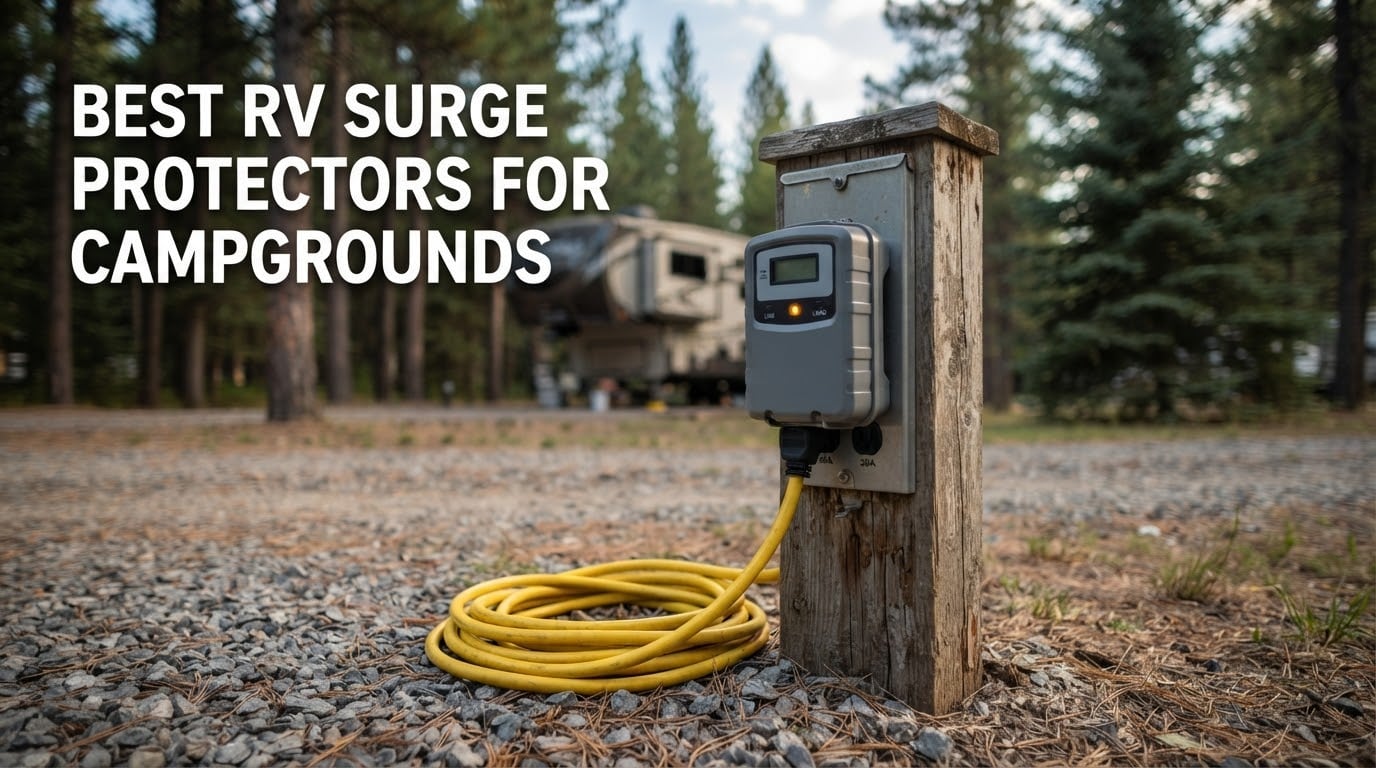
The campground pedestal is the only outlet in your life that somebody else installed, somebody else maintains, and somebody else shares with forty other rigs. At home your wiring is known-good because you own it. At a park it is an old shared circuit with a breaker that somebody resets, a neutral somebody re-terminates badly, and a maintenance schedule nobody publishes. That is why the best RV surge protector for campgrounds is not a luxury purchase. It is the cheapest insurance in the trailer.
The failure that actually hurts is rarely a lightning strike. It is sustained low voltage when the neighbors fire up three air conditioners on the same pedestal leg. One iRV2 member measured 85 volts where he expected 120, then lost a microwave, an entertainment center and a central vacuum on two separate visits before he stopped trusting the park. Another found a brand-new pedestal professionally miswired with 240V sitting on both the 30A and 50A outlets. Nobody was electrocuted. The appliances just cooked slowly.
We spent 2026 season sorting through ten of the most-reviewed RV surge protectors and electrical management systems available for campground power, matching each one to the amperage of the rig it is built for. What follows covers portable and hardwired models, 30 amp and 50 amp, and the differences that matter once your shore power cord is 30 feet from the socket.
Table of Contents
Our Top 3 RV Surge Protector Picks for 2026

Best RV Surge Protectors at a Glance
The full lineup in one place. Joules, amperage, installation type and the fault coverage each model gives you before your cord ever reaches the pedestal.
| Product | Specifications | Action |
|---|---|---|
 Progressive Industries SSP-30XL Progressive Industries SSP-30XL |
|
Check Latest Price |
| Power Watchdog PWD50EPOH |
|
Check Latest Price |
 Power Watchdog PWD30 Power Watchdog PWD30 |
|
Check Latest Price |
 GEARGO 30 Amp Circuit Analyzer GEARGO 30 Amp Circuit Analyzer |
|
Check Latest Price |
 Southwire Surge Guard 44280 Southwire Surge Guard 44280 |
|
Check Latest Price |
 CARMTEK CRTK-CA30 CARMTEK CRTK-CA30 |
|
Check Latest Price |
 Southwire Surge Guard 44290 Southwire Surge Guard 44290 |
|
Check Latest Price |
 MILLIONHOME 50 Amp MILLIONHOME 50 Amp |
|
Check Latest Price |
 Camco Power Grip 55306 Camco Power Grip 55306 |
|
Check Latest Price |
 FOCSPROD 50 Amp FOCSPROD 50 Amp |
|
Check Latest Price |
Know Your Amperage First: 30 Amp vs 50 Amp
Match the protector to your rig’s rated amperage, not to the pedestal you happen to find. A 30 amp travel trailer or B-van plugs into a NEMA TT-30 outlet and pulls up to 3750 watts on a single 120V leg. A fifth wheel, Class A motorhome or larger trailer with a washer-dryer and two air conditioners uses a NEMA 14-50 plug, which runs 50 amps across two 120V hot legs and 240V between them.
Forcing a 50 amp plug into a 30 amp protector, or a 30 amp plug into a 50 amp pedestal, is how people cook receptacles. Some owners do run 30 amp portable models on a 50 amp pedestal with a dogbone adapter to pull 30 amps off one leg, and the better models list dogbone adapters as a supported use. Do that only if the manufacturer says so, and understand you are giving up half your available power.
Dry campground display confusion is worth flagging here too. If your EMS screen sits blank when you are boondocking with no shore power, that is normal. It has nothing to measure. Several owners report assuming their unit had failed when the reality was simply that nothing was plugged in.
Surge Protector vs EMS: What You Actually Need at a Campground
A basic surge protector only absorbs voltage spikes. It does nothing at all against low voltage, open neutral, open ground or reverse polarity. That single sentence answers the most common question in this category, and it is worth sitting with, because the cheapest 30 amp units on the market are spike absorbers wearing the same name as real protection.
An electrical management system, or EMS, is a surge protector plus a continuous voltage monitor plus a circuit analyzer. It measures the incoming supply in real time, flags miswired pedestals before you connect, and physically disconnects your rig when voltage climbs above a safe ceiling or sags below a safe floor. Then, once conditions normalise, it waits and reconnects on its own.
The four wiring faults you will meet at a park are worth naming plainly. Open neutral is a pedestal neutral that has worked loose, and it can push higher voltage into a circuit that expects less. Open ground is a missing equipment ground, which turns any insulation fault into a shock hazard inside your trailer. Reverse polarity means hot and neutral are swapped at the pedestal. Miswiring covers everything else, including 240V appearing on a 30 amp outlet.
Inside your RV, your transfer switch already handles something different. It detects that shore power is present and switches your appliances off battery power accordingly. Newmar even sells a transfer switch labelled Surge Guard, and that name has done a lot of damage: those are transfer switches with no surge components inside them. Surge protection at the pedestal is an add-on, not something your coach already carries.
Our general rule after working through all ten models: buy an EMS. The incremental cost over a spike absorber buys detection, disconnection and delayed reconnection, which is the part that actually saves compressors.
Do You Need One? The Honest Case For and Against
There is a real campground forum faction that says the industry over-markets surge protection. Their argument is fair on its face. People have run three motorhomes and a travel trailer for years without one, and if your rig sits at well-maintained resorts with modern pedestals, you may genuinely never see an event. If you boondock more than you camp, you may barely plug in at all.
Against that, the physics does not care about the resort’s reputation. Your house wiring is inspected, permitted and yours to fix. A campground circuit is shared, ageing, and outside your control, and the damage events that reach RVs are ordinary ones: a brownout during a busy July weekend, a loose neutral after a technician replaces a breaker, a pedestal wired wrong from the day it was poured.
Then there is the placement argument, which is the one that convinced us. When a surge board takes a hit, you want the failure event to happen out at the pole, next to the receptacle, not inside your electrical compartment. One member’s power cord welded to the output of a portable unit after a pole strike, fusing the plug into the pedestal. Keeping protection at the pedestal is the difference between a burnt-out portable board and a scorched interior wall.
We think the honest answer is yes for anyone who connects to shore power regularly, and that the reason is the low-voltage compressor damage rather than the dramatic lightning story nobody in this category has actually experienced.
None of this matters if the rest of the coach is still rough around the edges. Our guides to the best RV toilet upgrades and replacements and the best RV coffee makers for travel cover the other two fixes full-timers queue up before a long season on the road.
When Your Surge Board Dies: Joule Depletion and Replaceable Modules
A joule is the amount of energy a surge component can absorb before it is permanently spent. Those components are sacrificial. They do not heal, they do not recharge, and once they are used up the unit can be worse than having nothing, because it will still close the circuit and pass a fault straight through to your appliances while implying everything is fine.
So how do you tell if a surge protector is going bad? Most units with app or LED diagnostics surface a surge failure indicator or a reduced-joules warning, and that is the signal to act on rather than ignore. Owners who ignore it are the ones who discover the problem during a storm.
The fix is often cheaper than the replacement you are dreading. Models built with a user-replaceable surge module let you swap the board yourself and stay protected instead of buying a whole new device. One owner swapped a spent surge board on his own and was back online in under twenty minutes after taking a significant hit. On the units without a replaceable module, expect to replace the protector when the components reach the end of their useful life.
Southwire owners note their internal protection components degrade over roughly eight years of use, which is a good reminder that age matters as much as joule rating. A ten-year-old protector with a healthy-looking case can be doing nothing.
1. Progressive Industries SSP-30XL Portable RV Smart Surge Protector – Best All-Rounder for 30 Amp Rigs
Progressive Industries SSP-30XL Portable RV Smart Surge Protector, Black, 30 Amp
- Smart detection of over and under voltage plus open ground and neutral
- Includes all-weather shield and thermal protection
- LED indicators readable in low light
- Security ring accepts a padlock
- Made in USA
- Weather shield needs a small Phillips screwdriver to fit
- Large and heavy relative to other 30A portables
- Some long-service units had water ingress
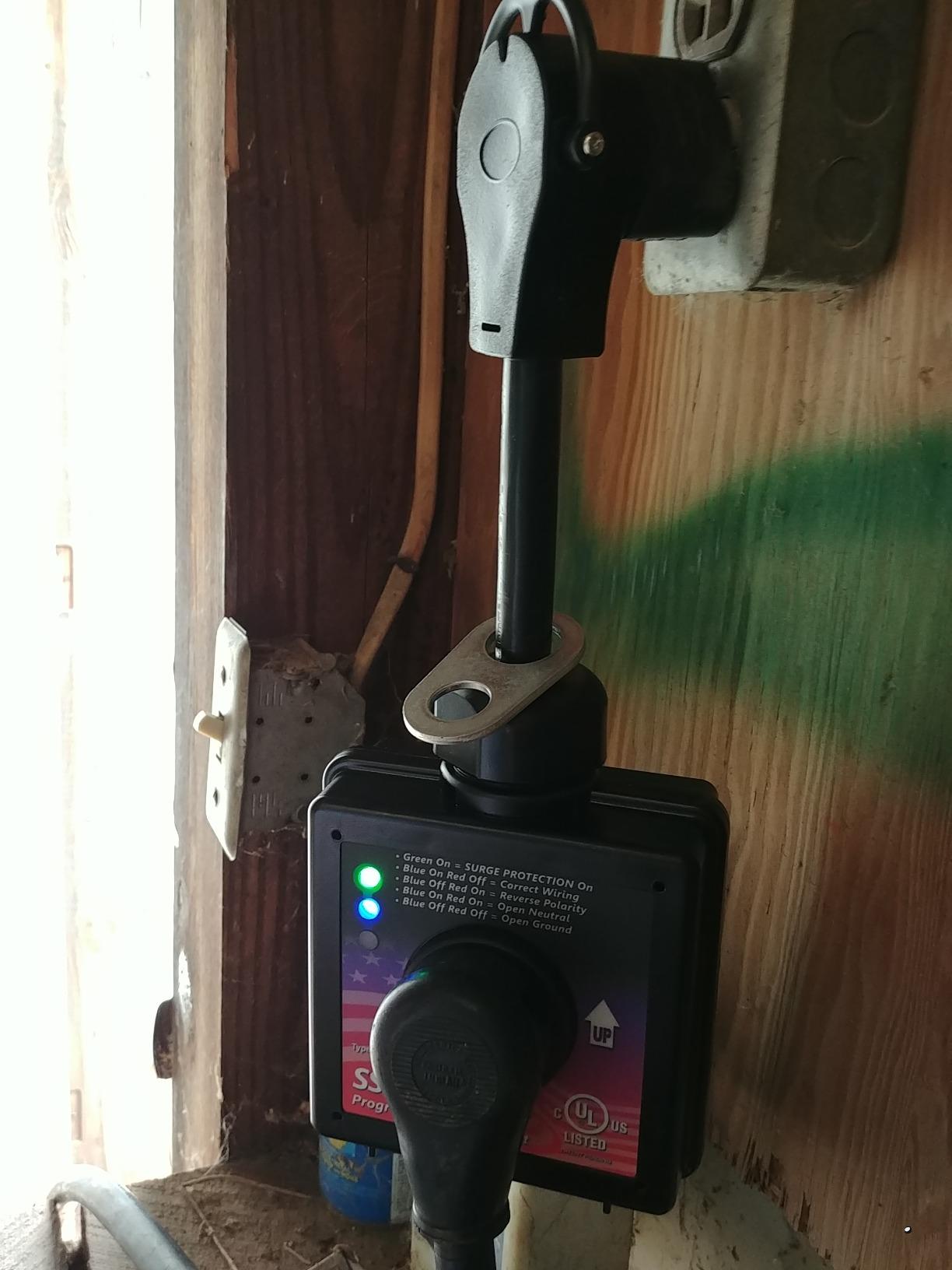
This is the unit we hand to a first-time trailer owner without hesitation. At 825 joules it is not the biggest absorber in this list, but the smart fault detection is what earns the place, because it warns on over and under voltage, open ground, open neutral, reverse polarity and surge failure before your rig is connected.
Reviews describe it working exactly as advertised across many years of full-time use, from Florida storms to Arizona heat and Oregon winters. Multiple owners recount it absorbing genuine spikes and correctly diagnosing pedestal wiring faults. One reviewer’s motorhome took a sacrificial hit at a faulty pedestal and the unit burned through instead of the coach wiring, which is exactly the outcome you are buying it for.
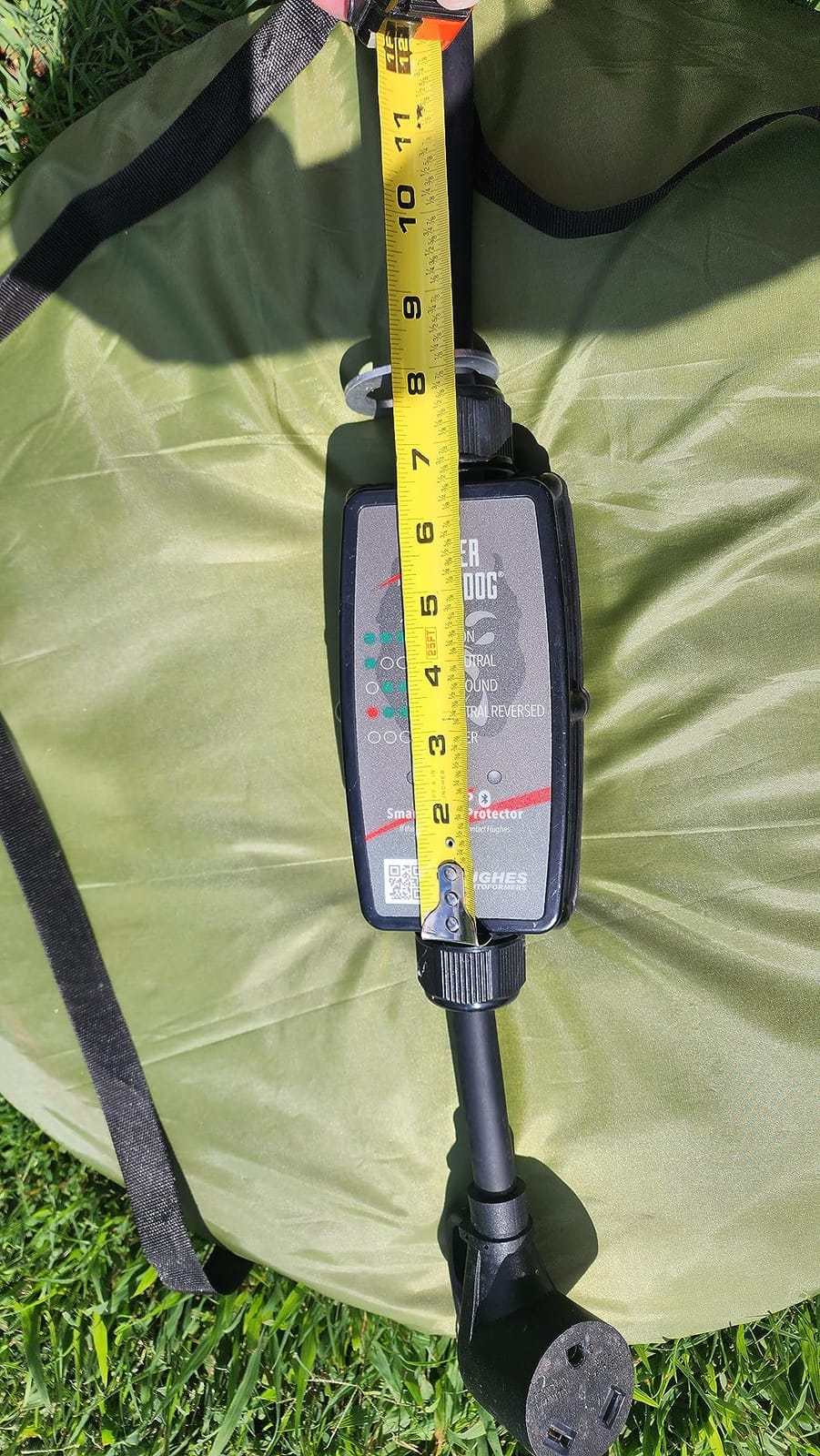
The 3,600 W capacity matches a standard 30 amp 120V service, and the Lexan housing is built for a rough life. Dimensions of 14 inches by 5.25 inches and a 2 pound weight make it the bulkiest of the 30 amp portables we tested, which matters if your pass-through storage is tight.
The warranty is lifetime on the unit, with the weather shield excluded, which is a stronger long-term promise than most competitors make. Expect to fit the shield once with a small Phillips screwdriver, which is the single most common complaint in the reviews and is a two-minute job at best.
What it gets right before power is even connected
The pre-connection diagnosis is the reason this leads the list. It tells you whether the pedestal is safe before the 30 foot cord goes into it, which means a miswired outlet costs you a walk to the office rather than a fried control board.
Open neutral and open ground detection is the piece basic spike absorbers in this price range simply omit, and open neutral is the fault most likely to reach your rig during a busy weekend.
Where it falls short
825 joules is the lowest surge capacity of the units we tested and roughly a quarter of what the 50 amp models carry. That is acceptable because joules are consumed only by real events, not by ordinary load, but it is worth knowing if you camp in lightning-exposed country.
There is no app monitoring here, just LEDs. Owners who want to check voltage from inside the coach after dark are better served by the Bluetooth models further down this list.
2. Power Watchdog PWD50EPOH 50A Hardwired Surge Protector – Best for Full-Timers
- Hardwired install removes theft and rain exposure
- Bluetooth app shows amps on both legs
- Replaceable surge module extends service life
- EPO trips fast on faults
- LED diagnostics flag wiring problems
- IN and OUT wiring documentation has been inconsistent
- App shows fault codes not plain language
- Bright logo LED with no off setting
- Displayed voltage reads a few volts low
- No Wi-Fi in this Bluetooth-only variant
This is the one to buy if you live in the rig full time and it is your only electrical system. At 6100 joules it carries by far the largest surge capacity in this group, and the hardwired install puts the whole device inside the coach where nobody can steal it and rain never reaches it.
The Bluetooth app is the reason owners like it, and the specific reason is both legs. On a 50 amp coach running two hot legs, watching amperage on each leg simultaneously is the difference between knowing and guessing. Wireless fault alerts also mean you find out about an anomaly while you are inside rather than after you walk out to the pedestal.
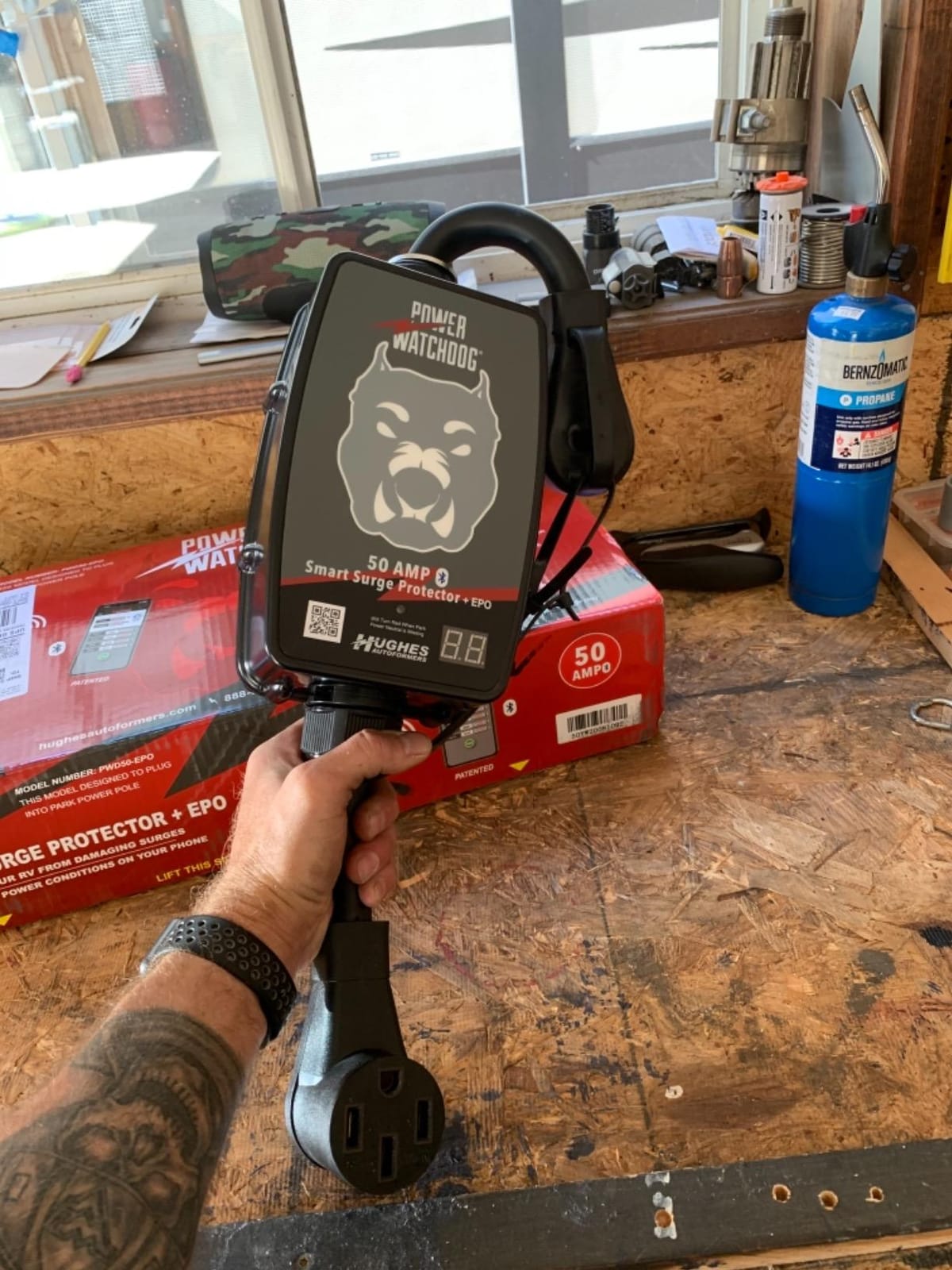
The replaceable surge module is the sleeper feature. When the board takes a hit you replace the module instead of the whole protector, which is the difference between a repair and a repurchase. Emergency power-off also trips quickly once a fault is present, and LED diagnostics flag ground faults and over-current clearly.
Installers, including professional electricians, describe the hardwired install as easy and less invasive than competing brands. Warranty coverage is three years from Hughes Autoformers, which is shorter than the lifetime promise on the Progressive portable above.
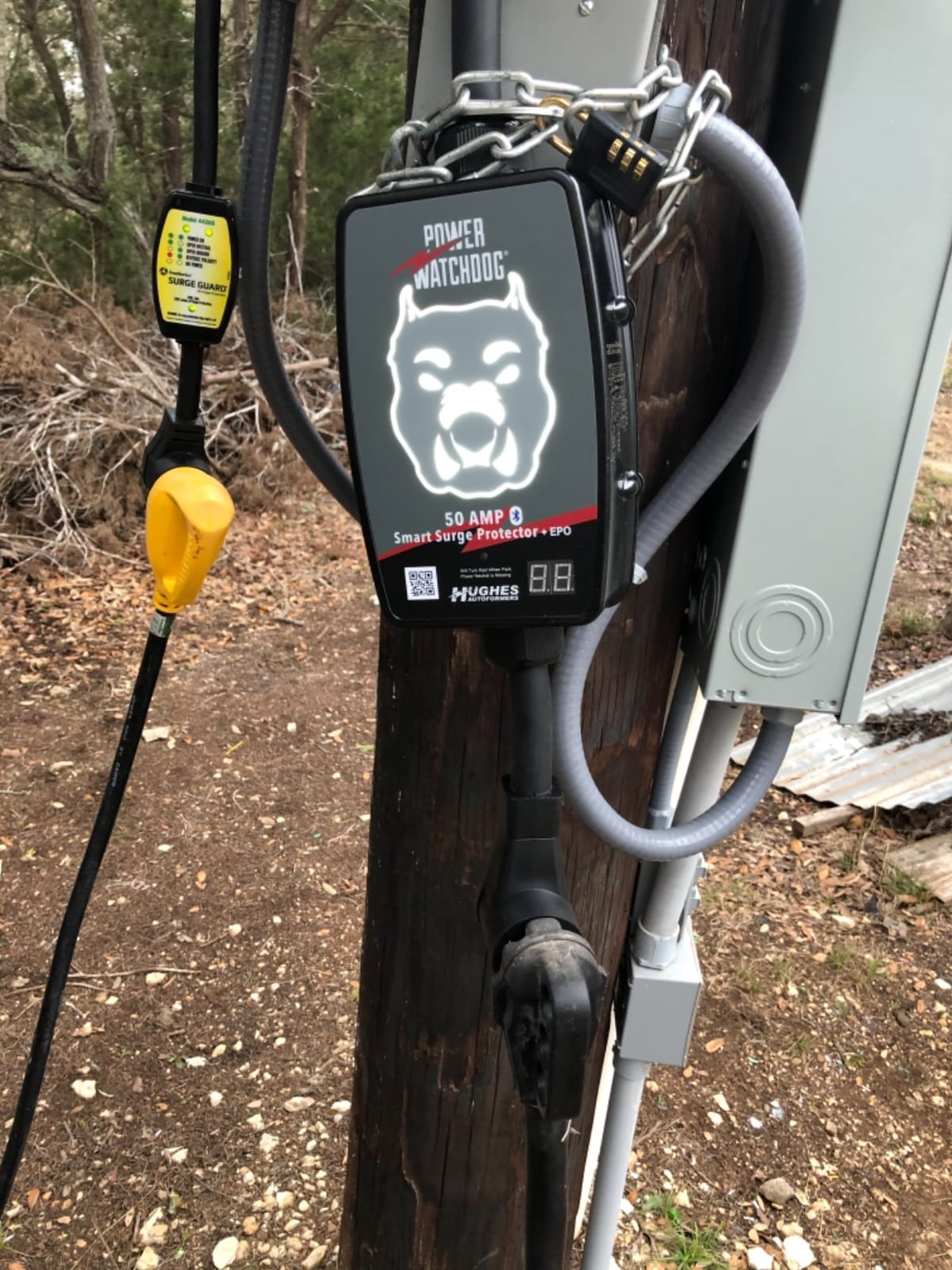
What makes hardwired worth the installation
Theft is the obvious one. A portable protector bolted to a pedestal with a padlock is a target, and hardwired means there is nothing outside to take. For a full-timer parked for weeks in storm country, that settles the argument quickly.
The second reason is power history. The app logs what your rig has drawn and when, which turns a guess about whether the battery or the alternator is the problem into an actual record.
Where it falls short
Documentation around IN and OUT orientation has been inconsistent between the unit itself and the manufacturer’s site, so check your wiring diagram twice before you commit. A minority of owners also report the displayed voltage reading a few volts below a measured actual voltage, and the app reports fault codes rather than plain-language explanations.
This variant is Bluetooth-only. Remote monitoring away from the coach needs the RVWhisper add-on or the Wi-Fi version, and on inverter/charger setups the startup sequence may require the inverter to sit downstream of the protector.
3. Power Watchdog PWD30 Bluetooth Surge Protector – Best App Monitoring on 30 Amp
- Highest rating in this lineup at 4.8 stars
- Live voltage amps and wattage on a phone
- Customisable alert thresholds
- LED park power diagnostics with wireless alerts
- Heavy duty build with grip handles
- Bluetooth range only works near the unit
- No Wi-Fi remote checking without a separate variant
This is the pick for a 30 amp trailer owner who wants to see what the pedestal is actually doing. At 3000 joules it carries roughly three and a half times the capacity of the Progressive portable while still fitting the lower amperage class, and it holds the highest rating of anything we tested.
The patented Bluetooth connectivity streams voltage, amperage and wattage to a phone through a free app, and the customisable alert thresholds are the feature owners mention most. You set the range you consider acceptable and the phone tells you when the park steps outside it, rather than waiting for the unit to make the call for you.
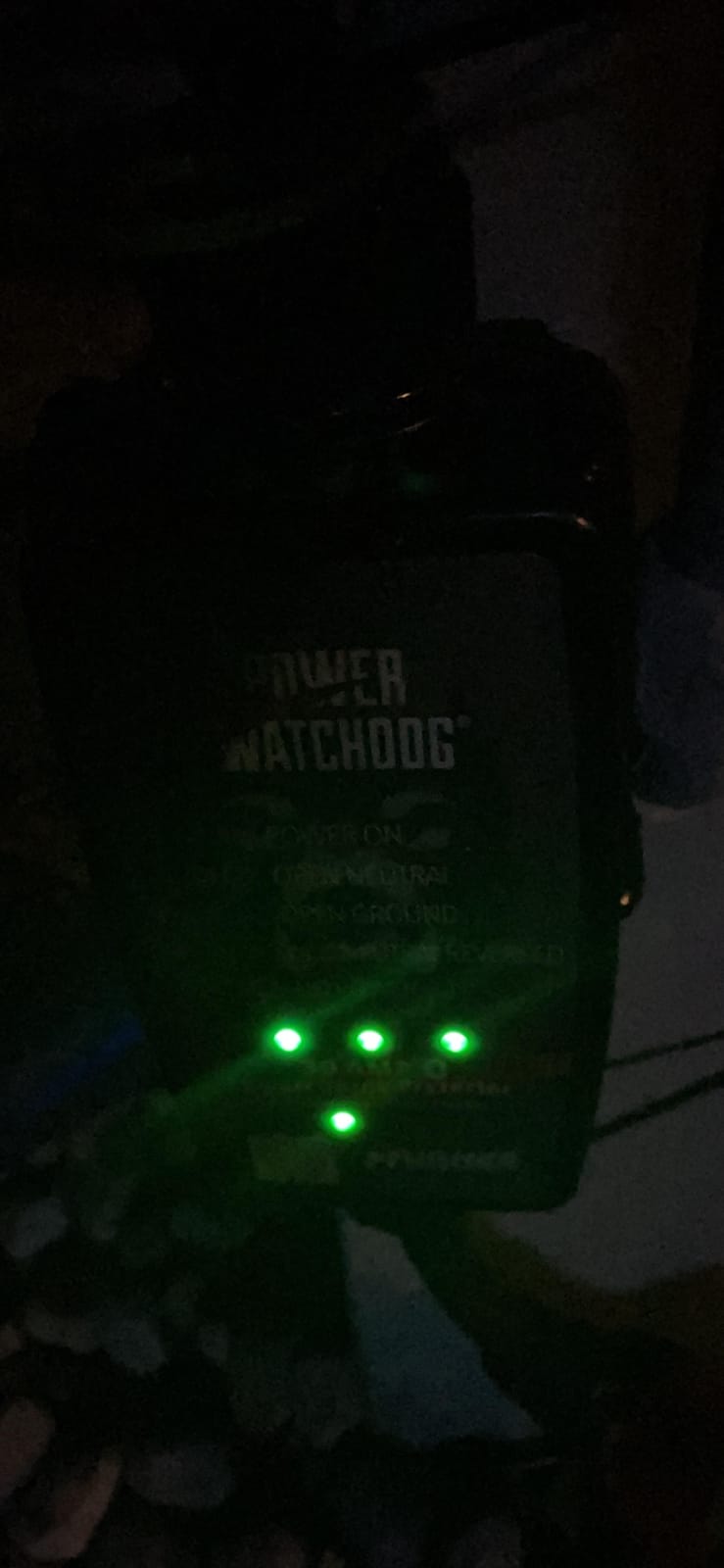
Complete LED park power diagnostics with wireless fault alerts cover the pre-connection check, and the heavy duty construction is described as holding up to everyday campsite use. The 14 inch portable form factor with easy grip handles is straightforward to carry from a storage bay to the pedestal.
It weighs 3 pounds, sits at number one in its category on the retail rankings, and carries a three year manufacturer warranty.
How the app changes daily camping
The practical win is that a voltage sag becomes a phone alert while you are still sitting at the picnic table, which lets you shed a load or walk to the office before your compressor has been running under-voltage for an hour.
Customisable thresholds mean a park running a steady 115V can stay quiet while a genuine brownout still gets flagged, which is where fixed-threshold units get ignored by owners.
Where it falls short
Bluetooth is short range by design. You have to be near the protector to read the app, so checking from bed after lights-out will not work, and remote checking requires a separate Wi-Fi variant.
It is a 30 amp model, so it will not serve a 50 amp fifth wheel or motorhome no matter how good the app is. For those rigs, look at the 50 amp options below.
4. GEARGO 30 Amp RV Circuit Analyzer – Best Budget 30 Amp Pick
- Diagnoses open ground open neutral and reverse polarity
- IP68 waterproof design with protective cover
- V-1 flame retardant materials
- FCC tested
- Grip handles and right-angle connector
- LED-only indication with no app or remote monitoring
- Entry-level surge capacity compared with the rest of this list
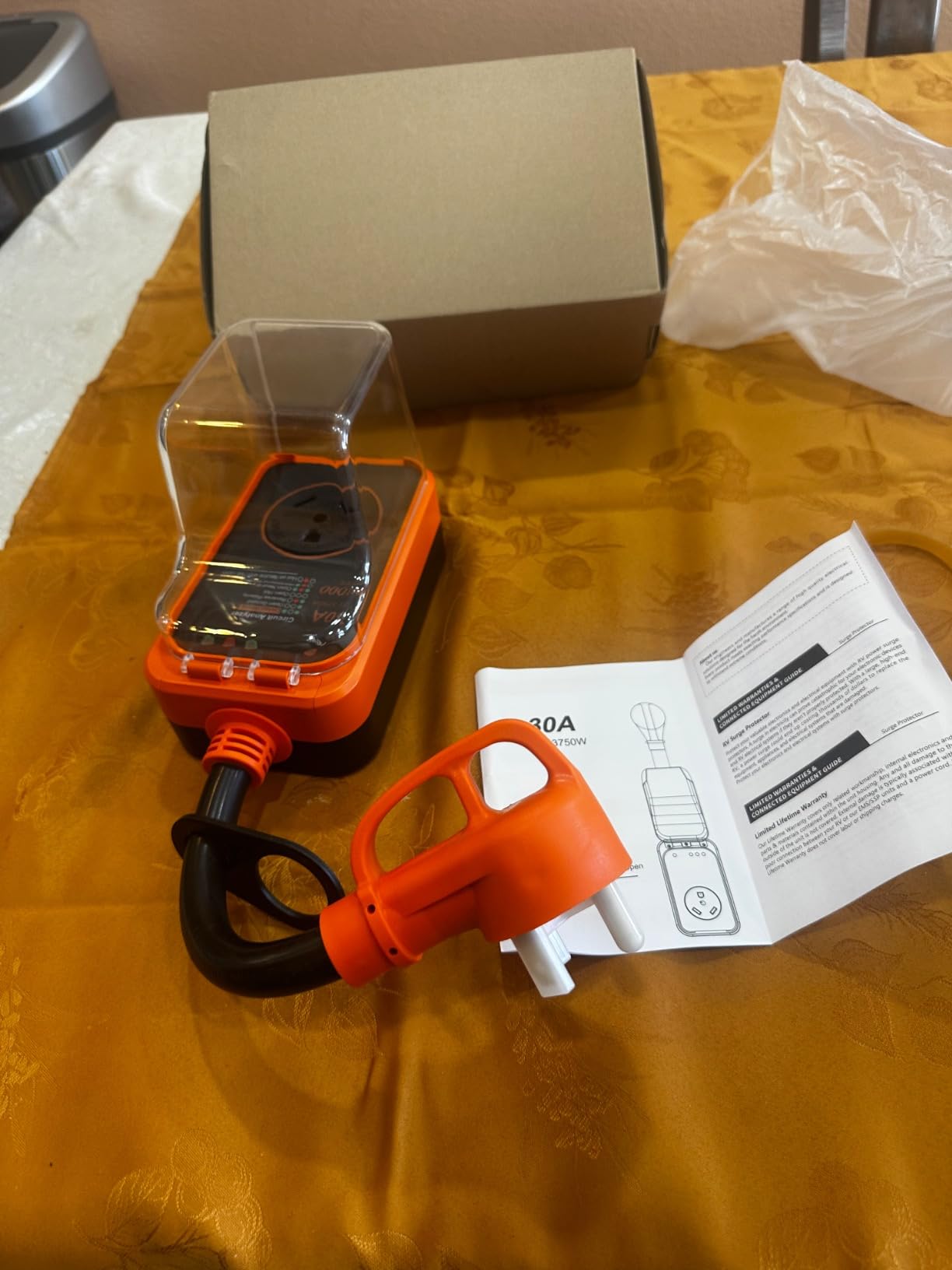
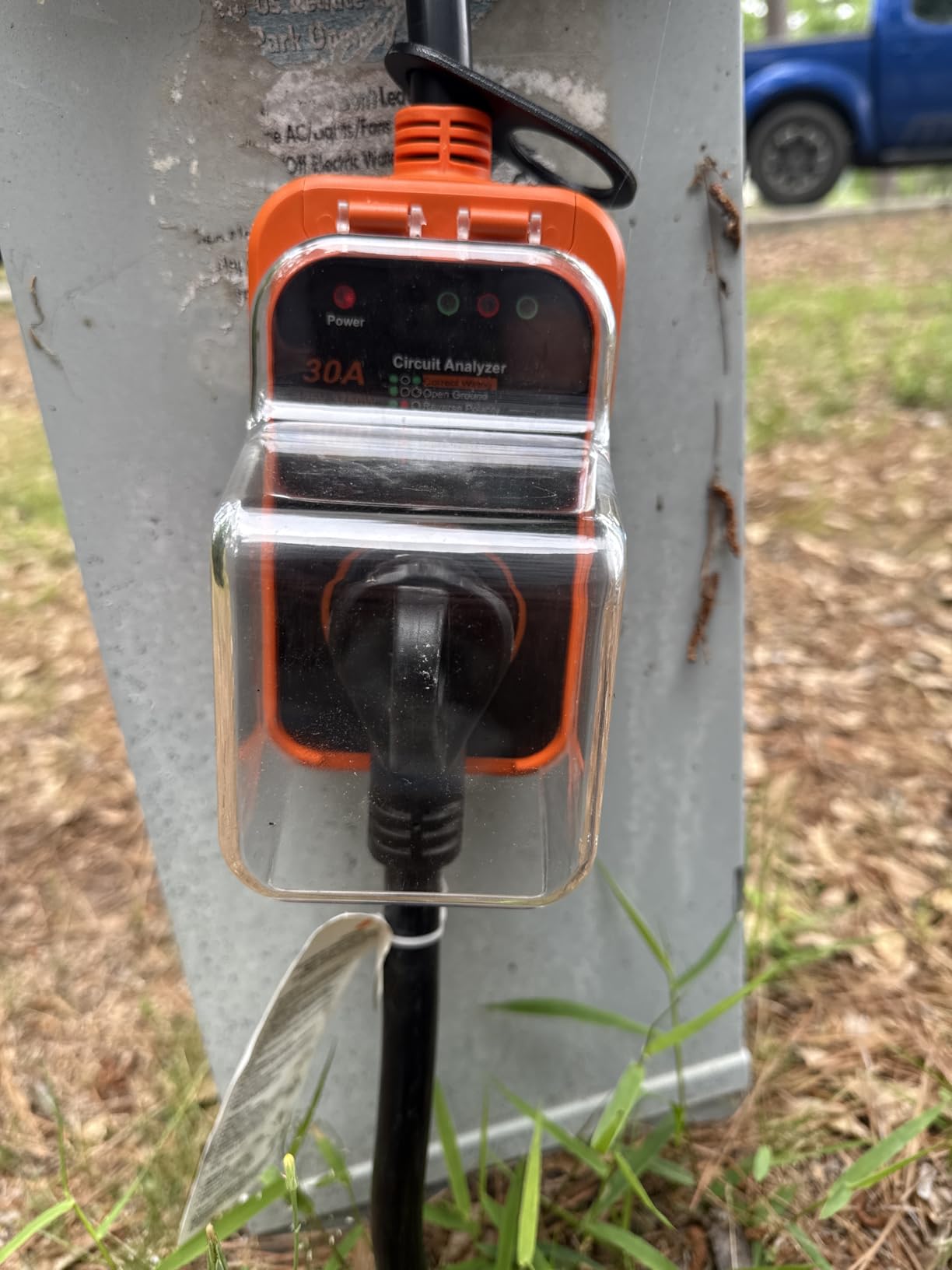
This is the low-cost entry point that still does the one job that matters most: it tells you whether the pedestal is wired correctly before you connect. The circuit analyzer verifies wiring and detects open ground, open neutral, reverse polarity, hot and ground reversed, and no power at all.
What makes it interesting for wet climates is the IP68 waterproof design with a cover that protects the circuit from rain, wind and sandstorm. That reduces both short circuit risk and the fire risk that follows, and the V-1 flame retardant materials add a second layer of safety.
![GEARGO RV Surge Protectors 30 Amp RV Circuit Analyzer, [𝟐𝟎𝟐𝟔 𝐍𝐞𝐰 𝐔𝐩𝐠𝐫𝐚𝐝𝐞𝐝 & 𝐆𝐞𝐧𝟐] Full Protection, RV Adapter Plug for Camper(Orange) customer photo 1](https://thesweetandsimplekitchen.com/wp-content/uploads/2026/10/B0B38DJ5Z9_customer_1.jpg)
It ranks first in its retail category, which tells you how much demand sits behind a well-priced 30 amp analyzer, and 88 percent of its reviews are five star. Owners report the ergonomic power grip handles and right-angle male connector making a low-bend connection that resists damage.
Three year warranty and responsive customer service round out a package that undercuts the branded units on price while still covering the wiring faults.
![GEARGO RV Surge Protectors 30 Amp RV Circuit Analyzer, [𝟐𝟎𝟐𝟔 𝐍𝐞𝐰 𝐔𝐩𝐠𝐫𝐚𝐝𝐞𝐝 & 𝐆𝐞𝐧𝟐] Full Protection, RV Adapter Plug for Camper(Orange) customer photo 2](https://thesweetandsimplekitchen.com/wp-content/uploads/2026/10/B0B38DJ5Z9_customer_2.jpg)
What a budget analyzer still does for you
Pre-connection fault detection is the whole value here. Knowing a pedestal has an open neutral before you plug in turns a potential appliance failure into a conversation with the park office.
The waterproofing rating is genuinely stronger than several pricier competitors, which matters for anyone camping through a wet shoulder season or a desert wind storm.
Where it falls short
1200 joules is the smallest surge capacity in this lineup, so it has the least headroom if you camp in lightning-exposed areas. It is also LED-only with no app or remote monitoring, so there is no history and no live reading.
Treat this as diagnosis-first protection rather than all-weather protection, and upgrade as the budget allows.
5. Southwire Surge Guard 44280 – Best for Small Storage Spaces
Southwire Surge Guard™ 30 Amp Portable RV Surge Protector with Enhanced Diagnostics, 2100 Joules, 44280
- Compact enough to store in a small RV compartment
- Limited lifetime warranty from a US manufacturer
- LED indicators readable in direct sun
- Anti-theft lock ring on the cord
- Thicker receptacle brass reduces heat
- 2100 joules is below several competitors
- LED indication only with no app
- Protection components degrade over roughly eight years
At 1.5 pounds, this is the smallest and lightest protector in the lineup, and for a pop-up or travel trailer with a shallow pass-through that matters more than joule count. It stores out of the way and still handles 30 amp 120V service with 2100 joules of capacity.
The limited lifetime warranty from a US manufacturer is unusual at this level. Southwire also fits thicker receptacle brass than most competitors, which cuts heat generation at the connection, and heat at a plug is where failures quietly start.
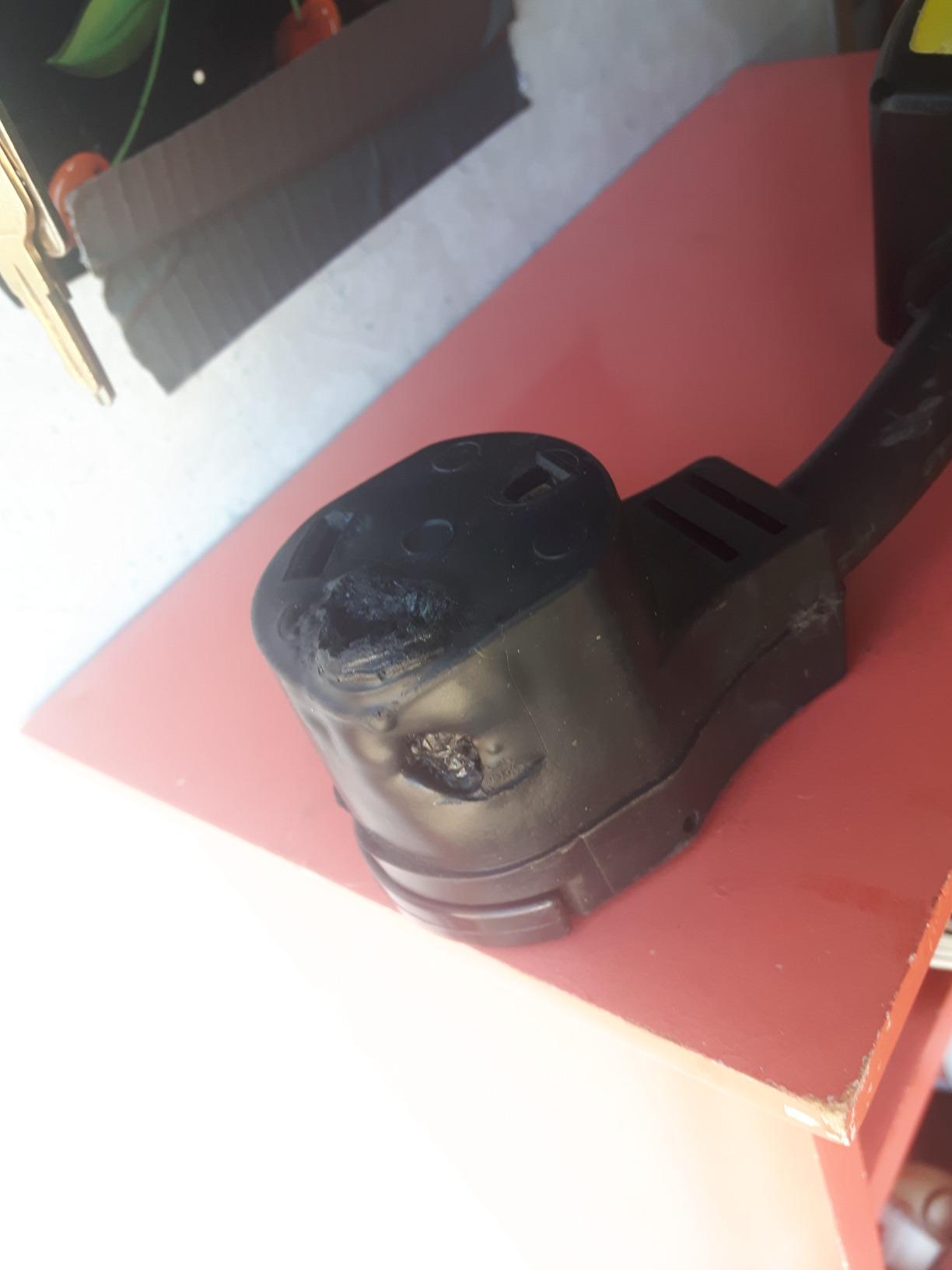
Reviewers describe it as compact, sturdy and easy to use, and several recount it protecting a trailer during a thunderstorm while a neighbouring rig’s air conditioner was destroyed by low voltage. LED indicators are clear and bright enough to read in direct sun, and the Easy-T-Pull handle has an integrated receptacle that simplifies plugging.
The anti-theft lock ring on the cord lets you secure it to the pedestal for long stays, which addresses the theft worry without buying a separate bracket.
Where compactness pays off
Storage is a genuine constraint in small trailers. A protector you have to leave in the truck because it will not fit in the compartment is one you will leave unplugged, and an unplugged protector protects nothing.
The lifetime warranty also means the unit itself is not a consumable purchase in the way a fixed surge board is.
Where it falls short
2100 joules sits in the middle of this group rather than the top, and there is no app or remote monitoring, so you are reading LEDs in the rain to know what is happening.
Owners should also know that the internal protection components degrade over roughly eight years of use. There is no replaceable module here, so when they are spent the whole protector goes.
6. CARMTEK CRTK-CA30 – Best for Warranty Service
CARMTEK RV Surge Protector 30 Amp – RV Circuit Analyzer with Integrated Smart 30 Amp Surge Voltage Protection with Grip Handles
- Analyzes correct wiring open ground open neutral and reverse polarity
- Flame retardant and thermally protected for outdoor use
- Operating range from -35C to +110C
- Lifetime warranty with same-day support
- Right-angle connector reduces cord strain
- 30A plug can be hard to pull out of the protector
- Plug can sit loosely in a power box if bumped
- No metal clamp for theft prevention
The distinguishing feature here is support, not circuitry. Owners report fast same-day email responses and replacement hardware when a component fails, including a failed LED, which is a different experience from most products at this level.
Technically it does the standard 30 amp job properly. It absorbs spikes up to 2100 joules, protects against high and low voltage disturbances, and runs a circuit analyzer that flags correct wiring, open ground, open neutral, reverse polarity, hot and ground reversed, and no power.
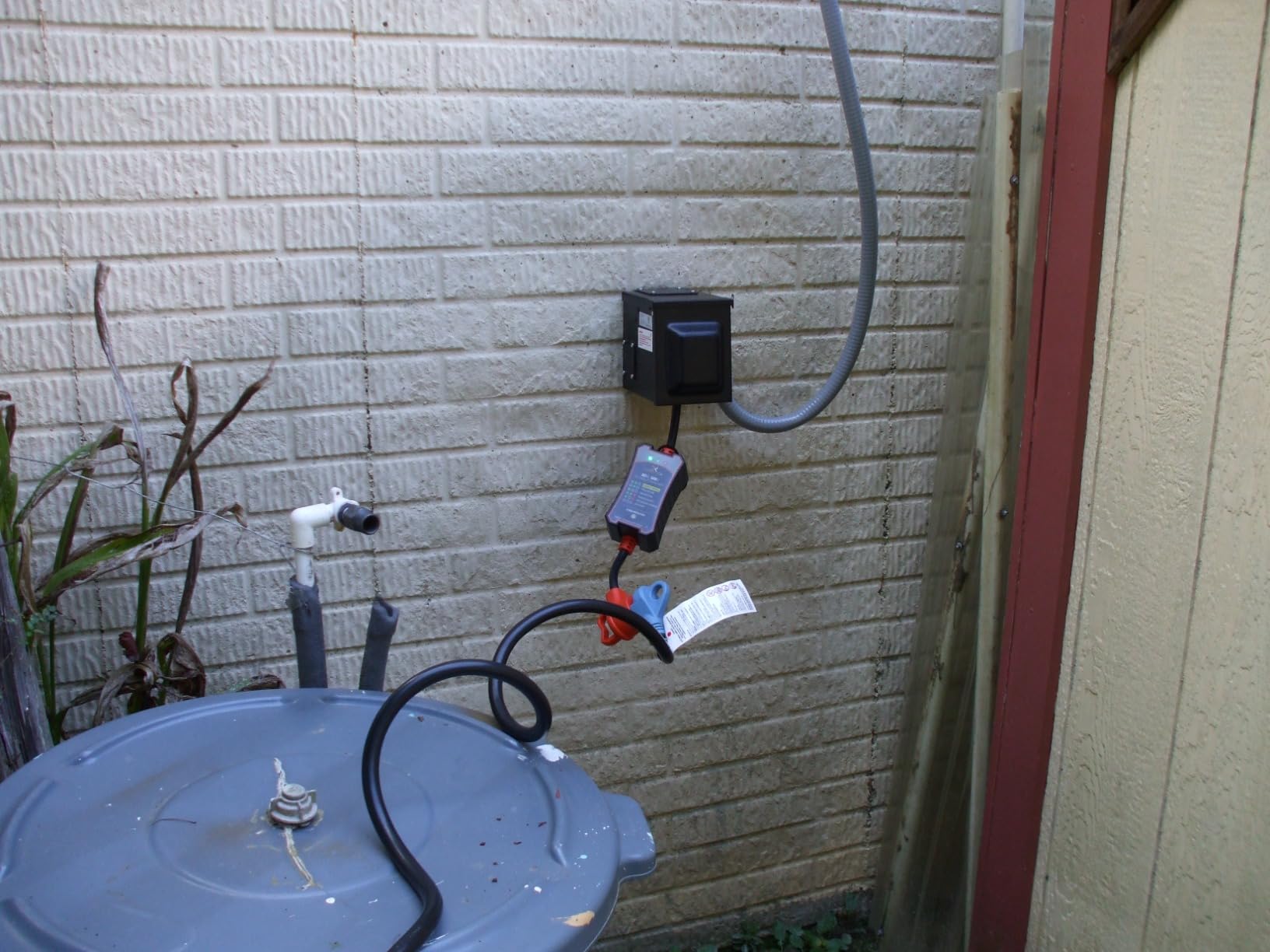
The build is UL listed, flame retardant, weather resistant and thermally protected, with an operating range from -35C to +110C. Rated at 30A, 125V, 3750W and 50/60Hz on NEMA TT-30P and TT-30R connectors, which is the standard 30 amp trailer configuration.
One owner noted it caught a miswired 30 amp pedestal hookup before any damage occurred, which is precisely the outcome that justifies carrying one at all.
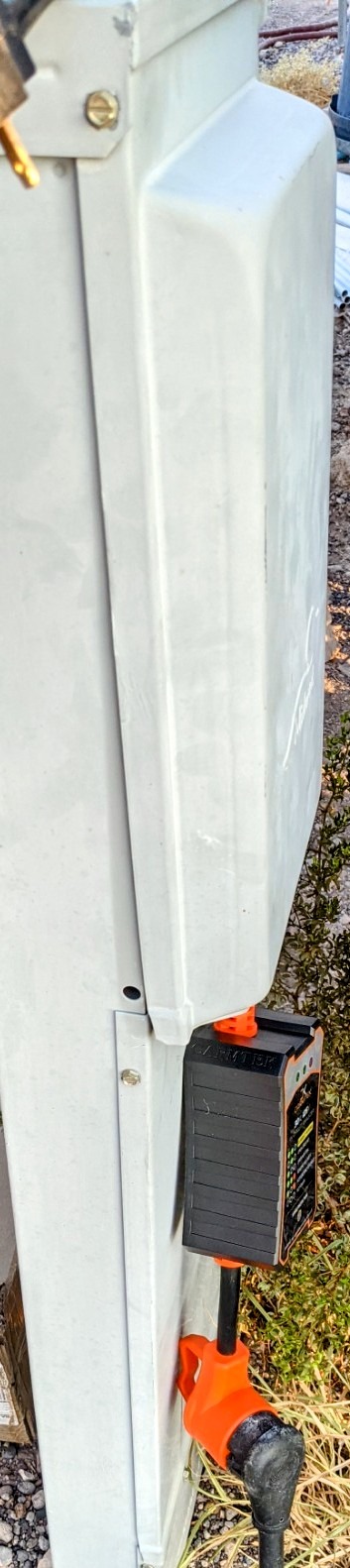
Why warranty service matters more than specs
These are sacrificial devices by design, so the support experience after a fault is part of the product. A lifetime warranty backed by same-day replacements means a surge event does not end with a shopping trip and a week of unprotected nights.
For full-time campers who will run one of these through many seasons, the responsiveness of the manufacturer is arguably worth as much as the extra thousand joules a competing model offers.
Where it falls short
The physical criticism is consistent: the 30 amp plug can be hard to pull out of the protector even using the built-in grip handle, and it can sit loosely in a power box and slip out if bumped, which some owners attribute to short prongs.
There is also no pre-designed metal clamp for theft deterrence, so securing it at the pedestal takes a workaround rather than an integrated feature.
7. Southwire Surge Guard 44290 – Best Diagnostic Value on 50 Amp
- 4200 joules across two hot legs
- Correctly identified a failed pedestal breaker and a missing L2 line
- Bright easy to read LED status lights
- Rugged enough to survive repeated drops on gravel
- Thicker receptacle brass reduces heat
- Anti-theft lock ring
- Bulky at 22.25 inches for small compartments
- No timed delay before restoring power
- No app or Wi-Fi connectivity
This is the 50 amp counterpart to the compact unit above, and it carries 4200 joules across the full 120/240V supply, which is what a fifth wheel or Class A motorhome with two air conditioners actually demands.
The standout review theme is diagnostic value rather than surge absorption. One owner used it to trace a persistent electrical problem to a failed 50 amp pedestal breaker after the park manager had suspected the trailer, which avoided a misdiagnosis running for weeks and hundreds of dollars of chasing the wrong part.
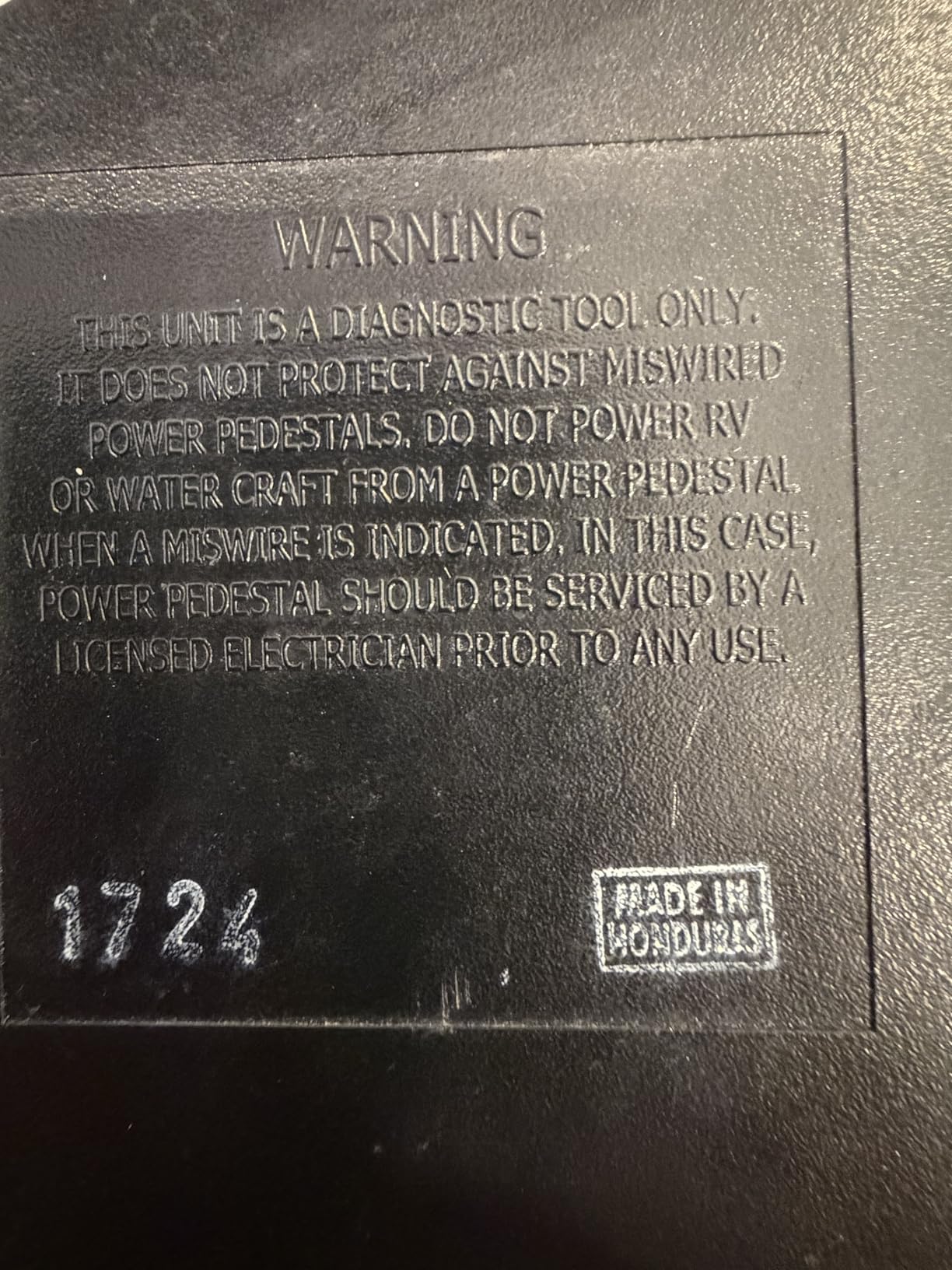
Durability is praised independently of the electronics. Owners report the unit surviving repeated drops onto gravel, and the thicker receptacle brass reduces heat at the connection. LED status lights are bright and easy to read in daylight.
The limited lifetime warranty carries, and the anti-theft lock ring on the cord lets you secure it to the pedestal during a long stay.
Why diagnostics matter on a 50 amp rig
A 50 amp coach has two hot legs, which means twice as many ways for a pedestal fault to present. Identifying a missing second leg or a bad breaker yourself, before blaming the trailer, is worth more over a season than any joule upgrade.
For rigs that see older campgrounds with mixed-era pedestals, a unit that names the fault in plain LEDs is more useful than one that only shows a number you have to look up.
Where it falls short
At 22.25 inches long it is the bulkiest portable in this lineup and genuinely awkward to store in a small compartment. There is also no timed delay before restoring power after an interruption, so it reconnects immediately when conditions clear rather than protecting compressors with a wait.
And there is no app or Wi-Fi connectivity, so monitoring is LED-only at the pedestal.
8. MILLIONHOME 50 Amp RV Surge Protector – Best for Surge Capacity on a 50 Amp Rig
- 18000 joules is the highest capacity in this lineup
- Circuit analyzer validates pedestal wiring before connection
- Waterproof design for rain wind and sandstorms
- Flame retardant materials
- Light at 1.5 pounds for a 50 amp device
- True surge performance cannot be verified without an actual surge event
- Basic non-LED variant with no detailed digital readout
If your question is simply how much surge capacity you can get for a 50 amp outlet, this is the answer in this group. At 18000 joules rated at 50 amp and 125 volts with a 6250 watt ceiling, it carries more than three times the joule rating of several branded models in the list.
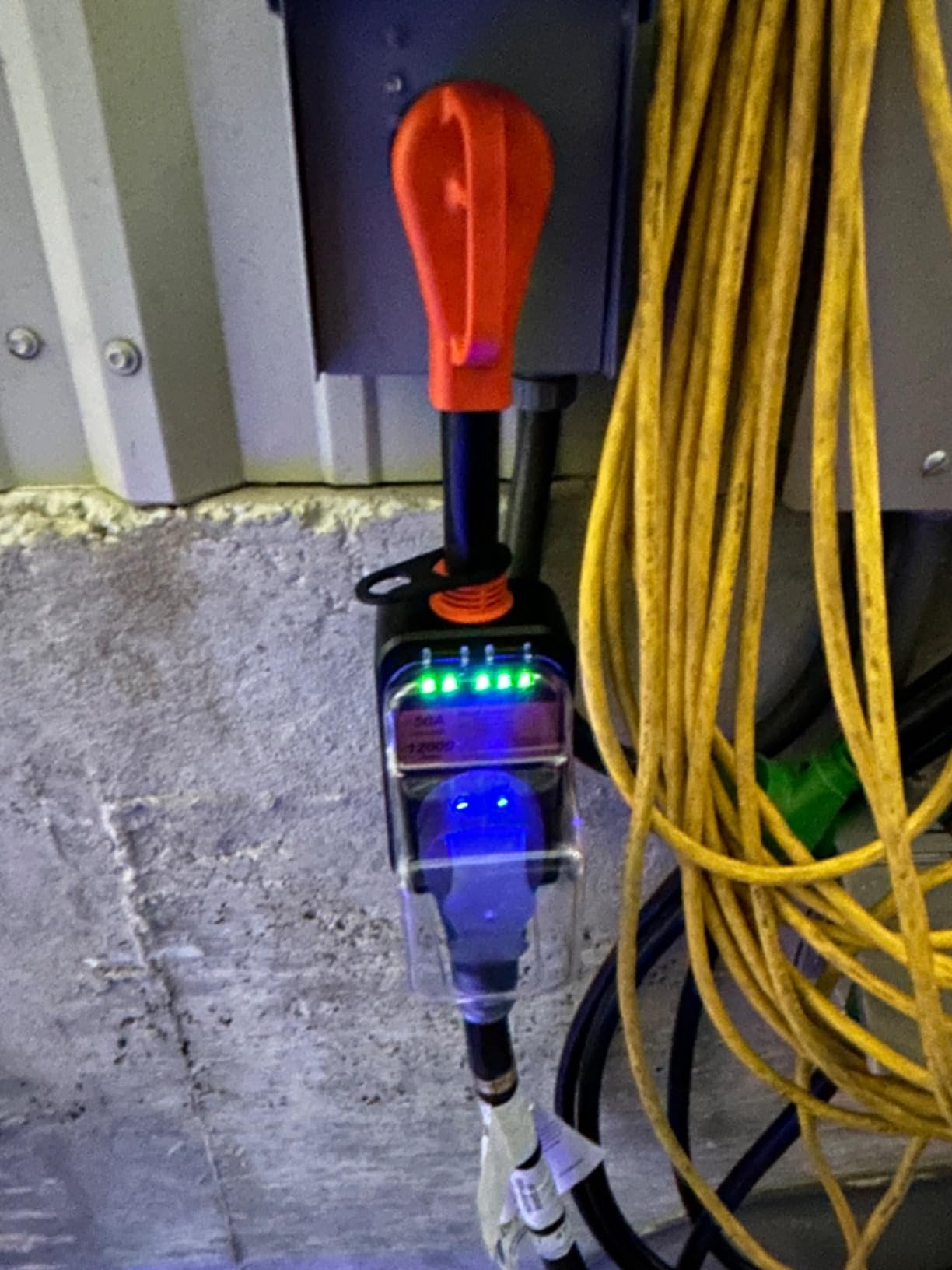
The circuit analyzer is the practical part. It quickly shows whether campground power is correctly wired before you connect the rig, which is the check that prevents the most common damage events from reaching your appliances.
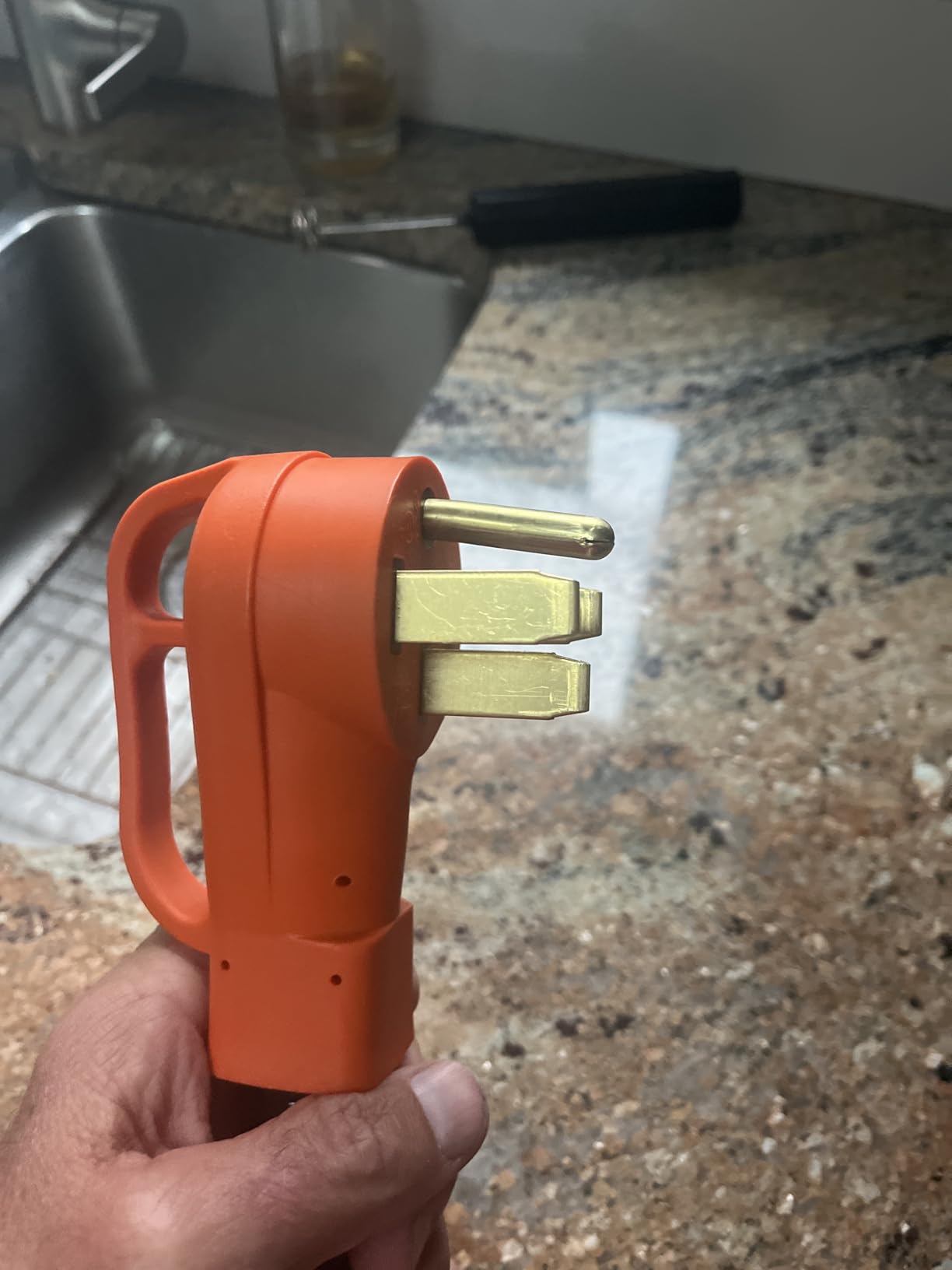
Owners characterise it as solid, waterproof and easy to hook up, with a reviewer comparing it to higher-priced units and calling the balance of surge capacity, waterproofing and diagnostics good for the money. It weighs 1.5 pounds, which is remarkably light for a 50 amp device.
The design is flame retardant and waterproof against extreme weather including rain, wind and sandstorms, and the plug-and-play format means no assembly before use.
What raw surge capacity actually does for you
Joules absorb spikes. A higher rating means more headroom before the sacrificial components are spent, which matters most in lightning-exposed regions or at parks with older transformers and longer shared runs.
On a 50 amp rig that carries two air conditioners, a compressor and a residential appliance, the higher rating is also a buffer against repeated smaller events that quietly erode capacity over a season.
Where it falls short
The recurring caveat is that true surge performance cannot be verified in normal use without an actual surge event, which is true of every protector here. This is the basic non-LED variant, so there is no detailed digital readout and you diagnose from lights only.
With that much capacity and no app monitoring, it suits an owner who wants protection and diagnosis at the pedestal rather than someone who wants to read voltage from a chair.
9. Camco Power Grip 55306 – Best 50 Amp Unit With Automatic Reconnect
- Disconnects above 132V and below 102V then reconnects automatically
- Diagnostic LEDs flag reverse polarity and open neutral
- 4200 joules of integrated surge protection
- Contoured Power Grip handles
- Weatherproof when installed upright
- Spares available for five years
- One year warranty is the shortest in this lineup
- Heaviest unit at 6.8 pounds
- No Bluetooth app or digital display
- Highest price among the 50 amp portables compared
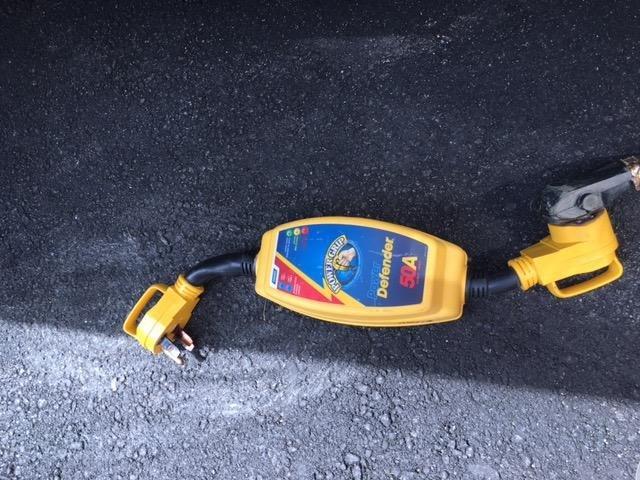
The Camco publishes its thresholds, which almost nobody does. It disconnects above 132 volts and below 102 volts, and reconnects once conditions return to normal. Knowing the exact numbers before you buy means you can check whether they match the appliances you are protecting.
Diagnostic LEDs indicate wiring faults including reverse polarity and open neutral at the moment you connect to the pedestal, and the integrated surge protection handles spikes up to 4200 joules on a NEMA 14-50P to 14-50R connection.
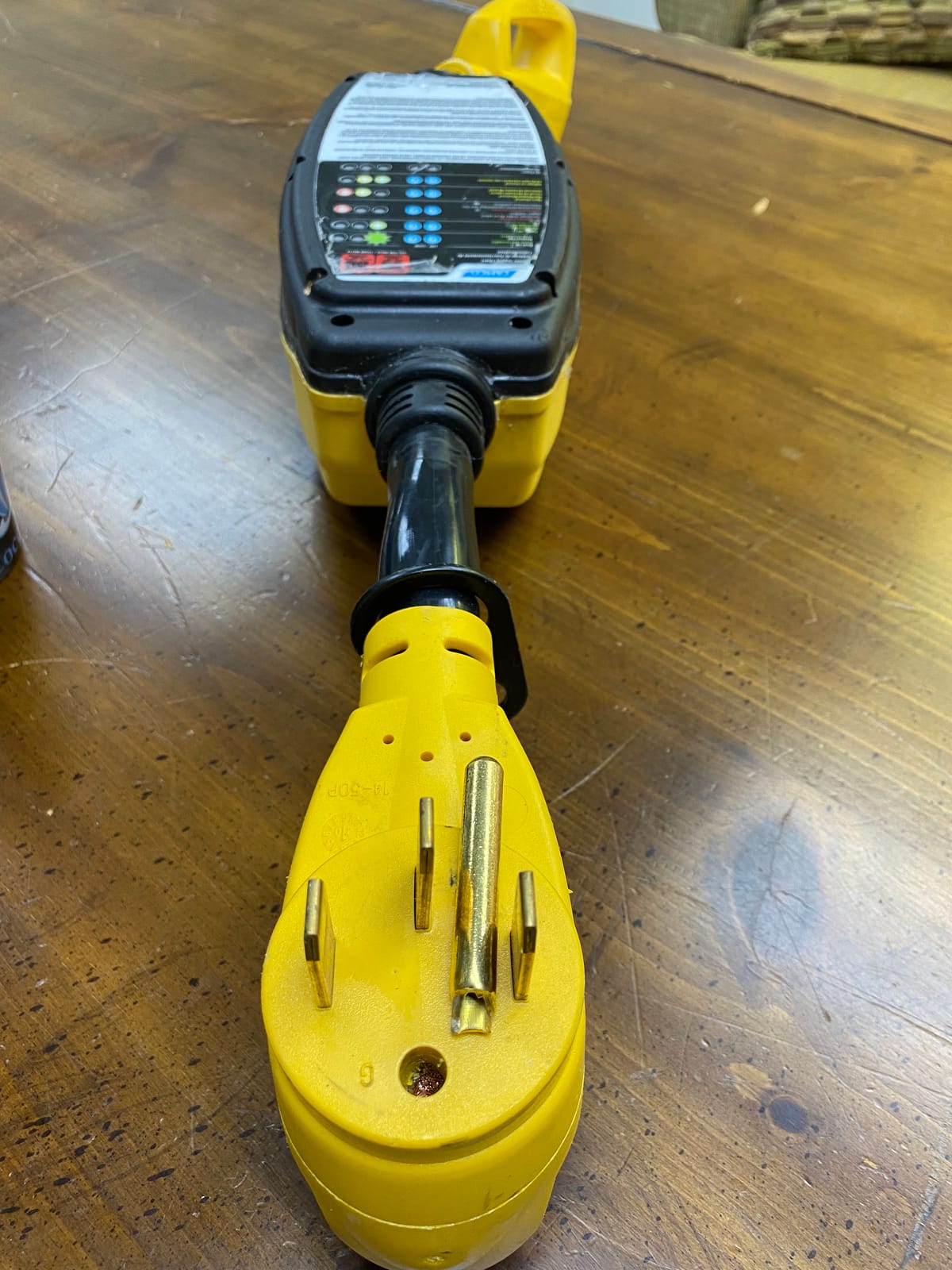
The contoured Power Grip handles make plugging and unplugging a 50 amp plug easier than most, which matters because those connectors are heavy and stiff. It is weatherproof when installed upright, and Camco lists spare part availability for five years, which is unusual for a device at the end of a supply chain.
At 6.8 pounds this is the heaviest unit we tested, a real consideration for anyone carrying it from a storage bay.
Where published thresholds help
Most competitors hide their voltage window. Knowing that a unit starts disconnecting below 102V tells you immediately whether it would have caught the kind of brownout that damages a compressor, and whether the setting is tight enough to avoid nuisance trips.
Automatic reconnect with no press required is convenient for full-timers who do not want to walk out in the rain at midnight to re-seat a breaker.
Where it falls short
The one year limited warranty is the shortest in this lineup, and reviews reflect that. Its 4.5 rating is the lowest of the ten we tested, with one-star share running higher than the competition, and the complaints cluster around warranty length and the absence of modern monitoring.
There is no Bluetooth, app or digital display, so you are reading LEDs on a 6.8 pound brick every time you want to know what the pedestal is doing.
10. FOCSPROD 50 Amp RV Surge Protector – Best Budget 50 Amp Fault Readouts
- Lowest cost in this lineup with 16000 joules
- Displays power on open ground open neutral neutral reversed over and under voltage and no power
- Waterproof cover and rugged housing for sun and rain
- Clear red and green indicator display
- Grip handles and right-angle plug
- LED-only indication with no app or digital meter
- Surge performance cannot be verified without a real surge event
This is the cheapest protector in the lineup and still manages 16000 joules on a standard 50 amp connection, which makes it the value pick for anyone whose first protector will get bashed around at a state park rather than a resort.
Its fault display is more granular than several pricier models. It names power on, open ground, open neutral, neutral reversed, over and under voltage, and no power, so you know exactly what the pedestal is doing wrong rather than just that something is.
The waterproof cover and rugged housing are built to stand rain, wind and intense sun, and the red and green indicator display makes power status readable at a glance in poor light. The ergonomic power grip handles and right-angle plug give a safe, space-saving connection.
Owners report strong build quality that holds up through heavy storm seasons, and one paired it with a 50 amp to 20 amp distribution adapter for layered protection at the campsite. Three year customer support rounds it out.
What the fault list is worth
Naming neutral reversed separately from open neutral matters, because they are different pedestal errors with different fixes, and a park that fixes one often does not check the other. Six distinct fault conditions is more coverage than most units in this price range report.
The red and green indicator scheme is the kind of simple detail that matters when you are plugging in at dusk in the rain and do not want to decode a label.
Where it falls short
LED-only indication with no app or digital meter readout means no live voltage value and no power history. If you want to see amperage and wattage from your phone, the Bluetooth models further up are the ones to buy.
As with the other high-joule budget units here, surge performance cannot be verified without a real surge event, so treat the rating as a specification rather than a promise.
How to Use It at the Pedestal: The Correct Plug-In Sequence
Order matters here. Connecting your rig before the protector has analysed the pedestal is how people defeat the protection they just paid for.
Plug the protector into the pedestal first. Not your cord into the protector. The protector into the pedestal outlet, with nothing attached to it yet.
Wait for the analysis. A circuit analyzer or EMS needs several seconds to establish voltage and check the wiring faults. Do not connect the rig while the readout is still settling.
Read the fault indicators. Any light for open ground, open neutral, reverse polarity, or over or under voltage means do not plug in. Take a photo of the indicator panel and show it to the park office, because it is hard to argue with.
Connect the shore power cord to the protector. For a hardwired model the sequence is the same idea: pedestal first, then the coach connection last.
Expect the delay before power returns. Once a fault clears, EMS units wait before reconnecting, and that wait can run from roughly 10 seconds to over two minutes depending on the model and the delay cycle setting.
Step five causes more confusion than any other. That delay is deliberate compressor protection, not a defect. Reconnecting instantly into a recovering compressor is exactly what shortens the life of an air conditioner, so the unit waits and then reconnects on its own. Owners who understand this stop assuming their new protector is broken on day one.
Before you leave, lock the protector to the pedestal if it has a security ring and you are staying a while. A portable protector is the easiest thing at a full site to walk off with.
Troubleshooting: Common Error Codes and Nuisance Trips
Why is my camper saying low voltage? The most common cause is an overloaded park circuit. When neighbours on the same leg run air conditioners, the pedestal voltage sags, and your EMS disconnects to protect the compressor. One member measured 85 volts of an expected 120 under exactly that load. On Progressive units this shows as a PE4 code. Shed a heavy load, wait for the delay cycle, or move sites.
What does E0 mean? On Progressive readouts E0 is the normal, no-fault state. It is not an error. If your display shows E0 and everything is running, nothing is wrong.
What does OA mean? Owners frequently read it as zero amps and assume a fault. It is usually the amps display sitting at zero because no load is running yet, or because you are reading it before the delay cycle completes.
Why does my display look blank? Most likely you are dry camping. With no shore power connected there is nothing for the unit to measure, so a non-flashing or blank display is expected rather than a fault. The same applies to a unit that shows nothing until the cord is seated fully.
Do adapters complicate protection? Yes. Running a 15 amp household plug through an adapter into a 30 amp protector leaves people unsure whether the protection is actually engaged in the circuit. If you use adapters, confirm with the manufacturer that the setup is supported, because a protector is only as good as its connection to the pedestal.
Is lightning protection real? Partially. A surge protector can absorb a small induced spike travelling along the shore power line, and it will sacrifice its components doing so. It is not a lightning arrestor and it cannot protect against a direct strike, which is why the honest answer is that it is one layer of a larger strategy.
Buying Guide: How to Choose a Campground Surge Protector
How we picked: we compared ten protectors across amperage, installation type, joule rating, fault coverage, monitoring, weather resistance and warranty, then weighted the decision by how much damage each failure mode actually causes at a campground. Ratings and review counts came directly from verified customer feedback, not from marketing copy.
Match the amperage to your rig. 30 amp travel trailer or B-van takes a TT-30 protector. 50 amp fifth wheel, Class A or larger trailer takes a 14-50 protector. This is the one rule that is not negotiable.
Choose an EMS over a spike absorber. This is the single highest-value decision. Only an EMS detects low voltage, open neutral, open ground and reverse polarity, and only an EMS disconnects your rig before the damage happens.
Check the joule rating against your exposure. For 30 amp service, 2000 joules or more is a sensible floor. For 50 amp service, 3500 and up is where we would start, and higher numbers cost little on modern units. Remember the rating depletes over time.
Decide portable or hardwired. Portable keeps your rig flexible and keeps the failure event out at the pedestal, but exposes the unit to weather and theft. Hardwired removes both risks and unlocks app monitoring, at the cost of installation effort and losing the ability to move the protection between rigs.
Decide how much monitoring you want. LED-only models diagnose faults and nothing more. Bluetooth models add live voltage, amperage and wattage plus alerts. Wi-Fi or a cellular add-on is the only way to check from inside the coach.
Look for a replaceable surge module. Surge components are sacrificial and will eventually be spent. A user-replaceable module means a repair rather than a repurchase, and it is the feature owners value most when a board dies.
Check weather resistance and warranty length. Your protector lives outside in rain and sun. IP-rated housings, rubber covers and included shields matter, and a lifetime warranty is meaningfully better than the one year some models still carry.
One last naming note worth repeating: a transfer switch labelled Surge Guard inside your coach is only a transfer switch. Whatever you buy at the pedestal is the protection you actually have.
Frequently Asked Questions
What is the best brand of RV surge protector?
Hughes Autoformers Power Watchdog and Progressive Industries lead the category, and both build full EMS units with fault detection, automatic disconnect and delayed reconnect. Southwire and Camco are respected alternatives that tend to cost less. The brand matters less than matching the amperage to your rig and choosing a unit with true EMS fault detection rather than a spike absorber. See the ten-model comparison above for the full lineup.
How many joules should a surge protector have for an RV?
For a 30 amp RV, look for at least 2000 joules, and 3000 or more if you camp in lightning-exposed areas. For a 50 amp rig, start at 3500 joules and go higher if the option is affordable. The key nuance nobody explains: joules deplete every time the unit absorbs a spike, so pick a model with a user-replaceable surge module rather than treating the printed rating as permanent.
Which 30-amp surge protector is the best for an RV?
The Progressive Industries SSP-30XL is our best overall 30 amp pick because its smart fault detection covers over and under voltage, open ground, open neutral and reverse polarity before you connect. For app monitoring, the Power Watchdog PWD30 is the stronger choice, and for the lowest cost with real fault diagnosis the GEARGO 30 Amp Circuit Analyzer does the job. All three are matched to a standard TT-30 120V supply.
Do I really need a surge protector for my RV?
Yes, if you connect to shore power regularly. The common argument against is that a house circuit is known-good while a campground pedestal is not, and that is exactly the point. The damage events that reach RVs are usually low voltage brownouts and miswired pedestals rather than lightning, and an EMS is the only device that detects and disconnects on those. One member measured 85V where he expected 120V and lost several hundred dollars of electronics twice before installing one.
What is the best EMS surge protector for an RV?
The best EMS is the one that matches your amperage and installation style. For a 30 amp trailer, the Power Watchdog PWD30 or Progressive SSP-30XL cover the fault set you need. For a 50 amp full-timer, the hardwired Power Watchdog PWD50EPOH adds both-leg monitoring, a replaceable surge module and 6100 joules. Every model in our comparison table lists its fault coverage so you can compare them directly.
Why is my camper saying low voltage?
The usual cause is an overloaded pedestal circuit, often when neighbouring rigs run air conditioners on the same leg and the voltage sags. Your EMS disconnects to protect the compressor, which shows as a PE4 code on Progressive units and similar readings elsewhere. Shed a heavy load, wait out the delay cycle, or move to another site. Sustained low voltage is what actually damages A/C compressors, so the trip is protection working, not a malfunction.
How to tell if a surge protector is going bad?
Look for the surge failure indicator or reduced-joules warning on the unit or in its app, since most modern models surface it. A spent surge board can be worse than none, because it will still close the circuit and pass a fault to your appliances while implying everything is fine. If your model has a user-replaceable surge module you can swap the board yourself and stay protected, which is far cheaper than replacing the whole device.
Do surge protectors protect against low voltage?
A basic surge protector does not. It only absorbs short voltage spikes and does nothing about low voltage, open neutral, open ground or reverse polarity. Only an electrical management system, or EMS, monitors voltage continuously and disconnects your rig when the supply is unsafe, then reconnects after a protective delay. If your device only has a joule rating and no fault detection, you do not have full protection at a campground.
Final Verdict: Which RV Surge Protector Should You Buy?
If you want one answer for a 30 amp trailer, take the Progressive Industries SSP-30XL. It has the largest body of verified owner feedback in this group, detects every common pedestal fault before you connect, and carries a lifetime warranty. If you want phone monitoring on the same amperage, the Power Watchdog PWD30 does it with 3000 joules behind it.
For a 50 amp fifth wheel or motorhome that you camp in full time, the hardwired Power Watchdog PWD50EPOH is the one I would install. The replaceable surge module, 6100 joules and both-leg amperage monitoring justify the installation effort, and it removes the theft question entirely. If you are not ready for a hardwired install, the Southwire Surge Guard 44290 gives you honest fault diagnosis at 4200 joules.
Whatever you choose, remember the sequence: protector into pedestal first, read the lights, then connect the coach. And if your rig spends time dry camping, a quiet display is simply a protector with nothing to measure.
If you are building out the rest of your rig, our guides to whole house surge protectors and RV mattresses cover the other two upgrades most full-timers prioritise.