
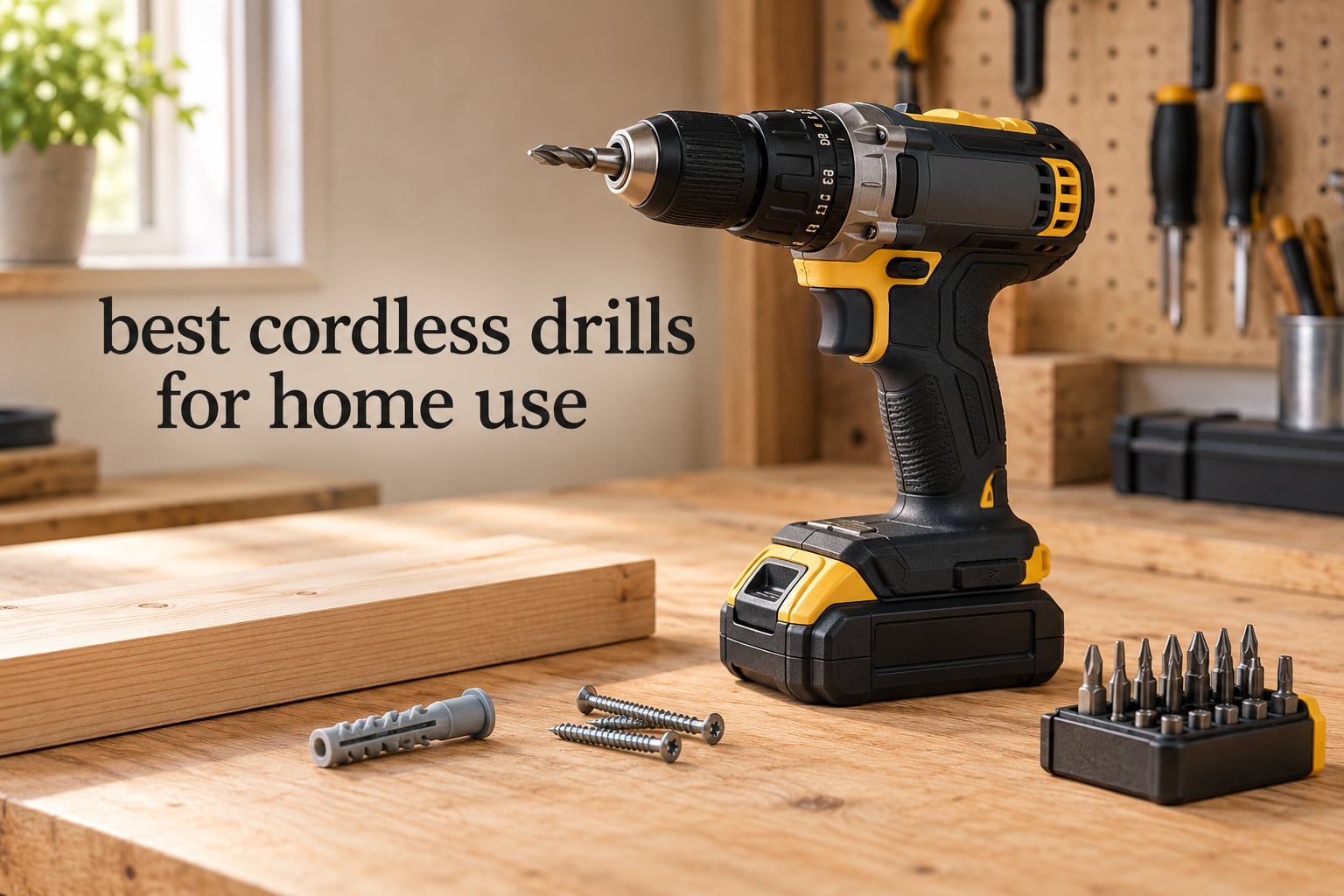
If you want one drill that handles flat-pack furniture, drywall anchors, shelves, light fixtures and heavy screws into studs, the DEWALT 20V Max DCD771C2 is the pick. It pairs a 650 in-lb drill/driver with a 1/2-inch ratcheting chuck, two 1.3Ah batteries and a contractor bag, and it carries close to 50000 buyer reviews. That is the short answer to the best cordless drills for home use question.
The rest of this roundup exists because there is no single right answer. If you only own flat-pack furniture and shelving, a 12V drill is genuinely enough. If you are hanging a heavy mirror into brick or replacing deck boards, you want a 1/2-inch chuck and more torque than that. And if you think you will buy a second tool within a year, the battery platform matters more than the drill itself.
We compared ten cordless drills, weighed the published specifications against what buyers actually report, and sorted them by the household jobs they suit. Every pick below lists its real specs, the complaints that show up repeatedly in reviews, and a clear disqualifier so you can rule it out fast. Last updated for 2026.
A note on method: we did not run lab torque curves. Instead we read the manufacturer specifications, cross-checked them against thousands of buyer reviews, and matched each tool to the jobs a typical homeowner actually tackles. Where a spec is a manufacturer claim, we say so. Where buyers disagree with the spec sheet, we say that too.
Table of Contents
Top 3 Cordless Drills for Home Use
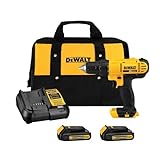
DEWALT DCD771C2 Drill/Driver Kit
- 650 in-lb max torque
- 1/2 inch ratcheting chuck
- Two 1.3Ah batteries included

DEWALT DCK240C2 Drill + Impact Combo
- Drill plus impact driver
- Two batteries and bag
- LED lights on both tools
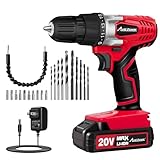
AVID POWER CD316-20 Drill Set
- 20V with 22-piece bit kit
- 15+1 clutch settings
- 2.5 lb lightweight body
The DEWALT DCD771C2 takes the top spot because it is the rare drill that is not obviously bad at anything a homeowner does. The DCK240C2 is the smarter buy if you think an impact driver is inevitable, since impact drivers handle long screws far better than any drill. The AVID POWER set is the low-risk entry point for light-duty work, with the trade-off being a sealed battery ecosystem and modest torque.
Quick Overview: Best Cordless Drills for Home Use in 2026
| Product | Specifications | Action |
|---|---|---|
| DEWALT 20V Max DCD771C2 Drill/Driver Set |
|
Check Latest Price |
| DEWALT 20V Max DCK240C2 Drill and Impact Combo |
|
Check Latest Price |
| AVID POWER 20V CD316-20 Drill Set |
|
Check Latest Price |
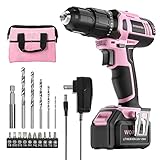 WORKPRO 20V ML-CD130-200KS Drill Set WORKPRO 20V ML-CD130-200KS Drill Set |
|
Check Latest Price |
 CRAFTSMAN V20 CMCK200C2 Drill and Impact Set CRAFTSMAN V20 CMCK200C2 Drill and Impact Set |
|
Check Latest Price |
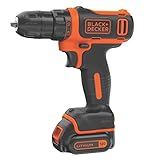 BLACK+DECKER 12V MAX BDCDD12C Drill/Driver BLACK+DECKER 12V MAX BDCDD12C Drill/Driver |
|
Check Latest Price |
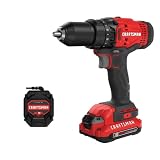 CRAFTSMAN V20 CMCD700C1 Drill Kit CRAFTSMAN V20 CMCD700C1 Drill Kit |
|
Check Latest Price |
 BLACK+DECKER 20V BDC120VA100 100-Piece Kit BLACK+DECKER 20V BDC120VA100 100-Piece Kit |
|
Check Latest Price |
 Makita XFD131 18V LXT Brushless Driver-Drill Makita XFD131 18V LXT Brushless Driver-Drill |
|
Check Latest Price |
 Bosch GSR18V-400B22 18V Compact Brushless Kit Bosch GSR18V-400B22 18V Compact Brushless Kit |
|
Check Latest Price |
1. DEWALT 20V Max DCD771C2 Drill/Driver Set: Best Overall for Home Use
- 650 in-lb of torque handles decking screws and 2x lumber
- 1/2 inch ratcheting chuck grips bits tightly
- Compact enough for cabinets and between studs
- Contractor bag and two batteries included
- No hammer mode for brick or concrete
- 1.3Ah batteries are the smallest capacity in the 20V range
- Not rated for heavy industrial work
This is the drill I hand to friends who ask for one recommendation. The DCD771C2 is a basic drill rather than a hammer drill, but for the overwhelming majority of household work that distinction never comes up. Picture hanging, shelving, cabinet hinges, drawer slides, flat-pack assembly and drywall anchors all fall well inside what it can do.
The two-speed gearbox gives you 0 to 450 rpm on setting one and 0 to 1,500 rpm on setting two. Low gear is where the torque lives and it is what you want for driving screws into hardwood. High gear is for boring holes and driving small fasteners, where speed matters more than force.
Buyers single out the 1/2-inch single-sleeve ratcheting chuck almost universally as a step up from the plastic chucks on cheaper drills. It grips a bit hard enough that it will not slip under load, which matters more than it sounds when you are drilling into a stud with a spade bit. The handle is genuinely comfortable for a full evening of work.
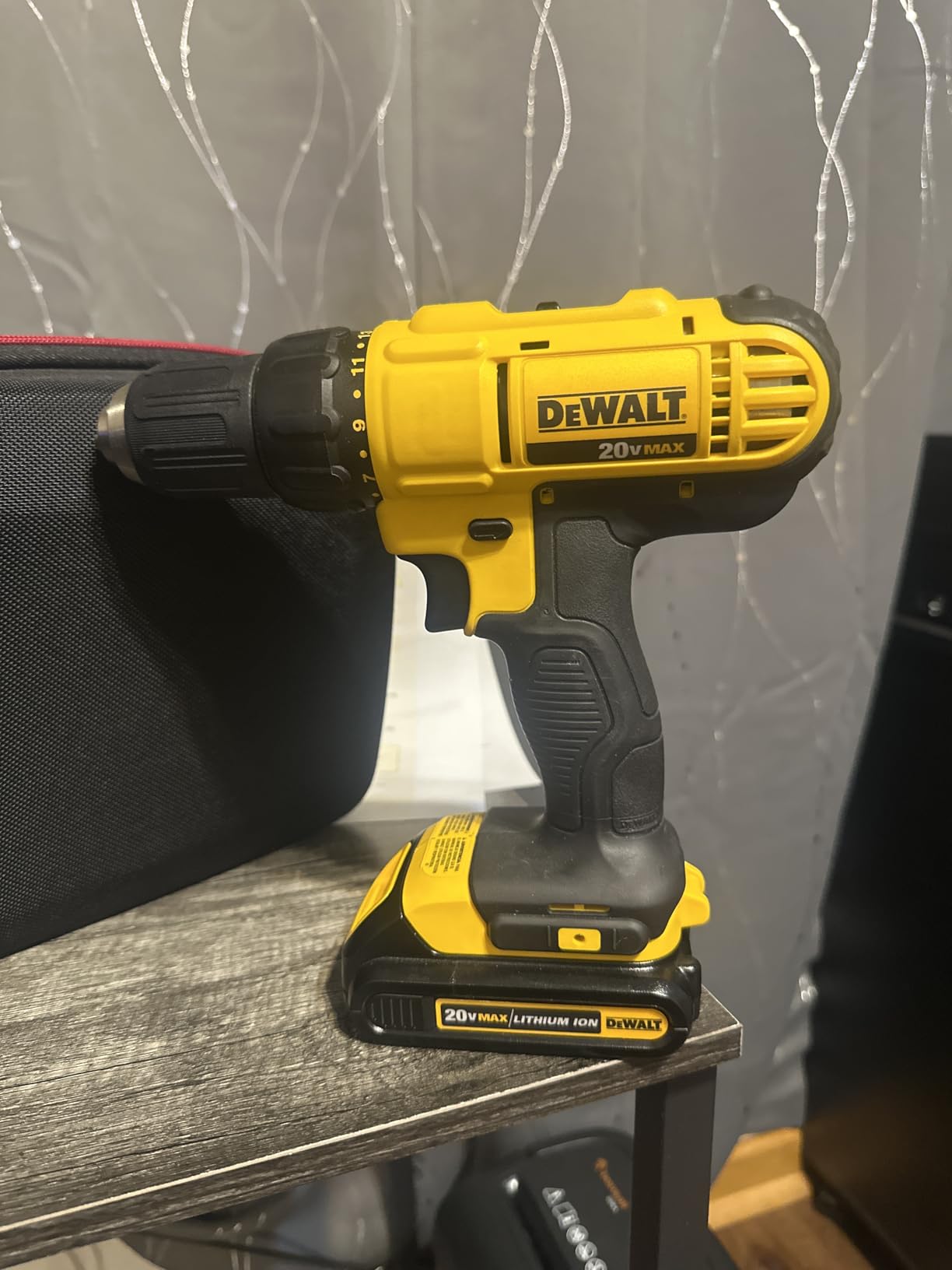
The specification that gets debated most is the 1.3Ah battery. Two are included, and buyers report the pair is workable for a weekend project, but the runtime per charge is short compared with the 2.0Ah and 3.0Ah packs in this roundup. The charger tops them back up while you work, so it becomes a rotation problem rather than a blocker.
Maximum torque is rated at 650 in-lb, and the manufacturer specifies drilling capacity of 30 mm in wood and 13 mm in metal. The listing is explicit that this is not a tool for concrete or masonry, and that limitation is the main reason it does not win every category here.
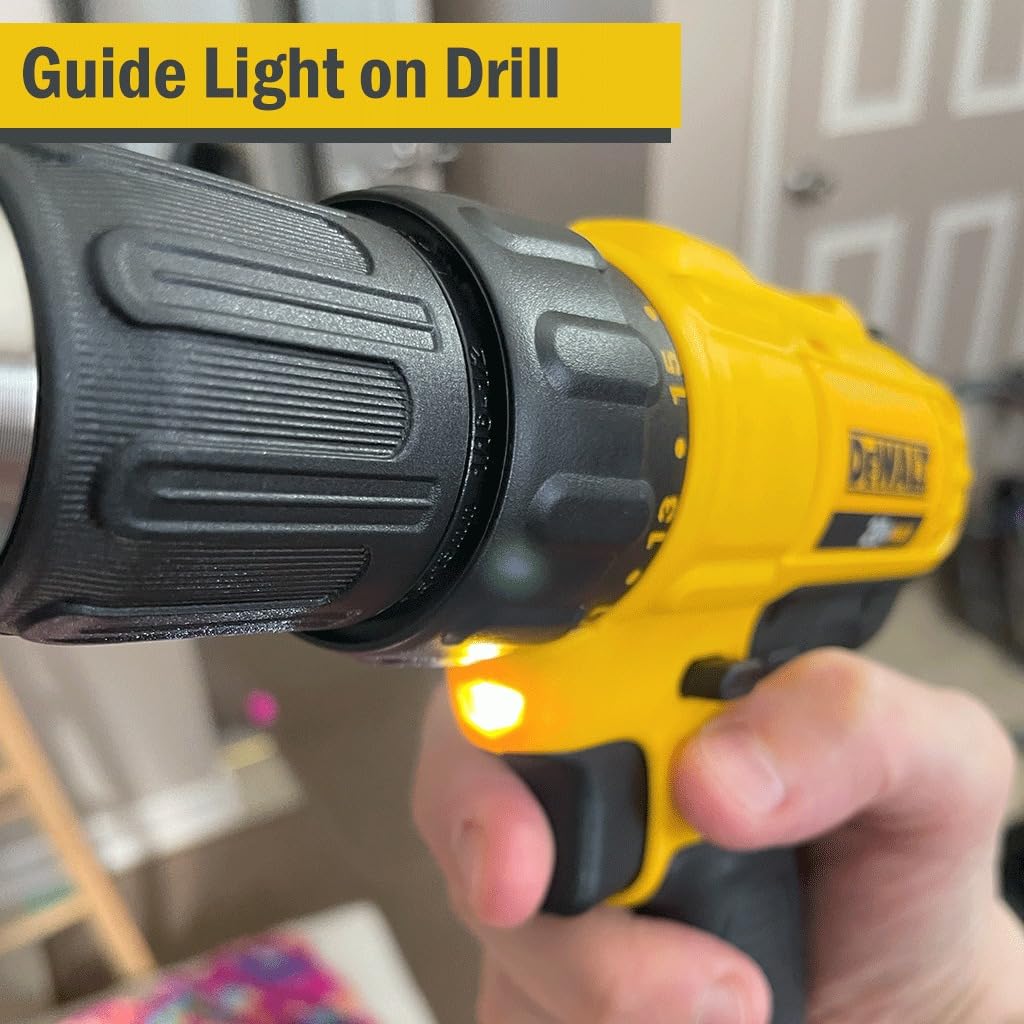
One more thing worth knowing: the 300 UWO motor figure is a DeWalt-specific work-output metric, not a torque number. It cannot be converted to in-lbs by any reliable method, so treat it as a way of comparing DeWalt drills to each other rather than against other brands.
What the DCD771C2 handles well and where it stops
It handles 3-inch screws into a doubled-up 2x, most wood screws, standard masonry anchors in drywall, and hole sawing up to the sizes a 1/2-inch chuck accepts. It also stands up on the battery, so you can set it down mid-task without it rolling over.
It stops short at brick and concrete, because there is no hammer mode. If drilling into masonry is on your list, look at a rotary hammer or a hammer drill instead, and treat the DCD771C2 as the wood and fastener tool it is.
Whether this is the right drill for your household
It suits homeowners and renters who do furniture, shelving, fixtures and light repair, and it suits them for a decade of ordinary weekend work. It is the safer default for anyone who will not want to research voltage classes before buying.
Skip it if you already own 18V or 20V DeWalt batteries, because the bare tool logic changes completely, or if brick, block or concrete is a regular part of your project list. In both cases you are paying for capability you will not use, or duplicating a battery you already have.
2. DEWALT 20V Max DCK240C2 Drill and Impact Combo Kit: Best Value Two-Tool Set
- Impact driver drives long screws and bolts far better than a drill
- Compact 5.55 in impact head reaches tight spots
- LED work lights with 20-second delay
- Two batteries and a bag in one purchase
- Charger indicator lights are poorly documented
- Battery output is moderate for large construction
- Occasional reports of smells and charger failures
This is the kit I would buy instead of the single drill if I were starting from nothing. The DCK240C2 pairs the DCD771C2 drill/driver with the DCF885 impact driver, and the impact driver is the tool that quietly removes half the frustration from DIY work.
Where a drill uses a friction clutch to stop driving at a set depth, an impact driver hammers while it turns. That combination drives a 3-inch structural screw into a stud with less force and far less wrist strain, and it makes stripped screw heads far less likely because there is less torque for you to fight.
Buyers use this kit for furniture, drywall, cabinetry and car audio installs, and the recurring theme is that the second tool justifies itself within a few weeks. Once you have driven a deck screw or a long lag bolt with the impact driver, going back to a drill feels like a downgrade.
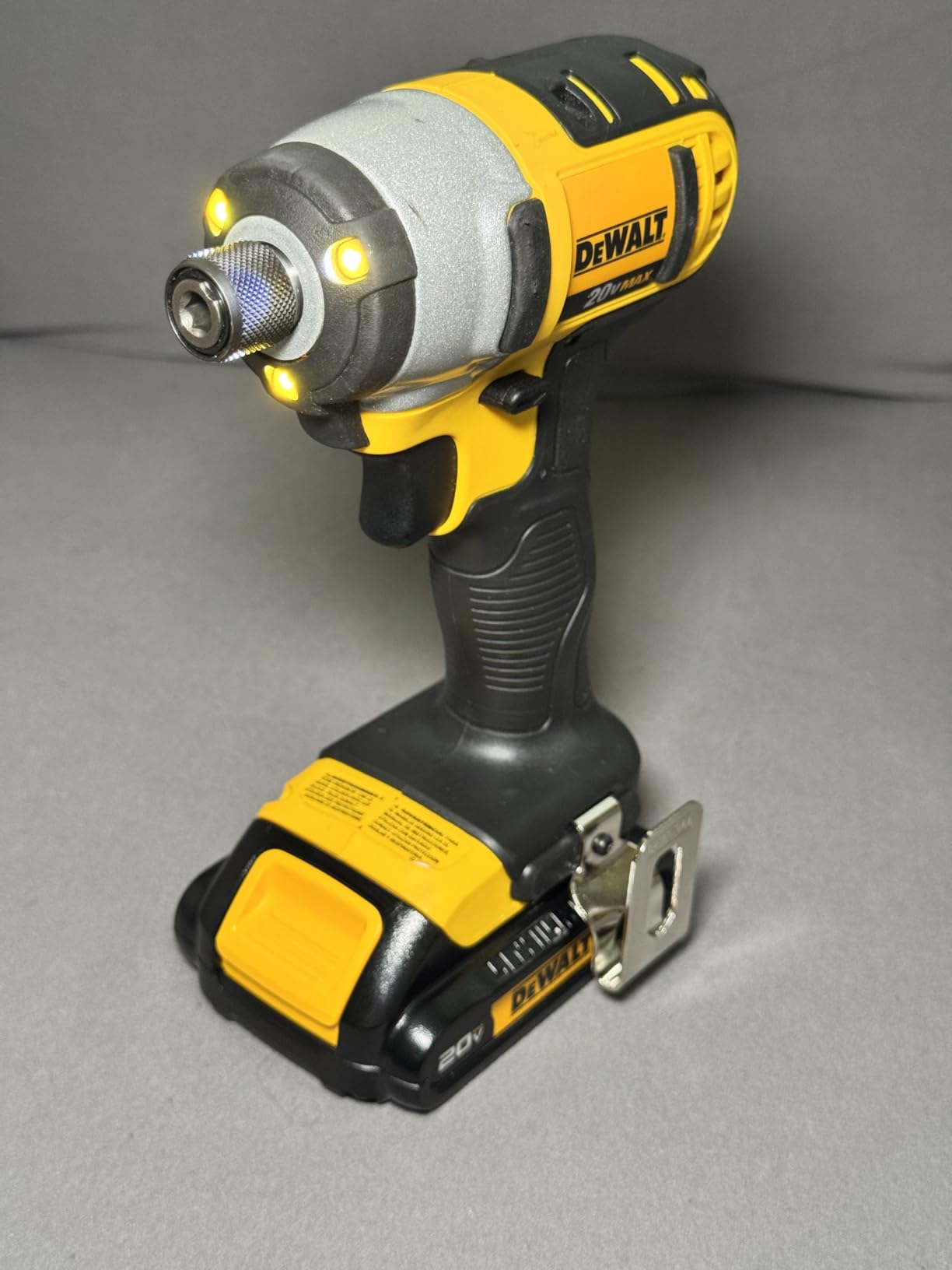
The impact driver has a 1/4-inch hex chuck that accepts one-inch bit tips, so you can drop a bit in one-handed without fussing with a sleeve. The 20-second LED delay is a small touch that lets you line up a screw in a dark stud cavity, switch on, and still have light when the trigger is pulled.
The drill/driver itself measures 7.5 inches long and 3.6 pounds, and the impact driver is 5.55 inches and 2.8 pounds. Those numbers matter in tight spaces, particularly between studs or inside a cabinet where a longer tool simply will not fit.
The complaints cluster around the charger rather than the tools. The red-light indicator scheme is not self-explanatory, and a small number of owners report one-off charger malfunctions or a smell from the impact driver. Neither is a reason to skip the kit, but both are reasons to keep the wall plug within reach of where you are working.

What the combo kit does that the single drill cannot
Long screws, bolts and deck fasteners are the clear win. The 1,700 in-lb impact figure is what makes a drill/driver alone struggle, and the impact driver simply does not bog down on them.
The second thing is battery rotation. With two packs, one charges while the other works, which is exactly what a one-battery kit cannot offer. Across this roundup that is the difference between a relaxed evening project and a paused one.
Whether the combo kit is worth the extra spend
It is worth it if you expect to drive more than a handful of long screws, or if flat-pack furniture is a recurring task, since furniture assembly is mostly long screws into particle board. It is also the right call if a second tool was always the plan.
Skip it if you are certain you will only ever hang pictures and assemble a wardrobe once. The drill half of the kit is the same DCD771C2, and the second tool would sit in the bag collecting dust, which is a poor return for any amount of money.
3. AVID POWER 20V CD316-20 Drill Set: Best Budget Starter Kit
- Genuinely light at 2.5 lb with a rubberized grip
- 15+1 clutch settings give fine screw control
- Battery charge level display on the pack
- 22 accessories mean no extra purchases
- Only works with AVID POWER batteries
- No hammer mode and no concrete capability
- Lower top-end torque than premium 20V kits
The AVID POWER CD316-20 is the pick if your entire list is flat-pack furniture, wall fixtures and small shelving, and the word in the job description is renter. It comes with 22 accessories, so the drill, charger and a usable spread of bits are in one box, and it weighs about 2.5 pounds.
Weight is the underrated spec here. A drill you can hold one-handed while supporting a shelf with the other is a fundamentally different experience from a 3.6-pound tool, and reviewers consistently mention reduced fatigue during long assembly sessions.
The 15+1 clutch settings are genuinely useful rather than decorative. Setting one is drilling mode, and the numbered settings above it step the torque down so the driver stops driving at a chosen depth, which is the difference between a flush screw head and a chewed-up one in soft particle board.
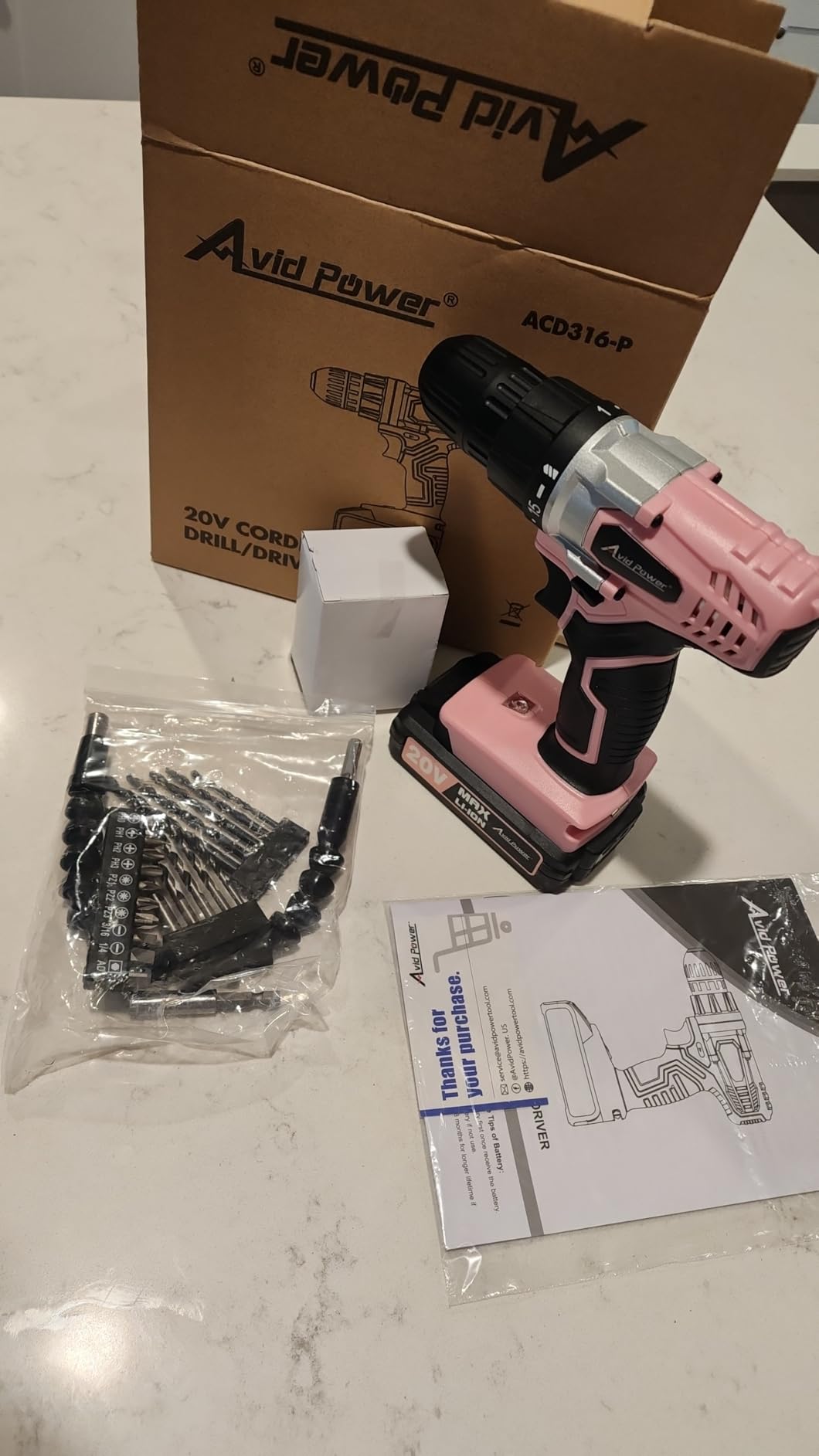
Top speed is 550 rpm and rated maximum torque is 280 in-lb, with drilling capacity listed at 20 mm in wood and 10 mm in metal. That is a modest envelope compared with the 650 in-lb of the DeWalt, and it shows when you meet a knot, a hardwood screw or a lag bolt.
Two limitations deserve a hard look. The pack works only with AVID POWER batteries, not other brands or higher-capacity packs, so the ecosystem is sealed before you buy it. And the tool is explicitly not suitable for concrete or masonry.
One practical note from owners: if you store the battery long-term, take it off the tool and top it up roughly every three months. Lithium-ion packs that sit fully depleted for a year are the most common reason a perfectly good drill suddenly stops working.
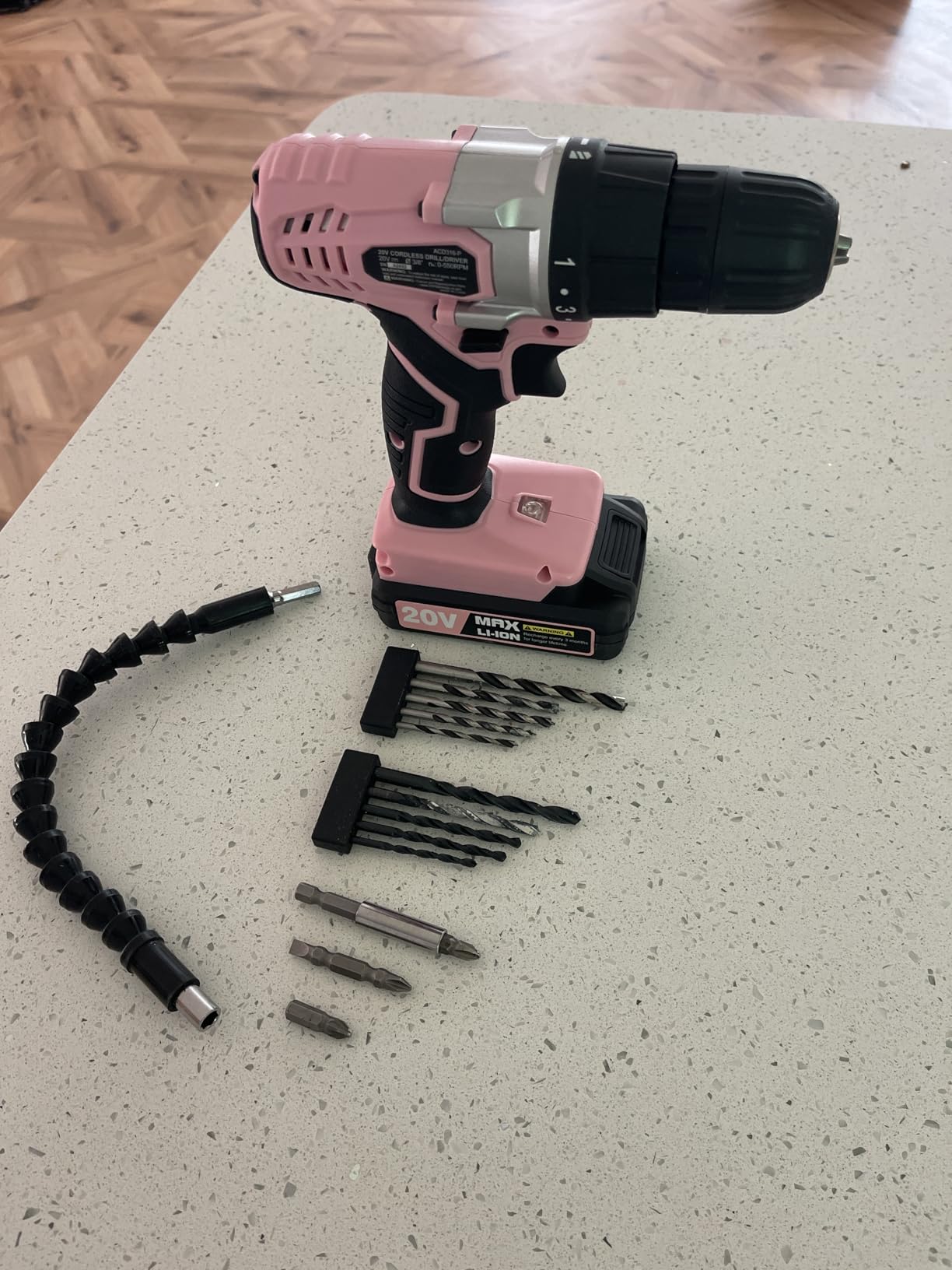
Which jobs the AVID POWER kit is genuinely right for
Flat-pack and knockdown furniture, curtain rails, light wall fixtures, shelving into studs, and craft or hobby drilling. None of these will strain a 280 in-lb drill, and the accessory kit covers most of them without a second purchase.
The charge level display on the battery is a small feature that pays for itself. Knowing you have 40 percent left changes how you approach a job, compared with finding out mid-screw that the tool is about to stop.
Where buyers regret this choice
The regrets are predictable and worth weighing. Anyone who later needs brick, block or concrete has no path forward with this tool at all, and anyone who gets into the platform discovers replacement batteries only come from one source.
It is also not the tool for a second battery purchase in a year, which is the opposite of what a platform-focused buyer wants. If there is any realistic chance of owning a second drill, driver, sander or sander-style tool within eighteen months, a 20V kit from a major platform is the better economics.
4. WORKPRO 20V ML-CD130-200KS Drill Set: Best Light-Duty 20V Drill With a Big Bit Kit
- Comfortable handling for long maintenance tasks
- 21+1 clutch positions give fine torque control
- Large 3/8 inch keyless chuck with strong bit retention
- Tool bag and 16-piece bit set included
- Carbon-brush motor produces visible sparking
- 203 in-lb is low for premium 20V drills
- Metal drilling capacity is not a strong specification
The WORKPRO ML-CD130-200KS is a straightforward light-duty 20V drill that does simple things well. It comes with a drill, a 1.5Ah battery, a charger, a tool bag, six HSS drill bits, a 60 mm extension bar and ten CR-V driver bits, which covers the majority of household maintenance without another purchase.
Owners highlight comfortable handling, easy bit changes and adequate power for light household projects. That is exactly the right framing. This is not a drill to take on framing lumber, but it is a perfectly good drill for the maintenance list that fills most homeowners’ toolboxes.
Its two-speed transmission runs 0 to 400 rpm and 0 to 1,500 rpm, and the 21+1 position clutch is more granular than many tools at this end of the market. On assembly work that means you can dial the torque down finely rather than guessing between a handful of settings.
Two features are worth calling out. The soft-grip handle reduces fatigue on long sessions, and the integrated LED light is positioned where you need it when you are driving a screw into a dark stud cavity or a cabinet back.
The main technical caveat is the carbon-brush motor. A brief larger spark at start-up is normal for this type of motor and settles during use, but owners should expect visible sparking and eventual brush wear over the tool’s life. Buyers in online communities are consistent on this point: most would not choose a brushed motor for a new purchase today.
Rated maximum torque is 203 in-lb and the listed metal drilling capacity is modest. Neither figure competes with the DeWalt or Makita options here, and both tell you the intended use ceiling.
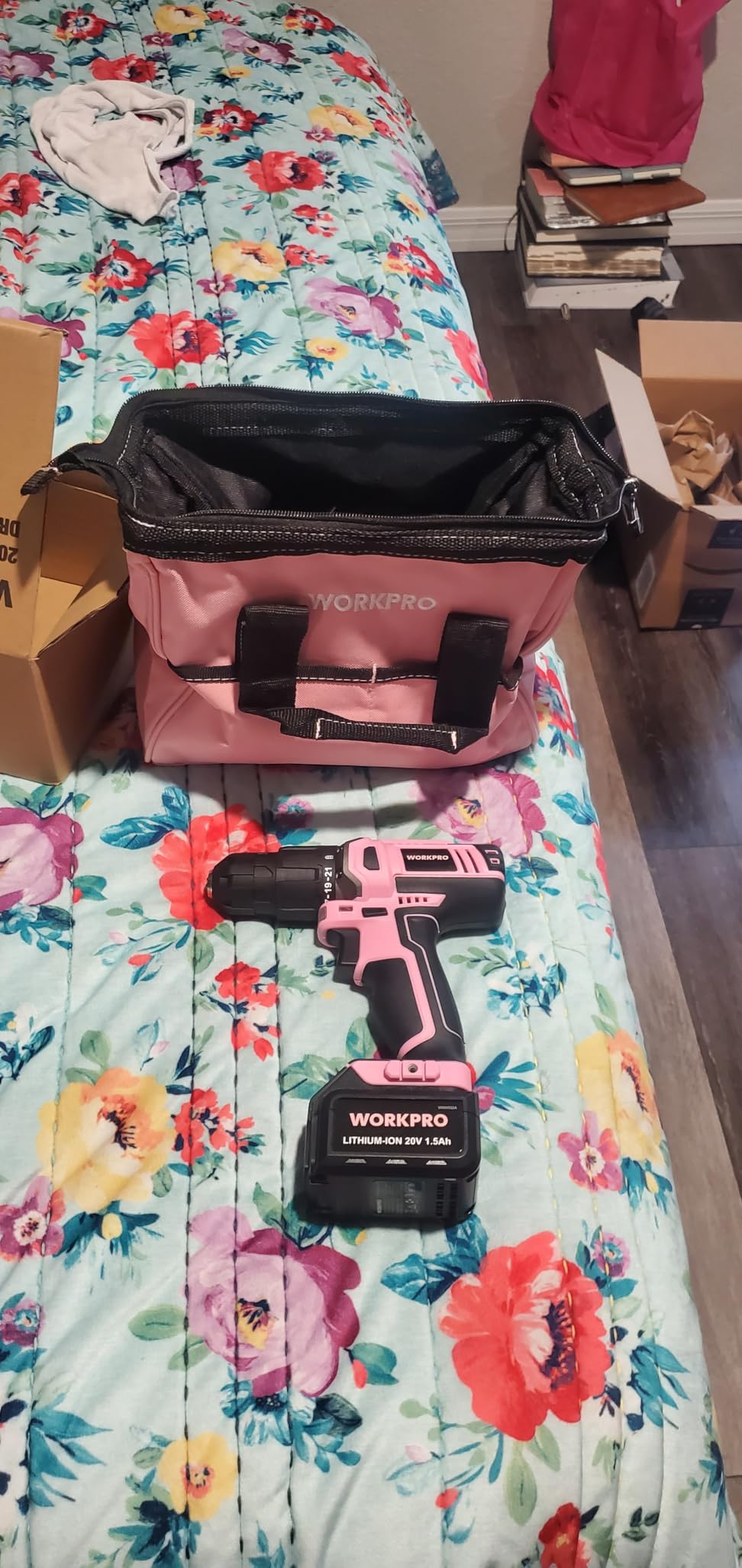
What the WORKPRO drill does well
Light maintenance, not construction. Replacing a door handle, fixing a loose shelf, rebuilding a small cabinet, mounting brackets, general household repairs. The soft grip and low weight make it easy to live with in a drawer between uses.
The 3/8-inch keyless chuck has strong bit retention, so bits stay put under load, and the 21+1 clutch gives finer control than most competitors in its class. The two-year manufacturer warranty is on the shorter side for this roundup.
Who should pass on it
Anyone planning to build a battery platform around this drill, because a brushed motor is the first thing you outgrow. The lower review base also means less long-term evidence about how these hold up compared with the heavily reviewed kits.
It is also the wrong answer for anyone with hardwood, large fasteners or any masonry on the list. There is no hammer mode, and 203 in-lb will bog down on a 3-inch screw into dense wood, which is the moment most buyers start looking for something stronger.
5. CRAFTSMAN V20 CMCK200C2 Drill and Impact Set: Best Matched Pair on One Battery Platform
CRAFTSMAN V20 MAX Cordless Drill and Impact Driver, 2 Batteries, Charger
- Matched drill and impact driver on one battery platform
- 1460 in-lb impact torque handles big fasteners
- Two 2.0Ah batteries give genuine runtime
- One-handed drop-and-load bit change
- Heavier overall package than a single-tool kit
- Only two bits included in the box
The CRAFTSMAN V20 CMCK200C2 solves the two-battery problem better than most kits. Both included packs are 2.0Ah rather than the 1.3Ah you get in many competitor bundles, and the V20 MAX platform is one of the more widely carried battery ecosystems you can buy into at a home improvement store.
The drill is the CMCD700, rated at 280 UWO with a two-speed gearbox of 0 to 350 and 0 to 1,500 rpm. The impact driver, the CMCF800, delivers 1,460 in-lb at 2,800 rpm with a 3,100 bpm impact rate, which is a substantial step up from a drill alone when you hit long screws or structural fasteners.
Owners value the matched pair, the LED lighting on both tools and the versatility of two 2.0Ah batteries for weekend projects and light trade work. The 8.4-pound package weight is the one number that reflects the whole kit rather than the drill.
The drop-and-load chuck on the impact driver is a small design decision with a real effect on workflow. You can hold a screw in one hand and a bit in the other and load the driver without a fiddly sleeve, which speeds up repetitive fastening more than any spec sheet suggests.
Both tools have LED work lights and contoured over-moulded handles. The handles are worth noting for overhead work, where a grip that narrows toward the base gives you a better hold when your wrist is at an awkward angle.
Two batteries at 2.0Ah means you can genuinely finish a project without a mid-task wait. The charger tops them up while you keep working, and the larger capacity also means fewer swaps during a long deck or shelving session.
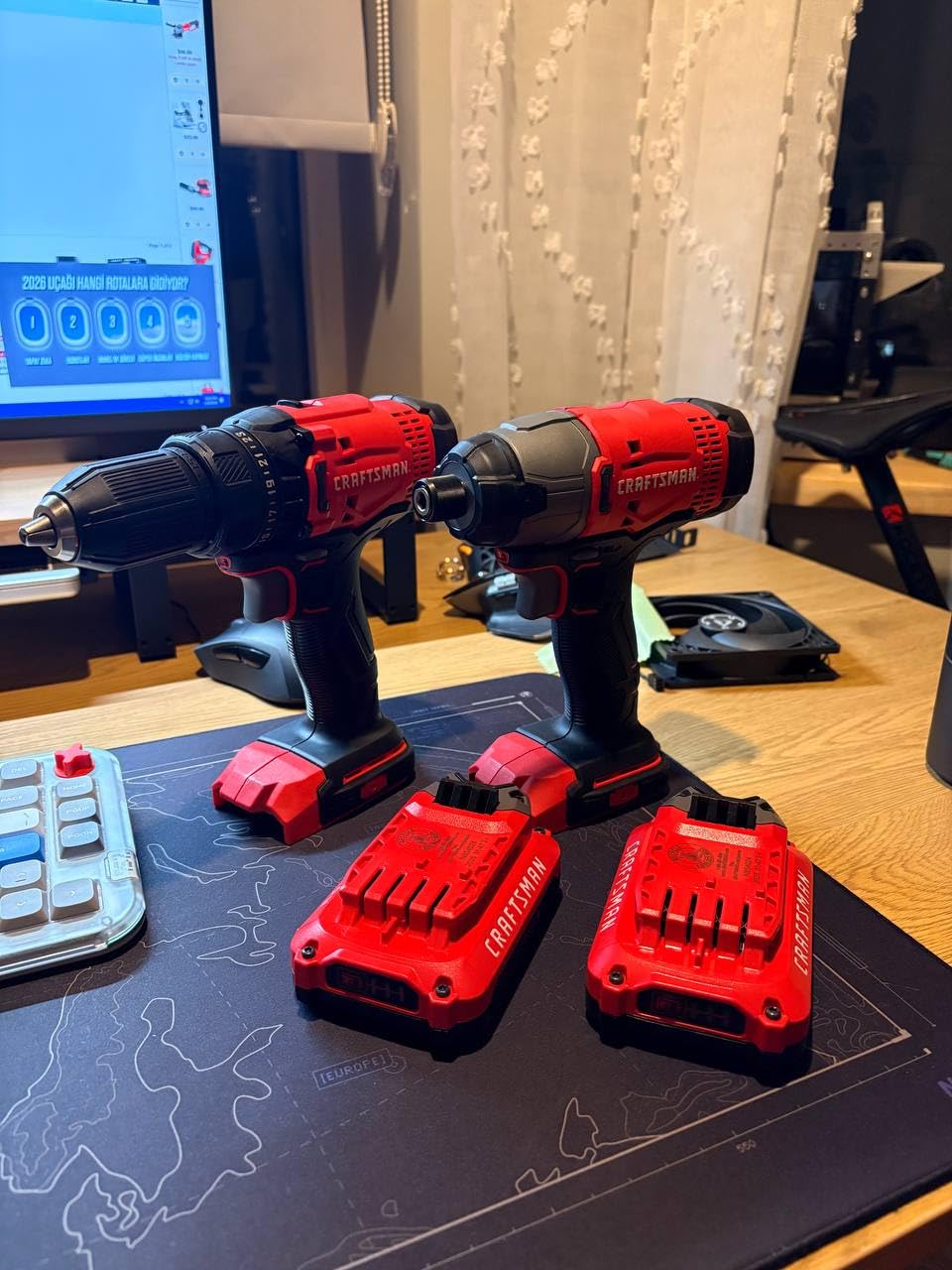
Why the matched pair matters for a homeowner
Because the two tools share one battery platform, one set of packs covers both. That is the entire argument for a combo kit, and CRAFTSMAN makes it with 2.0Ah packs rather than 1.3Ah ones, which is a real improvement over most kits at this level.
The impact driver is the tool that will get used more often than you expect. Long screws into studs, decking screws, structural fasteners and anything that makes a drill bog down are all handled far better by impact than by friction clutch.
The trade-offs to accept
The package is heavier than a single-tool kit, which matters if you are carrying it up stairs or between a garage and a house. And the bit count is thin, so plan on buying a driver bit set separately, which is true of most kits at this price tier.
If you are starting from nothing and expect to stay in one platform, this is a strong two-tool starting point. If you already own V20 MAX batteries, the single-tool CMCD700 is the more efficient purchase, covered separately below.
6. BLACK+DECKER 12V MAX BDCDD12C Drill/Driver: Best for Overhead Work and Small Spaces
BLACK+DECKER 12V MAX Cordless Drill/Driver, Battery and Charger Included (BDCDD12C)
- Very light and compact for cabinets and overhead work
- 11-position clutch gives good fastener control
- Keyless chuck makes bit changes quick
- Battery
- charger and a bit are included
- 12V platform delivers far less torque than 18V and 20V
- Wood drilling capacity limited to about 10 mm
- Single-battery kit means downtime while charging
The BLACK+DECKER BDCDD12C is the answer to a specific problem: working above your head or inside a cabinet where a full-size drill is too heavy and too long. At about 2.8 pounds with the battery and well under 10 inches long, it is a tool you can hold one-handed for an entire job.
Reviewers consistently recommend it for flat-pack furniture, shelves and light household fixtures. That matches the specification: 26 N m of torque, 550 rpm top speed and a 10 mm chuck, which is comfortably enough for screws into a stud and pilot holes in thin wood.
The 11-position clutch gives real control over fasteners, which matters because most of the “12V is too weak” complaints come from people using a full-speed drill on a screw instead of dialling the clutch down to a low setting.
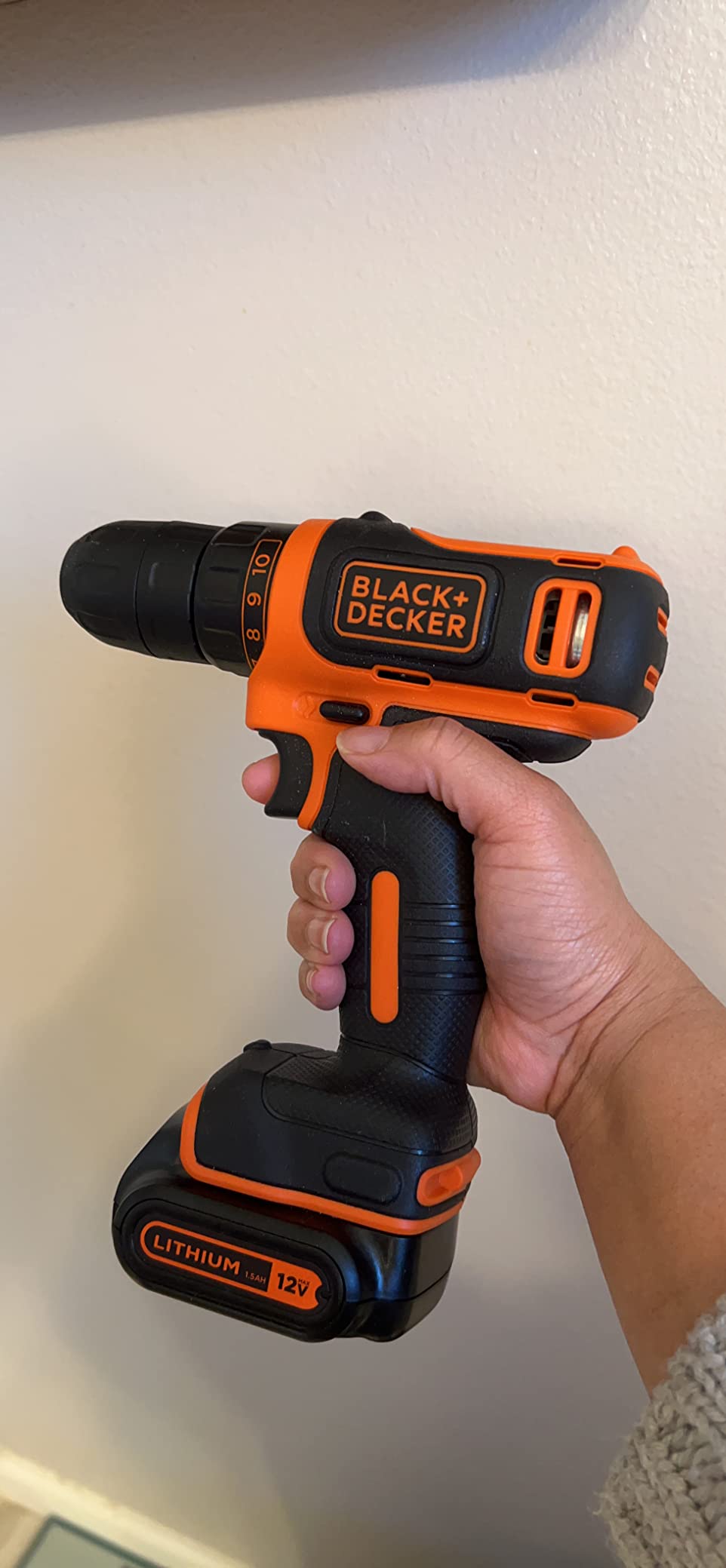
The keyless chuck makes tool-free bit changes, and the integrated LED covers drilling in dark places, which is the exact scenario where a 12V tool is most useful. Being able to work in a dark cabinet cavity one-handed is where this drill separates itself from its full-size siblings.
The limits are equally clear. Reviewers note it is underpowered for masonry or large structural timber, and the listed wood drilling capacity of 10 mm confirms the ceiling. A 12V drill is a fixture and assembly tool, not a boring or driving tool.
One battery is included, and that is the practical drawback. With a single pack you are waiting on the charger, and the fix is straightforward: if you buy this, buy a second 12V battery and keep it on the charger.
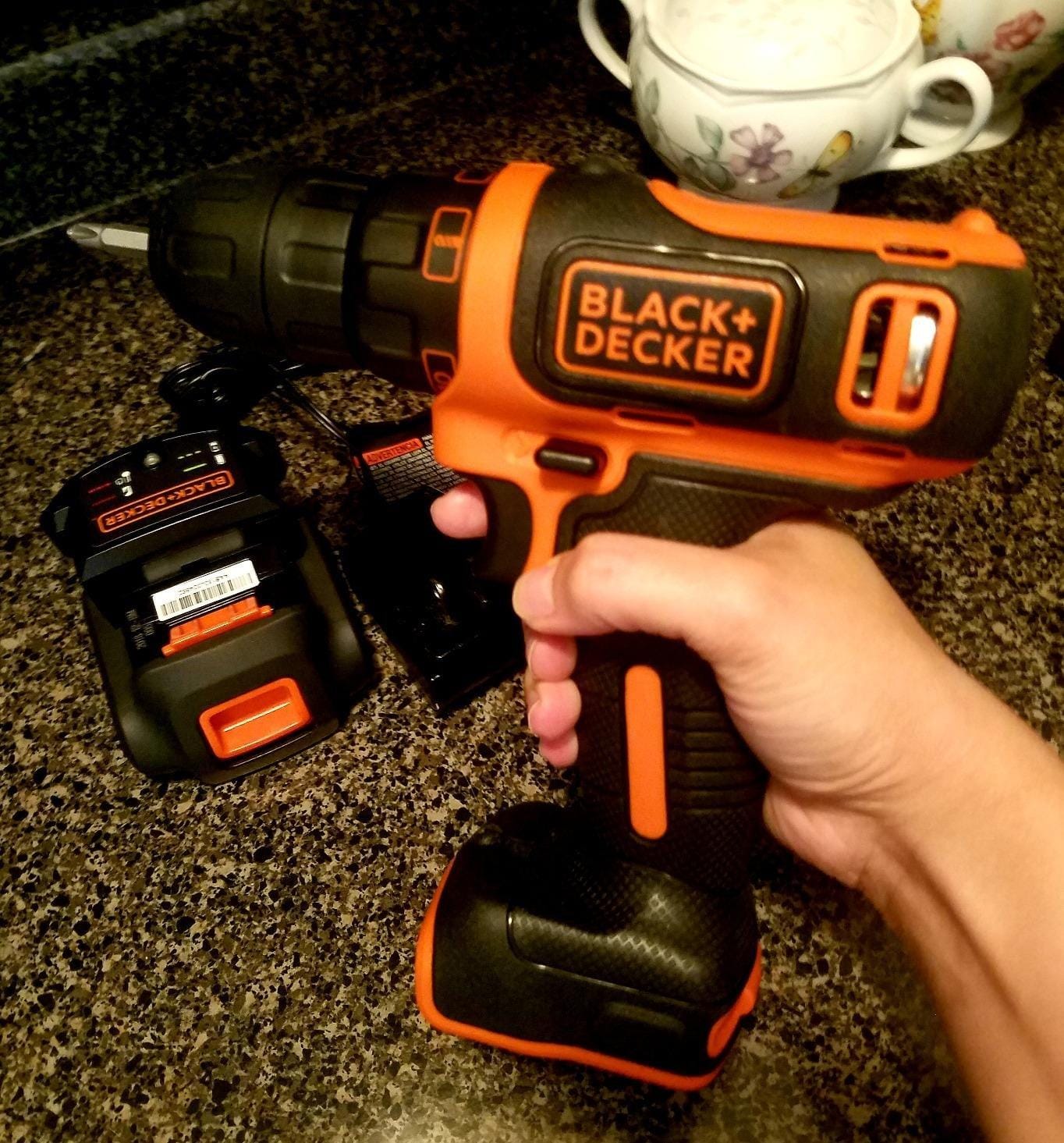
What a 12V drill is genuinely good for
Overhead work, cabinet interiors, between studs, drawer and cabinet hardware, light fixtures, and flat-pack assembly. The low weight means you can hold a shelf with one hand and drive screws with the other, which no full-size drill allows.
It is also the right tool for a renter, a small apartment, or anyone who wants a tool that lives in one drawer. The 2-year limited warranty is standard for the category.
When a 12V drill is the wrong answer
It is the wrong answer for large holes, long structural screws, hardwood, lag bolts, or anything involving masonry. Torque falls off quickly as the bit gets larger, and fighting a 12V through a big fastener wastes your time and wears the gear train.
It is also the wrong answer if you expect a second tool in the same platform soon, because 12V ecosystems are smaller and less common than 20V ones. Many households end up owning both a 12V and an 18V or 20V drill, which is a perfectly reasonable two-drill setup.
7. CRAFTSMAN V20 CMCD700C1 Drill Kit: Best Single Drill With a 1/2 Inch Chuck
CRAFTSMAN V20 Cordless Drill/Driver Kit, 1/2 inch, Battery and Charger Included (CMCD700C1)
- 1/2 inch keyless chuck accepts larger bits
- Recharges in 60 minutes or less on the included pack
- LED light improves visibility in dark areas
- Part of a widely carried V20 MAX battery platform
- Single-battery kit means no overlap when charging
- Only two speeds
- Clutch ring is not highlighted for fine control
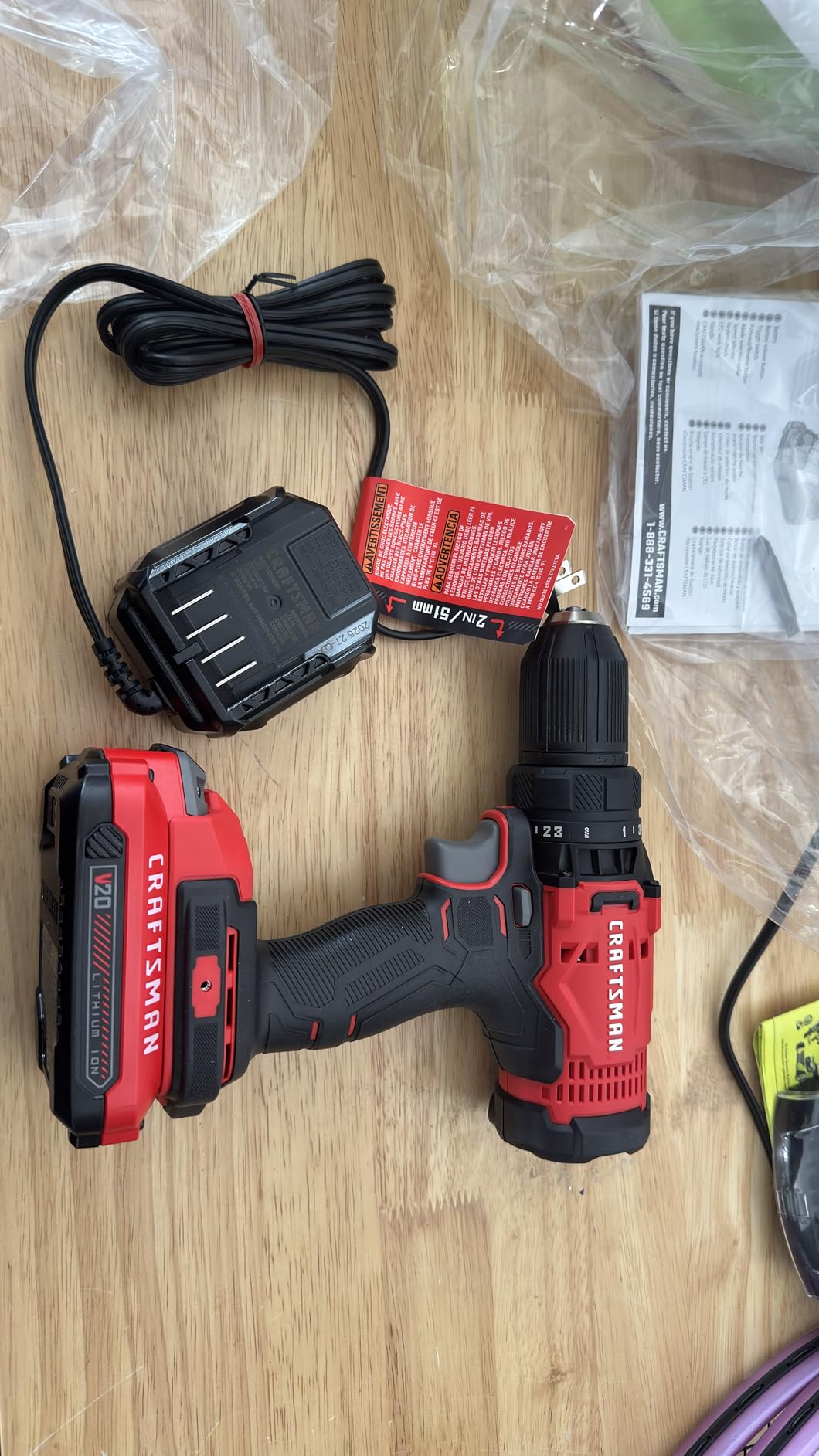
The CRAFTSMAN CMCD700C1 is the single-drill answer for anyone who wants a 1/2-inch chuck without buying a combo kit. That single specification opens up hole saws, paddle-style mixing bits, Forstner bits and larger masonry anchors, all of which will not fit a 3/8-inch chuck.
Owners use it for general household drilling and driving and point to the 1/2-inch chuck, the quick charging and the simple single-tool format as the reasons it works for them. The 280 UWO motor and two-speed gearbox of 0 to 350 and 0 to 1,500 rpm are typical for a drill in this class.
Charge time on the included 1.3Ah pack is 60 minutes or less, which is a real improvement on the wall-clock time some budget chargers take. The LED work light is a genuine convenience in dark work areas.
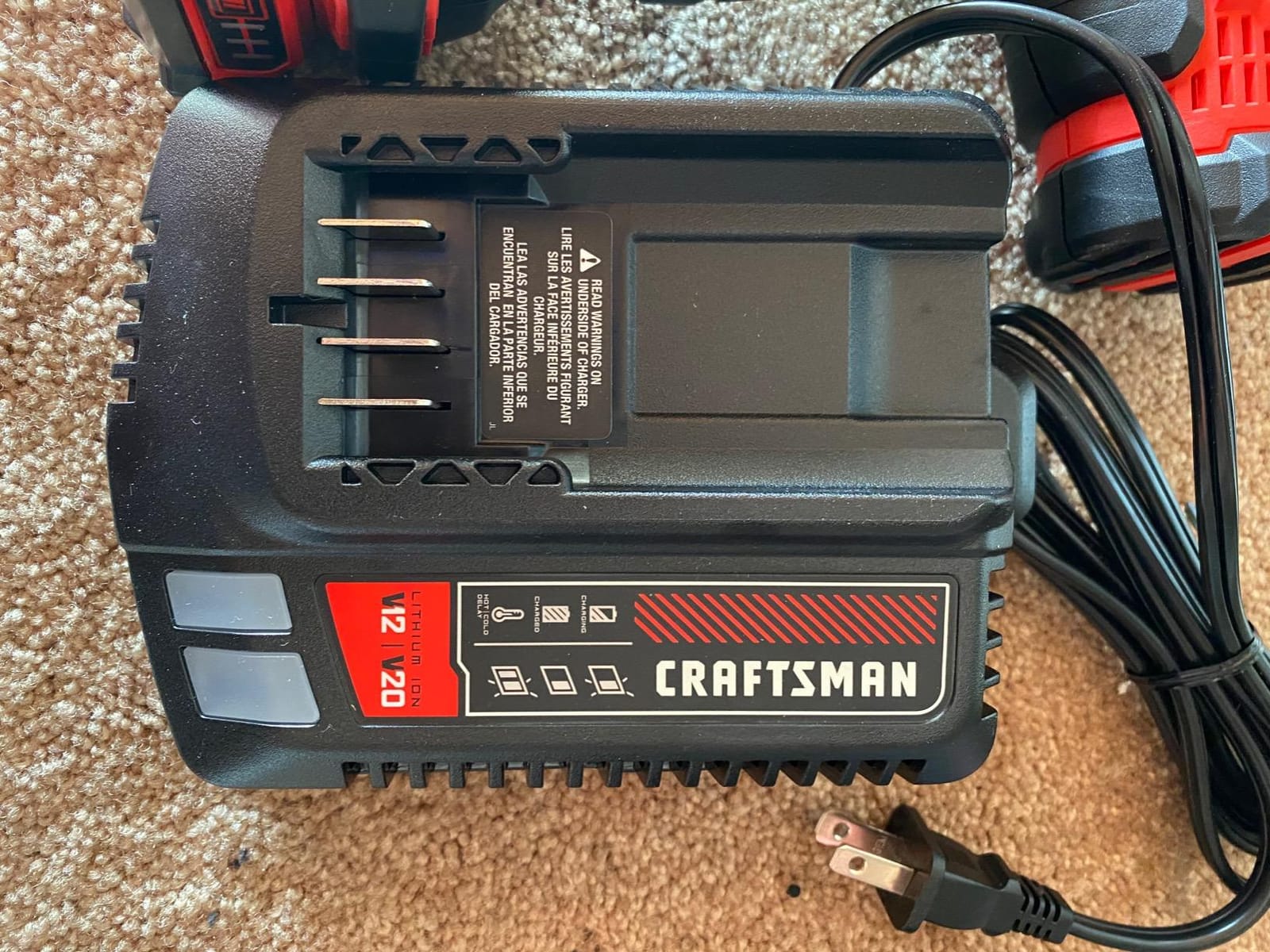
The chuck itself is a 1/2-inch keyless, so bit changes take seconds rather than requiring a key. For the number of jobs that involve swapping a drill bit for a driver bit, that is a small quality-of-life gain that adds up across a project.
Two things temper the recommendation. It is a single-battery kit, so there is no overlap while charging, and the listed configuration highlights two speeds with no specific mention of a finely graduated clutch ring. If you drive a lot of small screws into soft material, check the clutch positions before committing.
The tool is compatible with the Versatrack hang hook, which matters more than it sounds for a household tool. A drill that lives on a wall hook is a drill you will reach for; one in a drawer is a drill you will borrow a screwdriver to open the drawer for.
When a 1/2-inch chuck earns its place
Any job that needs a bit bigger than a standard 3/8-inch driver. Hole saws for cutting a hole for a pipe or a recessed light, Forstner bits for boring a shelf recess, paddle mixers for paint, and larger anchors for heavy items mounted into masonry-adjacent materials.
If your project list is screws, wood screws and pilot holes, the 3/8-inch drills in this roundup are lighter and cheaper. If there is any chance of a hole saw in your future, the 1/2-inch chuck is worth paying for.
Where this kit falls short
The single battery is the biggest practical gap. Add a second V20 MAX pack and the tool becomes far more usable for a long evening, and you have to add one anyway to get any real workflow out of a cordless drill.
It is also not a hammer drill. If your project list includes brick, block or concrete, the chuck size is the wrong thing to optimise, and you need a hammer setting or a rotary hammer instead.
8. BLACK+DECKER 20V BDC120VA100 100-Piece Tool Kit: Best All-in-One Box for a First Purchase
- 100-piece set removes extra purchases for basic jobs
- 24-position clutch aids precision driving
- POWERCONNECT battery works in other Black+Decker tools
- Storage case keeps the bits organized
- Single battery causes downtime while recharging
- Included masonry bits are limited to light-duty material
- 150 in-lb torque is modest for a 20V tool
The BDC120VA100 is sold as a complete first purchase rather than a drill. The LD120 drill/driver comes with a 1.5Ah POWERCONNECT lithium-ion battery, a charger, a 100-piece accessory set and a storage case, which means a new owner can start the same afternoon they open the box.
Buyers treat it as a value all-in-one starter kit and consistently praise the breadth of the included bits and the ability to move the battery into other Black+Decker POWERCONNECT tools. The accessory set includes masonry bits, HSS bits, sockets, nut drivers and a ratcheting screwdriver.
That accessory spread is the real argument. For someone who has never owned a drill, having the right bit in the case removes the most common early frustration, which is not having a 4 mm bit when a 4 mm hole is needed.
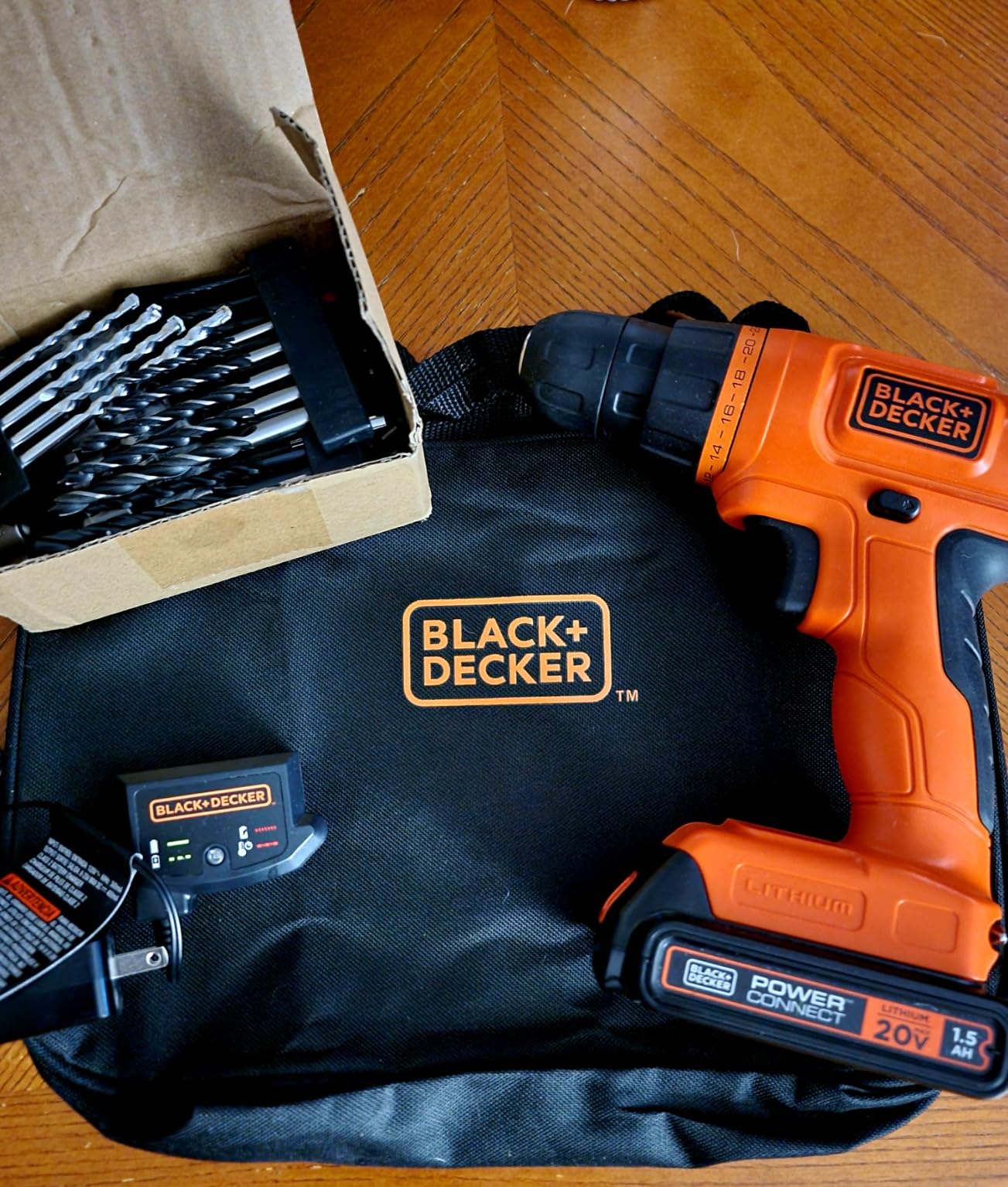
The 24-position clutch is genuinely granular for the price, and it gives finer control over fastener depth than a coarse collar. The soft-grip handle is a small comfort, and the combination drill design means the chuck can accept a 10 mm bit for driving screws and drilling pilot holes.
Rated maximum torque is 150 in-lb and top speed is 650 rpm, with drilling capacity of 10 mm in wood and 8 mm in metal. Those are modest numbers against the other 20V drills here, and they position this kit firmly in the light-to-medium duty band.
Two honest downsides. The single-battery configuration means a wait whenever the pack runs down, and the included masonry bits are intended for light-duty material rather than serious block work. If you take the set as a starting point and add a second POWERCONNECT pack, the downtime issue largely disappears.
Who this kit is built for
First-time buyers, renters, students and anyone who wants a single box that contains everything for a year of household repairs. The 100-piece set covers screws, pilot holes, light masonry and basic hardware work without a second shopping trip.
It is also a sensible second platform for anyone already running Black+Decker POWERCONNECT tools, since the battery moves between them rather than sitting in a drawer charging on its own.
What you give up for the accessory count
You give up torque and speed. At 150 in-lb and 650 rpm, this drill is not the tool for long structural screws, big hole saws, hardwood or anything that makes you think about a 1/2-inch chuck.
The 6.1-pound package weight is mostly the bits and the case, not the drill. And the two-year warranty is shorter than the three years offered on several other picks here, which is worth factoring in if you plan to pass this drill to someone else.
9. Makita XFD131 18V LXT Brushless Driver-Drill: Best for Long-Term Ownership
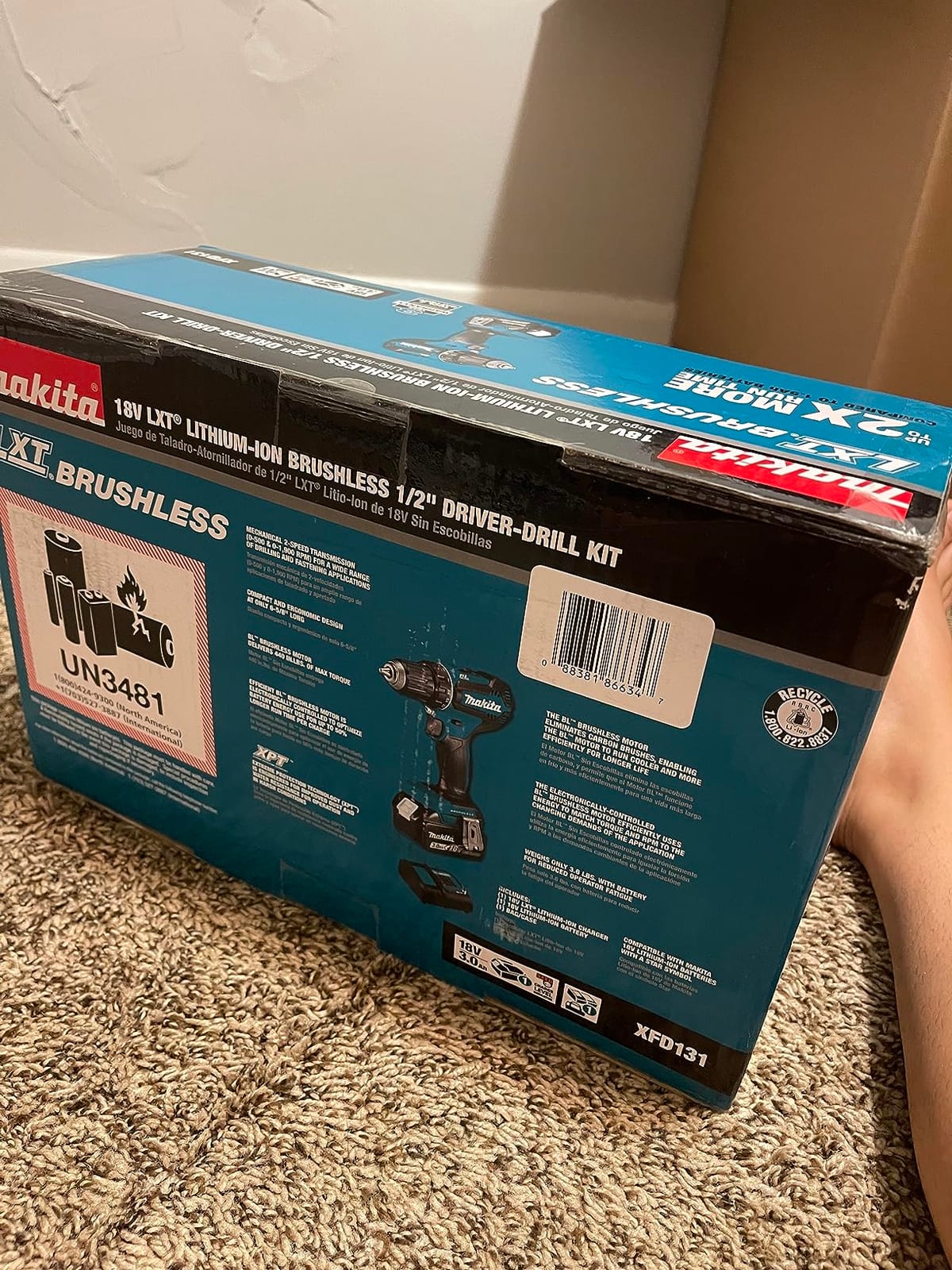
Makita XFD131 18V LXT® Lithium-Ion Brushless Cordless 1/2″ Driver-Drill Kit (3.0Ah), Variable Speed
- Brushless motor delivers strong torque for its size
- 3.0Ah battery holds charge for long sessions
- Light and well balanced for long use
- Battery and charger cross-compatible with 18V LXT tools
- LXT replacement batteries are costly
- Work light can cast a shadow over the work point
- Only one battery and one charger in the kit
The Makita XFD131 is the drill I would buy with a ten-year horizon rather than a two-year one. Long-term owners report drills still running after a decade of drops and hard use, and hobby woodworkers and home renovators cite strong power, quick charging and comfort as the reasons it stays.
It is a brushless drill, and that distinction is the whole story. The electronically controlled motor optimises battery energy for up to 50 percent longer runtime per charge than a comparable brushed motor, and there are no carbon brushes to wear out and replace.
Maximum torque is 440 in-lb with a mechanical two-speed transmission of 0 to 500 and 0 to 1,900 rpm. That 1,900 rpm high gear is faster than any other drill/driver in this roundup, which is what makes it the best of these for boring clean holes in wood quickly.
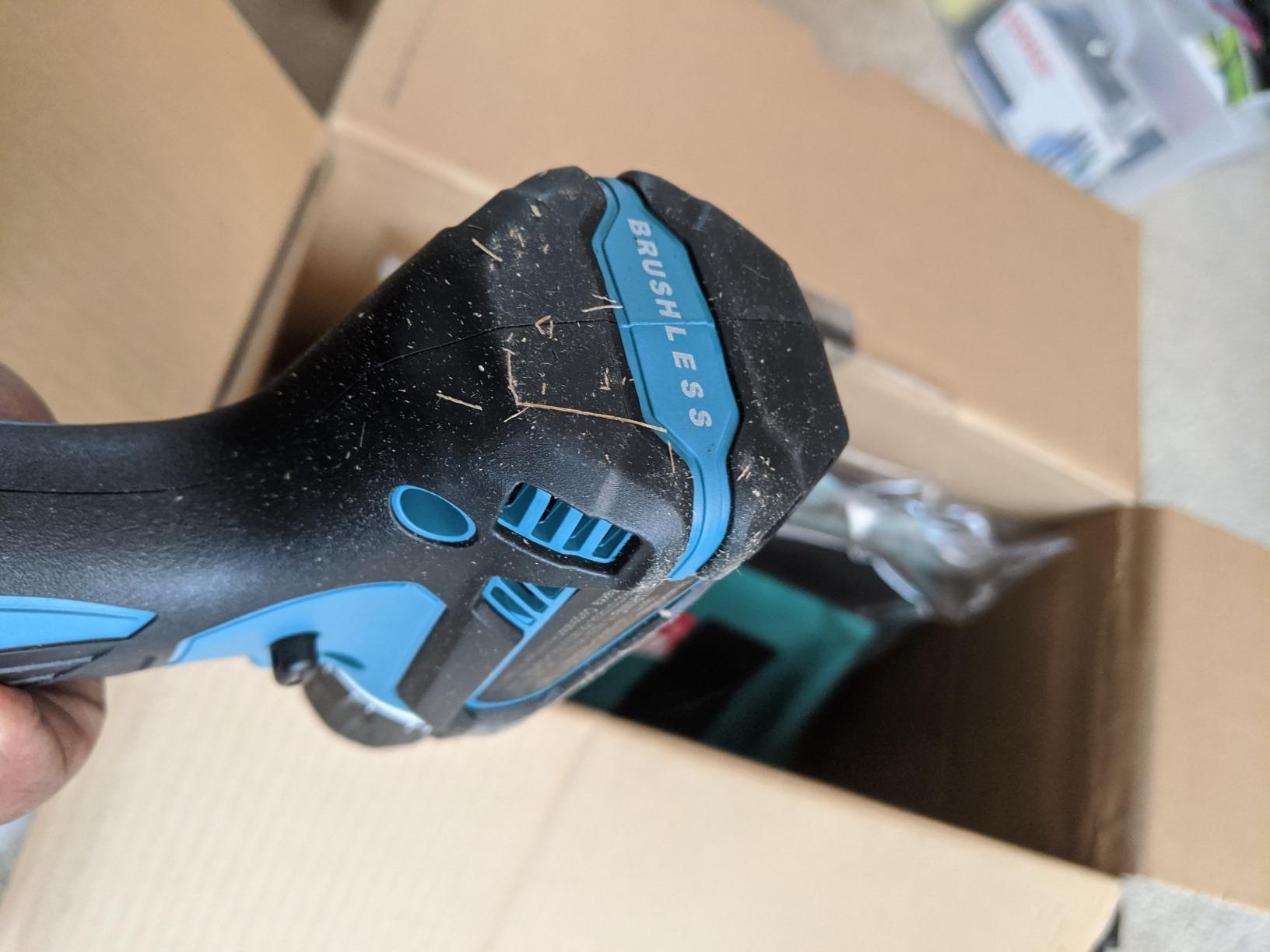
The 3.0Ah battery is the largest single pack in the group, and reviewers point to it holding charge through very long working sessions. Combined with the brushless efficiency, that means fewer swaps than any other 18V-class drill here.
Ergonomics deserve a mention because they are a genuine reason to pick this tool. Owners describe it as lightweight, well balanced and comfortable for long use, including for people with hand issues. For anyone with joint problems, a drill you can hold comfortably is not a minor feature.
The main gripe is the cost of LXT batteries, and it is a real one. The kit includes a BL1830B 3.0Ah pack and a DC18SD charger, and owners should understand that a second battery is the single most expensive ongoing cost of this platform.
What the brushless motor actually changes
Runtime, heat and tool life. There are no brushes to wear, so the tool holds its specification over years rather than months, and a larger share of the battery’s energy reaches the chuck instead of becoming friction and heat.
In practice that means the XFD131 is a drill you could hand to a teenager to assemble furniture without worrying about it bogging down, and a drill that will still work in eight years if it is looked after. If you have read our guide to brushless cordless drills, this is the reasoning behind the price gap.
Who pays, and who does not
You pay if you own one drill and want it to last. You pay if you plan to own several Makita tools over time and want one battery platform covering them, because 18V LXT is one of the broadest ecosystems in the market and our Makita cordless drill guide covers that in more depth.
You do not pay if this is a one-off tool for occasional flat-pack assembly, because the cheaper 20V drills here will do that work. The work light can also cast a shadow over the point of use, which is an irritation in precision work that reviewers do mention.
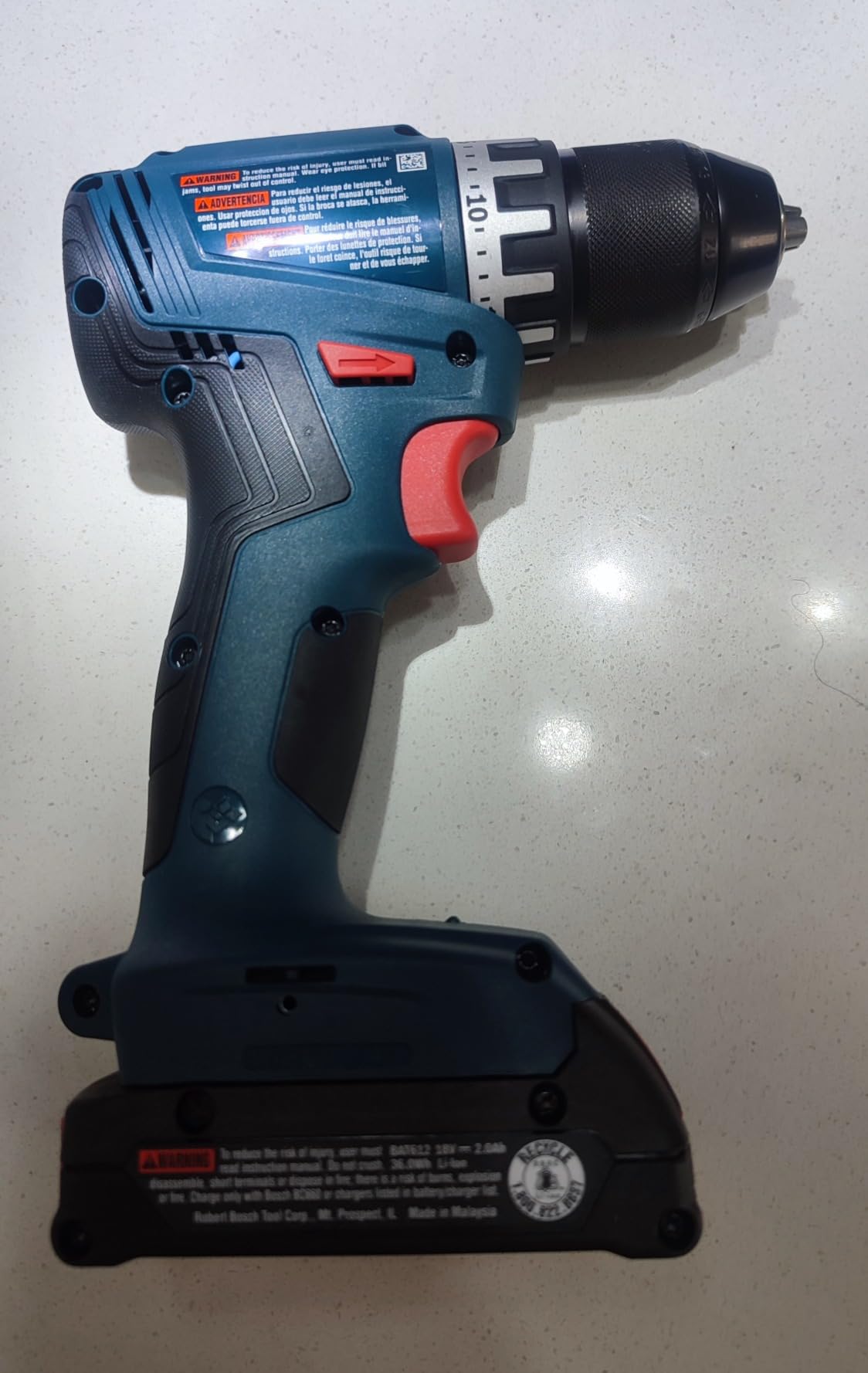
10. Bosch GSR18V-400B22 18V Compact Brushless Drill Kit: Best for Tight Spaces With Real Power
BOSCH GSR18V-400B22 18V Compact Brushless 1/2 In. Drill/Driver Kit with (2) 2 Ah Standard Batteries
- Half the weight of older cordless drills while delivering more power
- 6.3 inch head length fits tight spaces
- All-metal chuck is durable with strong bit retention
- Three-level charge LEDs and two batteries included
- Locking chuck must be tightened by hand only
- Over-tightening the locking chuck makes it bind
- 2 Ah batteries drain quickly on continuous work
The Bosch GSR18V-400B22 solves a specific tension: getting real power in a tool short enough for cabinets and confined stud bays. It delivers up to 400 in-lb from under 2 pounds, with a 6.3-inch head length, which is the shortest full-power drill in this roundup.
Owners upgrading from older cordless drills praise the weight and power jump and the metal chuck. The 20 clutch settings and variable speed give the control you would expect, and electronic cell protection guards against overload.
It is the least-reviewed kit in this roundup, and that context matters when you read the ratings. A smaller base of reviews means less long-term evidence, so treat the 4.4-star average as a snapshot rather than a settled verdict.
Two 2.0Ah SlimPack batteries and a charger are included, and a full charge takes roughly 50 minutes. The three-level battery charge LEDs are genuinely useful, which is more than several competing tools in this roundup provide at the tool itself.
The chuck is where the learning curve lives. It is an all-metal chuck that locks by tightening it by hand only, rather than a chuck you can spin closed while holding it. Owners who over-tighten it report it binding when they try to open it again.
That is the single most common complaint, and it is a technique issue rather than a defect. Tighten it snug, not hard, and the chuck works well and holds bits securely. A minority of users also report an underpowered feel and weaker ergonomics.
Where this Bosch drill earns its place
Confined spaces with real fastening needs. A 6.3-inch head reaches inside cabinets, between studs and up into a soffit where a 7.5-inch drill will not fit, and 400 in-lb is enough to drive long screws once you are in there.
It is also a good second drill for anyone who already has a compact 12V. The Bosch is the tool you grab when the 12V runs out of steam, and the 18V batteries give it far more headroom for a single drill/driver.
What to weigh before choosing it
The locking chuck takes adjustment to get used to, and the 2.0Ah packs drain quickly on continuous heavy work compared with the 3.0Ah pack in the Makita. If your drilling sessions are long and uninterrupted, battery capacity is where this kit gives ground.
It is also the lowest-rated pick here, with 9 percent of reviews at one star, mostly traced back to the chuck and the power-feel comments. If you are comfortable with that trade-off, our Bosch cordless drill picks cover the wider range.
How to Choose a Cordless Drill for Home Use
Most of the difficulty in buying a cordless drill is that the specification that matters most depends entirely on what you plan to build. A homeowner hanging pictures and a homeowner replacing deck boards have almost nothing in common, and the same drill can be the right answer for one and useless for the other. These are the decisions that actually move the needle.
12V vs 18V and 20V Max: which voltage class you need
A 12V drill is for overhead work, cabinets, fixtures and flat-pack furniture. It is light, short and genuinely capable of most household fastening, and it is the right choice for a renter or a first drill.
An 18V or 20V drill is for driving long screws, boring real holes, working with hardwood and anything demanding. The extra voltage shows up as torque, not as a headline number. Note that 18V, 20V Max and 20V are the same class of pack in practical terms, sold under different brand names.
More voltage does not automatically mean more usable power. Motor design, chuck quality and gear construction decide how much of the rating reaches the bit, which is why some higher-numbered drills in this roundup feel weaker than lower-numbered ones.
Brushless vs brushed motors
Brushless motors are now the baseline expectation among buyers, and the reasoning is simple: no carbon brushes to wear out, better battery efficiency and less heat. Most people in DIY communities say they would not buy a new brushed tool today.
Where a brushed motor still makes sense is a very cheap drill used only for soft materials and light maintenance. Just know that spark at start-up is normal, and that brushes are a consumable part.
Max torque and UWO: reading the numbers honestly
Torque is stated in in-lbs (or N.m) on most manufacturers, and bands run roughly 200 to 400 in-lb for light work, around 500 for medium, 600 and above for heavy fasteners, and 1,000 plus for serious work.
UWO, a work-output metric used by some brands, is a different quantity entirely. It is not a torque figure and it cannot be converted to in-lbs by any reliable method. Any brand claiming a conversion is estimating. Compare UWO only against other drills from the same manufacturer.
Chuck size: 3/8 inch or 1/2 inch
A 3/8-inch chuck handles every common driver bit and most small drill bits, and it keeps the tool lighter. A 1/2-inch chuck is required for hole saws, Forstner bits, paddle mixers and larger masonry anchors.
If your project list is screws and pilot holes, 3/8 inch is enough. If a hole saw appears anywhere on the horizon, go to 1/2 inch. It is a cheap upgrade to buy later only if the tool you own supports it.
How many batteries you need
Two batteries is the practical answer, and a single-battery kit feels like a bait-and-switch because you will spend half your evening waiting on a charger. Kits with two included packs are worth paying for if the packs are a genuine capacity, not the smallest available.
Capacity matters more than count. A 1.3Ah pack charges fast and cycles often; a 2.0Ah to 3.0Ah pack runs longer between charges. Two larger packs beat four small ones for real project time.
Store spare batteries off the tool and top them up every few months, because lithium-ion packs left fully depleted for long periods lose capacity permanently. More on that in our compact cordless drill guide.
Which battery platform to join
This is the decision most roundups skip and it is the one that costs real money later. A working commenter on a major drill roundup put it plainly: if someone is already invested in one platform, they are not going to switch because a rival drill is a little better. The same applies to households.
DeWalt 20V Max and Milwaukee M18 have the widest retail presence, so batteries and chargers are easy to find. Makita 18V LXT is a broad ecosystem with excellent ergonomics, at higher battery cost. CRAFTSMAN V20 MAX and Black+Decker POWERCONNECT are both common at home improvement stores.
Buyers repeatedly raise the same trap: buying a second platform because the first drill looked good, then discovering they own two chargers and no spare batteries. Pick the platform first, then the drill within it.
Corded vs cordless: do you still need a corded drill?
For almost all household work, no. The list of downsides of going cordless is short: runtime on heavy jobs, less raw power on a large fastener, and the small dead zone where a battery gauge can be wrong.
The honest advantages of a corded drill remain real for sustained heavy work without interruption. But convenience, not power, is what drives the switch, and homeowners consistently report that once they use cordless they do not go back.
Our advice is to buy cordless and skip the corded drill unless you have a specific reason, such as extended continuous boring or a workshop with no spare batteries.
Hammer drill vs rotary hammer for brick and concrete
Do you need a hammer drill? For mounting shelves, TV brackets or Tapcons into brick and block, yes, the hammer setting matters. A plain rotary drill will stall or walk the bit.
But buyers in tool forums make a fair point: for larger fasteners, a proper rotary hammer with an SDS chuck is the right tool, and a hammer setting on a drill is not a substitute. A homeowner fitting Tapcons needs the hammer mode; a homeowner boring a 12 mm hole for a pipe needs a rotary hammer.
None of the ten drills here has a hammer mode, so treat that as a deliberate scope choice. These are the drills that cover the wood, fastener and general household jobs the majority of owners actually have.
Which drill for which household job
Hanging pictures and light shelves: any drill here works, and a 12V is easiest overhead. Assembling flat-pack furniture: 18V or 20V with an impact driver, because the furniture is mostly long screws. Drywall anchors: set the clutch low, and any drill in this roundup handles it.
Installing a baby gate or a light fixture into studs: 18V or 20V, because you want torque you can dial back. Drilling into brick or block for Tapcons: a hammer drill or rotary hammer, which is outside this list. Replacing a rotted deck board: 18V or 20V with a 1/2-inch chuck and a long bit extension.
Cutting a recess for a shelf or a hole for a pipe: 1/2-inch chuck, so the CRAFTSMAN CMCD700C1, the DEWALT DCD771C2 or the Makita XFD131. Overhead work in a cabinet: 12V, so the BLACK+DECKER BDCDD12C.
Frequently Asked Questions
Which cordless drill has the highest torque?
Among the drills we cover, the DEWALT 20V Max DCD771C2 has the highest rated maximum torque at 650 in-lb. The Makita XFD131 follows at 440 in-lb and the Bosch GSR18V-400B22 at 400 in-lb. For household work, though, torque above roughly 500 in-lb changes very little unless you are driving long structural fasteners or lag bolts.
Are Dewalt drills better than Makita?
Neither is better in a way that matters for most homeowners. DeWalt 20V Max is cheaper to enter and spare batteries are easy to find, while Makita 18V LXT offers a broader tool range, excellent ergonomics and brushless efficiency. The decision comes down to what spare batteries cost, how close a retailer is to you, and which platform your household may expand into later.
Are corded or cordless hammer drills better?
For a homeowner, cordless wins on convenience because you are not managing a cord across a ladder or a crawlspace. Corded still has the edge for sustained heavy boring without interruption. If you mostly need to drive Tapcons or masonry anchors, a cordless drill with a hammer mode is the practical answer, and a rotary hammer beats a hammer setting for large holes.
Which cordless drill brands are considered the worst?
Brand alone does not determine quality, because budget and brushless status matter far more than the badge. The tools most likely to disappoint are brushed models sold on brand recognition alone, and kits that include only one small battery. Check the motor type, the chuck, and the number of included batteries rather than the name on the case.
What are the common problems with drills?
The most common issues are binding from too much torque, overload protection tripping on cheaper brushed motors, chucks that jam when over-tightened, and batteries that die because they were stored fully discharged for months. Most of these are avoidable with the right technique and a few storage habits.
What are the downsides of using a cordless drill?
The main downsides are runtime on heavy jobs, a slight loss of raw power on large fasteners compared with a corded drill, and battery cost when you need a spare pack. A second downside is dead weight when driving very large screws, where the clutch cannot stop the tool as quickly as a motor with a stall clutch. For household work, the convenience outweighs all of these.
Do I need a hammer drill?
Only if you plan to drill into brick, block or concrete. For pictures, shelves, flat-pack furniture, drywall anchors, cabinet hinges and stud work, a regular drill/driver is all you need. If you do drill masonry regularly, consider a proper rotary hammer with an SDS chuck for large holes, because a hammer setting on a drill is not a substitute for one.
How many batteries do I need with a cordless drill?
Two is the right number for most households, because one battery can be charging while the other works. Capacity matters as much as count, so two 2.0Ah packs will keep you working longer than four 1.3Ah packs. A single-battery kit is workable for occasional light use, but you will spend your evenings waiting on the charger.
Conclusion: The Best Cordless Drills for Home Use in 2026
For most households, the DEWALT 20V Max DCD771C2 is the best cordless drill for home use because it is the least likely to disappoint on any ordinary job, and it comes with two batteries and a bag. If you expect to drive long screws, the DCK240C2 combo is the better system because the impact driver changes the experience.
Buy a 12V BLACK+DECKER for overhead and cabinet work, add a Makita XFD131 if you want one brushless drill that lasts a decade, and pick the CRAFTSMAN CMCD700C1 when a 1/2-inch chuck is on your requirement list.
Whichever you pick, buy a second battery on day one and store it off the tool. That single habit removes the most common complaint we saw across thousands of reviews, and it is the fastest way to make any of these drills feel like a good purchase. Related reading: our picks for cordless angle grinders for home use once you move past the drill/driver stage.