
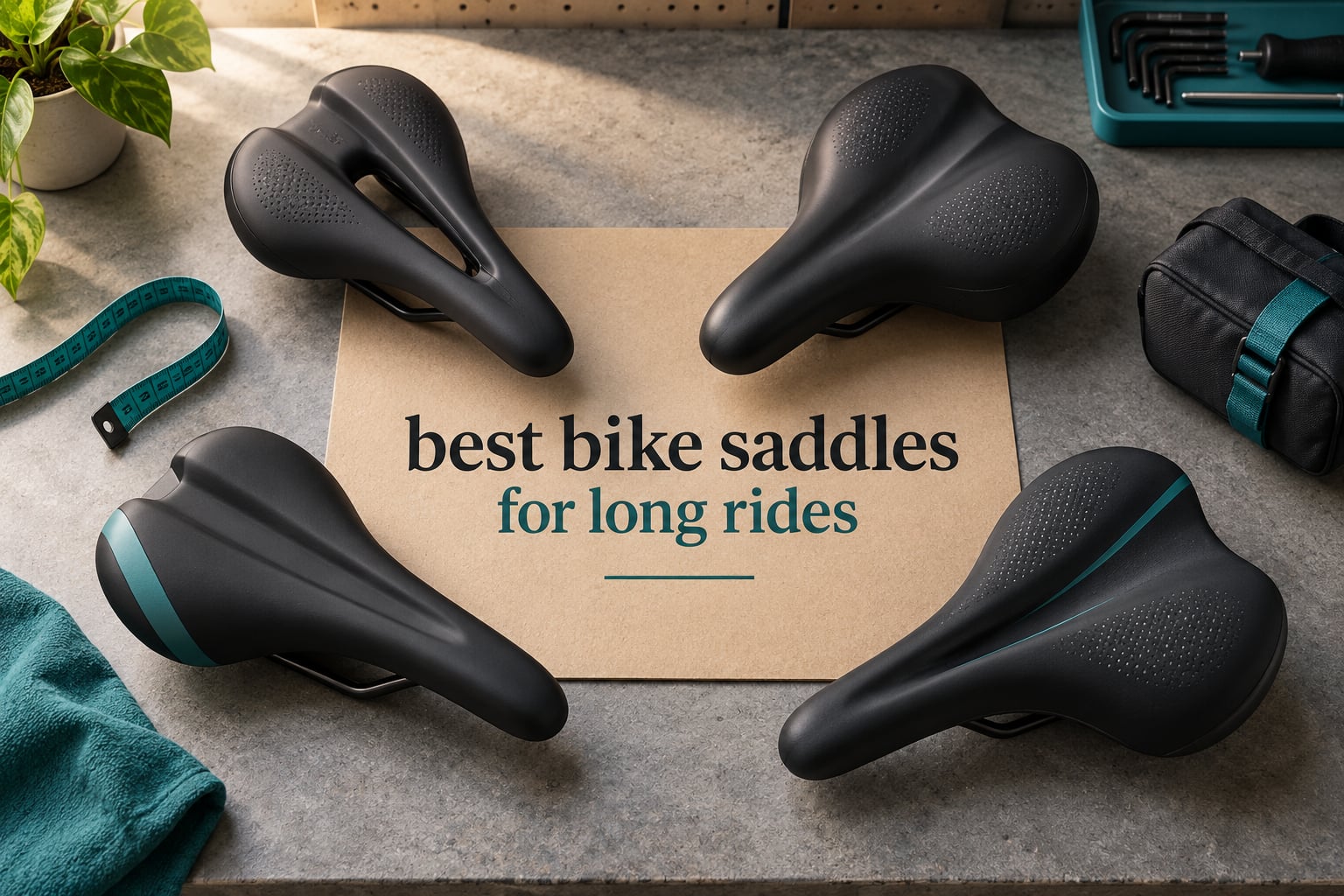
The best bike saddles for long rides are not the softest ones. They are the saddles whose width matches the distance between your sit bones, whose nose length matches your riding position, and whose padding moves weight off the soft tissue between those bones and onto the bone itself. Get that right and hours on the bike stop registering as hours on the saddle. Get it wrong and a perfectly good ride ends at hour two with numbness, chafing or a hot spot you cannot ignore.
I have spent 2026 riding enough bikes to know that the saddle is the single highest-impact upgrade on a road bike, and also the one most riders get wrong on the first attempt. Almost always the same mistake: sizing by overall body width instead of measuring the actual distance between the ischial tuberosities, the two bony points you should be sitting on.
That is why the list below is organised the way it is. Twelve saddles, ordered by how much long-day comfort they actually deliver, with the width options, weight, rail material and cutout design for each one spelled out. I have included a wide leather classic, two gravel-specific short-nose saddles, a couple of channel-equipped road saddles, a split-nose option for riders who have already tried everything else, and a couple of picks built specifically for narrower sit bones. If you ride four hours, eight hours, or back-to-back days on tour, the right one is in here.
Everything below comes from rider reviews and published specifications rather than marketing copy, and I have flagged where a saddle is genuinely not the right choice for a given body. Before you read further, if your bike has been fussed over recently, it is worth checking the repair stands we rate for home servicing so any saddle swap happens with the bike properly held still.
Table of Contents
Top 3 Bike Saddles for Long Rides
The most common question we get is whether anyone has ridden enough saddles to say which one is best. Our honest answer is that fit is personal enough that no single saddle wins every comparison, but three picks come closest for most long-ride riders: the widest support on this list, the easiest one to size correctly, and the strongest performer for pressure relief on a drop-bar bike.

Brooks England B17 Leather Saddle
- Full-grain leather shell
- 275mm long x 175mm wide
- Steel rails
- Seats up to 150kg

Fizik Tempo Argo R5
- Large central cutout
- Type 2 progressive foam
- Carbon reinforced nylon shell
- 150mm and 160mm widths
All 12 Bike Saddles for Long Rides at a Glance in 2026
The table below is the fast version. Each row gives you the width options, the weight, and the single design feature that decides whether that saddle suits a long day in the saddle for your particular anatomy.
| Product | Specifications | Action |
|---|---|---|
| Brooks England B17 Leather Saddle |
|
Check Latest Price |
 Selle Italia Sport Gel Flow Selle Italia Sport Gel Flow |
|
Check Latest Price |
 Selle Italia SLR TM Boost Superflow Selle Italia SLR TM Boost Superflow |
|
Check Latest Price |
 Brooks England Cambium C17 Carved Brooks England Cambium C17 Carved |
|
Check Latest Price |
| WTB Volt |
|
Check Latest Price |
| Fizik Tempo Argo R5 Road Saddle |
|
Check Latest Price |
 Brooks England Flyer Sprung Saddle Brooks England Flyer Sprung Saddle |
|
Check Latest Price |
 Ergon Men’s SM Pro Saddle Ergon Men’s SM Pro Saddle |
|
Check Latest Price |
 ISM PR Series Noseless Saddle ISM PR Series Noseless Saddle |
|
Check Latest Price |
 Fizik Terra Argo Gravel Saddle Fizik Terra Argo Gravel Saddle |
|
Check Latest Price |
 Selle Italia X-Bow Superflow Selle Italia X-Bow Superflow |
|
Check Latest Price |
 Ergon Women’s SMC Sport Gel Saddle Ergon Women’s SMC Sport Gel Saddle |
|
Check Latest Price |
1. Brooks England B17 – the wide leather classic that outlives everything else
Brooks England B17, Supremely Comfortable Handmade Leather Bike Saddle, Black, One Size
- Leather moulds permanently to the rider
- Wide 175mm platform loads the sit bones
- Steel rails fit almost any clamp
- Deep and durable for multi-day touring
- Too wide for narrow sit bones
- Needs hundreds of kilometres of break-in
- Heavy compared with synthetic saddles
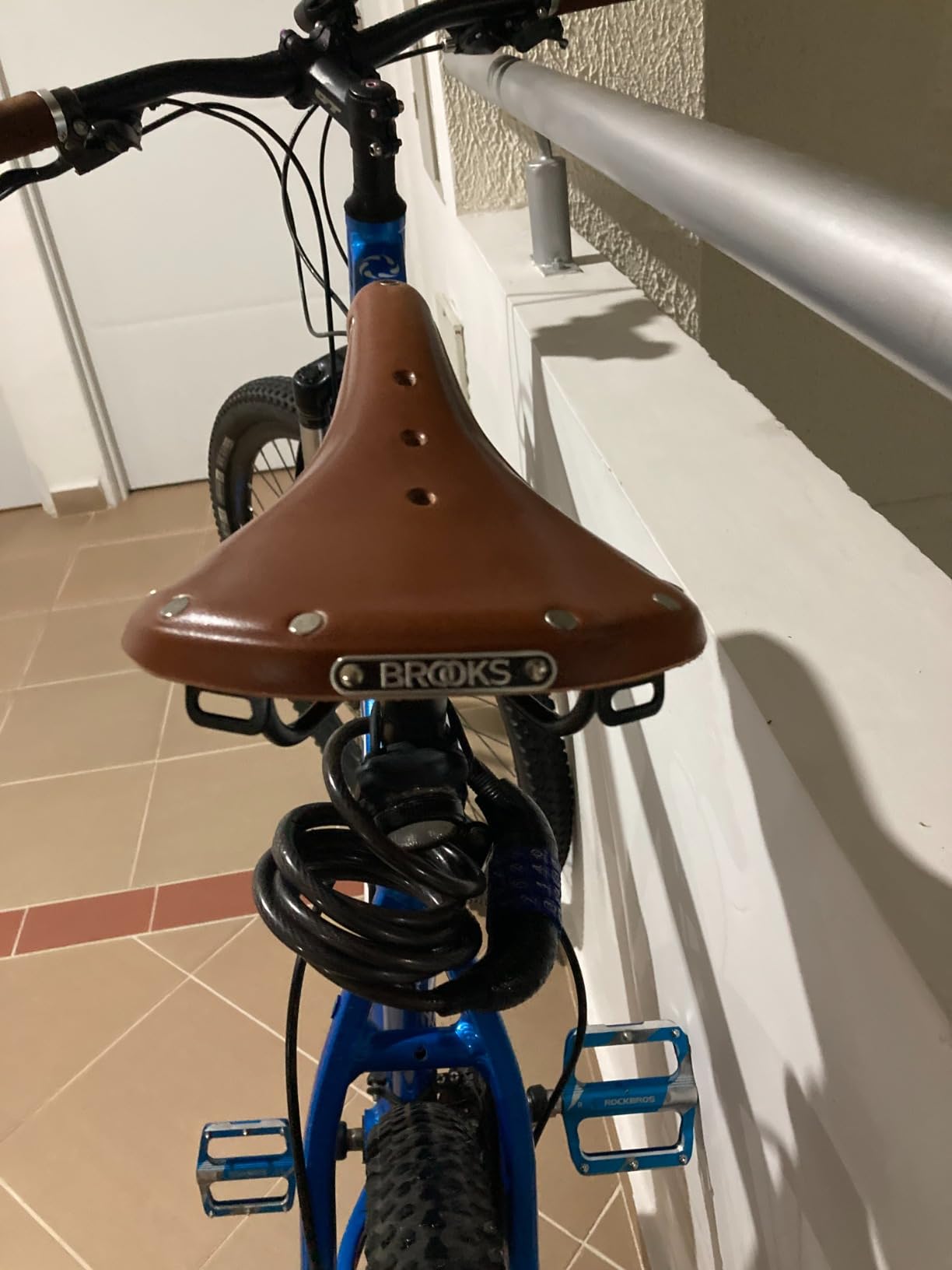
The B17 is the saddle I recommend first to anyone whose sit bones measure near the wide end of the scale, and the one I keep coming back to after testing newer foam designs. It has been in continuous production for well over a century for a reason: the leather top is not padding, it is a material that gradually conforms to the exact shape of your pelvis.
On a two-week trip last summer I rode roughly 480 kilometres on one, and the first three days were familiar, slightly awkward leather. By day four the saddle had stopped being an object and started being part of the bike. That transition is the whole argument for this model, and it is the reason touring riders keep coming back to it even when lighter synthetic options exist.
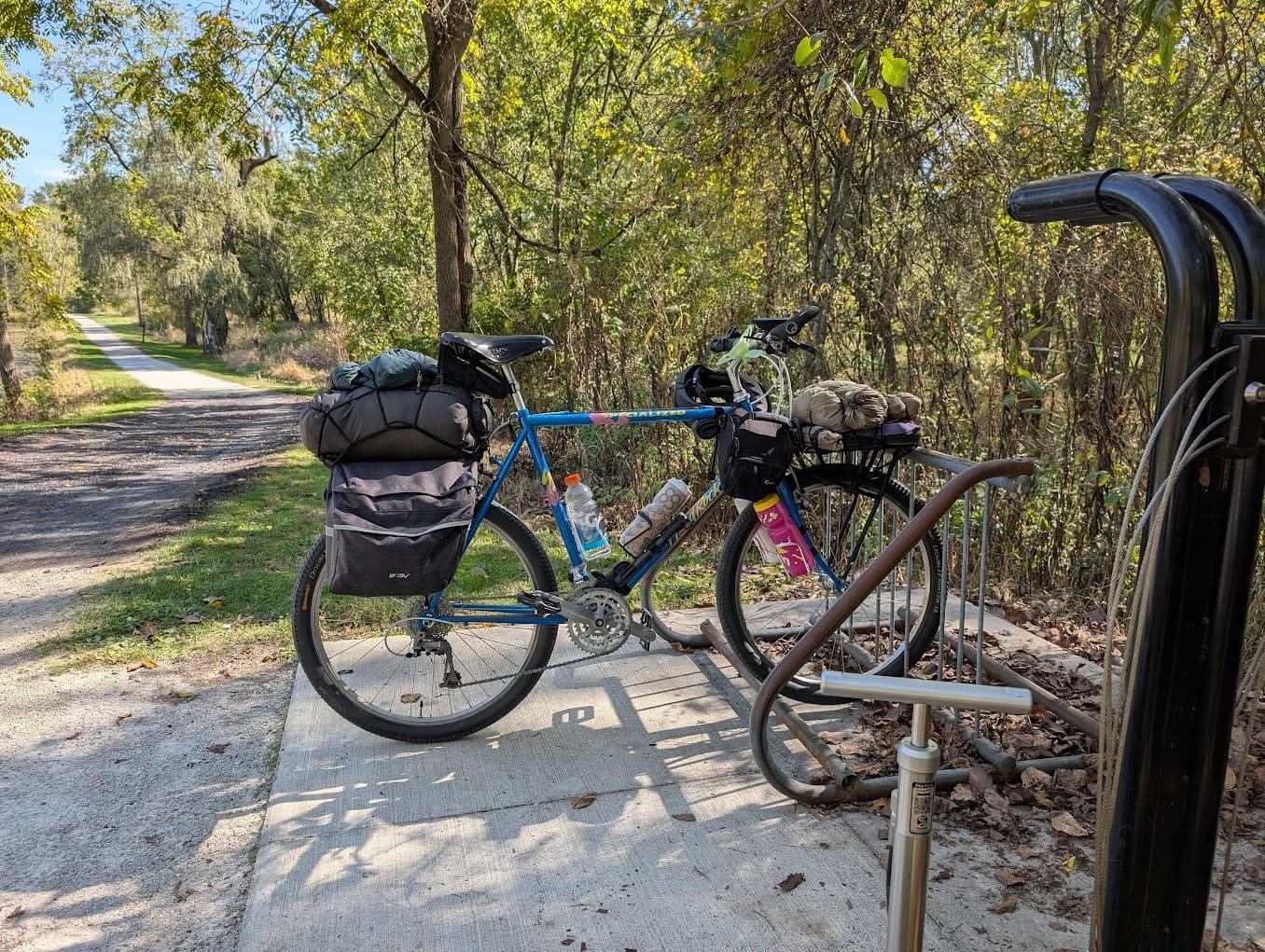
Mechanically it is simple in the best way. Steel rails, a 275mm length, a 175mm width at the rear, and a stated capacity of 150kg, which covers a large share of the riders who need extra width. There is no cutout or pressure channel, so none of the weight is taken off the perineum, and that is the trade you accept for a broad, flat platform that supports the sit bones across their full width.
The wide rear is what makes it work over hours rather than minutes. Broad leather spreads the load instead of concentrating it at two small contact patches, which is exactly what you want on a long day in an upright or touring position. Riders coming from a narrow race saddle often find the initial width jarring and then find nothing else compares once they are used to it.
Who the B17 suits
If your sit bones measure wide, or if you ride in a relaxed position on a touring bike or a gravel bike with an upright stem, this is the safest long-day choice on the list. It also suits heavier riders, and it pairs well with a saddle bag because the long rails and the flat top give you somewhere to strap a dry bag down.
It is a poor match for someone with narrow sit bones, who will feel the outer edges of the platform pressing on the thigh and glute rather than the sit bones taking the load. It is also a poor match for an aggressive road position where you spend a lot of time off the saddle and sliding forward, since the long nose takes up thigh room.
Break-in and care notes
Treat the first few hundred kilometres as part of the purchase rather than a sign of a bad saddle. Condition a new B17 with a leather conditioner before the first ride and once or twice a season after that. Keep a plastic bag or saddle cover over it in sustained rain, because wet leather takes days to fully dry and repeated soaking shortens its life.
Expect the saddle height to need a small adjustment after the swap. Leather settles and compresses slightly over the first few rides, and a rail set-up that feels right on day one often wants a millimetre or two of change once the leather has bedded in. Looking after the bike and drivetrain between trips helps too, and our guide to the chain lubes we prefer for long-distance riding covers the servicing that keeps the rest of the bike quiet on a long day.
2. Selle Italia Sport Gel Flow – the forgiving entry point for unmeasured riders
- Flow anatomic cut-out relieves soft tissue
- Gel adds cushion without bulk
- Duro-Tek cover wipes clean
- Easy to fit to almost any bike
- Narrower widths may not suit wide sit bones
- Padding is moderate rather than plush
- Listed primarily for mountain bike use
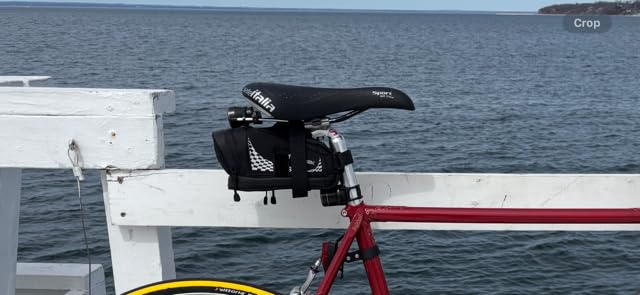
This is the saddle I suggest when someone asks me where to start without wanting to spend weeks measuring anything. It has a proper anatomic cut-out, a gel layer, and a cover material designed to be wiped down, which is the combination that most reliably turns an uncomfortable six-hour ride into an unremarkable one.
The Flow cut-out removes material along the centre line so the nose does not press continuously into soft tissue. Gel under the cover spreads low-level pressure rather than letting it build in one spot, which matters most in the second and third hour when a hard ridge would otherwise become a hot spot. Reviewers consistently describe it as taking the edge off rather than removing the problem entirely.
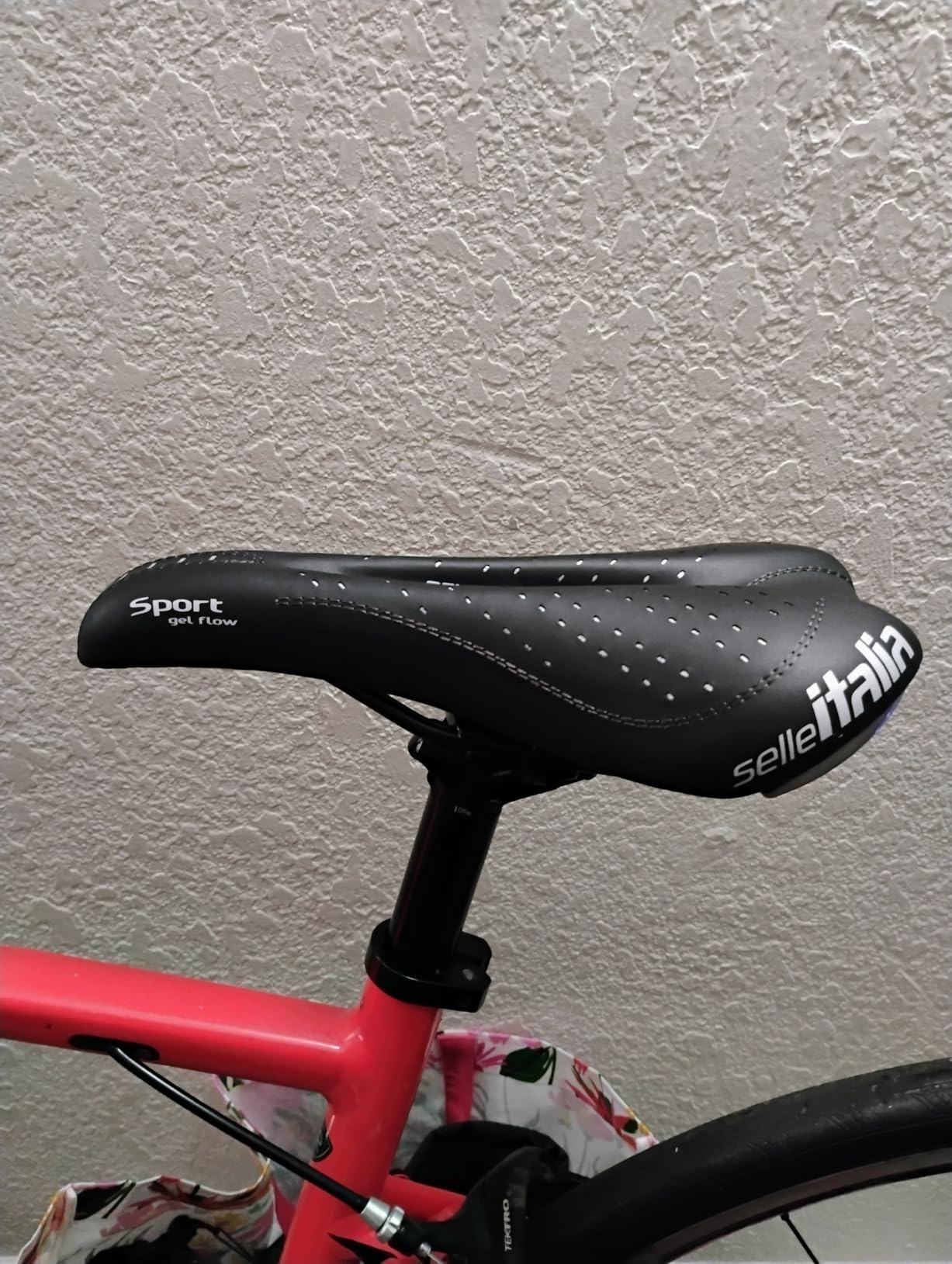
Steel alloy rails are the quiet hero here. They flex a little under load, they tolerate the clamping torque most riders use without complaint, and they need no special adapter. On a bike you maintain yourself, that matters as much as comfort over distance.
The honest limitation is width. The saddle comes in 140mm and 145mm options, which covers narrower anatomy well and leaves wider riders needing something else. The padding is also moderate rather than generous, so this is a support saddle that works with correct fit rather than a plush saddle that tries to compensate for the wrong fit.
Who it suits
Commuters and newer riders doing two or three hour rides, anyone on a hybrid or a light mountain bike, and riders who want a wipe-clean cover for winter commuting. It is also a sensible first replacement for an OEM saddle on a bike that already came with one of these fitted.
Skip it if your sit bones measure wide, or if you already know you need serious pressure relief in the perineum because of numbness on longer rides. In that case, go straight to a saddle with a deeper channel or a split nose.
Setup notes
Because the cut-out changes the effective centre of the saddle, set your fore-aft position by where your sit bones land rather than by the nose tip. A centimetre or two forward of the usual position often makes the gel sit under the right part of the pelvis. Ride it for a full hour before deciding whether the width is right.
3. Selle Italia SLR TM Boost Superflow – the 218g option for riders who also climb
- Very light for a road saddle
- Short nose frees the thigh
- Superflow cutout eases soft-tissue pressure
- Compliant manganese rails
- Short nose can feel restrictive
- Firm padding suits performance riders
- 145mm version can still be too wide
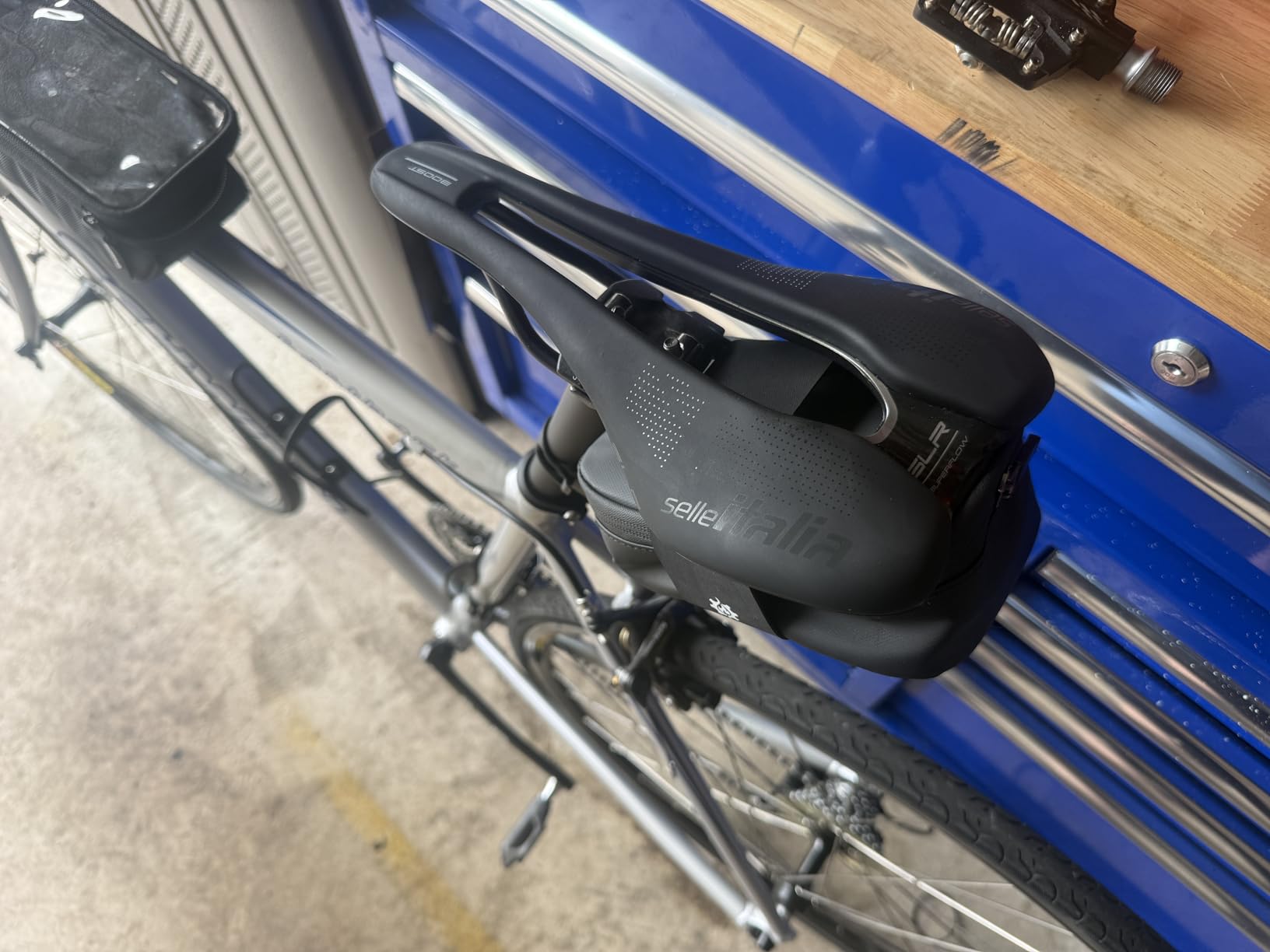
If you ride long routes with long climbs in them, this saddle earns its place for the weight rather than the padding. At a listed 218g it is the lightest saddle in this roundup, and on a road bike where every gram counts over a long day with repeated climbing, that is not a trivial detail.
The Boost short nose is the defining feature. By shortening the front of the saddle, the manufacturer frees up the inside of the thigh, which reduces rubbing on out-of-the-saddle sections and makes it easier to shift position when the road tips up. The Superflow cutout handles the perineal side of the equation.
Padding is the compromise. This is a firmer, performance-oriented layer, and riders moving from a heavily padded saddle often describe the first rides as harder than expected before adapting. Over a full day of spinning in the drops it holds up well; if your week is mostly upright riding and commuting, it will feel unnecessarily thin.
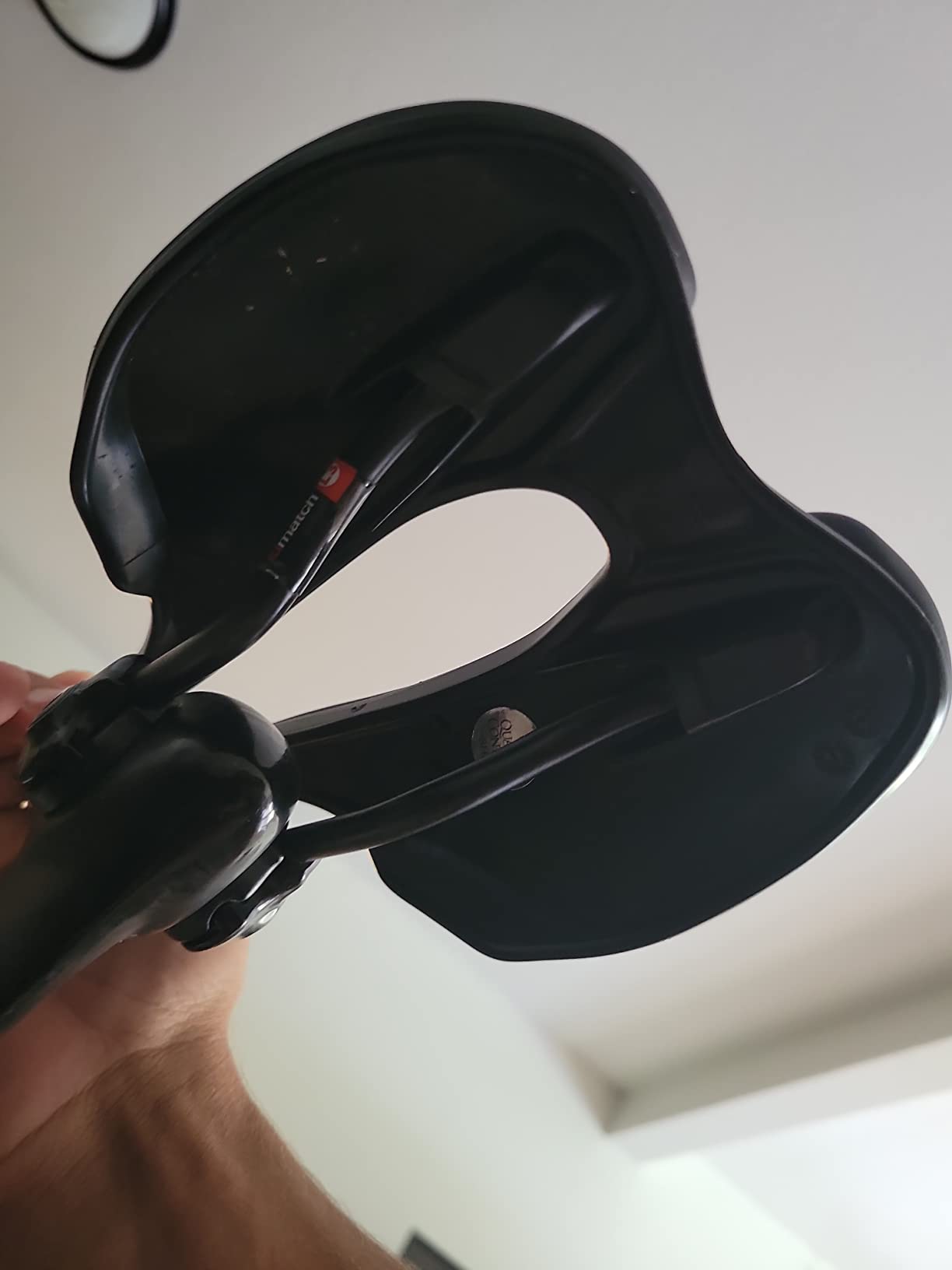
Manganese rails sit between steel and titanium in character, giving a small amount of compliance that takes the sting out of rough tarmac without the harshness of very stiff rails. They also resist the flex that makes a light saddle feel vague over broken surfaces.
Who it suits
Riders in a forward-leaning road position who spend real time out of the saddle, and anyone whose long rides are hilly enough that total weight matters. It also suits riders who have already established a correct width and just want the same fit in a lighter package.
It is the wrong choice if you ride in a relaxed, upright position with a wide rear platform, or if you have never ridden a short-nose saddle before and are still working out whether your position suits that shape at all. Transition is easier when it is one change at a time.
Sizing notes
Widths run to 130mm and 145mm depending on variant, and the short nose can make the saddle look set back compared with what you are used to. Expect to move the saddle forward slightly under the clamp so your sit bones still sit on the rear of the platform. Check the tilt first, because nose length changes how a saddle feels at a given angle.
4. Brooks England Cambium C17 Carved – the all-weather option for wet touring
Brooks England Cambium C17 Carved Bicycle Saddle Black, 164 mm Vulcanised Rubber Cycling Seat with Steel Rails
- Weatherproof and maintenance-free top
- Holds shape in cold and wet conditions
- Accessory loops for a saddle bag
- No break-in needed
- Narrower and firmer than the B17
- Rubber feels slick when hot
- 100kg limit is lower than some rivals
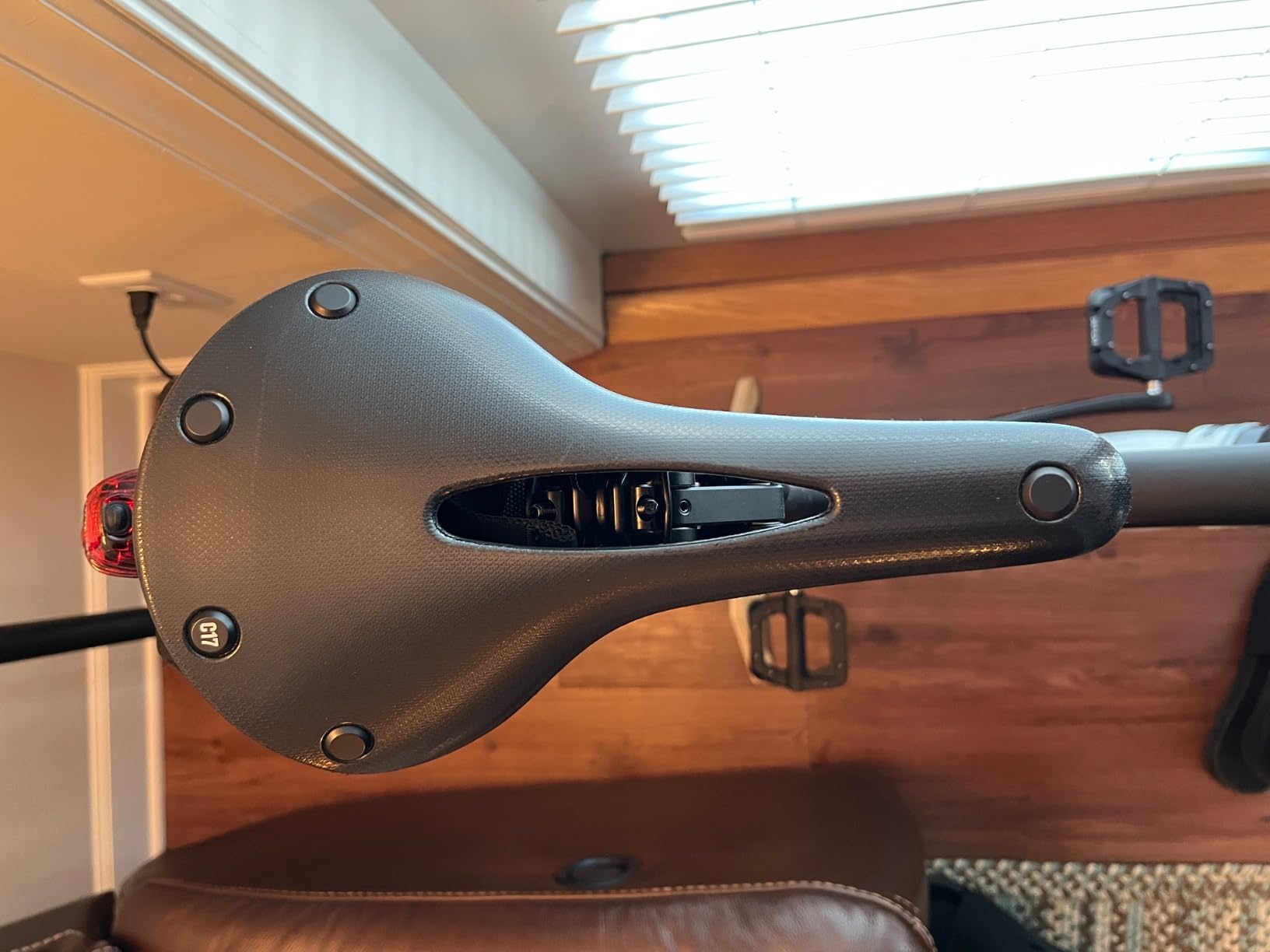
I would rather not own a leather saddle on a trip where rain is likely, and that is exactly the case this one covers. The top is vulcanised natural rubber over organic cotton canvas with a structural textile layer, which means it does not absorb water, does not need conditioning, and returns to its shape after getting wet instead of staying soft and slack.
That predictability is what makes it popular with gravel and all-road riders. Leather softens when it is wet and changes character between dry days and downpours, which is fine on a dry tour and annoying on a wet one. The rubber top does not care about the forecast.
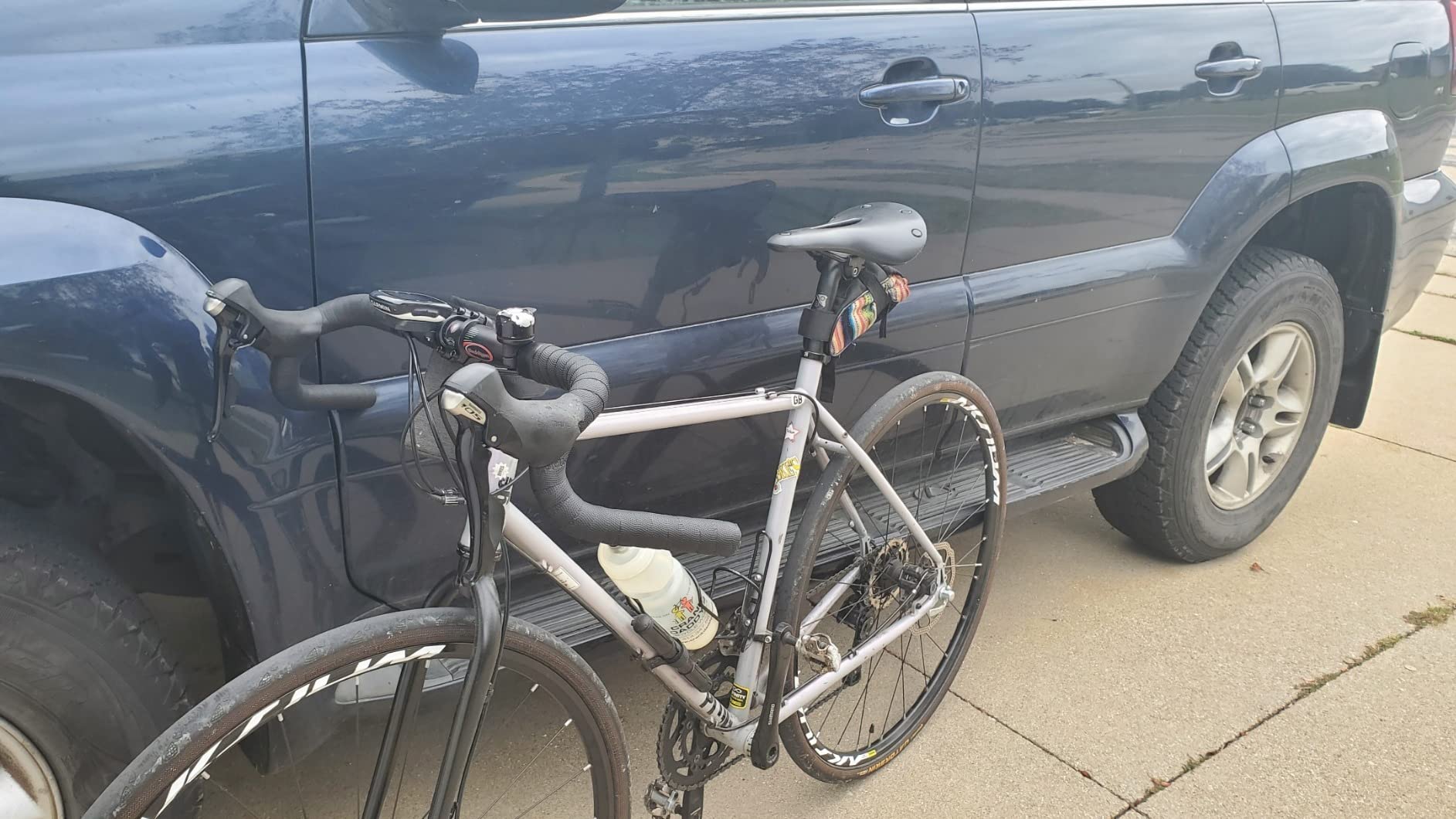
At 450g it is not a weight saddle, and the carved shape is narrower and less padded than the B17, so this is comfort through support rather than through cushioning. Riders who love deeply carved shapes describe excellent long-distance comfort; riders who want a soft padded platform describe it as firm. That split explains most of the feedback.
The fiberglass-reinforced back plate with accessory loops is a genuine touring feature, giving you a defined place to strap a saddle bag without improvising. Just check the 100kg stated capacity before committing if you are a heavier rider.
Who it suits
All-weather commuters, wet-climate tourers, bikepackers who ride in mixed conditions, and gravel riders who prefer a carved anatomical shape to a short nose. It is also a strong choice for anyone who does not want to spend time on leather care.
It is a poor match for riders who sit with a very wide sit-bone width, since the carved platform is narrower than the B17, and for hot summer riding where a rubber top can feel slick and less breathable than a microfibre or synthetic cover.
Setup notes
Because the top does not mould, there is no settling period, which also means no change in effective height once you have ridden a few hundred kilometres. Set it once and check it again after a month. Pair it with a saddle bag under the accessory loops and confirm the bag does not rub against your legs at the widest point of the rear.
5. WTB Volt – the easiest saddle to size correctly
- Three widths make sit-bone matching simple
- Love channel clears the soft tissue
- Contoured shape steadies the pelvis
- You choose the rail material
- Medium padding needs correct width
- Microfibre cover wears with heavy trail use
- Takes time to find the fore-aft position
The single biggest reason saddles fail riders is wrong width, and the WTB Volt solves that by coming in Narrow, Medium and Wide versions. That sounds basic, yet a lot of riders never get to choose, because the saddle fitted to their bike came in one width. Being able to match the width to a measurement rather than to a guess removes the most common cause of long-ride discomfort.
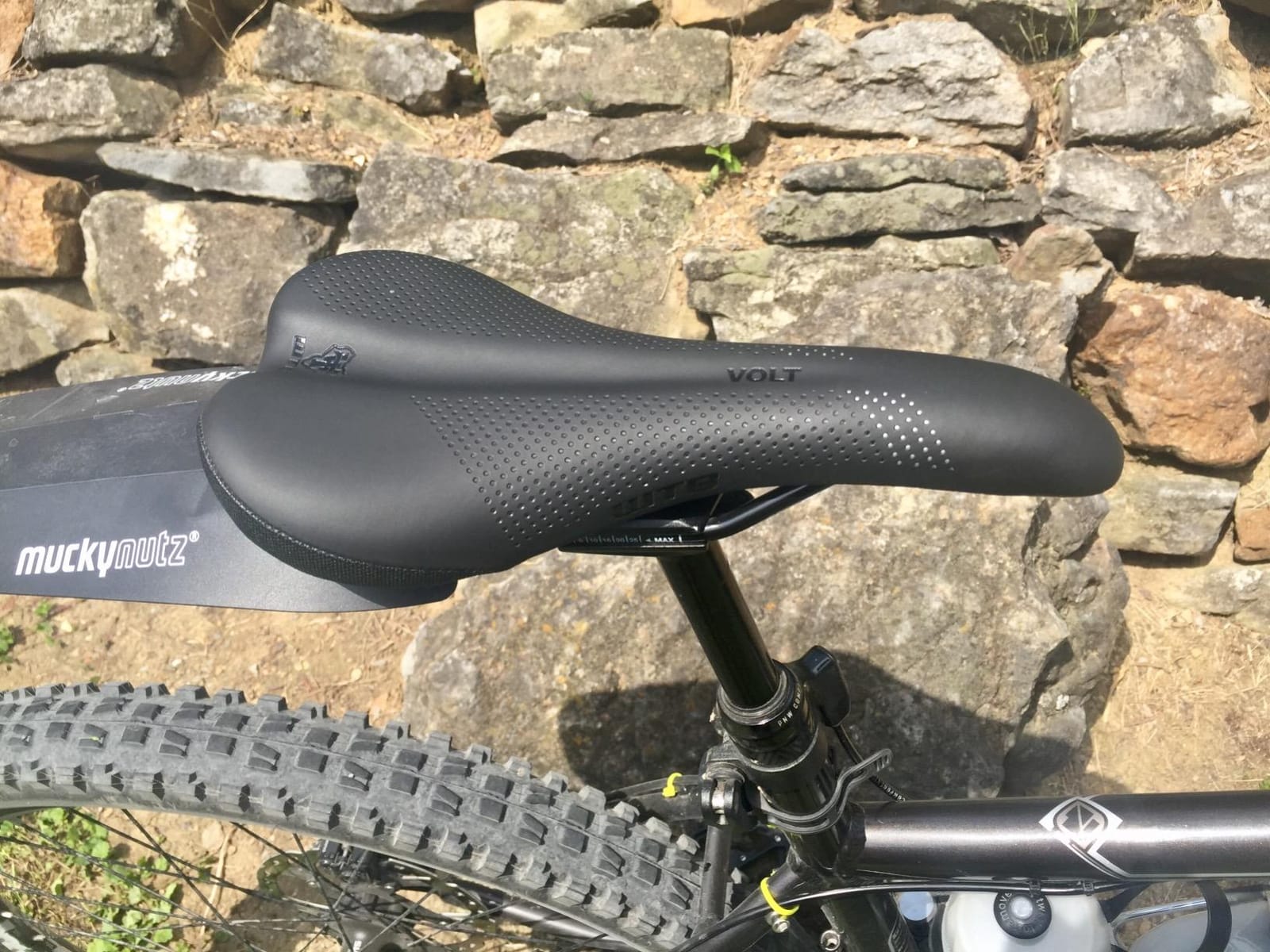
The love channel runs down the middle of the top from the rear to about 50mm short of the nose tip, with a matching compression relief zone underneath. In practice that means the perineum sits in a groove rather than on a ridge, which reviewers consistently credit with reducing numbness on long gravel and e-bike outings.
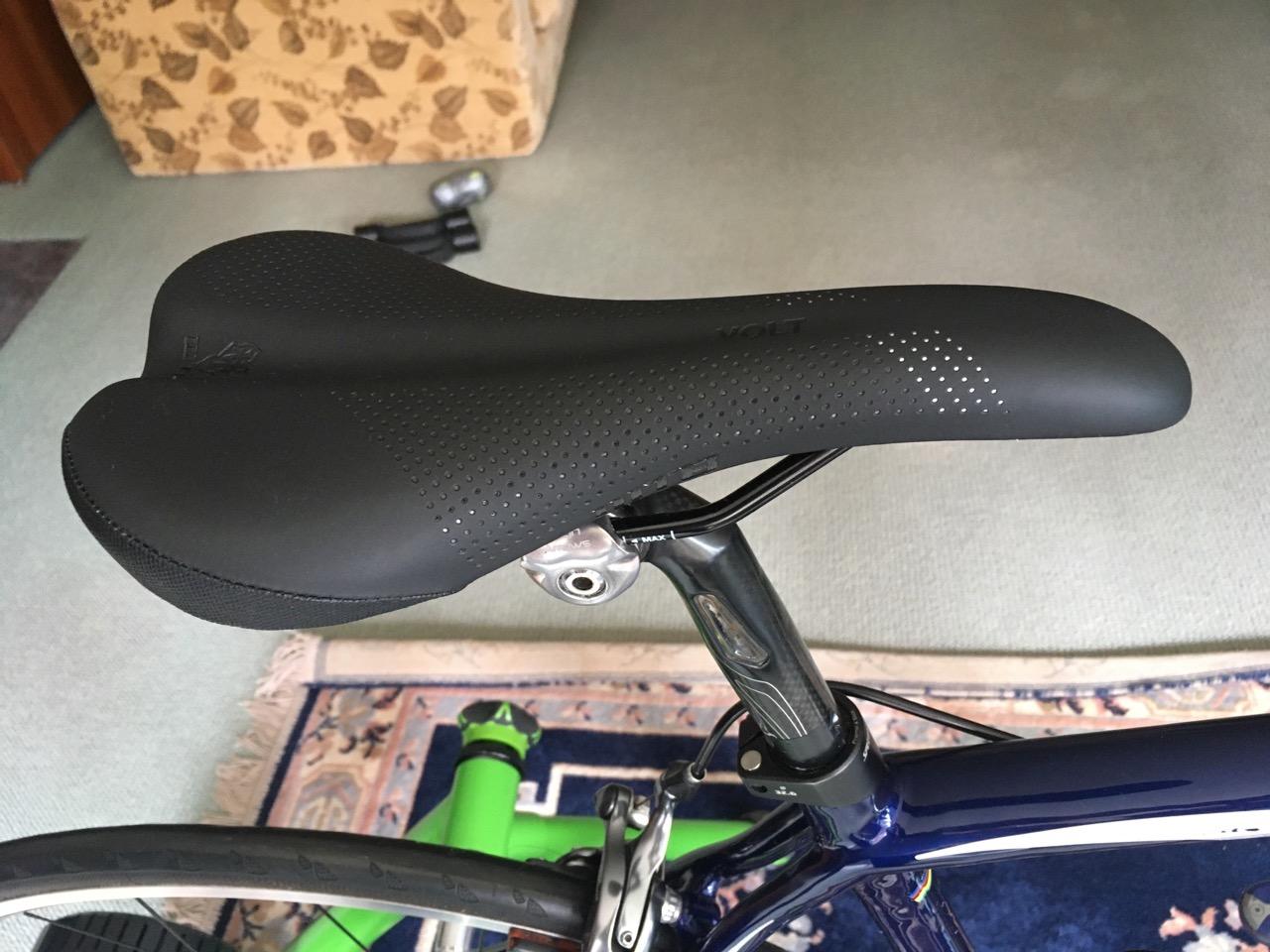
The deeply contoured shape is doing two jobs. It cradles the pelvis to reduce lateral movement on rough surfaces, and it gives you something to push against when you are out of the saddle on a loose climb. That second benefit matters more on gravel and e-bike riding than most roundups on this topic acknowledge.
Padding is medium thickness rather than plush, which is the right call for a saddle that has to work across mountain, gravel and e-bike use. It gives support without the heat and sweat build-up that comes with very thick foam. At 320g it is also lighter than most of the leather options here.
Who it suits
Riders who have measured their sit bones and want a straightforward match, anyone moving from an OEM saddle to something properly contoured, and gravel or e-bike riders who need stability over rough ground. Riders with reduced stability or core strength get a lot from the cradled shape.
It suits serious trail use less well than its mountain bike listing suggests, because the microfibre cover wears and stains quickly when the saddle is dragging against brush. If that is your use case, choose a saddle designed for it.
Sizing and rail notes
Pick the width from your measurement, then use the medium padding honestly as a test: if you feel the edges of the platform pressing on your thighs, you are one size too narrow. Rail choice is a weight and comfort decision, with steel for durability, cromoly as the balanced middle and titanium for the lightest result.
6. Fizik Tempo Argo R5 – the strongest reported relief for perineal numbness
Fizik Tempo Argo R5,Versatile Endurance Road Bike Saddle, Black, 150mm
- Largest relief channel in this roundout
- Generous support suits longer riders
- Short nose allows natural pedalling motion
- Clear step up from stock saddles
- Firm foam feels hard at first
- Fit is highly individual between riders
- Short nose changes how the saddle looks set
Owners of this saddle repeatedly describe something specific: numbness they had lived with for years disappearing after a few rides on it. That is the large central cutout doing its job, and it is the most open full-length relief channel on this list, which is why it appears here despite a middling overall rating.
The rating is the honest part of this review. At 4.3 it is the lowest-scoring saddle we list, and the reason is visible in the reviews: some riders report thigh soreness even after measuring correctly, and others simply never adapt to the short nose. Comfort on a saddle this shaped is genuinely individual, and we would rather say that than pretend otherwise.
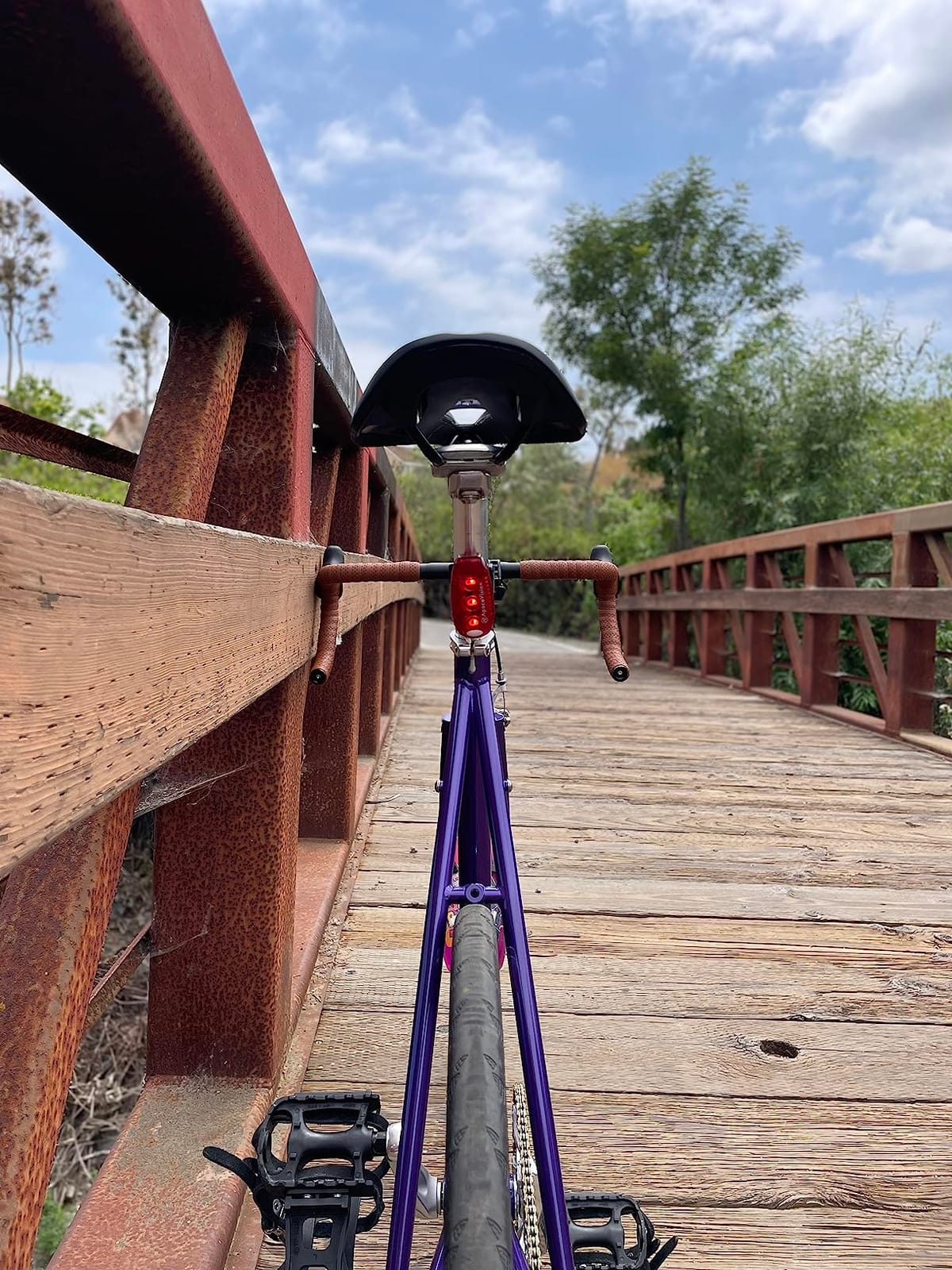
The Wingflex shell detail is easy to overlook and quite clever. The side edges of the shell flex with your inner leg, so the platform moves with your pedalling rather than resisting it, which reduces the rubbing that builds up when you hold a steady position for hours. Type 2 foam is progressive, meaning it softens gradually as load increases instead of bottoming out.
Widths at 150mm and 160mm are generous, and reviewers specifically credit the ischial support for riders with a longer or heavier frame. The carbon-reinforced nylon shell keeps the weight to a listed 241g while giving a little compliance on rough roads.
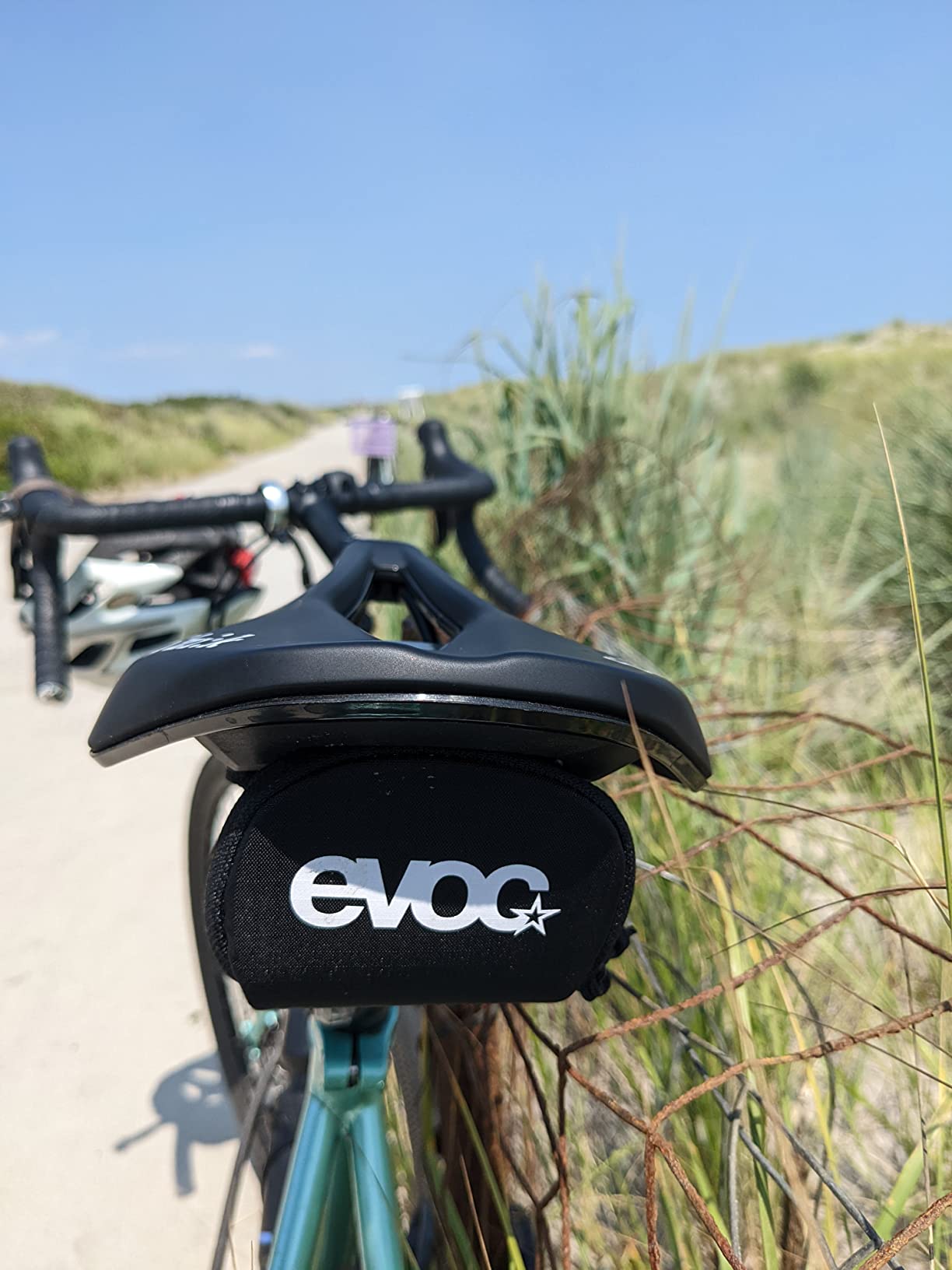
Who it suits
Riders whose main problem is perineal numbness on road rides, particularly those covering 30 to 80 miles in a day. It also works well for long indoor trainer sessions, where the cutout means pressure never builds up in one place over several hours.
It suits riders who want a soft, deeply padded saddle less well, because the foam is firm by design. It is also not the first thing to try if you have never ridden a short-nose shape, since the adjustment period can be longer than for a conventional saddle.
Setup notes
Measure before you order, and take the fit seriously: a minority of riders find that no width fully resolves their discomfort, which is a sign that the shape rather than the size is the issue. If you already know you are sensitive to short noses, move to the Gravel section below before committing.
7. Brooks England Flyer – sprung leather for multi-day trekking
Brooks England Flyer, Touring Leather Handmade Bike Saddle With Suspension Springs, Brown, One Size
- Springs absorb road buzz and rough surfaces
- Leather ages and moulds well
- Wide rear supports upright positions
- Steel frame built for touring loads
- Springs add real weight
- Upright shape suits only one position
- Leather needs a break-in period
Springs are an unfashionable feature that solves a specific problem: constant low-frequency road buzz over a long day. The Flyer uses two rear springs to take the edge off vibration before it reaches your sit bones, and touring riders who use them describe the difference as noticeable on rough surfaces and on days with a lot of stop-start riding.
The rest of the package is classic Brooks: European vegetable-tanned leather over a hardened black steel frame and rails. Vegetable tanning produces a leather that is firmer when new and slowly moulds with use, and it resists the surface cracking that shows up on cheaper leather saddles.
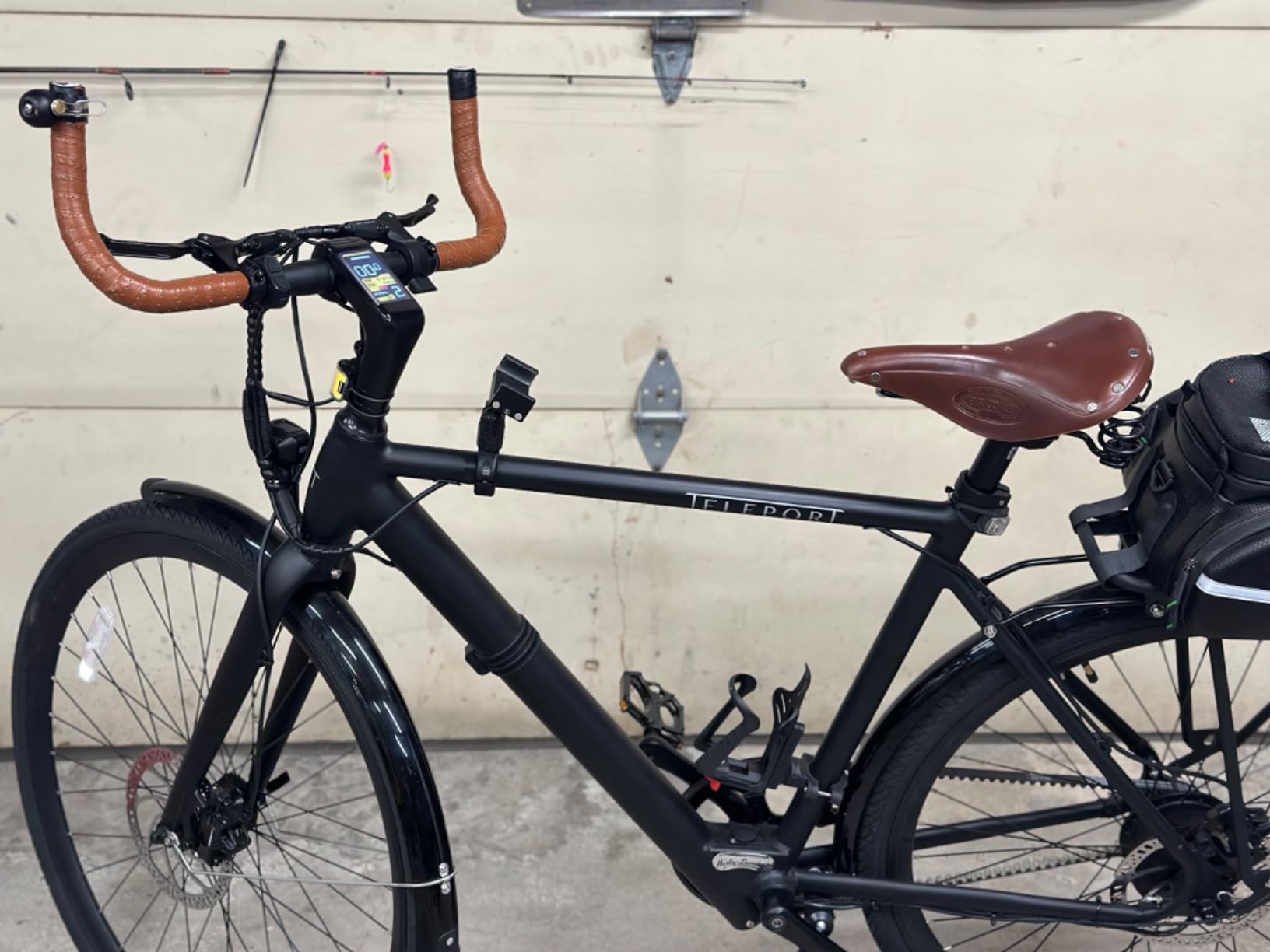
Weight is the clear trade-off here, and it is significant. Springs add bulk that you feel every time you lift the bike. On a touring bike loaded with panniers or bikepacking kit where every gram is fought over, that weight sits awkwardly with the rest of the setup even though the ride quality is excellent.
The shape is upright-focused, with a wide rear platform that supports a relaxed trekking position. That is the correct design for the intended use and an incorrect one for an aggressive road position, where you need to slide forward and the long wide nose gets in the way.
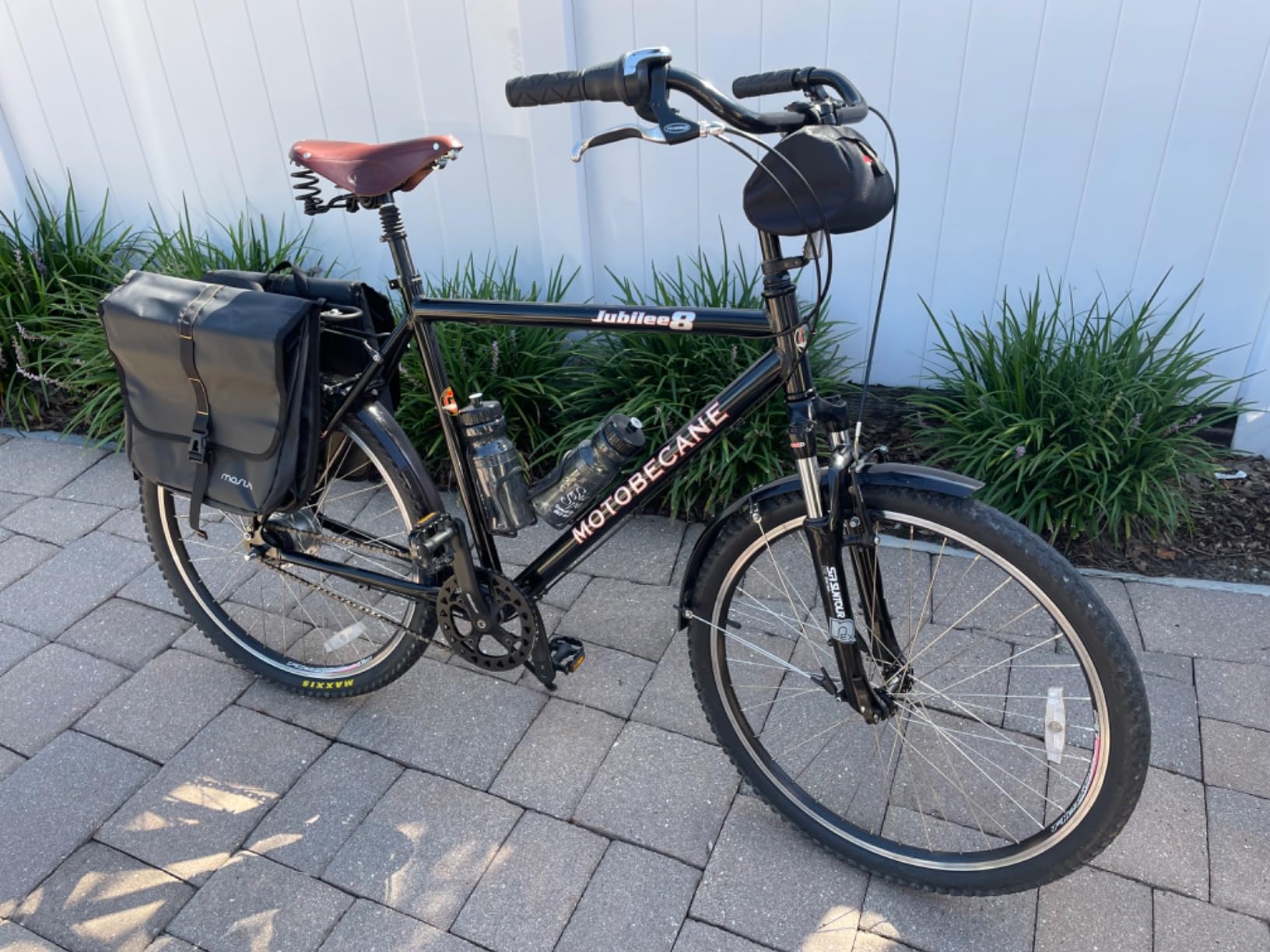
Who it suits
Tourers, trekkers, commuting riders on rough roads, and anyone spending consecutive days in the saddle rather than one long day. The sprung construction also suits riders who are sensitive to vibration, and the wide rear platform works well in an upright position with a seatpost that has some flex.
It is a poor match for competitive road riding, for riders where bike weight is a priority, and for anyone whose position puts them forward over the bars for most of the ride.
Break-in and care notes
Plan for the same break-in behaviour as other Brooks leather, with the leather firm at first and moulding over the first few hundred kilometres. Condition it before use and protect it from sustained rain. If you ride a bicycle that needs regular servicing on the road, our portable repair stand picks keep roadside adjustments manageable.
8. Ergon Men’s SM Pro – marathon comfort on gravel and trails
- Relief channel targets perineal pressure
- Men's shape loads the sit bones
- All-day cushioning without bulk
- Slick flanks reduce pedalling friction
- Only two fit sizes can leave a gap
- Flatter profile feels less accommodating
- Built around male anatomy
The detail that sets this saddle apart is where the relief channel sits. It is positioned rearward rather than centred, so it takes pressure off the perineum while still letting the sit bones load the widest, most supportive part of the platform. Riders on marathon and bikepacking days report that this specific placement is what removes the numbness they had accepted as normal.
AirCell foam with OrthoCell inlays gives cushioning without the bulk of a thick gel pad, which matters on a gravel bike where you will be out of the saddle as often as in it. Slick side flanks reduce the friction of your thighs against the saddle edges, a small detail that becomes a large one over six hours of movement.
The shape is men’s-specific with a flatter overall profile, which some riders find less accommodating than a deeply contoured saddle and others find far better for staying in one position. That split is normal, and it is the reason we size-check carefully below.
Who it suits
Gravel and all-road riders doing long days, bikepackers, and road riders who want a single saddle for both tarmac and dirt. It works particularly well for riders who spend a lot of time in one position because the flat profile keeps you planted rather than sliding.
It is the wrong choice if you want a deeply sculpted shape, if you ride very long nose-forward road positions and want maximum freedom to move forward, or if you want a unisex or women’s-specific profile.
Sizing notes
There are only two fit options, Small/Medium and Medium/Large, and riders sitting between them often find the fit imperfect. That is the most common complaint in the reviews, so measure rather than guess. The stated capacity is 220 pounds, which is worth checking against your own weight before you order.
9. ISM PR Series – the split-nose answer when nothing else has worked
ISM PR 3.0 Noseless Bike Seat – Comfortable Road Bike Seat for Men & Women
- Split nose is the most reported fix for numbness
- 60-series foam suits multi-hour days
- Wide rear works upright or on the time trial
- Unisex neutral sizing
- Needs tilt and fore-aft adjustment
- Split shape looks unconventional
- Rear could be wider for some anatomy
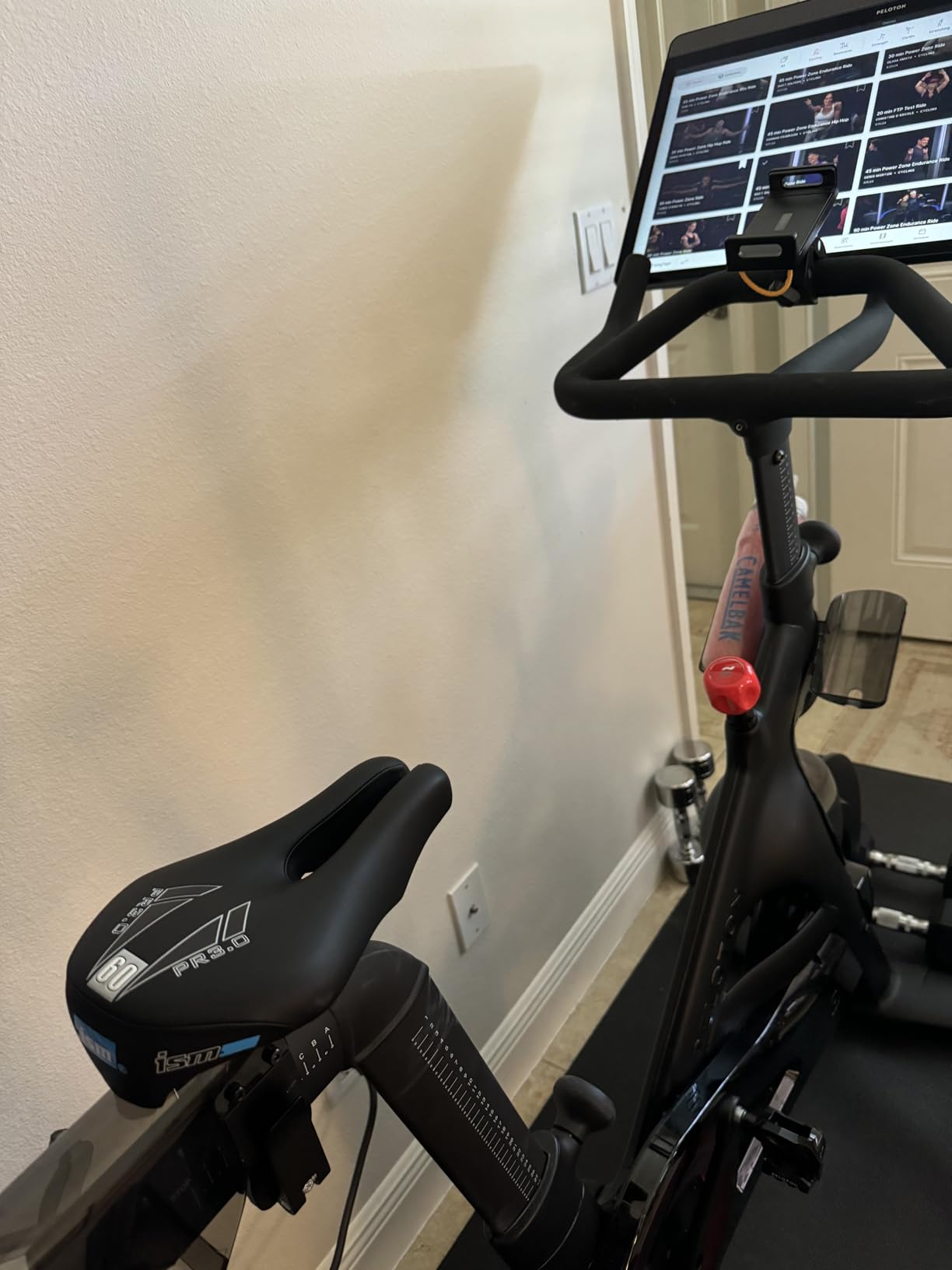
The ISM PR is the last-resort recommendation in this roundup, and that is deliberate. If you have already cycled through a dozen conventional saddles and still wake up numb after a long ride, the problem is almost certainly pressure on soft tissue, and no amount of extra padding in a conventional shape will fix it.
The patented split nose removes the section of saddle that sits between the legs entirely. There is nothing there to press against, which is why riders describe relief from problems that had lasted years. Reviewers report it working on outdoor rides of 30 to 125 miles and on long indoor trainer sessions, where pressure builds without the movement that normally relieves it.

The 60-series foam upgrade over earlier versions in the range gives enough cushioning for genuinely long days, and the 235mm by 145mm sizing is described as neutral, working for a broad range of men and women. The optimised rear end leaves room for thighs and hamstrings, which is what makes it viable in a forward position as well as an upright one.
Who it suits
Riders with persistent perineal numbness or discomfort, hybrid and time-trial riders who sit back and move in and out of an aero position, indoor riders who log many hours on a trainer, and anyone who has already tried and disliked narrow racing saddles.
It suits racers less well, because the split shape is not allowed in competition and you will spend the first few rides learning to sit correctly on the rear pads. Riders with wider sit-bone spacing may find the rear section could be broader, which is the most common reservation in the reviews.
Setup notes
Budget time for setup. The fore-aft position and the tilt both need adjusting so your sit bones rest fully on the rear pads rather than bridging between them. If the saddle tilts too far forward, the rear pads lose contact and you lose the support you paid for. Ride it for an hour in your normal position before changing anything else.
10. Fizik Terra Argo – built for gravel chatter, no break-in needed
- Comfortable from the very first ride
- Shell absorbs road chatter well
- Waved profile supports the lower back
- Runs 140mm to 160mm widths
- Narrower and harder than expected
- Short nose is poor for wide sit bones
- Variants not clearly shown on listing
- Rated to 100kg only
The Terra Argo is the gravel-specific short-nose option, and its selling point is immediate comfort with no break-in. Owners report riding 100km-plus gravel outings and feeling fine from the first ride, which is unusual in a category where new saddles normally demand an adjustment period.
The compliant shell is the part that matters on gravel. It has controlled elasticity that absorbs road chatter and vibration from unpaved surfaces, so the constant low-level buzz that wears riders out over a long day is filtered before it reaches you. Type 2 foam is thicker through the sit-bone area and more progressive than race-oriented foam, which is why it stays comfortable past the point where a pure performance saddle would start to press.
The waved profile supports the lower back and helps you hold position on loose climbs, while the dropped nose allows pelvic rotation, which is what generates traction and power when you are out of the saddle on gravel. Together they mean the saddle lets you change position more freely without losing support.
Who it suits
Gravel and all-road riders whose long days include long stretches of unpaved surface, riders who want one saddle for both tarmac and gravel, and anyone who does not want to spend weeks breaking a saddle in. The range of widths from 140mm to 160mm covers most sit-bone measurements.
It is a poor match if you run narrow and expect a soft saddle, because reviewers describe it as narrower and harder than expected. The stated 100kg limit is worth checking against your weight, and be careful to confirm which width variant you are actually ordering.
Setup notes
Because the shell is compliant and the profile is waved, the fore-aft position matters more than on a rigid saddle. Set it so the widest part of the sit bones sits in the rear third of the platform, then check the position again after a long ride when you can feel where your bones actually settled.
11. Selle Italia X-Bow Superflow – a wide platform with a real cutout
Selle Italia X-Bow TM Saddle 155x255mm (L3) Superflow Black –
- 155mm width suits a broad range of riders
- Cutout relieves perineal pressure
- Long rails give plenty of fore-aft adjustment
- Waterproof pad stays usable in wet conditions
- Rear-fixed rail reduces adjustment range
- Heavier than carbon-rail saddles
- Firmer than a gel saddle on long days
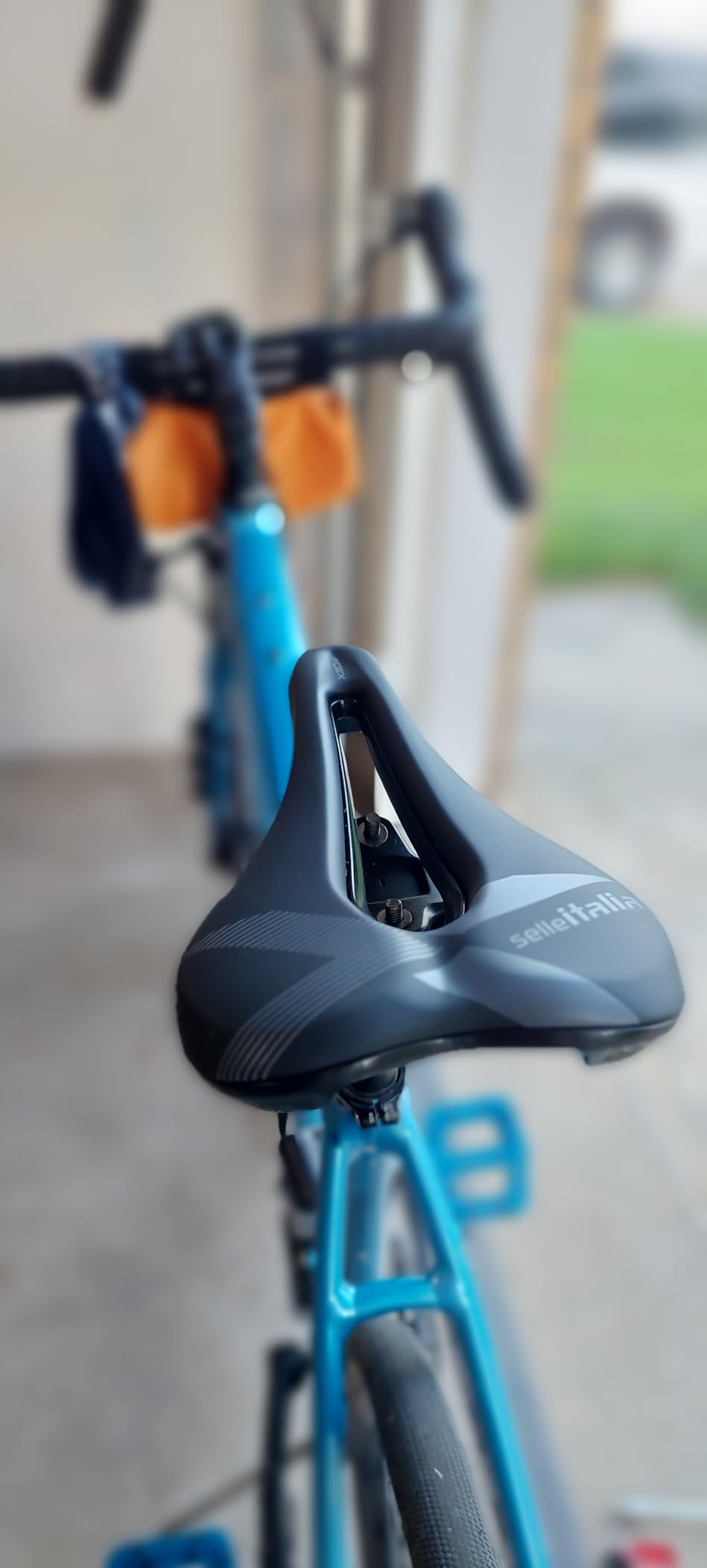
Most saddles with a proper cutout are narrow race shapes. This one pairs the Superflow central cutout with a 155mm width, which is unusual and useful, because it means riders who need more platform do not have to give up soft-tissue relief to get it.
The rail design is the other interesting part. The rail is fixed at the rear of the saddle, which frees the whole contact area between the ischial bones and the perineum from having to straddle a rail. That is the structural reason the pressure relief works properly rather than partially. The trade-off is less fore-aft adjustment than a fully floating rail design, though the rails are still long enough to give a usable range.
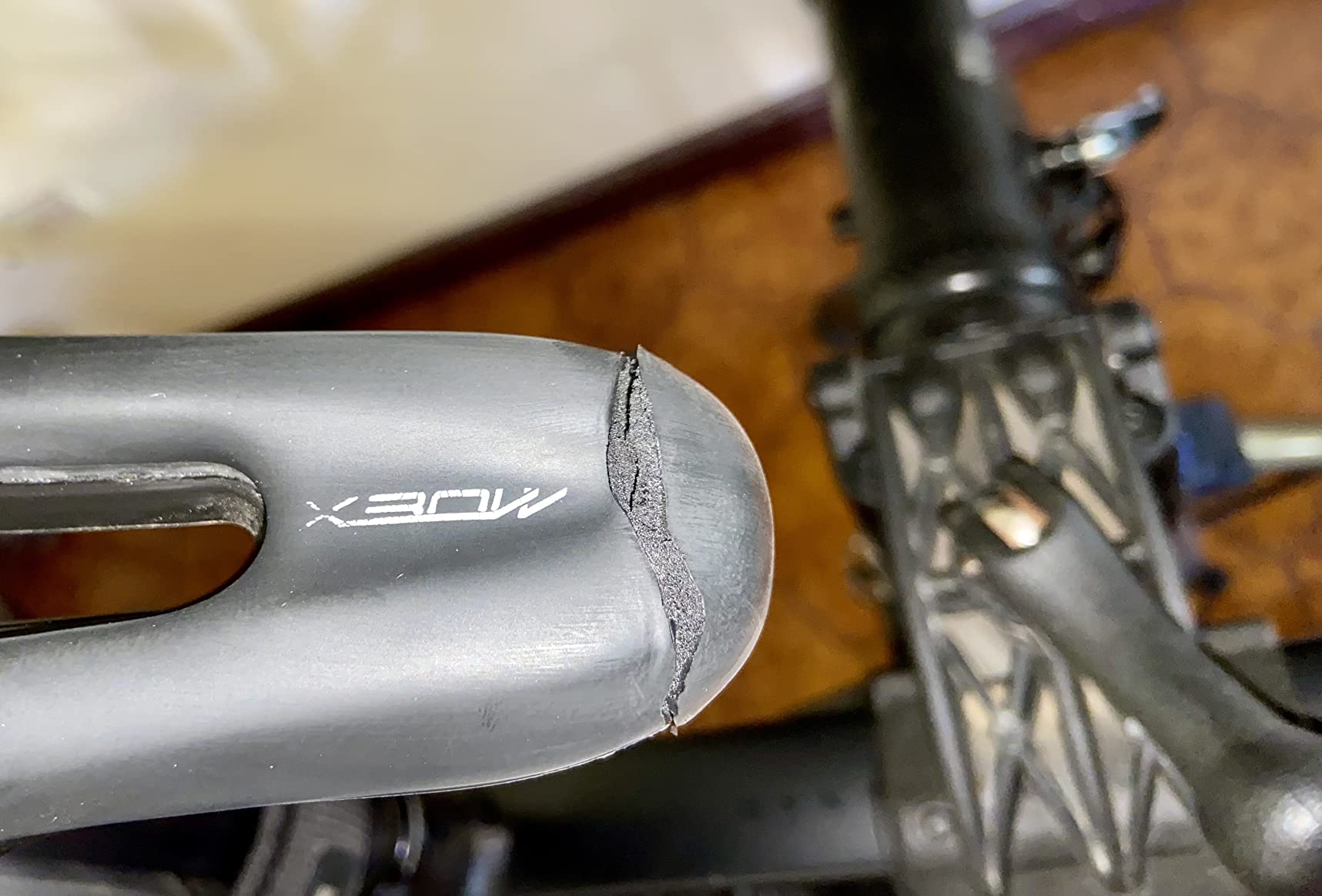
The SOFT-TEK top with a waterproof pad is a practical combination for year-round riding. It wipes down, holds up in rain, and provides enough grip for climbing out of the saddle without the aggressive grippy texture of a mountain bike cover.
Who it suits
Riders who want pressure relief but need a wider platform than most channel-equipped saddles offer, plus anyone who wants a cutout for a bike used for commuting and long weekend rides. The L3 size at 155mm suits broader anatomy, with an S3 option for smaller riders.
It suits racers poorly, since the L3 width and long nose are not a race shape. It is also not the best match if you need a lot of fore-aft movement to find your position, because the fixed rail section narrows the usable range.
Setup notes
With the rail fixed at the rear, set the fore-aft position by how your sit bones land on the wide section, not by nose length. The stated maximum rider weight is 90kg, so heavier riders should look at the wider leather or wider channel options instead. Firmness is the other thing to judge after an hour, not five minutes.
12. Ergon Women’s SMC Sport Gel – built for a narrower sit-bone pattern
- Relief channel reduces numbness
- Gel pads softer than foam-only designs
- Shape tuned for female sit bone geometry
- CroMo rails hold position firmly
- Bulkier between the legs
- Heavier than minimalist saddles
- Medium-Large can be too wide
- Microfibre cover feels warm when hot
This saddle exists because average male anatomy does not describe average female anatomy, and a saddle shaped for one can leave the other sitting on the edges of the platform. The SMC uses a women’s-specific ergonomic shape with the relief channel positioned to suit a narrower, differently spaced sit-bone pattern, plus gel pads layered over orthopedic comfort foam.
The relief channel is the part that does the real work. Ergon built the channel and the padding together, so the channel does not have to be deep enough to cut into a soft gel pad, which is a common failure mode on padded cutout saddles. Riders report riding for hours without the pressure hot spots they had on narrower saddles, and 77% of reviews are five-star.
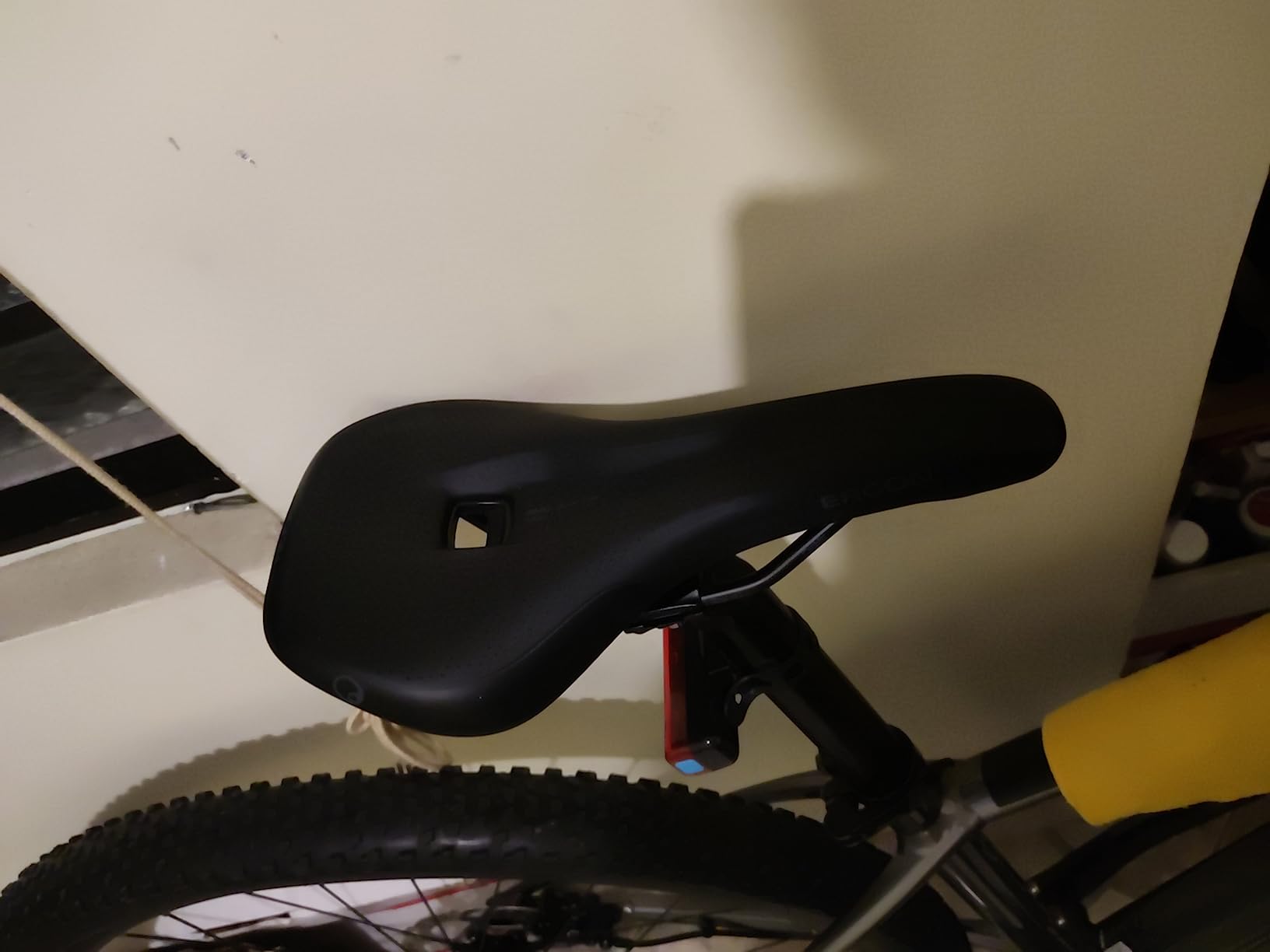
CroMo rails in 7x9mm hold their adjustment position firmly and resist the flex that makes cheap saddles feel vague. The microfibre cover is grippy and durable, though it does retain warmth in hot weather.
Who it suits
Riders with narrower sit-bone spacing, especially those who find most saddles too wide at the rear and push forward onto the nose to compensate. It works well for long road and mountain bike rides, and the stated capacity of 265 pounds covers most riders.
It is not a minimalist choice, and it is not a racing saddle. The bulkier profile takes up room between the legs that some riders dislike in a tucked position, and it is heavier than the minimalist options. Riders who also race may prefer a short nose.
Sizing notes
This is the saddle where choosing the smaller size matters most. Medium-Large is too wide for a lot of riders who would be better served by Small-Medium, and the sizing error shows up as pressure on the outer edges of the platform rather than a general discomfort. Measure, then order Small-Medium unless your measurement genuinely sits in the larger band.
How We Picked and Compared These Saddles
We built this list around one question: which saddles keep a rider comfortable past the point where most problems appear. That means hour three rather than minute thirty, so we weighted the features that only show up over distance: pressure relief, shell compliance, and the ability to hold position when you move on and off the saddle.
Every product here was checked against published specifications for width options, weight, rail material, cutout design and stated maximum rider weight, and against the pattern that shows up across thousands of rider reviews rather than a handful of sponsored ones. A saddle that produces the same relief complaint from a consistent share of reviewers was marked down, even where the specification sheet looks excellent.
We deliberately excluded saddles that we could not size properly from the rider’s perspective, and we kept saddles with middling ratings where the weakness is clearly explained. A 4.3 rating on a saddle that fixes numbness for a specific group of riders is a different proposition from a 4.6 rating on a saddle that works well for everyone, and we would rather you understand the difference than read a neat ranking that hides it.
Two products in this roundup carry no weight figure we could verify from the manufacturer listing, and several come in multiple widths, so treat the width as the first decision and the rest of the specification as supporting detail.
How to Choose a Long Distance Bike Saddle
Choose in three steps: measure your sit bones, match the nose and width to your riding position, then pick a padding type you can live with. Everything else on this page follows from those three decisions.
Step 1: Measure your sit bones
Sit-bone width is the distance between your two ischial tuberosities, and it is the number that determines saddle width. It is not your hip width and it is not your height. A simple home method: sit on a flat hard floor against a wall, with a sheet of stiff cardboard or a large book between you and the wall, and slide forward so your weight rests on your sit bones rather than your tailbone.
Mark the two deepest impressions on the cardboard, then measure the distance between them in millimetres. That measurement is your sit-bone width. Add roughly 20mm to the measurement for an upright or relaxed position, and closer to 40mm for a forward-leaning road or racing position, since a more aggressive position loads the sit bones differently and benefits from more support under the thighs.
Once you have a number, choose the saddle width at or just above it. Sitting on the widest part of the platform should feel like sitting on a well-fitted chair rather than on a bench that is too big, and the load should run through your bones and not through the soft tissue between them.
Step 2: Match the nose to your riding position
Nose length changes how much freedom you have to move. A short nose gives the inner thigh more clearance and makes it easier to shift forward for climbing or change position, which is why it dominates road and gravel saddles. A long nose gives more support between the legs and suits an upright or touring position where you stay put.
The practical crossover is around 160mm of total saddle length. Below that you are in short-nose territory and should expect a deliberate adjustment period if you have never ridden one; above it, you are in conventional long-nose territory and should expect a wide rear platform. Note that competition saddles have a regulatory minimum length, which is why race shapes cluster near the shorter end.
Match this to how you actually ride. Out-of-saddle time on a hilly route favours a short nose. A full day in the drops with few position changes suits either, provided the width is right. Multi-day touring in a relaxed position favours the long nose, and is where the leather options on this list earn their place.
Step 3: Choose your padding type
Leather has no break-in problem once it is finished, but it has an initial break-in period of a few hundred kilometres before it moulds to you. It is breathable, repairable, and it changes shape permanently to fit one rider. Synthetics and gel pads feel comfortable immediately, wipe clean, and cope with rain without care, at the cost of some heat build-up and a shorter service life.
Progressive and high-rebound foams sit between the two. They do not mould to your body but they are engineered to soften under load rather than bottom out, and modern performance foams have closed much of the gap with leather on long rides. The most common mistake here is assuming more padding means more comfort, which is wrong in a forward position: thick foam insulates the sit bones from the vibration that would otherwise irritate them, and the soreness appears two hours in rather than immediately.
A wider saddle is not a more comfortable saddle for a narrow-hipped rider, and a firmer saddle is not an uncomfortable one for a rider whose sit bones are correctly supported. Padding only helps once the geometry is right.
Symptom decoder: what hurts and what fixes it
Matching the symptom to the feature is faster than reading twelve reviews. Numbness in the perineum that appears after two or three hours points to a nose length or relief channel problem, not to width. Aching directly on the sit bones usually means a saddle that is too narrow. Rubbing on the inside of the thighs means the nose is too long for your position. Hot spots that build where the saddle meets your clothing usually mean padding that is too thin for the hours you are spending out of the saddle.
Chafing on hot summer days is mostly a heat and cover material problem rather than a width problem, which is why wipe-clean synthetic covers and thinner padding matter more on those rides. If pain appears on the front edge of the platform while descending, the saddle is usually tilted down or the nose is too low for your position.
Soreness that appears the morning after, rather than during the ride, points at something else entirely. A saddle that is comfortable while riding can still leave you sore if it forces you to hold your legs in a position your body fights against, and the fix is usually position and flexibility work rather than a different saddle.
Saddles for heavier riders and plus-size sit bones
Riders around the higher end of the weight range are usually steered towards width, and width is genuinely the right place to start, but it is not the only variable. Sit-bone width does not scale cleanly with body weight, so measure rather than assuming. Two riders of similar weight can differ by 20mm or more in sit-bone spacing, and the heavier rider is not always the one with the wider sit bones.
As a practical rule, riders in the heavier weight bands should aim at the wider end of the options for their measurement, adding the fuller 40mm allowance if they ride in a forward position. Among the saddles here, the widest platform is the Brooks B17 at 175mm with a stated capacity of 150kg, the Selle Italia X-Bow at 155mm is a middle option with real cutout relief, and the Ergon SMC carries a stated capacity of 265 pounds.
Several lighter options cap out lower than you would expect. The Fizik Terra Argo lists a 100kg maximum, and the Selle Italia X-Bow lists 90kg, so check the stated capacity before you order rather than after. Very wide leather platforms are the option riders in the highest weight bands most often report as the only ones that avoided saddle sores over long distances.
Heat, sweat and chafing on six-hour days
Over a hot long ride the real enemy is usually moisture and friction rather than pressure. Thinner, firmer padding moves less air than a thick gel pad, which is why riders in hot climates often move to a firmer saddle and a shorter nose and report an improvement. A wipe-clean synthetic cover also lets you dry the saddle at a stop instead of carrying moisture against you for the rest of the day.
Two habits do more than any saddle choice. Change your position and stand up for a few minutes every half hour, which breaks the pressure cycle before it becomes a hot spot, and make sure your bib shorts fit properly, since a saddle cannot fix a badly fitted chamois. Riders often blame the saddle for a problem that sits in the shorts, and swapping saddles then leads to blaming the new saddle for the same problem.
Break-in, care and the saddle swap checklist
Leather saddles need several hundred kilometres before they reach full comfort, and riding through that period consistently is what makes them worth the wait. Condition them before the first ride, protect them from sustained rain, and expect the shape to keep changing for as long as you own them. Rubber-topped and synthetic saddles need none of this, which is a real advantage for riders who store a bike outside or tour through wet climates.
Five steps for a saddle swap: confirm your rail diameter matches your seatpost clamp; set the fore-aft position so your sit bones sit in the rear third of the platform; set the tilt so the saddle is level or fractionally nose-up; ride for an hour and check the height; then re-measure saddle height, because a saddle with a different shape and different stack height can leave you sitting too high or too low even though the rails look the same length.
That last point is the one riders miss. If your saddle feels lower or higher than before with no change to the clamp position, the difference is in the shape and padding rather than the setting, and a fit check is worth doing before you assume the saddle is wrong.
Frequently Asked Questions
What is the best bike saddle for long distance rides?
The best long distance bike saddle is one whose width matches the distance between your sit bones and whose shape matches your riding position. Add a pressure relief channel or cutout to move weight off soft tissue, and a shell or rail material with some compliance to damp road buzz. For most riders the Brooks B17 covers the widest range of fits, while the WTB Volt is the easiest to size because it comes in three widths.
Which bike seat is most comfortable for long rides?
Comfort over distance comes from loading your sit bones rather than the soft tissue between them. A correctly wide saddle with a relief channel and compliant padding stays comfortable in hour four, while a narrow or heavily padded saddle often feels fine for the first hour and then fails. The most comfortable saddle for you also depends on whether you ride upright or forward, so measure before choosing.
What is the best saddle for a heavy cyclist?
Measure your sit bones first, because width does not scale neatly with body weight. Aim for the wider end of the available options and add closer to a 40mm allowance if you ride in a forward position. Check the stated maximum rider weight before ordering, since several lighter saddles cap out around 90kg to 100kg. Wide leather platforms are the option heavier riders most often report as avoiding saddle sores.
How do I measure my sit bone width?
Sit on a stiff sheet of cardboard or a large book on a hard floor against a wall and slide forward so your weight rests on your sit bones. Mark the two deepest impressions and measure the distance between them in millimetres. That is your sit-bone width. Add roughly 20mm for an upright position and closer to 40mm for a forward road position, then choose a saddle at or just above that figure.
Should I get a short nose or long nose saddle?
A short nose frees the inner thigh, makes it easier to shift forward and reduces rubbing out of the saddle, which suits road and gravel riding. A long nose gives more support between the legs and suits an upright touring position where you stay put. The practical crossover sits around 160mm of total saddle length. Expect a deliberate adjustment period if you have never ridden a short nose.
Is a thicker padded saddle more comfortable?
Usually not, especially in a forward riding position. Thick padding insulates your sit bones from the vibration that would otherwise irritate them, so soreness tends to appear two hours into a ride rather than immediately. Padding only helps once the width and shape are correct. Leather moulds to you permanently, synthetics feel comfortable straight away, and progressive foams sit between the two.
Why does my saddle hurt after 2 hours of riding?
Pain that appears around the two-hour mark usually points to one of three things: a saddle that is too narrow, a nose that is too long for your position, or insufficient pressure relief over the perineum. Pain on the sit bones specifically suggests going wider, while rubbing on the inner thigh suggests a shorter nose. A correct setup change usually resolves it faster than changing padding thickness.
Do I need to change saddle height when I fit a new saddle?
Often, yes. Different saddle shapes have different stack heights and ramp angles, so the same rail clamp position can leave you sitting higher or lower than before, which changes your effective riding position. Set the fore-aft position and tilt first, ride for an hour, then check your height and re-measure. A fit check is worth doing after any significant saddle change.
The Verdict in Three Steps
Pick the best bike saddles for long rides in three moves. Measure your sit bones on cardboard, add 20mm if you ride upright or 40mm if you ride forward, and choose a saddle at or just above that number. Then match the nose to your position: short for hilly road and gravel riding, long for upright touring. Finally, choose padding you will actually live with, leather if you will put in the break-in, synthetic if you ride in rain or want zero adjustment time.
Within that framework, the Brooks B17 is our first recommendation for wide sit bones and long-distance durability, the WTB Volt is the smartest starting point because width choice is built in, and the Fizik Tempo Argo R5 is the one to try when numbness is the specific problem you are solving. For narrower sit bones the Ergon SMC is designed for that anatomy rather than being a smaller version of a men’s saddle.
Give any new saddle a full hour on the bike before you judge it, re-check your height after the swap, and remember that the saddle is one of three contact points. Getting the other two sorted, from tyre pressure to bar position, is what lets a well-fitted saddle do its job for a full day in 2026 and every day after it.