
Affiliate disclosure: We may earn a commission from qualifying purchases made through the links on this page. It costs you nothing extra and it is how this site keeps publishing tested buying guides. We only recommend heaters we have researched in depth, and every number in this roundup comes from the manufacturer specification or the customer review record, never from a marketing page.
A camper van heater is not a comfort accessory. It is the single decision that decides whether your build is a three-season camper or a year-round home on four wheels, and most buyers treat it as a weekend of uncertainty before they commit. The wrong unit is either too small to keep you warm at altitude, or too big to throttle down in a small space, or cheap enough to leave you stranded in a mountain pass in February with no dealer within a hundred miles.
Our team compared ten 12V diesel heaters currently sold for vans, RVs and campers, weighing heat output against fuel burn, noise, tank size, altitude compensation and how much wiring each one actually asks of you. What follows is our tiered guide to the best diesel heaters for camper vans in 2026 — a budget all-in-one path, a mid-size path, and a permanent-install path, with the honest trade-off named for each one.
Before you browse heaters, it is worth checking the rest of your build. If your van is a ProMaster, our ProMaster van ladder rack guide covers roof and rack load limits, which matter because a heater install changes where you can safely run ducting. If you tow or run a second diesel vehicle, our Powerstroke lift pump guide is the other half of the fuel system conversation.
Table of Contents
Top 3 Picks for Camper Van Heating in 2026

LF Bros 5KW All-in-One
- 12V
- 24V and 110V operation
- 17
- 000 BTU heat output
- 0.18-0.53 L/h fuel burn
- Threaded leak-resistant fuel cap

VEVOR 8KW with Bluetooth
- 8 KW heat output
- 0.16-0.62 L/h fuel burn
- 5 L integrated tank
- Altitude compensation to 18
- 045 ft

maXpeedingrods 2KW
- 2 KW compact output
- 0.16-0.24 L/h fuel burn
- Low-frequency pulse fuel pump
- Altitude compensation above 5
- 500 m
Those three cover the widest range of real decisions. The LF Bros wins on flexibility and the strongest review record in the set. The VEVOR 8KW wins on raw output and altitude headroom. The maXpeedingrods 2KW wins if your van is small and your build is tight on space.
Best Diesel Heaters for Camper Vans in 2026
| Product | Specifications | Action |
|---|---|---|
| LF Bros 5KW Diesel Heater 12V/24V/110V |
|
Check Latest Price |
| VEVOR 8KW with Bluetooth App Control |
|
Check Latest Price |
 VEPURLT 8KW with 15L Tank VEPURLT 8KW with 15L Tank |
|
Check Latest Price |
 VEVOR 8KW 12V/24V with CO Alarm VEVOR 8KW 12V/24V with CO Alarm |
|
Check Latest Price |
 HCALORY 8KW Toolbox MAX 7.5L HCALORY 8KW Toolbox MAX 7.5L |
|
Check Latest Price |
| maXpeedingrods 2KW 12V/24V |
|
Check Latest Price |
 BougeRV 5KW All-in-One 5L BougeRV 5KW All-in-One 5L |
|
Check Latest Price |
 VEVOR 2KW with 10L Tank and App VEVOR 2KW with 10L Tank and App |
|
Check Latest Price |
 ZBJinG 8KW Air and Water Combo ZBJinG 8KW Air and Water Combo |
|
Check Latest Price |
 Eberspacher Airtronic AS3 D2L 12V Eberspacher Airtronic AS3 D2L 12V |
|
Check Latest Price |
One note before the individual reviews: nothing on this list is a Webasto, Eberspächer service-only unit, and nothing here requires a dealer appointment to fit. Four of the ten are all-in-one boxes you can set down and run within an hour. If you are planning a permanent install with fuel and exhaust routed into a hidden compartment, jump to review number ten first.
1. LF Bros 5KW All-in-One: The Most Flexible Heater in the Set
- Runs on 12V 24V or the included 110V transformer
- Threaded fuel cap resists spills on rough roads
- Very quiet once the fuel pump settles
- Responsive customer service with replacement parts after a year
- Intake air draws from the heated space unless ducted from outside
- Exhaust exits a single fixed side
- Fuel level display can read inaccurately
The LF Bros is the unit we kept coming back to while assembling this roundup. It carries a 5 KW heat exchanger rated to 17,000 BTU, and it runs from 12V, 24V, or the included 110V transformer, which means the same box works in a van, a truck and a garage while you are building it. Owners report the fuel pump becomes close to inaudible once it settles after startup, which matters more in a sleeping space than the headline wattage does.
Fuel consumption is listed at 0.18-0.53 L/h, and at the lower setting a full tank stretch is long enough that you can run it overnight without thinking about it. The working temperature range is -40F to 104F, so cold start is not the weak point.
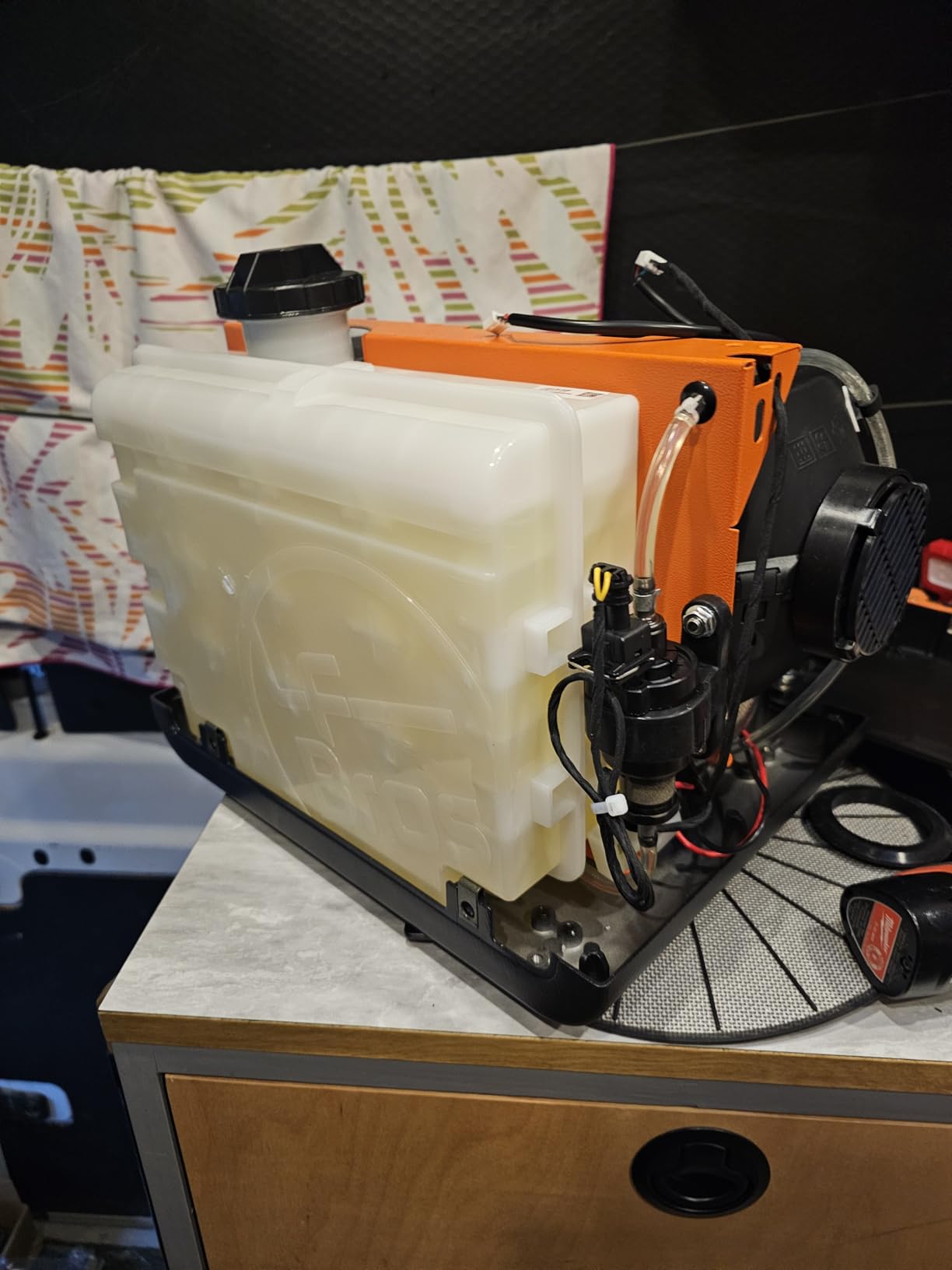
The threaded internal fuel tank cover is a detail we would call the sleeper feature of this design. Vented caps on cheaper all-in-one units are the most common complaint we found in owner reports about fuel spilling while the rig is moving, and this one is built to resist that. LF Bros customer service also comes up repeatedly as a reason owners recommend the brand, including replacement parts sent out a year after purchase.
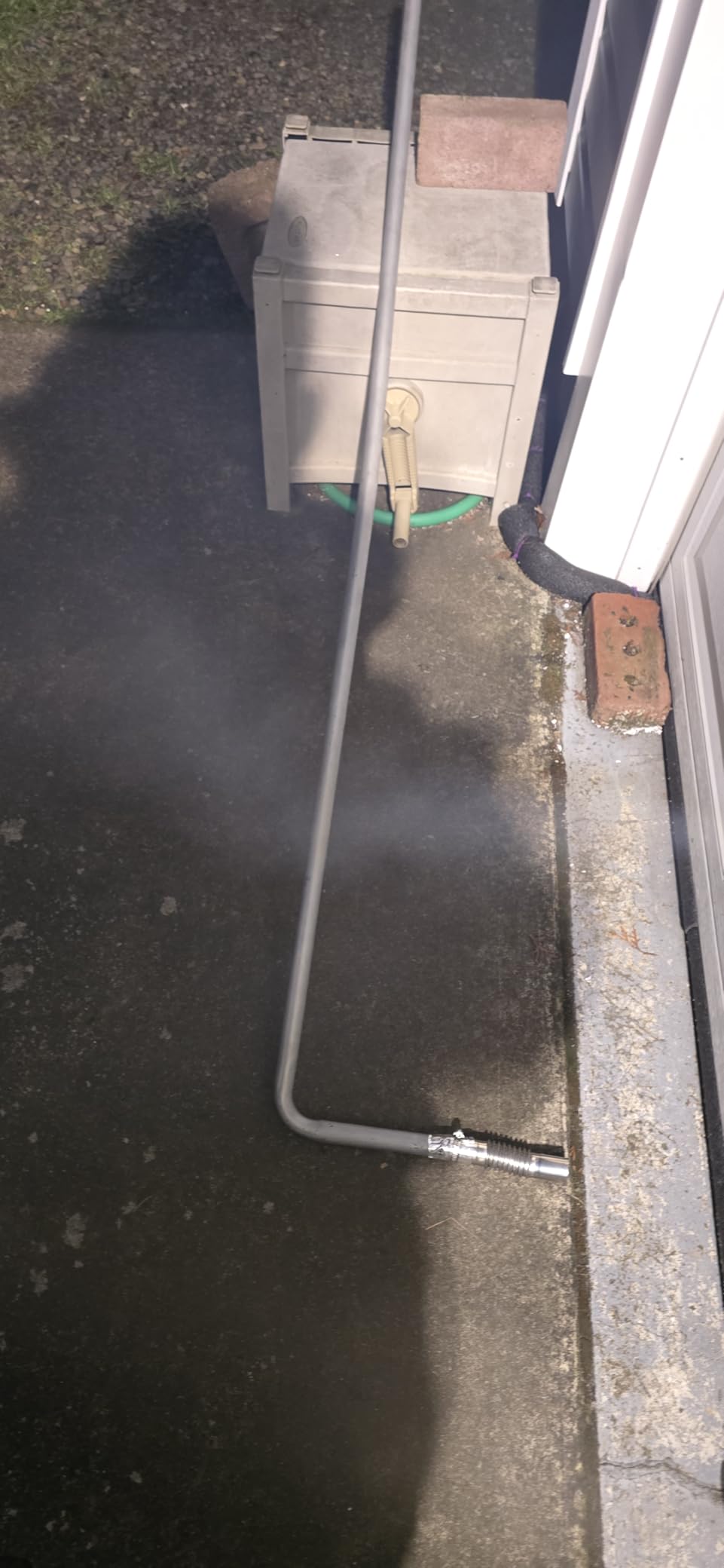
There is one design compromise worth understanding before you buy. This unit does not have a dedicated fresh-air intake port, so by default it draws combustion air from inside the space it is heating. Many owners duct the intake from outside to fix this. The exhaust also leaves from a single fixed side, which dictates where you can mount the unit. Check both against your van layout before you commit.
Who the LF Bros 5KW suits
This is the right pick for a full-time van build where you want one heater that covers both winter driving and weekend workshop heating. The 215-269 sqft coverage figure lines up with most high-roof cargo vans and small RVs, and the multi-voltage capability means you can bench-test it before it ever goes near your battery bank.
It also suits buyers who are nervous about off-brand support. The 1-year warranty is not generous by name-brand standards, but owners report the brand actually responds and ships parts, which is the part that matters when something fails in January.
Who should skip the LF Bros 5KW
Skip it if your install is a sealed, permanently ducted build and you refuse to add a fresh-air intake line. A unit that breathes the air it is heating is harder to certify and harder to run in an enclosed space for long stretches. Add the intake duct and it becomes a fine choice; leave it unaddressed and you are running a combustion appliance in a small volume.
Also skip it if you need a large tank. The 5 L integrated tank means refilling more often than a unit with a 10 L or 15 L reservoir, and the LCD display lead is reported as short for mounting inside a vehicle.
2. VEVOR 8KW with Bluetooth App Control: Most Output, Least Installation
- No drilling or permanent installation required
- Bluetooth app plus remote and LCD
- Automatic altitude compensation to 18045 ft
- 5 L tank for up to 8 hours of heat
- Overheat protection and constant temperature control
- 8 KW output is oversized for a small camper
- App remote and LCD can be redundant to configure
This is the highest-output all-in-one unit in the set, and it is the one we would put in a large Sprinter or Transit that needs heat pushed into a rear bench conversion. The manufacturer lists 215-269 ft2 / 20-25 m2 of coverage, a 46.4F to 96.8F controllable range, and a precision fuel pump drawing 0.16-0.62 L/h depending on setting.
The 5 L tank gives up to 8 hours of heat on low, which for most overnight cycles is more than enough. At 20.1 pounds and 15 x 5.9 x 16.1 inches it is a two-person lift, and that weight is the trade you make for the output.
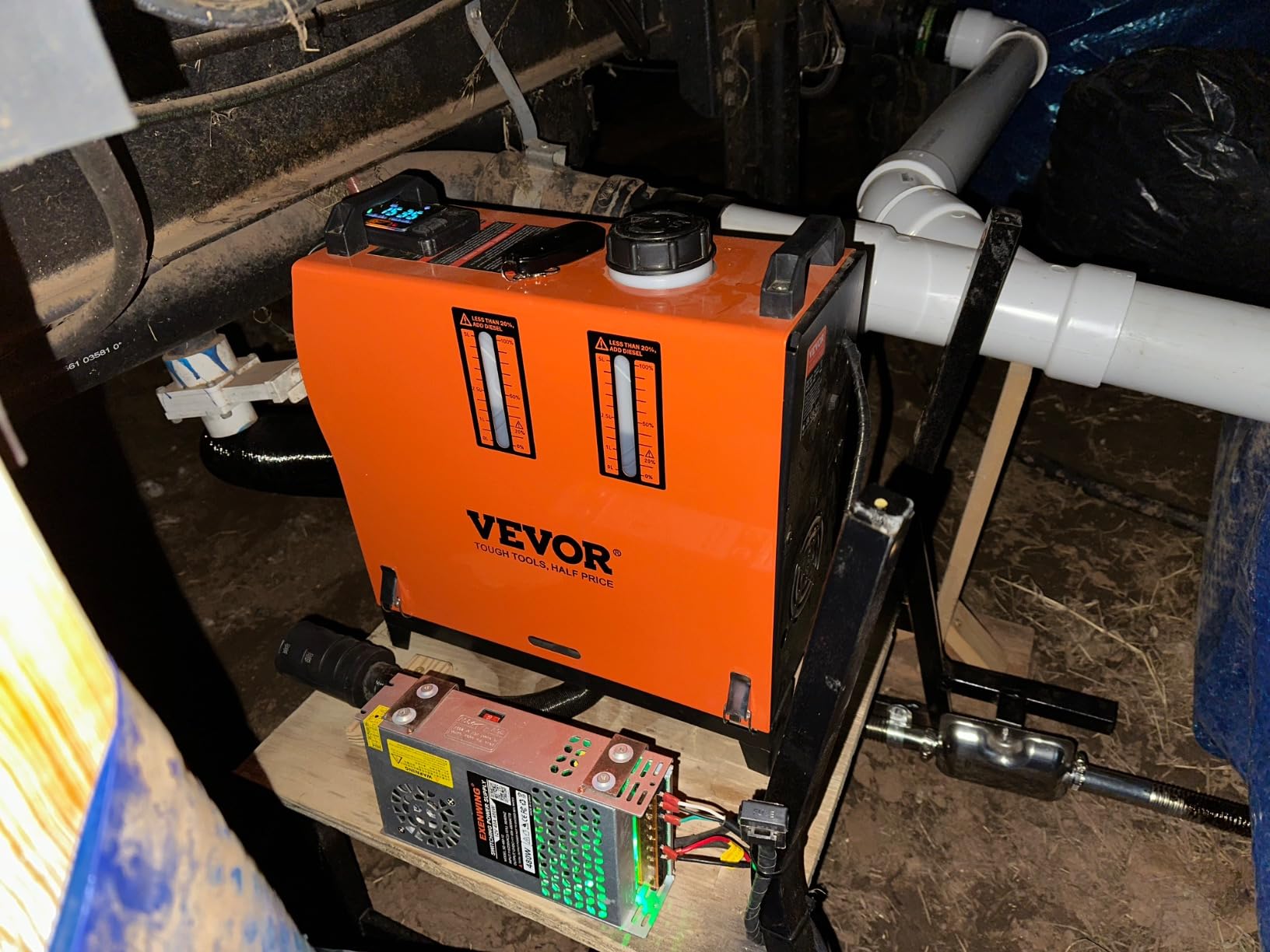
Automatic altitude compensation to 18,045 ft is the feature that separates this from cheaper all-in-ones, and owner reports on high-elevation trips repeatedly single it out. When thin air changes the fuel-to-air ratio, an unadjusted unit runs rich, smokes, and loses heat output. This one compensates on its own.
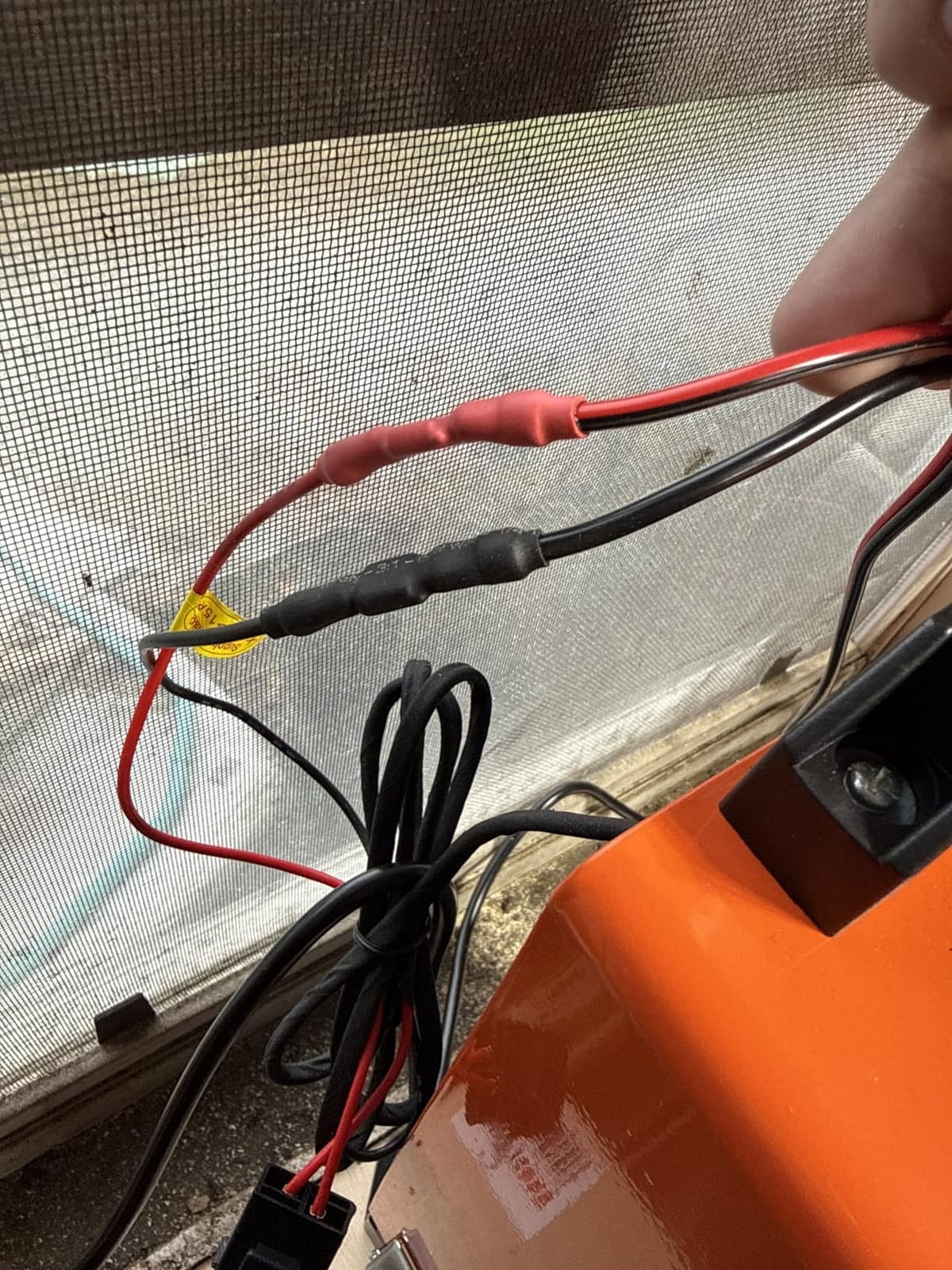
Control comes three ways: a Bluetooth app with a 30 m range, a 10 m remote, and an LCD panel. Owners like having all three. They also note that configuring all three is more than most people need, so pick the one you will actually use and leave the rest switched off.
Who the VEVOR 8KW suits
It suits large vans, box trucks and anyone heating a space over 20 m2 with a single unit. It also suits buyers who do not want to cut a single hole in their van, because the whole point of an all-in-one is that you place it, route the two hoses, and connect power.
If you are running propane and heating a large RV, the output headroom here is genuinely useful, and the constant temperature control means you are not cycling the burner on and off all night.
Who should skip the VEVOR 8KW
Skip it in a small van. Owners running 2 KW units report that the sensible answer is to run a smaller unit longer rather than a big one flat out, and 8 KW in a tight space is a short thermostat cycle, a louder blower, and fuel you burn for nothing. A smaller unit throttled down is both quieter and cheaper to run.
Also consider the fuel ceiling. At 0.62 L/h on high, the 5 L tank empties in roughly 8 hours, and the review record shows a 10% one-star share — the largest complaint cluster being fit-and-finish details and the app learning curve rather than heating failures.
3. VEPURLT 8KW with 15L Tank: The Longest Run Between Refills
- 15 L tank is the largest here and extends runtime between refills
- Low fuel consumption and Euro IV emissions
- Compact structure that is straightforward to install
- Automatic control with adjustable fuel power and temperature settings
- Separate components mean more assembly and ducting than all-in-one units
- Larger footprint than compact integrated heaters
The VEPURLT solves the problem the other all-in-ones create: how long before you are standing in the cold refilling a tank. At 15 L it holds roughly three times what a 5 L unit holds, and at the 0.2 L/h low setting that is a genuinely long stretch between fuel stops. For full-time winter van life where you do not want to handle a fuel can every morning, that matters.
It is a separate-component design, which is the whole trade. You get a fuel tank, a heater body, ducting and an included muffler, and you route them. The upside is serviceability: each piece is a discrete part rather than a sealed assembly.
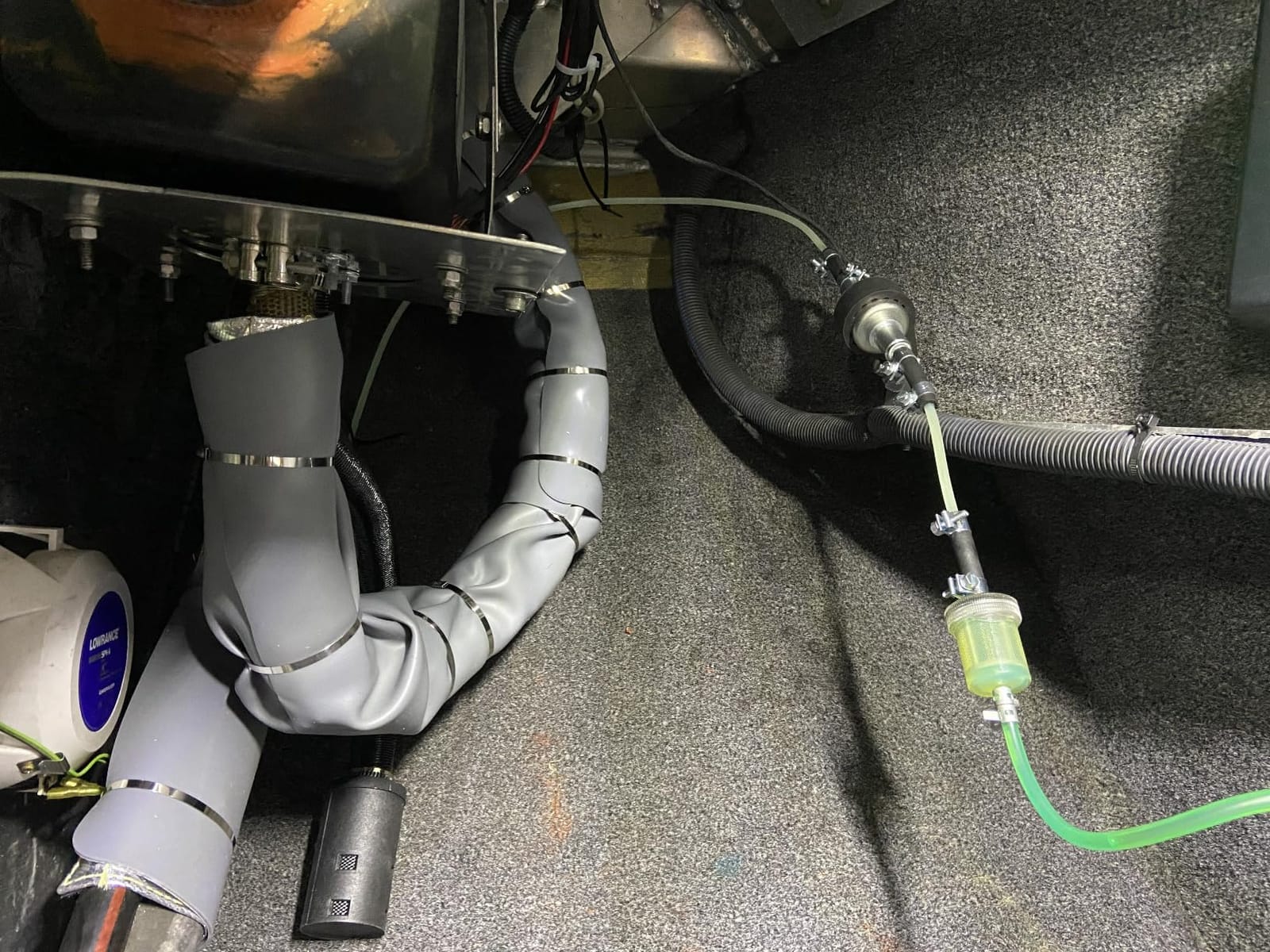
The ceramic ignition plug vaporises the fuel for fast ignition and complete combustion, and the whole unit is rated to run from -40C to +50C, with the fuel pump itself rated to -40C. That cold rating is a real differentiator when you are starting the heater at minus 30 before dawn.
The record on this one is solid for its volume — 407 reviews at 4.2, with 67% five-star. Owners like the tank size and the low running cost. The recurring criticism is not the heater but the install effort, and the 13% one-star share suggests the assembly experience is where some buyers bounce.
Who the VEPURLT 8KW suits
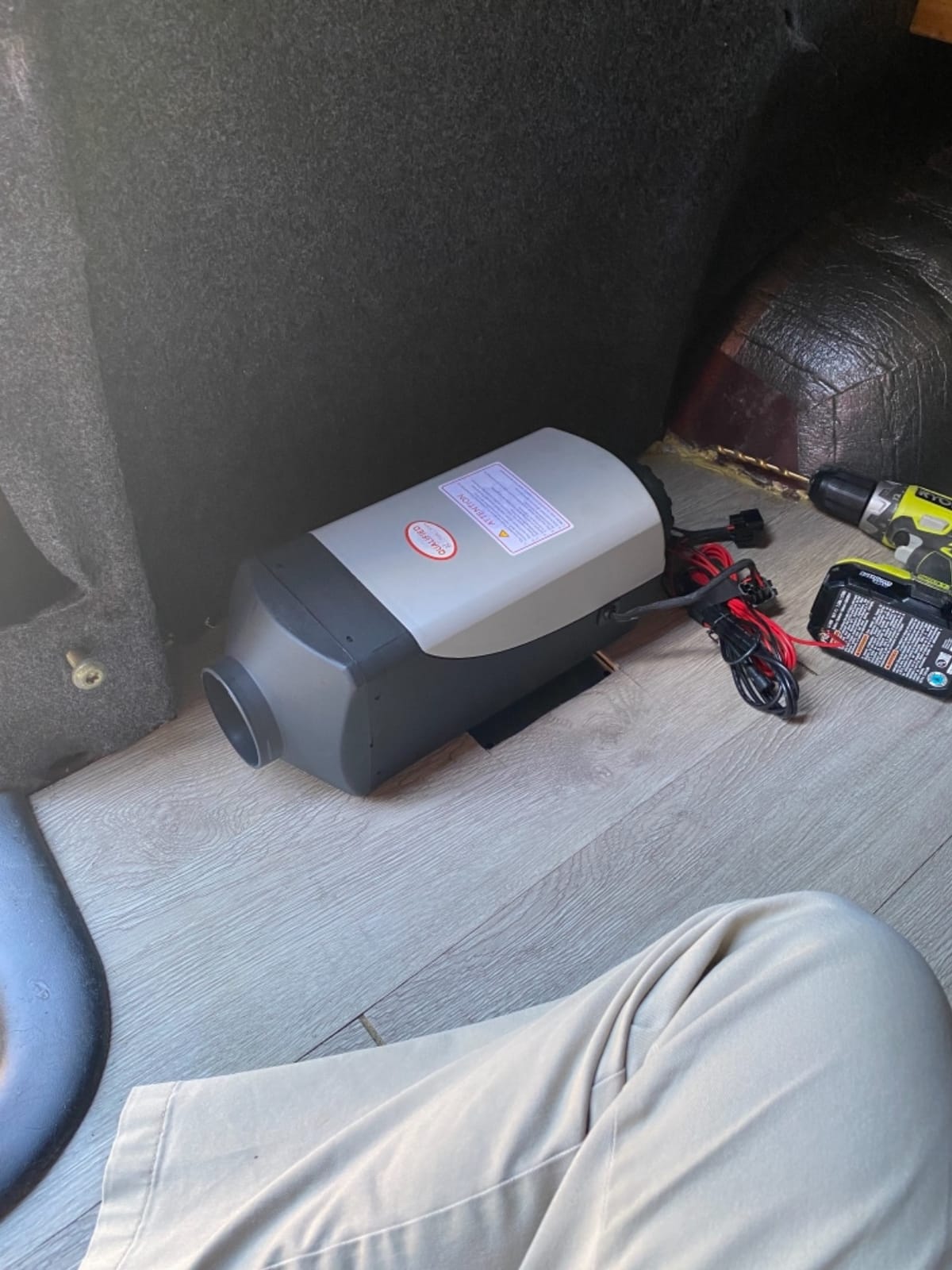
It suits full-timers, winter-season skiers, and anyone who would rather carry fuel than carry a refill schedule. The 18.11 x 17.72 x 10.24 inch footprint still fits behind a seat or under a raised floor in most high-roof vans.
It also suits buyers who want to service their own heater. Separate components mean you can replace a fuel pump, a muffler or a duct length independently instead of replacing a sealed unit.
Who should skip the VEPURLT 8KW
Skip it if you want to be running the heater within an hour of delivery and you have never routed ducting before. This is not a difficult install, but it is a real install, and first-time builders consistently underestimate the time spent sealing and routing intake and exhaust.
Skip it if weight and footprint matter more than runtime. At 16.19 pounds with a bigger housing than the integrated units, you are trading compactness for capacity.
4. VEVOR 8KW 12V/24V with CO Alarm: The Safest-Equipped Unit Here
- Built-in CO alarm with alerts and auto shut-off
- Premium muffler and fuel pump keep noise low
- Combustion efficiency of 96% or better at 0.18-0.4 L/h
- Die-cast aluminum body with ceramic igniter
- Three control methods including app and remote
- Heaviest mainstream unit at 19.8 pounds
- Requires a 15A+ capable 12V supply for full output
Safety is the reason to look twice at this one. It has a built-in carbon monoxide alarm with audible alerts and automatic shut-off, and almost nothing else in this price bracket ships with one. If you are new to combustion heaters, having the unit watch itself is a meaningful step up from bolting a separate detector to the wall and hoping you wired it right.
On paper it is also the most efficient 8 KW unit here: 0.18-0.4 L/h with combustion efficiency of 96% or better. The die-cast A380 aluminum body with reinforced nylon 6 housing is a sturdier material stack than the plastic-cased units at the same output.
Noise is listed at 75 dB or below thanks to the muffler and pump, and the 4.4 rating with 6% one-star share is the second-strongest rating record in the set. Operating noise sits at the top of what you can expect from a portable diesel heater, so it belongs at the foot of the bed, not beside it.
Who the VEVOR 8KW CO-alarm model suits
It suits first-time heater owners, families with children sleeping in the van, and anyone wintering in a small space where a CO event has no warning. The auto shut-off is the feature that turns a fault from dangerous into inconvenient.
Dual wiring options — an adapter and direct DC 12V — let you plug it into a power station, a battery, or a vehicle outlet, which makes it flexible for garage use during the build phase.
Who should skip the VEVOR 8KW CO-alarm model
Skip it if your electrical system cannot deliver 15 amps continuously at 12V. That requirement is real, and on a small starter battery with a frayed lead you will chase phantom fuel-pump failures that are actually voltage drops.
At 19.8 pounds it is heavy for a portable unit. And if you already own a certified CO detector mounted near the sleeping area, the built-in alarm does not replace it — a portable unit that gets moved around the van is not a fixed-location detector.
5. HCALORY 8KW Toolbox MAX: The Longest Unattended Runtime
- 7.5 L toolbox tank gives up to 62.5 hours on minimum setting
- Wireless remote doubles as an indoor thermostat
- Silent fuel pump removes the usual ticking
- Works across 110V 12V and 24V
- Automatic altitude compensation to 18000 ft
- Heaviest unit reviewed at 26.8 pounds
- Highest price among the 8 KW toolbox heaters
- 65 dB duct noise is still noticeable at maximum output
The HCALORY is built around one idea: let the heater live outside the living space and control it from inside. The 7.5 L tank is housed in a toolbox format, and the wireless remote doubles as an indoor thermostat, so the unit can sit in a bay, a garage, or the back of a pickup while you control temperature from the bed. That solves both the noise problem and the space problem at once.
Listed runtime is up to 62.5 hours on minimum setting, with a warm-up time of about 3 minutes. For someone running a heater overnight in sub-zero conditions without wanting to think about fuel, that is the single most useful number on this page.
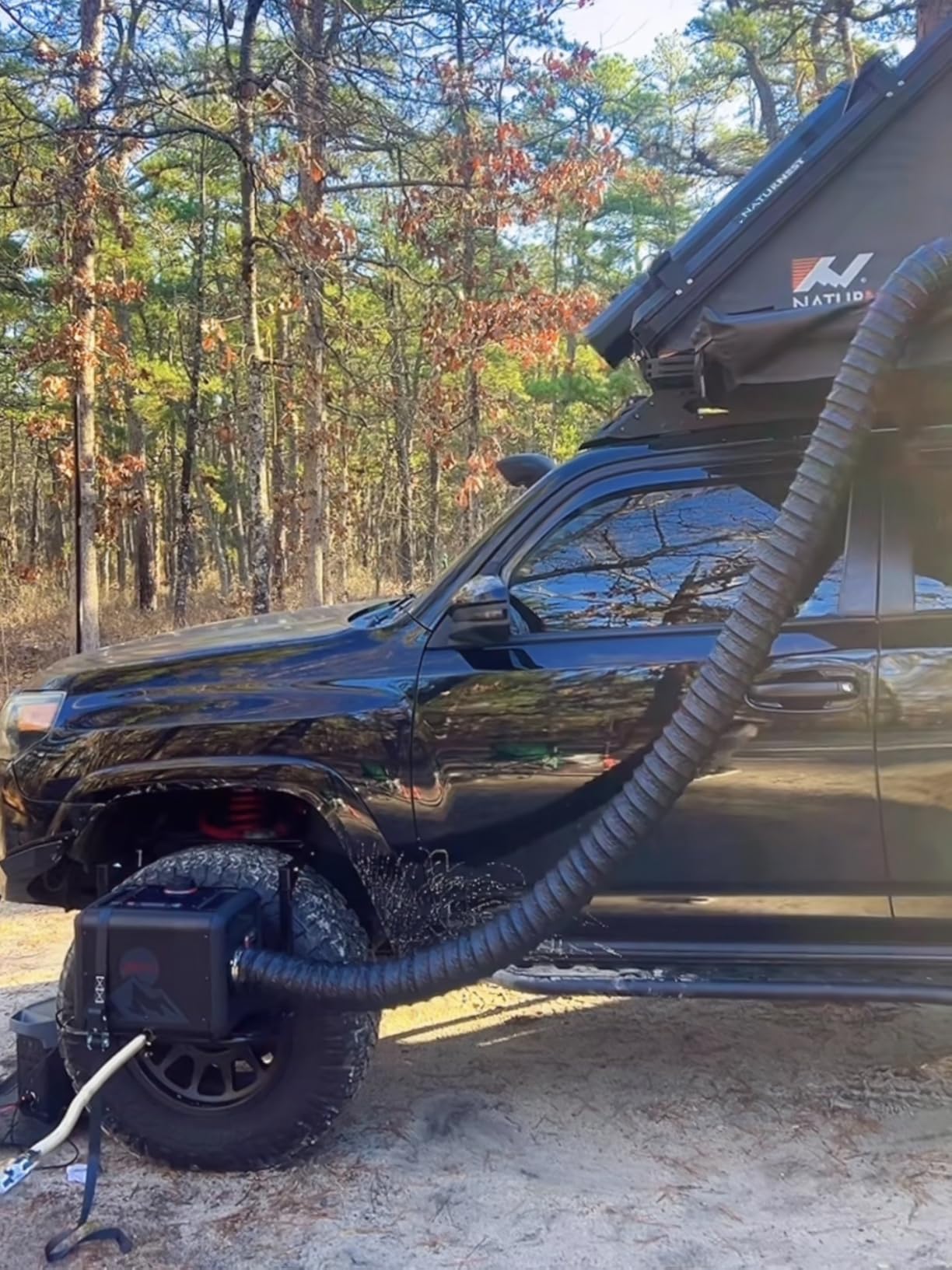
The upgraded silent fuel pump is a direct answer to the ticking noise that owners of other budget units complain about most. Duct noise is 65 dB at the air outlet, which is the lowest figure in this set, though owners still note it is audible at maximum output.
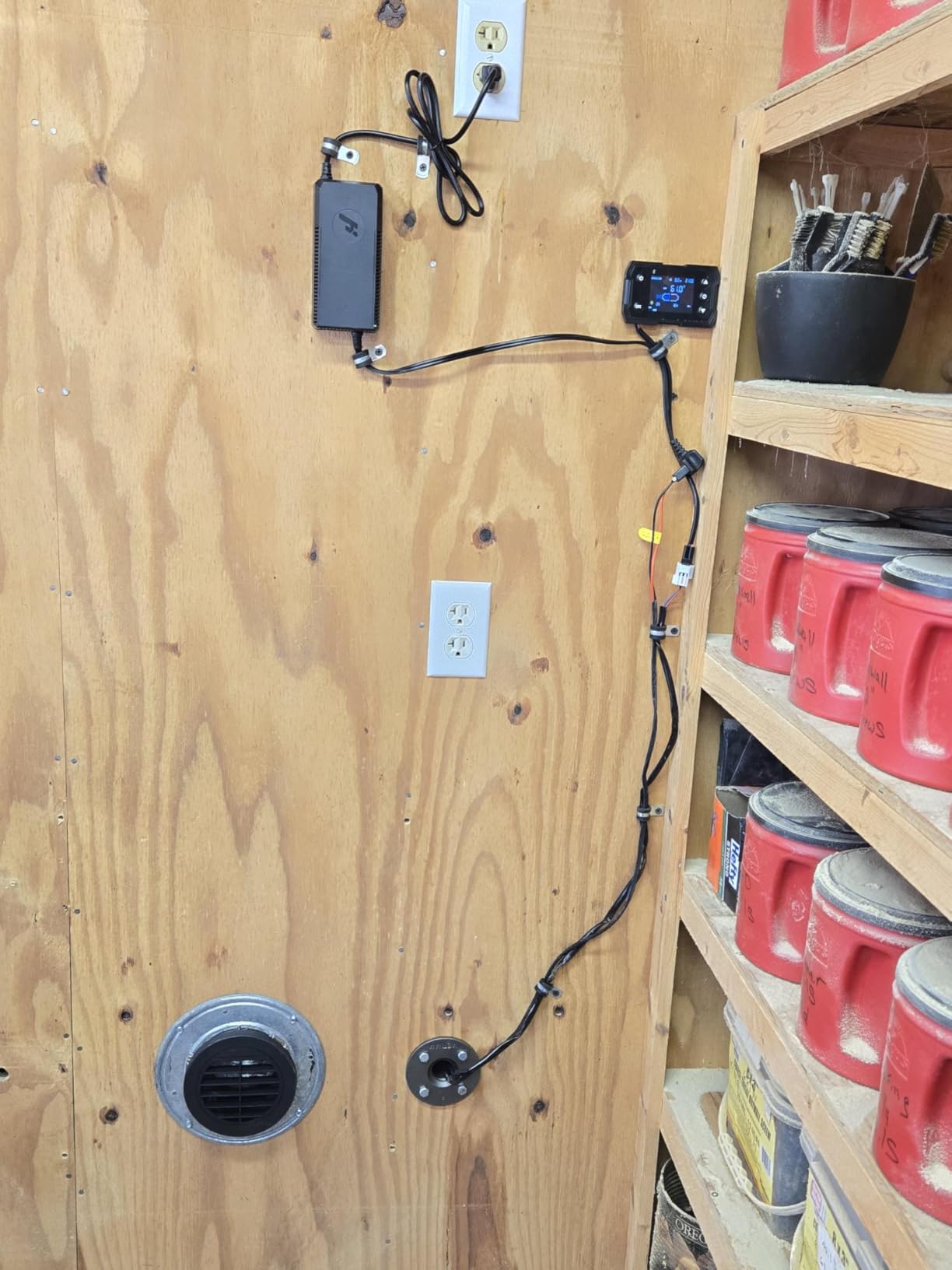
Two things hold it back. At 26.8 pounds it is the heaviest unit we reviewed, and it carries the largest one-star share among the 8 KW models at 18%, which usually points to packaging and shipping damage rather than heater failure but is still worth factoring in if you are buying ahead of a season.
Who the HCALORY Toolbox MAX suits
It suits van builders who want the heater out of the living area entirely, and it suits anyone whose van has no natural cavity for a 20-pound-plus appliance. The toolbox format also means you can keep it with gear rather than bolting it down permanently.
Altitudes up to 18,000 ft are handled automatically, which makes it a candidate for winter routes through mountain passes rather than just lowland campsites.
Who should skip the HCALORY Toolbox MAX
Skip it if lifting 26.8 pounds into a high van bed is outside what your install can handle, and skip it if budget is tight, since it is the most expensive of the 8 KW toolbox units we looked at. The 4.0 average rating is also the lowest among the 8 KW models here.
If you plan to sleep with the duct outlet in the same compartment as your head, the 65 dB figure is still too loud. Plan the ducting, not just the purchase.
6. maXpeedingrods 2KW: The Small-Space Most Versatile
maXpeedingrods 2KW Diesel Heater 12V/24V, App Remote Control,LCD Control
- Compact 2 KW footprint fits where larger units cannot
- Lowest fuel burn range of any unit here at 0.16-0.24 L/h
- Low-frequency pulse fuel pump keeps noise down
- App remote and LCD control
- Automatic altitude compensation above 5500 m
- 2 KW output is modest for large spaces or supplementary heating only
- Separate components mean more install work than an all-in-one
If your van is small, this is the honest answer rather than a compromise. A 2 KW unit at 0.16-0.24 L/h is the least thirsty heater in this roundup, and owners running 2 KW units consistently describe the output as comfortable precisely because it can be run longer at a lower setting instead of blasting on high.
At 12.79 pounds and 18.5 x 15.94 x 10.63 inches it installs where bigger units will not fit at all. Gasification technology with a ceramic igniter handles the burn cleanly, and the low-frequency pulse pump is the reason it does not tick itself to sleep in the corner of the van.
One owner in owner discussions reported running a maXpeedingrods 2KW close to three years without incident, and that kind of long-run report is rarer than it should be in this category. The 274-review record at 4.2 with a 17% four-star share suggests a well-liked unit rather than a lucky one.
Who the maXpeedingrods 2KW suits
It suits small vans, teardrop trailers, cargo vans used for weekend trips, and anyone heating a sleeping area rather than a whole living space. Owner experience also supports it as a supplementary heater in a large rig that already has another heat source for the main volume.
App control through the Booyood app plus remote and LCD gives you the same control options as units costing more than twice as much.
Who should skip the maXpeedingrods 2KW
Skip it if you are heating a full high-roof van in deep winter. Consensus across owner discussions is that 2 KW is enough for most vans, and the dissent comes from owners of larger RVs who found 2 KW underpowered. Know which one you are before you buy.
It is also a separate-component design, so you are still routing intake, exhaust and ducting. If you wanted the box-out-of-the-box experience, the all-in-one units are the better fit.
7. BougeRV 5KW: The Fastest Warm-Up in the Set
BougeRV 5KW Diesel Heater, 5L All-in-One Portable Air Diesel Parking Heater
- Warms 307 cubic feet from 32F to 68F in about 8 minutes
- Highest five-star share in the set at 76%
- Silent oil pump and silent muffler
- App and remote control with preheat and timer
- 5-layer safety protection and 2-year technical support
- Small-bore exhaust pipe can clog with soot and let fumes into the space
- Screw-in exhaust threads are fiddly to assemble
- Exterior control panel detaches easily when moved
The BougeRV posts a stated warm-up of 307 cubic feet from 32F to 68F in 8 minutes, and owners back that up. For a van where you get out of your bag at minus temperatures and want the space live before you make coffee, that speed is the whole selling point.
It runs from 12V and 24V DC as well as 110V and 220V AC, so the same unit covers a workshop bench and a vehicle. The 5 L tank gives 9-27 hours depending on setting, and app control with preheat and timer reaches about 33 ft.
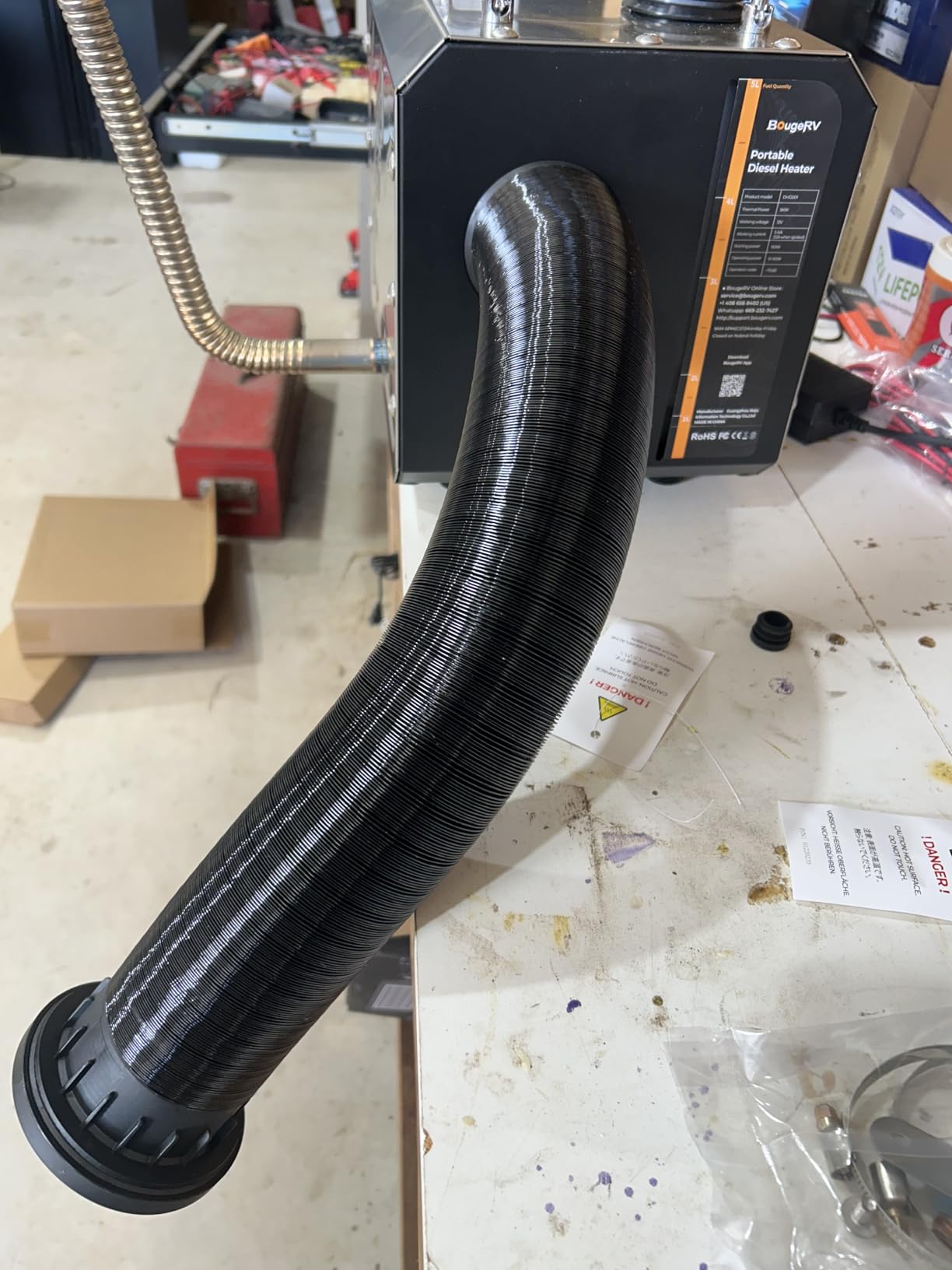
Five layers of safety protection are listed, covering overheat, short circuit, reverse connection, overvoltage and a leak-proof fuel path, with 2-year technical support behind it. The 76% five-star share is the highest in this roundup.
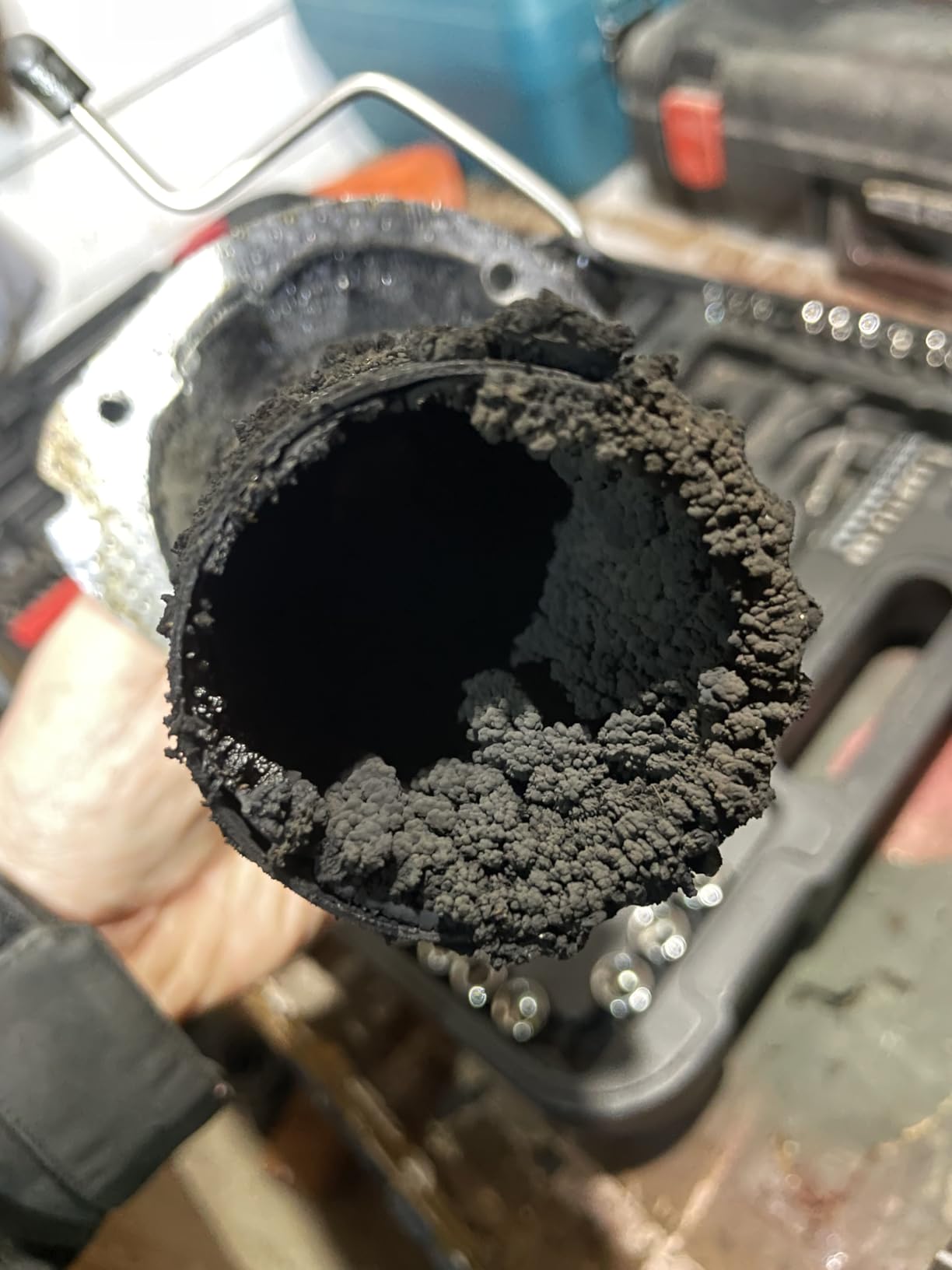
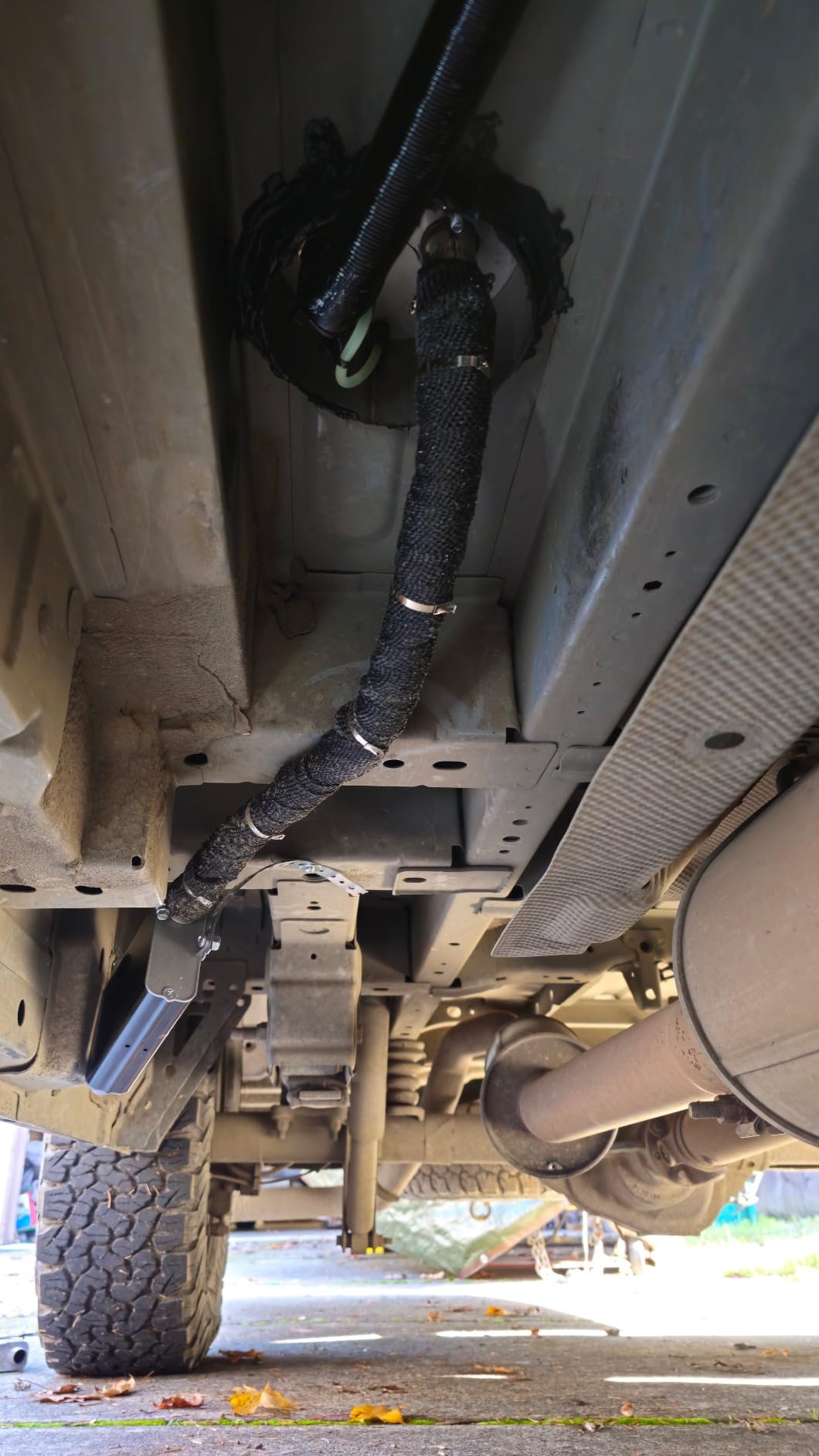
The serious reported complaint is the exhaust. Owners describe a small-bore exhaust pipe that can clog with soot and allow fumes back into a camper. Treat the exhaust routing as a maintenance item, not a set-and-forget fitting, and check it every few months through a heating season.
Who the BougeRV 5KW suits
It suits cold-climate campers who are out of the bag at dawn and want heat fast, and buyers who want a single box that works in the van and in the garage during the build. The 15.3 x 9.7 x 12.4 inch footprint and one-minute install claim make it a genuinely drop-in unit.
It also suits anyone who wants a heated space for a tent, boat or patio as a secondary use alongside the van.
Who should skip the BougeRV 5KW
Skip it if you cannot check the exhaust. A clogged exhaust in a sleeping van is the one failure mode that turns a heating accessory into a safety problem, and this unit’s exhaust is the specific component owners flag.
At 22 pounds it is not a lightweight carry, and the screw-in exhaust threads are reported as awkward to assemble in cold hands. Budget time and a bit of thread sealant for the first setup.
8. VEVOR 2KW with 10L Tank: Best Fuel Economy and Best-Sealed Housing
- Lowest fuel consumption in the roundup at 0.12-0.26 L/h
- Large 10 L tank gives up to 38 hours of runtime
- IP67 waterproof housing for outdoor and marine mounting
- Lightest 2 KW unit at 11 pounds
- Bluetooth app remote and LCD all included
- Lowest average rating in the set at 4.1
- Separate-component design means more installation and ducting work
- 2 KW output suits only small spaces or supplementary heating
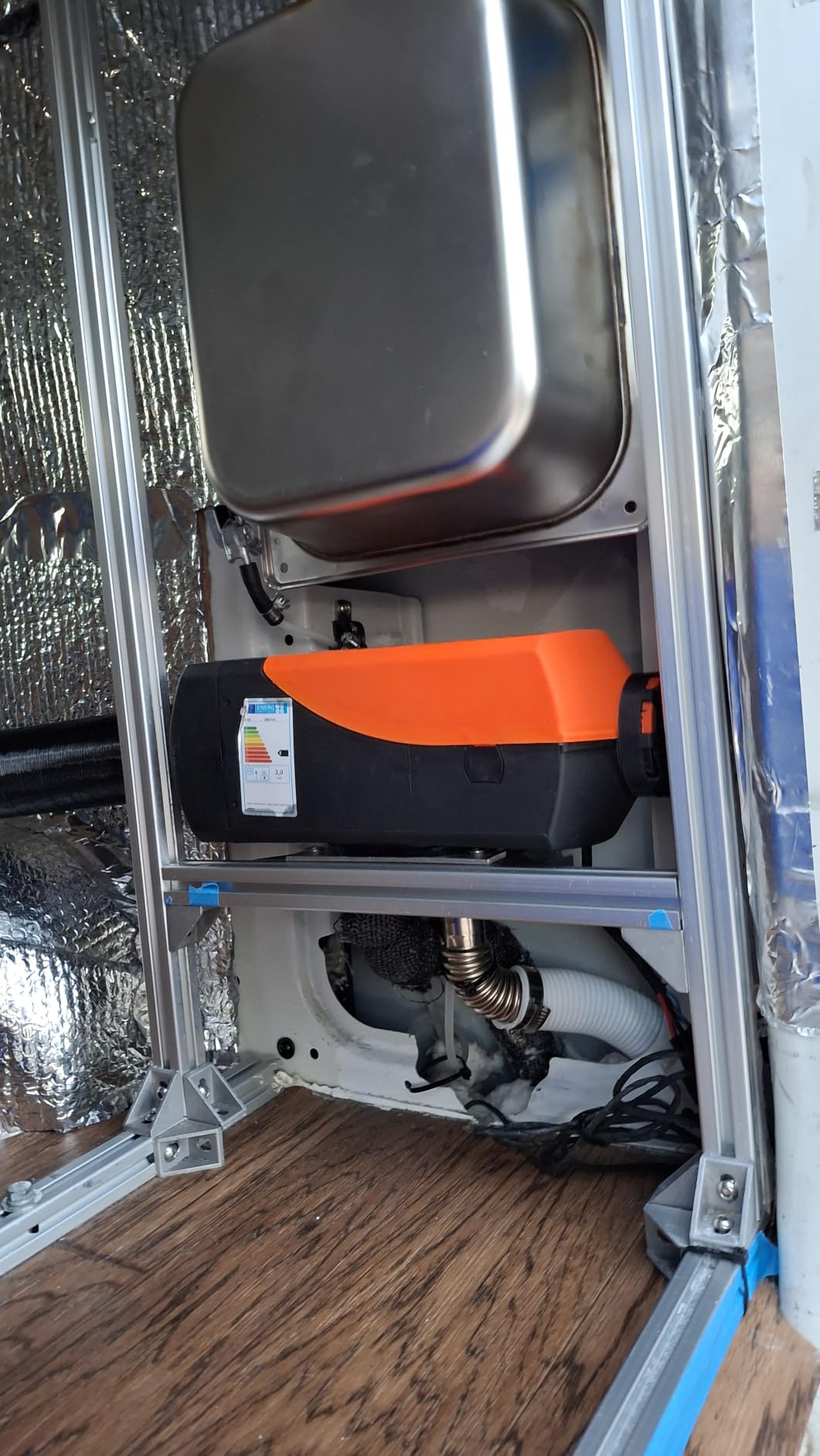
On paper this is the most economical heater here. Fuel consumption of 0.12-0.26 L/h is the lowest range in the roundup, and paired with a 10 L tank it yields a listed runtime of up to 38 hours. If your priority is nights per litre, the maths here is hard to argue with.
At 11 pounds it is the lightest 2 KW unit in the set, and the IP67 waterproof enclosure means you can mount it where spray and rain are a factor, which is also useful on a boat or in an open-backed truck camper.
Altitude compensation runs to 18,045 ft, and the 108-161 ft2 coverage figure lines up with a small cargo van or a well-insulated camper body. Control is app, remote and LCD, with constant temperature control, timing, voice broadcast, preheating and overheat protection at 270C.
Be aware of the record: 44 reviews at 4.1 is the thinnest and lowest-rated data set here, which is what a newer listing looks like rather than a fault. Owners praise the tank, the fuel burn and the app, and the rating reflects limited capacity for larger spaces plus a multi-component install.
Who the VEVOR 2KW 10L tank suits
It suits small vans and anyone who wants maximum runtime from the smallest possible burn. The 10 L tank at 2 KW is a combination that gives you genuinely long intervals between fuel stops, which suits long stretches without fuel access.
The IP67 housing also makes it the natural choice for anyone running a heater in an open-sided rig or a boat where spray is a factor.
Who should skip the VEVOR 2KW 10L tank
Skip it if you want the simplest possible installation. Separate components mean more assembly and ducting work than an integrated unit, and first-time installers report that as the main reason for the lower rating.
Skip it if you are heating a large van. 2 KW is sized for 108-161 ft2, and running it constantly in a bigger space is how you end up with a heater that never quite catches up.
9. ZBJinG 8KW Air and Water Combo: The Only Heater Here That Makes Hot Water
8kW Diesel Heater 12V All In One Air Water Combo With Aluminum Housing
- Only unit here that heats living space and domestic water at the same time
- Aluminum housing with aviation connectors is more durable than plastic cases
- Seven adjustable levels let you balance heat against noise
- Wireless remote has long range and confirms out of range
- LCD shows fault codes with suggested fixes
- Instructions are in Chinese or Japanese and sparse for DIY installers
- Requires careful fuel exhaust intake and electrical routing
- Remote and display feel cheap
- Some variants are 24V so check voltage before purchase
This is the odd one out in the roundup, and the oddness is the point. It heats air and domestic water simultaneously, with seven adjustable output levels and four water heating modes covering timed, constant temperature, maximum and combined. Owners who already understand diesel heater systems rate it highly and some compare it favourably to premium brand units on durability alone.
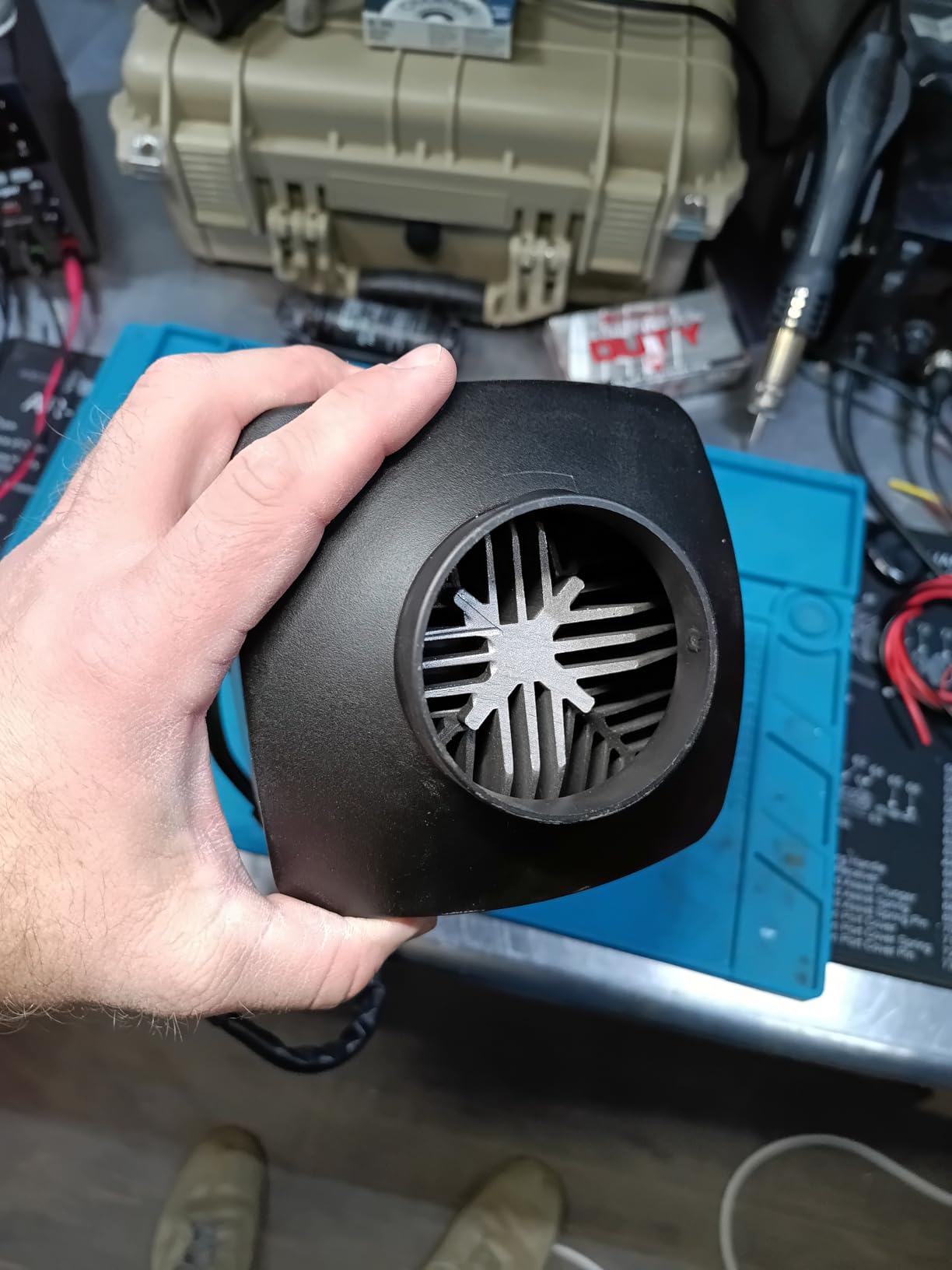
The aluminum housing with aviation connectors is a better material choice than the plastic-cased units at the same output, and an engine preheat function extends the idea to semi trucks and trucks in freezing weather. Operating range goes down to -40 degrees with auto mode and a high-temperature alarm protecting the cycle.
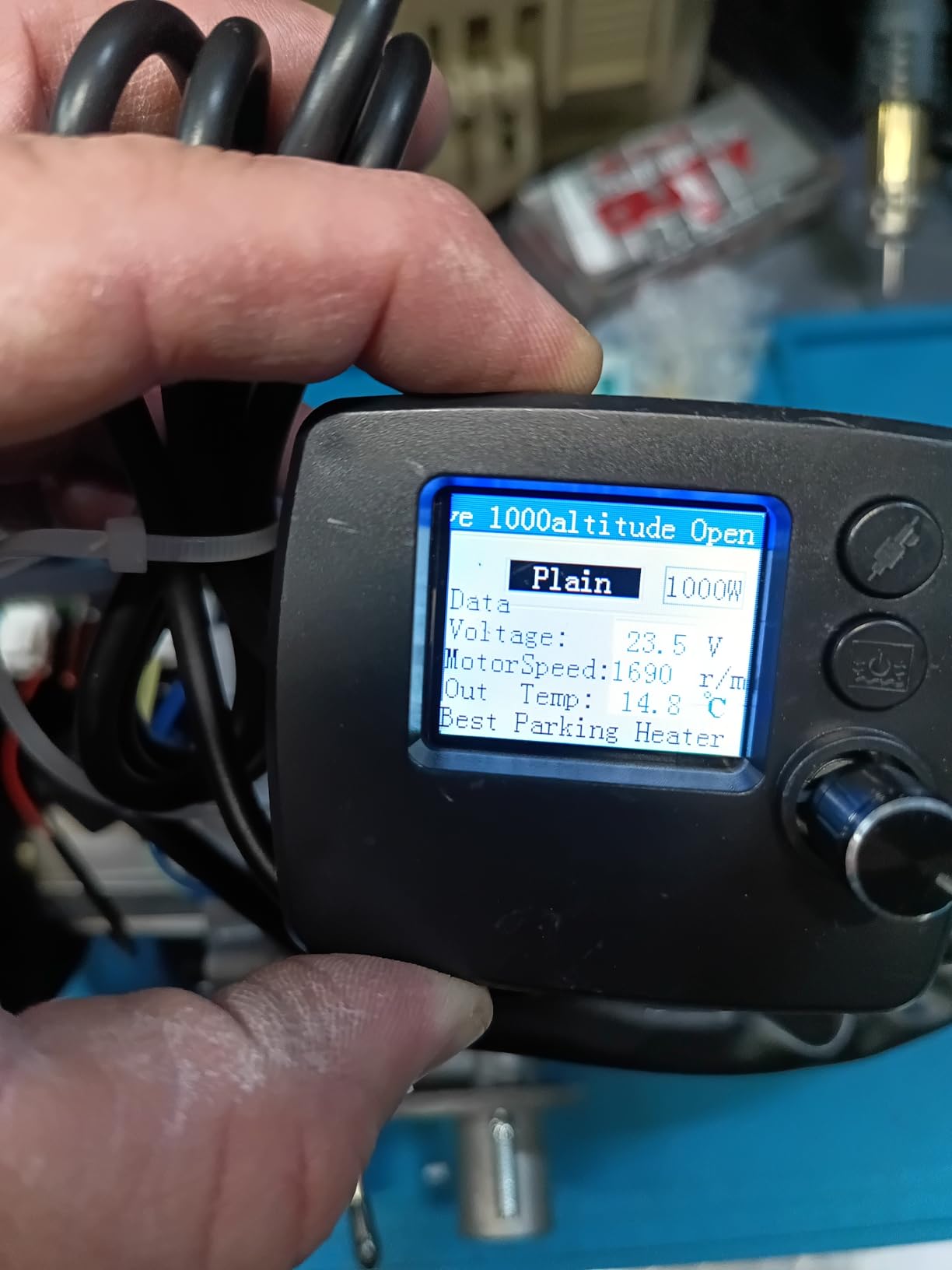
The controller is an STM32 microcontroller, and the LCD reports fault codes with suggested fixes rather than a blinking light. Seven speed levels give you a real control over the noise-to-heat ratio instead of a single on-off decision.
The documentation is the weak point. The manual is in Chinese or Japanese and is written for experienced or professional installers, and with only 45 reviews the field feedback is still thin. The 4.3 average is promising, but verify your voltage first, because some variants are 24V and buying the wrong one is an expensive mistake.
Who the ZBJinG combo heater suits
It suits builders who want hot water without a separate boiler, a boiler drain, or a second fuel line. Running air and water from one burner simplifies a build that would otherwise carry a full hydronic system.
It also suits truck and RV owners in freezing conditions who want a preheat function alongside cabin heat, and anyone comfortable with a documented, wired installation rather than a drop-in box.
Who should skip the ZBJinG combo heater
Skip it if you are a first-time installer who needs the manual to get through step one. Sparse documentation in a language you do not read, for a heater that needs careful fuel, exhaust, intake and electrical routing, is a real barrier.
Skip it if you only need air heat. Paying for water-heating hardware you will not use adds cost, complexity and a larger exhaust and fuel run to route.
10. Eberspächer Airtronic AS3 D2L: The Permanent-Install Choice
Eberspacher Espar Airtronic Heater Kit AS3 D2L (Diesel) 12V Upgraded Version of The S2 D2
- OEM-grade build from an established diesel heater manufacturer
- Brushless fan and dampened fuel piston run quieter
- Integrated temperature sensor with stepless blower control
- Works to -46C and to 18000 ft
- Plug-and-play install and reuse of existing Eberspacher controllers
- Far higher cost than generic aftermarket heaters
- 2 kW output is lower than most 5-8 kW units here
- Needs fuel exhaust and ducting routed rather than a single box placement
Everything else on this list is a portable appliance. The Eberspächer Airtronic AS3 D2L is a piece of vehicle equipment, and that changes how you should evaluate it. It is designed for under-seat installation in a camper van, drawing fuel from the vehicle tank through a standpipe or auxiliary tap, with exhaust and ducting routed permanently.
Heat output is 2 kW / 6824 BTU maximum, rated to operate down to -46C / -50F, with an integrated altitude sensor handling up to 18,000 ft. That -50F operating rating is the coldest figure on this page, and for winter mountain travel it is the number that matters.
The brushless fan and dampened fuel pump piston are the quietest hardware here, and the listed service life is up to 5,000 hours with a 2 year / 2,000 hour manufacturer warranty. It supports CAN, LIN and S+ protocols, so earlier Eberspächer controllers can be reused on a second install.
With only 30 reviews this is the thinnest data set in the roundup, so treat the rating as indicative. What you are really buying is parts availability, dealer service and a unit that will still be repairable in five years, and that is a fundamentally different proposition from the other nine.
Who the Eberspächer Airtronic suits
It suits full-time van builders committing to a permanent install, anyone who plans to keep the van for years, and buyers who would rather solve the heater once than replace an appliance every few seasons. The under-seat footprint and up to 15 m of adaptable ducting with closable 60 mm or 75 mm outlets make it layout-flexible.
It also suits buyers who already own Eberspächer control hardware, since protocol compatibility means one controller can run the whole build.
Who should skip the Eberspächer Airtronic
Skip it if you are still deciding whether you want a heater at all, or if you want something running tonight. This is a permanent commitment to routing fuel, exhaust and intake through the vehicle, and the cost difference against a generic unit is an order of magnitude.
Skip it if you want high output. 2 kW is the modest end, appropriate for a well-insulated van and supplementary heating rather than heating a large uninsulated space on its own.
How to Choose a Diesel Heater for Your Van in 2026
Pick your tier before you pick a brand
Three tiers cover almost every real case. An all-in-one portable unit such as the LF Bros 5KW, the VEVOR 8KW or the BougeRV 5KW needs no drilling and can be moved between the van and the garage. A separate-component unit such as the VEPURLT 8KW or the VEVOR 2KW gives you bigger tanks and serviceable parts at the cost of a real install. A permanent-install unit such as the Eberspächer Airtronic is a vehicle system, not an appliance, and it is the only tier where dealer support is a genuine part of the purchase.
Most first-time buyers are better served by tier one, and can always move up. The decision that is hard to reverse is the permanent install, because it determines your fuel routing for the life of the build.
2kW or 5kW: size to the space, not to the weather
The common sizing rule is 1 kW per 14 cubic metres, and a camper van interior is a small, enclosed volume that loses heat quickly through its shell, so the practical figure for a van is roughly double that per room. A 108-161 ft2 space is the coverage band the 2 KW units here are rated for, while 215-269 ft2 is the band the 5-8 KW units target.
Owner consensus lines up: 2 kW is enough for most vans, run longer at a lower setting rather than hotter. The dissent comes from owners of larger RVs who found 2 kW underpowered. The failure mode of an oversized heater is not comfort, it is a short cycling thermostat, a loud blower and wasted fuel.
What it actually costs to run
Convert litres per hour into the only unit that matters. A 2 kW heater running at its 0.16-0.24 L/h range for 8 hours overnight uses roughly 1.3 to 1.9 L. A 5-8 kW unit at its 0.5 L/h setting for the same 8 hours uses about 4 L. Multiply by your local road diesel price and you have your nightly number, which is the calculation almost every competitor article skips.
Over a full winter season, the difference between a 2 kW unit run frugally and a 5-8 kW unit run flat out is a meaningful share of a heater’s purchase cost. It is also the strongest argument for buying the smaller unit if your van is small enough to run it comfortably.
Battery draw and the van’s electrical budget
Heaters are the largest single load most van electrical systems carry. The LF Bros is rated at 15 A, and the VEVOR 8KW CO-alarm model needs a 15A+ capable 12V supply for full output. A heated van is typically drawing 120-200 Ah over a 24-hour cycle depending on runtime, settings and how many other loads are live.
Plan for a second battery dedicated to the heater, a dual-charging setup, or a power station, and make that decision before you install rather than after your first cold morning.
Altitude: above 1,500m, adjust or lose output
Thin air changes the fuel-to-air ratio, and an unadjusted heater runs rich, smokes and loses heat output. Around 1,500m is the threshold where unadjusted units start to struggle, and mountain passes go well beyond that. Automatic altitude compensation is the single most valuable feature on a mountain route, and four of the ten units here claim it, rated variously to 18,000 ft or to 5,500 m.
The Eberspächer and the HCALORY both use automatic or sensor-based compensation, as do several VEVOR models. If your winter route involves altitude, make this a hard requirement rather than a nice-to-have.
Diesel gelling and the cold-weather failure story
Below roughly -20C, diesel waxes and gells, and the first casualty is usually the fuel pump. This is the failure owners describe most often, and it is seasonal rather than random. The fix is preventive: a rated anti-gel additive in the tank ahead of a deep-cold trip, and a fuel line that is not running through an unheated section of the van.
Two units here carry cold ratings worth noting. The VEPURLT’s fuel pump is rated to -40C, and the Eberspächer operates to -46C. The ZBJinG runs to -40 degrees with auto mode.
Safety rules that are not optional
Run a certified carbon monoxide detector near your sleeping area, and treat it as separate from any built-in heater alarm. Keep the combustion air intake outside the van, and keep the exhaust discharging outside the vehicle body with the outlet well clear of any opening. Route intake and exhaust with roughly 50 cm of separation and make sure the exhaust exits past the van edge, not into a wheel arch.
Never run a diesel heater while the vehicle is in motion. Never refuel from a running heater. And run a high-output boost cycle for about 10 minutes before shutdown — heat soaks into the heat exchanger, burns off over time, and the carbon that would otherwise build up inside the unit is the residue you avoid. This is why the fuel-to-air ratio chart on budget units is worth learning: you can trim burn quality yourself.
What happens when a heater fails mid-trip
Parts availability is the question owners ask most and competitors answer least. Generic units have their weakest link in the parts ecosystem, not necessarily the heater body — supplied fuel tanks and fuel pumps are the components most often replaced. Name-brand units have dealers, but dealers may decline to service a DIY installation or charge premium labour for it.
A practical middle path: carry a spare fuel pump, a spare fuel line and a smoke or CO alarm, and know whether your heater’s parts are available from a source that will actually ship to you. If your route is remote, that knowledge is worth more than a spec sheet.
For the plumbing side of a build, our tankless water heater guide covers the other major utility decision most van conversions face.
Frequently Asked Questions
What are the best diesel heaters for campers?
For most vans the best choices fall into three tiers: an all-in-one portable unit for quick heat with no install, a separate-component unit for bigger tanks and serviceable parts, and a permanent-install brand unit for full-time builds. Pick the tier that matches how long you will keep the van before you compare brands.
What type of heater is best for a camper van?
A 12V diesel heater is best for most vans because it burns the vehicle’s own fuel, produces dry heat that does not create condensation, and runs all night on a single battery. Propane is simpler to install but produces wet heat and needs bottles carried. Electric heaters only work on shore power or heavy inverter setups.
What size diesel heater do I need for my van?
A 2 kW unit is enough for most camper vans, and owners report that running it longer at a lower setting is quieter and cheaper than a larger heater on high. Move to 5 kW or 8 kW for a large high-roof van, a converted bus, or a poorly insulated build. Check the rated coverage in square feet against your interior volume.
What brand diesel heater is best?
For a permanent install with dealer support, Webasto and Eberspächer are the established names. For the best value per unit of heat, VEVOR, LF Bros and BougeRV dominate owner recommendations. The off-brand risk is inconsistent quality control rather than universal failure, so buy from a seller with straightforward returns.
How much does it cost to run a 2kW heater for 1 hour?
A 2 kW heater typically burns 0.12 to 0.24 litres per hour depending on setting. Multiply that by your local diesel price for the hourly figure, and double it roughly for an eight-hour night. A 5-8 kW unit at its higher setting burns closer to 0.5 L/h, which is why sizing to your van matters more than brand.
Can you run a diesel heater while driving?
No. A diesel heater must never be run while the vehicle is in motion. It draws combustion air and discharges exhaust in ways that are not safe on a moving vehicle, and regulations in many regions prohibit it. Plan to heat only while parked, and never refuel from a running heater.
Do diesel heaters work at high altitude camping?
They do, but unadjusted units lose output because thin air changes the fuel-to-air ratio. Above roughly 1,500m expect reduced performance from a unit with no altitude compensation. Units rated to 18,000 ft or 5,500 m adjust automatically, and that is a requirement rather than a nicety on mountain routes.
The Verdict for 2026
Our pick of the best diesel heaters for camper vans this year is the LF Bros 5KW, because it is the only unit in this roundup that runs from 12V, 24V and mains, carries the largest review record at 4.3 stars, and ships with a threaded fuel cap that solves the spill problem owners complain about most. Buy it if you want flexibility now and permanence later.
Choose the VEVOR 8KW if you have a large van and want the most heat with the least installation, the maXpeedingrods 2KW if your space is small and fuel thriftiness matters most, and the Eberspächer Airtronic only if you are committing to a permanent install you will keep for years. Whichever you pick, duct the exhaust properly, keep a CO detector near your head, and never run it while driving.