
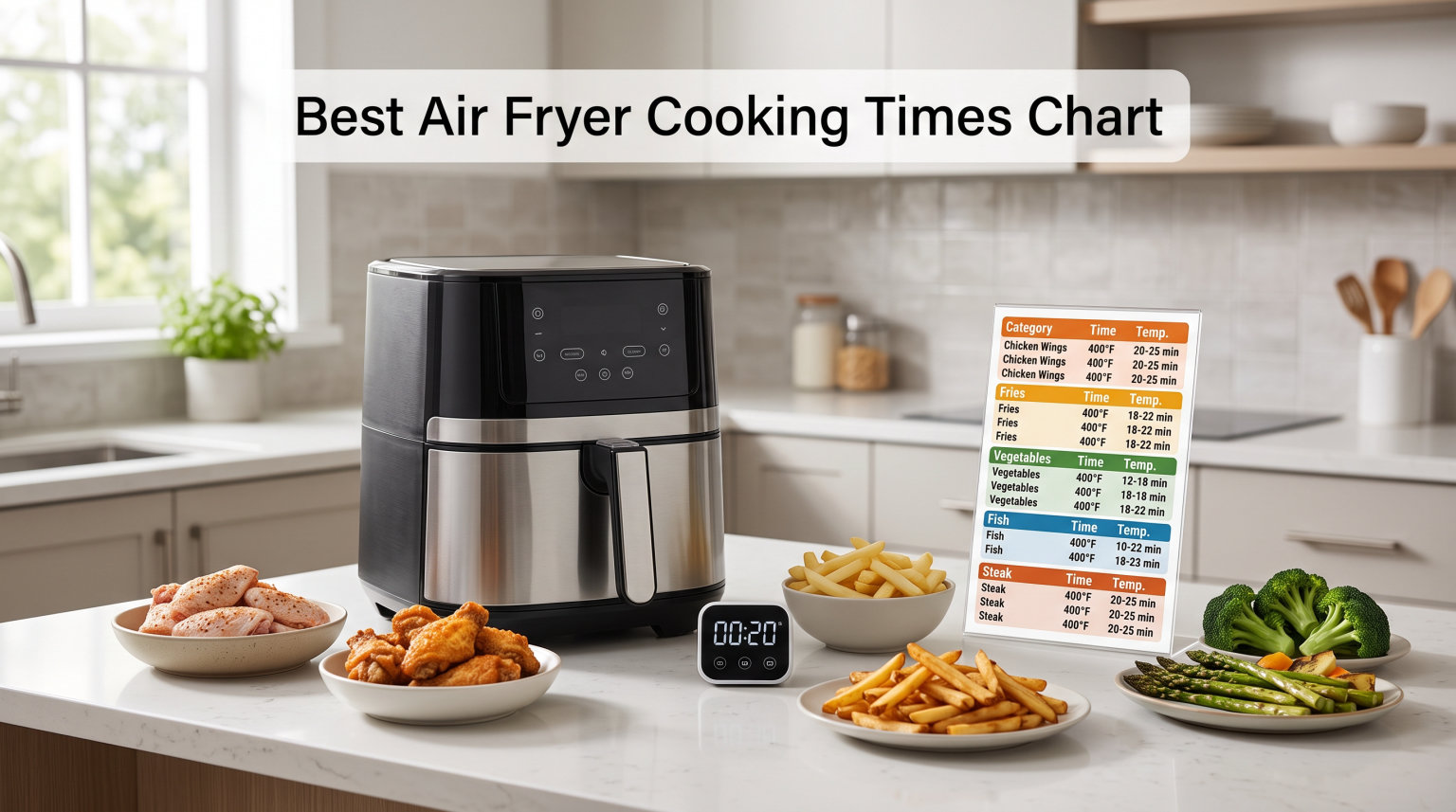
This best air fryer cooking times chart is most useful when it gives you a sensible starting point, then tells you what to watch for. Use these temperature and timing ranges for common foods, check early on the first batch, and finish meat and poultry with a thermometer. For focused methods, see my air fryer chicken thighs guide and air fryer frozen French fries method.
I have organized this guide by food type so you can find a practical range quickly, adjust for your appliance, and cook with less guesswork.
For those who also love crispy bacon, you might enjoy our oven-baked bacon method as an alternative when your air fryer basket is full.
Table of Contents
Best Air Fryer Cooking Times Chart: Everyday Foods
This master chart covers everything from fresh chicken breasts to frozen french fries. All times assume a preheated air fryer at the standard 1700-watt power level. I will explain wattage differences and preheating guidance further down the page.
Quick Air Fryer Timing Reference
These ranges assume a preheated basket-style air fryer. Thickness, basket crowding, and wattage can change the result, so use them as a starting point rather than a promise.
-
Chicken breast: 360°F for 18-22 minutes; cook to 165°F.
-
Bone-in chicken thighs: 380°F for 22-28 minutes; cook to 165°F.
-
Salmon fillets: 400°F for 8-12 minutes; cook to 145°F.
-
Shrimp: 370°F for 6-8 minutes; stop when pink and curled into a C-shape.
-
Broccoli florets: 370°F for 8-10 minutes; shake once.
-
Brussels sprouts: 375°F for 15-18 minutes; halve them first.
-
Frozen French fries: 400°F for 15-20 minutes; shake twice.
-
Frozen chicken tenders: 400°F for 10-14 minutes; check the package and heat through.
Meat and Poultry Cooking Times: The Complete Breakdown
Chicken is where most air fryer beginners struggle. The biggest mistake I see is trusting general timing charts without accounting for thickness and starting temperature. A one-inch chicken breast cooks faster than a two-inch breast, and frozen takes significantly longer than fresh.
For chicken breasts, A temperature of 360°F is a useful starting point for chicken breast. Higher temperatures dry out the exterior before the center reaches a safe 165 degrees Fahrenheit. Bone-in pieces need the lower end of 370 degrees Fahrenheit to ensure the meat near the bone cooks through without burning the outside.
Chicken wings are the exception where higher heat works better. I start at 380 degrees Fahrenheit and bump to 400 degrees Fahrenheit for the final five minutes to get that crackling skin. If your wings are frozen solid, add three to five minutes and expect slightly less crispy results.
Whole chicken in an air fryer is a game changer, but size matters. Do not attempt a bird larger than six pounds in a standard basket-style air fryer. The chicken needs space for air circulation, and overcrowding leads to uneven cooking and rubbery skin. Flip the bird breast side up halfway through for the most even browning.
Steak in the air fryer surprised me. A properly timed one-inch steak at 400°F can develop a browned exterior while staying nicely pink inside. The key is removing the steak from the refrigerator fifteen minutes before cooking. Cold steak straight from the fridge needs extra time and cooks unevenly.
Pork requires precision because it dries out faster than beef. Pork chops at one inch thick cook perfectly at 400 degrees Fahrenheit in twelve to fifteen minutes. Bone-in chops need the lower 380 degrees Fahrenheit because the bone insulates the meat and slows cooking near it. Always rest pork for three minutes before cutting to retain juices.
Seafood Cooking Times: When Shorter is Better
Seafood is where timing charts fail most often. Shrimp go from perfectly tender to rubbery in two minutes. Salmon transitions from silky to dry just as quickly. That is why it helps to check shrimp early rather than relying on a single fixed time.
Shrimp cook in six to eight minutes at 370 degrees Fahrenheit. The visual cue matters more than the clock: look for pink color and a curled C-shape. If your shrimp form tight O-shapes, they are overcooked. I recommend checking at the six-minute mark every time.
Salmon at 400 degrees Fahrenheit takes ten to twelve minutes depending on thickness. A six-ounce fillet is done when the flesh flakes easily with a fork and the internal temperature hits 145 degrees Fahrenheit. The skin gets crispy while the meat stays moist, something I never achieved consistently in my oven.
White fish like cod and tilapia cook even faster. Eight to ten minutes is all you need at 400 degrees Fahrenheit. These delicate fish benefit from a light oil spray before cooking to prevent sticking and help browning.
Scallops need high heat for that restaurant-quality crust. I cook sea scallops at 390 degrees Fahrenheit for eight to ten minutes, flipping halfway. The exterior should be golden brown while the center remains slightly translucent. Overcooked scallops turn rubbery, so err on the side of underdone.
Vegetable Cooking Times: Fresh and Flavorful
Vegetables in the air fryer develop a depth of flavor you cannot get from steaming or boiling. The dry heat caramelizes natural sugars, creating crispy edges and tender centers. Most vegetables cook between six and fifteen minutes depending on density.
Broccoli florets cook in eight to ten minutes at 370 degrees Fahrenheit. Cut them into similar-sized pieces so they finish at the same time. The edges should char slightly while the stems remain tender-crisp. Shake the basket at the five-minute mark for even browning.
Brussels sprouts transformed my opinion of this vegetable. Halved and cooked at 375 degrees Fahrenheit for fifteen to eighteen minutes, they develop crispy outer leaves and creamy centers. The key is cutting them uniformly and not overcrowding the basket.
Root vegetables need the most time. Small whole potatoes take twenty-five to thirty minutes at 400 degrees Fahrenheit. Wedge cuts reduce that to eighteen to twenty-two minutes. Always pierce whole potatoes with a fork before cooking to prevent steam buildup.
Asparagus is the fastest vegetable at six to eight minutes. Cook at 370 degrees Fahrenheit and watch for bright green color with slightly browned tips. Overcooked asparagus turns olive drab and stringy.
Frozen Food Cooking Times: No Thawing Required
The air fryer excels at frozen foods, often producing better results than the oven in half the time. No pre-thawing is necessary for most items. The circulating hot air crisps the exterior while heating the interior evenly.
French fries are the most common frozen food I cook. Thin cuts need twelve to fifteen minutes at 380 degrees Fahrenheit. Thick cuts and crinkle fries need two to three minutes more. Shake the basket vigorously at the halfway point to redistribute fries and ensure even crisping.
Frozen chicken wings need twenty-five to thirty minutes at 400 degrees Fahrenheit. This is longer than fresh wings because you are cooking through frozen meat. Flip them halfway and check that the internal temperature reaches 165 degrees Fahrenheit.
Chicken nuggets and fish sticks cook quickly at ten to twelve minutes on 400 degrees Fahrenheit. These pre-cooked items just need heating through and crisping. Watch carefully in the final two minutes as they can go from golden to burnt quickly.
Tater tots benefit from the full fifteen to seventeen minutes at 400 degrees Fahrenheit. They need time for the interior to heat while the exterior gets crispy. Shake the basket several times during cooking for the best texture.
Mozzarella sticks require attention at six to eight minutes on 360 degrees Fahrenheit. The lower temperature prevents the cheese from exploding out the wrapper. Remove them when the cheese just starts to ooze from the ends.
Air Fryer Wattage Guide: How Power Affects Cooking
This is the section missing from most cooking charts, and it causes more frustration than any other factor. A recipe written for a 1700-watt air fryer will produce undercooked food in a 1200-watt model and burnt food in an 1800-watt unit.
The cooking times in my chart assume a 1700-watt air fryer, which is the most common size for household models. If you have a different wattage, use these adjustments.
For 1200-watt air fryers (common in compact and mini models), increase cooking times by three to five minutes. These units heat slower and recover temperature more slowly when you open the basket. Small air fryers also cook hotter in the center, so rotate food or shake more frequently.
For 1500-watt air fryers, increase times by one to two minutes. This is a minor adjustment but important for meats where doneness matters. Check temperatures with a meat thermometer until you learn your unit.
For 1800-watt and higher units (common in oven-style and dual-basket models), reduce times by two to three minutes. These powerful air fryers cook faster and can burn food if you follow standard timing charts blindly. I recommend checking doneness a few minutes early until you dial in your specific model.
Basket-style versus oven-style air fryers also cook differently. Basket models circulate air more aggressively, cooking faster and producing crispier exteriors. Oven-style units cook more like convection ovens and may need slightly longer times, especially for larger items like whole chickens.
Oven to Air Fryer Conversion Formula
Converting your favorite oven recipes to the air fryer is simple with this formula I have tested across dozens of recipes. The air fryer cooks faster because the compact space and circulating hot air transfer heat more efficiently than a large oven.
Step 1: Reduce the temperature by 25 degrees Fahrenheit. If your oven recipe calls for 400 degrees Fahrenheit, set your air fryer to 375 degrees Fahrenheit.
Step 2: Reduce cooking time by 20 percent. Multiply the oven time by 0.8. A 20-minute oven recipe becomes 16 minutes in the air fryer.
Step 3: Check doneness early. Start checking at the calculated time and add time in two-minute increments if needed.
For baked goods like cookies and small cakes, reduce temperature by 30 degrees Fahrenheit instead of 25. The intense airflow can cause rapid browning on the outside while the center stays raw. Lower temperature gives the interior time to set.
Bacon converts beautifully using this formula. Oven bacon at 400 degrees Fahrenheit for 18 minutes becomes 375 degrees Fahrenheit for 14 to 15 minutes in the air fryer. The fat renders perfectly and cleanup is easier with the removable drawer.
Deep fryer recipes convert differently. Use the same temperature but reduce time by 25 percent. The air fryer mimics deep frying temperatures better than oven temperatures. A five-minute deep fry becomes three to four minutes in the air fryer.
Pro Tips for Perfect Air Fryer Results
These tips took me months of daily air fryer use to discover. They address the common complaints I see in cooking forums: uneven cooking, food sticking, and results that are not as crispy as expected.
Preheat your air fryer for two to three minutes before adding food. While not every recipe requires it, preheating jumpstarts the cooking process and improves browning. Think of it like preheating an oven, just much faster.
Arrange food in a single layer with space between pieces. Overcrowding is the number one reason for soggy air fryer food. The hot air needs to circulate around each piece. Cook in batches if necessary. It is better to do two batches of perfectly crispy food than one batch of steamed, soggy results.
Flip or shake halfway through cooking. This applies to 90 percent of air fryer recipes. Set a timer for half the total cooking time, then either flip larger items or shake the basket for smaller pieces. This ensures even browning on all sides.
Spray with oil for extra crispiness. Even though air fryers use less oil than deep frying, a light coating helps browning and prevents sticking. Use a high smoke point oil like avocado oil or refined olive oil. Avoid extra virgin olive oil which can smoke at air fryer temperatures.
Add water to the drawer when cooking fatty foods. Bacon, sausage, and high-fat meats can cause smoking as fat drips and burns. A tablespoon of water in the bottom drawer prevents this. Empty and wipe the drawer after cooking.
Use a meat thermometer for proteins. Timing charts are guidelines, but internal temperature is the only reliable doneness indicator. A $15 instant-read thermometer eliminates guesswork and ensures food safety.
Let breaded foods rest before cooking. If you bread chicken or vegetables, let them sit for five minutes after breading. This helps the coating adhere and prevents it from blowing off in the air fryer fan.
Clean your air fryer after every use. Built-up grease affects performance and can smoke during cooking. Most baskets and drawers are dishwasher safe. Wipe the heating element weekly with a damp cloth once cooled.
Frequently Asked Questions
Do I need to preheat an air fryer?
Preheating helps most foods brown and makes timing more repeatable. If your model does not preheat, add a few minutes and check early.
How do I adjust this chart for my air fryer?
Start at the low end of the range, avoid crowding the basket, and write down the timing that works in your own model. Higher-wattage units may finish sooner.
What should I check instead of relying only on time?
Use a thermometer for meat and poultry, and look for the right color, crispness, and tender texture for vegetables and frozen foods.
Conclusion
Keep this best air fryer cooking times chart nearby as a starting point, then let a thermometer, visual cues, and your own appliance notes guide the final minute or two. That small habit makes everyday air-fryer cooking more reliable.