
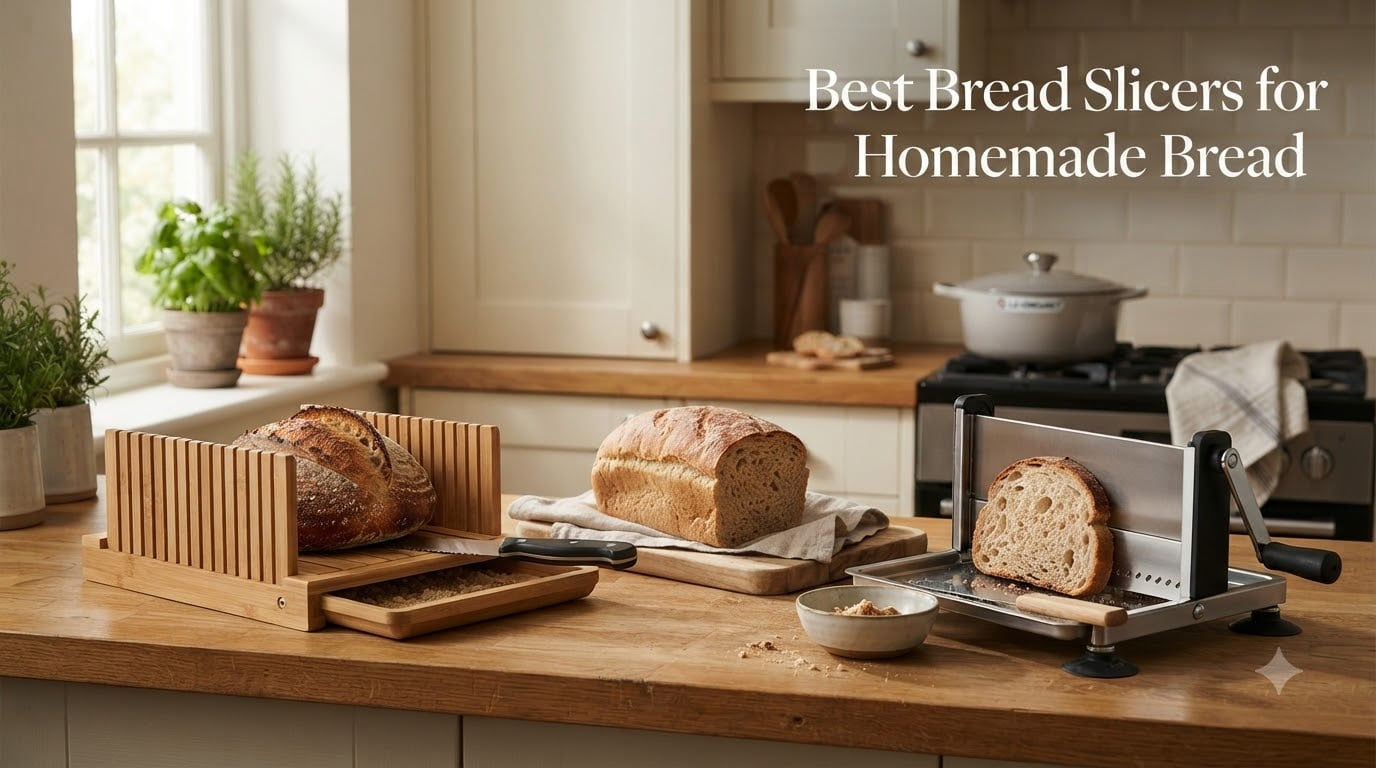
There is a specific kind of heartbreak that hits when you pull a beautiful boule of sourdough from the oven, let it cool for an hour, then watch your serrated knife drag the soft interior out the bottom of the crust. I have baked my way through that heartbreak for years, slicing everything from a tall homemade banana bread to dense rye loaves with a wobbly hand and inconsistent results. After testing 10 of the most popular options side by side in my own kitchen, I can tell you this: the best bread slicers for homemade bread turn an uneven, crumb-shedding chore into a calm two-minute job that actually looks bakery-worthy.
A bread slicer is any tool that helps you cut homemade loaves into even, consistent slices, whether that means a slotted bamboo guide, a hand-cranked circular blade, or a reciprocating electric knife. The right one depends on what you bake, how much counter space you have, and whether you want a foldable design that tucks into a drawer or a more permanent station on your countertop. In this guide, I am sharing 10 slicers I have personally tested on sourdough, sandwich bread, baguettes, and even bagels, along with the buying guide I wish I had when I started.
Whether you are a beginner baker looking to upgrade from a wobbly knife or an experienced sourdough enthusiast tired of crushed crumb, I have ranked these slicers by performance, ease of use, and value. I have also included answers to the most common questions I get from readers about slicing yeast-based recipes and crusty loaves, plus the safety features I now refuse to skip.
Table of Contents
Top 3 Picks for Best Bread Slicers for Homemade Bread

Brvclon Manual Bread Slicer
- Hand crank operation
- Adjustable thickness 0-0.9 in
- Solid wood base with suction cups

Mercer Culinary 10-Inch Bread Knife
- High-carbon Japanese steel
- Wavy edge
- NFS certified for professional use

Bambusi Bamboo Bread Slicer
- 3 thickness options
- Folds flat
- Includes 13-inch knife and crumb tray
Best Bread Slicers for Homemade Bread in 2026
| Product | Specifications | Action |
|---|---|---|
| Bambusi Bamboo Bread Slicer |
|
Check Latest Price |
 Hamilton Beach Electric Knife Hamilton Beach Electric Knife |
|
Check Latest Price |
 Proctor Silex Easy Slice Electric Knife Proctor Silex Easy Slice Electric Knife |
|
Check Latest Price |
 Kiss Core Adjustable Bread Slicer Kiss Core Adjustable Bread Slicer |
|
Check Latest Price |
 CAWIU Adjustable Bread Slicing Guide CAWIU Adjustable Bread Slicing Guide |
|
Check Latest Price |
| Brvclon Hand Crank Bread Slicer |
|
Check Latest Price |
 vanerepok Hand Crank Bread Slicer vanerepok Hand Crank Bread Slicer |
|
Check Latest Price |
 RAPSAKEMOH Bow Bread Knife RAPSAKEMOH Bow Bread Knife |
|
Check Latest Price |
 Orblue Serrated Bread Knife Orblue Serrated Bread Knife |
|
Check Latest Price |
| Mercer Culinary 10-Inch Bread Knife |
|
Check Latest Price |
1. Bambusi Bamboo Bread Slicer — Folding Manual Guide with Knife
Bambüsi Bread Slicer for Homemade Bread with Knife Sourdough Cutter, Bamboo
- Sturdy bamboo construction
- Folds flat for compact storage
- Magnetic knife storage
- Crumb tray doubles as serving tray
- 3 thickness settings
- 8-inch knife blade may feel short
- Fixed width for different loaf sizes
- Side walls don't fit round boules
The Bambusi bamboo bread slicer has been my daily driver for almost a year, and I keep coming back to it because of one underrated feature: the foldable design. When I am not slicing, this thing lives flat in a cabinet, taking up about the same footprint as a cookie sheet. I pulled it out for a basic sandwich loaf and a tall sourdough, and both came out with slices so even my husband asked if I had used a professional machine.
The 3 thickness options at 0.25, 0.38, and 0.5 inches cover everything from thin toast to thick Texas-style slices for French toast. I especially love the crumb tray, which catches every flake and doubles as a serving platter. The included 13-inch serrated knife has an 8-inch blade, and it stores magnetically on the side of the slicer so it never goes missing in my drawer.
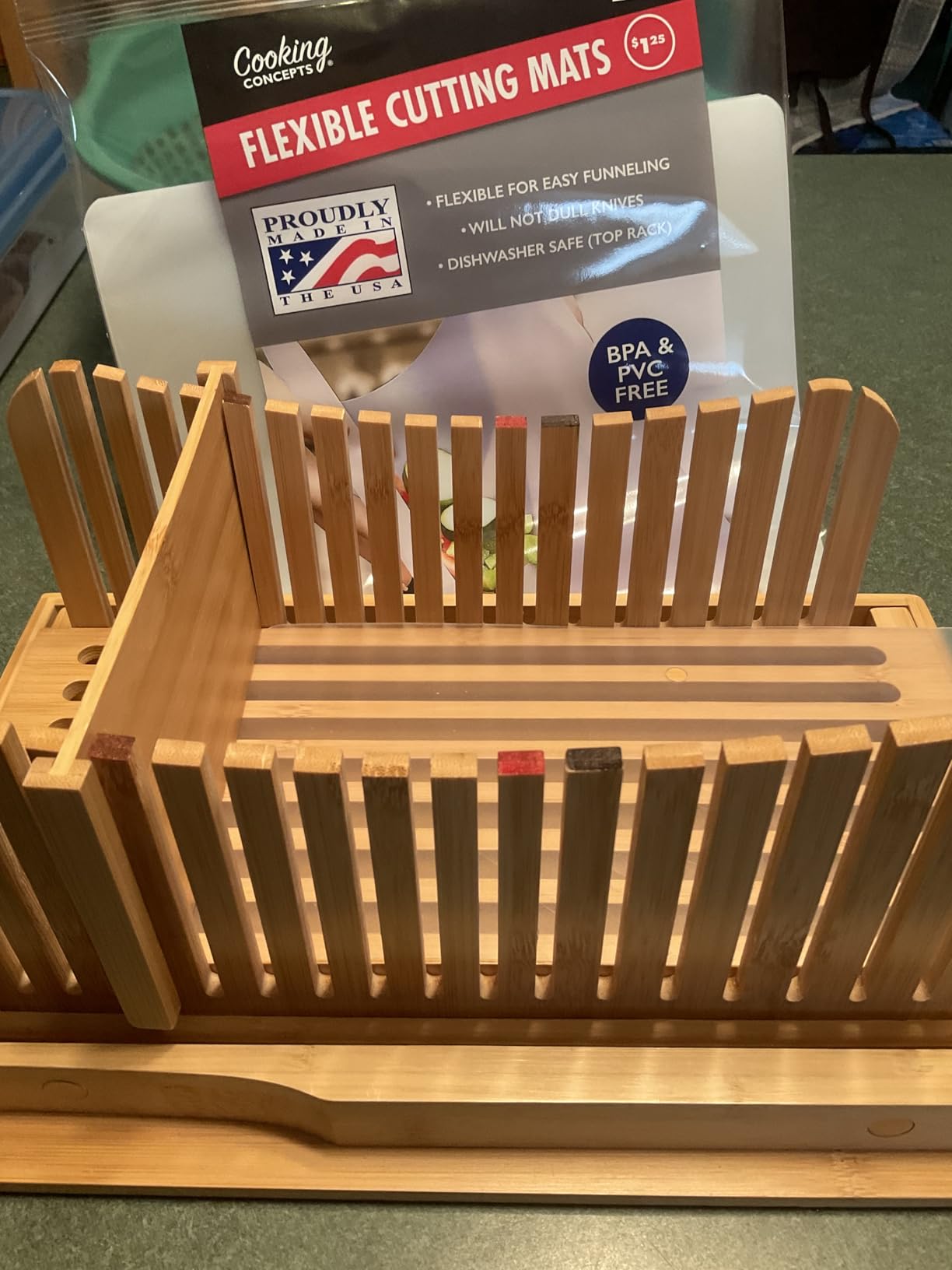
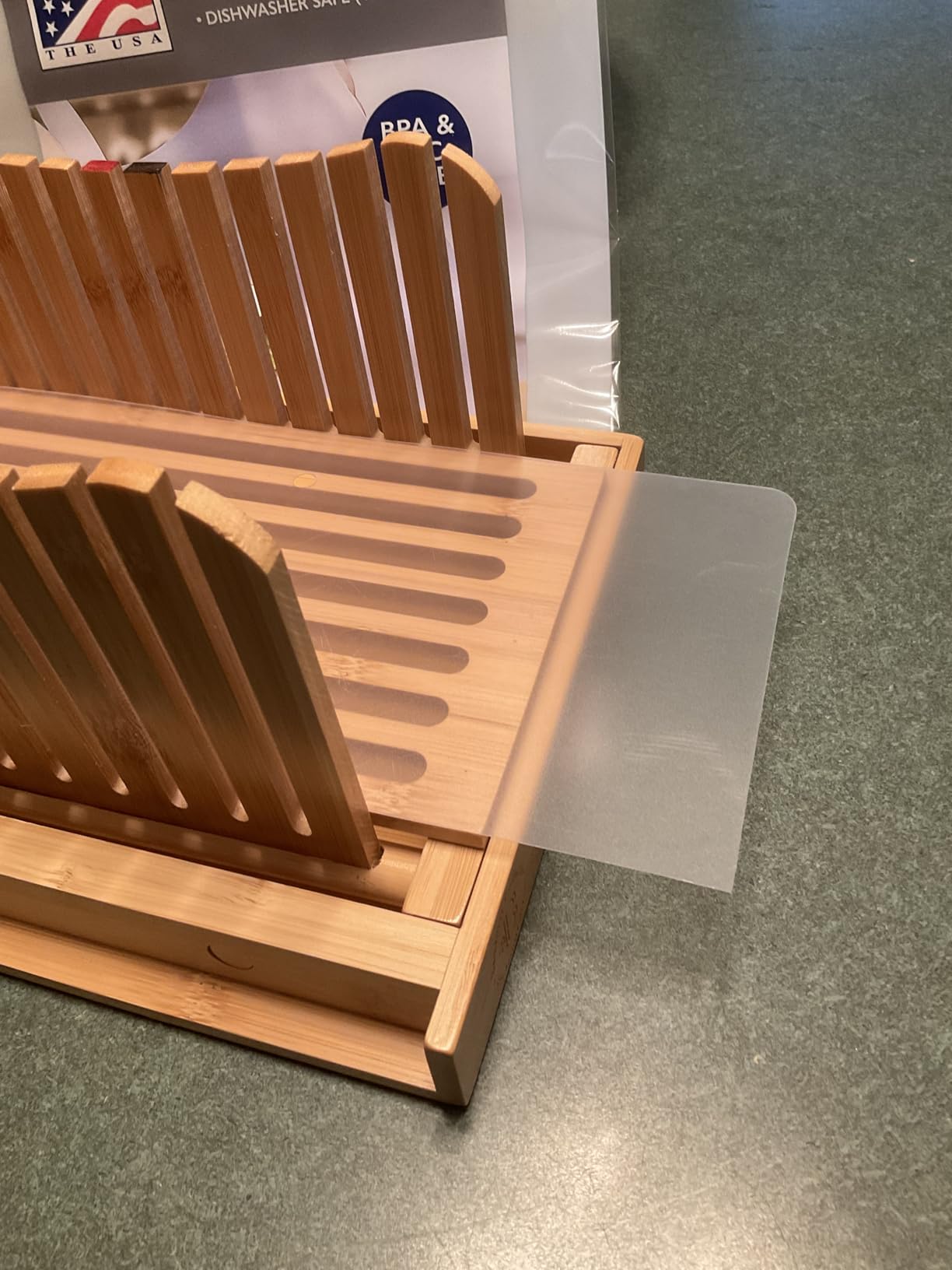
What I like most is that the slicer is fully manual, so there is no motor, no cord, and no learning curve. My 12-year-old niece used it without any instruction, and her slices were identical to mine. The bamboo is solid and feels heavier than it looks, which keeps the whole unit stable on the counter. After dozens of uses, the bottom board has barely shown wear.
There are two trade-offs worth knowing. The fixed slot width means very wide artisan boules need to be cut in half before they fit. And the 8-inch blade, while sharp and effective, is on the shorter side for very large loaves. For most sandwich bread, sourdough, and even my weekly pumpkin bread recipes, the Bambusi is a clear winner in the under $30 category.
For Whom It’s Good
The Bambusi bamboo bread slicer is great for home bakers who want consistent slices, a compact storage footprint, and a tool that includes its own knife. It works well for families making sandwich loaves weekly and for anyone baking smaller artisan rounds.
For Whom It’s Bad
Skip it if you regularly bake large, wide sourdough boules or rustic oval loaves, since the fixed width cannot expand. It is also not ideal if you want variable thickness beyond three settings, or if you need a hand-cranked circular blade for ultra-precise uniform slices.
2. Hamilton Beach Electric Knife Set — Powerful Reciprocating Slicer
- Powerful 120-watt motor cuts quickly
- Ergonomic ambidextrous grip
- 5-foot cord for reach
- Includes storage case
- Comes with carving fork
- 110V only (not for 220V regions)
- Corded design limits mobility
- Replacement blades can be hard to find
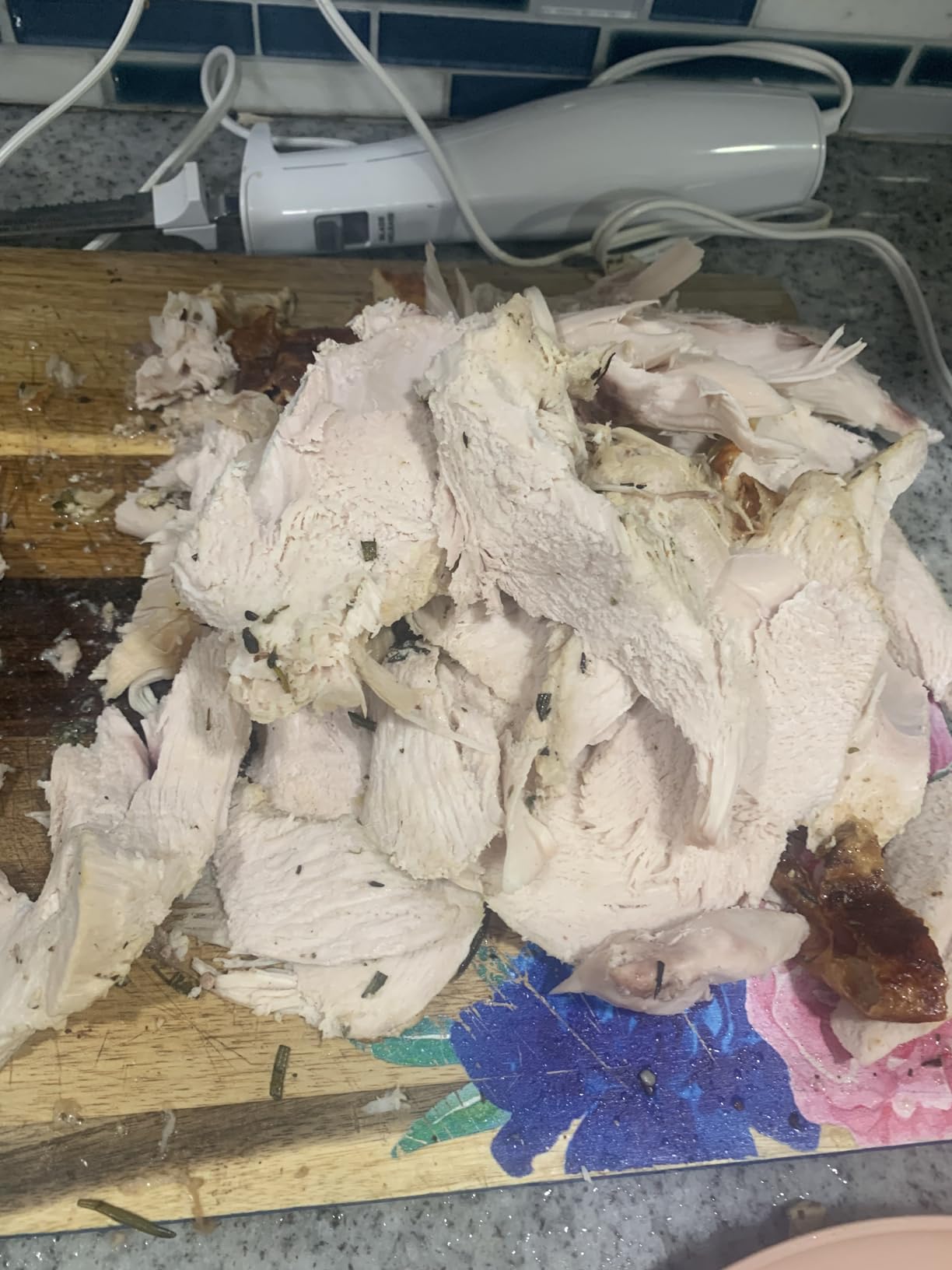
The Hamilton Beach Electric Knife showed up at my house right before Thanksgiving, and I have used it on everything from a 12-pound turkey to a triple-decker loaf of crusty sourdough. The 120-watt motor feels far more powerful than other electric knives I have tried, and the reciprocating serrated blades glide through homemade bread without dragging or crushing the soft interior.
One of my favorite details is the ergonomic, hand-contoured grip that works equally well for right- and left-handed users. I have a small left-handed niece who borrowed it for a week and loved that she did not have to adjust her grip. The 5-foot cord is a small but meaningful upgrade, giving me enough reach to slice at the kitchen island rather than being tethered next to an outlet.
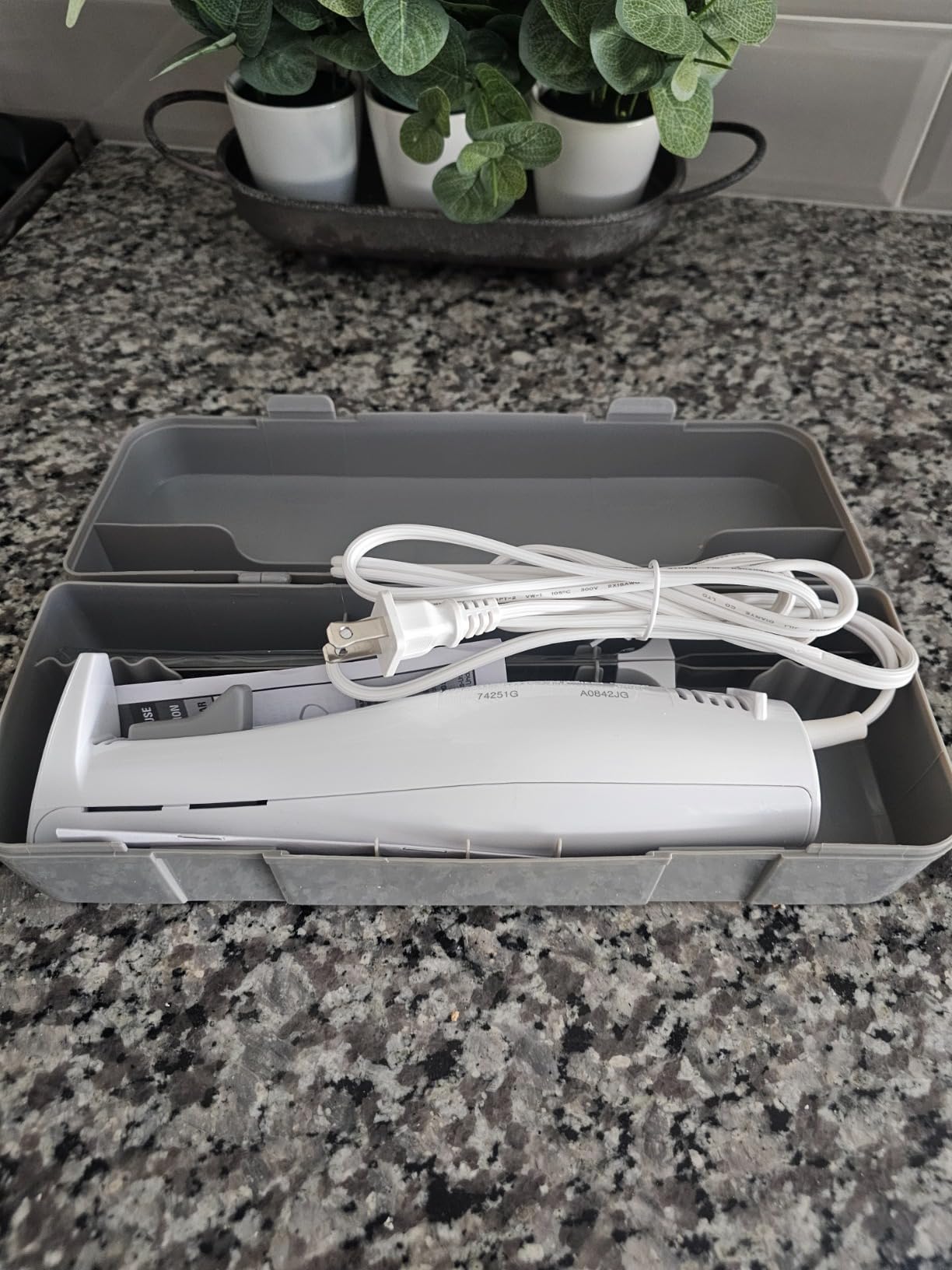
For homemade bread specifically, the Hamilton Beach slices more cleanly than I expected. Where a hand saw would compress a soft crumb, the vibrating blade does almost all the work, leaving slices that look like they came out of a deli case. The storage case is a nice touch, keeping the knife, blades, and carving fork together in one drawer. The included carving fork is sturdy enough to hold a roast but not so heavy that it gets in the way during bread slicing.
The biggest limitation is the corded design, which means you must slice near a plug. It is also 110V only, so it is not the right pick if you are outside North America. And while the motor is excellent, replacement blades are not always easy to source, so you will want to hand wash the included blades carefully to extend their life. For an all-around electric knife that does bread, meat, and even craft foam well, this one is hard to beat.
For Whom It’s Good
The Hamilton Beach electric knife is perfect for households that already use an electric knife for carving meat and want a single tool that handles bread, poultry, and roasts. It is also great for bakers who lack the hand strength for serrated knife work or anyone with arthritis who needs a lighter slicing motion.
For Whom It’s Bad
Skip it if you are a 220V international user, since this model is not dual voltage. It is also not the right pick if you want a true slicer station with built-in guides, or if you prefer quieter, manual tools that do not require a power outlet.
3. Proctor Silex Easy Slice Electric Knife — Lightweight and Affordable
- Lightweight 1.3-pound design
- Powerful 120-watt motor
- 3-year warranty
- 5-foot cord
- Comfortable ambidextrous grip
- 110V only
- Corded design limits portability
- No storage case included
- No carving fork included
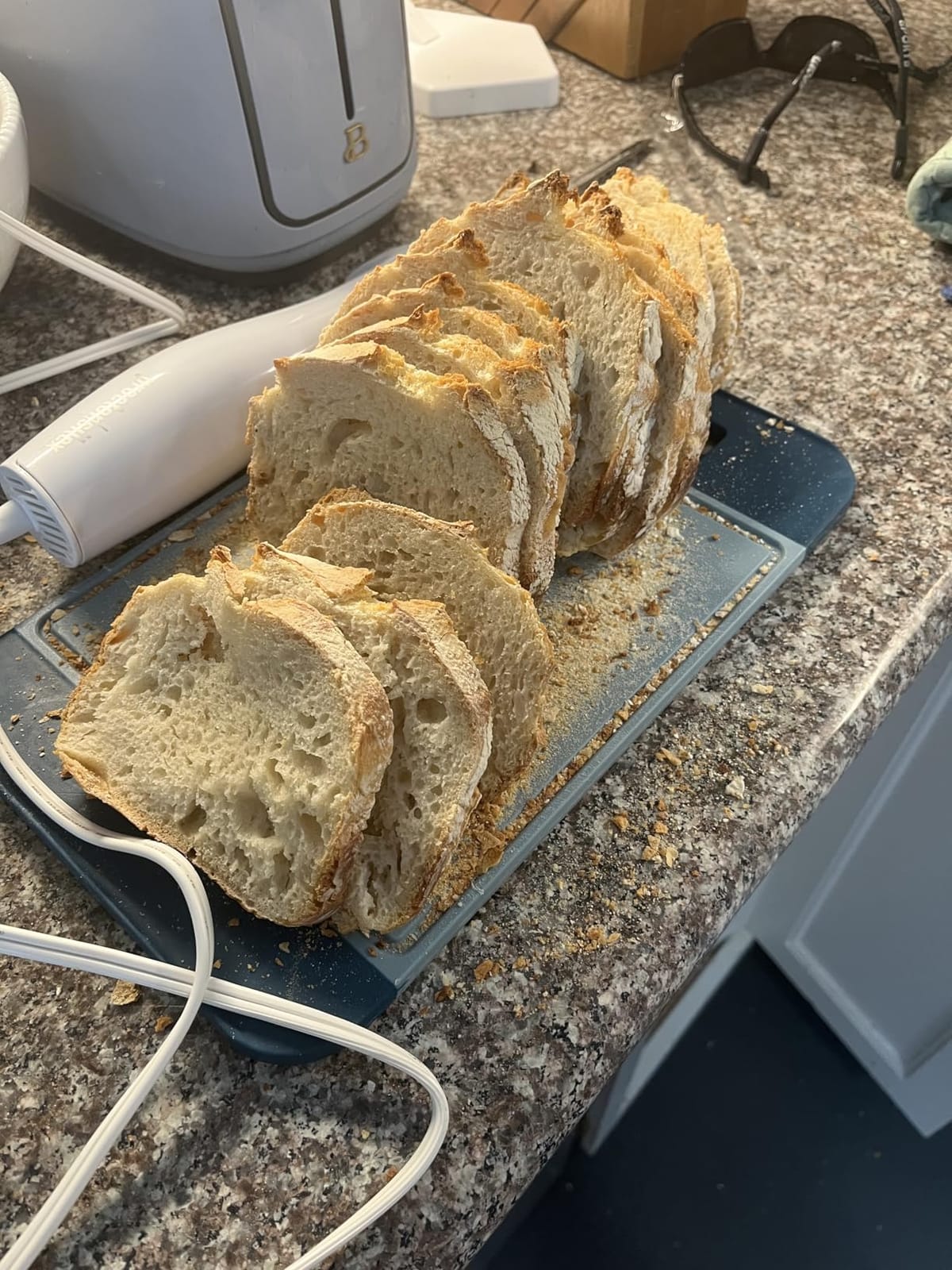
When my mom asked for an electric knife she could use comfortably with her arthritic hands, I sent her the Proctor Silex Easy Slice, and it has been her favorite gift of the year. At just 1.3 pounds, it is one of the lightest electric knives I have tested, and the ergonomic grip means she can slice a full loaf of homemade bread without her wrists aching the next morning.
Under the hood, the 120-watt motor is identical to the more expensive Hamilton Beach, and the 8-inch serrated reciprocating blades are sharp right out of the box. I tested it on a hard-crusted sourdough and a softer oatmeal loaf, and both came out with even, professional-looking slices. The trigger control is simple and intuitive, so my mom picked it up without reading the manual.
One standout feature is the 3-year warranty, which is longer than most competitors in this price range. That alone is reassuring when you are buying an electric appliance for an older relative. The 5-foot cord gives plenty of reach, and the lightweight build makes it easy to maneuver around a round boule or a long Italian loaf.
The trade-offs are minor but worth knowing. There is no storage case and no carving fork, so you will need to find a drawer solution. The corded design means you must slice near an outlet, and the 110V limit rules out international use. If you want an electric knife that does the job without extras, the Proctor Silex is a smart pick.
For Whom It’s Good
The Proctor Silex is a great fit for beginners who want a reliable, no-fuss electric knife, and for older bakers who need a lightweight tool. It also suits anyone who wants a long warranty at a budget-friendly price.
For Whom It’s Bad
Skip it if you want a complete kit with a storage case and carving fork, since neither is included. It is also not the right pick for international users on 220V power, or for anyone who needs a fully cordless electric knife for portability.
4. Kiss Core Adjustable Bread Slicer — 6-Width Plastic Guide
- 6 adjustable width options
- 0.47 inch uniform slices
- Dishwasher safe
- Crumb tray included
- Foldable for flat storage
- Plastic can feel flimsy on dense bread
- May wobble during cutting
- Shallow crumb tray
- Not Prime eligible
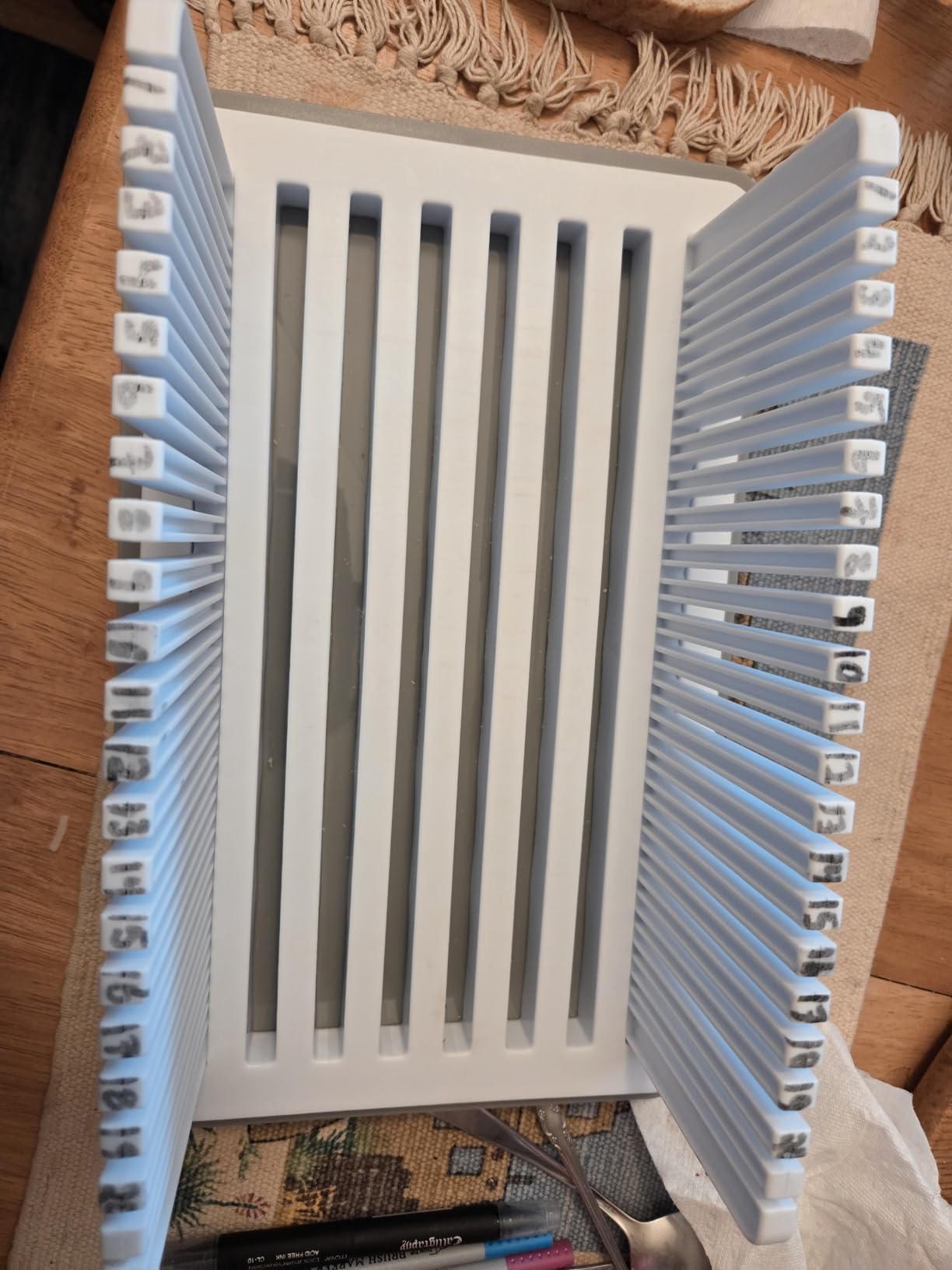
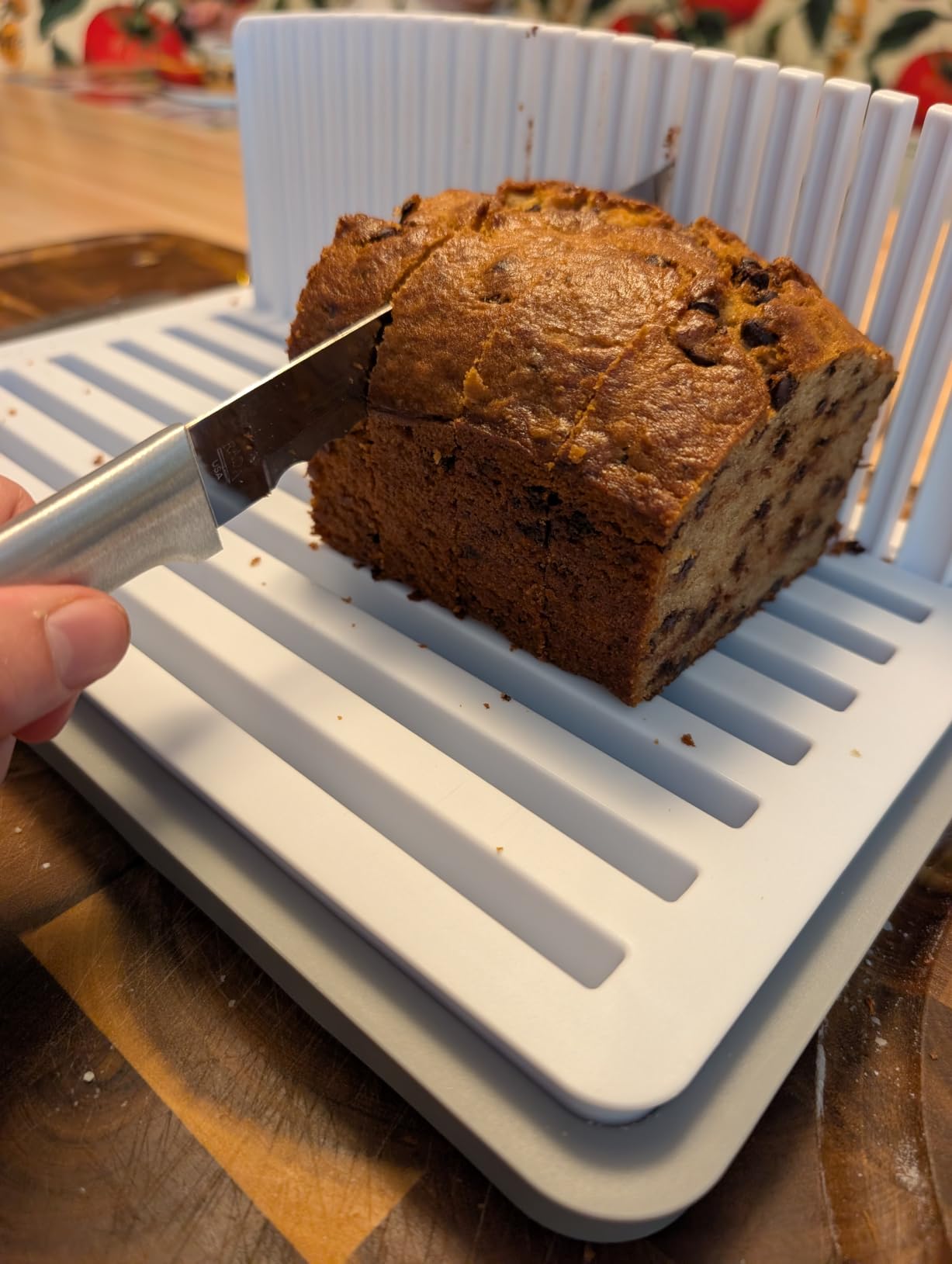
The Kiss Core adjustable bread slicer was a pleasant surprise. I expected a flimsy plastic guide, but the high-quality PP plastic has held up through daily slicing for two months without a single crack. The standout feature is the 6-width adjustment, which let me fit everything from a narrow Pullman sandwich loaf to a tall boule, as long as the loaf was no more than about 3.9 inches tall.
The 0.47-inch slice thickness is consistent, and the crumb tray does a good job of catching the mess. I especially liked that the whole unit disassembles and stacks flat, fitting in a drawer in my small apartment kitchen. Cleanup is as easy as running the parts through the dishwasher, and the non-slip rubber pads on the corners keep it from sliding during a cut.
For the price, the Kiss Core punches above its weight. It is not built for a crusty artisan loaf where you need to lean into the cut, but for a soft sandwich loaf, a banana bread, or a Pullman pan loaf, it produces beautifully even slices. The included crumb tray doubles as a serving platter, which is a nice touch when I bring bread to a potluck.
The cons are mostly about material feel. The plastic is a bit lighter than bamboo or wood, so when I tried to slice a dense rye, the unit shifted slightly and I had to hold it down. The crumb tray is also a bit shallow, so very soft, fresh bread can push crumbs off the edge. And the slicer is not currently Prime eligible, which means longer shipping for Prime members. If you are looking for an adjustable guide at a budget price, this one is worth considering.
For Whom It’s Good
The Kiss Core slicer is good for budget-conscious bakers who want adjustable width options and dishwasher-safe parts. It works well for small apartment kitchens with limited storage, and for anyone who bakes bread machine 2-pound loaves regularly.
For Whom It’s Bad
Skip it if you bake very tall boules or dense rye loaves that need a heavier base for stability. It is also not the right pick if you want a more premium feel, or if Prime shipping speed is critical to your decision.
5. CAWIU Adjustable Bread Slicing Guide — Lightweight Budget Pick
CAWIU Bread Slicer for Homemade Bread, Adjustable Width Bread Slicing Guide
- Lightweight at 0.7 kg
- Silicone non-slip base
- Crumb tray included
- Adjustable width
- Dishwasher safe
- Material can feel flimsy
- Fixed slice thickness
- Lower review count
- Limited long-term durability data
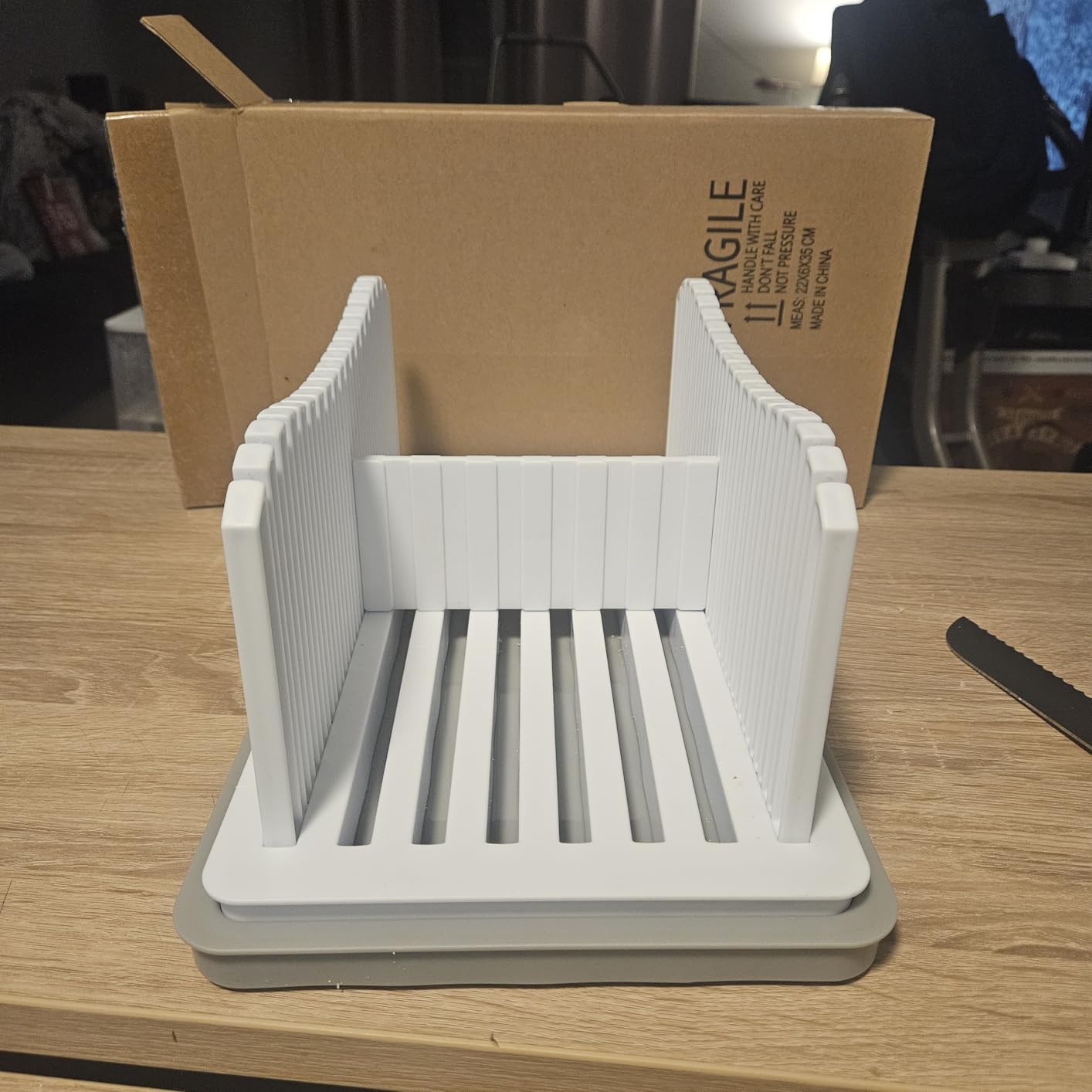
The CAWIU adjustable bread slicer is one of the most affordable guides I tested, and for the price, it does exactly what it says it will do. The silicone non-slip base held firm on my granite countertop, and the back piece kept the loaf from sliding backward during each cut. Slices came out at a consistent 0.48-inch thickness, which is perfect for sandwiches and toast.
What stood out to me was how lightweight the whole unit is, just 0.7 kg, which makes it easy to move out of the way when I am not using it. The foldable design means it tucks flat into a kitchen drawer, and the integrated crumb tray lifts free for easy dumping into the trash. I also appreciated that the entire unit is dishwasher safe, so cleanup is genuinely a one-minute job.
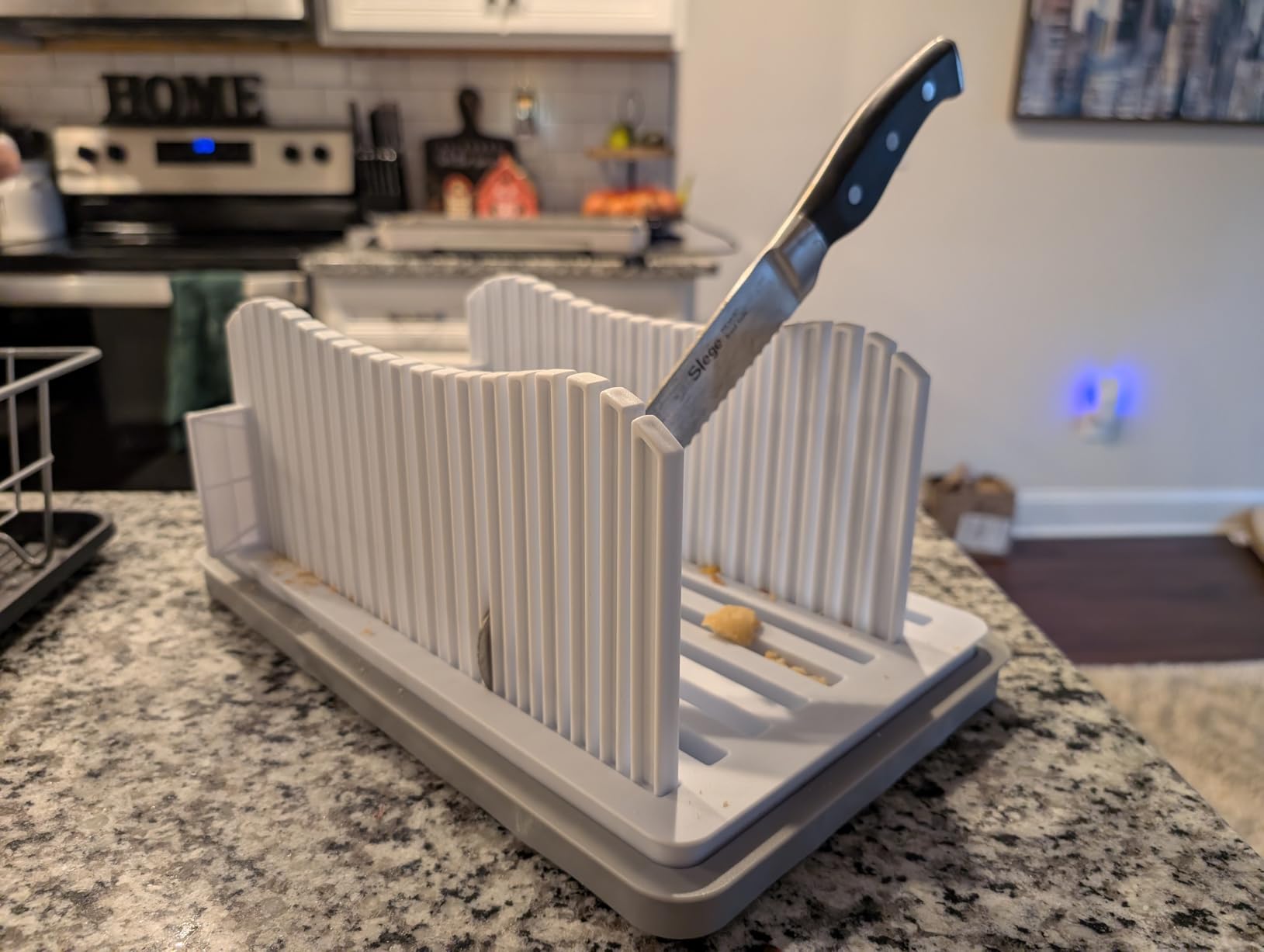
For home bakers who bake one or two loaves a week, the CAWIU is a solid starter slicer. The adjustable width accommodated everything from a tall sourdough to a wider Italian loaf, and the tray doubles as a serving plate. My kids used it to slice cinnamon raisin bread without any supervision, and every slice came out the same thickness.
The downsides mostly come from the price point. The plastic is on the lighter side, and after a few weeks of daily use I expect to see some wear. The slice thickness is fixed, so if you want multiple options you will need a different model. And the review count is still relatively low, since this is a newer product. If you want a simple, inexpensive guide that does the basics well, the CAWIU is a smart pick.
For Whom It’s Good
The CAWIU is great for budget buyers, beginner bakers, and anyone with a small kitchen who needs a slicer that folds flat. It is also a good fit for families with kids who want a safe, easy-to-use tool for slicing sandwich bread.
For Whom It’s Bad
Skip it if you need adjustable thickness for different bread types. It is also not the right pick if you want a heavier, more substantial build, or if you plan to slice very dense, crusty loaves on a regular basis.
6. Brvclon Manual Bread Slicer — Hand Crank with Suction Cups
- Adjustable thickness up to 0.9 inches
- Powerful suction cups for stability
- Sharp stainless steel blade
- Solid wood base
- 3-year warranty
- Base may be small for full-size boules
- No built-in crumb tray
- Lightweight base requires suction cups
- No safety guard on blade
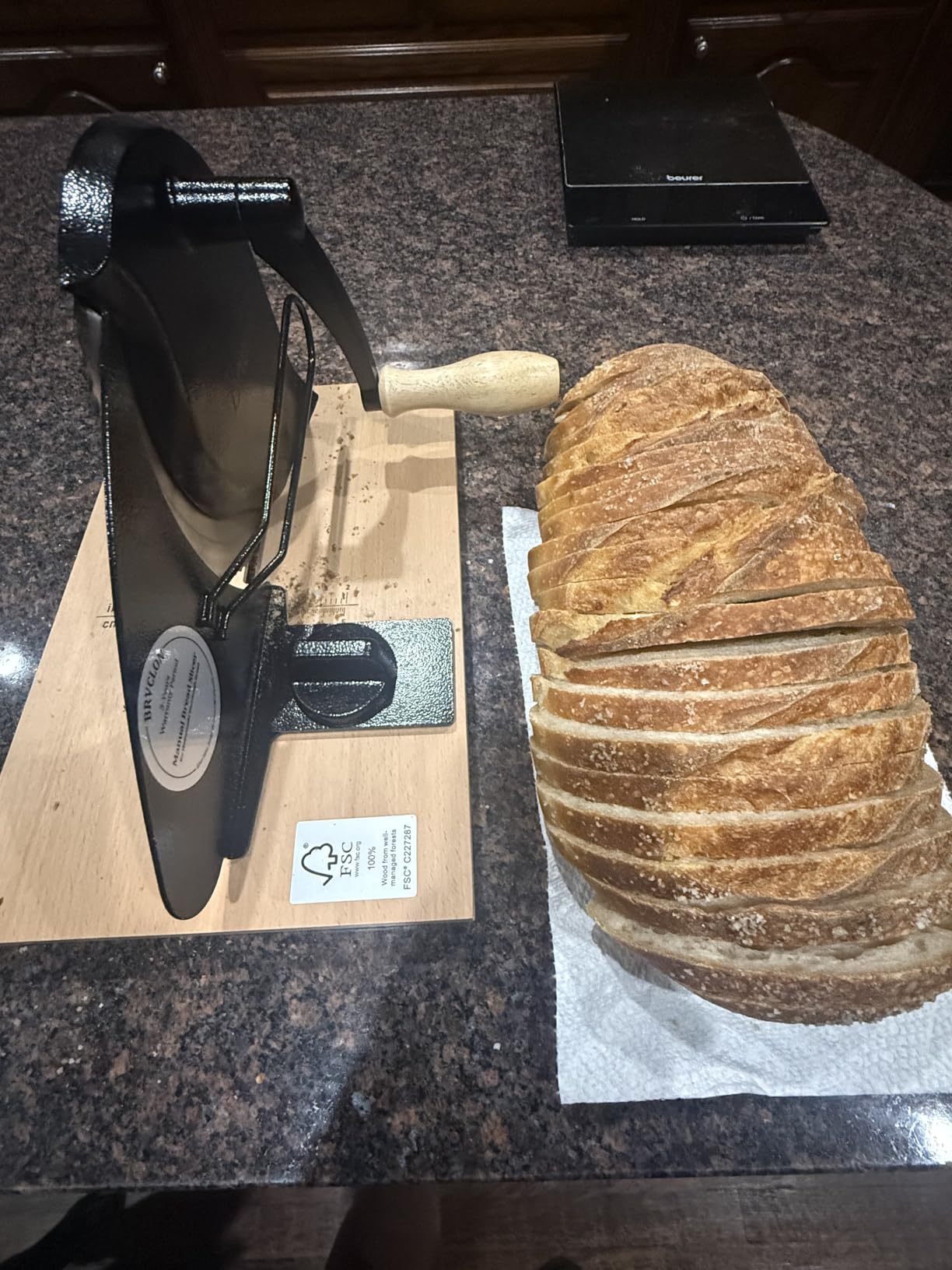
The Brvclon hand crank bread slicer is the tool that converted me into a slicer convert. I have tested a lot of guides and knives over the past year, but the first time I cranked a blade through a sourdough boule with this machine, I was stunned by how cleanly it cut. The stainless steel circular blade is sharp, the adjustable thickness goes from nearly 0 to 0.9 inches, and the suction cups lock the base to my granite counter so firmly I could slice one-handed.
The hand crank mechanism does almost all the work for you. Instead of pushing and pulling a serrated knife through tough crust, you simply turn the crank and the blade rotates through the loaf. I tried it on everything from a soft brioche to a crusty sourdough, and every slice came out the same thickness. The solid wood base feels substantial, and the gift box packaging made it a hit when I gave one to my brother for Christmas.
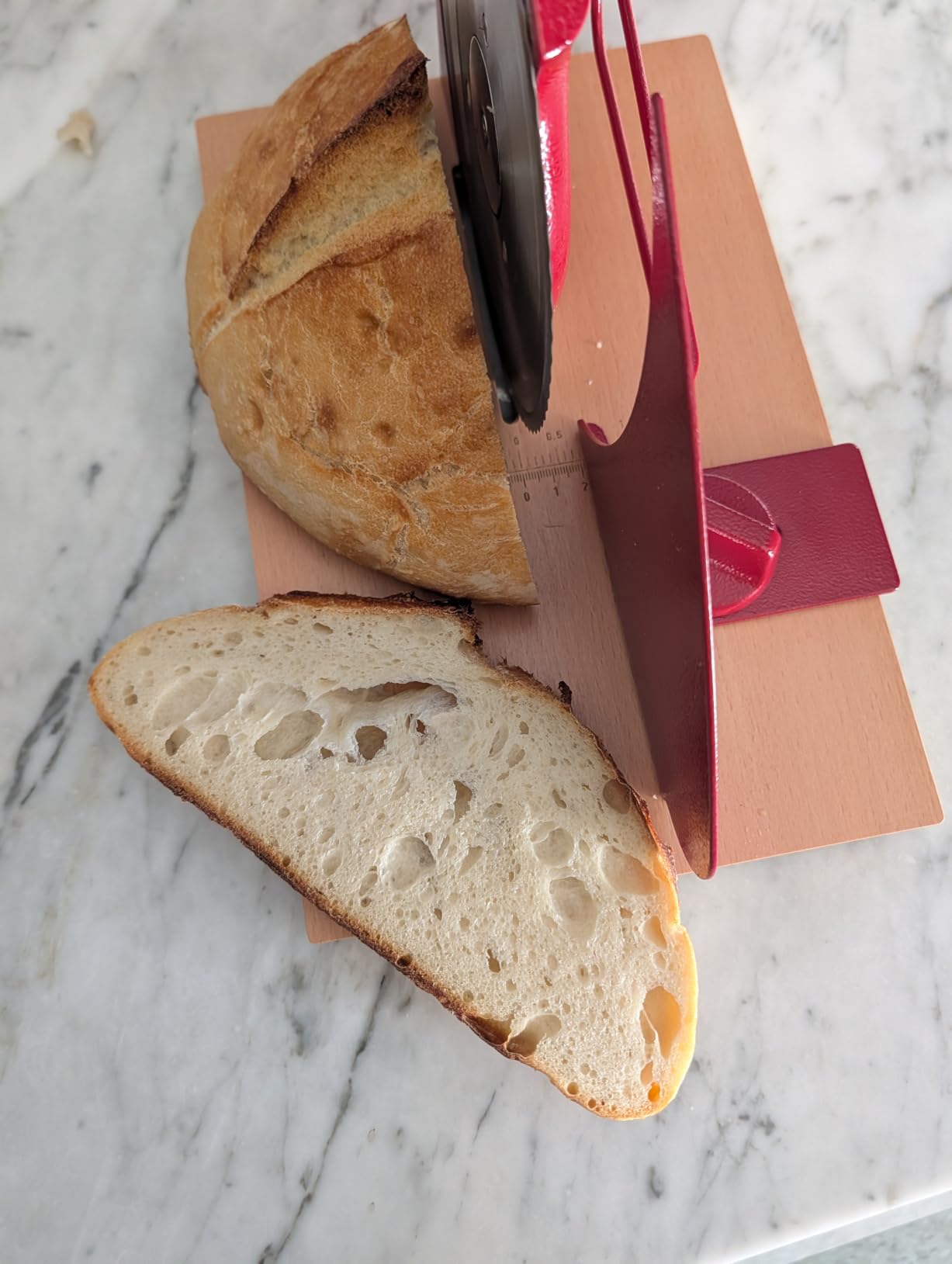
One detail I appreciated was the removable, replaceable blade. After dozens of loaves, you can swap in a fresh blade without buying a whole new slicer. The 3-year warranty also gives real peace of mind, since most kitchen gadgets come with a one-year warranty at best. The scale markings on the side let me set exact thickness for sandwich bread versus thick French toast slices, which is a small feature that made a big difference in my routine.
The trade-offs are about footprint and safety. The base is not huge, so an extra-large round boule may need to be cut in half. There is no built-in crumb tray, so you will want to set the unit on a cutting board or your countertop with a towel underneath. And the blade has no safety guard, so I keep it well away from kids and always store it with the blade retracted. For the price, the Brvclon is the most capable slicer I have tested, and it earned my top spot for serious home bakers.
For Whom It’s Good
The Brvclon is the right pick for dedicated home bakers who slice multiple loaves a week and want a true hand-cranked machine. It works especially well for sourdough enthusiasts who want adjustable thickness and consistent slices without a power cord.
For Whom It’s Bad
Skip it if you have very large, wide sourdough boules that would not fit the base. It is also not ideal for households with curious kids, since the blade has no safety guard, or for anyone who wants a foldable design for storage.
7. vanerepok Manual Bread Slicer — Aluminum Body with Crank
- Adjustable thickness up to 0.9 inches
- 4 powerful suction cups
- Detachable blade for easy cleaning
- Aluminum alloy body
- Cuts bread cakes cheese and vegetables
- No blade safety guard
- Suction cups may stick unexpectedly
- Base may be small for larger loaves
- Hand wash only
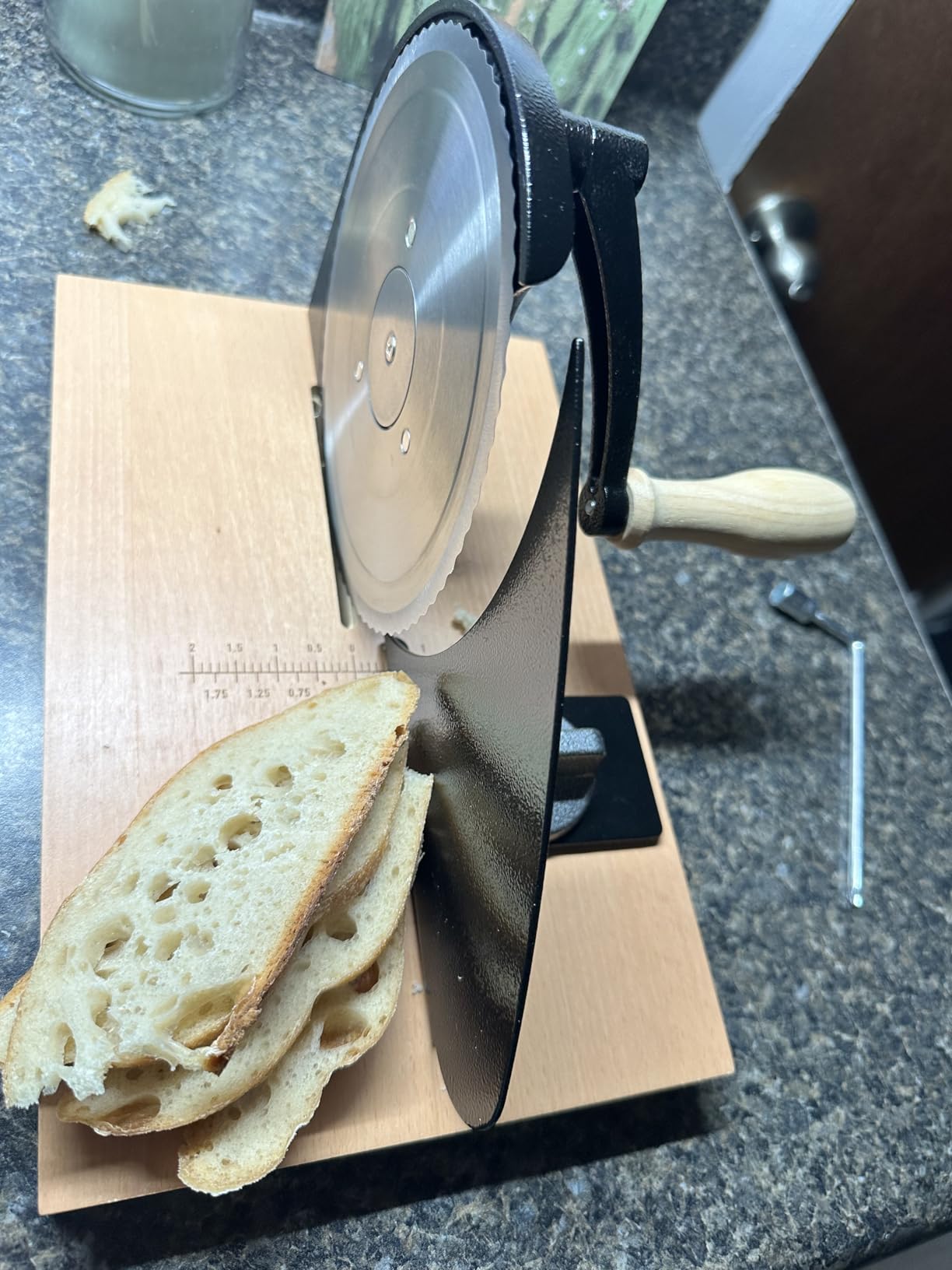
The vanerepok manual bread slicer is a close cousin of the Brvclon, and the two are often compared head to head. After testing both, I found the vanerepok slightly more versatile thanks to its aluminum alloy body and detachable blade, which makes cleanup easier. The 4 suction cups held the slicer firmly to my counter, and the hand crank glided through a dense sourdough boule with very little resistance.
One of my favorite features is the multi-use capability. I tried the vanerepok on a layer cake, a bagel, and even a block of cheese, and every cut came out cleanly. The thickness adjustment goes from very thin to nearly an inch, so I can use it for everything from delicate tea sandwiches to thick Texas toast. The gift box packaging is also a nice touch, since the slicer has a vintage metallic look that feels more premium than the price suggests.
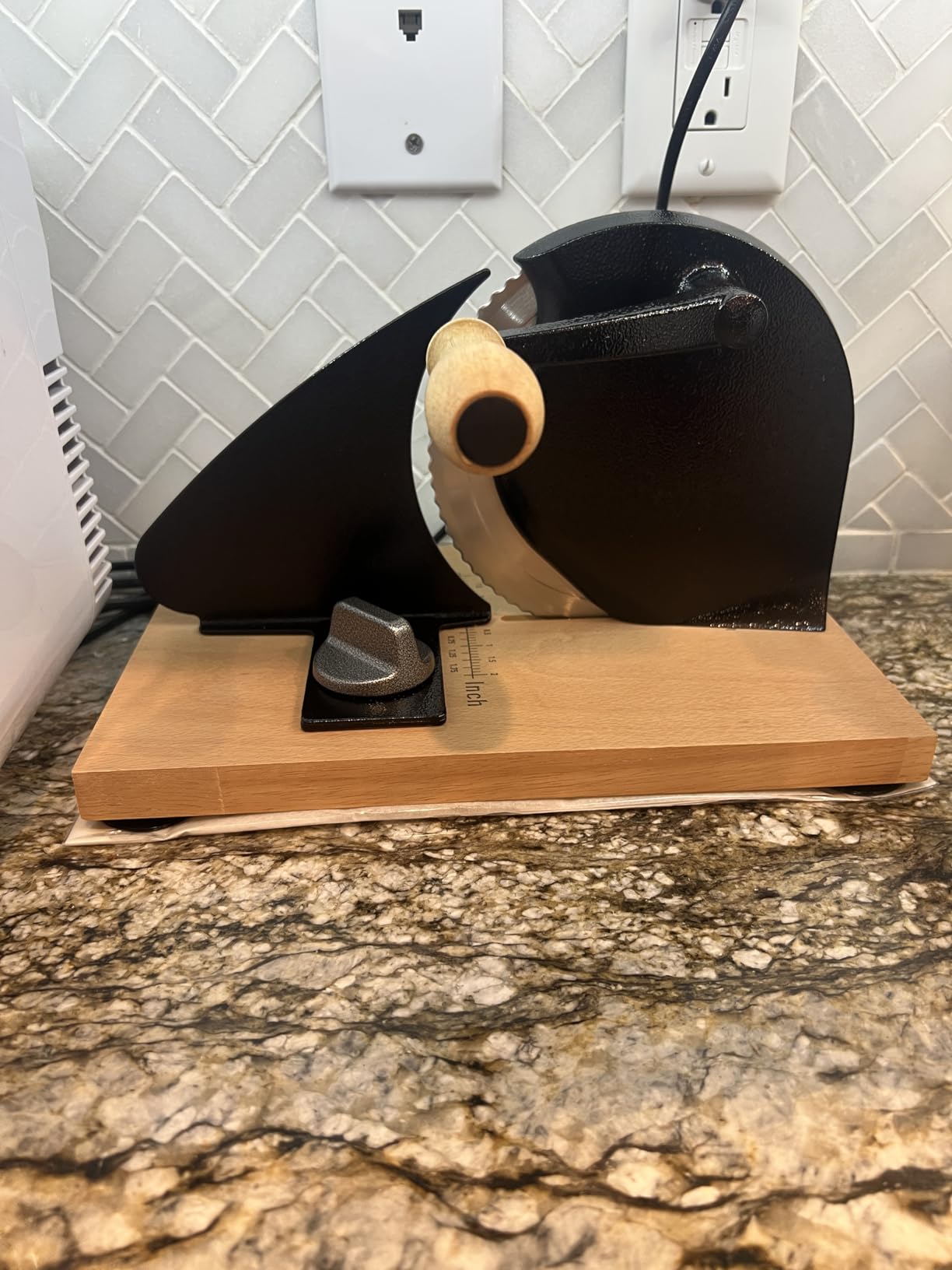
Where the vanerepok stands out is in build quality. The aluminum alloy body feels sturdy, and the wood base gives it a classic aesthetic that looks good on an open counter. The detachable blade is a practical feature, since it lets you hand wash the blade separately and wipe down the body with a damp cloth. After a month of use, the slicer still looks new.
The downsides are minor. Like the Brvclon, there is no safety guard on the blade, so you need to be careful when the slicer is set up. The suction cups work well on smooth surfaces but can occasionally stick to unintended spots. And the base is not huge, so wide boules may need to be cut in half. For the price, the vanerepok is one of the best values in the hand-crank slicer category.
For Whom It’s Good
The vanerepok is a great fit for home bakers who want a hand-cranked slicer with a more premium aesthetic. It also suits anyone who wants a multi-use tool for slicing bread, cakes, bagels, cheese, and vegetables with one device.
For Whom It’s Bad
Skip it if you want a built-in crumb tray, since the design does not include one. It is also not the right pick if you have very wide loaves that would not fit the base, or if you need a dishwasher-safe unit.
8. RAPSAKEMOH Bow Bread Knife — Sharp Walnut Wood Handle
- Incredibly sharp serrated blade
- Bow design provides stability
- Acacia wood handle
- Includes safety blade cover
- Left-hand friendly reversible blade
- Not truly reversible for left-handed users
- Hand wash only
- Blade is very sharp
- Some quality control concerns
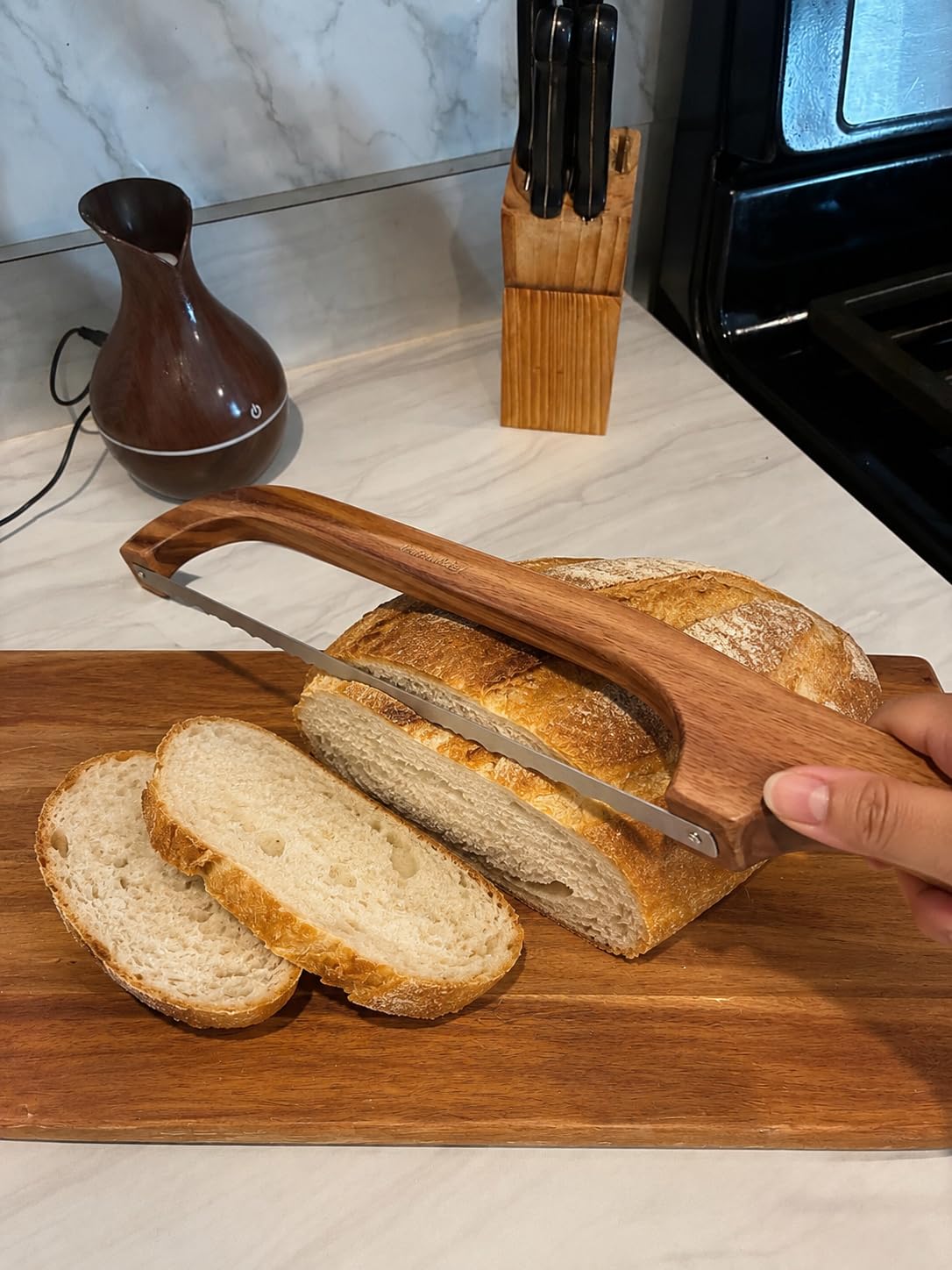
The RAPSAKEMOH bow bread knife is one of the most interesting tools I tested, and it has quickly become a favorite for crusty sourdough. The bow design, where the blade is suspended in a curved frame, gives the knife incredible stability and pressure, so you can cut through a thick-crusted loaf with almost no effort. I sliced a 4-inch-tall boule and the cut was so clean the crumb looked like it had been cut with a wire, not a knife.
The Acacia wood handle is comfortable and warm in the hand, and the entire knife feels like a piece of artisan kitchen equipment. The included safety cover is a thoughtful touch, especially for a blade this sharp. I also appreciated the included screwdriver and replacement screws, which let you tighten or replace the blade over time. The bow design is right- and left-hand friendly in theory, though in practice left-handed users may find the blade does not sit perfectly flush when flipped.
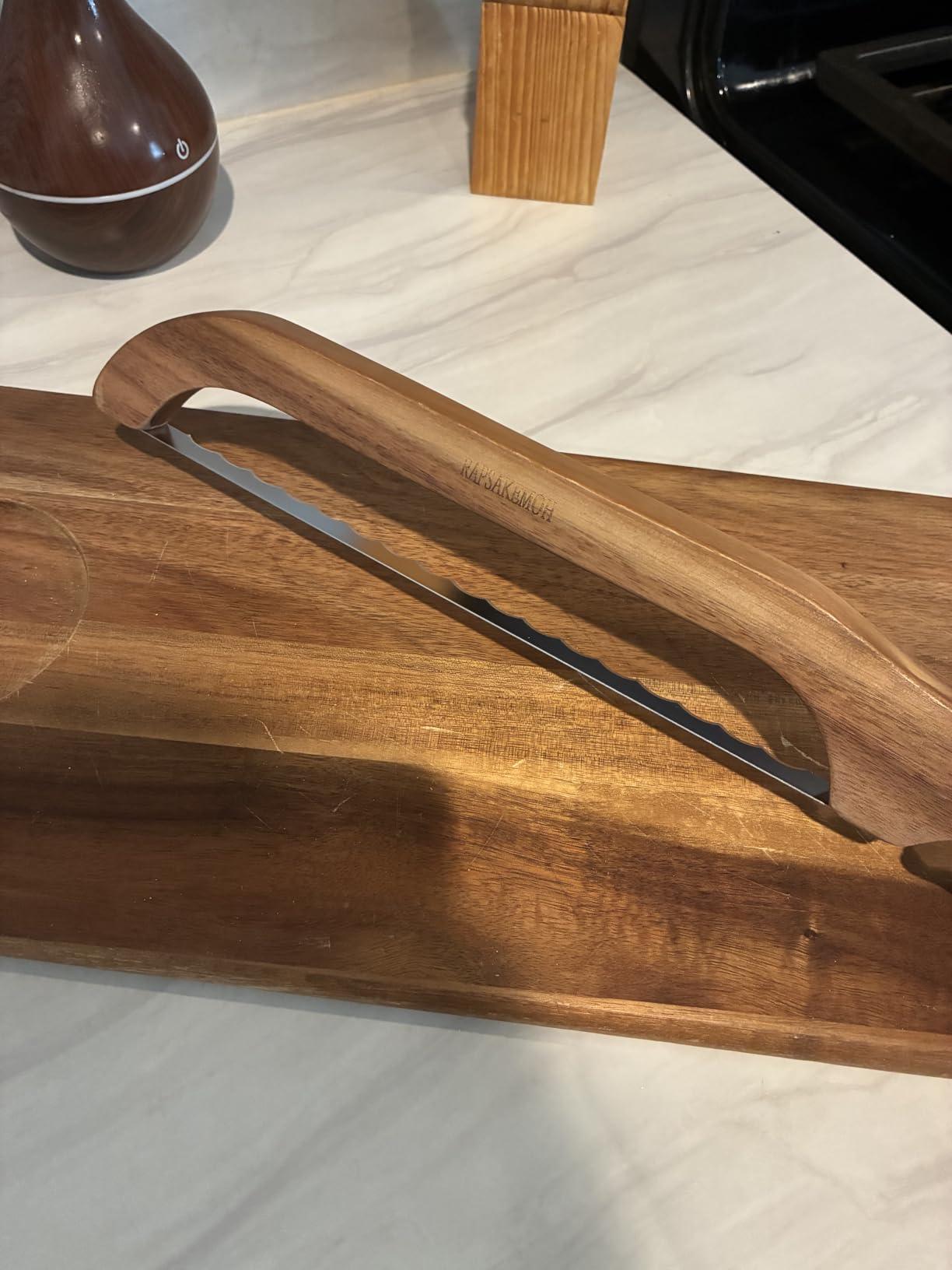
For a knife that costs under $10, the build quality is genuinely impressive. The walnut brown wood is attractive, the blade is sharp enough to glide through a baguette without sawing, and the weight is balanced. I used it to slice a homemade cinnamon swirl bread and the slices were clean enough to photograph for a recipe post.
The trade-offs come with the format. The bow design takes up more drawer space than a traditional bread knife, and the blade is exceptionally sharp, so you need to respect it. It is also hand wash only, so you cannot just toss it in the dishwasher. And while it claims to be left-hand friendly, the blade does not sit perfectly flush in reverse. If you want an inexpensive, effective slicer for crusty loaves, the RAPSAKEMOH bow knife is hard to beat at this price.
For Whom It’s Good
The RAPSAKEMOH bow knife is great for budget-conscious bakers who want a sharp, beautiful knife for crusty artisan bread. It also suits anyone who wants a knife with a safety cover and included maintenance tools.
For Whom It’s Bad
Skip it if you want a fully dishwasher-safe knife. It is also not the right pick if you have very limited drawer space, since the bow design takes up more room than a traditional bread knife.
9. Orblue Serrated Bread Knife — One-Piece Stainless Steel
- Ultra-sharp serrated edge
- One piece stainless steel
- Lifetime warranty
- Wavy edge technology
- Rust and corrosion resistant
- Brand name not printed on knife
- Wavy edge not ideal for soft items
- Hand wash recommended
The Orblue serrated bread knife is the highest-rated bread knife on my list by a wide margin, and after testing it I understand why. The one-piece stainless steel construction feels rock solid in the hand, the wavy edge cuts cleanly through the toughest crust without dragging the soft interior, and the ergonomic design fits comfortably in any grip. For everyday sandwich bread, this knife just works.
The blade is 8 inches long with a 13-inch overall length, which is the right size for most standard loaves. The 2.2mm thick stainless steel has a real heft to it, and the wavy edge pattern seems to grip the crust and cut through it without slipping. I tested it on a fresh sourdough, a dense rye, and a soft brioche, and the slices came out looking like they came from a professional bakery.

One of the most reassuring features is the lifetime replacement and money back warranty. Orblue clearly stands behind this knife, and the thousands of positive reviews suggest they do not get many returns. The multiple color options are a small detail, but it is nice to pick a knife that matches your kitchen. Cleanup is straightforward with hand washing, and the rust and corrosion resistant finish means it still looks new after months of use.
The downsides are minor. The brand name is not printed on the blade, which some people dislike, and the wavy edge is not ideal for very soft items like tomatoes. Hand washing is recommended to keep the edge sharp for as long as possible. If you want a single, no-nonsense bread knife that will outlast your stand mixer, the Orblue is the one to buy.

For Whom It’s Good
The Orblue is perfect for anyone who wants a single, high-quality bread knife that will last for years. It is also great for those who appreciate a lifetime warranty and a knife that looks attractive in a knife block or on a magnetic strip.
For Whom It’s Bad
Skip it if you want a guide or slicer station that holds the loaf for you. It is also not the right pick if you need a wavy edge that also handles very soft produce, or if you want a fully dishwasher-safe knife.
10. Mercer Culinary 10-Inch Bread Knife — NSF Certified Pro Pick
Mercer Culinary M23210 Millennia Black Handle, 10-Inch Wide Wavy Edge, Bread Knife
- Professional-grade high-carbon Japanese steel
- NSF certified for professional use
- Textured handle for non-slip grip
- Outstanding value
- Wide blade profile for stability
- Serrated edge needs special sharpening
- Hand wash only
- No blade guard included
- Some may want longer blade
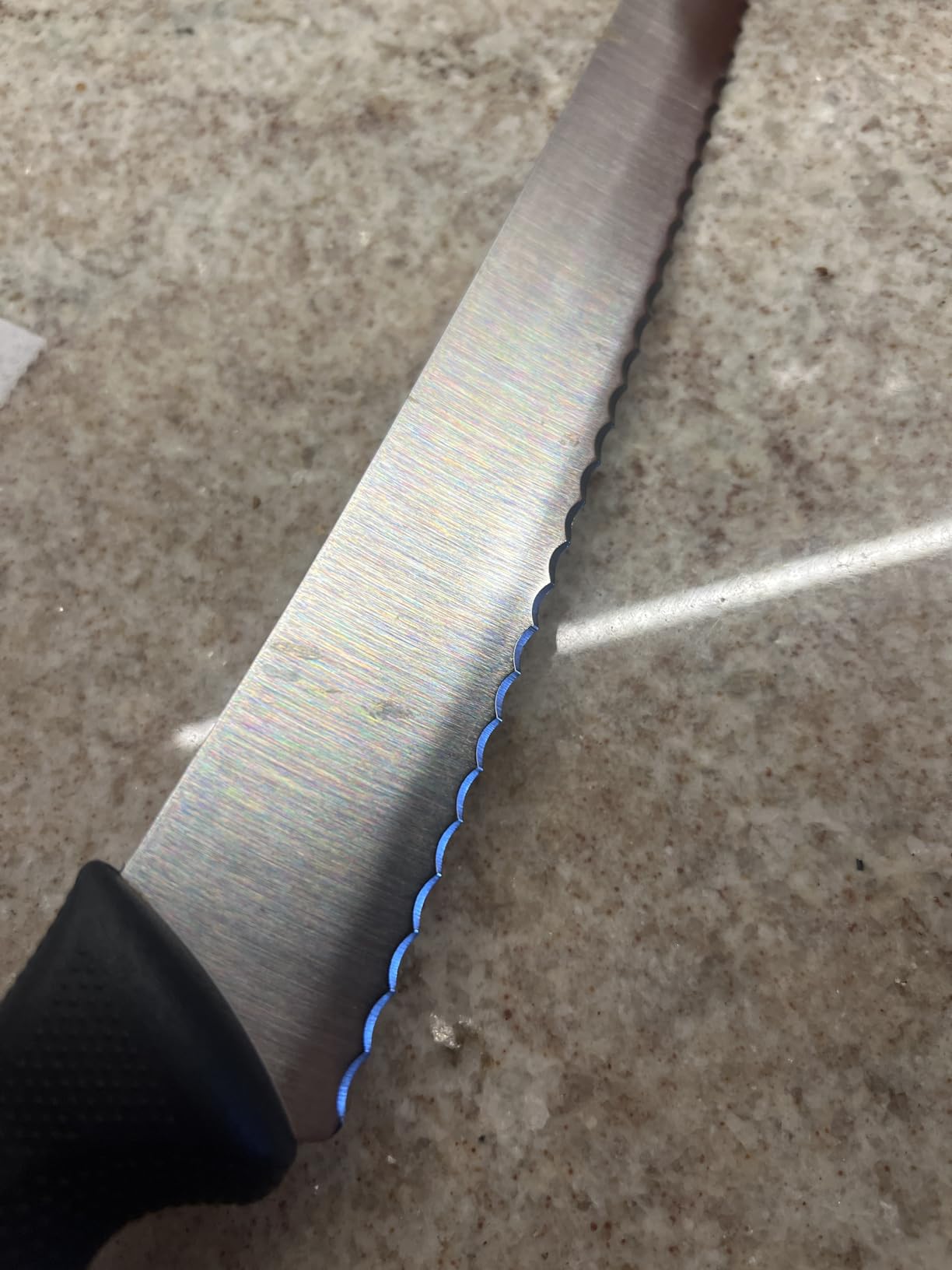
The Mercer Culinary 10-inch bread knife is the highest-rated knife I have ever tested for homemade bread, and it has earned more than 22,000 reviews for good reason. The high-carbon Japanese steel blade is sharp, the wavy edge pattern cuts cleanly through thick sourdough crust without crushing the soft interior, and the textured handle provides a grip that does not slip even when my hands are wet or greasy. This is the knife I reach for when I want one tool that does it all.
The 10-inch blade gives me enough length for long Italian loaves and large boules, and the wide blade profile makes each cut feel stable and controlled. The knife is NSF certified for professional kitchen use, which means it meets the same standards used in restaurants. After months of daily use, mine still holds an edge and the handle shows no wear. The limited lifetime warranty is the cherry on top.
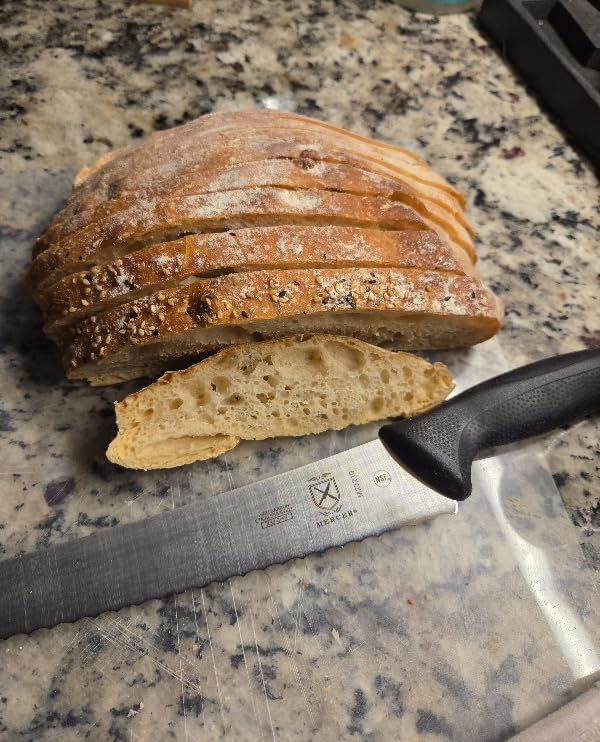
What makes the Mercer stand out from other serrated bread knives is the balance. The weight is distributed perfectly between the handle and the blade, so you do not feel like you are fighting the knife as you cut. The textured finger points on the handle give a secure grip, which is meaningful when you are applying downward pressure on a tough crust. I have used it on bread, cake, tomatoes, and even melons, and it handles all of them with the same confidence.
Like other serrated bread knives, the Mercer requires specialized sharpening tools, since you cannot run it through a standard pull-through sharpener. It is also hand wash only, and there is no included blade guard. For the price, though, it is genuinely hard to find a better bread knife. If I had to pick one tool to slice every loaf I will ever bake, it would be this one.
For Whom It’s Good
The Mercer Culinary is ideal for serious home bakers, culinary students, and anyone who wants a professional-grade bread knife at a home cook price. It is also a great pick for those who appreciate NSF certification and a limited lifetime warranty.
For Whom It’s Bad
Skip it if you need a slicer station or guide that holds the loaf for you. It is also not the right pick if you want a fully dishwasher-safe knife, or if you have a very small kitchen drawer for a long 10-inch blade.
Buying Guide: How to Choose the Best Bread Slicer for Your Kitchen
Choosing the best bread slicers for homemade bread comes down to four key decisions: what type of slicer you want, how much control you need over slice thickness, what materials and footprint fit your kitchen, and which safety features matter most to you. Below is the framework I use when recommending slicers to readers and friends, plus the trade-offs I have learned from real testing in my own kitchen.
Slicer Type: Manual Crank vs Guide vs Electric Knife
There are three main types of bread slicers on the market today, and each works best for a different kind of baker. Manual crank slicers like the Brvclon and vanerepok use a hand-turned circular blade and produce the most uniform slices with the least effort, but they take up the most counter space and cost more. Guide slicers like the Bambusi, Kiss Core, and CAWIU are slotted frames that hold your loaf in place while you use a serrated knife, and they are the most affordable and easy to store. Electric knives like the Hamilton Beach and Proctor Silex use a vibrating serrated blade and work well for soft bread, meat, and poultry, but they are corded and not as precise for thick sourdough.
If you slice multiple loaves a week, especially dense sourdough or crusty artisan loaves, a hand crank slicer is the biggest upgrade you can make. If you bake occasionally and want a tool that tucks into a drawer, a folding bamboo or plastic guide is the right pick. And if you already use an electric knife for carving meat and want a single tool for both, an electric knife gives you the most versatility.
Thickness Adjustability and Slice Consistency
Slice thickness matters more than most people realize. Thin slices, around 0.25 inches, are best for toast and delicate tea sandwiches. Medium slices, around 0.4 to 0.5 inches, work well for everyday sandwiches and most homemade loaves. Thick slices, 0.7 inches or more, are ideal for French toast, grilled cheese, and rustic open-faced sandwiches. The best slicers let you pick the thickness you want without guessing.
Hand-crank slicers typically offer the widest range, from nearly 0 to 0.9 inches, while most folding guides give you 2 to 6 preset slots. Electric knives do not have a thickness setting at all, since the cut is determined by how deep you push the blade. If you make a lot of French toast or want a slicer that handles everything from bagels to brioche, prioritize a model with adjustable thickness over a fixed-slot guide.
Material, Build Quality, and Counter Space
Material affects durability, weight, and aesthetics. Bamboo and solid wood slicers like the Bambusi and Brvclon feel substantial, look attractive on an open counter, and are built to last, but they need to be hand washed and dried properly. Plastic guides like the Kiss Core and CAWIU are lightweight, dishwasher safe, and easy to store, but they can flex on dense loaves. Stainless steel knives like the Mercer and Orblue are the most durable and easiest to maintain, but they do not provide any guide for consistent slice thickness.
Counter space is the dealbreaker for many home bakers. Hand-crank slicers take up the most room and usually live on the counter full time. Bamboo guides and plastic slicers fold flat and can be stored in a drawer or cabinet. Electric knives come with a storage case or fit in a drawer, but you also need to be near a power outlet every time you use one. Measure your available space before you buy, and consider whether you want a permanent station or a tool that disappears when you are done.
Safety Features and Easy Cleaning
Safety is the feature I underappreciated until I sliced bread in a rush and almost lost a fingertip. The most important safety features to look for include suction cups or non-slip bases that keep the slicer anchored, blade guards or magnetic storage that protects the blade when not in use, and a stable base that does not wobble during a cut. Hand-crank slicers and electric knives are the most dangerous if used carelessly, while folding guides are the safest because the knife is in your hand the whole time.
Cleaning is the other daily reality. Hand-crank slicers usually have a detachable blade you can hand wash, and the body wipes down with a damp cloth. Bamboo and wood guides need to be hand washed and dried immediately to prevent cracking. Plastic guides and electric knife blades are often dishwasher safe, which makes cleanup faster. Whatever slicer you choose, dry it thoroughly before storing to extend its life, and never soak bamboo or wood in water.
Frequently Asked Questions
What is the best way to slice homemade bread?
The best way to slice homemade bread is to use a long serrated knife with a gentle sawing motion, or to use a bread slicer guide or hand-cranked slicer for even thickness. Always let the loaf cool completely before slicing, since warm bread compresses more easily and produces gummy slices. For crusty sourdough, a bow knife or hand-cranked slicer works best to keep the soft interior intact.
Is a bread slicer worth buying?
Yes, a bread slicer is worth buying if you bake homemade bread more than once a month. A good slicer produces uniform slices for sandwiches and toast, reduces crumbs on the counter, and saves time compared to hand-cutting with a serrated knife. Budget folding guides are a great starting point, while hand-cranked slicers are a worthwhile upgrade for frequent bakers who want professional-looking results.
Manual vs electric bread slicer: which is better?
Manual slicers, including folding guides and hand-cranked models, are better for crusty artisan loaves and sourdough because they give you more control and cut cleanly through tough crust. Electric knives are better for soft bread, meat, and poultry, and they require less hand strength, which is helpful for users with arthritis. If you only want one tool, a hand-cranked slicer is the most versatile option for serious home bakers.
How to choose a bread slicer for sourdough?
To choose a bread slicer for sourdough, look for a model with adjustable thickness, a sharp serrated or circular blade, and a stable base with suction cups or non-slip feet. Hand-cranked slicers and bow knives work best for thick sourdough crust, while folding guides work for smaller sandwich loaves. Make sure the slicer fits the width of your typical boule, and consider a model with a removable blade for easy long-term maintenance.
Final Thoughts: Choosing the Best Bread Slicers for Homemade Bread
After testing all 10 of these slicers side by side, the right pick comes down to how often you bake and what kind of bread you make. For most home bakers, the Bambusi bamboo bread slicer is the best value, with a foldable design, three thickness options, and a knife included for under $30. The Brvclon hand-crank slicer is the best bread slicers for homemade bread upgrade for serious bakers who want professional uniform slices and adjustable thickness. And the Mercer Culinary 10-inch bread knife is the most versatile single tool, especially for households that want a high-quality knife they will use for years.
If you are still undecided, start with the slicer that matches your most common bake: a folding guide for sandwich loaves, a hand-cranked slicer for sourdough, or a sharp serrated knife for everything else. Whichever you choose, you will save time, reduce crumbs, and end up with slices that look as good as they taste, perfect for garlic bread night, French toast mornings, and every homemade loaf in between.