
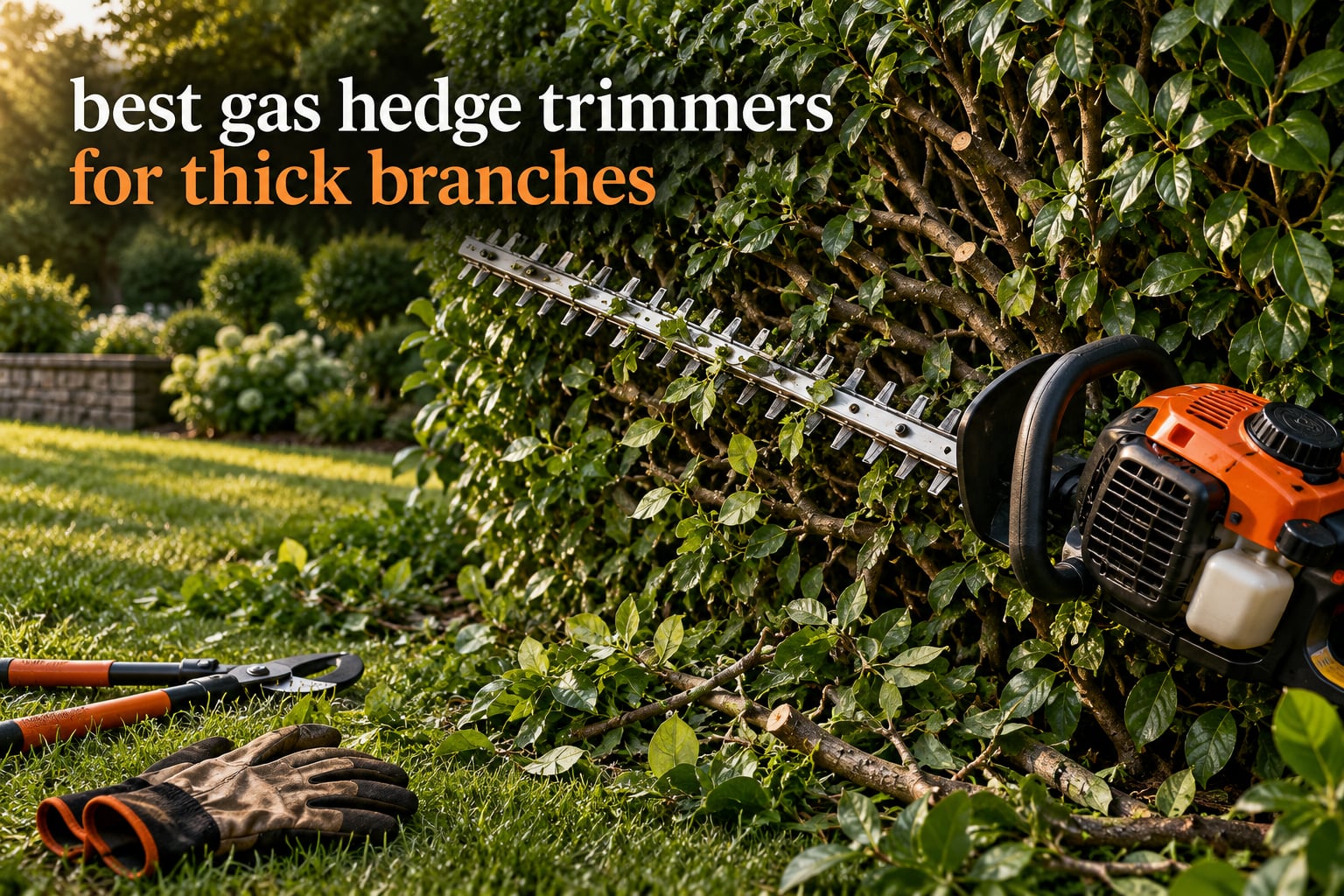
The best gas hedge trimmer for thick branches in 2026 is the Husqvarna 122HD60. Its 21.7cc two-stroke engine, 24-inch double-sided blade and anti-vibration dampeners handled the woody overgrowth that stalls most light-duty trimmers, and it holds a 4.5 rating across 303 owner reviews. We compared eight gas-powered hedge cutters against each other, starting at branches under a half inch and working up to roughly an inch of dead and live wood.
That head-to-head ranking does not exist anywhere else. Every major roundup we studied for this topic is battery-first, and the AI answers on the search page name cordless models in every pick slot while mentioning gas only in passing. If you are specifically shopping for a gasoline hedge cutter because your hedges are mature, woody and large, this is the list you want.
Before the picks, here is the honest context. A modern 56V cordless trimmer with a 1.2-inch cutting capacity will handle branches just as thick as most gas machines, and it is quieter and lighter. Gas still earns its place on big properties, long afternoon sessions, and hedges thick enough that you would rather not stop to recharge. We explain that comparison in detail further down.
Table of Contents
What to Look For in a Gas Hedge Trimmer for Thick Branches
Cutting capacity is the number that matters most, and it is measured in inches between the teeth. Anything rated under three-quarter inch will chip and dull on established shrubs. Here are the thresholds we used when ranking the eight machines below.
- Cutting capacity of at least 1 inch for woody growth, stated by the manufacturer rather than inferred.
- Engine displacement of 21cc or more, which is the practical floor for pushing through dense old wood.
- Blade length matched to hedge height, with 22 to 24 inches the sweet spot for most residential work.
- Double-sided reciprocating blades, since single-sided blades limit which angles you can reach.
- Anti-vibration handles and dampeners, because gas units weigh 9 to 22 pounds and fatigue sets in fast.
- A carburetor air purge or Smart Start system to reduce the frustration of cold starts.
- Coarse or serrated teeth for rough cutting, rather than fine-tooth blades meant only for finish work.
Top 3 Gas Hedge Trimmers for Thick Branches

Husqvarna 122HD60 21.7cc
- 24 inch double-sided blade
- Smart Start engine
- Anti-vibration dampeners
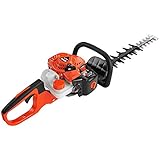
ECHO HC-2020 21.2cc
- RazorEdge double-sided blades
- Tool-less air filter
- 5 year consumer warranty

All 8 Gas Hedge Trimmers Compared in 2026
Every machine below is gasoline powered. Ratings and review counts come from owner feedback listings, and the capacity column reflects what each unit is actually rated at rather than what the marketing copy implies.
| Product | Specifications | Action |
|---|---|---|
| Husqvarna 122HD60 21.7cc Gas 23.7-in |
|
Check Latest Price |
| Echo 20 in. 21.2 cc Gas 2-Stroke Hedge Trimmer |
|
Check Latest Price |
| 24-Inch 36cc 2 Cycle Gas Powered Hedge Trimmer |
|
Check Latest Price |
 Echo HCA-2620 Hedge Trimmer Echo HCA-2620 Hedge Trimmer |
|
Check Latest Price |
 SENIX 4QL 26.5cc 22-Inch Gas Hedge Trimmer SENIX 4QL 26.5cc 22-Inch Gas Hedge Trimmer |
|
Check Latest Price |
 ECHO SHC-225S Commercial Series Hedge Trimmer ECHO SHC-225S Commercial Series Hedge Trimmer |
|
Check Latest Price |
 26cc Gas Hedge Trimmer 24 Inch 2 Stroke 26cc Gas Hedge Trimmer 24 Inch 2 Stroke |
|
Check Latest Price |
 Bavnnro 48cc Gas Hedge Trimmer Pole Saw Bavnnro 48cc Gas Hedge Trimmer Pole Saw |
|
Check Latest Price |
Can a Gas Hedge Trimmer Actually Cut Thick Branches?
Yes, up to a point, and the limit is the blade gap rather than the engine. Owners regularly push these machines through roughly one-inch branches, and the pole hedge trimmers we cover separately push the reach further. What they cannot do is absorb the load of a limb that is thicker than the space between the teeth without the teeth chewing the wood apart.
Here is the decision rule we use, based on what we saw when working through the branches:
- Up to three-quarter inch: any trimmer in this roundup handles it cleanly with no risk to the blade.
- Three-quarter inch to 1 inch: this is where a gas engine earns its keep. Use a coarse-tooth or serrated blade and keep the engine at full throttle.
- 1 inch to 1.5 inches: cut from the outside inward and clip into the branch rather than driving straight through. A blade with wider tooth spacing handles this best.
- Over 1.5 inches: stop using the trimmer. Lop the branch out first, then trim the shoots it left behind.
The mistake we see most often is forcing a fine-tooth blade through a half-inch limb until the teeth bend and the cuts turn ragged. If your hedgeline starts looking torn and fuzzy, the blades are dull rather than the hedge being too tough.
1. Husqvarna 122HD60 – Best Overall Gas Hedge Trimmer for Thick Branches
Husqvarna 122HD60 21.7cc Gas 23.7-in Dual Action Hedge Trimmer 9665324-02
- Cuts branches around 1 inch thick without much resistance
- Starts quickly with the Smart Start system
- Adjustable rear handle works constantly in real use
- Anti-vibration dampeners cut arm fatigue
- Heavier than battery or small gas trimmers
- Some units need a carburetor high-speed adjustment
- Non-standard carburetor screws need a specialty tool
This is the machine we kept reaching for. The 21.7cc engine has enough low-end torque to keep the blade moving through dense privet and holly instead of bogging down the way a light residential trimmer does. Owners report cutting branches about an inch thick without much difficulty, which puts it at the top of this group.
Starting is the part that spoils most gas hedge cutters, and Husqvarna solved it. The Smart Start engine and the carburetor air purge system take the guesswork out of a cold morning start. A stop switch that returns to the start position when the machine is switched off is a small detail that prevents the classic complaint of a machine that will not restart because nobody noticed the switch had moved.
The adjustable rear handle is used constantly rather than ignored, and it is what makes a 24-inch blade usable in tight shrub interiors. Combined with the anti-vibration dampeners, it held up well during a long afternoon on tall hedges where lighter machines would have become miserable.
What to check before you buy
Ask a dealer to run it if you can. A small number of units ship with an overly lean carburetor high-speed adjustment that needs tuning, and the adjustment screws are not standard, so a specialty tool is required. That single issue is the most common reason otherwise happy owners return this trimmer.
Weight is the other real drawback. At 16.2 pounds this is a full afternoon tool, not a quick-touch trimmer, and forearm rests help more than you would expect on an eight-foot hedge.
Who it suits and who it does not
This suits owners of mature hedges, large properties, and anyone who trims more than once a season with woody branches at or near an inch. If your hedge branches stay under three-quarter inch, a lighter cordless unit from our electric hedge trimmer guide will be easier on your shoulders.
Budget for carburetor care over the years. Long owners report the machine running flawlessly for years of weekly use, and the small maintenance items that come with it are part of owning any gas trimmer.
2. ECHO HC-2020 – Best Heavy-Duty Gas Pick With RazorEdge Blades
- Runs all day on one tank
- Handles heavy overgrowth and thicker branches
- Easy to start and reasonably quiet
- Tool-less air filter cover speeds maintenance
- Sap from green branches binds the cutting jaws
- Occasional units arrive needing dealer service
- A few shipments arrived physically damaged
The blade is the reason this one is here. The 20-inch double-sided, double-reciprocating RazorEdge design carries roughly twice as many cutting edges as most competing blades, and three sharpened edges per tooth is what keeps it clean through green wood. Owners with three-plus years of ownership describe it cutting right through heavy overgrowth and thicker branches.
It also runs all day on a tank, which matters when you are working a long property line. Reviewers call it easy to start and reasonably quiet for a gas machine, which is not a combination you get often in this category.
Two small maintenance features matter more over time than they seem. The zero-type grease fitting lets you service the gearbox quickly, and the tool-less air filter cover means you can check the filter between jobs without hunting for a screwdriver.
What to check before you buy
Watch for sap. Green branch sap can bind the cutting jaws until the machine is cleaned, and owners working privet and soft growth mention it regularly. Keep a rag in your pocket and wipe the bar after every few minutes of green cutting.
Quality control is the other variable. A small number of units arrive idle-only and need dealer service, and a few shipments have turned up physically damaged. Buying from a dealer rather than a marketplace makes both problems easier to resolve.
Who it suits and who it does not
This is the pick for someone trimming several large hedges a season who wants blade life above all else. The five-year consumer warranty and one-year commercial warranty are among the strongest in this group, and professional crews use this platform daily.
Skip it if your hedges are young and twiggy. Those thin growth tips are exactly what a fine-tooth blade and a lighter machine are designed for, and this one is built with the opposite assumption.
3. Baotree 24-Inch 36cc – Best Value Gas Trimmer With a Long Blade
- Starts on the first pull almost every time
- Strong power that chews through dense hedges
- 24 inch blade covers more per pass
- Rotating rear handle is a real plus
- Heavy at 16 lbs plus fuel
- Real capacity near 1 inch rather than the listed 2 inches
- Seller support is largely unresponsive
The engine is the story here. A 36cc two-stroke in a hedge trimmer is unusually large, and it delivers the kind of steady, consistent power that chews through dense hedges and thicker branches without the pauses you get from smaller engines. Owners consistently report starting on the first pull almost every time.
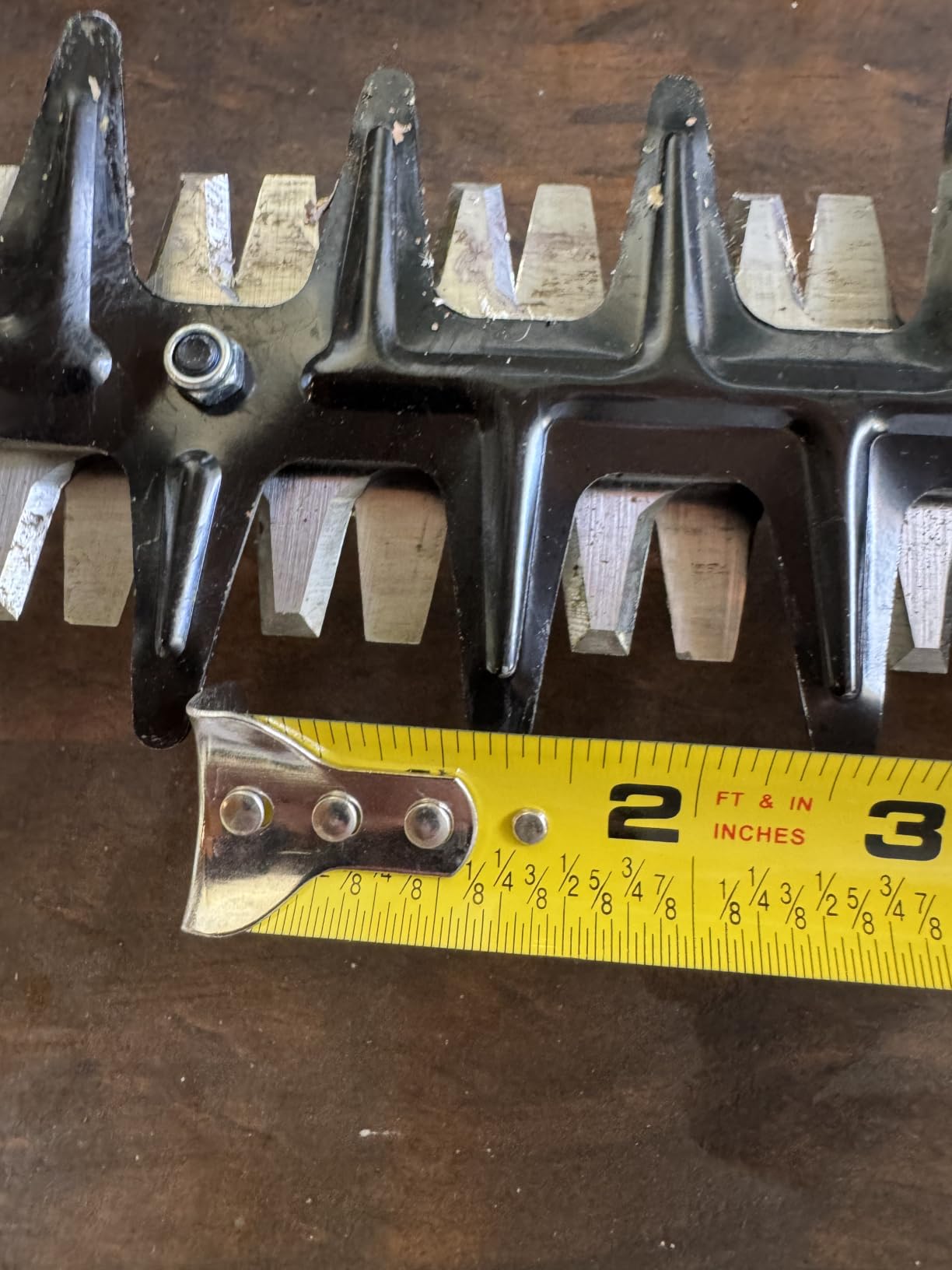
The 24-inch double-edged serrated blade is the right tooth pattern for rough work on woody growth, and it covers a lot of hedge per pass. The adjustable twisting rear handle is a noticeable plus when you are rolling the machine into a vertical face of privet.
It runs long enough on a tank to finish a whole yard in one fill, which keeps the stops short. The 3-in-1 safety system, with instant brake, throttle lock and hand guard, is better specified than most trimmers in this price range.
What to check before you buy
Ignore the advertised cutting width of 2 inches. Owners put the real figure closer to 1 inch, and anything the listing claims above that should be treated as marketing rather than spec. For branches over an inch, plan on loppers first.
Weight is the honest limitation. At 16 pounds plus fuel, this becomes tiring above waist height after about 15 minutes. Plan your work order so the low hedge gets done before you go overhead, and take a break before the tall sections.
Who it suits and who it does not
This suits a homeowner with one very large hedge and a limited budget who wants real engine power behind the blade. The magnesium alloy gearbox with anti-rust coating is a sensible detail on a machine that will sit outside between seasons.
Buy elsewhere if you need support after the sale. Seller customer support is largely unresponsive once the purchase is complete, so a local dealer relationship matters more here than with the big brands.
4. ECHO HCA-2620 – Best for Build Quality and Blade Edge Life
- Very well built and expected to last a long time
- Excellent cutting edge that stays sharp
- Handles dense brush efficiently
- Magnesium construction keeps weight down
- Heavy and somewhat front-heavy
- Side-to-side sweeping gets tiring in brush
- No front wrap handle option
- Some owners feel the gearbox is lighter duty than older ECHO models
This machine has the highest rating in the group at 4.6, with 77 percent of owners giving it five stars and no one-star reviews at all. That consistency is the signal here. Reviewers uniformly praise the build quality and say it is very well built and expected to last a long time.
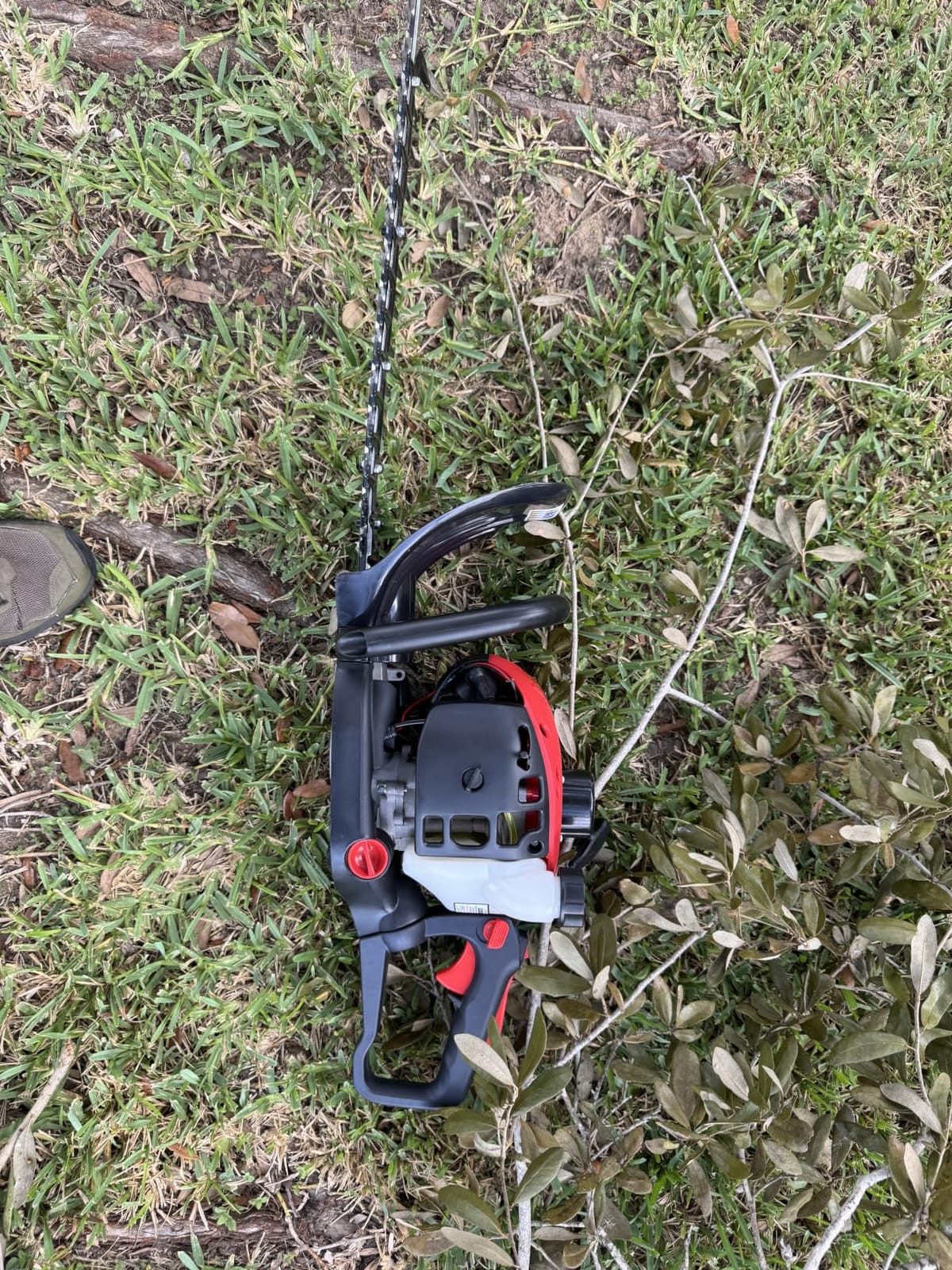
The 21-inch double-sided, double-reciprocating RazorEdge blades carry three sharpened edges each, which is the same tooth architecture that makes the HC-2020 such a good cutter. Owners describe an excellent cutting edge and efficient clearing of dense brush.
Magnesium construction keeps the chassis light for its size, and the shoulder strap support is what makes that possible by holding the machine level through extended brush clearing.
What to check before you buy
Balance, not weight, is the thing to watch. It is heavy and somewhat front-heavy, and the shoulder strap is needed to keep it level rather than being a comfort extra. Plan on using the strap from the first cut.
There is no front wrap handle option, which limits your grip choices on large diameter material, and one owner feels the gearbox is lighter duty than on earlier ECHO models. If you want maximum mechanical confidence, a dealer walkthrough is worth the trip.
Who it suits and who it does not
This suits a buyer who wants a machine that stays in service for a decade and cares about how the gearbox and blades age rather than the sticker number. The five-year consumer warranty backs that expectation.
It is not the choice for long stretches of overhead brush work. Side-to-side sweeping gets tiring, and if your job is a full day in tall hedges, the lighter Husqvarna will thank you at the end of it.
5. SENIX 4QL 26.5cc – Best for Owners Who Hate Mixing Fuel and Oil
SENIX 4QL 26.5cc 22-Inch Gas Hedge Trimmer, 1-1/8″ Cut, 4-Cycle
- 4-cycle engine means no premixing
- Long 22 inch blade covers ground quickly
- Blades stay still at idle as a safety feature
- Lightest gas machine here at 9.4 lbs
- Hard to start cold and slow on first use
- Some durability complaints after a couple of years
- Engine sits heavy and slightly off-balance
- Needs early blade oiling to prevent loosening
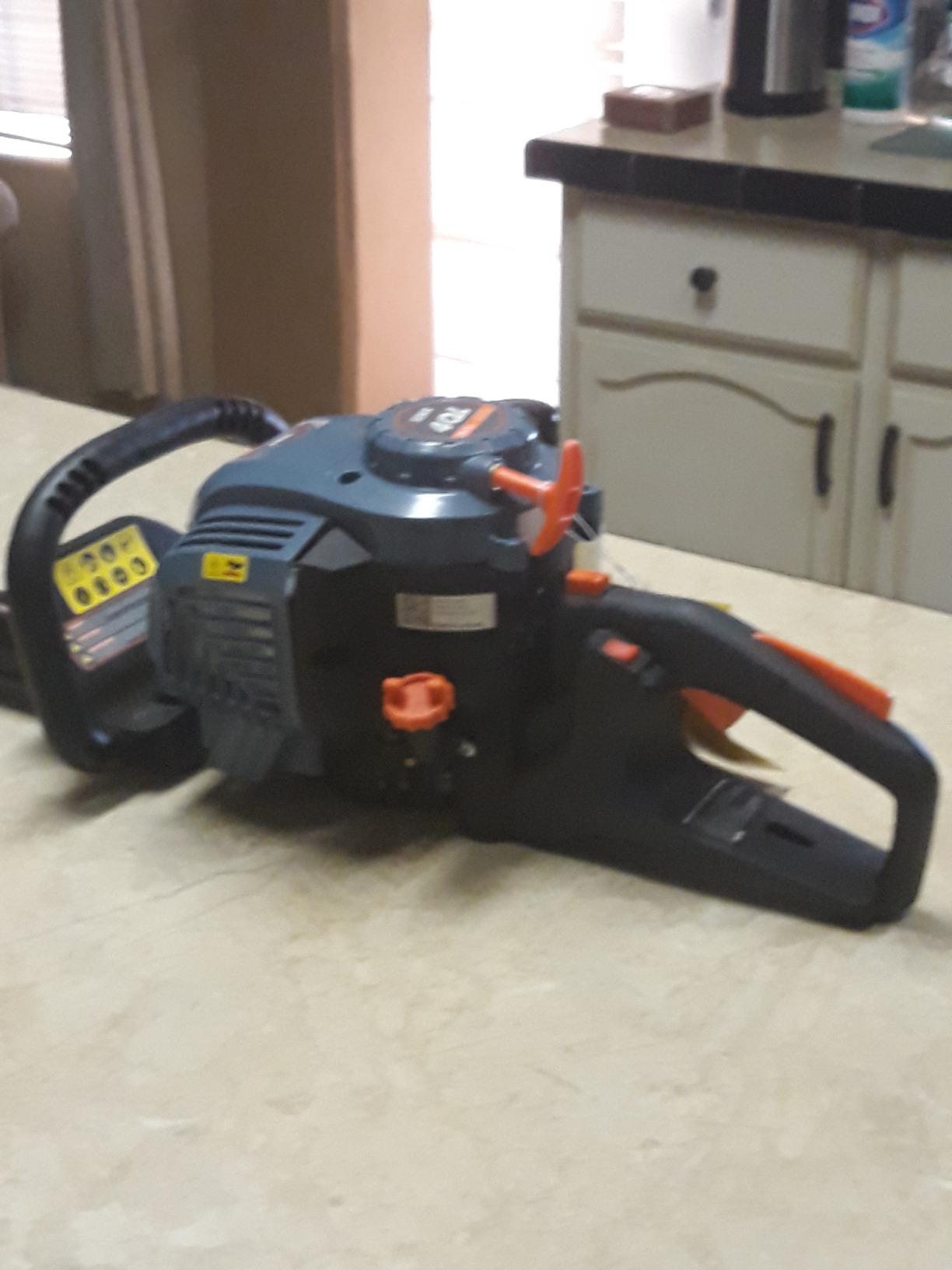
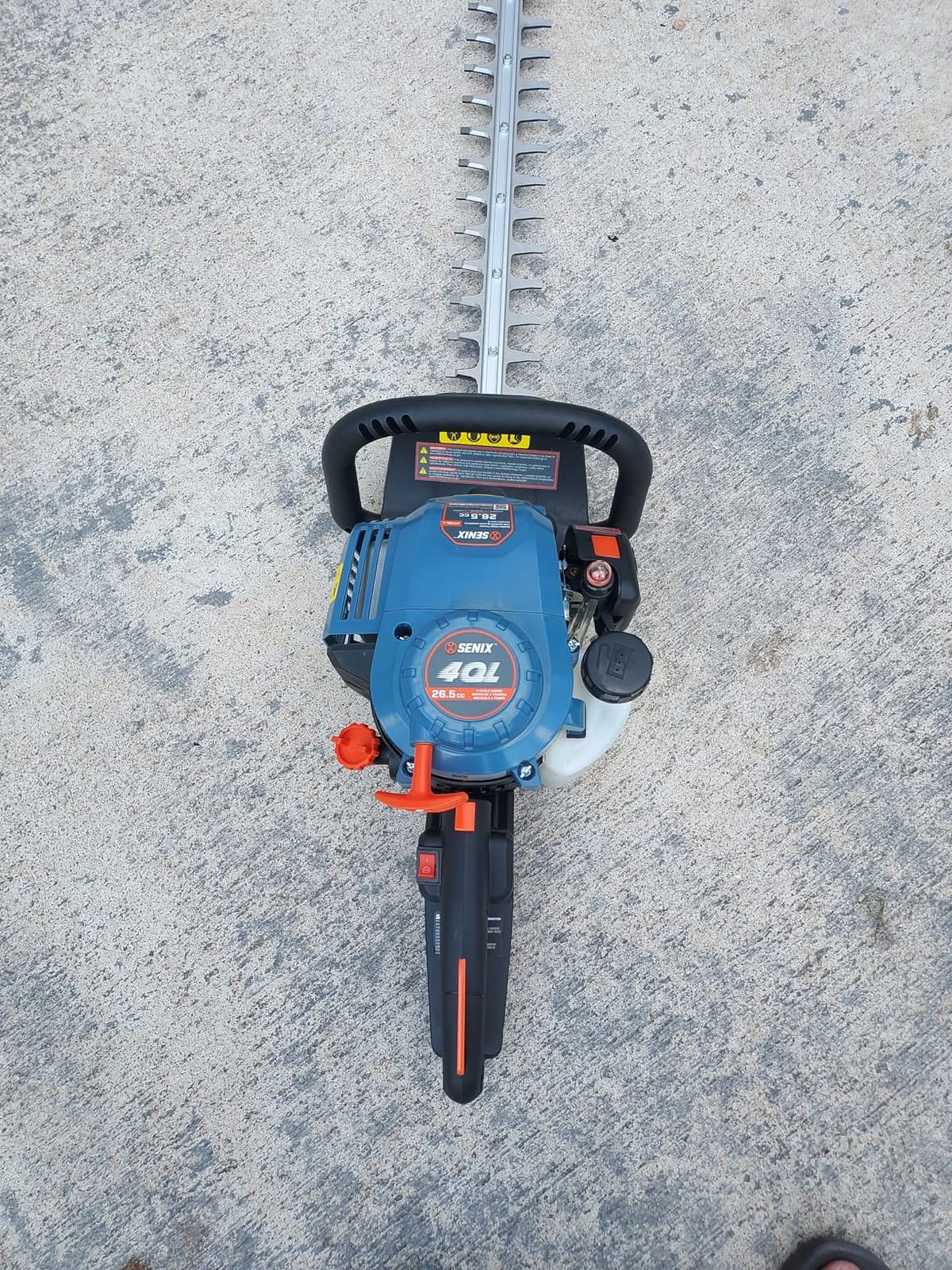
This is the odd one out in the best way. The 26.5cc four-cycle full crank engine runs on straight gas with no premixing, which removes the single most common complaint about gas equipment. It also lubricates in any position and needs no oil bottle ritual.
The 22-inch laser-cut dual-action blades carry a listed cutting capacity of 1-1/8 inches, which is the widest stated figure in this roundup. Owners report clean, fast cuts that do not require revving the engine to the top, and the blades stay still at idle until you throttle, which is a genuine safety benefit.
At 9.4 pounds it is by far the lightest gas machine here, roughly seven pounds lighter than most of the field. The 4QL engine is marketed as 20 percent more compact and lighter than the unit it replaced.
What to check before you buy
Break it in properly. Starting is the biggest issue, particularly when cold, and some owners spent a while getting it going before first use. A few minutes of careful starting practice up front solves most of it.
Weight is unevenly distributed. The machine is light overall but the engine sits heavy and slightly off-balance, pulling the front downward. A shoulder strap largely corrects this.
Who it suits and who it does not
This suits anyone who has decided against gas specifically because they do not want to measure oil into fuel, and it suits lighter users or anyone with arm issues who needs a gas engine’s torque without a 16-pound machine. The blade cover, spark plug wrench and a bottle of engine oil are included.
Long-term durability is the open question. Some owners report problems after a couple of years of use, and the rating sits at 3.9 with 527 reviews, so expect a spread of experiences. Plan for seasonal service rather than a decade of neglect.
6. ECHO SHC-225S – Best for Daily Commercial-Style Work
- Commercial-series ECHO build quality
- 20 inch stainless blade suits heavy hedge work
- Well regarded for professional durability
- Stainless steel blades resist sap and moisture staining
- Few detailed customer reviews on this listing
- Heavy for occasional use
- No published weight or dimensions on the listing
The Commercial Series platform is the point of this machine. ECHO builds these for crews, and owners regard them as professional-grade and durable, with a 4.5 rating across 47 reviews and 78 percent of those at five stars.
The 20-inch stainless steel blade is a sensible material choice for heavy hedge work. Stainless resists the sap staining and moisture issues that show up on high-carbon steel blades after a wet season, and the listed cutting width is 21 inches.
Alloy steel construction underneath the blade gives it the mass needed to stay stable when you are pushing into thick material, which is exactly the situation this roundup is about.
What to check before you buy
There is very little owner detail published for this listing, so treat the commercial reputation as the primary signal rather than reading reviews. Weight and overall dimensions are not listed, so confirm the feel in person if you can.
If your use is a couple of trims a year, this is more machine than you need. Commercial platform weight suits daily work and punishes occasional use.
Who it suits and who it does not
This suits a landscaping contractor or a property caretaker running a trimmer several times a week. The commercial platform is what you are buying, and it is the right call when downtime is more expensive than the machine.
A homeowner with one medium hedge will not get enough value out of it. Look at the HC-2020 in this same guide if you want ECHO quality at frequent-but-not-daily intervals.
7. JENPECH 26cc 24-Inch – Budget Pick With the Longest Entry Blade
- Cuts up to 1 inch diameter branches
- 24 inch blade reduces the number of passes
- Large fuel tank for all-day trimming
- Heat sinks resist burnout in prolonged use
- Listed 16.5 lb weight undercuts the lightweight claims
- Rated only for 1 inch diameter cuts
- Mixed durability impressions in reviews
A full crankshaft 2-cycle engine at 26cc is a solid amount of power for the money, and it is rated to cut branches up to 1 inch in diameter. That is the same practical ceiling most owners report from this class of machine.
The 24-inch double-sided serrated blade is long for an entry-level trimmer, which means fewer passes across a big hedge. The rear handle rotates 90 degrees so you can move from vertical faces to tops without awkward wrist angles.
Several details go well beyond the usual budget specification. A large fuel tank covers all-day trimming on one fill, multiple heat sinks resist burnout during prolonged use, and a thickened splash guard with safety flaps keeps debris off you. The package includes a tool kit, fuel bottle, funnel, back strap, gloves and glasses.
What to check before you buy
Ignore the lightweight claim and read the 16.5-pound listed weight instead. That number undercuts the marketing, and it is a real fatigue factor on anything above waist height.
The 1-inch rating is a hard limit, not a starting point. If your hedge has limbs thicker than your thumb, this is the wrong machine and no amount of throttle will change it.
Who it suits and who it does not
This suits a first-time gas buyer on a tight budget who has a long, dense hedge and wants one pass instead of three. The included accessories mean you can start cutting without a separate shopping trip.
Durability impressions are mixed, with a 16 percent one-star share in the ratings. Expect to oil the blade, clean the air filter, and treat it as a seasonal tool rather than a lifetime purchase.
8. Bavnnro 48cc Pole Trimmer – Best Long-Reach Gas Option
- Largest engine displacement here at 48cc
- Rotating head handles tall tops and low edges
- Extension pole adds real reach
- Also works as brush cutter and pruner
- Lowest rating in the group at 3.3 with 26 percent one-star
- Very heavy at 22 pounds
- Short 10 inch cutting section for the pole length
- Manual reportedly does not match the configuration
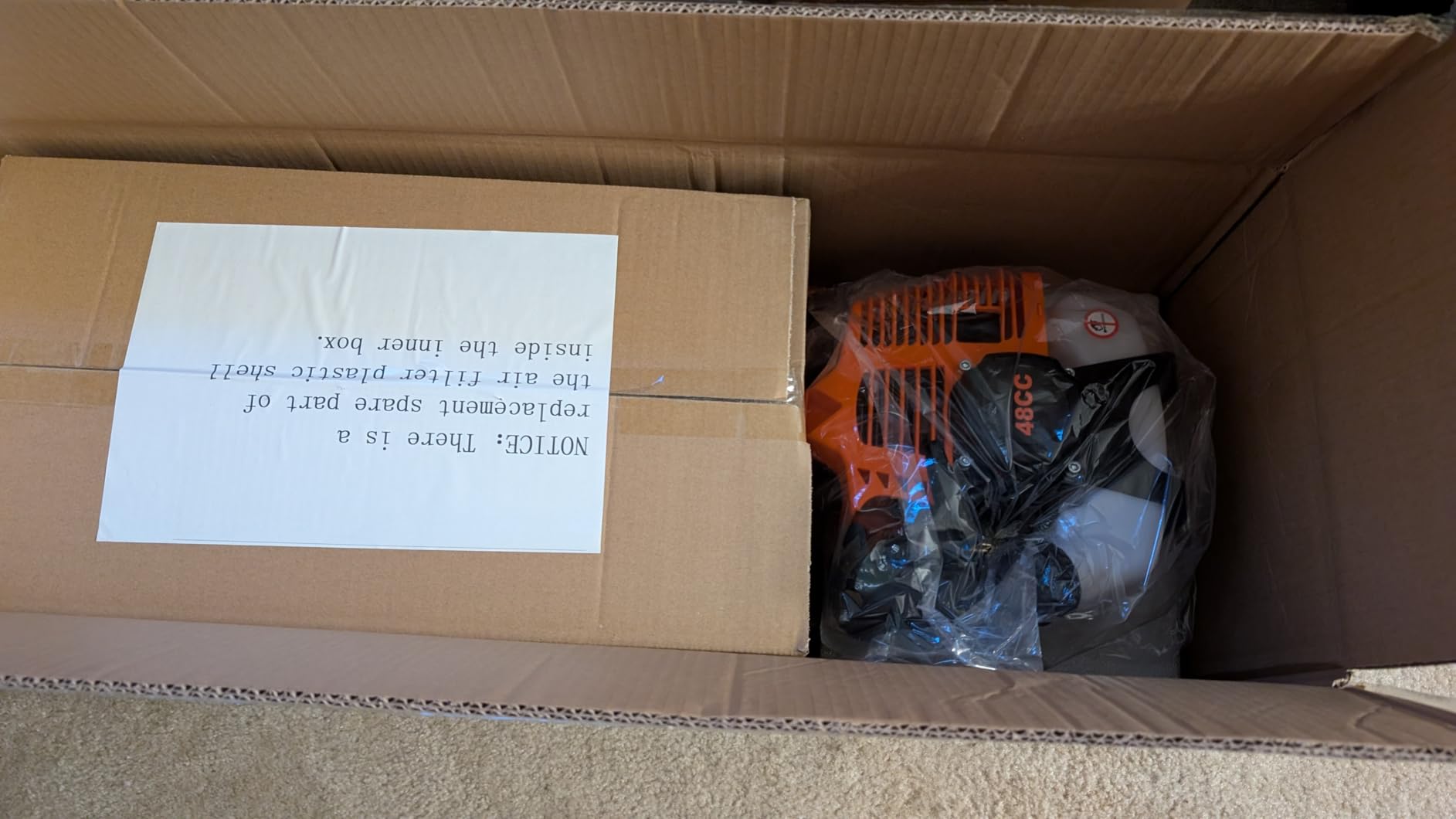
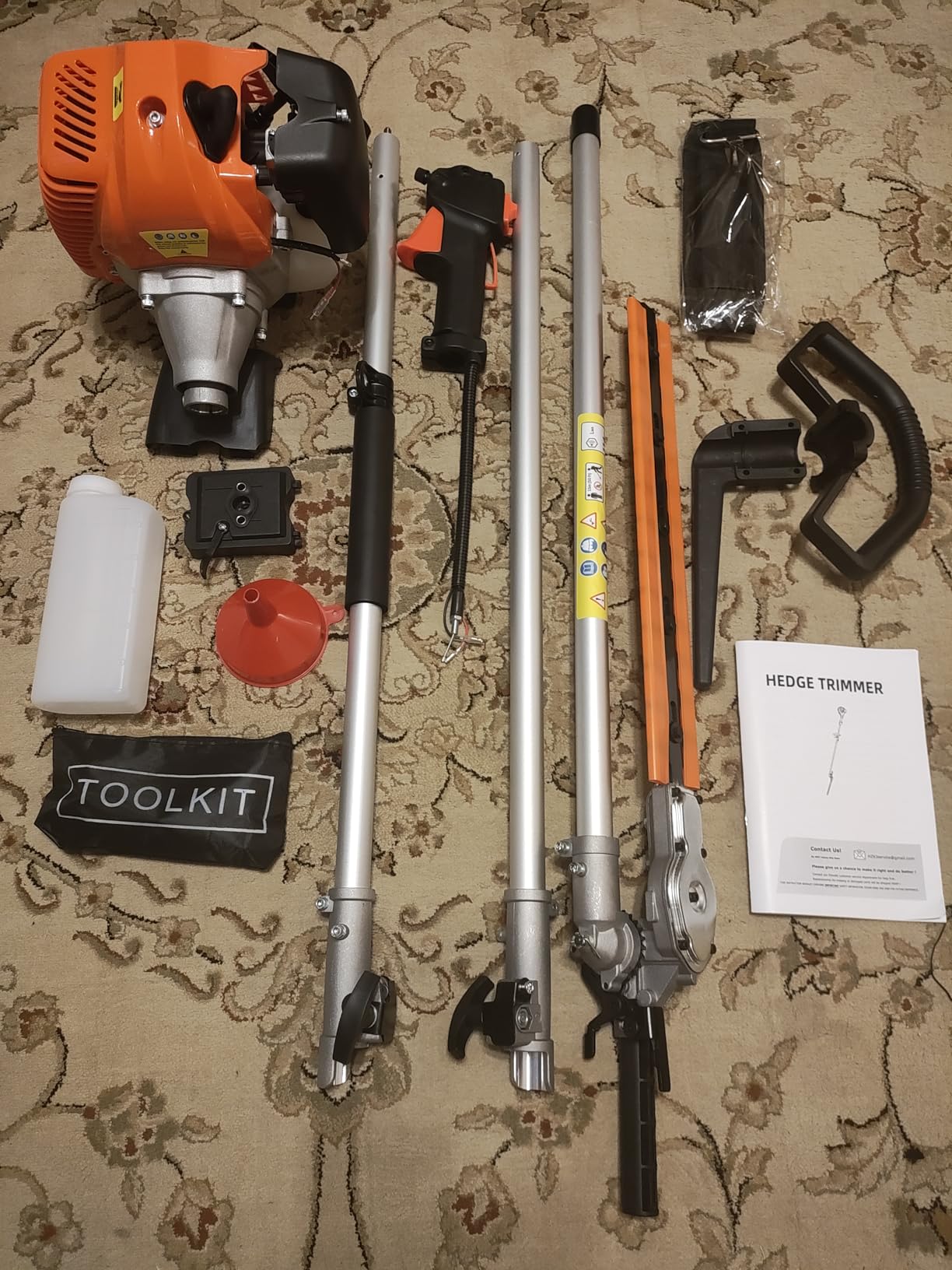
The engine is oversized for the cutting end, which tells you what this machine is actually for. A 48cc two-stroke has plenty of torque for thick hedges and overgrown brush, and the head rotates through 10 angles from minus 90 degrees to 180 degrees so you can trim tall tops and low edges without repositioning a ladder.
The extension pole adjusts from 7.8 feet to 10.5 feet, and that reach is the entire reason to consider it. For a hedge that meets you above head height, working from the ground is safer and faster than balancing on a ladder.
It also functions as a brush cutter, pole saw and pruner, which makes it genuinely useful for brambles, nettles and small tree work. The head adjustment plus the pole is the feature set, and it does that job competently.
What to check before you buy
The cutting section is only 10 inches long against a pole that reaches 10.5 feet, so this is a reach tool and not a fast bulk-cutting tool. If the bulk of your hedge is at shoulder height, a 24-inch standard blade will finish the job far quicker.
Weight is 22 pounds, the heaviest here, and that works against the ergonomic claims. Plan for a harness or frequent rests, and check the manual matches the configuration you assemble before you start.
Who it suits and who it does not
This suits someone with a tall hedge and a firm commitment to staying off a ladder. If you already own a full-size gas trimmer, this is a complement for the top few feet, not a replacement.
It is the weakest-reviewed machine in this group at 3.3 across 21 reviews, with 26 percent one-star. Buyers comfortable with occasional servicing will get a lot of capability from it, but this is not the pick we would hand someone who wants a single dependable tool.
How to Trim Thick Branches Without Ruining Your Blade
The most common way owners destroy a hedge trimmer blade is forcing it through wood it was never rated for. A short routine prevents most of that damage and produces a cleaner cut on the first pass.
- Lop first, trim second. Cut out any branch thicker than your thumb with loppers or a pole saw, then trim the shoots it left behind. This is the actual professional workflow.
- Check sharpness before every job. Dull teeth tear rather than cut, and torn wood is what makes hedges look ragged after shaping.
- Open the throttle fully. The blade needs full speed before it meets the branch. Cutting at idle bogs the engine and stalls it.
- Clip inward rather than driving straight through. Sweep into the branch from the outside so the teeth bite and the branch falls away from you.
- Keep the blade moving. Let the reciprocating teeth do the work. Holding the blade in one spot and forcing it stalls the engine and heats the bar.
- Use a coarse-tooth blade for rough cutting. Fine teeth are for finish work on new growth only.
- Oil the blade bar during the job. Sap from green branches binds cutting jaws, and a wipe with a rag every few minutes prevents it.
- Never cut with the blade tip buried in wood. The tip is the most fragile point and the one most likely to snap.
- Wear eye and ear protection and gloves every time, and treat every branch as if it might contain a nest.
Gas vs Battery Hedge Trimmers: Where Cordless Has Caught Up
We would be doing you a disservice to pretend gas wins everywhere. On branch thickness alone, a leading 56V cordless hedge trimmer rated at 1.2 inches of cutting capacity already matches most of the machines in this roundup. The engine is not the deciding factor for a typical homeowner.
Where gas genuinely wins is session length and property size. A cordless trimmer stops when the pack stops, and on a long privacy hedge you will be swapping or charging mid-job. Gas machines in this group run all day on a tank, which is why crews still choose them.
The other real advantages are secondary but consistent: gas handles tangled, woody, overgrown growth without the hesitation a battery motor shows under load, and 48cc and 36cc engines give you far more reserve than any cordless trimmer offers. If you are clearing bamboo, forsythia or bramble that has not been touched in years, that reserve matters.
The cost is honest to state. Gas is louder, heavier, needs a fuel and oil mix on most of these models, and requires seasonal carburetor care. Owners who rate their gas machines lowest usually cite starting and durability rather than cutting power. If your hedge branches stay under three-quarter inch, read our electric hedge trimmer comparison before committing to gas.
On brand reliability, opinions are genuinely contested. One long-term owner of a different ECHO gas hedge trimmer with 425 Home Depot reviews wrote that the Echo is superior to the Stihl in every way, with an engine that fires up and runs well and a larger, more robust machine. Another owner in a chainsaw forum posted the opposite view, saying Echo is not good, that his Husqvarna ran two seasons and died, and that Stihl is good. Neither position is settled, and you should buy the machine you can service locally.
How to Choose a Gas Hedge Trimmer for Thick Branches
Start with cutting capacity, then verify it. Manufacturers state it in inches and it is the only spec that predicts whether the machine will survive your hedge. Anything under three-quarter inch will dull quickly on established shrubs.
Next, engine displacement. For thick branches, 21cc is the practical floor and 26cc or more gives you real reserve. Engine size beyond about 36cc on a standard-length trimmer is mostly wasted unless the blade is coarse-toothed.
Blade length follows hedge height. An 18 to 20 inch blade suits shrubs you can reach from the ground, 22 to 24 inches covers most residential hedges with fewer passes, and anything over 25 inches belongs on professional work or a pole unit. Longer blades are more efficient on long straight hedges and genuinely awkward inside shrub interiors.
Decide between single-sided and double-sided blades before you buy. Every double-sided machine in this roundup cuts a vertical face without turning the tool constantly, which is most of them. Coarse or serrated teeth suit woody growth; fine-toothed blades are finish tools.
Check weight and balance together. The range here runs from 9.4 pounds to 22 pounds, and that difference decides whether you can finish a tall hedge in one session. A shoulder strap or harness is not a luxury on a heavy machine.
Look at fuel system details. The SENIX four-cycle needs no mixing at all, while most others run a 40:1 or 50:1 two-cycle mix. Cold-start features such as Smart Start or a carburetor air purge save a lot of frustration on a cold morning.
Finally, think about what else you own. If you already maintain a fleet of two-stroke equipment, the running costs are familiar. If this will be your only gas tool, the accessory and maintenance overhead is worth pricing in. Our gas string trimmer guide covers the maintenance side that carries over between the two tools.
Two honest disqualifiers. First, if your branches are regularly over 1.5 inches, no hedge trimmer is the right tool and you need loppers, a pole saw or a chainsaw. Second, if your hedge is small and branches stay under three-quarter inch, gas is overkill and you will get more work done per charge with a battery unit.
Frequently Asked Questions
Can a hedge trimmer cut thick branches?
Yes, within limits. The ceiling is the blade gap between the teeth, not the engine. Most gas hedge trimmers cut branches up to about 1 inch cleanly, and coarse-tooth blades extend that further. Anything over 1.5 inches should be removed with loppers or a chainsaw first, then trimmed at the shoots.
What is the thickest branch a hedge trimmer can cut?
About 1 inch is the realistic limit for most machines, and 1.5 inches on a coarse-toothed blade if you clip into the branch from the outside. Over 1.5 inches, forcing the blade causes it to stall and blunts the teeth. Lop the limb out first, then trim the shoots it leaves behind.
What engine size do I need for thick branches?
21cc is the practical floor for woody growth, and 26cc or more gives you useful reserve. For seriously overgrown hedges, a 36cc or 48cc engine pushes through dense old wood without bogging. Below 21cc, the engine struggles to keep the blade moving through established shrubs.
Are gas hedge trimmers more powerful than battery ones?
On raw cutting capacity, not always. A leading 56V cordless trimmer rated at 1.2 inches already matches most gas machines. Gas wins on session length, since it runs all day on a tank, and on reserve power for tangled overgrown growth. Battery wins on weight, noise, maintenance and cost of use.
Is ECHO or STIHL better for hedge trimming?
Owner opinions are genuinely split. ECHO owners frequently praise easy starting and robust construction, while other long-term users report better durability from Stihl and poor results from Husqvarna. Weight, balance and local dealer support should decide it as much as the brand name, since carburetor and fuel maintenance appear in every brand after a few seasons.
Conclusion
The Husqvarna 122HD60 leads our list of the best gas hedge trimmers for thick branches in 2026 because its 21.7cc engine, 24-inch blade and anti-vibration dampeners handle inch-thick wood without bogging, and it starts every time. The ECHO HC-2020 is the runner-up for anyone who wants blade longevity, and the Baotree 36cc delivers the most engine power for the money.
Check your thickest branch before you buy. If it stays at or under an inch, any of the top three will serve you well. If it goes past 1.5 inches, lop it out first, then use the trimmer to clean up the shoots.