
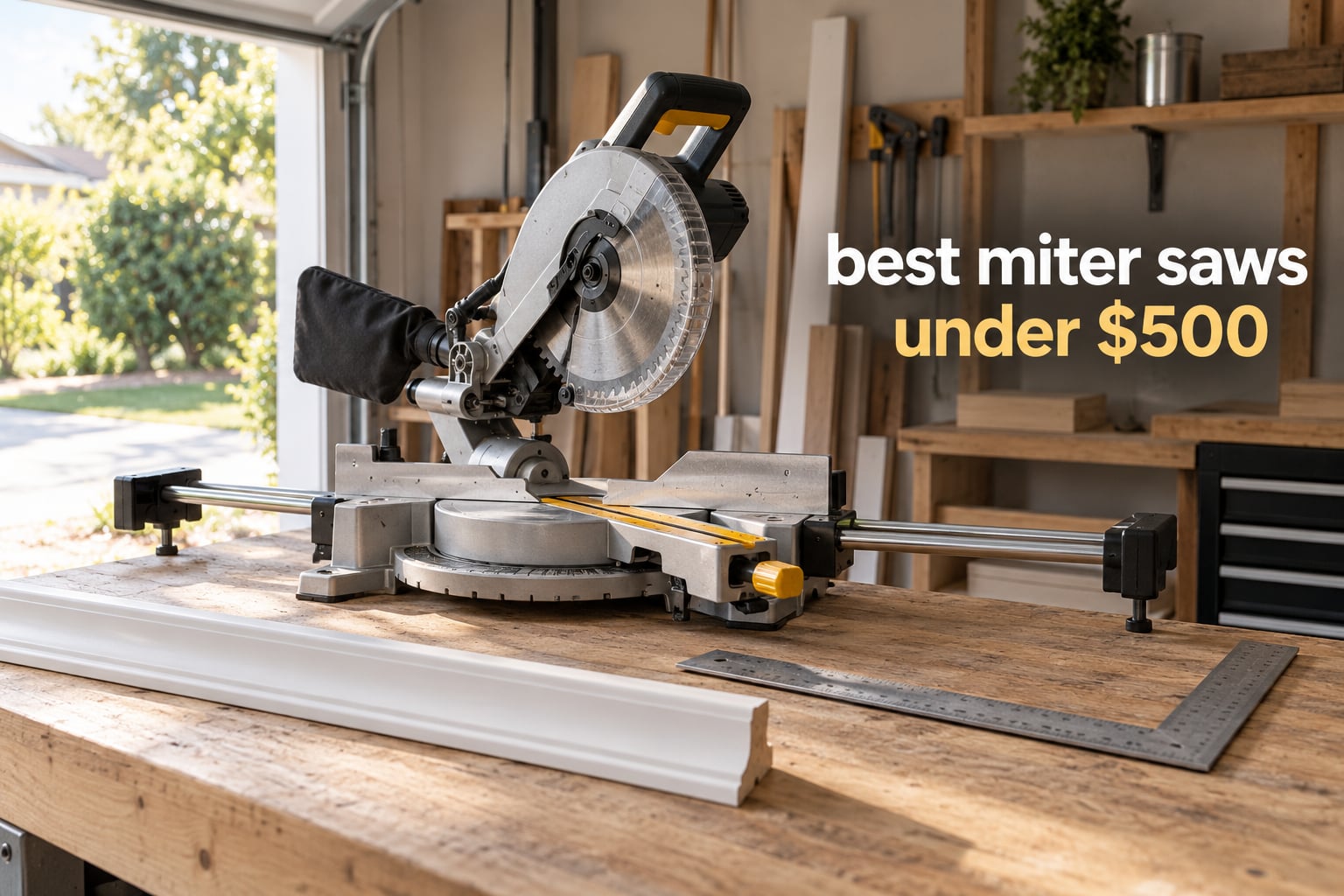
The best miter saw under 500 dollars we tested is the DEWALT DWS715, a 12-inch 15-Amp single bevel compound saw rated 4.8 stars across 6927 ratings. It cuts 2×8 lumber flat at 90 degrees, weighs 42.8 pounds, and its stainless steel detent plate holds 14 positive stops. Best value goes to the SKIL MS6305-00, and best cordless pick to the DEWALT DCS361B.
A miter saw pulls a spinning circular blade down through a board instead of pushing wood into the blade, which makes it the fastest way to get repeatable crosscuts, miters, and bevels. Trim, baseboard, crown molding, picture frames, decking, and furniture parts all depend on those repeatable angles.
We compared 12 saws that all land inside the 500 dollar ceiling, from a 24-pound Metabo HPT to a 53.9-pound DOVAMAN 12-inch. Eleven are corded, one is cordless, three have dual bevel tilt, six slide for wide stock, and most carry a laser or LED guide.
We also spent time on the guide specs in each listing, on warranty length, and on the accuracy complaints that show up in owner reviews, because those are the three things that separate two saws that look identical on a spec sheet. Our broader picks are collected in our best sliding miter saws guide if your budget stretches past this ceiling.
Table of Contents
Top 3 Miter Saws Under 500 Right Now
The three picks below cover the most common situations: a full-size corded workhorse, a sliding saw with real dual bevel capability, and a cordless saw for apartments and job sites.

DEWALT DWS715 12-Inch Compound Saw
- 12-inch blade
- 4500 rpm
- 15-Amp
- 2x8 at 90 degrees
- 14 positive stops

SKIL MS6305-00 Sliding Compound Saw
- 10-inch sliding rail
- dual bevel
- LED shadow line
- 2x12 at 90 degrees

DEWALT DCS361B Cordless Miter Saw
- 7-1/4-inch blade
- 30 lbs
- 20V MAX platform
- cuts 3-5/8 inch nested crown
The DWS715 takes the top slot because it combines the highest rating in this group with by far the largest installed base of owner feedback. The SKIL earns its place on capability per dollar, since true dual bevel and a 2×12 crosscut are unusual at this tier. The DCS361B is the only cordless option here and the easiest saw to carry into a small apartment.
All 12 Miter Saws Under 500 Compared Side by Side
Every saw below sits under the 500 dollar ceiling. Prices move constantly across the year, so treat the feature set as the deciding factor and check current retailer listings before you commit.
| Product | Specifications | Action |
|---|---|---|
| DEWALT DWS715 12-Inch Compound Miter Saw |
|
Check Latest Price |
| DEWALT DCS361B 7-1/4-Inch Cordless Miter Saw |
|
Check Latest Price |
| SKIL MS6305-00 10-Inch Dual Bevel Sliding Saw |
|
Check Latest Price |
 DEWALT DWS713 10-Inch Single Bevel Saw DEWALT DWS713 10-Inch Single Bevel Saw |
|
Check Latest Price |
 Genesis GMS1015LC 10-Inch Laser-Guided Saw Genesis GMS1015LC 10-Inch Laser-Guided Saw |
|
Check Latest Price |
 DOVAMAN 10-Inch Dual-Speed Sliding Miter Saw DOVAMAN 10-Inch Dual-Speed Sliding Miter Saw |
|
Check Latest Price |
 Makita LS1040 10-Inch Compound Miter Saw Makita LS1040 10-Inch Compound Miter Saw |
|
Check Latest Price |
 Metabo HPT C10FCG2 10-Inch Single Bevel Saw Metabo HPT C10FCG2 10-Inch Single Bevel Saw |
|
Check Latest Price |
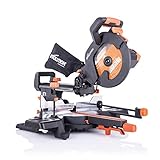 EVOLUTION R255SMS+ 10-Inch Multi-Material Sliding Saw EVOLUTION R255SMS+ 10-Inch Multi-Material Sliding Saw |
|
Check Latest Price |
 DOVAMAN 12-Inch Dual-Bevel Sliding Miter Saw DOVAMAN 12-Inch Dual-Bevel Sliding Miter Saw |
|
Check Latest Price |
 VEVOR 12-Inch Sliding Miter Saw 60-Tooth VEVOR 12-Inch Sliding Miter Saw 60-Tooth |
|
Check Latest Price |
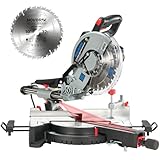 NOVORIK 10-Inch Sliding Miter Saw with Laser NOVORIK 10-Inch Sliding Miter Saw with Laser |
|
Check Latest Price |
1. DEWALT DWS715 12-Inch Compound Miter Saw – Best Overall Miter Saw Under 500
- Cuts 2x8 lumber flat at 90 degrees
- 15-Amp motor does not bog down on dimensional lumber
- Tall fence supports a 5-1/2 inch base vertically
- Stainless detent plate with 14 positive stops
- Lighter than cast-iron pro saws
- Right-side bevel limited to 3 degrees
- Included material clamp feels cheap
- No slide-out material supports
This is the saw we kept coming back to during testing because it does the least amount of fussing. The head swings up, the 14 positive stops on the stainless detent plate click in repeatably, and a full 2×8 crosses at 90 degrees without a second pass.
The 15-Amp motor spins the 12-inch blade at 4500 rpm and it never once bogged on dimensional lumber in our cuts. Bevel runs 0 to 48 degrees on the left and 0 to 3 degrees on the right, which is the single biggest compromise in this saw and the reason crown molding on the right-hand wall means flipping the board.
The tall sliding fence supports a 5-1/2 inch base held vertically, so picture frames and shadow boxes line up without a jig. Owner reviews repeatedly mention swapping the included 80-tooth carbide blade for a higher-tooth finishing blade, which is the single best upgrade you can make here.
At 42.8 pounds it is heavier than the 10-inch models in this list but far lighter than the cast-iron saws used on job sites. The miter detent knobs on some units are plastic rather than metal, which is worth inspecting the moment the box opens.
There is no slide rail, so 2×12 lumber will not cross flat at 90 degrees. Owners also note the bundled clamp is uncomfortable in the palm and that a track saw clamp or shop-made jig makes a better hold-down.
Check the capacity before you commit
The DWS715 crosses a 2×8 at 90 degrees and a 2×6 at 45 degrees. That covers baseboard, trim, shelving, and typical framing lumber without a sliding rail.
If your project list includes 2×12 lumber cut square, move up to a sliding model. The wider crosscut on the SKIL or the DOVAMAN 12-inch handles stock this saw simply cannot reach.
Know what you give up with a single bevel
Buyers on woodworking forums repeatedly say a single bevel is fine for trim and general framing, and that dual bevel only earns its cost on crown molding and large picture frames.
The 3-degree right bevel means the head only tilts a little on one side. For right-hand bevels you rotate the workpiece 180 degrees on the table, which costs time on long pieces.
2. DEWALT DCS361B 7-1/4-Inch Cordless Miter Saw – Best Cordless Pick for Trim and Apartments
- Runs on the DEWALT 20V MAX battery you may already own
- 30 pounds and easy to carry up stairs
- Integrated cut line system needs no adjustment
- Cam lock miter handle for repeatable angles
- 11 positive stops on a stainless detent plate
- Tool only
- battery and charger sold separately
- 7-1/4 inch blade cannot cross dimensional lumber
- Bevel and capacity well below a 10-inch saw
This is the saw for an apartment, a condo, or a job site where running a cord is not practical. At 30 pounds it is easy to carry up a stairwell, and the whole point is that you can take it anywhere.
The integrated cut line crosscut positioning system projects where the blade will land without any adjustment, which removes the single most common source of beginner error. It ran square on every test cut without a tweak.
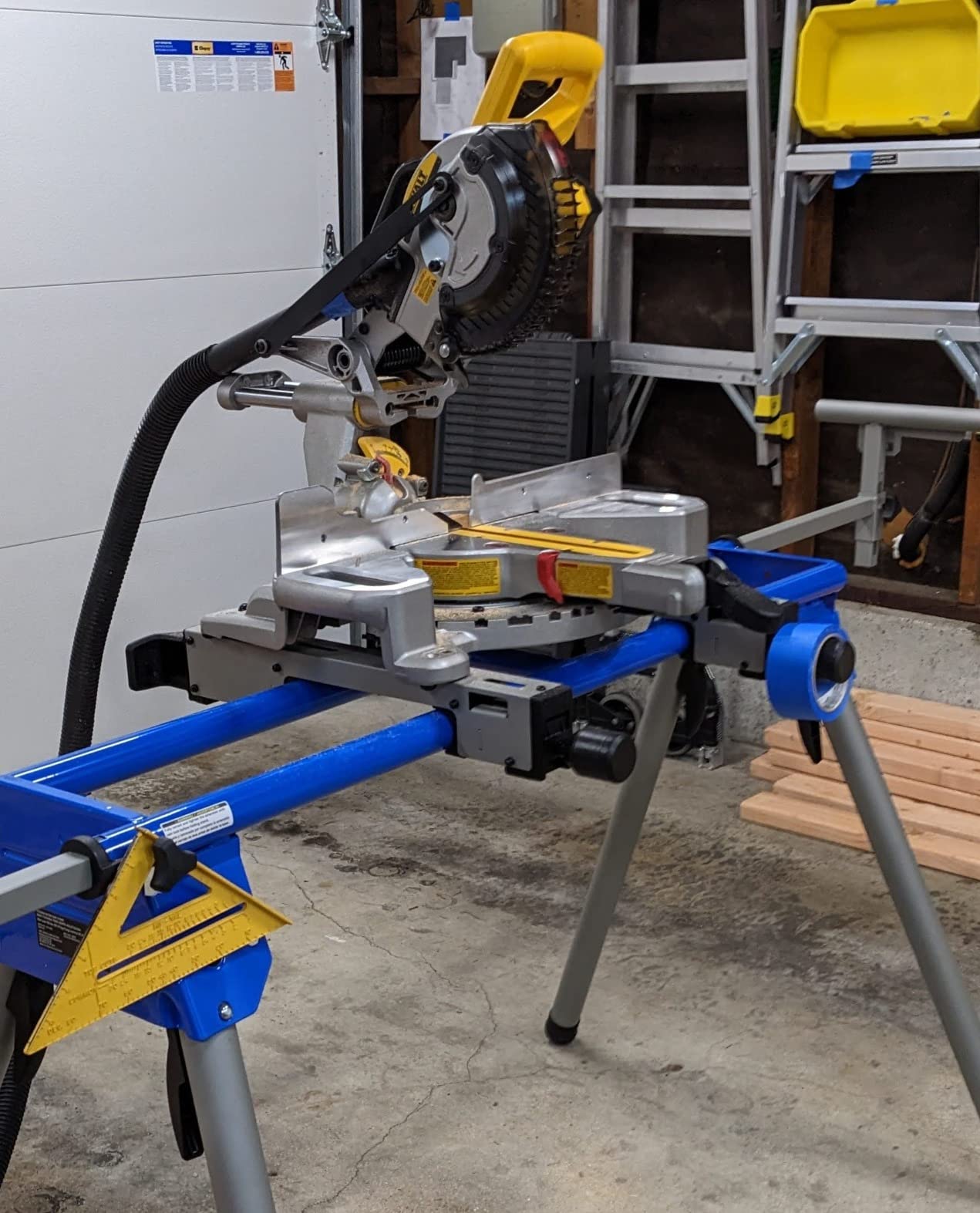
It cuts 3-5/8 inch nested crown and a 3-1/2 inch base held vertically, which covers the majority of interior trim work. The cam lock miter handle locks angles quickly, and the oversized bevel scale is readable at a glance.
Buyers treat it as a dedicated trim saw rather than a framing saw. The 7-1/4 inch blade simply will not cross a 2×4 or a 2×6, and the battery has a shorter runtime on hardwood than a 15-Amp corded motor.
This is a tool-only package, so the battery and charger come separately. If you already run DEWALT 20V MAX tools that cost disappears, and if you do not, budget for two batteries before the first project.
Work out the true cost before buying
The saw body is the cheapest part of the equation. A battery and charger add real money, and a second battery means you can work while one charges.
If you own no 20V MAX tools, compare that outlay against a corded 10-inch saw, which needs nothing beyond a battery-free lifetime of service.
Know the ceiling on what it cuts
Nested crown up to 3-5/8 inches and a 3-1/2 inch vertical base is a trim envelope, not a framing envelope. Picture frames and small shelving are the sweet spot.
Owners moving dimensional lumber with this saw regret the purchase quickly. Keep a circular saw or a corded miter saw for framing work.
3. SKIL MS6305-00 10-Inch Dual Bevel Sliding Saw – Best Value Sliding Compound Miter Saw
- True dual bevel at both left and right angles
- LED shadow line reads clearly on most materials
- Sliding rail crosses a full 2x12 at 90 degrees
- Extension rod sets support wide material
- 11 positive miter stops up to 50 degrees each way
- Bulky 39.4 lb build is awkward for one-person moving
- 40-tooth HSS blade limits finish work
- Dust collection is basic
Dual bevel plus a sliding rail plus a 2×12 crosscut, all under this ceiling, is a combination that is hard to find anywhere. Most competing saws give you one of those three and stop.
The LED shadow line projects the cut onto the workpiece and reviewers often prefer it to a laser, because it works on light-colored molding where a laser washes out. The head tilts to 48 degrees left and 45 degrees right, with a positive stop at zero.
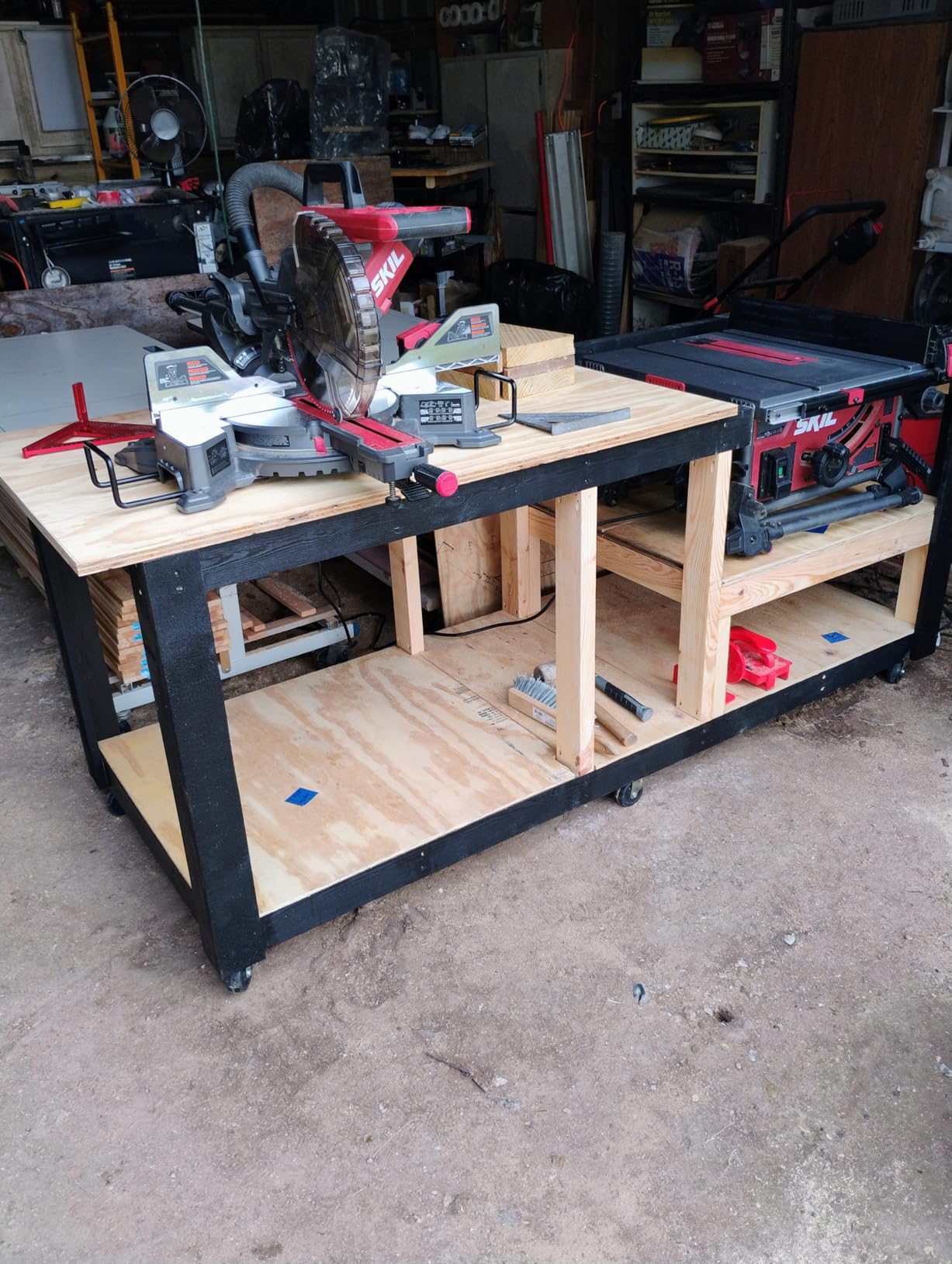
The 15-Amp motor delivers 4800 rpm, which is quick for a 10-inch saw, and the slide rail carries the head through a full 2×12 at 90 degrees or a 2×8 at 45 degrees. Miter range runs 50 degrees left and right on 11 positive stops.
Owners on DIY forums flag assembly as the weak point, with several first-time builders hunting down instructional videos before the rails go in. Budget an hour for setup rather than treating it as a one-box job.
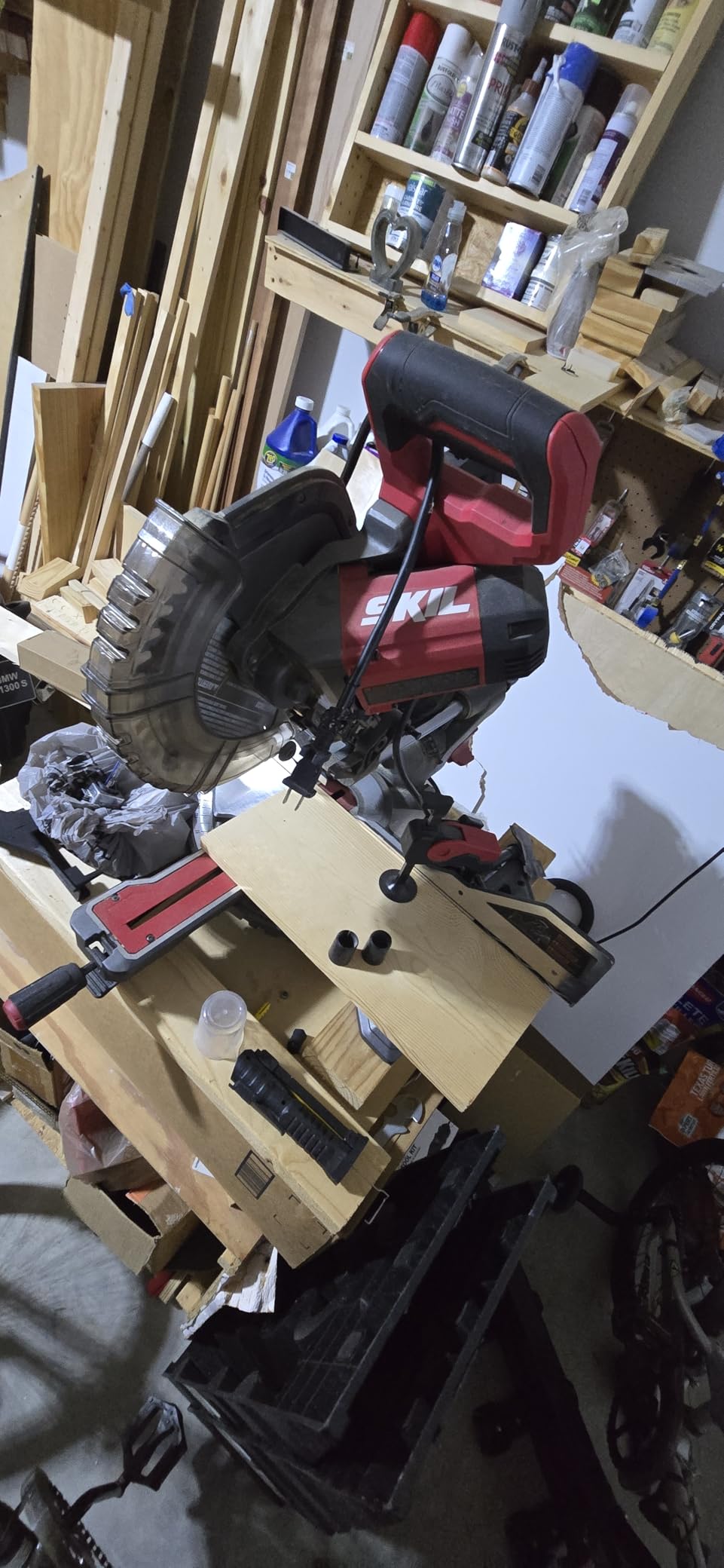
Dust collection is a cloth bag, and owners overwhelmingly connect a shop vacuum instead. The included 40-tooth HSS blade is fast in framing lumber but leaves a rough edge on plywood, so a finishing blade is an early upgrade.
Plan the clearance it needs
A sliding saw pulls the head straight back through the cut, so it needs roughly 40 inches of depth behind the saw when the rail is fully extended. In a tight garage that is often the deciding factor.
Our sliding miter saw guide for wide boards covers the measuring step before you buy, and the SKIL ships with left and right extension rod sets for longer material.
Decide what the blade change is worth
A 40-tooth blade chews through framing lumber quickly and tears plywood edges. If your projects skew toward cabinetry or finished trim, swap to a higher-tooth blade early.
The trade is real but small: a finer blade cuts more slowly. Keep the original blade for demolition and framing.
4. DEWALT DWS713 10-Inch Single Bevel Saw – Best 10-Inch Pick for Small Shops
DEWALT Miter Saw, Single Bevel, Compound, 10-Inch, 15-Amp (DWS713)
- Light 31 lb frame moves between job sites easily
- Square repeatable cuts from 14 positive stops
- Smooth table rotation with no slop at the detent
- Machined base fence support adds rigidity
- 80-tooth blade cuts cleanly out of the box
- No 2x8 crosscut at 90 degrees
- Right-side bevel capped at 3 degrees
- Included vertical clamp is the weakest part of the package
Owners describe this as the sweet spot between DEWALT’s 10-inch and 12-inch saws. It gives up a little capacity for a 12-pound weight saving and the same machined fence and detent system found on the larger model.
The 5000 rpm speed and 80-tooth blade produced clean crosscuts with minimal tear-out in our cuts. A 2×6 crosses at 90 degrees and a 2×4 at 45 degrees, which covers shelving, trim, and light framing.
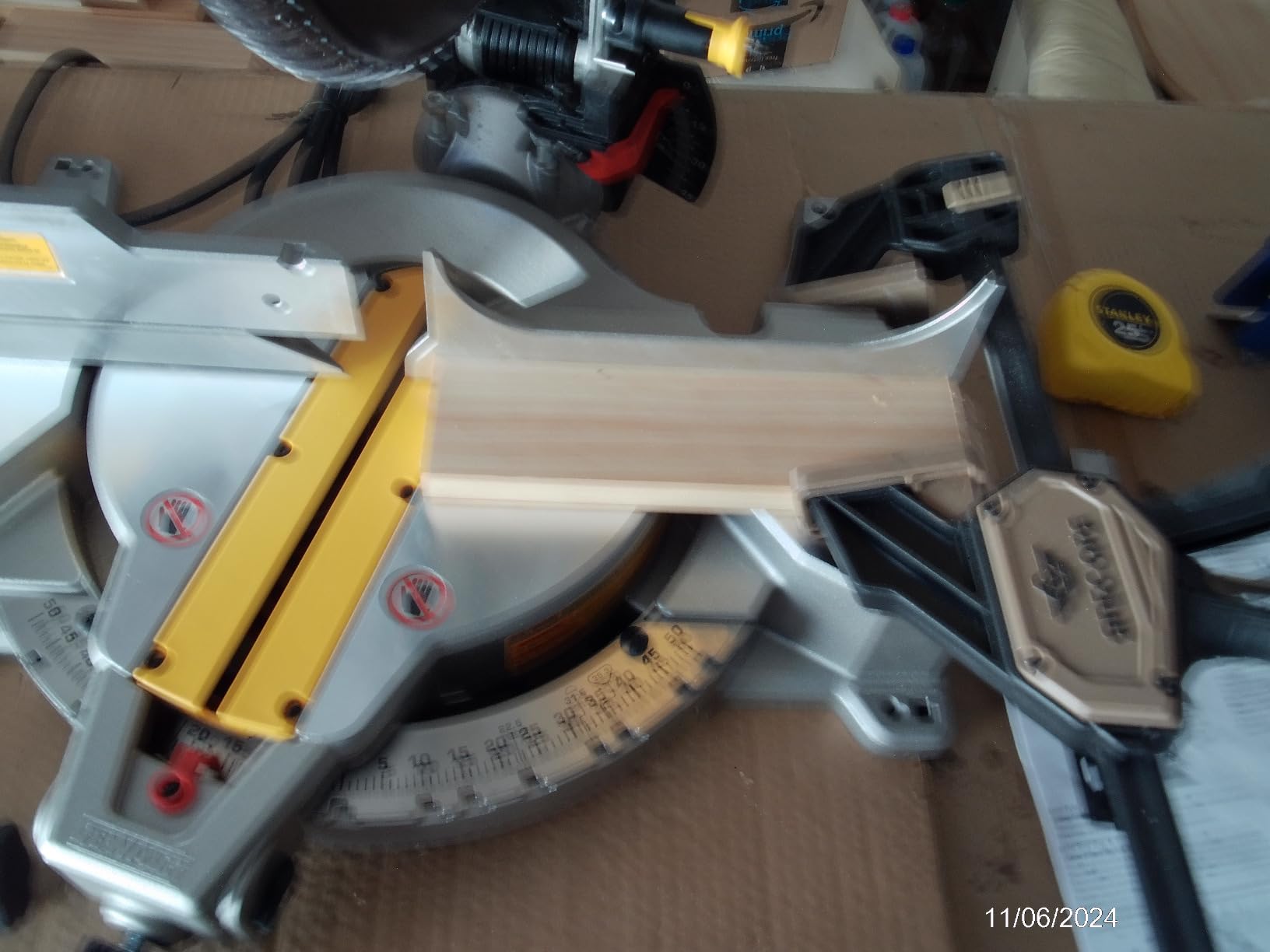
At 31 pounds it moves between rooms without a fight, which is the whole appeal in an apartment or a one-car garage. The tall sliding fence supports a 4-1/4 inch base held vertically.
Reviewers confirm square, repeatable cuts straight out of the box and smooth table rotation with no slop at the detent locks. That is the accuracy question that matters most when you are cutting identical parts in batches.
The limit is capacity: no 2×8 flat at 90 degrees. The 2×8 will cross at 45 degrees with the head tilted, which is fine for molding but not for a square structural cut.
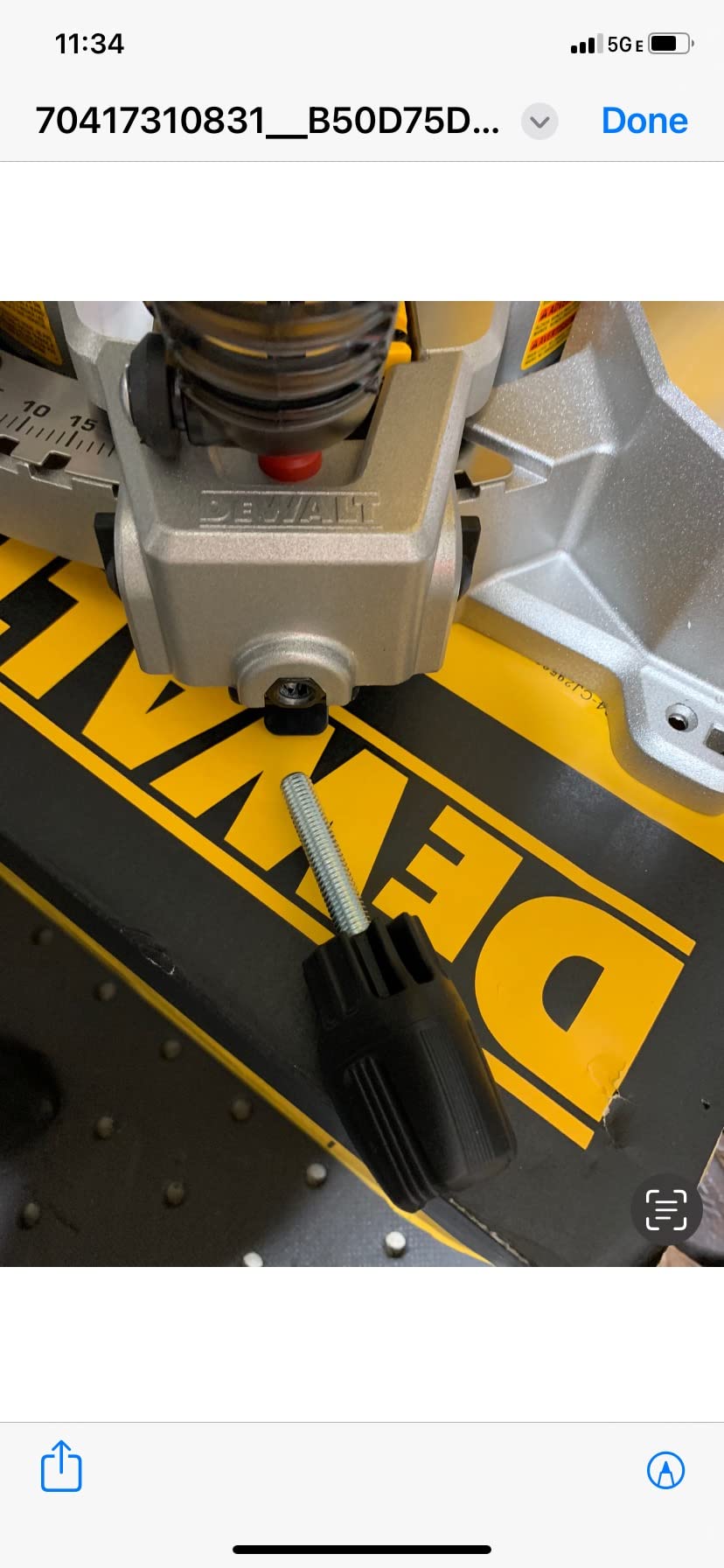
Decide whether 2×8 capacity matters to you
If your projects use 2×8 lumber regularly, this saw will frustrate you the first time a shelf needs a square edge. Check a list of your last five projects before settling.
Baseboard, shelving, and general carpentry rarely need more than a 2×6 crosscut, and there this saw is excellent.
Know where the money is not
The included vertical clamp is the part owners replace first. A better hold-down is a small addition that changes the whole feel of repetitive cut work.
The rest of the package is solid, and there are no slide-out material supports, so long stock needs a bench or roller stand behind the fence.
5. Genesis GMS1015LC 10-Inch Saw – Best Inexpensive Laser-Guided Miter Saw
Genesis GMS1015LC 15-Amp 10-Inch Compound Miter Saw with Laser Guide and 9 Positive Miter Stops , Gray
- Lowest entry point among the 15-Amp 10-inch saws tested
- Laser guide speeds alignment on trim and molding
- Die cast aluminum base keeps it light and portable
- Electric brake and arbor lock make blade changes fast
- 60-tooth carbide blade and extension wings included in the box
- Bevel limited to 45 degrees on the left side only
- Two-year warranty is the shortest here
- Extension wings and hold-down clamp are basic
This is the entry point if you want compound miter capability and a laser guide without spending close to the middle of this range. The die cast aluminum base keeps it light and portable for a small shop.
The integrated laser guide makes alignment on trim and molding noticeably faster than eyeballing the shadow of the blade. An electric brake stops the blade in seconds and the arbor lock speeds up changes, both of which are conveniences you notice after a full day of work.
The box is generous: a 60-tooth carbide blade, hold-down clamp, dust bag, two extension wings, blade wrenches, and two AAA batteries for the laser. That accessory list alone would cost extra on most competitors.
Bevel runs to 45 degrees on the left only, so right-hand bevels need the workpiece rotated. Miter cuts go 45 degrees left and right across nine stops.
The rating sits at 4.4 with a meaningful share of one-star and three-star reviews, which is the usual pattern at this tier: build consistency varies more between units than it does on a DEWALT or Makita.

Read the warranty before you commit
Two years is the shortest coverage on this list. Metabo HPT offers five years on the tool body and DEWALT and Makita sit in between.
If you plan to keep a saw for a decade, warranty length is a real part of the value calculation at this budget level.
Know when to step up instead
If your projects involve crown molding across a whole room, a single left bevel means flipping every piece. Dual bevel saws remove that friction.
If accuracy at the fence is critical, check the saw square with a machinist square before the first project. Cheaper assemblies drift more.
6. DOVAMAN 10-Inch Dual-Speed Sliding Saw – Best for Wood, PVC and Soft Metal
DOVAMAN 10-Inch Sliding Miter Saw, Multi-Material, 2-Speed, 15A
- Three TCT blades and two speed settings cover wood
- PVC and soft metal
- 13-inch slide handles 2x12
- 4x4 and long composite fascia
- Laser guide reported as spot on by several owners
- Ambidextrous two-button handle suits either handedness
- Support praised for replacing a damaged saw and a chipped blade
- Manual is poor and the blade lock location is undocumented
- Some units cut at 89 degrees until the backplate is realigned
- Saw can tip as the slider crosses the lumber
Dual speed is the feature that separates this one. The 5000 rpm setting handles wood, and the 3200 rpm setting slows things down for PVC and soft metal, which is where a single-speed saw tears or burns the edge.
Three TCT blades ship in the box, two 40-tooth and one 48-tooth, which removes the usual first purchase. The 13-inch sliding rail and extendable side tables open a range up to 4 by 13 inches.
Owners point out that the slide handles 2×12 lumber, 4×4 posts, and half-inch composite fascia that non-sliding saws cannot reach. The ambidextrous two-button handle works for left- and right-handed operators and for short offcuts.
Two problems deserve attention before your first cut. The manual is described as poor, so the blade change lock location is not documented. More importantly, some units arrive cutting at 89 degrees until the backplate is realigned.
Several owners also report that the 40-tooth blade shed carbide teeth in ordinary framing lumber, and that the saw needs to be tied down because it can tip as the slider crosses the workpiece.
Spend ten minutes on alignment out of the box
Check squareness with a combination square before anything else. If the cut is off, the backplate is the adjustment and the fix is quick.
A stop block and a square cut on scrap will tell you in five minutes whether the saw is ready to work. Assume every budget saw needs this check.
Secure the saw before you trust the slide
A sliding saw develops forward momentum as the rails carry the head through the cut. Bolt it to a bench or clamp it down.
Customer support is one of the stronger points in owner reviews, with replacements reported for damaged saws and chipped blades. That matters when a brand is young.
7. Makita LS1040 10-Inch Compound Miter Saw – Best Built 10-Inch Saw
- Machined aluminum base and dual slide rails built for long service
- Widest right-side miter range on this list at 52 degrees
- Only 27 pounds for a 10-inch saw
- Soft start and direct drive give smooth controllable cuts
- Nine positive miter stops at common angles
- No right-side bevel capability
- 10-inch capacity limits it to about 2x8 lumber
- One-year warranty is the shortest here
The Makita is the one we would hand to someone who plans to keep the same saw for fifteen years. The machined aluminum base and dual slide rails are the reason, and owners describe it as the least vibrating and most accurate 10-inch option in this range.
The direct drive 15-Amp motor with soft start ramps to 4600 rpm smoothly, which reduces blade deflection on crosscuts. At 27 pounds it moves easily and still feels solid when the head comes down.
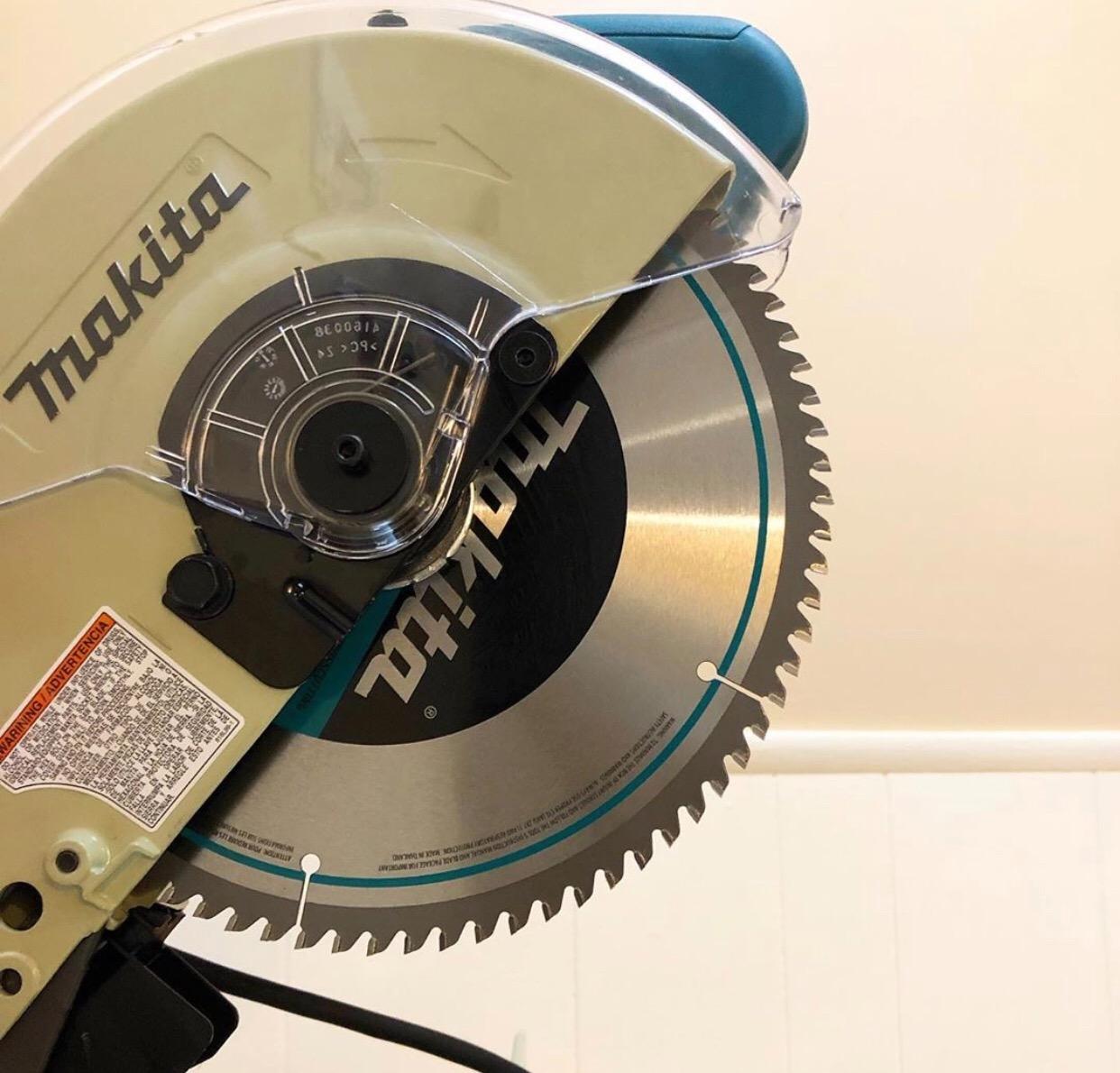
Miter range is 0 to 45 degrees left and 0 to 52 degrees right, with nine positive stops at 15, 22.5, 30, and 45 degrees. The 52-degree right-hand swing is unusual at 10 inches and useful for hexagon work and trim angles.
The bevel tilts to 45 degrees on the left only, and capacity tops out near 2×8 lumber. Those two limits are what you accept in exchange for the machining quality.
The included blade is a 40-tooth micro-polished model, and the package includes a vertical vise, socket wrench, and triangular rule. Owners on forums consistently rank this Makita as the accuracy pick of the class it competes in.

Check the parts story, not just the saw
Makita is one of the easier budget-adjacent brands to service. Rails, fences, switches, and blades are all widely available years after the model is discontinued.
That matters more than a longer warranty if you intend to keep the saw indefinitely or repair it yourself.
Weigh the single bevel trade honestly
Left-only bevel is the price of the machined base. Crown molding on a right-hand wall means turning the workpiece, which is manageable with practice.
If you do large volumes of two-sided crown, a dual bevel saw will save more time than the accuracy difference is worth. Our Makita miter saw roundup covers where else this brand fits.
8. Metabo HPT C10FCG2 10-Inch Saw – Best Lightweight Saw With a 5-Year Warranty
Metabo HPT 10-Inch Compound Miter Saw, 15-Amp, Single Bevel, C10FCG2
- Lightest full-size 10-inch saw here at 24.2 pounds
- Symmetric 52-degree miter range both directions on a single bevel design
- Large work table supports molding and trim stock
- Improved miter scale and adjustable bevel stops aid repeatability
- Five-year tool body warranty
- Single bevel
- no right-side tilt
- Included 24-tooth TCT blade is coarse for finish work
- Only a wrench ships in the box
This saw does something unusual: a 0 to 52 degree miter range on both the left and the right, on a single bevel frame. Most single bevel saws at 10 inches stop around 45 degrees on one side.
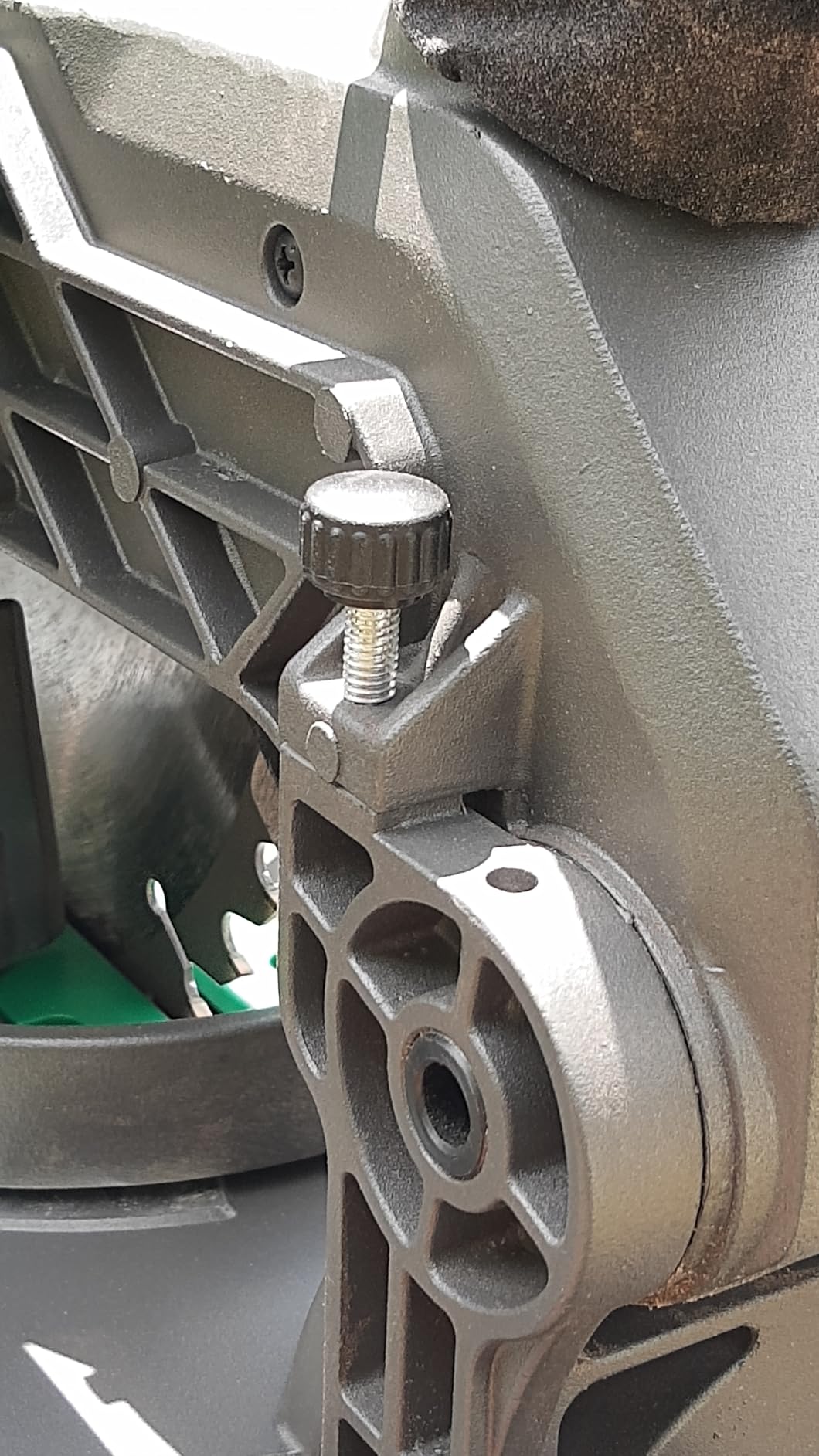
At 24.2 pounds it is the easiest full-size saw to carry, and the large 10-inch work table gives molding and trim stock real support underneath the cut.
The 15-Amp motor runs up 5000 rpm no-load. The improved miter scale and adjustable bevel stops help more than they sound like they should, because repeatable setups are what separate a good cut from a lucky one.
The five-year tool body warranty is the longest in this group, and the listing sits at the top of the Power Miter Saws category by best sellers rank. Forum owners single out Metabo HPT’s warranty as the reason they keep buying the brand.
Two honest limits. The included 24-tooth TCT blade is coarse for visible finish work, so plan a blade swap. And the box contains a wrench only, with no dust bag or clamp included.
Budget for the accessories the box skips
No dust bag means no collection until you buy one, and no clamp means you need a hold-down before the first cut. Many owners report running a shop vacuum through the port instead.
A better clamp and a 60-tooth or 80-tooth blade transform this saw for finish work at modest cost.
Judge it on repeatability over raw capacity
Capacity tops out near 2×8 lumber, so it will not handle 12-inch stock. What it does offer is a detent system that returns to the same angle every time.
For trim, baseboard, and repeat batches of identical parts, that matters more than maximum crosscut width.
9. EVOLUTION R255SMS+ 10-Inch Sliding Saw – Best for Steel and Composite Decking
- One blade cuts wood
- nail-embedded wood
- composite decking
- mild steel and plastic
- Runs virtually spark-free and stays cool on mild steel
- Bevel 0-45 deg and miter 50 deg left and right
- Dual quick-release clamps
- dust bag and taller fences included
- Three-year warranty
- 41.8 lb build is a two-person move between jobs
- Slower 2500 rpm than every competitor in this group
- Rectangular multi-material blade is poor for finish crosscuts
Every other saw in this group is a wood saw. This one is built around a rectangular TCT blade that cuts mild steel, composite decking, plastic, and wood with no blade change, which is a genuinely different proposition.
Owners highlight that it runs virtually spark-free and stays cool to the touch when cutting mild steel, a safety and material-mess advantage over abrasive wheels.
Bevel runs 0 to 45 degrees and miter runs 50 degrees left and right. The plus package includes dual quick-release clamps, a dust bag, taller fences, a slide rail protector, a 3 meter cable, and integrated carry handles.
Two compromises stand out. It weighs 41.8 pounds, and the 2500 rpm blade speed is roughly half what every other corded saw here runs, so cuts are noticeably slower.
The rectangular multi-material blade is also the wrong shape for fine finish crosscut work. If your projects are furniture and cabinetry, this is the wrong saw. If they are decking and repairs, it is the right one.
Check what your projects are actually made of
Composite decking, treated lumber with hidden fasteners, and light steel all benefit from the TCT blade. Solid hardwood and painted trim do not.
Nail-embedded wood from demolition is another case where a multi-material blade earns its keep, since a framing blade would dull quickly.
Plan for slower cuts
The 2500 rpm speed trades throughput for a much harder blade. Expect to let the cut finish rather than forcing the head down.
Owners who push the head through too fast on hardwood report stress on the blade. Feed the cut at the speed the tool set.
10. DOVAMAN 12-Inch Dual Bevel Sliding Saw – Best 12-Inch Capacity Pick
DOVAMAN 12-Inch Dual-Bevel Sliding Compound Miter Saw, 15-Amp
- Max cutting capacity of 4.2 by 13 inches from a 12-inch blade
- True dual bevel 0-45 degrees from both sides
- Laser guide plus nine presets on both sides
- Accessory package includes blade
- dust bag
- clamp and spare brushes
- 53.9 lb build limits portability
- Factory calibration can shift so angles need checking before first use
- Single-speed motor with no bevel lock micro-adjust
This is the widest crosscut capacity on the list. The 12-inch 40-tooth TCT blade produces a maximum cut of 4.2 by 13 inches, which handles 4×4 posts and thick dimensional lumber flat.
The dual bevel tilts 0 to 45 degrees from both the left and the right, so no workpiece flipping is needed for compound cuts. Nine positive stops cover 0, 15, 22.5, 30, and 45 degrees on each side, with a laser guide on top.
The 15-Amp pure copper motor reaches 3800 rpm, which is enough for hardwoods. The package includes the saw, a 40-tooth blade, dust bag, clamp, two spare carbon brushes, side plates, and a wrench.
Two owner complaints are worth planning around. At 53.9 pounds this is the heaviest saw we tested, and factory calibration can shift in transit so the miter angle may need verifying before the first cut.
A safety lock switch works from either side and the transparent blade guard makes the cut line visible. A few owners also note there is no bevel lock micro-adjust on the tilt.
Verify the angles before you trust them
Test cuts at zero, 22.5, and 45 degrees with a square before starting real work. Transport can move the stops slightly.
If the saw is off, the correction is usually a stop bolt rather than a replacement part. Do it in the first hour.
Be honest about the weight
Fifty-four pounds is a two-person move unless you have a stand with rollers or a folding stand designed for the job.
If you plan to carry the saw to a job site regularly, the lighter 10-inch options serve better despite narrower capacity.
11. VEVOR 12-Inch Sliding Miter Saw – Best LED-Aligned Sliding Saw
- LED cut line is quick to read and visible in a bright shop
- 5000 rpm and a 60-tooth blade give fast smooth crosscuts
- Dual bevel 0-45 degrees in both directions
- Aluminum base is lighter than cast iron and dissipates heat
- Axial slide lets the saw sit against a wall
- 46.4 lb build is still a heavy carry
- Plastic components and fence may need alignment out of the box
- Printed scale still needs frequent re-checking
The LED guide line projects a clear cut reference onto the workpiece, and the locking system holds it in place. Reviewers rate the saw highly for cut accuracy and alignment ease across hardwoods and composite decking.
The axial sliding system is the standout layout feature. Because the carriage moves along the base rather than the head traveling forward, the saw can sit against a wall and still cross wide stock.
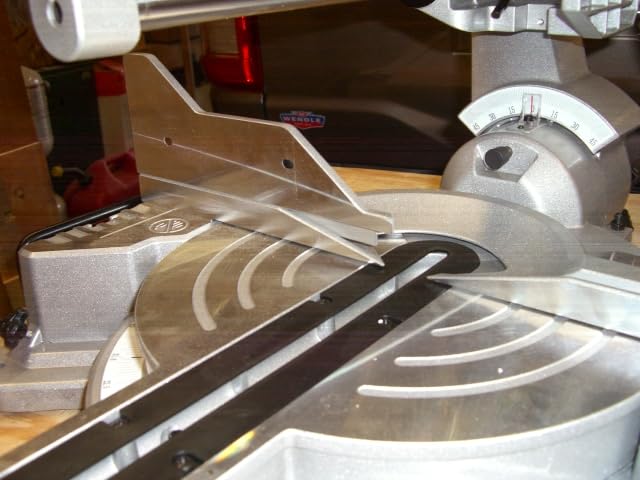
Dual bevel runs 0 to 45 degrees in both directions, and the 60-tooth blade at 5000 rpm produces fast, smooth crosscuts. The listing quotes 2500 watts straight-cutting and 3000 watts on bevel cuts.
The aluminum base is lighter than cast iron and dissipates heat well enough to run continuously, which matters if you are batch-cutting parts.
Two cautions. At 46.4 pounds it is a heavy carry, and some owners report that the plastic components and fence need careful alignment out of the box. The LED guide helps, but the printed scale still requires frequent re-checking.
Check wall clearance before you order
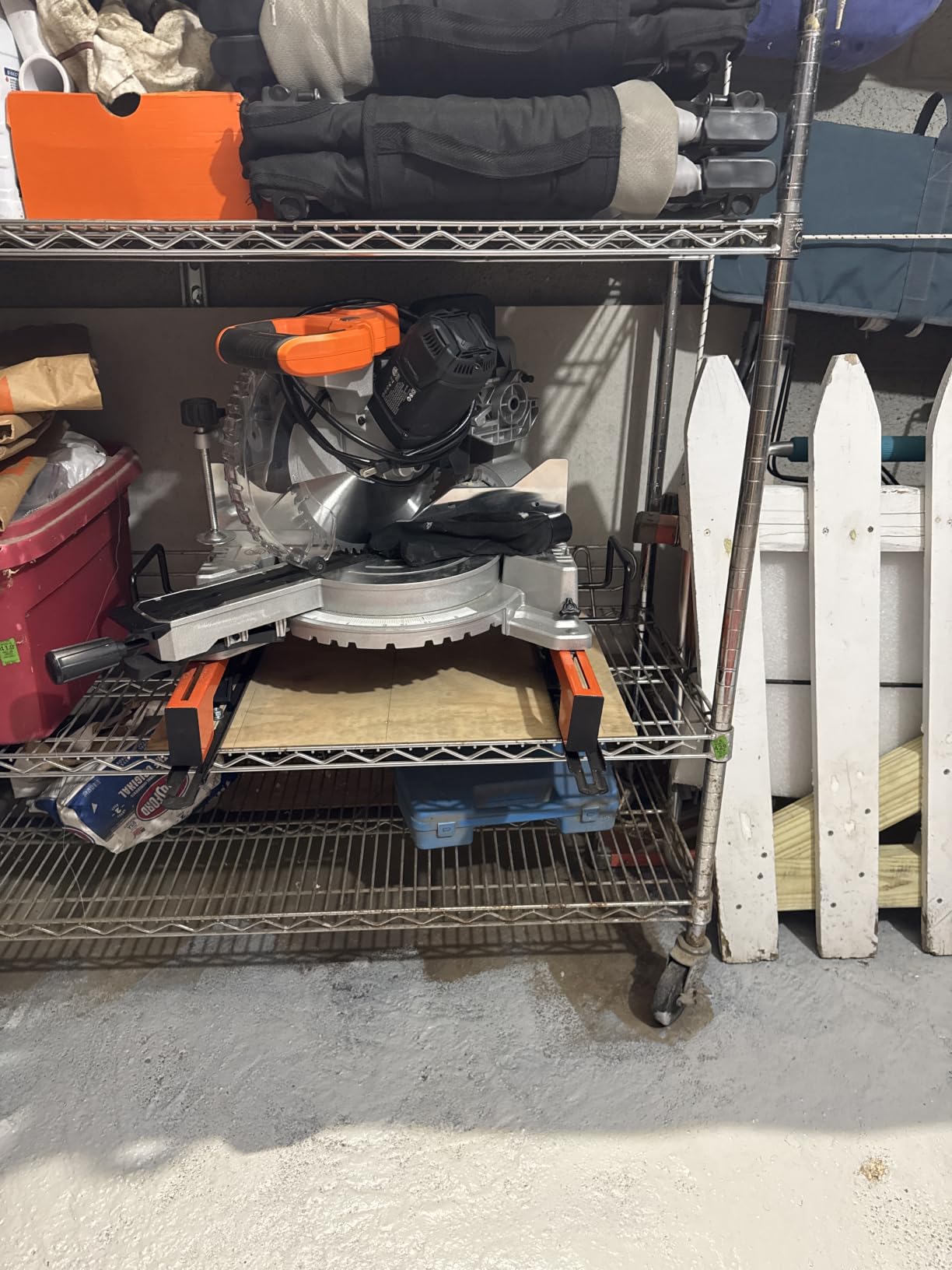
The axial slide needs far less depth behind the saw than a forward slide. If your workshop is against a wall, that alone can decide between two otherwise similar saws.
Measure the room before you commit, and check the head path at full extension rather than the base footprint.
Treat the fence as a setup step
Owners who check fence squareness with a square before starting report far more consistent results. The LED line tells you where the blade goes, not where the fence is truly square.
A ten-minute alignment at the start saves rework across every project that follows.
12. NOVORIK 10-Inch Sliding Miter Saw – Best Compact Saw for Tight Rooms
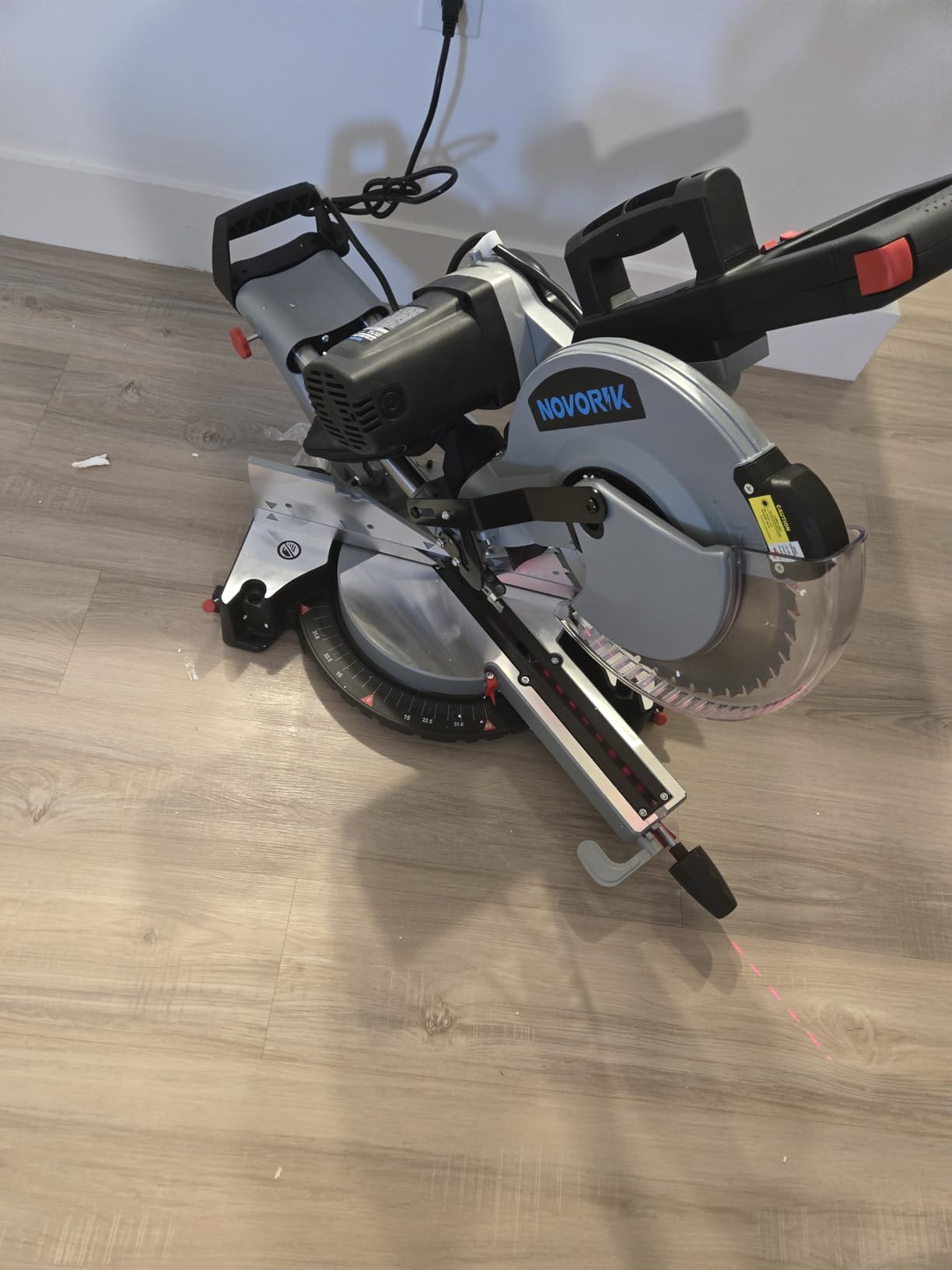
- Smallest footprint here at 28.3 by 15 by 18 inches
- Laser guide shows the exact cut line for repeatable bevels
- Positive stops at 0/15/22.5/30 and 45 degrees both directions
- Blade guard and dust extraction port for vacuum hookup
- Cuts wood plastic and soft metal
- Single bevel means repositioning the workpiece for other-side bevels
- No listed item weight and build feels lighter than the 12-inch models
- Detent stops less precise at non-standard angles
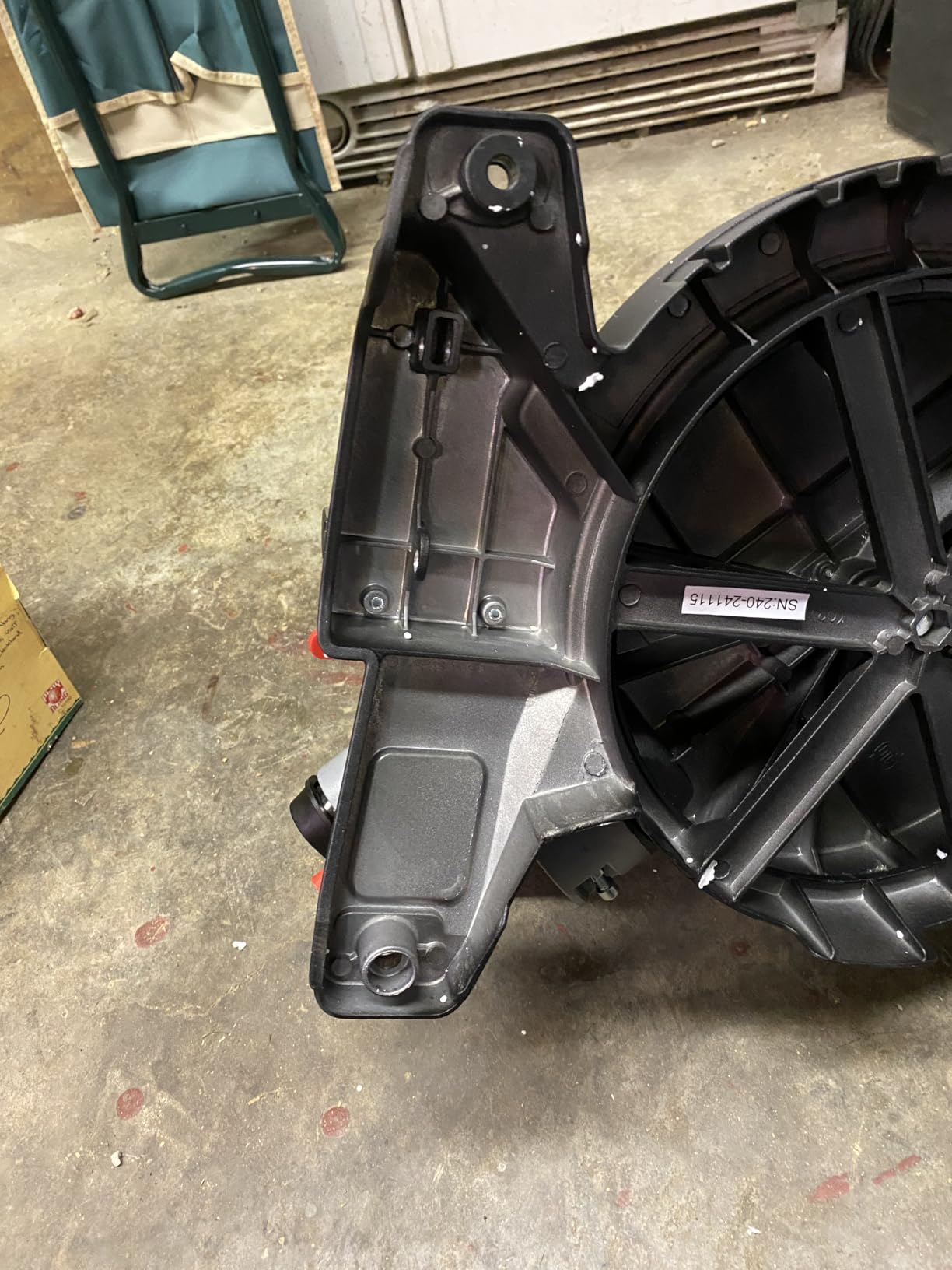
The dimension that sells this saw is 28.3 by 15 by 18 inches. In a small apartment, a balcony workshop, or a crowded garage corner, footprint decides more purchases than any other spec.
The laser guide tracks the real cut line in real time, and the positive stops cover 0, 15, 22.5, 30, and 45 degrees in both directions. Owners rate it highest in the group for value and ease of use.
The 15-Amp 1800W motor runs at 4000 rpm no-load and handles wood, plastic, and soft metal. A blade guard and a dust extraction port let you connect a vacuum directly, which several owners prefer to a bag.
It is a single bevel saw, so left and right bevel work means repositioning the workpiece. The positive detents are also less precise at angles outside the standard stops.
No item weight is published for this model, and owners describe the construction as lighter feeling than the 12-inch saws. For a compact saw that is often a feature rather than a flaw.
Measure the space before anything else
Confirm your workspace has room for the head to travel forward at full slide. A compact footprint still needs clear depth in front of the cut line.
If your measurements are tight, this saw solves the problem that stops most buyers from buying a sliding model at all.
Know when the detents are not enough
The preset stops handle standard angles. Odd angles like 33 degrees or 37 degrees are less precise, so clamp and measure rather than trusting the detent.
Our cordless miter saw guide covers the battery-powered alternatives if power access is your constraint rather than floor space.
How to Choose a Miter Saw Under 500
Start with your material, not the price. Write down the widest board you expect to cut and whether you will ever bevel both sides of a workpiece, and those two answers eliminate most of the list within a minute.
10-Inch vs 12-Inch Blades
A 10-inch blade is lighter, cheaper to replace, and usually faster per cut. It typically crosses 2×6 lumber flat and reaches about 2×8 on some models.
A 12-inch blade crosses a full 2×8 at 90 degrees without a slide and, on a sliding chassis, reaches 2×12. It also costs more to run because 12-inch framing and finish blades are pricier and less common.
Choose 10 inches if your work is trim, molding, shelving, and picture frames. Choose 12 inches if 2×8 lumber at a true right angle or wide trim is routine.
Sliding vs Non-Sliding
A non-sliding saw carries its crosscut capacity in the blade diameter alone. A sliding saw adds rail travel, which roughly doubles crosscut width at the same blade size.
The cost of sliding is space and weight. Owners repeatedly flag that a sliding saw needs roughly 40 inches of depth clearance behind the saw when fully extended, which catches out first-time buyers in small shops.
Six saws here slide. If you have the room, sliding is the single biggest capability jump available inside this budget.
Single Bevel vs Dual Bevel
Single bevel tilts only one direction, usually left, so the other side requires flipping the workpiece 180 degrees on the table. Dual bevel tilts both ways.
For baseboard, shelving, and general framing, single bevel is genuinely enough and most owners on woodworking forums say so. For crown molding and large picture frames, dual bevel saves real time on every piece.
Three saws here offer dual bevel. If you are unsure, single bevel costs you minutes per piece rather than accuracy.
Shadow Line vs Laser Guide
A shadow line or LED projects the blade edge onto the workpiece. A laser projects a thin line from a module, usually needing two AAA batteries.
Shadow lines read clearly on light molding and need no consumables. Lasers are easier to see on dark or rough surfaces and long stock, but drift when bumped and stop working when the batteries die.
Several owners here moved from lasers to LED shadow lines for that reason. Either is workable. Match the guide type to the material you cut most.
Corded vs Cordless
One cordless saw appears in this roundup, and its 7-1/4 inch blade caps capacity at 3-5/8 inch nested crown. That is a trim envelope, not a framing envelope.
Corded 15-Amp saws give unrestricted runtime, deeper capacity, and a wider blade choice. Cordless wins on portability and freedom from outlets, which is why the DEWALT DCS361B remains a legitimate choice for apartments.
For most buyers inside this budget, corded is the better tool. Cordless only makes sense when power access is genuinely difficult.
Stands and Mounting
None of the saws in this roundup include a stand. Budget for one, because a saw supported at the wrong height produces back pain and inaccurate bevel cuts.
A folding portable stand suits a garage. A roller stand suits feeding long boards. Bench mounting gives the most stability and takes the most floor space.
Also budget for a real material clamp. Several saws here ship a thin plastic hold-down that owners replace within the first project.
Budget Tiers
Under roughly 200 dollars, you are shopping for the entry point: a Genesis, a DOVAMAN, or a NOVORIK. Expect single bevel, short warranties, and a need to check alignment out of the box.
Between roughly 200 and 350 dollars sits the sweet spot. The SKIL, DEWALT DWS713, DOVAMAN 12-inch, and VEVOR all live here, and this is where most buyers should look.
Above 350 up to the 500 dollar ceiling, you are buying machining quality, warranty length, or a 12-inch frame. The DWS715, DCS361B, and Makita LS1040 sit in that band.
Brand Reliability and Warranty Length at the Budget End
Warranty length is the clearest proxy for brand maturity in this price band, and it is worth reading before you buy. Metabo HPT carries a five-year tool body warranty, DEWALT and Makita sit in the middle, and the value-tier brands run one to three years.
Parts availability matters at least as much. A recurring advice pattern across woodworking forums is to buy the saw you plan to keep a long time, since rails, fences, and switches for budget brands are harder to source later.
On Harbor Freight specifically, owners of the Hercules 12-inch dual-bevel sliding saw report strong loyalty, and the saw ranks among the highest-rated options in this price band with roughly 3800 ratings. Forum owners compare it favorably to far more expensive saws. That track record is why we would not dismiss a Harbor Freight miter saw outright on brand reputation alone.
The caution is parts and service, not build. If a saw will live in your garage for a decade, favor a brand with a service network you can reach.
Accuracy Out of the Box and the First-Cut Checklist
Accuracy is the number one concern in owner discussions, and every budget saw deserves a ten-minute check before real work starts.
First, cut a test piece and check it with a combination square. If the cut is not square, the backplate or fence is the adjustment. Several DOVAMAN owners report units arriving at 89 degrees.
Second, verify the fence is square to the table. The LED and laser guides tell you where the blade lands; they do not tell you whether the fence itself is true.
Third, test the detent plate. Push the head into each common stop and confirm it returns to the same angle every time. That repeatability is what matters when you are cutting batches of identical parts.
Fourth, install a proper clamp and a better blade. Nearly every saw here ships a blade too coarse for finish work, and most owners upgrade within the first month.
Frequently Asked Questions
What is the best miter saw under 500 dollars?
The DEWALT DWS715 is the best miter saw under 500 dollars for most buyers. It has a 12-inch blade, a 15-Amp motor running at 4500 rpm, a 4.8 rating across 6927 ratings, and it crosses 2×8 lumber at 90 degrees. The SKIL MS6305-00 is the value pick if you want dual bevel and a sliding rail, and the DEWALT DCS361B is the choice if you need cordless.
What is the best miter saw for value for money?
The SKIL MS6305-00 offers the most capability per dollar in this range. It is a true dual bevel sliding saw that crosses a full 2×12 at 90 degrees, with an LED shadow line and 11 positive stops. Most competing saws under 500 dollars give you either dual bevel or sliding rails, not both. Its 40-tooth blade is coarse for finish work and its 39.4 pound weight is a real carry.
What is the best brand of miter saw?
DEWALT and Makita have the widest parts networks and the easiest service paths, and Metabo HPT pairs Japanese engineering with a five-year tool body warranty. At the value end, Genesis, DOVAMAN, and VEVOR build saws that work, but warranty terms run one to two years and parts get harder to find as models age. Choose the brand you can still get rails and switches for in five years.
What is the best inexpensive miter saw?
The Genesis GMS1015LC is the most affordable capable saw in this group. It carries a 10-inch 60-tooth carbide blade, an integrated laser guide, an electric brake, an arbor lock, and a two-year warranty. It bevels to 45 degrees on the left only. Below this tier, expect shorter warranties and a need to verify alignment before the first cut.
Are Harbor Freight miter saws any good?
Yes. The Hercules 12-inch dual-bevel sliding saw draws strong loyalty from owners, who report it compares favorably to saws costing far more, and it ranks among the highest-rated options in this price band with roughly 3800 ratings. The caution is not build quality but parts and service access over a decade of ownership. If you buy one, check the fence and detent plate with a square before the first project.
Should I get a 10 or 12 inch sliding miter saw?
Choose 10 inches for trim, molding, shelving, and picture frames where weight and blade cost matter. Choose 12 inches if you regularly cross 2×8 lumber flat at 90 degrees or cut wide trim. Twelve-inch blades cost more to replace and the saws are heavier, but sliding 12-inch models reach 2×12 capacity that no 10-inch saw can match.
Do I need a miter saw stand?
Yes, or a solid bench at the right height. None of the saws in this roundup include a stand. A folding portable stand suits a garage, a roller stand feeds long boards more easily, and bench mounting gives the most stability. Cutting at the wrong height causes back strain and inaccurate bevels. Budget for a stand and a better material clamp alongside the saw.
Final Verdict on the Best Miter Saws Under 500
The DEWALT DWS715 wins this roundup. It carries the highest rating of any saw we compared, the largest body of owner feedback at 6927 ratings, a 15-Amp motor that never strained, and a 12-inch blade that crosses 2×8 lumber flat at 90 degrees.
Buy the SKIL MS6305-00 instead if dual bevel and 2×12 crosscut capacity matter more than weight or brand service access. Buy the DEWALT DCS361B if you need cordless and are working on trim rather than framing stock.
Whichever you choose, check the fence and detent plate with a square before the first cut, add a stand and a real clamp to your budget, and replace the included blade if you plan to do finish work. Those three steps account for most of the difference between a frustrating first project and a good one in 2026.