
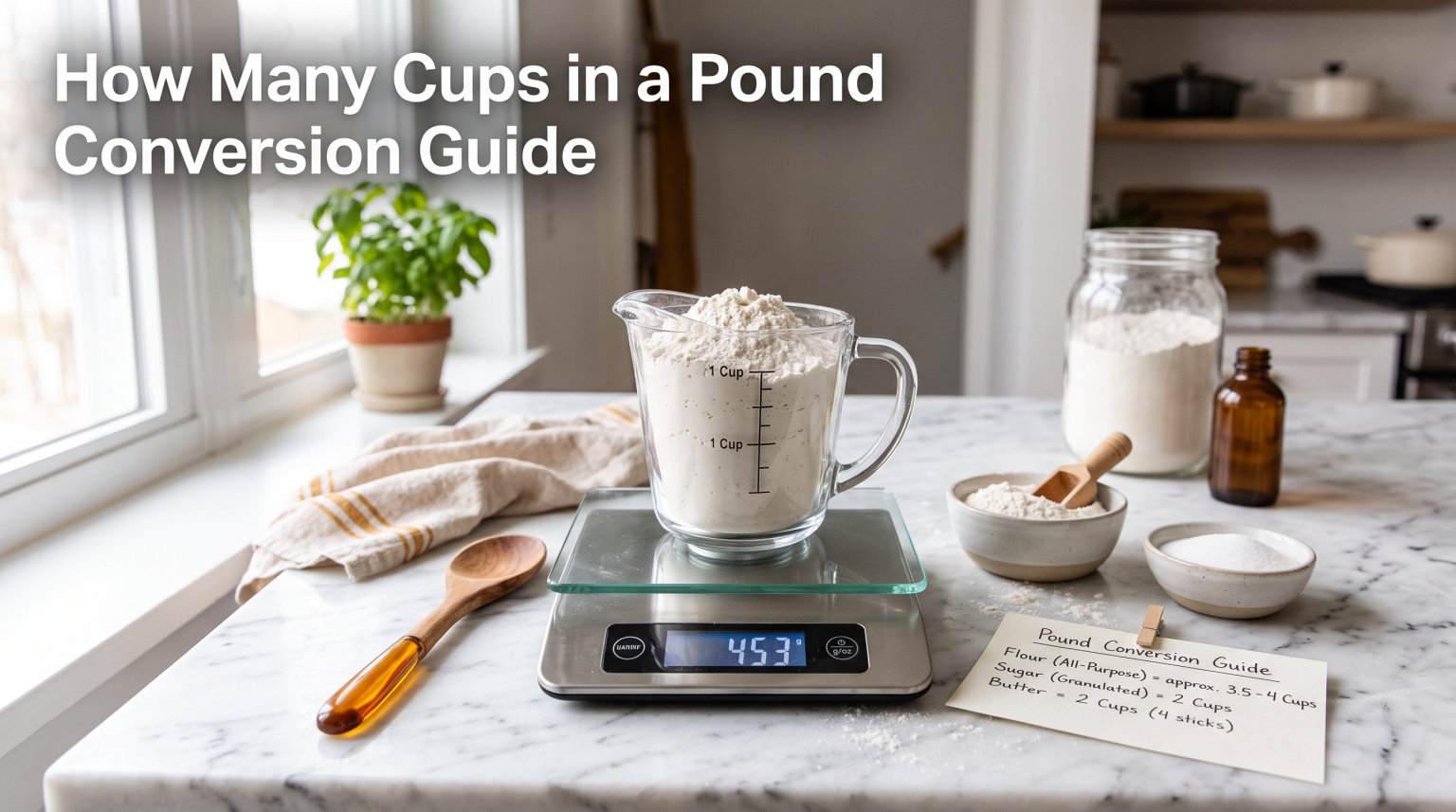
In this how many cups in a pound conversion guide, the ingredient comes first because pounds measure weight while cups measure volume. One pound of granulated sugar, flour, butter, oats, and chopped produce will each fill a different number of cups, so the dependable answer is ingredient-specific.
Use this guide for practical kitchen estimates, but use a scale when precision matters—especially for bread, cakes, and large recipe batches.
Table of Contents
Quick Answer: How Many Cups in a Pound?
For US kitchen conversions, start with these common estimates:
-
All-purpose flour: about 3½ to 3¾ cups per pound
-
Granulated sugar: about 2¼ cups per pound
-
Butter: 2 cups per pound
-
Rolled oats: roughly 5 to 5½ cups per pound
One pound equals approximately 2 cups as a general rule of thumb. However, the exact conversion varies by ingredient because of differences in density. Water weighs more per cup than flour, so 1 pound of water equals about 1.92 cups while 1 pound of all-purpose flour equals about 3.6 cups.
Quick Reference for Common Ingredients:
-
Water: 1.92 cups per pound
-
All-purpose flour: 3.62 cups per pound
-
Granulated sugar: 2.27 cups per pound
-
Butter: 2 cups per pound
-
Brown sugar (packed): 2.5 cups per pound
-
Powdered sugar: 3.75 cups per pound
Planning a baking project? Use these conversions alongside my old-fashioned cake recipes, bread recipe ideas, or cookie recipe collection.
How Many Cups in a Pound Conversion Guide: Ingredient Index
When converting pounds to cups for baking and cooking, you need ingredient-specific measurements. The density of each substance determines how much volume a pound will occupy. Below are detailed conversion charts for the most common kitchen ingredients.
Flour Conversions: All-Purpose, Bread, and Cake Flour
Flour is the ingredient that causes the most conversion confusion. Different flour types have different densities based on protein content and how finely they are milled.
All-Purpose Flour
-
1 pound = 3.62 cups (about 3 5/8 cups)
-
2 pounds = 7.24 cups (about 7 1/4 cups)
-
5 pounds = 18.1 cups (about 18 cups)
-
1 cup = 0.28 pounds (about 1/4 pound or 4.5 ounces)
Bread Flour
-
1 pound = 3.49 cups (about 3 1/2 cups)
-
2 pounds = 6.98 cups (about 7 cups)
-
5 pounds = 17.45 cups (about 17 1/2 cups)
-
1 cup = 0.29 pounds (about 1/3 pound or 4.6 ounces)
Cake Flour
-
1 pound = 3.98 cups (about 4 cups)
-
2 pounds = 7.96 cups (about 8 cups)
-
5 pounds = 19.9 cups (about 20 cups)
-
1 cup = 0.25 pounds (exactly 1/4 pound or 4 ounces)
Bread flour is denser than all-purpose flour due to higher protein content, which is why you get fewer cups per pound. Cake flour is lighter and fluffier, giving you more cups per pound. This explains why substituting bread flour for cake flour in a recipe without adjusting quantities will produce dense, heavy results.
Sugar Conversions: Granulated, Brown, and Powdered
Sugar conversions depend on crystal size and whether the sugar is packed or loose. Brown sugar especially requires attention to whether your recipe calls for “packed” or “unpacked” measurements.
Granulated Sugar
-
1 pound = 2.27 cups (about 2 1/4 cups)
-
2 pounds = 4.54 cups (about 4 1/2 cups)
-
5 pounds = 11.35 cups (about 11 1/3 cups)
-
1 cup = 0.44 pounds (about 7 ounces)
Brown Sugar (Packed Firmly)
-
1 pound = 2.5 cups (exactly 2 1/2 cups)
-
2 pounds = 5 cups
-
5 pounds = 12.5 cups
-
1 cup = 0.4 pounds (about 6.4 ounces)
Brown Sugar (Unpacked/Loose)
-
1 pound = 3.5 cups (about 3 1/2 cups)
-
1 cup = 0.29 pounds (about 4.6 ounces)
Powdered Sugar (Confectioners Sugar)
-
1 pound = 3.75 cups (about 3 3/4 cups)
-
2 pounds = 7.5 cups
-
5 pounds = 18.75 cups
-
1 cup = 0.27 pounds (about 4.3 ounces)
The difference between packed and unpacked brown sugar is significant. Always pack brown sugar firmly into your measuring cup unless your recipe specifically states otherwise. This is why brown sugar bags often include a recipe note about packing.
Fat and Liquid Conversions
Butter, oils, milk, and water have more consistent conversions because they are liquids or semi-solids at room temperature.
Butter
-
1 pound = 2 cups (exact)
-
1 pound = 4 sticks (standard US packaging)
-
1 stick = 1/2 cup = 1/4 pound
-
1 cup = 1/2 pound = 2 sticks
Water
-
1 pound = 1.92 cups (about 1 7/8 cups)
-
2 pounds = 3.84 cups
-
1 cup = 0.52 pounds (about 8.35 ounces)
Milk
-
1 pound = 1.87 cups (about 1 7/8 cups)
-
1 cup = 0.54 pounds (about 8.6 ounces)
Cooking Oil
-
1 pound = 2.08 cups (about 2 cups)
-
1 cup = 0.48 pounds (about 7.7 ounces)
Butter is the easiest conversion to remember because 1 pound equals exactly 2 cups. This is why most American butter is packaged in 1-pound boxes containing four 1/2-cup sticks.
Grain and Oat Conversions
Grains and oats vary significantly based on whether they are raw, cooked, or in different forms like steel-cut versus rolled.
White Rice (Uncooked)
-
1 pound = 2.45 cups (about 2 1/2 cups)
-
1 cup = 0.41 pounds (about 6.5 ounces)
Rolled Oats (Uncooked)
-
1 pound = 5.6 cups (about 5 2/3 cups)
-
1 cup = 0.18 pounds (about 2.9 ounces)
Steel-Cut Oats
-
1 pound = 2.8 cups (about 2 3/4 cups)
-
1 cup = 0.36 pounds (about 5.7 ounces)
Elbow Macaroni (Dry)
-
1 pound = 4 cups (approximately)
-
1 cup = 0.25 pounds (about 4 ounces)
Rolled oats are exceptionally light, which is why you get over 5 cups per pound. This surprises many home cooks who expect all grains to convert similarly. When meal prepping, remember that cooked pasta and rice expand significantly, so 1 pound dry does not equal 1 pound cooked.
How to Convert Pounds to Cups: The Formula
The National Institute of Standards and Technology explains mass units; in kitchen practice, one avoirdupois pound is 453.6 grams.
Understanding the formula behind these conversions empowers you to calculate cup measurements for any ingredient, even those not listed in standard charts. The key factor is density, which measures how much mass fits into a given volume.
Understanding Ingredient Density
Density is measured in grams per milliliter (g/mL) or grams per cubic centimeter (g/cm3). Water has a density of 1 g/mL, which serves as our baseline. Ingredients with density greater than 1 g/mL are heavier per cup, while ingredients with density less than 1 g/mL are lighter per cup.
Here are the densities for common ingredients:
-
Water: 1.0 g/mL
-
All-purpose flour: 0.53 g/mL
-
Granulated sugar: 0.85 g/mL
-
Butter: 0.91 g/mL
-
Milk: 1.03 g/mL
-
Cooking oil: 0.92 g/mL
-
Honey: 1.42 g/mL
Notice that flour has a density of only 0.53 g/mL, meaning it is about half as dense as water. This is why 1 pound of flour gives you nearly twice as many cups as 1 pound of water.
The Conversion Formula
To convert pounds to cups, use this formula:
Cups = Pounds / (Density x 0.00423)
The 0.00423 factor converts the units properly, accounting for 1 pound equaling 453.6 grams and 1 cup equaling 236.6 milliliters.
Let me walk through an example. Say you want to know how many cups are in 1 pound of all-purpose flour:
-
Find the density: 0.53 g/mL
-
Multiply density by 0.00423: 0.53 x 0.00423 = 0.00224
-
Divide pounds by that result: 1 / 0.00224 = 3.57 cups
This gives us approximately 3.6 cups, which matches our conversion chart.
Here is another example for honey, which has a high density:
-
Honey density: 1.42 g/mL
-
Multiply: 1.42 x 0.00423 = 0.0060
-
Divide: 1 / 0.0060 = 1.67 cups
So 1 pound of honey equals about 1 2/3 cups, significantly less than the 2-cup general rule.
Converting Cups to Pounds
To convert in the opposite direction, from cups to pounds, use this formula:
Pounds = Cups x Density x 0.00423
For example, to find how many pounds are in 3 cups of granulated sugar:
-
Sugar density: 0.85 g/mL
-
Multiply: 3 x 0.85 x 0.00423 = 0.0108
-
Result: 3 cups of sugar weigh about 1.08 pounds
I keep a printed density chart in my kitchen for quick reference when working with unusual ingredients.
US Cup vs UK Cup: What’s the Difference?
If you have ever followed a British or Australian recipe and ended up with disappointing results, the difference between US and UK cup measurements might be the culprit. These cups are not the same size.
US Standard Cup: 240 milliliters (8 fluid ounces)
UK/Imperial Cup: 284 milliliters (about 9.6 fluid ounces)
Metric Cup: 250 milliliters (about 8.45 fluid ounces)
This means a UK cup holds about 18% more than a US cup. If you use a UK cup measurement with US ingredients, your recipe proportions will be off significantly.
Here is how this affects pound-to-cup conversions:
US, Metric, and UK Cup Sizes
-
US legal cup: 240 milliliters for nutrition labeling
-
US customary cup: about 236.6 milliliters
-
Metric cup: 250 milliliters
-
UK recipes: modern recipes commonly use metric weights, so check the source before converting
The small difference may not matter in soup, but it can matter in baking. When the recipe gives grams, keep the weight measurement instead of translating it into cups.
Measuring Tips for Accurate Conversions
Even with perfect conversion charts, improper measuring technique will ruin your results. After years of testing, I have developed foolproof methods for both dry and wet ingredients.
Measuring Dry Ingredients
Flour and other powdery ingredients compress easily, so your measuring technique dramatically affects the actual amount you use.
The Fluff, Spoon, and Sweep Method:
-
Fluff the flour in its container with a spoon to aerate it
-
Spoon the flour gently into your measuring cup without packing it
-
Fill the cup until it mounds above the rim
-
Level off the excess with a straight edge like a knife or spatula
Never scoop directly from the bag with your measuring cup. This packs the flour and can add up to 25% more flour than the recipe intends. I tested this myself: scooping gave me 5.2 ounces per cup while the fluff-and-spoon method gave me 4.5 ounces.
For Brown Sugar:
Unless your recipe specifies “loose” or “unpacked,” always pack brown sugar firmly into the cup. Press it down with the back of the spoon until it holds its shape when turned out.
For Powdered Sugar:
Sift powdered sugar first if it has lumps, then spoon and level gently. Do not pack unless making a dense frosting.
Measuring Wet Ingredients
Liquid measurements require a different approach entirely.
Clear Liquid Measuring Cups:
Always use a clear measuring cup with markings on the side. Place it on a flat surface and bend down to eye level to check the measurement. Reading from above creates parallax error.
Sticky Liquids (Honey, Molasses, Syrup):
Spray your measuring cup with cooking spray before adding sticky ingredients. They will slide right out instead of sticking to the cup. This technique saves both time and accuracy.
Butter:
Use the markings on the wrapper for stick butter. For block butter, cut on the measurement lines or weigh it for precision.
When to Use Weight Instead of Volume
Professional bakers use weight measurements because they are more accurate and consistent. Consider buying a kitchen scale if you bake regularly.
Weight measurement is especially important for:
-
Bread baking, where hydration ratios are critical
-
Macarons and delicate pastries
-
Recipes from professional cookbooks that list weights
-
Scaling recipes up or down
A digital kitchen scale costs between $15 and $40 and eliminates guesswork entirely. I switched to weight measurements for bread three years ago, and my loaves have been consistently better since.
Common Recipe Conversion Examples
Let me share some real-world scenarios I encounter regularly in my kitchen and during meal prep sessions.
Converting a 5-Pound Bag of Flour
You bought a standard 5-pound bag of all-purpose flour. How many cups does that give you?
5 pounds x 3.62 cups per pound = approximately 18 cups
This is enough flour for about four batches of cookies (assuming 4.5 cups per batch) or three loaves of sandwich bread (assuming 5-6 cups per batch).
Converting a 2-Pound Bag of Sugar
That 2-pound bag of granulated sugar converts to:
2 pounds x 2.27 cups per pound = approximately 4.5 cups
This will make about three batches of chocolate chip cookies or two double-layer cakes.
Meal Prep Batch Conversions
When I meal prep for the week, I often work backwards from cup measurements to pounds for shopping.
If my meal plan calls for 2 cups of dry rice per day for five days:
10 cups total / 2.45 cups per pound = about 4 pounds of rice needed
For oats, if you want 1 cup of dry oats for seven days of breakfasts:
7 cups / 5.6 cups per pound = about 1.25 pounds (or 1 1/4 pounds) of rolled oats
Cooked vs Raw Ingredient Considerations
One common mistake is confusing cooked and raw measurements. Pasta and rice expand significantly when cooked.
1 cup of dry rice yields about 3 cups cooked rice
1 cup of dry pasta yields about 2 to 2.5 cups cooked pasta
So 1 pound of dry rice (2.45 cups) will give you about 7.3 cups of cooked rice. This is important for meal prep calculations and understanding serving sizes.
When a recipe calls for “2 cups of cooked chicken,” you need about 1 pound of raw boneless chicken breasts, which will cook down to approximately that amount.
Frequently Asked Questions
Does one pound always equal two cups?
No. Two cups is only a rough memory aid for some dense or liquid ingredients. Flour is lighter by volume, while butter and granulated sugar are denser.
How many cups are in a pound of all-purpose flour?
A pound of all-purpose flour is roughly 3½ to 3¾ cups when spooned and leveled. Brand, humidity, and measuring technique can shift the volume.
How many cups are in a pound of granulated sugar?
One pound is approximately 2¼ cups of granulated sugar. Use weight for candy, preserves, or scaled baking formulas.
How many cups are in a pound of butter?
One pound of butter equals 2 US cups, or four standard 4-ounce sticks.
Should brown sugar be packed before converting?
Yes, when a recipe specifies packed brown sugar. Press it into the cup firmly enough to hold its shape when turned out.
What is the fastest accurate way to convert a new ingredient?
Find a trusted weight-per-cup value for that specific ingredient, then divide 453.6 grams by the grams in one cup.
Conclusion
Use this how many cups in a pound conversion guide as a reminder that the answer is really a density question, not a universal equation. Understanding how many cups are in a pound is more than memorizing numbers. It is about recognizing that weight and volume measure different properties, and ingredient density bridges the gap between them. Once you grasp this concept, you can convert any ingredient with confidence.
Keep this guide bookmarked in your kitchen for quick reference. The conversion charts for flour, sugar, butter, and common ingredients will save you from recipe disasters and wasted ingredients. Remember the 2-cup rule for quick estimates, but rely on ingredient-specific conversions for baking success.
With practice, these conversions become second nature. Your recipes will turn out consistently, your meal prep calculations will be accurate, and you will never again wonder if you are measuring correctly when a recipe calls for a pound of flour but your measuring cups only show cups.