
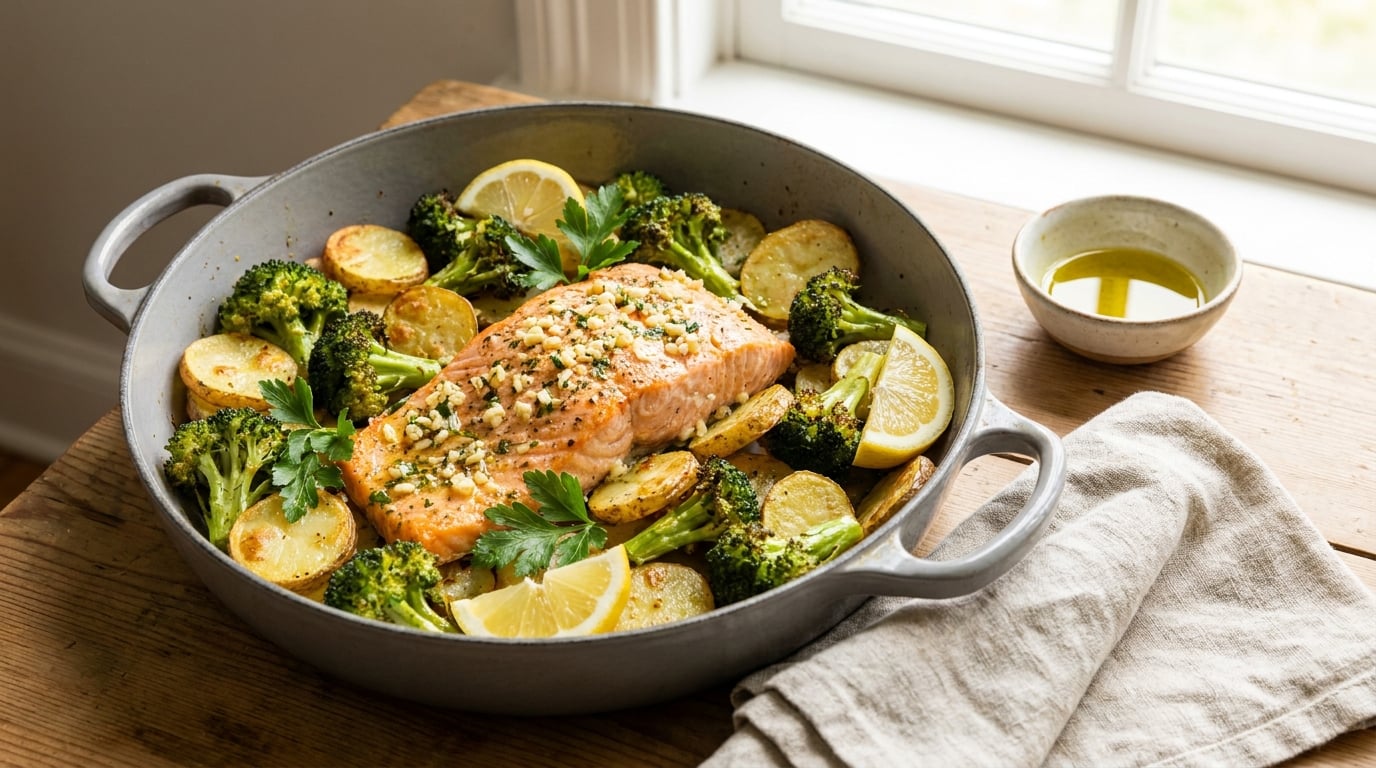
One pan salmon dinner recipes with vegetables are the answer on a Tuesday when you want something that tastes like you planned it, but all you have energy for is one pan and one fork. Every recipe below puts skin-on or boneless salmon fillets and a pile of vegetables on a single sheet pan or in a single skillet, then finishes in 25 to 40 minutes. No flipping a dozen components, no separate side dish, one thing to wash at the end.
I cook these on weeknights when the day already used up the patience I had. Each one gives you a different flavor base, a different vegetable, and a different pan, so you can pick by mood: sweet and sticky, smoky and fast, or herb-heavy and slow. I keep an instant-read thermometer within arm’s reach for all of them, because the only reliable answer to “is it done” is a number.
Table of Contents
One Pan Salmon Dinner Recipes With Vegetables at a Glance
Here is the whole collection on one page. Times include prep and cook. If you want more one-pan ideas that are not fish, my 15 best one pan dinner recipes roundup is worth a scroll.
| Recipe | Time | Difficulty | Best for |
|---|---|---|---|
| 1. Lemon Garlic Salmon With Broccoli and Potatoes | 28 min | Easy | Your first time cooking salmon |
| 2. Honey Mustard Salmon With Green Beans | 26 min | Easy | Kids and picky eaters |
| 3. Blackened Salmon With Corn and Zucchini | 24 min | Medium | A fast, smoky dinner |
| 4. Teriyaki Salmon With Sesame Bok Choy | 25 min | Easy | Weeknight takeout nights |
| 5. Mediterranean Salmon With Tomatoes and Zucchini | 32 min | Easy | Colorful summer plates |
| 6. Chili Lime Salmon With Bell Peppers | 25 min | Easy | Mild heat and big flavor |
| 7. Dijon Salmon With Asparagus and Potatoes | 40 min | Medium | A slightly fancy dinner |
| 8. Coconut Curry Salmon With Peas and Carrots | 30 min | Easy | Comfort food that is still light |
| 9. Balsamic Glazed Salmon With Brussels Sprouts | 35 min | Medium | Crispy edges and a glossy finish |
| 10. Cajun Salmon With Okra and Corn | 30 min | Medium | Louisiana-style comfort food |
1. Lemon Garlic Salmon With Broccoli and Potatoes
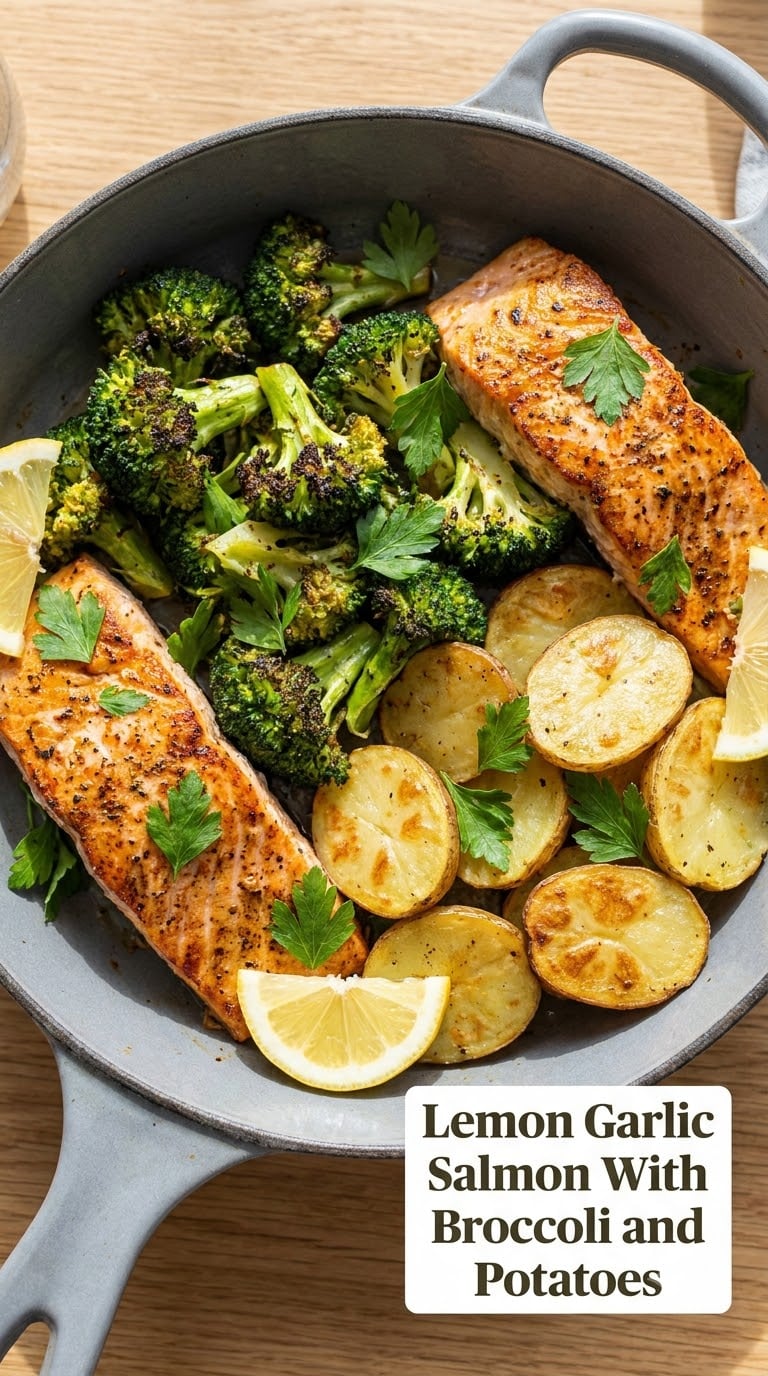
This is the one I cook most often and the one I hand to anyone who says they have never cooked salmon. The potatoes go in first and take the longest, the broccoli joins halfway, and the salmon finishes on top with a lemon garlic butter that keeps it moist. It is forgiving, it smells incredible, and the same pan handles all three.
Yield: 4 servings · Prep: 10 min · Cook: 18 min · Total: 28 min · Difficulty: Easy
Ingredients
- 1 1/2 pounds baby gold potatoes, sliced 1/4 inch thick
- 4 cups broccoli florets
- 4 salmon fillets, 5 to 6 ounces each, skin-on
- 3 tablespoons olive oil, divided
- 4 garlic cloves, minced
- 1 lemon, zested and juiced
- 2 tablespoons unsalted butter
- 1 teaspoon dried oregano
- 1/2 teaspoon kosher salt and 1/4 teaspoon black pepper
- 2 tablespoons chopped flat-leaf parsley
Instructions
- Heat the oven to 425°F (220°C) and set a 12-inch oven-safe skillet in it while it heats.
- Toss the potato slices with 2 tablespoons olive oil, the oregano, and the salt. Spread them in a single layer in the hot skillet.
- Bake the potatoes for 8 minutes, until the edges look golden and a knife slides through with no resistance.
- Push the potatoes to the outer ring of the skillet and add the broccoli to the center with the remaining tablespoon of oil.
- Season the salmon with pepper, set it skin-side down on top of the vegetables, and bake for 6 to 8 minutes more.
- Check the salmon with a thermometer at the thickest part. Pull it at 140°F (60°C) and let it carry over to 145°F (63°C), the safe minimum for fish.
- While the fish rests two minutes, melt the butter with the garlic, lemon zest, and lemon juice in a small pan until it foams.
- Spoon the garlic lemon butter over the salmon, scatter with parsley, and serve straight from the skillet.
Tip: Do not skip the preheated pan. Potatoes that hit a cold cast iron or heavy skillet release water and steam instead of roasting, and that same steam is what keeps salmon from browning.
Swap it: Yukon Gold or red potatoes work just as well, cut to the same 1/4 inch. Cauliflower or green beans can replace the broccoli with the same add time.
Storage: Refrigerate in a sealed container for up to 3 days. Reheat the salmon and vegetables together in a 300°F (150°C) oven for 8 to 10 minutes, or add a splash of broth and cover for 3 minutes on the stovetop.
2. Honey Mustard Salmon With Green Beans
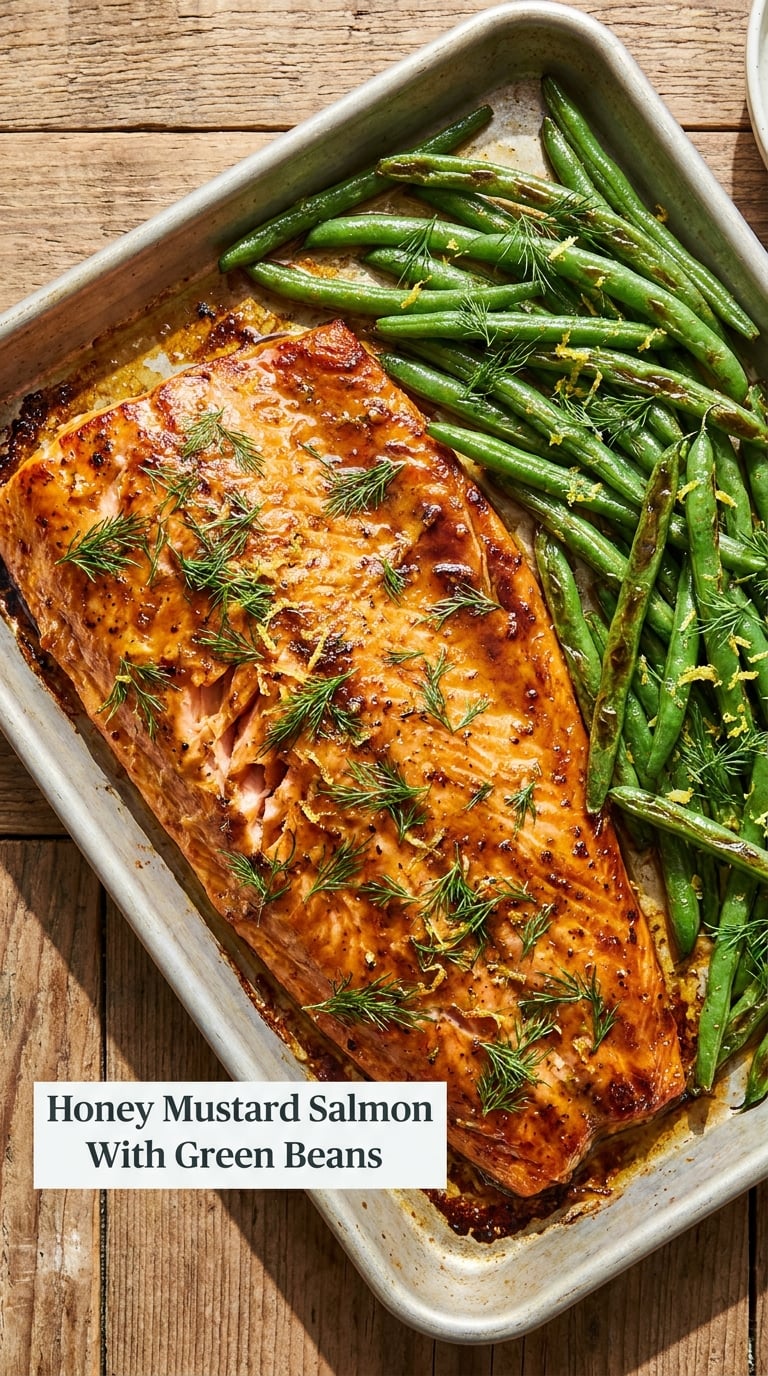
Honey mustard is the glaze that converts a skeptical eater, and green beans roast into a thin, sweet-edged vegetable that never goes soggy. Everything goes on one rimmed sheet pan at the same time, which means this is the fastest recipe in the collection. The glaze caramelizes in the last few minutes and turns lacquer-dark.
Yield: 4 servings · Prep: 8 min · Cook: 18 min · Total: 26 min · Difficulty: Easy
Ingredients
- 1 1/2 pounds green beans, trimmed and halved
- 4 salmon fillets, 5 to 6 ounces each, skin-on
- 2 tablespoons olive oil
- 1/2 cup honey
- 1/4 cup Dijon mustard
- 2 tablespoons soy sauce
- 1 tablespoon apple cider vinegar
- 2 garlic cloves, minced
- 1/2 teaspoon black pepper
- 1 teaspoon fresh dill, chopped, for finishing
Instructions
- Heat the oven to 425°F (220°C) and line a large rimmed sheet pan with parchment.
- Whisk the honey, Dijon, soy sauce, vinegar, garlic, and pepper together in a small bowl.
- Toss the green beans with 1 tablespoon olive oil and spread them on the pan, keeping them in a single layer.
- Pat the salmon dry, set it skin-side down on the pan, and brush each fillet with half the glaze.
- Roast for 10 minutes, then brush with the remaining glaze and rotate the pan.
- Roast 5 to 7 minutes more until the salmon flakes at the thickest part and reads 145°F (63°C) on a thermometer.
- Scatter the green beans and salmon with dill and serve from the pan.
Tip: Honey goes from golden to burnt fast, so brush the second coat late and pull the pan the moment the edges of the salmon turn opaque all the way through.
Swap it: Use tamari instead of soy sauce and honey-sweetened coconut aminos for a fully soy-free version. Asparagus or snap peas can stand in for the green beans with no time change.
Storage: Keeps in the fridge for 3 days. Warm gently in a covered skillet over low heat for 4 to 5 minutes so the glaze does not scorch.
3. Blackened Salmon With Corn and Zucchini
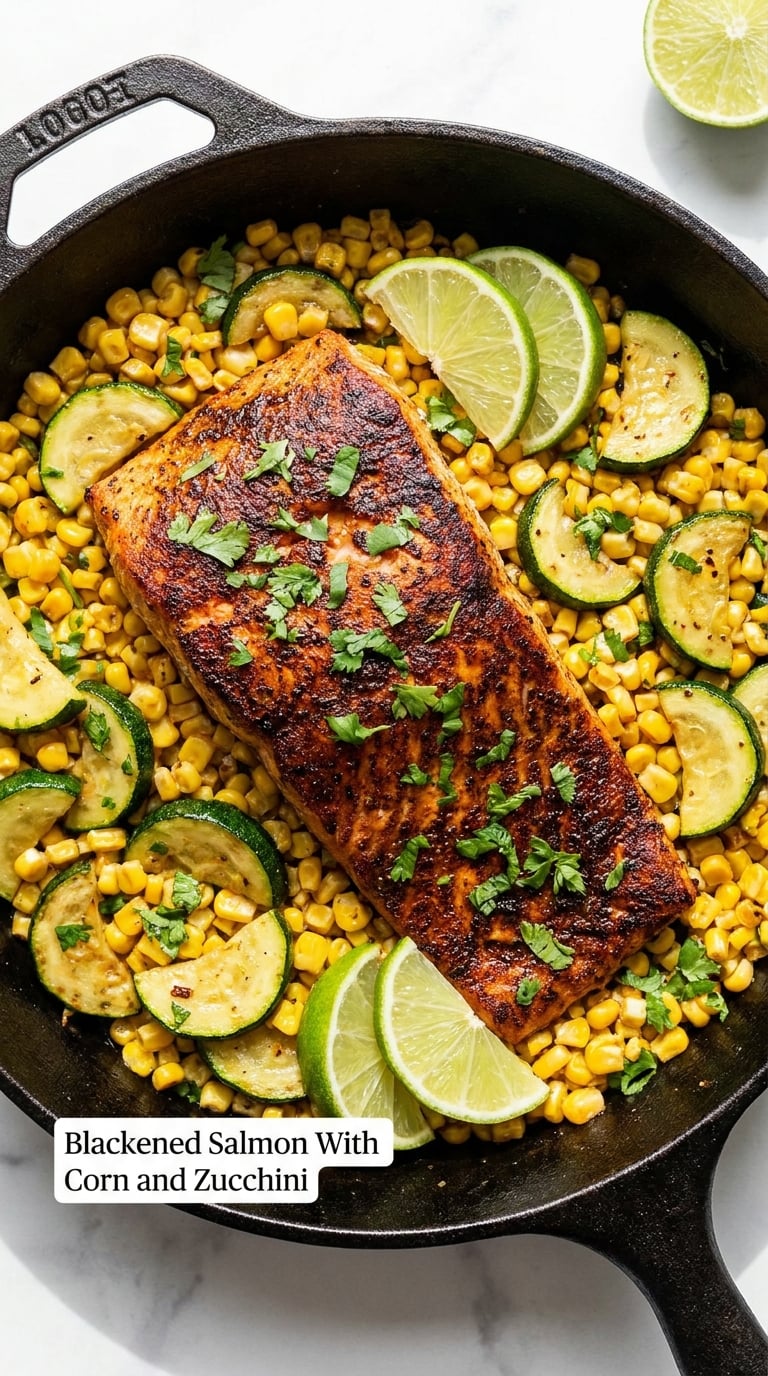
Blackened salmon is loud, smoky, and fast, and cast iron is the only pan that gives you the crust. Corn and zucchini go in the same skillet and cook in the rendered fat, so the vegetables pick up the spice too. This is the shortest recipe here, which makes it the one for the nights you get home late.
Yield: 4 servings · Prep: 8 min · Cook: 16 min · Total: 24 min · Difficulty: Medium
Ingredients
- 4 salmon fillets, 5 to 6 ounces each, skin-on
- 2 tablespoons unsalted butter
- 1 tablespoon olive oil
- 1 tablespoon blackened or Cajun seasoning
- 1 teaspoon smoked paprika
- 1/2 teaspoon garlic powder
- 2 ears corn, kernels cut off
- 2 medium zucchini, sliced 1/2 inch thick
- 1 tablespoon lime juice
- 1/4 cup chopped cilantro
- Lime wedges for serving
Instructions
- Pat the salmon very dry and press the blackened seasoning, smoked paprika, garlic powder, and half the butter into the flesh side of each fillet.
- Heat a cast iron skillet over medium-high heat until a drop of water skitters and evaporates.
- Add the olive oil and the corn, then cook 4 minutes, stirring often, until the kernels start to brown.
- Add the zucchini and a pinch of salt, and cook 3 minutes more until the edges take on color.
- Push the vegetables to the outer ring and lay the salmon in the center, seasoned side down.
- Cook without moving the fillets for 4 minutes, until a dark crust forms.
- Flip the salmon and cook 2 to 3 minutes more, until the center reaches 145°F (63°C) and flakes lightly.
- Finish with the lime juice, the remaining butter, cilantro, and lime wedges.
Tip: The crust forms from contact, not from stirring. If the salmon sticks when you try to flip it, give it 30 more seconds instead of forcing it.
Swap it: A simple paprika, garlic, and oregano rub works for anyone who finds blackened seasoning hot. Sweet peppers can join the corn for the same 7 minutes.
Storage: Refrigerate for up to 3 days. The crust softens in the fridge, so reheat uncovered in a 400°F (205°C) oven for 6 to 8 minutes to bring it back.
4. Teriyaki Salmon With Sesame Bok Choy
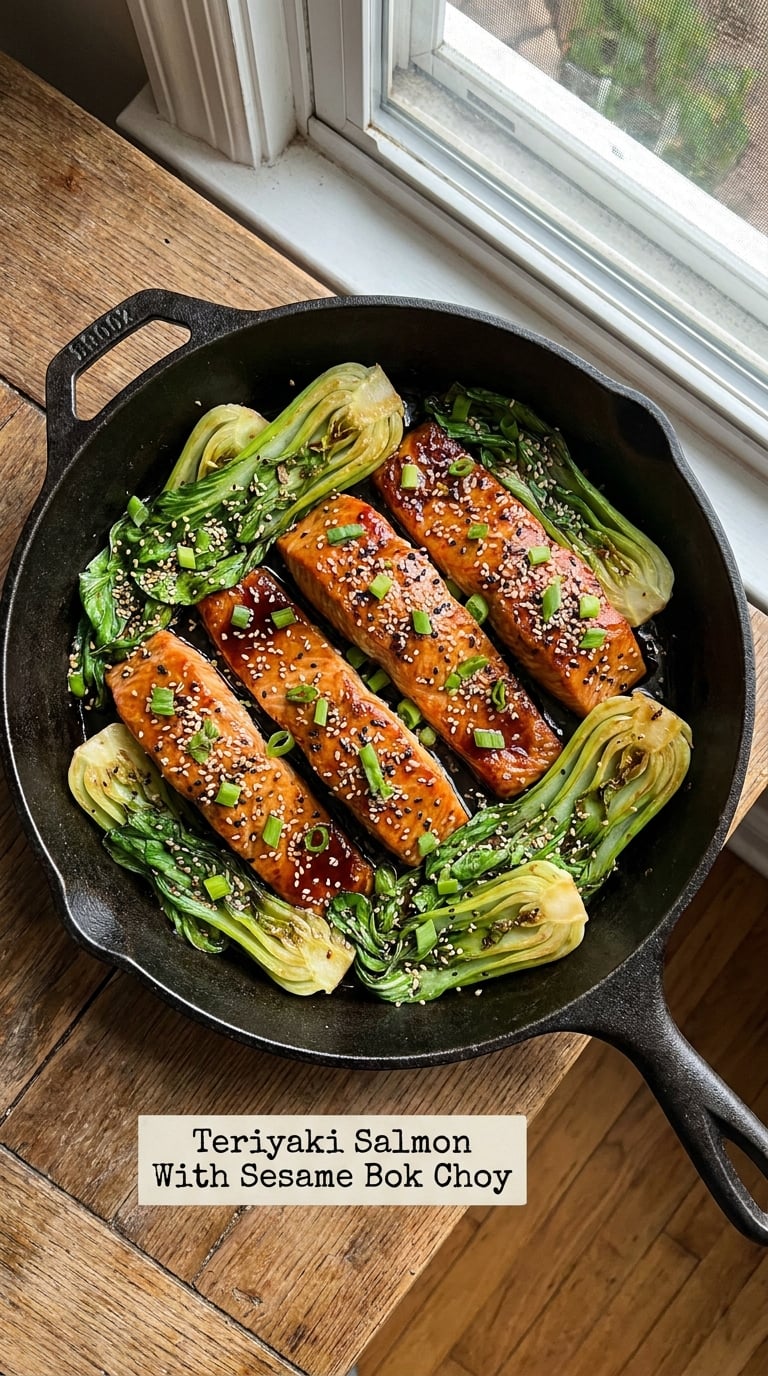
Teriyaki is the weeknight version of takeout, and bok choy is the best vegetable for it because the stems stay crisp while the leaves collapse. The trick is reducing the sauce in the pan before the salmon goes in, so the fish lands in a glaze that is already thick instead of thin liquid that never sticks. Twenty-five minutes, start to finish.
Yield: 4 servings · Prep: 10 min · Cook: 15 min · Total: 25 min · Difficulty: Easy
Ingredients
- 4 salmon fillets, 5 to 6 ounces each, skin-on
- 1 pound baby bok choy, halved lengthwise
- 1 tablespoon sesame oil
- 1 tablespoon canola or avocado oil
- 1/3 cup soy sauce
- 1/4 cup rice vinegar
- 2 tablespoons brown sugar
- 1 tablespoon fresh ginger, grated
- 2 garlic cloves, minced
- 1 teaspoon toasted sesame oil, drizzled at the end
- 2 tablespoons sesame seeds and 2 scallions, sliced
Instructions
- Whisk the soy sauce, rice vinegar, brown sugar, ginger, and garlic together in a large skillet.
- Simmer over medium heat for 5 to 6 minutes until the sauce reduces to a syrup that coats the back of a spoon.
- Add the sesame oil and the canola oil, then lay the bok choy cut-side down in the sauce.
- Cook the bok choy 3 minutes, turning once, so the stems soften and the leaves wilt.
- Nestle the salmon fillets into the sauce, skin-side down, and bring to a gentle simmer.
- Spoon sauce over the tops of the fillets and cook 6 to 8 minutes, until the salmon reads 145°F (63°C) and the sauce looks lacquered.
- Drizzle with the toasted sesame oil and scatter with sesame seeds and scallions.
Tip: Keep the simmer gentle. A hard boil makes the sauce foam, reduces it too fast, and pushes the salmon past done before the timer goes off.
Swap it: For a soy-free version, use coconut aminos and add 1 teaspoon of maple syrup to keep the balance. Tatsoi or baby spinach can replace bok choy and cook in 2 minutes.
Storage: Holds in the fridge for 3 days. Reheat in a covered skillet over low heat for 4 minutes, then spoon fresh sauce over the top, since the glaze thickens as it sits.
5. Mediterranean Salmon With Tomatoes and Zucchini
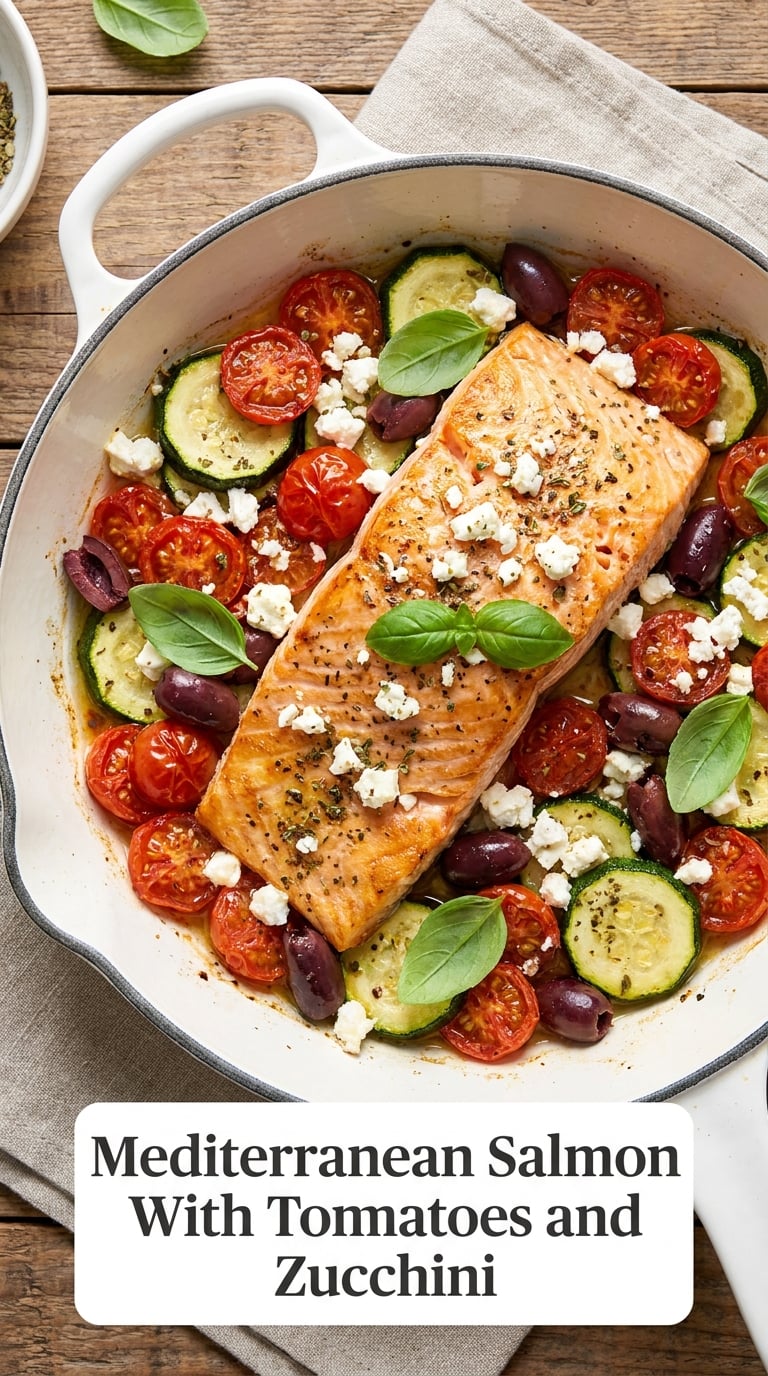
When the cherry tomatoes start to collapse in the pan, they make a sauce on their own, and the zucchini soaks it up. Olives and feta add salt and sharpness, so this plate needs very little else on it. It is the most colorful recipe in the collection and the one that looks like you did more work than you did.
Yield: 4 servings · Prep: 10 min · Cook: 22 min · Total: 32 min · Difficulty: Easy
Ingredients
- 4 salmon fillets, 5 to 6 ounces each, skin-on
- 1 pint cherry tomatoes, halved
- 2 medium zucchini, cut into half-moons
- 1/2 cup cherry or grape tomatoes, for later
- 1/3 cup kalamata olives, pitted and sliced
- 3 tablespoons olive oil, divided
- 3 garlic cloves, minced
- 1 teaspoon dried oregano
- 1/2 teaspoon red pepper flakes
- 1/3 cup crumbled feta
- 1/4 cup torn basil leaves
- 1/2 teaspoon kosher salt
Instructions
- Heat a 12-inch skillet over medium heat and add 2 tablespoons olive oil.
- Sear the salmon skin-side down for 4 minutes without moving it, then flip and cook 2 minutes. Set it aside on a plate.
- Add the remaining olive oil, the halved cherry tomatoes, and the garlic, and cook 6 minutes until the tomatoes slump and release their juice.
- Add the zucchini, olives, oregano, red pepper flakes, and salt, and cook 5 to 6 minutes until the zucchini is tender with a little bite.
- Stir in the whole cherry tomatoes and let them warm for 2 minutes.
- Return the salmon to the pan, spooning the tomato juices over it, and cook 3 to 4 minutes until it hits 145°F (63°C).
- Scatter with feta and basil and bring the whole skillet to the table.
Tip: Sear the fish before the vegetables. Once tomatoes are in the pan releasing water, the temperature drops and the salmon crust will never recover.
Swap it: Olives carry most of the salt here, so leave the feta off and skip the salt entirely for a lower-sodium plate. Yellow squash works in place of zucchini one for one.
Storage: Refrigerate for 3 to 4 days. Reheat in a 325°F (165°C) oven for 7 minutes, since the tomato sauce needs to come back to a simmer more than the fish needs to heat.
6. Chili Lime Salmon With Bell Peppers
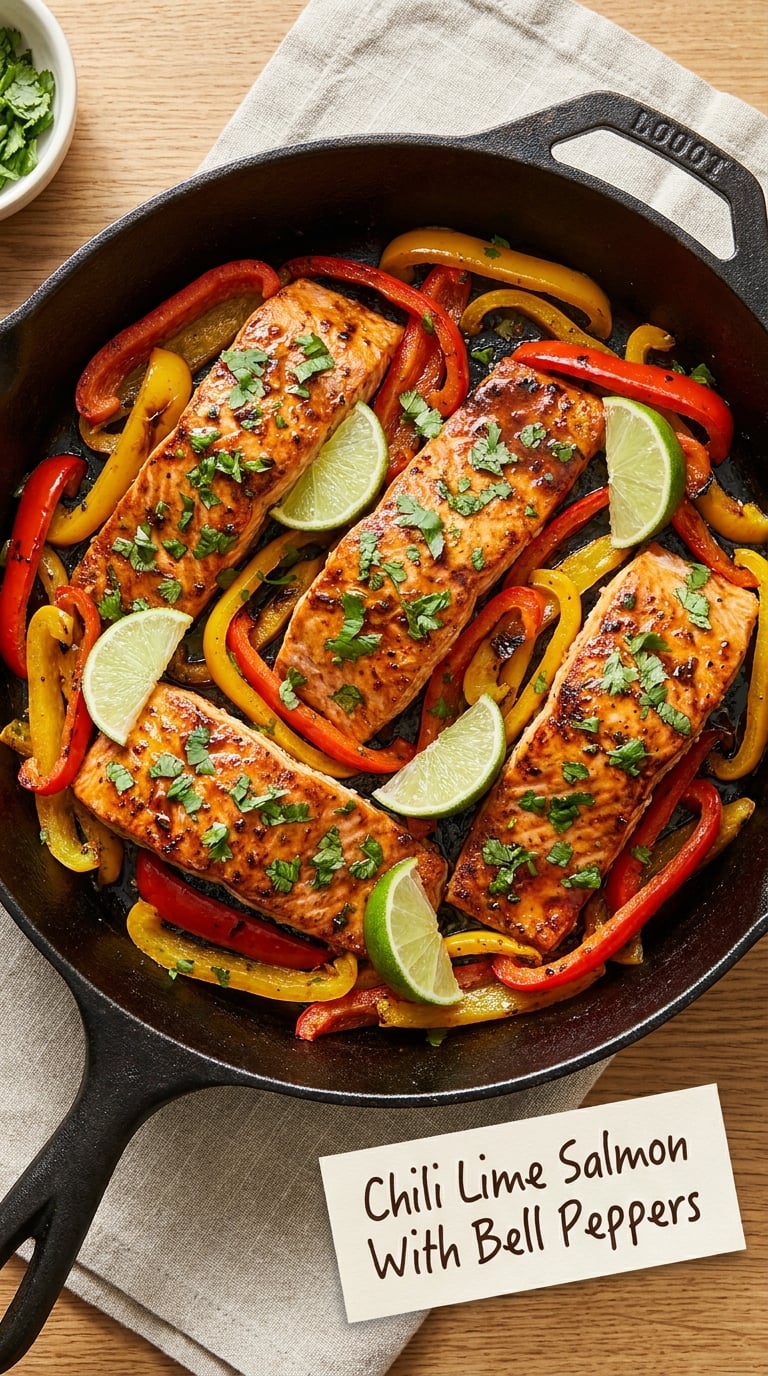
Red and yellow peppers roast into sweet, soft strips that take the chili lime dressing well, and the whole thing tastes bright rather than heavy. It is the recipe in this list that tastes most like a restaurant plate, and it takes about the same time as the honey mustard one. Fresh cilantro goes on at the very end so it stays lively.
Yield: 4 servings · Prep: 10 min · Cook: 15 min · Total: 25 min · Difficulty: Easy
Ingredients
- 4 salmon fillets, 5 to 6 ounces each, skin-on
- 2 red bell peppers, sliced 1/2 inch wide
- 1 yellow bell pepper, sliced 1/2 inch wide
- 1 red onion, cut into thin wedges
- 2 tablespoons olive oil
- 1 tablespoon chili powder
- 1 teaspoon ground cumin
- 1/2 teaspoon smoked paprika
- 2 tablespoons lime juice
- 1 tablespoon soy sauce
- 1 tablespoon honey
- 1/4 cup chopped cilantro
Instructions
- Heat the oven to 425°F (220°C) and line a rimmed sheet pan with parchment.
- Whisk the lime juice, soy sauce, honey, chili powder, cumin, and smoked paprika into a glaze.
- Toss the peppers and onion with the olive oil and spread them across the pan.
- Roast the vegetables 6 minutes, until the edges start to soften and brown.
- Set the salmon on top of the vegetables and brush with half the glaze.
- Roast 7 to 9 minutes more, basting once with the remaining glaze, until the salmon reaches 145°F (63°C).
- Scatter with cilantro and serve with extra lime wedges.
Tip: Give the peppers a real head start. Raw peppers sitting under the fish release water, and that water steams the salmon instead of roasting it. Six minutes is the difference between char and sizzle.
Swap it: For a gluten-free, soy-free plate, swap the soy sauce for coconut aminos. Zucchini or yellow squash can take the peppers’ place, added at the same time.
Storage: Refrigerate for 3 days, keeping the glaze separate if you can. Reheat the salmon and peppers together at 325°F (165°C) for 8 minutes, then add the cilantro fresh.
7. Dijon Salmon With Asparagus and Potatoes
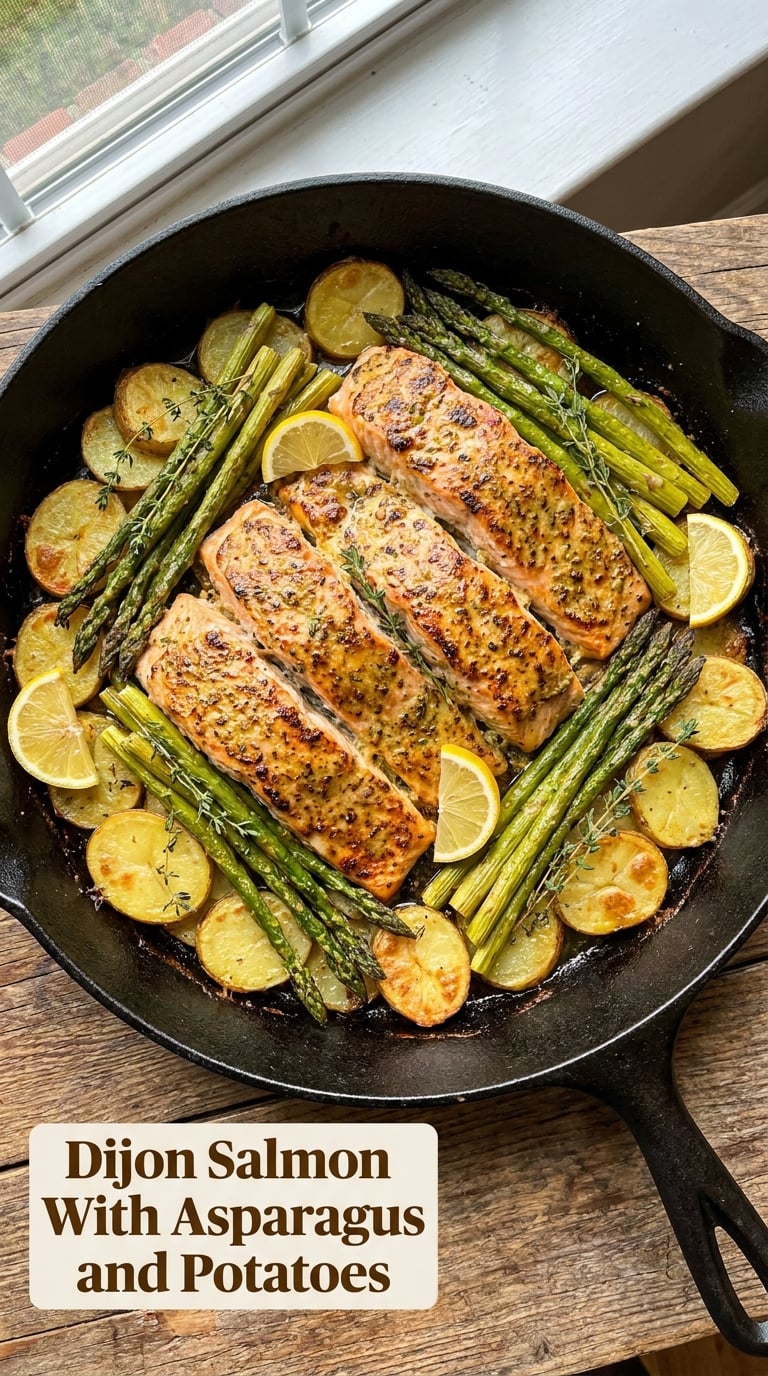
This is the longest cook in the collection, at 40 minutes, and it is the one worth making when you have a little more patience and want the plate to look like you tried. A Dijon and panko crust turns golden and crunchy in the oven, and the potatoes roast underneath the asparagus the entire time, absorbing the drippings. It is the most forgiving recipe here, since the vegetables can wait while the fish finishes.
Yield: 4 servings · Prep: 15 min · Cook: 25 min · Total: 40 min · Difficulty: Medium
Ingredients
- 1 1/2 pounds baby red or Yukon Gold potatoes, halved
- 1 bunch asparagus, about 1 pound, woody ends snapped off
- 4 salmon fillets, 5 to 6 ounces each
- 3 tablespoons olive oil, divided
- 1/3 cup panko breadcrumbs
- 2 tablespoons Dijon mustard
- 1 tablespoon finely grated Parmesan
- 1 teaspoon fresh thyme leaves, chopped
- 1 lemon, cut into wedges
- 1/2 teaspoon kosher salt and 1/2 teaspoon black pepper
- Zest of 1 lemon
- 1 teaspoon garlic powder
- 1 tablespoon melted butter
Instructions
- Heat the oven to 425°F (220°C) and line a large sheet pan with parchment.
- Toss the halved potatoes with 2 tablespoons olive oil, the salt, and pepper, then roast 15 minutes until the undersides are golden.
- While the potatoes roast, mix the panko, Parmesan, lemon zest, thyme, garlic powder, and melted butter in a small bowl.
- Brush the salmon with the Dijon, then press the panko mixture onto the top of each fillet.
- Move the potatoes to the edges of the pan and lay the asparagus in the center, drizzled with the last tablespoon of oil.
- Set the salmon on top of the asparagus and roast 9 to 11 minutes, until the crust is deep gold and the salmon reads 145°F (63°C).
- Squeeze lemon over the pan before serving.
Tip: Press the crumb mixture on firmly right before the salmon goes in the oven. A loose crust slides off the fish when you try to lift it.
Swap it: For a gluten-free crust, use almond flour in place of panko and reduce the bake by a minute. Green beans can take the asparagus’ place, added at the same 9-minute mark.
Storage: Refrigerate for 3 to 4 days. The crust softens in the fridge, so reheat at 400°F (205°C) for 8 to 10 minutes and expect a slightly softer topping with a very crisp bottom.
8. Coconut Curry Salmon With Peas and Carrots
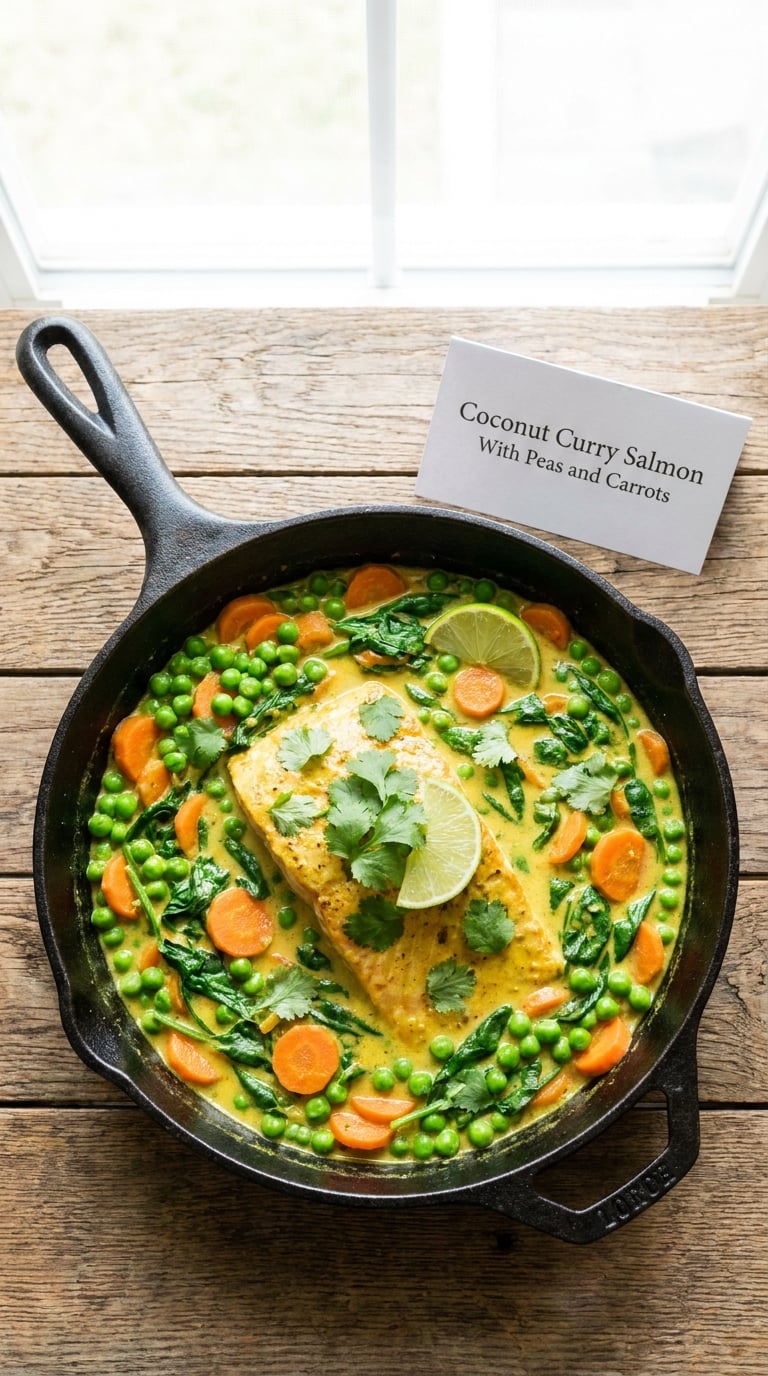
Coconut milk makes a sauce in the same pan the fish cooks in, so this is a curry with no separate pot and no rice required to make sense of it. The salmon poaches gently in the sauce and stays tender, which makes it a good recipe when your fillets are thicker than usual. Peas and carrots go in late so they keep their color and shape.
Yield: 4 servings · Prep: 10 min · Cook: 20 min · Total: 30 min · Difficulty: Easy
Ingredients
- 4 salmon fillets, 5 to 6 ounces each, cut into large chunks
- 1 tablespoon coconut oil or canola oil
- 1 medium onion, diced
- 2 garlic cloves, minced
- 1 tablespoon grated fresh ginger
- 1 tablespoon mild curry powder
- 1 teaspoon ground turmeric
- 1 can (13.5 ounces) full-fat coconut milk
- 1 cup frozen peas and carrots
- 2 cups baby spinach
- 1 tablespoon lime juice
- 1/4 cup chopped cilantro
- 1 teaspoon fish sauce or soy sauce
Instructions
- Heat a wide skillet over medium heat and add the coconut oil.
- Cook the onion for 4 minutes until soft, then add the garlic, ginger, curry powder, and turmeric and stir for 45 seconds.
- Pour in the coconut milk and bring it to a gentle simmer, stirring to combine.
- Nestle the salmon chunks into the sauce and cover the pan.
- Simmer gently for 7 to 8 minutes, until the salmon turns opaque and flakes easily.
- Add the frozen peas and carrots, cover again, and cook 4 minutes more.
- Stir in the spinach, fish sauce, and lime juice, and let the leaves wilt, about 1 minute.
- Scatter with cilantro and spoon the sauce around the bowl.
Tip: Cut the salmon into large chunks rather than thin slices. Thin pieces go from raw to rubbery in the time it takes the coconut milk to come to a simmer.
Swap it: Any firm white fish works in place of salmon, and broccoli florets can stand in for the peas and carrots with the same 4-minute add. For a thicker sauce, stir in 1 tablespoon of coconut cream at the end.
Storage: Refrigerate for 3 to 4 days and keep the rice separate if you are serving it. Reheat gently in a covered skillet over low heat for 5 minutes, stirring so the sauce does not catch.
9. Balsamic Glazed Salmon With Brussels Sprouts
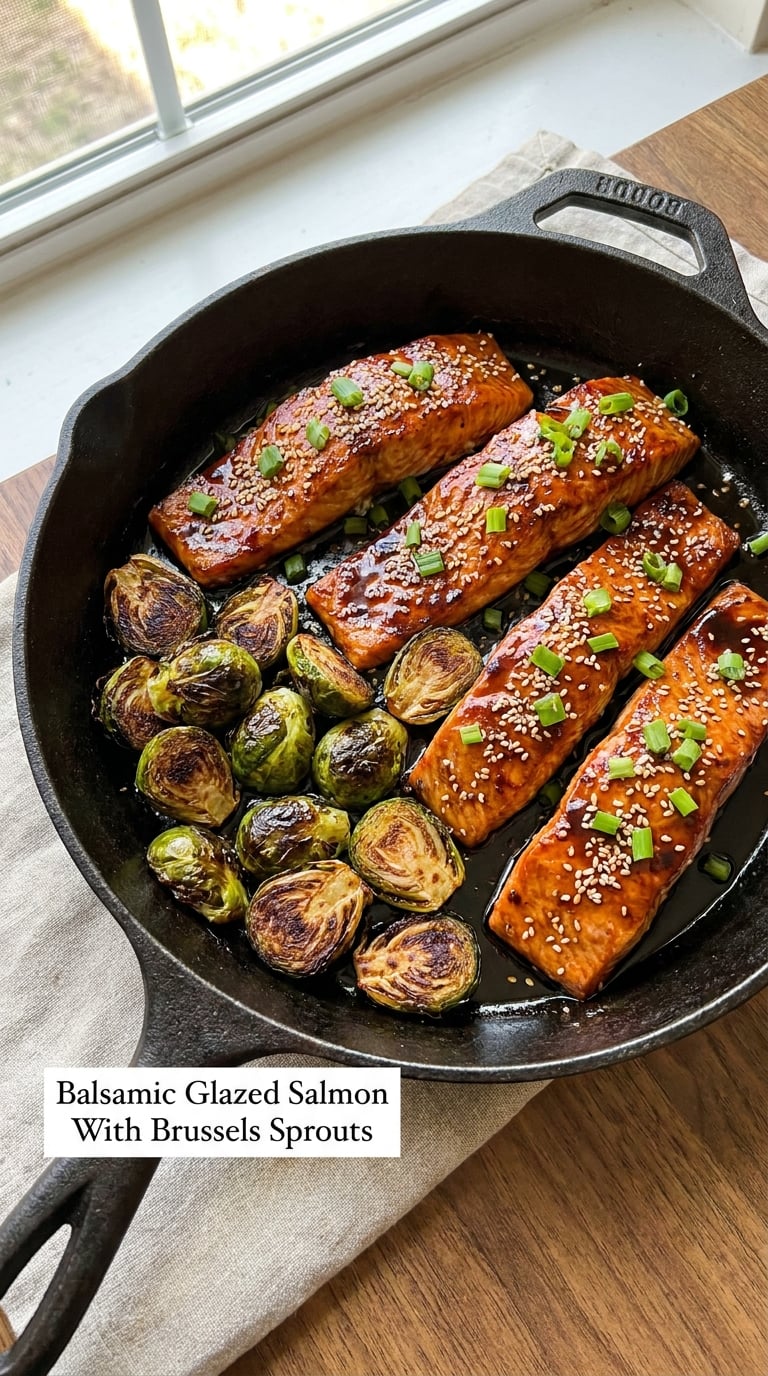
Halving the Brussels sprouts is the whole trick. Flat sides hit the pan, brown hard, and go nutty while the salmon picks up a balsamic reduction that turns glossy and almost sticky on the fish. Roasting the sprouts separately from the fish for the first stretch means nothing steams, which is what ruins most vegetable and salmon pans.
Yield: 4 servings · Prep: 10 min · Cook: 25 min · Total: 35 min · Difficulty: Medium
Ingredients
- 1 pound Brussels sprouts, trimmed and halved lengthwise
- 4 salmon fillets, 5 to 6 ounces each, skin-on
- 3 tablespoons olive oil, divided
- 1/3 cup balsamic vinegar
- 2 tablespoons brown sugar
- 1 tablespoon Dijon mustard
- 2 garlic cloves, minced
- 1/2 teaspoon kosher salt and 1/2 teaspoon black pepper
- 2 tablespoons sesame seeds
- 2 scallions, sliced thin
Instructions
- Heat the oven to 425°F (220°C) and line a large rimmed sheet pan with parchment.
- Simmer the balsamic vinegar, brown sugar, and Dijon in a small saucepan for 5 to 6 minutes until it coats a spoon.
- Toss the Brussels sprouts with 2 tablespoons olive oil, the garlic, salt, and pepper, and spread cut-side down on the pan.
- Roast the sprouts 12 minutes, until the flat sides are deeply browned and the outer leaves are crisp.
- Brush the salmon with olive oil and set it on the pan beside the sprouts, not on top of them.
- Roast 8 to 10 minutes, until the salmon reaches 145°F (63°C) and flakes at the center.
- Brush the salmon generously with the balsamic reduction and return it to the oven for 1 minute to set the glaze.
- Finish with sesame seeds and scallions.
Tip: Keep the fish and the sprouts side by side rather than stacked. The sprouts need dry heat to crisp, and a fillet sitting on top of them steams the cut faces and softens the crust.
Swap it: For a nuttier glaze, add 1 teaspoon of Dijon and swap half the brown sugar for maple syrup. Broccoli or cauliflower florets can replace the sprouts and need only 10 minutes of the first roast.
Storage: Refrigerate for 3 to 4 days. Store the leftover reduction separately and reheat both at 375°F (190°C) for 7 minutes, brushing the fish with the glaze again just before serving.
10. Cajun Salmon With Okra and Corn
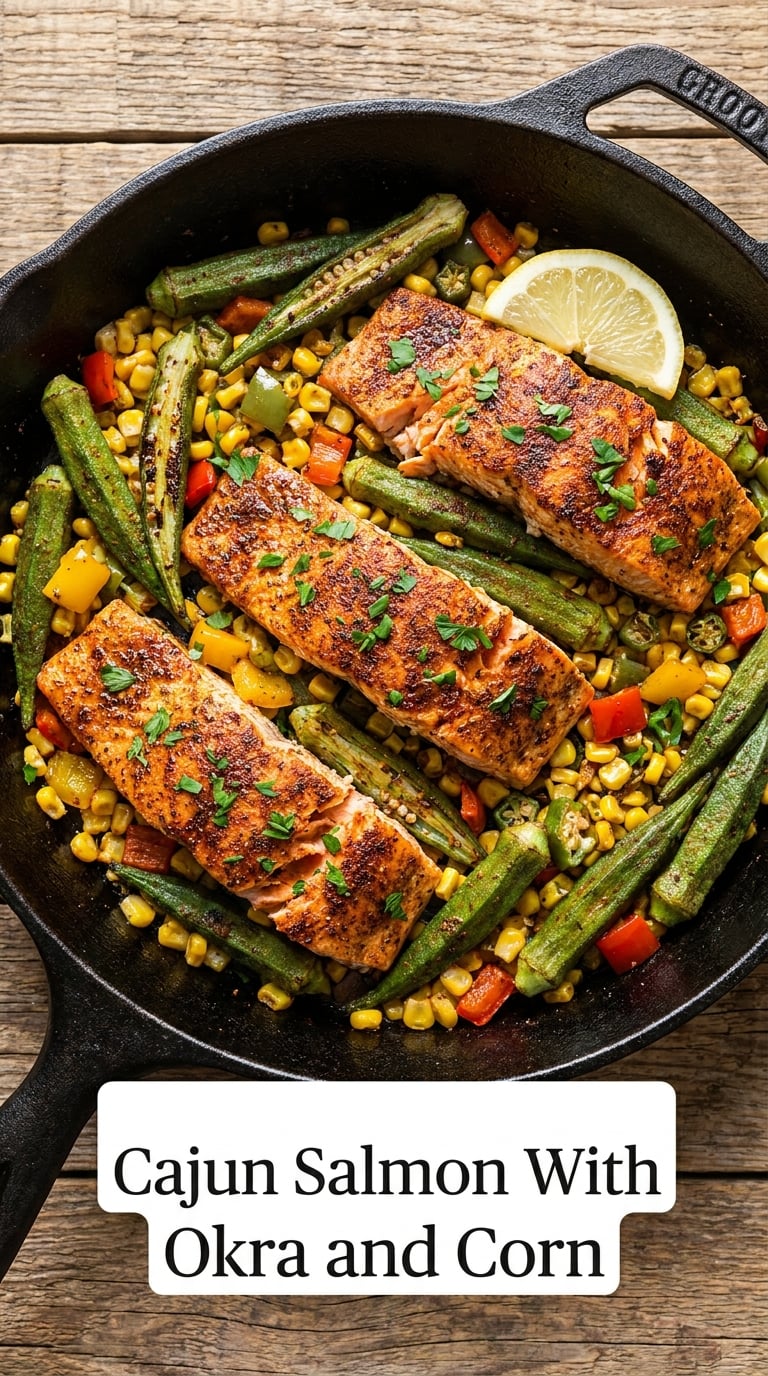
This is the boldest plate in the collection, seasoned like a jambalaya and built on okra, corn, and bell pepper. Okra releases a little moisture as it cooks, so the skillet stays wetter than the others and the salmon needs to go on only after the moisture cooks down. Get that step right and you get a clean, smoky crust instead of a steamed fillet.
Yield: 4 servings · Prep: 10 min · Cook: 20 min · Total: 30 min · Difficulty: Medium
Ingredients
- 4 salmon fillets, 5 to 6 ounces each, skin-on
- 1 tablespoon canola or avocado oil
- 1 tablespoon unsalted butter
- 1 cup frozen okra, thawed, or 4 ounces fresh sliced okra
- 1 ear corn, kernels cut off
- 1 red bell pepper, diced
- 1/2 small onion, diced
- 2 garlic cloves, minced
- 1 tablespoon Cajun seasoning
- 1 teaspoon smoked paprika
- 1/2 teaspoon dried thyme
- 1 tablespoon lemon juice
- 1/4 cup chopped flat-leaf parsley
Instructions
- Pat the salmon dry and press the Cajun seasoning, smoked paprika, thyme, and half the butter into the flesh side.
- Heat a cast iron skillet over medium-high heat and add the canola oil.
- Cook the onion, bell pepper, and corn for 4 minutes until the corn browns and the pepper softens.
- Add the okra and cook 5 to 6 minutes, letting any released liquid reduce until the pan looks dry and the okra looks tacky.
- Stir in the garlic for 30 seconds, then move the vegetables to the outer ring of the skillet.
- Lay the salmon in the center, seasoned side down, and cook 4 minutes without moving it.
- Flip and cook 3 to 4 minutes more, until the center reaches 145°F (63°C).
- Finish with the lemon juice, the remaining butter, and the parsley.
Tip: Let the okra cook down before the salmon goes in. Any liquid still sitting in the pan when the fish arrives will steam instead of sear, and the blackened crust never forms.
Swap it: Zucchini can stand in for the okra and keeps the same timing and still works with the Cajun rub. Going Creole-style, use shrimp and andouille in place of the salmon, which also takes about 4 minutes a side.
Storage: Refrigerate for 3 to 4 days. Reheat in a 350°F (175°C) oven for 8 minutes with a splash of broth, since okra keeps releasing moisture as it warms.
Tips for Making These
- Stop cooking at 140°F, not 145°F. Salmon keeps cooking after it leaves the heat, so pulling it a few degrees below the safe minimum of 145°F (63°C) means it lands there on the plate instead of dry and past it.
- Pick the pan before you pick the recipe. A rimmed sheet pan gives you space and even roasting for four fillets, a 12-inch oven-safe skillet works for the lemon garlic and Cajun recipes, and cast iron is the only option that gives you a real sear or a blackened crust.
- Stagger the vegetables by density, not by list order. Potatoes and other dense vegetables go in first at 425°F (220°C), quick vegetables like asparagus, peppers, and cherry tomatoes join 5 to 7 minutes later, and the salmon goes in last with roughly 7 to 10 minutes to finish.
- Keep one layer and one lane. A crowded sheet pan drops the pan temperature and traps steam, so vegetables soften without browning and salmon never crusts. Use two pans rather than doubling up, and I keep a sheet pan dinner recipe roundup for the other ideas that work that way.
- Dry everything before it touches the pan. Pat the salmon fillets and the vegetables dry with paper towels. Surface moisture is the single biggest reason a pan of salmon steams instead of browns.
- Reheat gently and with liquid. A 300°F (150°C) oven, a splash of broth, and a loose cover keep next-day salmon from turning to rubber. Leftovers keep 3 to 4 days in the fridge, and the glaze or sauce from the original cook is worth saving separately.
Frequently Asked Questions
How do I know when salmon is cooked through in a one-pan dinner?
Push an instant-read thermometer into the thickest part of the fillet, avoiding the bone. Fish is done at 145°F (63°C) internal. Because the pan keeps cooking after the heat goes off, most cooks pull it at 140°F (60°C) and let carryover finish the job. The flesh turns opaque and separates into flakes when pressed gently with a fork.
What vegetables work best with one-pan salmon dinners?
Firm, sturdy vegetables that hold their texture: broccoli, asparagus, Brussels sprouts, zucchini, bell peppers, green beans, corn, and small potatoes. Cut everything to about the same size so it finishes at the same time, and add the fastest vegetables a few minutes after the densest ones. Delicate greens like spinach go in at the very end or wilt in the sauce.
Can I use frozen salmon fillets instead of fresh salmon?
Yes, and for weeknight cooking it often works better than fresh. Thaw overnight in the fridge for the best texture, or run the sealed fillet under cold water for 20 to 30 minutes. Pat it dry before seasoning, since thawed ice leaves moisture on the surface. Frozen fillets do not need any extra cooking time, so follow the recipe times exactly.
How long does one-pan salmon with vegetables take?
Most of these recipes run 24 to 40 minutes from start to finish, including prep. Sheet pan versions with potatoes take the longest at about 40 minutes because the potatoes need a head start. Skillet versions without dense vegetables can be on the table in 25 minutes. If you are short on time, pick honey mustard salmon or chili lime salmon, both of which cook in under 30 minutes.
What is the best pan for cooking salmon and vegetables together?
A rimmed sheet pan for four fillets, because the extra surface area keeps everything in one layer. A 12-inch oven-safe skillet works well for two to three fillets with sturdy vegetables. Cast iron is worth the extra effort for a sear, a blackened crust, or any recipe with a cornstarch-thickened sauce. Avoid nonstick for blackened recipes, since high heat can damage the coating.
How should I store and reheat leftover salmon and vegetables?
Move everything to a shallow sealed container and refrigerate within two hours, keeping cooked fish for no more than 3 to 4 days. Reheat at 300°F (150°C) for 8 to 10 minutes, or warm in a covered skillet over low heat with a splash of broth. A microwave works but dries the fish, so a low oven gives you the better result.
Your Next One Pan Salmon Dinner
Start with the lemon garlic salmon with broccoli and potatoes. It teaches you the timing that every other recipe here uses: dense vegetables first, quick vegetables second, salmon last at 145°F (63°C), and one pan from the first potato to the last dish towel. Get that one comfortable and the other nine are small variations on the same idea.
If you want something sweeter and faster, the honey mustard version is the same week in about half the time. My one-pan skillet dinners roundup and my one-pot soup recipes follow the same logic when you are not in the mood for fish at all.