
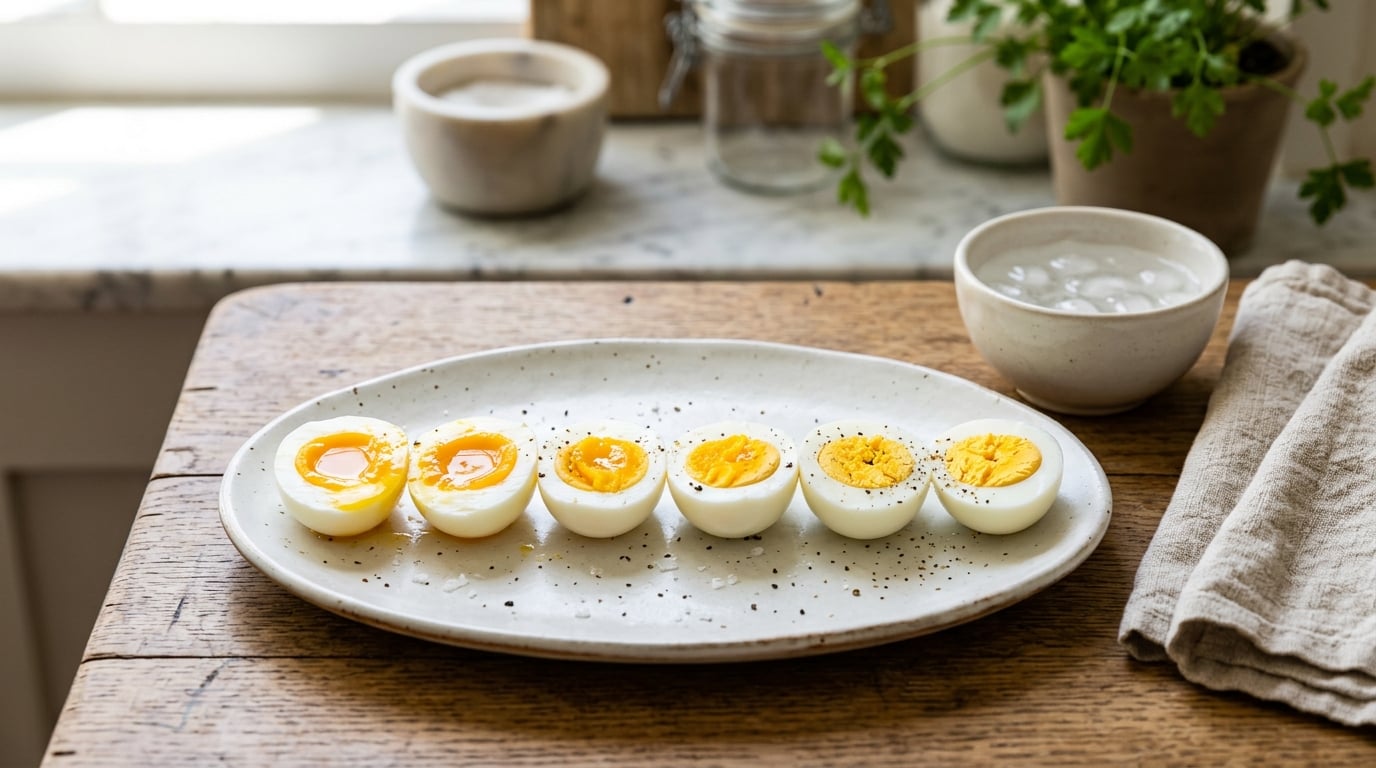
If you are wondering how long to boil eggs for easy peeling, the answer is 10 to 12 minutes. Start the timer the moment fridge-cold large eggs touch already-boiling water, then drop them straight into ice water for 10 minutes before peeling. Cook a little longer and the white grips the shell; cook a little less and the yolk is still soft in the middle, which makes peeling a mess.
That window is for large eggs, roughly 50 to 55 grams, straight from the fridge, lowered gently into a rolling boil. Everything in this guide builds on those conditions, and I will give you the adjustments for bigger eggs, room-temperature eggs, high altitude and batch cooking once the basics are clear.
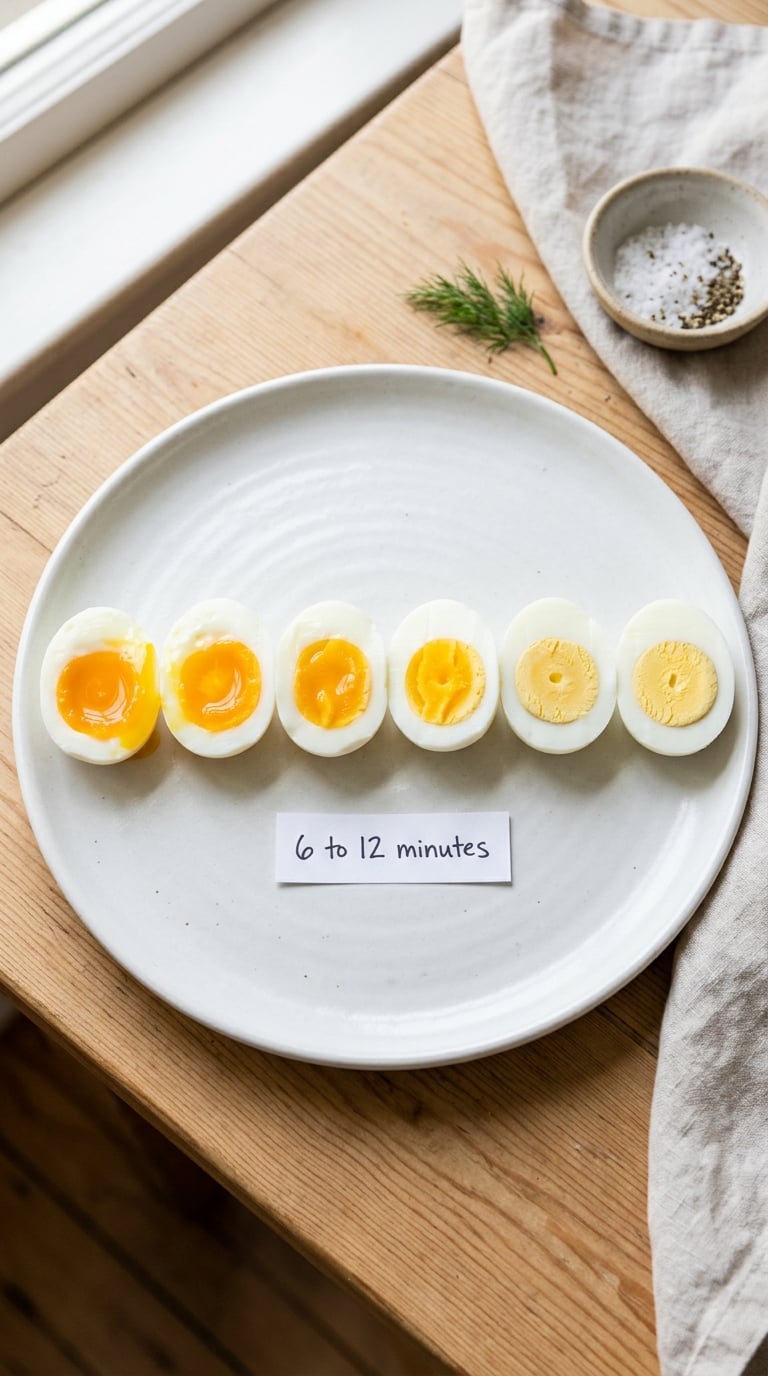
The reason timing matters so much for peeling is simple. Heat makes the cooked white shrink slightly away from the inner shell membrane, and cooling drops the pressure inside the egg. That gap is what lets water slip between shell and white. Cook too long and the white sets hard against the shell instead of pulling away. Cook too short and there is not much gap at all.
Once you have the timing down, you can put the boiled eggs straight to work. My hard boiled eggs easy guide covers the serving side, and air fryer hard boiled eggs is worth a look if you want to skip the pot entirely.
Table of Contents
How Long to Boil Eggs for Easy Peeling: Quick Timing Guide
The table below is the whole answer to how long to boil eggs for easy peeling. Every time assumes large fridge-cold eggs lowered into water that is already at a rolling boil, with the timer started at egg-drop.
| Minutes | Yolk texture | White | How it peels |
|---|---|---|---|
| 6 minutes | Runny, still liquid in the centre | Just set | Peels easily, but tears if handled roughly |
| 7 to 8 minutes | Soft and jammy, thick but not firm | Set | Very easy peel, the shell slips off in sheets |
| 9 to 10 minutes | Moist and creamy, no gloss | Firm | Easy peel, best all-round texture |
| 11 to 12 minutes | Fully set and chalky | Rubbery if pushed further | Easiest hard-boiled peel of all |
| 15 minutes or more | Dry, crumbly, dull | Tough and rubbery | Shell bonds to the white, often tears |
For hard-boiled eggs you plan to slice for sandwiches or deviled eggs, 11 to 12 minutes is where peeling is easiest. For soft-boiled eggs served on toast, 7 to 8 minutes is the sweet spot and peels just as cleanly.
How to adjust the time for egg size, temperature and altitude
Egg size changes the timing more than anything else, and most home cartons are full of mixed sizes anyway. Sort your eggs by weight before they go in if you want every one of them to land at the same stage.
| Variable | Adjustment |
|---|---|
| Extra large egg, about 60 grams | Add 30 to 60 seconds |
| Jumbo egg, about 65 grams | Add 1 to 2 minutes |
| Room temperature instead of fridge-cold | Subtract about 30 seconds |
| High altitude, roughly 1,000 feet above sea level | Add 1 minute |
| Unwashed farm or UK eggs with an intact bloom | Add about 1 minute and expect a slightly firmer white |
Water boils at a lower temperature up in the mountains, so eggs need longer to reach the same doneness. A reader cooking near 5,900 feet reported adding six minutes to the usual timing, which is more conservative than the one-minute-per-1,000-feet rule but gets the job done.
What Boiling Time Gives the Texture You Want?
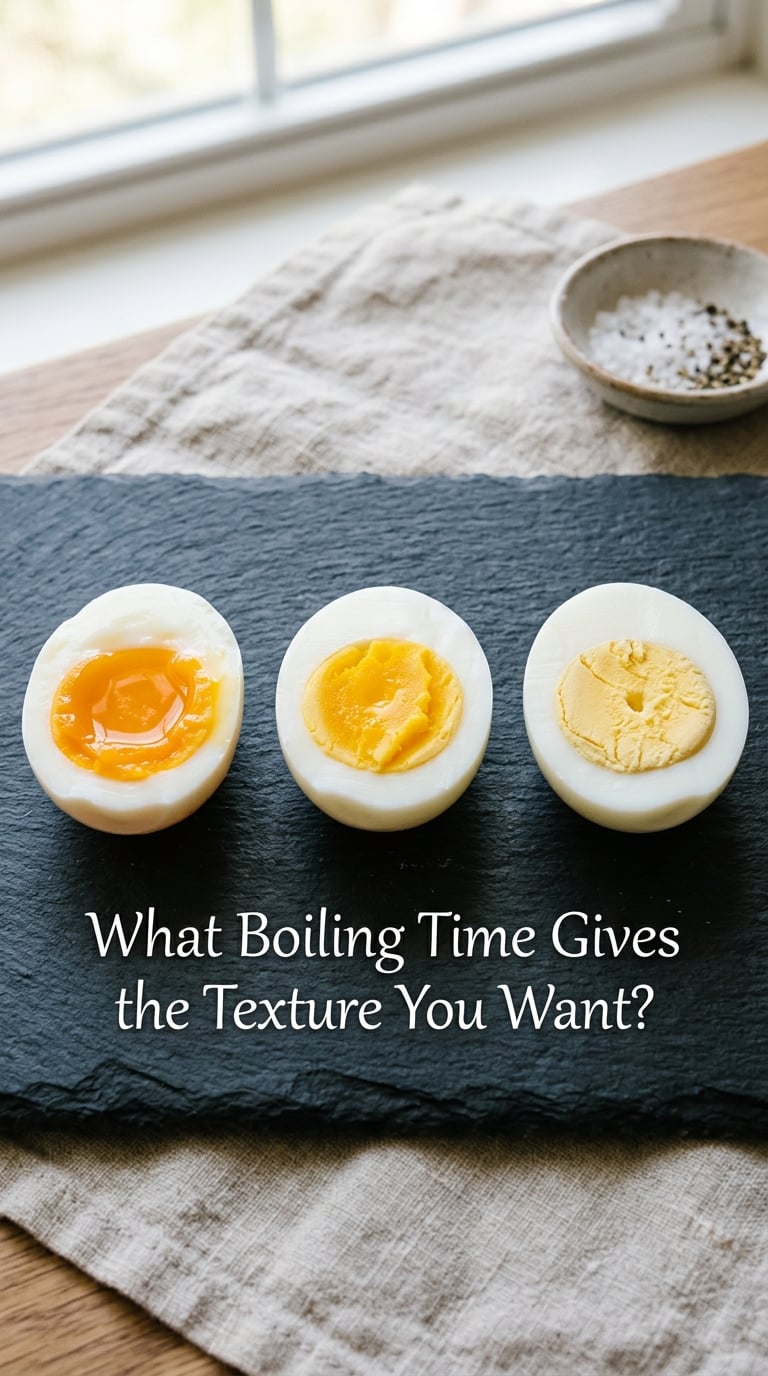
The word “boiled” covers three very different textures, and each one suits a different job. Pick the stage first, then worry about the clock.
Soft-boiled eggs: 6 to 8 minutes
At 6 minutes the yolk is still liquid enough to run across the plate when you cut it. By 8 minutes it has thickened into something jammy and scoopable. The white is fully set but still tender, which is why these peel more cleanly than hard-boiled eggs.
Soft-boiled eggs are for dipping into toast soldiers, topping with flaky salt, or serving alongside a bowl of soup. If you are making ramen eggs or ajitama, cook to 7 minutes, then marinate in the fridge overnight.
Medium-boiled eggs: 9 to 10 minutes
This is the sweet spot for most cooking. The yolk is moist and creamy with no glossy sheen, and the white has enough structure to hold a slice together without feeling bouncy.
Medium-boiled eggs work for egg salad sandwiches, chopped into Caesar salad, or eaten cold with a little butter and salt. They also make a good compromise when you are feeding people with different preferences, because the texture reads as neither raw nor overdone.
Hard-boiled eggs: 11 to 12 minutes
Fully set means the yolk has lost all of its gloss and looks matte and chalky when you cut it. Twelve minutes is the reliable ceiling. Push past it and the white gets tough, a grey-green ring forms around the yolk, and the shell starts bonding to the surface.
Hard-boiled eggs are the ones for deviled eggs, chopped into a weeknight egg and potato skillet, or packed into lunchboxes. If you want to cook them in advance, this stage travels best.
How to Boil Eggs So They Peel Easily
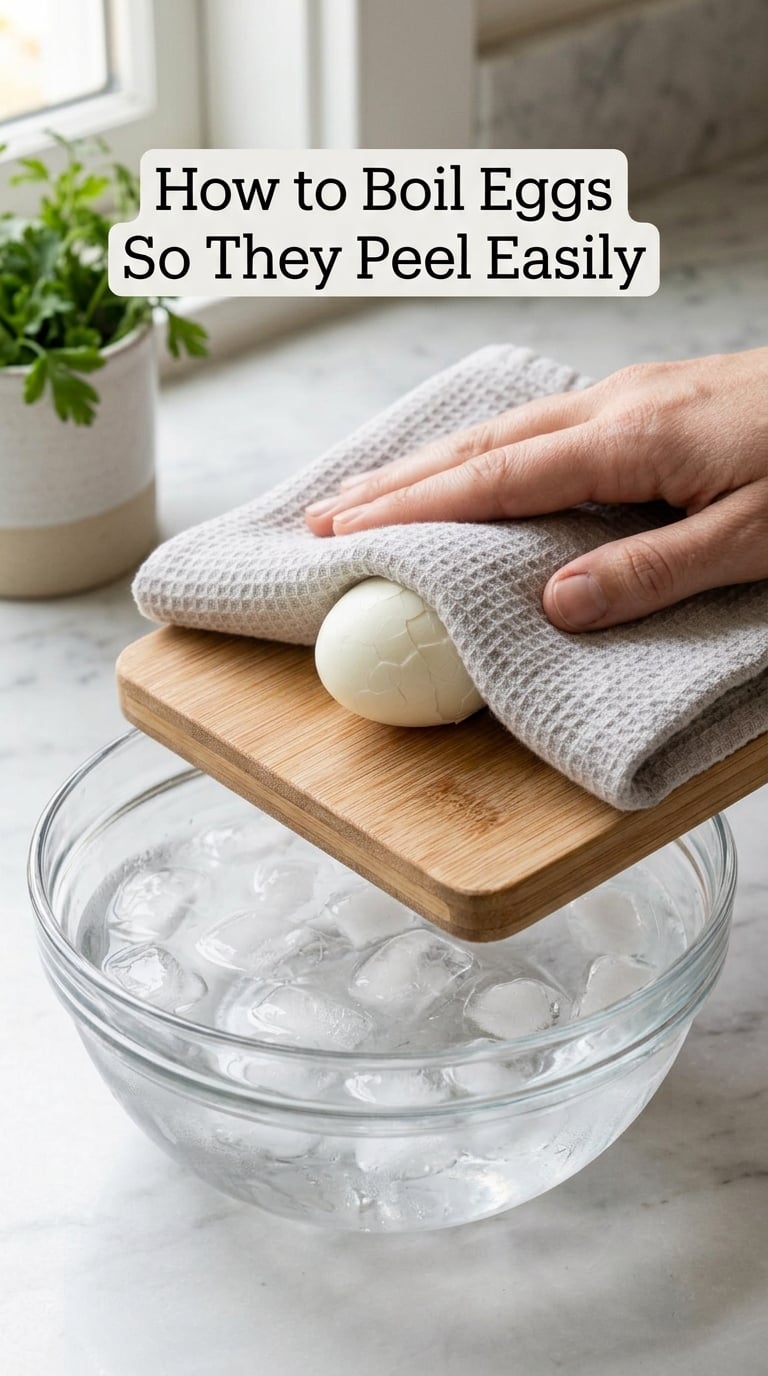
This is the method I use, and it is the one that fixes the two problems people hit most: shells that tear the white and eggs that come out rubbery. Timing starts at egg-drop, not at the boil.
The six-step method
- Bring the water to a full boil first. Use a saucepan with enough water that the eggs sit in a single layer and still have an inch to spare above them.
- Lower the eggs in gently. Take them straight from the fridge and use a slotted spoon so nothing hits the side of the pot. A hard drop in violent water is what causes cracks.
- Start the timer now. Leave the water at a rolling boil for large eggs. If it drops to a lazy simmer, turn the heat up so the cooking temperature stays consistent.
- Cook for the time from the table above. Large fridge-cold eggs need 11 to 12 minutes for a firm set. Do not go past 12 for a fully cooked yolk.
- Move the eggs into ice water for 10 minutes. Cold tap water works fine if you have not got ice, but ice water cools them faster and stops the cooking. Refrigerate within two hours either way.
- Peel under cold water. Tap the egg all over on the counter, roll it firmly under a folded kitchen towel until the shell is covered in fine cracks, then drop it into a bowl of cold water and peel from the wide end.
Peeling methods ranked by how much white you lose
These are the techniques home cooks actually use, and what happens with each one. Food & Wine’s test kitchen ran a scored comparison of six methods and found that rolling first, then peeling in a bowl of water, outperformed everything else.
| Method | How it goes |
|---|---|
| Rolling under a kitchen towel, then peeling in a bowl of water | The micro cracks let water in and the shell lifts in whole pieces |
| Peeling in a bowl of cold water | Reliable on its own, even better combined with the towel roll |
| Peeling under cold running water | Works well, though it washes away any seasoning you plan to add later |
| Rolling hard on the counter, then peeling | Effective, but a little rougher on the white |
| Shaking in a mason jar | Popular with families cooking for kids, but inconsistent and easy to overdo |
| Peeling with the back of a spoon | The viral hack, and the worst performer in published tests. Skip it. |
Start at the wide end, where the air cell sits, and work toward the pointy end. The membrane under the shell is what usually grabs, so pull the shell off in as few large pieces as you can rather than picking at it in flakes.
If your eggs are fresh from the farm
Very fresh eggs are the hardest case, and there is no technique that fully fixes them. The membrane inside is still tightly bonded to the shell, so it takes a piece of white with it no matter how carefully you work.
Two things help. Steaming instead of boiling for 12 to 13 minutes gives a slightly looser bond, and letting eggs sit in the fridge for at least a week before cooking relaxes the bond naturally. If you only have fresh eggs, roll them in the towel harder than feels necessary and accept some white loss.
Should You Add Baking Soda or Vinegar?
Baking soda helps a little, vinegar does almost nothing for peeling, and salt is mostly superstition. Here is what each one actually does to the egg.
| Additive | What it does | Worth it? |
|---|---|---|
| Baking soda, 1 teaspoon | Raises the pH of the water and loosens the albumen so the cooked white does not grip the membrane as tightly | Yes, if your eggs peel badly. Add a teaspoon to the boiling water. |
| Vinegar, 1 teaspoon | Does very little to the shell. It is often added so that if an egg cracks, the white coagulates faster in the pot | Only for preventing a cracked egg from losing its contents |
| Salt, 1 tablespoon | Seasoning mostly. It may raise the boiling point slightly and affect the texture of the white | Optional. It does not make peeling easier. |
| Nothing | The default, and the right choice when your eggs are a week or two old | Yes |
The reason baking soda works comes down to pH. Egg albumen is close to neutral when raw. Alkaline water loosens the proteins that bond to the inner membrane, and the cooked white contracts away from the shell a little further. A teaspoon is plenty, and more can give the white a slightly rubbery, soapy texture.
You will also see advice about piercing the blunt end with a pin so the expanding air cell does not burst the shell. It works in theory, but a hole made too large turns into a crack and the egg blows up in the pot anyway. A gentle lowering with a slotted spoon solves the same problem without the risk.
Why Are My Eggs Hard to Peel?
When an egg tears, the cause is almost always one of four things. Work through them in order, because the first one explains most of the bad eggs.
| Cause | What you see | Fix |
|---|---|---|
| The eggs are very fresh | Chunks of white come away with the shell every time | Use eggs at least a week old, or steam them for 12 minutes |
| Cooked too long | The white grips and the yolk has a grey-green ring | Cut back to 11 to 12 minutes for large eggs |
| Peeled while still hot | The shell sticks and the white tears in strips | Cool for a full 10 minutes in ice or cold water first |
| Eggs hit hard water | Hairline cracks, or a white that leaked into the pot | Lower them with a slotted spoon and never drop them from height |
There is also the size problem within a single carton. Two eggs from the same box can be a full minute apart on doneness, which is why one peels perfectly and its neighbour does not. Sorting by size before cooking is the boring fix that works every time.
Common Egg-Boiling Mistakes and Fixes
These are the mistakes I see most often, including one I made for years. Each one has a simple correction.
- Starting the timer too early. If you start counting when the water boils, every egg is overcooked. Start the timer when the eggs go in.
- Crowding the pot. Eggs stacked on top of each other cook unevenly and are hard to fish out. Use a single layer with space between them, or two pans.
- Skipping the cool-down. Peeling a warm egg means fighting the membrane. Ten minutes in ice water is not optional.
- Going straight from the fridge to a lower simmer and never raising the heat. If the water never returns to a boil, add two minutes to the timing.
- Testing doneness with a knife. Cutting into a soft-boiled egg to check tells you nothing useful and wastes the yolk. Trust the timer and cut once at the end.
- Cooking eggs from the fridge in cold water. It works, but the timing is a rough estimate and results vary more from egg to egg. Boil first is more predictable.
- Leaving cooked eggs on the counter. Refrigerate within two hours. Cooked eggs keep 3 to 4 days in the fridge in their shell, and eggs are a major allergen, so store them sealed and labelled if anyone in the house reacts.
Frequently Asked Questions
What is the best boiling time for easy-to-peel hard-boiled eggs?
Boil large fridge-cold eggs for 11 to 12 minutes, starting the timer when they touch already-boiling water. That is the point where the white has set and pulled away from the membrane, so the shell comes off in pieces. Cool for 10 minutes in ice water before peeling. Add 30 to 60 seconds for extra large eggs and about a minute for jumbo ones.
Should boiled eggs be placed in ice water before peeling?
Yes, and ten minutes is the target. The shock stops the cooking, drops the pressure inside the egg, and leaves a gap between the white and the shell membrane that makes peeling quick. Cold tap water works if you have no ice, but cooling is slower. Either way, refrigerate the eggs within two hours and use them within three to four days.
Do eggs peel better when they are older or freshly laid?
Older eggs peel far better. The inner membrane is loosely bonded to the shell in an egg that has sat in the fridge for a week or more, and it tightens again as the egg ages toward fresh. This is the single most repeated tip across home cooking forums. Fresh farm eggs are the hardest case, so steam them for 12 minutes and expect to lose a little white.
How do I peel an egg without breaking the white?
Cool the egg fully first, then tap it all over the counter and roll it firmly under a folded kitchen towel until the shell is covered in fine cracks. Put it in a bowl of cold water and peel from the wide end, pulling off large pieces rather than picking at flakes. Peeling from the pointy end is where the white usually tears.
Does baking soda really make hard-boiled eggs easier to peel?
Yes. A teaspoon of baking soda raises the pH of the cooking water, which loosens the cooked white from the inner membrane so the shell releases more easily. Use no more than a teaspoon, since a stronger alkaline solution can give the white a rubbery texture. Vinegar does not help peeling at all, though a spoonful can stop a cracked egg losing its contents.
How long can boiled eggs be stored in the refrigerator?
Hard-boiled eggs keep for three to four days in the fridge, still in their shell. Leave them in the carton or a sealed container so they do not absorb kitchen smells, and refrigerate within two hours of cooking. Peel only the eggs you are about to eat, because a peeled exposed white dries out and picks up flavours much faster.
Easy Peeling Starts with the Right Timing
Start with the timing table at the top. For hard-boiled eggs you want to slice, cook large fridge-cold eggs for 11 to 12 minutes in water that is already boiling, and start the timer at egg-drop. Cool them for ten minutes, then roll each egg under a kitchen towel and peel it in a bowl of cold water.
If you are still struggling, change one thing at a time. Age of the egg is usually the culprit, followed by cooking past 12 minutes. Getting how long to boil eggs for easy peeling right is a ten-minute job once you stop guessing.