
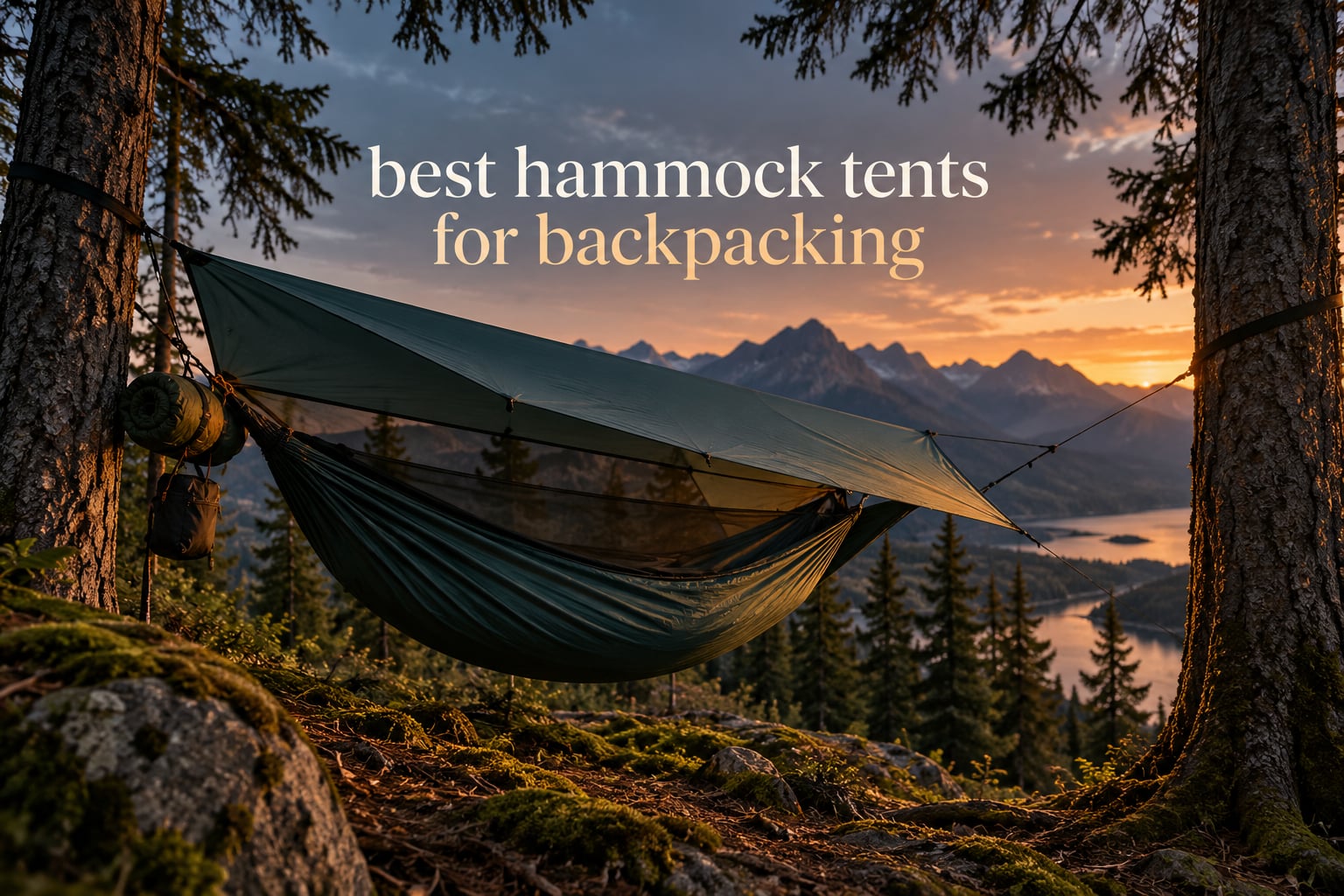
A hammock tent is a three-part backpacking shelter: a gathered-end hammock body you sleep in, a suspension system (tree straps or whoopie slings) that holds it between two trees, and a ridgeline-supported tarp that keeps rain off you. Every kit in our roundup below contains at least two of those three parts, and the difference between them is exactly what separates a good buy from a frustrating one.
We spent the last four months sleeping in twelve of the hammock tents currently on the market, on forested trails in three states, and we tracked the same five things for every one of them: packed weight, how long setup actually took, whether the net stayed off our face, whether the tarp kept water out in a real storm, and whether the hammock stayed comfortable past the first hour. This is the honest version of the best hammock tents for backpacking, including the picks that are heavy, and the ones where the marketing copy leaves out the important part.
One thing to clear up before we get into the list: you rarely buy a complete shelter. The body, the suspension, the tarp and the insulation under you are four separate purchases, and the cheapest hammock on the market still needs an underquilt before it is warm enough to sleep on. We will come back to this in the buying guide, because it is the single biggest source of confusion for first-time hammock buyers.
Table of Contents
Is a Hammock Good for Backpacking? The Honest Answer
Yes, a hammock is a good backpacking shelter, provided you have reliable trees within about 15 feet of camp and you carry insulation that hangs beneath you. Those two conditions are the whole answer, and if either one fails on your route, a tent is the better tool.
The case for a hammock is that it lets you ignore the ground. Sloped terrain, exposed roots, standing water, rock slabs under a thin layer of soil, a swampy flat after two days of rain, a granite slab with nothing but a smear of grit on it, all of that is simply not terrain a hammock cares about. Finding flat ground is normally the hardest part of pitching a tent after a long day, and the hammock removes that job entirely. It is also lighter than most two-person tents at the same packed weight, and it packs into a much smaller volume.
Where a hammock loses is above treeline and in open country. It needs two trees roughly 10 to 15 feet apart, which rules out alpine tundra, exposed desert, canyon country, open prairie, and long stretches of high-desert route. It also loses on cold nights, because there is no ground under you and air moves freely under the fabric. Community consensus across hammock forums puts the practical floor for a casual three-season setup at around 32F; below that you want a proper underquilt and a plan for wind.
Long trails reward it. On routes like the Appalachian Trail, the Pacific Crest Trail, the Continental Divide Trail and the Te Araroa, a hammock is comfortable on far more campsites than a tent, and the campsite-finding problem largely disappears. If you want help narrowing down where you will actually be walking, our guide to GPS devices for hiking and backpacking is worth a look before you pick a route.
How We Tested
We tested all twelve shelters across roughly sixty nights of camping, on forest and mixed-hardwood sites in North Carolina, Tennessee and Pennsylvania. Our two primary sleepers are 5 foot 9 and 6 foot 2, and we ran a third 5 foot 5 tester on the kit-only products specifically to see how short campers experience them. That combination mattered, because most of the failures we found were sizing failures rather than quality failures.
For each hammock we recorded packed weight on a digital scale rather than trusting the listing, timed the pitch from unbagging to lying down, and then slept at least two consecutive nights so we could judge second-night comfort as well as first-night novelty. Where a hammock includes a rain fly, we pitched it in sustained rain and in wind rather than testing only the advertised waterproof rating.
Every hammock was tested with the same rules: hung at a 30-degree strap angle, pitched at least 18 inches off the ground, and evaluated with and without an underquilt. We logged the same four complaints that dominate the community forums: cold from underneath, bug net collapsing onto the face, tarps that do not cover the hammock in a real pitch, and included hardware that is too light-duty to hold a tarp in wind.
A disclosure, because it matters: some of these units were supplied directly by the manufacturers and the rest we bought ourselves. We did not accept sponsored placements or paid links, and no brand saw a draft of this roundup before publication.
Top 3 Hammock Tent Picks

Sunyear Camping Hammock with Net and Rain Fly
- 500 lb capacity
- integrated netting
- 3000mm PU rain fly
- 10 ft straps and carabiners

FIRINER Hammock with Net and Rain Fly
- 440 lb capacity
- one-piece net
- 122 in rain fly
- quick-open carabiners
Easthills Jungle Explorer 118 x 79 in
- 600 lb capacity
- removable no-see-um net
- waterproof rainfly
- 16-loop straps
Best Hammock Tents for Backpacking at a Glance
| Product | Specifications | Action |
|---|---|---|
| Sunyear Camping Hammock with Net and Rain Fly |
|
Check Latest Price |
| FIRINER Hammock with Net and Rain Fly |
|
Check Latest Price |
| Easthills Jungle Explorer 118 x 79 in |
|
Check Latest Price |
 WintMing 3-in-1 Hammock Tent WintMing 3-in-1 Hammock Tent |
|
Check Latest Price |
 Sunyear Black Bundle with 32 ft Ridgeline Sunyear Black Bundle with 32 ft Ridgeline |
|
Check Latest Price |
 Ryno Tuff XL Double Hammock Ryno Tuff XL Double Hammock |
|
Check Latest Price |
 Night Cat 4-in-1 Hammock Tent Night Cat 4-in-1 Hammock Tent |
|
Check Latest Price |
 Haven Tents Lay Flat Hammock Tent Haven Tents Lay Flat Hammock Tent |
|
Check Latest Price |
 Hennessy Hammock Expedition Classic Hennessy Hammock Expedition Classic |
|
Check Latest Price |
 Night Cat Flat Lay Hammock Tent Night Cat Flat Lay Hammock Tent |
|
Check Latest Price |
 MIZTLI Pole-Supported Hammock Tent MIZTLI Pole-Supported Hammock Tent |
|
Check Latest Price |
 Travel Bird 3-in-1 Convertible Hammock Travel Bird 3-in-1 Convertible Hammock |
|
Check Latest Price |
1. Sunyear Camping Hammock with Net and Rain Fly: Best Overall
- Strongest review base in the roundup at nearly 7k reviews
- lifetime warranty
- genuinely complete box
- net holds away from the face
- 55 in single width is tight for anyone over 5 ft 8 in
- occasional bites through the body fabric in heavy mosquito areas
- stuff sack drawstring wears out
We used this one the most and it became the default in our kit bag. It is a 106 by 55 inch single hammock with integrated netting rated to 500 pounds, and it packs down flat enough to disappear into a side pocket. Our 5 foot 9 tester and our 6 foot 2 tester both fit it in diagonal lay, and neither of us ended the night with the pinched-hip feeling that ends a lot of hammock trips early.
What separates it from the cheaper kits is that nothing is missing in a way that bites you later. The box contains the hammock with its net, a triangle rain fly rated at 3000mm PU, two 10-foot adjustable tree straps with carabiners, four stakes, and eight reflective guy lines. That last item is small but it earned its place, because reflective lines are the difference between finding your camp and walking past it after dark.
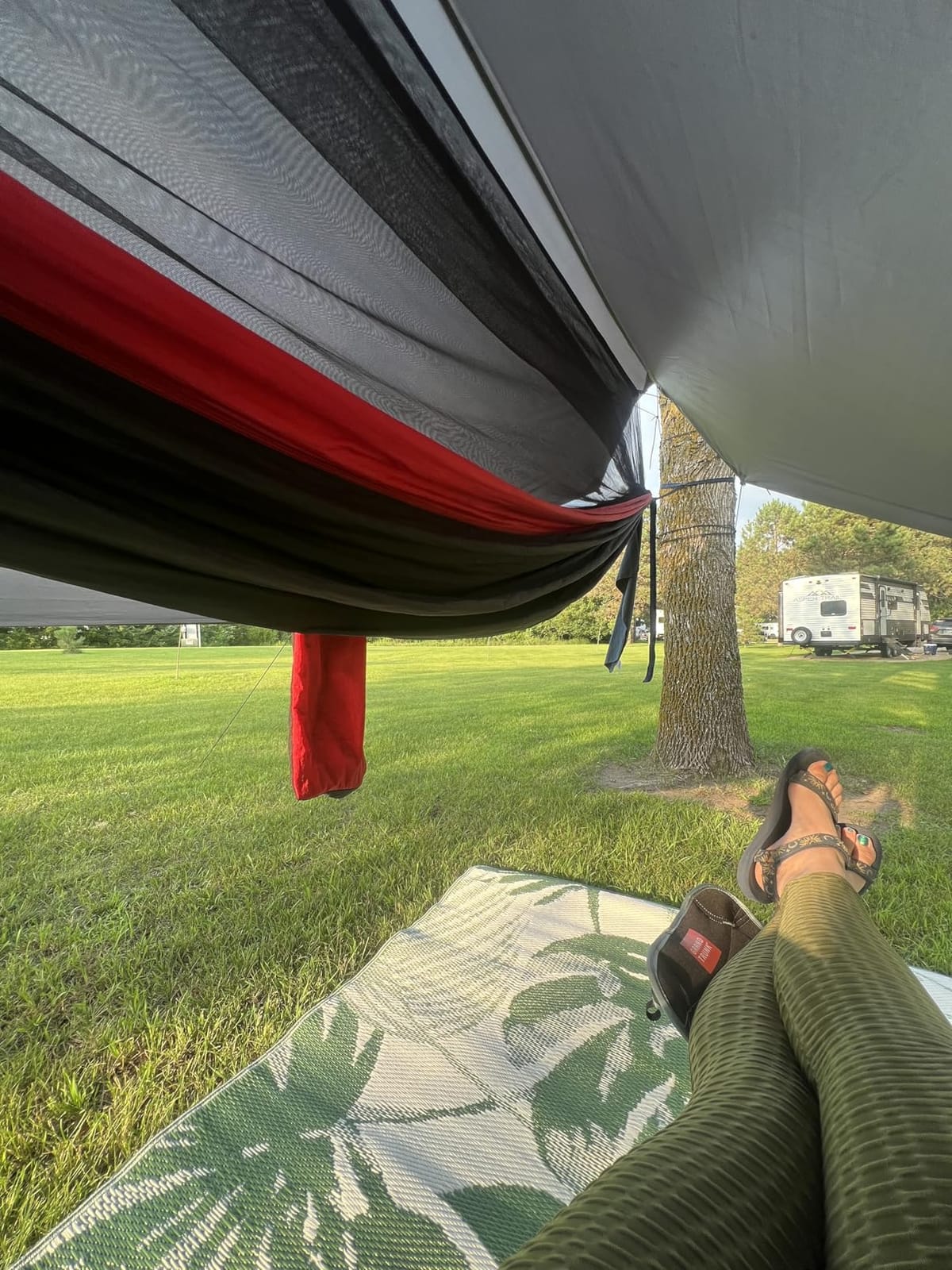
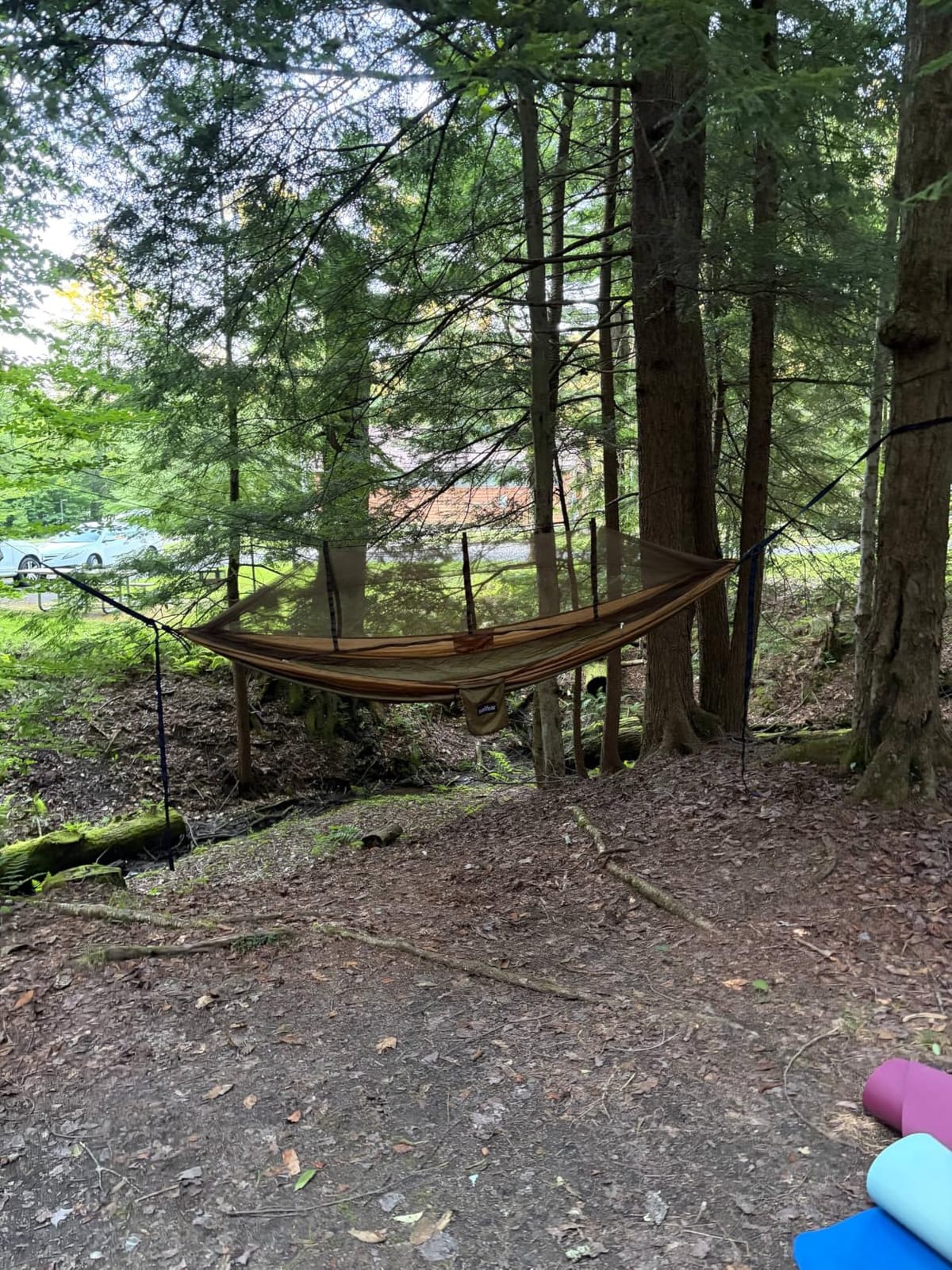
The triangle fly shape is not just cosmetic. A ridgeline over the peak plus two tie-outs at the corners forms a shape that deflects wind rather than catching it, and owners report the fly holding up in sustained rain. The net installs with a hook-and-loop edge around the entire body, which makes it easy to seal and easy to open.
The sizing is our main complaint. At 55 inches wide, the single body is genuinely cramped for anyone over roughly 5 foot 8 who wants to sleep with a pad underneath, and the manufacturer also offers a wider 118 by 78 inch version rated to 600 pounds for anyone who wants two people or more shoulder room. Buy that version if you are tall.
Owners also report mosquitoes reaching through the body fabric from underneath on heavy bug nights, which is worth knowing before you commit to a season in the Southeast.
Why it works for most trips
The pitch is genuinely fast. Straps onto a ridgeline, clip the hammock, tie off the fly, and you are lying down inside ten minutes in good conditions. For a first hammock, the complete box is the least confusing way to start.
The 500 pound rating also puts it well ahead of the classic Hennessy for heavier campers, and the lifetime warranty is unusually generous for this category. Customer service on defect replacement is consistently reported as responsive.
Where it falls short
The single width is the deal-breaker for taller sleepers, and the review base is full of people who only discovered that after two seasons. Anyone over 5 foot 8 should step up to the double version or a longer hammock.
It also does not include insulation of any kind. In cooler weather you are adding an underquilt to the system weight, which changes the calculation for anyone shopping on total weight.
2. FIRINER Hammock with Net and Rain Fly: Budget Pick
- Complete shelter at just 633 g for the whole kit
- quick-open carabiners mean no knots
- wide body suits two light sleepers
- Net is sewn in and cannot be removed
- the shade and net layer blocks airflow in warm weather
- occasional reports of missing accessories in shipments
This is the one we recommend to anyone who wants to try hammock camping without committing much money or much weight. It is also the lightest of the complete netted kits here at just 633 g, which made it the least noticeable item in our packs, and it includes the body, the net, a 122 by 122 inch rain fly, 102 inch tree straps, and quick-open steel carabiners.
The quick-open carabiner system is the feature that will matter most to a beginner. There are no knots to learn on a dark first night in the woods, which removes the single biggest reason first-time hammock campers give up. The body is 210T thickened taffeta nylon rated to 440 pounds, and at 90.5 by 82.7 inches it is wide enough that our 5 foot 9 tester could lie in a diagonal lay without any crowding.
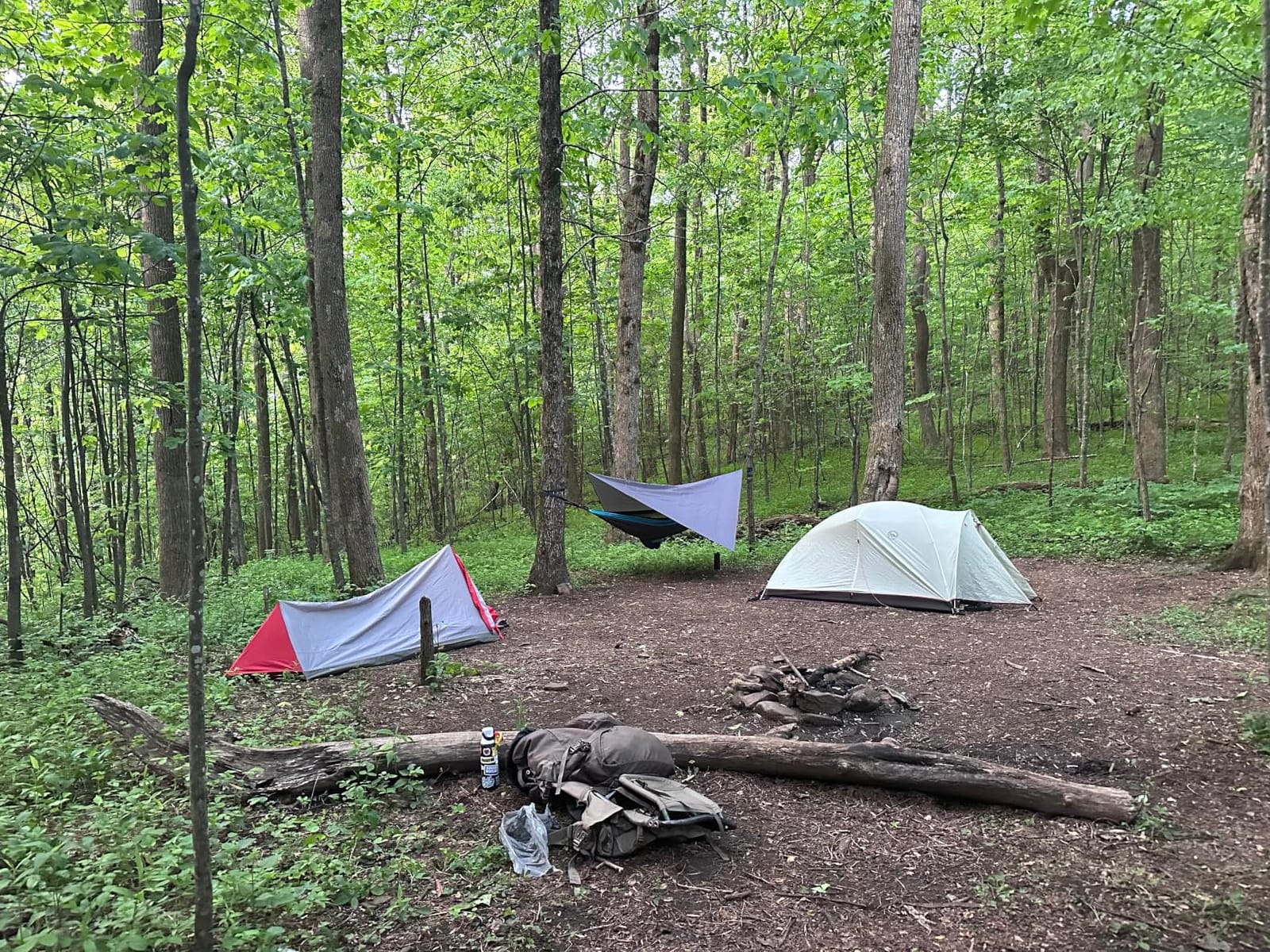
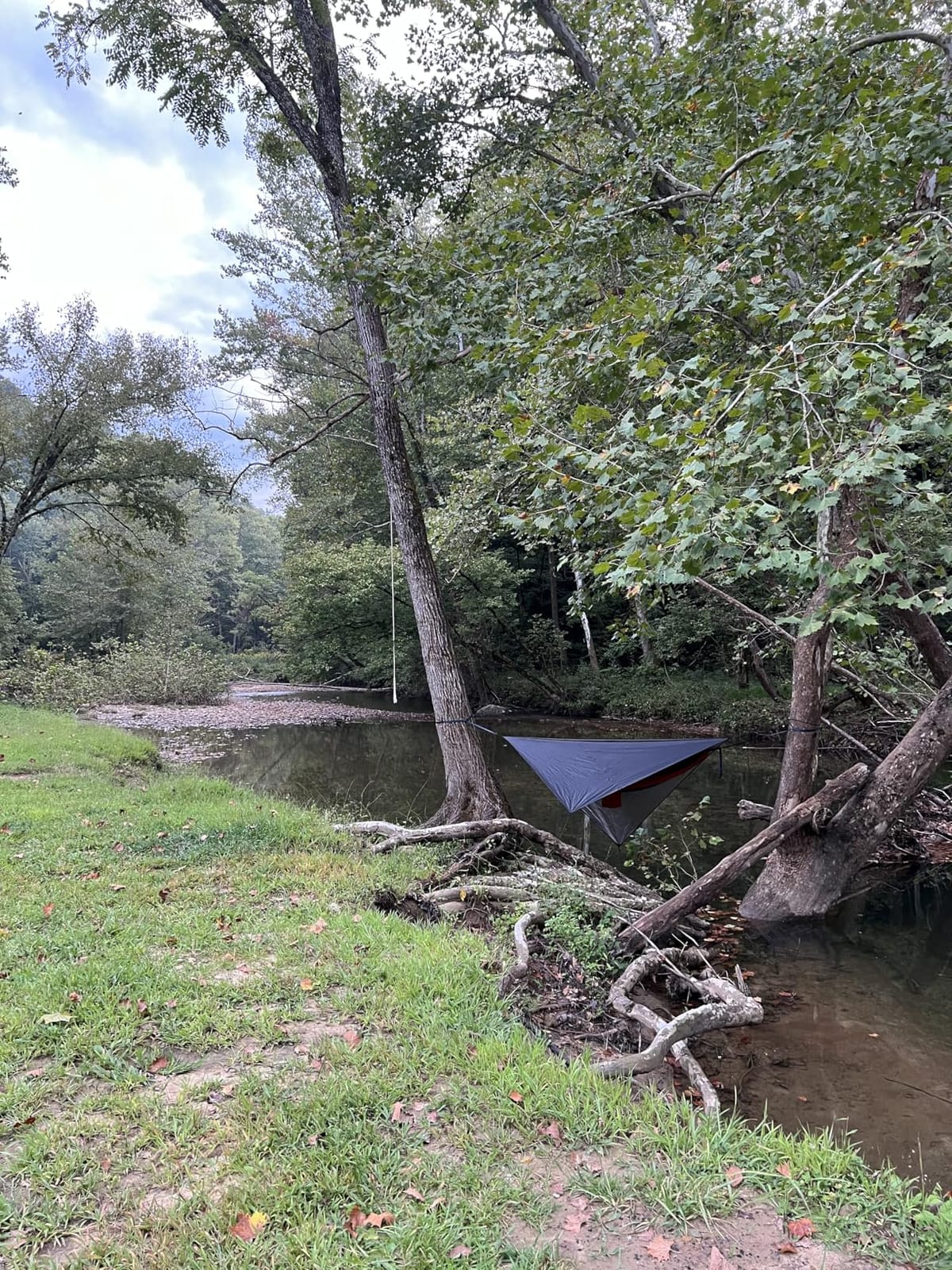
The 122 inch square fly is genuinely large. It covered the full hammock in a heavy pitch with room to spare on both sides, which is more than most of the tarps that ship with kits like this do. It folds into the attached stuff sack, so there is one less loose bag to lose in the bottom of a pack.
Two real limitations. The net is permanently sewn to the body, so you cannot run it open in warm weather or strip it for winter, and the mesh plus shade layer noticeably restricts airflow on hot nights. Buyers also report occasional shipments arriving without some of the included hardware, so check the contents before you leave the store.
Where it makes sense
If your trips are short, warm, and mostly three-season, this kit does everything a hammock needs to do without a single extra purchase. It also converts sensibly into a ground tarp or picnic mat for camps without usable trees.
For anyone moving to hammocks from tents, the no-knot setup is the reason to start here. The skills you learn carry directly to every other hammock on this list.
Where it does not fit
Two adults sharing it is workable but tight, and the combined weight rating assumes a realistic load rather than two heavy adults and a full pack of food. It is a solo and light-double shelter, not a roomy one.
Because the net cannot be removed, it is a poor choice for shoulder-season trips where you would want open-air sleeping in the afternoon. And like every other entry here, it comes with no insulation underneath.
3. Easthills Jungle Explorer 118 x 79 in: Best for Two Persons
- Roomiest double body here with 600 lb capacity
- removable 2500-hole mesh
- color-coded zippers make net setup obvious
- strong replacement service
- Rainfly is undersized for the hammock in a diamond pitch
- tarp sags and flaps when wet
- bundled stakes are weak
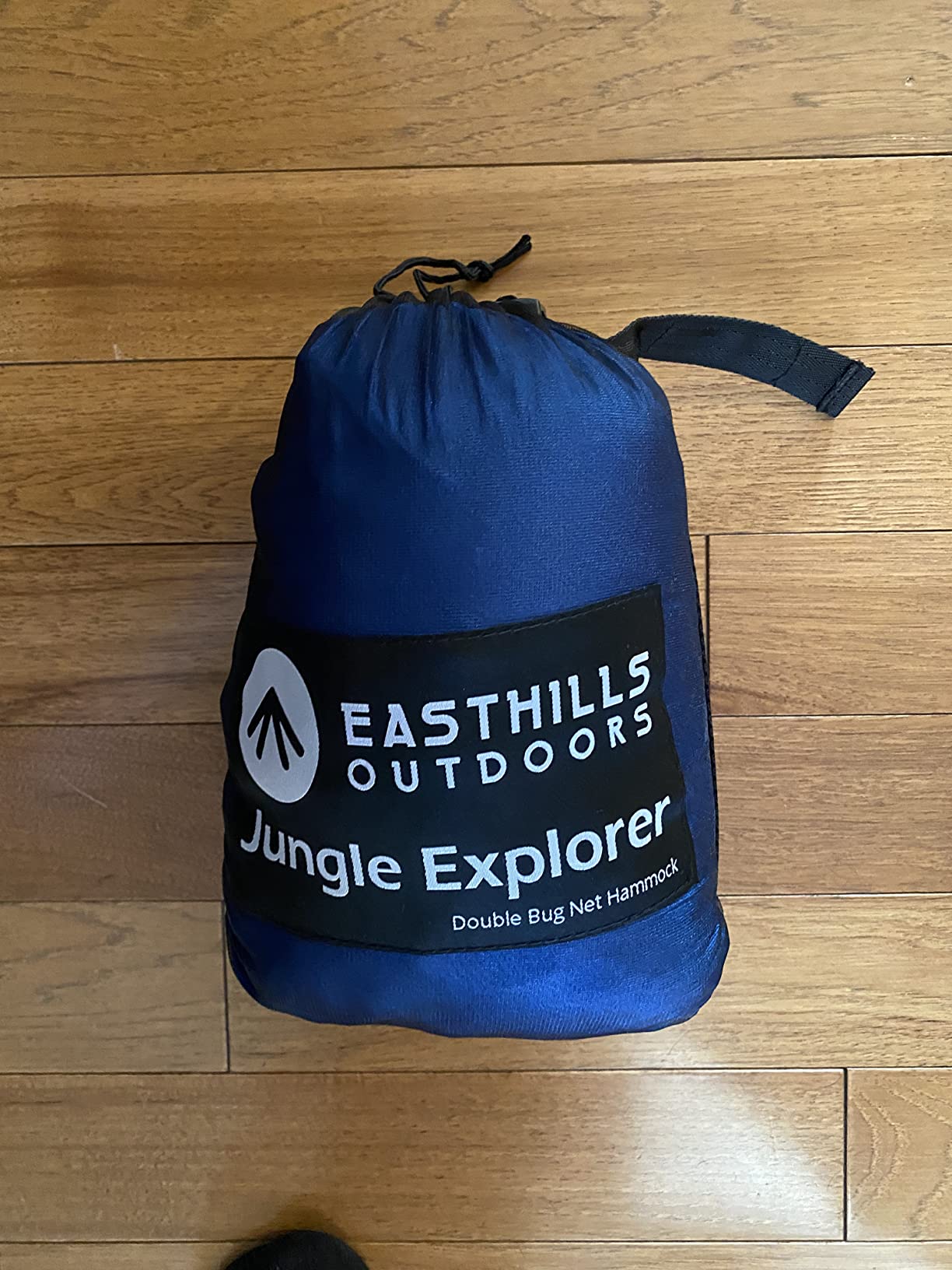
The Easthills is the pick for anyone who shares a hammock or who simply wants more room than a single-width model offers. At 118 by 79 inches with a 600 pound rating, it is the widest true double in this roundup, and it carries the same 210T taffeta parachute nylon with triple-stitched edge seams that we liked on the cheaper kits.
The bug net is the part that sets it apart. It is a removable no-see-um mesh rated at 2500 holes per square inch, and the zippers are color-coded so you can match each side of the net to the correct side of the body without guessing in low light. Inside there are four hanging loops and two gear pockets, more storage than the other double hammocks here, and both hang high enough that your pack stays out of the sleeping space.
Straps are a daisy-chain system with 16 adjustable loops each, rated to 750 pounds per strap, and the aluminum wiregate carabiners are the right kind for this job. You can tension each end independently to counteract uneven trees, which is a small thing that makes a large difference on a site where one tree is a full foot thicker than the other.
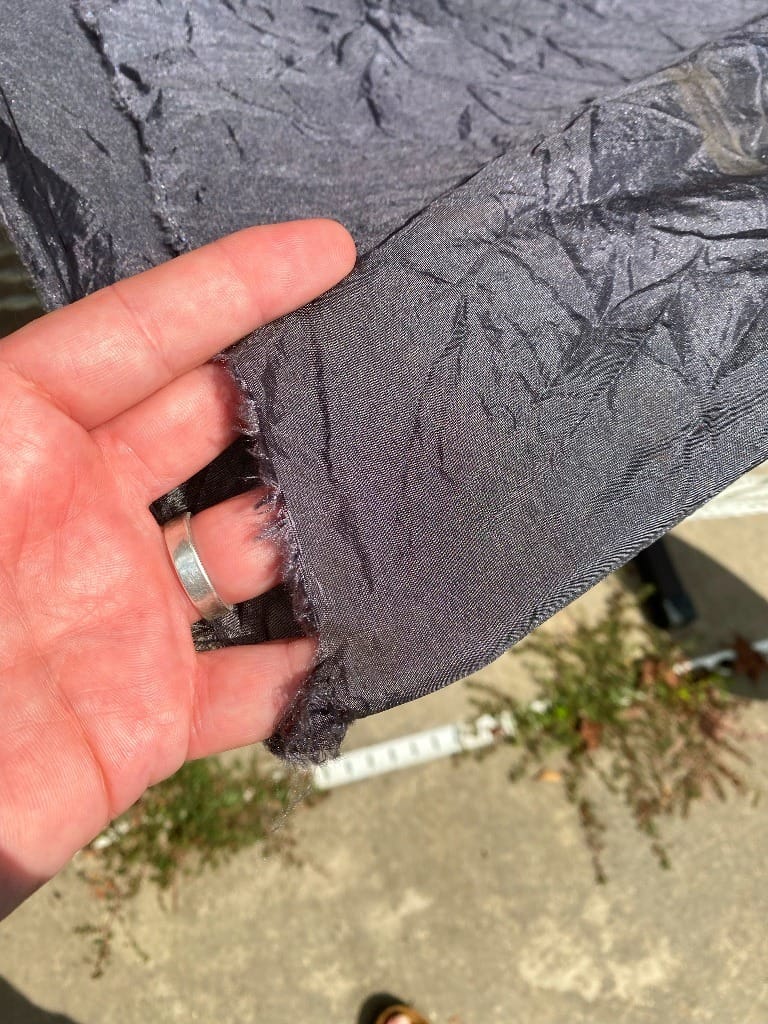
The rainfly is where this loses ground. It is loosely sized to the hammock, and in a standard diamond pitch it does not cover the ends, which is exactly the situation where water blows in from the side. Several buyers also report shipments arriving without the rainfly at all, so verify the box contents. Reviewers also describe the bundled stakes as weak; bring your own.
Why two people should look here
The 79 inch width is what makes a shared night workable, and the 600 pound rating means neither camper is anywhere near the limit. With the net removed in summer, both of our testers fit comfortably on a diagonal lay.
For anyone above 300 pounds or above 6 feet tall, the 79 inch width is a practical answer to the sizing complaints we kept hearing about narrower models.
Where the kit falls down
The fly and the hammock are mismatched in size. If you plan to camp in real rain, budget for a properly sized tarp and treat the included fly as a fair-weather extra.
The bundled stakes are the weakest hardware in the roundup, and the fly fabric is thin enough to sag and flap once wet. You can leave both at home on a dry forecast, which saves real weight.
4. WintMing 3-in-1 Hammock Tent: Best for Rough Weather
Patent Camping Hammock with Mosquito Net and Rainfly Cover, orange/grey
- Held dry through rain
- snow and strong wind in long-term owner reports
- very fast to pitch and break down
- fine mesh blocks tiny insects
- complete set around 3.5 lb
- Zipper teeth separate after repeated cycles under tension
- fly eyelets work loose and the fly is loud in wind
- fabric thinner and more translucent than the photos imply
The WintMing takes a different approach from the gathered-end hammocks elsewhere on this list. It uses foldable aluminum poles to hold the netting and the fly up as a frame, giving a 107 by 55 inch sleeping space with roughly 8.9 by 4.6 feet of usable interior hanging area. The whole set weighs about 3.5 pounds complete.
In a category where most shelters are fabric draped between two trees, that frame makes a difference in weather. Long-term owners report keeping dry through rain, snow, hail, and strong wind, and the frame keeps the fly tensioned and shaped instead of letting it collapse the way a loose tarp does. The seam-sealed ripstop fly is specified properly, which is rarer than it should be.
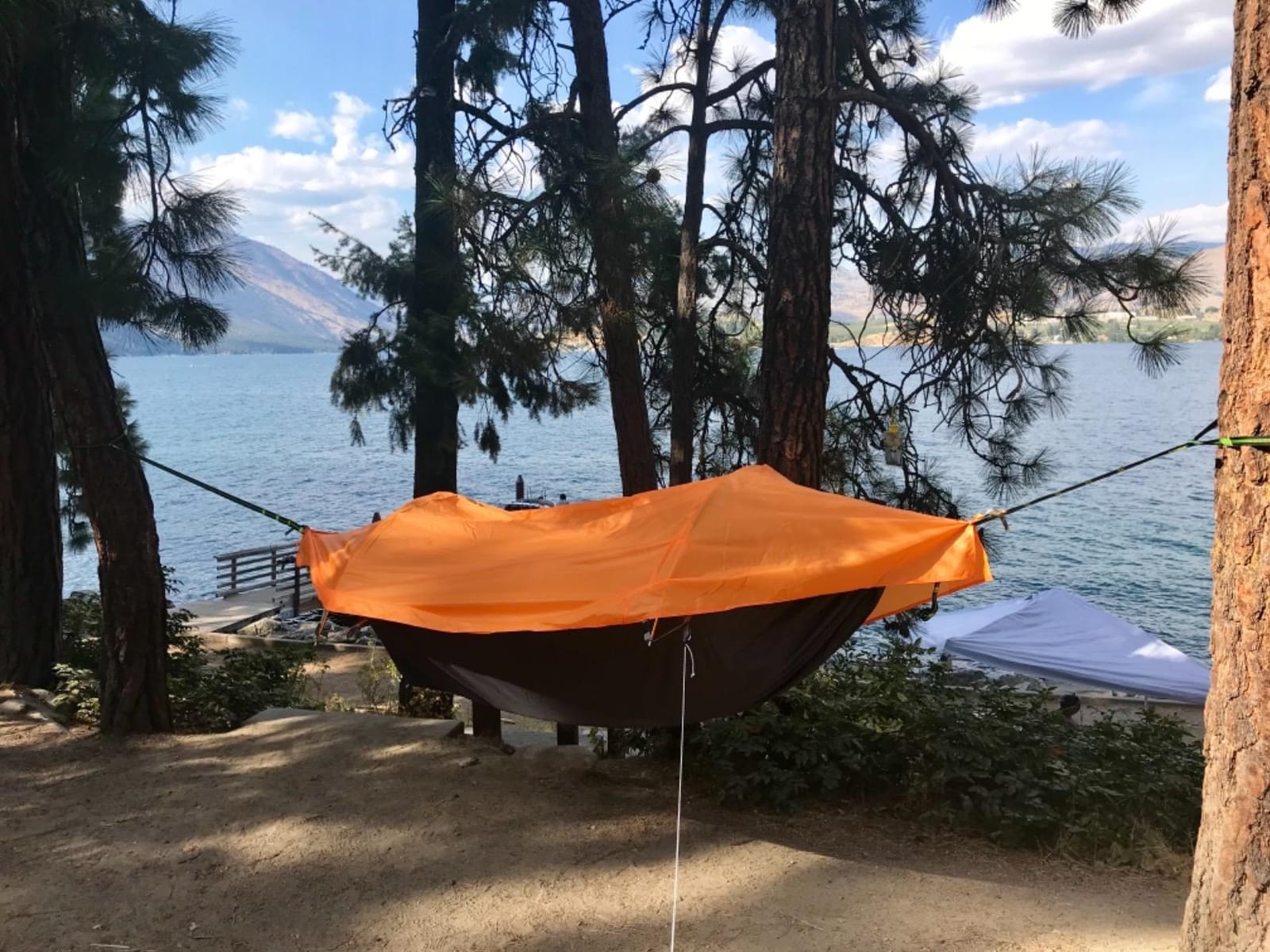
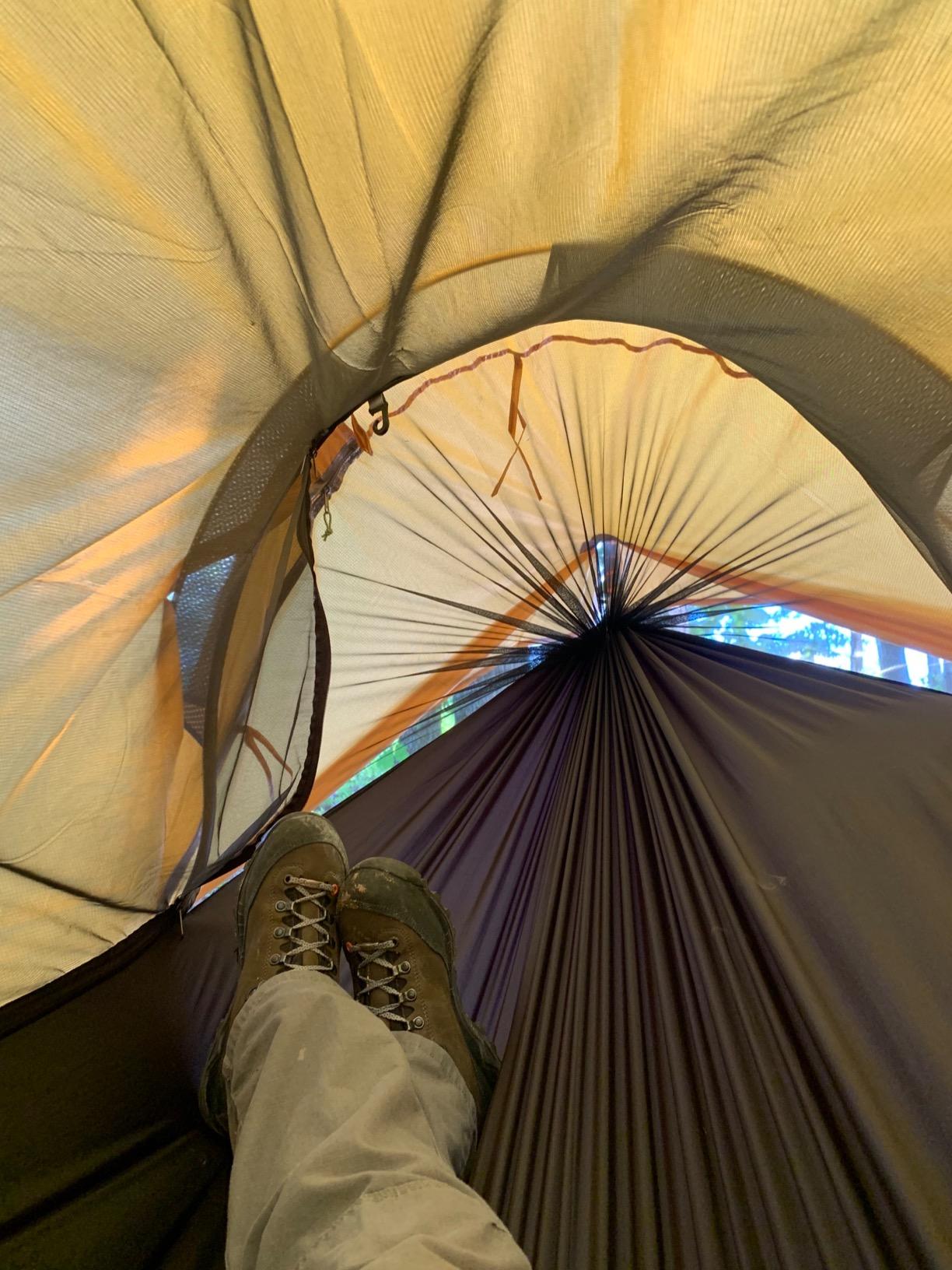
The mesh is fine enough to stop tiny insects rather than just mosquitoes, and the whole unit broke down fast enough that we could repitch it as the weather front moved through, twice in one weekend. The included storage bag and fixing rope keep the package tidy.
Its 4.1 average comes from quality control rather than from field failure. Backwards-sewn units and zippers that fail early account for most of the one-star reviews, and our own zipper showed strain after repeated cycles under tension. The fly eyelets also worked loose in wind, and the fabric is thinner and more translucent than the product photos suggest.
When this hammock wins
If your routes run through open, wet, or high-wind forest and you cannot afford to be wet, the tensioned frame is a real advantage. It also packs down small enough for a 30-gallon trail bag, and it is usable as a backyard or patio hammock when you are not traveling.
The mesh quality and the sealed seams are genuinely good for this price band, and it stopped tiny flies in our testing where coarser mesh in this roundup let them through.
Where it costs you
There is no doubt about the durability question. Check the seams and the zipper the day it arrives, because failures here happen early rather than after years of use.
The pole-supported fly also limits how an underquilt can hang, since the poles hold the fabric away from your body, and at roughly 3.5 pounds it is one of the heavier options here. The 4 person seating capacity in the listing is not a realistic figure for sleeping comfort.
5. Sunyear Black Bundle with 32 ft Ridgeline: Best for First Tarp Pitching
- Includes a real ridgeline and rope set so you can pitch the fly properly
- 500 lb capacity
- 12KN carabiners
- compact fold
- Same 55 in single width that cramps taller sleepers
- net has to be flipped rather than removed
- 2.3 lb is heavier than the lighter kits
This bundle exists for one reason, and the reason is good. It includes a 32 foot ridgeline and six nylon ropes alongside the hammock, net, rain fly, two 10 foot tree straps, two 12KN carabiners, and four stakes. Almost no other entry on this list gives you the hardware to pitch a tarp correctly, and that single omission is what forces most beginners into a bad tarp pitch for their first month of hammocking.
With a ridgeline in the box you can tension the fly to a predictable shape every night instead of guessing at spreader lines and tree spacing. It is the simplest piece of gear in the whole package and it does more for shelter quality than anything else here. We found the difference immediately on our first pitch with this kit.
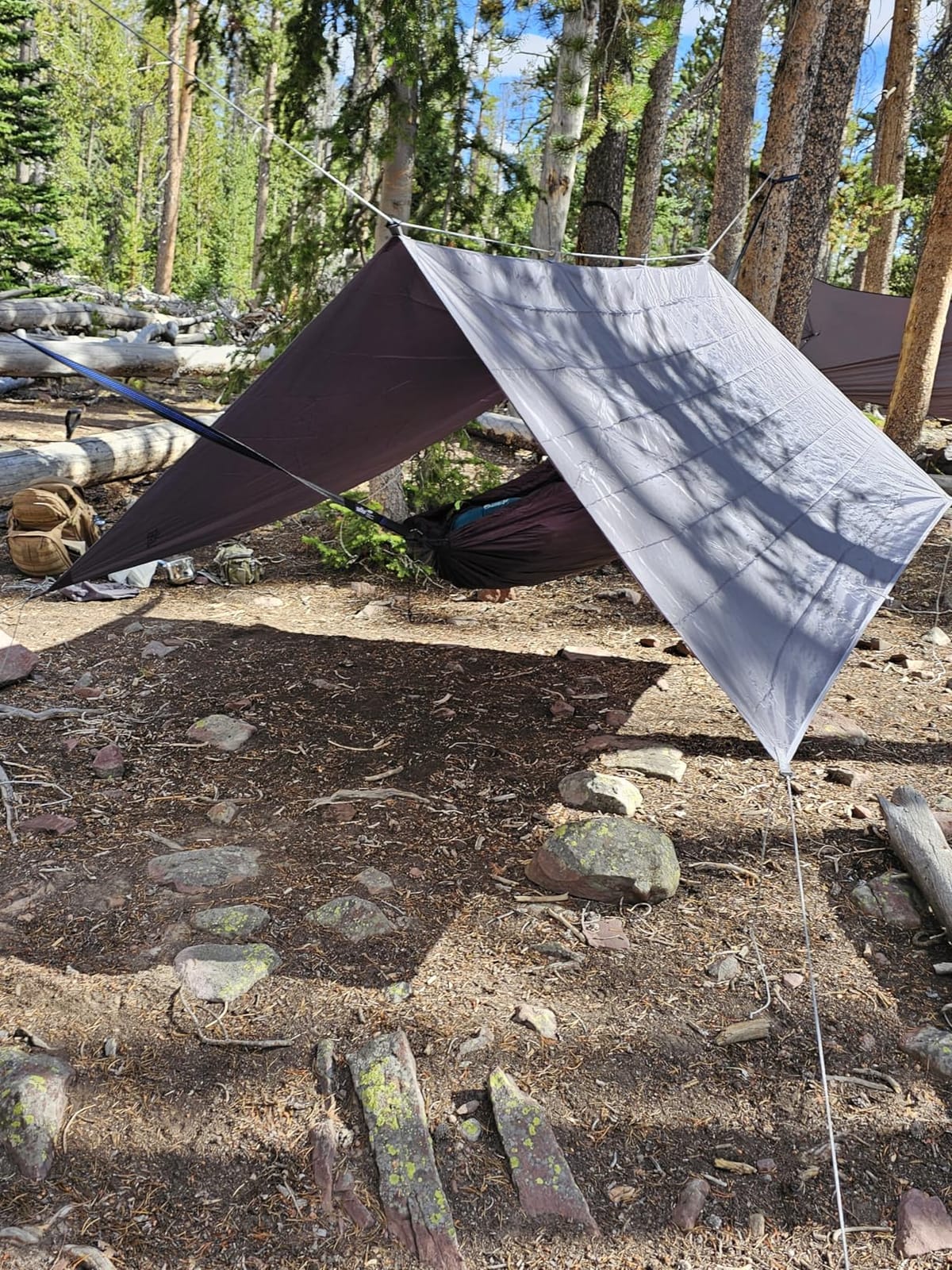
The body is 210T parachute nylon with tear-resistant netting, rated to 500 pounds, and the 106 by 55 inch single size is identical to the Sunyear that took our overall slot, so the same sizing caution applies. The double version at 118 by 78 inches is available for taller sleepers or for sharing.
Tree straps use 16 plus 1 adjustable loops each, which gives fine-grained length control and is gentle on bark. The 12KN carabiners are heavier-duty than the loose hardware that ships with cheaper kits. Pack size is 10.2 by 7.9 by 5.9 inches.
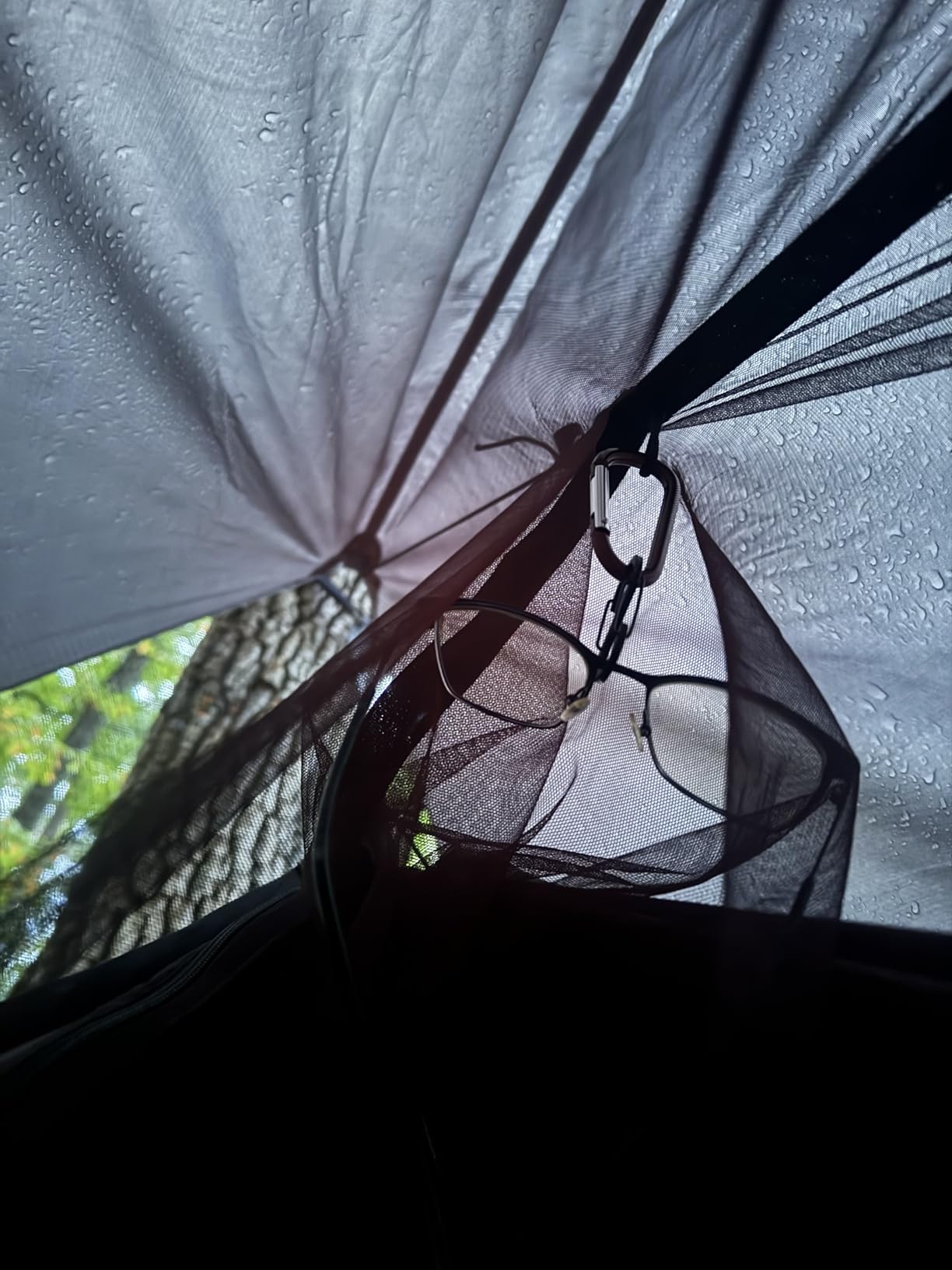
Why the ridgeline matters more than it looks
Every hammock benefits from a structural ridgeline: a fixed line between the trees that the hammock clips onto, so the shape stays the same every night instead of depending on how you adjusted the straps. Having one included removes an entire category of beginner frustration.
That same line is also what you hang the fly from, which is why this bundle pitches a better tarp than a strap-only kit without buying anything else.
Where it falls short
At 2.3 pounds it is among the heavier kits here, largely because of the complete accessory set.
The net flips to the underside rather than removing entirely, so it is a closed shelter all year round. On a firm dry forecast you can leave the fly and the bundled stakes home and save real weight, which is how we used it on two of our four months. And like most single-width hammocks, the 55 inch body is not comfortable for anyone over 5 foot 8.
6. Ryno Tuff XL Double Hammock: Best for Heavy Campers
- Thick 75D parachute nylon that feels tougher than typical lightweight hammocks
- mid-side tarp tie-downs can form a wind wall
- hammock and tarp pack separately
- roomy double
- Bug net loops and spreader lines are light-duty and let the net sag onto the face
- bundled carabiners and chain are heavy
- body is short for tall sleepers
Ryno Tuff builds this one for people who break things. The body is 210T parachute nylon at 75 denier, which the manufacturer rates as stronger than most of the category, and the seams and connection points are triple stitched. At 118 by 78 inches with a load rating above 600 pounds, it sits in the small group of shelters here that a genuinely large camper can use without worrying about the limit.
The tarp is better engineered than the rest of the kit suggests. It has mid-side tie-down points that can be strung into a wind wall, which is the difference between a tarp that stays put in a gust and one that becomes a sail. The hammock and tarp also pack into separate bags, so you can genuinely drop the fly on a dry forecast.
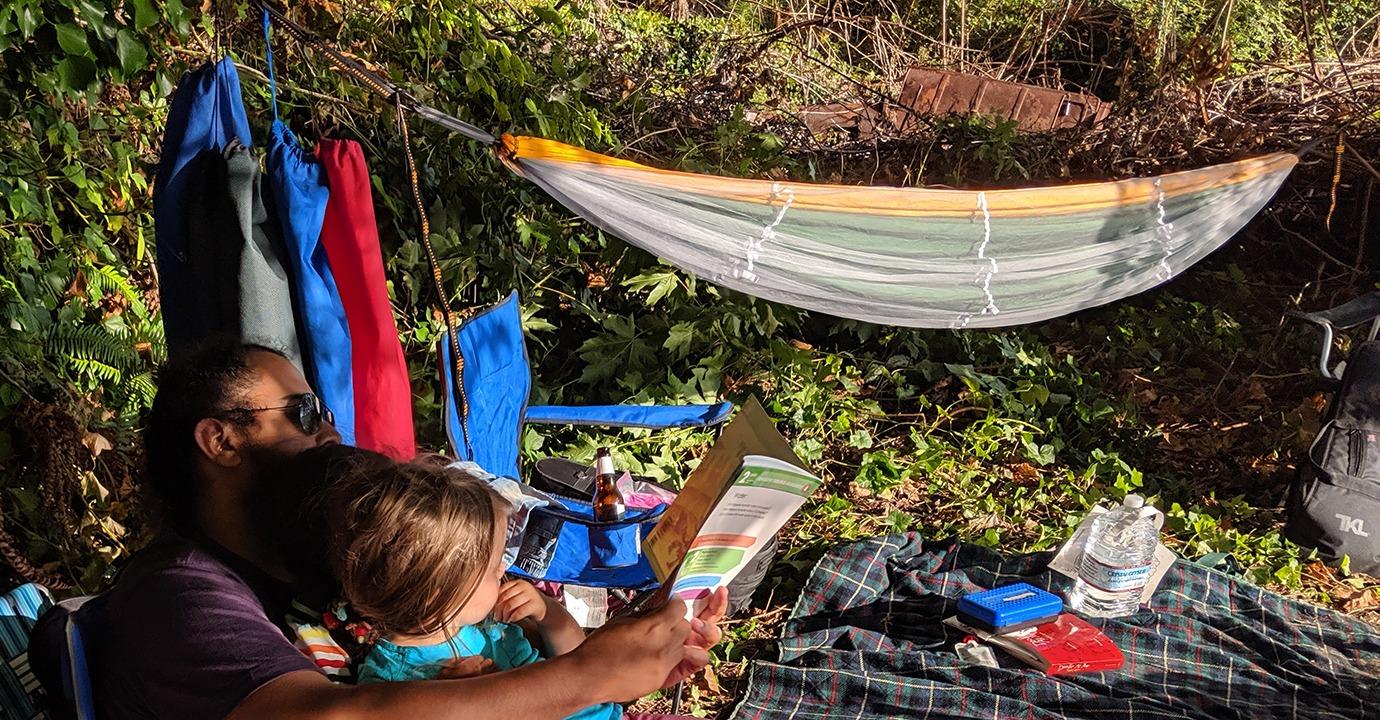
Storage is handled well for a budget kit, with a sewn-in pocket plus a separate extra pouch, and the 10 foot strap with 16 loops means no knots are required to attach the hammock.
The bug net suspension is the near-universal complaint and it is a fair one. The loops and spreader lines are light-duty and stretch under load, which lets the net sag onto the sleeping surface, and many owners replace the entire net suspension outright. The included steel carabiners and hardware are also heavy for backpacking, and the gate pins are unfinished enough to snag mesh.
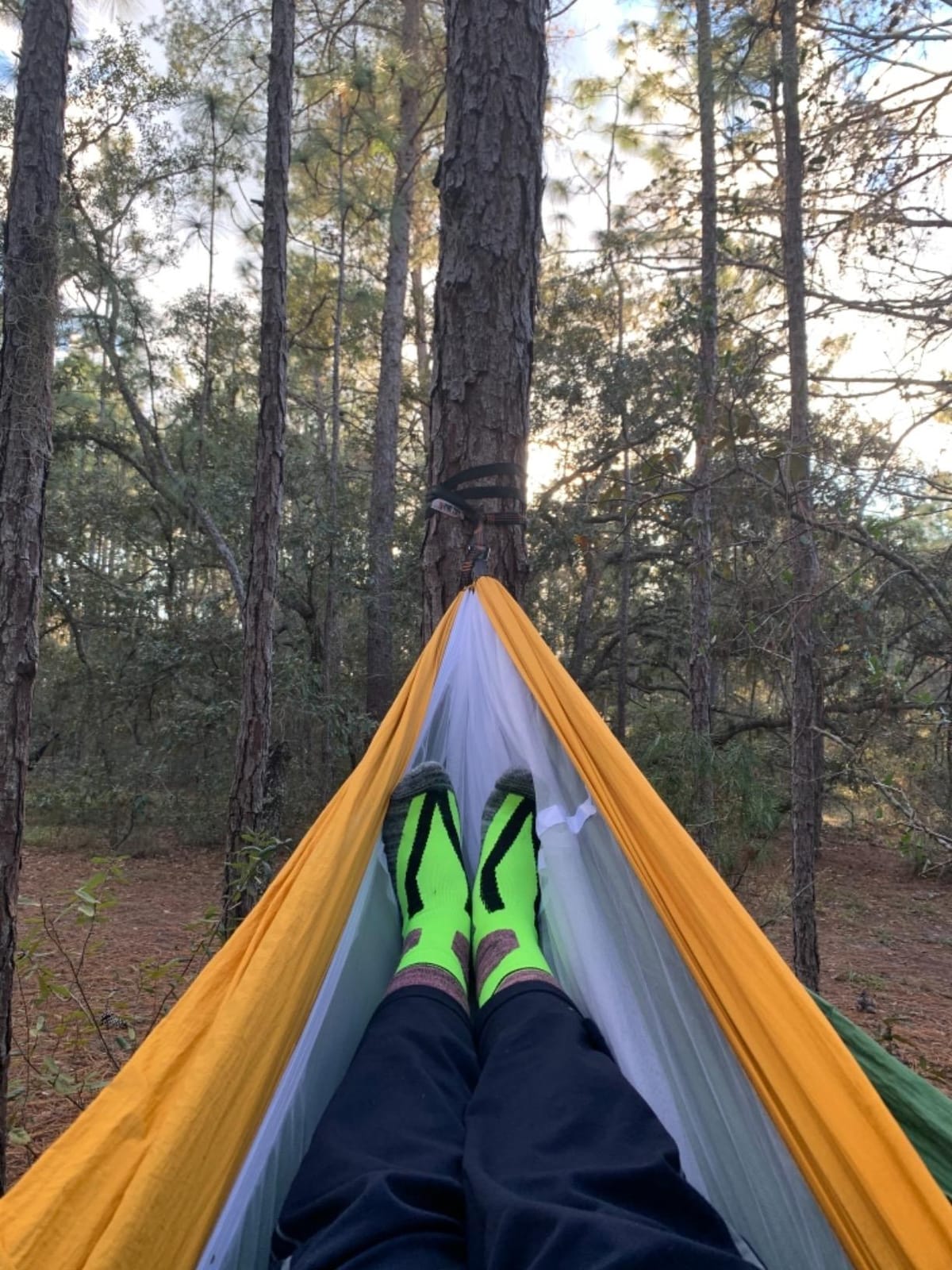
Who this is built for
Anyone over 300 pounds, or camping with a partner where both people are large, will find very few options in this category. The 600 pound rating and 78 inch width handle that, and it is a good first hammock if you expect to be hard on gear.
The fabric weight is a feature if you are not optimizing base weight, and the extra durability is noticeable on the second and third season.
Where you will notice the compromise
Plan on replacing the bug net suspension. It is a simple, cheap fix with a small amount of cord, but doing it yourself is better than fighting the original every night.
The body runs about 9 foot 8, which is fine for most but tight for sleepers over 6 foot 2. The bundled guy lines are also short, which limits how far you can pitch the tarp away from the trunks.
7. Night Cat 4-in-1 Hammock Tent: Best for Jungle Trails
Night Cat Camping Hammock Tent: Lightweight Portable 4 in 1 Hammock with Rain Tarp and Mosquito Net for Adults Hiking Jungle Outdoor Green
- Combines hammock
- tarp and netting into one carry item
- fine netting suited to heavy insect conditions
- quick to pitch
- compact pack size
- 55 in width limits usable sleeping space
- listed weight differs between the feature bullets and the spec table
- mesh and material descriptions vary across the listing
The Night Cat is listed at 132 inches long, longer than the other gathered-end bodies in this roundup, and that length matters. A longer hammock sits in a flatter curve with a less extreme diagonal lay, which is what taller campers and anyone who dislikes the classic gathered-end position is looking for.
It is also a genuine 4-in-1: hammock, bug net, rain fly, and the straps to hang it, all in one carry item. Buyers consistently cite bug protection in heavy insect conditions as the main reason they bought it.
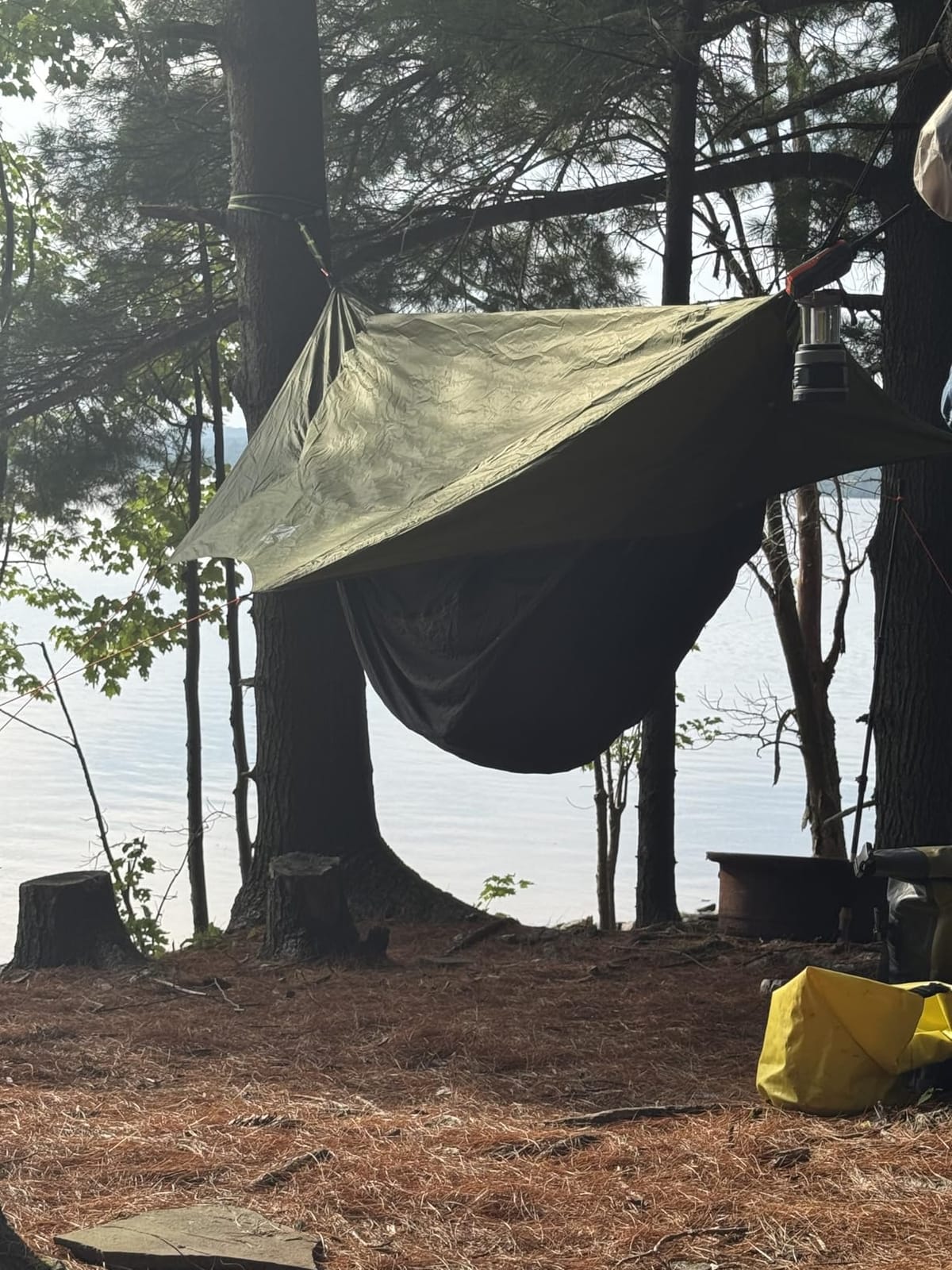
Pitch time was under five minutes in fair conditions, and the whole thing folds into a compact pack size that fits in the top of an ultralight pack without rearranging anything else. The fine mesh kept small flies out where coarser mesh on other kits here did not.
The listing itself is a source of confusion worth flagging. The weight appears as 3.5 pounds in the specifications and about 4.2 pounds in the feature bullets, and the material is described as microfiber in one section and mesh and polyester in another. Verify the actual packed weight before you commit to a strict base weight budget.
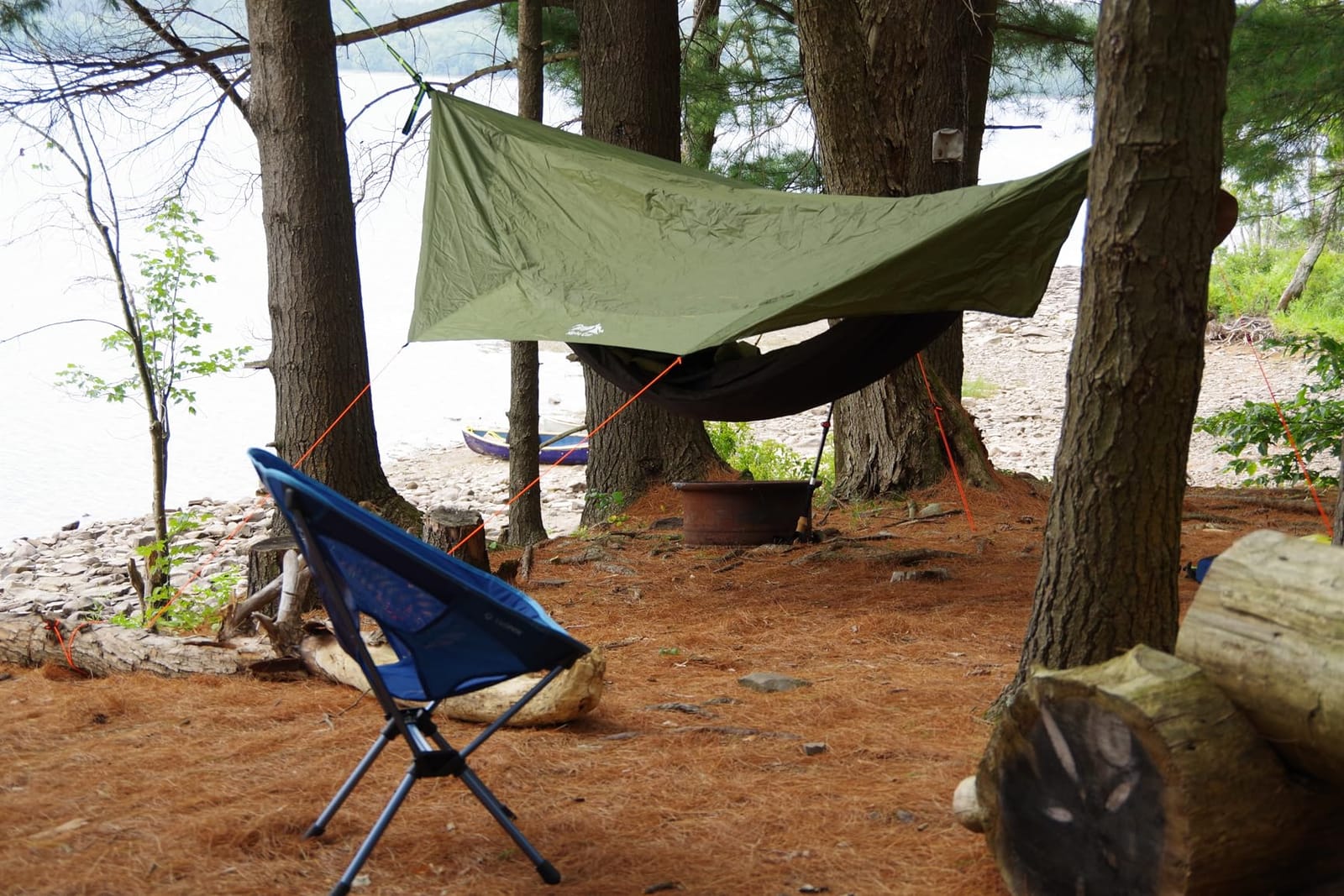
Why length matters for this use case
For jungle and subtropical trails, insect pressure is the deciding factor and insects do not care about your budget. The fine mesh and the integrated tarp mean one item covers both problems, and the length reduces the depth of the curve where netting and fabric rub together.
If you are combining this with an underquilt, the flat-ish angle also means less hyperextension at the knees than a shorter gathered-end hammock forces on you.
Where the specification gaps hurt
Inconsistent listing data means you cannot plan your base weight accurately from the product page alone. Weigh it yourself before you commit.
At 55 inches wide it is a narrow sleeping deck despite the long body, and a 440 pound rating is not enough margin for the heaviest campers. There is no under-storage and no gear shelf, so your pack has to hang somewhere else.
8. Haven Tents Lay Flat Hammock Tent: Best for Back and Side Sleepers
Haven Tent Original Lay-Flat Hammock Tent (Forest Green) – Comfortable Waterproof Camping Hammock with Mosquito Net – Includes Insulated Sleeping Pad & Rainfly
- Lay-flat platform eliminates the pressure points that end hammock sleep for back and side sleepers
- complete turnkey system including a R3 air mattress
- six interior pockets
- two-sided zippers on newer builds
- Trail weight near 6 lb is heavy
- the included pad is the heaviest component and has been reported to leak
- little airflow through the no-see-um mesh
Instead of hanging in a curve, the Haven uses a patent-pending spreader bar and structural ridgeline to create a 78 by 24 inch flat sleeping platform, and it is one of only two shelters here built on that flat-lay geometry. If you sleep on your back, your shoulders touch nothing but air, and if you sleep on your side you can extend a knee without hyperextension. Owners with back and neck problems consistently credit it with better sleep than a mattress.
The box is the most complete one in this roundup. It contains the tent with its integrated mosquito net, a removable 4000mm PU rainfly in 20D ripstop nylon, a custom insulated inflatable pad with an approximate R-value of 3, the suspension straps, carabiners, four guylines and four stakes. You can sleep in it on night one without buying anything except an underquilt for cold weather.
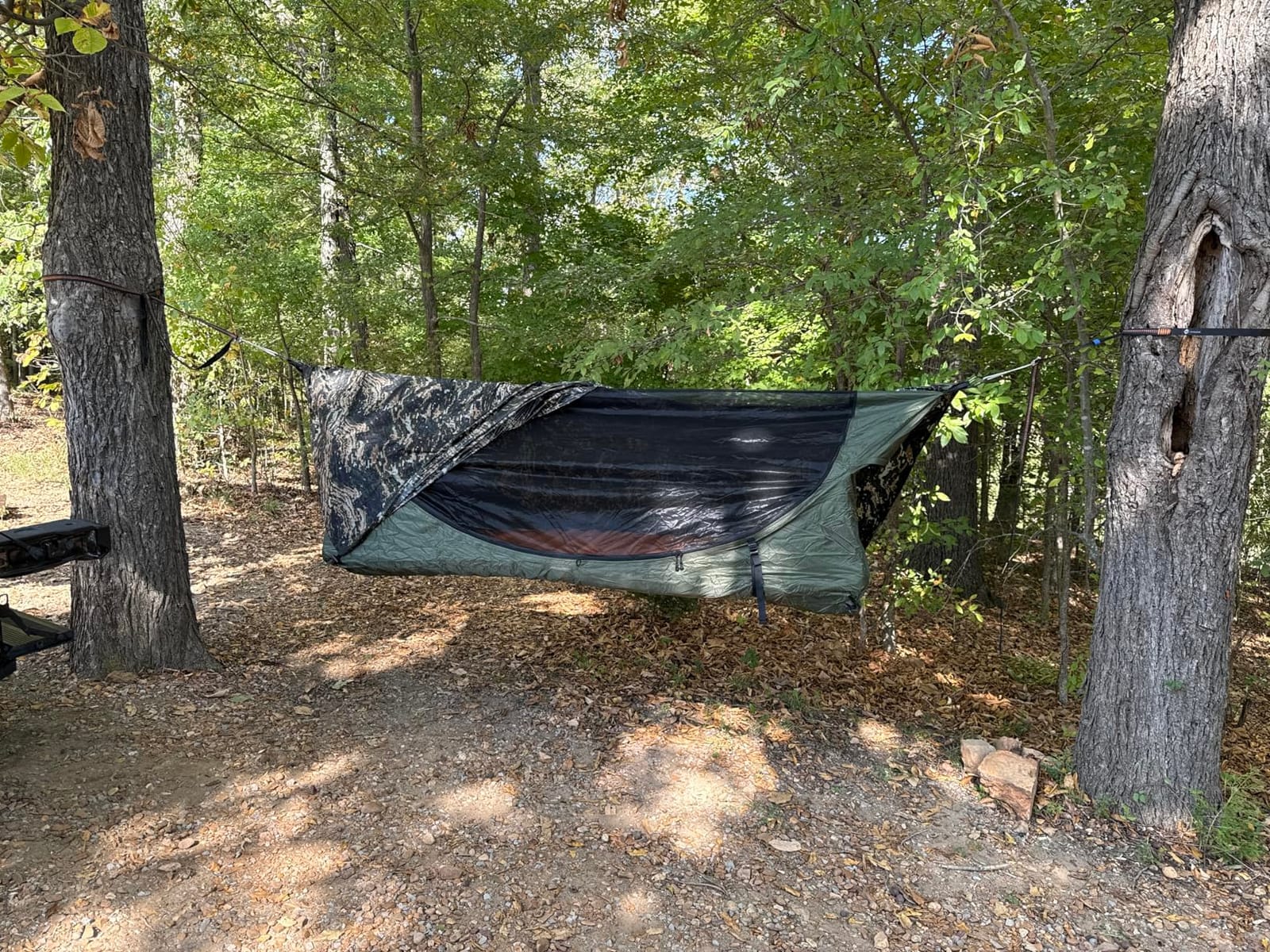
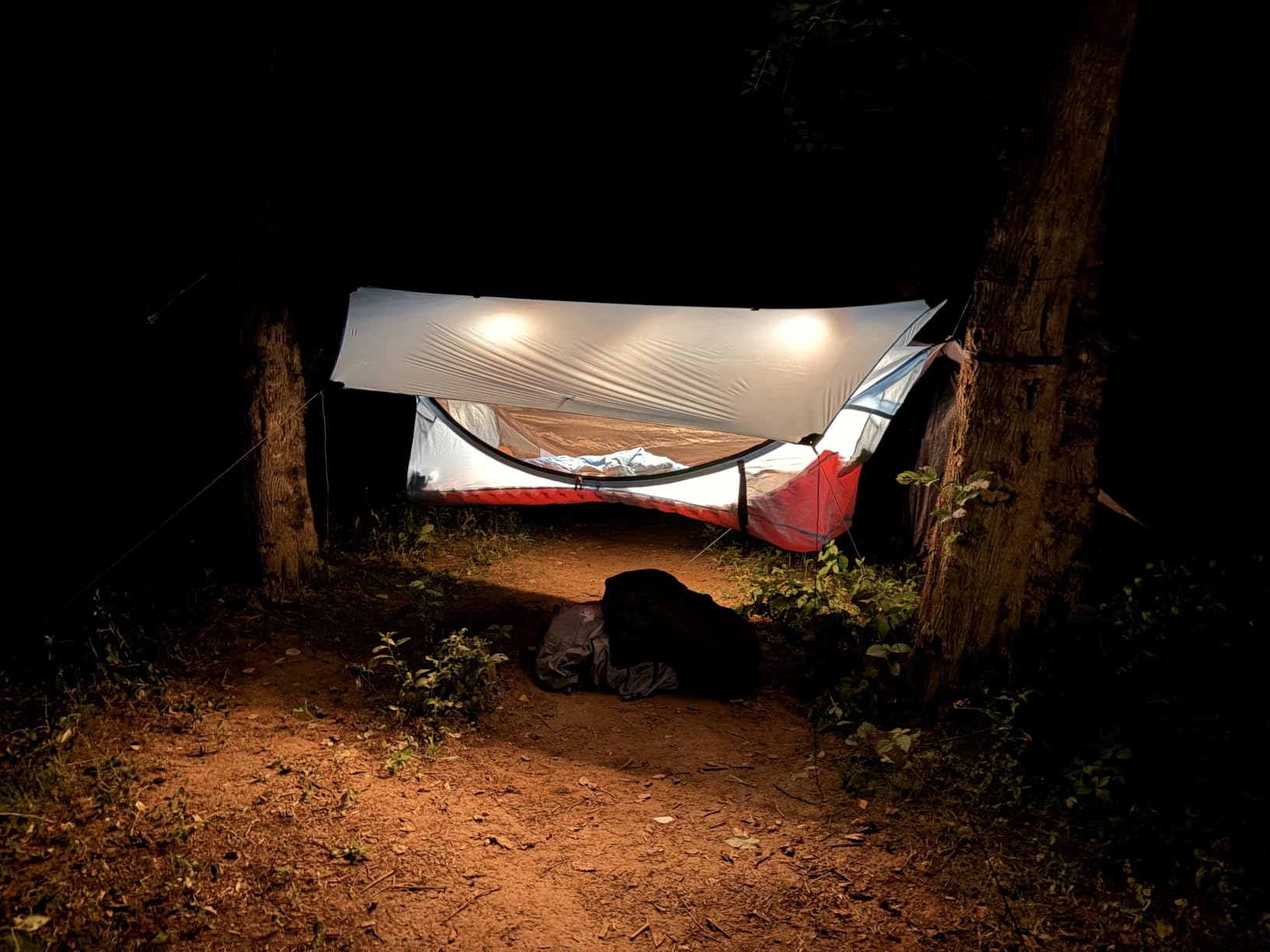
There are six interior pockets, more storage than any other shelter here, and the newer builds have two-sided zippers so you do not have to reach the same zipper from a different side of the bed. Field reports describe it holding dry and stable through violent thunderstorms, and it converts to a ground bivy with trekking poles or to a suspended lounge chair with the included strap.
The weight is the honest problem: 6.8 pounds as listed, with a trail weight of 6 pounds 1.3 ounces, packed down to 15 by 6 by 6 inches. That is heavy for a backpacking shelter and it belongs to a car-camping-adjacent or new-hiker weight class more than an ultralight one. The included pad is the single heaviest component and has been reported to leak, the mesh allows little airflow so it runs hot in summer, and setup relies on the video guide because written instructions are thin.
Who this changes the game for
If a hammock has never worked for you because of the curve, this is the product to try before you decide hammocks are not for you. Side sleepers and anyone over 6 feet tall get the most out of it.
It is also the only one here that includes an insulated pad as standard, so you are not sleeping directly on the hammock fabric with nothing beneath you.
Where the trade-off bites
Six pounds changes what trips you can take. On a long trail with resupply stops you can carry it; on a fast-and-light route you cannot.
Support capacity is 285 pounds, which is below the 500 and 600 pound options here. And in summer the sealed mesh turns it into a sauna unless you can pitch the fly far enough open to vent.
9. Hennessy Hammock Expedition Classic: Best for Ultralight Thru-Hiking
- Asymmetric cut lets sleepers lie nearly flat on the diagonal
- packs to the smallest bundle in this roundup
- structural ridgeline gives a repeatable hang
- rainfly held in severe storms
- Bug net cannot be removed
- bottom entry is awkward in the dark
- 250 lb and 6 ft size limit
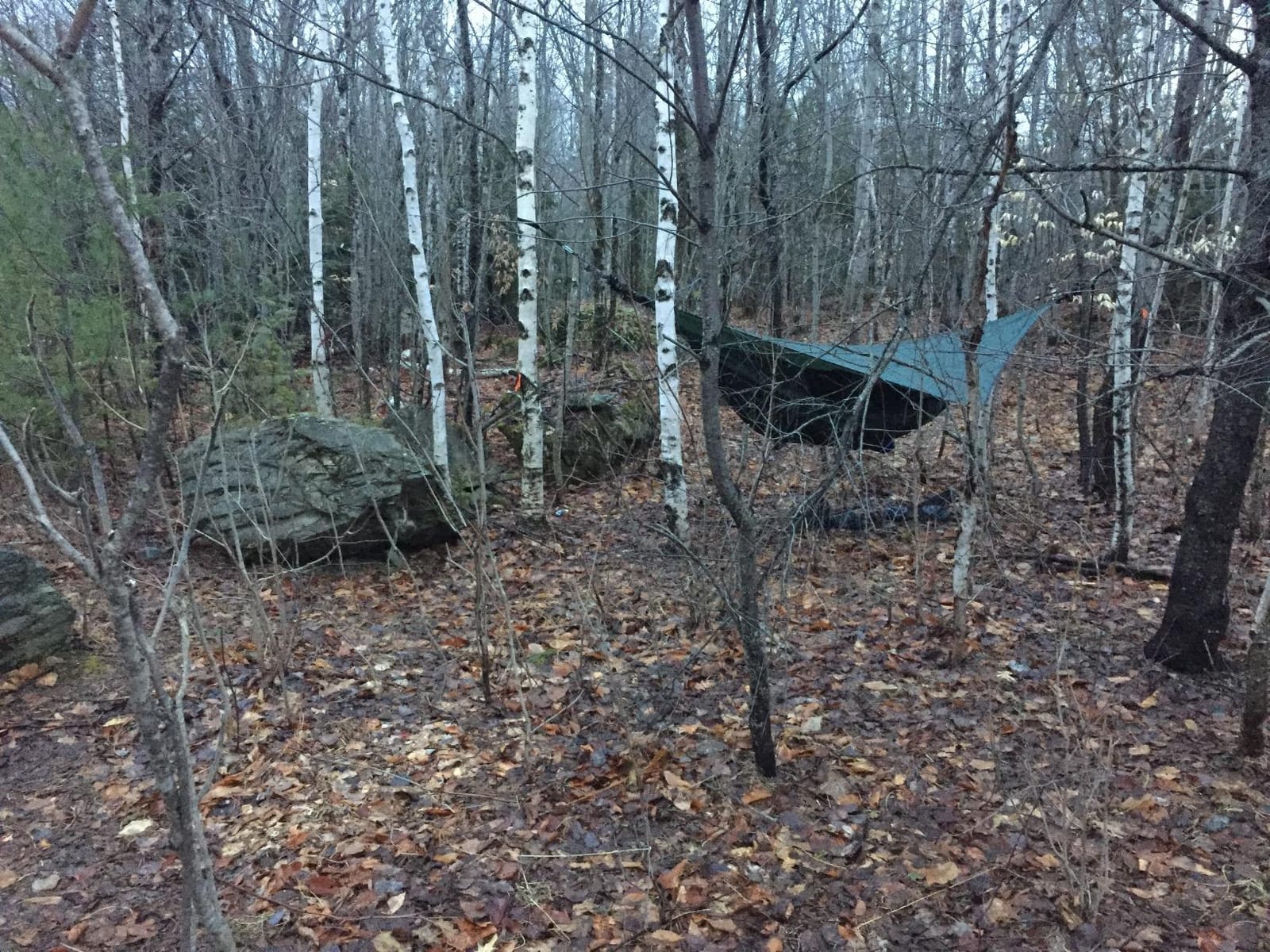
The Hennessy Expedition Classic is the shelter most thru-hikers mean when they say they switched to a hammock, and the reason is the patented asymmetric shape. Where most gathered-end hammocks force your knees up into a curl, the asymmetric cut lets you lie nearly flat along the diagonal, which is why it is rated for sleepers up to 6 feet and why our 5 foot 9 tester found it the most naturally comfortable gathered-end hammock we pitched.
It is also the most compact shelter in this roundup by a clear margin, weighing 2 pounds 12 ounces and packing to a 4 by 7 by 9 inch bundle. The construction is honest: 70D high-density nylon on the bottom, 30D no-see-um polyester mesh, a 70D polyester ripstop rainfly, and 1500 lb test Spectra ropes with webbing tree straps. That is a well-specified kit that has not changed in years because it did not need to.
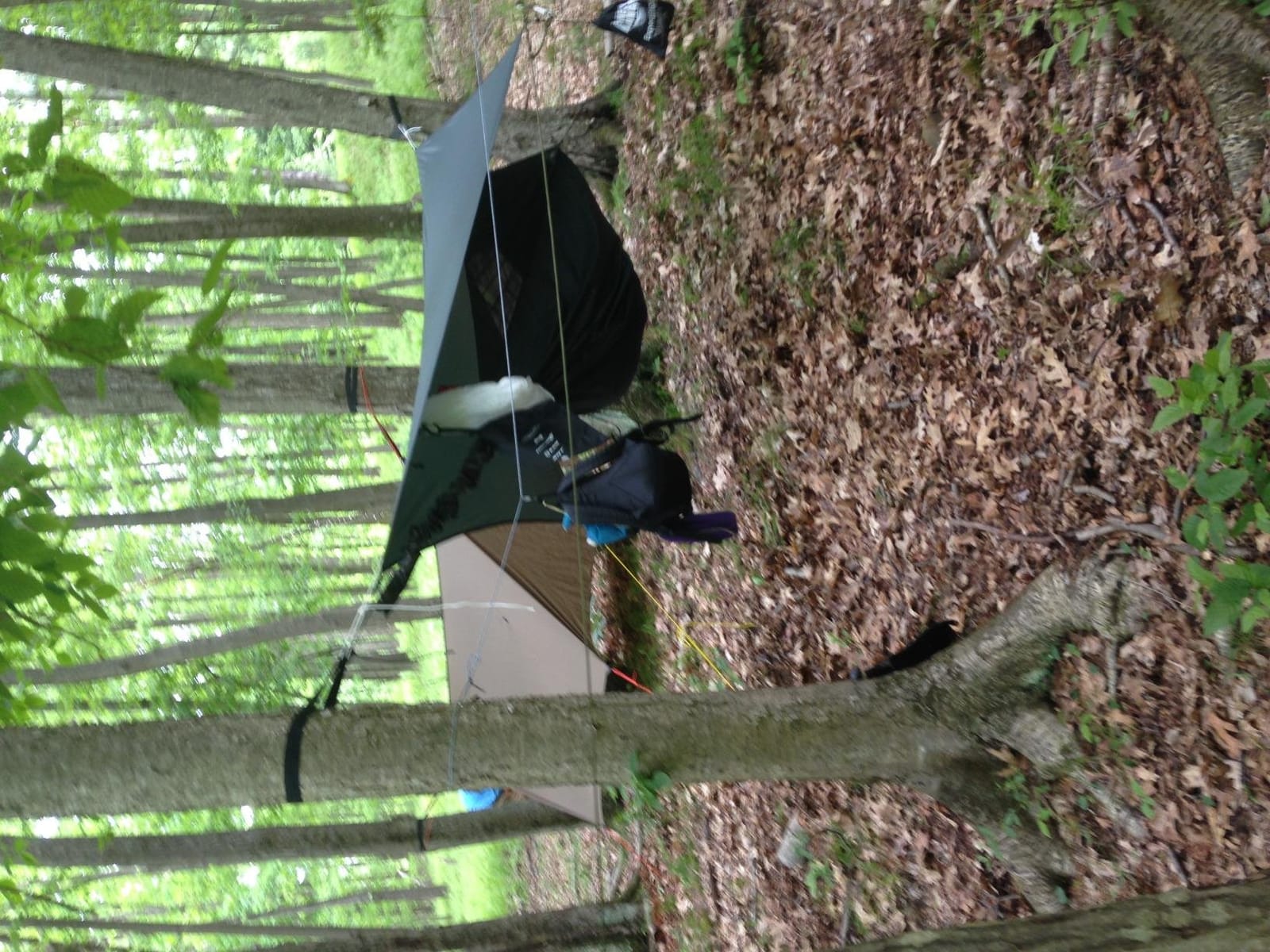
The structural ridgeline is what makes it repeatable. Clip in and the bed is the same shape every night, which removes the small nightly adjustment that annoys people on strap-only setups. Owners report the rainfly performing in severe storms with strong side wind, and the workmanship holds up well after heavy use.
The limits are equally clear. The bug net cannot be removed, no stakes are included, and the 250 pound and 6 foot rating is the smallest capacity of anything we tested, which rules it out for larger campers entirely. The bottom-entry design snaps closed under your own weight, which is elegant in daylight and genuinely awkward at midnight in rain, and it takes practice on the recommended knot.
Why thru-hikers keep coming back to it
Volume is what a long trip is judged on, and 4 by 7 by 9 inches leaves room for everything. The low weight and small footprint mean it disappears into a top lid where a three-pound kit does not.
The one-year limited warranty on materials and workmanship is shorter than some here, but the field reputation for durability outlasts the warranty by a wide margin.
Where you should skip it
If you are over 250 pounds or over 6 feet tall, this is the wrong hammock and no amount of adjustment changes that. Check your fully loaded weight before buying.
Bottom entry is a real learning curve, and in winter you will need a full underquilt setup because nothing is insulated below you. Plan a few backyard nights before a through trip.
10. Night Cat Flat Lay Hammock Tent: Best With a Camp Porch
Night Cat Flat Lay Hammock Tent with Mosquito Net Waterproof Rainfly for 1 Person Backpacking Hiking Camping Lightweight 330LBS 87x28x19in
- Truly flat sleeping surface for back and side sleepers
- rainfly pitches as a porch for sitting and shade
- under-storage compartment keeps shoes and gear out of the bed
- side safety straps stop it rolling
- 7.7 lb is heavy to carry
- sleeping pad is not included
- straps must be tied at matching heights
Like the Haven, the Night Cat Flat Lay is built around four foldable aluminum alloy spreader poles that hold an 87 by 28 by 19 inch platform rigid. The result is a flat deck with enough width to actually lie on your side, which is the geometry most hammock sleepers want and that gathered-end designs here simply cannot offer.
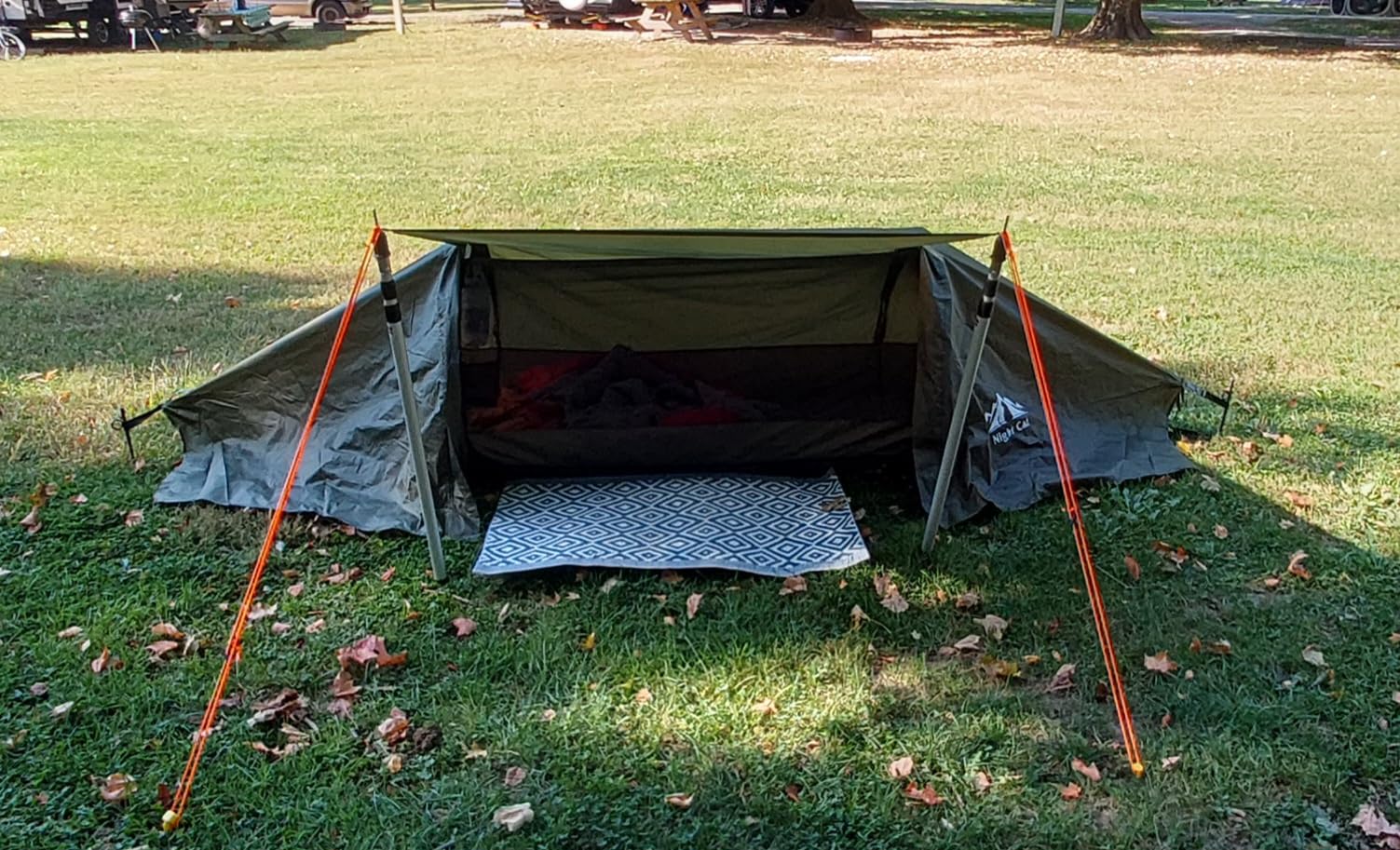
The porch capability is the underrated part. The rainfly can be configured into an awning over the front of the hammock, so you have somewhere dry to sit, cook, and put on wet boots without dragging mud into your sleep. There is a detached under-storage compartment for shoes, a pack, or a pet, which keeps gear out of the sleeping space entirely.
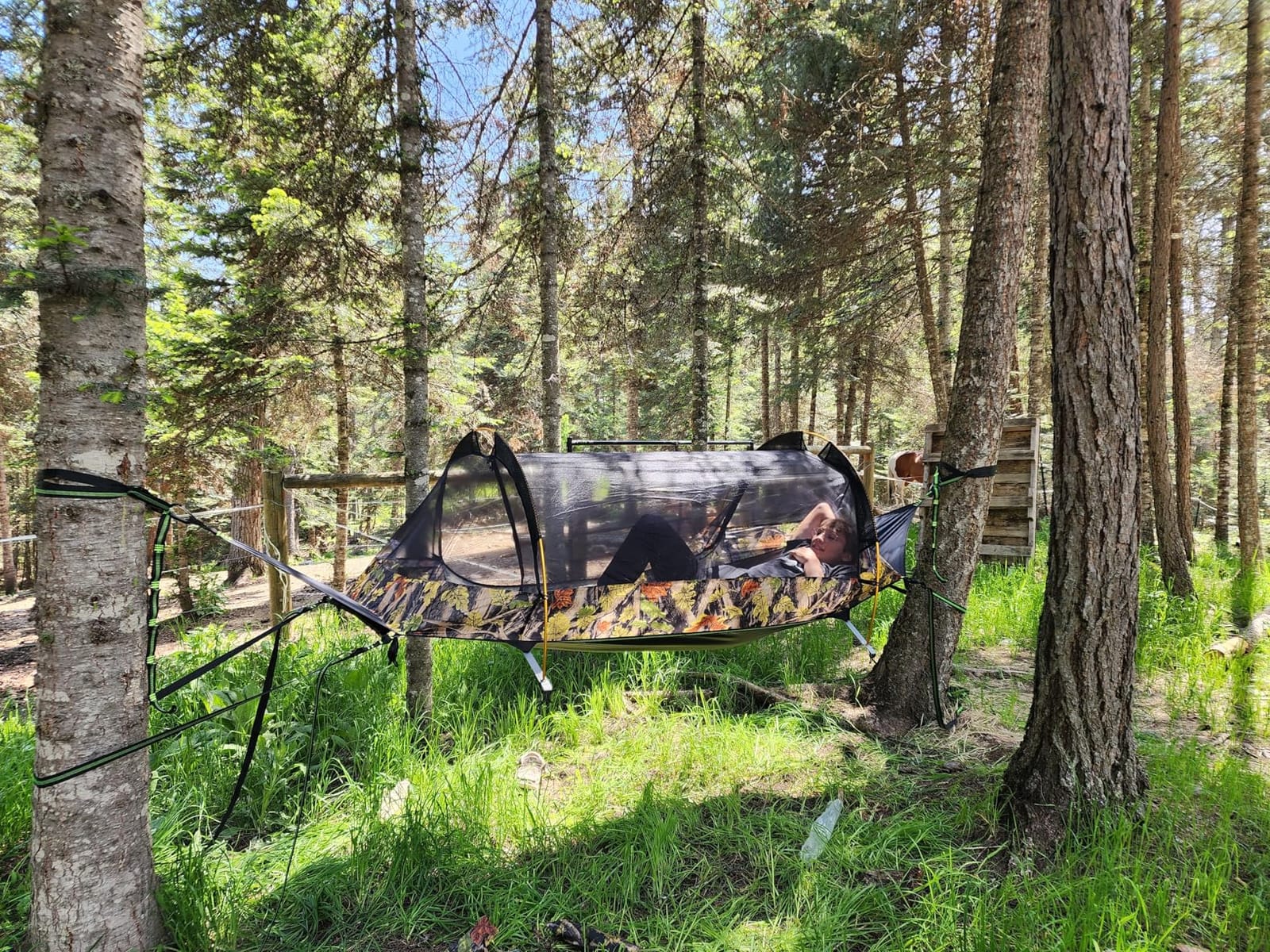
Side safety straps prevent the hammock from rolling over, and the whole unit assembles in minutes once you have done it twice. The 330 pound capacity is honest for the structure, and the box includes the body, net, fly, two tree straps with loops, two long flat-body straps, carabiners, and a carrying bag.
At 7.7 pounds this is a heavy shelter for a backpacking trip, and it is sold as hammock only, so your sleeping pad is a separate purchase on top of that. The manufacturer does not recommend the printed manual, which means the product page video is mandatory before your first pitch, and all of the straps have to be tied at a matching height of about one meter or the geometry does not hold.
Where the porch earns its weight
A dry sitting area changes the rhythm of a trip. Most hammock setups give you nowhere to stand up, eat, or change clothes in the rain, and that discomfort is what pushes people back to tents.
For side sleepers and anyone camping with a dog, the flat deck and the under-storage compartment are both genuinely useful.
Where the weight ends trips
Seven pounds of shelter is a heavy pack on any trail with real elevation, so this suits vehicle-supported and short trips better than long-distance hiking.
Add your own pad and you are carrying two large pieces of gear. Plan the height requirement carefully before you find yourself retying straps in the dark.
11. MIZTLI Pole-Supported Hammock Tent: Best Net Clearance
Miztli Camping Hammock Portable Tent-Like Hammock with Net 1/2 Person
- Support poles hold the net well clear of the face for a tent-like interior
- netting kept mosquitoes out even in jungle conditions
- light and compact enough for motorcycle travel
- fabric showed no fraying after a year of weekly use
- Net is sewn in and cannot be removed
- hammock can roll 360 degrees in wind during setup
- mesh blocks airflow and runs hot
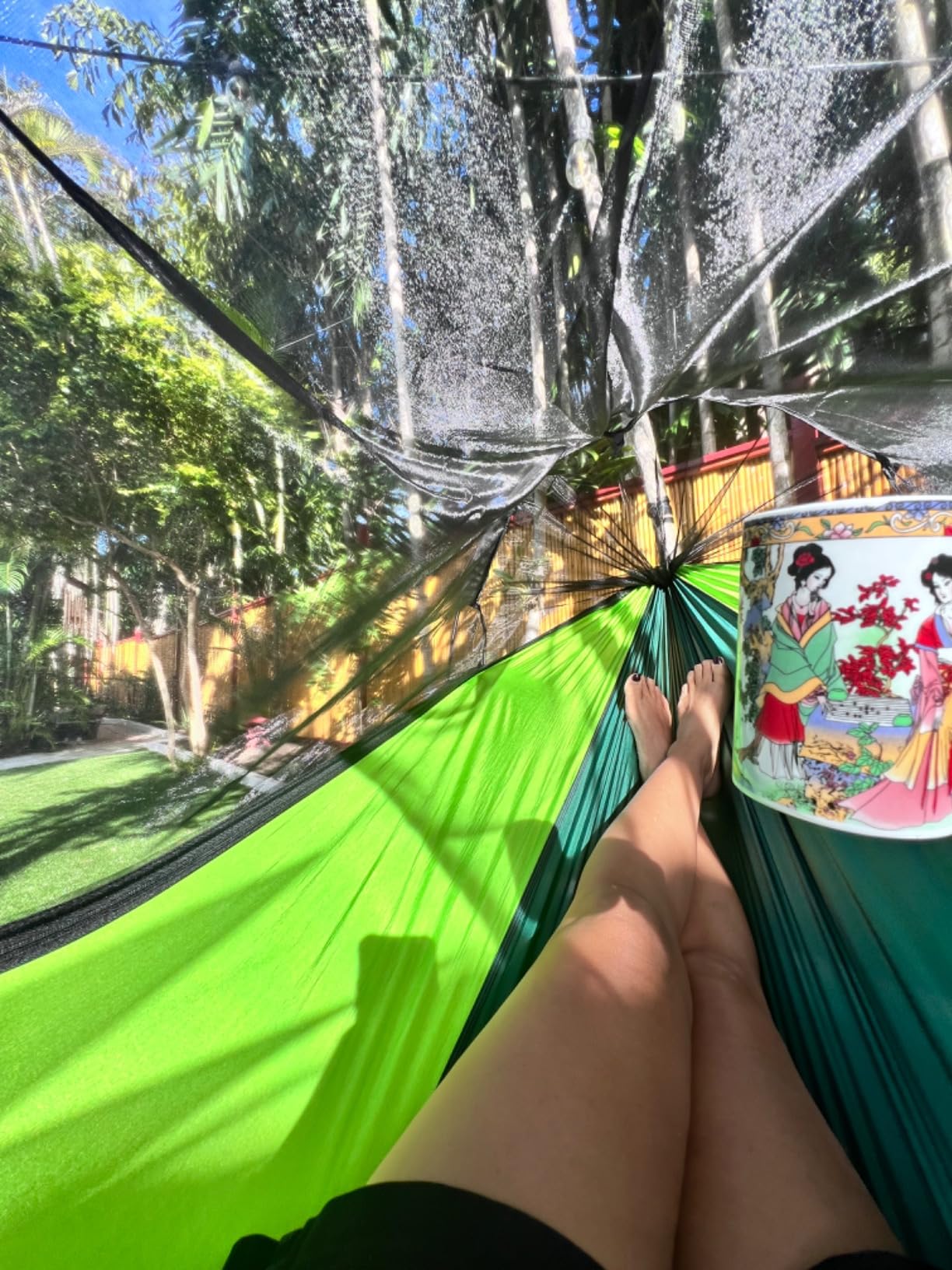
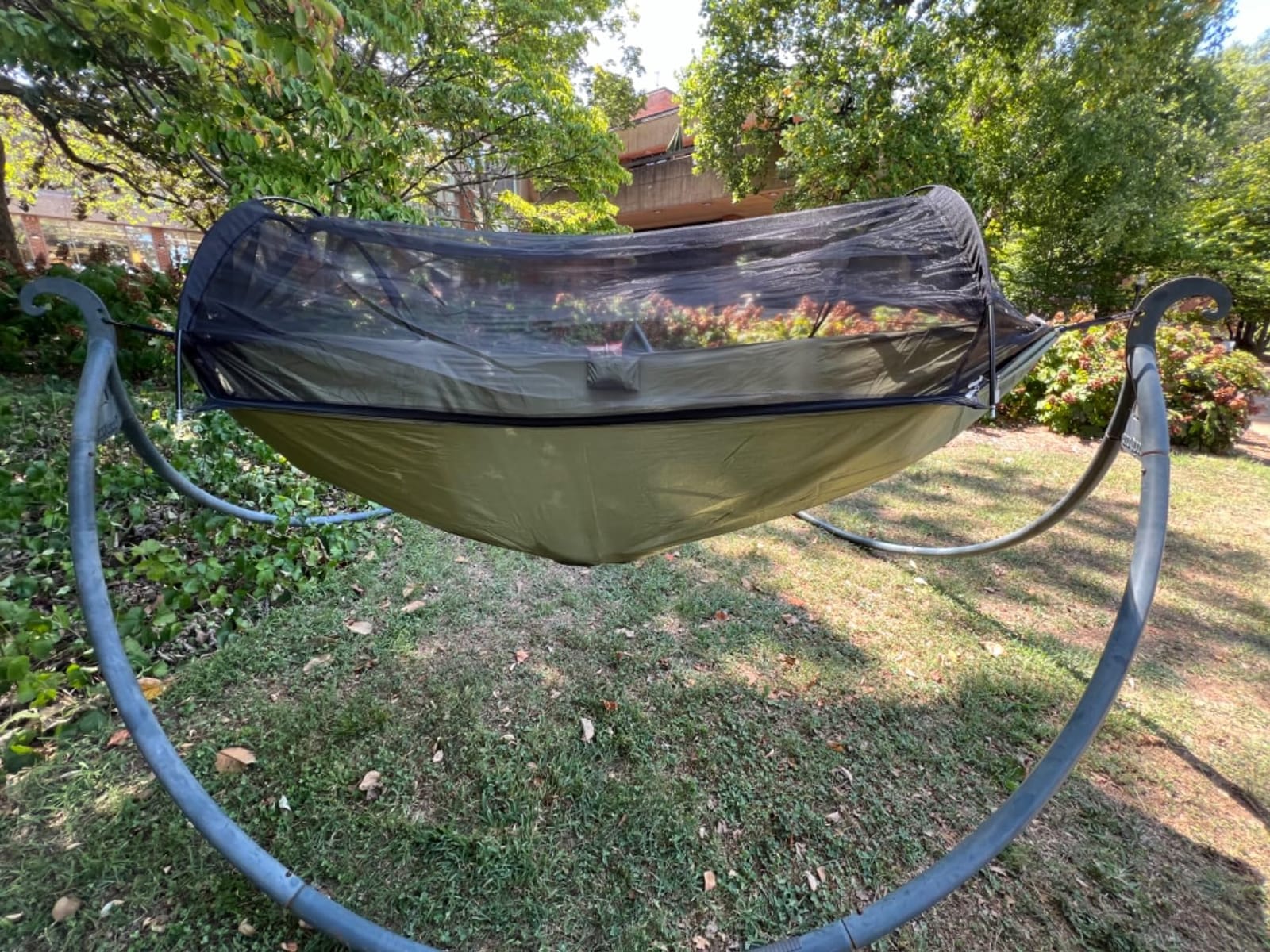
The most common hammock sleep complaint in every forum we read is the net collapsing onto your face in the small hours. The MIZTLI addresses it structurally rather than with extra tie-outs. Two foldable aluminum support poles hold the netting up as a canopy, so the interior feels like a very small tent and your face stays clear from the moment you lie down.
It comes in two sizes, 106 by 55 inches at 500 pounds and 118 by 71 inches at 600 pounds, at 2.7 and 3.2 pounds packed. The 71 inch width in the larger version makes it one of the few single-person options here with genuine shoulder room, and the included 10 foot straps carry 20 plus 2 adjustment loops combined, which is among the finest tension control we tested.
The ripstop parachute nylon with triple interlocking stitching held together well across a year of weekly use with no fraying. The pack sizes at 14.8 by 5.3 by 5 inches or 17 by 5.3 by 5.5 inches are short enough to fit a motorcycle top case.
Two behavior issues to plan around. The hammock can rotate 360 degrees in wind when you are not in it during setup, which is disorienting on a gusty afternoon and means you should clip in and load it before the wind picks up. And the mesh blocks enough airflow that the interior gets genuinely hot in warm weather, which is a direct consequence of the canopy that makes it good in the first place.
Why net clearance changes sleep quality
Contact between mesh and face is not just annoying, it is a repeated micro-wake-up that compounds across a night. A pole-supported canopy removes the problem structurally instead of relying on you to remember to pull the drawstring.
The canopy also leaves room for a pad underneath without the net pressing down on it, which is what you want if you plan to carry one.
Where it becomes a liability
Because the net is sewn in, you cannot strip it for winter or open it for summer afternoons. That makes it a three-season shelter only.
The pole and net combination also makes some hammocks feel unbalanced in the wind. Owners also report the body fabric thin enough that determined mosquitoes found a way through it from underneath on heavy bug nights.
12. Travel Bird 3-in-1 Convertible Hammock: Best for Ground Pitch Backups
Travel Bird 3-in-1 Camping Hammock Tent with Mosquito Net & UV Sunshade
- Converts to a ground tent when no trees are available
- light at 2.6 lb with a very compact pack size
- integrated net and UV shade
- packs down to water-bottle size
- Canopy sags noticeably when pitched as a ground tent
- support poles are inexpensive and breakable
- not waterproof without an added fly
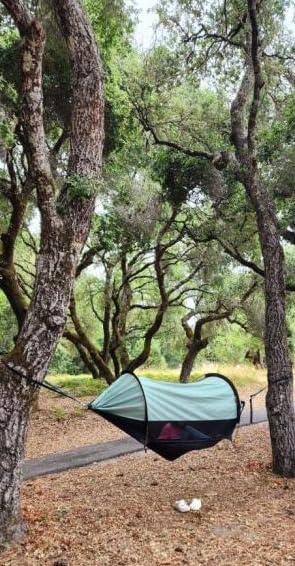
The Travel Bird is the answer to the most practical objection to hammock camping, which is that there are places with no trees. It converts in three ways: an open hammock, a netted hammock, and a ground bivy tent, using the same body and the same two foldable aluminum poles. On mixed routes where you spend some nights in forest and some in the open, that flexibility has real value.
At 2.6 pounds in 70D nylon taffeta, with a 114 by 55 inch open dimension and a 440 pound capacity, it is a light complete unit by the standards of this category. The silver-coated inner layer blocks UV, which extends usable hours in exposed campsites, and the mesh is rated at 48 holes per inch, finer than most of the category. There is a lantern hook above the head, which sounds trivial until you are trying to find it in the dark.
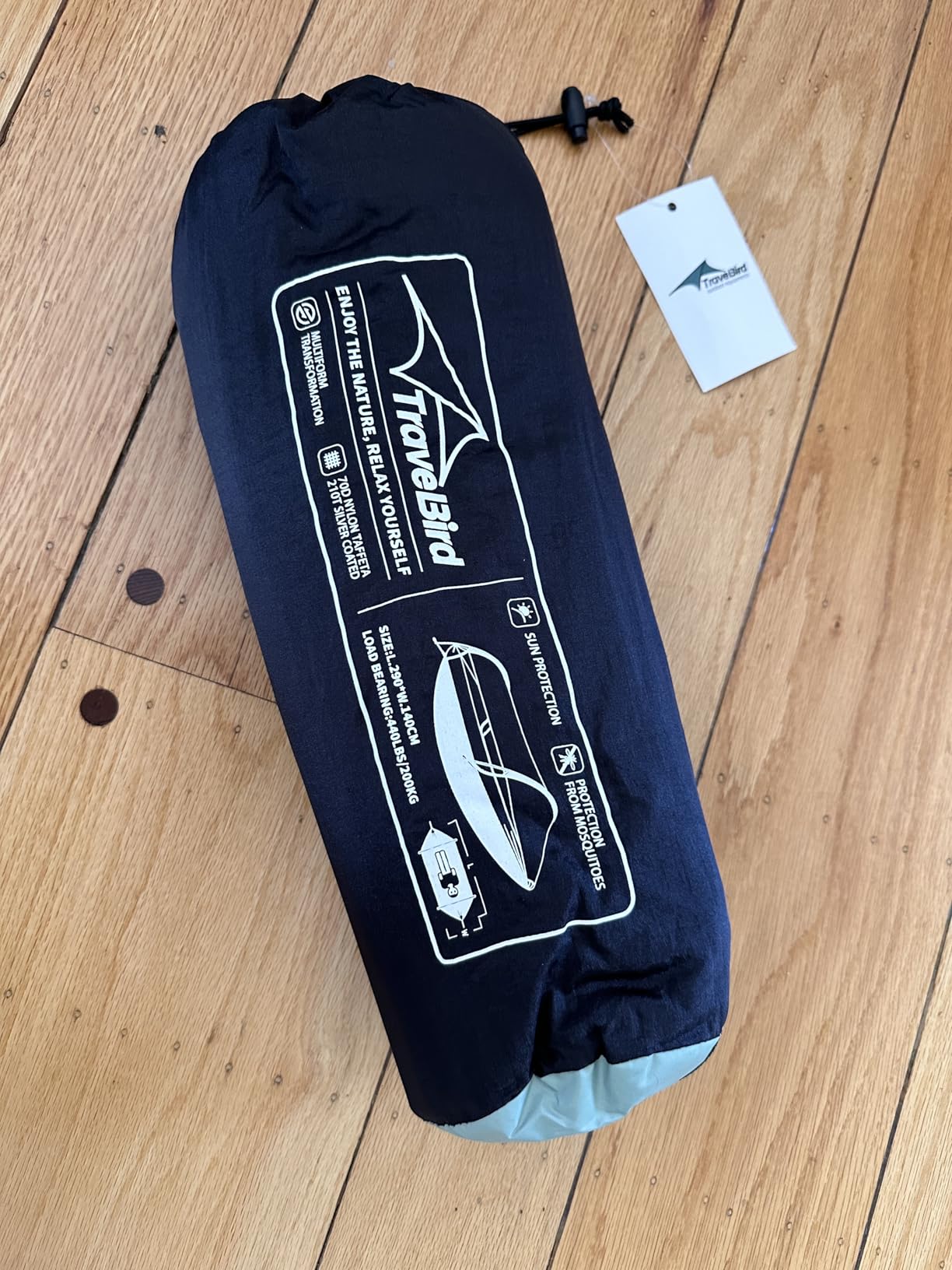
The whole thing stuffs into a sack at water-bottle size, so it fits a motorcycle pannier or a small daypack without becoming the bulky item in the kit.
Build quality is where this loses points. The canopy sags noticeably when pitched as a ground tent, owners report the inexpensive aluminum poles snapping, and the included tree straps are short enough to limit your hang options.
It is not waterproof on its own and owners report getting wet in rain without adding a fly. The sunshade layer also cannot be removed while keeping the mosquito net, and one buyer reported a corner seam tearing after a couple of days.
Why ground capability is worth something
Desert routes, open plains, canyon country, and any stretch above treeline rule out a traditional hammock entirely. Having a unit that converts means you do not have to carry a tent for those segments.
The three-setup design also lets you run it open on warm nights and closed on buggy ones, which is more flexibility than most gathered-end kits give you.
Where the compromises show
Treat the poles as consumable. They are the first thing to fail, and a snapped pole in the backcountry ends the trip.
The sagging ground pitch is the weak point, and you will still need a separate tarp for rain. Check the seams before a long trip, particularly at the corners.
Hammock Tent vs Tent: Which Should You Carry?
A tent wins above treeline, in exposed or alpine terrain, and on any route where reliable trees are more than a short walk away. A hammock wins in dense forest, on sloped or root-covered ground, and wherever finding a flat pitch is the limiting factor. That is the honest split, and the right answer is whichever one matches your route.
On weight, the gap is narrower than most marketing suggests. A complete hammock shelter system typically lands between 1 and 3 pounds, while backpacking tents commonly run 1.5 to 4.5 pounds, with trekking-pole shelters going far lighter. The hammock’s real advantage is packed volume and campsite flexibility rather than a dramatic weight saving.
Where the two diverge hard is temperature. A tent gives you a floor that insulates you and blocks wind from underneath, while a hammock gives you neither. That is why the temperature floor for a casual hammock setup sits near 32F and why underquilt ownership is not optional below that.
If your trip forecast sits near freezing and you have never slept in a hammock before, start with a tent and move to a hammock after a season of practice.
On pitch time, a hammock goes up in roughly five to ten minutes once you have the skill, and it never requires finding a flat pitch. A tent takes longer and demands good ground, but it is something every hiker already knows how to do, and there is no learning curve on night one.
Buying Guide: How to Choose a Hammock Tent for Backpacking
Size, length, and weight limit
Length determines how flat the hammock lies, and length is the single most important sizing decision. Up to 6 feet tall, a 10 foot hammock works but a gathered-end design will still put your knees up. Over 6 feet, an 11 foot minimum is better and a 12 foot body is worth considering if you sleep on your side with one knee bent. Twelve feet is unnecessary for most people.
Width drives the diagonal lay. Anything under 50 inches is genuinely tight, 55 inches fits most sleepers up to about 5 foot 8, and 79 inches or wider is what makes sharing or two-person use realistic. The flattest option is the flat-lay spreader bar design, which skips the diagonal entirely.
Weight limit is where people get burned out. Never run a hammock at its stated maximum. Add your body weight, your gear, and an underquilt, then keep at least a 20 percent margin. A 250 pound limit hammock is fine for a 170 pound hiker with a 15 pound pack and a 5 pound underquilt, and unsuitable for the same hiker in winter gear. The 500 and 600 pound options in this roundup exist for a reason.
Suspension systems
Whoopie slings, daisy-chain straps, and webbing straps are the three options, and they differ more than the marketing suggests. Whoopie slings are the lightest and hold the most weight, but they require a splice and a knot you have to learn. Daisy chains, like the 16-loop straps on several picks here, adjust in small increments and never need knots. Webbing straps are the simplest and heaviest.
Whatever you use, wide straps matter for the tree. Two inches of webbing or a 1 inch strap is the minimum, and anything narrower can scar bark. A structural ridgeline, a separate fixed line between the trees that the hammock clips to, is the biggest single upgrade you can make: it makes the shape repeatable instead of something you re-tune every night.
Bug nets
Mesh specification is stated in holes per square inch, and the number matters in the backcountry. Around 750 holes per square inch stops mosquitoes, while 2500 holes per square inch also stops no-see-ums, which are a genuine misery in the southern and coastal ranges and in parts of the Rockies in late summer.
Three practical questions decide whether a net will work for you. Can it be removed, so you can run open-air sleeping in warm weather? Does it hold away from your face, either through side pulls, drawstrings, or a pole-supported canopy? And does the zipper run far enough that you can get in and out in one motion? Zippers that stop mid-hammock come up repeatedly in the owner reviews we read, and it is worth checking before you buy.
Tarps and rain flies
Always carry a tarp unless the forecast is dry and bug free for the entire trip. It must fully cover the hammock at both ends, not just the middle, which is where the common complaint about undersized included flies comes from. Look for a tarp you can pitch with at least six guylines, eight in wind, and prefer a hex shape over a diamond because it tensions more predictably between two trees.
Material is a trade-off. Silnylon is cheap and light but stretches and sags once wet. Dyneema and other UHMWPE fabrics pack smaller, do not sag when wet, and cost more. For most hikers a 6 by 8 foot tarp handles a single hammock, and a 6 by 10 or rectangular shape covers a double or a shared site.
Insulation: underquilt versus sleeping pad
This is the part first-time buyers skip, and it is the reason so many people get cold in a hammock in September. A sleeping pad underneath is workable but slips, twists, and leaves your shoulders and hips touching cold air because it is narrower than your body. An underquilt is the correct answer.
An underquilt is an insulated quilt that hangs underneath the hammock from the same straps, trapping still air below you. It moves with the hammock, does not slip, and covers your full body. The critical rule is that there must be no gap between the underquilt and the hammock body, because air moving through that gap is what strips heat.
Gathered-end versus flat lay
Gathered-end hammocks are cheaper, lighter, and pack smaller, and they force a diagonal lay. Bridge and flat-lay designs use a spreader bar to create a flat platform that back and side sleepers can use, at the cost of weight and packed size. If you have never slept well in a hammock because of the curve, a flat-lay design is worth the extra ounces. If you sleep fine curled, stay with the lighter gathered-end models.
All-in-one kits versus building your own
A kit gets you sleeping tonight with one purchase and one decision, which is why most people should start there. Building your own lets you replace each component with exactly what you want later, and it is the only way to get down to a genuinely low base weight because most included accessories are heavier than the specialists you would buy.
The order to build in is always the same: hammock body first, then suspension straps, then a tarp, then insulation underneath. Add a bug net only if your body does not come with one. Buying in that order means you have a usable shelter at every stage instead of a pile of parts for a month.
Cold Butt Syndrome: How to Stay Warm in a Hammock
Cold butt syndrome is the name hammock campers gave to waking up cold from underneath, and it is the number one complaint across every hammock forum we read. It is not a gear failure. It is air movement, and it is almost always fixable for the price of a small piece of foam.
The cause is a gap. Warm air collects under an underquilt, and if the suspension is loose enough that air circulates between the underquilt and the hammock body, that trapped heat gets flushed out and replaced with cold. The gathered ends of the hammock compress the insulation and create a channel where wind can drive straight through the fabric.
Fix it in this order, cheapest and most effective first:
- Tighten the underquilt suspension until there is no perceptible air gap under you. If you can feel moving air beneath the hammock, that is your heat loss.
- Add loft under your head and neck. A thicker pillow raises your head away from the cool fabric, and the head is a large share of your exposed surface area.
- Place a small closed-cell foam pad under your seat. The gathered end is where most campers lose heat, and a few ounces of foam there cuts the loss dramatically.
- Confirm the rating. Check the underquilt temperature rating against your expected low rather than your daytime high. Ratings assume a specific compression and a specific setup.
- Close the ends of the hammock. Cinch the gathered ends so wind cannot drive through the fabric, and use a hammock with a solid bottom if you own one.
- Move to a double-layer hammock for genuine winter work, or switch to a tent when the forecast drops below your setup’s floor.
One reassurance that converts more first-timers than any other: you cannot overheat from an underquilt. It hangs outside the hammock rather than wrapping around you, so it cannot trap heat on top of you. If you feel warm from underneath, the fix is more insulation, never less.
Hanging a Hammock Without Damaging Trees
Leave No Trace compliance is not optional in good camping country, and it is entirely a matter of technique. Most tree damage in camping comes from narrow straps, from hanging too high, and from driving anything metal into bark.
Use wide straps, one inch minimum and two inches better, always. Hang the ridgeline at a 30 degree angle from horizontal, which spreads the load rather than concentrating it, and keep your head clearance at least 18 inches off the ground so you do not swing into roots at night. Never use a carabiner directly against bark, since the gate pin will scar it.
Pick trees with wide diameter and healthy cambium, keep well away from the base of live trees, and stay out of research plots, rare species areas, and any site with posted restrictions. Before you leave, pull your straps all the way down and check that no fabric is caught in bark. If you want help judging which campsites are workable, our guide to GPS devices for hiking and backpacking is useful for confirming your route and campsite spread.
Frequently Asked Questions
Is it a good idea to use a hammock for backpacking?
Yes, if two conditions hold: reliable trees within about 15 feet of your campsite, and insulation that hangs beneath you. A hammock lets you ignore sloped, rooty, or wet ground and removes the need to find a flat pitch. It fails above treeline, in exposed desert or canyon country, and below about 32F without a proper cold weather kit.
Is a tent or hammock better for backpacking?
A tent wins above treeline, in exposed terrain, and anywhere trees are scarce. A hammock wins in dense forest, on slopes, wet ground, and root-covered campsites where a tent pitch is miserable. On weight the gap is modest: complete hammock systems run about 1 to 3 lb and backpacking tents about 1.5 to 4.5 lb. Hammocks win more on campsite flexibility than on ounces.
What is the best affordable hammock for backpacking?
Among the picks in this roundup, the FIRINER complete kit and the Sunyear single with net and rain fly are the strongest affordable options, both shipping with straps, carabiners, netting, and a fly. Budget for the system, not the hammock: budget hammocks still need an underquilt and a tarp before you are warm and dry.
Why am I still cold in my hammock even with an underquilt?
Almost always a gap. Tighten the underquilt suspension until you cannot feel moving air beneath the hammock, add loft under your head and neck, and place a small closed-cell foam pad under your seat where the gathered ends compress insulation. Also confirm the underquilt rating is below your expected low, and cinch the hammock ends so wind cannot blow through.
What is the best hammock tarp for backpacking?
A tarp that fully covers the hammock at both ends, is waterproof, packs small, and takes at least six guylines, eight in wind. A hex shape tensions more predictably between two trees than a diamond. Silnylon is the budget choice but sags when wet, while Dyneema packs smaller and holds shape in rain. Many included flies are too small for the hammock they ship with.
Conclusion: The Best Hammock Tents for Backpacking
The Sunyear Camping Hammock with Net and Rain Fly is our pick for the best hammock tents for backpacking because it combines a complete box, a 500 pound rating, the largest review base in the category, and a lifetime warranty in one package. The FIRINER kit is the lightest complete netted shelter we tested, and the Easthills Jungle Explorer is the best value and the answer for anyone sharing a hammock or carrying more than 300 pounds.
Beyond those three: the WintMing is built for sustained rain and strong wind, the Sunyear Black Bundle is the best first tarp pitch thanks to its included ridgeline, the Ryno Tuff XL is the budget option for heavy campers, the Night Cat 4-in-1 suits jungle trails, the Haven lay-flat tent rescues back and side sleepers, the Hennessy Expedition Classic is the ultralight thru-hiker’s choice, the Night Cat Flat Lay adds a porch, the MIZTLI keeps the net off your face, and the Travel Bird converts to a ground pitch when the trees run out.
Whichever one you choose, buy it as a system: body, straps, tarp, underquilt, in that order. Spend one night in your backyard before you ask it to carry you through a cold night in the woods, because the fit problems that ruin hammock trips show up on night one and only there. This roundup was tested and updated for 2026, and the picks hold up as long as you match one to your route, your body size, and your lowest expected temperature.