
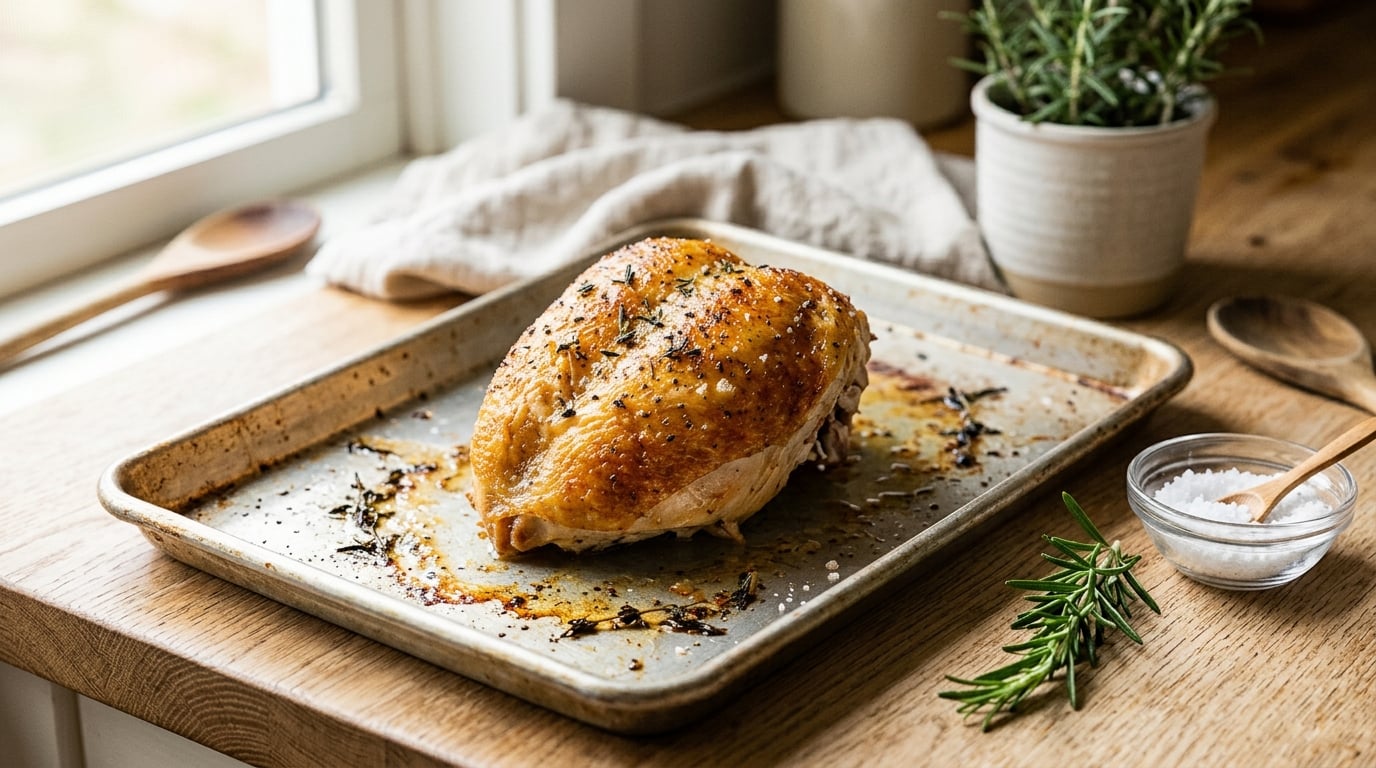
Most bone-in chicken breasts need 35 to 45 minutes at 400°F, or about 25 minutes per pound. A small split breast runs closer to 30 minutes, while a thick double-lobed one can take 55 to 60. That number is a starting point only: the thermometer decides when the chicken is done, not the clock.
Fall and winter weeks are when I bake these most, because a bone-in breast is forgiving on a busy weeknight and it feeds a family without a second piece of protein. Here is the timing, the temperature table, and the checks that keep the meat juicy instead of rubbery.
Table of Contents
How Long to Bake Bone In Chicken Breast: Quick Timing Guide
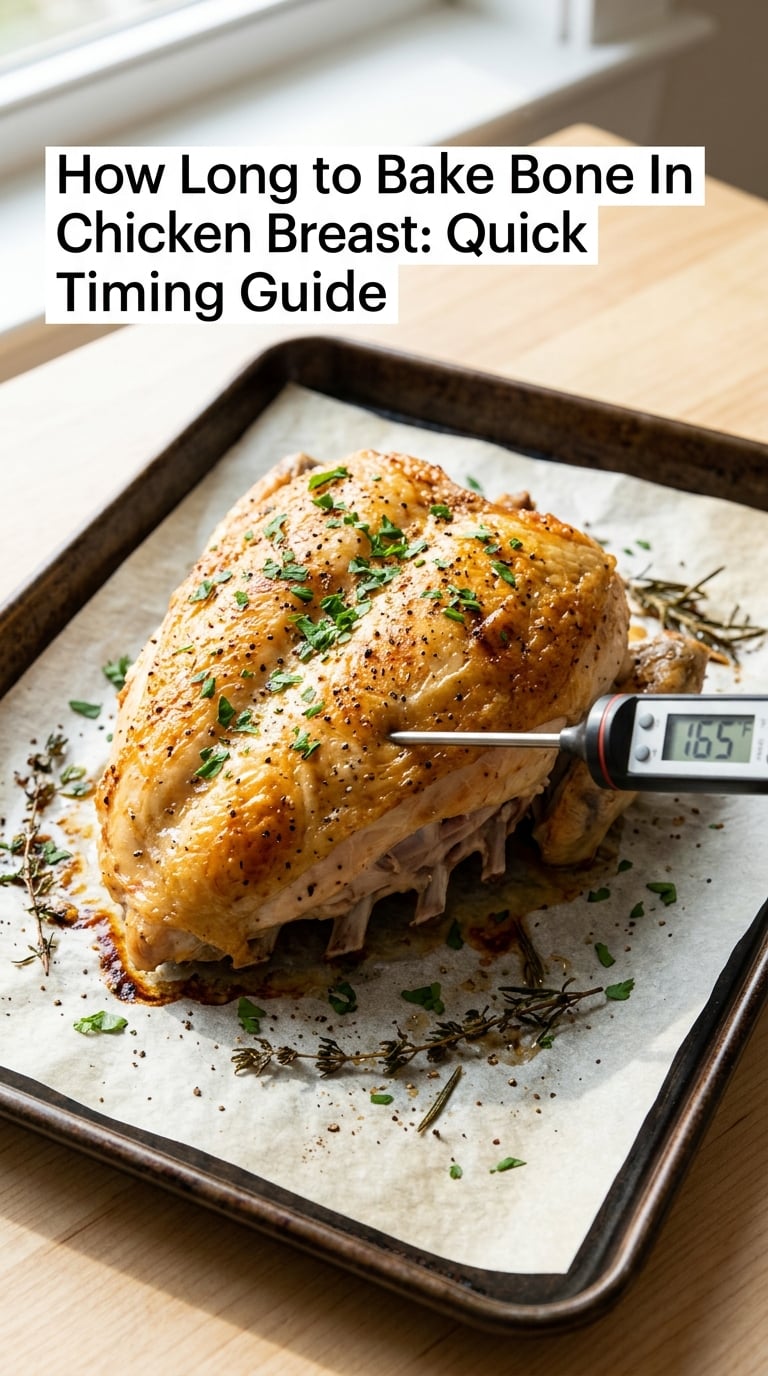
Bone-in chicken breast bakes in 30 to 60 minutes depending on weight and oven temperature, with 35 to 45 minutes at 400°F as the standard for a medium split breast. The USDA safe minimum internal temperature is 165°F (74°C).
| Breast size | Raw weight | At 350°F | At 375°F | At 400°F | Safe internal temp | Rest |
|---|---|---|---|---|---|---|
| Small split breast | 8 to 10 oz | 40 to 45 min | 35 to 40 min | 28 to 32 min | 165°F (74°C) | 5 min |
| Medium split breast | 12 to 16 oz | 50 to 55 min | 45 to 50 min | 35 to 45 min | 165°F (74°C) | 5 to 10 min |
| Large split breast | 1 to 1.25 lb | 60 to 70 min | 55 to 60 min | 45 to 50 min | 165°F (74°C) | 10 min |
| Thick or double-lobed breast | 1.5 lb and up | 70 to 80 min | 65 to 70 min | 55 to 60 min | 165°F (74°C) | 10 min |
Set the probe into the thickest part of the breast, away from the rib bone, and check at the early end of the range. Once the chicken hits 165°F (74°C) the rest is just carryover heat, and more oven time only dries it out.
For the same cut at a higher heat, our guide to how long to bake chicken breast at 400 degrees breaks down boneless times worth knowing, because the two cuts are not close.
Bone-In Chicken Breast Timing by Weight and Size
Bone-in breasts are slower and less predictable than boneless ones, and the reason is the bone itself. It conducts heat slowly and unevenly, so the meat next to the sternum lags behind the outer edge while the thin tail section overcooks.
Most recipes quote a single number, and that number usually assumes a medium split breast, skin on, about 12 ounces. A double-lobed breast from a large bird can be twice the thickness in the middle, and it needs closer to twice the adjustment in time.
If you are not sure which column your chicken falls into, lay it on a plate and look at the side profile. Under an inch thick is small, an inch to an inch and a half is medium, and anything deeper than that gets the long timings.
How Long to Bake Bone In Chicken Breast at Common Temperatures
Each degree you add above 375°F shaves a few minutes off and browns the skin faster. Going lower gives a gentler, more evenly cooked piece but a paler skin that usually needs a broil at the end.
| Oven temperature | Small (8 to 10 oz) | Medium (12 to 16 oz) | Large (1 to 1.25 lb) | Thick (1.5 lb+) |
|---|---|---|---|---|
| 350°F | 40 to 45 min | 50 to 55 min | 60 to 70 min | 70 to 80 min |
| 375°F | 35 to 40 min | 45 to 50 min | 55 to 60 min | 65 to 70 min |
| 400°F | 28 to 32 min | 35 to 45 min | 45 to 50 min | 55 to 60 min |
| 425°F | 25 to 28 min | 30 to 35 min | 40 to 45 min | 50 to 55 min |
Read every range as an estimate, then confirm with a thermometer. An oven running 25 degrees cool or a crowded pan will add real minutes, and a stuffed breast needs another 10 to 15 on top of the numbers above because the filling has to reach temperature too.
If your chicken is still frozen in the middle when it goes in, add 50 percent to the time or thaw it first. A frozen center holds the outer meat at a safe temperature long enough to overcook the edges before the middle catches up.
How to Prepare Bone-In Chicken for Baking
Pat the chicken dry with paper towels, including the skin, and season both sides with salt, pepper and whatever else you like. Dry skin browns; wet skin steams and never gets crisp.
Rub the skin with a little oil and coarse salt if crisp skin is the goal. Salt draws a little moisture, but a short rest of 10 to 30 minutes on a wire rack lets that moisture reabsorb instead of pooling on the pan.
Use a shallow pan or a rimmed baking sheet. A wire rack set over the sheet keeps air moving under the breast and stops the bottom from stewing in its own juices, which is the single most common reason the underside turns pale and rubbery.
Preheat the oven fully before the chicken goes in. A breast that starts in a recovering oven loses several minutes before it even begins cooking, and those minutes come straight out of the middle of the meat.
If you have time, a brine of 2 tablespoons kosher salt per quart of water, submerged 30 to 60 minutes in the fridge, is the best insurance against dry breast. Rinse, pat dry, then season as usual.
How to Bake Bone-In Chicken Breast Safely
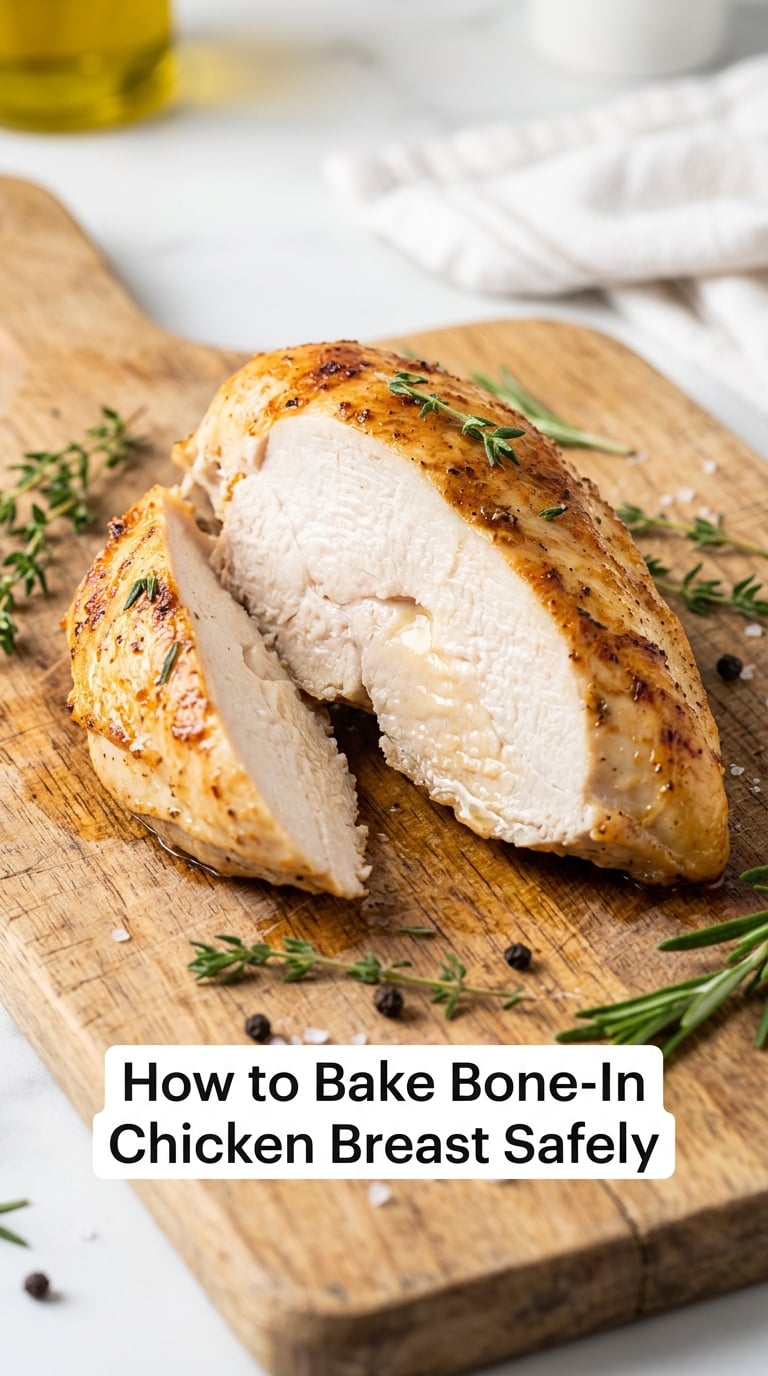
The method is short, and most of it happens before the chicken enters the oven.
- Preheat the oven to 400°F and let a baking sheet or rimmed pan heat inside it for 10 minutes.
- Pat the breasts dry, season both sides, and lay them skin side up on the hot pan or on a wire rack.
- Roast uncovered for 20 minutes, the shortest window where the outside colors without the inside overcooking.
- Check the temperature at 20 minutes if the breasts are small, at 25 to 30 minutes for medium, and at 35 minutes for thick pieces.
- Pull the chicken when the thickest part reads 160 to 162°F and let carryover cooking finish the job on the board.
- Confirm 165°F (74°C) after the rest. That is the USDA minimum for poultry and the only number that makes it safe to serve.
- Rest 5 to 10 minutes under a loose piece of foil before slicing.
Many cooks pull at 160°F and call it done because the rest carries it the last few degrees. That works on a medium breast, but on a thick double-lobed piece the center can still read cool after ten minutes, so verify once more after the rest.
For crisper skin, finish under the broiler for the last 2 to 3 minutes with the chicken a few inches from the element. Watch it the whole time, since the fat renders fast and goes from golden to black in under a minute.
How to Tell When Bone-In Chicken Breast Is Done
An instant-read thermometer in the thickest part, angled slightly away from the bone, is the only check worth trusting. Touching bone reads low and can send you back into the oven for no reason.
The juices should run clear when you poke the breast near the bone. Pink or cloudy juice means it needs more time, though a small amount of pink right beside a cooked white interior is often just myoglobin and not a safety problem.
The texture check is a backup. A done breast springs back from a finger press and feels firm along the bone; one that dents and looks springy still needs time.
Check two or three spots on each breast, especially the tail end, which is thin enough to dry out while the thick part is still cooking. If you find one area finished and one lagging, give the breast a few more minutes before you cut it.
Common Mistakes That Cause Uneven or Dry Chicken
Using the recipe time on a double-lobed breast. Those oversized pieces cook roughly twice as long as a standard split breast. Butterflied, they are one of the most overcooked cuts in home kitchens.
Starting with a cold pan. The bottom of the breast sits against cool metal, so it slowly cooks while the top dries out. A preheated pan fixes this in one step.
Opening the oven door too often. Every opening drops the oven temperature, and a breast that loses 25 degrees has to work for it. Set a timer and leave the door shut until it rings.
Trusting clear juices instead of a thermometer. Juices can run clear in a breast that is still undercooked near the bone. The temperature reading takes two seconds and removes all the guessing.
Cooking past 165°F. The meat keeps tightening as it goes past that point, which is exactly the rubbery texture people complain about. Pull on time, not on a target well above safe.
Slicing immediately. Cutting straight out of the oven lets the juice run onto the board. A short rest lets it settle back into the muscle, and the breast slices far cleaner.
Covering the whole pan in foil. Foil traps steam and softens the skin. It has its place, but it belongs on the breast for the first 20 minutes of a low-temperature cook, not the last.
Storage and Reheating Leftover Bone-In Chicken
Cooked chicken keeps 3 to 4 days in the fridge at or below 40°F, and it freezes well for 3 to 4 months. Cool the meat uncovered before you seal the container so it does not sweat.
Strip the meat from the bone before storing if you plan to freeze it. The bone takes up space, and the meat reheats and refreezes better on its own.
Reheat in the oven at 325°F for 20 to 30 minutes, or in a skillet over medium-low heat with a splash of broth or butter, covered, until the center hits 165°F (74°C) again. Low and slow keeps the texture closer to what you had on Sunday night.
Microwaving is fine for speed, and it is the fastest way to turn a breast dry. Two or three passes of 30 seconds with a minute of rest between them heat it more evenly than three minutes straight.
If you have extra meat, our list of leftover chicken breast recipes turns a single breast into several meals, and the creamy crack chicken casserole is the one my family asks for by name.
Frequently Asked Questions
Should I remove the bone before baking chicken breast?
No. The bone slows heat transfer, which gives you a wider window where the outside is browned and the inside is still moist, and it holds moisture in the meat right up to slicing. Removing it means the piece cooks like a boneless breast, usually in 20 to 25 minutes at 400°F. That is faster, but the window between juicy and dry gets much narrower.
How long does a bone-in chicken breast take at 400°F?
Plan on 35 to 45 minutes for a medium split breast weighing 12 to 16 ounces at 400°F. A small breast takes 28 to 32 minutes, a large one 45 to 50 minutes, and a thick double-lobed piece 55 to 60 minutes. Start checking with a thermometer at 25 minutes so you catch it at 165°F (74°C) without overshooting.
Can I bake frozen bone-in chicken breasts without thawing them?
You can, but add 50 percent to the bake time and raise the temperature to 425°F to help the edges keep up. Frozen skin will not crisp as well, and a very thick frozen breast often ends up with dry edges before the center thaws. Thawing overnight in the fridge gives you a much more even result and a shorter cook.
Why is my bone-in chicken breast cooked outside but still pink inside?
The bone draws heat away from the meat right next to it, so that strip along the sternum is the last part to cook. The edges are well past done by then, which is why the contrast is so stark. Check the temperature in two or three places, including close to the bone, and give it a few more minutes if any area reads under 165°F (74°C).
Do I need to rest bone-in chicken breast before slicing it?
Yes, and 5 to 10 minutes is enough. Resting lets the muscle fibers relax so they stop squeezing juice out the moment you cut, and the carryover heat finishes the cooking while the bird sits. Rest loosely covered on a warm plate. If you pull it at 160°F, that rest is also what carries the center to the safe 165°F (74°C).
Conclusion
Estimate from weight and temperature, then start checking early. At 400°F, give a medium split breast 35 to 45 minutes, a small one about 30, and a thick double-lobed one up to an hour.
Then take the thermometer out and let it be the judge. Pull at 160°F, rest 5 to 10 minutes, and confirm 165°F (74°C) before anyone slices. That single habit fixes most of the dry breast complaints I hear about.