
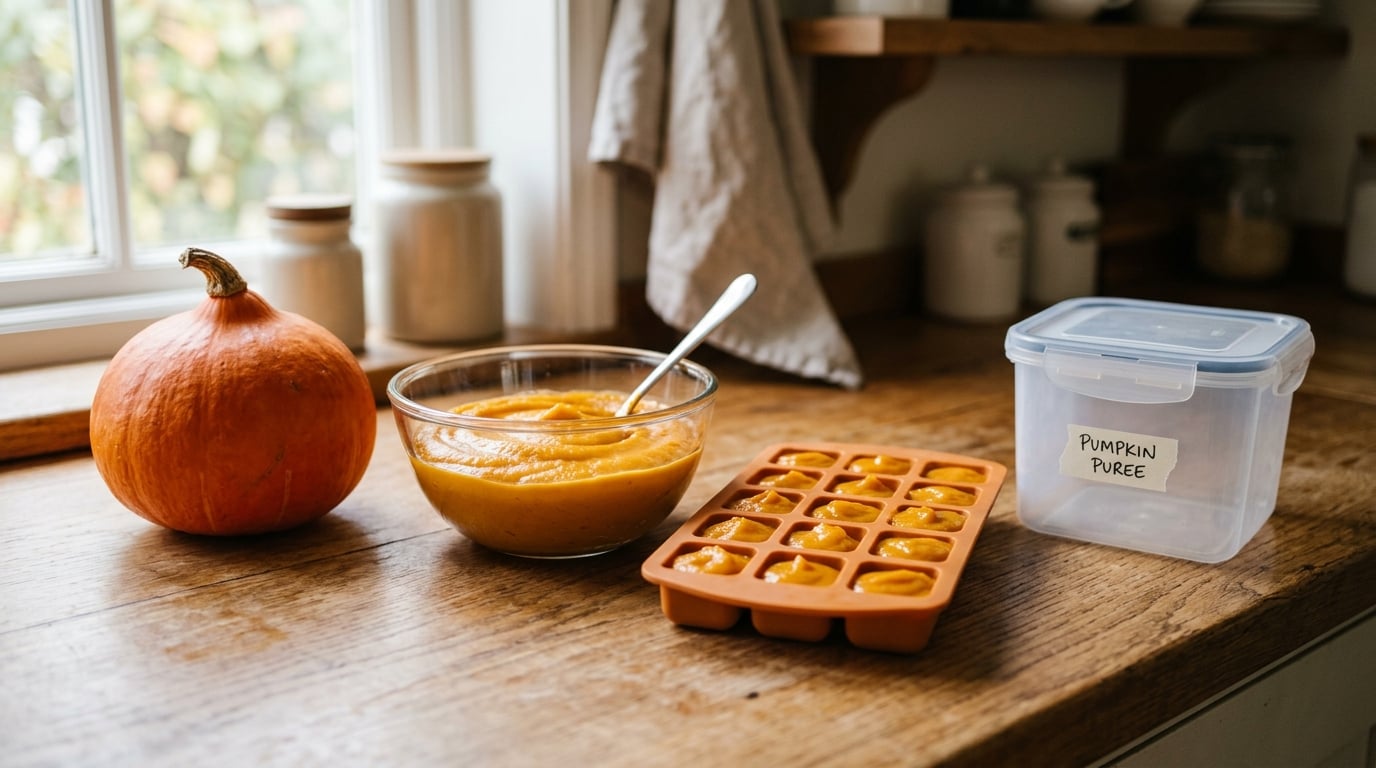
You can freeze pumpkin puree for up to 3 to 6 months at its best, and up to 12 months before quality really slides. Cool it first, portion it into 1-cup amounts, pack it in airtight freezer-safe bags or containers with half an inch of headspace, label with the date, and get it into the freezer.
Fall pumpkin does not wait for you. A whole pie pumpkin roasted and pureed on a Sunday is still around in February if you freeze it, and so is the two tablespoons of puree left in a can you opened for one pie. Freezing pumpkin puree takes about fifteen minutes of actual work.
The one rule that catches people: never freeze puree in the can. Liquid expands as it freezes, and a metal can can crack or burst. Move the puree into a container first. More on that below.
Once your freezer is stocked, [15 Easy Pumpkin Recipes for Fall Baking](https://thesweetandsimplekitchen.com/15-easy-pumpkin-recipes-for-fall-baking/) is a good place to start planning what those portions go toward.
Table of Contents
How to Freeze Pumpkin Puree: Quick Storage Guide
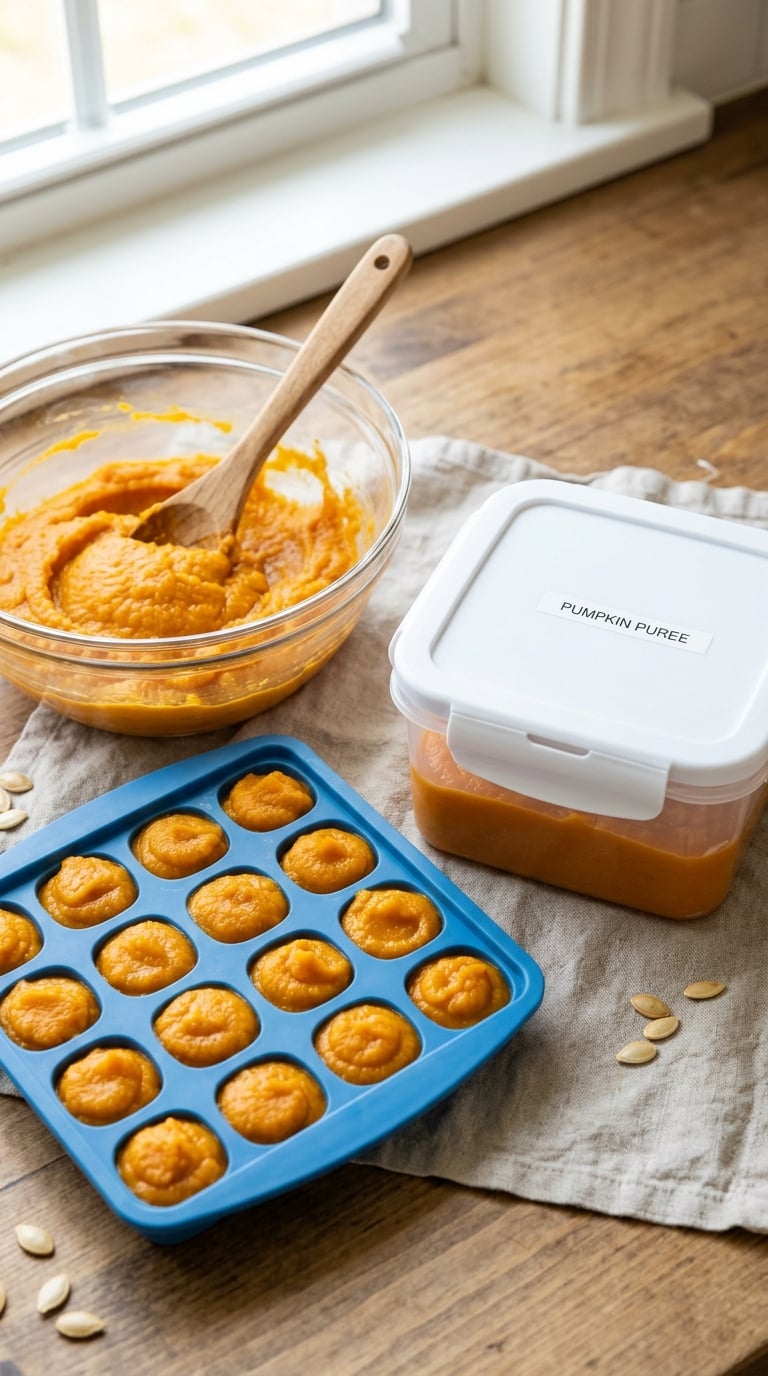
Here is the short version of how to freeze pumpkin puree, with the numbers you actually need. Portion size is the decision that matters most, because frozen puree you cannot break apart cleanly is puree you thaw and waste.
| What to decide | What to do |
|---|---|
| Portion size for baking | 1 cup per bag or container |
| Portion size for smoothies | 1 tablespoon per ice cube |
| Portion size for one pie | 2 cups in a rigid container |
| Headspace in rigid containers | 1/2 inch, more for single servings |
| Freezer time, best quality | 3 to 6 months |
| Freezer time, safe limit | up to 12 months |
| Refrigerator time after cooking or opening | 4 to 7 days |
| Thaw time in the fridge | 12 to 24 hours |
Cooked and opened-canned puree keeps about four to seven days in the refrigerator, which is the same window most leftover cooked foods get. Freezing is the only way to stretch fall pumpkin into winter.
What Kind of Pumpkin Puree Can You Freeze?
Yes, you can freeze homemade pumpkin puree, and yes, you can freeze canned pumpkin puree. They behave almost identically once cooked, because both are already a smooth, high-moisture, unsweetened puree with no starches to turn gummy.
Homemade puree tends to be thinner and more flavorful. Canned puree is more consistent in thickness, which actually makes it easier to measure portions. If your homemade puree came from a very watery sugar pumpkin, the thinness is the reason your pie filling can weep.
Sweetened pie filling is a different story. Freezing sweetened pumpkin pie filling is not the same as freezing puree, because the sugar and condensed milk change with cold, and dairy-based fillings are best kept refrigerated. Freeze the plain puree and sweeten it when you bake.
Raw pumpkin freezes too, but blanching helps. Raw pumpkin freezes fine for three to six months without blanching if you cook it from frozen, though blanching for three minutes first keeps the texture firmer after thawing. Since most people who ask about freezing raw pumpkin are really trying to save pie pumpkins, and puree goes into the freezer better than chunks, pureeing before you freeze is the route I use.
How to Prepare Pumpkin Puree for Freezing
Pumpkin puree is very wet, and that water is the only thing that can go wrong with it. A few minutes of prep before packaging keeps thawed puree smooth instead of split into solids and liquid.
Cool the puree first. Warm puree going into a freezer container raises the temperature inside the freezer and speeds up freezer burn for everything around it. Spread it in a shallow bowl and let it sit until it stops steaming, then chill it in the refrigerator for an hour or two. Cool puree also sets up thicker, so it scoops cleanly instead of sloshing into the bag.
Skim any foam or surface liquid. A skin of water on top means less puree per container and thinner thawed results. Spoon off what you can.
If your puree is noticeably loose, reduce it in a saucepan over medium-low heat until it thickens to the consistency of thick yogurt. Simmering concentrates the flavor too, which is a bonus for bread and muffins. Another option is to press the puree through a fine sieve or strain it in a mesh strainer lined with cheesecloth, though that takes real time for a small gain.
Season lightly, if at all. Pumpkin holds salt and spices for months, and a faintly seasoned puree that later goes into a boldly spiced pie is much better than one that tastes seasoned on day one and salty by month four.
One more safety note: use clean utensils and cool the puree within two hours of cooking it. Do not let it sit out at room temperature overnight to save a step.
What Containers Are Best for Freezing Pumpkin Puree?
The best container is the one that matches how you cook. Freezer bags for baking portions, ice cube trays for smoothies and taste tests, rigid containers when you want one whole pie’s worth in a single pour.
| Container | Portion it holds | Best for | Freeze flat? |
|---|---|---|---|
| Resealable freezer bag | 1 cup or 2 cups | Most baking, easy to stack | Yes |
| Ice cube tray | 1 tablespoon | Smoothies, shakes, taste testing | No, transfer to a bag |
| Standard muffin tin | 1/2 cup | Single muffin or small loaf | Cover, freeze, pop out |
| Silicone mold or ice block tray | 2 to 4 tablespoons | Larger smoothie portions | No, transfer to a bag |
| Rigid glass or plastic container with a lid | 1 to 4 cups | One pie, soup base, serving scoops | Yes |
| Silicone freezer storage bag | 1 cup or 2 cups | Reusable option with a hard write-on strip | Yes |
Whichever you pick, leave headspace. Liquid expands about nine percent when it freezes, and a rigid container filled to the rim will split its lid or crack its glass. Half an inch is enough for a jar of puree; leave a full inch for wide single-serving containers.
Squeeze the air out of freezer bags before sealing them, then lay them flat on a baking sheet and freeze until solid. Once hard, they stack like books and stop taking up a whole shelf. Trapped air is what causes freezer burn, that dry grey patch on the surface.
Glass containers are the best-looking option and the worst space-savers. Bakers who care about texture and about not freezing puree in a metal can usually get through a whole can in one 2-cup container.
The same portioning logic applies to other cooked staples, by the way. [Can You Freeze Mashed Potatoes for Later?](https://thesweetandsimplekitchen.com/can-you-freeze-mashed-potatoes-for-later/) works on the same headspace and air-removal rules.
How to Freeze Pumpkin Puree
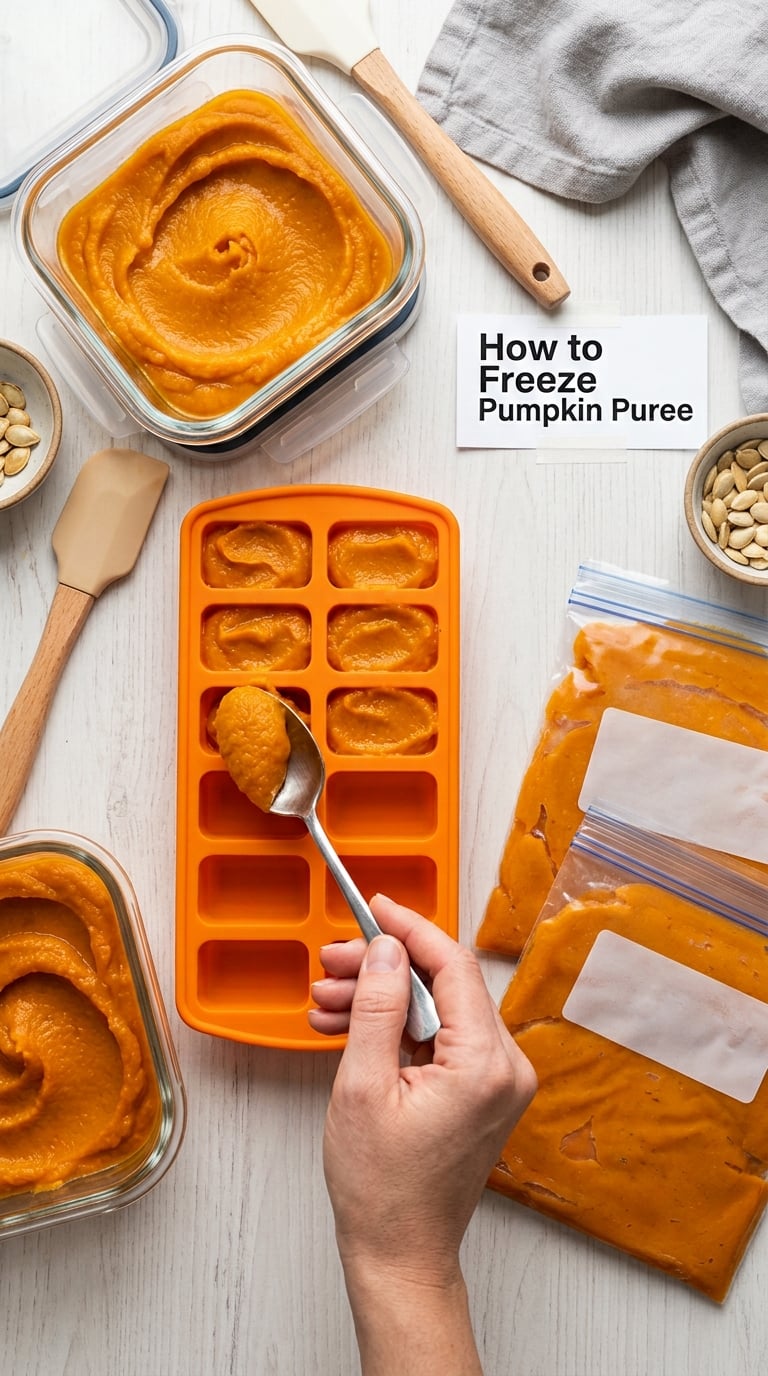
Five steps, one action each, and the whole thing takes about fifteen minutes once the puree is cool.
- Cool the puree. Let it stop steaming, then chill it in the refrigerator until it firms up, about 1 to 2 hours.
- Decide your portions. Measure 1 cup for most baking recipes, 1 tablespoon for ice cubes, or 2 cups for a full pie filling.
- Pack the puree. Fill freezer bags or rigid containers, leaving 1/2 inch of headspace in anything rigid.
- Remove the air. Squeeze the top of each bag until the puree sits in a flat layer, then seal. For containers, press a sheet of parchment or a small plate on top to weigh the puree down.
- Label and freeze. Write the portion size and the month on every bag, stand the containers upright so any leak stays visible, and freeze in the coldest part of the freezer.
Labeling is the step people skip and then wish they had not. Frozen food looks frozen whether it went in on Monday or in August, so write a use-by date six months out and believe it.
Never freeze puree in the can. Expanding liquid can crack or burst the metal, and you would be cleaning pumpkin out of the bottom of your freezer. Scoop it into a container, even for leftovers of two tablespoons.
How Long Does Frozen Pumpkin Puree Last?
Frozen pumpkin puree is safe to eat for up to 12 months in a well-sealed container, but the best flavor and texture sit in the first 3 to 6 months. That gap explains the conflicting numbers you find online: people are quoting the safety limit when they mean the quality limit.
Here is how each storage method compares.
| Storage method | How long it keeps | What to watch |
|---|---|---|
| Countertop, room temperature | About 2 hours | Discard after that, cooked or opened |
| Refrigerator, homemade puree | 4 to 7 days | Smell test after day 4 |
| Refrigerator, opened can | 4 to 7 days | Transfer to glass if you can |
| Freezer, best quality | 3 to 6 months | Use for pies and breads |
| Freezer, safe limit | Up to 12 months | Good for soups and smoothies |
| After thawing in the fridge | 3 days | Refreeze only if it was frozen raw |
You can refreeze thawed puree that was thawed in the refrigerator, as long as you have not warmed it on the counter, but expect the texture to take another hit. Refreezing thawed puree is fine for soup and for blending, and I would not do it for a pie filling.
Freezer burn is a quality issue, not a safety one. If a bag comes out with dry grey patches on top, scrape them off and use the rest. If it smells sour, smells fermented, or has visible fuzzy spots, throw it out no matter how new it is.
How to Thaw Frozen Pumpkin Puree
Move the container to the refrigerator 12 to 24 hours ahead and let it thaw there. This is the method that keeps the texture closest to what you had before freezing, and it is the one to use when you are baking.
For a faster thaw, seal the container in a bowl of cold water and change the water every 30 minutes. A 1-cup portion usually loosens within 1 to 2 hours. Do not use warm water. Warm water thaws the outside of the puree first and leaves the center frozen and the surface in the food-safety danger zone.
Microwave defrost works in short bursts. Run it on defrost for 30 seconds, check, and repeat. Microwaved puree heats unevenly, so stir it between bursts, and keep an eye on it for hot spots.
Countertop thawing takes 2 to 3 hours for a small portion. That is fine for puree going into a soup where it will be boiled anyway, and it is the one method I would skip for anything you plan to eat cold.
Thawed puree often separates slightly, with thin liquid sitting on top of thicker solids. Stir it hard before measuring, and do not drain that liquid off unless your recipe specifically calls for drained pumpkin, because in most batters that liquid is what keeps a loaf or a muffin moist.
Good thawed puree is smooth, thick, and smells like pumpkin. If it smells sour or faintly fizzy, or if there is fuzzy growth on the surface, it goes in the trash.
How to Use Thawed Pumpkin Puree
Most recipes ask for one cup, so freezing in single cups means no measuring and no waiting for a block to soften before you can cut it. Thawed puree works in anything from pie filling to a weeknight soup.
Baking and sweets: pumpkin pie, pumpkin bread, pumpkin muffins, pumpkin pancakes and waffles, cookies, quick breads, bars, and rolled-out pastry where you swap some of the flour for puree.
Savory: pumpkin soup, pumpkin chili, pumpkin pasta sauce, pumpkin hummus, roasted pumpkin soup with curry, and a risotto where a cup of puree swaps some of the stock.
Blended: smoothies, shakes, and overnight oats, where a frozen cube goes straight into the blender without thawing.
Other: baby food for a purée beyond the “use by” window on the jar, homemade dog treats, and pumpkin pancakes for pets with sensitive stomachs. Pumpkin is bland and high in fiber, which is why it works in all of these.
For substitution, one cup of thawed puree usually replaces one cup of the liquid or flour in a recipe, but reduce added sugar by a tablespoon or two since puree brings its own sweetness. In a soup, add it in the last ten minutes over low heat; a hard boil is what makes pumpkin soup turn grainy and split.
If you have a lot of portions to use, start with [12 Best Pumpkin Dessert Recipes](https://thesweetandsimplekitchen.com/best-pumpkin-dessert-recipes-ideas/) for the sweet side, and save the savory ones for the freezer stock you will build next fall.
Common Mistakes When Freezing Pumpkin Puree
Freezing it in the can. Expanding liquid can crack or burst the metal, and you lose the whole can plus freezer cleanup time. Scoop it into a container, even for a small leftover.
Freezing warm puree. Warm puree traps condensation and dries out faster, and it warms everything around it in the freezer. Chill it first.
Filling rigid containers to the rim. Puree expands as it freezes, so a full container splits its lid. Leave half an inch, or a full inch for a wide single-serving tub.
Leaving air in the bag. Trapped air causes freezer burn, which is that dry grey layer you scrape off. Squeeze the bag flat before you seal it.
Skipping the label. A freezer full of grey-white blocks is a guessing game. Write the month and portion size with a marker or a piece of tape.
Thawing in warm water. It warms the outside while the center stays frozen, and it puts the puree into the danger zone. Use cold water and change it often.
Thawing and refreezing repeatedly. Every cycle costs more texture. Thaw only what the recipe needs, and put the rest back in the freezer without letting it soften first.
Believing a 12-month bag still tastes good. Safety and quality are different things. Rotate your oldest portions forward so nothing hits the back of the freezer and stays there for a year.
Frequently Asked Questions
Can you freeze homemade pumpkin puree?
Yes, and it is the best reason to buy pie pumpkins in season. Roast, puree, cool it in the refrigerator, then portion it into 1-cup freezer bags with the air squeezed out. Homemade puree stays safe for up to 12 months frozen and tastes best within 3 to 6 months. If it is thinner than canned puree, simmer it down first so it does not split in your pie.
Can you freeze canned pumpkin puree?
Yes, including the leftover puree from a can you opened for one recipe. Spoon it into a freezer-safe container or bag, leaving half an inch of headspace, seal, and label with the date. Never freeze puree in the can itself, because the expanding liquid can crack or burst the metal. Thaw it in the refrigerator overnight before baking.
How long does pumpkin puree last in the freezer?
Frozen pumpkin puree stays safe to eat for up to 12 months, but flavor and texture are at their best in the first 3 to 6 months. Airtight packaging, squeezed-out air, and headspace all extend that window. If a portion comes out with dry grey patches, scrape them off; if it smells sour or has fuzzy spots, discard it regardless of the date.
Should I thaw frozen pumpkin puree before using it in baking?
Yes, thaw it in the refrigerator for 12 to 24 hours and stir it well before measuring. Pie filling, breads, and muffins all turn out better with thawed puree because you control the exact amount of liquid going into the batter. Blended drinks are the exception: drop a frozen cube straight into the blender. Never drain the separated liquid unless the recipe says to.
Can you freeze pumpkin puree in ice cube trays?
Yes. Fill the tray, smooth the top, freeze until solid, then pop the cubes into a freezer bag so you can stack them and stop losing tray space. One standard cube holds roughly a tablespoon, which is right for smoothies, shakes, and tasting. For bigger servings, use a silicone mold with 2 to 4 tablespoon cavities instead.
Does pumpkin puree freeze better in bags or containers?
Bags win on space and consistency, because they freeze flat and you can push out every bit of air. Rigid containers win when you want one pie’s worth in a single pour, since you can scoop straight from the jar. Both need headspace: half an inch for a jar of puree, a full inch for a wide single-serving container. Label either one with the portion size and month.
Conclusion
The easy way to freeze pumpkin puree is cool it, measure it into 1-cup portions, seal it airtight with half an inch of headspace, label the month, and keep it in the coldest part of the freezer for up to six months. Use small cubes for smoothies and 2-cup containers when you are baking a pie.
Label and date every portion, and pull the oldest forward first. Then pick one recipe before you close the freezer door, because pumpkin that already has a plan is pumpkin that gets used.