
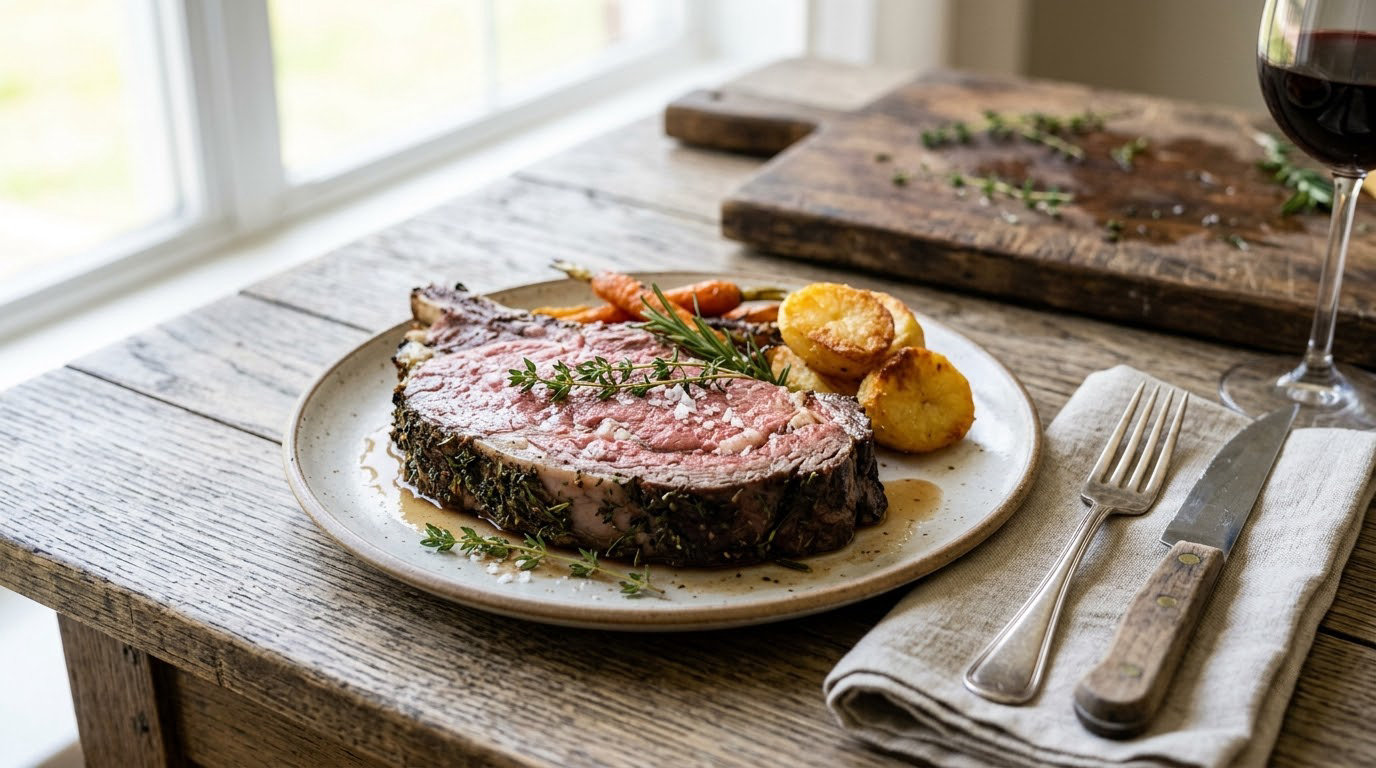
If you only remember one number from this page: pull most beef roasts at 130°F (54°C) for medium-rare or 140°F (60°C) for medium, measured in the thickest part with a meat thermometer. That is the internal temperature you want before the roast rests, because residual heat pushes the number up another 5 to 20°F while it sits. Cook by temperature, not by the clock.
Timetables are a planning tool, nothing more. Two roasts of the same weight can be done ten degrees apart because one came straight from the fridge and one sat on the counter, because one is bone-in and one is boneless, because one oven runs hot and one runs cool. The thermometer is the only number that tells you the truth.
Here is how the temperature question breaks down: the oven temperature you set, the internal temperature you pull for, and the safe minimum the USDA recommends are three different numbers, and mixing them up is where most dry roasts come from.
Table of Contents
What Temperature to Cook a Beef Roast to by Cut
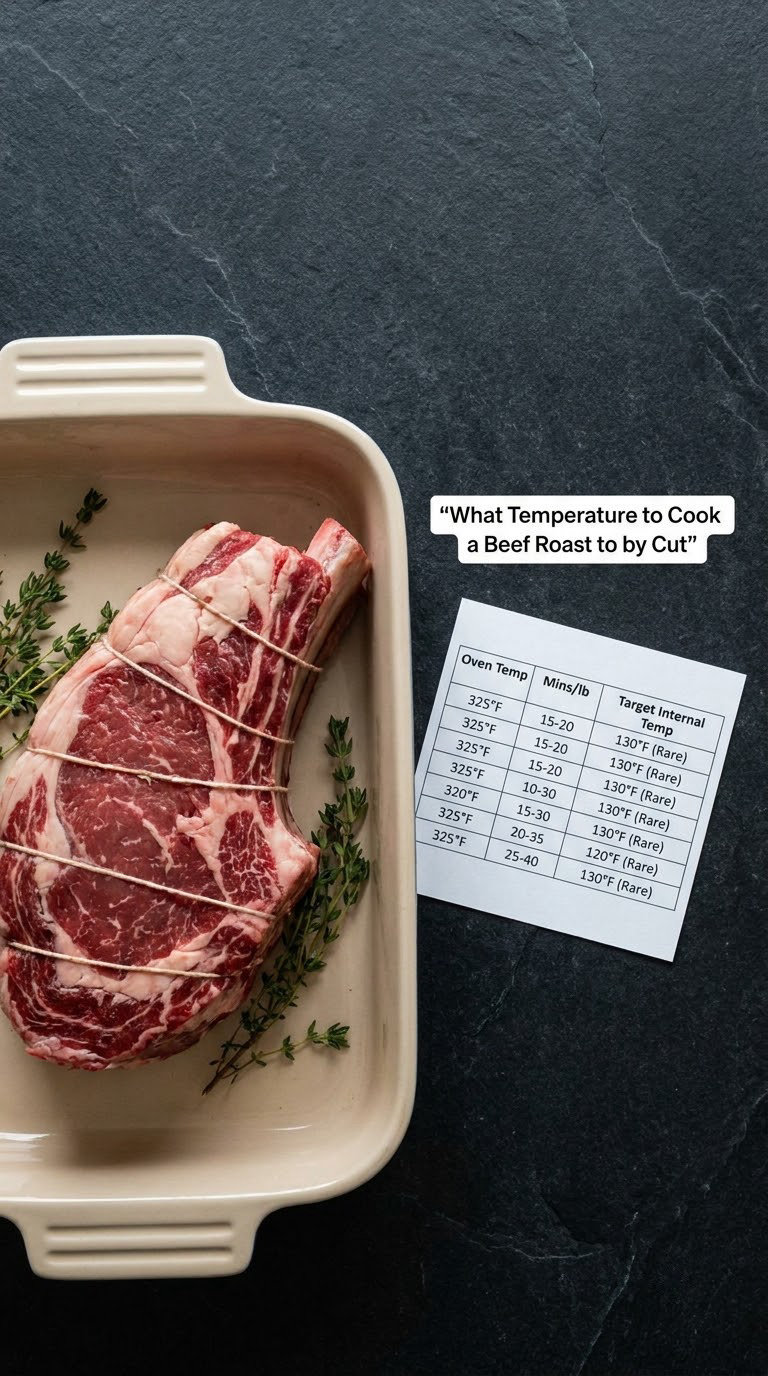
Different cuts want different answers because they carry different amounts of fat, muscle and connective tissue. A rib roast has enough marbling to stay tender past 140°F. An eye of round has almost none and dries out fast, so it comes off the heat early and finishes on carryover.
| Cut | Oven temperature | Approximate time | Pull from the oven at |
|---|---|---|---|
| Standing rib roast (prime rib) | 450°F (232°C) for 15 min, then 325°F (163°C) | 6–8 min per lb | 130–135°F (54–57°C) |
| Beef tenderloin | 425–450°F (218–232°C) | 5–6 min per lb | 125–130°F (52–54°C) |
| Top sirloin roast | 350°F (177°C) | 8–10 min per lb | 130–135°F (54–57°C) |
| Eye of round | 225–250°F (107–121°C), then a 500°F (260°C) blast | 10–12 min per lb | 120–125°F (49–52°C) |
| Top round | 325°F (163°C) | 8–10 min per lb | 130–135°F (54–57°C) |
| Bottom round | 325–350°F (163–177°C) | 8–10 min per lb | 140–150°F (60–66°C) |
| Rump roast | 325°F (163°C) | 8–10 min per lb | 145–150°F (63–66°C) |
| Chuck roast, roasted dry | 325°F (163°C) | 6–8 min per lb | 160–180°F (71–82°C) |
Notice the chuck row. It is the only cut on this list that gets pulled hot, and that is not a mistake. Chuck is full of collagen, and collagen does not soften at 135°F. It needs sustained heat in the 160–200°F range, plus liquid, before it turns tender. For a pot-style cook, most people go all the way to 195–205°F (90–96°C) and shred it.
If you want more chuck ideas, my 10 best chuck roast recipes beyond pot roast covers the shapes and sizes that cook best wet.
Roast Temperatures and Doneness Targets
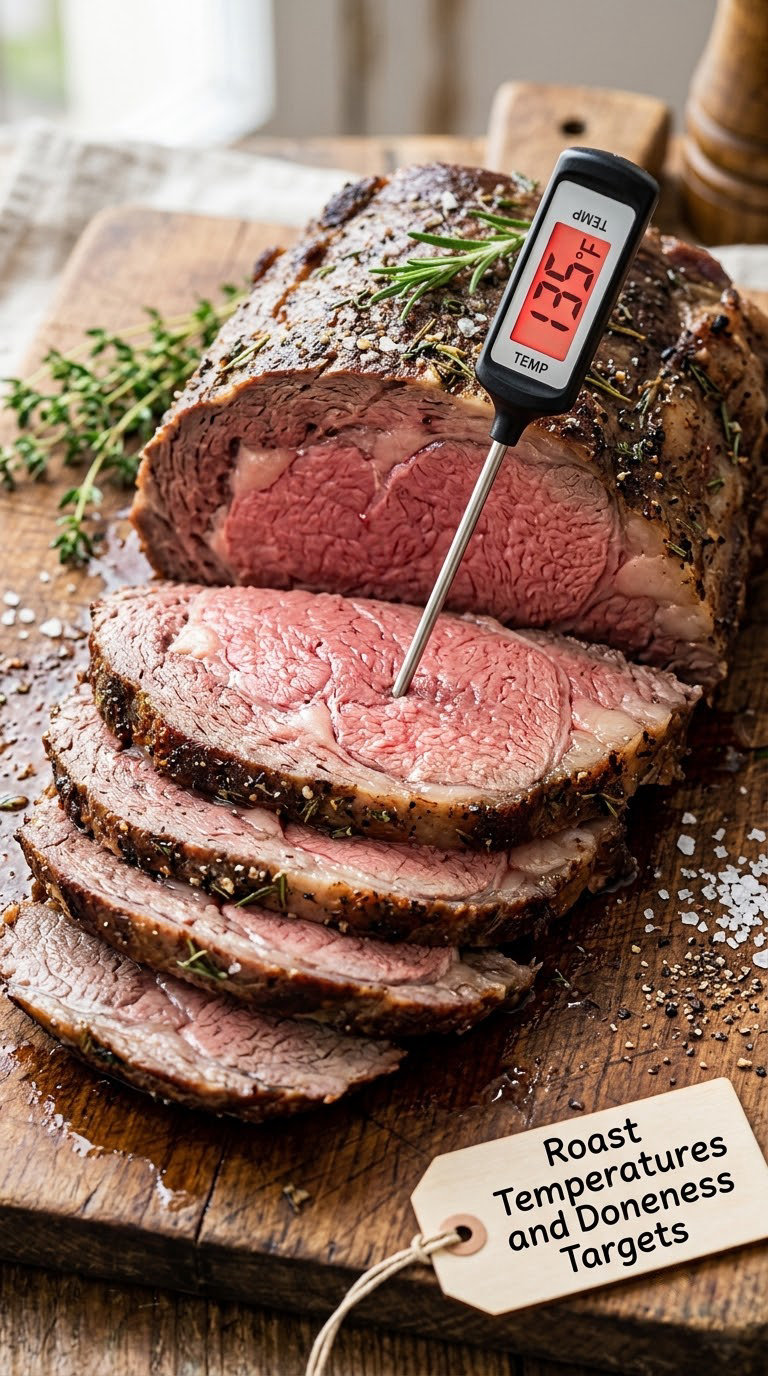
Oven temperature is about speed and browning. Internal temperature is about the food itself. Setting your oven to 450°F does not make the center of a 6-pound rib roast any hotter any faster than 325°F does in any way you can control, but it does brown the outside harder.
The USDA safe minimum for beef, pork, veal and lamb steaks, chops and roasts is 145°F (63°C) followed by a 3-minute rest. That is a food safety floor, not a serving suggestion. Below 145°F, intact whole cuts are more at risk from bacteria carried on the surface, which is why intact roasts get the higher number while ground beef only needs 160°F.
What Temperature to Cook a Beef Roast To: Pull Temps by Doneness
| Doneness | Final internal temp | Pull temp (before rest) | Rest | What it looks like |
|---|---|---|---|---|
| Rare | 120–125°F (49–52°C) | 115–120°F (46–49°C) | 5–10 min | Deep red center, barely pink edges |
| Medium-rare | 130–135°F (54–57°C) | 125–130°F (52–54°C) | 10–15 min | Pink center with a thin red ring |
| Medium | 140–145°F (60–63°C) | 135–140°F (57–60°C) | 10–15 min | Warm pink throughout, no red ring |
| Medium-well | 150–155°F (66–68°C) | 145–150°F (63–66°C) | 10–15 min | Mostly brown with a hint of pink |
| Well done | 160°F+ (71°C+) | 155°F (68°C) | 10–15 min | Gray-brown all the way through |
These pull temps assume a normal roast at 325–350°F. A very large roast or a very hot oven climbs more during the rest, so pull lower. A small cut barely climbs at all, so pull higher.
Experienced home cooks tend to land in the same place on this: cook at 275–300°F for even cooking, pull 5–10°F under your target, and let the rest finish the job. The usual advice for medium-rare is to rest longer and pull lower rather than to chase 130°F straight out of the oven.
How to Roast a Beef Roast Safely
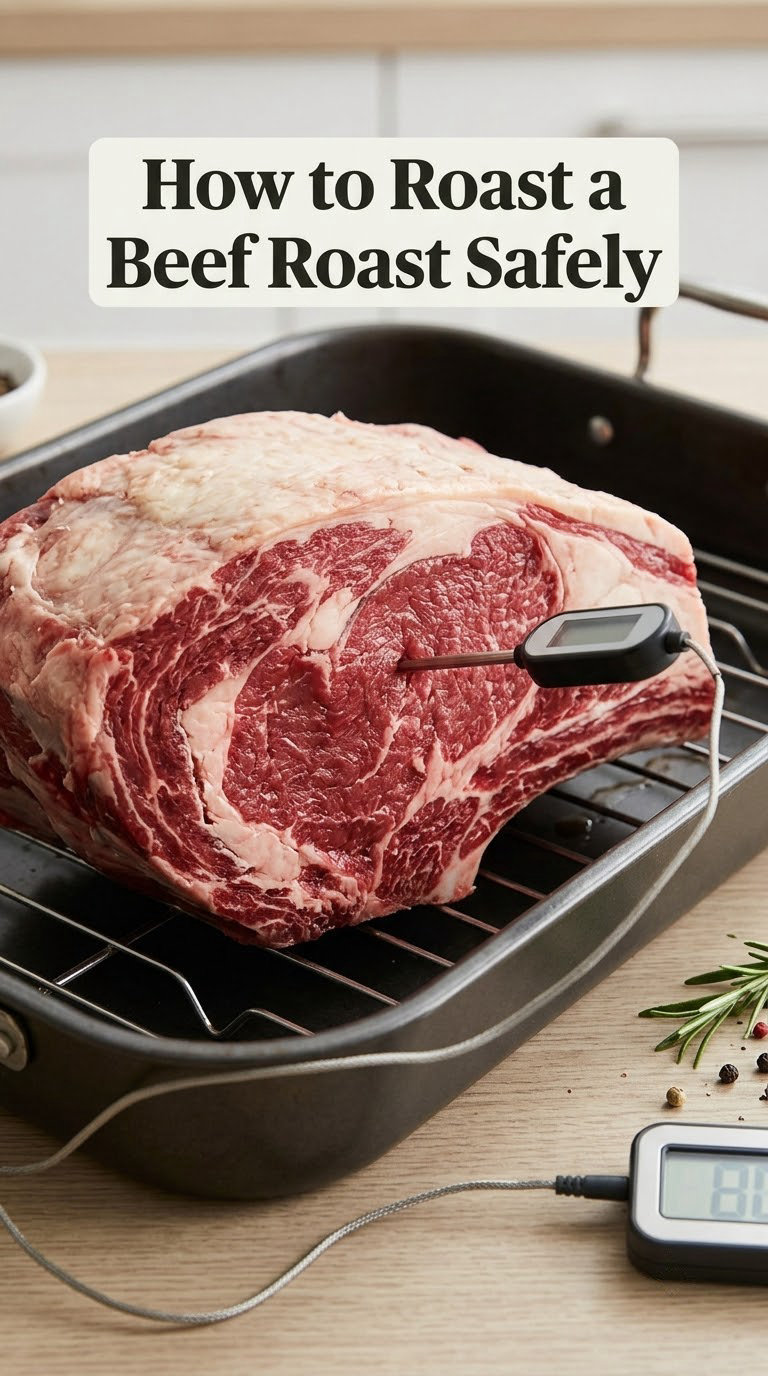
This is the method that works for any cut on the table above. Follow it once and you will never need a timetable again.
- Take the roast out early. Thirty to forty-five minutes before it goes in the oven sits the single biggest improvement available. A cold roast spends extra oven time just warming through.
- Dry the surface and season it. Pat the roast with paper towels, then salt it generously all over and into the crevices. Dry surface means crust; wet surface means steam and a pale roast.
- Heat the oven fully first. Set the oven temperature, then wait ten minutes after the preheat light goes off. Most ovens are still climbing.
- Start hot if you want crust. For a rib or sirloin roast, 10 to 15 minutes at 450°F builds a browned crust, then drop the oven to 325°F and finish.
- Roast on a rack in a pan. A roasting rack lifts the meat so hot air circulates underneath. Without one, the bottom sits in drippings and steams.
- Probe without opening the door. Put a leave-in probe thermometer into the thickest part before the roast goes in, running the wire out through the side of the pan. Then stop opening the oven.
- Pull on temperature, rest on the counter. Take the roast out when it hits the pull temp for your doneness, tent it loosely with foil, and rest it 10 to 20 minutes.
- Slice against the grain. Find the direction the fibers run across the cut, then slice perpendicular to it. This shortens the muscle fibers and makes any roast taste tenderer.
The oven door is the real enemy here. Every opening drops the temperature 20°F or more, and the roast then spends part of the cook below its target, which stretches the total time and dries the surface. Probe, pull, rest.
How Cooking Time Changes by Weight and Cut
Time is arithmetic you do in advance. It is genuinely useful for planning dinner, and it is genuinely unreliable as a doneness test. Two variables move the number more than weight does: where the meat starts, and how much connective tissue it carries.
| Roast weight | At 325°F (163°C) | At 350°F (177°C) | Carryover rise during rest |
|---|---|---|---|
| 2 lb | 20–25 min | 18–22 min | 5–8°F |
| 3 lb | 30–35 min | 27–32 min | 8–12°F |
| 4 lb | 40–45 min | 35–40 min | 10–15°F |
| 6 lb | 60–70 min | 50–60 min | 12–18°F |
| 8 lb | 80–90 min | 70–80 min | 15–25°F |
| 10 lb | 100–120 min | 90–105 min | 20–30°F |
Read the carryover column as the reason a big roast needs a lower pull temp. A 10-pound roast taken out at 130°F can finish resting in the mid-140s. Pull the same reading on a 2-pound roast and you land around 137°F, closer to medium.
Marbling and bone change the pace too. A well-marbled bone-in rib roast cooks faster per pound than a lean boneless eye of round, which is why lean cuts get lower oven temperatures and earlier pull temps. The reverse-sear approach works the same way: a long slow hold at 225–250°F up to 120–130°F, a 30-minute rest, then about ten minutes at 500°F to build the crust without drying the inside.
Roast vs. Pot Roast: Which Temperature Should You Use?
Both start with the same thermometer answer. They differ in oven temperature and how much heat the cut needs before collagen gives up.
Dry roast: 325 to 450°F
A dry roast uses dry heat, so the surface browns through the Maillard reaction while the inside cooks gently. This suits tender cuts with low connective tissue: rib roast, tenderloin, sirloin, top round, eye of round. Pull these between 120°F and 145°F. Going past 150°F on a lean round roast is what turns it into a tire, and there is no amount of resting that brings the moisture back.
Pot roast: 300 to 325°F with liquid
A pot roast adds liquid to the pan, which means the meat cooks at or near the temperature of water rather than the temperature of the oven. That is the point: moist, gentle heat is what dissolves collagen. Chuck, brisket, short ribs and rump all want this treatment, and they want to go to 195–205°F (90–96°C) before the connective tissue turns to gelatin. Cook a chuck roast to medium-rare and it will chew like a tire no matter how exact your thermometer was.
For a crockpot version, my easy cranberry pot roast runs all day on low and uses the same collagen logic.
One practical note: if a roast is going in liquid, do not sear it first for crust. The crust you built will dissolve in the braising liquid anyway. Brown the meat in batches, then transfer.
How to Use a Meat Thermometer Correctly
A decent instant-read thermometer does more for a roast than any technique I know. There are two useful kinds, and they solve different problems.
- Instant-read for steaks, chops and small roasts. You press it in, read in five seconds and pull it out.
- Leave-in probe with a wired readout for large roasts. The probe goes in before cooking and you read the temperature through the oven window without opening the door.
Where to put the probe
Push the tip into the thickest muscle section, away from the bone, away from the outer fat cap, and away from any spot touching the pan. Bone conducts heat and gives you a falsely high reading. Fat gives a falsely low one. A reading taken in the eye at one end of a roast tells you nothing about the thick middle.
Check two or three spots if the roast is uneven. The lowest reading is the one that matters, because that is where the least cooked part is.
Oven, convection and air fryer adjustments
Convection fans cook about 25°F faster than a conventional oven at the same setting, so drop the temperature by that amount and check a little sooner. A full-size roast does not fit in most air fryers; if you try it with a smaller cut, run 25°F cooler than the recipe and pull five degrees under target, since air fryers cook from above and brown before they penetrate.
Calibrate once a year in boiling water with ice. Most thermometers read close to correct out of the box and drift with drops and washes.
Common Beef Roast Mistakes and Fixes
| What went wrong | Why it happened | Fix it next time |
|---|---|---|
| Roast is gray all the way through | It went well past 160°F and stayed there | Pull 10–15°F earlier; slice thin against the grain to offset the dryness |
| Roast is tough but not dry | A collagen-heavy cut stopped at 135–145°F | Chuck and brisket need 195–205°F with liquid; only tender cuts belong at medium-rare |
| Outside burned before the inside was done | Oven too hot, roast too close to the element, or no rack | Use a rack, move the pan to the lower third, drop to 325°F after any blast |
| Finished 30 minutes late | Roast went in refrigerator cold, or the door kept opening | Rest the meat out beforehand and use a leave-in probe instead of checking |
| Dry slices and a dry pan | Sliced straight off the heat with no rest | Rest 10–20 minutes tented before carving |
| Seasoning only on the surface | Salting right before it went in | Salt at least 40 minutes ahead; there is not enough time for it in a hot oven |
| Lean roast dried out past 150°F | Treated eye of round or bottom round like a rib roast | Lean round cuts go low and slow, then finish on carryover at 120–125°F |
If a roast came out tough and you still have it, slicing it paper-thin while cold helps more than anything else. You are mechanically shortening muscle fibers that were too long to chew through. Leftovers make excellent sandwiches this way.
How to Rest, Slice, and Store Beef Roast
Resting is not optional. Cut into a roast too soon and the juice that has moved to the center runs out onto the board instead of staying in the meat.
- Rest 10 to 15 minutes for steaks, chops and small roasts.
- Rest 20 to 30 minutes for prime rib, tenderloin and any roast over 5 pounds.
- Rest loosely tented with foil so heat stays in without steaming the crust soft.
- Slice against the grain, carving the first slices to show guests the direction, then turning the roast.
Storage and reheating
Cooked beef keeps 3 to 4 days in the refrigerator at 40°F (4°C) or below. Slice it cold and store it airtight; a whole unsliced roast dries out faster in the fridge than a sliced one covered in sauce. Freeze it in portions for up to 2 to 3 months for best quality. When reheating, use a low oven or a skillet with a splash of broth and a lid, and add 10 to 20°F over your target since reheating dries protein out fast.
Leftovers go a long way. My 20 best leftover pot roast recipes is a good place to start planning around what you cooked.
Related reading: if you cook a lot of beef in smaller batches, my guide to the best way to cook ground beef on the stove covers the same thermometer logic at a different scale.
Frequently Asked Questions
What is the safe temperature for beef roast?
The USDA safe minimum internal temperature for beef roasts is 145°F (63°C), followed by a 3-minute rest before carving. That is a food-safety floor rather than a serving recommendation. Most home cooks choose medium-rare at 130-135°F (54-57°C) or medium at 140-145°F (60-63°C), and those levels are safe for intact whole cuts when the surface was seared and the meat rested.
How long should a beef roast cook at 350°F?
At 350°F (177°C), budget roughly 8-10 minutes per pound for a lean boneless roast such as sirloin, top round or bottom round. A 3-pound roast takes about 30 to 35 minutes and a 7-pound roast about 60 to 70 minutes at that setting. Treat these as planning estimates only, then confirm doneness with a thermometer rather than the clock.
What temperature should a beef roast be medium rare?
For a final medium-rare result of 130-135°F (54-57°C), pull the roast from the oven at 125-130°F (52-54°C) and let carryover cooking finish it during a 10 to 15 minute rest. Larger roasts climb more while resting, so an 8-pound roast pulled at 125°F can still land in the right window. Check the thickest part with a probe, never the bone or the fat cap.
Do you need to let a beef roast rest before slicing?
Yes, and skipping the rest is the most common reason a good roast tastes dry. Rest 10 to 15 minutes for steaks and small roasts, and 20 to 30 minutes for anything over 5 pounds such as prime rib or tenderloin. Loosely tent with foil to hold the warmth. Resting lets the juice redistribute into the muscle, and it also gives carryover cooking time to finish the center evenly.
Can I roast a beef roast from frozen?
You can, but you lose control and often lose the crust. A frozen roast needs roughly 50 percent more cooking time, and thawing in the refrigerator overnight gives far better results. If you must cook it frozen, remove the packaging, set the roast in a pan, and start checking the internal temperature about two-thirds of the way through the estimated cook time rather than at the end.
How do I know when a beef roast is done without cutting it?
Use a meat thermometer in the thickest muscle section, away from bone, fat and the pan. A leave-in probe with a wired readout is the easiest option because you can read the temperature through the oven window without opening the door. Check two spots on an uneven roast and trust the lower number. You are looking for 145°F (63°C) or higher for safety, or 125-135°F (52-57°C) for medium-rare.
The Best Temperature Approach for a Juicy Roast
Set the oven for the cut: 325°F for most roasts, a 15-minute blast at 450°F when you want crust, 225–250°F for lean round cuts that need a slow climb. Then watch the thermometer, not the clock, and pull about 5 to 15°F below your target so the rest finishes the job.
Start with what temperature to cook a beef roast to at 130°F pull for medium-rare or 140°F for medium, rest it 15 minutes, then slice against the grain. That sequence covers most Sunday dinners and holiday roasts without any guesswork.