
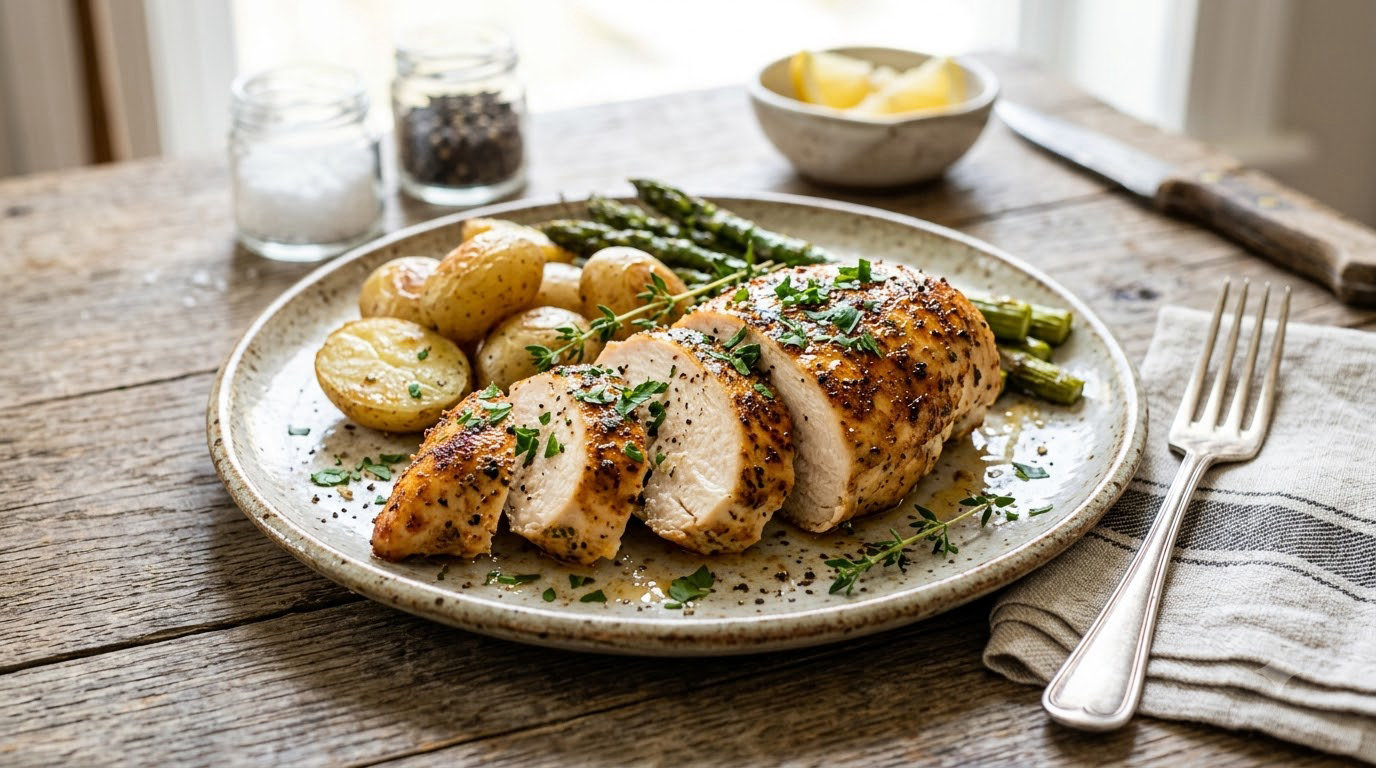
How long to bake frozen chicken breast? Bake it at 400°F (200°C) for 35 to 45 minutes, then check the thickest part with an instant-read thermometer and pull it the moment that reads 165°F (74°C). The time on the clock is only a starting estimate; thickness, pan crowding and your oven decide the real number.
This is the situation almost every home cook hits at 5:40 pm: the chicken is in the freezer, dinner is in an hour, and thawing on the counter is not an option. Baking straight from frozen is completely safe, as long as the center actually reaches 165°F. What you trade for skipping the thaw window is a little more attention, because the outside browns long before the middle cooks through.
The single tool that makes this easy is a cheap instant-read thermometer. Without one you are guessing, and guessing is exactly how frozen chicken ends up dry on the outside and pink in the middle.
Table of Contents
Frozen Chicken Breast Baking Times at a Glance
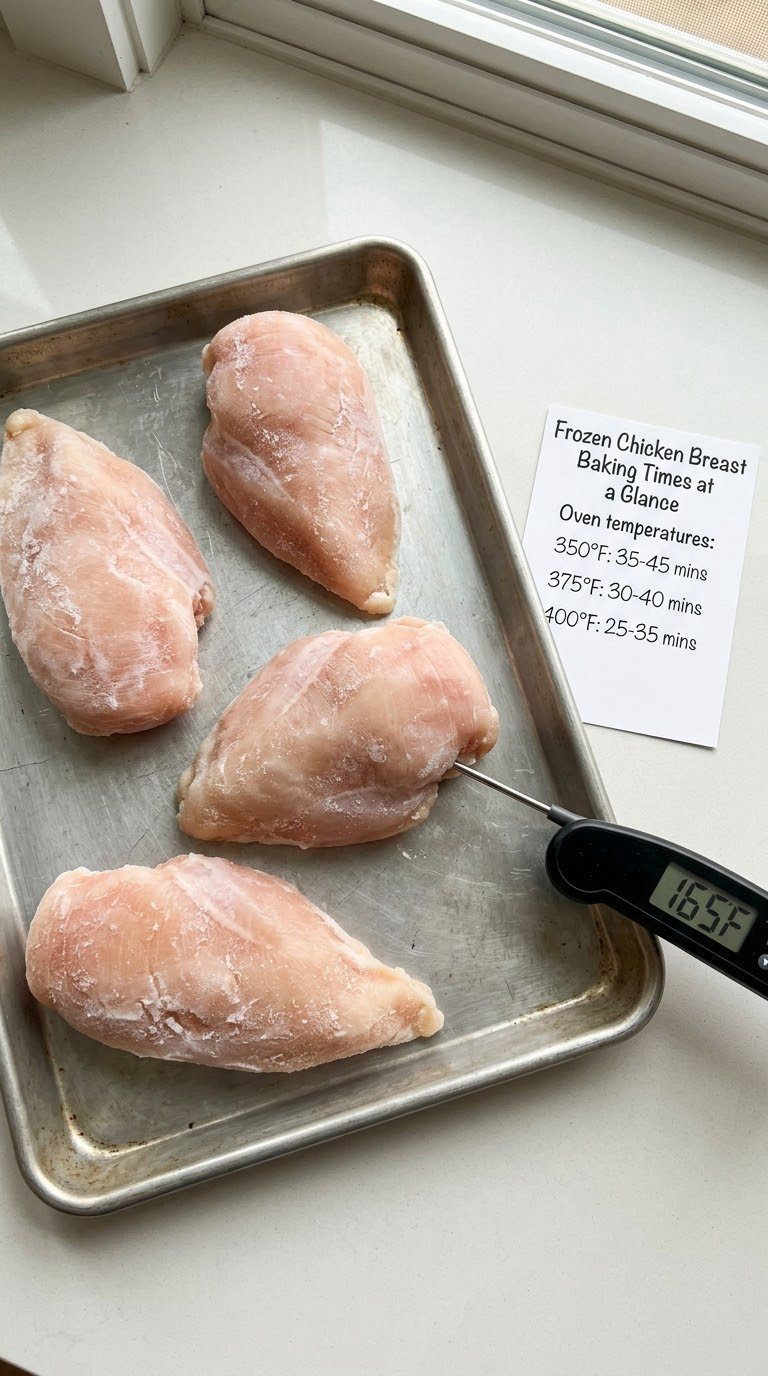
Here is the short version most people need. All times assume a conventional oven, a single layer on a sheet pan, and no crowding.
| Oven temperature | Thin breast (under 1 inch) | Medium breast (1 to 1.5 inch) | Thick breast (over 1.5 inch) | Safe internal temperature |
|---|---|---|---|---|
| 350°F (175°C) | 35 to 40 minutes | 40 to 50 minutes | 50 to 60 minutes | 165°F (74°C) |
| 375°F (190°C) | 30 to 35 minutes | 35 to 45 minutes | 45 to 55 minutes | 165°F (74°C) |
| 400°F (200°C) | 25 to 30 minutes | 30 to 40 minutes | 40 to 50 minutes | 165°F (74°C) |
| 425°F (220°C) | 20 to 25 minutes | 25 to 35 minutes | 35 to 45 minutes | 165°F (74°C) |
A useful second rule: a frozen breast takes about 1.5 times as long as the same breast would if it were thawed. If a recipe tells you 25 minutes for a thawed breast at 400°F, budget 35 to 40 minutes for the frozen version and start checking early.
Add 10 to 15 minutes if the pieces touch each other. Air has to circulate for the outside and the center to cook at the same rate, and a crowded pan steals that air.
How to Bake Frozen Chicken Breast
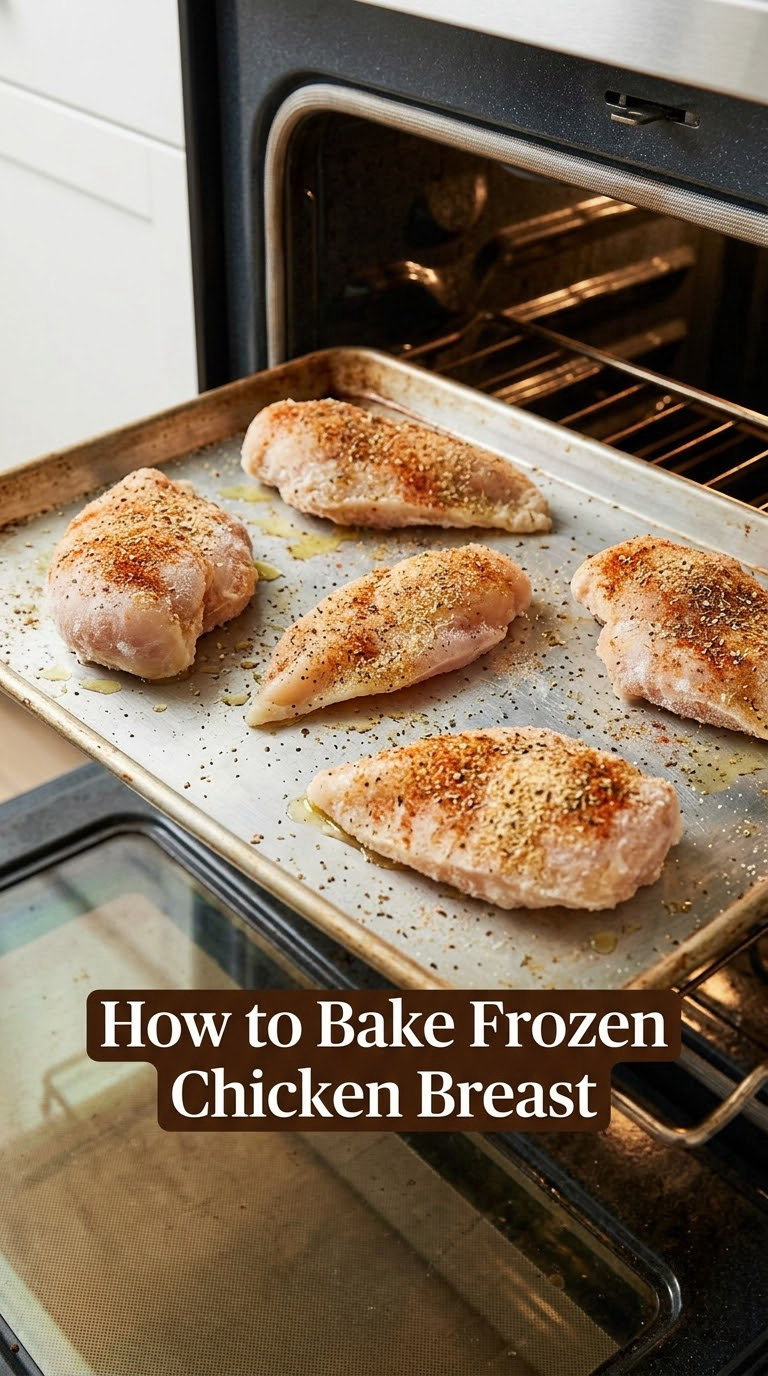
This is the method I use. It is deliberately boring, because boring works at 5:40 pm.
- Preheat the oven to 400°F (200°C). If you are using convection, drop it to 375°F (190°C). Let it run a full 10 minutes before the pan goes in.
- Heat a rimmed baking sheet in the oven while it preheats. A hot sheet starts the outside browning immediately instead of letting the breast warm up in a cold pan first.
- Take the breasts out of the freezer. Separate any pieces that are frozen in one solid block, gently, without forcing them apart.
- Set them on the hot sheet in a single layer with an inch of space between them. A little oil or cooking spray on the surface helps the seasoning stick and reduces sticking.
- Season now. A simple rub of salt, black pepper, garlic powder and paprika works straight from frozen. Salt early is fine, because the breast is not going to dry out faster than it did from ice.
- Bake uncovered. Foil traps steam and keeps the surface pale, and you want that browning.
- Start checking at the low end of the time in the table. Push the thermometer into the thickest part, away from the bone and away from the pan, and read it.
- Pull the chicken at 165°F (74°C). Add 5 minutes of rest under loose foil before slicing.
Resting is not optional if you care about texture. The juices need those few minutes to settle back into the muscle instead of running out onto the cutting board the second you slice.
Baking Times by Chicken Breast Thickness
Package size is a poor guide. A 10-ounce breast can be a slim cut that finishes in 30 minutes or a thick center-of-the-pack cut that needs 50. Measure or eyeball the height of the piece, not the weight on the label.
Thin frozen chicken breasts (under 1 inch thick)
These cook fast and dry out fastest, because there is very little interior to hold moisture. Expect 25 to 30 minutes at 400°F, or 30 to 35 minutes at 375°F. Start checking at 22 minutes, because these can go from done to dry in under three minutes.
The visual cue: juices run completely clear when you pierce the thickest part, and the inside is white all the way through with no translucent pink band.
Medium frozen chicken breasts (1 to 1.5 inches thick)
This is the most common grocery-store cut, and 30 to 40 minutes at 400°F is the range that works most often. At 350°F, plan on 40 to 50 minutes. These are the pieces most often labeled “boneless skinless chicken breasts” in a bag, and they bake evenly enough that the timer is roughly trustworthy.
The visual cue: the center springs back slightly when pressed but does not feel squishy, and the sliced interior is uniformly white.
Thick frozen chicken breasts (over 1.5 inches thick)
Thick cuts need patience. Budget 40 to 50 minutes at 400°F and 50 to 60 minutes at 350°F. The outside will look done and deeply browned well before the center is anywhere near 165°F, which is exactly when people pull it too early.
If you have a knife, butterfly the thick piece or slice it horizontally into two thinner fillets while it is still frozen solid. You get two thin pieces that cook in half the time and stay juicy.
The visual cue: the juices at the center run clear, and there is no pink or translucent rubbery band around the middle when you cut into it.
How Long to Bake Frozen Chicken Breast at Different Temperatures
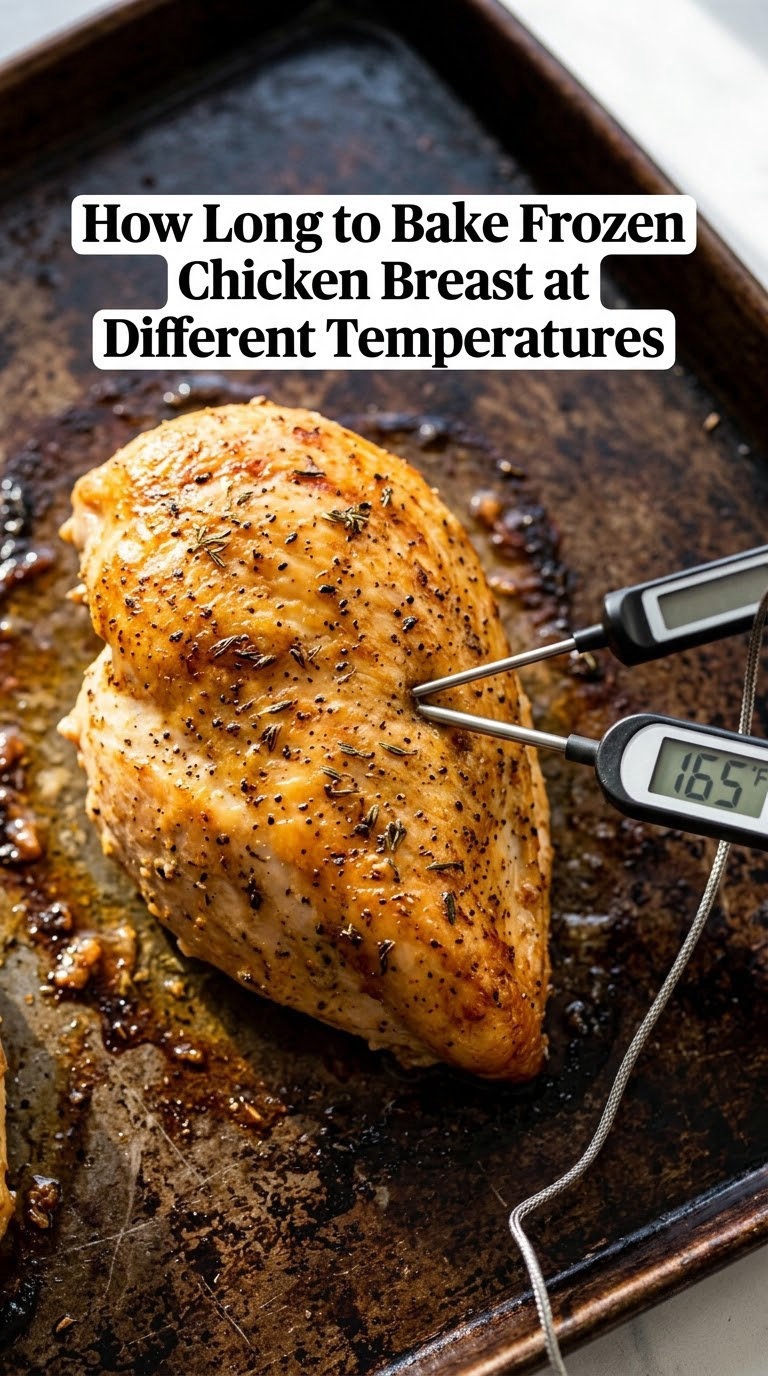
All four temperatures below are safe. They differ in how fast the outside colors, how much moisture the breast holds, and how forgiving the window is.
Baking at 350°F for a gentler cook
At 350°F (175°C) the breast spends longer in the oven, so more moisture leaves it, but the surface colors slowly and evenly and the risk of a scorched outside over a raw center is the lowest of the four. Expect 40 to 50 minutes for a medium breast. This is the temperature the forums reach for when someone is nervous about cooking from frozen, and it is a safe, forgiving choice.
Baking at 375°F as a middle ground
At 375°F (190°C) you get decent browning with a shorter, less drying cook than 350°F. A medium breast takes 35 to 45 minutes. If your oven runs hot or you are cooking a large batch, this is the calmest option.
Baking at 400°F for the best balance
This is the temperature I use most, and the one this guide defaults to. At 400°F (200°C) a medium frozen breast hits 165°F in 30 to 40 minutes with a properly browned surface and less moisture loss than 350°F. It is the shortest route that still browns well, which is why so many home cooks land here.
If you want the full breakdown for thawed and frozen cuts, my guide to how long to bake chicken breast at 400 degrees goes deeper on the timing math.
Baking at 425°F for speed and browning
At 425°F (220°C) a medium breast finishes in 25 to 35 minutes with a crisp, dark surface. The tradeoff is real: the window between done and dry is narrow, and the outside can go from golden to burned while the center is still cold. This temperature works best for thin cuts and for people who are checking with a thermometer every few minutes.
Whichever temperature you pick, resist the urge to let the breast darken deeply as proof of doneness. Color is a surface reaction and says nothing about the center. If you want more browning, put it under the broiler for the last 1 to 2 minutes after the center is already cooked through.
Adjusting for a convection oven
Convection moves air around the pan faster and cooks more evenly, which is genuinely helpful with frozen chicken because it reduces the burnt-outside, raw-middle problem. Drop the temperature by 25°F (about 15°C), so 400°F conventional becomes 375°F convection, and start checking about 20 percent earlier. If convection is the only setting on your oven, run it for the last 10 to 15 minutes only, so the surface still gets that browning.
Should You Thaw Frozen Chicken Before Baking?
You do not have to. Baking from frozen is safe, and the oven does the thawing and the cooking in one step. Just remember that the surface thaws and browns first while the center is still ice, so watch the thermometer instead of the clock.
Thawing first is worth the wait when you have time and the breast is thick, because a thawed piece cooks faster, seasons more evenly and dries out less. Thaw in the refrigerator overnight on a plate, or in cold water sealed in its packaging for about 30 minutes, changing the water every 10 minutes. Never thaw chicken on the counter and never in warm water, since the outside enters the bacterial danger zone long before the center softens.
There is one quick middle path. Let the breast sit at room temperature for 10 to 15 minutes so the surface is no longer rock hard, then bake. It shaves a few minutes off and helps the seasoning adhere, without putting the chicken in the danger zone for long.
If you bake from frozen regularly, buy individually quick-frozen breasts rather than a block. A solid frozen clump thaws and cooks unevenly no matter how carefully you time it.
Common Mistakes When Baking Frozen Chicken Breast
- Crowding the pan. Touching pieces steam each other and cook in a slow, uneven ring. Space them an inch apart, use two sheet pans for a big batch, and add 10 to 15 minutes if you have no choice.
- Waiting for the color instead of the temperature. A deep golden exterior can sit on a raw center for ten more minutes. Check the thickest part with a thermometer and trust the number.
- Going high and walking away. A 450°F oven browns the outside in 15 minutes and leaves the middle frozen. Lower heat plus a thermometer is the whole trick. If you want crisping, do it at the end under the broiler.
- Covering with foil for the whole cook. Foil traps steam and the breast finishes pale. A loose foil tent for the first 15 minutes is fine for a thick cut, but take it off to brown.
- Using pumped or glazed frozen chicken. Some frozen breast is injected with up to about 20 percent salt and phosphate solution, which is exactly why it turns out watery and mushy. Patting it dry before seasoning and baking it uncovered on a hot sheet helps. Buying unprocessed chicken from a butcher counter avoids the problem completely.
- Slicing straight out of the oven. Cutting before resting pushes the juice onto the board and the breast tastes dry. Wait the full 5 minutes.
- Reusing the same pan juices across batches. The liquid in the pan after cooking from frozen carries a lot of released water. Drain it rather than pouring it over fresh chicken.
Once the chicken is cooked, cool it before refrigerating and keep it in an airtight container for up to 3 to 4 days. The leftovers are the actual reason to cook a second breast; these leftover chicken breast recipes turn a plain baked breast into a second meal, and something like this bang bang chicken bake is fast enough for a night when you did not plan ahead at all.
Frequently Asked Questions
Can I cook a frozen chicken breast without thawing it?
Yes. Oven-baking chicken straight from the freezer is safe, and plenty of home cooks do it every week. Bake at 400°F (200°C) until the thickest part of the breast reads 165°F (74°C) on an instant-read thermometer, which usually takes 30 to 40 minutes for a medium breast. Do not judge doneness by the clock or by the color of the outside, because the surface browns long before the center cooks through.
How long does it take to bake frozen chicken breast at 400 degrees?
At 400°F (200°C) most frozen boneless skinless chicken breasts need 30 to 40 minutes. Thin cuts under 1 inch thick cook in 25 to 30 minutes, and thick cuts over 1.5 inches can take 40 to 50. Start checking at the low end and pull the chicken the moment the thickest part reads 165°F (74°C). Add 10 to 15 minutes if the pieces are touching on the pan.
Is it better to bake chicken at 350 or 400?
For frozen chicken, 400°F (200°C) is the better choice. It browns the surface properly while still finishing a medium breast in 30 to 40 minutes, and the shorter cook loses less moisture. 350°F (175°C) is more forgiving and less likely to scorch the outside, but it takes 40 to 50 minutes and dries the breast out a little more. Either is safe as long as the center hits 165°F (74°C).
Can I bake chicken breasts that are still slightly frozen?
Yes, still slightly frozen or icy in the center is fine. The oven melts the ice as it cooks, and the breast is safe once the thickest part reaches 165°F (74°C). The only real concern is timing, because an icy center takes longer and the outside may scorch first, so keep the temperature moderate and check with a thermometer rather than trusting the recipe clock.
How do I know when frozen chicken breast is done without a thermometer?
Pierce the thickest part with a fork or skewer and look at the juices. When they run completely clear with no pink or red tint, the breast is done. Cut a tiny slit at the thickest point to check the center, which should be white all the way through with no translucent rubbery band. Without a thermometer this method is not as reliable, so a ten dollar instant-read thermometer is worth buying.
What are the common mistakes when cooking frozen chicken?
The most common mistakes are crowding the pan, using foil for the whole cook, and trusting the clock instead of a thermometer. Crowding makes the pieces steam each other and cook unevenly, while foil traps steam and leaves the breast pale. Watery results usually come from frozen chicken that was pumped or glazed with added salt solution, so pat it dry and bake it uncovered on a hot sheet. Slicing before the 5-minute rest also dries it out.
Conclusion
Bake frozen chicken breast at 400°F (200°C) until the thickest part reads 165°F (74°C), which for most boneless skinless breasts lands somewhere around 30 to 40 minutes. Use the timing table as a starting estimate only, keep the pieces spaced on a hot sheet, and let the chicken rest 5 minutes before you cut it.
Check the thermometer first, not the clock. That one habit is the difference between a juicy weeknight breast and a dry one with a raw middle.