
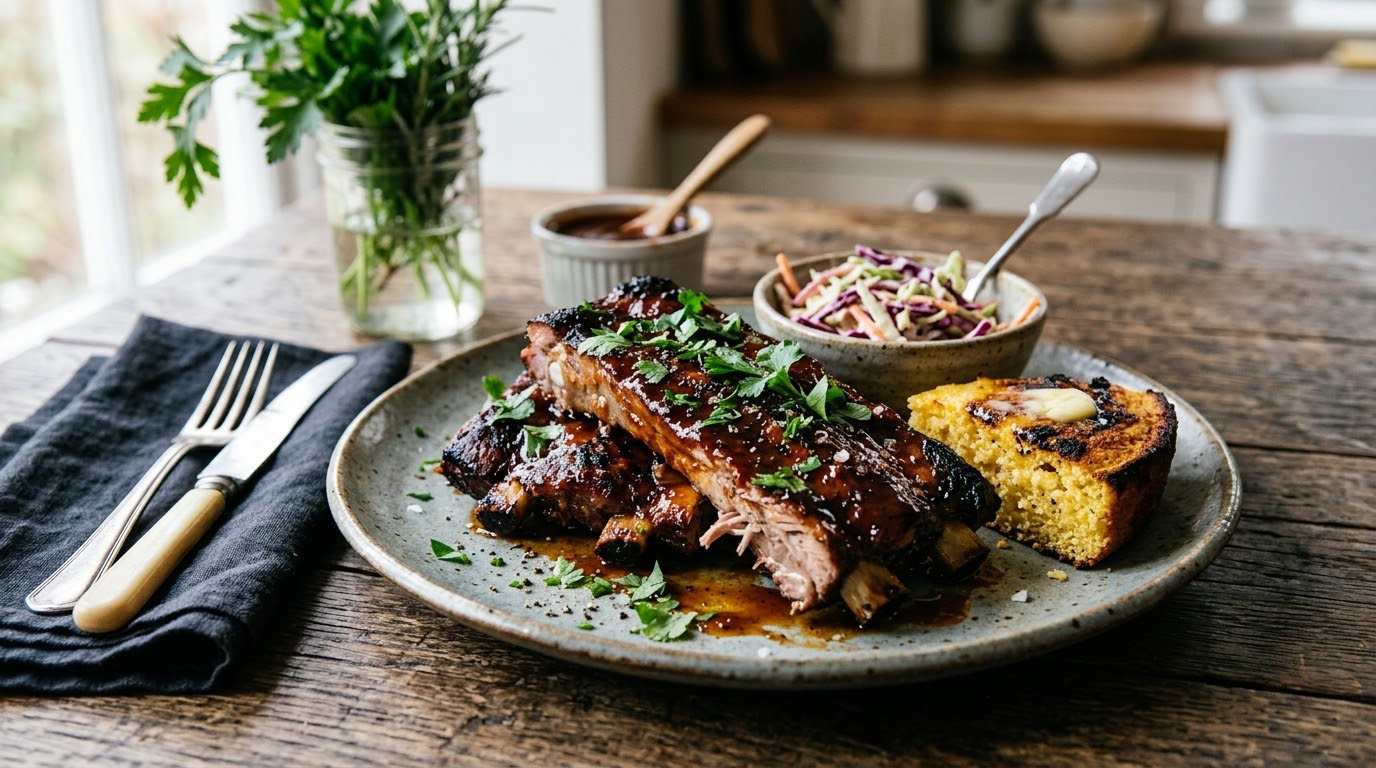
What temperature to cook ribs in the oven? Most home cooks land on 275°F (135°C) for the long, slow phase, with 300°F (150°C) as the faster option. Either way, the target is 190-205°F (88-96°C) in the thickest part of the meat, checked with a thermometer rather than a clock.
Ribs are mostly collagen, fat and muscle, and that collagen is what turns chewy and turns tender. A low, patient cook keeps the surface from drying out while the connective tissue slowly converts to gelatin, so the meat loosens from the bone instead of tearing away from it. In September that means tailgate Saturday, Labor Day cookouts and the start of football season, when a three-hour oven cook is easier to manage than a smoker.
If you are new to ribs, the [boneless pork ribs recipes on this site](https://thesweetandsimplekitchen.com/best-boneless-pork-ribs-recipes-ideas/) are a good side dish run, because they cook faster than racks of bone-in and need none of the tenderness negotiation.
Table of Contents
What Temperature to Cook Ribs in the Oven: Quick Guide
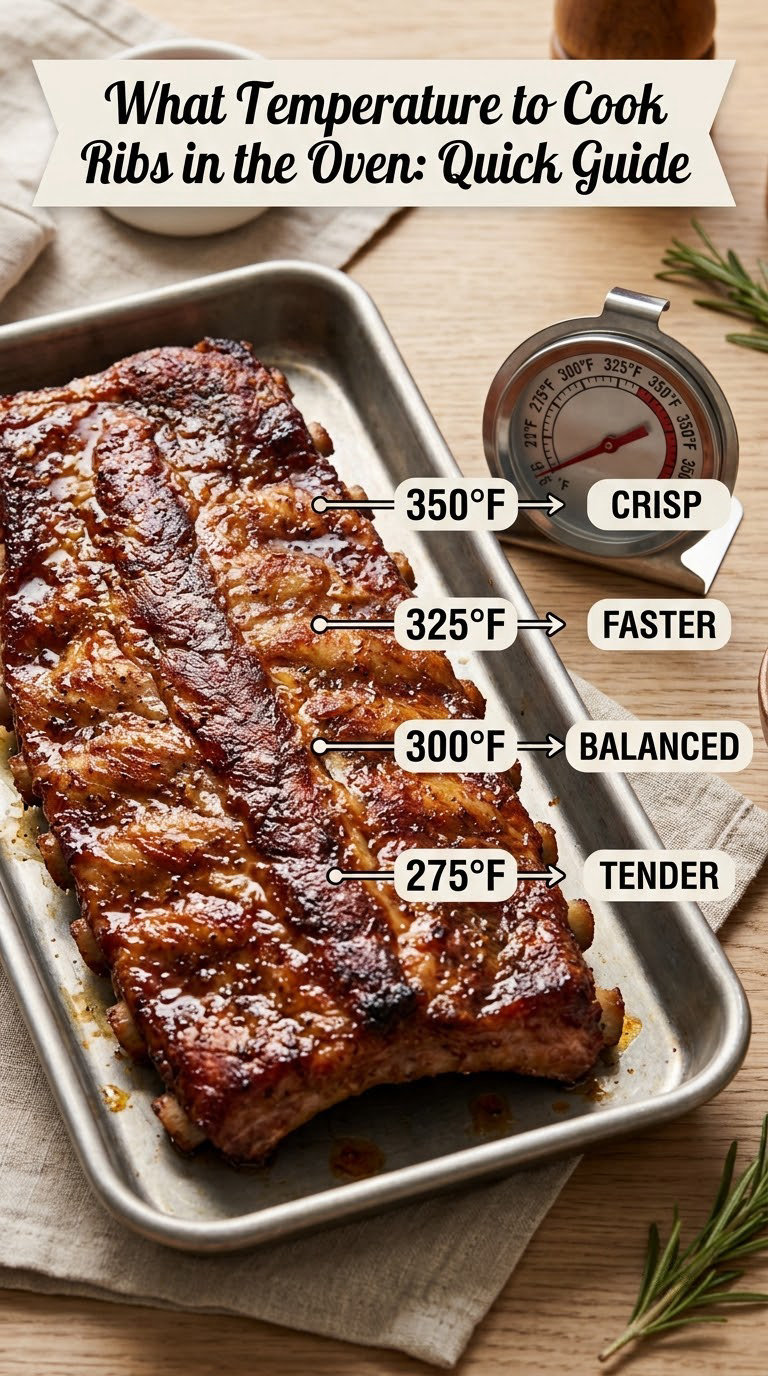
There is no single right number, but there is a right range. Here is the short version most people need:
- Best tenderness: 275°F (135°C), low and slow, covered for most of the cook.
- Faster hands-off cook: 300°F (150°C), about 30 to 45 minutes quicker with a similar result.
- Short on time: 350°F (177°C), roughly 50 to 75 minutes, firmer texture.
- Target internal temperature: 190-205°F (88-96°C).
- Food safety minimum: 145°F (63°C) with a three-minute rest. Ribs are safe well before they are tender.
| Oven temperature | Approximate time | Texture | Best for |
|---|---|---|---|
| 250°F (121°C) | 3.5-4.5 hours | Very tender, softer bend | Overnight-style cooks and big spare ribs |
| 275°F (135°C) | 2.5-3.5 hours | Classic tender, clean bend | The default choice for bone-in racks |
| 300°F (150°C) | 2-2.5 hours | Tender, slightly firmer edge | Weeknight cooks and feeding a crowd |
| 325°F (163°C) | 1.5-2 hours | Tender, holds together well | Boneless ribs and small racks |
| 350°F (177°C) | 50-75 minutes | Firmer, more chew, better bark | When you want ribs on the table now |
Those times assume ribs that start at room temperature. Ribs straight from the freezer need another 30 to 45 minutes, and most home ovens run somewhere between 10 and 25°F off the dial, which is why a cheap leave-in oven thermometer is the most useful tool in this whole guide.
Which Oven Temperature Is Best for Each Rib Cut?
Cut matters more than most people expect. A rack of spare ribs has nearly three times the meat of a baby back rack, and it takes longer to move heat through it.
- Baby back ribs: Small, curved, quick to cook. 275-300°F (135-150°C) for 2.5 to 3 hours.
- Spare ribs: Long, flat and meaty. 275°F (135°C) for 3 to 4 hours.
- St. Louis style ribs: A trimmed spare rib, so it cooks a little faster than a full spare. 275°F (135°C) for 3 to 3.5 hours.
- Boneless spare ribs: No bone holding the structure together, so 300-325°F (150-163°C) for 1.5 to 2 hours.
- Country style ribs: Cut from the shoulder, chunky and quick. 325-350°F (163-177°C) for 45 to 70 minutes. Start with these [boneless country style rib ideas](https://thesweetandsimplekitchen.com/best-boneless-country-style-ribs-recipes-ideas/).
Whether the ribs are bone-in or boneless changes the method more than it changes the number. Bone conducts heat into the surrounding meat and gives you something to grip, which is why a bone-in rack can be cooked at a lower temperature without drying out. Boneless ribs have no thermal mass, so they want more heat and less time, plus a shorter, hotter finish under the broiler to get colour on the surface.
What Temperature to Cook Ribs in the Oven for Each Style?
For a low-and-slow method, go 275°F (135°C) and expect 3 to 4 hours covered. For a classic cook, 300°F (150°C) for about 2.5 to 3 hours covered, then 10 to 15 minutes uncovered at the same temperature to set the sauce. For a faster method, start covered at 325°F (163°C) for 1.5 to 2 hours, then uncover and broil for 3 to 5 minutes until the sauce bubbles and caramelises.
The one place to be careful is 350°F (177°C). It is not dangerous, it just trades texture for speed. Above roughly 375°F (190°C) the outer meat starts setting hard, moisture pushes out, and the collagen in the middle never gets the hours it needs. Most people who end up with chewy ribs cooked them too hot, not too short.
Home ovens are also worth a second thought. A convection setting runs about 25°F (14°C) cooler than a conventional bake at the same dial setting, so drop the temperature by 25°F and check the ribs about 25 percent sooner. A [leave-in oven thermometer](https://thesweetandsimplekitchen.com/best-leave-in-oven-thermometers/) is the honest fix for a dial that lies to you.
How Long Do Ribs Take at Each Temperature?
Time is an estimate, never a promise. Thickness, how cold the ribs were, whether the pan is covered and how full your oven is all move the finish line. Use the table as a starting point and start probing in the last 30 minutes of the window.
| Oven temperature | Baby back ribs | Spare or St. Louis ribs | Boneless spare ribs |
|---|---|---|---|
| 250°F (121°C) | 3-3.5 hours | 4-4.5 hours | 2-2.5 hours |
| 275°F (135°C) | 2.5-3 hours | 3.5-4 hours | 1.5-2 hours |
| 300°F (150°C) | 2-2.5 hours | 3-3.5 hours | 1.5 hours |
| 325°F (163°C) | 1.5-2 hours | 2.5-3 hours | 1-1.25 hours |
| 350°F (177°C) | 50-75 minutes | 1.5-2 hours | 40-50 minutes |
If a rack has to be cut to fit your pan, cooking the two halves side by side makes them finish at the same time. Leaving a full rack crammed into a small pan means the edges of the pan run hotter and drier than the middle, and you get one overcooked end and one tough middle.
How to Prepare Ribs for the Oven
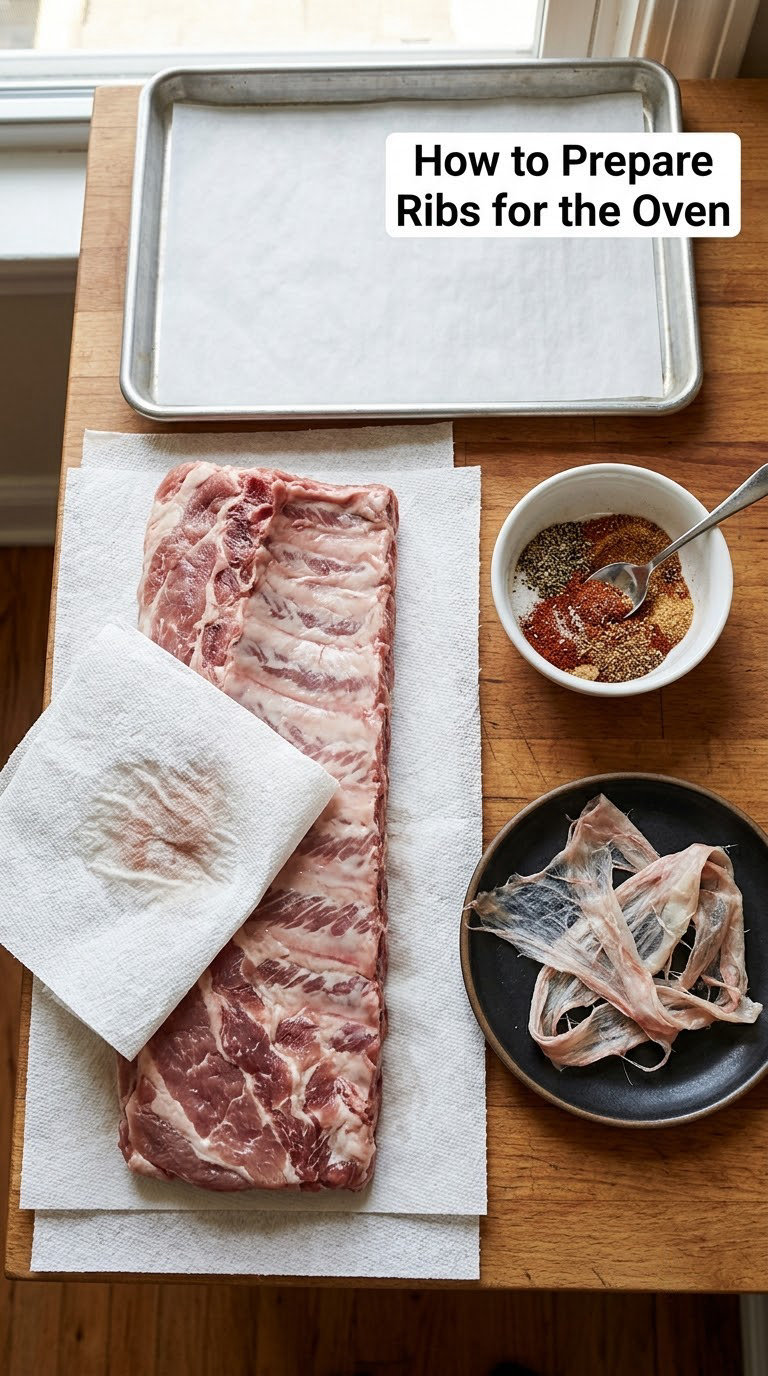
Most of the work happens before the oven is on. Ten minutes of prep is the difference between ribs that hold their shape and ribs that fall apart dry.
- Pat the ribs dry. Blot both sides with paper towels. Wet surface meat steams instead of browning, and it will never build a bark.
- Trim the loose fat. Leave a thin layer on top. Fat rendering is flavor, but thick pockets of it drip and smoke your oven.
- Pull the membrane if you want easy eating. Slide a paring knife under the thin white sheet on the bone side, grab it with a paper towel, and pull. Skip it and the ribs will still cook fine, they just eat more like ribs.
- Season both sides. Dry rub first: salt, black pepper, paprika, brown sugar, garlic powder and a little cayenne. A thin coat of yellow mustard as a binder keeps the rub from washing off in the first hour.
- Choose the pan. A rimmed baking sheet for single racks, a heavy roasting pan for two, or foil packets for the covered phase. Line with foil and add a splash of apple juice or cider vinegar if you plan to braise.
- Preheat properly. Give the oven a full 15 to 20 minutes at your cooking temperature before the ribs go in, and set the rack in the middle so the heat is even.
Rack position matters more than most recipes admit. The middle of the oven is where the air moves most evenly, so ribs never scorch on the bottom pan element while the top is still pale.
How to Cook Ribs in the Oven Step by Step
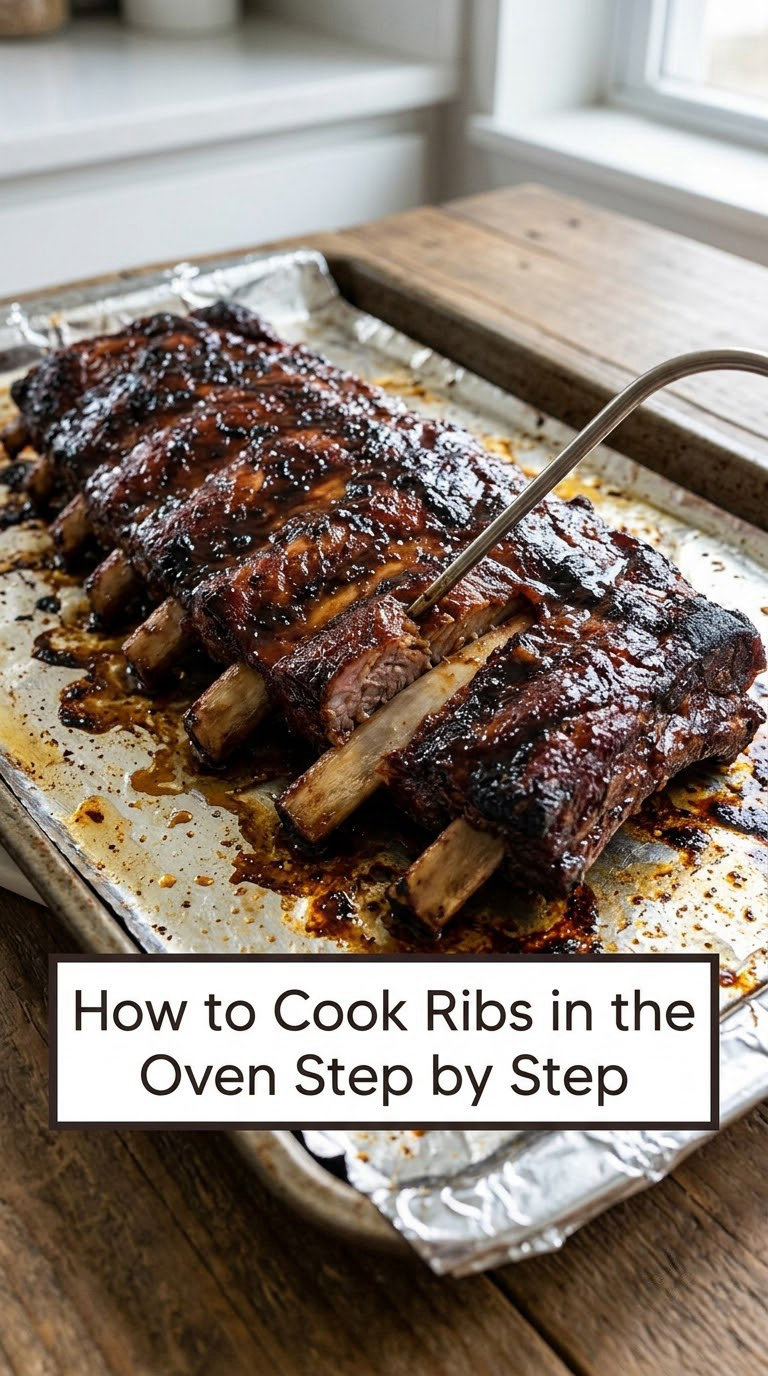
- Preheat to 275°F (135°C), or 300°F (150°C) if you want a shorter cook.
- Season the ribs as prepared above, and let them sit at room temperature for 15 to 20 minutes so they are not fighting a chill.
- Roast uncovered for 30 minutes at 275°F (135°C). This drying window is what gives you a surface to hold sauce later.
- Wrap tightly in foil, or cover the pan with a lid or sheet of foil, crimping the edges. Loose foil is the most common reason ribs come out dry.
- Bake for 2 to 3 more hours at 275°F (135°C), checking every 30 minutes after the 2-hour mark.
- Test for tenderness. The meat should pull away from the bone with almost no resistance, the classic sign of collagen fully broken down. If you want it firmer, pull earlier.
- Uncover and glaze. Brush on a thin layer of BBQ sauce and return the rack to the oven, uncovered, for 10 to 15 minutes.
- Broil for 3 to 5 minutes at high heat, watching constantly, to caramelise the sauce. It goes from glazed to burnt in under a minute.
- Rest 10 minutes before slicing between the bones. The rest keeps the juice in the meat.
The USDA recommends cooking pork to at least 145°F (63°C) internal with a three-minute rest. That is the safety floor, not the finish line for ribs. If you cook other cuts often, our [pork temperature guide](https://thesweetandsimplekitchen.com/what-temperature-is-pork-done-at/) covers the same numbers for chops, tenderloin and shoulder. For ribs specifically, texture is somewhere between 190°F (88°C) and 205°F (96°C), and where you land inside that band is a matter of taste.
Some people want ribs that fall off the bone on the first tug. Others, including plenty of people on r/smoking, prefer ribs with a bit more grip, cooked uncovered for a longer stretch, because the texture holds up better when you sauce and slice them.
Should You Cover Ribs While Baking?
Covering ribs traps steam, so the meat stays wet while the connective tissue softens. Uncovering lets the surface dry and brown. The answer depends on the finish you want, and the popular method uses both in sequence.
- Fully covered: Maximum moisture and the fastest route to tender. Little browning, so the sauce does the work at the end. Best for beginners and for large spare ribs.
- Partially covered: Loosen one edge of the foil. A middle ground, and the compromise most weeknight cooks settle on.
- Uncovered: A dry rub develops a real bark and the fat renders properly, but the cook takes longer and the meat needs basting or a braising liquid in the pan to stay moist.
Whatever you choose, seal the foil properly. Ribs baked in a loosely crimped packet lose their steam, and dry ribs are the most common complaint in the comments of every rib recipe I have read.
How to Tell When Oven Ribs Are Done
Appearance tells you very little. Colour happens long before collagen gives up, so use one of these instead, in order of reliability.
- Thermometer first. Push the probe into the thickest meat between two bones, angling it away from the bone so the reading is pure meat. 190-205°F (88-96°C) is the range for fall-off-the-bone texture.
- Bone pull second. Lift a rib by the bone. When it slides out with almost no effort and the meat stays behind, the collagen has converted.
- Bend test third. Grab the middle of a rack and bend it gently. When the ribs hinge and separate at the joints, they are done.
- Toothpick last. Slide a toothpick along the bone. If it slides in and out with no resistance, the meat has converted to gelatin.
Above 205°F (96°C) the fat in the meat renders out and the ribs start tasting lean, even if they are still soft. Most people would rather stop a little early.
Common Mistakes When Baking Ribs
Ribs are tough. Usually the temperature was too high or the cook was too short. A tight, chewy texture that never softens means the collagen never converted, and time was the missing ingredient, not heat.
Ribs are dry. Either the foil seal leaked, the ribs sat uncovered for most of the cook, or they went past 205°F (96°C). Braising with a cup of apple juice in the packet fixes the first two.
Sauce burns in seconds under the broiler. Stay at the door, use a low broil setting where available, and sauce before broiling rather than after. A thin coat caramelises in 3 to 5 minutes; a thick one goes black before the centre warms.
The membrane fought back. Grab it with a dry paper towel for grip and pull in one steady motion. Poking at it in small pieces leaves scraps behind, and those scraps are the chewy bits.
Racks finished unevenly. Cut racks to the same length, cook halves side by side rather than stacked, and rotate the pan once if your oven has a hot spot.
Everyone pulled the meat at 145°F and called it done. That is the safety minimum. It is also the point at which ribs are still noticeably springy, which is the single most common source of disappointment.
Frequently Asked Questions
Can I bake frozen ribs without thawing them?
Yes, and it works better than most people expect. Baking from frozen actually helps a dry rub bond to the surface. Set the oven to 300°F (150°C), skip the initial uncovered drying step, and add 30 to 45 minutes to the cook time. Wrap them in foil for most of the cook so the outside does not dry out, and probe the thickest part of the meat to 190-205°F (88-96°C) before you pull them.
Should I wrap ribs in foil for the entire cooking time?
For the tenderest result, no. Start uncovered for 30 minutes at 275°F (135°C) to dry the surface, then wrap tightly in foil for the long middle phase, then unwrap for the sauce and broil finish. Wrapping for the entire cook gives you tender meat but no browning, and a loosely sealed packet is the usual reason ribs come out dry.
What is the best temperature for reheating baked ribs?
Reheat at 250°F (121°C) with a splash of apple juice or apple cider vinegar in the pan and the ribs covered in foil. Warming the sauce in the same steam keeps the meat from tightening and drying out. Allow about 20 minutes for a whole rack, less for individual pieces, and warm them only until hot rather than piping. Reheated ribs rarely re-braise well, so skip this if they have already been reheated once.
Do pork ribs need to reach 190°F to be safe to eat?
No. The USDA safe minimum internal temperature for pork is 145°F (63°C) with a three-minute rest, and ribs reach that point well before they feel tender. 190-205°F (88-96°C) is a texture target for fall-off-the-bone ribs, not a safety requirement. Cooking to the higher number gives collagen time to break down into gelatin, which is what turns a chewy rib into a tender one.
Why are my ribs tough after baking for several hours?
Two causes account for nearly all of it. The cook was too hot, so the outside firmed up and squeezed the moisture out while the collagen stayed intact. Or the cook was too short, and the ribs came out before the connective tissue converted, which is common at 350°F (177°C). Fix both by dropping to 275°F (135°C), wrapping tightly, and probing to 195-205°F (91-96°C) before slicing.
How do I keep ribs from drying out in the oven?
Keep the meat surrounded by steam for most of the cook. Seal the foil packet properly, or set a lid on a roasting pan, and add a cup of apple juice, cider vinegar or water when the ribs go in. Then unwrap only for the last 10 to 15 minutes to set the sauce, and pull the ribs as soon as they reach 205°F (96°C). The rest before slicing keeps the juice where you want it.
Conclusion
If you remember one number from this guide, make it 275°F (135°C), covered for most of the cook, then 300°F (150°C) when you need the ribs on the table in under three hours. Use the times above as a starting point and let tenderness plus the thermometer, not the clock, decide when they come out. A quick look at [how to cook bacon in the oven the same way](https://thesweetandsimplekitchen.com/how-to-cook-bacon-in-the-oven-crispy/) is a good reminder that a good oven thermometer changes almost every result in this kitchen.