
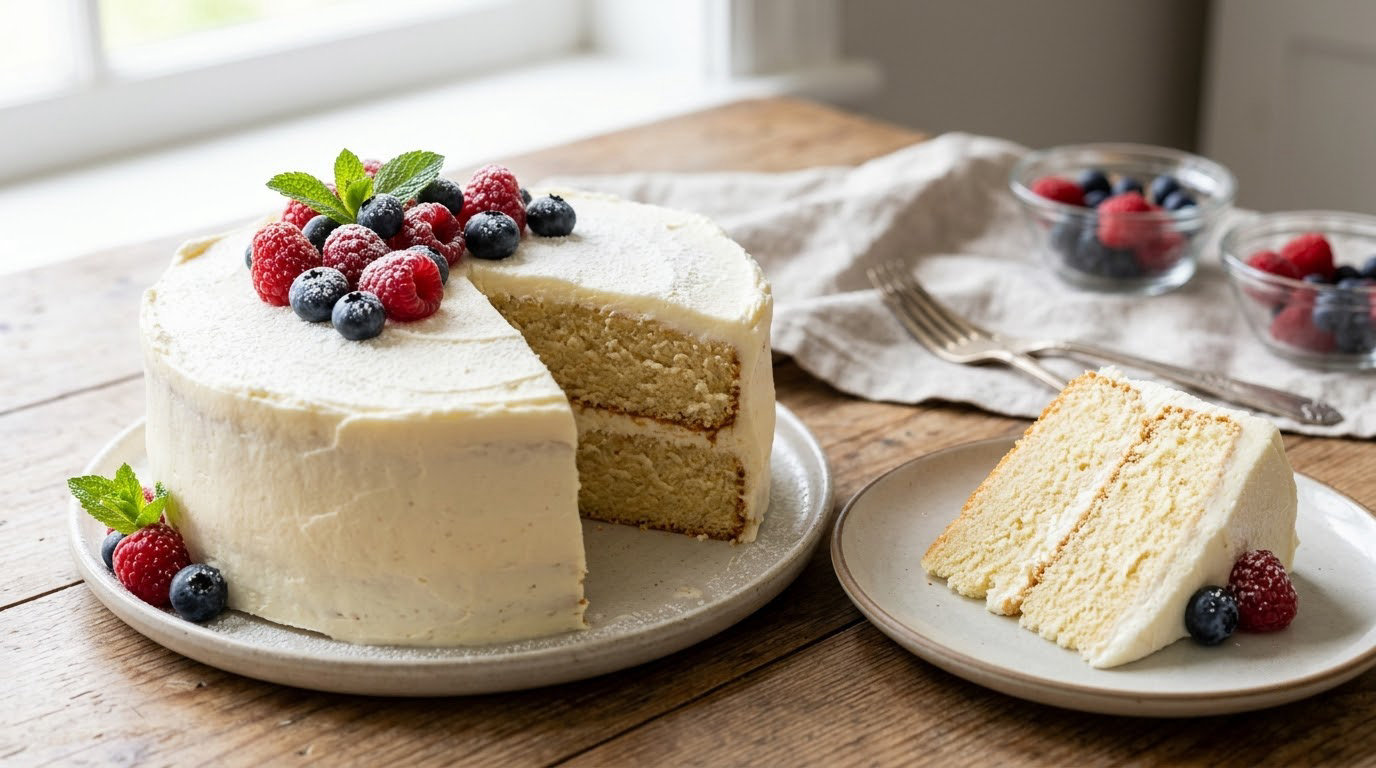
The quick answer to what temperature to bake a cake at: most cakes go into the oven at 350°F (177°C) in a conventional oven. Drop to 325°F (163°C) for large layer cakes, sheet cakes and richer batters. A fan oven needs 25°F lower than the recipe states, and the doneness cues at the end matter more than any number on the dial.
That is the short version. The useful version is the one that accounts for your cake, your pan and your oven, because those three things move the result more than a 25-degree difference ever will.
I keep an inexpensive oven thermometer on the middle shelf all the time. My own oven ran 20 degrees hot for years before I checked, which is a fair number of pale, dry cakes I did not need to eat. Once you know what your dial is really doing, choosing the temperature stops being guesswork.
Table of Contents
What Temperature to Bake a Cake At: Quick Guide
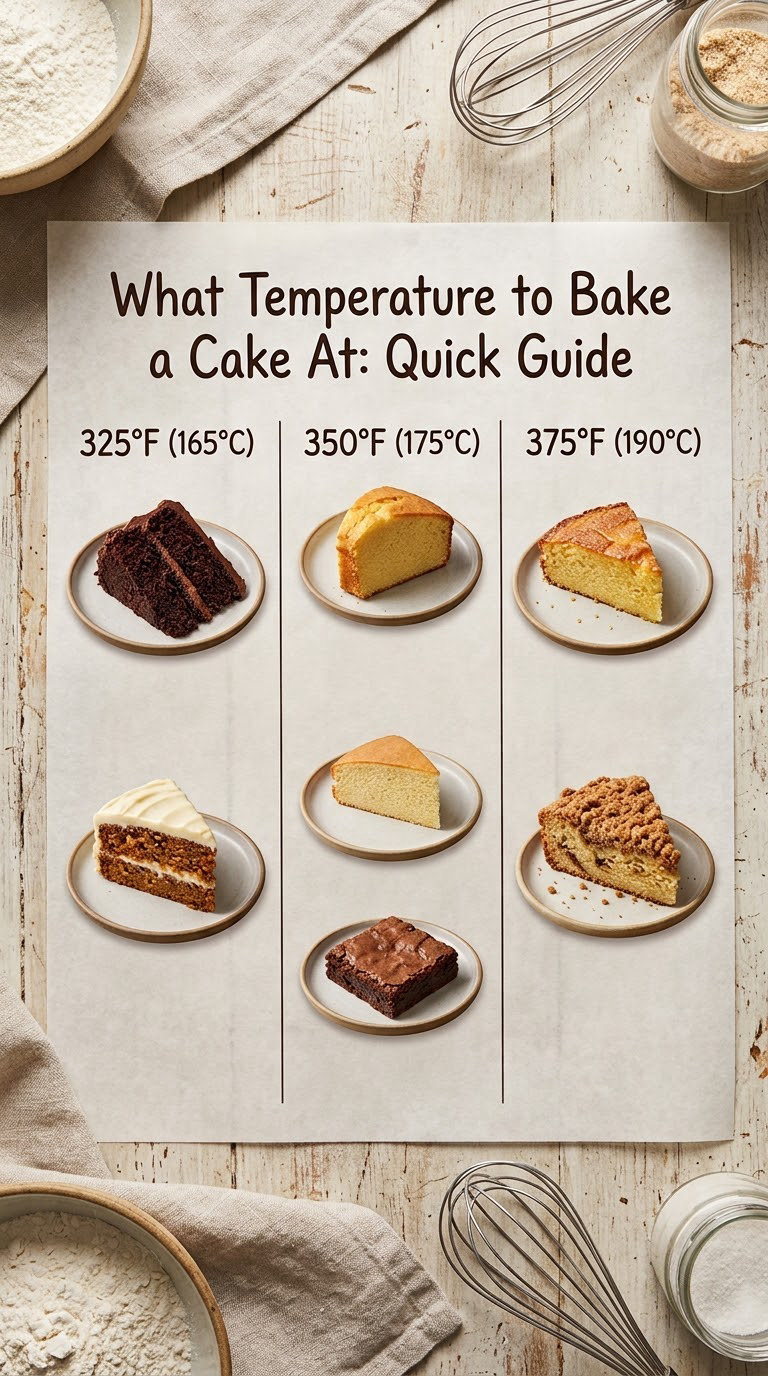
The table below is the whole guide in one place. Oven temperatures are listed for a conventional oven first, then the fan equivalent you should actually dial in.
| Cake type | Conventional | Fan oven | Typical bake time |
|---|---|---|---|
| Standard layer cake (9-inch round) | 350°F (177°C) | 325°F (163°C) | 28 to 32 minutes |
| Large layer or sheet cake (9×13) | 325°F (163°C) | 300°F (149°C) | 35 to 45 minutes |
| Pound cake (tube or loaf pan) | 350°F (177°C) | 325°F (163°C) | 60 to 75 minutes |
| Sponge cake | 325 to 350°F (163 to 177°C) | 300 to 325°F | 30 to 40 minutes |
| Bundt cake | 350°F (177°C) | 325°F (163°C) | 55 to 70 minutes |
| Angel food cake | 325°F (163°C) | 300°F (149°C) | 55 to 65 minutes |
| Cheesecake, water bath | 325°F (163°C) | 300°F (149°C) | 55 to 70 minutes |
| Brownies | 350°F (177°C) | 325°F (163°C) | 25 to 30 minutes |
| Cupcakes | 350°F (177°C) | 325°F (163°C) | 16 to 20 minutes |
| Fruit cake | 300°F (149°C) | 275°F (135°C) | 2 to 4 hours |
What temperature to bake a cake at by cake type
Rich batters with a lot of butter, sugar or chocolate carry more fat and sugar than lean ones, and fat slows the browning. Pound cakes and dense chocolate cakes take a gentle 350°F for that reason, because they brown on the surface long before the dense middle sets.
Cheesecake is the clearest case for going low. At 325°F (163°C) in a water bath, the custard sets slowly and evenly. Push the oven higher and you get the split, shrunken centre that sends people searching for help.
Angel food cake and other egg-white sponges go low too, at 325°F (163°C), because there is no fat in the batter at all to slow browning. Fruit cakes go lower still, at 300°F (149°C), since they need hours rather than minutes.
Cupcakes run hot for their size. The batter is in a small pan close to the element, so the top sets fast and you get a domed, browned top with a tender crumb underneath.
If you want a chewy brownie edge, 350°F (177°C) is the number. Drop to 325°F (163°C) and the same recipe bakes into a softer, cakier brownie.
How Pan Material, Size, and Depth Change the Temperature
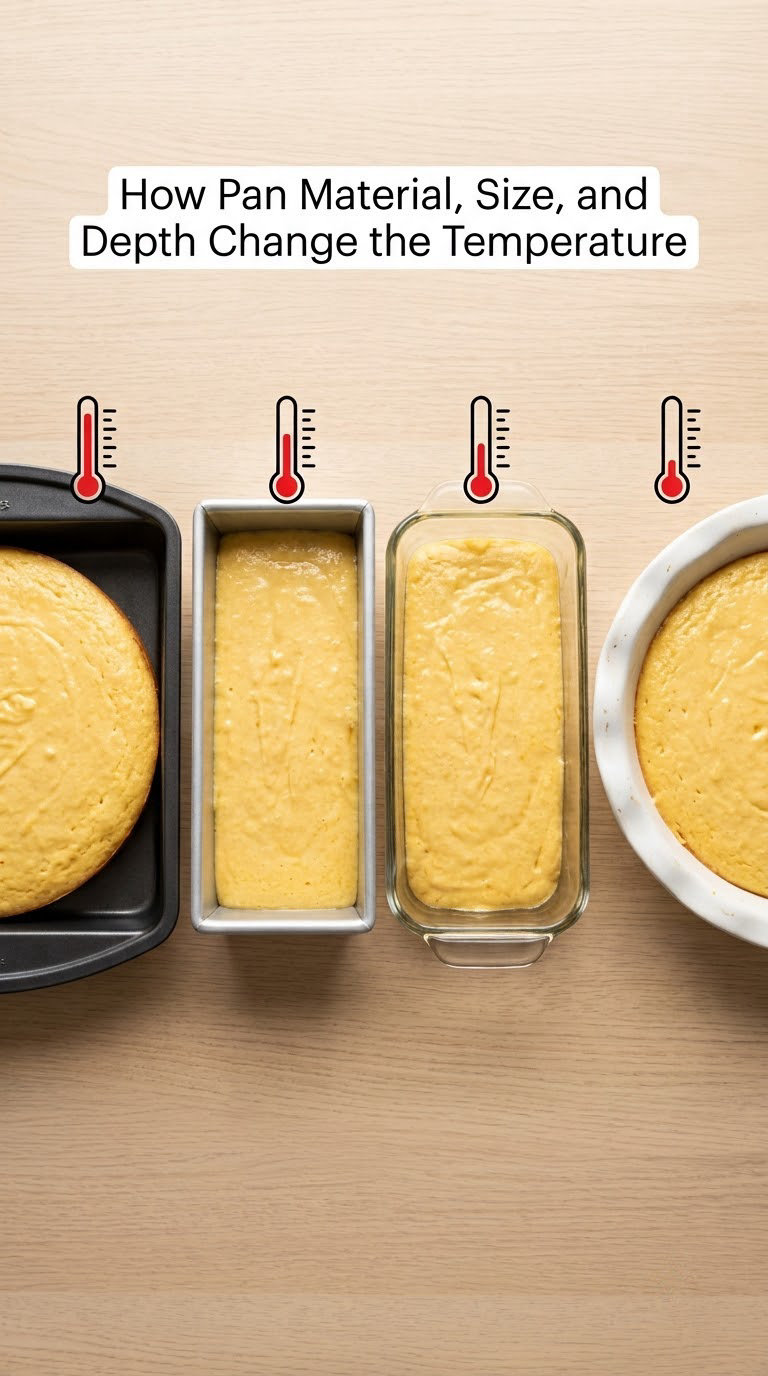
The pan decides how fast your cake’s surface heats up, which changes how you should treat the recipe temperature.
Dark metal pulls heat in quickly and browns the sides and bottom hard. When a recipe says 350°F and you are using a dark nonstick pan, drop 25°F to 325°F (163°C) or your edges will be overcooked and dry before the centre is done.
Light-coloured aluminium is the slow, forgiving one. Bakes close to the recipe temperature and gives the most even, gentle browning, which is why many bakers refuse to bake in anything darker.
Glass and ceramic heat more slowly than light metal but keep baking after the oven is off, so a cake in a glass Pyrex often needs another 5 to 10 minutes. The same goes for stoneware and heavy clay pans, which can hold 20 to 30 degrees above the dial once heated.
Size and depth change the maths more than material does. A cake twice the volume needs longer, but not double the time, because the outside has more surface to set. Going from a 9-inch to an 8-inch round pan adds roughly 10 to 15 percent to the bake time. Going from a 9-inch to a 9×13 pan lowers the temperature by 25°F, since the batter is shallower and the top is closer to the element.
For a deep 9×13, a tall layer cake or a full sheet cake, treat 325°F (163°C) as the starting point and let the doneness test do the rest.
How to Adjust the Oven Temperature for a Reliable Cake
Use the recipe temperature unless something in this list applies to you.
- Check your oven with a separate oven thermometer for 15 minutes at 350°F. If it reads more than 25 degrees off in either direction, subtract or add that offset to every temperature you cook at.
- Set the rack in the centre of the oven, not on the top shelf or the floor. Middle racks get the most even radiant heat.
- For a tall or deep cake, move down one rack so the top is not sitting directly under the upper element.
- Preheat fully, 15 to 20 minutes at a conventional temperature. An un-preheated oven gives you the opposite of even browning.
- Use a light-coloured metal pan unless the recipe calls for something else.
- If the batter is rich or the pan is dark, reduce by 25°F (15°C) and add a few minutes to the bake time.
- Rotate the pan halfway through if you bake two at once, and never crowd the rack or let pans touch the oven walls.
The rule experienced bakers fall back on: when in doubt, drop the temperature and add time. The reverse, baking harder and shorter, is what dries the edges and cracks the top.
Fan Oven vs Conventional Oven: The 25°F Rule
A fan oven bakes about 25°F (15°C) lower than the recipe temperature, because the fan circulates hot air around the cake instead of relying on radiant heat alone. A recipe calling for 350°F becomes 325°F in a fan oven. A recipe calling for 375°F becomes 350°F.
The benefit is real: a fan gives faster, more even browning and less risk of a sunken centre. The cost is a drier cake if you forget the offset, because the surface sets sooner and traps the moisture in.
If your recipe already states a fan temperature, use it as written. Conflicting instructions here cause most of the confusion I see, so read the oven type before you turn the dial.
Oven Temperature Conversion Chart
| Fahrenheit | Celsius | Fan oven Celsius | Gas mark |
|---|---|---|---|
| 250°F | 120°C | 110°C | 1 |
| 275°F | 140°C | 120°C | 2 |
| 300°F | 149°C | 130°C | 3 |
| 325°F | 163°C | 145°C | 4 |
| 350°F | 177°C | 160°C | 5 |
| 375°F | 190°C | 170°C | 6 |
| 400°F | 204°C | 180°C | 7 |
| 425°F | 220°C | 190°C | 8 |
| 450°F | 230°C | 200°C | 9 |
Gas mark 4 is 350°F (177°C) in a conventional oven and 160°C in a fan, which is the one conversion I look up most often.
Cake Baking Times by Pan Size
Time is a starting point, not a target. Every one of these is a range you check with doneness cues, never a number you set a timer to.
| Pan | At 325°F (163°C) | At 350°F (177°C) | At 375°F (190°C) |
|---|---|---|---|
| 8-inch round | 35 to 40 minutes | 30 to 35 minutes | 25 to 30 minutes |
| 9-inch round | 32 to 36 minutes | 28 to 32 minutes | 24 to 27 minutes |
| 8-inch square | 35 to 40 minutes | 30 to 35 minutes | 25 to 30 minutes |
| 9×13-inch | 40 to 45 minutes | 35 to 40 minutes | 30 to 35 minutes |
| 12×12-inch sheet | 50 to 60 minutes | 45 to 55 minutes | 38 to 45 minutes |
| 9×5-inch loaf | 65 to 75 minutes | 55 to 65 minutes | 50 to 55 minutes |
| Cupcakes | 18 to 22 minutes | 16 to 20 minutes | 14 to 17 minutes |
Chilled batter from the fridge needs an extra 5 to 10 minutes, since it starts colder than room-temperature batter.
How to Tell When a Cake Is Done Without Cutting It
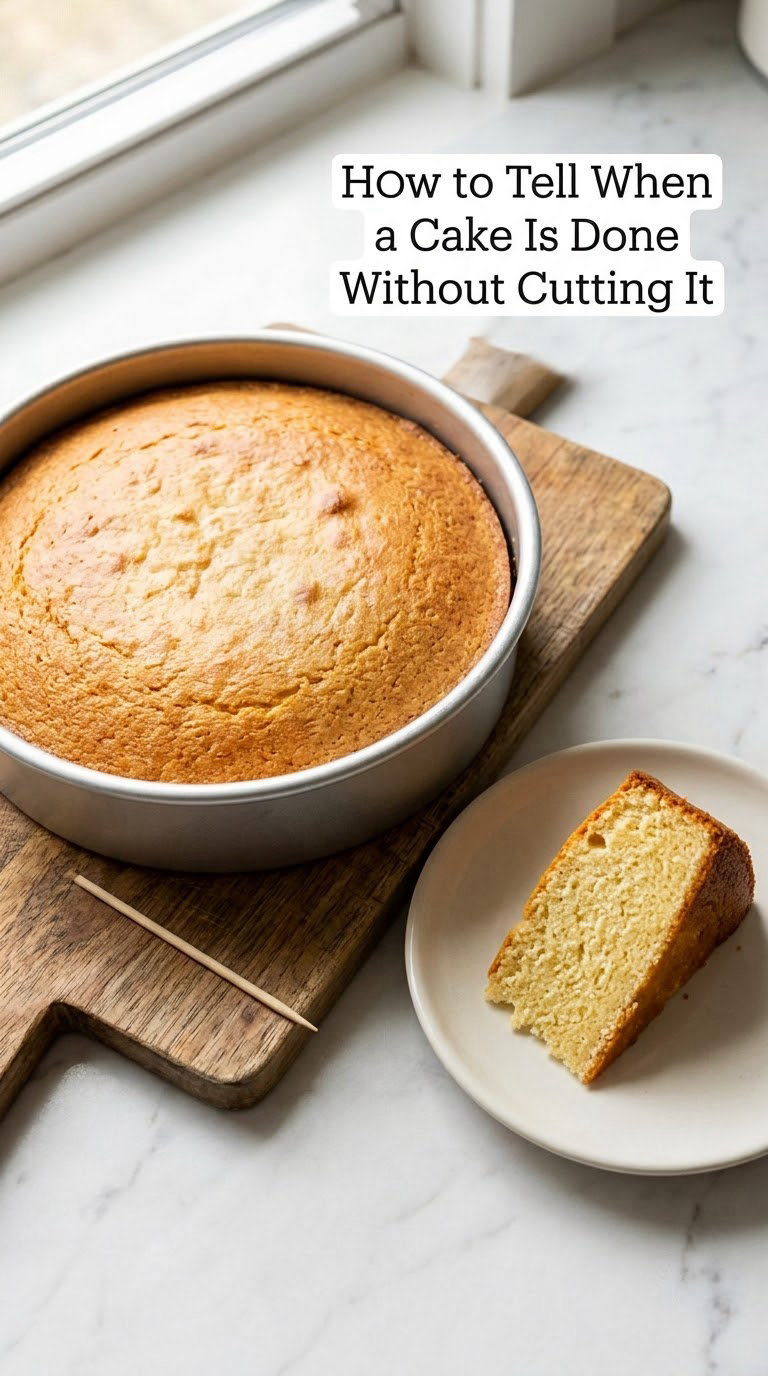
Use the toothpick test first. Stick a toothpick into the deepest part of the centre. A few moist crumbs are the goal, and a clean or almost-clean toothpick means it is done.
The spring-back test takes five seconds. Press gently on the centre of the top with a fingertip. If the dent springs back, the cake is set. If the impression stays, give it more time.
A skewer or knife works the same way as a toothpick. Wet batter on the blade means keep going; sticky crumbs mean take it out.
If you want numbers, an instant-read thermometer in the centre should show 200 to 205°F (96 to 100°C) for a fully baked cake.
The edges and aroma tell you as much as the middle. Edges that have pulled from the pan and released their raw batter smell point to a finished cake.
An underbaked cake looks sunken in the centre, has a wet crumb, and may show a ring of raw batter around the edge. An overbaked one pulls cleanly from the pan but tastes dry, and its edges are hard and dark.
Should You Reduce the Temperature If My Cake Is Baking Unevenly?
Not always. Reduce the temperature only when the outside is cooking faster than the inside, which shows up as dark edges and a pale or wet centre.
A hot oven and a hot pan are two different problems, so diagnose which one you have. If the top browns first while the bottom stays pale, the top element is too close; move the pan down a rack, or tent it loosely with foil for the last third of the bake.
If the bottom browns and darkens before the top colours, the pan is sitting too close to the lower element, or it is a dark metal pan. Drop 25°F (15°C) and move the rack up one position.
If one side is browner than the other, it is placement, not temperature. Centre the pan and keep it clear of the oven walls.
If every cake bakes the same way in the same pan, your oven is the variable. Run the thermometer test and correct for the difference rather than rewriting every recipe.
If you want the gentlest possible bake for a delicate sponge or cheesecake, a water bath steadies the temperature around the pan and stops the surface setting too fast.
Common Cake Temperature Mistakes and How to Fix Them
- Baking in a cold oven. Preheat for 15 to 20 minutes. Going in cold makes the edges set before the centre gets going, and the middle sinks.
- Opening the door too early. Wait until the cake has risen and set at the edges, roughly two-thirds of the way through. A draft and a drop in temperature can collapse the centre.
- Trusting the timer instead of the cues. Check five minutes early with a toothpick. Ovens and pans vary enough that the clock is only a prompt to start testing.
- Using a dark metal pan at the recipe temperature. Drop 25°F (15°C) and add a few minutes.
- Crowding the rack. Air needs to circulate. Bake one sheet at a time, or rotate pans halfway through.
- Forgetting the fan oven offset. Reduce 25°F (15°C) from the recipe temperature, or the cake dries out.
- Baking high above sea level. Drop about 15 to 25°F per 1,000 feet of elevation, since thinner air means the cake sets and rises faster.
- Filling the pan too full. Two-thirds full is the target. Overfilled pans overflow, and the overflow drips on the oven floor and smokes.
Baking a cake at 400°F (204°C) is possible, and box mixes ask for it, but you get more colour than structure and the timing window is short. Brownies and cupcakes handle it well. Layer cakes do not.
For more ideas once you have the temperature right, my 15 easy chocolate cake recipes for birthdays are worth a scroll, and most of them use that dependable 350°F starting point.
If you also cook meat, I keep the same approach in what temperature pork is done at, where an oven thermometer settles the argument just as quickly.
Frequently Asked Questions
What is the best temperature for baking a cake?
350°F (177°C) in a conventional oven is the best all-round temperature for most cakes. Drop to 325°F (163°C) for large layer cakes, sheet cakes, pound cakes and cheesecakes, and lower by another 25°F if you are using a fan oven. Adjust down for dark pans and up if your oven thermometer reads low.
Should I bake a cake at 325°F or 350°F?
Use 325°F (163°C) for deep, rich or large batters, including sheet cakes and cheesecakes, because the slower heat sets the middle before the edges overcook. Use 350°F (177°C) for standard layer cakes, cupcakes and brownies. Both work for most recipes; 325°F just needs a few extra minutes and gives a moister crumb.
Why is my cake browning before the center is done?
The outside is getting heat faster than the middle can absorb it. Lower the temperature by 25°F (15°C), move the pan down a rack if the top is browning early, use a lighter coloured pan and tent with foil near the end. If your oven runs hot on the dial, an oven thermometer will confirm it.
Do glass cake pans need a lower baking temperature?
Not lower, but longer. Glass and ceramic heat more slowly than light metal and keep cooking after the oven is switched off, so follow the recipe temperature and add 5 to 10 minutes to the bake time. Avoid sudden temperature changes with glass, since a hot glass pan going onto a cold surface can crack.
Can I use convection to bake a cake?
Yes, and most cakes come out more evenly browned. Set the fan oven 25°F (15°C) lower than the recipe’s conventional temperature, which usually means 325°F (163°C) instead of 350°F (177°C). Cakes do not need much longer, and open the door less because the fan spreads heat quickly.
Why is the bottom of my cake burning?
The pan is too close to the lower element, the oven is running hot, or you are using a dark metal pan. Move the rack up one position, drop the temperature by 25°F (15°C) and check your oven with a thermometer. Wrapping the outside of the pan in foil also insulates the base.
Conclusion
Start at 350°F (177°C) for a conventional oven and 325°F (163°C) for a fan oven. Drop to 325°F (163°C) for large, rich or deep cakes, and lower by another 25°F if the pan is dark.
Then let the cake tell you when it is done. Check with a toothpick around two-thirds of the way through, keep the door closed until the edges are set, and give your oven a thermometer so you know what the dial is really doing. That combination is what makes the answer to what temperature to bake a cake at less of a gamble.