
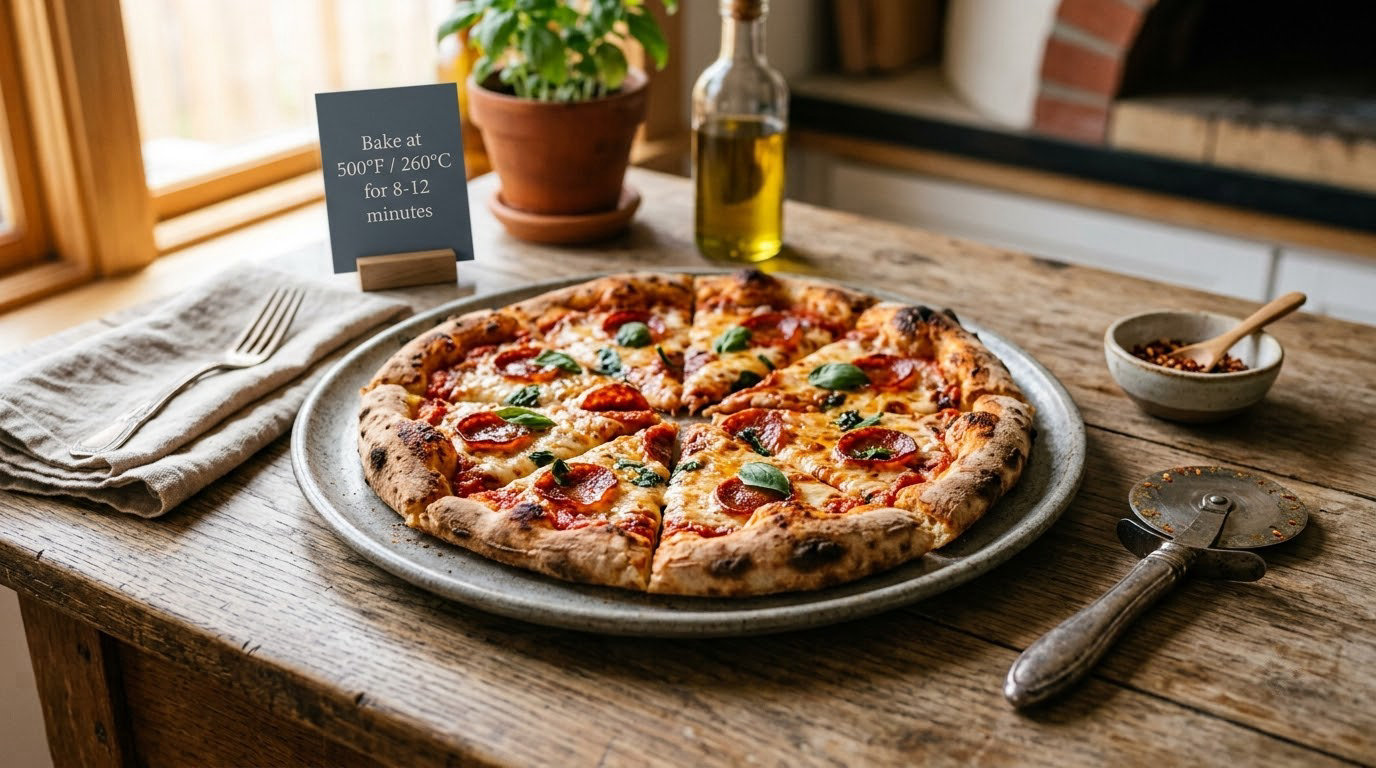
The short answer: bake pizza at 475°F (245°C) for a thin or medium crust and at 425°F (218°C) when the dough is thick, deep-dish or loaded with toppings. If your oven reaches higher, use that heat on a preheated stone or baking steel. So, what temperature to cook pizza in the oven? Crank it as high as the dial goes, and let the surface do the rest.
I spent years baking at 450°F because that is what most printed recipes say. The pizza was fine. Then I bought a cheap infrared thermometer, pointed it at my stone after an hour of preheating, and found the surface was running about 50°F under the dial setting. Everything I had been blaming on my dough was my oven. Once I started working from the real surface temperature and the colour of the crust edge, the crust stopped being tough and started snapping.
This guide covers the numbers that matter, why higher heat is not always better, how to preheat properly, how to check doneness without cutting the pizza, and what to do when the edges scorch before the centre sets. Pick the row in the table that matches your pizza and start there, then adjust from what you see rather than from what the dial says.
Table of Contents
What Temperature to Cook Pizza in the Oven: Quick Guide
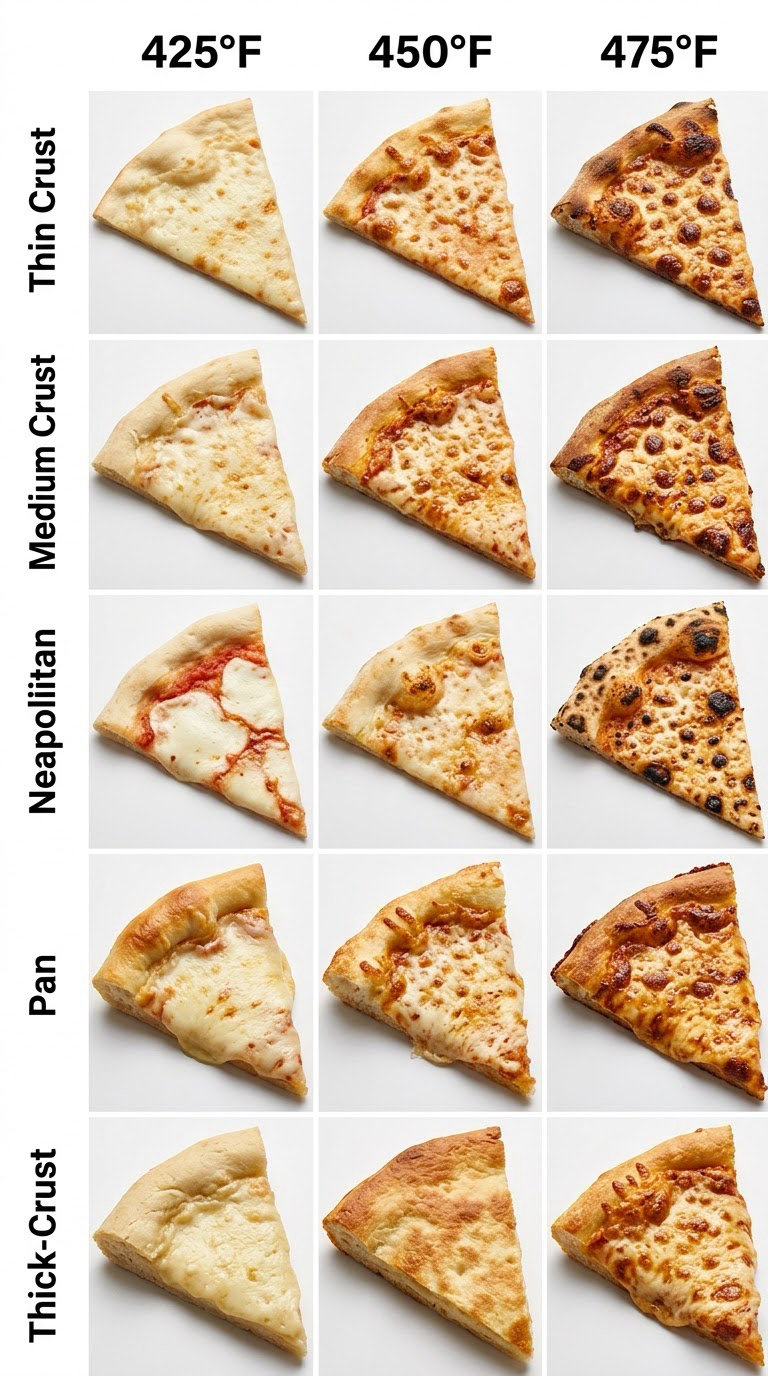
Most home pizzas want one of three temperatures: 425°F for thick dough, 475°F for thin and medium crust, and the oven’s highest setting when you have a baking steel or a broiler finish. Times below assume a fully preheated oven and a 12-inch pizza.
| Pizza style | °F | °C | Time | Rack position | Equipment |
|---|---|---|---|---|---|
| Neapolitan-style (broiler finish) | 550 | 288 | 4-6 min | Upper middle | Baking steel |
| Thin crust | 475 | 245 | 8-12 min | Lower middle | Stone or steel |
| New York style | 500-550 | 260-288 | 6-10 min | Lower middle | Stone or steel |
| Medium crust | 475 | 245 | 9-13 min | Lower middle | Stone or steel |
| Pan pizza (Detroit, Sicilian) | 425-450 | 220-230 | 18-25 min | Lower middle | Cast iron or square pan |
| Thick crust and deep dish | 425 | 218 | 30-40 min | Lower middle | Deep pan, springform |
| Frozen pizza | 400-425 | 205-220 | 10-14 min | Centre rack | Preheated baking sheet |
| Reheating a slice | 450 | 230 | 4-5 min | Centre rack | Stone or steel |
Two things in that table matter more than the rest. First, the time assumes the oven has been at temperature for at least 30 minutes with the stone inside. Second, a stone in a cold oven is just heavy stone, so the first pizza after preheating always bakes slower than the ones after it.
Which Pizza Temperature Gives the Best Results?
The ideal temperature depends on how much water the dough holds, how much sugar is in it, how thick it is, and how crisp you want the finish. Thicker dough insulates its own centre, so it needs a longer, gentler bake. Thin dough has almost no insulation, so it needs enough heat to set the crust in the first minute or it dries out before it ever crisps.
Thin and medium crust
Thin crust bakes best at 475°F (245°C). That is hot enough to set the dough quickly and brown the underside, but not so hot that the crust edge burns in the first three minutes.
Medium crust, the sort of dough most people buy from a supermarket, sits in the same range at 475°F and needs about a minute or two longer. If your crust edge is going pale rather than golden, move to 500°F and shorten the bake by a minute or two.
Neapolitan-style pizza
A real Neapolitan pizza bakes at 800-900°F (427-482°C) in about 90 seconds, and no home oven gets there. The closest you can get is the broiler method: preheat a baking steel at your oven’s top setting for a full hour, launch the pizza onto the steel, and give it 2 to 3 minutes under the broiler. The top browns and the cornicione blisters while the bottom cooks on the steel.
You need a 00 flour dough, very high hydration and a short 60-second bake for that to work. With supermarket dough the edges scorch and the middle stays doughy, which is the single most common complaint from people trying this at home.
Pan pizza, Detroit and Sicilian style
Pan pizza drops to 425-450°F (220-230°C) and bakes for 18 to 25 minutes. The dough is thick, the pan holds heat, and the cheese is usually a heavy layer that needs time to render rather than scorch.
Cheese is the reason pan pizza tolerates a lower temperature. Shredded mozzarella melts and browns slowly, so a slow bake gives you an even, glossy top instead of burnt patches. A very light drizzle of olive oil on the base before the sauce helps the edges caramelise at this gentler setting.
Thick crust and deep dish
Chicago deep dish and thick home-oven crusts want 425°F (218°C) for 30 to 40 minutes. The dough sets from the outside in, and a hotter oven bakes the outer ring long before the middle fillings are piping hot.
For a deep dish with sausage or other meat, hold the bake time and check that the filling reaches 165°F (74°C) for poultry, 160°F (71°C) for ground meat, or 145°F (63°C) with a 3-minute rest for beef, pork, veal and lamb. That temperature guidance matters more here than in any other pizza style, because the centre is a stew, not a sauce.
Frozen pizza and reheating
Frozen pizza wants less heat than homemade, because the dough is already par-baked. Follow the box first at 400-425°F (205-220°C), then next time try 425°F on a preheated baking sheet with a few drops of olive oil brushed on the frozen crust. The oil browns the base and cuts the soggy middle that makes people think frozen pizza is a scam.
For leftovers, 450°F (230°C) for 4 to 5 minutes on a preheated stone gives you a re-crisped base and melted cheese without drying the slice out. The microwave makes a crust chewy and damp, which is why most people end up using the oven anyway.
Why higher heat is not always better
Crust texture comes from two reactions. Moisture turning to vapour pushes the dough outward, which is oven spring, and sugars and proteins browning is the Maillard reaction with caramelisation alongside it. Both need heat, and both need time. Too little heat and the crust bakes grey and bends. Too much and the outside carbonises while the inside is still wet dough.
The trap is chasing a number. An oven set to 550°F with a cold stone behaves like a 450°F oven, because the dough lands on a room-temperature surface and spends its first minutes pulling heat out of the stone. Preheat is not a formality you skip; it is half of the temperature.
Stone or steel changes the temperature you choose
A baking stone stores heat gently and releases it steadily, so 475-500°F is plenty. A baking steel conducts heat far faster and tolerates higher settings, so 500-550°F is realistic on one and usually gives a noticeably crisper base in a shorter bake.
If you are shopping for gear, the pizza oven accessory kits page covers what fits your oven, and there is a good outdoor pizza oven stands guide if you ever move to a dedicated pizza oven outside.
What Temperature to Cook Pizza In the Oven by Pizza Style
In short: Neapolitan-style at 550°F with a broiler finish, thin and medium at 475°F, New York at 500-550°F, pan pizza at 425-450°F, thick and deep dish at 425°F, frozen at 400-425°F. Stone and steel work at the same setting but reach it in different time.
When you are unsure between two numbers, start at the higher one and cut the time. A pizza pulled two minutes early still has carryover heat in the crust. A pizza left in for two minutes too long has no way back.
Do You Need to Preheat the Pizza Oven?
Yes, and for a pizza stone or steel you need a longer preheat than most recipes state. Give it 45 to 60 minutes at the oven’s top setting with the stone already inside. A stone that has been warming for 20 minutes is not the same object as one that has been warming for an hour, and that difference shows up in the crust.
The reason is thermal mass. A thick stone or steel has to absorb a large amount of energy before its surface reaches baking temperature, and it loses heat every time a cold, wet dough hits it. That first dough also cools the whole stone, which is why the second pizza on the same stone bakes faster and better than the first. Plan on discarding or eating the first one as a calibration bake.
The exception is pan pizza. A cast iron or heavy aluminium pan in a preheated oven for 10 to 15 minutes is enough, because the pan itself conducts heat and the bake is long and gentle. Preheating an hour for a pan pizza buys you nothing.
How to check your oven is actually hot enough
Oven dials lie, sometimes by 25°F and sometimes by more. An infrared thermometer costs very little and settles the argument in seconds: hold it a few inches from the stone’s centre after preheating and read the surface. Do that check once so you know what your own dial does at each setting.
If you cannot get a thermometer, drop a few drops of water on the stone. It should sizzle instantly and skate across the surface rather than sit and steam. That is a rough check, but it separates 450°F from 500°F when the dial cannot.
How to Tell When Pizza Is Done
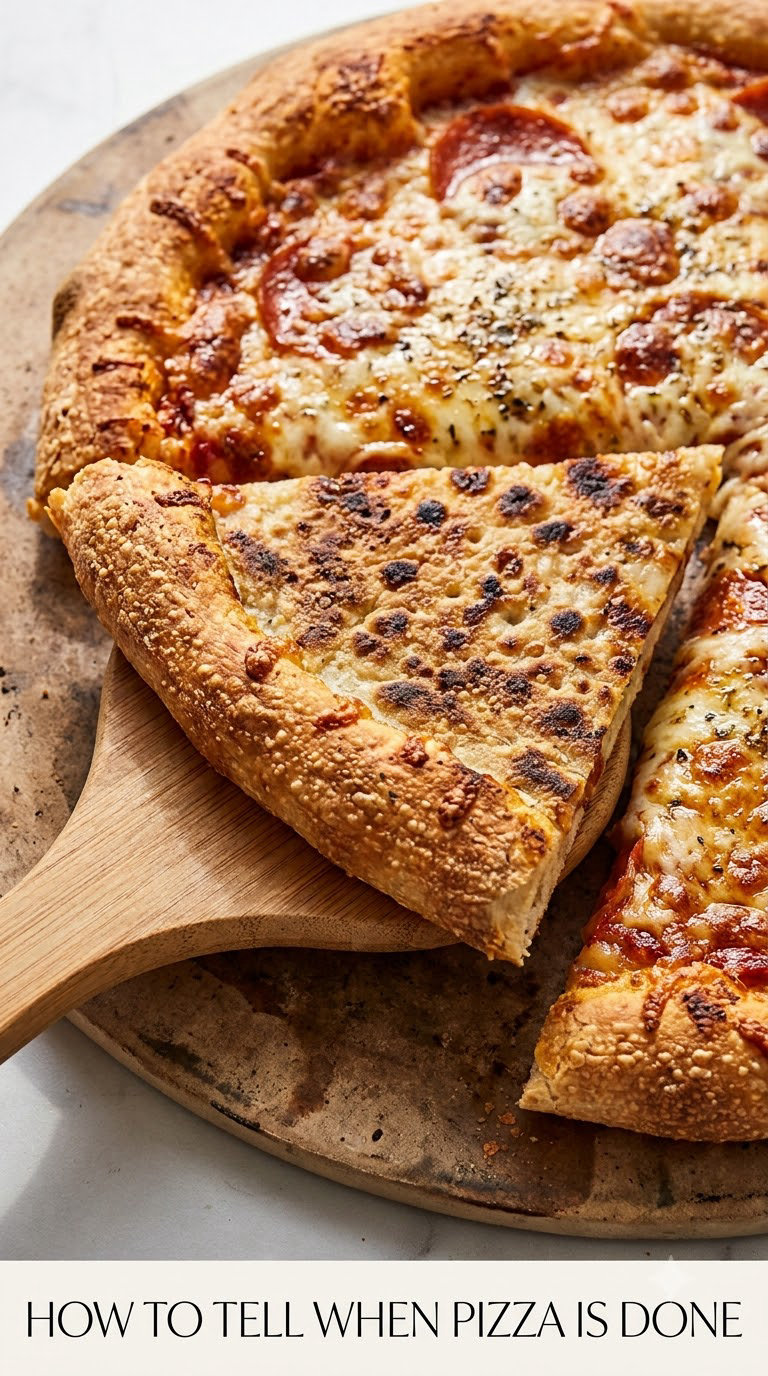
Three visual cues tell you what temperature to cook pizza in the oven is working for you: a deeply golden, stiff crust edge; cheese that is melted with a few browned bubbles; and a base you can see is golden under the whole slice. Time is a guide, not the test.
Lift a corner with a peel and look underneath. If the base is pale, give it another 60 to 90 seconds. If it is deep gold and firm, the pizza is done even if the top colour looks light, because the underside is where most of the browning happens on a stone.
The crust edge should be stiff enough that a lifted slice holds its shape rather than folding. That stiffness is a sign the starches have set and the moisture has moved out to the surface. A floppy edge means the bake was too short or too cool.
Carryover cooking finishes the centre after the pizza leaves the oven, which is why pulling it a shade early is the safer habit. Thick styles like deep dish benefit most from this; the fillings keep cooking during the two or three minutes it sits on the board before you cut.
Should You Use Convection for Pizza?
Convection is useful, with one adjustment: drop the temperature by 25°F (15°C). So 475°F (245°C) conventional becomes 450°F (230°C) fan. The fan moves air past the pizza, so the top browns faster and the whole pie cooks more evenly, but it also dries the crust edge out faster.
Convection earns its keep on pan and deep-dish pizza, where an even top without a hot spot matters more than a fast bottom. It is less useful on a thin crust baked on a steel, because the steel already supplies even bottom heat and the fan mostly adds drying.
When in doubt, use standard bake. The differences on a home oven are small, and switching between fan and conventional makes it harder to read your own results. If your fan oven has a setting that turns the fan off after a set time, that gives you the best of both: even browning early, then a dry finish.
How to Keep Pizza From Burning Before the Center Cooks
This is the most common complaint on pizza forums, and it almost always comes down to radiant heat from above doing its job faster than the dough can cook. Work through these in order.
- Check the dough thickness first. A thick centre needs longer at a lower temperature, not the same time at a higher one. If the edge browns in 4 minutes, either drop to 425°F or spread the toppings thinner.
- Drain the moisture out of your toppings. Wet tomato, drained mushrooms and rinsed artichokes are the difference between a cooked centre and a grey one. Press the tomato slices between paper towels for a minute before they go on.
- Lower the temperature by 25°F and add time. 450°F for 12 minutes beats 475°F for 8 minutes when the centre is raw, because the top gets less intense while the base still crisps.
- Preheat fully. A cold stone makes the bottom slow, so only the top browns. Ninety seconds of extra preheat is cheaper than foil.
- Shield the trouble spots. If one side runs hot, tent that edge loosely with foil for the first 3 minutes, then remove it to brown.
- Rotate once, early. Turn the pizza about halfway through, not at the end. Rotating late spreads toppings and tears the set crust edge.
- Drop the rack. Moving the pizza one shelf lower cuts radiant heat from the top element and gives the base more of the heat.
With a baking steel you get a fourth lever: two minutes under the broiler at the end, with the pizza on the top rack close to the coils. That browns the top fast so you can finish the pie at a lower conventional temperature without losing colour.
Common Mistakes
- Baking on a cold stone. The crust lands cool and stays pale. Preheat the stone 45 to 60 minutes and verify the surface temperature.
- Trusting the dial. Ovens commonly run 25-50°F off in either direction. One infrared reading tells you which way yours leans and what to add to the setting.
- Skipping the preheat. Preheat means the oven body and the stone are both saturated with heat, not that the control light came on.
- Crowding the oven. Two pizzas at once halves the recovery rate after each launch, so both bake paler. One at a time is faster overall.
- Too many toppings. A heavily loaded centre insulates itself and traps steam. Cook it longer at a lower temperature instead of piling it higher.
- Rotating at the wrong time. Turn halfway through for an even bake. A late turn drags toppings and tears the crust.
- Overloading parchment. Direct parchment at 500°F+ on a hot stone darkens and can smoke. Use it only below about 475°F, or go bare on the steel.
- Leaving the pizza on the rack after baking. Carryover heat keeps cooking the base, so a slice sitting on a hot stone or a warm rack goes past done within a minute. Move it to a rack.
- Running the broiler for the whole bake. Broiler heat is intense and unbalanced. Use it for the last two minutes, not the whole ten.
Frequently Asked Questions
What is the best temperature to cook pizza in the oven?
For a home oven, 475°F (245°C) for 8 to 12 minutes is the best starting point for thin and medium crust on a preheated stone or steel. Thick, deep-dish and pan pizza do better at 425°F (218°C) for 18 to 40 minutes. If your oven reaches 500 to 550°F (260 to 288°C) and you own a baking steel, go to the top setting and shorten the bake.
Is 450°F or 475°F better for homemade pizza?
475°F (245°C) is better if you have a pizza stone or steel fully preheated for 45 minutes, because the extra 25 degrees sets the crust before it can dry out. Without any stone, both numbers bake similarly and 450°F (230°C) gives you more forgiveness. The bigger difference comes from equipment, not from 25 degrees of dial setting.
Do I need to preheat the oven for pizza with a baking stone?
Yes, and give it 45 to 60 minutes rather than the 15 or 20 minutes most recipes allow. A stone needs time to absorb enough heat to reach baking temperature at the surface, and it cools every time wet dough lands on it. The first pizza after preheating bakes slower and paler than the second, so plan for that. A pan pizza in a heavy cast iron pan only needs 10 to 15 minutes.
Should I use convection when baking pizza?
You can, but drop the temperature by 25°F (15°C), so 475°F becomes 450°F (230°C) on the fan setting. The fan browns the top faster and more evenly, which helps pan and deep-dish pizza. On a thin crust on a baking steel it mainly dries the crust edge, so standard bake gives you more control and a crisper result.
Why is the crust burning before the pizza is done?
The top element is outrunning the dough. Drop 25°F, drain wet toppings, move the rack one shelf lower and turn the pizza halfway through rather than at the end. If you are baking thin crust at 500°F or above without a stone, that is usually the real cause, because a room-temperature sheet cannot crisp the base before the top scorches.
How do I know when pizza is cooked without cutting it?
Look at the crust edge, the cheese and the base. The edge should be deeply golden and stiff enough that a lifted slice holds its shape instead of folding. The cheese should be fully melted with a few browned bubbles. Lift a corner with a peel and check that the underside is golden across the whole slice. A pale base needs another 60 to 90 seconds.
The Best Pizza Temperature to Start With
Preheat the oven fully, put the stone in first, and set 475°F (245°C) for thin or medium crust. That is the number that works across most home ovens without a steel. Drop to 425°F (218°C) the moment the dough gets thick or the pan goes in, and take thin crust to the oven’s top setting when you have a baking steel sitting at temperature.
Adjust only after you check the crust colour and lift a corner to see the base, because your oven is its own piece of equipment. One infrared reading tells you whether your dial runs hot or cold, and from then on you can cook by eye instead of guessing. The dough and the pan shape how much heat the pizza can absorb, so once the temperature is right, the rest is technique.