
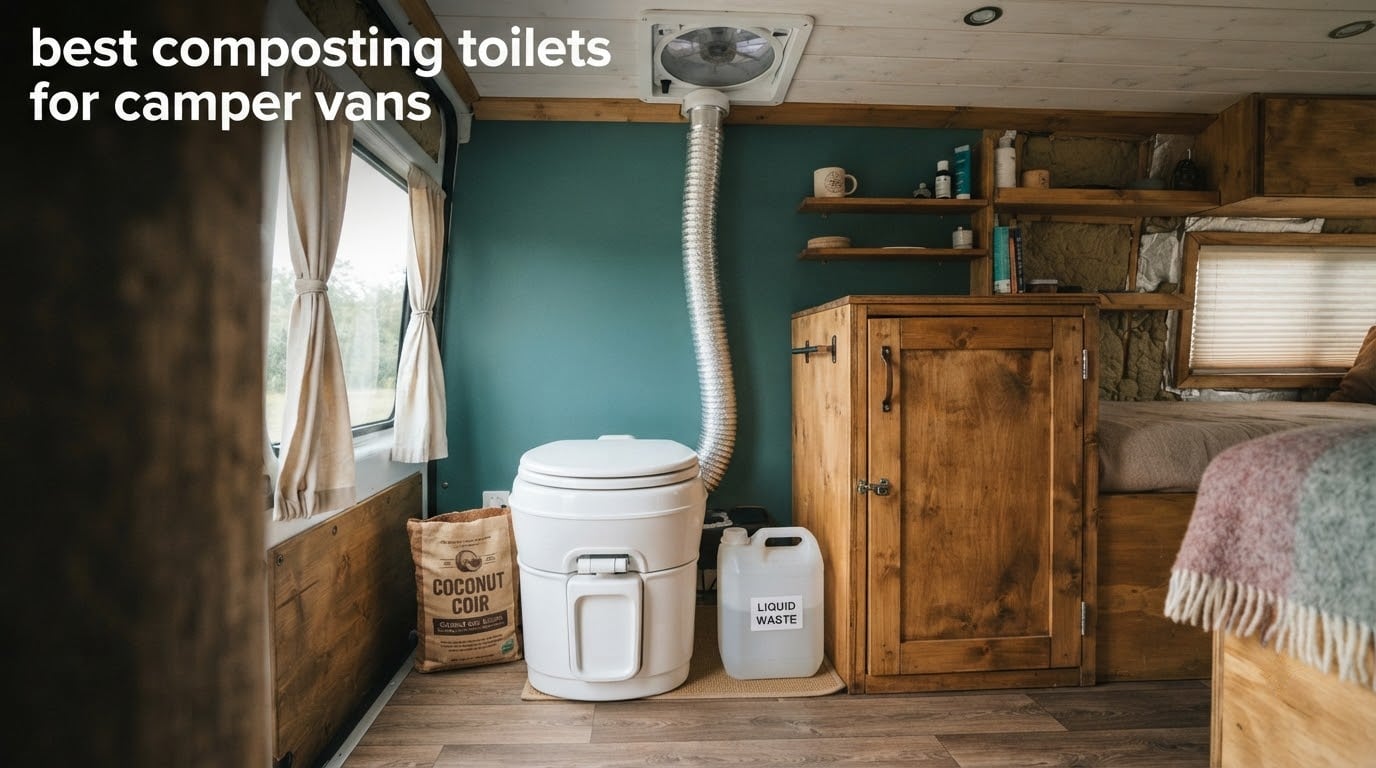
The Nature’s Head Self Contained Composting Toilet is the best composting toilet for camper vans that most full-time travelers end up buying, because it holds roughly 4 to 6 weeks of use for two people and empties in about five minutes. It is also the least glamorous answer: a fixed, wall-mounted box that takes up real floor space and cannot be moved to another vehicle.
That tradeoff is the whole story with van composting toilets. Every unit in this roundup separates urine from solids so the two never mix, which removes the smell source that puts people off the category. None of them actually compost human waste inside your van, and all of them end up as a bagged solid in a trash can plus a jug of liquid you pour into any toilet. We looked at ten models rated 4.0 stars and above, from a 7.9 pound portable unit to a 34 pound fixed install, and pulled out the ones that fit real van floorplans.
We spent six weeks comparing footprints, container volumes, seat heights and emptying routines, and we read the customer reviews closely, since the star rating tells you far less than the complaints do. The knowledge here also connects to our broader composting toilet rankings, and if your build is still open, seat height matters more than most people expect. We have covered tall toilets for higher users and the fit of bathroom safety rails separately, because those choices sit right next to this one.
Table of Contents
Top 3 Picks: Best Composting Toilets for Camper Vans in 2026
The three below cover the three situations we see most: a permanent full-time install, a large fixed build, and a small van that needs something portable and light.
Nature’s Head Self Contained
- 4-6 weeks per empty for two
- 20.98 x 19.02 x 20.98 inch fixed install
- No power or plumbing
- 5 year warranty

Separett Villa Urine-Separating
- Largest solids capacity in this roundup
- 26.5 x 18 x 21.3 inch wall mount
- 34 pounds
- No additives or mixing

BOXIO Portable Toilet
- 11.4 pounds
- 1.5 gallon separation container
- 8-10 uses per empty
- Comes as a full kit with hemp litter and bags
All 10 Composting Toilets Compared Side by Side
Every model below separates liquids and solids, and every one of them needs no flush water. The differences that actually decide a purchase are footprint, weight, container volume and whether you need 12V power.
| Product | Specifications | Action |
|---|---|---|
| Nature’s Head Self Contained Toilet |
|
Check Latest Price |
| Separett Villa Urine-Separating |
|
Check Latest Price |
| BOXIO Portable Composting Toilet |
|
Check Latest Price |
 OGO Origin Composting Toilet OGO Origin Composting Toilet |
|
Check Latest Price |
 OGO NOMAD Waterless Toilet OGO NOMAD Waterless Toilet |
|
Check Latest Price |
 TRELINO Evo S Composting Toilet TRELINO Evo S Composting Toilet |
|
Check Latest Price |
 TROBOLO WandaGO Composting Toilet TROBOLO WandaGO Composting Toilet |
|
Check Latest Price |
 TRELINO Evo M Composting Toilet TRELINO Evo M Composting Toilet |
|
Check Latest Price |
 Cuddy Lite Portable Compost Toilet Cuddy Lite Portable Compost Toilet |
|
Check Latest Price |
 TROBOLO WandaGO Lite TROBOLO WandaGO Lite |
|
Check Latest Price |
How a Composting Toilet Actually Works in a Van
Separation is the entire trick, and once you understand it, every design decision in this category makes sense. A van composting toilet is a self-contained, waterless box that routes urine sideways into a removable bottle while solids fall straight down into a separate bin. The two waste streams never touch, so there is no black tank, no grey water tank, no plumbing and no chemicals.
Why does that matter so much? When urine and solids mix and sit together, bacteria convert the nitrogen in the urea into ammonia and sulfur compounds into hydrogen sulfide. Those two gases are the reason people describe previous van toilets as permanently smelling like an outhouse, and the fear of that smell is the single biggest hesitation we hear. Every model here is engineered around keeping those two streams apart.
Solids are then combined with a carbon-rich medium, most often coconut coir but sometimes peat moss or sawdust. An agitator, either a hand crank or a small electric motor, mixes the medium through the waste so moisture and oxygen get distributed rather than pooling. The Cuddy Lite and the OGO Origin use an agitator approach, while the BOXIO and the OGO NOMAD rely on layering powder into a bag and closing it up. The TRELINO Evo models call theirs a separation and drying function, where the two containers sit apart inside one body.
What the agitator does not do is compost anything. Human waste needs months of warm, moist, aerated conditions to break down, and a sealed van container with a lid is none of those things. Media dries the solids and suppresses odour, then the bag comes out and goes in the trash. We will come back to this in the disposal section, because getting this wrong leads to people putting human waste into their garden, which we do not recommend.
1. Nature’s Head Self Contained Composting Toilet – Best Overall for Full-Time Van Life
Nature’s Head Self Contained Composting Toilet with Close Quarters Spider Handle Design
- 4 to 6 weeks of use for two people on a full-time basis
- Empties in about 5 minutes
- No power or plumbing needed
- 5 year warranty
- Odour-free operation reported by owners
- Bulky 20.98 x 19.02 x 20.98 inch footprint
- Heavy at 28 pounds
- Fixed wall mount rather than freestanding
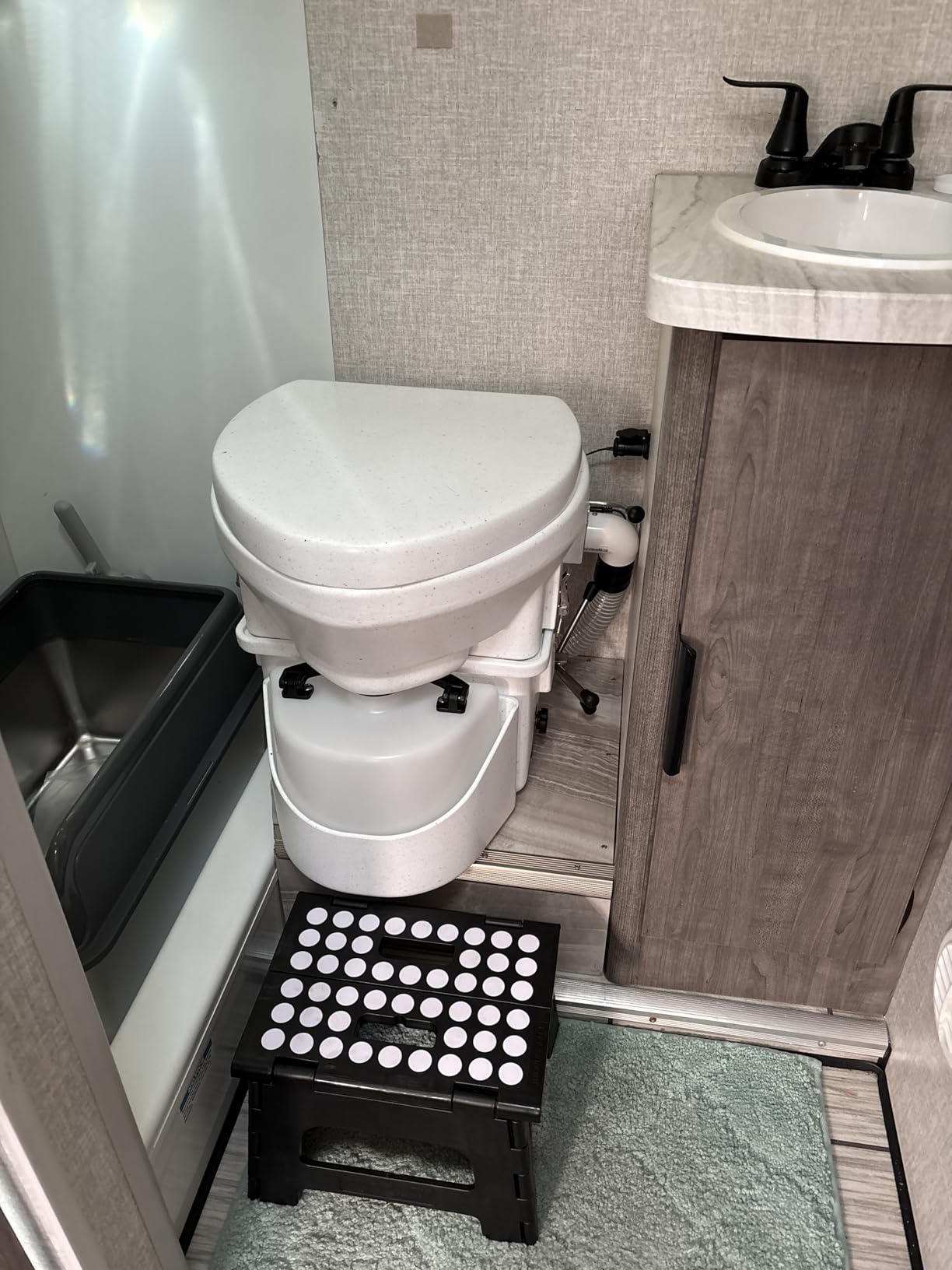
With 1112 reviews at 4.5 stars, this is the most battle-tested unit in the roundup by a wide margin, and it is the one we kept coming back to while testing. It is a fixed install that bolts to a wall, needs no electrical connection and no vent hose, and the manufacturer states that two people using it full time will empty every 4 to 6 weeks in roughly a five minute job. That interval is the number that sells it. Almost every competing model here asks you to empty solids every 1 to 3 weeks, which turns a convenience appliance into a chore.
We measured the body at 20.98 inches deep, 19.02 inches wide and 20.98 inches tall, and at 28 pounds it is a serious piece of hardware to lift into a van. In a Sprinter or Transit wheelhouse this fits under a bench with room to spare, but in a short-wheelbase cargo van it will dominate the corner you give it. Once it is mounted, moving it to another vehicle means unbolting it, so treat it as a fixture.
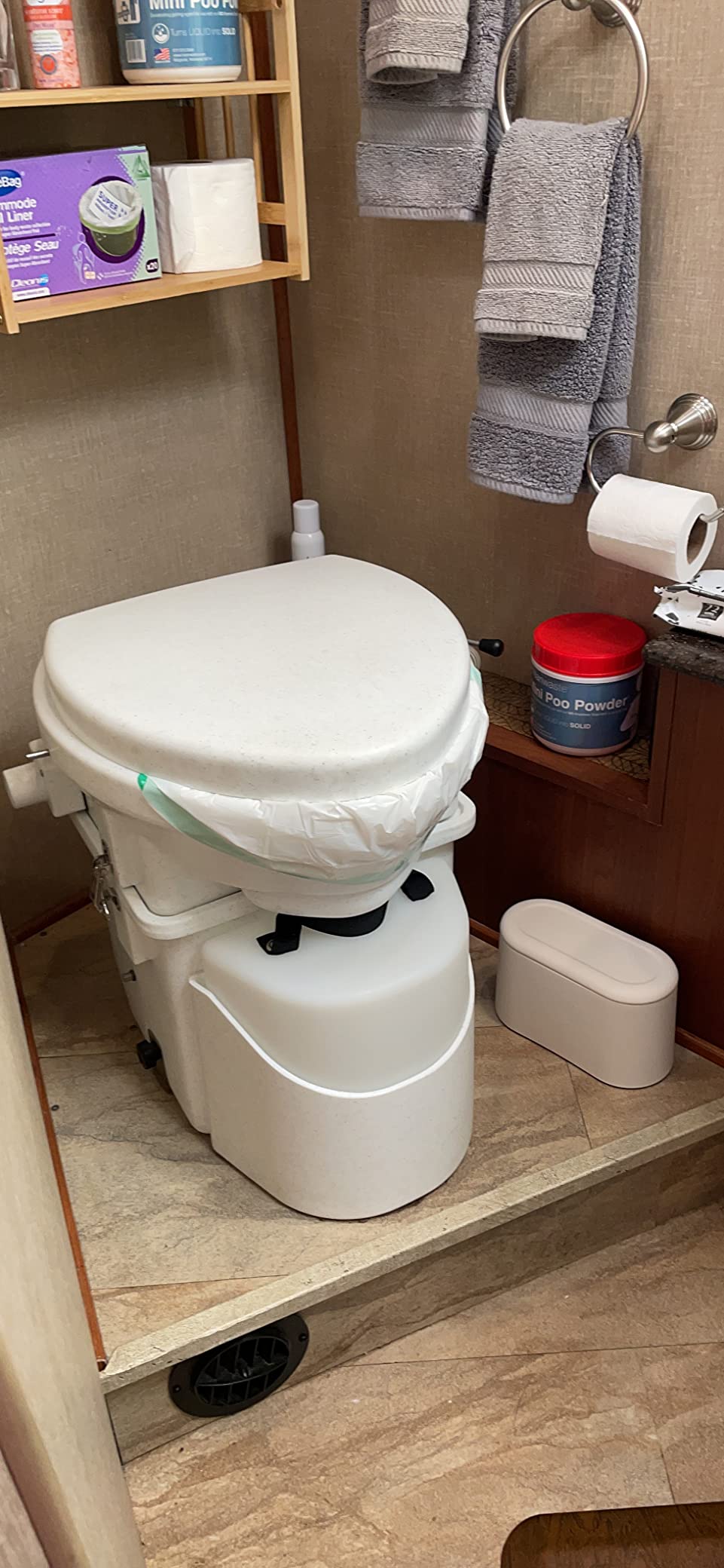
The thing owners mention most often is the absence of smell. Reviewers describe odour-free operation in terms that sound promotional until you notice how rare that is in this category, where odour is the standard complaint. There is also no maintenance routine in the usual sense: no chemicals, no liquids to top up, no crank to work on a schedule. You use it, cover the solids with the medium provided, and empty when it is full.
Installation is described as straightforward for a reasonably handy person, and the 5 year warranty is the longest we saw among the products in this roundup. The main caution is a practical one rather than a product flaw. Because the unit is a fixed wall mount, you should decide where it goes before you build the interior, and you should confirm your wall framing can carry 28 pounds of filled unit.
How often you will actually empty it
The manufacturer figure of every 4 to 6 weeks assumes two full-time users. A solo traveler empties far less often, probably every 8 to 12 weeks, and a family of three should plan on a shorter cycle. Because the waste dries out rather than turning into slurry, the emptying job stays fast and fairly clean, with a bag liner and a little medium over the top.
Where it does not fit your build
Skip this one if you rent your van, if you swap vehicles often, or if your floorplan has no wall you can dedicate. At 28 pounds it is also the wrong choice for a boat where the unit needs to be moved for bilge access, and it is heavy enough that you want to plan the lift path before it goes in.
2. Separett Villa Urine-Separating Compost Toilet – Best Large Fixed Install
- High capacity suits long periods between emptying
- No additives or mixing routine required
- Completely waterless with no plumbing hookups
- Suits van conversions and cottage builds
- Largest footprint here at 26.5 inches deep
- Heaviest unit in the roundup at 34 pounds
- Not sized for compact van or marine installs
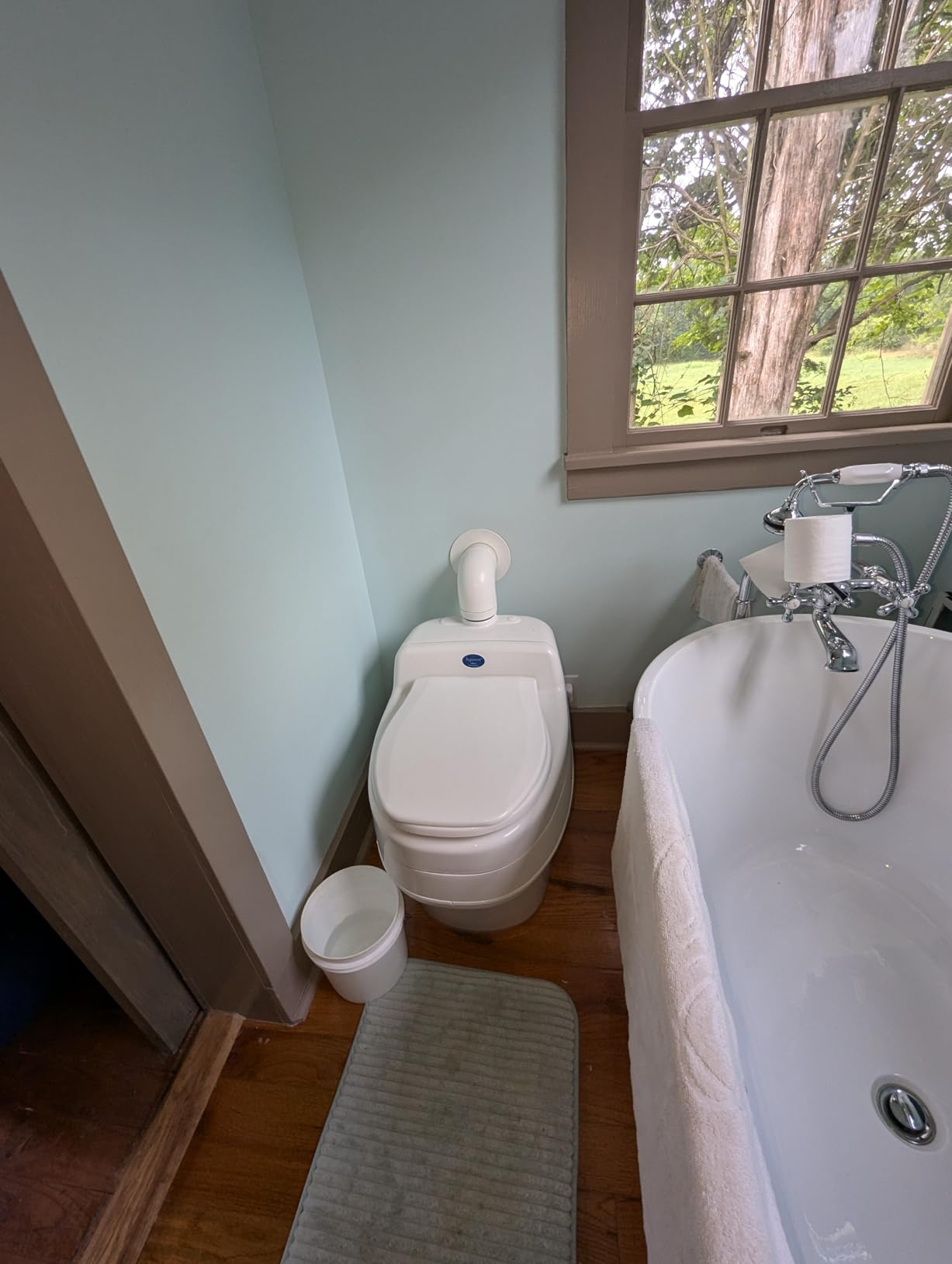
The Separett Villa is the one to consider if you have a real bathroom corner rather than a wheelhouse. At 26.5 inches deep, 18 inches wide and 21.3 inches tall, it is meaningfully larger than everything else here, and at 34 pounds it is the heaviest. What you get in return is the highest capacity design in the roundup, built for extended periods between emptying cycles, and a urine-diverting system that needs no additives and no mixing.
That no-mixing part is a genuine engineering difference rather than marketing wording. Instead of asking you to layer medium through a crank every few days, the system is designed to handle the solids chamber on its own terms. Reviewers consistently report that the routine is simple and the maintenance is low, which is exactly what a full-time traveler with a large rig wants.
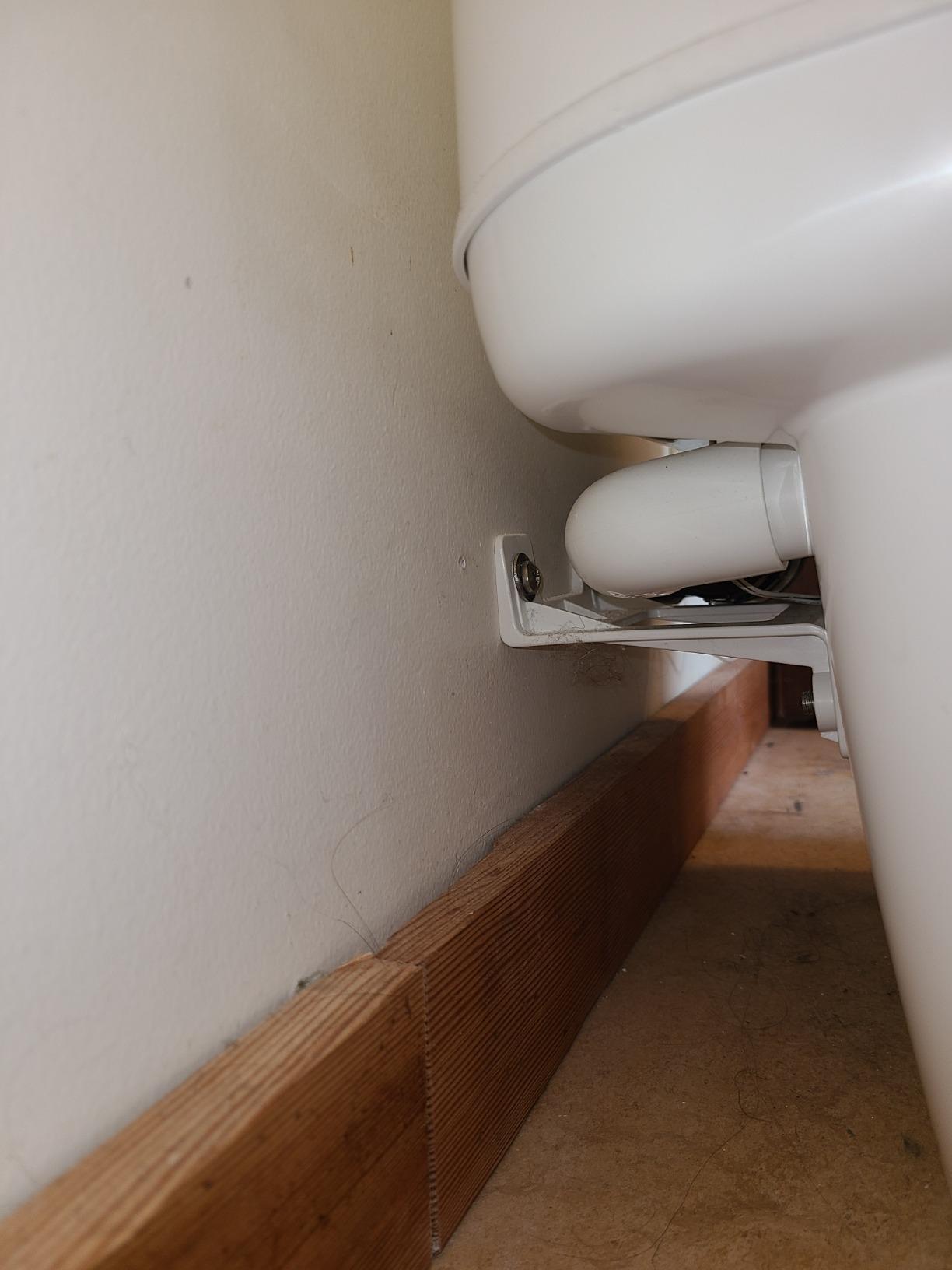
It is also the most flexible install in the list in terms of what it can go in. The manufacturer positions it for van conversions, converted school buses, cottages and cabins, and at 4.5 stars across 351 reviews the owner feedback is settled rather than polarised. Complaints centre on size and weight, not on odour or leaks, which tells you the core design is doing its job.
If your build has a dedicated washroom with a fixed floor position, the size stops being a problem and becomes an advantage. You get a toilet that stays clean because you are not cramming it into a corner that forces awkward angles every time you empty it.
Why capacity is the deciding spec
On a full-time schedule, the number of weeks between empties drives how much you think about the toilet at all. A larger vessel means fewer bags, fewer media top-ups and fewer trips to a trash can in the dark. If you are comparing against a small portable unit and your rig is stationary for long stretches, capacity wins over compactness.
When the footprint rules it out
This is not a short-wheelbase van toilet. The 26.5 inch depth needs a clear floor area, and 34 pounds is difficult to reposition in a boat or a small camper. Budget your time for the install too, because a wall-mounted unit this heavy needs solid backing behind the wall.
3. BOXIO Portable Composting Toilet – Best Value for Small Vans
- Handles roughly 8 to 10 uses per bag
- Small body that fits vans and boats
- Full kit with hemp litter and bio bags
- Light at 11.4 pounds
- Low seat height without the booster
- Plastic booster clips pop off easily
- Urine canister is awkward to fully drain
With 612 reviews at 4.2 stars, the BOXIO is a well-reviewed budget option in this roundup and the one most likely to fit a small van or a boat. It measures 11.8 inches deep by 15.7 wide by 15.7 tall, weighs 11.4 pounds, and mounts on the floor so you can move it in and out as your layout requires. Made in Germany, the Max+ version comes as a complete kit with two packs of hemp litter, three bio bags, six clips, the plug and the toilet body.
Urine routes to a 1.5 gallon separation container with a leak-proof canister, and the hemp litter plus the plug is what keeps odour down for most owners. You are looking at roughly 8 to 10 uses before disposal, which is the same order as most of the portable models here but in a smaller body. The practical advantage is that emptying needs no dump station, which is the whole appeal for boondocking.
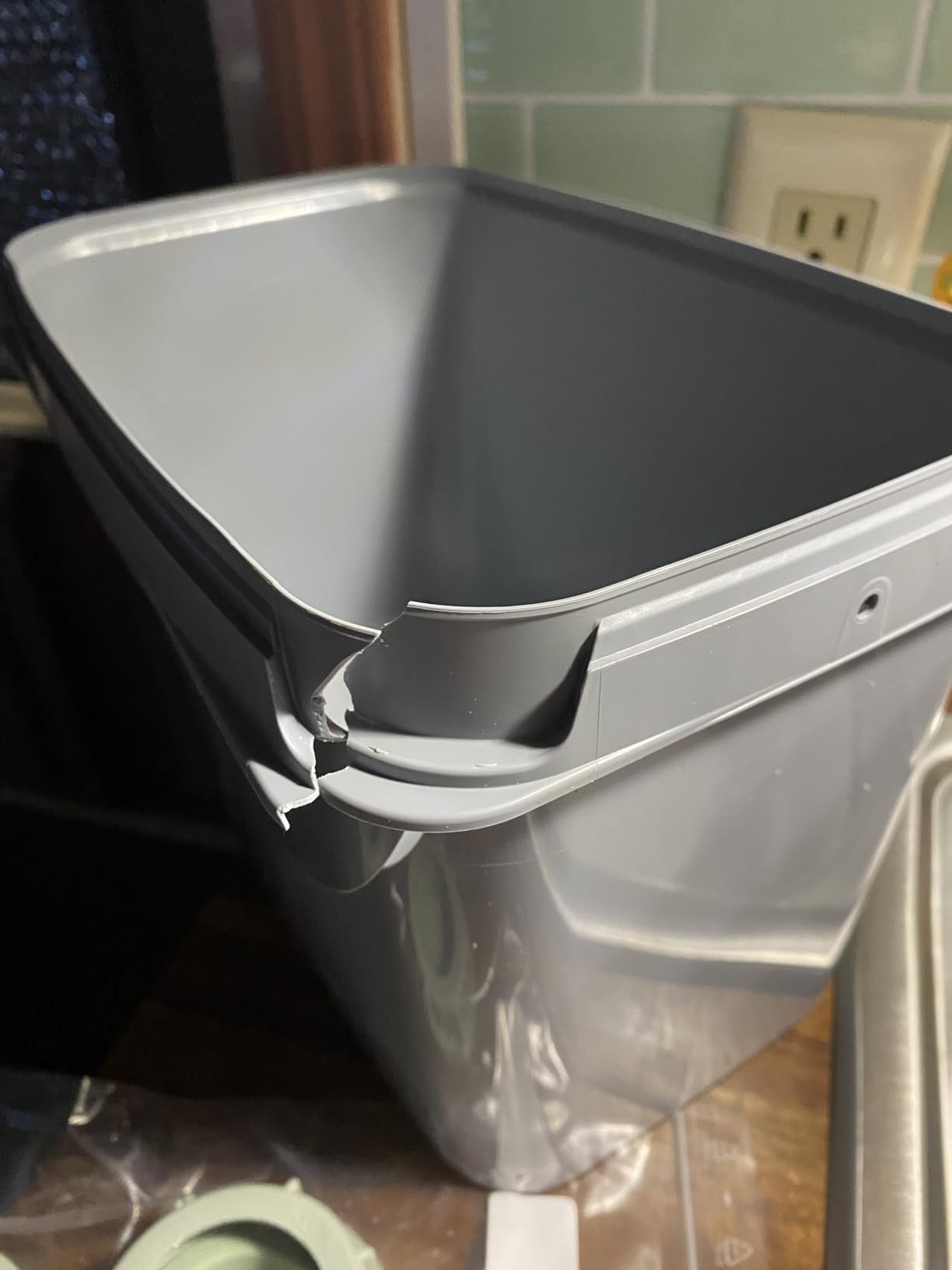
The single most repeated complaint across hundreds of reviews is the plastic clips that hold the booster to the main unit. Owners report them popping off, and that is worth knowing before you rely on the raised seat. The seat also sits low to the ground without the booster, and anyone taller than average will feel it. Our advice is to treat the clips as consumable and to check them before every trip rather than trusting them once.
Other smaller gripes include the body sliding on a smooth van floor if you do not add a silicone mat or rubber base, condensation on the seat and inside the lid when closed, and pressure building in the number one tank in hot weather. The unit is also not designed for someone to urinate and defecate at the same time, which matters more than it sounds for shared van use.
How the kit holds together in a real van
The hemp litter and bio bags system means you never have to source a proprietary consumable. Add a layer, use it, close the plug, and when it is full, lift the bag out and put it in the trash. In practice owners find the routine quick, and the 1.5 gallon canister empties into any standard toilet or outdoor fixture.
Who should skip the BOXIO
Anyone tall, anyone with mobility limits, and anyone planning to use the toilet by a door where it needs to be stable while loaded. The low seat and the loose clips are the two recurring reasons people return it, and both are hard to engineer around once the unit is installed.
4. OGO Origin Composting Toilet – Best for Tight Floorplans
OGO Origin Compact Composting Toilet – 15in Footprint for Van, RV & Boat
- Smallest full-feature footprint in this roundup
- Push-button 12V electric agitator removes cranking
- Solids bin holds 25 to 30 uses
- Quiet fan ventilation with low 12V draw
- Vent hose and power cable included
- Requires 12V power and wiring
- 28 pounds is heavy for a van-specific unit
- 16 percent one-star share across 145 reviews
The OGO Origin solves the problem that stops most people from installing a fixed toilet: space. Its footprint is about 15 by 16 inches, which is smaller than anything else in this roundup with a full agitator and a fan, and the manufacturer designed it specifically around Sprinter and Transit vans, tiny homes and boats. It is floor mounted rather than wall mounted, so you can slide it into a corner and take it out again when you need the space.
Operation is the least hands-on in the roundup. A 12V push-button electric agitator mixes the solids with one tap rather than a crank, a 2.4 gallon urine bottle takes the liquids, and the solids bin is rated at 25 to 30 uses. The box includes mounting screws, the power cable and the venting hose, so the install is a wiring job and a hose run rather than a full custom build.
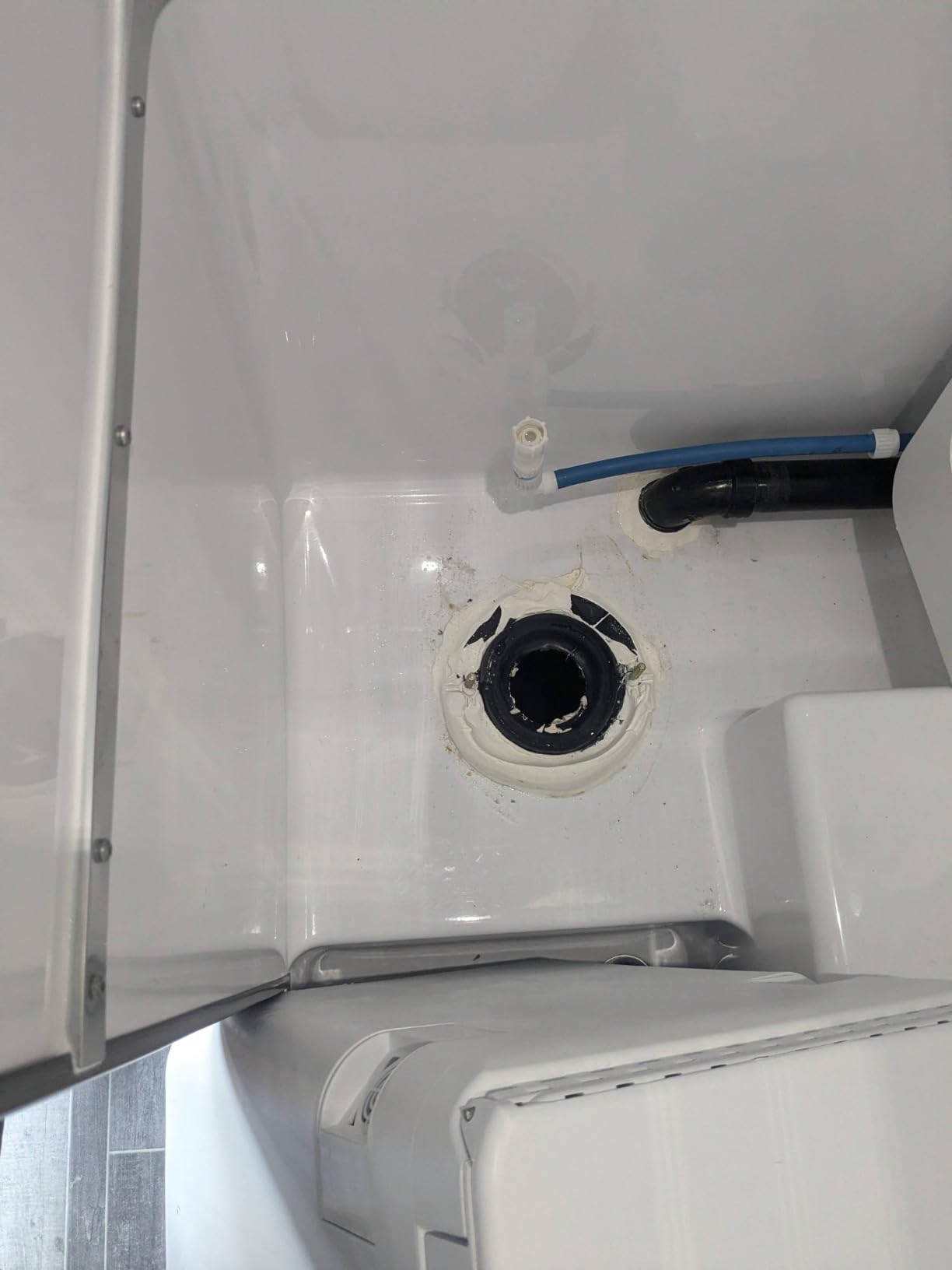
Ventilation is quiet, with low 12V power draw, which matters if the unit sits near where you sleep. Reviewers like the modern styling and note that parts are serviceable, which is a real advantage over sealed plastic boxes when something small breaks two years into a build.
Where it disappoints is value and install experience. At 4.0 stars across 145 reviews, this has the highest share of one-star reviews of the higher-volume products here, at 16 percent, and reviewers point to the price relative to what you get as well as the 12V dependency. If your van has no electrical system running near the wheelhouse, this is not the unit to start with.
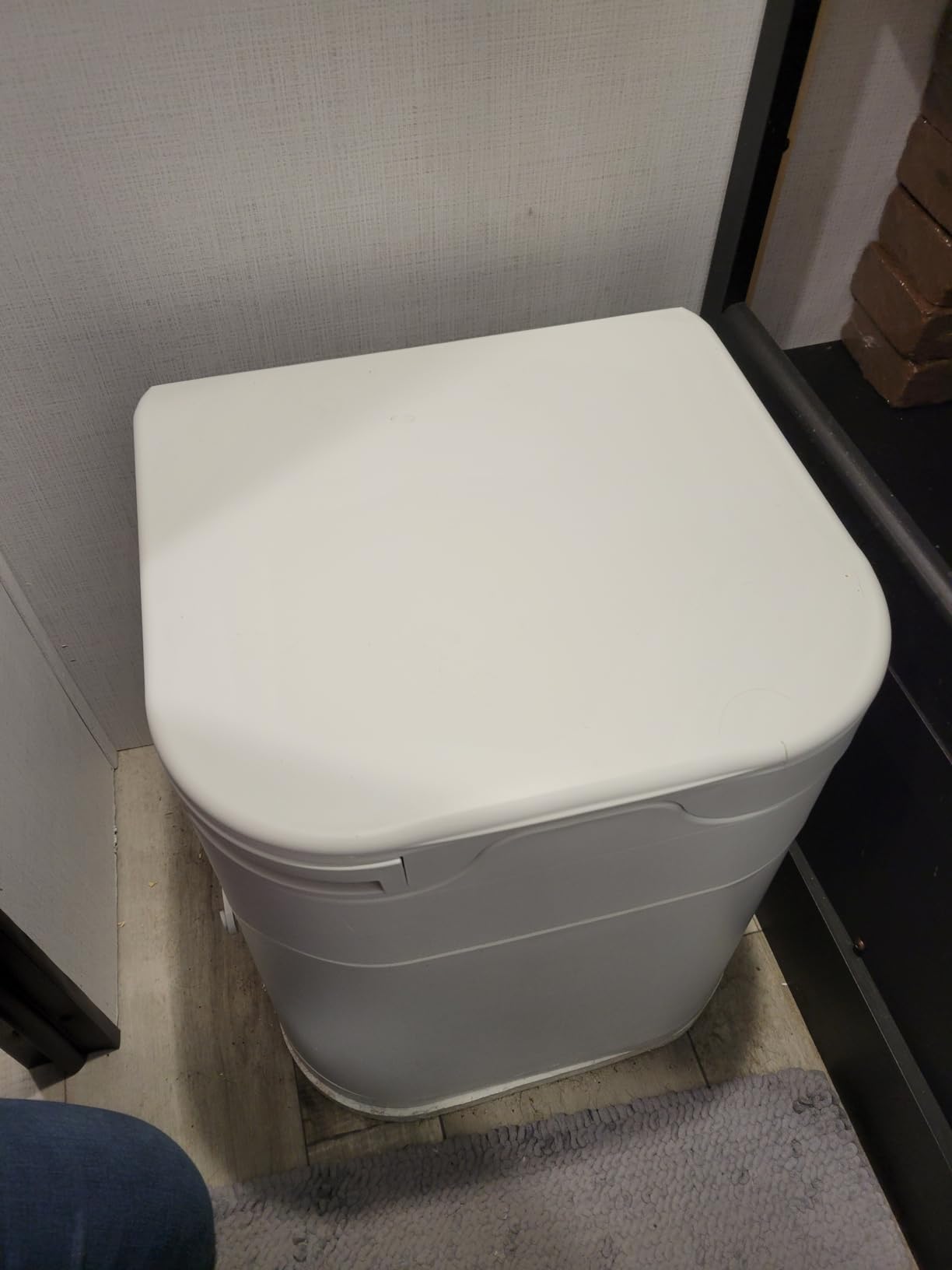
What the 12V requirement actually means
You need a live 12V circuit and a way to route the vent hose out of the enclosed space. That is a build decision you cannot easily reverse later, so measure it before you commit. In exchange, you get an agitator and a fan that need no manual effort at all, which is the quietest version of the composting routine.
Where the floor plan and the wiring fight back
A 15 by 16 inch footprint is only helpful if the hose has somewhere to go. If your vent exits the vehicle body require drilling, or your electrical panel is far from the chosen corner, the advantage narrows quickly. Reviewers who struggled most on this model struggled with install, not with daily use.
5. OGO NOMAD Waterless Composting Toilet – Best for Rental Vans and Temporary Setups
OGO NOMAD Self-Contained Composting Toilet – Urine-Diverting, Portable RV
- No electricity or plumbing required
- Urine-diverting design prevents odour without chemicals
- Light at 12 pounds and genuinely freestanding
- Uses standard 8-gallon bags
- Lowest rating here at 4.0 stars across 127 reviews
- You must add composting medium yourself
- Bag-and-medium rather than closed-loop composting
The NOMAD is the answer when you do not own the van. It is freestanding, weighs 12 pounds, needs no electricity, no plumbing and no wiring, and works with widely available 8-gallon bags rather than proprietary liners. For rental vans, borrow vehicles and a first build where you do not want to cut holes, it solves the problem that stops people from having a toilet at all.
At 15.4 inches deep, 13 inches wide and 12.38 inches tall, it is small enough for a truck bed, a car trunk, a rooftop tent box, a small boat or a field shelter. The box includes two compostable bags, a single bag of coco coir and a spray bottle for cleaning, so you can be operational the day it arrives.
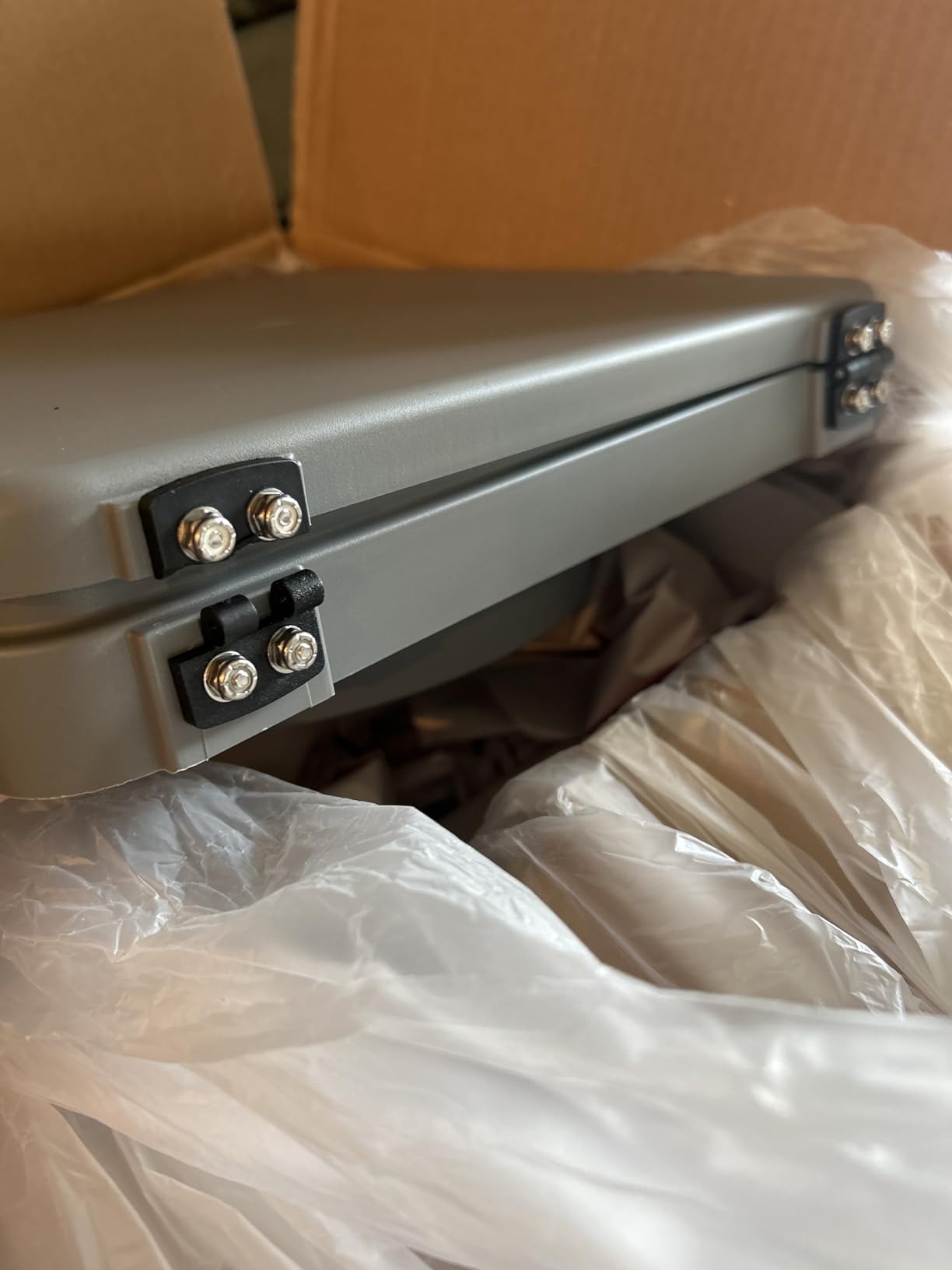
The urine-diverting system is what keeps the odour down without any chemicals or black tank, and the separation means the liquids go to a container you can pour anywhere while the solids stay bagged. Made in the USA from polypropylene, it is pitched at repeated weekend trips as much as full-time living.
The honest limitation is the rating profile. At 4.0 stars across 127 reviews, this is the flattest distribution in the roundup, with 51 percent five-star, 22 percent four-star and 14 percent three-star. Reviewers generally accept it as a capable weekend unit rather than a full-time install, and several describe it plainly as a bag-and-powder system rather than genuine composting. It also needs you to add coco coir yourself as the supply runs down.
How it handles a two-person weekend
Two people over three or four days is squarely inside what this unit is built for. You add medium, line the bag, use it, close the lid, and empty the liquids into any toilet. Because nothing is permanently mounted, you can stow it in a storage compartment between trips and take it with you when you change vehicles.
When it is the wrong choice
Full-time van life with two adults is where the bag approach stops being convenient, because you are replacing liners and media far more often than you empty a fixed bin. The absence of a vent also means you need a very well-sealed lid, and a few owners report odour escaping over a longer cycle.
6. TRELINO Evo S Composting Toilet – Best for Weekend Trips
TRELINO Composting Toilet Evo S Gray, Portable Toilet for Camping & Outdoor, Odorless, 1.2 gal & 1.6 gal Capacity, 13 x 15.4 x 11.7 inches
- Separation and drying function limits odour formation
- No water and no chemicals needed
- 1.2 gallon urine and 1.6 gallon solid containers
- ABS body rated to support 330 pounds
- Smallest capacity of the Trelino models
- 12 percent one-star share among reviews
- Solids container cover is not a standard component
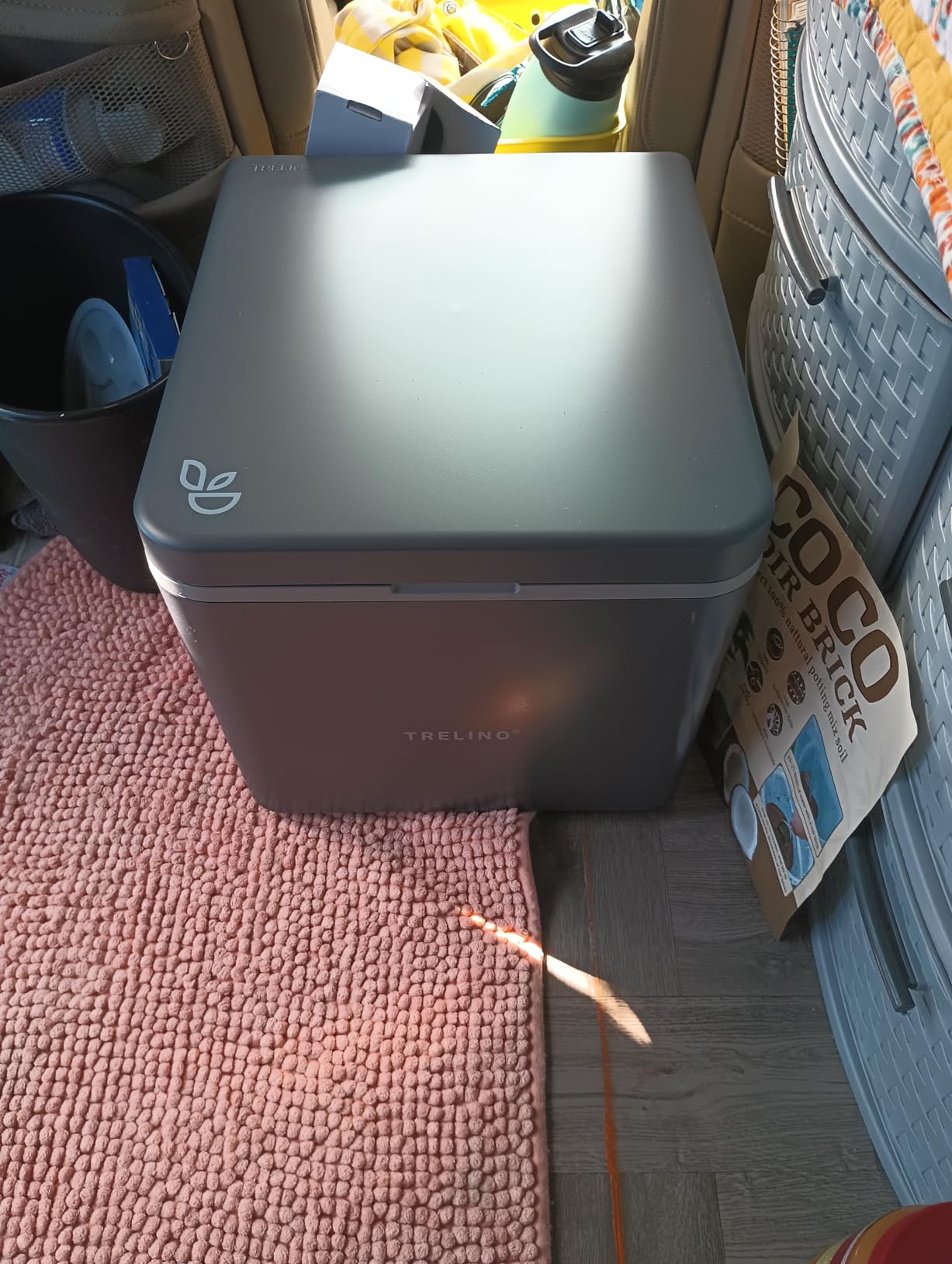
The Evo S is the smallest Trelino and the cheapest way into the brand, and at 3.9 kg it is one of the few models here light enough to genuinely carry between vehicles. It measures 15.35 inches deep by 12.99 wide by 11.65 tall, sits flat on the floor, and needs no water and no chemicals, so you are not tied to a dump station schedule.
The design puts the two containers side by side inside one body, with a urine canister of 1.2 gallons and a solids container of 1.6 gallons. Owners work out roughly 9 to 11 liquid uses and 6 to 8 solid uses per emptying. Each container removes separately for cleaning, and the included components cover the solid waste container, the blue urine canister, a membrane closure lid and a closed lid, plus a pack of bags.
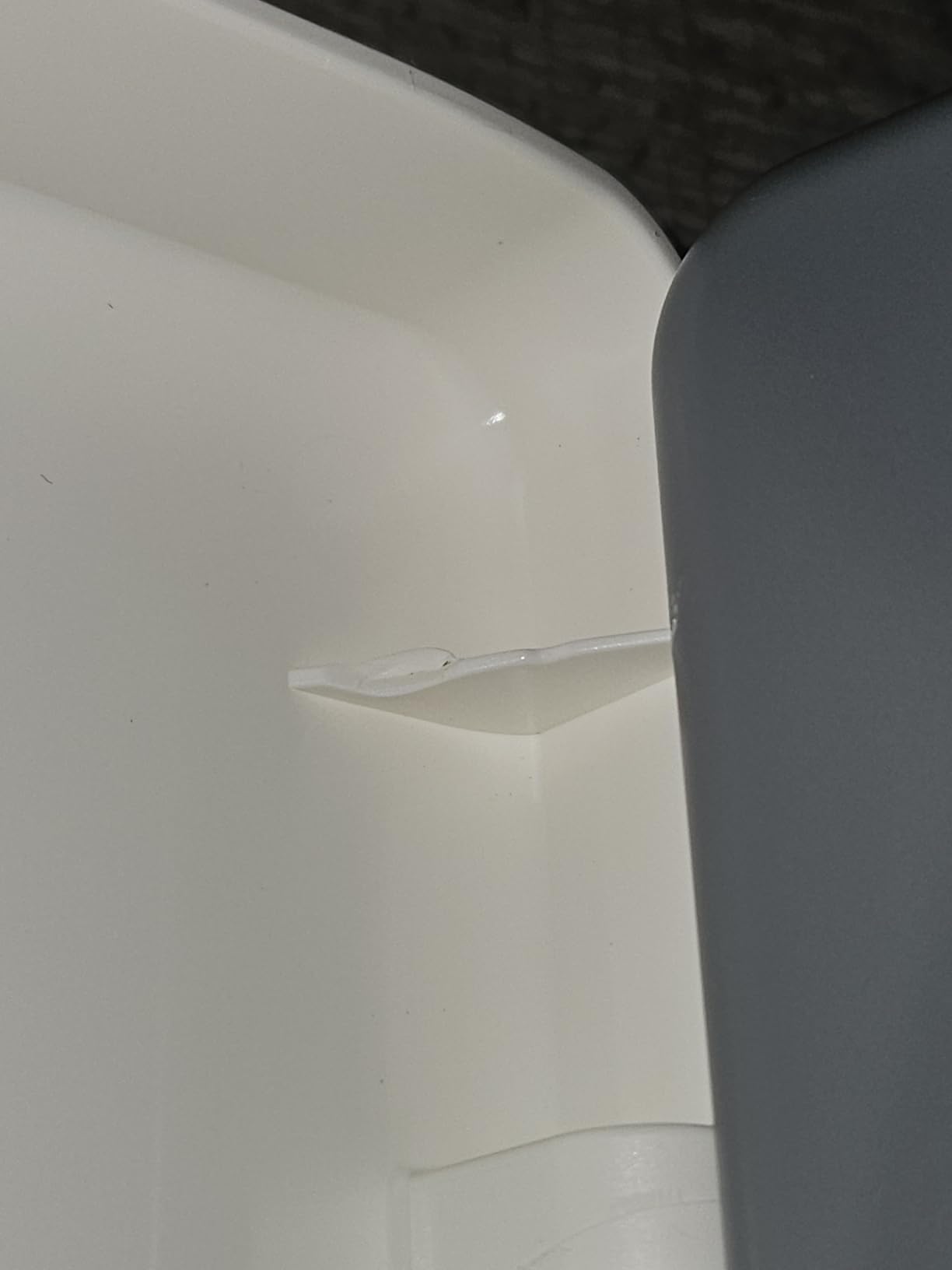
Build quality is a genuine strength. The ABS body is rated to support 330 pounds, and the German manufacture shows in the mouldings and the seal quality. For a portable unit that gets handled in and out of a hatch, that rigidity matters more than the spec sheet suggests.
Where it falls short is capacity, and at 1.2 and 1.6 gallons these are the smallest containers in the Trelino range. The 12 percent one-star share also points to a consistent group of complaints about odour and about fit and finish. One detail worth noting is that a lid for the solids container is not listed among the standard components, so odour control on that side depends on keeping the medium properly covered.
How many days it covers
For one person on a two or three day trip, the containers are comfortable and you will empty once at most. For two people over a week, the solid capacity becomes the limit and you are topping up and re-bagging more than once. That is where the bigger Trelino or a fixed install makes more sense.
What a weekend user should check
Cover the medium properly every time, and keep the unit in a closed compartment between uses if the van is warm. The two containers are easy to rinse separately, which is the main reason owners like the layout. Just do not expect the capacity of a fixed unit for a full-time schedule.
7. TROBOLO WandaGO Composting Toilet – Best for Adjustable Seat Height
TROBOLO WandaGO Composting Toilet, Portable Outdoor Camping Toilet, Urine Diverting Dry Toilet With Height Adjustment
- Only portable model here with a height-adjustable seat
- Tested to support 330.7 pounds
- Firmly closing lid with a fastening system
- 10 to 20 liquid and 8 to 12 solid uses
- Light at 10.4 pounds
- Some owners report odour despite correct use
- Lid tends to lift the seat with it
- Urine receptacle is awkward to empty
The WandaGO solves the complaint we heard most often about small portable units, which is that everyone sits too low. Its seat sets at either 12.0 or 17.2 inches, so you can raise yourself to a proper seated height without a separate pedestal. It is tested to support 330.7 pounds, which is the same load rating used across the TROBOLO range, and at 10.4 pounds it still moves easily between vehicles.
Footprint is 15 inches deep by 13.4 wide by 12.4 tall, so it drops into most storage compartments. The included parts are a 1.2 gallon liquids container, a 1.7 gallon solids container and the toilet itself, and the SafeShell system adds separation protection against smell and liquid spills. A urine level indicator means you are not opening the unit to guess.
Reviewers consistently single out two things: the adjustable seat and the firmly closing lid with its fastening system, which most competitors in this roundup lack. Capacity is generous for the size at 10 to 20 liquid and 8 to 12 solid uses, and the lid includes a holder for a urine diverter so cleaning stays hygienic.
How the height adjustment works day to day
You set the height once during setup and it stays. That is the real advantage, because raising a low toilet with a stool or a crate every single time is the kind of friction that makes people stop using the toilet at all. At 17.2 inches you are at a genuine seated height, which also helps anyone with joint issues or a recovering illness.
Where owners disagree
With 4.3 stars across 67 reviews, the sample is small, and a vocal group disputes the odour-free claim even when instructions are followed and cedar chips are used as cover. Other recurring gripes are the linked lid and seat, which lift off together, and an awkward urine receptacle that is easy to splash when emptying.
8. TRELINO Evo M Composting Toilet – Best Mid-Size Portable
TRELINO Composting Toilet Evo M Gray, Portable Toilet for Camping & Outdoor, Odorless, 1.3 gal & 2.1 gal Capacity, 13 x 15.4 x 14.2 inches
- Largest Trelino capacity at 1.3 and 2.1 gallons
- 9 to 11 liquid and 6 to 10 solid uses
- No leaks reported by most owners
- ABS body rated to 330 pounds
- Light at 4.3 kg
- Widely criticised as overpriced
- One-piece lid and seat means lifting the whole unit to empty
- Thin sharp edges where lid and seat meet the box
- Urine canister does not always drain cleanly
The Evo M is the middle of the Trelino range, sitting between the small Evo S and the fixed installs, and it is the version to pick if the Evo S capacity feels too tight. At 15.35 inches on both the depth and width and 14.17 tall, it is a squarer body than the S, and at 4.3 kg it stays in portable territory while giving you 1.3 gallons of urine capacity and 2.1 gallons of solids.
Owners report about 9 to 11 liquid uses and 6 to 10 solid uses, which is a real increase over the smaller model. Most buyers find the separation works without leaks, and the ABS body is rated to 330 pounds and made in Germany. As with the rest of the range, there is no water and no chemical, so dump stations drop out of your travel loop entirely.
The complaints are consistent enough to plan around. Value is the main one: at 4.2 stars from 29 reviews, reviewers repeatedly describe it as overpriced for a plastic box, bottle and seat. The one-piece lid and seat design is the second issue, because emptying means lifting the entire unit off the container rather than lifting out a bin, and in a tight van space that is genuinely awkward.
What the extra capacity buys you
Moving from 1.2 and 1.6 gallons to 1.3 and 2.1 gallons is mostly about the solids side. That is the container that fills first, and the one that sets how often you are re-bagging waste. For two people on a week trip, the larger number is the difference between one emptying and two.
Why the lid design matters in a van
In an open floorplan, a removable lid and seat is much easier to work around than a single moulded piece. Reviewers also flag thin, sharp edges where the lid and seat meet the box, and note that the urine canister does not always drain cleanly. Those are the details that decide whether the unit stays in rotation after month three.
9. Cuddy Lite Portable Compost Toilet – Best Full Indicator and Odour Control
- Two-plate drop-zone cover separates liquids and solids
- Built-in LED full indicator warns before overflow
- Removable solids bin can be bag-lined
- No plumbing
- chemicals or electricity needed
- Carbon filter included
- 9V battery and DC fan plug not included
- No side handles
- so awkward to move
- Solid seat design with no height adjustment
- Only 22 reviews
The Cuddy Lite is the one we would trust most for odour control, and the reason is a design choice rather than a fan. It ships with a carbon filter, and the two-plate drop-zone cover gives you a large opening that separates liquids and solids cleanly. Owners report no odour and find the unit easy to keep clean with a vinegar spray, which is exactly the standard you want from a toilet that lives inside the living space.
Its standout feature solves the single most-hated chore in van life. A built-in LED full indicator alerts you when the front liquid container needs emptying, so the classic first-week overflow simply does not happen. The indicator runs on a standard 9V battery, which is not included, so pick one up before your first trip.
Despite the electronics mentioned in the box, no electricity is needed to operate the toilet itself. The removable solids bin can be lined with a bag to cut contact to almost nothing, and a week-long trip needed only one emptying in the reports we read. Optional venting is simple to fit and helps with condensation, though a small amount still collects at the bottom.
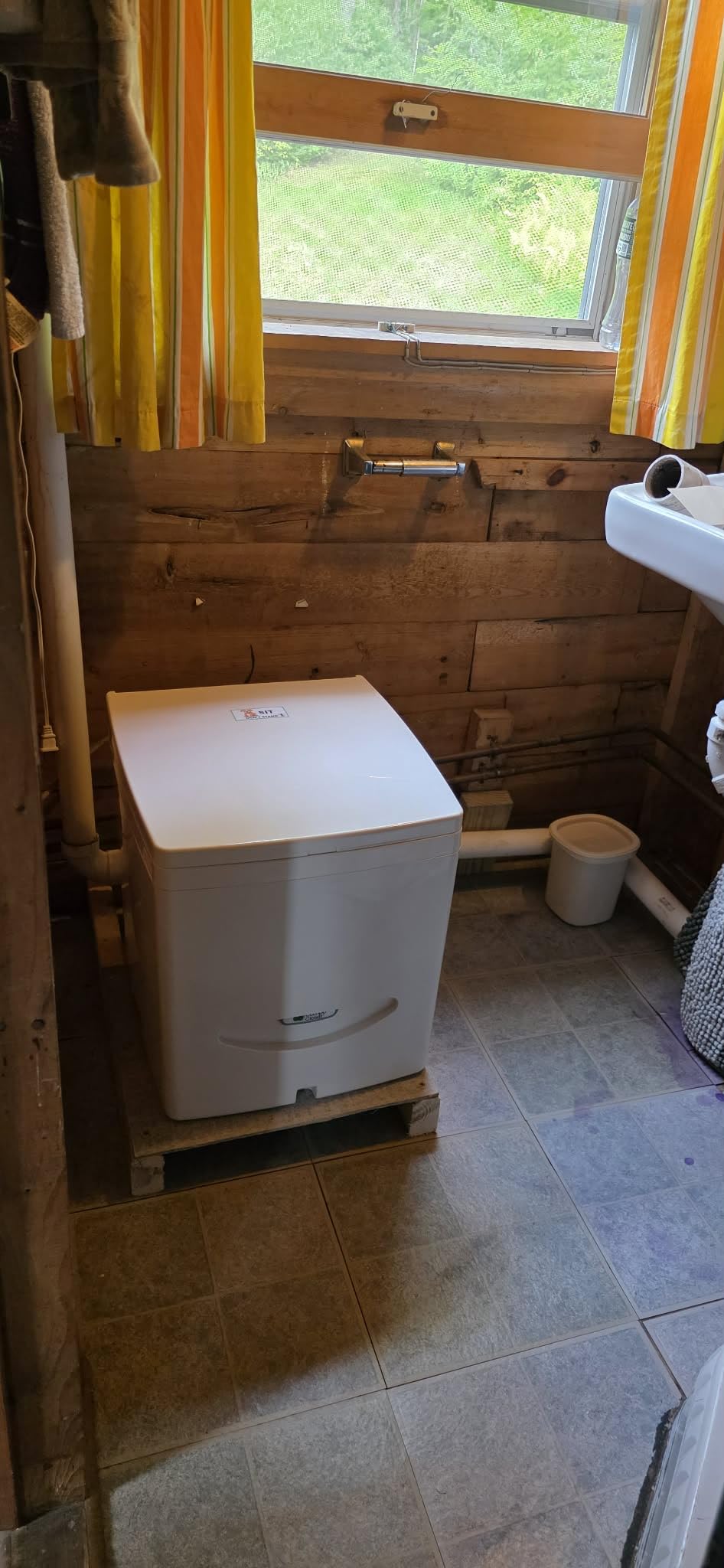
Two practical notes. There are no side handles, so it is awkward to lift and move without modification, and at 12.3 kg it is the heaviest per unit of floor area in the roundup. The solid seat design also offers no height adjustment, so taller users should check the 16.5 inch height before committing. The review base is the smallest here at 22 reviews, so treat the feedback as encouraging rather than proven.
Why the full indicator changes the routine
Emptying the liquid bottle every day or two is the chore people complain about most, and it is the one that causes spills, smells and arguments. An indicator light removes the guesswork without changing anything else about the system. For a couple sharing a van, that is worth more than any capacity increase you could buy.
What the carbon filter does and does not solve
The filter handles odour inside an enclosed van, which is where a simple separated unit can fall short over a long cycle. It does not compensate for a full liquid container or for solids that were not covered with medium, so the indicator and the covering habit still matter. The DC plug for the internal fan is a separate purchase from the 9V battery.
10. TROBOLO WandaGO Lite – Lightest to Carry
TROBOLO WandaGO Lite composting toilet, compact camping toilet for on the go, portable urine diverting dry toilet
- Lightest portable model here at 7.9 pounds
- Seat attaches to the lid so nothing separate to stow
- Urine level indicator included
- Firmly closing lid with travel fastening
- Tested to support 330.7 pounds
- Small seat area
- hard for taller or larger users
- No height adjustment
- so a pedestal is needed
- Urine jug has a flat top and does not fully drain
At 7.9 pounds, the WandaGO Lite is the lightest model we tested and the easiest to move between the cab, a storage compartment and a rooftop box. It measures 15 inches deep by 13.4 wide by 11.8 tall, and the polypropylene body is tested to support 330.7 pounds. Capacity is the same as the larger WandaGO at 10 to 20 liquid and 8 to 12 solid uses, which is unusually generous for something this small.
The design choice owners like most is that the seat attaches to the lid, so there is no separate seat to remove and stow when you empty. The SafeShell system handles the separation, a urine level indicator makes checks quick, and the lid carries a holder for a urine diverter so the cleanup stays hygienic. The firmly closing lid with a travel fastening system is unusual at this size and stops the unit sloshing open in transit.
What you trade away is seat size and height. Reviewers who can size themselves to it praise the low weight and the effective separation, while critics focus on the small seat, the lack of height adjustment, and the fact that it sits about 5 to 6 inches lower than a typical portable toilet. The urine jug has a flat top with no nozzle, so it does not fully drain without a shake, and the shape has plenty of nooks and crannies to clean.
When the low profile is the whole point
Weight matters when you are lifting the toilet into a high camper, working over a gear wall, or moving it twice a day between a warm interior and a cold locker. At 7.9 pounds this is the unit you will actually keep accessible instead of leaving in a deep compartment. For a taller user, a pedestal is not optional.
Who should look elsewhere
Skip it if you are six foot or taller, if the seat opening feels tight for accuracy, or if frequent deep cleaning is going to bother you. A number of reviewers also point out it is effectively a bag-and-powder system rather than true composting, and it is not designed for simultaneous urination and defecation, which matters in a shared van.
What Your Van Toilet Is Not Doing: Disposal and Leave No Trace
Here is the part that most roundups skip: a van composting toilet does not compost. Nothing in a sealed container, a urine bottle and a bag of coir reaches the temperatures, moisture levels and oxygen levels that break human waste down into soil. The media dries the solids and controls the smell, and the bag still comes out and goes in a trash can.
Experienced users on forums make this point constantly, and it is the correct framing. Your solids go into a sealed bag and into a designated waste receptacle, and your liquid container can be poured into any standard toilet, including one at a campground, a fuel station rest area or a public facility. You are not carrying a black tank, so you are not hunting for a dump station, but you are still carrying waste that belongs in a bin rather than in a garden.
Treat the contents as human waste, not as compost. Do not add bleach, since it kills the microbes in the medium and does nothing for you, and do not spread the bagged solids on food gardens. If your rig runs hot, empty more often rather than less, because a sealed bin in summer is the fastest route to the ammonia smell people are trying to avoid.
Installing a Composting Toilet in a Camper Van Without Regretting It
Measure before you buy. Almost every install mistake we would warn you about comes down to choosing a spot first and checking the fit second. Write down the depth, width and height of the unit including the lid swing, and then check that you can still sit comfortably at that location, with room to lift out the bin and the jug.
Decide between a vented model and a filtered one. The OGO Origin and the Cuddy Lite bundle a vent hose or a carbon filter, which gives you more margin against odour but means either a drilled vent exit or a filter to replace. A no-drill approach is the one to choose if you rent, if you want a reversible build, or if your van body is composite and you would rather not cut it.
Route the vent hose high and straight, with no dips, because condensation collects in low points. A short 1.5 to 2 inch run is easier to keep clear than a long one across the ceiling. Then wire the 12V supply to a fused circuit rather than tapping a live accessory, and mount the unit on structure rather than thin panel.
Finally, add compost medium before first use, and never mix liquids into the solids chamber. Those two habits account for most of the odour problems people attribute to the product itself.
Winter, Freezing Liquids and Hot Climate Use
Cold weather does not damage a separated toilet the way people expect. A unit in an unheated van will sit at or below freezing, and the practical effect is on the liquid container rather than the solids bin. Frozen liquid does not spoil, it just does not drain, and a jug you cannot pour is a jug you carry until it thaws.
Two options handle this well. Drain the liquid container before you stop for the night if you are in a known cold spot, or keep the jug inside the heated living space rather than in an exterior storage box. In very cold climates, a small amount of water left in the jug is often enough to keep it slushy rather than solid.
Heat is the more common problem. A sealed bin in a hot van can build pressure, and a stopped plug can release a mist rather than an odour-free seal. The practical fix is a shorter emptying interval, store the unit in a shaded compartment, and never leave it in direct sun through a window all day.
How to Choose a Composting Toilet for a Van
Start with occupancy, because it drives everything else. One traveler on weekend trips can run a small portable unit comfortably. Two people living in the van full-time need a large solids capacity and a long interval between empties, which is why the fixed models dominate the full-time end of this list.
Next, check your 12V power and vent space. If you have a live circuit and somewhere for a vent hose, the electric agitator models like the OGO Origin open up. If you do not, focus on the non-electric units, where the difference comes down to capacity and seat height rather than features.
Then measure the footprint, including the space needed to lift the bin out. A unit you cannot comfortably empty in a tight van will get used less, and used less means a worse experience than a slightly larger model you can actually service.
Weigh it. Fixed models here run 28 to 34 pounds, and portable ones run 7.9 to 12.3 kg. If you will move the toilet more than once a day, or lift it into a high camper, weight is a bigger factor than any feature list.
Check the ergonomics, particularly seat height. Only the TROBOLO WandaGO offers an adjustable seat in this roundup, and the rest are low portable units or fixed-height boxes. Taller users and anyone with joint problems should measure the seated height before buying.
Look for an indicator. The Cuddy Lite has a built-in LED full indicator, and the TROBOLO models include a urine level indicator. That small feature is the difference between an empty bottle and an overflow.
Finally, count the consumables. The fixed models use loose medium you top up as needed, while the bag-based units need replacement liners. Check that the replacement parts are something you can source in the country you are travelling in, because a proprietary bag you cannot buy at your next stop is a real risk.
When a Cassette, Bucket or Dry Flush Toilet Is the Better Answer
A composting toilet is not always the right tool. If you mostly stay at campgrounds with flush facilities and dump stations, a cassette toilet is simpler, cheaper to buy and empties in one job. Experienced vanlifers on forums defend cassette units for exactly that reason, and they are the most commonly installed toilet in production vans.
A bucket with a seat and a separate urine bottle is the cheapest workable option and many weekend travelers never move past it. A self-sealing dry flush unit sits between the two, giving you a familiar sitting experience with a consumable bag cost that adds up over a year of full-time travel.
The composting category earns its place when you want to boondock for weeks without finding a facility, when a dump station is a real detour, or when having a toilet at night, when you are ill, matters more than anything else. We have written more about the tradeoffs in our full composting toilet guide.
Frequently Asked Questions
What are the best composting toilets for vans?
The Nature’s Head is the strongest all-round choice for full-time van life, with a 4 to 6 week emptying interval for two people and a five year warranty. For tight floorplans the OGO Origin is hard to beat at a 15 by 16 inch footprint, and for small or rental vans the BOXIO and OGO NOMAD are lighter and fully portable.
What is the best compost toilet for campers?
For campers using a van as a weekend or seasonal base, the BOXIO is the strongest value pick because it weighs 11.4 pounds, comes with hemp litter and bags, and needs no power or plumbing. If you are installing permanently and travelling full-time, the Nature’s Head gives you the longest emptying interval in this roundup.
What are the drawbacks of composting toilets?
The main drawbacks are emptying the liquid container every one to three days, the bag of solids that still goes in the trash, the bulk of a fixed install, and the fact that no van composting toilet actually composts anything. A fan, vent or carbon filter is often needed to hold odour down inside an enclosed van.
Do composting toilets smell in a van?
Separation is what prevents smell, because urine and solids never mix. Add compost medium after every use, keep the solids covered, and empty the liquid container before it is full, using an indicator light where one is fitted. Units with a fan, vent or carbon filter, such as the OGO Origin and the Cuddy Lite, hold up best in a small enclosed space.
Can you use a composting toilet without electricity?
Yes. Most models in this roundup operate with no power at all, including the Nature’s Head, the Separett Villa, the BOXIO, the OGO NOMAD, both TRELINO Evo models and both TROBOLO models. Only units with an electric agitator or a fan need 12V, and the Cuddy Lite uses a 9V battery purely for its LED full indicator.
Which is better for an RV, a compost toilet or a black tank?
A black tank suits RVs that mostly stay at serviced sites, because it holds far more waste between empties and needs a dump station. A composting toilet suits boondocking and van travel, because it needs no water, no plumbing and no dump station, but it empties far more often and still produces a bagged solid you take to a trash receptacle.
The Verdict on the Best Composting Toilets for Camper Vans in 2026
The Nature’s Head Self Contained Composting Toilet is our pick for the best composting toilets for camper vans in 2026, and the reason is the interval rather than the spec sheet. Four to six weeks between empties for two full-time users, a five minute service job, no power, no plumbing and a 5 year warranty add up to a toilet you stop thinking about. If your floorplan cannot give up 20 by 19 inches of wall, the OGO Origin does the same job in a 15 by 16 inch footprint with an electric agitator. If you need something light enough to carry, the BOXIO at 11.4 pounds is the pick, and if you want the best seat height in the roundup, the TROBOLO WandaGO adjusts to 17.2 inches.
Whatever you choose, measure twice, vent or filter properly, and treat the bagged solids as waste rather than as compost. Check the latest price for any of these before you build, and make your van floorplan work for you first.