
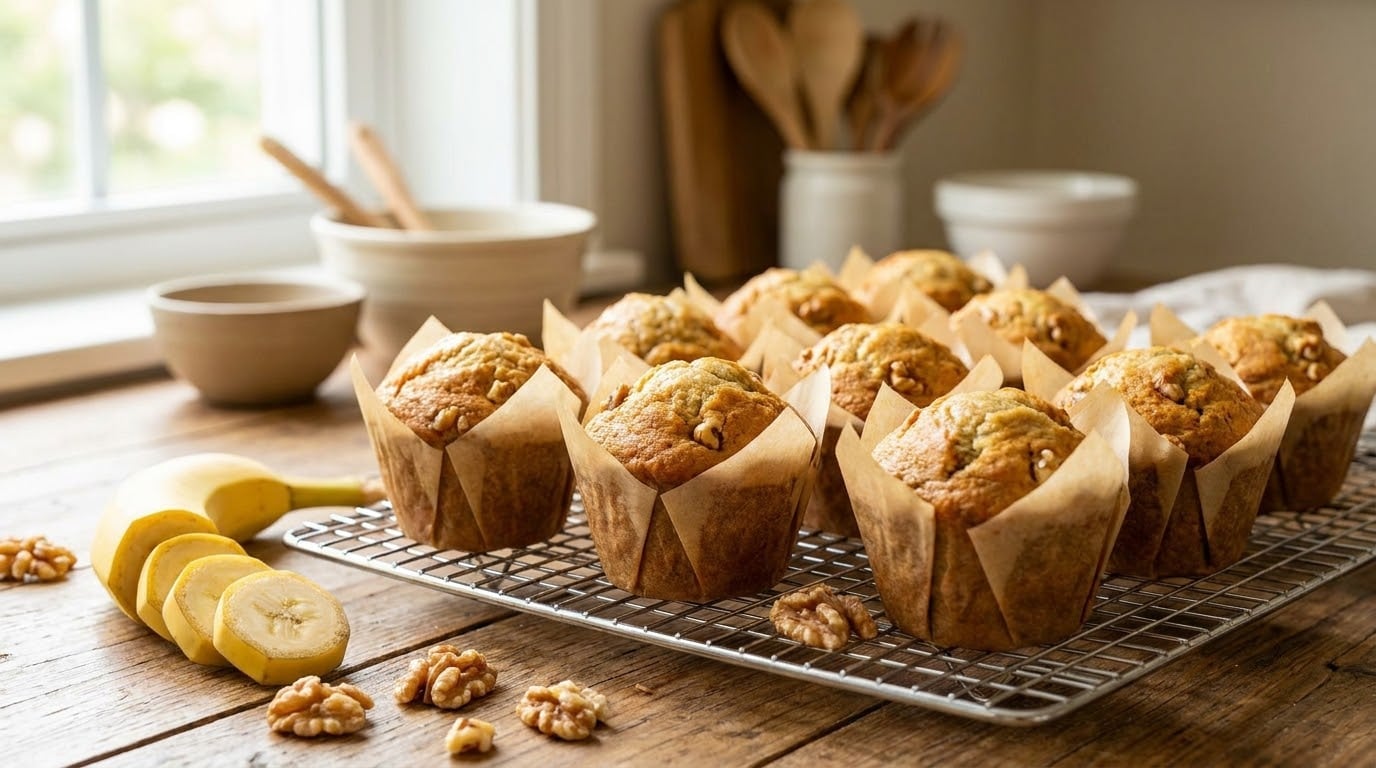
This banana nut muffins recipe is the one I reach for every time my counter fills up with speckled, overripe bananas. It uses one bowl, basic pantry staples, and bakes up tall, golden, and bakery-style in about 35 minutes from start to finish. The crumb is soft and moist, the walnuts stay crunchy in every bite, and the tops dome up beautifully without any special equipment.
If you have been let down by flat, dry, or dense muffins in the past, the technique details below are written for you. I cover the exact leavener ratio, the high-heat trick that gives you those tall bakery tops, and the small mistakes that quietly ruin muffin texture. Grab three ripe bananas and let us bake a batch you will actually look forward to in the morning.
Table of Contents
Why This Recipe Works
Three small technique choices separate a good muffin from a forgettable one, and I build all of them into this banana nut muffins recipe. First, very ripe bananas (the kind with heavy brown speckling all over the peel) give you natural sweetness and deep flavor without needing a lot of added sugar. Second, two leaveners (baking powder and baking soda) work together so the muffins rise evenly and the crumb stays tender. Third, gentle mixing from the moment the flour goes in keeps the batter airy and the final texture soft rather than tough.
The total time is about 35 minutes, with 10 minutes of prep and 25 minutes of bake time. Almost every ingredient is a pantry staple you probably already have: flour, sugar, butter, eggs, vanilla, and walnuts. The only fresh thing you really need is those ripe bananas, which is exactly why this recipe exists.
Ingredients
- 3 medium very ripe bananas, mashed (about 1 1/4 cups / 300g)
- 1 3/4 cups all-purpose flour (220g)
- 3/4 cup granulated sugar (150g)
- 1/2 cup unsalted butter, melted and slightly cooled (113g)
- 2 large eggs, room temperature
- 1/4 cup whole milk or buttermilk (60ml)
- 1 teaspoon baking powder
- 1/2 teaspoon baking soda
- 1/2 teaspoon fine sea salt
- 1 teaspoon pure vanilla extract
- 1 cup chopped walnuts (100g), plus extra for topping if you like
On banana ripeness: the peel should be yellow with lots of brown spots, or even mostly brown. Underripe bananas will taste starchy and will not mash as smoothly.
On walnuts: I prefer toasted walnuts for deeper flavor. Spread them on a sheet pan and toast at 350°F (177°C) for 6 to 8 minutes, then cool before chopping.
Easy swaps: replace buttermilk with 1/4 cup whole milk plus 1/2 teaspoon lemon juice or white vinegar. Replace melted butter with 1/2 cup neutral oil (canola or vegetable) for a slightly more tender crumb. Replace the two large eggs with two flax eggs (2 tablespoons ground flaxseed whisked with 5 tablespoons water, rested 5 minutes) for an egg-free version.
Equipment
You need a standard 12-cup muffin tin. A dark, nonstick pan gives taller tops; a lighter aluminum pan gives slightly more even browning. Either works here.
Paper liners are my default for this banana nut muffins recipe because they make cleanup easy and stop the walnuts from sticking to the pan. If you prefer to skip liners, generously grease every cup with butter or nonstick spray, including the flat tops between cups.
You also need a 1-cup measure or medium bowl for mashing the bananas, a couple of mixing bowls, and a whisk. A cookie scoop (about 1/4 cup size) makes filling the cups fast and even.
How to Make Banana Nut Muffins
Step 1: Prep the oven and pan. Position a rack in the center of the oven and preheat to 400°F (204°C). Line a 12-cup muffin tin with paper liners or grease well.
Step 2: Mash the bananas. Peel the bananas into a 1-cup measure or medium bowl. Mash with a fork or potato masher until mostly smooth with a few small lumps remaining. You want about 1 1/4 cups of mash.
Step 3: Mix the dry ingredients. In a large bowl, whisk the flour, baking powder, baking soda, salt, and sugar until evenly combined.
Step 4: Combine the wet ingredients. In a separate bowl, whisk the melted butter, eggs, milk, and vanilla until smooth. Stir in the mashed bananas.
Step 5: Combine wet and dry. Pour the wet mixture into the dry ingredients. Use a spatula to fold gently, stopping as soon as you no longer see streaks of flour. The batter should look thick and slightly lumpy. Overmixing is the most common reason muffins turn out tough, so resist the urge to stir it smooth.
Step 6: Fold in the walnuts. Add the chopped walnuts and fold just until they are distributed. Save a small handful to sprinkle on top if you like a crunchier crown.
Step 7: Fill the muffin cups high. Scoop the batter into the prepared tin, filling each cup almost to the top. For tall bakery-style tops, you want each cup about 90 percent full, which feels like too much but is exactly right.
Step 8: Bake with the high-heat trick. Bake at 400°F (204°C) for 5 minutes. Without opening the oven door, reduce the temperature to 350°F (177°C) and bake for another 15 to 18 minutes. The muffins are done when the tops are deeply golden, spring back lightly when pressed, and a toothpick inserted into the center comes out with just a few moist crumbs. Cool in the pan for 5 minutes, then transfer to a wire rack.
Doneness cues to trust: the tops should be a full golden brown, not pale. If the tops feel soft or look wet between the cracks, give them another 2 minutes. A clean toothpick is fine, but a toothpick with a few moist crumbs usually means a more tender muffin.
Tips for Success
Why muffins sink in the middle: the most common cause is overmixing, which builds up gluten and then the structure collapses. The second cause is opening the oven in the first 10 minutes, which lets the steam escape before the crumb has set.
Why muffins turn out dry: usually too much flour. Always measure flour by spooning it into the cup and leveling it off, or better yet, weigh it. A second culprit is overbaking. Pull the muffins as soon as the toothpick shows a few moist crumbs.
Why muffins stick to the liners: skip the liners entirely or let the muffins cool for a full 10 minutes before peeling. Warm muffins release steam that gets trapped under the liner and makes them stick.
How to get tall bakery-style muffin tops: fill the cups almost to the top, start the bake at 400°F for the first 5 minutes, then drop to 350°F. The blast of high heat makes the batter rise quickly before the crumb sets, which is what creates that signature dome.
Why walnuts can taste bitter: old walnuts or walnuts stored near the back of the fridge can turn rancid. Always toast fresh walnuts briefly and taste one before folding them in. If they taste sharp or soapy, swap in pecans or chocolate chips instead.
Variations
Chocolate chip banana nut. Reduce the walnuts to 1/2 cup and fold in 3/4 cup of semi-sweet or dark chocolate chips with the nuts. A pinch of flaky salt on top before baking is wonderful.
Pecans instead of walnuts. Pecans are a touch sweeter and softer. Use the same 1 cup, chopped, and toast them just like the walnuts for the best flavor.
Dairy-free banana nut muffins. Replace the butter with 1/2 cup melted coconut oil or vegan butter, and use 1/4 cup unsweetened oat milk in place of the dairy milk. Everything else stays the same.
Gluten-free banana nut muffins. Swap the all-purpose flour for 1 3/4 cups (220g) of a measure-for-measure gluten-free flour blend that contains xanthan gum. Let the batter rest for 10 minutes before scooping so the blend can hydrate, then bake as written.
Cinnamon-streusel topping. For a bakery-style finish, mix 1/3 cup flour, 1/3 cup brown sugar, 1/2 teaspoon cinnamon, and 3 tablespoons cold butter with your fingers until crumbly. Sprinkle generously on each muffin before baking.
Storage, Make-Ahead and Reheating
Store the muffins in an airtight container at room temperature for up to 2 days. For longer storage, refrigerate for up to 5 days, though the crumb is most tender on day one. To freeze, wrap each muffin individually in plastic wrap and place in a freezer bag for up to 3 months. Thaw at room temperature or warm straight from the freezer in the microwave for about 20 seconds.
To make ahead, you can also freeze the unbaked batter. Scoop the batter into a lined muffin tin, freeze until solid, then transfer the frozen pucks to a freezer bag. Bake straight from frozen, adding about 5 minutes to the bake time. No need to thaw.
To reheat, microwave a single muffin for about 15 seconds. The quick burst of steam brings back that just-baked softness. A 5-minute warm-up in a 300°F (150°C) oven works too if you prefer a slightly crisp top.
What to Serve With It
Salted butter. A thin smear of cold salted butter on a warm muffin is simple and perfect with morning coffee. Try a small dish of whipped cream alongside if you want something a little softer.
Cream cheese. A smear of plain or honey-sweetened cream cheese pairs beautifully with the walnuts and the banana.
Coffee or espresso. The deep caramel notes in ripe bananas play well with a strong cup of coffee or a latte. An English muffin on the side turns it into a fuller breakfast spread.
Fruit and yogurt parfait. For a more balanced breakfast plate, serve one muffin with a small bowl of plain Greek yogurt, fresh berries, and a drizzle of honey. If you have more ripe bananas to use up, this roundup of banana dessert recipes is a great next stop.
Frequently Asked Questions
How ripe should bananas be for banana nut muffins?
Use bananas that are yellow with heavy brown speckling or even mostly brown. The peel should feel soft and the fruit inside should mash smoothly with a fork. Underripe bananas will taste starchy and will not break down as easily, which can lead to a denser crumb. If your bananas are still mostly yellow, leave them on the counter for another day or two.
Can I make banana nut muffins without nuts?
Yes. Simply leave the walnuts out of the batter, or replace them with an equal amount of chocolate chips, dried cranberries, or shredded coconut. If you want to keep the crunch without nuts, toasted sunflower seeds or pumpkin seeds are a good alternative. The recipe still works with the same wet and dry ratios.
Why are my banana nut muffins dry?
Dry muffins usually come from one of three things: too much flour, overbaking, or both. Measure flour by spooning it into the cup and leveling, or weigh it at 220 grams. Pull the muffins from the oven as soon as a toothpick shows a few moist crumbs, not when it is completely clean. A ripe-banana-heavy batter also helps keep the crumb moist for days.
How do I get tall bakery-style muffin tops?
Fill each muffin cup almost to the top, about 90 percent full, and start the bake at 400°F (204°C) for 5 minutes before dropping the oven to 350°F (177°C) for the rest of the bake. The burst of high heat makes the batter rise quickly before the crumb sets, which is what gives you that signature bakery dome. Avoid opening the oven in the first 10 minutes so the steam stays trapped.
Can I freeze banana nut muffins?
Yes, both baked and unbaked muffins freeze well. For baked muffins, cool completely, wrap each one in plastic wrap, and freeze in a bag for up to 3 months. Thaw at room temperature or microwave from frozen for about 20 seconds. For unbaked muffins, scoop the batter into a lined tin, freeze until solid, then store the pucks in a bag and bake from frozen, adding about 5 minutes.
Conclusion
Bake a batch of this banana nut muffins recipe this weekend while your bananas are at peak ripeness. Use the high-heat trick for those tall bakery tops, fold the walnuts in last, and pull the muffins when a toothpick still shows a few moist crumbs. Once you taste that first warm muffin with a smear of salted butter, you will never let overripe bananas go to waste again.