
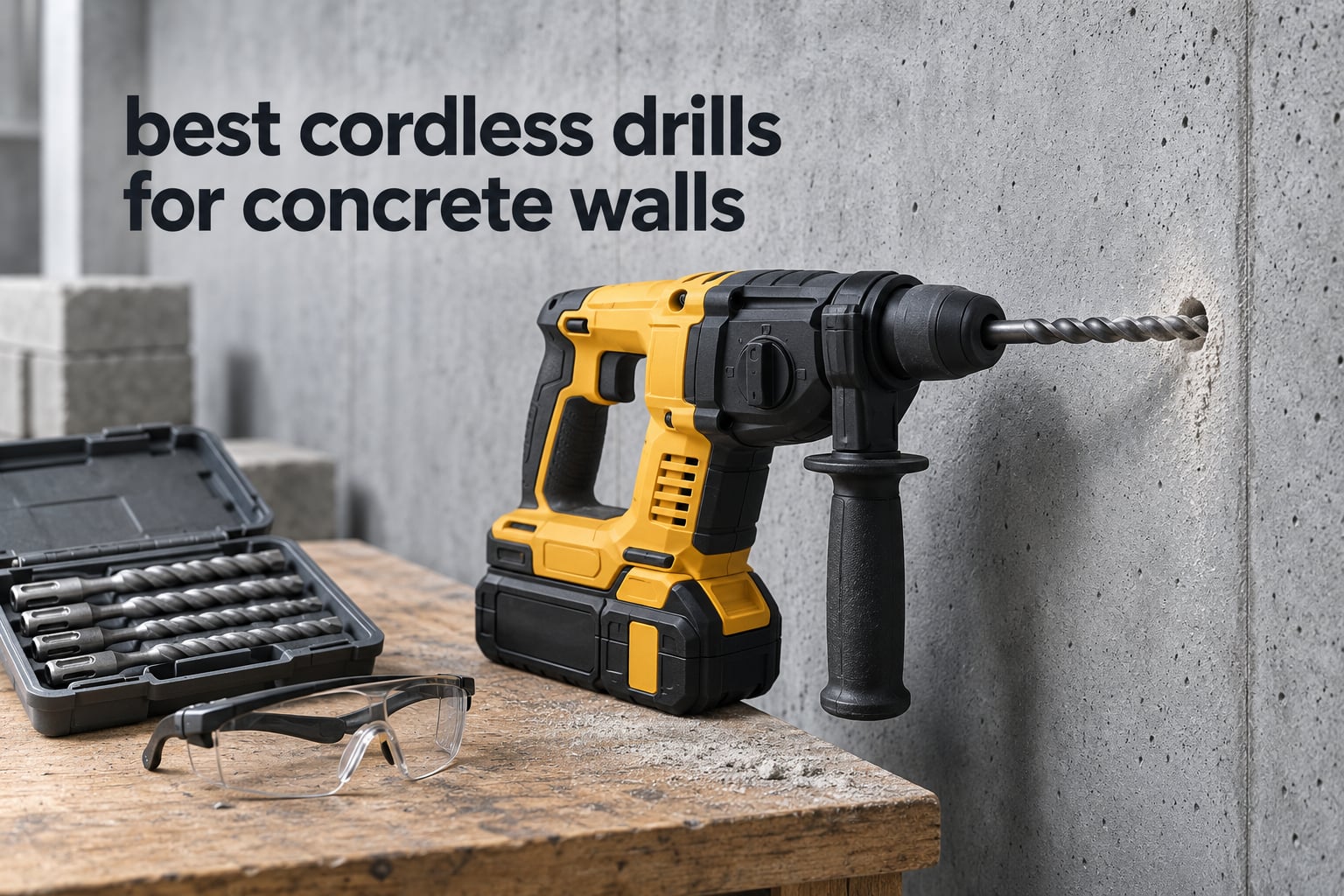
A standard cordless drill/driver will not drill into a concrete wall. It will grind, stall, and eventually burn out. For concrete anchors and Tapcon screws you need at least a hammer drill, a tool whose internal hammer mechanism strikes the bit thousands of times per minute to shatter the concrete into dust while the bit rotates and cuts. For holes larger than a quarter inch, or for more than a handful of holes, the right answer is a cordless SDS-Plus rotary hammer.
That is the whole decision, and it is the decision most people get wrong. The forums are full of homeowners describing a brand new cordless hammer drill overheating after a single hole, or getting two inches into a slab after fifteen minutes, because the job needed a rotary hammer all along. This guide fixes that by sorting ten real tools into the three categories that actually matter for concrete walls, then telling you which one your anchor size demands.
We compared all ten on the specs that drive concrete performance: impact energy in joules or blows per minute, motor type, battery platform and amp-hour capacity, shank standard, tool weight, and the maximum concrete hole each is rated for. We then mapped every pick back to the job it is genuinely suited for, from hanging a shelf with four Tapcons to running conduit through a basement foundation wall. Last updated for 2026.
Table of Contents
Top 3 Cordless Drills for Concrete Walls in 2026

DEWALT DCH133B 20V SDS Plus Rotary Hammer
- 2.6 Joules of impact energy
- 3 modes: drill/hammer/chip
- 5 pounds
- side handle and depth rod included
DEWALT DCH273B 20V SDS Rotary Hammer
- 2.1 Joules of impact energy
- SHOCKS vibration control
- 3 modes
- 6.4 pounds

Makita XRH04Z 18V LXT 7/8 inch Rotary Hammer
- 0-1200 RPM and 0-4000 BPM
- 3 modes plus torque limiting clutch
- 7.4 pounds
- runs on 18V LXT
The DEWALT DCH133B takes the top spot because it pairs 2.6 Joules of impact energy with a 5-pound body, and that combination is what separates a tool you can hold overhead with one hand from one you cannot. The DCH273B is the more proven of the two DEWALT rotary hammers by review count and adds vibration control that pays off on long overhead runs. The Makita XRH04Z is the pick if you already own 18V LXT batteries or want the torque-limiting clutch that protects the gear train when a bit binds.
Best Cordless Drills for Concrete Walls in 2026: The Full Comparison
| Product | Specifications | Action |
|---|---|---|
| DEWALT DCH133B 20V SDS Plus Rotary Hammer |
|
Check Latest Price |
| DEWALT DCH273B 20V SDS Rotary Hammer |
|
Check Latest Price |
| Makita XRH04Z 18V LXT Rotary Hammer |
|
Check Latest Price |
 DEWALT DCH293B 20V XR Rotary Hammer DEWALT DCH293B 20V XR Rotary Hammer |
|
Check Latest Price |
 CRAFTSMAN V20 1/2 inch Hammer Drill Kit CRAFTSMAN V20 1/2 inch Hammer Drill Kit |
|
Check Latest Price |
 Seesii 18V 1 inch SDS Plus Rotary Hammer Seesii 18V 1 inch SDS Plus Rotary Hammer |
|
Check Latest Price |
 VEVOR 20V SDS Max Rotary Hammer Kit VEVOR 20V SDS Max Rotary Hammer Kit |
|
Check Latest Price |
 RYOBI ONE+ HP 18V SDS Plus Rotary Hammer RYOBI ONE+ HP 18V SDS Plus Rotary Hammer |
|
Check Latest Price |
 DCK 20V Brushless Hammer Drill Kit DCK 20V Brushless Hammer Drill Kit |
|
Check Latest Price |
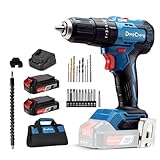 Dong Cheng 20V Brushless Hammer Drill Kit Dong Cheng 20V Brushless Hammer Drill Kit |
|
Check Latest Price |
Two of the entries above, the CRAFTSMAN V20 and the DCK, are conventional hammer drills rather than rotary hammers. They are included because for a small number of quarter-inch anchor holes they are the correct and cheaper answer, and because a lot of readers arrive searching for a cordless drill for concrete without knowing the two categories exist.
1. DEWALT DCH133B 20V MAX SDS Plus Rotary Hammer with D-Handle
DEWALT 20V MAX SDS Plus 1 Inch Cordless Rotary Hammer with D-Handle, Bare Tool Only (DCH133B)
- Brushless motor and German-engineered mechanism deliver efficient runtime
- Rotating dial switches between drill
- hammer drill and chip modes
- Lightweight and well-balanced for one-handed overhead work
- 360 degree side handle and depth rod included
- Users report it matching corded Hilti and Milwaukee tools at home
- Bare tool only
- battery and charger sold separately
- Requires SDS-plus bits rather than standard three-flute masonry bits
- Not intended for continuous heavy-duty demolition
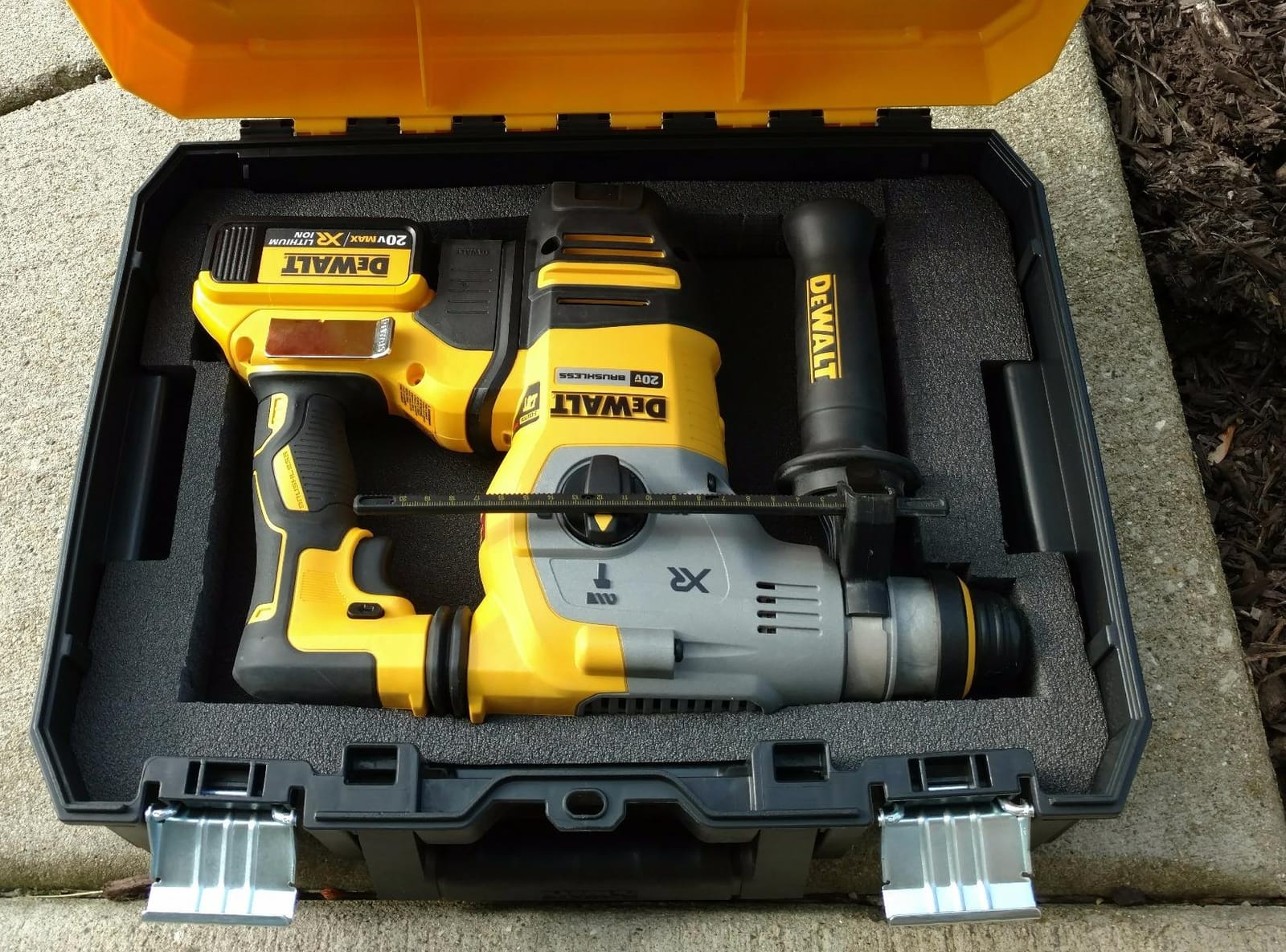
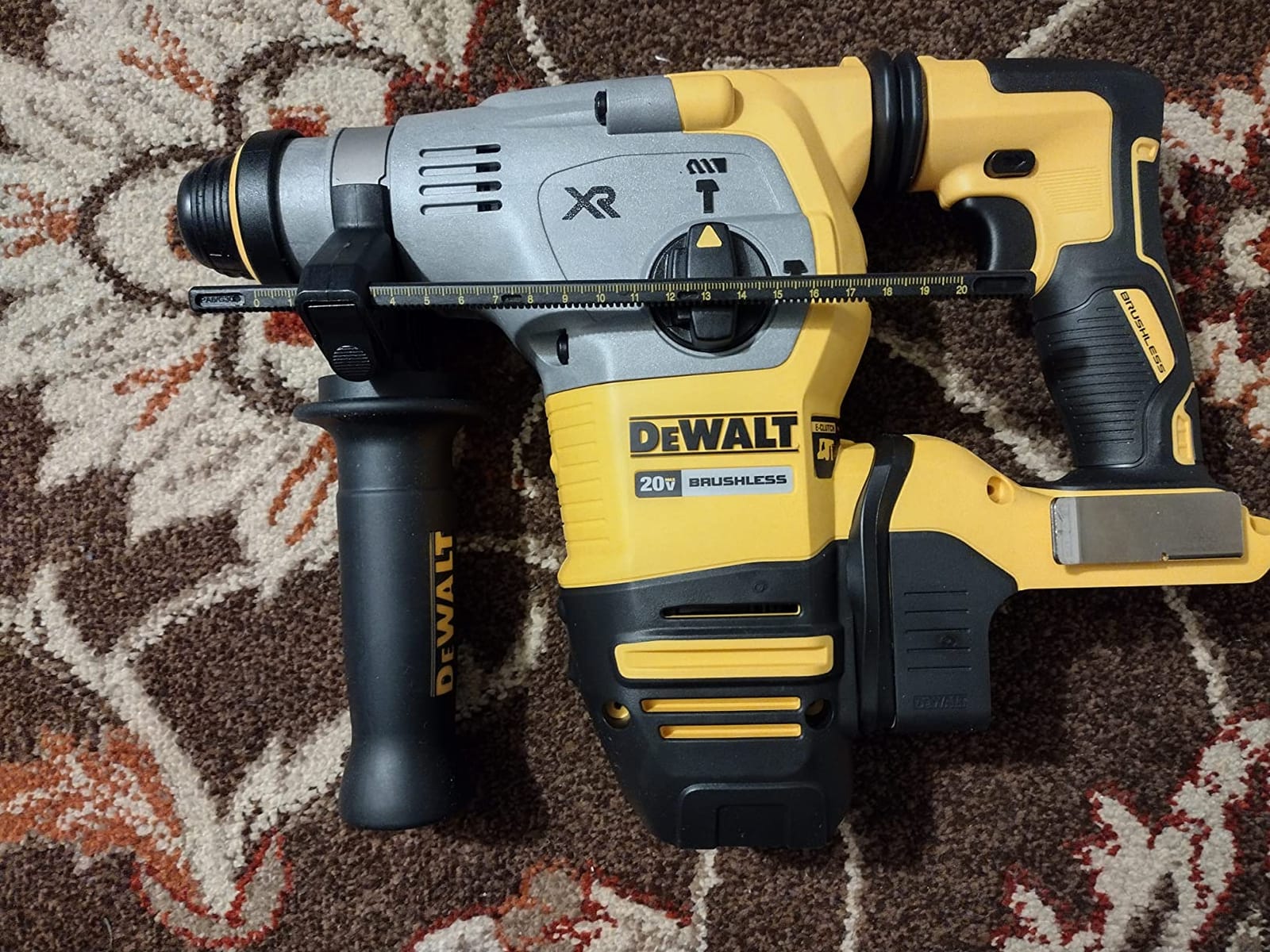
This is the tool we hand to someone hanging a cabinet on a poured basement wall for the first time. The 2.6 Joules of impact energy is the number that matters on a wall, because that figure is the energy the hammer delivers per blow rather than the twisting force of the motor. A 5-pound body with a rotating mode dial is a rare pairing: most tools at this energy level come in heavier.
In use, the drilling feels like the bit is being driven rather than ground, and it stays controllable at the trigger because the mode is set before you touch the wall. Owners regularly describe it punching through concrete and brick faster than a standard hammer drill, and using the chip mode for light trenching when no other tool was on hand.
The D-handle arrangement and the 360 degree side handle are what let you keep two hands on the tool for a deep anchor hole. The depth rod that ships with it means you can stop at a set depth instead of guessing and over-drilling into something buried behind the wall. Owners also point out the brushless motor and German-engineered mechanism as the reason runtime holds up across a long anchor run.
Two cautions. The package is bare tool, so budget for a 20V MAX battery and charger if you do not already own them, and the tool only accepts SDS-plus bits, not the three-flute masonry bits that sit in most existing drill bit sets. Plan on buying a four-piece SDS-plus masonry bit set as part of the purchase.
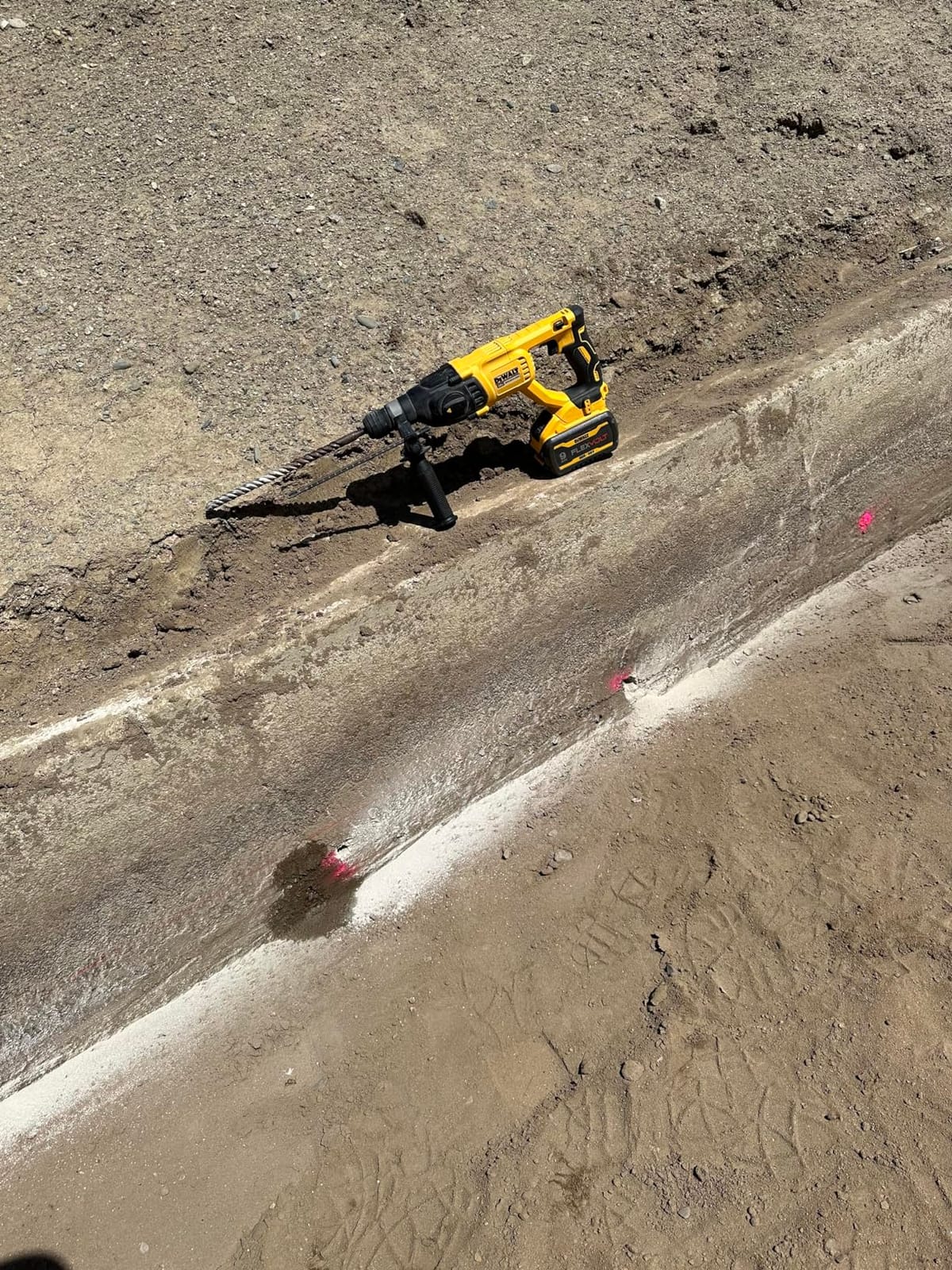
What job the DCH133B handles best
This is the right pick for a run of anchor holes in a poured concrete wall: shelving brackets, a wall-mounted TV, a heavy mirror, or a bank of Tapcon screws driving into a garage or basement. The impact energy clears the aggregate without stopping to cool down, and the light body keeps your arm up if you are drilling above head height on a stairwell wall.
It also handles light demo work in chip mode, which is how a lot of people end up using it. Removing a strip of tile or knocking out a section of block for a rough-in is well within what the mechanism was built for.
Where the DCH133B is the wrong tool
It is not a continuous demolition machine, and anyone expecting it to be will be disappointed. If your job is a run of three-quarter inch holes through reinforced concrete for days on end, you need more energy and you need a bigger battery platform, and you should be looking at the DCH293B further down or a dedicated SDS-Max tool.
Overhead work in a confined space is also less pleasant than it should be, because the auxiliary handle takes up room you may not have between studs. And if your project is four quarter-inch holes, this is more tool than the job requires.
2. DEWALT DCH273B 20V MAX SDS Rotary Hammer Drill
DEWALT 20V MAX SDS Rotary Hammer Drill, Cordless, 3 Application Modes, Bare Tool Only (DCH273B)
- Compact and light for a tool with 2.1 Joules of impact energy
- SHOCKS active vibration control reduces fatigue on extended drilling
- Three modes broaden it to light demolition
- Users report blasting through concrete and cinder block quickly
- One 4Ah battery reportedly drilled 22 four-inch deep holes
- Bare tool only
- no battery or charger included
- Requires dual-slot SDS-plus bits and some three-flute bits will not fit
- Heavier than a conventional hammer drill
- Very loud in hammer mode so ear protection is needed
This is the rotary hammer most DEWALT owners describe as the sweet spot in the range, and the reason is straightforward: it is noticeably shorter and lighter than the heavier DCH293B while still delivering SDS-plus concrete performance. For drilling into a concrete wall with a ladder up, that size difference matters more than the extra half-joule of energy.
The SHOCKS active vibration control is the feature that gets mentioned most in long sessions. It cuts the vibration transmitted through the handles, which is what actually ends a drilling session early when you are working overhead or holding the tool out in front of you at chest height.
Battery endurance is the other story. One owner reported drilling 22 four-inch deep holes from a single 4 amp-hour pack, which lines up with the 5 amp-hour system the tool is designed around. Modes cover drill, hammer drill and chip, and the 360 degree side handle and depth rod are included in the box along with an adjustable hook for belt or ladder mounting.
The bit compatibility is the thing to sort out before you buy. It takes dual-slot SDS-plus bits, and some three-flute bits from other brands will not seat properly. If you already own an SDS-plus set you are fine; if you own nothing, this is a good excuse to buy a proper set rather than the three-flute bits that came with your old drill.
What job the DCH273B handles best
Overhead and elevated drilling in concrete is where this earns its place: running conduit drops from a garage ceiling slab, installing anchors for upper cabinets in a basement, or working from a ladder on an exterior wall. The vibration control is doing real work there, and the 6.4-pound figure is a manageable load with arms extended.
It is also a strong general-purpose pick for a homeowner who does a mixed stream of work. The chip mode handles small demo tasks, and the same battery platform runs the rest of a 20V MAX kit.
Where the DCH273B is the wrong tool
It is loud in hammer mode. Users consistently note that ear protection is not optional, which matters if you are drilling repeatedly in a basement or an occupied room. It is also bare tool, so the real cost of the purchase is the tool plus a battery and charger unless you are already in the platform.
If your project is a long run of large-diameter holes, 2.1 Joules is not the ceiling of what concrete can demand. That is the DCH293B’s territory or a dedicated SDS-Max tool.
3. Makita XRH04Z 18V LXT Cordless 7/8 Inch Rotary Hammer
Makita XRH04Z 18V LXT® Lithium-Ion Cordless 7/8″ Rotary Hammer, accepts SDS-PLUS bits, Tool Only
- Very strong motor
- users compare it favorably to a corded Hilti on anchor work
- Drills a 3/8 inch hole through 2 inches of concrete in seconds
- Torque limiting clutch protects the gear train when a bit binds
- Works with existing Makita 18V LXT battery collections
- Bare tool only
- battery and charger sold separately
- Battery mount and chuck described by some owners as feeling flimsy
- Consumes batteries quickly and runs hot on extended drilling
- Long body is hard to use in tight confined spaces
The XRH04Z is the pick for anyone already sitting on Makita 18V LXT packs, and the upgrade people describe coming from a conventional hammer drill is dramatic. Reports go from a handful of anchor holes per battery to dozens, and the motor is regularly compared to a corded Hilti for concrete anchor work.
Three modes cover rotation only, hammering with rotation, and hammering only for chiseling and knockout work. The synchronized RPM and BPM is a quiet advantage: the two rates scale together, so the tool stays in a productive range instead of running the bit fast with no impact to match.
The torque limiting clutch is the feature that separates this from the rest. If a bit binds in a wall, the clutch disengages the gears rather than transmitting the shock into the gearbox. On reinforcement-adjacent drilling where binds are likely, that protection is the difference between a tool that lasts and one that does not.
Owners describe drilling a 3/8 inch hole through two inches of concrete in seconds, which is the right benchmark for shelf and cabinet anchors. The included depth gauge and side handle cover the two accessories you actually need.
What job the XRH04Z handles best
Makita platform owners get the most out of this: no battery purchase, no charger, no second ecosystem to maintain. It handles anchors, Tapcon screws, brick, and stone, and the hammering-only mode adds small chiseling jobs that a plain hammer drill cannot touch.
It is a good fit for renovation work where binds are common, particularly when drilling near reinforcement or into dense aggregate where a carbide bit can grab suddenly. The clutch absorbs those grabs instead of the gear train.
Where the XRH04Z is the wrong tool
Several owners describe the battery mount and chuck as feeling flimsy, and that is worth factoring in if you are rough on tools. The long body is the other recurring complaint: it is awkward in a small catch basin or any confined space where you are reaching in rather than standing in front of the wall.
It also drains batteries faster than the DEWALT rotary hammers on sustained drilling and runs hot on long runs. Give yourself a pause every few large-diameter holes, which is good practice with any cordless rotary hammer.
4. DEWALT DCH293B 20V MAX XR Brushless 1-1/8 Inch L-Shape SDS Plus Rotary Hammer
DEWALT DCH293B 20V Max XR Brushless 1-1/8” L-Shape SDS Plus Rotary Hammer Drill (Tool Only)
- 3.5 Joules of impact energy
- the highest in the cordless SDS-plus line here
- E-Clutch and SHOCKS reduce kickback and hand fatigue
- L-shape handle feels balanced and runs smooth with low vibration
- Brushless motor gives strong all-day runtime on a 20V MAX battery
- Owners report performance comparable to a Hilti TE6A-class corded hammer
- Heavier and larger than the DCH273B
- closer to a corded Hilti in size
- Bare tool only
- battery and charger sold separately
- Rubber boot on the shock absorber handle is a wear point in daily abuse
- Expensive relative to lighter-duty cordless rotary hammers
This is the pick when the concrete fights back. At 3.5 Joules of impact energy it is the strongest hammer in this group short of the SDS-Max kit, and the L-shape body gives it the mass and balance you want when drilling into dense aggregate, hitting reinforcement, or working a slab rather than a hollow wall.
The E-Clutch handles the moment a bit binds. It limits the reaction so the tool does not twist out of your hands, and paired with SHOCKS active vibration control it keeps the run controllable through a long sequence of deep holes. Owners compare its output to a corded Hilti TE6A-class hammer, which is the closest thing to a pro endorsement a homeowner will get.
The retractable utility hook is a small convenience that matters more than it sounds when you are on a ladder or a roof deck, since the tool hangs off the belt rather than your hand. Dust management readiness with the D25304DH attachment is a genuine advantage for anyone drilling a lot of holes in an enclosed space, because silica dust is the most common long-term complaint about concrete work.
Brushed-motor-free construction is why runtime holds up across a day. If you are drilling anchor holes by the dozen and swapping batteries is your bottleneck, the efficiency of the brushless motor shows up directly in holes per charge.
What job the DCH293B handles best
Deep holes in hard concrete: three-quarter inch anchor holes for a wall-mounted handrail, lag bolts into a poured foundation, or running pipe and conduit through a basement wall where the hole has to go a foot or more. The 1-1/8 inch rated capacity covers what most residential work demands in a single tool.
It also makes sense if you already own DEWALT 20V MAX batteries and expect repeated concrete work over months rather than one afternoon. The energy is on reserve for the days the wall is old, dense, or full of aggregate.
Where the DCH293B is the wrong tool
Weight and size are the honest trade-off. At 3.95 kg this is closer to a corded professional hammer in the hand, and it is noticeably more awkward than the DCH273B for a one-handed overhead anchor or for a job where you are reaching into a tight space between studs.
It is also the most expensive bare tool in this group, and the rubber boot on the shock-absorbing handle is a wear point that contractors doing daily abuse tend to criticize. If you are a homeowner with a modest anchor list, this is more machine than the job requires.
5. CRAFTSMAN V20 Cordless 1/2 Inch Hammer Drill Kit with Two Batteries
CRAFTSMAN V20 Cordless Hammer Drill Kit, 1/2 inch, 2 Batteries and Charger Included (CMCD711C2)
- Complete kit with two 20V MAX batteries and a 60 minute or less charger
- 25500 BPM hammer rate for concrete and brick
- 1/2 inch ratcheting chuck holds bits securely
- Good value as an all-in-one starter kit for anchoring
- Part of the widely available V20 cordless platform
- Impact hammer drill rather than a true SDS-plus rotary hammer so there is no chisel mode
- Included batteries are only 1.3 amp-hours so runtime is modest on heavy work
- Less capable than an SDS-plus tool for repeated large-diameter holes
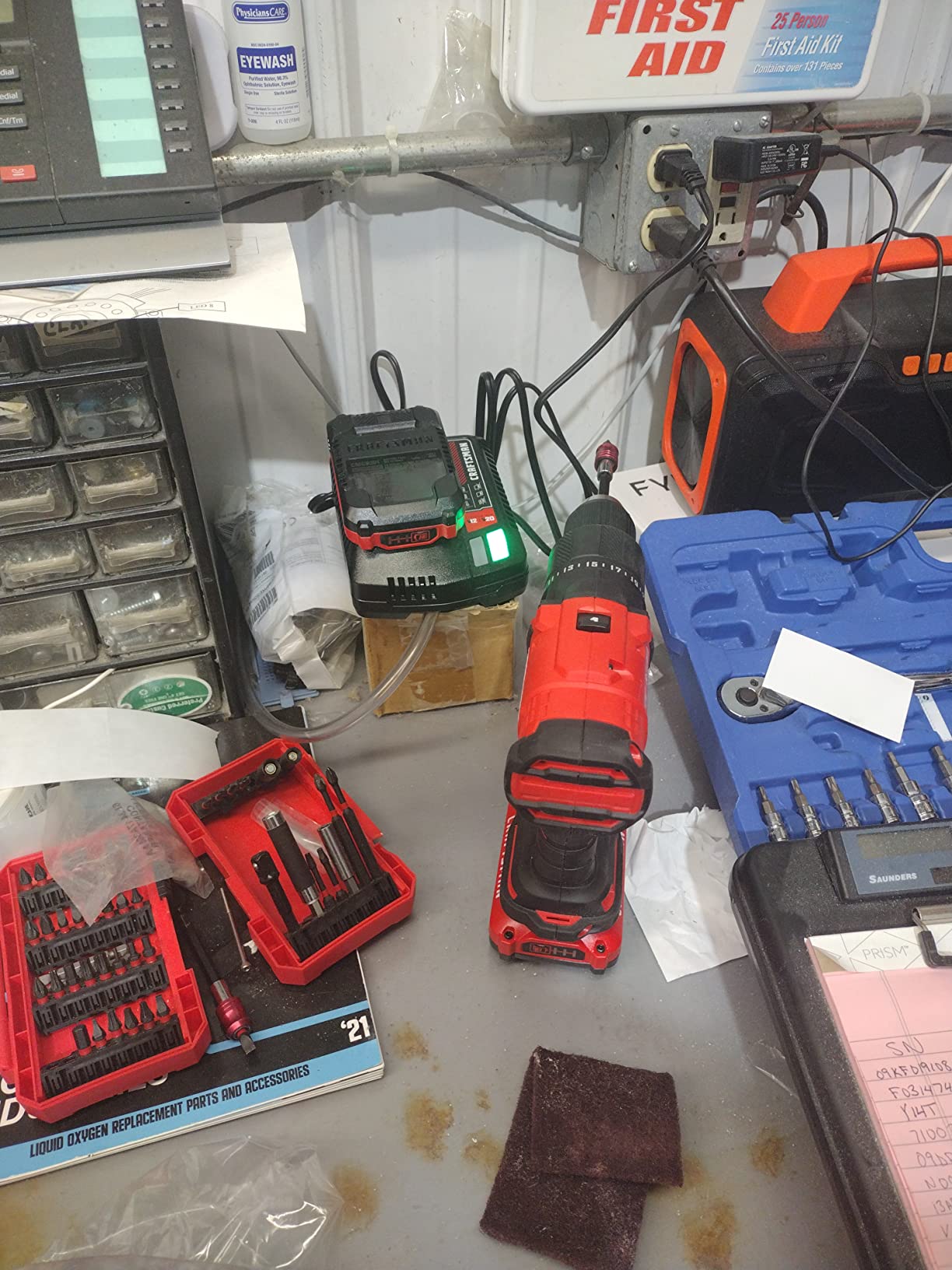
Two batteries and a charger in the box changes the arithmetic on a first cordless tool more than anything else on the spec sheet. If you are starting from nothing, the CRAFTSMAN V20 kit means you can drill a full row of anchors and still have a charge left, without a separate battery purchase.
As a hammer drill, the 25,500 blows per minute rating is respectable for masonry work, and the 1/2 inch ratcheting chuck does a better job of holding a bit than a smooth keyless chuck. The two-speed gearbox at 0-350 and 0-1500 RPM gives you a low range for starting holes cleanly, which is the difference between a clean entry and a chipped edge on a finished face.
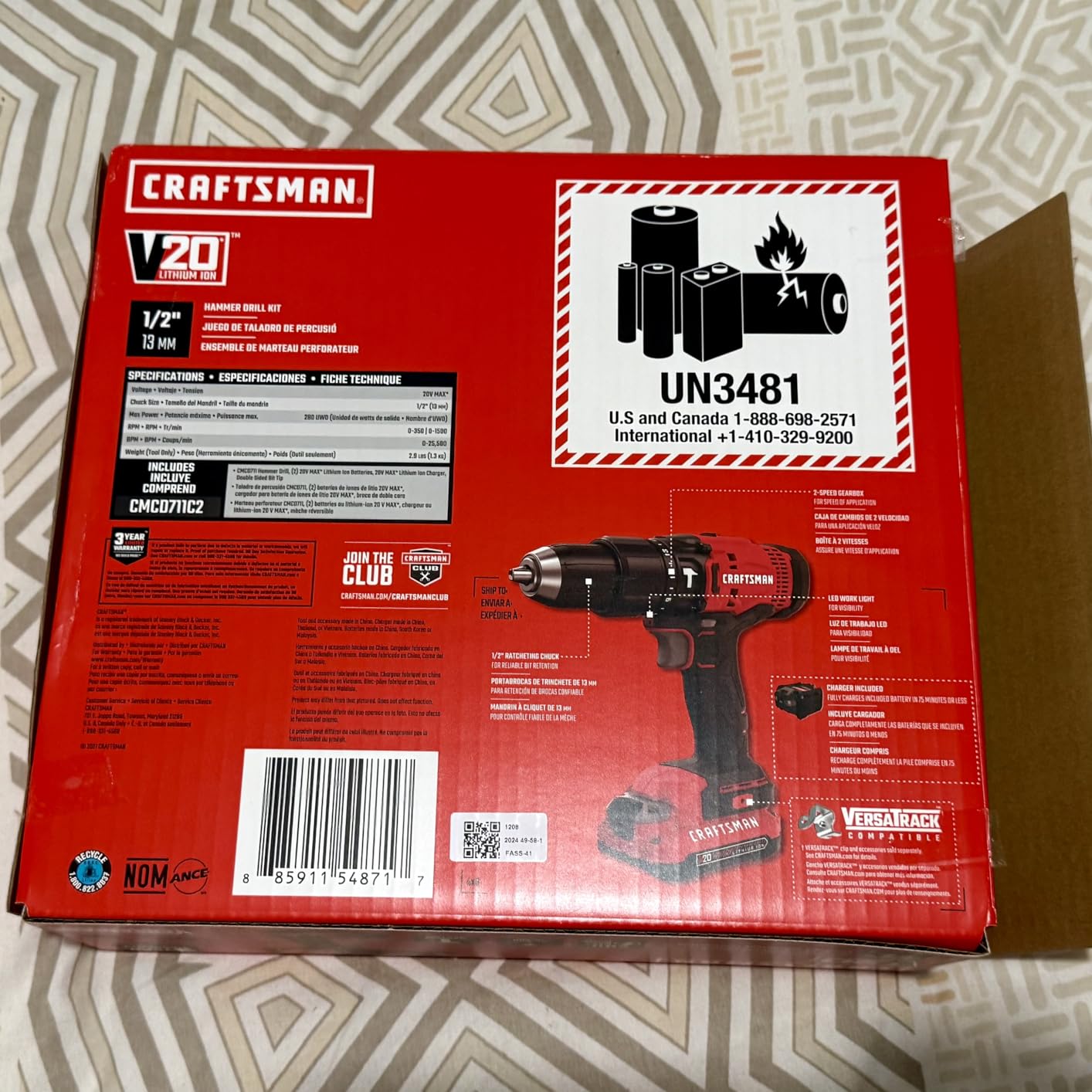
It is also compatible with the VERSATRACK wall organization system, so a wall-mounted storage rail is available if you want the batteries off the bench and onto the wall. That is a small thing that matters in a garage.
Be clear-eyed about the category. This is an impact hammer drill, not an SDS-plus rotary hammer. It has no chisel mode, and the hammer action is far gentler than a rotary hammer’s percussive mechanism. For a handful of quarter-inch anchor holes it is genuinely fine.
What job the CRAFTSMAN V20 handles best
Shelves, brackets, and light fixtures on a concrete or brick wall, where you are drilling a dozen holes of a quarter inch or less. It is also an honest first tool for a renter or a new homeowner because nothing else in the kit list is optional, and the ratcheting chuck reduces the annoyance of a bit working loose mid-hole.
If your platform does not exist yet, the V20 system is wide enough that the batteries will not be stranded. That matters more than most buyers assume.
Where the CRAFTSMAN V20 is the wrong tool
It has no chisel mode and limited capacity for repeated large-diameter concrete holes. The moment your list includes a half inch or three-quarter inch hole, or more than about twenty anchors, you are asking a tool to do something outside what it was designed for, and the forum consensus on that is consistent.
The 1.3 amp-hour batteries are the other limit. They hold noticeably less charge than 2.0 amp-hour packs or larger, so on heavy concrete work you will be swapping more often. The charger tops them up in 60 minutes or less, which softens the inconvenience but does not remove it.
6. Seesii 1 Inch Cordless SDS Plus Rotary Hammer Drill, 2.5J Brushless
Seesii 1 inch Cordless SDS Plus Rotary Hammer Drill, 2.5J Brushless, 4-Mode
- 2.5 joule brushless motor punches through concrete
- brick and stone
- Four modes including chisel and adjustable chisel angle for demo
- Kit includes two 4.0 amp-hour batteries charger bits chisels depth gauge and case
- Compatible with existing Makita 18V batteries
- The classic-chuck bit adapter was missing from some delivered kits
- SDS-plus chuck reported as tight and bit shanks should be greased
- Much smaller review base than established brands
- Some users find 16mm drilling at the top of its capability
This one is interesting because it runs on Makita 18V batteries and comes with two 4.0 amp-hour packs, a charger, three SDS-plus bits, two chisels, a depth gauge, and a case. If you are already in the 18V battery format, the combination of platform fit and kit completeness is hard to argue with.
The specification is a genuine rotary hammer rating: 2.5 Joules, 900 watts, 4800 blows per minute, concrete to 1 inch. Four modes give you drill, hammer drill, chisel, and an adjustable chisel angle, which is more demolition flexibility than most tools in this group offer.
Owners report a 4.0 amp-hour pack barely dropping a bar through more than fifteen holes in reinforced concrete, and describe stable low-vibration drilling. The anti-kickback safety clutch is a real addition at this level, since it limits the twist when a carbide bit catches.
What job the Seesii handles best
Makita 18V owners who need rotary hammer capability without changing platform. It suits anchor work in concrete, brick, and stone, and the chisel modes add tile removal and light trenching that a plain hammer drill cannot do.
For a homeowner who wants a complete kit in one box without buying batteries separately, the included two 4.0 amp-hour packs and the case make this unusually self-sufficient.
Where the Seesii is the wrong tool
Grease the bit shanks. The chuck is reported as tight, and a dry shank in a tight SDS-plus chuck is the most common reason owners think the tool is faulty when it is not. The classic-chuck bit adapter was also missing from some delivered kits, which meant contacting customer service.
Some users find 16mm drilling to be the top of its comfortable range, so treat the 1 inch concrete rating as a headline number rather than a working limit. And with a much smaller review base than the established brands, long-term parts support is less predictable, which is the trade for the kit value.
7. VEVOR 20V Cordless SDS Max Rotary Hammer Kit with Two Batteries
- Very high 7 joule impact energy for a cordless tool
- Two 20V 4.0 amp-hour batteries charger bit chisel depth gauge and case included
- Speed control is easy to use and three modes cover drilling
- hammering and chiseling
- Handles concrete breaking
- slab work and tile demolition
- Heaviest kit here at 23.6 pounds which is tiring in extended use
- SDS-Max rather than SDS-plus so it needs larger bits and will not fit SDS-plus bits
- Not suited to continuous daily professional use
- Instruction manual is unclear and the SDS-Max system needs lubrication
At up to 7 Joules of impact energy this is the most powerful hammer in the roundup, and it comes with everything: two 4.0 amp-hour batteries, a charger, a drill bit, a pointed chisel, a depth gauge, a wrench, and a carrying case. For breaking up slab sections or demo work rather than drilling neat anchor holes, that combination of power and included kit is unusually complete.
Three modes cover drilling, hammer drilling, and chiseling with an adjustable chisel angle, and overload, overheat, and over-discharge protection covers the three ways a cordless rotary hammer typically fails. The 360 degree adjustable side handle helps when you are working overhead or upside down against a soffit.
Two things to know before committing. SDS-Max is a different and larger shank standard than SDS-plus, so a set of SDS-plus masonry bits will not fit. That is not a flaw, it is a category, but it does mean your existing bit collection is not usable and you are buying into a narrower accessory pool.
The 23.6-pound listed weight is a genuine fatigue factor over a long demo session. Consider it a tool for a weekend of slab work rather than a daily partner.
What job the VEVOR handles best
Demo and heavy removal: breaking up a concrete section for a remodel, taking out tile and thinset, knocking out a block wall opening, or drilling large-diameter holes where you need punch rather than precision. The chiseling modes with adjustable angle are the reason to pick it over a drill-focused rotary hammer.
It is also the choice for a homeowner who wants a self-contained kit with batteries, bits, chisels, and a case, and does not want to assemble a platform first.
Where the VEVOR is the wrong tool
Not for daily professional duty. Reviewers are clear that this suits one-off and occasional jobs. If you are drilling anchors every day, the weight and the SDS-Max lubrication routine become a tax rather than a bargain.
It is also the wrong shape for neat finish work. SDS-Max bits and a 23.6-pound package are clumsy for a run of quarter-inch anchors in a finished wall where accuracy at the entry point matters. The instruction manual is also reported as unclear, so plan a few minutes with the controls before starting.
8. RYOBI ONE+ HP 18V Brushless 1 Inch SDS-Plus Rotary Hammer
ONEAND HP 18V BRUSHLESS Cordless 1 in. SDS-Plus Rotary Hammer Drill Tool ONLY
- Brushless motor and 1 inch SDS-plus capacity punch through brick and concrete
- Works in both hammer-drill and hammer-only modes
- Shares the widely owned RYOBI ONE+ 18V battery platform
- Users report a 1 inch hole through 16 inches of solid brick quickly
- Lightweight and easy to handle one-handed
- Bare tool only
- ONE+ battery and charger sold separately
- Slower than premium-brand SDS-plus rotary hammers on sustained heavy drilling
- Replacement parts and accessory availability vary by region
The ONE+ platform is the argument here. RYOBI owners already have 18V packs, and this is the only cordless rotary hammer in the roundup that shares that system. The brushless motor and 1 inch SDS-plus capacity are a real step up from the impact drivers and small hammer drills that platform usually tops out at.
Three speeds, with the top end at 1380 rpm, plus three operating modes including hammer-only chiseling. One review describes drilling a 1 inch hole through 16 inches of solid brick in short order on a 4 amp-hour pack, which is the kind of result that makes people stop using a hammer drill for masonry altogether.
At 6.5 pounds with a 1 inch SDS-plus chuck, it handles one-handed and stays manageable above shoulder height. For an electrician or a plumber working a basement with a ladder in the way, that weight-to-capability ratio is the deciding factor.
It is a bare tool, so the purchase is only sensible if you are already in the ONE+ ecosystem. Buying it as a standalone means adding a battery and charger to the cost.
What job the RYOBI ONE+ HP handles best
Platform fit makes this the natural choice for anyone who has ONE+ 18V tools already. The 1 inch SDS-plus capacity and hammer-only mode cover anchor holes, brick work, and light chiseling, and the reported solid-brick performance suggests it will not disappoint on dense masonry.
It is a good everyday masonry tool for a renter or a homeowner doing a mix of drilling and light demo, as long as the holes stay in the quarter to half inch range and the runs are not marathon length.
Where the RYOBI ONE+ HP is the wrong tool
The recurring reservation is speed on sustained heavy drilling. It is slower than the premium-brand SDS-plus rotary hammers when you are putting a run of large holes through dense concrete, and on a long job that difference compounds.
Replacement parts and accessory availability also vary by region, which is worth considering if you are far from a service point. And if you are not already in the ONE+ platform, the economics of a bare tool change the comparison entirely.
9. DCK 20V Brushless Hammer Drill, 531 in-lbs, 1/2 Inch Keyless All-Metal Chuck
- High 36000 IPM impact rate and 531 in-lbs torque reviewers say punches into poured concrete
- 4.0 amp-hour battery charger bit set and carry bag included
- All-metal keyless chuck is durable and holds bits securely
- Works as drill
- hammer drill and screwdriver in one tool
- Strong value compared to much costlier drills
- Hammer drill rather than a true SDS-plus rotary hammer so there is no chisel mode
- Work light shuts off as soon as the trigger is released
- All-metal chuck can be glitchy after extended hammer-setting use
- Listed at 8.8 pounds
- heavier than comparable 20V hammer drills
Tapcon screws into poured concrete is the single most common reason people end up on this page, and this is the drill we would point at for it. At 531 in-lbs of torque and 36,000 impacts per minute, reviewers report driving Tapcons into poured concrete and cinder block without struggle, and several compare its output to their old corded drills.
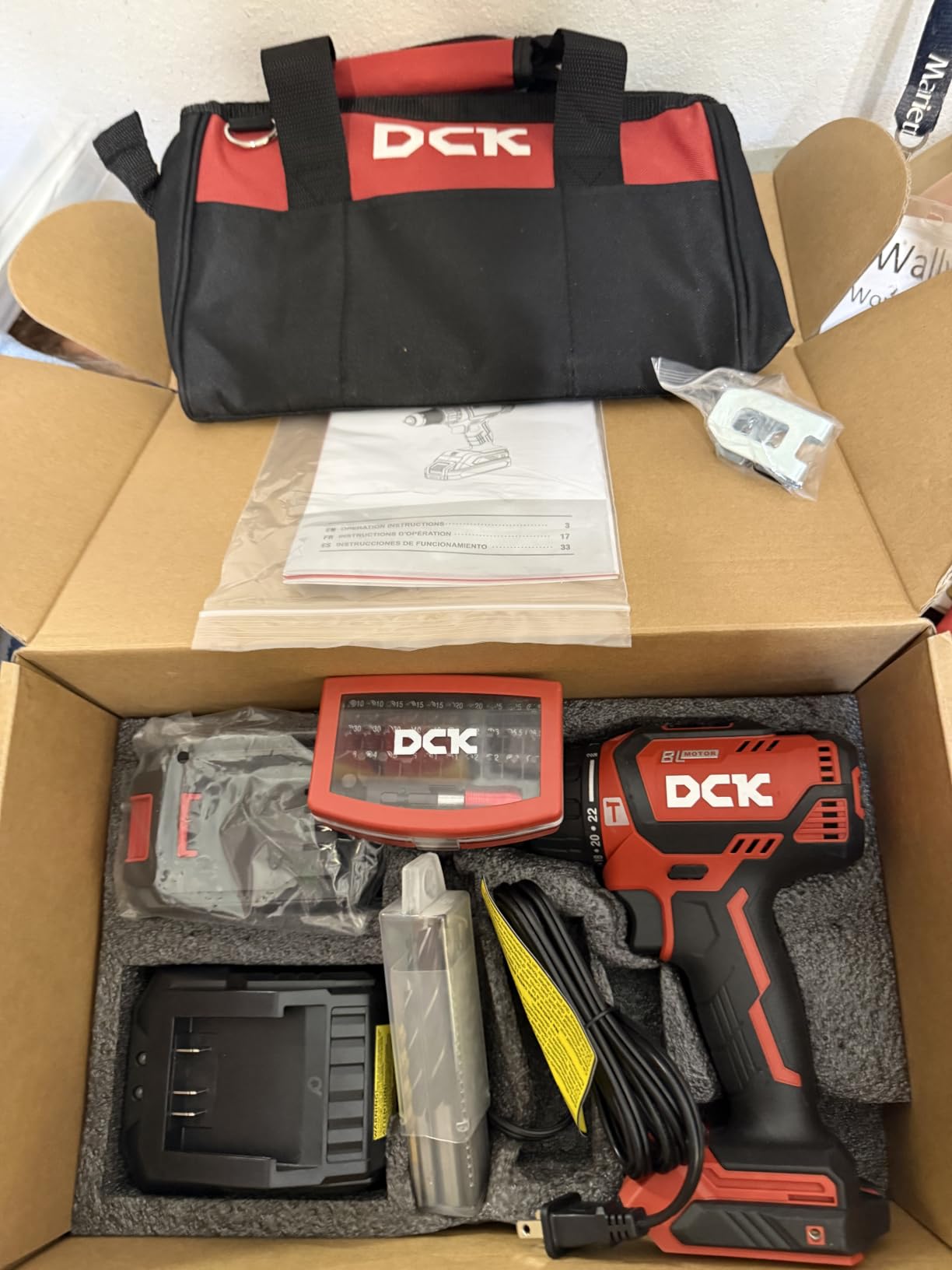
The kit is complete for the job: a 4.0 amp-hour battery, a charger, a 15-piece bit set, a belt hook, and a carry bag. The 1/2 inch keyless all-metal chuck is a genuinely good component and it holds bits securely, which matters when you are driving fasteners rather than drilling holes.
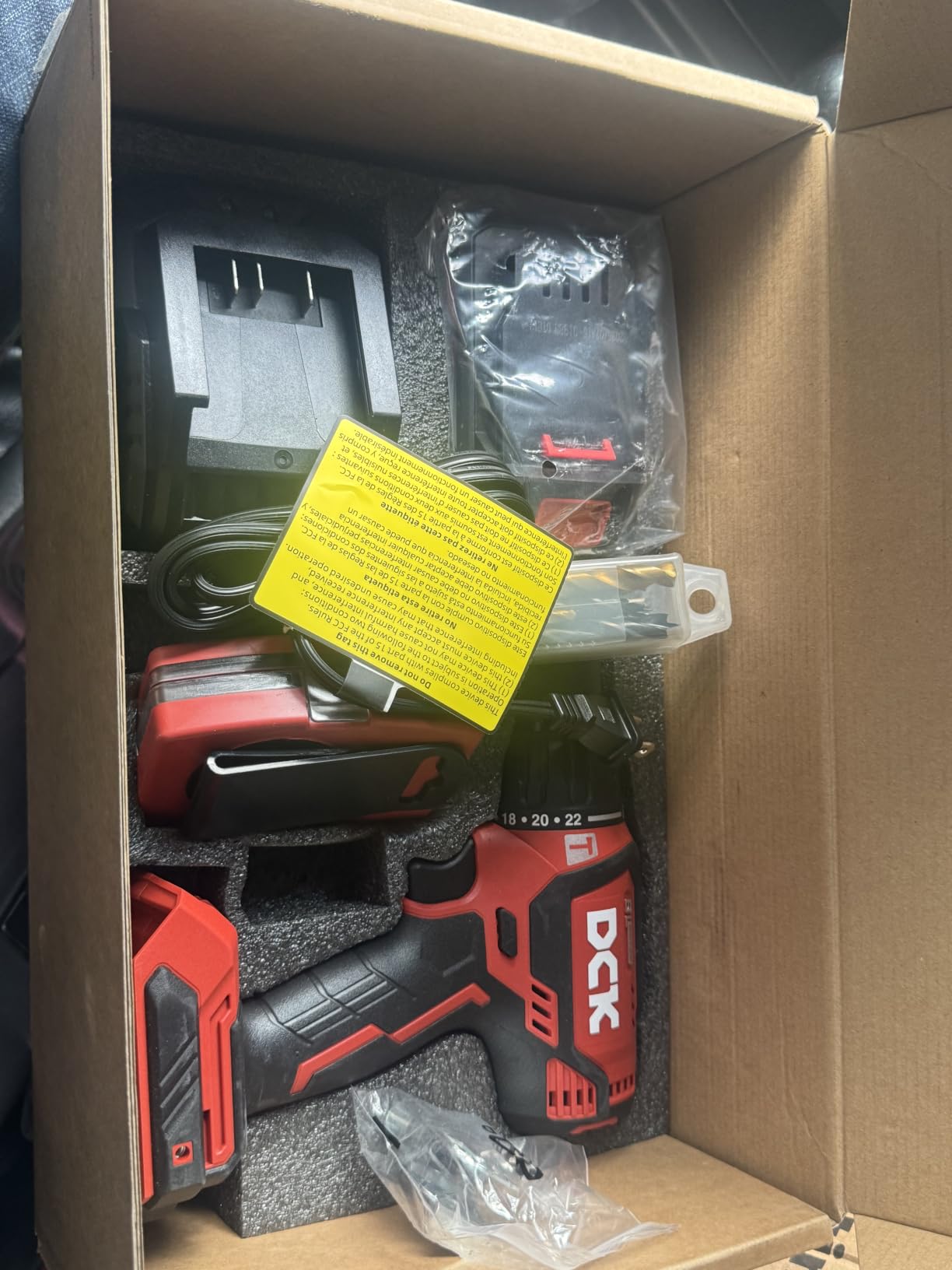
The 22+1+1 clutch gives real torque control for setting fasteners without over-driving them, and the two-speed gearbox spans 0-550 and 0-2200 RPM. The same motor runs about 800 screws per charge on a 4.0 amp-hour pack according to the spec sheet, which is a meaningful figure if you are setting a whole wall of fasteners.
One practical note: the LED work light is trigger-activated, so it goes out the moment you release the trigger. That makes it a drilling aid rather than a lamp, and it is the most commonly mentioned annoyance in reviews.
What job the DCK handles best
Driving Tapcon screws and other masonry fasteners into poured concrete, cinder block, and brick. The torque figure and the clutch give you enough control to set a fastener without stripping it or driving it too deep, and the 3-in-1 format means the same tool handles wood screws and assembly work.
It is also a strong value choice for a first cordless tool with a real battery in the box, at a size that covers brick and light concrete drilling as well as fastening.
Where the DCK is the wrong tool
It is a hammer drill, not a rotary hammer, so there is no chisel mode for light demo, and it is at its limit on large-diameter concrete holes. If your list includes a half inch or larger, move up a category.
The listed 8.8-pound weight is heavier than comparable 20V hammer drills and you will feel it overhead. The all-metal chuck is also reported to become glitchy after extended hammer-setting use, so check the bit after a long masonry session rather than trusting it blindly.
10. Dong Cheng 20V Brushless Impact Drill, 443 in-lbs, 1/2 Inch Metal Chuck
- Hammer mode drills through cinder block and concrete steps effectively
- Lightest option here at 2 pounds which reduces fatigue on long jobs
- 1/2 inch all-metal ratcheting chuck with tool-free bit changes
- Two batteries plus a carry case in the kit
- Brushless motor runs quietly and cooler than brushed designs
- Hammer drill only
- no SDS-plus rotary hammer or chiseling mode
- 2.0 amp-hour batteries give moderate runtime and drain quickly
- Least concrete capability in this group
- best for anchors and light masonry holes
- Less refined ergonomics and finish than established brands
At two pounds, this is the lightest tool here by a wide margin, and for a homeowner drilling a handful of anchors into a wall, that is the feature that decides the purchase. Fatigue is the real limit on small jobs, not capability.
It is also a 3-in-1: drill, driver, and hammer drill with 443 in-lbs of torque and 27,000 blows per minute. Owners report good hammer-mode performance on cinder block, brick walls, and mounting lights into concrete steps, and the brushless motor runs quieter and cooler than a brushed design of the same class.

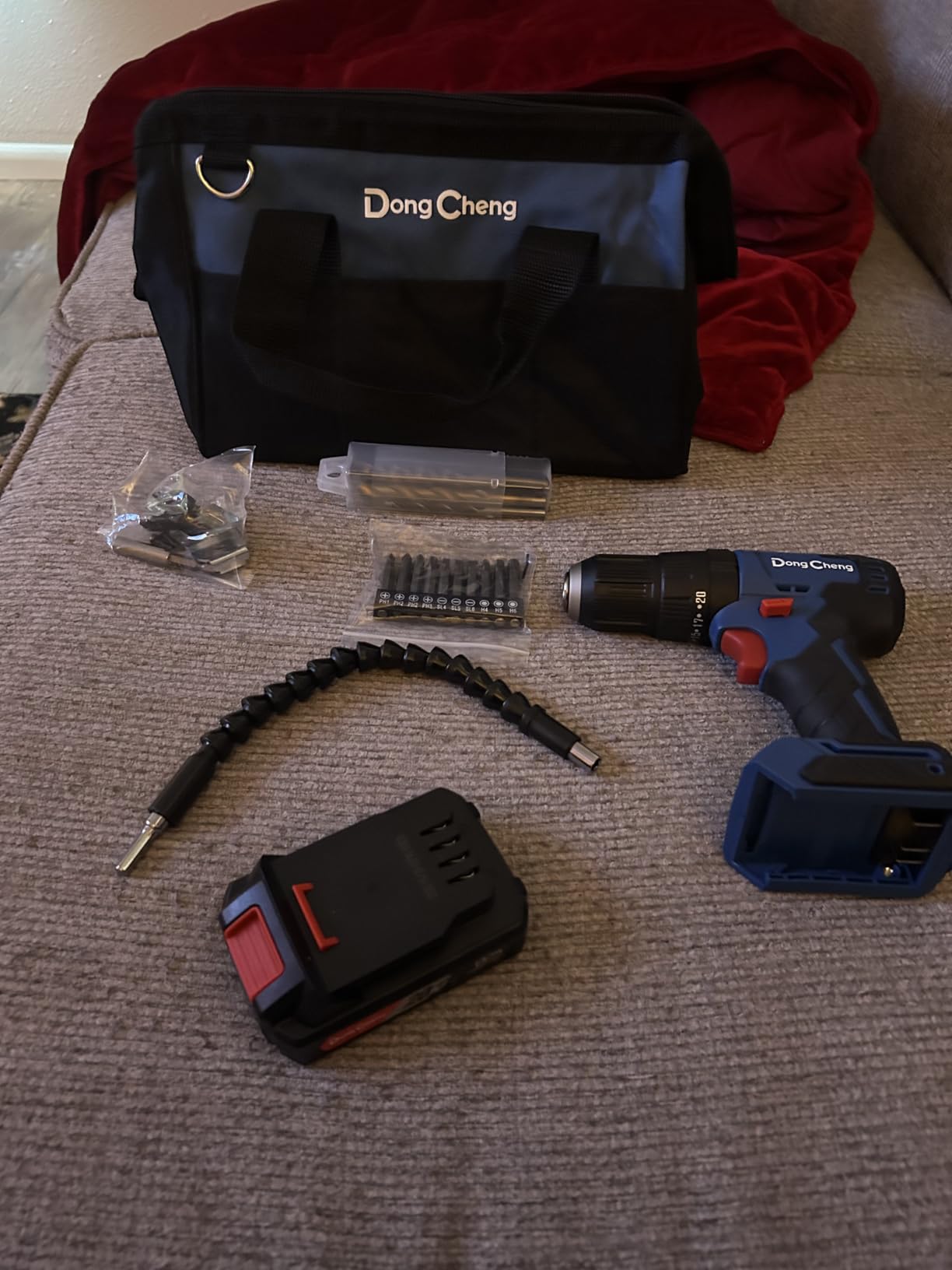
The 1/2 inch all-metal ratcheting chuck is over-specified for this weight class, in a good way. Ratcheting collars tighten incrementally rather than snapping shut, and the tool-free bit change means you are not fighting the chuck with gloves on. Twenty-plus clutch settings cover the driving work as well as the drilling.
Two batteries and a carry case in the kit mean it is ready to use out of the box, and the dual speed range of 0-550 and 0-1800 RPM gives a low gear for clean starts on a finished face.
What job the Dong Cheng handles best
A small number of quarter-inch anchor holes in cinder block, brick, and light concrete, especially overhead where a two-pound tool keeps your arm up. It is also a credible everyday drill/driver for wood and metal assembly because of the 20+1+1 clutch.
For someone who drills a few anchors a month and wants a tool that does not hurt to hold, the low mass and the included kit are the reason to buy it.
Where the Dong Cheng is the wrong tool
It has the least concrete capability in this roundup. There is no SDS-plus mode and no chiseling mode, so anything beyond small masonry holes is out of reach. If you have a basement project with more than a dozen anchors planned, this is the wrong spend.
The 2.0 amp-hour batteries are the practical limit, and several users note they drain fairly quickly on anything heavy. The ergonomics and finish are also less refined than the established brands, which you will feel on a long job even if the tool is light.
How to Choose a Cordless Drill for Concrete Walls
The three drill types and what each one handles
There are three categories, and the difference between them is what separates a five-minute install from an afternoon of frustration.
A standard drill/driver has no hammer action. It spins a bit, which on concrete means grinding dust and stalling. It is not a concrete tool and no amount of torque will change that.
A hammer drill adds a mechanism that strikes the back of the bit thousands of times per minute while the bit rotates. That combination pulverizes the concrete so the bit can advance. It takes standard round-shank masonry bits in a normal chuck, and it is the right tool for quarter-inch anchor holes, Tapcon screws, and light masonry work.
A rotary hammer uses a different, heavier mechanism that drives the bit forward with each blow, and it takes SDS-plus or SDS-Max bits. It is dramatically faster in concrete and it adds a hammer-only mode for chiseling. Most of the picks in this roundup above are rotary hammers.
Hammer drill or rotary hammer: the hole-size threshold
The threshold people argue about most online is a simple one: how big is your hole. Up to a quarter inch with a masonry bit, a hammer drill will do it. Beyond that, or beyond roughly twenty holes, a cordless rotary hammer is the correct tool and a hammer drill is the fallback.
The failures are predictable and they are reported constantly. A brand new cordless hammer drill overheating after a single small hole, or two inches of progress after fifteen minutes, is not a defective tool. It is a category mismatch, and no amount of patience or bit selection fixes it.
Half inch and three-quarter inch anchor holes, running conduit or pipe through a foundation wall, and anything near reinforcement all sit firmly in rotary hammer territory. Forum consensus among electricians and plumbing trades is consistent: a rotary hammer is the default, and a plain hammer drill is for light work only.
SDS vs SDS Plus vs SDS Max shanks
These three are not interchangeable, and the single most common expensive mistake is buying into the wrong one.
SDS is the older, lighter standard, mostly seen in smaller tools and lighter duty work. SDS-plus is the homeowner and light commercial standard, and it is what you want for a residential concrete wall. SDS-Max is a heavier, larger shank for big holes, heavy demo, and continuous professional drilling.
The practical rule: buy SDS-plus unless you have a specific reason not to. An SDS-Max chuck will not accept SDS-plus bits, and a household with one masonry bit set is not going to benefit from the larger standard. If you already own SDS-plus bits, that choice is made for you.
18V and 20V are the concrete threshold; 12V is not
Below 18V, a cordless drill will stall on concrete. This is the mistake that costs people the most, because a compact 12V tool feels powerful on wood and screws, so it gets bought first, stalls on the first masonry hole, and then a second larger tool has to be bought anyway.
18V and 20V are effectively the same class, and the battery packs are not interchangeable between brands or between voltage tiers. That is the ecosystem lock-in to think about before you buy: the drill is the cheapest part of a platform, and you are committing to that platform’s batteries and chargers for years.
Decide based on what you already own. If you have Makita 18V LXT packs, the XRH04Z or the Seesii makes the most sense. If you are in DEWALT 20V MAX, the DCH133B, DCH273B, and DCH293B all drop into your existing batteries. If you are on RYOBI ONE+ 18V, that is the ONE+ HP. If you have nothing, any 18V or 20V platform is a defensible starting point.
Brushless vs brushed motors
Brushless motors run cooler, waste less energy as heat, and hold their performance as the battery drains. They have fewer moving parts, so they also last longer in a dusty concrete environment. Brushed motors use carbon brushes that wear and that generate heat under load, which is the last thing you want in a tool drilling pulverized concrete.
Every rotary hammer in this roundup is brushless, and it is one of the reasons runtime holds up across a long anchor run. Among the hammer drills, the DCK, Dong Cheng, and the RYOBI ONE+ HP are brushless, while brushed designs in the same class will run hotter and shorter for the same battery capacity.
Bits and anchors: the diameter rule
The most common cause of a failed anchor install is a hole that is the wrong size. The rule is simple: your drill bit must be slightly smaller than the anchor’s shank diameter, so the anchor has something to grip as it expands.
In practice, match the bit diameter to the anchor’s published hole size, and let the anchor manufacturer’s chart make the call rather than eyeballing it. For Tapcon screws, use the bit size the screw’s packaging specifies, and do not go larger for speed, because a hole that is too big means the screw has nothing to bite into.
The bit type matters as much as the diameter. Standard three-flute masonry bits work in a hammer drill’s standard chuck. A rotary hammer needs SDS-plus bits with a carbide or diamond carbide tip, and a bit designed for one will not simply work in the other. The Seesii’s tight chuck is also a reminder to grease the shank before insertion.
What each capability tier actually unlocks
Because no price appears in this guide, it is worth framing the tiers by capability instead. A budget hammer drill kit with a small battery gives you a handful of quarter-inch anchor holes and a good general-purpose driver, and it will stop you the moment the job turns into repeated large-diameter drilling.
A mid-tier cordless rotary hammer with roughly 2 to 2.5 Joules of impact energy gives you the range that covers almost all residential concrete wall work: anchors, Tapcons, conduit runs through basement walls, and light chiseling. This is the tier we recommend for most people, and three of the picks above sit here.
The top tier, from about 3 Joules upward and including the SDS-Max kit, adds what matters when the concrete is dense, the holes are large, or you are doing it daily. The extra joules reduce the number of strikes per inch of penetration, which is what keeps a long run of holes efficient and the tool cool. You are buying speed per hole and tolerance for reinforcement and aggregate.
What not to use on concrete
An impact driver is not a hammer drill, and this is the most widespread misconception in DIY forums. An impact driver applies a rotational socket impact, not a percussive blow to a masonry bit, and it will not drill into concrete. Torque numbers do not compare between the two tools because they are measuring different things.
A plain drill/driver with no hammer setting will grind and stall. A corded hammer drill is a fine tool, but if your total runtime need is short, a cheaper corded rotary hammer is a reasonable alternative to a cordless one you will own for years.
And check for buried wiring and plumbing before every hole in a finished wall. A stud finder and a shallow exploratory hole in an inconspicuous spot is cheap insurance against a face full of water.
How to Drill Into a Concrete Wall Without Cracking It
Cracking or chipping a finished concrete face comes down to entry technique, hole size, and control, in that order.
Locate first. Scan for wiring and plumbing with a stud finder, and drill a shallow exploratory hole in a spot you can patch if something is found.
Match the bit to the anchor. Use the hole diameter the anchor manufacturer specifies, and never oversize the hole. A hole that is too big means the anchor has nothing to grip.
Use the right bit type. SDS-plus carbide masonry bits in a rotary hammer, three-flute masonry bits in a hammer drill. Do not mix the standards.
Start on low gear at full trigger. The low range at 0 to around 500 RPM centres the bit and cuts a clean entry instead of skidding across the face and chipping it.
Switch to the hammer setting. Do this before the bit touches the wall where possible, or at least before the bit has a grip. Changing hammer mode under load will snap the bit.
Apply steady, moderate pressure and let the hammer do the work. Pushing hard does not speed up concrete drilling. If you are leaning on it, the bit is dull or the mode is wrong.
Pause on large holes. Every few deep holes, stop and let the bit and the tool cool. Overheating is the top complaint from people drilling concrete, and a short pause prevents it.
Clear the dust. Pull the bit out every few inches to clear slurry. Silica dust is the serious long-term exposure here, and a vacuum attachment on a well-supported cordless rotary hammer is worth having if you are drilling dozens of holes.
If you hit a rebar bar, do not force it. A carbide bit will glance off and round itself, and a pilot hole at half the diameter plus a step-up usually gets through. If you hit an aggregate pocket and progress stops dead, back the bit out, blow the hole clean, and resume at full trigger rather than leaning into it.
One final warning from the field: hammer drilling near finished tile can shatter it, because the vibration travels into the substrate. When working on a tiled or glazed surface, use a lower speed, mark the entry point, and keep the bit perpendicular with a sharp carbide tip.
Frequently Asked Questions
Do I need a hammer drill for concrete walls?
Yes. A standard drill/driver has no hammer action and will only grind and stall on concrete. A hammer drill adds rapid percussive blows to the bit, which is the minimum for quarter-inch anchor holes. For holes larger than a quarter inch, or for more than about twenty holes, a cordless SDS-plus rotary hammer is the correct tool.
Can a cordless drill drill into concrete?
A cordless hammer drill or cordless rotary hammer can. A plain cordless drill/driver cannot make meaningful progress on concrete. Below 18V, even a cordless hammer drill tends to stall and overheat on a poured wall, which is why 18V and 20V are the practical threshold for concrete work.
What type of drill is best for drilling into concrete for anchors?
For quarter-inch anchor holes and Tapcon screws, a 18V or 20V cordless hammer drill with a 1/2 inch chuck is enough. For half inch and larger holes, repeated anchor work, or anything near reinforcement, choose a cordless SDS-plus rotary hammer with at least 2 Joules of impact energy. Match the bit diameter to the anchor’s specified hole size, and never drill a hole larger than the anchor’s published diameter.
What drill bit do I need to drill into concrete?
Use a masonry bit in a hammer drill and an SDS-plus or SDS-Max bit in a rotary hammer, matched to the tool’s chuck or shank standard. The bit must be the diameter the anchor manufacturer specifies, or slightly smaller than the anchor shank, so the anchor has something to grip. The standards are not interchangeable between hammer drills and rotary hammers.
Is an impact driver stronger than a hammer drill?
No, and the two are not comparable. An impact driver delivers a rotational socket impact for driving fasteners and cannot drill into concrete. A hammer drill strikes the bit shank percussively while rotating, which is what breaks concrete. Torque ratings on the two tools measure different things entirely.
The Bottom Line on Cordless Drills for Concrete
The best cordless drills for concrete walls are not the same tools, and the first thing to settle is which of the three categories you are shopping in. For a handful of quarter-inch anchor holes, the DCK or the Dong Cheng 20V hammer drills will do it, and the CRAFTSMAN V20 kit is the sensible place to start if you have no batteries at all. For anything beyond that, an SDS-plus cordless rotary hammer is the answer, and there is no substitute for it.
Among those rotary hammers, the DEWALT DCH133B is our pick for 2026 because 2.6 Joules of impact energy in a 5-pound body is the combination that keeps a wall job quick and an overhead hole possible. The Makita XRH04Z is the right answer if you already own 18V LXT batteries, and the DCH293B covers hard concrete and reinforcement when the wall pushes back.
Before you buy, check which battery platform you already own, buy a proper SDS-plus masonry bit set to go with it, and remember that no cordless drill substitutes for a stud finder. Those three steps prevent nearly every complaint we see about drilling into concrete. If you want a broader look at the platforms involved, our guides to Milwaukee drills and Bosch cordless drills cover the same ecosystem questions from a different angle.