
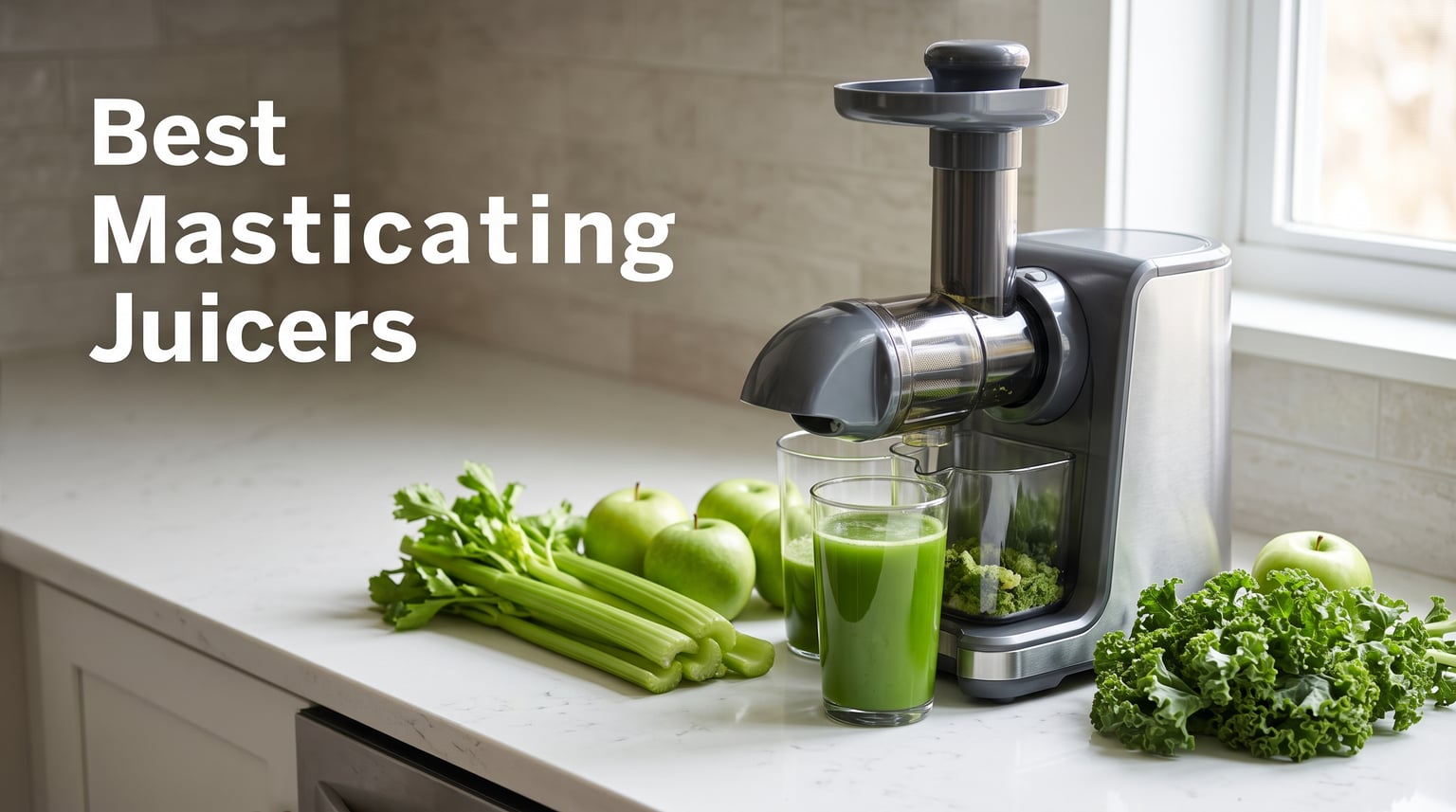
Finding the best masticating juicers means looking past a large chute or a bold yield claim. A cold press juicer uses a slow-turning auger to crush and press produce, rather than spinning it through a fast centrifugal basket, so it is designed for lower-speed extraction with less foam.
For this guide, I compared the 10 selected models using their documented motor details, chute and hopper sizes, care instructions, included strainers, warranty language, ratings, and review volume. I also used recurring home-juicing concerns from forum discussions: cleanup that takes too long, fibrous kale that clogs a machine, early-morning noise, and the need to make several servings without constant prep.
The short version is simple: choose the Nama J2 when hands-free loading and a long warranty matter most, choose the Ninja NeverClog when compact pulp control and dishwasher-safe parts are your priorities, and look at the wide-hopper models when batch juicing is the goal. None of the manufacturer yield percentages below are independently verified here, so treat them as product claims rather than a guaranteed result in your kitchen.
A masticating juicer is not automatically right for every household. If you want a very fast single glass from a few apples, a centrifugal machine can still suit you; if you regularly juice greens, ginger, celery, carrots, or mixed batches, the slower auger format is usually the more relevant place to start.
Table of Contents
Top 3 picks answer the most common juicing needs
The Nama J2 leads for hands-free recipe loading, the Ninja NeverClog leads for straightforward daily use, and the Canoly C16 stands out when quiet operation and several strainer types are high on your list. These are use-case selections based on the listed specifications and buyer feedback, not laboratory rankings.
I would start with hopper capacity before motor wattage. A large hopper changes the routine because you can load a planned batch, while a compact design makes more sense when counter space and small daily portions matter.


These best masticating juicers in 2026 cover ten distinct setups
The comparison below is a quick way to narrow the field by feed design, capacity, extraction speed, and cleanup approach. Read the full notes before choosing, especially where a model lists only a brand claim rather than a measured performance result.
| Product | Specifications | Action |
|---|---|---|
 Anybear Cold Press Juicer Anybear Cold Press Juicer |
|
Check Latest Price |
| Nama J2 Cold Press Juicer |
|
Check Latest Price |
 TUUMIIST TM-780SJ TUUMIIST TM-780SJ |
|
Check Latest Price |
 SMALLHOO TM-1080SJ SMALLHOO TM-1080SJ |
|
Check Latest Price |
 TUUMIIST TM880SJ TUUMIIST TM880SJ |
|
Check Latest Price |
| Ninja NeverClog JC151 |
|
Check Latest Price |
 Canoly C16 Canoly C16 |
|
Check Latest Price |
 EanOruus E-18 EanOruus E-18 |
|
Check Latest Price |
 ACOQOOS TM-980SJ ACOQOOS TM-980SJ |
|
Check Latest Price |
 YPONE SJ-057 YPONE SJ-057 |
|
Check Latest Price |
1. Nama J2 is the hands-free choice for planned batches
- Hands-free recipe loading
- 50 RPM operation
- Quick-release parts
- 15-year warranty
- Hand wash only
- 12.1 pound body
The Nama J2 is the clearest fit for someone who wants to load produce and step away from the machine. Its self-feeding hopper is designed to cut and juice a whole recipe automatically, which speaks directly to the prep fatigue that comes up repeatedly in home-juicing conversations.
The listed 200-watt motor runs at 50 RPM, and the product data describes that setup as quiet. I would view “quiet” as a relative claim, but 50 RPM is a useful documented signal for a low-speed slow juicer.
The 30-fluid-ounce capacity suits a household making a small batch rather than one drink at a time. It also includes juice and pulp containers, a fine strainer, a coarse strainer, a pusher, and a spinning brush, giving the owner a complete starting set.
Cleanup is still a hand-wash task, despite the quick-release part design. That is the trade-off to weigh: the workflow can reduce active feeding, but it does not remove the need to rinse and wash the parts after use.
The hopper makes batch juicing the main reason to choose it
A self-feeding hopper helps most when you make a mixed recipe with apples, celery, greens, and citrus in one session. It is less meaningful if you only make a small ginger shot or one glass at a time.
The 30-ounce stated capacity gives a practical ceiling for the juice side of the routine. Plan your ingredient amount around that container instead of assuming the hopper capacity and juice-container capacity are the same thing.
The warranty makes long-term ownership the deciding factor
Nama lists a 15-year warranty, which is longer than the one-year warranty language found on several alternatives in this group. Read the warranty terms before buying because duration alone does not describe coverage conditions.
The unit weighs 12.1 pounds and stands 17.7 inches tall, so I would leave it on the counter if the available height allows. Moving a heavier vertical juicer in and out of a cabinet can weaken the convenience of its hands-free setup.
2. Ninja NeverClog is the compact daily-use pick with pulp control
- Two pulp filters
- Dishwasher-safe parts
- Reverse function
- Anti-drip lever
- Hard vegetables may need pre-cutting
- 24oz jug
The Ninja NeverClog makes the most sense for a daily juicer who wants a familiar, compact machine rather than a large hopper system. It has a 150-watt motor, a 24-ounce juice jug, a 36-ounce pulp container, and a body sized to fit under kitchen cabinets.
Its standout feature is texture choice: two interchangeable pulp filters let you choose between different pulp levels. That is more useful than a generic “high yield” claim if you know you prefer a clearer juice one day and more body the next.
Ninja lists start/stop and reverse as simple one-touch programs. The reverse function is worth having for fibrous ingredients, though it should not be treated as permission to overload the feed area with long celery strings or dense chunks.
Forum users frequently point to cleanup as the reason a juicer stops getting used, and the dishwasher-safe parts are a strong practical response. The listed limitation is that very hard vegetables may need pre-cutting, so whole-produce convenience is not its main strength.
The two filters make texture control the key benefit
The included pair of pulp filters is helpful for households with different preferences. Rather than buying a machine for one fixed result, you can alter the pulp level with the supplied filter choice.
This is also a sensible setup for recipes that vary between soft fruits and firm vegetables. Use the reverse option only when needed, then disassemble and rinse before residue dries in the filter.
The compact body makes storage the practical advantage
The Ninja weighs 7.93 pounds and measures 12.11 inches deep by 7.15 inches wide by 15.93 inches high. Those dimensions are friendlier to tighter counters than the tallest large-hopper choices in this guide.
The 24-ounce jug favors a couple of servings over a large family batch. If you want to fill several bottles at once, a model with a 90- or 100-ounce hopper is a closer match.
3. Canoly C16 is the quiet-operation option with three strainers
- Listed 35dB motor
- Three strainers
- 90oz hopper
- Dishwasher-safe parts
- 13.9 pound weight
- One-year limited warranty
The Canoly C16 is the model to examine first when the juicer will run while other people are asleep or working nearby. Canoly lists a 250-watt AC brushless motor at 35 dB, the only explicit decibel figure among these selected product records.
Its 6-inch chute and 90-ounce hopper point toward a batch-oriented routine. The supplied three-in-one strainers cover juice, sorbet, and nut milk, so it has a documented route beyond standard fruit and vegetable juice.
The C16 includes auto-reversing and dishwasher-safe parts. Those two features address common friction points, but I would still rinse all parts immediately after a green juice because dried pulp is more difficult to remove from any strainer.
At 13.9 pounds, it is among the heavier options here. The stated 15-year motor warranty is reassuring, although the overall product listing separately names a one-year limited warranty, so confirm what each warranty applies to.
The listed decibel figure makes it the clearest morning-use candidate
Canoly’s 35 dB figure is a brand specification, not a third-party sound test. Still, it gives shoppers who care about sound a concrete point to compare against models described only as quiet.
Sound in a home also changes with hard carrots, container vibration, and the counter surface. Put a stable machine on a firm surface and feed ingredients at a measured pace for the calmest routine.
The three strainers make versatility the second reason to choose it
Use the appropriate supplied strainer for juice, sorbet, or nut milk rather than expecting one screen to handle every recipe equally. That distinction matters if you want a machine that earns counter space beyond morning juice.
The 90-ounce hopper suits a household that prepares ingredients ahead. The 17.52-inch width is worth measuring against your storage shelf before committing.
4. TUUMIIST TM-780SJ is the large-hopper multi-purpose choice
- 100oz hopper
- Whole-apple chute
- Juice milk and sorbet
- Quick-release parts
- 30-day satisfaction guarantee
- No stated noise rating
The TUUMIIST TM-780SJ combines a 6.5-inch chute with a stated 100-ounce mega hopper, making it one of the more clearly batch-focused models. Its listed uses include apples, beetroot, carrots, celery, ginger, kale, and wheatgrass, which is a broad produce list for a home slow juicer.
The manufacturer lists a 350-watt motor running at 60 RPM. Wattage does not prove a better extraction on its own, but it tells you this model is positioned for substantial mixed-produce loads rather than only soft fruit.
It includes a hopper, brush, juice cup, and pulp cup, and its quick-release parts are presented as easy to wash. The product care instructions allow dishwasher-safe or hand washing, which is welcome for people whose main concern is shortening cleanup.
This is a 3-in-1 appliance for juice, nut milks, and sorbet. That versatility is useful only if those extra foods are part of your plan; for juice alone, the hopper size and cleaning routine are the better reasons to compare it.
The 100-ounce hopper makes it suitable for prep-ahead sessions
A hopper this size is aimed at loading a larger recipe before extraction starts. It is a better fit for a family batch than a small single-serving routine.
Even with a wide chute, inspect produce first and remove pits, stones, and hard inedible parts. A wide opening reduces cutting but does not make every ingredient safe to feed whole.
The listed produce range makes greens and roots a useful test case
The recommended-use list specifically includes kale and wheatgrass alongside root vegetables. Start slowly with fibrous greens and alternate them with juicier produce to help the auger keep moving.
Its stated dimensions are 7 by 13 by 17 inches and it weighs 7 pounds. Measure vertical clearance as well as counter footprint, since the height is close to many upper cabinets.
5. SMALLHOO TM-1080SJ is the biggest listed hopper for family batches
- 120oz hopper
- 7 inch chute
- Three functions
- Dishwasher-safe parts
- No stated product weight
- One-year warranty
The SMALLHOO TM-1080SJ has the largest stated hopper in this selection at 120 ounces. Pair that with its 7-inch ultra-wide chute and it is plainly built around reducing prep interruptions during a large juice session.
Its product information lists 350 watts and 60 RPM, along with juice, creamy nut milk, and natural sorbet functions. The stated care instructions permit dishwasher-safe or hand washing, and the design is described as tool-free to disassemble.
I would not assume a 7-inch opening means every fruit should go in unprepared. The manufacturer says it can accept unpeeled whole fruit, but hard pits and non-edible rinds still need removal before any cold press juicer is used.
This is an appealing option for people who hate stopping to refill the hopper. On the other hand, the product record does not state a weight, so there is no verified basis here for calling it easy or difficult to move.
The 120-ounce hopper makes fewer reloads the direct benefit
A large hopper is most helpful when you juice several glasses in one run or prep ingredients for the next day. It does not alter the time required to wash the strainer and auger afterward.
Fill it with a sensible mix rather than packing it tightly. Alternating watery fruit with leafy or stringy ingredients can help maintain a steady feed.
The dishwasher-safe parts make cleanup easier to plan
The ability to use a dishwasher can lower the end-of-session workload. I would still brush and rinse the strainer right away, because a dishwasher cycle cannot reliably undo pulp that has hardened in fine openings.
The model measures 13 inches deep, 7.5 inches wide, and 17 inches high. Its narrow width can help, but depth and cabinet clearance still deserve a quick measurement.
6. TUUMIIST TM880SJ is the touchscreen choice with auto-reverse
- One-tap modes
- Auto-reverse
- Listed under 60dB
- 3-minute rinse claim
- 10 pound body
- No stated warranty duration
The TUUMIIST TM880SJ is for a buyer who prefers a guided control layout. Its Smart Touch screen has stated one-tap settings for juice, milk, and sorbet, and the 6.5-inch chute is meant to accept whole fruit.
The manufacturer specifies 3 liters of capacity, a 350-watt motor, and 60 RPM. It also claims a 95% juice yield and bone-dry pulp, but actual yield changes with the ingredient, its freshness, and how it is prepared, so I would not use that number as a promised outcome.
An auto-reversing function is the technical detail that matters most for occasional buildup. It can assist with a jam, but careful feed order remains the first defense against clogging from celery strings or large pieces of leafy greens.
TUUMIIST lists dishwasher-safe parts and a three-minute rinse. A quick rinse is useful, yet a full cleanup still includes checking the strainer and the pulp path, particularly after carrot or beet juice.
The touchscreen makes mode selection the clearest distinction
Dedicated juice, milk, and sorbet controls make this model easier to understand for someone who will use more than one function. The controls do not replace following the supplied instructions for the relevant strainer and ingredients.
The 100-ounce stated capacity is suited to batches, while the 10-pound weight makes it a reasonable candidate for a permanent counter spot. Its dimensions run 16.92 inches deep, which may be more important than width in a shallow kitchen.
The auto-reverse makes fibrous-produce recovery the main technical draw
Auto-reverse is valuable as a recovery feature, not a signal to force ingredients through. Trim especially tough ends, cut dense roots to a manageable size, and alternate greens with moist fruit.
The listing describes the motor as under 60 dB, but no test method is provided. Treat that as a comparative manufacturer statement rather than a measured room-noise promise.
7. EanOruus E-18 is the high-capacity 3-in-1 option
- 100oz hopper
- Three functions
- Brushless motor
- Dishwasher-safe parts
- 12.13 pound weight
- One-year limited warranty
The EanOruus E-18 gives you another documented 100-ounce hopper paired with a 6.5-inch mega-wide chute. It is designed around hands-free large-batch preparation, with juice, nut milk, and sorbet listed as its three uses.
A 250-watt AC motor powers the unit, and the listing calls it whisper-quiet and brushless. Since no decibel value is supplied, I would compare it on hopper needs and cleanup features first, then treat the quiet language as a claim to verify after purchase.
Its included parts list is detailed: hopper, juice strainers, sorbet strainer, chamber, auger, pusher, cups, brush, and pulp filter. That equipment list is a meaningful advantage for anyone who intends to use the non-juice functions rather than buying extra accessories later.
The removable pulp ejector and dishwasher-safe care instructions may reduce the cleanup barrier. It weighs 12.13 pounds, though, so it is more of a stable counter appliance than a lightweight one-glass machine.
The supplied strainers make the three functions genuinely usable
Juice, nut milk, and sorbet are listed alongside dedicated strainers, which gives the 3-in-1 label practical substance. Keep the parts organized and use the brush on each strainer immediately after use.
For simple daily juice, only assemble the components you need. Fewer parts on the counter makes the end-of-session washup feel more manageable.
The 100-ounce hopper makes shared households the natural audience
The hopper is best for households that want several servings without repeated loading. It is also useful for making a batch from prewashed produce, provided you do not store freshly made juice longer than your recipe and food-safety routine allow.
The body measures 13.7 inches deep, 7.48 inches wide, and 17.4 inches high. Check both shelf clearance and the path for lifting it out if you plan to store it away.
8. ACOQOOS TM-980SJ is the straightforward wide-chute batch model
- Whole-fruit chute
- 100oz hopper
- Juice milk and sorbet
- Dishwasher-safe parts
- Hard pits must be removed
- One-year warranty
The ACOQOOS TM-980SJ focuses on the same high-capacity workflow as other family-size models: a 6.5-inch feed chute and a 100-ounce gravity-fed hopper. It is a reasonable model to compare when batch loading matters more than elaborate controls.
The product data lists 60 RPM cold press technology, 350 watts, and a claimed juice yield of up to 90%. As with every yield figure, use it as the maker’s stated target rather than a number that can predict every kale, carrot, or apple batch.
Its listed functions include juice, sorbet, and nut milk, with dishwasher-safe care instructions. The model also has overheat protection and a pre-cut system in its special-feature list, but no specific operating-time limit is given in the supplied data.
ACOQOOS explicitly notes that hard pits and seeds should be removed. That is sensible advice for all auger machines and is especially important if you are trying to avoid an interruption during a large hopper load.
The gravity-fed hopper makes batch loading the direct appeal
A gravity-fed 100-ounce hopper lets you work through a prepared produce batch with fewer pauses. It will appeal to people who juice for more than one person or make servings for later the same day.
The stated 8.7-pound weight is lower than several big-hopper alternatives in this guide. It may be easier to move, although counter height and grip matter as much as the scale number.
The pit-removal warning makes ingredient preparation the key rule
Whole-fruit language should never include hard pits, stones, or seeds that the manual says to remove. Prep stone fruit carefully and cut or core ingredients whenever the instructions call for it.
The model’s recommended uses include apples, carrots, celery, grapefruit, kale, pomegranate, and wheatgrass. Start small with fibrous produce until you learn how it behaves with your preferred recipe.
9. YPONE SJ-057 is the powerful-motor choice with dual strainers
- 400W motor
- Dual strainers
- 55 RPM operation
- Safety lock
- One speed setting
- No stated hopper volume
The YPONE SJ-057 is a two-in-one cold press juicer with a listed 400-watt motor and 55 RPM slow-press operation. Its 5.8-inch chute is smaller than the 6.5- and 7-inch entries above but still intended for larger pieces of produce.
The supplied features call out dual strainers and a claimed 99% juice yield. I would focus on the dual-strainer setup rather than the percentage: different strainers can make a real difference in the texture of the final drink.
YPONE says the machine comes apart into three main parts for cleaning and has dishwasher-safe or hand-wash care. The safety lock is a worthwhile family-oriented detail because it helps prevent operation before components are assembled correctly.
There is only one speed setting, so buyers looking for a range of modes may prefer a touchscreen or multi-function alternative. The listing does not state a hopper volume, making it hard to compare batch capacity with the 90-, 100-, and 120-ounce choices.
The 400-watt motor makes dense-produce work its main pitch
A higher wattage figure suggests this model is positioned for firm fruits and vegetables, but motor power alone does not establish juice quality. Feed carrots and beets in manageable pieces and follow the manual’s loading guidance.
The product record includes a quiet-motor claim but no decibel measurement. If sound is your top requirement, the Canoly’s stated 35 dB figure is a more concrete data point.
The dual strainers make juice texture the buying decision
Dual strainers are attractive when you want some flexibility in pulp level. Check which strainer is installed before you start, because changing it after the chamber is full adds unnecessary cleanup.
The unit weighs 4.42 kilograms and measures 5 inches deep by 11 inches wide by 13 inches high. Its listed height is notably compact, which can help in kitchens with low cabinet clearance.
10. Anybear SJ054C is the compact slow-speed option with a long stated warranty
- 65 RPM operation
- 4.3 inch chute
- Tritan material
- Five-year warranty
- Hand-wash care listed
- No stated hopper capacity
The Anybear SJ054C is the most compact-looking vertical model in this group, with listed dimensions of 7.8 inches deep, 6.65 inches wide, and 15.3 inches high. Its 4.3-inch feed chute is not the widest here, but it is stated to fit whole fruits.
Anybear lists a 200-watt, 180 Nm high-torque motor operating at 65 RPM. The listing also claims juice yield up to 98.9%, which should be read as a brand claim and not a consistent performance guarantee across every ingredient.
The material list includes baby food-grade Tritan, and a brush is included for cleanup. Care instructions list both dishwasher-safe and hand-wash language, so I would consult the manual for the specific parts rather than assuming every piece belongs in a dishwasher.
A five-year extended warranty with free replacement is one of its stronger documented ownership details. The product record does not name a hopper capacity or a noise figure, so it is harder to judge its suitability for large batches or sound-sensitive homes.
The narrow footprint makes limited counter space the main fit
At 6.65 inches wide, this is the narrowest listed body in the roundup. It can be a useful answer for a small kitchen where a wide horizontal footprint would be awkward.
The 15.3-inch height can also work under more cabinets than the 17-inch tall batch models. Measure your clearance with the lid-opening motion in mind, not only the closed height.
The 65 RPM speed makes slow extraction the core specification
The listed 65 RPM sits in the low-speed range associated with a masticating juicer. Slow operation is helpful context, but good feeding habits and prompt cleaning remain just as important to the daily result.
The 4.3-inch chute may reduce cutting compared with a narrow tube, though it does not offer the same whole-recipe loading as a large hopper. It is best viewed as a space-conscious juicer for modest batches.
A good masticating juicer choice starts with your actual routine
The right slow juicer is the one you will rinse, reassemble, and use again next week. These four checks matter more than a single headline specification.
Masticating extraction is better for greens when you accept a slower pace
A masticating juicer uses an auger to crush and press ingredients against a strainer. A centrifugal juicer relies on a fast-spinning basket, which is typically quicker for a fast glass but may create more foam and is less often the preferred format for leafy greens.
That does not make one format universally superior. Choose a slow juicer if you want lower-speed processing, mixed produce, greens, ginger, and batches; choose centrifugal if speed for simple fruit juice matters most.
A hopper matters more than chute width when prep time is the problem
A wide chute can reduce chopping, while a large hopper can reduce the number of times you need to stand beside the juicer. The Nama J2, TUUMIIST TM-780SJ, SMALLHOO, EanOruus, ACOQOOS, and Canoly are the models here with the clearest hopper-based batch workflow.
Still remove hard pits, non-edible rinds, and ingredients the manual excludes. A large opening is a convenience feature, not a promise that everything belongs in the chamber whole.
Cleanup is easier when you rinse the strainer before pulp dries
Forum discussions get this right: cleanup determines whether many people keep juicing. A dishwasher-safe label helps, but the fastest habit is to disassemble promptly, rinse the auger and chamber, and brush the strainer before fiber hardens.
For the easiest clean in this group, start with a model that lists dishwasher-safe parts and a simple part count, such as the Ninja. For large-hopper units, accept that the extra capacity may mean more components to rinse.
Noise comparisons need stated data rather than marketing labels
“Quiet” appears in several listings, but only the Canoly C16 provides a 35 dB specification in this product data. The TUUMIIST TM880SJ lists operation under 60 dB, while the Nama J2, SMALLHOO, and EanOruus are described as quiet without a stated decibel value.
Use those claims as starting points, not identical measurements. Hard produce, countertop vibration, feed speed, and a room’s acoustics all affect what you hear at home.
Yield claims are useful only when you compare similar produce
Several brands claim yields from 90% to 99%. Those figures cannot be compared fairly without the same produce, weight, preparation, strainer, and test method, so I would not use them to calculate a cost per glass.
Instead, watch the pulp from your own usual recipe. Drier pulp can suggest more extraction, but it is not a complete quality score because texture and the amount of water-rich produce also change the result.
Capacity and storage should be measured before you order
Batch models need vertical clearance, counter depth, and a place for the juice and pulp containers. The SMALLHOO and several other choices are about 17 inches tall, while the Anybear and YPONE have lower listed heights.
Write down the width, depth, and height of your available spot before choosing. I also recommend checking whether you will leave the machine out, because a juicer that takes effort to retrieve is less likely to become a daily habit.
Common masticating juicer questions have clear answers
Is a masticating juicer better than a juicer?
A masticating juicer is better for people who prioritize low-speed extraction, leafy greens, ginger, and less foam. A centrifugal juicer can be better when speed and a quick single glass matter more than a slower pressing process.
What is the number one rated juicer?
In this 10-product selection, the Anybear Cold Press Juicer has the highest listed rating at 5.0 from 184 reviews. A rating alone is not the full answer: the Nama J2 has a 4.7 rating from 1,484 reviews and is the stronger match for hands-free batch loading.
What juicer does Martha Stewart recommend?
The supplied research does not provide a verified Martha Stewart recommendation. Rather than attribute a recommendation without evidence, compare a juicer by documented needs such as hopper size, cleaning instructions, strainer options, and warranty coverage.
What is the healthiest type of juicer?
No juicer alone makes juice healthy; ingredients and overall eating habits matter most. A masticating juicer is a practical choice when you want a low-speed process for vegetables, fruit, and leafy greens, but it does not replace eating whole produce and its fiber.
The Nama J2 is the best masticating juicer for hands-free batches
Choose the Nama J2 when automatic recipe loading, a 50 RPM motor, and the stated 15-year warranty are the priorities. Choose the Ninja NeverClog if a smaller body, pulp control, and dishwasher-safe components will make daily use easier.
The best masticating juicers in 2026 are not a one-size-fits-all category. Match the hopper to your batch size, choose documented cleaning features you will actually use, and give more weight to verified specifications than sweeping yield claims.