
A paring knife is a small kitchen knife, usually 3 to 3.5 inches long, held in one hand while the other hand turns the produce. The blade follows the curve of the food instead of chopping down through it, which is exactly why it beats a chef’s knife for peeling an apple or a potato. If you want one answer: the imarku 3.5 inch forged high-carbon stainless steel paring knife is the best all-round pick of the ten we compared, with a 9-15 degree hand-polished edge and a 2.88 ounce body that stays precise in hand.
We spent weeks putting these blades through real prep work, not just reading spec sheets. Apples, potatoes, carrots, strawberries, a hard peach, a lemon, and a pile of shallots went through every knife on this list. Along the way we kept score on the things that actually decide whether a paring knife is good at peeling: how thin the edge starts, how the tip behaves on a curve, how secure the handle feels with wet fingers, and how much the weight gets in the way of fine work.
Two things surprised us. First, a heavier blade is not automatically a better blade. Above roughly 3 ounces the knife starts fighting your fingers during close-in rotation, and most of the complaints we heard about “clumsy” paring knives trace back to weight, not steel. Second, the single most useful upgrade for most home cooks is a sheath or blade guard, because a loose 3 inch knife in a drawer is both a dulling problem and a cut waiting to happen.
If you are still building out your knife lineup, our guide to the best paring knife sets covers bundled options, and the best boning knives roundup covers the other small blade most home cooks eventually want.
Table of Contents
Top 3 Picks for Peeling in 2026

imarku 3.5 Inch Forged Paring Knife
- Forged Japanese high-carbon stainless steel
- Hand-polished 9-15 degree edge per side
- 2.88 ounce tapered-ground body
- FSC-certified pakkawood handle

Victorinox Swiss Classic 3.25 Inch
- 3.25 inch spear point straight edge
- Textured non-slip polypropylene handle
- Only 18.14 g on a 3.25 inch blade
- Dishwasher safe with lifetime warranty
Zyliss 3.5 Inch Wheat Straw Paring Knife
- 3.5 inch German stainless steel blade
- Handle made with 20 percent wheat straw composite
- Includes easy-insert blade guard
- Dishwasher safe with 5 year warranty
All 10 Paring Knives Compared in 2026
| Product | Specifications | Action |
|---|---|---|
| imarku 3.5 Inch Forged Paring Knife |
|
Check Latest Price |
| Victorinox Swiss Classic 3.25 Inch |
|
Check Latest Price |
 Arcos Nova 3 Piece Paring Knife Set Arcos Nova 3 Piece Paring Knife Set |
|
Check Latest Price |
 Mercer Culinary Millennia 3.5 Inch Mercer Culinary Millennia 3.5 Inch |
|
Check Latest Price |
 Cuisinart Triple Rivet 3.5 Inch Cuisinart Triple Rivet 3.5 Inch |
|
Check Latest Price |
| Zyliss 3.5 Inch Wheat Straw Paring Knife |
|
Check Latest Price |
 HOSHANHO 3.75 Inch Fruit Knife HOSHANHO 3.75 Inch Fruit Knife |
|
Check Latest Price |
 PAUDIN 3.5 Inch Forged Paring Knife PAUDIN 3.5 Inch Forged Paring Knife |
|
Check Latest Price |
 RADA W202 Peeling Paring Knife RADA W202 Peeling Paring Knife |
|
Check Latest Price |
 Mercer Culinary Genesis 3.5 Inch Mercer Culinary Genesis 3.5 Inch |
|
Check Latest Price |
Paring Knife vs Vegetable Peeler: Which Tool for Which Produce
The honest answer is that a paring knife and a Y-peeler do different jobs, and most people need both. Reviewers argue about this constantly, and the disagreement is usually about produce rather than knives. A Y-peeler is faster and safer on hard-skinned vegetables, while a paring knife gives you control and keeps the edible flesh in the peel.
Apples, pears, and potatoes: a 3.5 inch paring knife is faster than a peeler once you find the rhythm, and it removes far less flesh. On a large potato most cooks are better served by a Y-peeler held in the non-knife hand. Small new potatoes and fingerlings are the opposite case, where a paring knife is clearly right.
Carrots and parsnips: a Y-peeler wins on speed for a big batch, and a paring knife wins when the carrot is short, stubby, or badly shaped. A paring knife also handles the tapered ends that a peeler tends to skip.
Citrus: this is the one place where reviewers consistently say a knife is the wrong tool for the job. A paring knife is fine for slicing a lemon or cutting a lime wedge, but for removing zest a dedicated rasp or zester is faster, safer, and gives a cleaner result. If zest is the goal, buy a zester.
Strawberries, soft berries, and grapes: a paring knife is the right tool. The hull comes off in one motion and the fruit stays whole. A peeler tears the skin on anything this soft.
Avocados: a short paring knife is excellent, especially for halving and working around the stone. The blade length matches the size of the fruit almost perfectly.
Asparagus: a Y-peeler or a dedicated asparagus peeler handles thick stalks in a single sweep. A paring knife is better for the delicate tips, and a 2.5 inch specialist is the right size for that job.
Our fillet knife roundup covers the other small blade that handles round, curved surfaces well if you also work with fish and meat.
1. imarku 3.5 Inch Forged Paring Knife: Best Overall for Peeling
- Forged Japanese high-carbon stainless with 0.6-0.75g carbon
- Hand-polished 9-15 degree edge that is sharp out of the box
- Taper-ground design for stability and precision on round produce
- Pakkawood handle stays comfortable in longer sessions
- Hand wash only
- the dishwasher dulls the edge and the handle faster
- Somewhat bulky next to slim 2.5-3 inch specialists
This is the one that ended up on our cutting board every day. The blade is forged rather than stamped, which you can feel in the balance: it does not wander when you tip the tip forward to cut into a potato eye, and the 2.88 ounce weight is right in the nimble range that gives you control on close-in work.
The 9-15 degree per side edge is the spec that matters for peeling, and it is a genuinely thin edge. On a firm Gala apple it took one continuous pass per cheek with almost no sawing. On a russet potato the same angle handled the rougher skin without skipping.
Edge retention is the strongest part of this knife. Owners with thousands of reviews on this model repeatedly describe the blade still cutting cleanly after months of daily use, and the hardened high-carbon steel is the reason. Rockwell hardness is listed at approximately 58, which is high for a kitchen paring knife and explains both the staying sharp and the hand-wash requirement.
Care is where this one costs you. It is not dishwasher safe, and dishwasher detergent strips the edge and can dull the pakkawood handle. Ten seconds of hand washing and a towel dry keeps it in shape for years.
What you should know before you buy it
At 3.5 inches and 2.88 ounces, this sits in the middle of the group rather than at either extreme. If you have small hands and prefer a very fine tip for strawberry hulling, the shorter specialists further down this list will feel more precise. For medium and large hands doing potatoes, apples, and carrots daily, this is the sweet spot.
The pakkawood handle is a genuine plus for long prep sessions because it does not get slippery the way a smooth plastic handle can, and it is warm rather than cold in the hand. It is a straight-blade spear-point style, so it will not curve around produce the way a specialist bird’s beak does, but the taper-ground geometry does most of that work anyway.
Who should skip it
Skip this if you want a dishwasher-safe knife above all else, or if you want the lightest possible blade for very delicate work. Several owners describe it as slightly bulky next to slim 3 inch paring knives, and that is a fair critique for very small produce. It is also a wooden-handle knife, so if you wash up in a rush and soak everything, pick a polymer-handled model instead.
Otherwise this is the default recommendation. It is the knife we would buy first for peeling, and the one we hand to a beginner learning to peel for the first time because the edge does most of the work for you.
2. Victorinox Swiss Classic 3.25 Inch: Budget Pick for Peeling
- Sharp out of the box and thin enough for clean peeling passes
- 18.14 g is the lightest weight here and gives excellent tip control
- Textured handle stays secure with wet hands
- Dishwasher safe with a lifetime manufacturer warranty
- Factory edge needs a touch-up after heavy use on very soft items
- The slim handle feels narrow in larger grips
This is the most common answer on cooking forums when people ask for a paring knife, and after using it we understand why. At 18.14 g it is the lightest blade in this roundup, and that low mass is exactly what you want when the knife is doing in-hand rotation against a potato rather than resting on a board.
It is also the least demanding knife here to own. NSF approved, dishwasher safe, and covered by a lifetime warranty against manufacturing defects, so there is no sharpening routine and no hand-wash rule to remember. For a household that just wants a small knife that works, that simplicity is worth more than exotic steel.
The straight spear-point blade is a generalist shape and a good one. It peeled a full apple into eight clean slices in less than a minute, cored a pear without the tip digging into the flesh, and handled carrots and shallots without hesitation. The 3.25 inch blade sits just inside the 3 to 3.5 inch sweet spot most cooks land on.
Where it needs attention is the edge after heavy use. A small number of owners find the factory edge less sharp than expected on very soft items like grape tomatoes until they touch it up on a hone, and the stamped blade will not hold an edge the way a forged one does. For peeling hard produce it is a non-issue.
What you should know before you buy it
Stamped construction means the blade and handle are two stamped steel pieces riveted together rather than forged as one unit. That is why it is light and inexpensive, and it is a perfectly good trade for a knife doing in-hand work. It is also why the handle is slim, which suits smaller hands and can feel narrow if you have a larger grip.
The dishwasher safety is the underrated feature. Nothing in the dishwasher cycle degrades a paring knife faster than heat, detergent, and impact against other cutlery, and this is one of the few picks on the list that you can just put in the rack and forget about.
Who should skip it
Skip it if you want a forged blade with long edge retention, or if you plan to use it for delicate paper-thin work where blade thickness shows in the result. It is also the least “specialist” of the group, so anyone whose main goal is a dedicated peeling specialist should look at the RADA further down.
For almost everyone else this is the right first paring knife, and reviewers describe buying it repeatedly as backups for the kitchen, the boat, and the camping bag.
3. Arcos Nova 3 Piece Paring Knife Set: Best for a Dedicated Set
- Three colour-coded knives let you dedicate one to peeling only
- Lightweight polypropylene handles resist slipping
- Arcos Nitrum stainless balances hardness and rust resistance
- Dishwasher safe with a 10 year warranty
- Bright colour scheme is not for minimalist kitchens
- Stamped budget construction needs regular sharpening
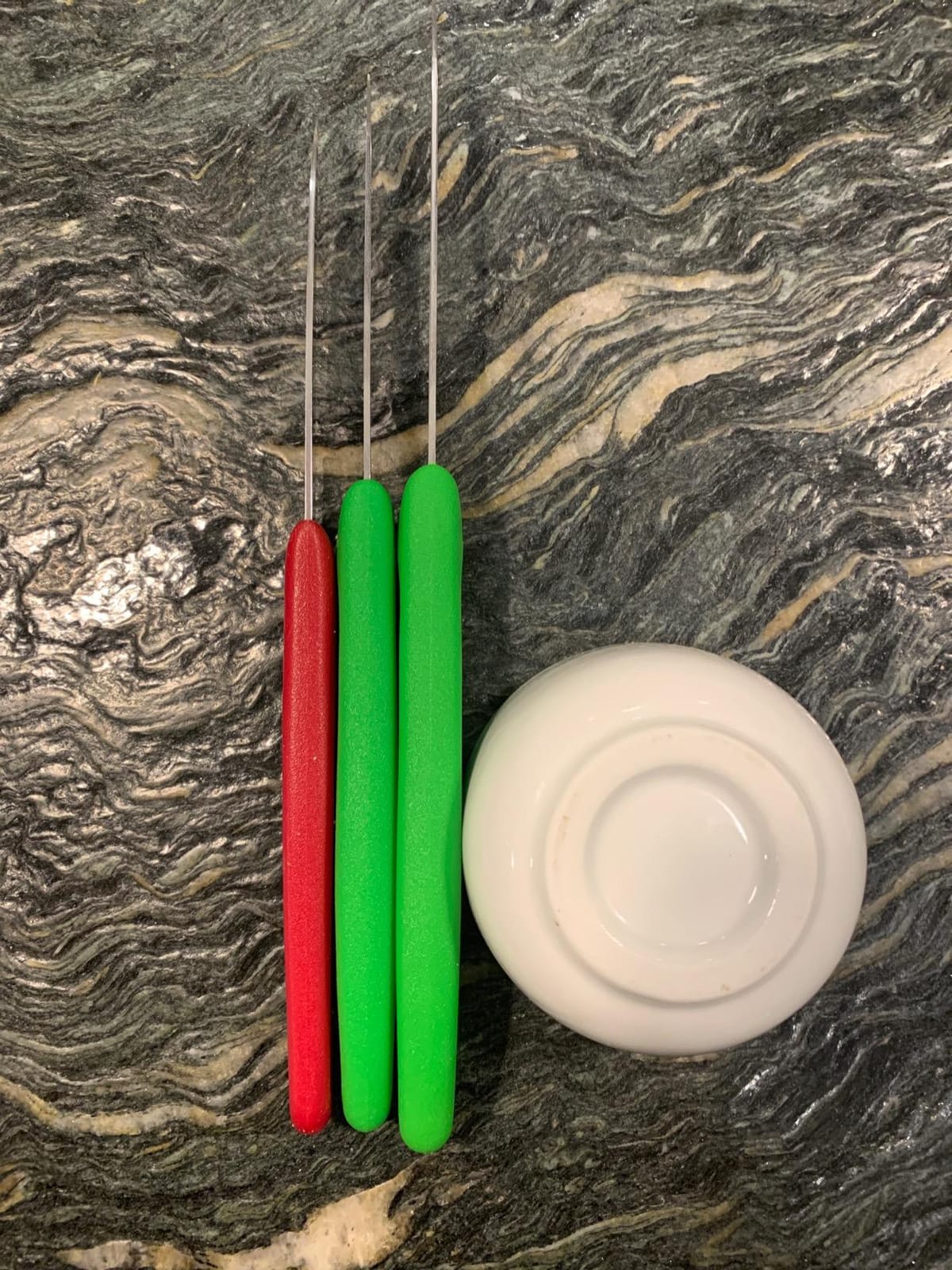
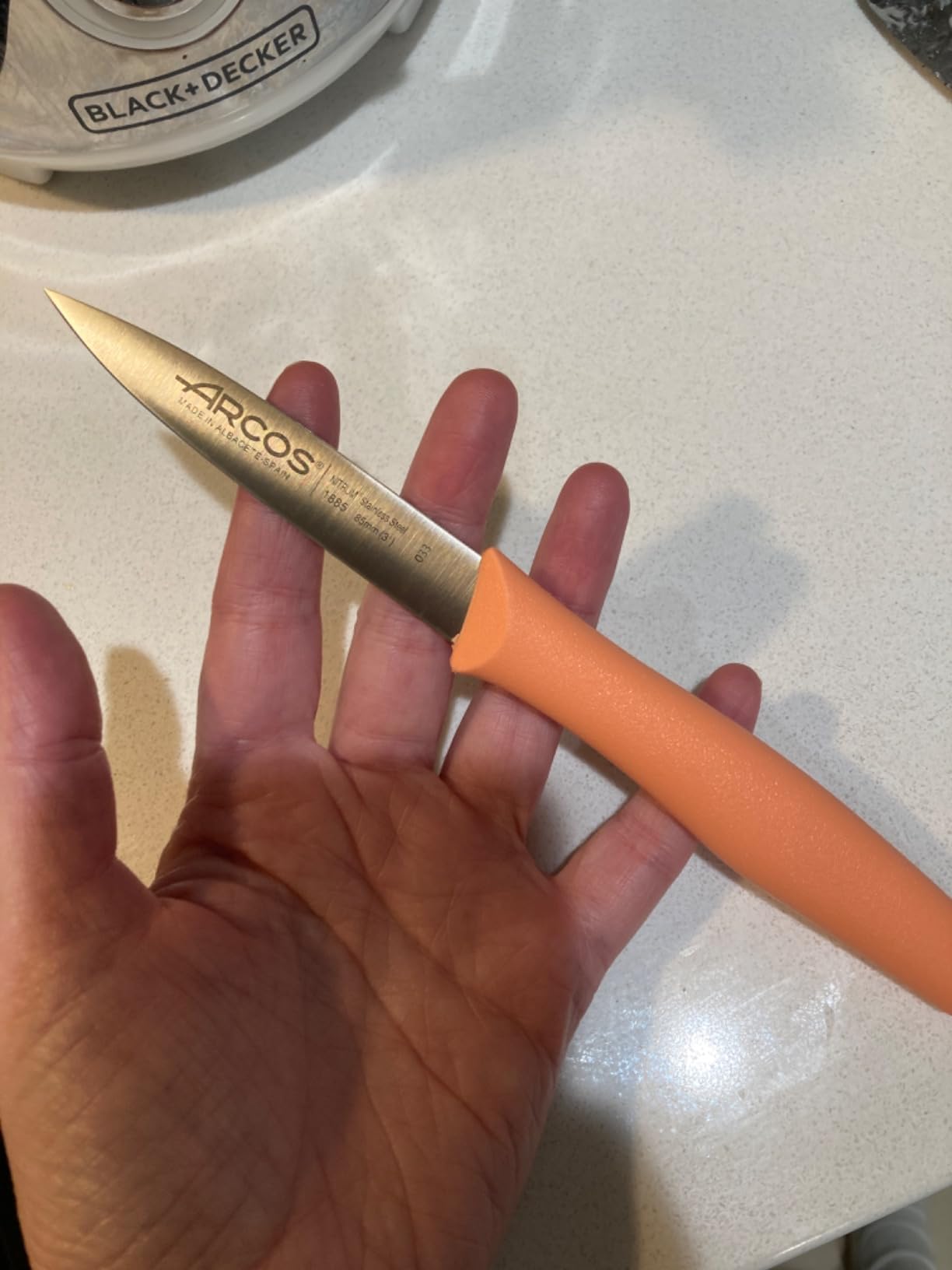
Colour coding sounds like a gimmick until you have three cooks or three tasks competing for one small knife. The practical win here is separation: one knife lives on the board for produce, one stays in your hand for peeling, and the third handles raw meat or garlic without cross-contaminating your fruit prep.
Each knife has a 3.5 inch blade on a light 80 g body, which is a workable weight for peeling potatoes and apples. The Arcos Nitrum stainless steel is a mid-tier hardness that resists rust well and takes a sharpen without drama, and the polypropylene handles fit the hand without pinching.
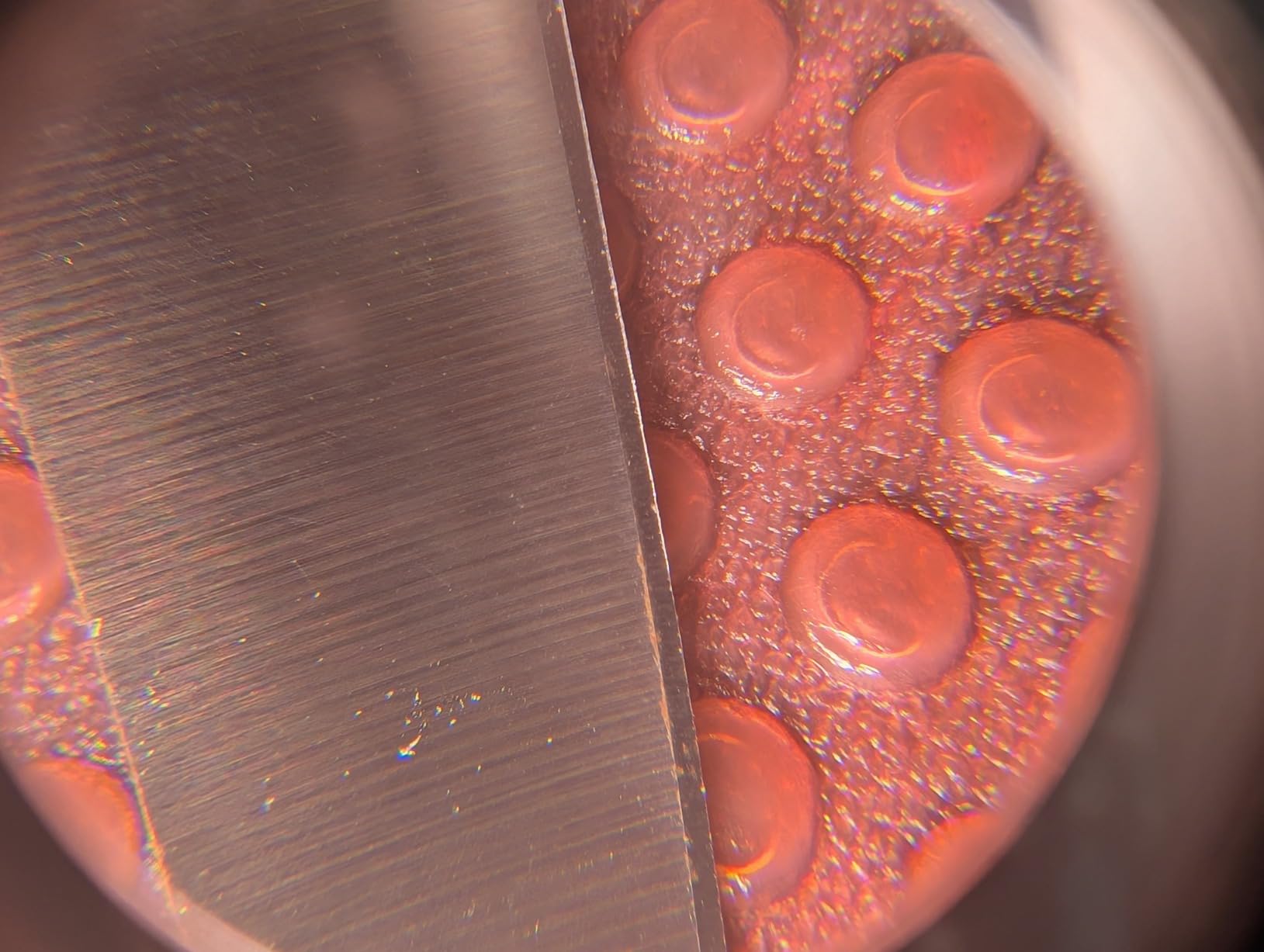
All three are dishwasher safe, and the set carries a 10 year manufacturer warranty. For a shared kitchen, a holiday cottage, or a house where produce prep is constant, buying three at once costs less attention than maintaining one knife and losing it in a drawer.
Reviewers are split on the colours, and that is worth being upfront about. The orange, yellow, and blue handles are genuinely useful for identification but visually loud, and they will not blend into a neutral kitchen. Functionally the handles are the best part: reviewers repeatedly praise how well they resist slipping.
What you should know before you buy it
This is stamped construction at a budget price point, which is where the sharpening habit comes from. Owners report needing to touch the edge up sooner than they would on a forged blade, and the same is true of the Victorinox in the same situation. A few minutes with a honing rod every few weeks keeps all three working well.
These are full-size paring blades rather than specialty 2.5 inch models, so you get versatility in exchange for a little of the fine control a short blade offers.
Who should skip it
Skip it if you only need one knife and do not want to choose a colour, or if you want something you can sharpen to a razor and keep for a decade. This is a working set, not a keepsake. It also runs large in a drawer, so plan on a small knife roll or block insert rather than tossing it loose.
4. Mercer Culinary Millennia 3.5 Inch: Best for Grip Strength and Small Hands
Mercer Culinary M22003 Millennia Black Handle, 3.5-Inch, Paring Knife
- Thick one-piece steel blade that handles tough jobs better than thin flexible blades
- Textured finger points give a large secure grip and reduce hand fatigue
- Lightest blade in the roundup at 1.6 ounces
- Good for garnishes seeding deveining and trimming
- Manufacturer advises hand washing only
- Edge fades sooner than premium forged blades
- Thicker blade is less suited to paper-thin peeling than a slim blade
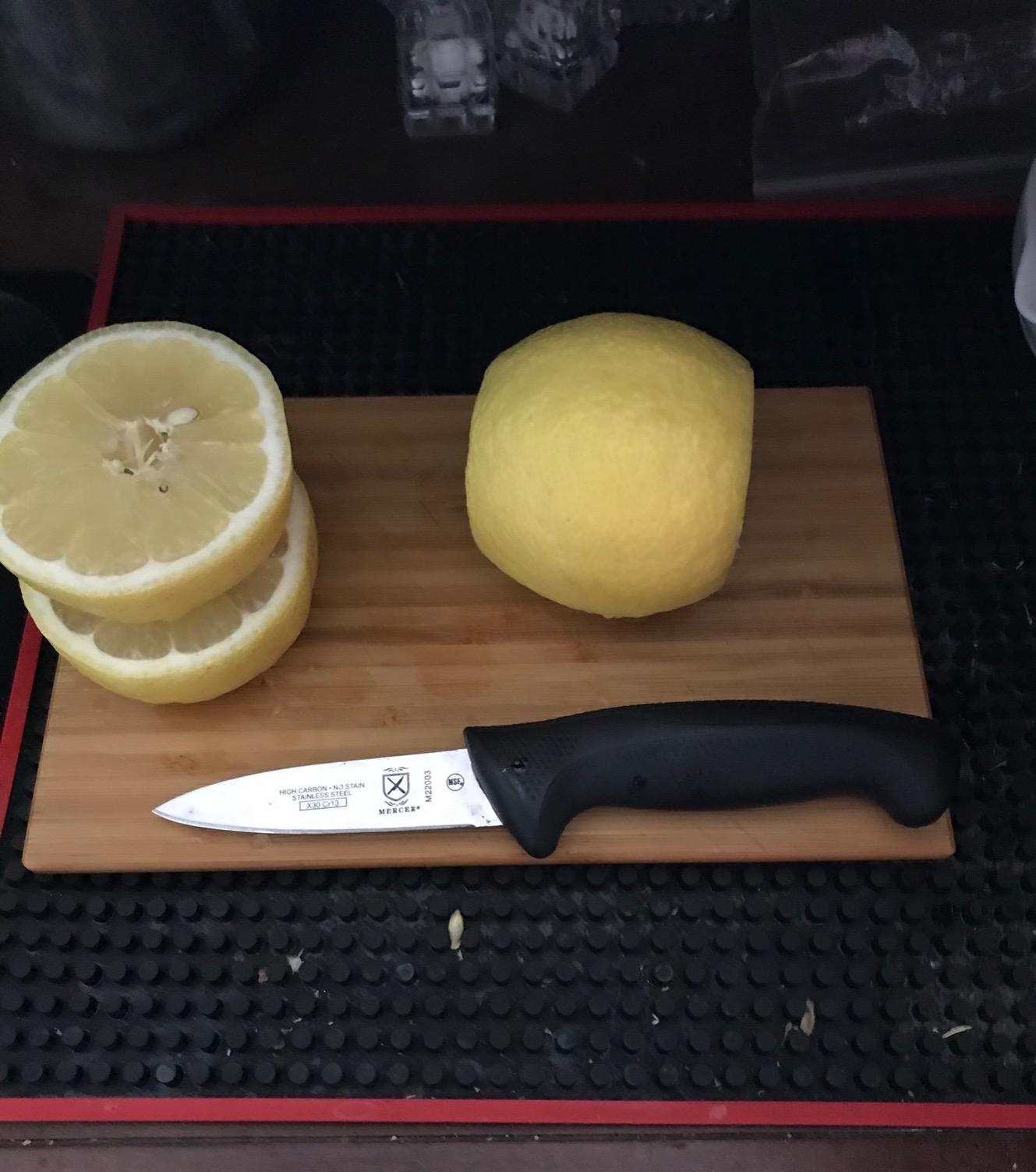
At 1.6 ounces this is the lightest knife in the roundup, and that is the whole argument for it. Lower mass means less fatigue over a long session and a tip that tracks where you point it, which is exactly what close-in peeling work demands. Reviewers with limited grip strength single out the handle as the reason they keep reaching for it.
The textured finger points are the detail that matters most here. Instead of a smooth oval, the handle has raised texture where your fingers sit, so a wet or oily hand still finds purchase. That is not a gimmick on this model, and it is why it comes up so often in conversations about arthritic hands and small grips.
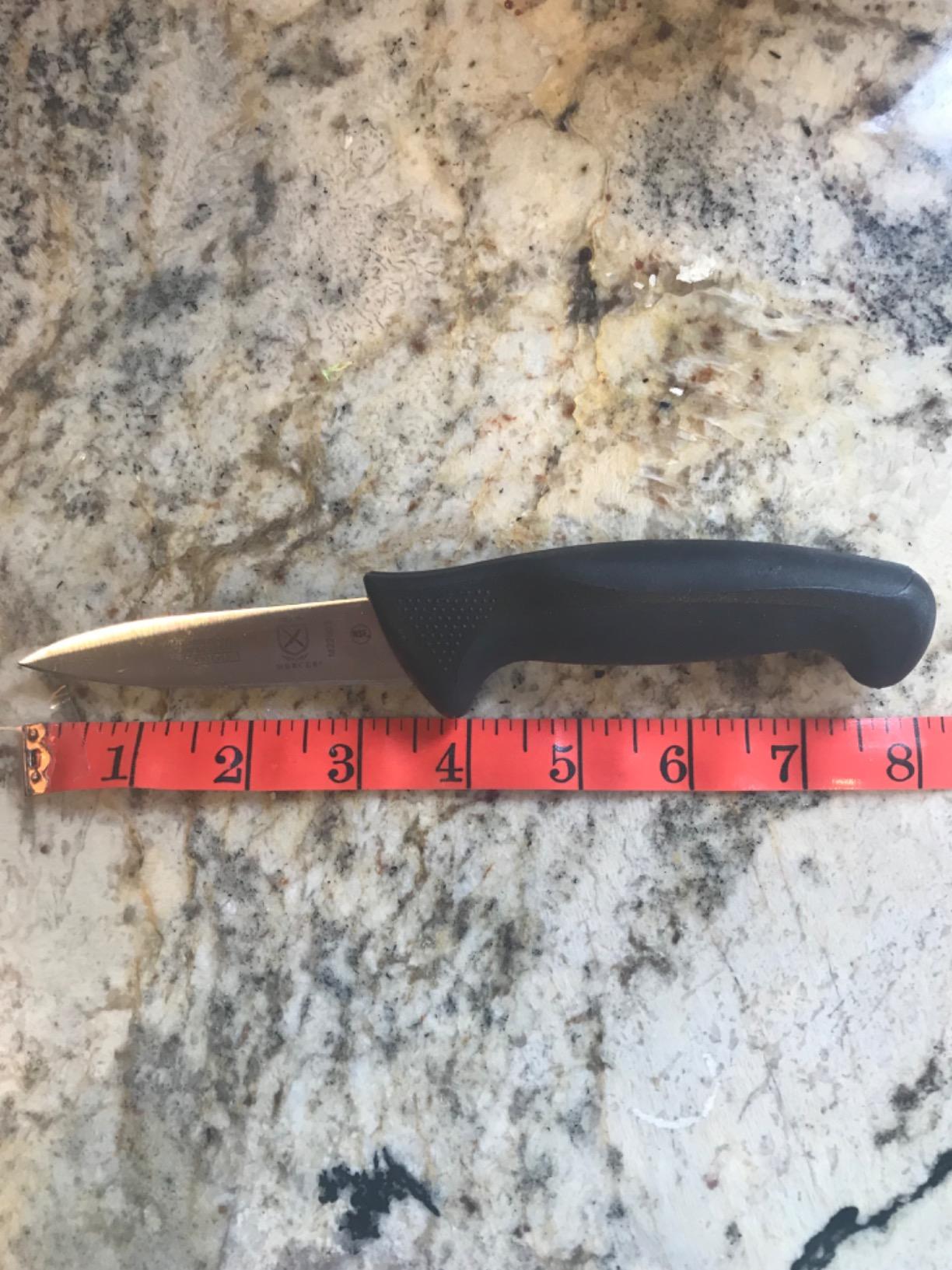
The one-piece high-carbon Japanese steel is sturdy and easy to maintain. The trade-off is that the blade is thicker and more robust than a slim flexible paring, which helps with carrots and tough stems but shows up if you want translucent, paper-thin apple peel. Most owners are happy trading finesse for strength.
Hand wash only, and the edge does need more frequent attention than a forged blade. Owners describe it as dependable and comfortable rather than exotic, which is fair praise for a knife that gets used daily and never disappoints.
What you should know before you buy it
This is a stamped construction at 1.6 ounces, and both of those facts are the design. If you are used to a heavier European-style paring, this will feel almost flimsy at first, and that impression fades once you get used to how lightly it moves.
Because the handle is broad and textured rather than slim, it suits small and medium hands particularly well. If you have a very large grip, a slim European handle will feel more natural, though the texture still helps. The single-piece steel also means fewer seams for water to sit in when you wash it.
Who should skip it
Skip it if edge retention is your top priority, since the high-carbon steel here gives up sharpness faster than the forged picks on this list. Skip it if you want dishwasher convenience, and skip it if your priority is the thinnest possible peel on soft fruit, because the sturdy blade thickness works against that. For grip strength and low hand fatigue, though, nothing else here compares.
5. Cuisinart Triple Rivet 3.5 Inch: Best for Drawer Storage
Cuisinart C77TR-3PR Triple Rivet Collection 3.5″ Paring Knife, Black
- Extra-wide forged bolster gives real finger clearance when peeling
- Full-tang blade with three rivets is solidly built
- Includes a protective blade guard for drawer storage
- Backed by a lifetime warranty
- Heaviest practical option here at 3.52 ounces
- Stainless edge dulls quickly under heavy use and needs regular sharpening
- Plain functional styling
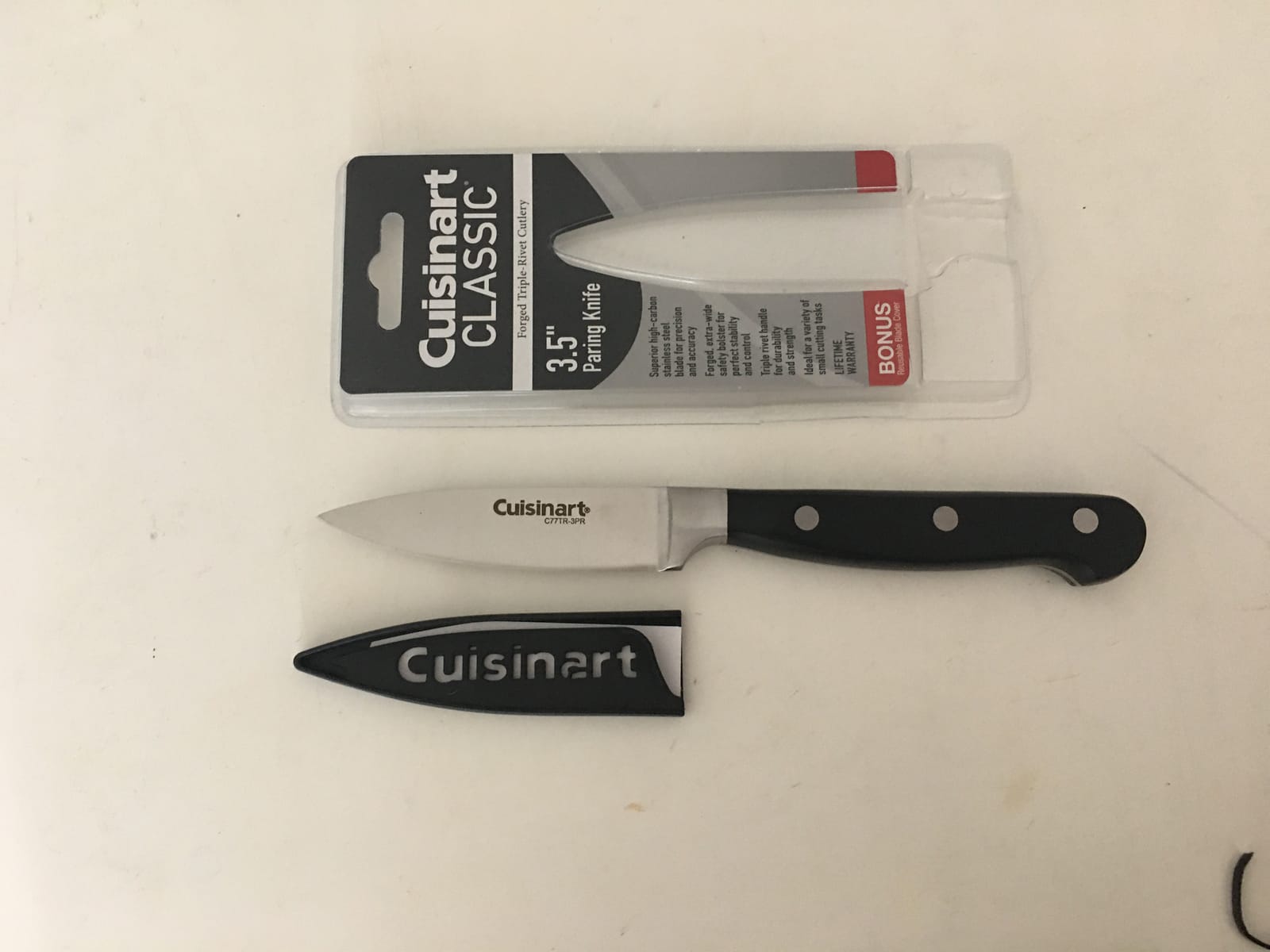
The included blade guard is the reason this knife is on this list, and it is a bigger deal than it sounds. A 3.5 inch paring knife in a mixed cutlery drawer gets knocked against forks and spatulas, which chips the tip and dulls the edge. A guard solves that in one motion, and this is one of only three picks here that come with one.
The extra-wide forged bolster is the second reason. It gives a real shelf of steel between your gripping hand and the edge, which is the single most useful safety feature on a paring knife because your index finger sits right there during rotation. Full tang and three steel rivets make this a knife that will survive a drop.
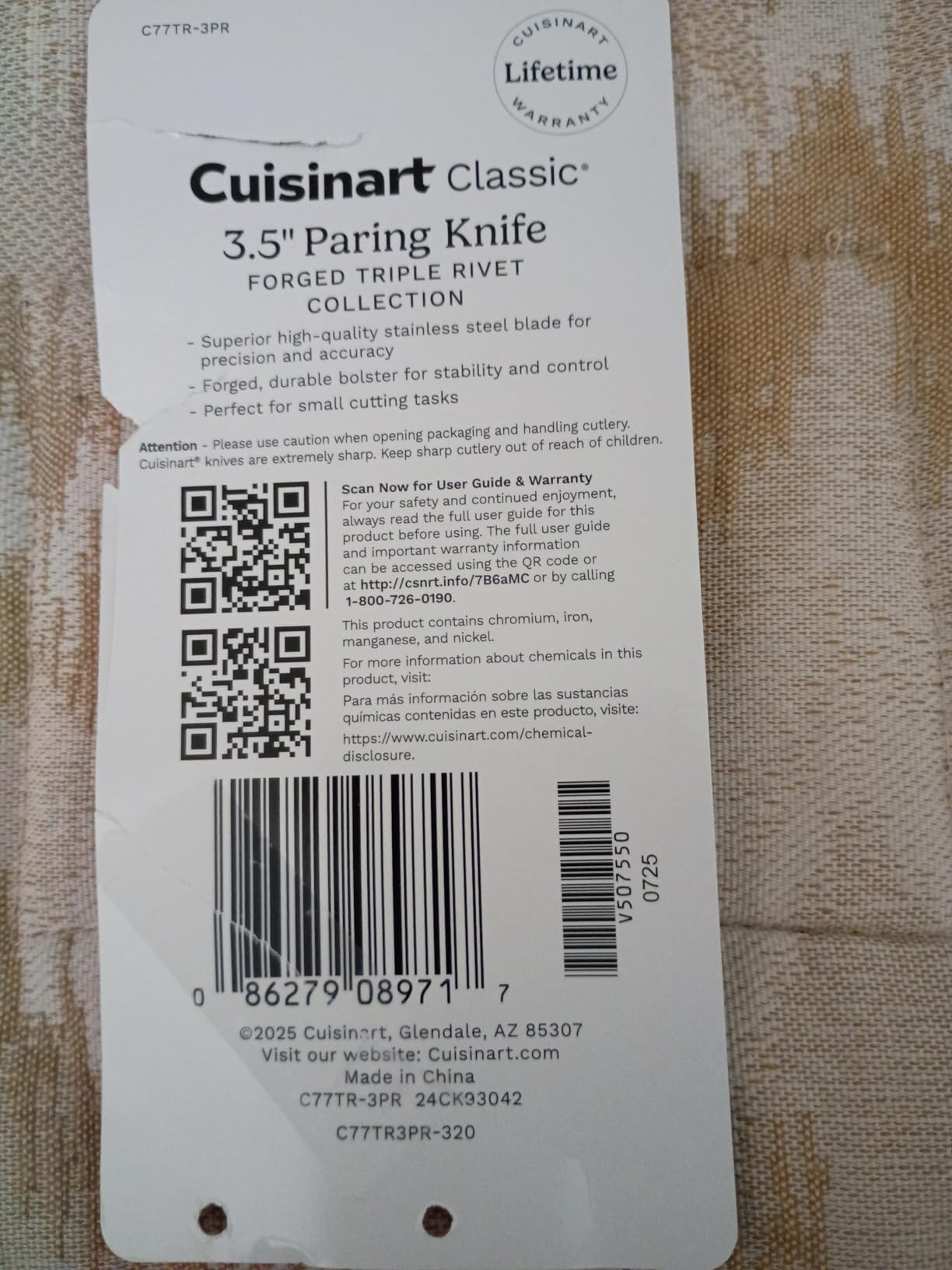
It is not a light knife at 3.52 ounces, and that shows when you get to fine detail. For peeling potatoes, apples, and carrots, the weight is helpful and makes the blade feel planted. For strawberry hulling or micro-garnishes, you will feel every ounce of it.
Owners treat it as a no-fuss workhorse. The stainless edge is straightforward to sharpen on a stone or a hone, and the lifetime warranty covers defects. Styling is deliberately plain, which is fine for a tool that lives in a drawer.
What you should know before you buy it
At 3.5 inches with a 6.6 inch overall length, this is on the larger side of the paring category, and that pairs well with the weight. The blade is high-carbon stainless in a full-tang, riveted build, which is the most durable construction style in this roundup short of a one-piece steel handle.
Watch the weight if you have limited hand strength. For continuous close-in work, the lighter Mercer and Victorinox options are easier to hold for long stretches, and reviewers commonly note this knife feels heavier than expected for its size.
Who should skip it
Skip it if you want a featherweight blade, if you want fine tip work, or if edge retention matters more than durability, since stainless loses its edge quickly under heavy use and wants regular honing. A small number of owners also report the factory edge arriving dull, so plan a touch-up on day one. If you want something that will not get destroyed by a busy drawer, this is the safest buy here.
6. Zyliss 3.5 Inch Wheat Straw Paring Knife: Best for Dishwasher and Low-Impact Living
- German stainless steel blade is sharp out of the box and holds an edge
- Non-slip wheat straw composite handle that works in any hand
- Includes a blade guard for drawer storage or travel
- Dishwasher safe without rusting or tarnishing
- The blade guard takes care to insert and can nick the edge if rushed
- Factory edge is machine finished and not the sharpest in the drawer
- Stamped construction dents more easily than a forged blade
At 32 g this sits in the middle of the weight range, light enough for detail work and substantial enough that it does not skate around. The German stainless steel blade is sharp out of the box and reviewers report years of use without sharpening, which is an unusually good result for a stamped blade at this level.
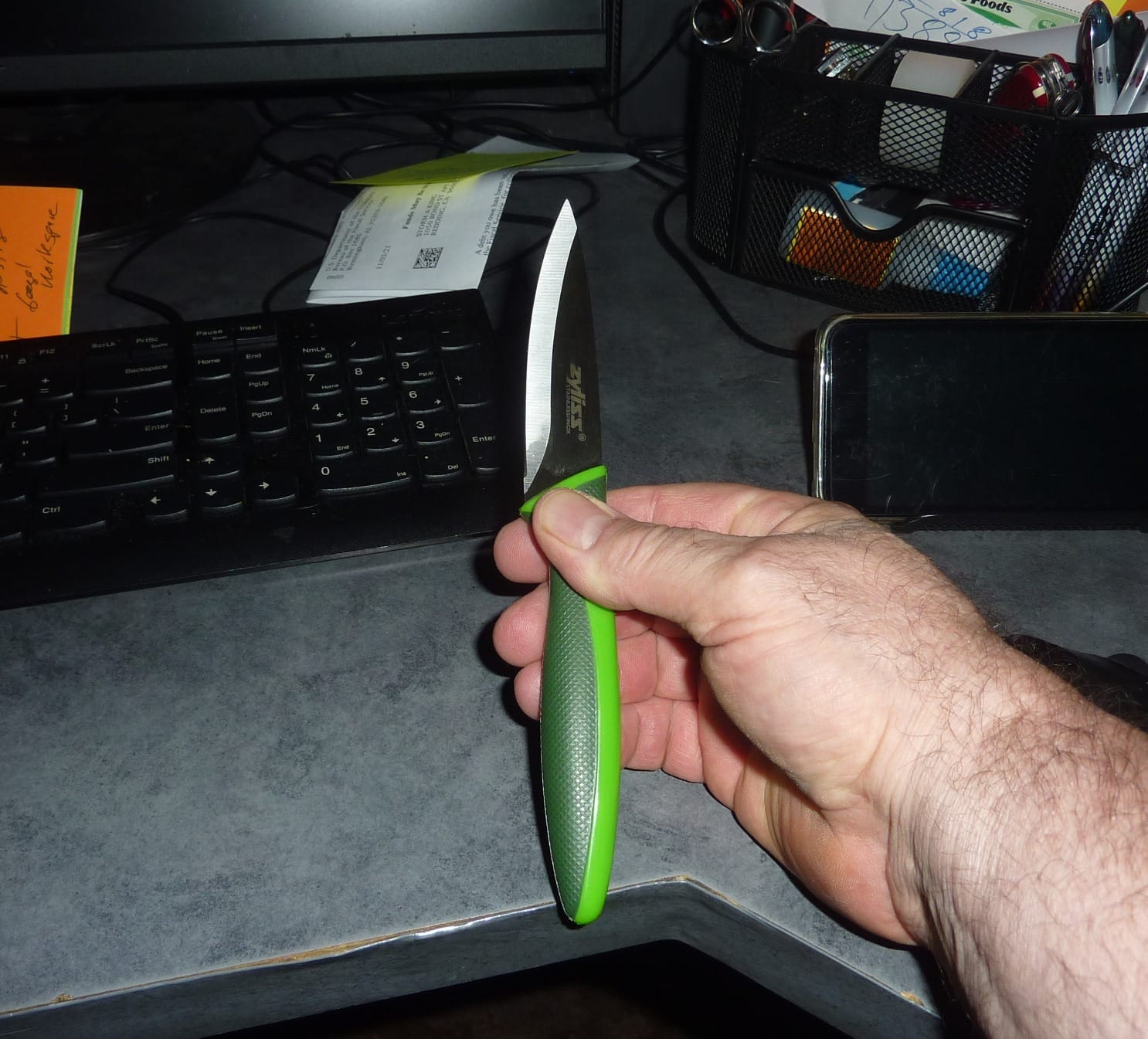
The handle is the distinguishing feature. It is made with 20 percent wheat straw composite rather than virgin plastic, and it is genuinely non-slip with a soft, slightly rubbery feel. Reviewers who have used it through wet prep sessions report the grip holds up where smoother polymer handles fail.
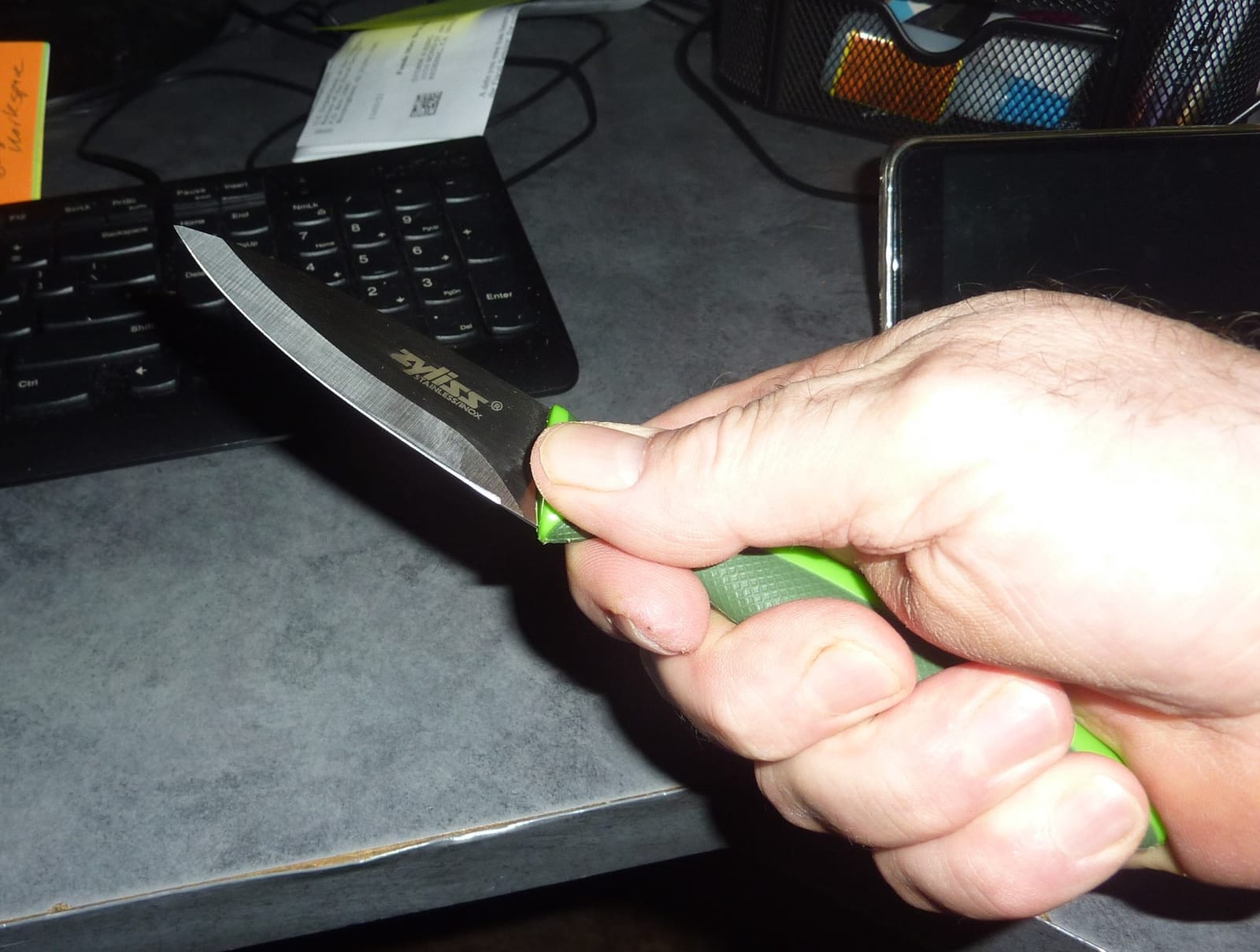
The two-tone gray finish is also practical. In a crowded drawer it is easy to spot, which matters for a small knife that is otherwise easy to lose. It is dishwasher safe, carries a 5 year Zyliss warranty, and will not rust or tarnish in the cycle.
The most common complaint is the blade guard, which several owners say takes real care to insert. The guard itself works well once seated, and it is a useful thing to have. Just do not rush it with a blade exposed.
What you should know before you buy it
Overall length is 7.48 inches with a 3.5 inch blade, right in the middle of the sweet spot for peeling. The stamped wheat straw construction makes this lighter in the hand than a forged steel model and gives up some rigidity, so treat it as a general prep knife rather than a prying tool.
Dishwasher safety plus a blade guard is a combination you rarely see together at this level. If you are the cook who washes everything immediately and does not own a honing rod, this is a low-friction daily driver that will not punish you.
Who should skip it
Skip it if you want a factory edge sharper than a typical machine finish, since some owners note it is not the sharpest blade in their drawer out of the box. Skip it if you want a forged blade that resists dents, and be cautious with the guard insertion if you are new to small knives. Otherwise the combination of grip, weight, and dishwasher tolerance makes this an easy recommendation.
7. HOSHANHO 3.75 Inch Fruit Knife: Best for Firm Produce
HOSHANHO 3.75 inch Paring Knife, Ultra Sharp Japanese Kitchen Fruit Knife
- Japanese steel hardened to 60 HRC resists abrasion and chipping
- Cold nitriding treatment improves wear and chip resistance
- Hand-sharpened 15 degree edge gives very clean precise cuts
- Pakkawood handle is warm and comfortable
- Wood handle needs hand washing and occasional oiling
- Heaviest pick here at 3.84 ounces so it suits medium rather than large hands
This is the hardest-working blade in the roundup, and that is by design. The Japanese 10Cr15CoMoV steel is hardened to 60 HRC and then vacuum cold nitrided, which is a surface treatment that hardens the outer layer against chipping. On a firm peach, a waxy new potato, or a hard winter squash skin, that toughness is the difference between a clean cut and a skipped one.
The 3.75 inch blade is the longest here, and owners like the way it handles fruit held in the palm. The hand-sharpened 15 degree edge produces clean, precise cuts with very little drag, and it is noticeably crisper on soft produce than a machine finish.
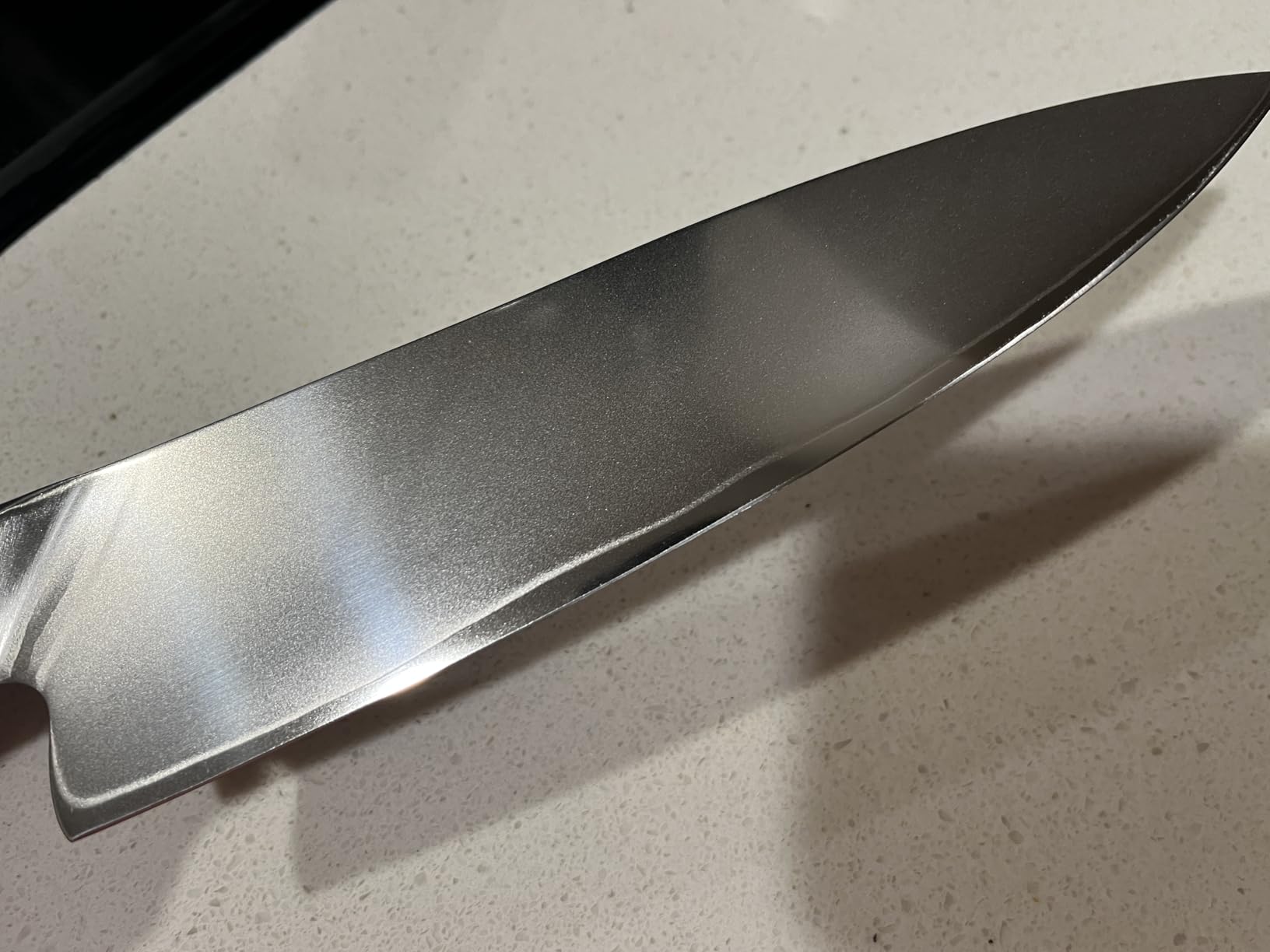
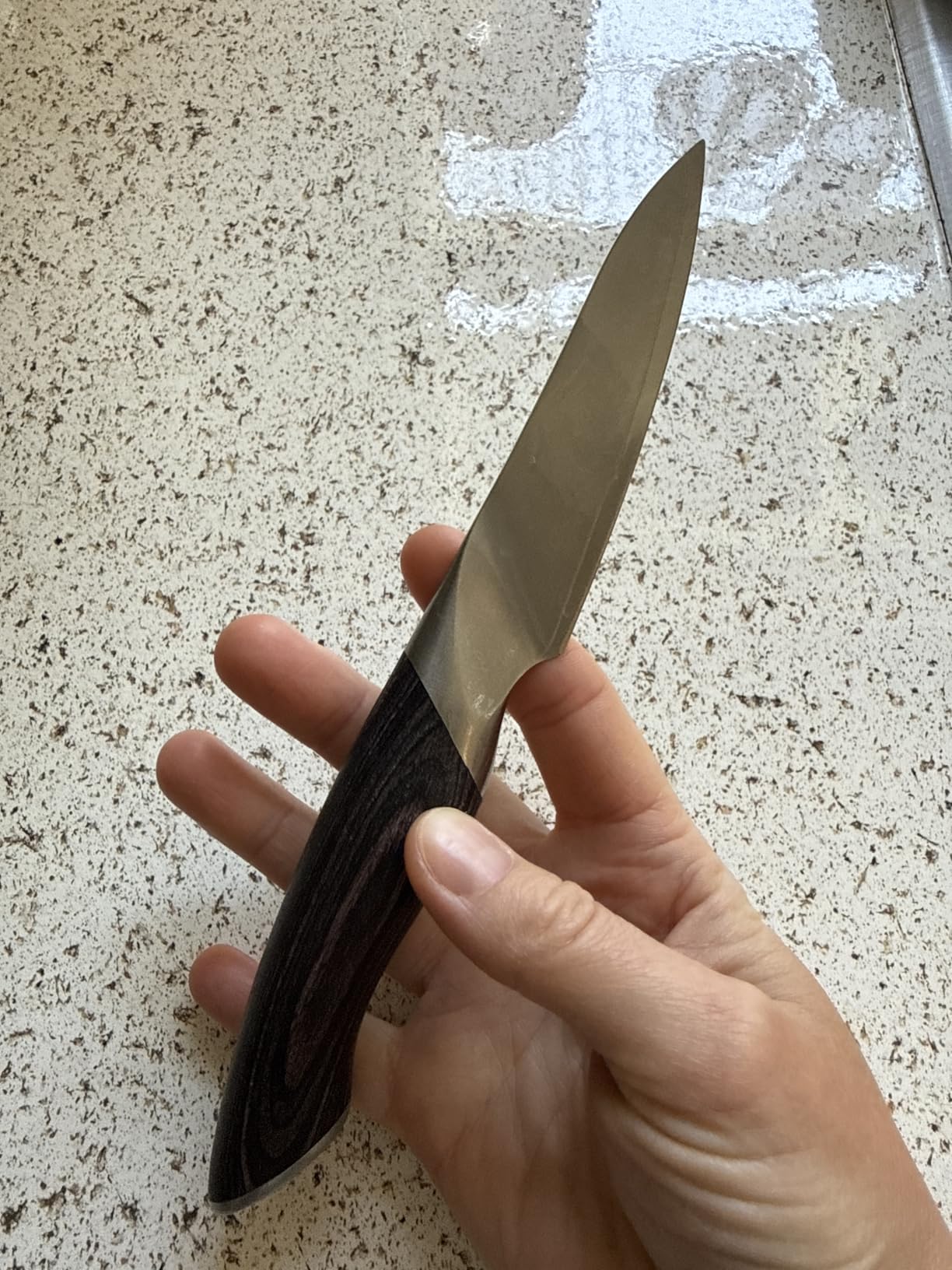
At 3.84 ounces this is the heaviest pick on the list, and we want to be straight about the consequence. Above roughly 3 ounces a paring knife starts to feel planted rather than nimble, and fine work like strawberry hulling or a decorative twist is noticeably more effort. For hard produce, that weight helps. For delicate work, it works against you.
The pakkawood handle is the other trade-off. It looks handsome and feels warm, but wood needs hand washing and periodic oiling, and it will not tolerate a dishwasher. Owners consistently mention the care requirement as the main recurring caution.
What you should know before you buy it
Overall length is 8.2 inches with a 3.75 inch blade, so it is a full-size knife rather than a compact in-hand tool. Rated for home kitchens, restaurants, and cafes, it is built for volume prep. If you only peel two apples a week, this is more knife than you need.
Medium hands will find the pakkawood grip comfortable. Owners note it suits medium rather than large hands because of the blade mass, so if you have a bigger grip or weaker hands, look at the lighter Mercer or Victorinox models instead. A single 15 degree edge angle is also straightforward to maintain on a stone or a ceramic hone.
Who should skip it
Skip it if you want a lightweight blade for delicate work, if you need dishwasher safety, or if you peel mostly soft produce where a super-hard edge is overkill. Do not skip it if you handle firm, hard-skinned fruit or vegetables regularly, because the hardened and nitrided steel here handles that better than anything else in this roundup.
8. PAUDIN 3.5 Inch Forged Paring Knife: Best for Both Hands
- Forged 5Cr15MoV steel with conical grind and ice tempering for edge retention
- Ergonomic pakkawood handle works for left- and right-handed users
- Good close-in control for peeling coring and detail work
- Includes a blade guard and presentation box
- The waved blade pattern is etched rather than real Damascus
- Hand wash only because of the pakkawood handle
- Edge is finer than some buyers expect and needs occasional sharpening
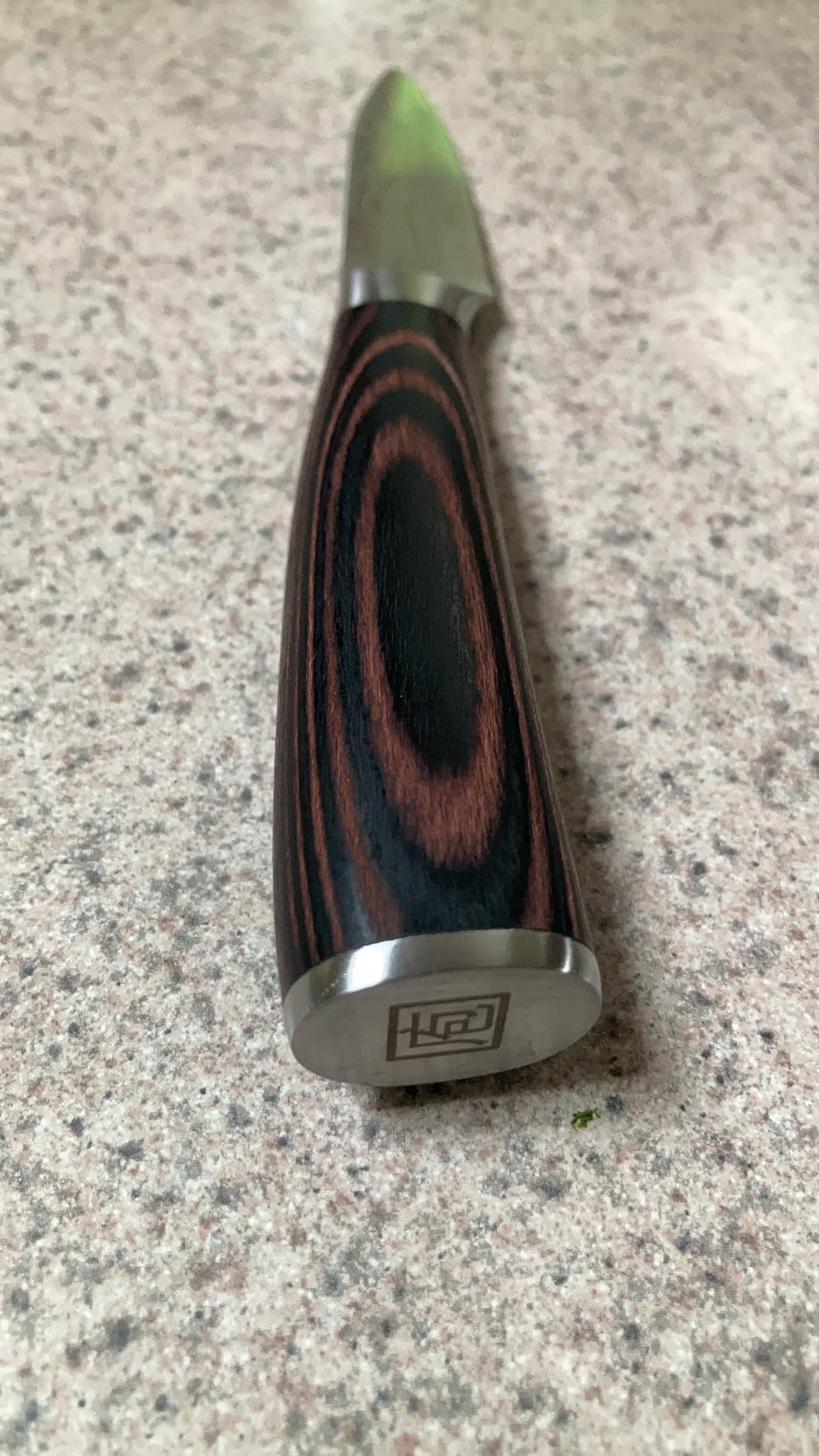
This is the pick for left-handed cooks, and the reason is specific. The handle is symmetric rather than contoured to one hand, so the grip does not fight you when you reverse your hold for a different cut. Many users describe the pakkawood as non-slip and comfortable, and reviewers with arthritis single it out for being kind to weak grips.
The steel is forged 5Cr15MoV high carbon stainless with a conical grind and ice tempering. That combination is a good middle ground: hard enough to hold a working edge through a session, tough enough not to chip on a potato, and easy to restore on a honing rod.
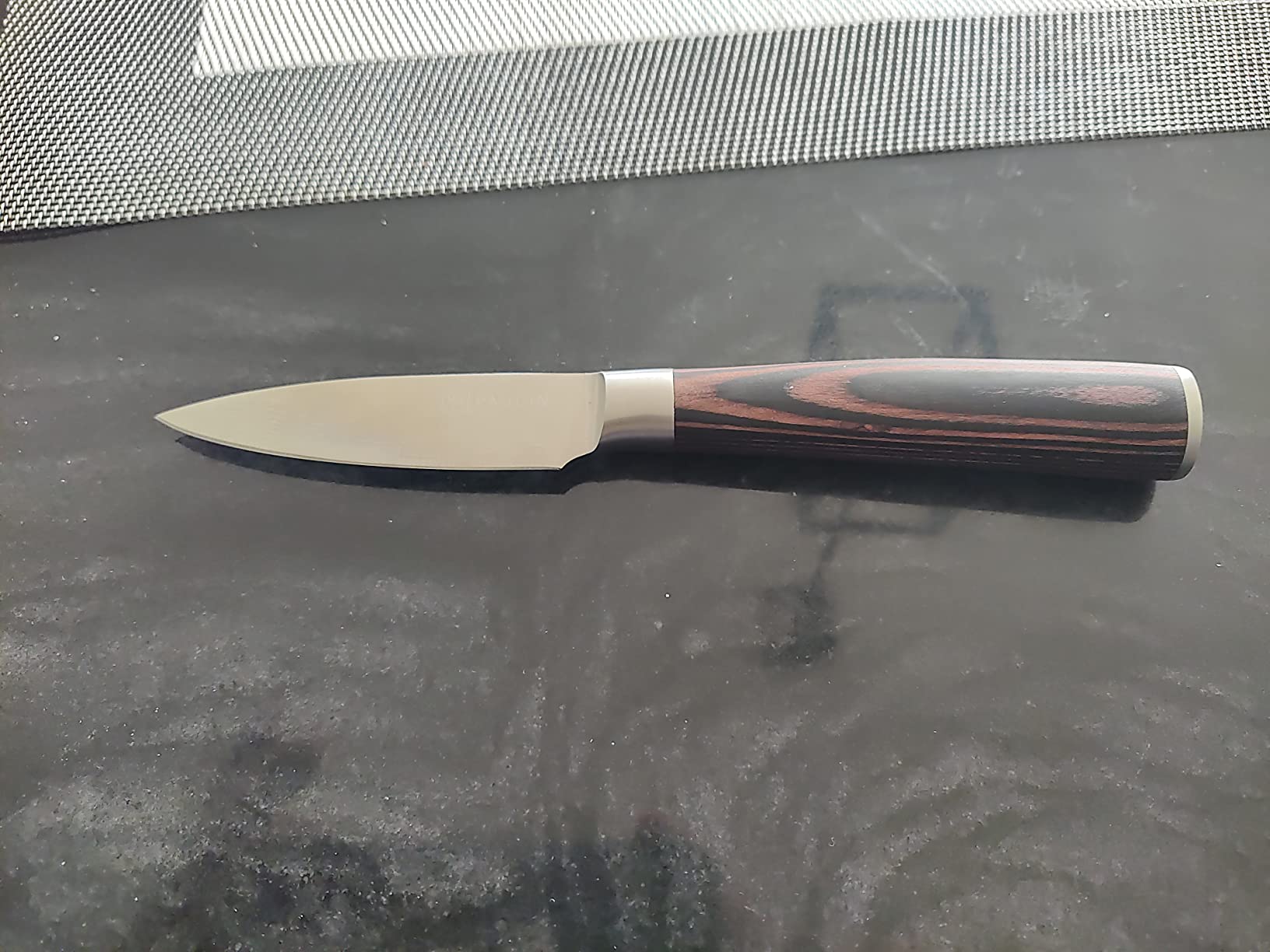
At 80 g it is on the heavier side for a paring knife, and that gives it a planted feel on hard produce. For very fine detail work the mass is noticeable, but the control for routine peeling and coring is very good, and reviewers report the blade arrives sharp and stays that way with routine stropping.
Be clear about one thing that comes up constantly: the wavy etched pattern is decorative, not true Damascus steel. It looks layered and it is not. That matters only if you were expecting a premium laminated steel, and the actual cutting performance does not depend on it.
What you should know before you buy it
Overall length is 7.87 inches with a 3.5 inch blade, a normal paring footprint. The included blade guard is a real benefit given how small this knife is, and it arrives in a presentation box that also makes it an easy gift.
The lifetime guarantee covers defects in material and workmanship, which is a real commitment from the manufacturer. Plan on hand washing because of the pakkawood, and on an occasional sharpening session, because the edge is finer than some buyers expect from a forged blade.
Who should skip it
Skip it if you are left-handed and want a fully contoured handle, because a symmetric grip is good but a purpose-built one is better. Skip it if you need dishwasher safety or the lightest possible blade. And skip it if you are drawn in specifically by the Damascus look, since the pattern is etched. If you peel with either hand and want a good-looking knife with a sheath, this is a strong choice.
9. RADA W202 Peeling Paring Knife: Best for Pure Peeling
- Purpose-built peeling knife with a short 2.5 inch blade that is easy to control
- Hollow-ground T420 high-carbon stainless holds a sharp edge
- Non-serrated edge glides cleanly through soft fruit and vegetable skins
- Dishwasher safe and made in the USA with a lifetime guarantee
- 2.5 inch blade is shorter than most paring knives and limits larger cuts
- Slim handle may feel small in larger hands
- Shorter blade means more re-positions when peeling large produce
This is the only knife in the roundup designed for one job, and that is exactly why it earns the highest average rating in the group. A 2.5 inch hollow-ground T420 high-carbon stainless blade is short enough to be completely controlled in the hand and hollow-ground thin enough to glide through soft skin with almost no downward force.
On an apple or a soft peach the results are excellent, with a peel thin enough to see light through. On a potato it is competent rather than impressive, because the short blade means you re-position your grip more often as the vegetable narrows.
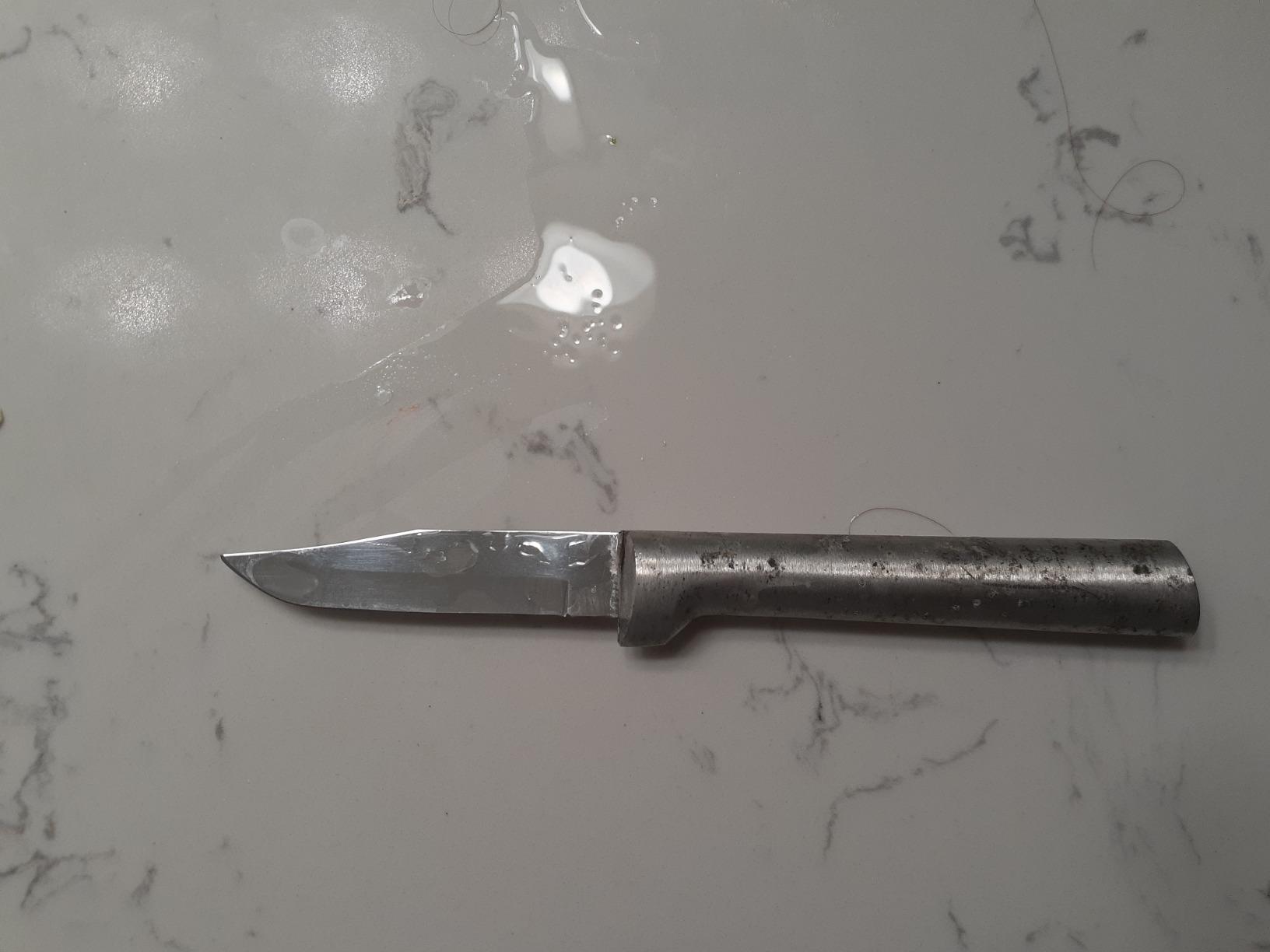
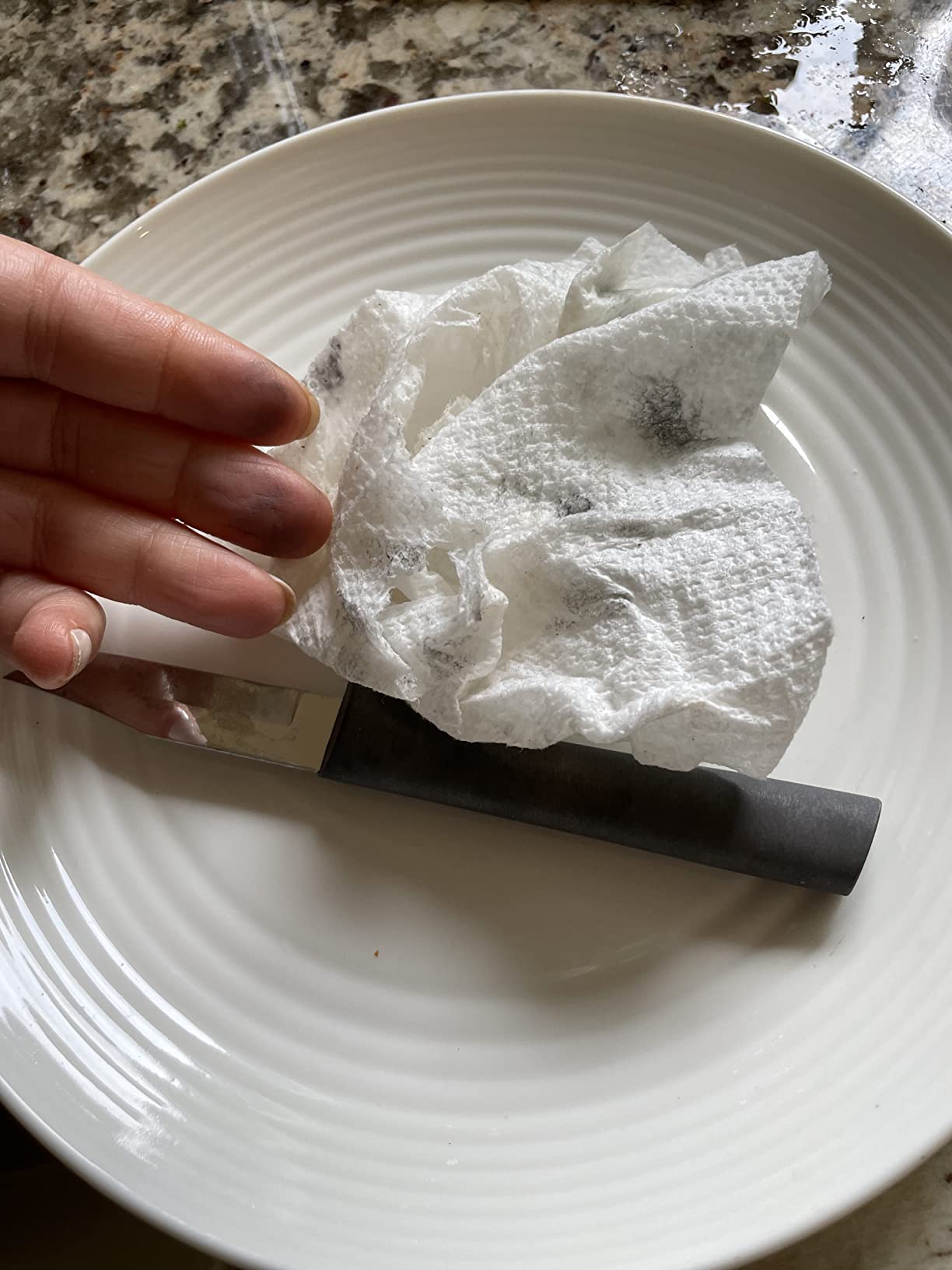
It carries the highest average rating here at 4.8, and reviewers consistently call it an ideal dedicated peeling tool. The resin handle is dishwasher safe and the whole thing is made in the United States with a lifetime guarantee on materials and workmanship.
The trade-offs all come from the size. A 2.5 inch blade is well under the 3 to 3.5 inch sweet spot, so it is not a general-purpose paring knife, and the slim handle can feel small in larger hands. The hollow edge is a specialist shape rather than a workhorse one.
What you should know before you buy it
Overall length is 6.13 inches, which makes it the most compact knife on this list and easy to control one-handed. If you also want to core, deveining, trim, or cut garnish, you will be reaching for a second knife, and several users pair it with a longer paring for exactly that reason.
Weight is not published for this model, so do not expect the same precision weight comparison you can make across the rest of this roundup. The stainless steel and resin construction is simple and cleanable, which is why it is dishwasher safe.
Who should skip it
Skip it if you want a single all-purpose paring knife, since this is a specialist. Skip it if you have large hands, because both the slim handle and the short blade work against that. And skip it for large, hard vegetables where a Y-peeler or a longer blade finishes faster. If peeling soft fruit is the task you care about most, nothing else here matches it.
10. Mercer Culinary Genesis 3.5 Inch: Best for Edge Retention
- Precision-forged German steel holds sharpness longer than cheaper stamped blades
- Taper-ground edge is efficient and easy to restore
- Well-balanced blade with a non-slip Santoprene handle
- Backed by a limited lifetime manufacturer warranty
- Handle is thicker and heavier than slim European-style paring knives
- Hand wash only
- Less thin and flexible than a dedicated 2.5 inch peeling knife
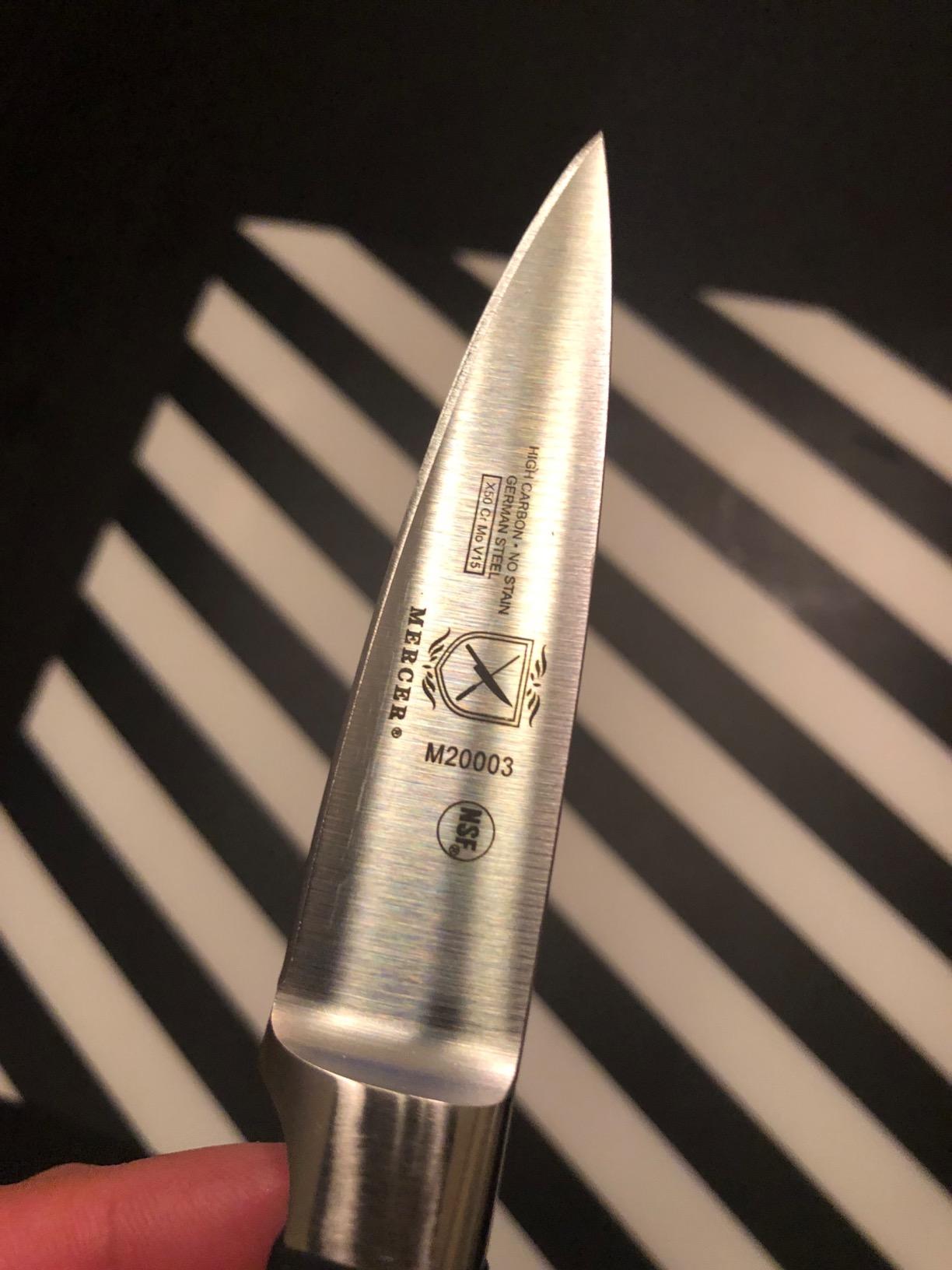
This is the pick if you care most about how long the edge lasts. Precision-forged high-carbon German steel with a taper-ground edge keeps a working edge far longer than stamped budget blades, and owners frequently compare it favourably to premium European and Japanese knives at a fraction of their cost.
The taper grind is worth understanding: it thins the blade from spine to edge, which reduces the resistance as you push through an apple skin. That is why it produces thin, even peel strips with very little sawing motion, and it is also why the edge is easy to restore at home on a stone or a hone.
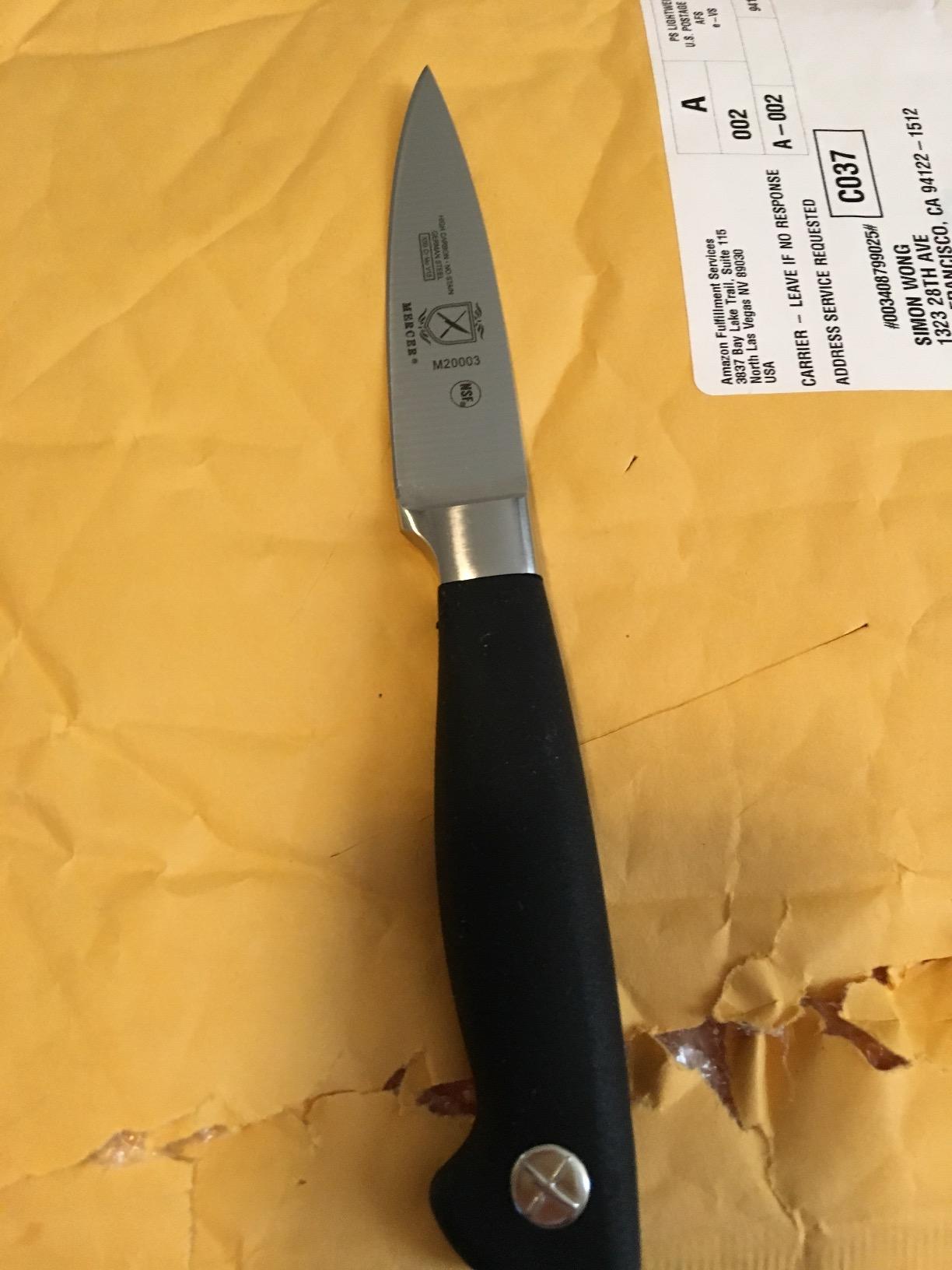
At 3.17 ounces the weight is moderate rather than heavy, and the blade feels balanced rather than planted. The full-tang Santoprene handle is non-slip and comfortable, though it is thicker than a slim European-style paring and takes a little getting used to, especially for small hands.
Hand wash only, and the warranty is a limited lifetime manufacturer warranty. Owners also note the handle sits bulkier than a Zwilling or Wusthof paring, which is the main thing you give up compared with those heritage brands.
What you should know before you buy it
This is a one-blade, 3.5 inch paring knife from the Mercer Genesis line, and the blade is the point. Forged German steel, a full tang, and a taper ground edge put it in the same performance class as knives several times its price, which is why it carries one of the two highest average ratings here.
If you want a second blade in a different size, our gyuto knife roundup covers the Japanese-style profile, and the caping knife guide covers another narrow blade built for trimming and shaping.
Who should skip it
Skip it if you have small hands and dislike chunky handles, since that is the most common complaint in reviews. Skip it if you want dishwasher convenience. And skip it if your priority is the thinnest possible peel, because a 2.5 inch specialist is thinner. If edge retention and value for money are what you are optimising for, this is the one to buy.
How to Peel with a Paring Knife
This is the part no roundup covers, and it matters more than any steel designation. You can own the best blade on this list and still produce thick, wasteful peel strips if your grip and rotation are wrong. Five steps fix that.
1. Hold the produce in your non-knife hand, not on the board. Cup the apple or potato in your palm with your thumb pressed into one end to stop it turning. A paring knife is an in-hand tool; working it against a board is how people hurt themselves.
2. Take a pinch grip, not a fist. Pinch the blade between your thumb and the pad of your index finger with your middle finger supporting the spine. This is the only grip that gives you the fine tip control close-in peeling requires.
3. Let the blade do the work and turn the produce instead. The mistake almost everyone makes is pushing the knife forward. Rotate the apple against a nearly stationary edge and the blade follows the curve naturally, taking off a thinner, more even strip with far less effort.
4. Keep your knuckles rounded and slightly curled. Your index finger should be tucked into a loose fist, not extended past the bolster. On the Cuisinart’s extra-wide bolster you have real clearance to do this properly.
5. Lift away from the skin, not into it. On the last pass over a curve, rotate the blade so the spine rises slightly. That keeps the tip from catching the flesh near the stem and keeps your knuckles clear.
A dull blade is more dangerous than a sharp one, and this is the safety point we would underline above all others. A blunt edge needs more force, and more force means more slipping. If your paring knife needs pressure to cut a tomato, stop and sharpen it before using it on produce with a slippery skin.
How to Choose a Paring Knife for Peeling
Blade length: 3 to 3.5 inches is the sweet spot. Longer blades are harder to control in the hand and shorter than 2.5 inches make you re-grip constantly on anything larger than a strawberry. Most cooks land between 3.25 and 3.5 inches, and that is where eight of the ten knives here sit.
Weight: aim for about 2 ounces, and treat anything over 4 ounces as a specialist tool. This is the single most useful number in this category and the one most often ignored. A paring knife does in-hand work, not heavy board work, so steel marketing matters far less than how the knife feels while you rotate it. The lightest option here is 1.6 ounces and the heaviest is 3.84 ounces, and the difference is obvious after an hour of prep.
Forged or stamped: forged gives you edge retention, stamped gives you light weight and low maintenance. A forged blade is thicker at the spine, harder to make, and holds an edge noticeably longer. A stamped blade is pressed from sheet steel, which makes it lighter, cheaper, and easier to throw in a dishwasher. For most home cooks, stamped is the right trade. For anyone who sharpens, forged is worth the extra cost.
Steel: high-carbon stainless is the easy-care default, and it is enough. Every pick on this list is stainless of some kind, which means rust resistance and no immediate need to sharpen a new knife. Higher hardness ratings such as 60 HRC give better chip resistance on hard produce but reward less forgiving steels. A single 15 degree edge angle is simple to maintain on a stone or a ceramic hone.
Handle fit matters more than any of the above. Slim European-style handles suit smaller hands, broad textured handles suit larger hands and weaker grips, and symmetric handles work for left-handed cooks. This is the most common purchase regret in reviews, and it is invisible on a spec sheet. If you can, hold one before you commit.
Maintenance: dishwasher safe or hand wash only. Dishwasher safety is real convenience, but heat and detergent are the fastest way to dull a fine edge and strip a wood handle. Hand-wash picks include the imarku, both Mercer models, the HOSHANHO, and the PAUDIN. Dishwasher-safe picks include the Victorinox, the Arcos set, and the Zyliss.
Storage: buy a guard or an insert. A paring knife is too small for a block, so it ends up loose in a drawer, where it gets dulled by contact and can slip out when you reach in. Three of the ten picks here include a blade guard, and if the one you want does not, a small knife roll or drawer insert solves it.
Care and Storage for Small Blades
Hand wash with warm soapy water, dry immediately, and store dry. A wet blade left in a closed sheath or drawer is the fastest route to a dull or spotted edge, and it is worth keeping a towel near the sink rather than relying on later.
Hone regularly and sharpen rarely. A honing rod realigns an edge that has rolled over, which is normal and does not remove metal. Actual sharpening removes metal, so do it a few times a year rather than weekly, on a whetstone or a ceramic hone.
Never put a good paring knife in a drawer loose. Use the included guard where there is one, or a small roll, and keep the blade away from forks and spatulas that will chew the tip.
Frequently Asked Questions
What knife is best for peeling?
A 3 to 3.5 inch paring knife with a plain, non-serrated edge is best for general peeling. The imarku 3.5 inch forged high-carbon stainless paring knife is our top all-round pick, and the Victorinox Swiss Classic 3.25 inch is the best value option. For soft fruit specifically, the short 2.5 inch RADA W202 is the specialist choice.
What is the difference between a paring knife and a vegetable peeler?
A vegetable peeler strips skin in one fast downward sweep and is faster on large, hard-skinned vegetables like carrots and potatoes. A paring knife is held in the hand and rotated against the produce, which gives you more control, removes less edible flesh, and works on items a peeler tears apart, such as soft berries and avocado. Most cooks use both.
What knife is best for peeling an apple?
Any of the 3.5 inch paring knives here will peel an apple well. The imarku 3.5 inch with its 9-15 degree per side edge takes a very thin strip in a single pass, and the Mercer Culinary Genesis 3.5 inch with its taper-ground German steel is a close second. Technique matters more than the blade: rotate the apple against a nearly stationary edge instead of pushing the knife forward.
What makes a high quality paring knife?
For peeling, weight and handle fit matter more than steel marketing. Aim for roughly 2 ounces, a 3 to 3.5 inch blade, and a handle that fits your hand. A plain edge beats a serrated edge for peeling, a wide bolster gives finger clearance, and a blade guard prevents the edge being destroyed in a drawer.
Should I buy a premium paring knife or an inexpensive one?
An inexpensive one is enough for almost everyone, because a paring knife does in-hand cutting rather than heavy board work, so very hard steel adds little in practice. A premium forged blade is worth it only if you sharpen your knives and want edge retention. Among the picks here, the Victorinox and Zyliss are the easy-care options and the imarku and Mercer Genesis are the forged ones worth sharpening.
The Verdict: Which Paring Knife Should You Buy?
Buy the imarku 3.5 inch forged paring knife. It is the best balance of edge sharpness, control, and durability we found for peeling, with a 2.88 ounce weight, a taper-ground forged blade, and a 9-15 degree edge that stays sharp through months of daily use. It is the single default recommendation among the best paring knives for peeling this year.
Buy the Victorinox Swiss Classic 3.25 inch if you want zero maintenance and the lightest handling. Buy the Zyliss 3.5 inch if dishwasher safety and a good grip matter most. Buy the RADA W202 if peeling soft fruit is the job you care about most, and buy the Mercer Culinary Genesis 3.5 inch if you sharpen your knives and want the edge to last.
Whichever you pick, spend the two minutes learning the rotation grip. It changes more about how thin your peel is than any of the specifications on this page.