
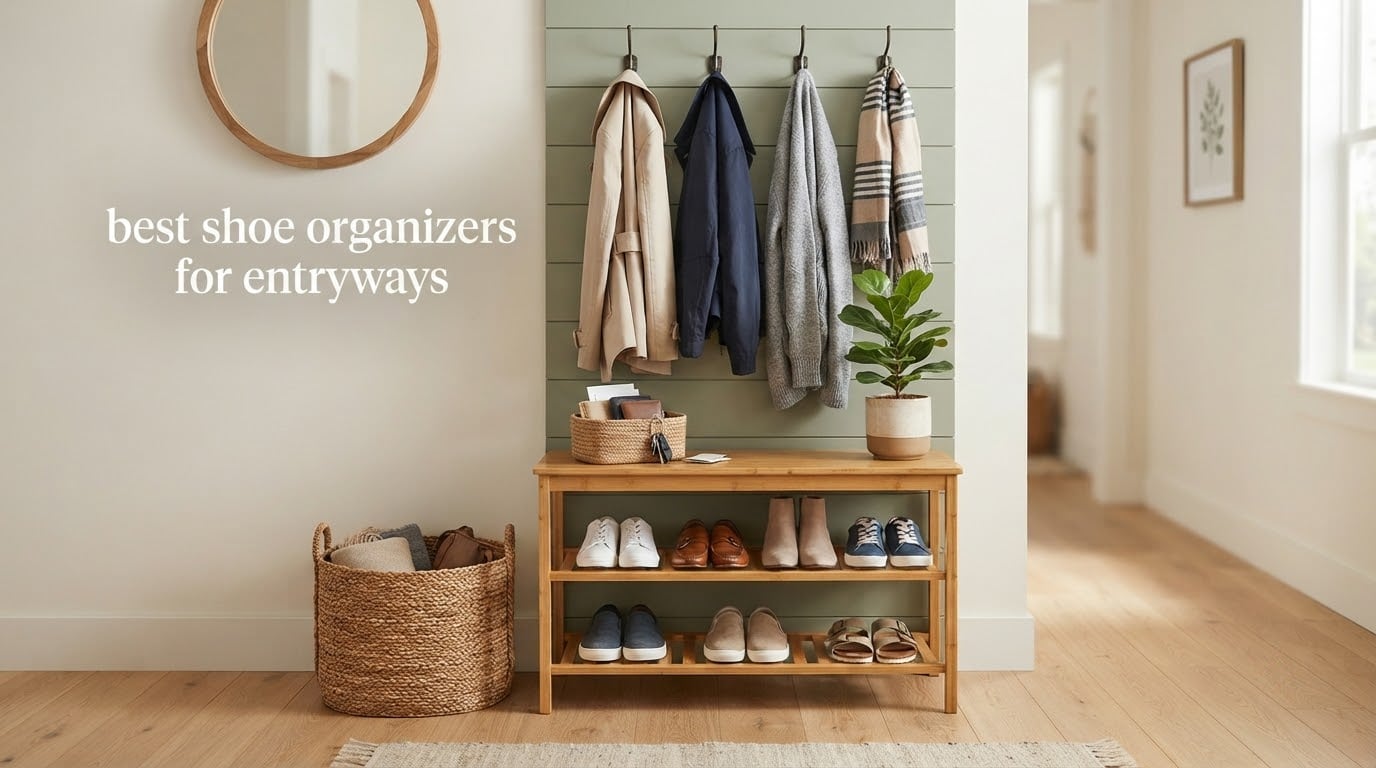
Every household I have ever organized has the same entryway problem: shoes spread across the floor and into the hallway because nobody planned where they should live. The best shoe organizers for entryways solve a narrow question, which is how do you give shoes one obvious home at the door without cutting the walkway in half. In 2026 I compared ten organizers across every format that fits a real doorway: slim benches, hall trees, open metal racks, flip-drawer cabinets and an over-the-door unit that needs no tools at all.
What follows is organized the way I actually shopped for this. Each pick lists its published dimensions in both inches and centimeters, its real pair capacity, and the specific household it suits. I also flag the units I would skip for a narrow hallway, because most shoe organizer roundups ignore the clearance problem and the shoe pile comes right back in a week.
One thing worth saying early: the organizer is only half the job. The half that actually sticks is deciding which pairs live at the door and which ones move to a closet or under-bed bin. I have a longer take on that in our roundup of shoe racks for entryways, and if you are leaning toward a closed cabinet I have covered those separately too.
Table of Contents
Top 3 Picks for the Best Shoe Organizers for Entryways in 2026
Three picks earned a place above all the others after I weighed review volume, published dimensions and how each one behaves in a real doorway. The bamboo bench won because it stores shoes, gives kids a seat and stays under 12 inches deep, and it carried the largest review base in the group by a wide margin.
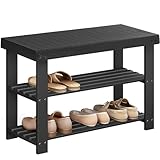
SONGMICS Bamboo Bench
- 3 tiers
- 6 pairs or more
- 17.8 in seat height
- 286 lb top load
- 11.3 in deep

VASAGLE Hall Tree
- 4-in-1 design
- 9 removable hooks
- hanging rod
- 198 lb bench load
- anti-tip kit

HOOBRO 5-Tier Rack
- 16-20 pairs
- tilting and removable mesh shelves
- 29.5 in wide
- 31.8 in tall
All 10 Entryway Shoe Organizers Side by Side in 2026
Every organizer below holds shoes off the floor, but they solve very different problems. Compare depth first, because depth is what decides whether a hallway still works after the furniture goes in.
| Product | Specifications | Action |
|---|---|---|
| SONGMICS 3-Tier Bamboo Bench |
|
Check Latest Price |
 VASAGLE 15-Cubby Cushion Bench VASAGLE 15-Cubby Cushion Bench |
|
Check Latest Price |
| VASAGLE 4-in-1 Hall Tree |
|
Check Latest Price |
 KEETDY 3-Tier Wire Rack KEETDY 3-Tier Wire Rack |
|
Check Latest Price |
| HOOBRO 5-Tier Mesh Rack |
|
Check Latest Price |
 BORNOON 3 Flip-Drawer Cabinet BORNOON 3 Flip-Drawer Cabinet |
|
Check Latest Price |
 UVIAHOMI Over-the-Door Organizer UVIAHOMI Over-the-Door Organizer |
|
Check Latest Price |
 QIVOMIX Walnut Flip-Drawer Cabinet QIVOMIX Walnut Flip-Drawer Cabinet |
|
Check Latest Price |
 SNTD Expandable 2-Tier Rack SNTD Expandable 2-Tier Rack |
|
Check Latest Price |
 HOOBRO 3-Tier Mesh Bench HOOBRO 3-Tier Mesh Bench |
|
Check Latest Price |
A quick note on what this roundup measured and what it did not. I worked from published manufacturer dimensions and specifications, cross-checked them against what buyers report back after living with the unit, and read the full review summaries for each product. I did not lab-test load limits, and I did not test any of these units against wet boots long-term. Where a number comes from the maker rather than my own measurement, I say so.
1. SONGMICS 3-Tier Bamboo Shoe Bench Review
The SONGMICS 3-Tier Bamboo Shoe Bench is the best shoe organizer for entryways overall because it stays 11.3 inches deep, doubles as seating, and carries more owner feedback than anything else in this roundup.
SONGMICS Shoe Rack Bench, 3-Tier Bamboo Entryway Bench, 27.6 Inches Width
- Deepest daily-value option that also gives kids a seat to sit on
- 11.3 in depth keeps a hallway walkable
- bamboo top holds 286 lb and each shelf holds 22 lb
- light enough at 8.8 lb to move between rooms
- one of the most reviewed organizers in the group
- Occasional cracked or splintered shelves reported on arrival
- 27.6 in width reads smaller in person than the number suggests
- holds only about 6 pairs so overflow needs a second home
I set one of these in the narrowest hall in my house, against the wall opposite the front door, and it took about a quarter of the walkway out. That depth figure is the whole reason I keep recommending it: at just under 12 inches it sits deeper than a baseboard and shallower than most kitchen cabinets.
The three shelves are tiered rather than flat, which means shoes stand up and lean back instead of stacking on top of each other. Owners say two wide shelves hold at least six pairs, and the top panel doubles as a landing spot for keys, a wallet or a bag.
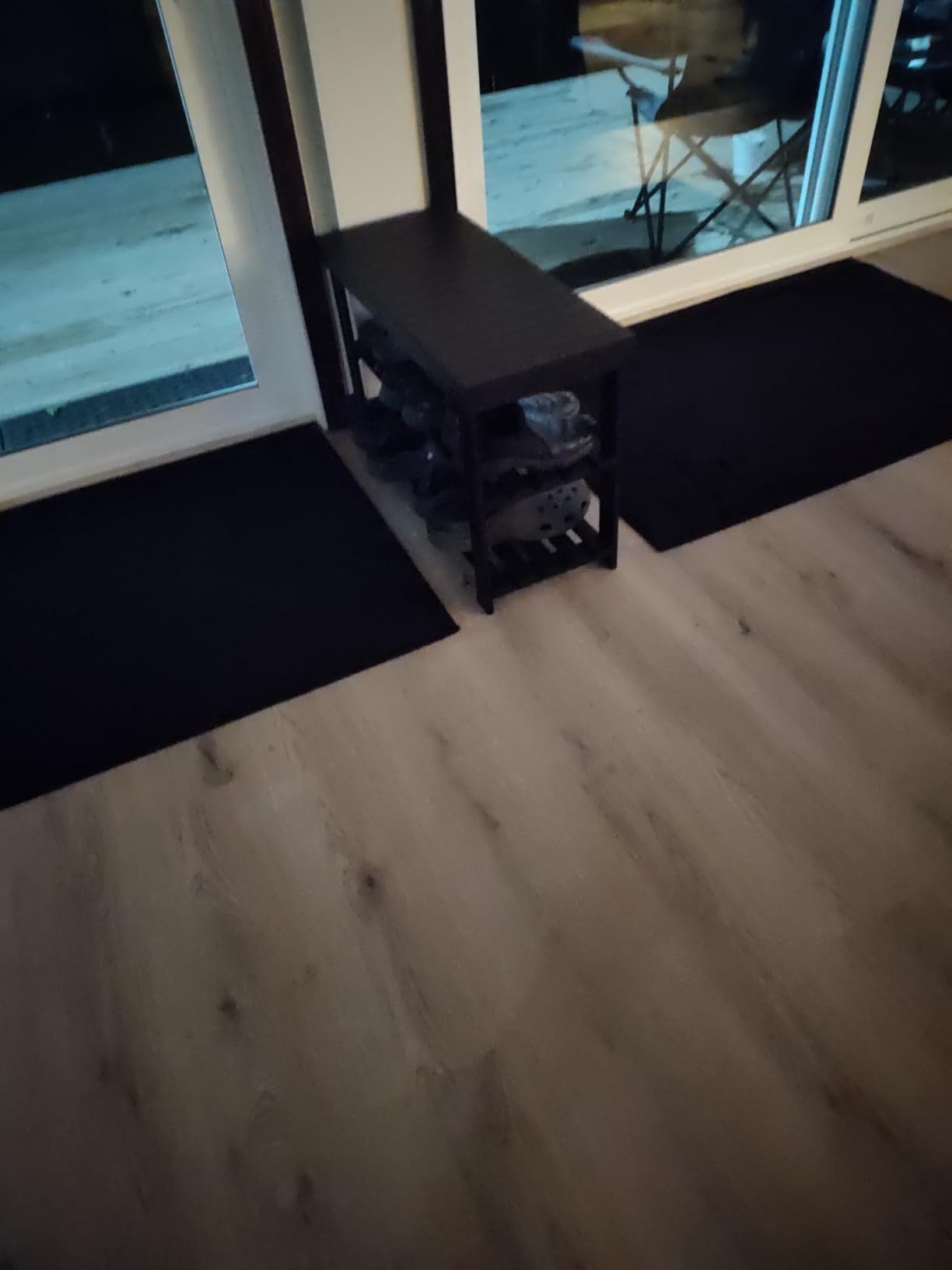
The bamboo frame is what makes it feel less like garage furniture. It takes a wipe with a dry cloth, and the seat height of 17.8 inches is close enough to adult height that people use it as a side table without feeling like they are sitting on a prop. Rated seating capacity is two.
Assembly was the easiest part of my week. The hardware came in the box, the instructions were clear, and the whole thing is light enough to carry with one hand while you find the right wall.
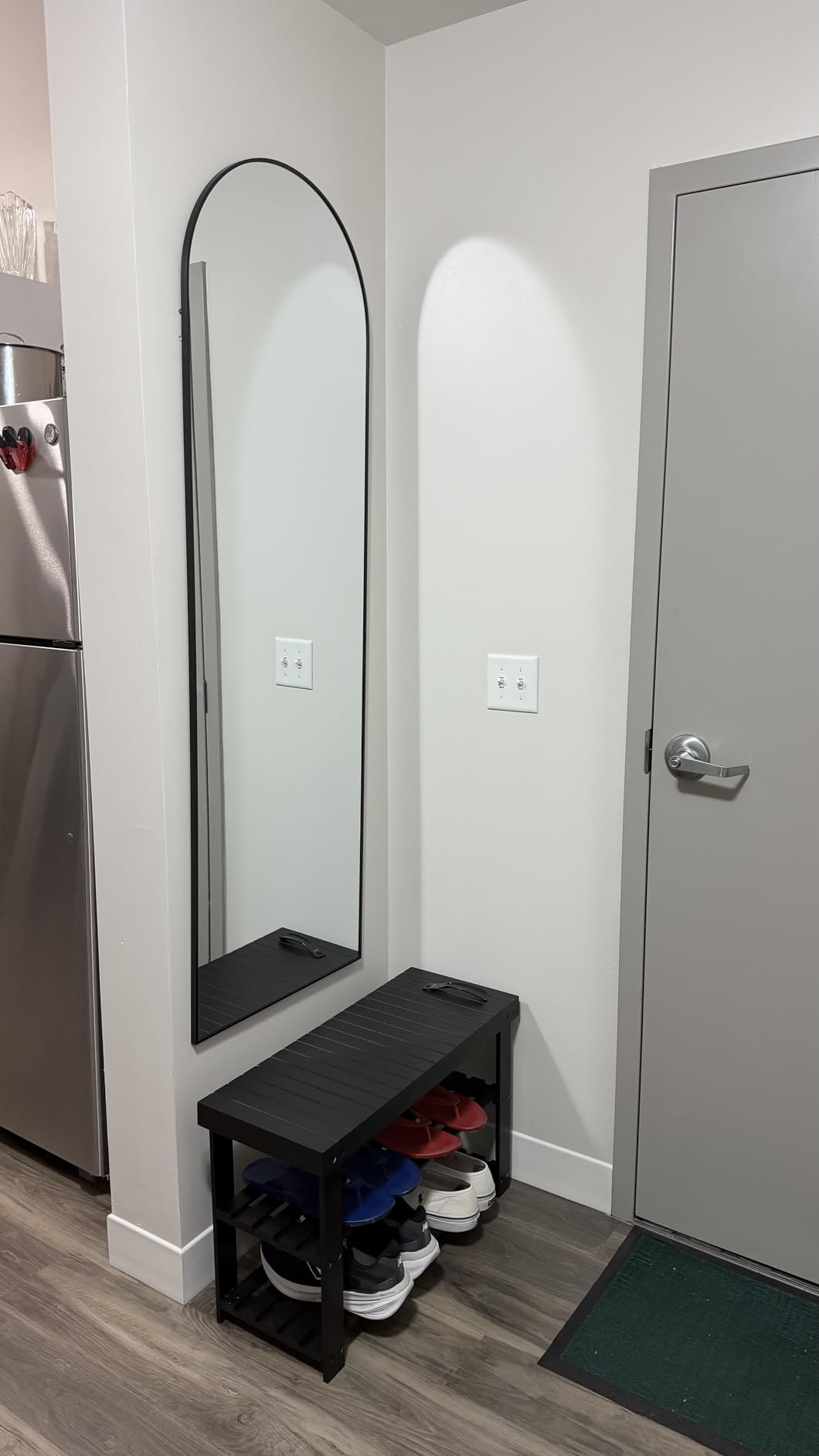
What the SONGMICS bench does well in a real entryway
It solves seating and storage in one footprint, and the reviewer base agrees. The most common theme in owner feedback is versatility: the same unit gets used as a side table, a plant stand, a bathroom shelf and a shoe bench over the course of a year.
The 286 lb top load also means it holds bins and baskets without creeping, which matters if you stack winter scarves on it in January. And at 8.8 pounds it is simple to reposition when the season changes.
Where the SONGMICS bamboo bench falls short
Six pairs is not a lot, so this works only if you follow the rule of keeping rarely worn shoes elsewhere. A minority of buyers also report receiving units with chipped or splintered shelves, so inspect the package before you assemble it.
It is also an open design. That means you see the clutter rather than hiding it, which some households like and others find harder to live with on the way out the door.
2. VASAGLE 15-Compartment Cushion Shoe Bench Review
The VASAGLE 15-Compartment Cushion Shoe Bench is the best entryway shoe bench for a family that has more shoes than floor space, because 15 separate cubbies sort pairs instead of piling them.
VASAGLE Shoe Bench with Cushion, 15 Compartments, 11.8 x 41.3 x 18.9 Inches
- Fifteen labelled cubbies keep pairs separated instead of heaped
- removable wipe-clean cushion with a zippered cover makes a real seat
- top rated to 300 lb with floor pads that protect hard floors
- neutral two-tone styling suits most decor
- cubby heights work for boots kept upright
- Cubbies run tight for men's high-tops and large boots
- cushion is thin for long sits
- one-person assembly takes about an hour and some pre-drilled holes can be missing
At 41.3 inches wide this is a two-person bench, not a single drop zone. In a standard entryway it needs a wall at least that wide, so I would only recommend it where you have one long blank wall or a mudroom rather than a hallway.
The compartment layout is the real argument. Fifteen cubbies means each family member gets a fixed spot, and a parent can see at a glance whose shoes are missing from the entryway. That is a small thing that changes household behavior more than any organizer I have tested.
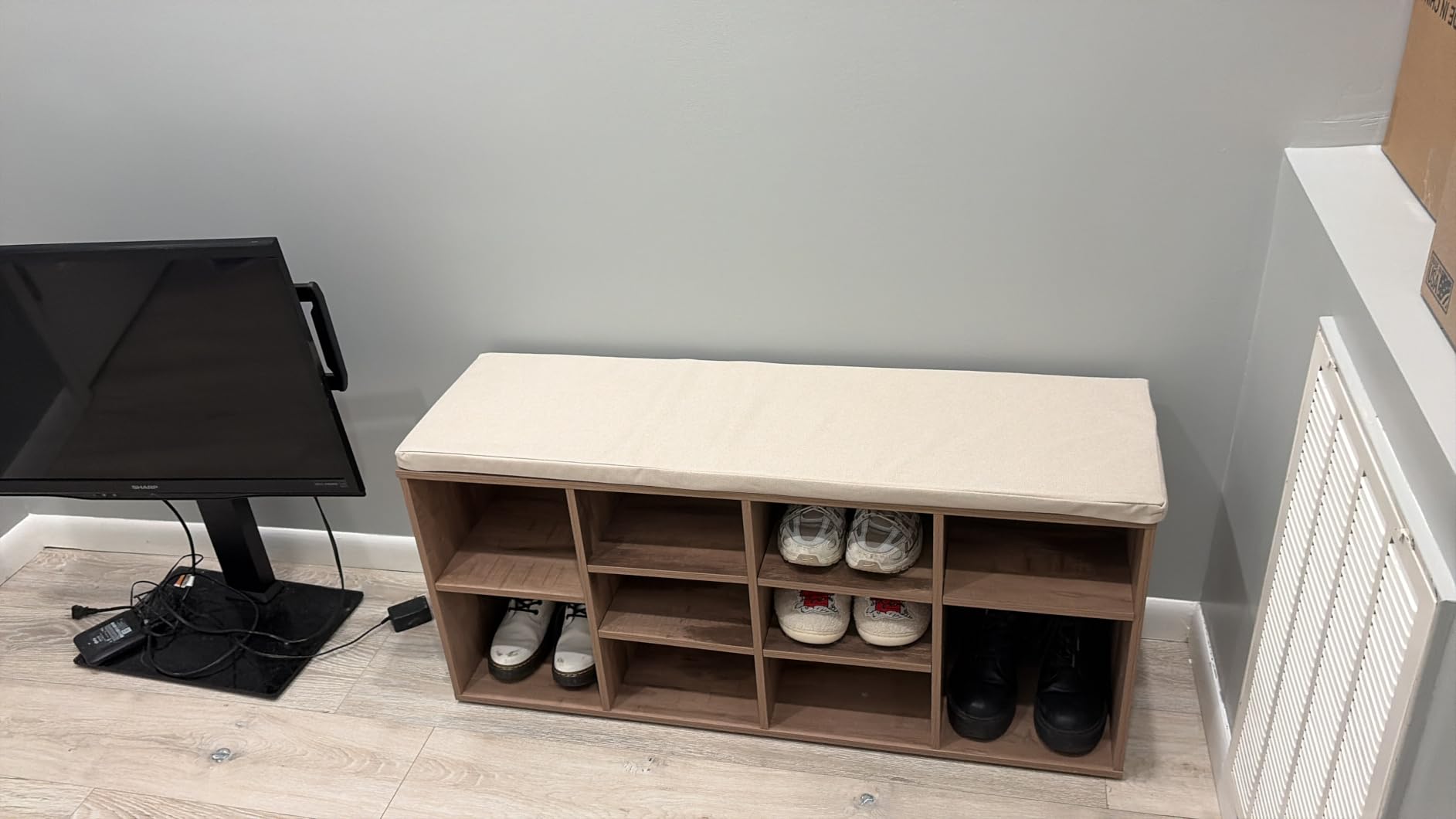
The cushion attaches with hook-and-loop and has a detachable zippered linen-look cover, so when it takes a beating from wet socks you pull the cover off rather than scrubbing the foam. The seat height of 18.9 inches suits adults and older children putting shoes on.
The build is particleboard on an engineered wood frame with protective pads on the base. Buyers note it stays stable once assembled, which matters more than it sounds when a 300 lb rated top is shared by three people.
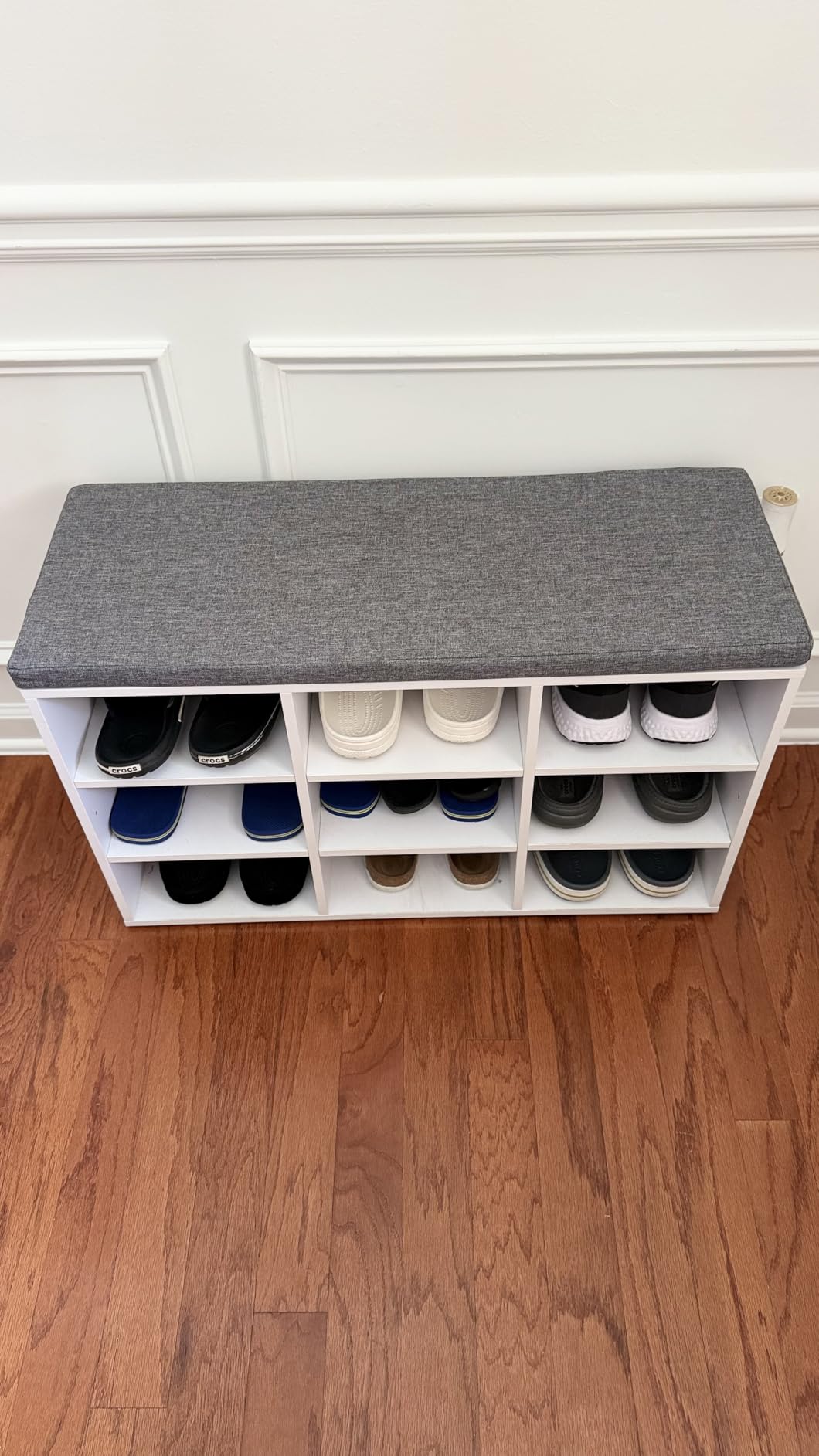
Why the 15 cubbies matter for a busy household
Separate compartments fix the argument you already have. Shoes stop migrating, everyone can find their own without moving other pairs, and the count of what is at the door is visible rather than guessed.
Reviewers also highlight that boots can stand upright inside the taller cubbies rather than lying on their side and cracking the shaft. Families mention taming entryway clutter as the single biggest reason they bought it.
Where the VASAGLE cushion bench disappoints
The cubbies are the trade-off. Reviewers consistently flag that large shoes such as men’s high-tops and big boots fill a compartment awkwardly or do not fit at all, so boots need another home.
Assembly is the other friction point. Expect about an hour solo, and check for missing pre-drilled holes before you start. The cushion is also thin, so this is a seat for putting shoes on rather than a place to linger.
3. VASAGLE 4-in-1 Hall Tree With Bench Review
The VASAGLE 4-in-1 Hall Tree is the best shoe organizer for entryways when coats are the bigger clutter problem, because it combines a hanging rod, nine hooks, a bench and shoe shelves in one 28.3-inch footprint.
VASAGLE Coat Rack, Hall Tree with Shoe Bench, 4-in-1, 9 Removable Hooks
- Combines coat hanging
- hooks
- bench and shoe shelves in one footprint
- nine rust-resistant metal hooks can be repositioned in two rows
- ships with an anti-tip kit for a unit this tall
- free-standing so no wall mounting is needed
- wide range of owner feedback at a 4.7 average
- 72.1 in height is unusable under a low ceiling and dominates a small hall
- full-height frame assembly takes real time
- 13.3 in depth is deeper than the slim options in this roundup
The height is the whole conversation with a hall tree. At 72.1 inches it needs a ceiling with room to spare and a wall that is not already doing something else, and in a short hallway it reads as furniture rather than as storage.
In exchange you get a proper drop zone. The top bar carries scarves, umbrellas and hangers, the nine hooks take daily coats, and three low shelves hold shoes. Nobody walks past a mound on the floor when there is a bench with a coat hook right there.
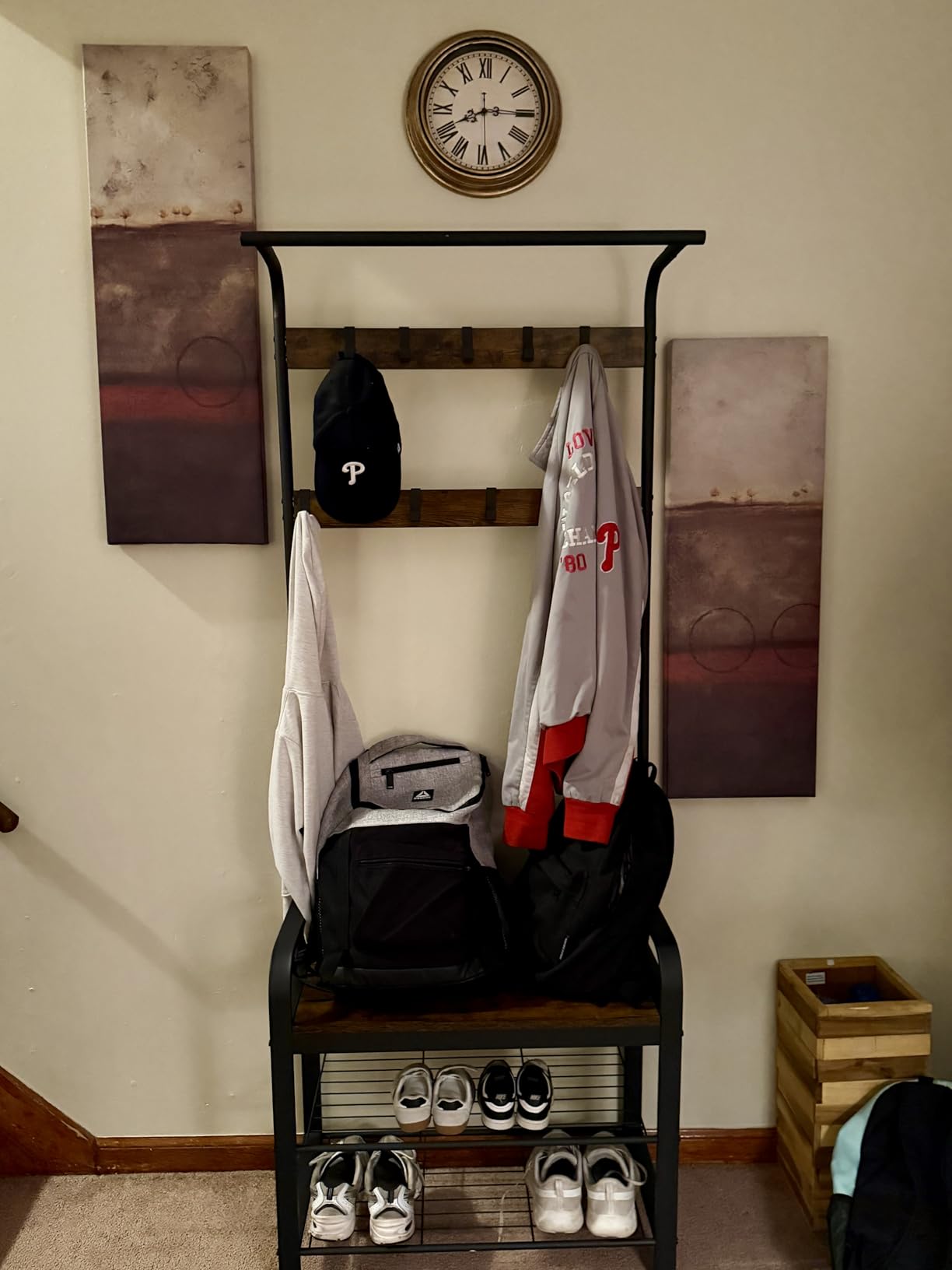
The frame is alloy steel with a particleboard finish and 1.5 inch legs, rated to 198 lb across the unit. An anti-tip kit is included in the box, and I would install it even though it is freestanding, because a 72-inch frame near a door is exactly the shape that worries parents.
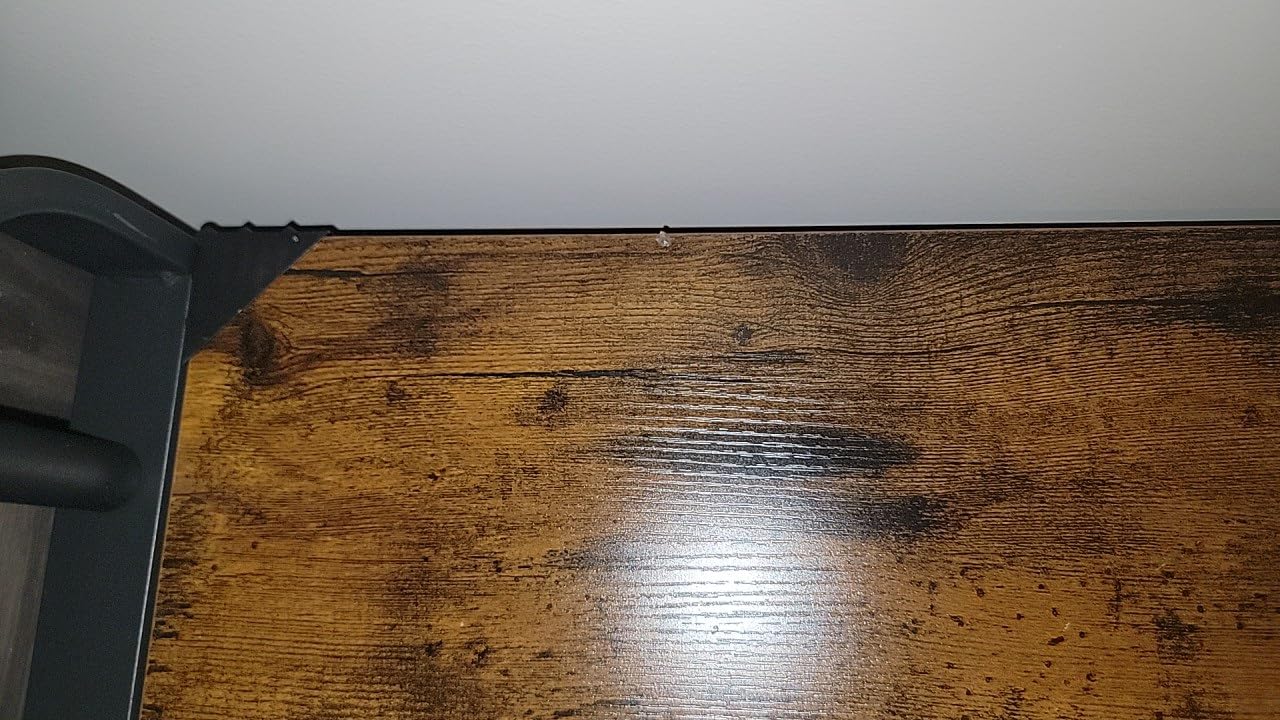
The hooks are removable and sit in two repositionable rows, so you can group hooks by family member or by task. Owners single out that adjustability as the feature they use most.
Where a hall tree earns its floor space
It consolidates three jobs into one footprint. If you currently have a coat rack, a shoe pile and a bench competing for the same square foot of hallway, this replaces all three and looks intentional doing it.
Reviewers rate it at 4.7 across more than fifteen thousand ratings, with 81 percent five-star feedback. Recurring praise lands on the removable hooks and the frame solidity rather than on looks alone.
Where the 72-inch hall tree is the wrong choice
Skip it in a low-ceilinged entryway or a corridor you walk through in shoes. At 13.3 inches deep it is also wider front-to-back than the slim cabinets here, so clearance is the first thing to check.
Be honest about assembly time. Building the full-height frame takes longer than a bench does, and the two-person conversations people have about this product usually start there.
4. KEETDY 43-Inch 3-Tier Metal Shoe Rack Review
The KEETDY 43-Inch 3-Tier Metal Shoe Rack is the best shoe rack for entryways with a long blank wall and a boot problem, because 8-inch shelf clearance and about five pairs per tier are unusual at this width.
KEETDY 3-Tier Long Shoe Rack for Closet Metal Shoe Organizer for Entryway, Wide Stackable Shoe Storage Shelf with Sturdy Wire Grid for Closet Floor, Bedroom, Black
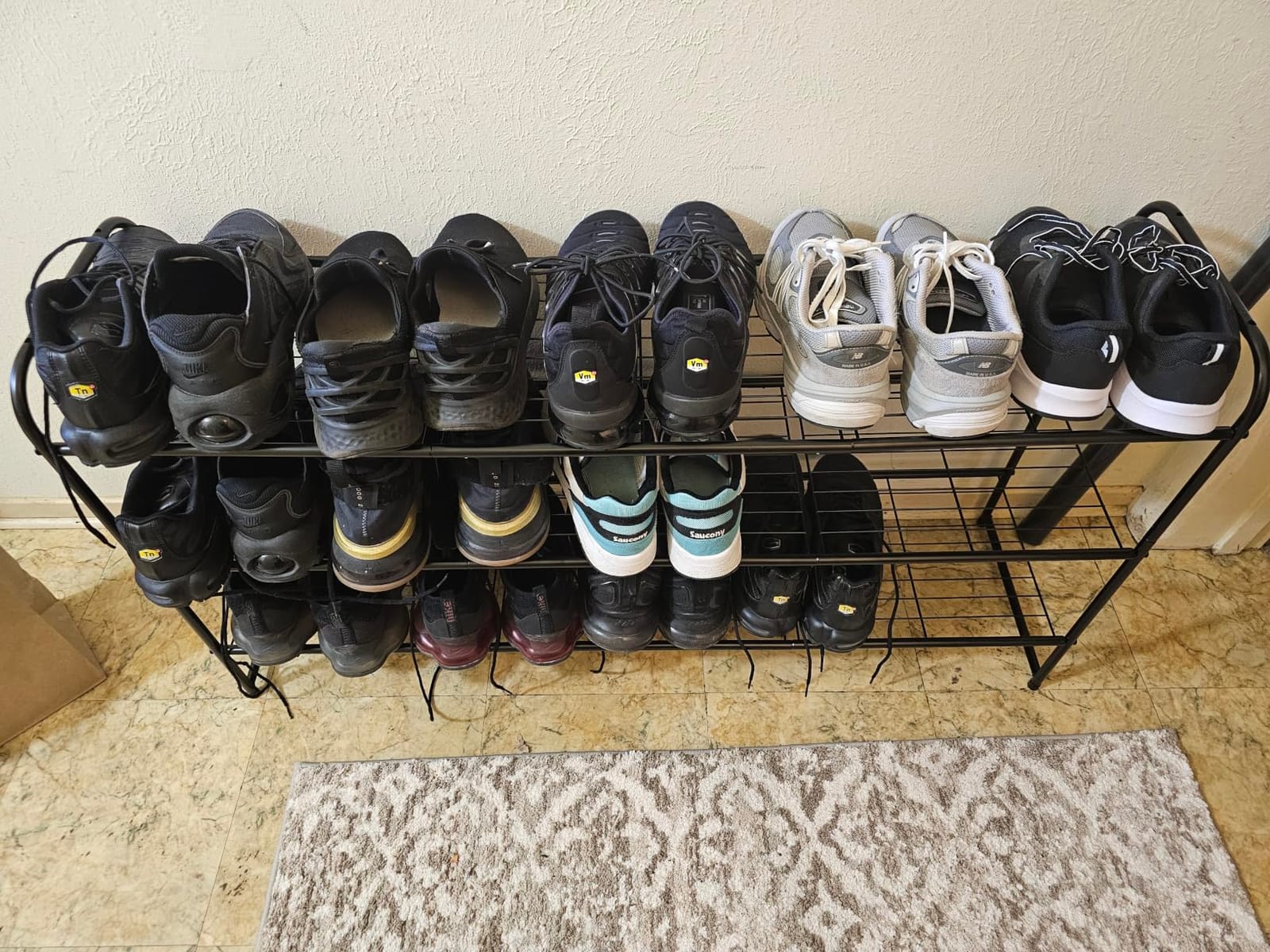
- 43-inch shelves hold roughly 5 pairs per tier including heels and boots
- 8-inch spacing clears snow and rain boots
- a second rack stacks onto it for a 6-tier build
- wire grid drops dirt through and shows shoes at a glance
- quick click-together assembly
- 43-inch footprint will not fit a narrow entryway or a standard interior door
- middle of the shelf flexes under heavy loads over time
- light frame can wobble on uneven floors without adjustable feet
This is the one rack in the group that assumes you have room. Forty-three inches wide and 24.4 inches tall, it needs a wall roughly the width of a small desk, and the minimum door width is listed at 43 inches.
What you get for that footprint is a lot of pairs. Owners work out to about five pairs per tier, so three tiers carry roughly fifteen, and a second set turns it into a six-tier unit if you later need more vertical space.
The wire grid design has an underrated benefit in an entryway: grit falls through instead of settling on a shelf. In a mudroom or a covered porch where shoes come in wet, that keeps the lower tier from turning into a tray of mud.
It is also stackable and adjustable. Remove a tier and the clearance above it opens up for tall boots, which is a rarer feature than it sounds on racks in this price and weight class.
When a wide rack beats a slim one
Wide wins when shoes are bulky. Heels, hiking boots and winter boots eat horizontal space that a narrow angled tower simply cannot provide, and five pairs across a tier is more than most narrow racks manage on two tiers.
Reviewers call this the sturdiest rack they have owned in several cases, with 84 percent five-star ratings. The adjustable spacing and the option to drop a tier for boots come up again and again.
Where the wide wire rack is impractical
Measure first. If your wall is under 43 inches or the entryway doubles as a walking route, this is the wrong rack, and the flex in the middle of the shelf shows up once you load it with heavy boots.
There are no adjustable feet, so uneven floors produce wobble. If your entryway floor is older hardwood or tile with a slope, plan on shimming it or pick a rack with leveling feet instead.
5. HOOBRO 5-Tier Adjustable Mesh Shoe Rack Review
The HOOBRO 5-Tier Adjustable Mesh Shoe Rack is the best shoe organizer for entryways with a 20-plus pair collection, because five tiers at four to five pairs each adds up to 16 to 20 pairs in under 32 inches of height.
- Five tiers hold 16-20 pairs
- a real number rather than a vague capacity claim
- mesh shelves tilt
- level or remove for heels and tall boots
- particleboard and metal frame resists bending with age
- top surface takes bags or a plant tray
- Backless design may need wall anchoring in a busy entryway
- assembly is required even though tools are included
- only 29.5 in wide so a large family shares shelves
This is the one I would point at when someone says they have thirty pairs and nowhere to put them. Twenty pairs at the door is already generous, so the number where the habit breaks is right around here, and this rack hits it without going floor-to-ceiling.
The mesh shelves are the reason it earns its place over a plain wire tier. Each one tilts, levels or lifts out, which means you can angle a shelf for flats, level it for heels, and pull it entirely for a pair of tall boots. Most racks make you choose one shoe type and accept the rest.
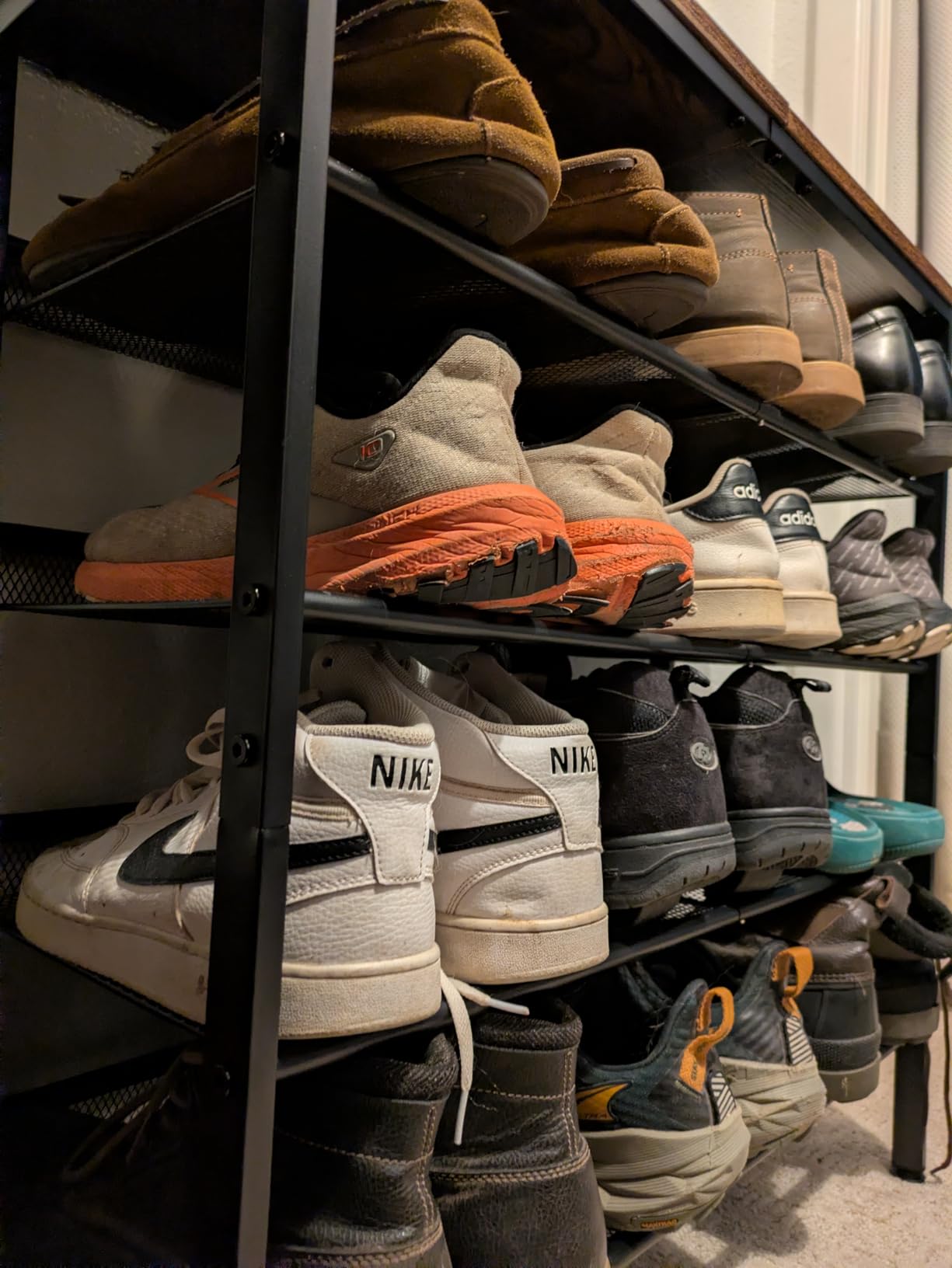
Construction is particleboard with a metal frame and metal mesh shelves. The top takes 44 lb and each mesh shelf is rated to 22 lb, and owners note the frame resists bending compared with cheaper all-wire racks they have replaced.
Styling is a matte black frame with a greige finish, which is unusual in this category and lets it stand alone in an entryway rather than looking like garage equipment.
How the tilting mesh shelves handle mixed footwear
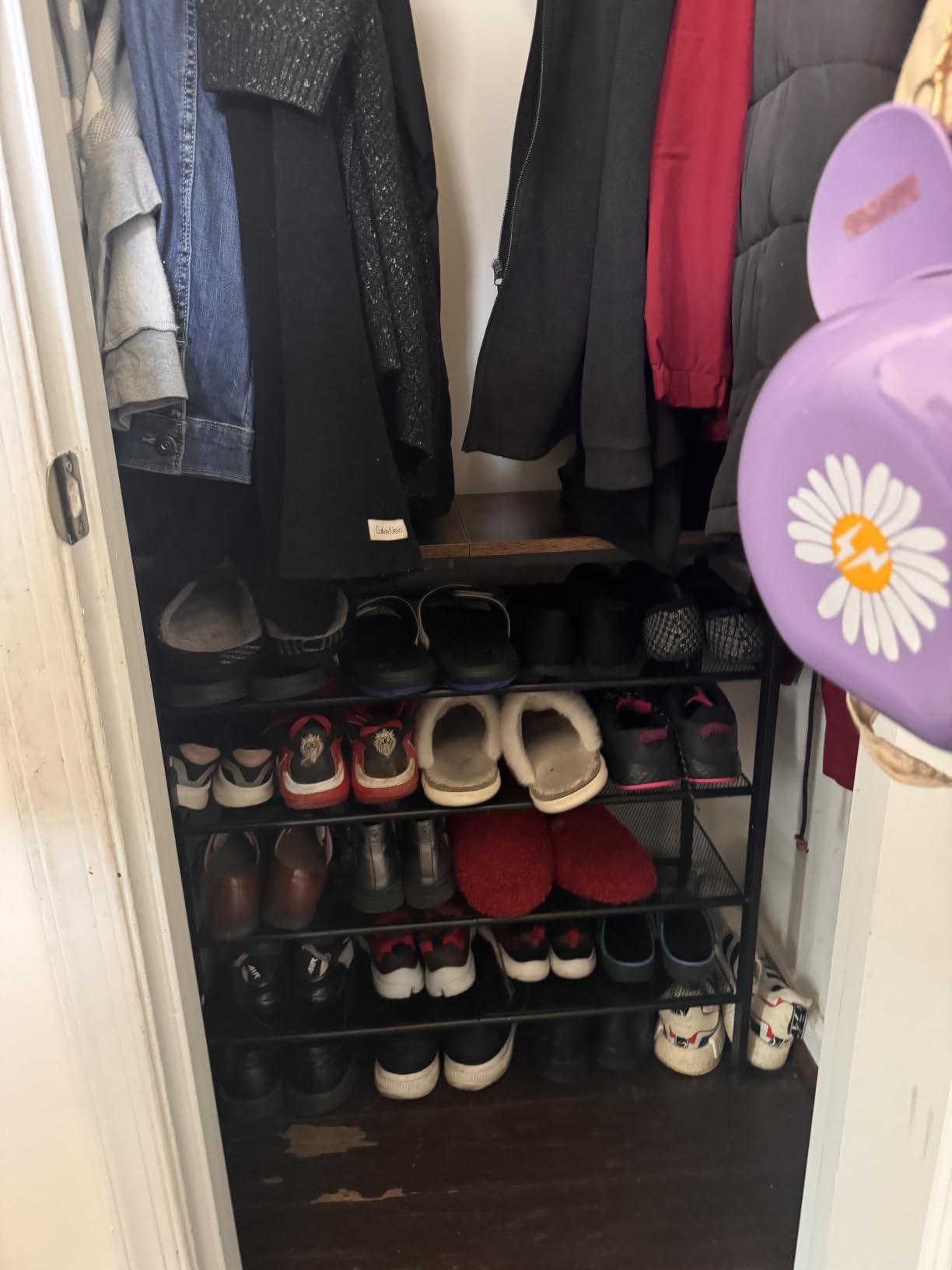
Most entryways hold more than one shoe type, and this is where the rack separates itself. A tilting shelf presents a heel at a stable angle, a level shelf displays a pair flat, and a removed shelf makes room for boots that would otherwise lie down and crease.
Capacity is stated as 4 to 5 pairs per tier, which lands the 16-to-20-pair range. That is the honest number to plan around, since a family of four with a work shoe each is already there.
Where the HOOBRO 5-tier rack needs care
It is backless, so in a hallway where people brush past it, wall anchoring is the sensible precaution. Buyers flag the open back as the main design compromise rather than a defect.
Assembly is still a job even with tools included, and at 29.5 inches wide a large family ends up sharing shelves, which is where the arguments start.
6. BORNOON 3 Flip-Drawer Shoe Cabinet Review
The BORNOON 3 Flip-Drawer Shoe Cabinet is the best shoe cabinet for entryways that need to hide clutter, because it stores 18 to 24 pairs behind flip drawers in a footprint just 9.45 inches deep.
BORNOON Shoe Cabinet with 3 Flip Drawers, Hidden Wood Shoe Cabinet,Freestanding Shoe Storage Cabinet for Entryway Hallway.White. 47.2″ H*31.5″ W*9.45″ D.
- 9.45 in depth is the narrowest floor footprint of any freestanding cabinet here
- flip drawers keep shoes hidden and dust-free while saving floor space
- adjustable and removable panels fit flats
- mid boots or heels
- anti-tipping device adds child safety
- clean white finish suits a hallway
- Nearly 60 lb assembled
- so moving it means two people
- engineered wood panels are more vulnerable to water damage than solid wood
- at 47.24 in tall it needs wall clearance above
Depth is what makes this cabinet different from everything else on this list. Nine and a half inches is narrower than a baseboard-heavy wall usually allows, which means it clears a doorway swing that stops wider cabinets cold.
The flip drawers are the second reason. Instead of swinging a door into the walkway, each drawer tilts up and stays flat, so the unit keeps working in a corridor where an open cabinet door would be a hazard every time someone passes.
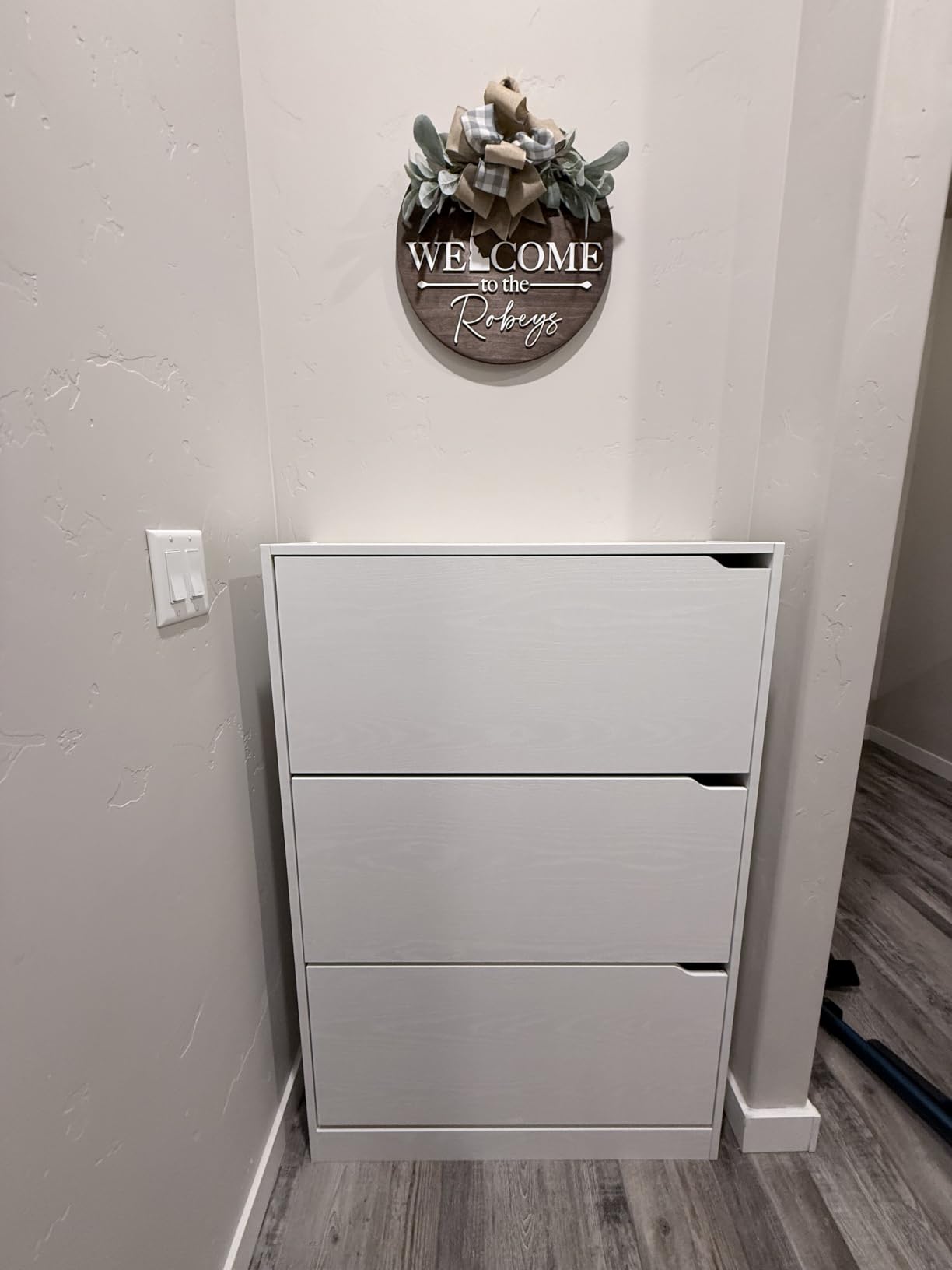
Inside, each drawer has two panel tiers that adjust or remove. That is how one cabinet covers flats, mid boots and heels without anyone losing shelf space permanently, and it is the feature owners describe as the difference between a display shelf and storage.
An anti-tipping device is included for wall mounting. At 47.24 inches tall in engineered wood with an entryway full of children, I would install it the day it arrives.
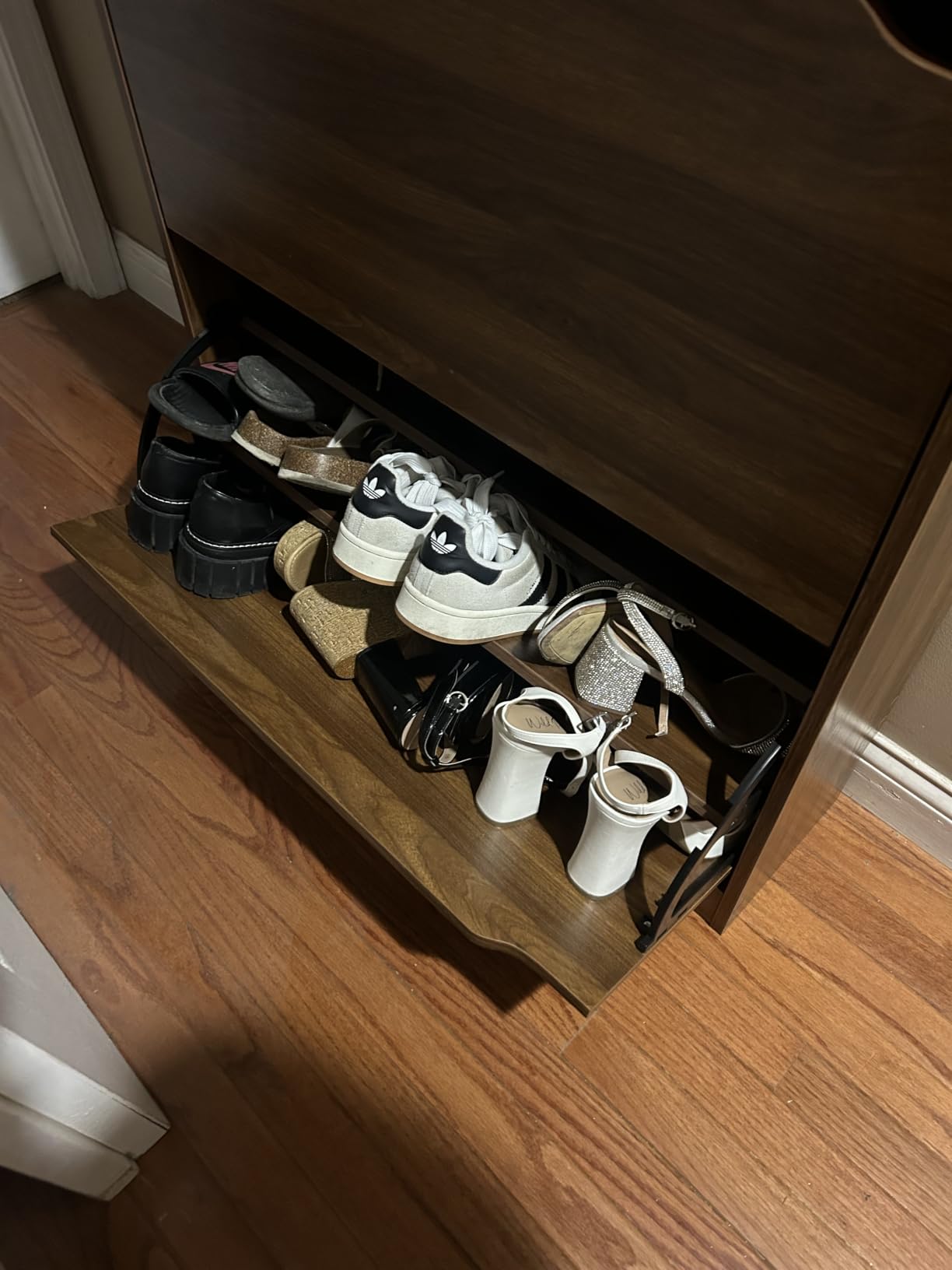
Why flip drawers hide clutter in a hallway
An open rack in a hallway displays the problem instead of solving it. Flip drawers give you a closed face, which is what most households actually want when guests walk past on the way in, and 85 percent of owners rate this cabinet five stars.
Buyers also mention that replacement panels were provided after transit damage, which tells you something about how the panels pack. Engineered wood holds up well in a dry entryway and less well in a wet mudroom.
Where the BORNOON cabinet is a poor fit
It weighs nearly 60 pounds assembled, so relocating it later is a two-person task. If you live in a rental where you may need to move it, factor that in.
Water is the other limit. Engineered wood and chipboard will not forgive a dripping wet umbrella or a soaked pair of boots parked against the panel, so keep wet footwear on a separate rack rather than inside.
7. UVIAHOMI Over-the-Door Shoe Organizer Review
The UVIAHOMI Over-the-Door Shoe Organizer is the best shoe organizer for entryways in rentals where drilling is not allowed, because it hangs on four metal hooks and holds 20 to 30 pairs.
- No assembly at all
- just four hooks and a hang
- 20-30 pairs in a floor footprint of zero
- clear PVC pockets so you can spot a pair without unpacking
- four metal hooks rated 20 lb each for 80 lb total
- also organizes towels
- toys and hats
- Bulky sneakers fit snugly in the pockets
- the unit swings when the door opens and may need pinning at the base
- new PVC material can carry a temporary odor
If you cannot drill, this is the format with no compromise. It uses zero floor area, which matters enormously in a closet-less apartment where every square foot of the entryway is also a walking square foot.
Owners report packing in more than the stated capacity, with some fitting 30 to 39 pairs. The ten tiers and twenty pockets are sized for sneakers, boots, heels and kids’ shoes at 22.5 inches wide and 10 inches deep.
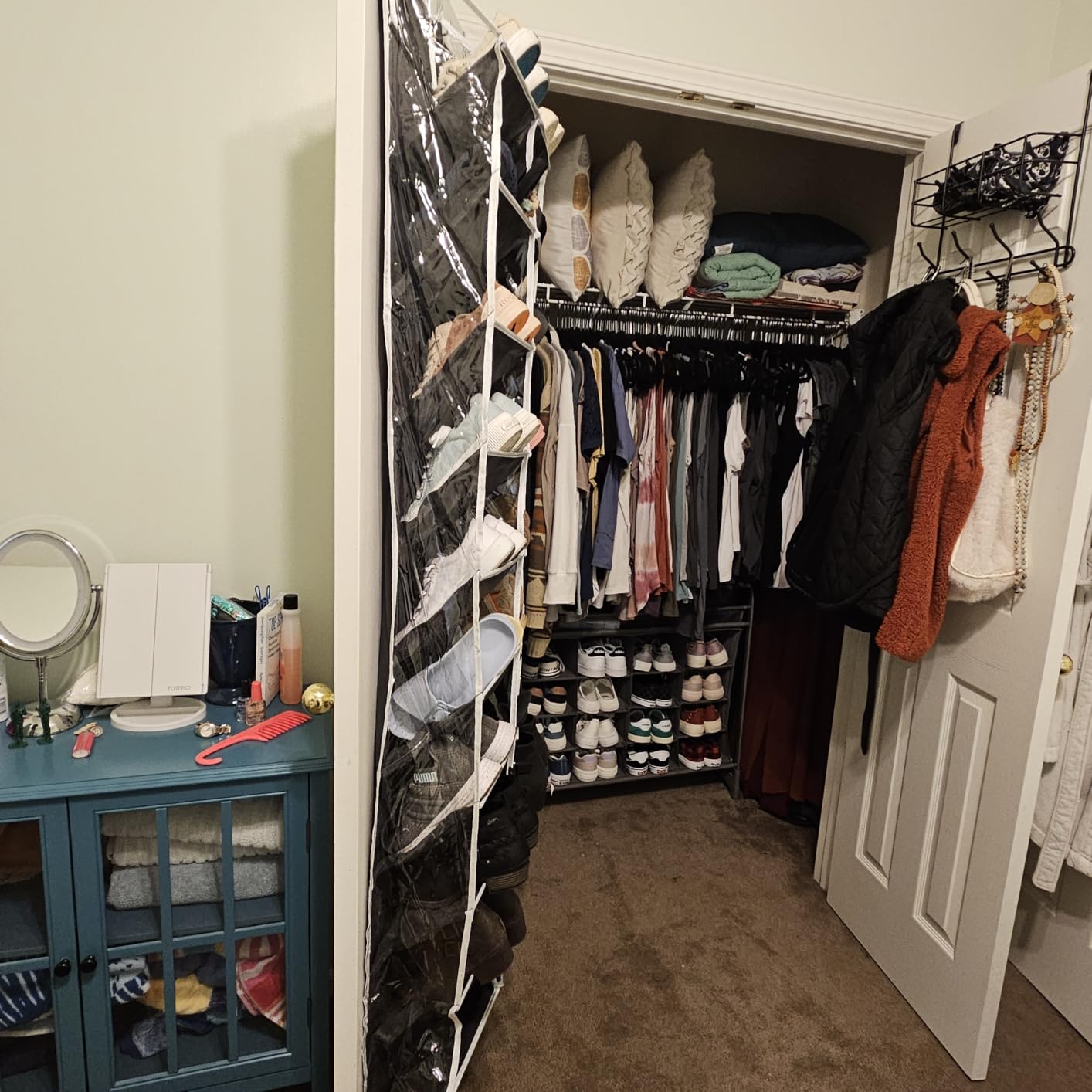
Check your door thickness before anything else. It fits doors from 1.37 to 1.98 inches, which covers most interior doors but will not clear a thick modern entry door or a hollow-core slab.
The transparent PVC side windows are the detail that gets used daily. You see the shoe and grab it in one motion instead of pulling everything out, and 85 percent of ratings are five stars.
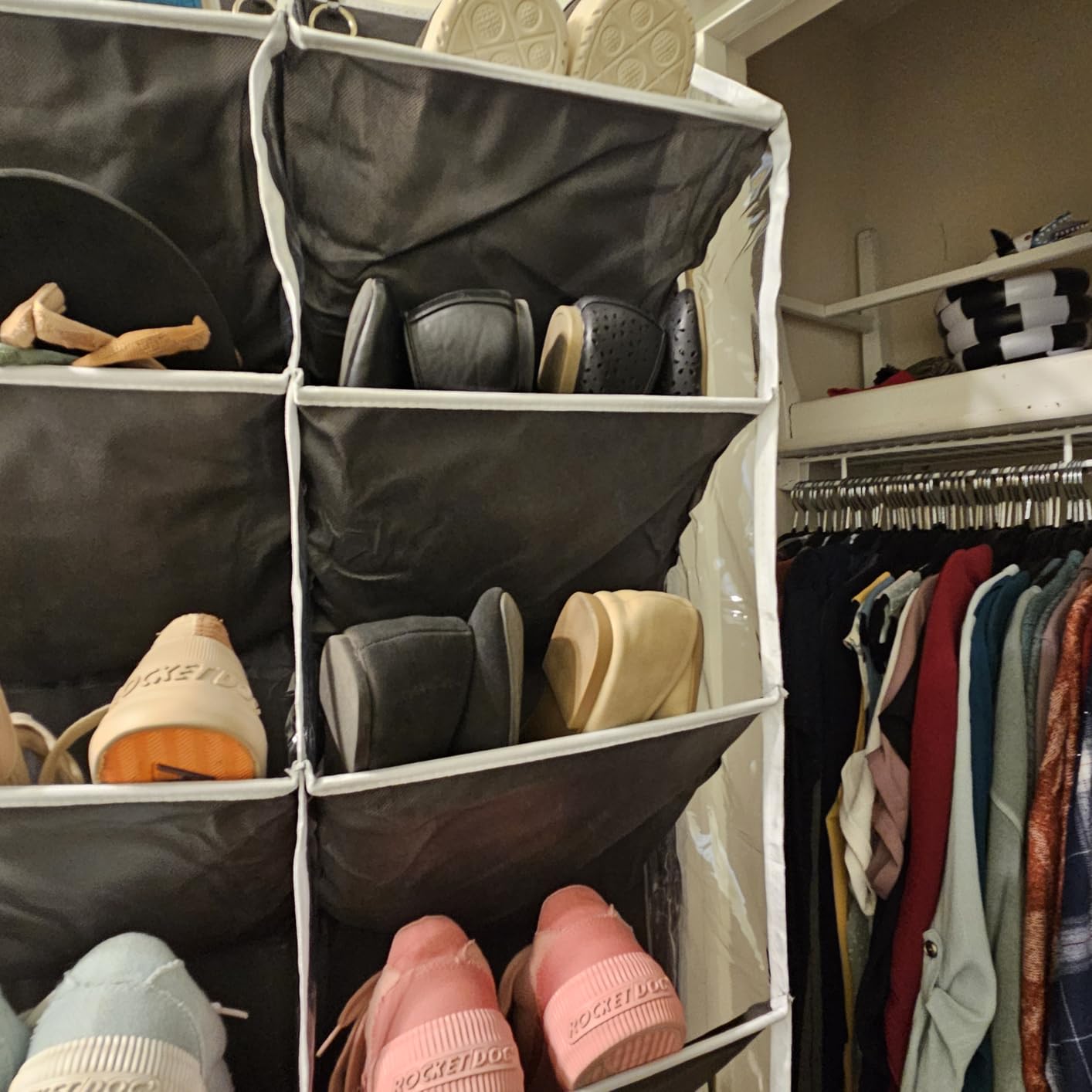
When a door-hung organizer is the only option
Renters, dorm rooms and anyone with a closet already full of coats hit the same wall: no drilling, no floor space, lots of shoes. This answers all three at once, and it also doubles as closet-door storage for guests who bring more than one pair.
The breathable non-woven fabric also keeps shoes from trapping the way a solid bin does, which is a modest but real benefit in a small closet.
Where the over-the-door unit falls short
Bulky shoes are tight. Reviewers note that larger sneakers and chunky boots fit snugly, and forcing them in strains the pocket seams over time.
The swing is the bigger practical problem. It moves every time the door opens, so many owners pin or wedge the base, and it is awkward in a doorway where the door is the main traffic route. Expect a faint new-plastic smell that fades after a few days.
8. QIVOMIX Walnut 2-Drawer Flip-Drawer Shoe Cabinet Review
The QIVOMIX Walnut Flip-Drawer Shoe Cabinet is the best shoe storage cabinet for entryways where appearance matters as much as capacity, because a walnut wood-grain finish and arc handles read as furniture rather than storage.
QIVOMIX Shoe Cabinet Storage, Modern Freestanding Organizer with 2 Flip Drawers, Narrow Shoe Rack for Entryway, Walnut
- Narrow 9.4 in depth suits compact entryway footprints
- walnut wood-grain finish and rose arc handles give a modern look
- thickened top rated to 80 lb for keys
- wallets and plants
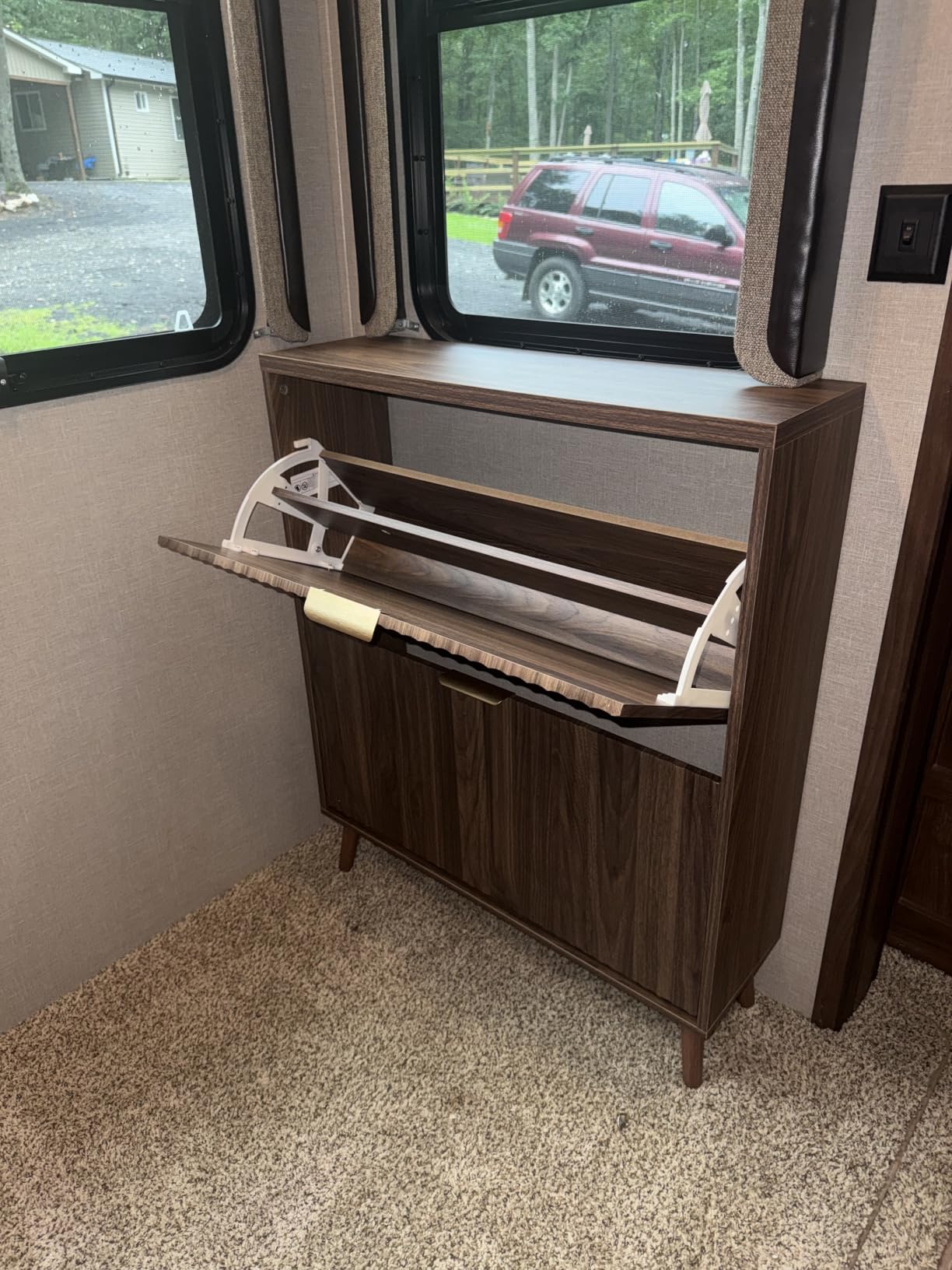
- flip drawers protect shoes from dust and pet chewing
- anti-tipping device included for wall mounting
- Lowest average rating in this group at 4.4 stars
- large boots only fit if the centre divider is removed
- far fewer reviews than the other picks so long-term feedback is thin
The finish is the reason to pick this one. Most flip-drawer cabinets in this category are white or plain chipboard, and a walnut wood-grain face with rose-colored arc handles reads as a piece you chose rather than a box you tolerated.
At 9.4 inches deep and 38 inches tall it sits lower than the BORNOON cabinet, which helps in an entryway with a low console or a radiator on that wall.
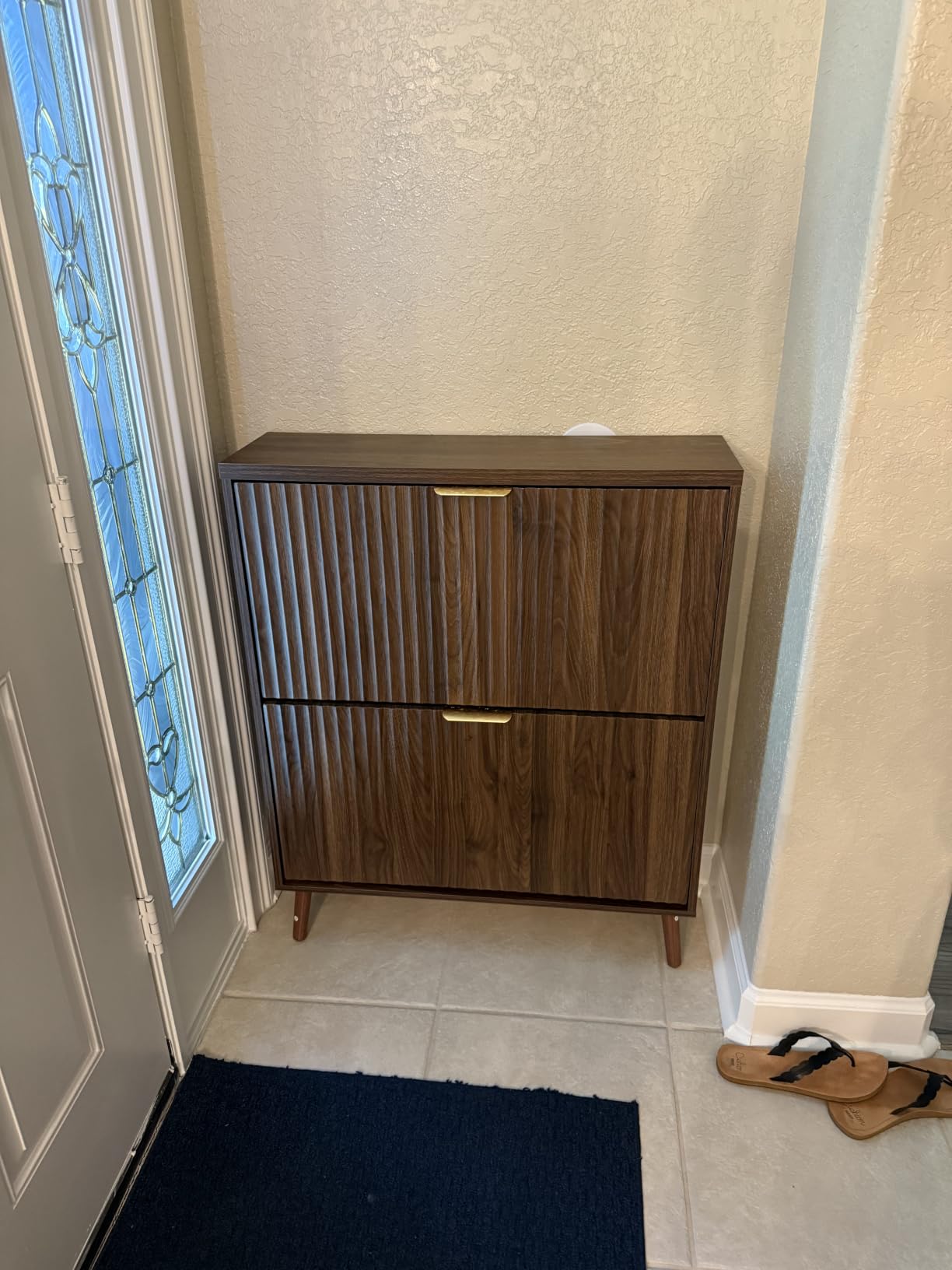
Capacity is about 14 adult pairs, or up to roughly 20 children’s pairs, with sizing up to a women’s 16 and a men’s 15. The top surface takes 80 lb, so it earns its place as a key drop as much as a shoe store.
Flip drawers keep shoes away from dust and away from curious pets, and the enclosed design suits households where an open rack of shoes looks like clutter every time someone walks past.
Where the walnut cabinet earns its footprint
It is the most furniture-like option here, which changes how an entryway feels. A closed wood face with hardware that matches the rest of the room is the difference between a shoe cabinet you hide and one you leave in plain sight.
Owners like the modern styling and the slim, dust-hiding drawers, and the 80 lb top makes it a practical landing surface for keys and wallets on the way out.
Where the QIVOMIX cabinet disappoints
It carries the lowest average rating in this roundup at 4.4 stars, with a small share of one-star feedback, and the review base is the thinnest by a wide margin at 546. There is simply less long-term evidence here.
Large boots need the centre divider pulled out, which costs you a slot. If boots are a daily part of your routine, pick a rack with adjustable clearance instead.
9. SNTD Expandable 2-Tier Metal Shoe Rack Review
The SNTD Expandable 2-Tier Metal Shoe Rack is the best shoe organizer for small entryways with awkward dimensions, because it adjusts from 18.6 to 30.5 inches wide after it is already in the room.
Expandable Metal Shoe Rack for Closet, Entryway & Garage, 2-Tier, Black
- Expandable width fits a tight spot at first and grows when you need more
- taut mesh shelves keep high heels from slipping through
- height adjustment accommodates taller boots
- powder-coated heavy-duty metal resists sagging and rusting
- assembles in under 10 minutes and rinses clean
- Only two tiers means lower capacity than taller racks
- adjustable feet need setting by hand to sit level
- at 8 pairs it suits a couple rather than a family
Expandable is the feature that rescues projects you would otherwise abandon. You measure the gap, set the width between 18.6 and 30.5 inches, and the rack fits a space you had written off.
The mesh is taut rather than loosely welded, and that difference decides whether heels work. Owners single it out as the reason high heels sit flat instead of teetering through wide gaps.
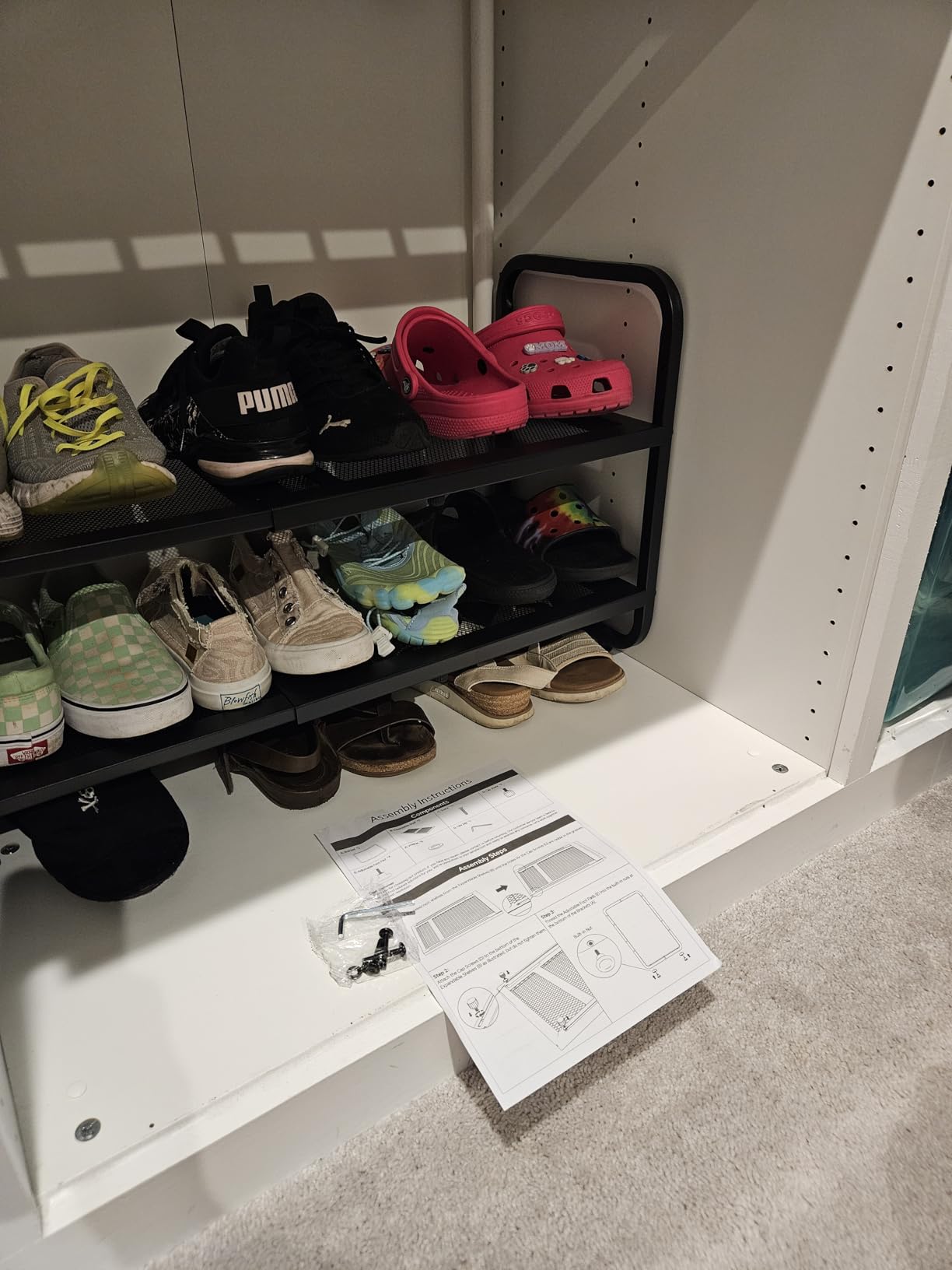
Height is adjustable too, which opens clearance for boots, and the unit stacks into four-, six-, eight- or ten-tier builds as your collection grows. That is a gradual upgrade path rather than a replacement.
It weighs 6.2 pounds and assembles in under 10 minutes, and the coated metal wipes or rinses clean, which is exactly what you want in a spot where shoes come in wet.
Why an expandable rack works in an awkward hallway
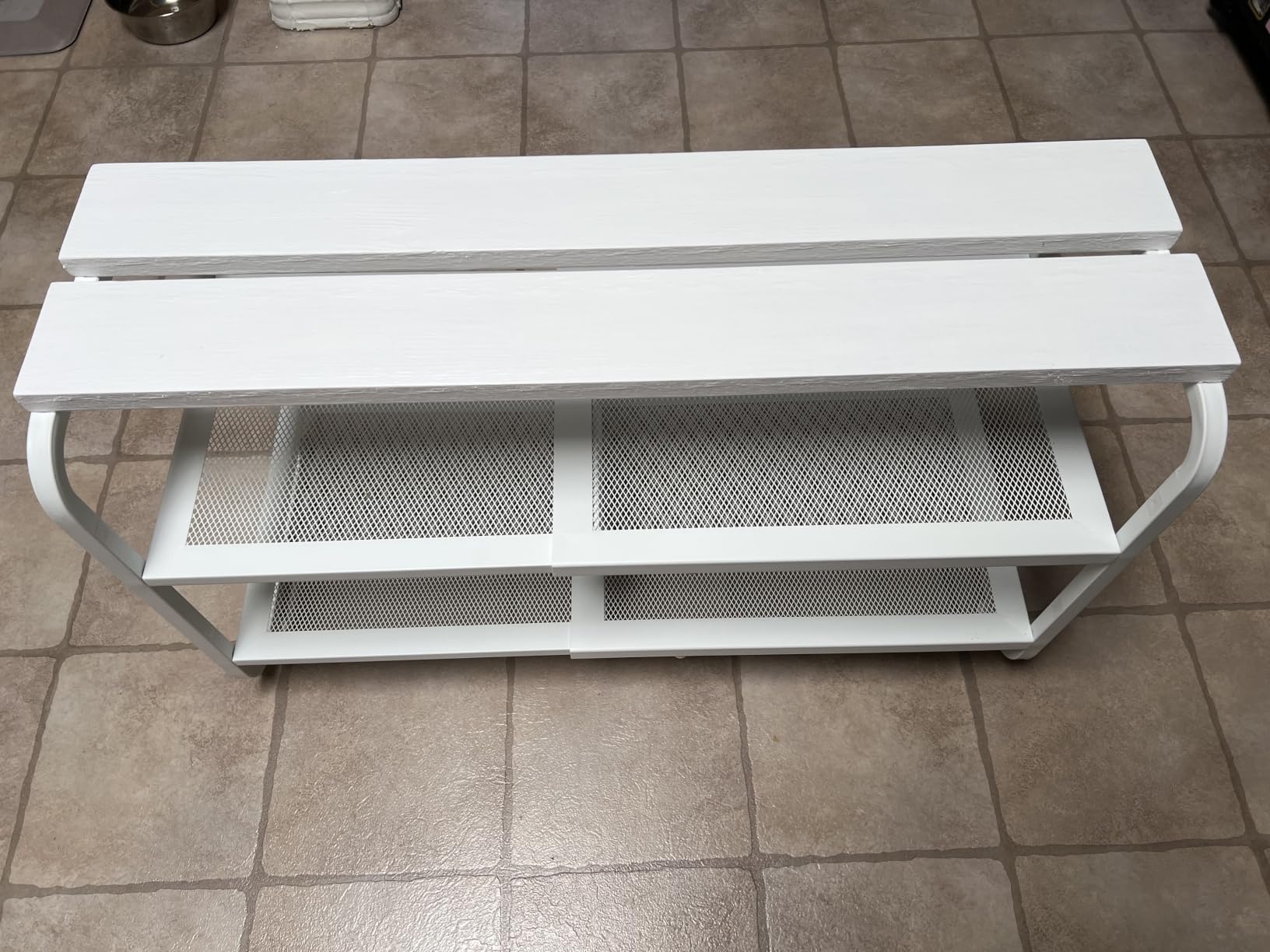
It removes the guesswork. Most racks fail in real homes because the wall is 26 inches and the rack is 30. This one telescopes, so you size it after the measurement rather than before.
The stackable design also makes it a starting point rather than a compromise. If two tiers is all you need today, buy one; if the collection grows, add tiers instead of buying something new.
Where the SNTD rack is not enough
Eight pairs across two tiers is genuinely small. A family of four puts shoes on here and overflows onto the floor within a week, which defeats the purpose.
Adjustable feet have to be set by hand, so on an uneven floor expect to level it yourself before it stops wobbling. And the minimum door width for the fully extended position is 30.5 inches.
10. HOOBRO Industrial 3-Tier Mesh Shoe Bench Review
The HOOBRO 3-Tier Mesh Shoe Bench is the best entryway bench with shoe storage for narrow halls, because at 11.2 inches deep it adds seating while staying inside a tight walkway.
- Bench top gives a real place to sit while putting shoes on
- two mesh shelves hold roughly 8-12 pairs depending on shoe size
- 11.2 in depth suits narrow entryways and stair landings
- top rated to 300 lb with an industrial metal frame
- retro styling blends with farmhouse
- eclectic and modern rooms
- Some owners report slight wobble when an adult sits on the bench
- capacity is lower than wider benches
- smaller variant holds about 4 pairs of women's size 9
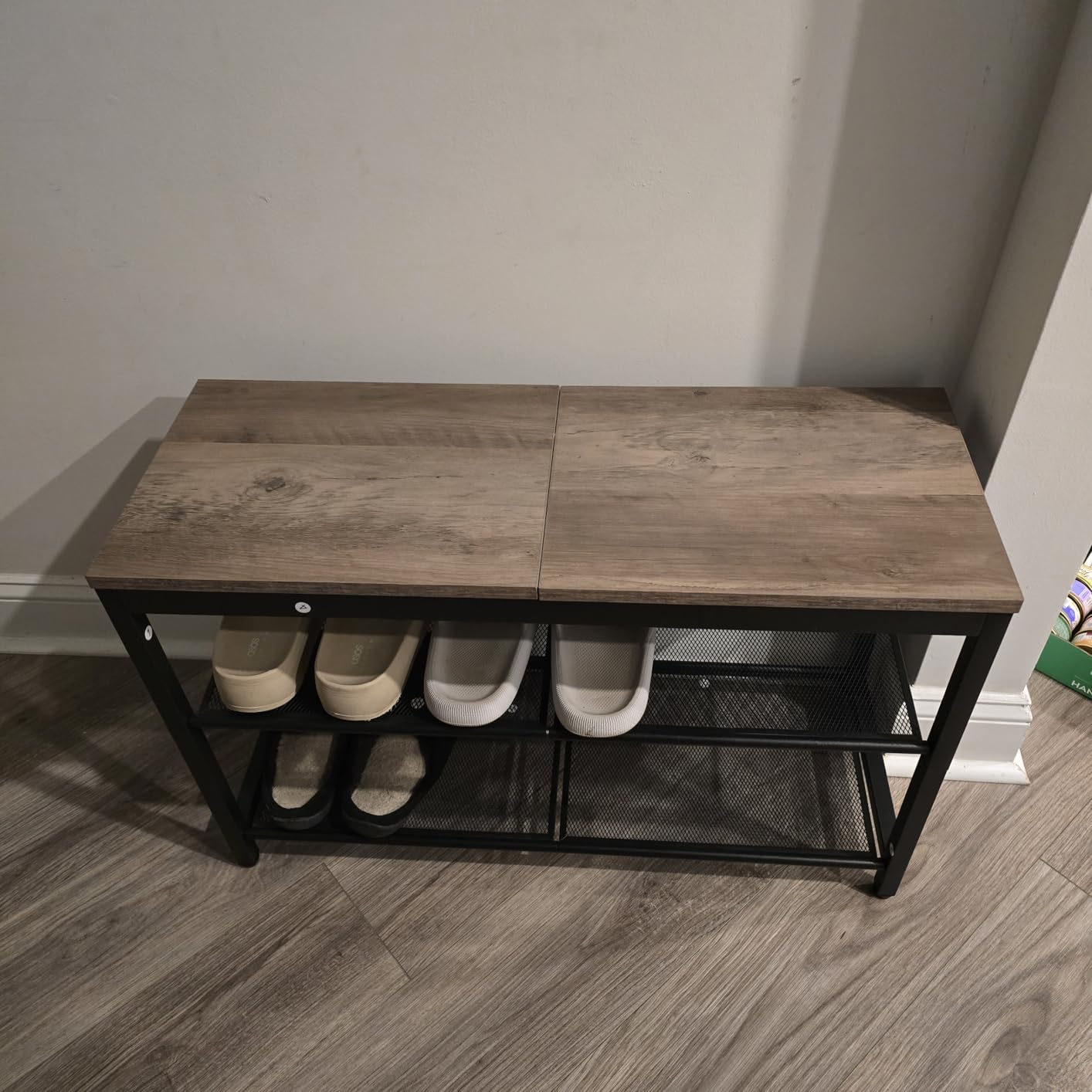
The bench height of 19 inches is the number that matters here. It is close to standard bench height, so an adult can sit and remove boots without perching, and a child can get on it without a step.
Underneath, two mesh shelves hold roughly 8 to 12 pairs depending on shoe size. Mesh rather than solid board means grit falls through, which is a real advantage in an entryway where shoes arrive damp.
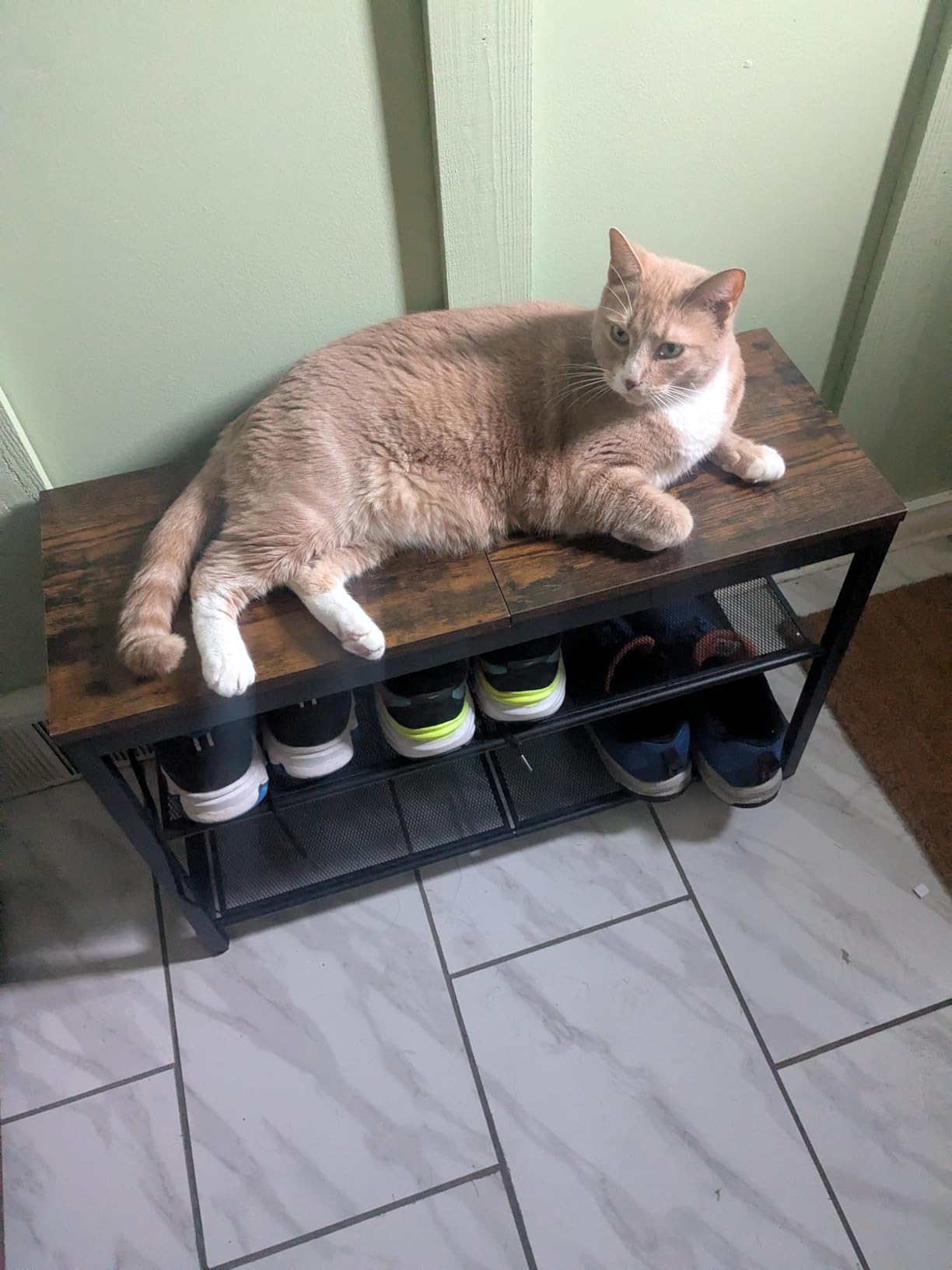
The frame is metal with premium board surfaces, and the top is rated to 300 lb. Styling is retro industrial with a rustic brown and black finish, which reviewers say sits well with farmhouse, eclectic and modern rooms alike.
Assembly is illustrated and the parts are labelled, which sounds minor until you are on the floor of a hallway with an Allen key and no manual.
Where a mesh bench beats an open rack
A bench does two jobs in one footprint. On a hall where you already need somewhere to sit for a guest or a kid, adding a rack above or below the seat costs you nothing in floor space, and the top also becomes a drop surface for keys.
Reviewers rate it 4.6 with 80 percent five-star feedback, and the combination of seating and storage is the most common word in owner write-ups.
Where the HOOBRO bench wobbles
The most repeated complaint is slight wobble when an adult sits on the bench. It does not tip, but it moves, and it is worth tightening before you hand it to a child.
Capacity is also modest, and the smaller variant holds about four pairs of women’s size 9 shoes. Check the variant dimensions twice, because capacity changes sharply between sizes in this line.
How to Choose a Shoe Organizer for Your Entryway in 2026
Choosing well comes down to four measurements and one honest count of your shoes. Do both before you shop and you will not be returning anything in 2026.
Measure the entryway before you buy anything
Start with the wall you intend to use and take three numbers: the available width between the wall and whatever is opposite it, the depth from that wall to the walking line, and the ceiling height if you are considering a hall tree. Then measure the door swing, because that is the measurement that decides whether a cabinet works at all.
Width decides your format. Under about 16 inches of usable width means a slim tower, a bench or an over-the-door unit. Between 16 and 32 inches opens up open racks and most flip-drawer cabinets. Above 32 inches you can consider a long bench or a wide tiered rack.
Depth decides whether the hallway survives. Anything under 10 inches deep is safe in a corridor. Ten to 13 inches works if the opposite wall is not a traffic route. Over 13 inches and you should confirm people can still walk past carrying something.
Door swing, walkway and baseboard clearance rules
Leave a clear walking width of about 30 inches if the hallway is a through-route, and never let furniture overlap the arc of an inward-swinging door. This is the most common reason a good organizer ends up disassembled and returned.
Check baseboard depth too. A unit deeper than 11 inches cannot sit flush against a baseboard-heavy wall, which explains why so many slim cabinets in this roundup measure 9.4 or 9.45 inches deep.
For any piece over 40 inches tall, anchor it. Tall towers and hall trees are exactly the shape that goes over when a child pulls on a shelf, and anti-tip kits come with most of the cabinets here.
Capacity math: pairs per square foot
Work out your daily pairs first. Owners on decorating forums consistently recommend keeping only the shoes worn most days at the door and moving the rest to a closet, bin or under-bed space, because the pile returns the moment the entryway runs out of room.
As a rough guide, an open tiered rack returns about 4 to 5 pairs per square foot of floor. A vertical or stackable tower returns closer to 8 to 10 pairs per square foot. A bench with cubbies lands around 6 to 8. A flip-drawer cabinet reaches 12 to 15 pairs per square foot because it uses drawer volume rather than open floor.
In a 2 by 3 foot zone, that spread is the difference between roughly 12 pairs and about 45 pairs. That is why narrow entryways usually need a closed cabinet rather than an open rack.
Keep daily pairs in the entryway and push the rest out
The most recommended practice among people who have actually solved this is subtraction, not storage. Keep one pair per household member per weekday, plus boots in season, and relocate everything else. An organizer holding twenty pairs of which eight are worn will look cluttered forever.
Sort by frequency, then give each pair a fixed position. Households report that labelled positions cut shoe-dragging dramatically, because the alternative is a decision every single time the door opens.
Set a reset. A five-minute weekly clear-out is what keeps an organizer from becoming the thing you are avoiding looking at. Our shoe storage cabinet roundup goes deeper on the cabinet side of this, and our bamboo drawer organizer picks cover the small containment jobs at the same spot.
Materials explainer: bamboo, metal, particleboard and fabric
Bamboo and solid wood take a wipe, resist scratches and look like furniture, which is why the SONGMICS bench and the hall tree read well in an open entryway. They do not love standing water.
Powder-coated metal is the most forgiving material for a wet or messy drop zone. It resists rust and sagging, rinses clean, and stacks or expands as your collection grows.
Particleboard and engineered wood give you the cheapest way to get doors, drawers and adjustable panels, which is why both cabinets here use it. The tradeoff is water: keep soaked boots and dripping umbrellas off the panels, or they swell. Fabric organizers are the softest option and the least durable, so treat them as overflow rather than as a primary home.
Renter rules: organizers that need no drill
If you cannot drill, your realistic options are an over-the-door unit, a freestanding tower or bench, and a stackable rack. Freestanding frames with anti-tip kits are safer than they look, since the kit usually straps to a stud-free wall anchor rather than requiring masonry work.
Check the door thickness before any over-the-door purchase. Most fit doors from about 1.37 to 1.98 inches, and a thicker entry door will not take the hooks at all.
Frequently Asked Questions
What is the best shoe cabinet storage for an entryway?
A flip-drawer cabinet is the strongest all-round answer. It stores 18 to 24 pairs in a footprint as narrow as 9.45 inches, hides clutter behind a closed face, and keeps doors from swinging into the walkway. Anchor any cabinet over 40 inches tall to the wall and keep wet boots outside the panels.
What is the best shoe organizer for storing a lot of shoes?
A five-tier adjustable rack is the best value, holding 16 to 20 pairs in about 29.5 inches of width and 31.8 inches of height. Stackable designs let you add tiers later rather than replacing the whole unit once the collection outgrows it.
What is the best shoe rack for a narrow entryway?
A slim bench or expandable rack works best when the wall is tight. The SONGMICS bamboo bench is 11.3 inches deep and doubles as seating, while the SNTD rack telescopes from 18.6 to 30.5 inches wide. For walls under 10 inches of depth, an over-the-door organizer uses no floor space at all.
Where to put shoes in a narrow hallway?
Put shoes against the longest uninterrupted wall, outside the arc of any inward-swinging door, and leave at least 30 inches of clear walking width if the hallway is a through-route. Choose a unit under 10 inches deep, check that the baseboard is shallower than the unit, and anchor anything over 40 inches tall.
What size shoe rack should I buy?
Match the format to your wall width. Under 16 inches of usable width means a slim tower, bench or over-the-door unit. Between 16 and 32 inches fits open racks and most flip-drawer cabinets. Above 32 inches you can take a long cubby bench or a wide tiered rack. Depth under 10 inches keeps a corridor walkable.
How many pairs of shoes can a shoe rack hold?
Capacity depends on format, not brand. A two-tier rack holds about 8 pairs, a three-tier wide rack around 15, a five-tier adjustable rack 16 to 20, a cubby bench 8 to 15 depending on shoe size, and a flip-drawer cabinet 18 to 24. Keep only daily-wear pairs at the door and move the rest elsewhere.
Are shoe racks good for small spaces?
Yes, when you pick the right format. Small spaces favour units under 10 inches deep, tall vertical storage, and anything mounted or hung rather than placed on the floor. Open racks show clutter, so a closed cabinet or flip-drawer design usually feels calmer in a narrow hall than an open tiered shelf.
The Best Shoe Organizer for Your Entryway in 2026
The SONGMICS 3-Tier Bamboo Shoe Bench is the best shoe organizer for entryways most homes should buy, because 11.3 inches of depth, a 286 lb rated seat and more than 25,000 owner ratings make it the safest default in 2026. It also gives kids somewhere to sit, which quietly keeps shoes off the floor more than any storage upgrade does.
Pick something else when your space says so. A long blank wall calls for the KEETDY 43-inch wire rack. A 20-plus pair collection calls for the HOOBRO 5-tier rack. A hallway that cannot spare depth calls for the BORNOON flip-drawer cabinet at 9.45 inches. A rental with no drilling and no floor space calls for the UVIAHOMI over-the-door unit.
Whatever you choose, measure first and subtract second. Keep only the pairs that get worn at the door, give each one a fixed spot, and the best shoe organizers for entryways will keep working long after the first attempt at organizing failed.