
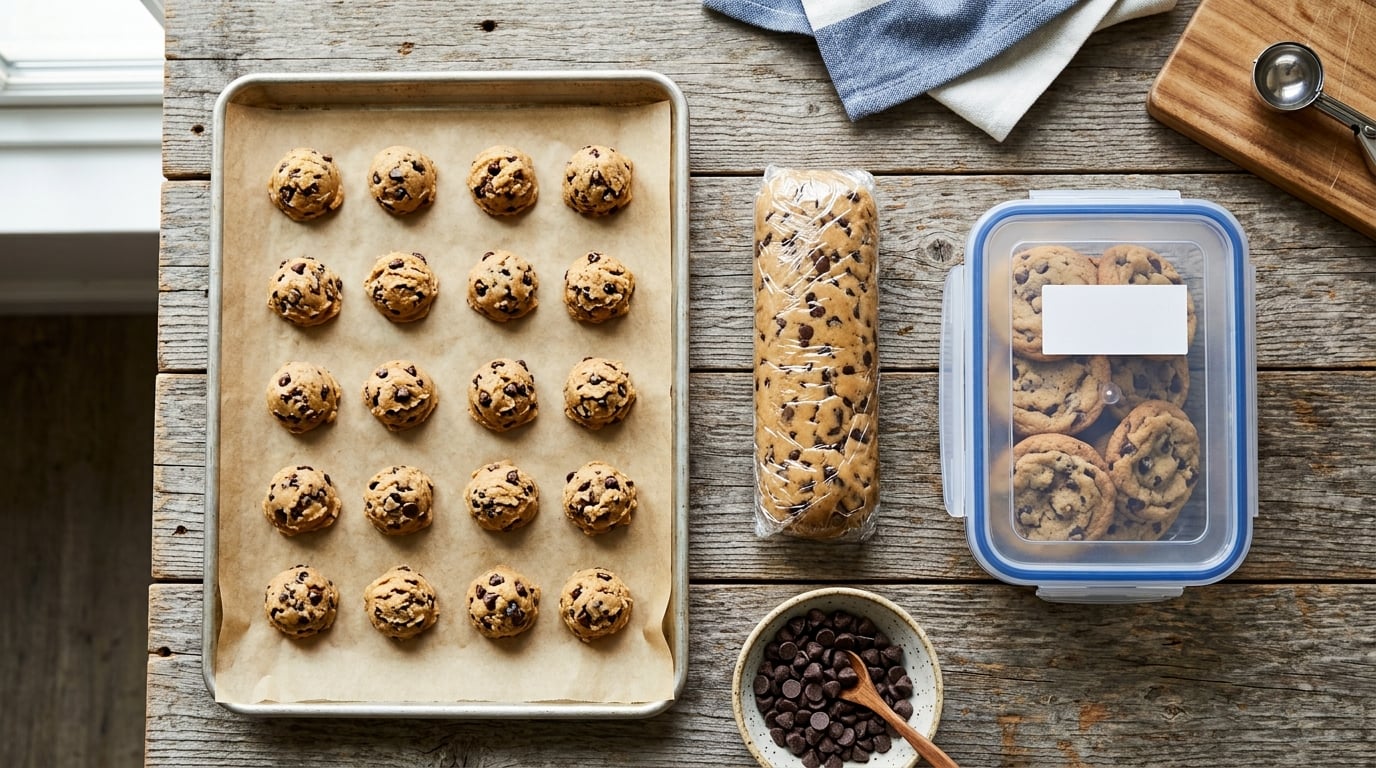
To freeze cookie dough for later, scoop it into balls, flash-freeze them on a parchment-lined baking sheet for 1 to 2 hours until solid, then move them to a labeled zip-top freezer bag. Stored airtight that way, dough balls keep well for up to 3 months, and most drop cookies can go straight from the freezer into a slightly cooler oven with a few extra minutes of bake time.
That 3-month stash is what turns one afternoon of mixing into a whole season of warm cookies. Instead of a two-hour bake on a Saturday, you bake four cookies on a Tuesday because somebody wants a cookie now. Last updated October 2026.
Table of Contents
How to Freeze Cookie Dough for Later: Quick Storage Guide
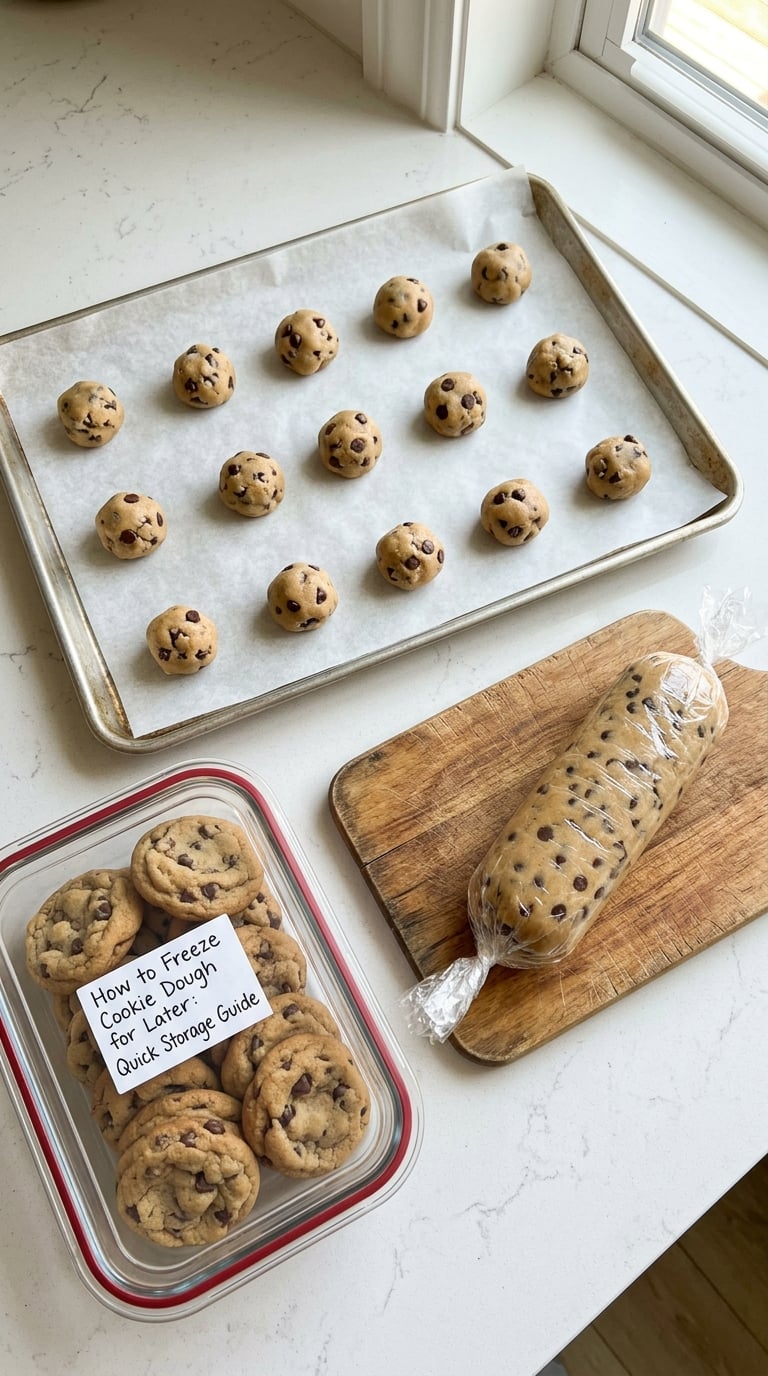
Three freezing methods cover almost every cookie you will ever bake, and each one trades a little convenience for a little freshness. Here is the short version before the detail.
| Freezing method | Best for | Keeps in the freezer | Main benefit |
|---|---|---|---|
| Portioned dough balls | Drop cookies: chocolate chip, oatmeal, snickerdoodle | Up to 3 months | Bake one or two at a time, no portioning later |
| Wrapped dough log | Slice-and-bake and icebox cookies, shortbread | Up to 3 months | Clean even slices whenever you want them |
| Fully baked cookies | Crisp cookies, decorated cutouts, iced cookies | Up to 4 months | No oven time at all, thaw and serve |
Everything else, from bar dough to sugar-cookie cutouts, is a variation on one of these three. I keep one bag of balls for cravings and one log for weekends, and that covers most weeks without any planning.
Which Cookie Dough Freezing Method Should You Use?
Choose the method that matches how you intend to use the cookies, not the recipe. Scooped dough balls suit baking in small amounts, a log suits people who want uniform slices every time, and baked cookies suit anyone who would rather not turn on the oven at all.
Freeze dough balls for on-demand baking
This is the one I use most. Portion with a cookie scoop or a trigger ice cream scoop so every ball bakes to the same size, then freeze them flat. It takes about five minutes extra at mixing time and saves you from dealing with a frozen brick of dough later.
Freeze a dough log for slice-and-bake cookies
Roll the dough into a log about 2 inches thick, wrap it tightly in plastic wrap, then add a second layer of foil or parchment. Chilled snickerdoodle, shortbread, and molasses cookies slice beautifully this way, and the log itself survives the freezer better than thin discs.
Freeze baked cookies when you have no freezer patience
Baking the batch first and freezing the finished cookies costs you the same afternoon but nothing later. Cookies thaw in about 20 minutes at room temperature and keep their texture for up to 4 months. Iced and decorated cookies are the exception, since condensation can dull a design or make royal icing sticky.
Which method to pick for a bake sale
Freeze dough balls. You can bake and cool in waves on the day of the sale, and leftovers are still dough rather than stale cookies. For a holiday gift tin, a frozen log of ginger molasses dough is more forgiving than a last-minute batch from scratch.
How Long Can Cookie Dough Stay in the Freezer?
Frozen cookie dough stays usable for up to 3 months, and baked cookies for up to 4 months. The window is shorter for doughs with a lot of moisture or very soft doughs, and longer for shortbread-type doughs that are mostly butter and flour.
| Format | How long it stays good | Notes |
|---|---|---|
| Dough balls | Up to 3 months | Best used within 8 weeks for the softest centers |
| Dough log | Up to 3 months | Thaw in the refrigerator before slicing |
| Dough discs (sugar cookies) | Up to 3 months | Roll or cut while thawed, not frozen |
| Bar dough in the pan | Up to 3 months | Wrap the whole pan tightly with plastic wrap |
| Baked cookies | Up to 4 months | Cool fully on a rack before wrapping |
Most standard doughs handle the full 3 months without trouble. Sugar cookie dough is fine but loses a little snap, so freeze it when you know you will bake within 6 to 8 weeks. Oatmeal and chocolate chip doughs hold their chew remarkably well, and shortbread-style dough can go the whole 3 months.
After 3 months, frozen dough does not become unsafe. It goes bland and picks up freezer odors, and that is the real reason to eat it earlier. A badly sealed bag tastes faintly of frozen peas no matter how long the dough has been in there.
How to Prepare Cookie Dough Before Freezing
Preparation is where most freezing mistakes happen. A warm dough ball freezes unevenly, a bag with loose air gets freezer burn, and an unlabeled bag becomes a mystery object in March.
- Finish the chill first. Most doughs want 24 to 72 hours in the refrigerator before they go to the freezer. The fridge firms the butter and lets the flavors settle, and freezing cannot do that job for you.
- Portion before freezing. Scoop the dough with a cookie scoop or measure it by spoonfuls. Never freeze one solid mass, because you cannot break it back up cleanly later.
- Squeeze the air out. Seal the bag, press the air toward the top, and zip it shut. A vacuum sealer works if you own one, but a zip-top bag pressed flat is close enough.
- Label with the recipe and date. Include the variety, the quantity in cookies, the bake temperature, and the date. I write it on a strip of painter tape stuck on the bag, which peels off cleanly.
- Keep dough off freezer surfaces. Dough that touches the shelf or the side of the container can pick up off-flavors fast. Always put the dough in a bag or a lidded box rather than straight onto a wire shelf.
Skip the raw flour no-cook angle entirely. Every dough on this page is baked, and dough made with raw egg is fine to freeze as long as it gets a full bake.
How to Freeze Cookie Dough in Three Simple Ways
Method 1: How to Freeze Cookie Dough as Individual Balls
- Scoop chilled dough onto a baking sheet lined with parchment paper, spacing the balls about 1 inch apart so they do not touch.
- Freeze the sheet uncovered for 1 to 2 hours, until the balls are hard to the touch.
- Lift the parchment and transfer the balls to a heavy-duty zip-top freezer bag or a lidded airtight container.
- Press out the air, seal, and label with the recipe, the number of cookies, the bake temperature, and the date.
- Store flat in the freezer for up to 3 months, and bake directly from frozen with no thawing.
Method 2: Freezing a Wrapped Cookie Dough Log
- Roll the chilled dough into an even log about 2 inches thick on parchment paper.
- Wrap it tightly in plastic wrap, pressing out air at every turn, then wrap again in parchment or foil.
- Freeze for 2 to 4 hours until the log is solid all the way through.
- Move it to a labeled freezer bag, where it keeps for up to 3 months.
- Thaw the log in the refrigerator for 24 to 48 hours, then slice with a sharp serrated knife and bake as usual.
Letting the log reach refrigerator temperature before you cut it matters. Slicing a rock-hard log shaves slices instead of cutting them, and shaved slices bake into uneven shapes.
Method 3: Freezing Baked Cookies
- Bake the batch and cool the cookies completely on a wire rack, usually 20 to 30 minutes.
- Stack them in a single layer or in small layers separated by parchment paper inside an airtight container or freezer bag.
- Seal, label, and freeze for up to 4 months.
Baked cookies soften in the freezer if they go in warm, and the condensation that creates can make them sticky on top. Cool first, always. If you have room, freeze them in a single layer on a tray first, then pack them into the container once they are hard.
How to Thaw and Bake Frozen Cookie Dough
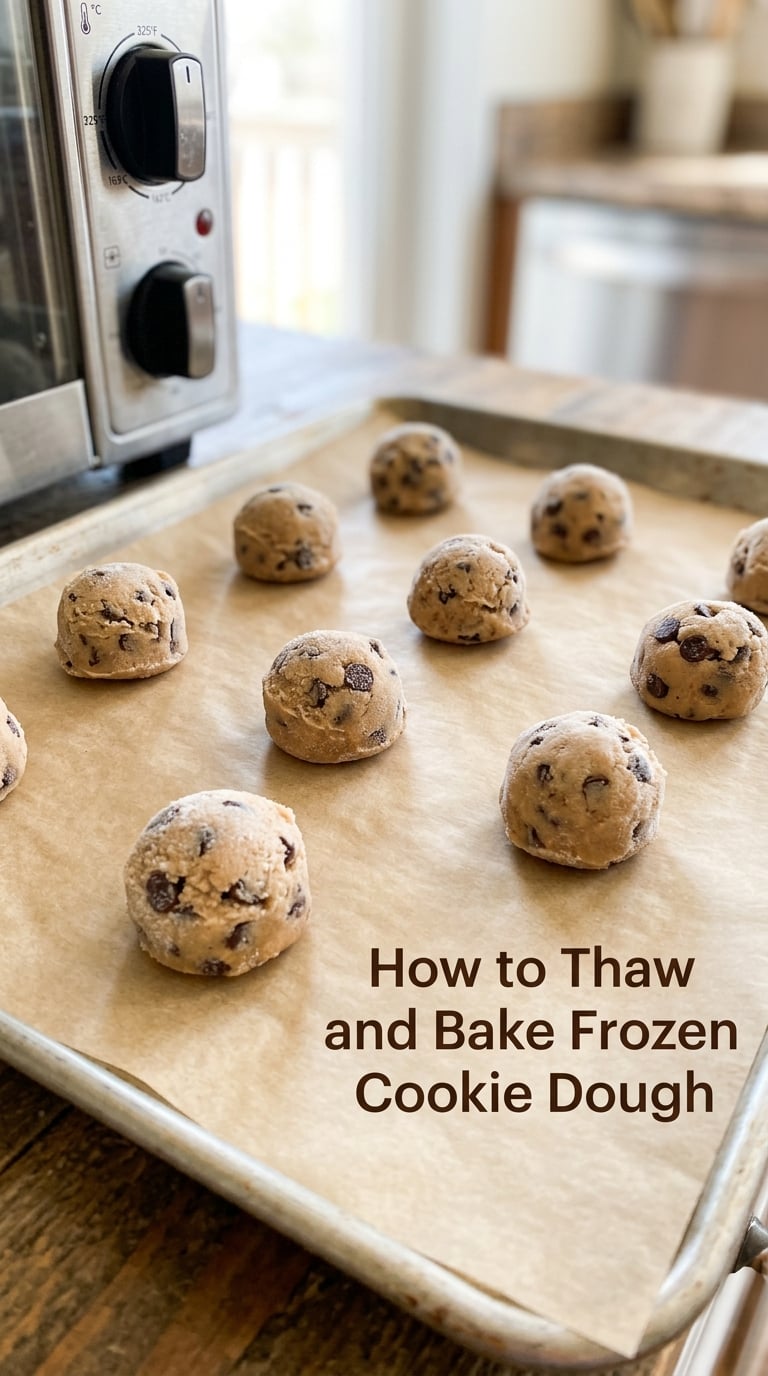
Bake frozen dough straight from the freezer for drop cookies and dough logs. There is no benefit to thawing, and thawed dough is easier to overwork, so it spreads more and loses its shape. Drop the balls about 1 inch apart on a baking sheet, leaving 2 inches between balls so they can spread.
The freezer cools the dough, so the oven needs a little help to get back to temperature. Drop the setting about 25°F and add 1 to 3 minutes to the usual bake time.
| Normal oven temperature | Bake frozen dough at | Extra time |
|---|---|---|
| 350°F (175°C) | 325°F (165°C) | 1 to 3 minutes |
| 375°F (190°C) | 350°F (175°C) | 1 to 3 minutes |
| 325°F (165°C) | 300°F (150°C) | 2 minutes |
The signs of a frozen dough cookie that is working: the edges set and turn golden about 2 minutes before the center firms, and the finished cookie has a matte, slightly paler top than a same-day cookie. If the outside browns while the middle stays raw, add another 2 minutes at the reduced temperature rather than turning the heat up.
To bake logs, thaw in the refrigerator for 24 to 48 hours and bake at your normal temperature. For sugar cookie discs and cutouts, thaw until workable, re-roll if the edges look tired, and bake as directed. Bar dough frozen in the pan goes straight into the oven, though it needs a longer bake since the whole pan is cold.
Never thaw cookie dough on the counter. Room-temperature thawing lets surface bacteria grow on raw egg and raw flour. Move the dough to the refrigerator, or to the baking sheet and then the fridge, and let it come to temperature there.
What Containers Work Best for Freezing Cookie Dough?
Whatever you use has one job: keep air out. Freezer burn happens when moisture on the dough escapes and the surface goes dry, which dulls the flavor and dulls the texture with it.
- Heavy-duty zip-top freezer bags for dough balls. The narrow shape suits a single layer, and you can write a label right on the front with a marker.
- Airtight containers for logs and bar dough. A rigid box holds a cylinder straight instead of letting it bend, and stackable boxes keep the freezer readable.
- Parchment paper between layers of anything. It keeps cookies and discs from touching, which is the whole point for a sliced log stored next to a box of balls.
- Plastic wrap plus foil for logs before they go in a bag. The double wrap is what stops a log from going stale on the cut faces.
To keep dough balls from fusing into one solid mass, freeze them solid on the sheet first, then lay them in a single layer in the bag. When you need a second layer, add a sheet of parchment and do not stack more than two deep. One bag per recipe also means you pull out three cookies rather than a mystery mix of forty.
If you open a bag and the balls are welded together, break the block apart while it is still frozen and drop the pieces onto a cold baking sheet. Cold separates cleanly; thawed dough smears into a single lump, and you cannot portion that.
Can You Freeze Cookie Dough With Chocolate Chips?
Yes, chocolate chip cookie dough is one of the best candidates for freezing. Standard chips are stable when frozen, and dough balls baked from frozen come out with a crisp browned edge and a soft, chewy middle.
A couple of adjustments help. If your dough is very soft, chill it a little longer than the recipe says before scooping, because soft dough spreads thinner when it hits the warm sheet. The extra 1 inch of spacing from the original recipe also matters more here, since the oven is working against cold dough that will not set as quickly.
Delicate mix-ins are the exception. Freshly grated coconut, chopped nuts, and anything dusted in powdered sugar or cornstarch can turn grainy after thawing. Toast the nuts before freezing them, and add powdered-sugar cookies only if you are baking within a couple of months. For more ideas that freeze well, browse our 13 easy homemade cookie recipes.
Common Cookie Dough Freezing Mistakes
Bagging the dough warm. Warm dough freezes into a lumpy mass, and the lumps are impossible to portion later. Chill the dough in the refrigerator first, 24 to 72 hours depending on the recipe.
Freezing before the dough is solid. Balls moved to the bag after 20 minutes instead of a full 1 to 2 hours merge into one block. The flash-freeze step is the one step nobody should shorten.
Leaving air in the bag. Air means moisture moves around, and you get freezer burn. Press the bag flat before zipping it closed.
Forgetting to label. An unlabelled bag in December is an unlabelled bag in February. Recipe, count, temperature, and date, every time.
Thawing on the counter. Raw egg and raw flour are not safe at room temperature for long. Thaw in the refrigerator and use the dough promptly.
Baking frozen dough at full heat. The outside browns before the inside cooks, and you get a raw middle wrapped in a dark edge. Drop the oven 25°F and add a couple of minutes instead.
Storing dough beside strong smells. Freezer odors travel through a bag that is not airtight, and dough absorbs them fast. Seal it properly and keep it away from the unopened bags of broth and spices in the door.
Dough that is genuinely delicate does not belong in the freezer at all. French macarons, pizzelles, and meringue-based cookies set by drying rather than baking, and frozen they come out flat and brittle. If you want to make those, make them fresh and plan the timing. For seasonal batches that freeze beautifully, our easy Christmas cookie recipe ideas are a good place to start, and a reliable sheet pan helps more than people think, so do check our best cookie sheet sets when your current one is warped.
Frequently Asked Questions
Can I freeze cookie dough after mixing it?
Yes, you can freeze cookie dough after mixing it, though chilling it in the refrigerator for 24 to 72 hours first gives you better flavor and a firmer texture. Portion the dough before it goes into the freezer, since a frozen block of dough cannot be broken into usable pieces later. Every dough that contains raw egg or raw flour should be fully baked, which all the methods here do.
Do you need to chill cookie dough before freezing?
You do, and the refrigerator chill is not optional. Chilling firms the butter so the dough holds its shape, and it lets the flavors settle into each other overnight. A 24 to 72 hour chill in the refrigerator is the usual range. Dough that skips the chill and goes straight to the freezer spreads more in the oven and bakes up flatter.
Should frozen cookie dough be baked from frozen or thawed?
Bake drop cookie dough straight from the freezer with no thawing at all. Lower the oven about 25°F and add 1 to 3 minutes to the usual bake time, and space the balls about 1 inch apart. Logs, discs, and cutouts are the exceptions: thaw those in the refrigerator for 24 to 48 hours so you can slice and roll them cleanly.
How do I keep cookie dough balls from sticking together in the freezer?
Flash-freeze the balls on a parchment-lined baking sheet for 1 to 2 hours until they are hard to the touch, then transfer them to a bag in a single layer. Freezing them solid first is what stops them fusing. For a second layer, add a sheet of parchment and keep it to two layers deep. If they have already welded into a block, break it apart while it is still frozen.
Can you freeze cookie dough in a Ziploc bag?
Yes, a zip-top freezer bag is the container most people should use. A regular sandwich bag works for small batches, but a heavy-duty freezer bag is less likely to puncture or let air in. Press the excess air out before you seal it, lay the dough in a single layer, and write the recipe, count, bake temperature, and date on the front.
Can you freeze cookie dough logs and slice them after thawing?
Freeze the log wrapped tightly in plastic wrap plus a second layer of parchment or foil, and it keeps for up to 3 months. Thaw it in the refrigerator for 24 to 48 hours before slicing, since a rock-hard log shaves into uneven slices instead of cutting. Once thawed, slice with a sharp serrated knife and bake at your normal oven temperature.
Easy Cookie Dough Freezing Cheat Sheet
Pick your method first: balls for cookies you want one at a time, a log for cookies you want sliced, baked cookies for cookies you want to eat without a baking sheet involved. Then chill the dough 24 to 72 hours, portion it, and label the bag before it goes in.
The freezer is the store; your counter is the bakery. Pull out only what you are baking today, thaw nothing you do not have to, and the last batch of the year will taste like the first one did. If you are still planning what to bake, start with our 13 easy homemade cookie recipes and pick two that freeze well, then mix one big batch and split it between the bag and the log.