
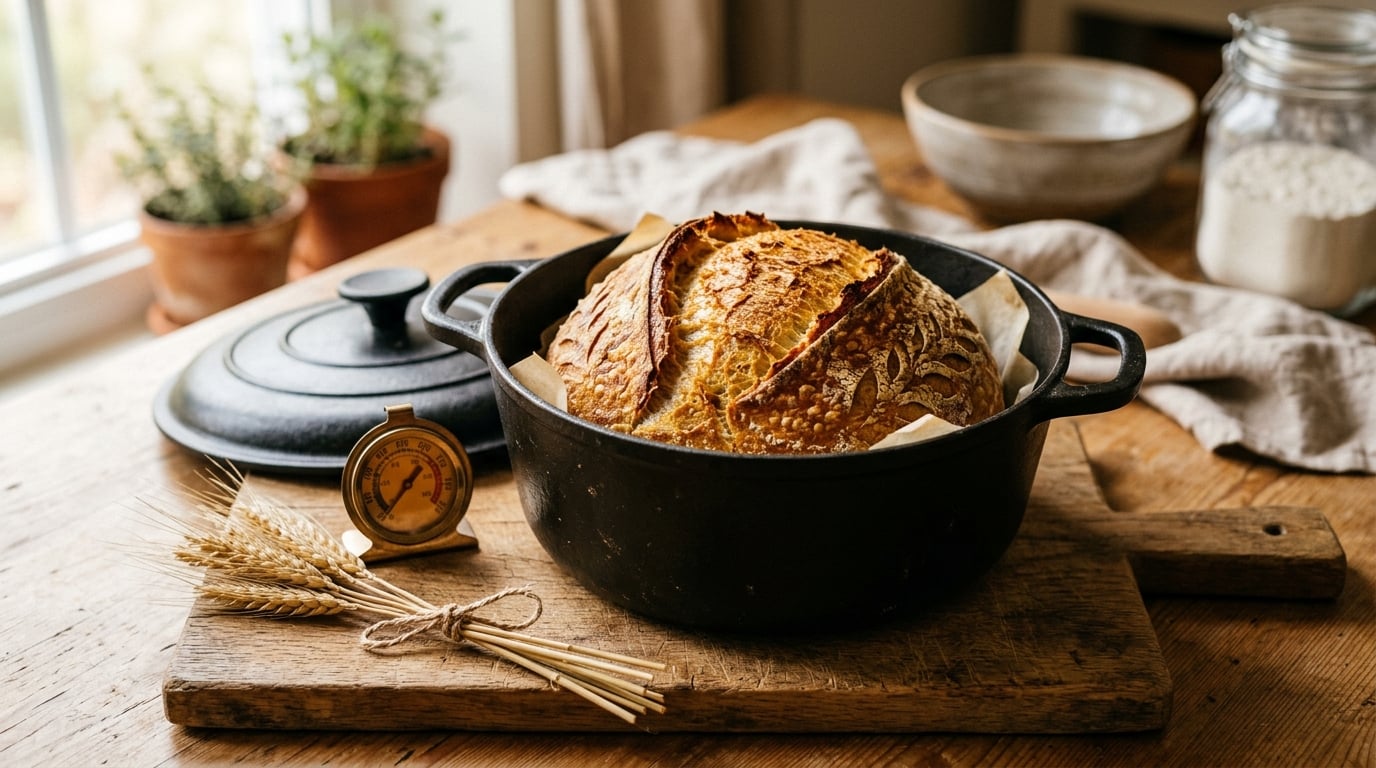
Bake most bread at 425°F to 450°F (220°C to 230°C). That is the short answer to what temperature to bake bread at for almost every home loaf, baguette and dinner roll. The exception is enriched bread with sugar, milk, butter or egg, which belongs at 350°F to 400°F (175°C to 200°C) so the outside does not scorch before the middle cooks through.
I have baked on the same run-of-the-mill home oven for years, and the number on the dial tells you less than most people assume. A second, different number decides when the loaf is actually done: the internal temperature in the center of the crumb. Both numbers matter, they answer different questions, and once you keep them apart you stop guessing.
Fall baking season is when most people take this up anyway. Whatever you are baking, the recipe’s stated temperature is a good starting point, and this guide explains what to change when your oven runs hot, when you use convection, or when the loaf is bigger than the one the recipe pictured.
Table of Contents
What Temperature to Bake Bread At: Quick Guide
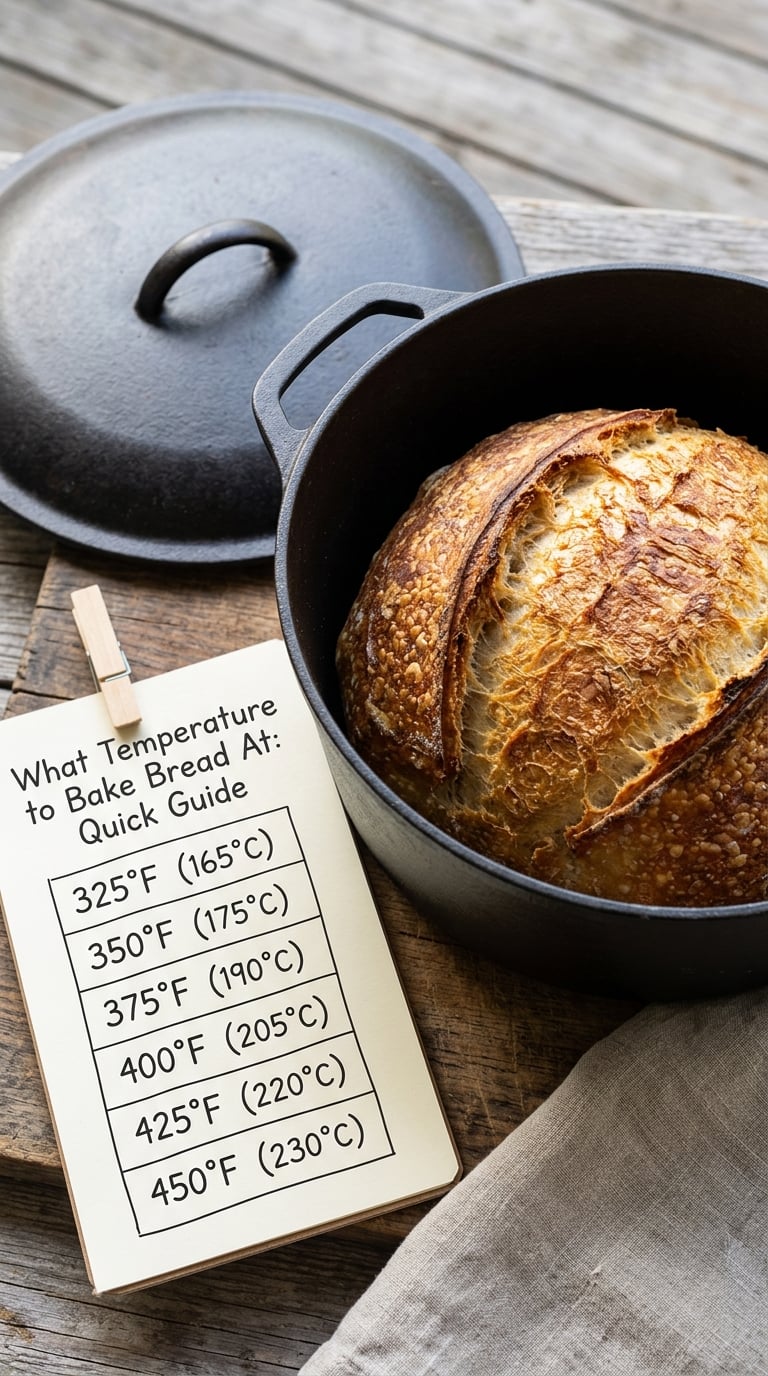
Start with the table below, find your bread, and use the oven temperature and the internal target together. The bake times assume a fully preheated oven and dough that has completed its final proof.
| Bread type | Oven temperature | Typical bake time | Internal target |
|---|---|---|---|
| Sandwich or enriched white loaf | 350-375°F (175-190°C) | 30-40 min | 190-200°F (88-93°C) |
| Sweet quick bread, banana bread | 350-375°F (175-190°C) | 50-65 min | 200°F (93°C) |
| Brioche or milk bread | 350-375°F (175-190°C) | 30-40 min | 190-200°F (88-93°C) |
| Whole wheat loaf | 375-400°F (190-200°C) | 35-45 min | 195-205°F (90-96°C) |
| Rye bread | 350-400°F (175-200°C) | 40-50 min | 205-210°F (96-99°C) |
| Sourdough boule in a Dutch oven | 450°F (230°C) covered, 425-450°F uncovered | 45-60 min | 205-210°F (96-99°C) |
| No-knead loaf | 450°F (230°C) | 40-45 min | 205°F (96°C) |
| Baguette | 450°F (230°C) with steam | 20-25 min | 200-205°F (93-96°C) |
| Dinner rolls and buns | 375-400°F (190-200°C) | 12-18 min | 190°F (88°C) |
| Bagels, boiled first | 425-450°F (220-230°C) | 20-25 min | 190-200°F (88-93°C) |
| Pretzels | 425-450°F (220-230°C) | 15-20 min | 190-200°F (88-93°C) |
| Focaccia and flatbread | 425-450°F (220-230°C) | 20-30 min | 200-205°F (93-96°C) |
| Gluten-free yeast bread | 350-375°F (175-190°C) | 30-40 min | 205°F (96°C) |
Two quick notes before you go further. First, preheat a full 30 minutes at 450°F (230°C); a loaf that goes into a barely warm oven spreads and bakes unevenly. Second, if you own an oven thermometer, put it in the oven now. Home dials are routinely off by 25°F, and that single fact explains most dark bottoms and pale tops. If you are just starting out, my [10 easy focaccia bread recipes for beginners](https://thesweetandsimplekitchen.com/easy-focaccia-bread-recipes-for-beginners/) are a forgiving place to learn the feel of a hot oven.
Which Temperature Is Best for Different Types of Bread?
The best temperature is the one that suits the dough’s weight, sugar and moisture. Lean dough made only of flour, water, salt and yeast wants a hot oven because a burst of heat early on gives it lift before the crust sets. Enriched dough is a different animal. Sugar and dairy brown fast, so a 450°F (230°C) oven browns the loaf’s shoulders long before the buttery center finishes setting.
What Temperature to Bake Bread At by Bread Type?
- Sandwich bread: 350-375°F (175-190°C). Gentle heat protects the crust and gives an even, soft crumb. Push to 190-200°F (88-93°C) inside.
- Whole-grain loaves: 375-400°F (190-200°C). Whole grain holds more water, so the center needs longer and runs wetter. Aim for 195-205°F (90-96°C).
- Sourdough: 450°F (230°C) covered, then 425-450°F (220-230°C) uncovered. The lid traps steam, the open finish browns the crust. Pull at 205-210°F (96-99°C).
- Dinner rolls: 375-400°F (190-200°C) for 12-18 minutes. Small and thin, so they brown long before the center could catch up at 450°F.
- Bagels: 425-450°F (220-230°C) after a short boil. The boil sets the crust, so the bake is mostly for color.
- Pretzels: 425-450°F (220-230°C). Same logic as bagels, and the high heat is what gives the deep chestnut color.
- Quick breads: 350-375°F (175-190°C) for 50-65 minutes. These are batter, not yeast dough, and sugar is everywhere. A skewer at 200°F (93°C) with no wet batter is the test.
- Gluten-free: 350-375°F (175-190°C). Lower heat limits the crust before the starch finishes setting; the crumb is done nearer 205°F (96°C).
If you like a heavier, softer crumb, look at my [12 old fashioned bread recipes](https://thesweetandsimplekitchen.com/best-old-fashioned-bread-recipes-ideas/) and keep an eye on the temperature column. Many of those are enriched or whole-grain, and the number is lower than you would use for a sourdough.
How Do You Know When Bread Is Fully Baked?
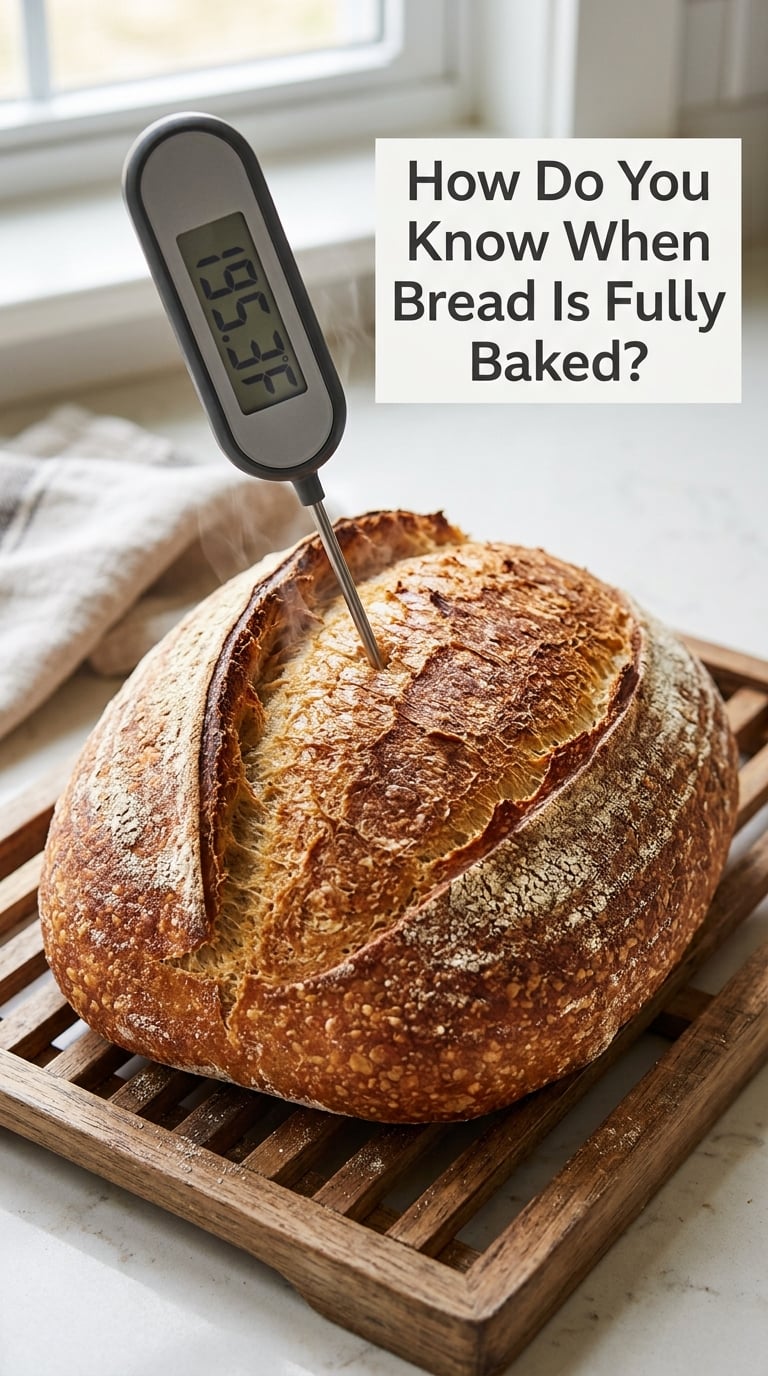
Bread is done when the center of the crumb hits its target temperature, not when the timer says so. Ovens vary, doughs vary, and every time on a recipe is an estimate. One useful fact settles a lot of anxiety: bread’s internal temperature can never go above 212°F (100°C), the boiling point of water, so you cannot accidentally cook the crumb past done.
- Wait five minutes less than the recipe’s stated time, then start checking.
- Take an instant-read thermometer, not a probe left in during the bake, which reads the oven temperature rather than the crumb.
- Insert the tip into the thickest part of the center, at an angle, without touching the pan or the crust.
- Read, pull, and look. The number is the main signal; color and feel confirm it.
- If you are 10 to 15°F (5-8°C) short, give it two to three more minutes and check again.
Use your senses alongside the reading. A well-baked loaf is deep golden brown, sounds hollow when you tap the bottom, and feels light for its size. Thin things like baguettes and flatbread are better judged by color, since a probe tip can skew a small volume easily. An underbaked loaf feels heavy and damp, and a crumb that squishes under a finger is still gummy rather than set.
There is a small amount of carryover cooking, mostly in large, dense loaves. That is why the safe move is to err a minute or two long rather than pull early, and why the last five degrees matter more in a rye or sourdough than in a dinner roll.
Should I Reduce the Temperature for Convection Baking?
Yes, usually by 25°F (15°C). A convection fan pushes hot air past the food, so the crust browns faster and the loaf bakes in less time. Bake a sourdough boule at 425°F (220°C) in convection rather than 450°F, and check it five minutes earlier than you would conventionally.
Bread that is dense or enriched is the exception. A banana loaf or a whole wheat sandwich loaf can dry out and darken too fast with aggressive airflow, so reduce by only 15°F (8°C) or use the standard temperature with the fan off.
If your oven has a convection setting that lets you choose fan on or off, turn the fan off for the first ten minutes on a loaf with a lid or a pan, then switch it on. That gives the dough a gentle rise before the fan starts driving color.
How Do Dough Size, Pan Type, and Proofing Change the Baking Time?
Size changes time, not temperature. Twelve dinner rolls at 375°F (190°C) take about 15 minutes; the same dough as one big boule at 450°F (230°C) takes the better part of an hour. Keep the recipe’s temperature and adjust the clock, checking small items early and large ones late.
Pan material matters too. Dark metal loaf pans and cast iron conduct heat straight into the bottom of the loaf, which is why dark pans browning a crust before the top catches up is such a common complaint. If your bottom is going early, move the loaf to the center rack, wrap the base in foil, or double-pan it for the last ten minutes. A light-colored aluminum pan forgives a 10°F (5°C) hotter oven.
Proofing is the quiet factor. A fully proofed dough has the gas structure it needs, so it sets quickly and rarely spreads or burns. Dough that went into the oven underproofed spends its first minutes still trying to rise, which delays the crumb setting and leaves you exposed at exactly the wrong moment. A dough that has been sitting too long and gone slack will spread in a hot oven no matter what the dial says. If the bowl or the Dutch oven is the problem rather than the oven, [this list of bread cloche and proofing setups](https://thesweetandsimplekitchen.com/best-bread-cloches/) is worth a look.
Do You Need to Change Bread Baking Temperature at High Altitude?
You may want to lower it slightly, but check doneness earlier and treat time as the thing you adjust. Above roughly 3,000 feet (900 m) water boils at a lower temperature, so moisture leaves the dough faster and gases expand a little more. The result is a drier crumb and a crust that darkens sooner.
Start by dropping the oven temperature 5-10°F (3-5°C) from the recipe’s number. That small cut is enough; going much lower dulls the crust color without fixing anything. Bake time may stretch, so check the internal temperature from the early end of the stated time. If you are more than an hour or two above sea level, dough that is wet and slack spreads more, so a slightly firmer dough gives you more room to work with.
Do not go above the recipe temperature because of altitude. Faster drying is the problem, and more heat makes it worse.
How to Use a Baking Stone, Dutch Oven, or Steam for Better Bread
Preheated equipment changes the temperature strategy because it stores heat and delivers it fast. A baking stone or steel should sit in the oven at the baking temperature for at least 45 minutes, with the dough formed and ready to go in. The stone is not a way to bake at a lower oven setting; it is a way to get a crisp bottom at the same setting.
A Dutch oven does two jobs at once. Preheat the pot at 450°F (230°C) with the oven, bake the loaf covered for roughly 20 to 25 minutes to trap steam and keep the dough flexible, then drop to 425-450°F (220-230°C), remove the lid and bake another 20 to 25 minutes until the crust is deep brown. Handle the pot with dry oven mitts, and set the lid somewhere heat-safe rather than on a cold counter.
Steam is the other half of the crust. A tray of boiling water on the oven floor, a handful of ice cubes tossed onto that tray, or a spray of water onto the dough just before it goes in all delay evaporation so the crust stays stretchy and glossy. A kettle of boiling water poured onto a heated tray at the start of the bake works well and needs no special equipment. If the loaf is browning faster than you want, more steam is often the fix that lets you keep the high heat for the crust.
Common Bread Baking Temperature Mistakes and How to Fix Them
Nearly every bread problem traces back to a mismatch between the oven setting, the size of the loaf and the recipe’s clock. The fixes below run from least to most intervention.
- Pale, flat crust: the oven is too cool or was not preheated long enough. Give the oven a full 30 minutes, and verify it with an oven thermometer. A hot oven makes oven spring; a cool one does not.
- Burnt bottom, pale top: the loaf is too close to the heating element, or the pan is dark metal sitting on the floor of the oven. Move it up a rack, wrap the base in foil, or use a second pan as a riser.
- Dark crust wrapped around a doughy center: the outside is outrunning the inside. Shield the top with foil, drop 25°F (15°C), and check the internal temperature in the last ten minutes rather than trusting the timer.
- Dense, gummy crumb: usually underbaked, sometimes underproofed. Extend the bake two or three minutes at a time until the center hits its target. If the dough was slack going in, fix the proof next time rather than baking it longer.
- Collapsed or spread loaf: overproofed dough, or too hot an oven early in the bake. Check the dough before it goes in, and hold the temperature a little lower for the first ten minutes if the oven runs hot.
- Uneven browning: rotate the loaf once, about two-thirds of the way through, and move the rack if the back of the oven is stronger than the front.
Almost all of these trace back to an uncalibrated oven, which is why an oven thermometer is the first tool I would buy. If you are using a bread machine instead, the temperature is fixed for you and the clock and internal target do all the work; [these bread machine recipes](https://thesweetandsimplekitchen.com/easy-bread-machine-recipes-for-beginners/) are built around that setup.
Frequently Asked Questions
What temperature should I use for most homemade bread?
Most homemade bread bakes at 450F (230C). Sourdough, no-knead loaves, baguettes, bagels and pretzels all do best in that hot range because the initial heat gives them lift and browns the crust fast. Sandwich loaves, brioche and quick breads sit lower at 350-375F (175-190C) because sugar and dairy burn before the center sets. If you are unsure, the recipe’s number is almost always right.
Why is my bread burning on the bottom but pale on top?
That pattern points to heat reaching the base of the loaf faster than the top, usually a dark metal loaf pan sitting low in the oven. Move the loaf up a rack, wrap the base in foil, or set it on an upside-down second pan to lift it off the floor. A lower temperature for the last ten minutes helps too. Finally, check your oven with a separate oven thermometer, because dials are often off by 25F or more.
Can I bake bread at a lower temperature and bake it longer?
Yes, with care. Dropping from 450F to 350F (230C to 175C) will bake the loaf through, but you trade away crust color and oven spring for a longer bake, so expect a paler, softer, thicker crust. Add time in 5 to 10 minute steps and judge by internal temperature rather than the clock. Going much below 325F (165C) is rarely worth it and leaves the crumb dense and underdone.
Should I cover bread while baking to keep the crust soft?
A covered Dutch oven or loaf pan is about trapping steam, not softening the crust. Steam keeps the young crust stretchy so the loaf can expand, and the lid comes off for the second half of the bake so the surface can dry and brown. For a soft crust, lower the temperature slightly and pull a touch earlier. For a soft top and a dark bottom, tent the loaf loosely with foil after the crust color is where you want it.
Does bread temperature affect whether the loaf rises properly?
Yes, mostly in the first ten minutes. A hot oven drives oven spring, so lean dough that has had a full proof will expand before the crust sets. If the oven is too cool, the loaf rises more slowly, spreads and stays dense. A loaf that is already overproofed will not be rescued by heat and will spread instead of climbing, so proofing is the more important variable. Proofing is also much cooler than baking, typically 75-85F (24-29C).
A Simple Temperature Plan for Better Bread
Use the temperature the recipe gives you, then let the dough and the oven have a look. Preheat properly, run convection 25°F (15°C) lower, and keep an oven thermometer in there so you know what the number on the dial really means.
Check small loaves early and big ones late, and stop when the center of the crumb hits its target rather than when the timer rings. If you take one habit from this guide, make it the thermometer in the middle of the loaf. That single reading fixes more bad bread than any change to the dial, and it is the same reason knowing what temperature to bake bread at only gets you halfway to a good loaf.