
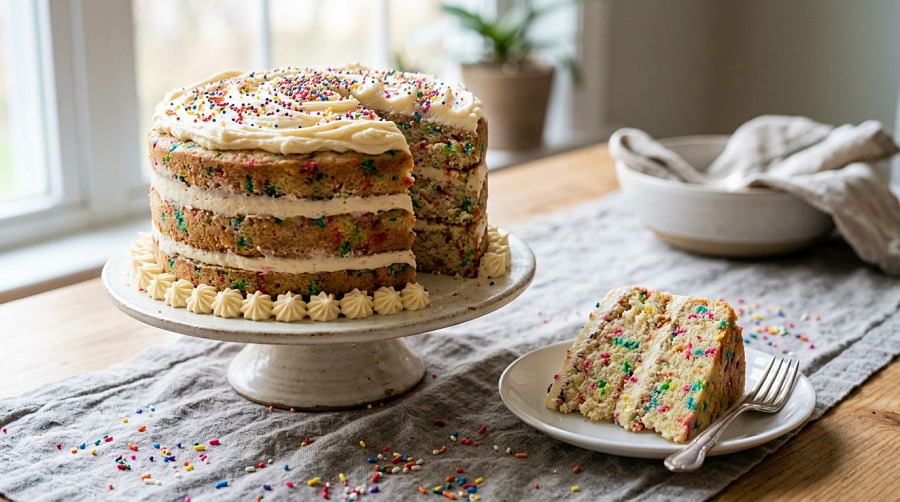
The first time someone asked me for my “from scratch” confetti cake recipe at a birthday party, I almost laughed in their face. It was a box mix. A doctored one, sure, but the kind of box that costs three dollars at the grocery store and lives next to the brownies. That moment is exactly why I keep coming back to this doctored confetti cake mix method. It tastes like I spent four hours on it, and it took me twenty minutes of active work.
If you have ever felt that creeping baking anxiety where you spend forty dollars on flour, fancy vanilla, and cake flour only to end up with a dry, sad layer cake, this is your answer. A few smart swaps turn a doctored confetti cake mix into something soft, buttery, and bakery-worthy, without the risk.
To make a box confetti cake mix taste homemade, swap the water for room-temperature buttermilk, replace the oil with melted unsalted butter, add an extra egg yolk, stir in 2 teaspoons of pure vanilla extract, and top it with real homemade buttercream. The fat, dairy, and yolk change the structure and flavor enough that nobody will know it started in a box.
Table of Contents
Doctored Box Confetti Cake Mix Recipe At a Glance
| Details | |
|---|---|
| Prep time | 15 minutes |
| Cook time | 28 minutes |
| Total time | 1 hour 30 minutes (with cooling) |
| Servings | 12 slices |
| Difficulty | Easy |
| Approx. calories | 480 per slice (with buttercream) |
| Cuisine | American |
In this guide I walk through the exact swaps, the full ingredient list with measurements, a step-by-step method for a three-layer naked cake, my go-to fluffy vanilla buttercream, and the tips I learned from baking this cake more times than I can count.
Why This Doctored Confetti Cake Mix Works
Box cake mixes are formulated with cheap fats and powdered milk solids that give a flat, slightly synthetic flavor. The chemistry of the rise still works perfectly, which means the structure is reliable. What is missing is fat content, real dairy, and proper vanilla. When you replace the water and oil with buttermilk and butter and add a yolk, you are essentially rebuilding the fat and flavor profile of a scratch cake on top of a foolproof base.
Fat coats flour proteins and slows gluten development, which is why butter and full-fat dairy produce a more tender crumb than oil and water. That single principle is what turns this confetti cake from grocery-store bland into something that tastes like a bakery birthday cake.
Ingredients
For the cake
- 1 box (15.25 oz) white or vanilla confetti cake mix (Pillsbury Funfetti and Betty Crocker both work)
- 1 cup buttermilk, room temperature
- 1/2 cup unsalted butter, melted and slightly cooled
- 3 large eggs, room temperature
- 1 large egg yolk
- 2 teaspoons pure vanilla extract
- 1/2 teaspoon fine sea salt
- 1/3 cup rainbow jimmies (not nonpareils, they bleed)
For the vanilla buttercream
- 1 cup unsalted butter, softened to room temperature
- 4 cups powdered sugar, sifted
- 3 tablespoons heavy cream
- 2 teaspoons pure vanilla extract
- 1/4 teaspoon fine sea salt
A note on substitutions, honestly: If you do not have buttermilk, you can make a quick substitute by stirring 1 tablespoon of lemon juice or white vinegar into 1 cup of whole milk and letting it sit 10 minutes. It works, but real buttermilk is thicker and gives a noticeably more tender crumb. If you only have salted butter, leave out the added salt in the cake. Skim milk in place of buttermilk is a true compromise and the cake will be drier, I would skip the project until you can get the right dairy.
The sprinkle choice matters more than you would think. Jimmies (the small cylindrical ones) hold their shape and color through the bake. Nonpareils (the tiny round balls) dissolve and turn the batter gray. Avoid them.
Equipment You Will Need
- Three 8-inch round cake pans (or two 9-inch if that is what you have)
- Parchment paper
- Stand mixer or hand mixer
- Offset spatula
- Bench scraper (for the naked cake finish)
- Serrated knife
- Cooling rack
Step-by-Step Instructions
1. Prep your pans and oven
Preheat the oven to 350°F. Cut three rounds of parchment to fit the bottoms of your 8-inch pans. Grease the pans, press the parchment in, and grease the parchment lightly. This is the single thing that prevents stuck cakes, and most box mix instructions skip it.
2. Whisk the wet ingredients
In a large bowl, whisk together the buttermilk, melted butter, eggs, egg yolk, and vanilla extract until smooth. The butter should be warm but not hot, otherwise it will scramble the eggs on contact. If you see streaks of butter in the buttermilk, give it another 30 seconds of vigorous whisking.
3. Combine wet and dry
Pour the cake mix and salt over the wet ingredients. Using a hand mixer on low speed, mix for 30 seconds to combine, then increase to medium for 90 seconds. Stop and scrape the bowl. The batter will be thicker than a standard box mix because of the higher fat and lower water content. That is correct.
4. Fold in the sprinkles
Switch to a rubber spatula and gently fold in the rainbow jimmies. Stop the moment they are distributed. Overmixing here will smear the colors and you will end up with a tie-dye batter.
5. Divide and bake
Divide the batter evenly between the three pans. I weigh mine on a kitchen scale (about 380 grams per pan) but eyeballing is fine. Bake on the middle rack for 24 to 28 minutes, until a toothpick inserted in the center comes out with a few moist crumbs. The tops should spring back when touched lightly.
6. Cool properly
Let the cakes cool in the pans for 10 minutes, then run an offset spatula around the edges and turn them out onto a cooling rack. Cool completely before frosting, at least 90 minutes. Frosting a warm cake is the number one cause of buttercream sliding off the sides like a sad waterfall.
Making the Homemade Buttercream
While the cakes cool, make the buttercream. Beat the softened butter in a stand mixer with the paddle attachment on medium-high for 4 minutes, until it is pale and fluffy. This step alone is what separates real buttercream from the canned stuff, the air you whip in changes the entire texture.
Reduce speed to low and add the sifted powdered sugar one cup at a time. Once incorporated, add the heavy cream, vanilla, and salt. Beat on medium-high for another 3 minutes until light, smooth, and spreadable. Taste it. If it is too sweet for you, add another pinch of salt. If it is too stiff, add cream a teaspoon at a time.
Assembling the Naked Confetti Layer Cake
- Level the cakes. Use a serrated knife to slice off any domed tops so each layer is flat. Save the scraps for snacking, that is the baker’s tax.
- Anchor the bottom layer. Place a small dollop of buttercream on your cake stand or plate, then press the first layer onto it flat-side down.
- Frost between layers. Spread about 1/2 cup of buttercream over the first layer using an offset spatula, going all the way to the edges. Place the second layer on top, top-side down. Repeat with another 1/2 cup of buttercream. Set the third layer on top, flat-side up.
- Crumb coat. Spread a thin layer of buttercream over the entire cake, sides and top. This locks in crumbs. Chill the cake for 20 minutes in the fridge.
- Add the final coat. Pile more buttercream on top and use the offset spatula to push it down the sides. Then run a bench scraper firmly along the sides at a 90-degree angle, scraping away excess until you can see the cake layers peeking through. That is the naked look.
- Finish. Pipe rosettes or kisses along the top edge using a Wilton 1M tip if you have one, then shower with extra sprinkles. Three or four fresh florals on top look stunning, but skip them if you have kids who might grab a bite without thinking.
Pro Tips From Many Batches
- Room temperature matters. Cold buttermilk and cold eggs will seize the melted butter into little flecks. Pull everything out an hour before you start.
- Weigh your flour-equivalent. If you are mixing two boxes for a larger cake, weigh the box contents. Some “15.25 oz” boxes are closer to 432 grams, others are 450 grams.
- The toothpick test lies sometimes. Look for the cake pulling away from the sides of the pan and a top that springs back. Those two signs together are more reliable than the toothpick.
- Sift the powdered sugar. I used to skip this step and my buttercream was lumpy every single time. Two extra minutes of sifting saves the texture.
- Color the buttercream the day before. If you want pastel pink or blue frosting, mix it the night before. Gel food coloring deepens overnight, so what looks pale at midnight is the right shade by morning.
Variations Worth Trying
- Almond confetti cake. Swap 1 teaspoon of the vanilla for almond extract. Tastes like a wedding cake.
- Brown butter confetti. Brown the 1/2 cup of butter before melting and cooling. Adds a nutty depth that is incredible with vanilla buttercream.
- Lemon confetti. Add 1 tablespoon of lemon zest to the batter and 1 teaspoon to the buttercream. A bright, summery version.
- Chocolate buttercream finish. Use the same buttercream recipe but add 1/2 cup of unsweetened cocoa powder and an extra tablespoon of cream.
- Cupcakes instead. This batter makes 24 standard cupcakes baked at 350°F for 18 to 20 minutes. Same recipe, different format.
Storage, Make-Ahead, and Freezing
Counter: A fully frosted cake holds for 2 days under a cake dome at room temperature. The buttercream actually keeps the crumb soft longer than refrigeration does.
Fridge: Up to 5 days, covered. Pull slices out 30 minutes before serving so the buttercream softens back to its proper texture.
Freezing the cake layers: Wrap unfrosted, cooled layers tightly in plastic wrap, then foil. Freeze up to 2 months. Thaw on the counter still wrapped. The plastic catches the condensation as it warms, which keeps the layers moist.
Freezing the assembled cake: Freeze the finished cake uncovered until the buttercream is rock solid (about 2 hours), then wrap in plastic. Thaw in the fridge overnight. The buttercream holds up surprisingly well.
Make-ahead schedule: I bake the layers a day ahead, make the buttercream the morning of, and assemble two hours before serving. The cake actually tastes better on day two as the moisture redistributes.
Serving Suggestions
This cake is a birthday classic, but I have served it for baby showers, graduation parties, and last summer for a no-reason Tuesday because my kid had a hard week. It pairs well with strong coffee, a glass of cold milk, or vanilla ice cream if you really want to commit. If you are building a dessert table, this works beautifully alongside easy cake mix cookies for sprinkle-on-sprinkle abundance, or simpler treats like these 3-ingredient desserts.
For a backyard birthday spread, I pair it with a cold dessert like no bake cheesecake so guests have options. Coffee table parties get a plate of soft chocolate chip cookies alongside the cake.
According to the USDA FoodData Central guidelines, any cake made with eggs should not sit at room temperature for more than 2 hours if your kitchen is above 90°F. For most indoor settings, the standard 2-day counter rule applies.
Common Mistakes That Ruin a Doctored Confetti Cake Mix
- Using cold ingredients. Cold butter and milk seize, batter looks broken, cake bakes uneven.
- Overmixing after adding sprinkles. Tie-dye batter every time.
- Frosting warm cakes. The buttercream melts, the layers slide, you cry.
- Skimping on vanilla. Imitation vanilla in the box plus no real vanilla added equals a flat-tasting cake.
- Using nonpareils. They bleed. Always jimmies.
FAQ
Can I make this doctored confetti cake mix the day before?
Yes. Bake and cool the layers, then wrap each tightly in plastic wrap at room temperature overnight. Frost the next day. The crumb actually softens slightly, which works in your favor.
Why is my box cake mix cake dry?
The most common cause is overbaking, even by 2 to 3 minutes. Start checking at the 24-minute mark and pull the cakes the moment a toothpick comes out with moist crumbs. The other culprit is using water instead of dairy. Buttermilk fat is what keeps the crumb tender.
Can I use this method with chocolate cake mix?
Yes, the swap ratios work the same way. I add 1 tablespoon of espresso powder to chocolate box mixes to deepen the flavor. Skip the sprinkles, obviously.
How do I get a flat top on my cake layers?
Bake at 325°F instead of 350°F for about 5 extra minutes. The lower heat reduces doming. Or use cake strips (wet, wrapped around the pan edges) for an even flatter result.
Can I make this gluten free?
Use a 1-to-1 gluten free white or vanilla cake mix. King Arthur’s gluten free mixes respond well to this doctoring method. The texture is slightly denser but still very good.
How long does the buttercream keep?
In an airtight container in the fridge, up to 1 week. Before using, let it sit at room temperature for 1 hour and rewhip for 1 minute to bring back the fluffy texture.
Can I double this recipe for a larger cake?
Yes. Two boxes will fill three 9-inch pans or four 8-inch pans nicely. Double the buttercream too. Bake times stay roughly the same, check at 28 minutes.
Final Thoughts
This doctored confetti cake mix is the recipe I reach for when I need something that looks like I tried, tastes like I tried, and frees up an entire afternoon I would rather spend with my kids than with a pile of flour-dusted dishes. The trick is not in the box itself, it is in respecting that real fat, real dairy, and real vanilla can rescue almost any shortcut. The next time someone hands you a birthday and you are out of time and energy, this is the cake to make.
If you give this doctored confetti cake mix a try, leave a rating and a comment below. I love hearing how yours turned out, especially the variations. Save it to Pinterest for the next birthday that sneaks up on you in September, and tag me if you post the naked cake finish on Instagram.