
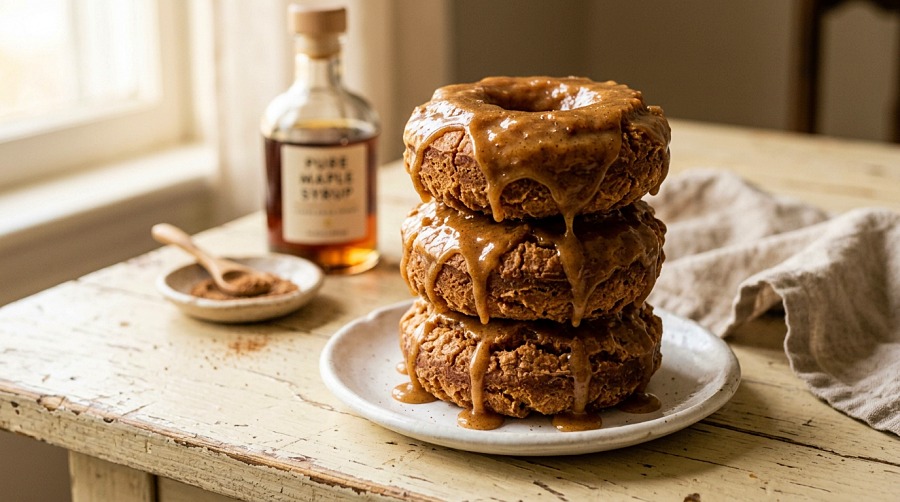
Today is a donut day. Honestly, around here every day is a donut day, but today the craving hit before my coffee had even cooled, and that is how I ended up elbow-deep in donut dough by 9 a.m. If you have ever stood in front of a bakery case and reached past the yeast donuts for the craggy, glaze-soaked old-fashioned ones, you already know what we are doing here. These sour cream cake donuts with a maple brown butter glaze are the homemade version of that exact donut — tender inside, crackly outside, and absolutely worth turning your stove on for.
I will not pretend frying donuts at home is zero effort. But it is also not the production it sometimes looks like online. One bowl of dough, a heavy pot of oil, and about an hour of your morning. That is the whole job. And the payoff is a stack of warm sour cream cake donuts that taste like the bakery counter at its very best.
Table of Contents
What Are Sour Cream Cake Donuts?
Sour cream cake donuts are fried, baking-powder-leavened donuts made with full-fat sour cream as the primary source of moisture and fat. The sour cream tenderizes the crumb, adds a subtle tang, and helps form the signature crackled, golden exterior when the dough hits hot oil. They are denser and more cake-like than yeast donuts, with cracks across the top that catch glaze beautifully.
At-a-Glance
| Detail | |
|---|---|
| Prep time | 25 minutes |
| Chill time | 1 hour (or overnight) |
| Cook time | 20 minutes |
| Total time | 1 hour 45 minutes |
| Servings | 12 donuts + about 20 donut holes |
| Difficulty | Intermediate |
| Approx. calories | 310 per glazed donut |
| Cuisine | American |
Below you will get the full ingredient list, step-by-step instructions, the maple brown butter glaze, and every troubleshooting answer I have ever needed for sour cream cake donuts at home. If you are completely new to frying donuts, I will hold your hand through the whole thing.
Why This Sour Cream Cake Donuts Recipe Works
The fat in full-fat sour cream does most of the heavy lifting here. According to the Kitchn, sour cream’s high fat content guarantees tender, moist doughnuts every time, with a similar effect to buttermilk but the bonus of not thinning out the dough. That fat also creates a soft crumb without making the dough wet, which is what gives you a tender interior and a crisp, crackled outside — not a heavy, greasy one.
Cold dough matters too. After mixing, the dough rests in the fridge for at least an hour. This firms up the butter and sour cream, makes the dough easier to roll and cut, and slows the baking powder reaction so it has more leavening power left when the donuts hit the oil.
The maple brown butter glaze is honestly what sets these apart from any other sour cream cake donut you have had. Browning the butter first gives the glaze a deep, nutty backbone, the maple syrup adds caramel notes and a faint smokiness, and a hint of vanilla rounds it all out. It is the kind of glaze that makes people quiet for a second after the first bite.
Ingredients
For the Sour Cream Cake Donuts
- 3½ cups all-purpose flour
- 1 tablespoon baking powder (double-acting)
- ½ teaspoon baking soda
- 1 teaspoon ground cinnamon
- 1 teaspoon freshly grated nutmeg (or ground)
- ¼ teaspoon fine salt
- 1 cup granulated sugar
- 2 large eggs
- ⅓ cup unsalted butter, melted and slightly cooled
- 1 teaspoon pure vanilla extract
- 1 teaspoon finely grated lemon zest
- 1 cup full-fat sour cream (please, not low-fat — it makes a real difference)
- Neutral oil for frying (canola, vegetable, or peanut), about 6 cups
For the Maple Brown Butter Glaze
- 3 cups powdered (icing) sugar, sifted
- 3 tablespoons pure maple syrup (the real stuff, grade A amber)
- ½ teaspoon pure vanilla extract
- 3 tablespoons brown butter (from about 4 tablespoons unsalted butter)
- 3 to 4 tablespoons whole milk
- Tiny pinch of salt
Ingredient Notes & Honest Substitutes
- Full-fat sour cream — non-negotiable. Low-fat changes both the moisture and the texture, and the donuts come out tougher. Greek yogurt (full-fat) works in a pinch but the tang is sharper and the crumb is a touch denser. Compromise, not equivalent.
- All-purpose flour — what we are using. Cake flour produces an even more tender, slightly crumblier donut if you want to swap in 3¼ cups cake flour instead. The crackled top is less pronounced with cake flour, in my experience.
- Nutmeg — fresh-grated has noticeably more aroma. Pre-ground works, just use a slightly fuller teaspoon.
- Lemon zest — adds brightness that balances the richness. Skip it if you don’t have it, but I would not.
- Maple syrup — pure maple syrup only. Pancake syrup makes the glaze taste flat and artificial. This is a hill I will die on.
Equipment You Will Need
- A heavy-bottomed pot or Dutch oven (4-quart or larger)
- A clip-on candy or deep-fry thermometer (the single most important tool here)
- A donut cutter, OR a 3-inch round cutter + a 1-inch round cutter
- A wire cooling rack set over a sheet pan
- A slotted spoon or wire spider
- Paper towels
How to Make Sour Cream Cake Donuts
Step 1: Mix the Dry Ingredients
In a large mixing bowl, whisk together the flour, baking powder, baking soda, cinnamon, nutmeg, and salt until evenly combined. Make a well in the center and set the bowl aside.
Step 2: Cream the Wet Ingredients
In a separate medium bowl, beat the eggs, sugar, vanilla, and lemon zest with an electric mixer on medium-high speed for about 2 minutes, until the mixture is pale, thick, and ribbony. Slowly stream in the melted butter while beating, until just combined. Add half the sour cream and beat to combine, then add the remaining sour cream and beat just until smooth.
Step 3: Fold Wet into Dry
Pour the wet ingredients into the well of dry ingredients. Using a spatula, gently fold the two together with about 15 to 20 strokes — you want everything just combined with no streaks of flour. The dough will be soft, slightly sticky, and look more like a thick batter than a typical dough. That is exactly right. Do not overmix; overworking the dough develops gluten and gives you tough, chewy donuts instead of tender ones.
Step 4: Chill the Dough
Scrape the dough onto a large piece of plastic wrap, pat it into a 1-inch-thick disc, and wrap tightly. Refrigerate for at least 1 hour, or up to overnight. The dough is far easier to work with cold, and the rest helps the flavors come together.
Step 5: Heat the Oil
When you are ready to fry, pour about 2 inches of neutral oil into your heavy pot and clip on your thermometer. Heat over medium heat to 350°F (175°C). Hold it there. According to King Arthur Baking, donuts fried at too low a temperature will absorb more oil and be greasy and heavy, so try not to let it dip below 340°F. Too hot and the outsides scorch before the centers cook. The thermometer is not optional.
Step 6: Roll and Cut
Lightly flour a cool work surface and turn your chilled dough out. Dust the top with flour and roll to about ½ inch thick. Cut out donuts with a 3-inch round cutter and a 1-inch cutter for the holes, or use a donut cutter if you have one. Lightly dip the cutter in flour between cuts so it does not stick.
Pro tip from years of trial and error: To get the rustic, bakery-style crack across the top, take a sharp paring knife and lightly trace a shallow circle around the top of each cut donut — just barely scoring the surface, not piercing all the way through. When the donut hits the hot oil, the score will open up into that classic craggy split.
For the scraps, do not re-roll. Re-rolled dough is tougher because of the extra handling. Instead, cut the leftover scraps into more little donut hole shapes. They will not be perfectly round, and that is part of the charm.
Step 7: Fry the Donuts
Working in batches of 2 to 3 donuts at a time so you don’t crowd the pot, gently lower the donuts into the hot oil. They will sink, then float to the top within about 30 seconds. Once they float, fry for about 1 minute, then flip with a slotted spoon and fry for another 1 minute on the second side. You are looking for a deep golden brown, almost mahogany, with the signature crackled top.
For the donut holes, they only need 1½ to 2 minutes total, turning occasionally so they cook evenly.
Step 8: Drain and Cool
Use a slotted spoon to lift each donut out, letting the excess oil drip back into the pot. Transfer to a wire rack set over a sheet pan lined with paper towels. Let them cool for about 5 minutes before glazing — long enough to handle, hot enough that the glaze will still soak into the cracks.
How to Make Maple Brown Butter Glaze
Step 1: Brown the Butter
Put 4 tablespoons of unsalted butter in a small light-colored saucepan over medium heat. Once it melts, swirl the pan occasionally. After 3 to 5 minutes, the butter will foam, then quiet down, and the milk solids on the bottom will turn a deep amber. You’ll smell something distinctly nutty and toffee-like — that’s your cue. Immediately pour the brown butter into a heatproof bowl, scraping in those toasted bits at the bottom, and let it cool for 5 minutes. Do not skip the scraping — that’s where all the flavor lives.
Step 2: Whisk the Glaze
Measure 3 tablespoons of the cooled brown butter into a medium bowl. Add the powdered sugar, maple syrup, vanilla, salt, and 2 tablespoons of milk. Whisk until smooth. If the glaze is too thick to pour, add the remaining milk 1 tablespoon at a time until you reach a thick but pourable consistency — it should coat the back of a spoon and slowly drip off, not run.
Step 3: Dip and Set
Dip the top two-thirds of each warm donut into the glaze, letting the excess drip off, then return to the wire rack. The glaze will set and form a soft crackled crust in about 10 minutes — if you can possibly wait that long.
Pro Tips for Perfect Sour Cream Cake Donuts
- Keep your dough cold. If your kitchen is warm and the dough softens while you are rolling, slide the rolled dough (still on the work surface) onto a sheet pan and pop it in the fridge for 10 minutes before cutting.
- Don’t crowd the oil. Adding too many donuts drops the oil temperature fast, and you’ll end up with greasy donuts. Three at a time, max, in a 4-quart pot.
- Watch the oil between batches. The temperature will dip every time you add donuts. Wait for it to climb back to 350°F before the next round.
- Glaze while warm. Warm donuts grab the glaze better and the glaze settles into the cracks instead of sitting on top.
- Score for the crack. That paring knife trick really is the difference between a smooth-topped donut and a true bakery-style one.
Variations
- Brown Butter Glaze (no maple) — Skip the maple syrup and add an extra teaspoon of vanilla. Cleaner, butterier flavor.
- Cinnamon Sugar — Skip the glaze entirely. Toss warm donuts in ½ cup granulated sugar mixed with 1 tablespoon cinnamon for an old-fashioned cinnamon donut.
- Chocolate Glaze — Use 2½ cups powdered sugar, ⅓ cup cocoa powder, 3 tablespoons melted butter, and 4 to 5 tablespoons milk. Whisk smooth.
- Apple Cider — Swap ¼ cup of the sour cream for reduced apple cider for a fall-spiced version. Lovely with the cinnamon-nutmeg base.
Storage, Make-Ahead, and Freezing
Same day: Donuts are best within 4 hours of frying. Store at room temperature, loosely covered, on a wire rack so the bottoms don’t get soggy.
Up to 2 days: Store glazed donuts in a single layer in an airtight container at room temperature. They will soften and the glaze will go from crackly to creamy — different, still good. I genuinely think these hold up better the next day than most fried donuts.
Make ahead: The donut dough can be made up to 2 days in advance and kept tightly wrapped in the fridge. Roll and fry when ready. Don’t fry, then store unglazed and try to glaze later — the glaze needs warm donuts to set properly.
Freezing: Freeze un-glazed donuts in a single layer on a sheet pan until solid, then transfer to a freezer bag for up to 1 month. Reheat in a 300°F oven for 5 to 7 minutes, then glaze.
Serving Suggestions
A warm sour cream cake donut next to good coffee is the entire move. I will sometimes serve them with a side of fresh berries and a small bowl of softly whipped cream for a slightly more dressed-up brunch. If you are doing a donut spread, pair these with my perfect yeast doughnuts for a yeast-versus-cake offering, or my raspberry jam filled donuts for a third flavor. A glass of cold milk is also, somehow, exactly right.
If you are someone who likes baked-not-fried, my baked lemon raspberry donuts are a great place to start instead.
Troubleshooting Sour Cream Cake Donuts
| Problem | Likely cause | Fix |
|---|---|---|
| Donuts are greasy | Oil too cool, under 340°F | Use a thermometer; let oil recover between batches |
| Outside browned, inside raw | Oil too hot, above 365°F | Lower heat; aim for 350°F |
| Tough, chewy crumb | Overmixed dough or re-rolled scraps | Mix until just combined; cut scraps into holes |
| No crackled top | Skipped the score, or dough too warm | Score with a paring knife; keep dough cold |
| Glaze running off | Glaze too thin, or donuts too hot | Whisk in more powdered sugar; cool donuts 5 min |
| Donuts collapsed/flat | Old baking powder | Test baking powder in hot water — should fizz |
FAQ
Can I make sour cream cake donuts ahead of time?
Yes. The dough holds for up to 2 days in the fridge, tightly wrapped. Roll and fry when ready. Fried donuts are best eaten the day they are made, but glazed ones still taste great on day 2.
Can I bake these instead of frying?
You can, but they will not have the same crackled exterior or that signature texture — they will be more like a soft cake muffin. If baking is what you have, scoop the batter into a greased donut pan and bake at 350°F for 10 to 12 minutes. For a baked donut designed for the oven from the start, my baked lemon raspberry donuts are a better bet.
What kind of oil is best for frying donuts?
Any neutral oil with a high smoke point. Canola, vegetable, peanut, or refined sunflower all work. Avoid olive oil (low smoke point, strong flavor) and unrefined coconut oil. You want something that can hold 350°F steadily without breaking down.
Why did my donuts come out tough?
Two usual suspects: overmixing the dough, or re-rolling scraps. Fold the wet into the dry only until just combined, and turn leftover scraps into donut holes instead of re-rolling.
Can I freeze sour cream cake donuts?
Yes — freeze un-glazed donuts in a single layer for up to 1 month. Reheat at 300°F for 5 to 7 minutes, then glaze.
How do I dispose of the leftover frying oil?
Let it cool completely in the pot. Funnel it into the original bottle or a sealed jar, and toss it in the trash — never down the drain, where it will clog your pipes. Some areas accept used cooking oil for recycling; worth a quick check locally.
Do I have to use sour cream, or can I use yogurt?
Full-fat sour cream is what gives you that classic tender, cakey crumb and the slight tang. Full-fat Greek yogurt works in a pinch but the flavor is sharper and the texture slightly denser. Low-fat versions of either give you a tougher, less tender donut.
What is the difference between cake donuts and old-fashioned donuts?
Old-fashioned donuts are a type of cake donut, leavened with baking powder, with that distinctive cracked, craggy surface. Regular cake donuts (the kind from a donut pan) tend to be smoother and softer. These sour cream cake donuts fall squarely in the old-fashioned camp.
A Note on Frying Oil and Cleanup
Two tips that will save you a kitchen mess. One: line the surrounding stovetop with a few paper towels before you start frying — splatters are inevitable. Two: invest in a splatter screen if you fry more than once or twice a year. It is one of those tools that costs almost nothing and earns its keep on the first use. For more equipment recommendations, our recipes and dessert collections both reference our tested favorites.
Final Thoughts
Sour cream cake donuts are one of those recipes where the effort is real but the reward is bigger. You crack open a pot of hot oil for an hour, and what comes out the other side is a stack of warm, tender, glaze-soaked donuts that genuinely rival anything you will find at the bakery counter. The maple brown butter glaze pushes them past good and into the territory where people get quiet and ask for the recipe.
A small warning: once you share these with people, you will be asked to make them again. And again. I tested this batch on my husband, my neighbor, and my brother-in-law on the same morning, and all three texted me about them within 24 hours. So make them, and make them generously.
If you tried this recipe, please leave a rating and a comment below — I genuinely love hearing how they turned out and what variations you tried. And if you save it to Pinterest for later, drop me a comment so I can stop by your board. Happy frying, friends.
If you loved these, you might also love my cookies and cream donuts, my skillet cinnamon buns, or my coffee cinnamon twists — all sweet, all simple, all worth a Saturday morning.