
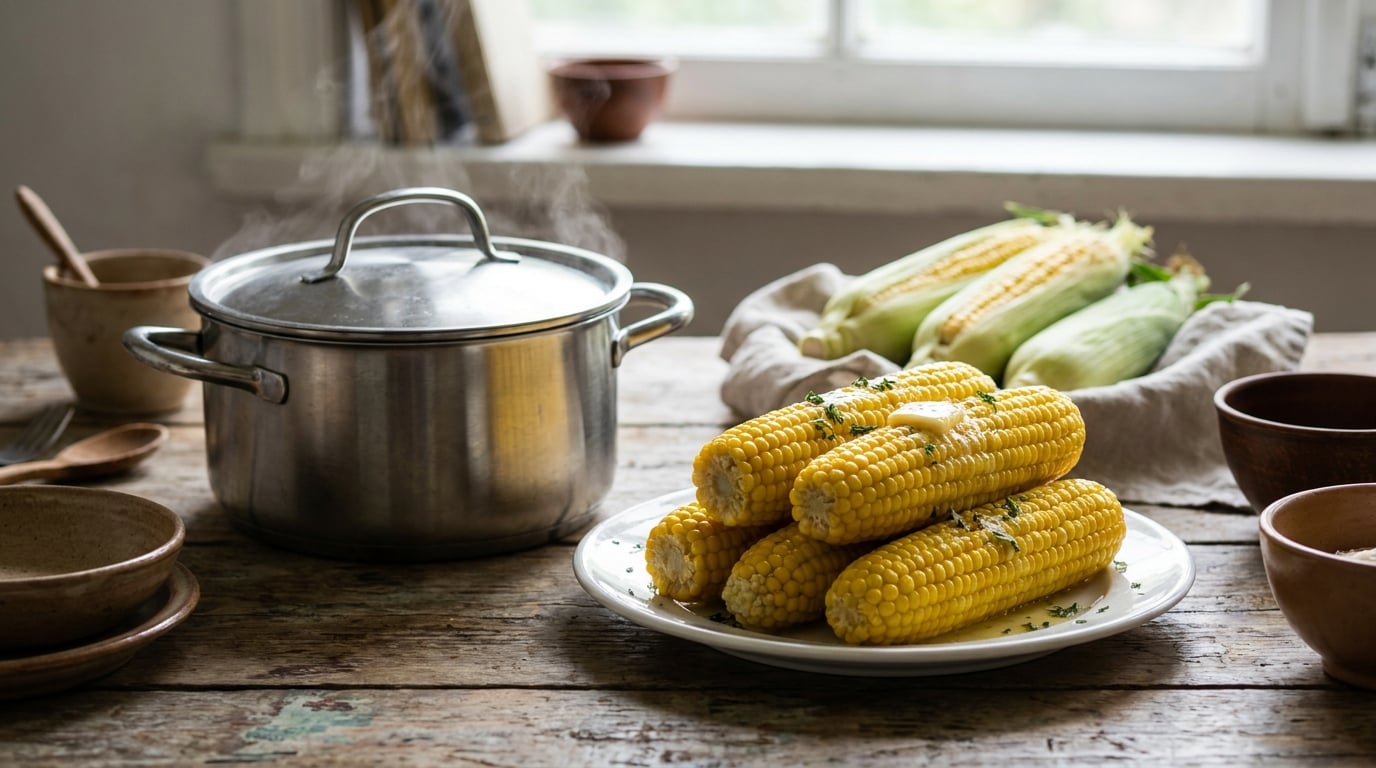
Boil fresh corn on the cob for 3 to 5 minutes in water that is already at a rolling boil. The timer starts the second the ears go in, not when you turn on the stove. Start with a big pot, leave the water uncovered, and start checking at the 3-minute mark.
That short window surprises people. Sweet corn is mostly water already, and its sugars turn tender fast at boiling heat. Every extra minute waters down the sweetness and softens the kernels until they turn mushy, which is why the clock matters less than the temperature and the doneness test. Here is the full timing chart, plus how to cook corn with the husk still on, from frozen, and from a jar of cut kernels.
Table of Contents
How Long to Boil Corn on the Cob at a Glance
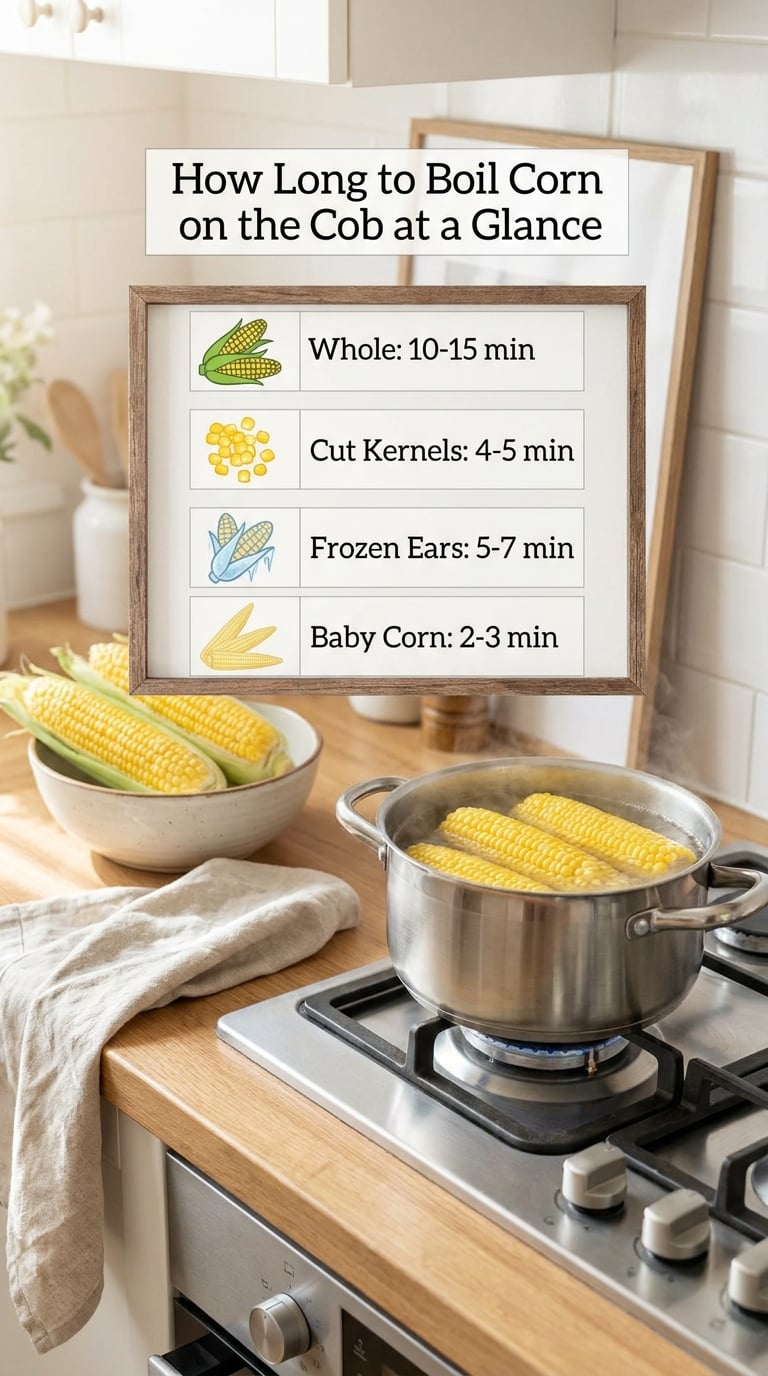
These times assume the water is at a full rolling boil before the corn goes in, and that the corn is fully submerged.
| Corn type | Boiling time | What you should get |
|---|---|---|
| Fresh young ears, husk off | 3 to 4 minutes | Crisp-tender, bright sweet kernels |
| Fresh medium ears, husk off | 4 to 5 minutes | Tender with a slight bite |
| Fresh large or mature ears | 6 to 8 minutes | Firm, slightly chewy kernels |
| Frozen ears, thawed or not | 6 to 8 minutes | Sweet and tender throughout |
| Corn in the husk | 5 to 8 minutes | Husk-steamed, very sweet |
| Cut kernels | 2 to 3 minutes | Just tender for salads and soups |
| Baby corn | 4 to 5 minutes | Delicate, still snappy |
A rolling boil means large bubbles that keep breaking the surface, and they do not stop when you stir. Salting the water is optional, roughly a tablespoon per quart, and many home cooks skip it and season the corn afterward instead.
What You Need to Boil Corn on the Cob
You need less than most people expect: a large pot, corn, water, and salt. A stockpot that holds the ears flat in a single layer works best, because crowded cobs cook unevenly and steam each other instead of boiling.
- A large pot: room for the ears plus enough water to cover them by an inch.
- Fresh or frozen ears: fresh summer sweet corn gives the best flavor, and frozen ears cook up sweeter than old-season corn.
- Water: cold tap water is fine. Do not add milk, sugar, or butter to it.
- Salt: a tablespoon per quart, plus more for serving.
- Optional: butter, olive oil, or a squeeze of lime for the table.
Yes, the pot needs to be big enough to submerge the corn. If the ears sit above the waterline, the exposed kernels cook differently from the covered ones and you get a soft, uneven result.
How Long to Boil Fresh Corn on the Cob
Fresh ears need 3 to 5 minutes, with 5 minutes as a practical ceiling for most grocery-store corn. Five minutes leaves the kernels firm, and somewhere past seven they turn mushy, which is a narrow window on a boiling pot.
How Long to Boil Corn on the Cob by Ear Size
- Small ears, under 6 inches: 3 minutes.
- Medium ears, 6 to 7.5 inches: 4 to 5 minutes.
- Large ears, over 7.5 inches: 5 to 6 minutes.
- Mature field-grown corn: 8 to 12 minutes, and expect a chewier, less sweet result.
Size is a better guide than the label at the stand, since vendors rarely tell you which bin a cob came from. A cob picked the same day off a roadside stand can be ready in 3 minutes, while supermarket corn that sat a week wants 5.
Longer is not automatically better, and neither is shorter. Past the tender point the kernel walls break down, the sugars leach into the water, and the texture goes from snap to flour. That is why I cap fresh corn at 7 minutes no matter how big the cob is.
How to Boil Corn on the Cob Step by Step
Boil time and total time are different things. Total time includes bringing the water to a boil, which takes 8 to 12 minutes on a typical stove. Only the minutes after the corn enters the water count as boil time.
- Fill the pot with water, leaving 2 inches of headspace, and salt it with a tablespoon per quart.
- Bring to a rolling boil over high heat.
- Prep the corn. For fresh ears, snap off the stalk end, strip the husk and silk, and rinse under cold water.
- Lower the ears in gently and start your timer as they go in. Nudging them under with tongs is fine.
- Keep it uncovered and boiling. Leave the lid off so the water stays at temperature. Do not drop to a gentle simmer, which stretches the cooking time and dulls the flavor.
- Start testing at 3 minutes. Use a fork or knife tip on a kernel near the thick end of the cob.
- Drain and cool. Tip the corn into a colander, and for large batches drop the cobs into an ice bath for 2 minutes to stop the cooking.
- Season right away with butter and salt, or a squeeze of lime and a pinch of chili.
Timing the same way each time is what makes this repeatable. A lid speeds things up slightly by holding heat, but it traps steam and softens the outside of the kernels faster than the center, so most cooks leave it off.
How Long to Boil Frozen Corn on the Cob
Frozen ears take 6 to 8 minutes in boiling water, and you do not need to thaw them first. Dropping a frozen cob into already-boiling water thaws the outside and cooks the center at the same time, which is why the time is longer than for fresh corn.
Start checking at 5 minutes. The kernels should give easily to a fork and feel plump, not rubbery. You can boil them from frozen, or thaw them in the fridge overnight if you prefer a shorter cook, but thawing adds a step without adding flavor.
For a big cookout, boil frozen ears in batches rather than crowding the pot. Ten minutes in a cold pot is how you end up with half the batch overdone.
Can You Boil Corn Without the Husk?
Yes, and husk-off is the standard method. Boiling in the husk is a separate technique: the husk acts as a wrapper, so add 2 to 3 minutes, and check for doneness by squeezing the cob, since you cannot see the kernels.
For fresh ears, snap off the stalk end and pull down the husk. Most of the silk comes away with it, and any strands left behind are harmless. If you want very clean cobs, blanch the ears in the boiling water for 30 seconds, dunk them in cold water, and the silk slides right off.
To cut kernels off afterward, stand the cob upright in a shallow bowl, slice down the sides with a sharp knife, and rotate it as you go. Those kernels go into corn rib recipes, salads, and soups. One of my easy street corn pasta salad recipes starts with leftover boiled kernels, and the same kernels round out a weeknight skillet dinner in my 6 easy recipes with ground beef and corn.
Boiled Corn vs. Steamed Corn: Which Is Better?
Neither method wins outright, and the difference is smaller than most debates about it suggest. Boiling is faster to start because the water is already hot, and it seasons the kernels slightly through the water. Steaming keeps every bit of the flavor and nutrients in the cob itself, with no leaching into a pot of water.
- Boiling: 3 to 5 minutes, best when you want salted kernels and a fast weeknight side.
- Steaming: 6 to 8 minutes, best for the sweetest possible corn and for very large ears.
- Microwaving: 3 to 4 minutes on high for one ear on a plate, with a cup of water beside it.
- Grilling: 10 to 15 minutes over medium heat, turning often, for charred edges.
If you are after the sweetest corn of the season, steam it. If you are boiling a dozen ears for a cookout, boil them.
Common Mistakes When Boiling Corn on the Cob
- Starting in cold water. This is the habit that produces hard centers and watery outsides. The water needs to be at a rolling boil before the corn goes in, which is the single most repeated piece of advice in cooking forums.
- Going overboiled. 20 minutes is far too long for fresh corn. Long boiling belongs to canning and posole, where the goal is breaking kernels down on purpose, not eating them crisp.
- Crowding the pot. Cobs stacked on top of each other steam rather than boil, so batch them instead.
- Lowering the heat to a simmer. A lazy simmer stretches the cook and waters down the flavor. Keep the boil going.
- Walking away and trusting the timer alone. Test a kernel instead. The window between perfect and past it is roughly two minutes.
- Skipping the ice bath for a big batch. Residual heat keeps cooking the ears in the colander while you carry them to the table.
How to Tell When Corn on the Cob Is Done
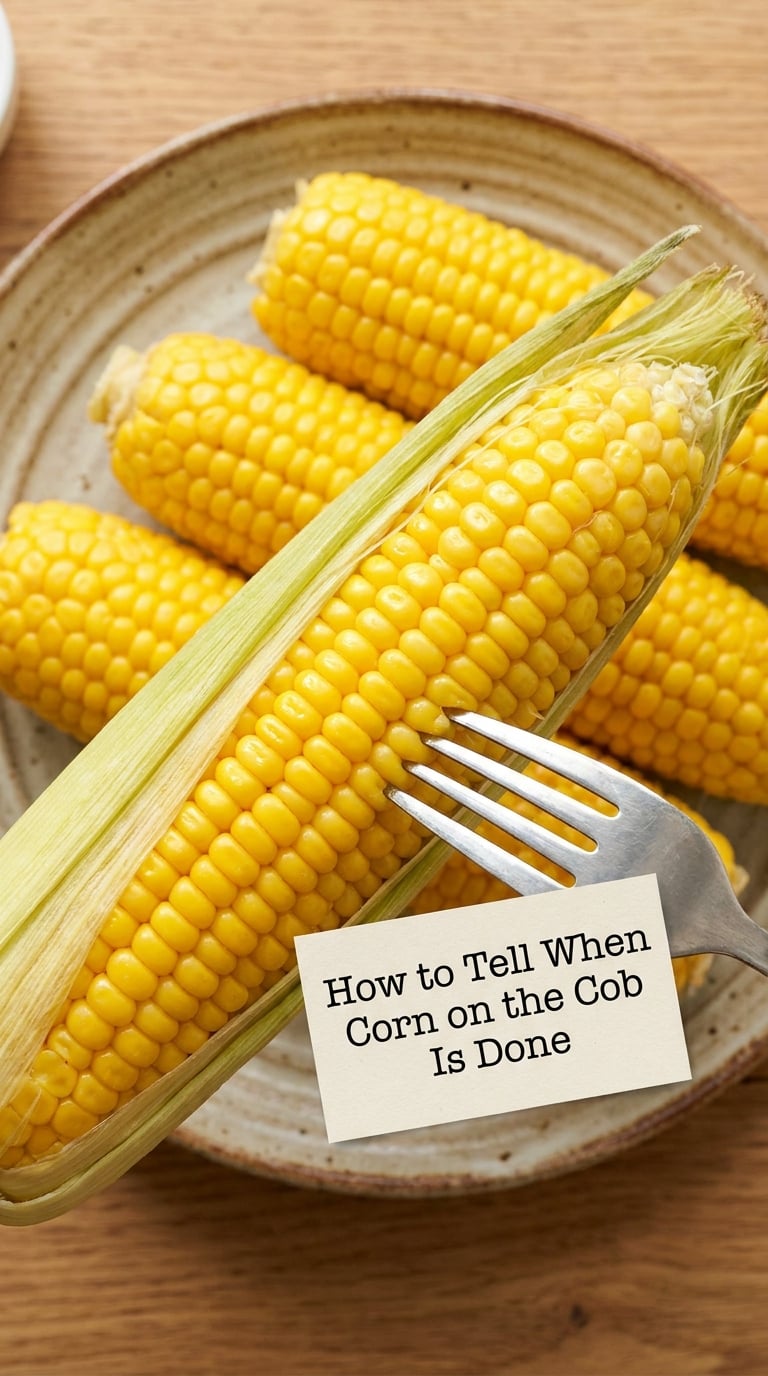
Color is a poor test. Bright yellow corn can still be raw in the center, and pale varieties go buttery without ever going golden. Use your hands and a fork instead.
- Pierce test: slide a fork or knife tip into a kernel near the thick base of the cob. It should go in with almost no resistance.
- Squeeze test: press a kernel with your thumbnail. It should give and feel juicy, not pop back like a raw kernel.
- Look at the cut end: a slice off the bottom of the cob should show liquid running clear rather than milky and thick.
- Taste one: if you can spare a kernel, biting it is the final word. Tender-crisp means a little resistance, not a soft, floury chew.
For corn boiled in the husk, squeeze the cob itself. A gentle give means the kernels inside have turned tender, and the husk will slip off in one piece once you cool it under running water.
Simple Ways to Season Boiled Corn on the Cob
Seasoning happens after draining, so you taste and adjust instead of guessing.
- Butter and salt: the classic, and the easiest thing that works.
- Lime and chili: a squeeze of lime, a pinch of chili powder, and a little salt for corn that tastes bright.
- Garlic butter: melt butter with minced garlic and a pinch of salt, then brush it on while the cobs are hot.
- Fresh herbs: chopped parsley or basil with a drizzle of olive oil.
- Cheese and pepper: grated hard cheese and cracked black pepper for a kid-pleasing plate.
For more ideas built around corn, my 12 easy corn side dish recipes for summer cookouts covers the serving table from cold salads to grilled ears.
Frequently Asked Questions
How long do you boil corn on the cob at high altitude?
Water boils at a lower temperature above about 5,000 feet, so corn cooks a little more slowly. Add 2 to 3 minutes to the timings in the chart: fresh ears take 5 to 8 minutes instead of 3 to 5. Make sure the water is at a genuine rolling boil before the corn goes in, and test a kernel with a fork rather than trusting the clock alone.
How long should corn on the cob be boiled after it starts simmering?
Count 3 to 5 minutes from the moment the water returns to a full boil after you add the corn. If you lower the heat to a simmer, the kernels take longer and lose more sweetness, so keep the boil going and leave the lid off. Start checking at 3 minutes with a fork, since a corn cob goes from tender to mushy in about two minutes.
Is it better to boil corn with the husk on or off?
Husk off is faster and gives you an even cook, so it is the usual choice. Husk on adds 2 to 3 minutes and steams the cob inside a wrapper, which some cooks like for extra sweetness. With the husk on, you cannot see the kernels, so judge doneness by squeezing the cob for a gentle give and cool it under running water so the husk peels off cleanly.
How do I know if corn on the cob is overcooked?
Overcooked corn feels soft and floury instead of crisp-tender, and the sweetness flattens because sugars have leached into the water. Kernels can also start to slip off the cob and the tip can wrinkle. Pull one and bite it: if there is no resistance at all, it has gone a minute or two too far. Start checking at the 3-minute mark next time.
Can I boil frozen corn on the cob without thawing it first?
Yes, and it is the easier method. Put the frozen ears straight into already-boiling salted water and give them 6 to 8 minutes, checking from 5 minutes with a fork. The outside and center cook at the same time, so the kernels come out even instead of raw in the middle. Thawing overnight in the fridge works too, but it adds a step without improving the flavor.
How long does it take to boil corn kernels instead of whole ears?
Cut kernels boil much faster than whole cobs: 2 to 3 minutes in boiling salted water, or 4 to 5 minutes from frozen. Keep an eye on them, since they go from tender to soft quickly with no cob protecting the centers. Drain them into a colander and cool before adding them to a salad, soup, or corn rib recipe so they do not warm everything else on the plate.
Conclusion
Give yourself 3 to 5 minutes for fresh corn on the cob, 6 to 8 for frozen, and 5 to 8 for ears still in the husk. The first thing to do is get the water to a rolling boil before the corn goes anywhere near it, and start the timer at that moment.
Then stop watching the clock and poke a kernel at the 3-minute mark. That single habit, more than any exact number, is what tells you how long to boil corn on the cob so it comes off the cob bright, sweet, and still snapping.