
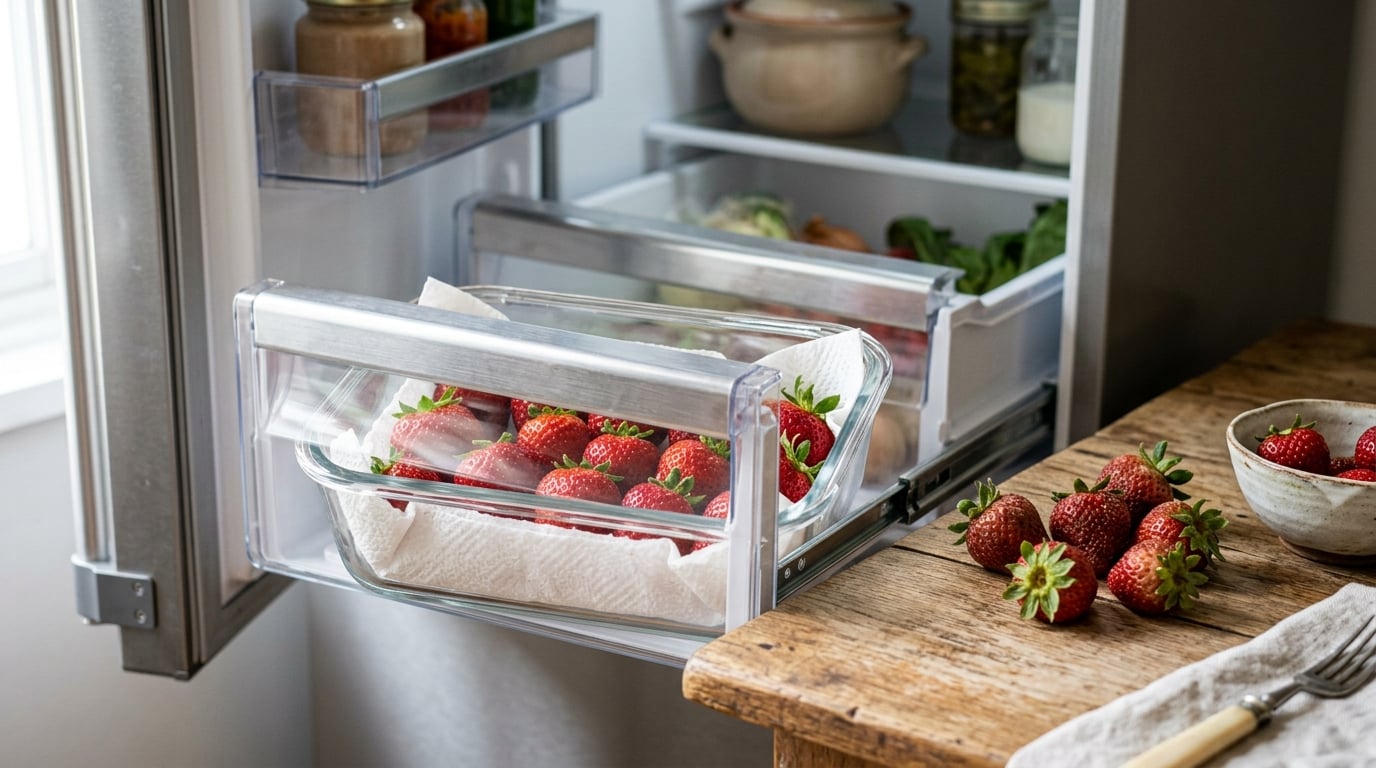
To store fresh strawberries so they last longer, keep them unwashed and dry in a paper-towel-lined container in the crisper drawer at 40°F or below, and only wash the berries right before you eat them. If you prefer to wash first, give them a 3:1 water-to-white-vinegar soak for 2 to 5 minutes, rinse, then dry them completely before they go in the fridge. Either way, expect 5 to 7 days from the store, or closer to 10 to 14 with full prep.
The reason it matters: strawberries have no protective skin, they keep respiring after harvest, and the mold that spoils them often grows from inside the fruit. A good storage method cannot stop that clock, but it can stop one damp berry from turning the whole carton to mush.
Strawberry season is also when people buy in bulk, so this is the guide for a farmers market haul or a two-pound clamshell as much as for a single punnet. I have ruined more than my share of berries to learn this stuff, and most of it comes down to one thing: moisture.
Table of Contents
How to Store Fresh Strawberries So They Last Longer
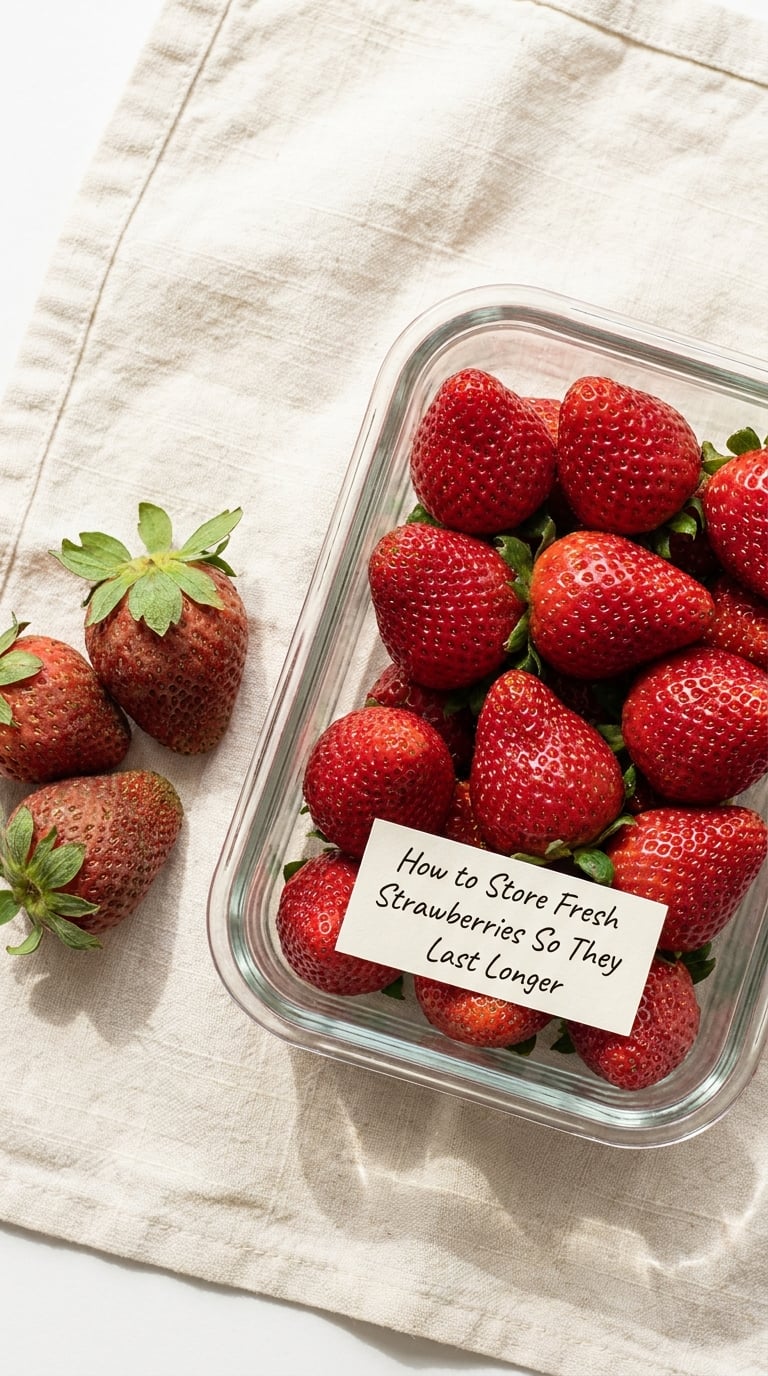
Here is the full method, in order. Do not skip step 5, because it is the step that decides whether the rest worked.
- Sort the berries the moment you get home. Pull out anything bruised, leaking, soft at the bottom, or showing fuzz. If one berry at the bottom of the clamshell is moldy, toss the whole clamshell rather than picking around it.
- Decide now whether you are washing today. For the longest life, store them unwashed and wash at the point of eating. If you want them washed and ready, continue to step 3.
- Give them a vinegar bath. Mix 3 parts cold water to 1 part white distilled vinegar in a large bowl or colander, submerge the berries, and soak 2 to 5 minutes. Apple cider vinegar works fine too.
- Rinse and drain. Swish the berries in clean cold water, then drain them in a colander for a full minute. Rinse them even after the vinegar bath, otherwise they can taste sour.
- Dry them completely. This is the step people rush. Use a salad spinner and spin in batches, or spread the berries in a single layer on a clean towel and air-dry for at least an hour. They should feel dry, not tacky.
- Store in a single layer. Hull the berries now if you want them snack-ready, line a shallow container or the original clamshell with a paper towel, arrange the berries so nothing touches, and refrigerate at 40°F or below in the crisper drawer.
One quick note on hulls: leave the green caps on until after the wash, because water gets into a bare berry much faster. Take the caps off before storage if you are cutting them for kids, and refrigerate them separately in a sealed container.
Should You Wash Strawberries Before Storing Them?
No, not if your goal is shelf life. Store unwashed berries and wash them in the colander right before eating, with a quick rinse being plenty.
The reason unwashed wins is straightforward. Rinse water carries mold spores and bacteria across every berry in the bowl, and the vinegar rinse mostly leaves that same film of moisture behind. Damp berries in a closed container is the exact combination that grows fuzz fastest.
So does the vinegar bath do nothing at all?
It does something, just less than the viral posts claim. A diluted vinegar soak knocks down bacteria and surface spores on the skin, which is why many home cooks notice a few more good days. It cannot reach fungi growing inside the fruit, which is the mold you actually notice first, so the honest expectation is a couple of extra days at best.
Washing ahead still wins in two situations: when you are prepping a week of kids snacks, and when you plan to freeze the berries. Both work better with clean fruit than with dusty fruit that has to be handled again later.
Is baking soda a decent substitute for vinegar?
Yes, and it is gentler on the fruit. A teaspoon of baking soda in about a quart of cool water, soaked for 5 to 10 minutes, then rinsed well, is a milder wash with no sour aftertaste. It does a decent job lifting bugs out of the crevices where they hide.
Skip both if the berries are already soft, since any soak makes soft fruit softer. And skip baking soda if the berries are very ripe and sweet, because the faint alkaline taste is harder to hide in a ripe berry than a rinse of vinegar.
The Best Container and Location for Refrigerated Strawberries
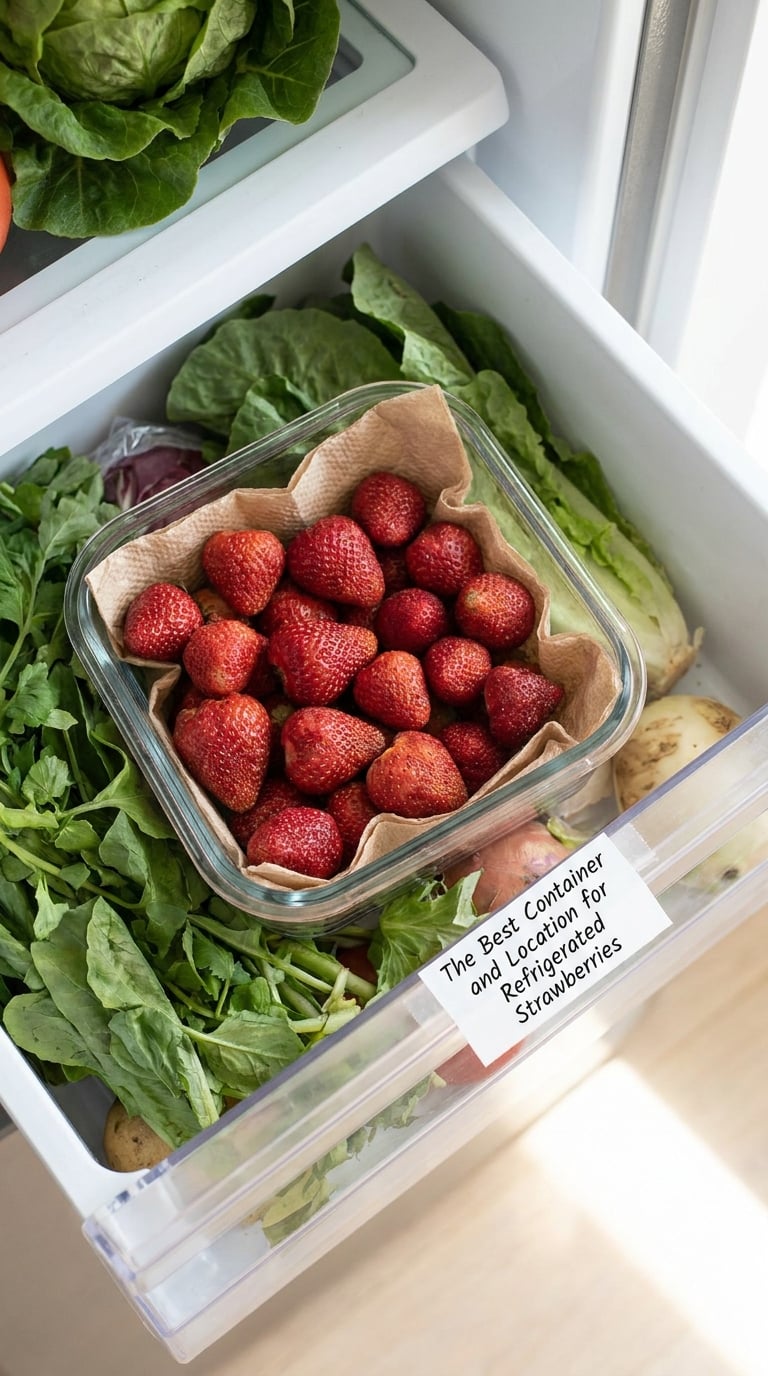
The best container is a shallow one that breathes. A vented clamshell or a glass dish lined with a paper towel beats a sealed tub every time, and the paper towel is the part people skip.
| Container | Airflow | Moisture control | Verdict |
|---|---|---|---|
| Original vented clamshell, lid cracked open | Good | Okay | Fine for 2 to 3 days |
| Paper-towel-lined glass or plastic dish, single layer | Good | Best, towel pulls juice away | My everyday choice |
| Airtight plastic tub | Poor | Traps condensation | Mold magnet, avoid |
| Mason jar, lid screwed on tight | None | Seals in juice and heat | Can backfire, see below |
About the mason jar, since it circulates so much online. A jar of dry berries with a loose lid and a paper towel at the bottom works. A jar of wet berries with an airtight lid is a different thing: the juice ferments, gives off carbon dioxide, and pressure builds behind the lid. People report fizzing liquid and popped tops, and once berries are sitting in fermented juice they are past saving.
For location, the crisper drawer wins because it holds steady humidity and a steadier temperature than the rest of the fridge. Set the drawer to high humidity if your fridge has the control. The door is the worst spot in your kitchen for berries because the temperature swings every time someone grabs milk.
Strawberries also respire and give off ethylene, so keep them away from bananas, avocados, and apples if you are trying to slow ripening.
How Long Do Fresh Strawberries Last in the Fridge?
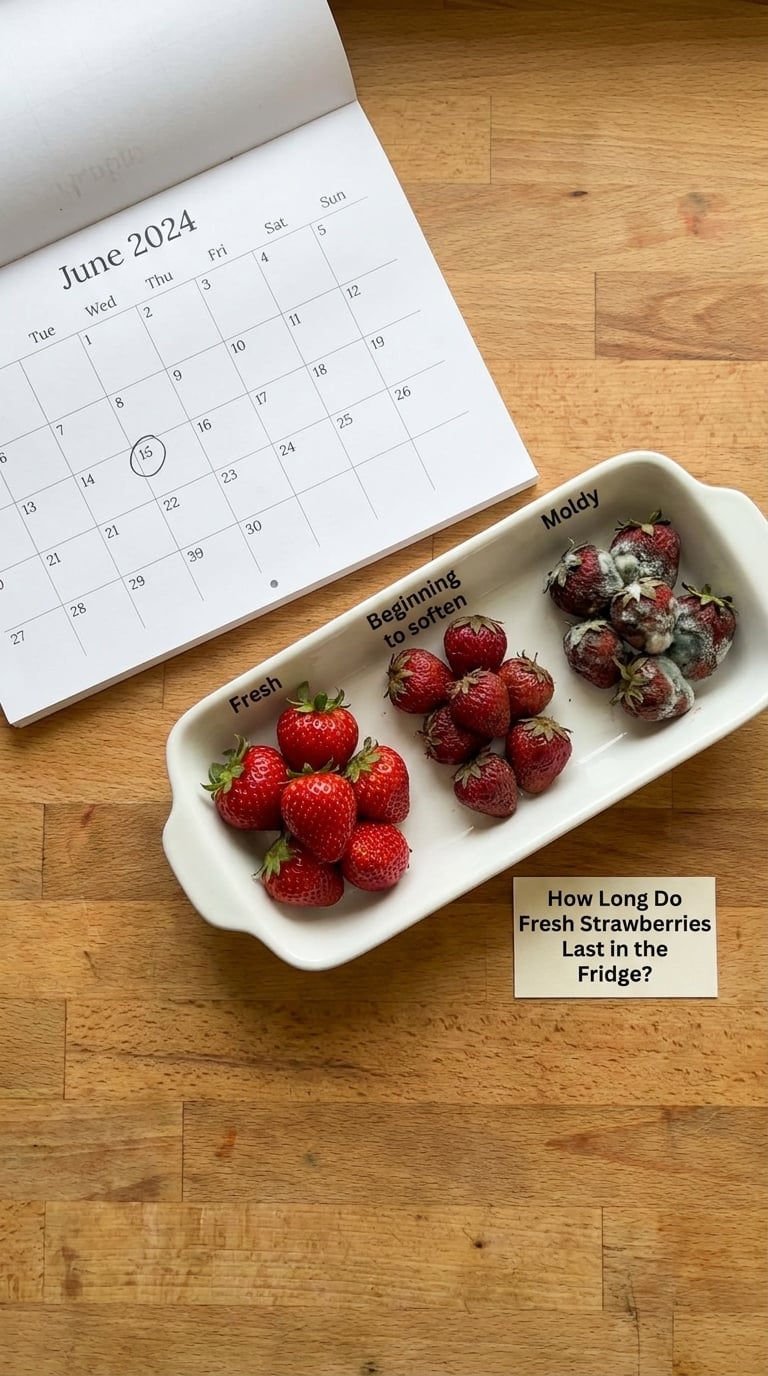
Unwashed berries in a cool fridge give you about 3 to 5 days. Fully prepped, dried, and paper-towel-lined berries give you 7 to 14 days, though 10 is a more honest number than 14.
| State of the berries | Fridge life | Notes |
|---|---|---|
| Store-bought, unwashed, in clamshell | 3 to 5 days | The default |
| Vinegar washed, dried, single layer on towel | 7 to 10 days | Replace the towel when damp |
| Very ripe, almost-doubling berries | 1 to 2 days | Freeze or use tonight |
| Cut or sliced | 1 day, sealed | Cut fruit browns fast |
| Frozen | 9 to 12 months | Best for smoothies and baking |
Check daily rather than trusting the calendar. Mold on a single berry means the whole container goes, because the spores are already on the others.
Quick spoilage checklist
- White or grey fuzz anywhere, or juice that has gone cloudy and fizzy: discard.
- Uniformly soft and leaking: that is rot, not ripeness, and it will spread.
- A little softness with no fuzz and no liquid: usually fine, use within a day.
- Wrinkled but firm, no discoloration: thirsty, not spoiled. A short cold-water soak brings them back.
- Yeast or alcohol smell: fermented, discard the batch.
How to Keep Strawberries Fresh Longer Than a Few Days
A few things add days on top of the basic method. The vinegar rinse is the most repeated, and it is worth doing even if the payoff is only a couple of days. Drying is what decides whether the rest works at all.
Swap the paper towel whenever it feels damp rather than waiting for the berries to complain. That single habit is the difference between a good week and a bad one, since a wet towel puts the moisture right back.
For a bulk haul from a u-pick farm or a warehouse club, scale the bath: a quart of water to a quarter cup of vinegar handles about two pounds, soak in two batches so berries are not crushed, and dry in the spinner in three loads. Freeze everything you cannot eat within a week.
On the counter question, which comes up constantly: strawberries are fine out for a few hours, and up to a day if the house is cool and the berries are under-ripe. Warm kitchens, direct sun, and bowls of ripe bananas cut that fast.
To revive berries that have gone soft and wrinkled in the fridge, soak them in cold water for 10 to 15 minutes, drain, dry thoroughly, and eat the same day. They will not return to store-bought firmness, but they plump up enough for a topping.
Can You Freeze Strawberries to Make Them Last Longer?
Yes, and for anything past about two weeks, freezing beats every fridge method.
- Wash the berries, hull them, and cut the larger ones in half so they freeze at an even rate.
- Dry them completely on a towel. Water left on the fruit freezes into ice crystals and turns the berries mushy.
- Freeze in a single layer on a baking sheet for 2 hours, until solid.
- Transfer to a freezer bag or container, press out the air, seal, label with the date, and keep at 0°F.
Do not freeze them in sugar or syrup unless you are making jam or pie filling, since that syrup dissolves into the berries and leaves them watery and soft when thawed.
Frozen berries are not for eating straight from the bag. They are for smoothies, sauces over pancakes and yogurt, oatmeal, and baking. For creamy uses, try the easy breakfast smoothie recipes, where the thawed texture is invisible. For a table dessert, pair the sauce with something from our fresh fruit dessert ideas.
Strawberries That Are Already Soft or Beginning to Turn
Soft berries are not automatically ruined. Sort them into groups and each group gets a different plan.
- Firm but slightly dull: still fridge-worthy. Store dry and unwashed in a single layer and use within two days.
- Soft, no fuzz, no liquid: eat tonight, or freeze now. Do not wash these, water finishes them off.
- Wrinkled, firm, no discoloration: soak in cold water for 10 to 15 minutes, dry, and use the same day.
- Any fuzz, leaking juice, or a fermented smell: compost the batch, do not compost the moldy part and keep the rest.
- Under-ripe berries at the bottom of the punnet: leave them at room temperature out of the fridge in a single layer until they colour, then refrigerate them.
The soft, clean berries are your jam and sauce fruit, and there is no faster way to use them than a quick saucepan cook. Blanch them for 30 seconds, then simmer with equal weight in sugar and a squeeze of lemon for about 20 minutes. Fresh summer berries are also the whole point of picnic food served cold, so freeze part of your haul to keep that option open later.
Common Mistakes When Storing Strawberries
- Washing and storing wet. The single biggest spoiler. The fix is a full hour of drying, minimum, and a paper towel in the container.
- Sealing the lid airtight. Condensation collects and sits on the fruit. Crack the clamshell open or leave a vent.
- Stacking berries in layers. The weight bruises the ones underneath. A single layer or two at most.
- Storing bruised or over-ripe fruit with the good ones. One leaking berry ruins the container. Sort on day one and again on day three.
- Using the fridge door. The temperature swing there is almost as good at spoiling berries as humidity is. Use the crisper drawer.
- Storing near ripe bananas, apples, or avocados. Ethylene speeds up ripening and mold. Give the berries their own shelf space.
- Leaving old paper towels in place. Replace the towel as soon as it feels damp, not when the berries look bad.
- Leaving the caps on for weeks. Hulls pull moisture and dry out the fruit. Take them off once the berries are dry.
Frequently Asked Questions
How long will strawberries last in a sealed mason jar?
A sealed mason jar of dry berries with a paper towel at the bottom keeps them about 5 to 7 days. Sealing wet berries is the problem: juice ferments, gives off carbon dioxide, and pressure builds behind the lid, and you may get fizzing liquid or a lid that has already popped. Use a loose lid on dry berries only, and never store berries submerged in juice.
Is it better to put strawberries in the fridge or leave them out?
Fridge, if you want them to last more than a day. Cold slows respiration and mold growth, which is why a berry at room temperature can double in size overnight while a chilled one barely changes. Leave berries out only if they are under-ripe and you want them to colour, in a single layer, in a cool room, away from sunlight and ripening fruit.
What is the best container to store strawberries in?
A shallow glass or plastic dish lined with a folded paper towel, berries in a single layer, is the best everyday option. The towel pulls juice away from the fruit and you can swap it when damp. A vented clamshell is fine for a few days. Avoid airtight tubs, which trap condensation, and sealed jars of wet berries, which ferment.
Should strawberries be stored with a paper towel?
Yes, and this is the step that makes the biggest difference to shelf life. A folded paper towel at the bottom of the container absorbs the juice the berries release as they respire, so the fruit is not sitting in moisture. Replace the towel as soon as it feels damp rather than at the end of the week, and add a second sheet under a large batch.
How long should strawberries sit in vinegar water, and do you rinse after?
Soak them 2 to 5 minutes in a solution of 3 parts cold water to 1 part white distilled vinegar. Long soaks soften the fruit and dull its flavor, so set a timer. Always rinse in clean cold water afterwards and drain, otherwise the berries taste of vinegar. Then dry them fully, which is the step that actually decides how long they keep.
Conclusion
Start with the sort, not the wash. Pull out anything bruised or fuzzy, put the good berries in a single layer on a paper towel in a shallow container, and refrigerate at 40°F or below in the crisper drawer with the lid vented. That alone buys you five to seven days instead of three.
If you want more, wash first with a 3:1 vinegar soak for 2 to 5 minutes, rinse, and give the berries a full hour to dry. And freeze whatever you cannot eat inside a week, single layer on a baking sheet first, then bagged. That is the only way to know how to store fresh strawberries so they last longer than any fridge can manage.