
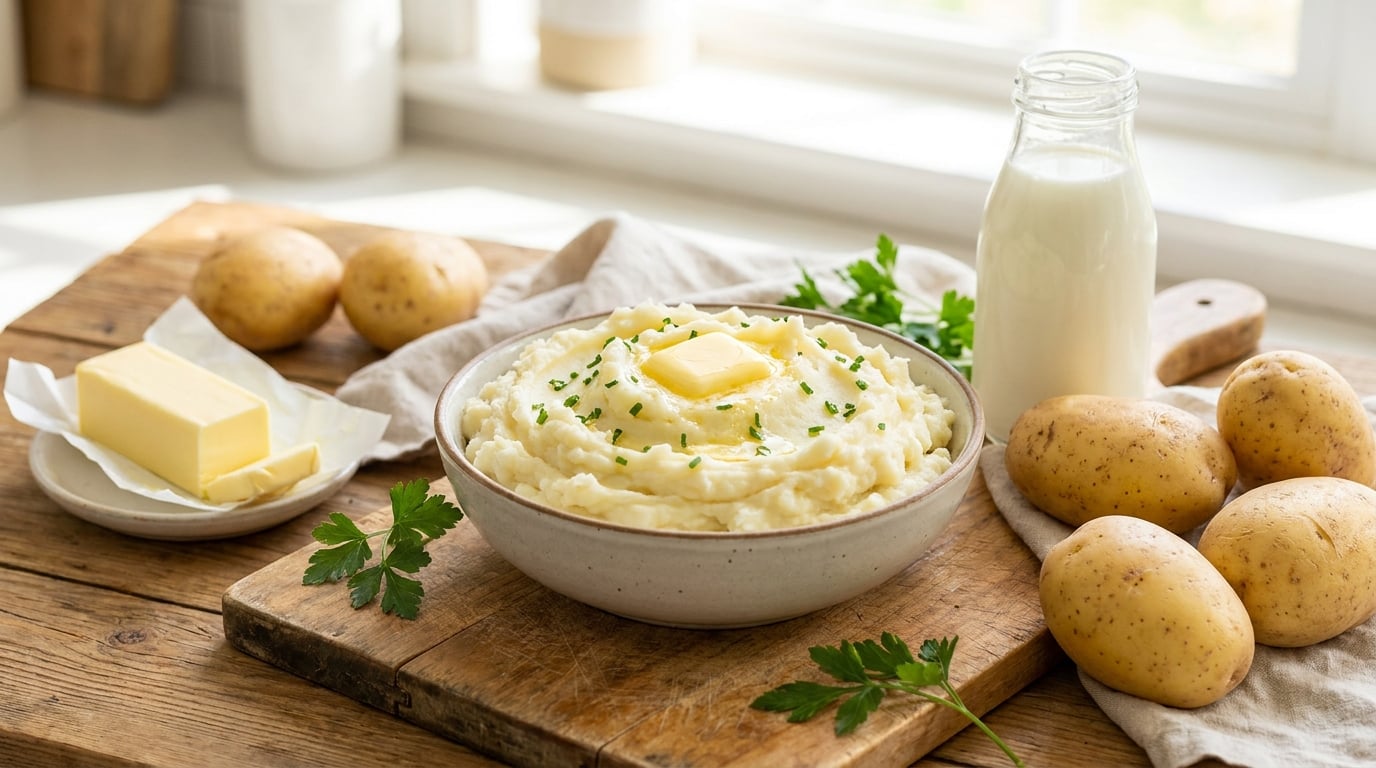
An easy homemade mashed potatoes recipe creamy enough to earn the second helping comes down to technique, not a long ingredient list. This one takes 30 minutes from cutting board to table, uses potatoes, butter, milk and salt, and asks you to watch three cues: even cuts, a cold-water start, and the exact moment you stop mashing.
I make this for weeknight chicken and for the holiday table, and it behaves the same both ways. Yukon Gold gives the creamiest result, russet gives the fluffiest, and a half-and-half blend is my usual compromise. The method below is the version I keep coming back to, including the part most recipes skip: steaming the drained potatoes dry before any dairy goes in.
Table of Contents
Why This Recipe Works
Potato starch is what makes mash creamy, and it only behaves when it is hydrated gently. Everything below protects that starch.
- Even 1-inch cuts cook at the same rate, so nothing turns to mush while the rest is still firm.
- A cold salted start heats the potato from the outside in, giving an even, tender cook instead of a waterlogged outside.
- Steam-drying for a minute removes surface water that would otherwise loosen the mash into a thin puddle.
- Warm butter and warm milk added slowly coat the starch rather than shocking it with cold fat.
- Stopping before you overmix is the single biggest variable. More stirring releases more starch, and more starch turns gluey.
Prep is 10 minutes, cooking is 20, total 30. Everything comes from a standard pantry except the potatoes.
Ingredients
Pick your potato before you start, because the starch level changes how the mash behaves. All three options below work; they just lean different ways.
| Potato | Texture | Best For |
|---|---|---|
| Yukon Gold | Waxy, moist, naturally creamy | The smoothest, richest mash |
| Russet | Starchy, dry, light | The fluffiest, most absorbent mash |
| Red potato | Waxy with skin, holds shape | Chunky rustic mash, skin left on |
| 50/50 Yukon Gold and russet blend | Balanced | Creamy body with some fluff |
- 2 pounds (about 900 g) Yukon Gold or russet potatoes, peeled or scrubbed if leaving the skin on
- 5 tablespoons unsalted butter, divided
- 3/4 cup warm whole milk or half-and-half (see the ratio below for scaling)
- 2 teaspoons kosher salt for the cooking water
- 1 1/2 teaspoons kosher salt for the finished mash, plus more to taste
- 1/2 teaspoon freshly ground black pepper
- Optional: 2 garlic cloves, 1/4 cup sour cream or Greek yogurt, 2 tablespoons chopped chives
Cut every potato the same size. If one is golf-ball sized and the next is a marble, they will not finish together, and the small one dissolves into paste before the big one softens.
Unsalted butter gives you control of the seasoning. If you only have salted, use it and cut the finishing salt back by about half a teaspoon.
How to Make Creamy Homemade Mashed Potatoes
Make Easy Homemade Mashed Potatoes Recipe Creamy from Scratch
This first stage is where smooth texture is won or lost, and it is mostly about heat, not stirring.
- Cut the potatoes into even 1-inch chunks. Leave the skins on Yukon Gold and red potatoes if you like the texture; peel russets for the classic fine mash.
- Start them in cold salted water. Put the chunks in a large pot, cover completely with cold water by about 2 inches, and add 2 teaspoons kosher salt.
- Bring to a boil, then drop to a steady simmer. Once small bubbles break the surface, turn the heat down so the water barely moves. A rolling boil breaks the potatoes apart from the outside.
- Cook 15 to 20 minutes, checking from minute 12. They are done when a thin knife slides into a piece with no resistance at all. If it meets any drag, give it two more minutes.
That knife test is the only doneness cue you need. Potatoes that cook past this point start breaking down, and their cells release water that drains away as you mash, which is where watery potatoes come from.
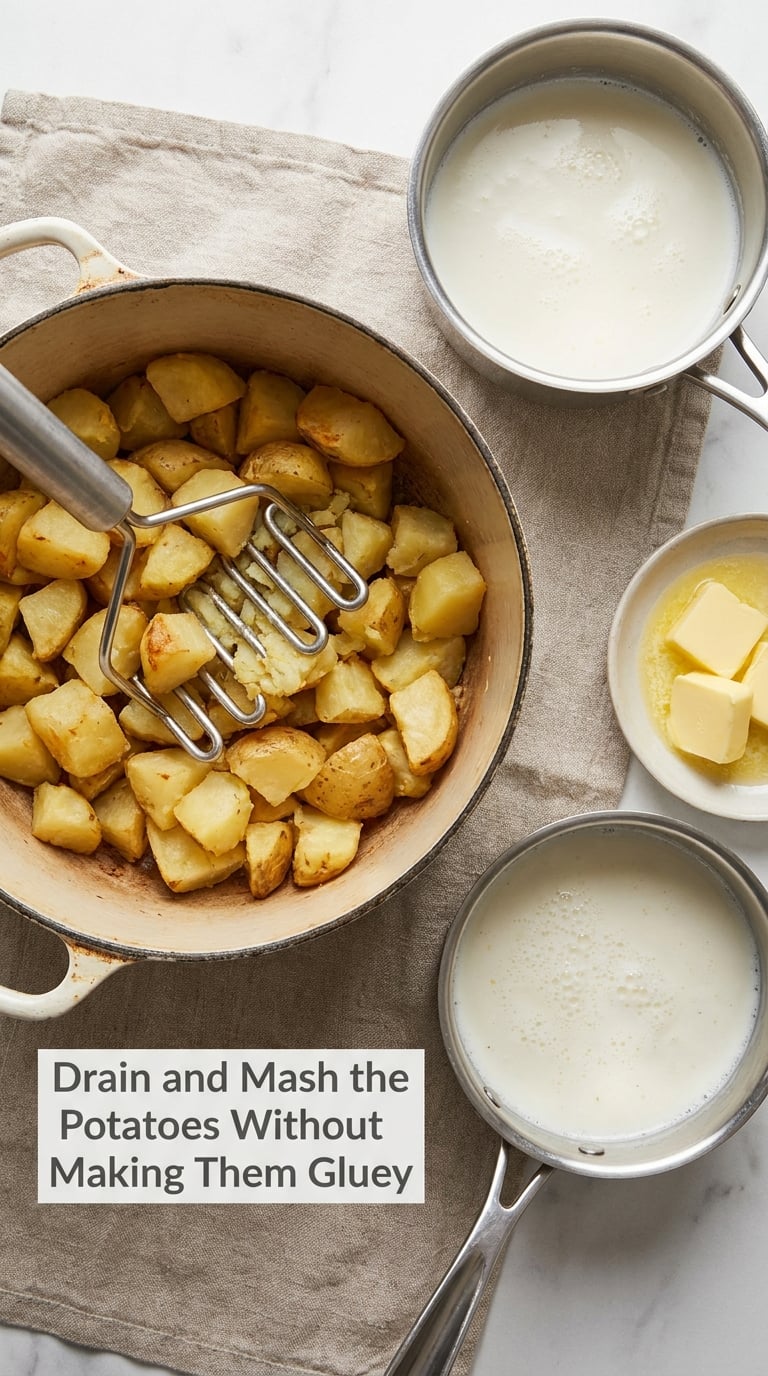
Drain and Mash the Potatoes Without Making Them Gluey
- Drain well. Tip the potatoes into a colander and let them drip for a full minute. Shake the colander once to break up any pieces stuck together.
- Steam-dry in the hot pot. Put the empty pot back on the burner for 30 seconds, return the potatoes, and swirl them for about a minute until the surface stops looking wet.
- Add the first butter. Cut 4 tablespoons of the butter into chunks and drop them in. Let them melt and coat the potatoes for a minute before you touch a masher.
- Warm the milk. Heat 3/4 cup milk with the black pepper in a small saucepan over low heat for 2 to 3 minutes, until it steams and has a faint skin forming. Do not let it boil.
- Mash with a masher, pressing rather than stirring. Push straight down through the potatoes. Add the warm milk a quarter-cup at a time, mashing a few strokes between additions, until the mash is smooth and holds its shape on the spoon.
- Stop while it still looks slightly fluffy. Overworked potatoes turn gluey within seconds, and the damage cannot be undone. A few small lumps are fine, sharp lumps mean keep going.
Season and Finish the Mashed Potatoes
- Season to taste. Stir in the remaining 1 1/2 teaspoons salt. Taste with a clean spoon before deciding it needs more, since butter and milk both mute salt.
- Add the last tablespoon of butter and swirl it in for a glossy finish.
- Adjust the consistency before serving. Too thick, loosen with a splash of warm milk. Too loose, set it back on low heat and stir for a minute or two until it tightens.
- Hold covered. A lid traps steam and stops the surface from drying out and forming a skin.
The base ratio scales cleanly: about 2 tablespoons of butter and 3/8 cup of milk per pound of potatoes, with 3/4 teaspoon of salt per pound. Four pounds of potatoes takes about 25 minutes to cook in two pots.
Tips for Success
- Never use a blender or food processor. Blades shear the cells and release all the starch at once. The result is glue with a lid on it.
- Hold back the dairy and add it hot. Cold milk drops the temperature of the starch, which thickens the mash and dulls the flavor.
- Salt in two stages. Water salt seasons the potato itself; finishing salt seasons the fat. Skip the second stage and the mash tastes flat no matter how much butter you add.
- Dry the pot, not just the potatoes. Moisture trapped under a layer of mash steams the starch and loosens everything underneath.
- Let the pot sit off heat a minute before mashing. Potatoes mash more easily when they are hot but not screaming hot.
- For an instant version, put cooked, drained potatoes through a ricer before the butter goes in. The strands are separate, so the dairy coats each one and the texture turns extra light.
| What went wrong | Cause | Fix |
|---|---|---|
| Gummy or gluey | Overmixing, or cooking past fork-tender | Next time, press instead of stir and stop at smooth. A ruined batch loosens slightly with warm milk stirred in over low heat. |
| Watery or thin | Started in boiling water, or under-drained | Drain longer, steam-dry in the hot pot, and add the butter before the milk. |
| Lumpy | Uneven cuts or undercooked centers | Cut to 1 inch, simmer instead of boil, and test with a knife rather than the clock. |
| Greasy or separated | All the butter added at once while very hot | Add softened butter in stages and warm the dairy gently. |
| Bland | Seasoning added at the end only | Salt the water and taste again after the dairy goes in. |
| Tough or rubbery | Mash sat untouched until it cooled and set | Warm it with a splash of milk over low heat and fold, do not beat. |
Variations
- Garlic mashed potatoes: tuck 2 whole peeled garlic cloves into the boiling water for the last 5 minutes, then fish them out. Dropping a clove in for the final minutes is a neat trick, and the garlic melts into the mash without any raw bite.
- Roasted garlic version: Roast 1 whole head at 400°F (205°C) for 45 minutes with a drizzle of oil, squeeze the cloves out, and fold them in with 4 ounces of room-temperature cream cheese. Cream cheese also helps the mash hold heat longer on a buffet.
- Dairy-free: Use olive oil in place of butter and unsweetened plant milk, warmed the same way. The texture is slightly less rich but the technique is identical.
- Richer holiday bowl: Swap the milk for heavy cream, add 1/4 cup sour cream or Greek yogurt, and fold in chives. Sour cream lightens the texture because the extra fat coats the starch, and the tang balances the butter.
- Loaded style: Top with sautéed onion and garlic cooked in butter while the potatoes boil. Sweet onion works too and adds a little crunch.
For a smooth base to build on, this collection of leftover mashed potato recipes covers shepherd’s pie, potato pancakes and casseroles once you have a batch on hand.
Storage, Make-Ahead and Reheating
Cool leftovers within 2 hours, then refrigerate in a sealed container for 3 to 4 days. Mashed potatoes reheat better than most cooked sides, and a splash of liquid brings back the creaminess.
To reheat in the oven: put the mash in a buttered baking dish, dot with a tablespoon of butter, cover tightly with foil, and heat at 200°F (95°C) for 20 to 30 minutes. Stir once halfway through. This is the method that gets closest to the day-of texture.
To reheat on the stove: warm over low heat with a splash of milk, stirring gently until hot and loose. Keep the heat low; a hot pan will tighten the starch and make it gluey all over again.
To reheat in a slow cooker: set to warm, add a splash of milk, and stir every 20 minutes for about an hour.
To reheat in the microwave: cover loosely, use 50 percent power, and stir every 90 seconds so the edges do not scorch.
To freeze: Freeze flat in a freezer bag or container with the air squeezed out, up to 2 to 3 months. Thaw overnight in the fridge, then warm with milk on the stove. Freeze before adding extra salt.
To make ahead: Cook, mash, and refrigerate up to 2 days early. Reheat covered at 200°F and loosen with warm milk right before serving.
To keep warm: Set the covered pot in a 200°F (95°C) oven for up to 2 hours. A bain-marie works too: the covered pot sits in a larger pan of hot water, and the steam keeps the mash from drying out. If you prefer a hands-off option, making mashed potatoes in an Instant Pot gets you a batch done in a fraction of the time with the same cold-water start.
Main allergen: this recipe centers on dairy. Butter and milk both appear, so it is not suitable for a milk-free or vegetarian-dairy diet without a swap.
What to Serve With Mashed Potatoes
Rich, creamy mash needs a main with enough acid or char to cut the butter. These are the pairings I cook most:
- Roast chicken cooked to 165°F (74°C), with the pan juices loosened with a little water and poured over the top.
- Meatloaf or Swedish meatballs, which hold their sauce next to the mash instead of on it.
- Baked fish at 145°F (63°C) with a squeeze of lemon. The acid keeps a buttery side from feeling heavy.
- Shepherd’s pie, where the mash goes on top of a beef filling cooked to 160°F (71°C) and bakes until the top browns.
- A holiday turkey dinner, where the mash holds on the buffet for an hour without drying out. For that table, this slow cooker garlic parmesan chicken is an easy second main that needs no last-minute work.
As a side dish, plan about 1 pound of raw potatoes per serving. A 2-pound batch makes roughly 6 servings, which is usually right for a family dinner and short for a holiday table of 10.
Frequently Asked Questions
What is the best potato for creamy mashed potatoes?
Yukon Gold potatoes give the creamiest, most buttery mash because their flesh is moist and naturally waxy. Russet potatoes give the lightest, fluffiest result because their high starch soaks up the dairy. A 50/50 blend of the two is a good middle ground, and red potatoes work well if you leave the skins on and want a chunkier, more rustic texture.
How many pounds of potatoes should I make for a family dinner?
Plan about 1 pound of raw potatoes per serving, so 2 pounds makes roughly 6 servings as a side dish. For a holiday table of 10, cook 4 to 5 pounds, using two pots rather than crowding one. That same ratio scales the seasoning: about 2 tablespoons of butter, 3/8 cup of milk and 3/4 teaspoon of finishing salt per pound.
Why are my mashed potatoes gluey and gummy?
Overworking is almost always the cause. Stomping, stirring or beating the potatoes breaks open the cells and releases starch, and that starch turns to paste with the added liquid. Cook them only until a knife slides out with no resistance, drain and steam-dry them, then press with a masher instead of stirring. Stop as soon as the mash is smooth and slightly fluffy.
Can I add the butter and milk before serving?
Add the butter when the potatoes are still hot, before mashing, so it melts and coats the starch evenly. Hold the milk back until the mash is partly mashed, then add it a quarter-cup at a time. Once the mash is finished, you can still loosen it with a splash of warm milk right before serving, but you cannot fix a mash that was mixed too long.
How do I reheat mashed potatoes without making them dry?
Add a splash of warm milk first, then warm slowly and covered. The oven is the best method: 200°F (95°C) for 20 to 30 minutes under foil, stirred once. On the stove, use low heat and a gentle fold rather than a whisk. A microwave works at 50 percent power, stirred every 90 seconds, and loosens the mash more than it dries it.
Can I make mashed potatoes ahead of time?
Yes, and it is the easiest way to host. Cook and mash up to 2 days ahead, refrigerate in a covered container, and reheat at 200°F (95°C) with a splash of warm milk until loose and hot. Do not freeze the seasoned finished batch if you can avoid it, because the texture is better after reheating a freshly made one.
Make This Easy Homemade Mashed Potatoes Recipe Creamy for Your Next Dinner
Make this one first because it is forgiving: the only real deadline is stopping the mash while it still looks fluffy, and everything after that is a matter of warm milk and a taste test. A 2-pound batch is 30 minutes of work and covers a weeknight meal or a make-ahead holiday side.
Warm the dairy, cut the potatoes even, start them cold, and stop mashing at smooth. Those three habits are the difference between this easy homemade mashed potatoes recipe creamy enough to spoon and a bowl of glue.