
How to freeze cooked ground beef is simple: brown it fully, let it cool in a shallow dish, spread it flat in a freezer bag, press out the air, label the date, and freeze it flat. Cooked ground beef keeps its best quality for 3 to 4 months in a freezer held at 0°F (-18°C).
The reason to cook before freezing is simple. A bulk tube of beef becomes a weeknight dinner, a batch of taco meat, and a jar of sauce, all from one browning session. You also skip the raw-thaw step entirely, and you season it exactly how you like it instead of working with a frozen pink brick.
What you give up is a little texture. Frozen beef is never quite as tender as beef straight from the skillet, and no container fixes that. Everything else, from freezer space to food waste, improves when you do it this way. Below is the system I use, tested over a lot of Sunday browning sessions and cleaned up after more than one freezer-burned bag.
Table of Contents
How to Freeze Cooked Ground Beef at a Glance
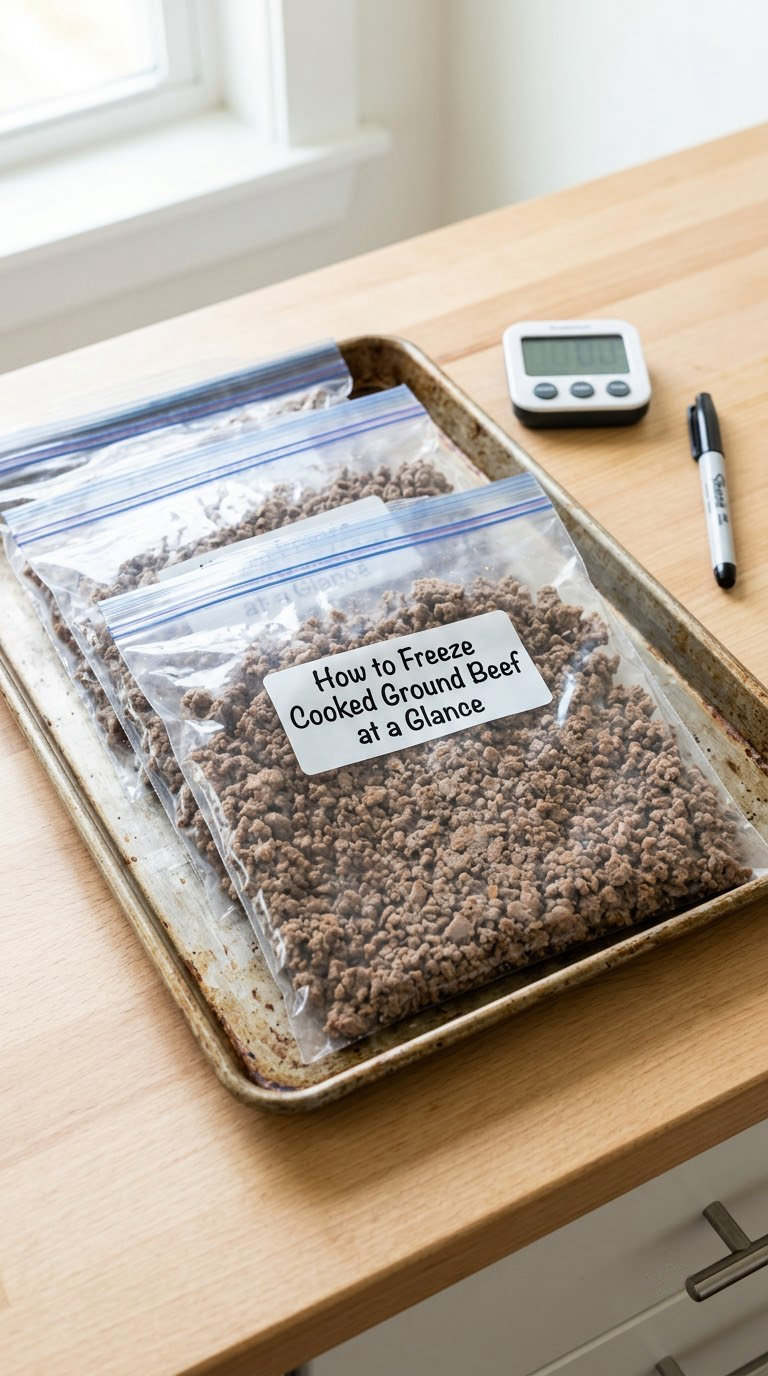
Here is the whole method in one table, with the temperatures and timings that matter.
| Step | What to do | Number to remember |
|---|---|---|
| Cooking | Brown the beef, breaking it up as it cooks | 160°F (71°C) internal, checked with a thermometer |
| Cooling | Spread in a shallow dish, or set the dish in an ice bath | Get it into shallow containers within 2 hours of cooking |
| Fridge window | Eat it, or move it to the freezer | 3 to 4 days refrigerated |
| Portioning | Spread flat, score into squares, press out air | About 1 lb per quart-size bag suits most recipes |
| Freezing | Seal, label with date and quantity, lay flat | 3 to 4 months at 0°F (-18°C) for best quality |
| Thawing | Refrigerator, cold water, or microwave | A 1 lb portion thaws in about 4 to 6 hours in the fridge |
| Reheating | Skillet, covered dish, or microwave | 165°F (74°C) for reheated leftovers |
How to Freeze Cooked Ground Beef Step by Step
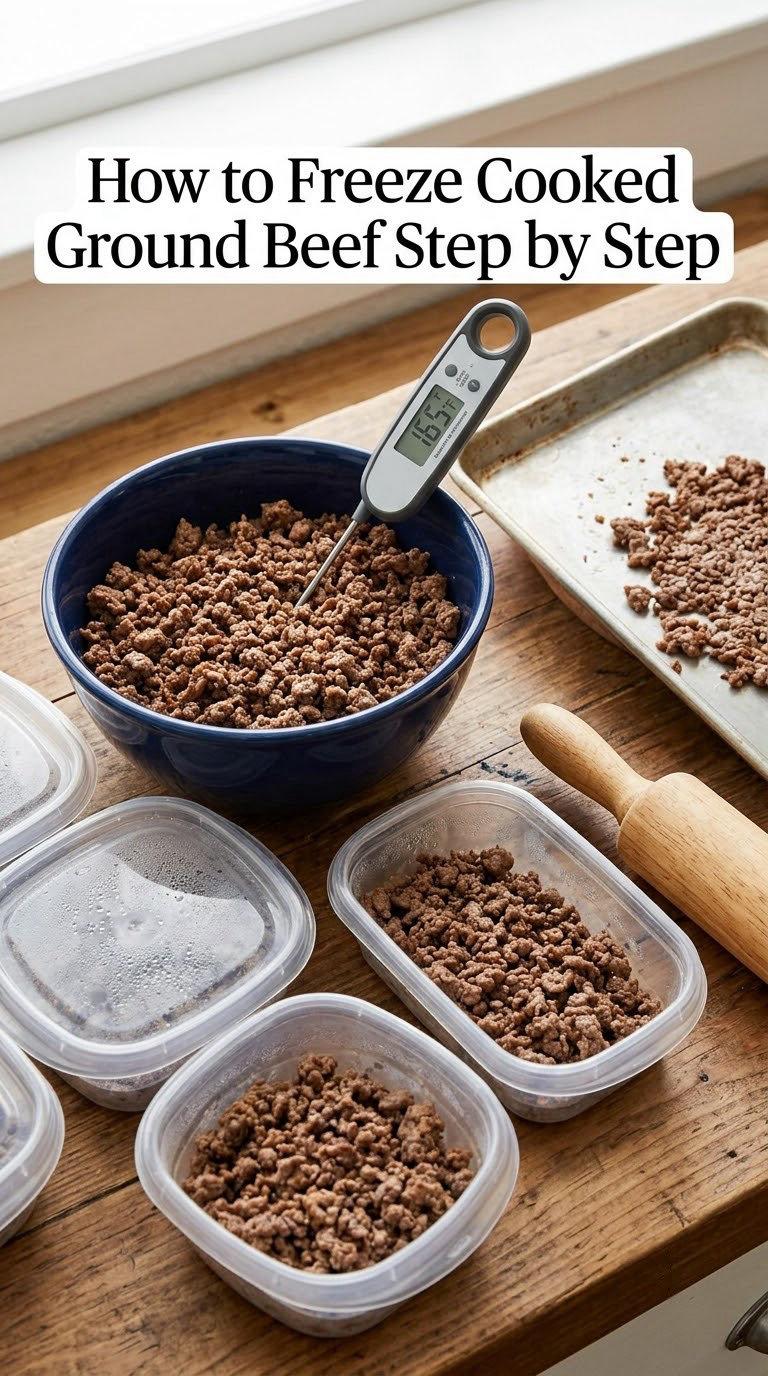
- Check the temperature before you do anything else. Ground beef is done at 160°F (71°C). Take the skillet off the heat once the thermometer reads there, because it keeps cooking for a minute or two after the burner goes off.
- Move it into a shallow dish right away. A big pile of beef steams itself into a soggy mess. One inch of beef in a 9×13 pan cools in a fraction of the time a heaped bowl does.
- Drain off the grease. Tilt the pan and spoon the rendered fat into a jar for later cooking, or just let it cool and skim it. Leave the tiniest film of fat on the meat, because that is what keeps it from turning dry in the freezer.
- Spread it flat and press out the air. Scoop the beef into a freezer bag on a flat surface, press it into an even layer about half an inch thick, and roll it with a rolling pin or a wine bottle until no lumps remain.
- Score it into portions. With the bag on a hard counter, run the back of a butter knife or a pair of chopsticks through the meat to make a grid. You are cutting through cold, firm beef, so the lines have to be made now, before it freezes solid.
- Press out the air, seal, label, and lay it flat. Zip the bag closed with as little air inside as you can manage, write the date and the quantity on it with a permanent marker, and slide it into the freezer on a flat surface until it hardens.
That last step, scoring the bag, is the trick most people skip and the one I would not give up. Once the beef is hard, you bend the bag and a clean square snaps off. It goes straight into a hot pan, no thawing, no guessing at the portion, and the rest of the bag stays put in the freezer.
Cool and Package the Beef Safely
Cooling is the step where safety actually lives. USDA guidance is to get food into shallow containers and into the refrigerator or freezer within about two hours of cooking, and warm beef sitting on the counter is a food safety risk long before it looks or smells wrong.
Three things speed up the cooling:
- Shallow containers. Divide a skillet of beef between two or three dishes rather than leaving it in one deep pile.
- An ice bath. Set the dish in a larger bowl filled with ice and water and stir every few minutes. This drops the temperature much faster than the counter alone.
- A fan or a cool room. Moving air over the surface of the beef shortens the wait noticeably.
Leave a finger of headspace in whatever container you use. Ground beef expands slightly as it freezes, and a rigid container filled to the rim will crack or pop its lid on the way to becoming a brick.
Condensation is the reason people end up with watery meat. Warm beef traps steam, and steam that has nowhere to go becomes ice crystals in the freezer. Once that ice forms and you thaw the beef, the crystals melt into the meat and the texture goes soft and mealy. Cooling first, sealing second, and squeezing the air out of the bag is the whole defense.
For the same reason, pat the beef dry before it goes in. Surface moisture turns into ice just as quickly as trapped steam does.
Choose the Best Container for Freezing Ground Beef
Freezer bags are the default because they cost almost nothing and lie flat, but they are not the right answer for every portion. Here is how the main options compare.
| Method | Best for | Portion control | Freezer space |
|---|---|---|---|
| Freezer bag, flattened | Cooked crumbles, taco meat, sauce | Good, once you score it | Excellent, stacks like paper |
| Rigid airtight container | Portions you want to keep separate, like a week’s worth of lunch filling | Very good, one box per portion | Fair, they do not nest well |
| Silicone ice cube tray | Small doses, a couple of tablespoons for a sauce | Excellent, one cube per serving | Excellent |
| Sheet pan, cut into cubes | Bulk freezing, then bagging the cubes | Fair, cubes are roughly 1 cup each | Good, freezes fast in single layers |
| Vacuum seal | Long storage or a deep freezer, and the least freezer burn | Very good | Good |
For most of us, the sheet pan trick first and the bags second is the fastest setup. Put the cooled beef on a parchment-lined sheet pan, freeze it for about an hour until firm, then cut it into 1-inch cubes and transfer the cubes to bags. The beef freezes in one thin layer instead of a solid block, and you get uniform portions that thaw at the same rate.
Silicone trays are the answer when the beef is destined for a sauce or a soup where you only need a spoonful. Pop the frozen cubes into a bag for long-term storage, since trays are easy to lose in the back of a freezer.
How Long Can Cooked Ground Beef Stay Frozen?
Cooked ground beef keeps its best quality for 3 to 4 months when frozen at 0°F (-18°C), according to USDA guidance. That is the number to write on the label, and it is the number to plan your meals around.
Past that window the beef is not automatically dangerous, but the quality slides downhill. Ice crystals grow, more moisture escapes during thawing, and the texture turns dry and crumbly. Freezer burn shows up first as a grey or white patch on the surface, then as dry edges, then as a flat off-taste that no amount of seasoning hides.
A few things shorten the useful life: a freezer that runs warm, a door that opens often, packaging that leaked air, and beef that was still warm when it went in. A home freezer holds 0°F fairly reliably, but a garage freezer in a hot climate often sits at 10°F or higher, and food in it ages faster than the label suggests.
When in doubt, throw it out. A gray cast or a smell of ammonia means the package was compromised, and no reheating temperature makes that safe again.
How to Thaw Frozen Ground Beef
Thawing in the refrigerator is the best method for texture. Put the portion on a plate or in a bowl, set it in the fridge, and give it 4 to 6 hours for a 1 lb bag, or overnight for a thicker portion. Cook it straight from there.
Cold water thaws faster. Seal the portion tightly, submerge it in cold tap water, change the water every 30 minutes, and cook it immediately. A 1 lb portion loosens up in about 45 minutes this way.
The microwave works when you are reheating, not when you are cooking. Use the defrost setting at about 50% power, turn the beef often, and move it to the stove or a bowl the moment it is no longer solid. Parts of it will start cooking in the microwave, which is fine for crumbles going into a sauce and less fine for anything you want to sear.
Cooking from frozen is genuinely fine for crumbles. Break the beef into a hot, oiled skillet, keep the heat medium, and stir as the ice melts. Expect a few extra minutes and some steam. Trying to brown beef in one frozen brick is where this goes wrong, so only skip the thaw if the beef is already in small pieces.
Thawing on the counter is the one method to skip. The outside of the beef warms into the danger zone long before the middle softens.
How to Reheat Frozen Ground Beef Safely
Reheated leftovers need to reach 165°F (74°C) all the way through, and that is the temperature to check, not the temperature of the pan.
Skillet. The best option for crumbles. Melt a tablespoon of oil, add the beef from frozen, and stir over medium heat until it steams dry and the thermometer reads 165°F (74°C). Ten to fifteen minutes is typical for a 1 lb portion.
Covered dish in the oven. Put the frozen beef in a small covered casserole with a splash of broth or water and bake at 350°F (175°C) for 20 to 25 minutes. The lid traps steam, which is what stops reheated beef from turning dry and rubbery.
Microwave. Cover loosely and heat in 1-minute bursts, stirring between each one, until it hits 165°F (74°C). Microwave reheating heats unevenly, so stir more than you think you need to.
Two tricks bring back some of the texture. Add a splash of liquid, broth, water, or even a bit of the sauce you are serving it with, and keep the pan covered for the last minute of cooking. Dry reheating is the single biggest reason people decide frozen ground beef was a bad idea.
Can You Refreeze Cooked Ground Beef?
Yes. Beef that was cooked first, then frozen, then thawed safely in the refrigerator can be refrozen. This is the rule that clears up most of the confusion on this topic: cooking it first is what makes refreezing reasonable.
Beef that was frozen raw, thawed, and then cooked should not be refrozen. Cooking does not reverse whatever happened to it during that first thaw, and the safe move is to cook it and eat it within a few days instead.
For a good reason to be cautious with refreezing: each freeze and thaw cycle costs moisture. Refrozen beef is perfectly safe when thawed in the fridge, but it will be drier than beef that was frozen once. Refrozen portions should also carry a shorter date, and I use the same 3 to 4 month window rather than restarting the clock.
Refreezing is worth doing when you thawed far more than a meal needed. Portion the rest, press out the air, and back in the freezer it goes.
Common Mistakes When Freezing Cooked Ground Beef
- Freezing it while it is still warm. The trapped steam turns into ice crystals and the meat comes back soggy. Fix: cool it in shallow containers or an ice bath first, and get it into the freezer within two hours of cooking.
- Using one oversized container. You end up thawing 2 lb to use 1 lb. Fix: one pound per bag, or a sheet pan of cubes bagged separately.
- Draining every speck of grease. All the fat comes out and the beef freezes dry. Fix: skim the pooled fat, leave a thin film on the meat.
- Filling the container to the top. The beef expands as it freezes and pushes the lid off or cracks the container. Fix: leave an inch of headspace in rigid containers, and in bags leave room to lay it flat.
- Leaving air in the bag. Air is where freezer burn starts. Fix: press the bag flat on the counter, then seal it, squeezing from the middle out toward the zipper.
- Skipping the label. A frozen bag with no date becomes a guessing game. Fix: date and quantity on every bag, and rotate the oldest to the front of the freezer.
One more worth naming: freezing beef that sat in the fridge past 4 days. Cooked ground beef keeps 3 to 4 days refrigerated, so the fifth day is not a freebie. If the beef is at day four and you cannot use it, freeze it now rather than the day after.
Frequently Asked Questions
Can I freeze cooked ground beef in individual servings?
Yes, and that is the easiest way to do it. Spoon one or two tablespoons of cooked beef into each well of a silicone ice cube tray, freeze until solid, then pop the cubes out and move them into a freezer bag. For larger servings, flatten the beef in a bag, score it into squares, and break off only what you need. Individual servings thaw in minutes instead of the hours a whole frozen block takes.
Should I remove the grease before freezing cooked ground beef?
Drain the pooled grease, but do not strip every trace of fat from the meat. Skim the fat that collects in the pan, since a thick layer freezes solid and turns waxy, then leave a thin film behind. That small amount of fat is what keeps the beef from drying out in the freezer and again when you reheat it. Save the drained grease in a jar; it is excellent for frying potatoes or greasing a pan.
Can I freeze cooked ground beef with vegetables or sauce?
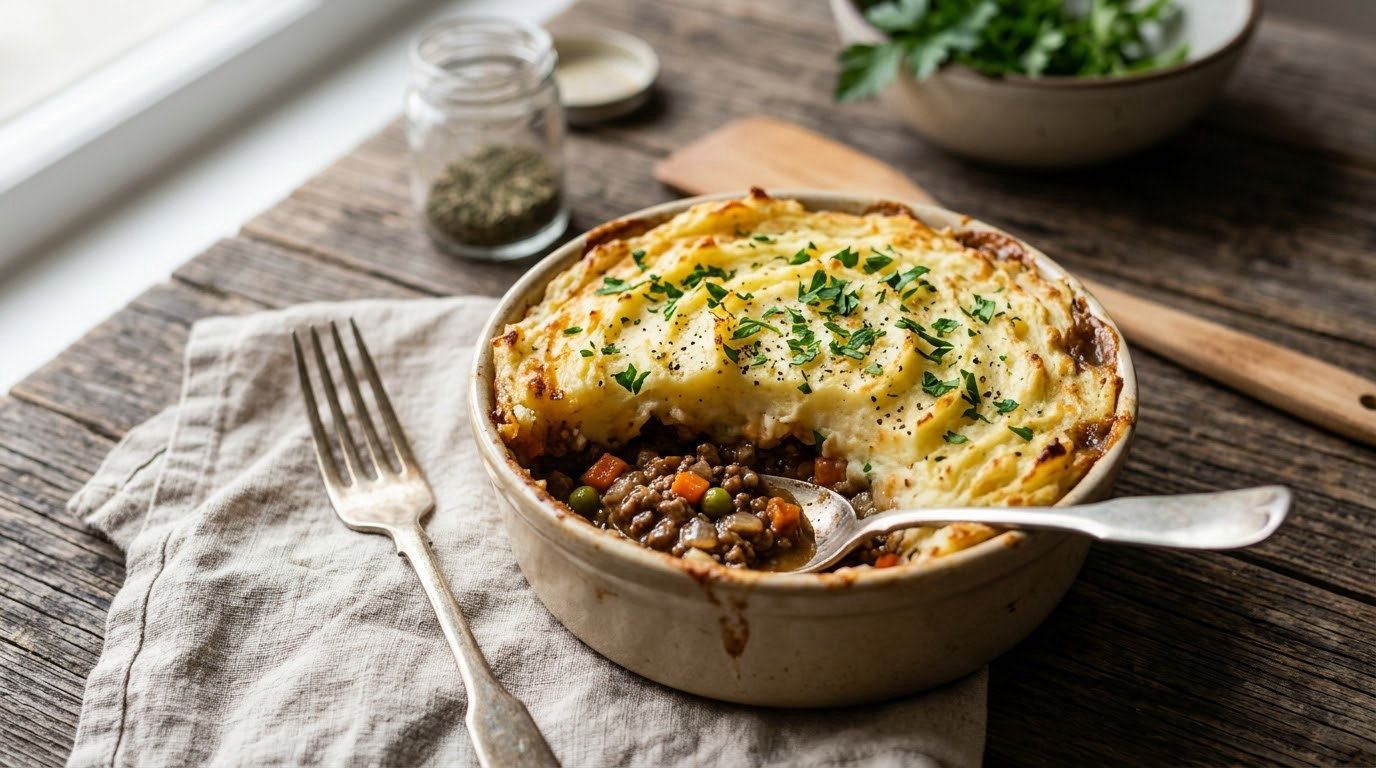
You can, and for dishes like chili or shepherd’s pie it saves real time. Freeze everything together in an airtight container or bag, leaving an inch of headspace for expansion. Be aware that vegetables can get soft or watery after thawing, so if you want them to keep their bite, freeze the beef by itself and add fresh vegetables when you cook. Cream-based sauces sometimes thicken in the freezer, so thin them a little first.
Can I refreeze cooked ground beef after thawing it in the refrigerator?
Yes. Beef that was cooked before it was frozen can be refrozen after a safe thaw in the refrigerator, and this is the distinction that trips people up. What is not recommended is freezing raw beef, thawing it, then cooking it and refreezing that. Expect some extra dryness from a second freeze and thaw cycle, so use it within the same 3 to 4 month window you would have used the first time.
How do I prevent freezer burn on cooked ground beef?
Freezer burn happens when air reaches the surface of the food. Squeeze the air out of freezer bags before sealing them, press the beef into a single flat layer, and do not leave bags open or half-zipped. Rigid airtight containers and vacuum sealing both help. Keep your freezer at 0u0026deg;F (-18u0026deg;C), avoid long stretches with the door open, and use older packages first so nothing sits for years.
Can I microwave cooked ground beef from frozen?
Yes. Break the frozen beef apart first so it is in crumbles rather than one block, place it in a microwave-safe dish, cover it loosely, and heat in 1-minute bursts, stirring between each one. Cook until it reaches 165u0026deg;F (74u0026deg;C). The microwave heats unevenly, and edges can get hot while the center is still icy, so stir more often than feels necessary and move it to a skillet if you want browning.
Conclusion
Start with cooling. Put the cooked beef into a shallow dish, get it cooled within two hours, and stop the process there if you are tired. Everything after that is quick.
Once it is cool, scoop it into a freezer bag, flatten it with a rolling pin, press out the air, score it into squares, and label it with the date and the quantity. That is the whole of how to freeze cooked ground beef, and it turns one skillet of beef into a month of meals. A bag of it makes a fast weeknight [Korean ground beef bowl](https://thesweetandsimplekitchen.com/easy-korean-ground-beef-bowls-recipe/), and a larger portion turns into a [ground beef noodle casserole](https://thesweetandsimplekitchen.com/best-ground-beef-and-noodle-casserole-recipe/). Our [guide to freezing cooked rice](https://thesweetandsimplekitchen.com/can-you-freeze-cooked-rice-safely/) follows the same cooling and labeling rules, which is the easy way to build a freezer that actually makes sense.