
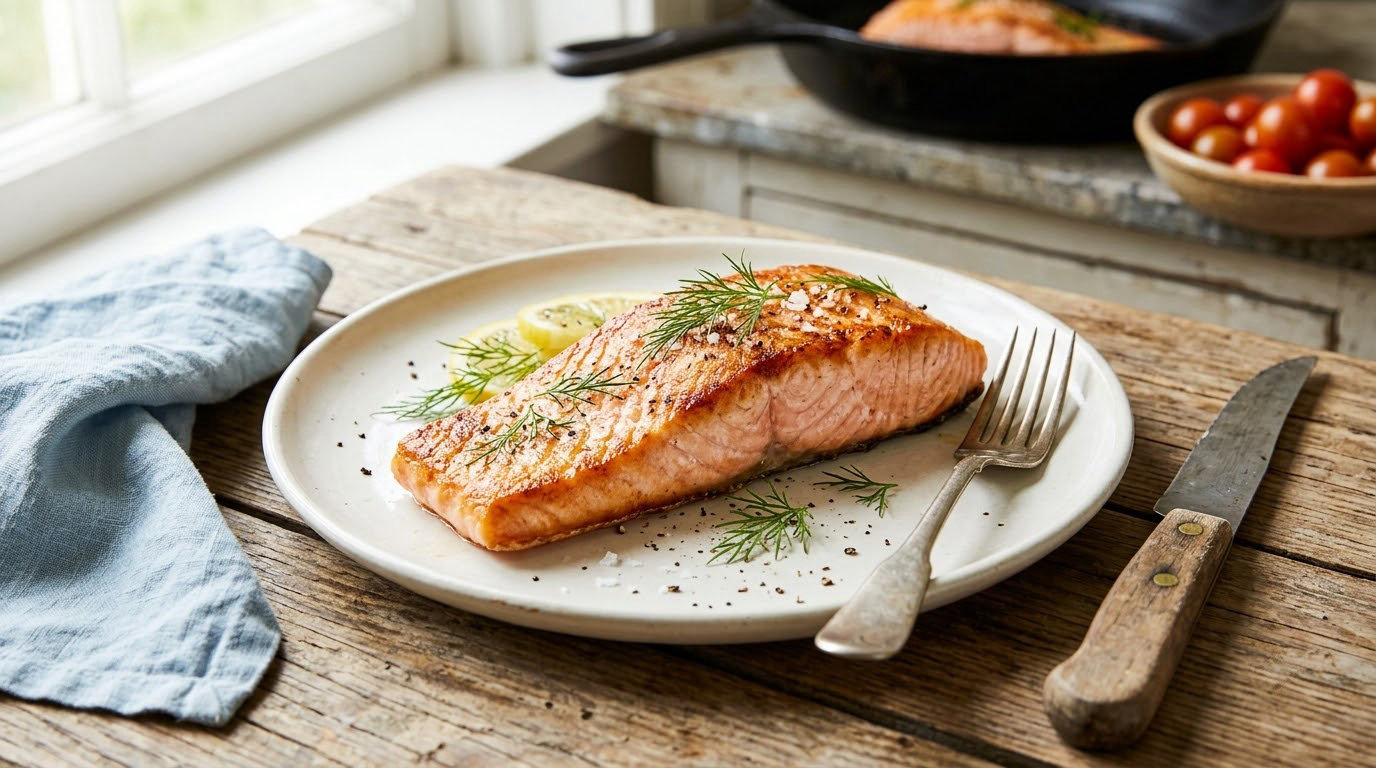
Fish is done at 145°F (63°C) internal temperature, measured in the thickest part of the fillet. That is the USDA safe minimum internal temperature for fish and shellfish. Plenty of restaurant kitchens pull lean white fish at 125-130°F (52-54°C) instead, then let carryover heat finish it while the fish rests.
Those two numbers answer different questions. The 145°F number is about safety. The lower number is about texture, and it is why a buttery cod served at a restaurant feels nothing like the dry, chalky slab most of us bake at home. Knowing what temperature is fish done at means holding both in your head at once, then letting a thermometer settle the argument.
Fall weeknights are when I cook fish most, and it is also when I overcook it most. Standing at the stove counting minutes does not work on fish the way it works on a steak, because a 1/2-inch tilapia fillet and a 1 1/2-inch halibut steak can hit the pan at the same moment and be done twenty minutes apart. Once I started taking a reading early, everything got easier.
Table of Contents
What Temperature Is Fish Done At?
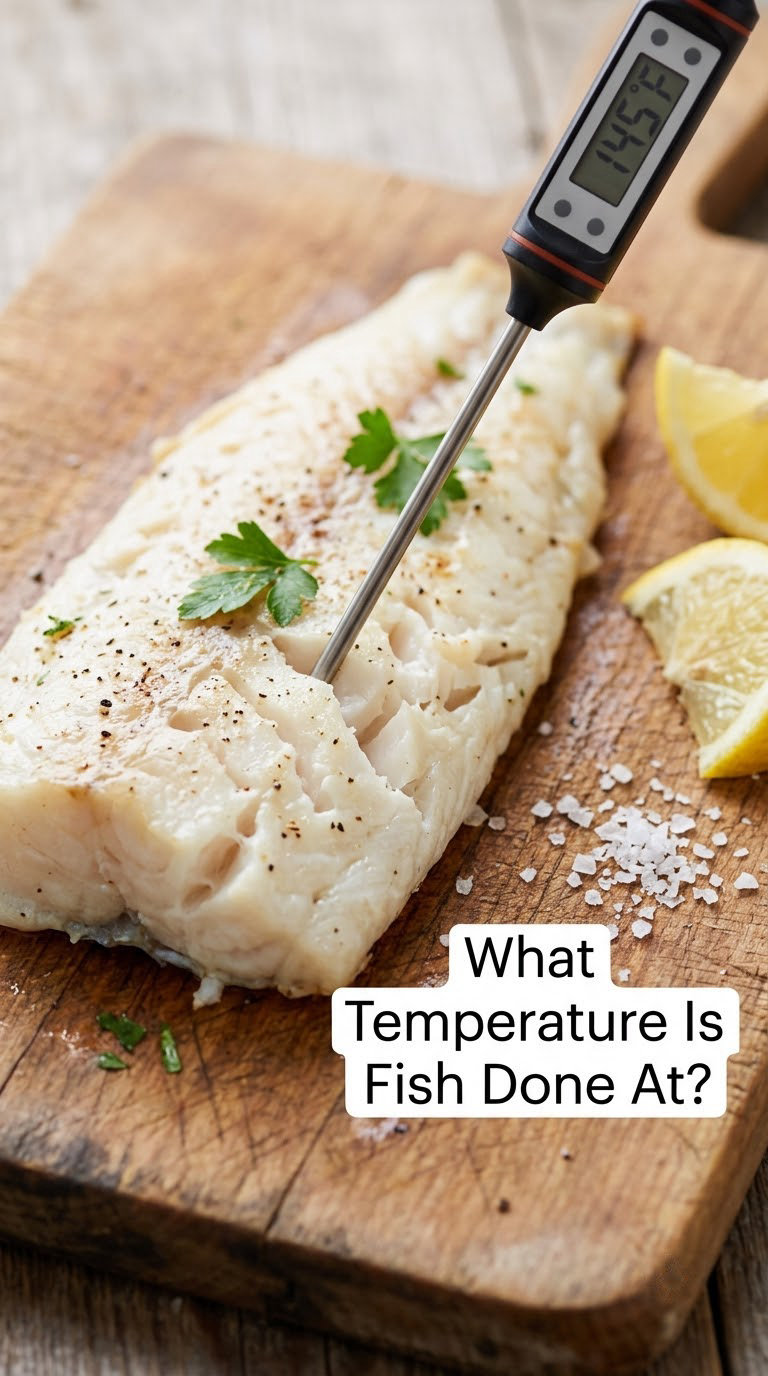
There are three temperatures worth separating, and confusing them is the reason most home cooks end up with rubbery fish.
- USDA safe minimum internal temperature: 145°F (63°C) for fish and shellfish, measured in the thickest part. Non-negotiable if you are cooking for anyone pregnant, elderly, very young, or immunocompromised.
- Pull temperature: the reading you accept at the moment the fish leaves the heat. Usually about 5°F (3°C) below your target.
- Carryover-finished temperature: what the fish reaches on its own during the rest. This is the number that actually lands on the plate.
Here is where fat content matters more than species name. Lean fish like cod, haddock, halibut, tilapia and pollock have very little fat to keep them moist, and they go dry quickly past 145°F. Fatty fish like salmon and trout carry enough oil to stay moist well past that mark, and most cooks serve them slightly under the safety line on purpose.
| Fish | USDA safe minimum | Pull from heat at | What you get |
|---|---|---|---|
| Cod | 145°F / 63°C | 135-140°F / 57-60°C | Flaky and moist; past 150°F it goes dry |
| Haddock | 145°F / 63°C | 135-140°F / 57-60°C | Tender flakes, forgiving of a minute or two |
| Halibut | 145°F / 63°C | 135-140°F / 57-60°C | Very lean, so pull on the early side |
| Tilapia | 145°F / 63°C | 140-145°F / 60-63°C | Thin and quick, hard to overcook once it flakes |
| Catfish | 145°F / 63°C | 140-145°F / 60-63°C | Mild, holds up to high-heat methods |
| Pollock | 145°F / 63°C | 135-140°F / 57-60°C | Flakes in large clean pieces |
| Sea bass | 145°F / 63°C | 135-140°F / 57-60°C | Delicate, rewards an early pull |
| Snapper | 145°F / 63°C | 135-140°F / 57-60°C | Firm white flakes, thin tail cooks fastest |
| Walleye | 145°F / 63°C | 135-140°F / 57-60°C | Lean and fragile, easy to overcook |
| Salmon, farmed | 145°F / 63°C | 125-130°F / 52-54°C | Moist, medium-rare center, fattiest of the group |
| Salmon, wild | 145°F / 63°C | 125-130°F / 52-54°C | Leaner than farmed, pull a touch earlier |
| Trout | 145°F / 63°C | 125-130°F / 52-54°C | Silky, holds moisture far better than white fish |
| Tuna, ahi | 145°F / 63°C | 115-125°F / 46-52°C | Seared rare; cooking it through turns it tuna-canned |
| Swordfish or mahi mahi | 145°F / 63°C | 140°F / 60°C | Mild and firm, tolerates a hot pan well |
| Shrimp | 145°F / 63°C | 140-145°F / 60-63°C | Opaque and firm, curls into a C |
| Scallops | 145°F / 63°C | 145°F / 63°C | Go rubbery fast, pull the moment they feel firm |
| Lobster tail | 145°F / 63°C | 140-145°F / 60-63°C | Shell turns red and meat goes opaque |
Shellfish follow the same 145°F (63°C) rule and different visual cues. Shrimp turn from grey to pink and curl inward, scallops go from translucent to milky white and stop wobbling, and lobster meat loses its raw grey gloss entirely.
Underneath all of it is protein denaturation, which sounds like a science lecture and is really just one idea. Raw fish muscle is translucent and held together by tight connective tissue. As heat passes roughly 140°F (60°C), those proteins unfold and set, the flesh turns opaque, and the tissue binding the flakes together relaxes enough that a fork slides through without resistance. Past that point the water inside the muscle keeps squeezing out, which is the entire definition of dry fish.
What Temperature Is Fish Done At by Cooking Method?
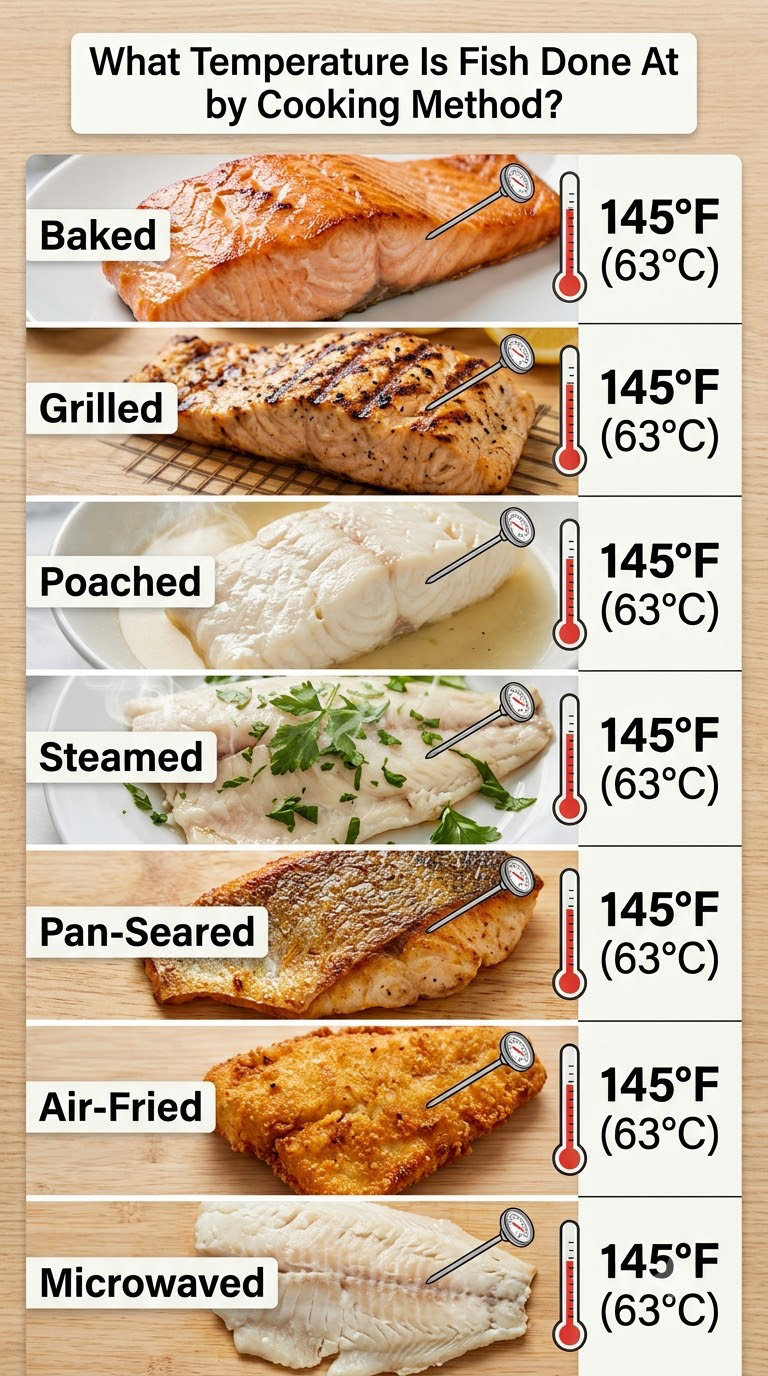
The target does not change much by method. What changes is how fast the outside gets hot and how much you have to watch.
| Method | Target internal temp | Typical conditions | Doneness cues |
|---|---|---|---|
| Baking or roasting | 145°F / 63°C | 400-450°F / 205-230°C oven | Opaque, flakes easily, releases from the pan |
| Grilling | 145°F / 63°C | Medium-high grill, skin or flesh side down first | Charred crust, releases from the grate without forcing |
| Pan-searing | 145°F / 63°C | Hot skillet with oil, 3-4 minutes per side | Deep golden crust, flesh springs back lightly |
| Poaching | 145°F / 63°C | Hold at 160-180°F / 71-82°C, just below a simmer | Slab stays intact, turns opaque through the centre |
| Steaming | 145°F / 63°C | Steamer over boiling water, tight lid | Flesh separates into clean flakes |
| Air frying | 145°F / 63°C | 400°F / 205°C, 6-10 minutes depending on thickness | Crisp edges, opaque and flaky at the centre |
| Broiling | 145°F / 63°C | High heat, 2-4 inches from the element, stay in the kitchen | Browned top, flesh just turning opaque |
| Microwaving | 145°F / 63°C | 50% power, 2-4 minutes, covered, turned once | Uneven heating, so probe two spots |
Poaching is the one method where you hold a target rather than reach one. Keeping the liquid at 160-180°F (71-82°C) cooks the fish gently while you do something else, which is why it is my answer when dinner has to wait on me.
How Long Should Fish Cook by Thickness?
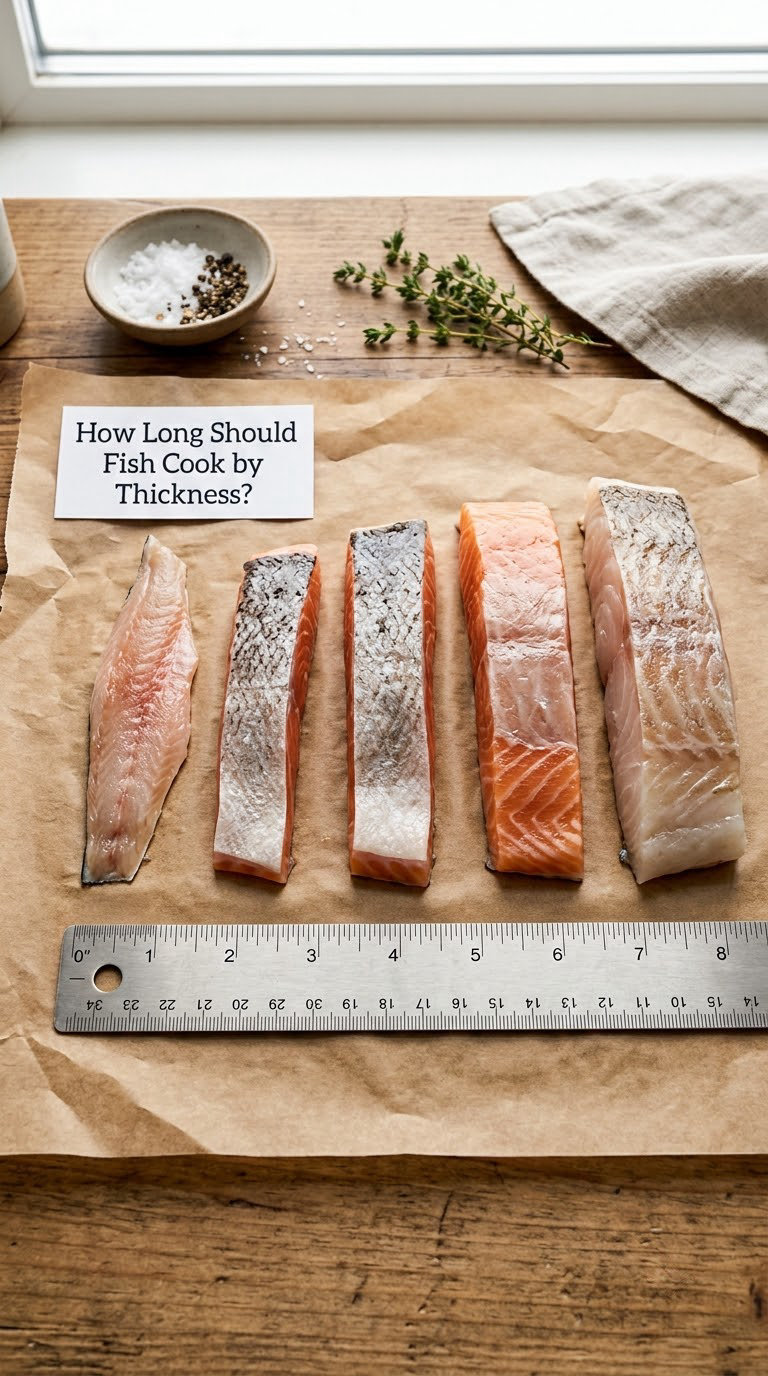
Time is a starting point. Temperature is the finish line. But you still need a time to start from, and thickness is the variable that decides it. Measure at the widest point of the fillet, not the tail flap.
| Thickness | Pan-sear | Bake at 400°F / 205°C | Grill | Air fryer 400°F | Poach |
|---|---|---|---|---|---|
| 1/2 inch | 2-3 min per side | 8-10 min | 3-4 min per side | 5-6 min | 5-7 min |
| 3/4 inch | 3-4 min per side | 10-12 min | 4-5 min per side | 7-9 min | 7-9 min |
| 1 inch | 4-5 min per side | 12-14 min | 5-6 min per side | 9-11 min | 9-11 min |
| 1 1/4 inch | 5-6 min per side | 14-16 min | 6-7 min per side | 11-13 min | 11-13 min |
| 1 1/2 inch | 6-7 min per side | 16-20 min | 7-8 min per side | 13-15 min | 14-16 min |
| 2 inch | 8-9 min per side | 20-25 min | 9-10 min per side | 16-18 min | 18-20 min |
The famous 10-minute rule means ten minutes per inch of thickness at 400°F (205°C), which matches the table above closely. Treat it as a starting point and expect it to fail in three situations: a thin fillet, where 10 minutes per inch overshoots badly, a sugary marinade, which burns before the centre cooks, and fish cooked from frozen, which needs noticeably longer and often turns rubbery at the edges while raw in the middle.
How to Check Fish Doneness Without Overcooking It
Where the thermometer goes
Find the thickest part of the fillet, usually just behind the head end on a whole fillet. Insert a slim instant-read probe at a slight angle, aiming into the centre of that section, and read without touching bone, the pan wall or the thin tail flap. Bone reads low, the thin tail flap reads high, and both give you a number that has nothing to do with your dinner.
What temperature is fish done at when you have no probe
A thin metal skewer or cake tester works almost as well. Push it into the thickest part, leave it for ten seconds, then touch the tip to the inside of your lower lip. If it feels neutral or barely warm, keep going. If it feels hot, take the fish off the heat. The meat is past the USDA minimum.
Visually, run through this list in order. The flesh should be fully opaque with no translucent patches, it should flake into clean pieces when a fork slides in at a slight angle, the glossy raw sheen should be gone, and a small amount of clear white juice should come out rather than none at all or a lot of water. Texture matters too: cooked fish springs back lightly when pressed and springs back less as it goes further past done.
The pull-early rule
Here is the habit that fixed my dry fish: take the reading about 5°F (3°C) below your target, move the fish to a warm plate, and wait one to three minutes. A 1-inch fillet climbs roughly 4-6°F (2-3°C) during that rest. A half-inch fillet barely moves at all, so thin fish should come off closer to 145°F than thick ones do.
Baked or Roasted Fish: Step-by-Step
- Heat the oven to 400°F (205°C), or 425°F (220°C) if you want browning on the top.
- Pat the fillet dry on both sides and season. Wet fish steams instead of searing.
- Lightly oil the top and lay it in a small baking dish. A snug dish keeps moisture in; a huge sheet pan dries the edges.
- Bake on the middle rack for the time that matches its thickness in the table above.
- Start checking temperature in the last third of the estimated time, not at the end.
- Pull at about 140°F (60°C) for a thick fillet, rest 3 minutes, serve.
If you want a crust, sear the fillet in a hot pan for 90 seconds per side first, then transfer it to the oven to finish. That combination gives you a browned exterior and a moist centre without drying the fish out, which is the trade-off you are always making with lean white fish.
Baked fish also plates beautifully with the sides in what to serve with fried fish, so a temperature question never has to mean a plain plate.
Grilled, Pan-Seared, or Poached Fish: Step-by-Step
High heat: grilling and pan-searing
- Scrape the grill grates clean and oil them. Fish sticks to cold, dirty metal.
- Pat the fillet dry and oil it lightly. Moisture is the enemy of a crust.
- Set it on the grill or in a hot skillet and leave it alone for the full first-side time from the table.
- Turn once. Use a wide spatula and slide it under rather than flipping it in the pan.
- Check the temperature before the second side finishes, because carryover is already working.
- Pull fatty fish low at 125-130°F (52-54°C), lean fish at 140°F (60°C).
Low heat: poaching
- Bring the poaching liquid to a bare simmer, then lower the heat so it stays at 160-180°F (71-82°C).
- Add the fillet. If it is fully submerged it cooks evenly; if not, turn it halfway through.
- Poach for the thickness-based time from the table.
- Check the temperature in the thickest part near the end of that window.
- Remove with a slotted spatula and rest for 2-3 minutes before serving.
Poaching is worth doing properly rather than occasionally. I keep one dedicated pan for it so I am not fighting a deep skillet for the burner, and if you want to buy one, these are the fish poachers I would pick again.
How Temperature Changes Fish Texture
Two things happen as heat climbs past 140°F (60°C). The connective tissue binding the flakes together relaxes and the fish starts to separate, which is the flaking you want. At the same time the muscle proteins tighten and squeeze out moisture they used to hold, which is the dryness you do not. Everything below 145°F is a negotiation between those two effects, and fat is what keeps the losing side from winning too quickly.
That is the whole explanation for why salmon and tuna tolerate low temperatures while halibut does not. A fatty salmon fillet at 128°F (53°C) is still juicy because there is oil in the muscle holding water in place. A halibut steak at 128°F (53°C) is undercooked for most people and past safe only in the sense that you still want it opaque, but at 150°F (66°C) it has given up nearly all of its water and tastes like firm chalk.
If a fillet goes past where you wanted it, the recovery options are limited but not zero. A squeeze of lemon or a spoon of sauce adds moisture and acidity that the flesh no longer has. Shredding it into a salad or a rice bowl breaks up the dry muscle fibres and mixes them with something moist. Shredded fish tossed with mayo, dill and capers is the fastest thing I can do with an overdone fillet, and honestly it is often better than the fish would have been.
Common Fish Cooking Mistakes
Checking only the thin edge. The tail flap cooks first and is always hottest, so probing it tells you nothing about the centre. Move to the thickest part.
Hitting bone with the probe. A bone reading is unreliable and usually low, which makes you cook the fish longer. Angle the probe forward, into the thick meat just ahead of the bone line.
Waiting until the estimated time is up before checking. Every extra minute of oven time after the fish is done is moisture leaving. Start probing a third of the way through the estimated time.
Cooking until the USDA line with no pull-early rest. You will land at 150°F (66°C) before you even sit down to eat. Pull at 140°F (60°C) and rest.
Crowding the pan. Fish needs a hot surface, and a crowded pan drops the temperature fast enough to steam it. Cook in batches if the fillets are touching.
Using a pan that is too small. One thick fillet needs room to lie flat. If the fish is folded or curved in the pan, the thick part cooks slower than the thin part.
Turning fish three or four times. Every flip costs you crust and tears the surface. Turn once, or not at all on thinner fillets.
Relying on colour alone. Fish can look opaque at the surface and still be raw in the middle, especially with a thick loin or a rolled fillet. Colour is a hint, not a verdict.
Leaving refrigerated fish out for hours before cooking. Letting fish sit at room temperature to cook faster is a safety trade you do not need to make. Thirty minutes is enough; the temperature gain is negligible.
Frequently Asked Questions
What is the 10 minute rule for fish?
The 10 minute rule means cooking fish for 10 minutes per inch of thickness at 400F (205C). It is a starting point, not a target. It overshoots badly on thin tilapia or sole fillets, burns sugary marinades before the centre cooks, and always needs a few extra minutes on fish cooked from frozen. Check the temperature in the thickest part before the timer runs out.
Is fish done at 135 degrees?
135F (57C) is past the point where most lean white fish flakes cleanly, so it is a perfectly good chef target. It is not the safety number though. The USDA safe minimum internal temperature for fish is 145F (63C). If you are serving anyone pregnant, elderly, young or immunocompromised, treat 145F as the line and rest the fish there.
Is fish done at 140 degrees?
140F (60C) is the standard pull temperature for a 1-inch fillet. Pull it there, rest it 3 minutes, and carryover heat finishes it near 145F (63C) on the plate. Thick fillets need this more than thin ones, since a thin fillet barely rises in temperature while it rests. Lean fish like halibut and cod benefit most from this approach.
How do I tell if my fish is fully cooked?
Look for four things: the flesh is fully opaque with no translucent patches, it flakes into clean pieces when a fork slides in at an angle, the glossy raw sheen has disappeared, and a little clear white juice comes out. Texture matters too. Cooked fish springs back lightly when pressed, and the spring fades as it goes further past done. With a thermometer, 145F (63C) in the thickest part settles it.
How long does it take fish to cook at 375 degrees?
At 375F (190C), allow roughly 10 minutes per inch of thickness, which is the same rate as 400F. In practice that is 8 to 10 minutes for a half-inch fillet, 10 to 12 minutes at three-quarter inch, and 12 to 14 minutes at one inch. Start probing the temperature a third of the way through the estimated time rather than waiting for the end.
What is the FDA minimum internal temperature for fish?
The USDA Food Safety and Inspection Service lists 145F (63C) as the safe minimum internal temperature for fish and shellfish, measured in the thickest part with a food thermometer. Restaurants serve many fish dishes well below that number, which is a culinary choice about texture rather than a different safety standard. The 145F line matters most for vulnerable diners.
Conclusion: Use the Thermometer First
One number to remember: 145°F (63°C) in the thickest part, measured with a food thermometer. Everything else on this page is about how to reach that number without turning the fish into a hockey puck.
Take the reading early rather than at the end, pull thick fillets about 5°F (3°C) below the target, and give them one to three minutes to rest. Start with a fish you like, get the timing from the thickness table, and keep your 10 Best Diabetic Fish Recipes Ideas or the what temperature is pork done at guide handy for the other proteins you cook the same careful way.