
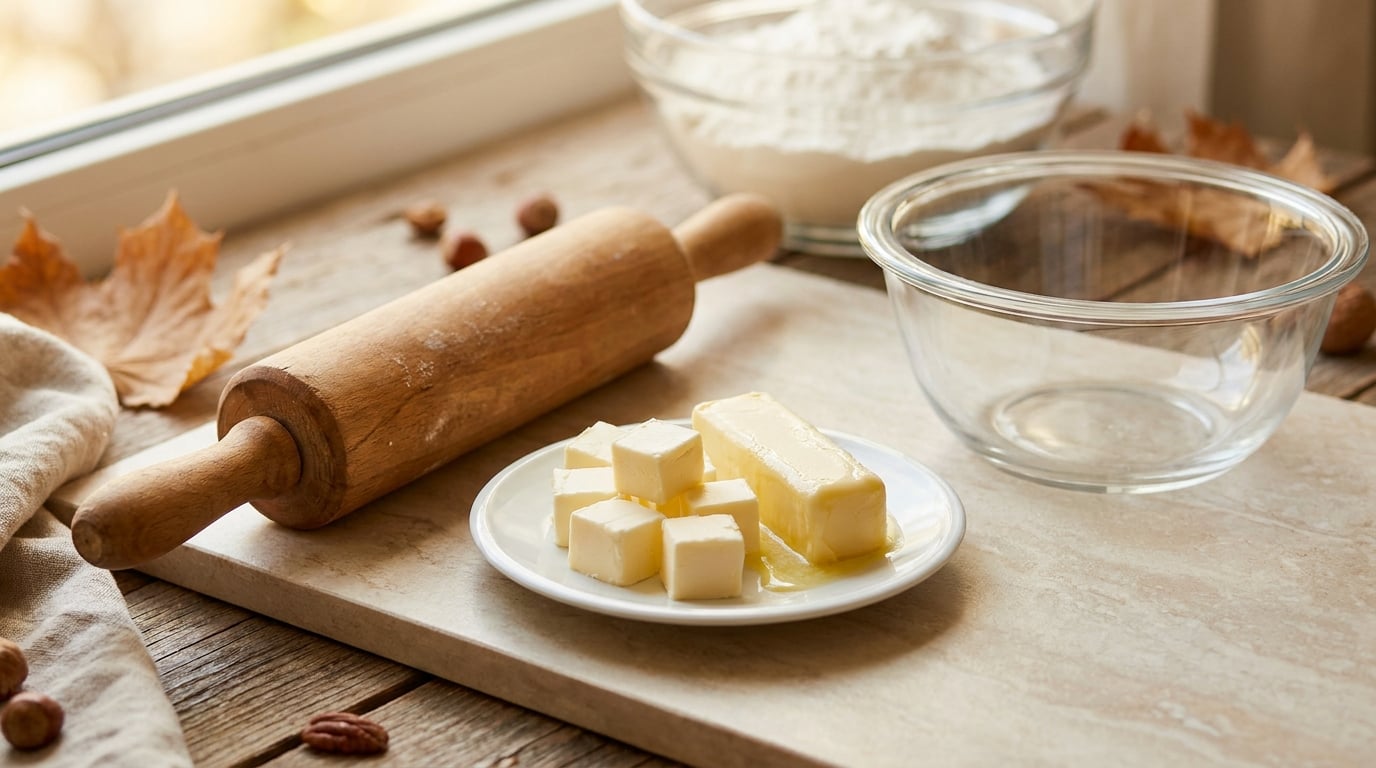
Softened butter sits at about 65-70°F (18-21°C): cool to the touch, pliable, and dented by a fingertip without losing its shape. If your butter is still in the fridge, cube it and pound it flat with a rolling pin, or use 5-10 second microwave bursts. Both reach that window in minutes without melting it.
Forgetting to pull the butter out is the single most common baking mistake I see, and the panic it causes is real. Nobody wants to abandon a cookie project because the fat is too hard to beat.
Before you reach for the microwave, it helps to know what you are aiming for. Recipes call for room temperature butter because creaming needs fat that is soft enough to trap air. Too cold and the batter stays lumpy and dense; too warm or melted and it turns greasy, flat, and short. Every method below is judged against that narrow window.
Timing does depend on your kitchen, though. Most of the numbers I use assume a room around 70-75°F. In a cooler kitchen, counter times stretch and the microwave or the rolling pin earns its keep much faster.
Table of Contents
How to Soften Butter Quickly for Baking: At a Glance
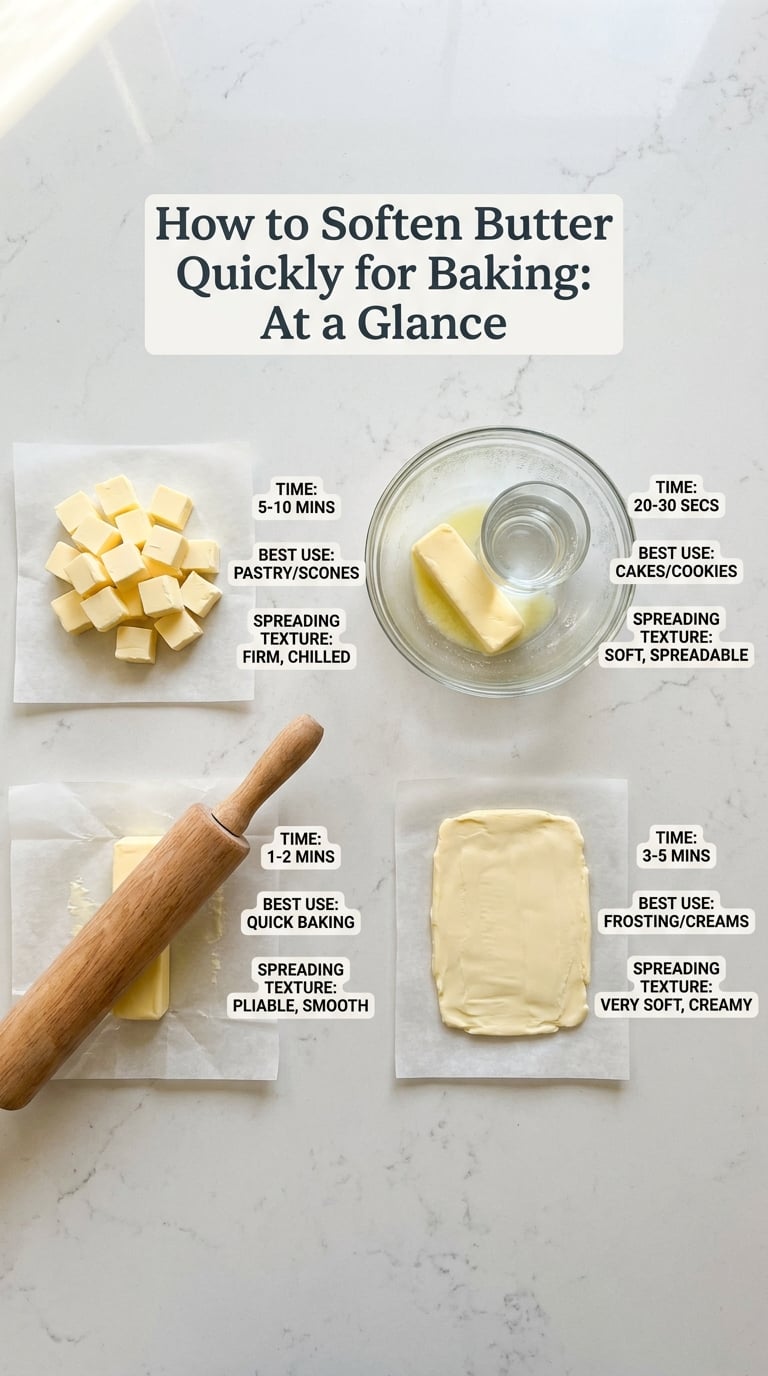
Here is the short version. Cube and roll is the most controllable, the microwave is the fastest, and the counter is the one you plan for in advance.
| Method | Typical time | Tools | Best for | The sign it is ready |
|---|---|---|---|---|
| Cube and roll | 5-10 min | Knife, rolling pin, wax paper | Anything, especially pie crust and pastry | Cubes flatten into a supple sheet that bends without cracking |
| Microwave bursts | 30 sec-2 min | Microwave | Cookies, cake batter, last-minute baking | Stick dents under a thumb but still stands on its own |
| Counter rest | 30-90 min | Cutting board | Planning ahead, large batches, buttercream | Whole stick gives slightly when pressed, then holds shape |
Times by quantity, since that is usually where plans fall apart:
| How much butter | Cube and roll | Microwave bursts (1000W) | Counter rest |
|---|---|---|---|
| 2 tablespoons (1 oz) | 2-3 min | 5-10 seconds | 15-20 min |
| 1 stick (4 oz) | 5-8 min | 10-20 seconds | 45-60 min |
| 2 sticks (8 oz) | 8-12 min | 20-30 seconds | 60-90 min |
| 1 cup or more (bulk block) | 12-18 min, work in batches | 30-45 seconds, rotate often | 90-120 min |
One note on the butter itself. European-style sticks with a higher fat content are softer straight from the fridge, so they need less heat than standard salted or unsalted American butter. If your butter bends when you lift it out of the wrapper, cut the microwave time in half.
3 Ways to Soften Butter Without Melting It
Each of the three methods works by getting heat into the middle of the stick faster than the outside can melt. The difference is how much control you keep.
If you are in a hurry and have a microwave, bursts get you there first. If you have five minutes and a rolling pin, you get the most even result and almost no risk of overheating. The counter method only wins when you planned ahead, or when you are softening a large block for a big batch of scones and want the whole thing to soften slowly and evenly.
How to Soften Butter Quickly for Baking by Cubing and Rolling
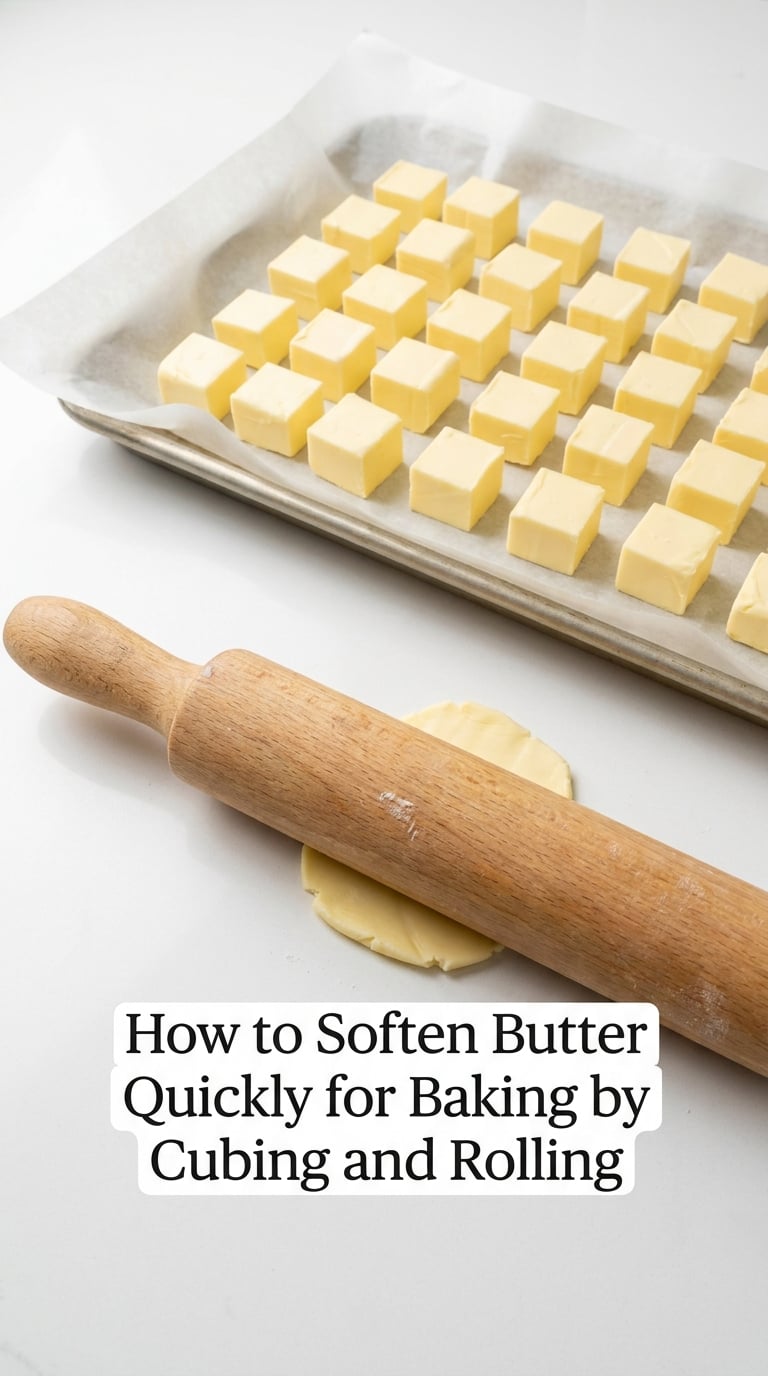
This is the method I use most, and the one I point friends to. Cutting the stick into smaller pieces multiplies the surface area, so the cubes reach room temperature in a fraction of the time a whole stick would. Rolling them flattens that last hard core.
- Cut the cold butter into 1-inch cubes with a sharp knife. A 4 oz stick gives you eight cubes.
- Leave the cubes on the board for 2-3 minutes so the surfaces lose their chill.
- Put the cubes inside a sheet of wax paper or a sealed snap-lock bag and fold it closed.
- Smash the cubes flat with the flat side of a rolling pin, working one at a time until each is a thin, even sheet.
- Turn the butter out and press it firmly with your thumb. If the pad sinks in and stays dented, it is ready. If it springs back, keep rolling.
For a whole stick, allow 5-8 minutes. Two sticks take closer to 10, and a full cup of cubed bulk butter usually needs 12-18 because you are working through it in batches.
Rolling beats pounding with a heavy fist. An uneven strike splatters butter and leaves you picking wax paper off the counter for five minutes, and honestly that is the whole reason the microwave is popular.
One more visual cue for measuring: press the softened butter into a measuring cup and level the top with the back of a knife. If it holds a clean edge instead of slumping, you are right on target for a recipe that says softened.
How to Soften Butter Quickly for Baking in the Microwave
Yes, you can soften butter in the microwave without melting it, and for cookies and cake batter the method is genuinely fast. The trick is low power, short bursts, and rotating the stick between them.
- Unwrap the butter and place it on a small microwave-safe plate. Paper towel underneath catches any seepage.
- Set the microwave to 30% power, or the lowest defrost setting your machine has.
- Run it for the starting time for your quantity from the table above.
- Open the door, turn the stick, and press your thumb into it.
- Repeat in 5 second bursts until it dents without splitting. Stop as soon as it gives.
Two signs tell you you have gone too far: butter pooling in the tray, or a glossy, sweating surface. Either one means the fat and water have started separating, and no amount of chilling puts that back. Start over with a fresh stick.
Never leave a stick unattended. A full-power run can go from softened to liquid in under a minute, and a microwave running empty for a minute is a fire risk. The low-power approach is slower and much easier to stop.
For large amounts, a 1200W microwave on 30% power behaves quite differently from a 600W one on 50%. Treat the table as a starting point, then trust your thumb.
How to Soften Butter Quickly for Baking on the Counter
Counter softening wins on evenness and loses on speed, but it is the only method that does not need a single tool, so it is the right choice when you set butter out before you start anything else.
A single 4 oz stick needs about 45-60 minutes at 70-75°F. Two tablespoons need only 15-20. In a 65°F kitchen, budget closer to an hour and a half for a full stick, which is why so many people think the method is broken. Nothing is wrong, the room is just cold.
Cut the stick in half lengthwise before it goes out. Two thinner pieces soften faster than one thick log, and the exposed cut face does most of the warming.
For food safety, butter is high in fat and low in available water, so it is not the same risk category as cream or milk. Still, keep it covered and use it within a couple of hours. If you are baking in a very warm room, put it back in the fridge between steps.
How to Tell When Butter Is Soft Enough for Baking
The finger test is the only skill you need. Press your thumb firmly into the butter. Correctly softened butter dents, and the dent stays. Too cold and the butter dents only at the edges, or the stick cracks with an audible snap. Too warm and the thumb sinks straight through, leaving a hole that fills with fat.
The bend test works well for a whole stick. Lift it by the ends and let it bow under its own weight. It should curve like a soft banana, not hang limp and not stay rigid.
The taste is a poor guide, since temperature is hard to judge with your tongue. The texture is not.
| What it looks like | What it is | What happens in the bake |
|---|---|---|
| Firm, matte, snaps when bent | Cold, 40-50°F | Lumpy batter, dense and heavy cookies |
| Matte, dents under a thumb, bends without cracking | Softened, 65-70°F | Creams light and traps air properly |
| Shiny surface, thumb sinks through, grease on the board | Too soft or melting, 72°F and up | Greasy, flat, dense bakes that spread too far |
| Translucent, liquid, water droplets in the pan | Melted | Fat separates, batter goes loose and flat |
None of these need a thermometer, but if you own one, an instant-read thermometer makes the guesswork disappear. 65-70°F is the target, and no recipe cares about the second digit.
How Much Softer Does Baking Butter Need to Be?
Different jobs want different amounts of softness, and going one step too soft is the most common way good bakers ruin a batch.
- Creaming cookies and cake batter: 65-70°F. It should hold a fingerprint but not smear when you drag a finger across the surface.
- Greasing a cake pan: the same 65-70°F. Melted butter runs down the sides and misses the middle entirely.
- Lining a pie tin or making pastry: cool and firm, closer to 60-65°F. You want it to hold its shape when pressed into the pan and to flake in layers, not smear into the flour.
- Rolling pastry dough: butter that is room temperature and plastic. Cold chunks leave hard streaks, fully soft butter blends into the flour and the dough loses its layers.
- Buttercream frosting: 65-70°F with no shine. This is the one case where being a little cool is safer than being a little warm.
If you are unsure which one you need for a specific bake, my [peanut butter chunker cookies recipe](https://thesweetandsimplekitchen.com/peanut-butter-chunker-cookies/) starts from room temperature butter beaten with brown sugar, so 65-70°F is the target there. For a frosting-heavy bake, the brown butter glaze in my [sour cream cake donuts recipe](https://thesweetandsimplekitchen.com/sour-cream-cake-donuts-with-maple-brown-butter-glaze/) is easier to nail because the butter is cooked rather than softened.
Common Mistakes That Ruin Softened Butter
You microwaved it on full power. Fix: use 30% power or defrost, and run 5 second bursts. Full power softens the outside while the middle stays hard, then overshoots into a puddle before you can stop it.
You left it out too long and forgot. Fix: if the surface is greasy and shiny, put it in the fridge for 20-30 minutes, then roll it back out. It comes back closer than you think, though it will never return to the texture of fresh softened butter.
You melted it. Fix: for cookies and cake, you cannot fully reverse it. Chill the butter until it is solid, then cut off the amount you need and soften that piece properly. Reserve melted butter for recipes that ask for it, like a poured cake batter or a glaze.
You softened the whole box at once. Fix: work in batches. Ten sticks on the counter turn into a race you will lose. Cube a few sticks, soften them, use them, and repeat.
You are in a cold kitchen and trusted the timer. Fix: stop timing entirely and test by hand every few minutes. A kitchen at 64°F can add half an hour to every counter estimate in this article.
You used melted butter where the recipe said softened. Fix: this is the mistake that quietly ruins texture. Melted butter cannot trap air, so cookies spread and cakes go dense. Measure it solid and soften it first.
While the butter comes to temperature, it is a good moment to double-check the leavening in the recipe. [Baking soda versus baking powder](https://thesweetandsimplekitchen.com/baking-soda-vs-baking-powder/) explains which one your cookies actually need, and getting that wrong affects texture as much as the butter does.
Frequently Asked Questions
Can you soften butter in the microwave without melting it?
Yes. Set the microwave to 30% power or the lowest defrost setting, and run it in 5 second bursts rather than one long cycle. Turn the stick between bursts and press your thumb into it after each one. Stop the moment it dents without splitting. A 4 oz stick on a 1000W microwave usually needs 10-20 seconds of total run time.
How long should butter sit outside the refrigerator to soften?
About 45-60 minutes for one 4 oz stick at a room temperature of 70-75°F. Two tablespoons need only 15-20 minutes, and a full cup needs 90-120. Cutting the stick in half first shortens the wait because more surface is exposed. Keep the butter covered while it sits out.
Is softened butter the same as melted butter?
No, and the difference changes the bake completely. Softened butter is 65-70°F: solid, dented by a finger, and able to trap air when creamed with sugar. Melted butter is liquid, and the fat and water start separating. Cookies made with melted butter spread flat and go dense instead of light.
How soft should butter be before making cookies?
Aim for 65-70°F. The stick should hold a clear fingerprint when pressed and bend without cracking when you lift it by the ends. If the surface turns shiny or your thumb sinks straight through, it has gone too soft and the cookies will spread too far and bake up greasy.
What is the fastest way to soften a whole stick of butter?
Cut the stick into 1-inch cubes, leave them for 2-3 minutes, then smash each one flat under a rolling pin inside a sheet of wax paper. That takes 5-8 minutes with no risk of melting. A microwave on 30% power is faster at 30-60 seconds, but it is much easier to overshoot.
Can I use salted butter in a recipe that calls for unsalted butter?
You can, and most cookies will be fine, but expect a slightly saltier result and check that your leavening is not already salted. Salted butter also softens faster because salt slightly lowers the fat melting point, so trim a few seconds off any microwave timing. Pie crust and pastry are less forgiving, so use unsalted there.
Softening Butter Faster for Your Next Recipe
If you remember only one thing, make it this: cut the stick into cubes and roll them flat. Five to eight minutes, no melting, and even softening all the way through, which is the part microwave bursts rarely give you. Use short microwave bursts only when the butter has to be ready in the next sixty seconds.
Whichever route you take, check the softness before it goes into the bowl. If you are working out how to soften butter quickly for baking, one press of the thumb tells you everything a timer cannot.