
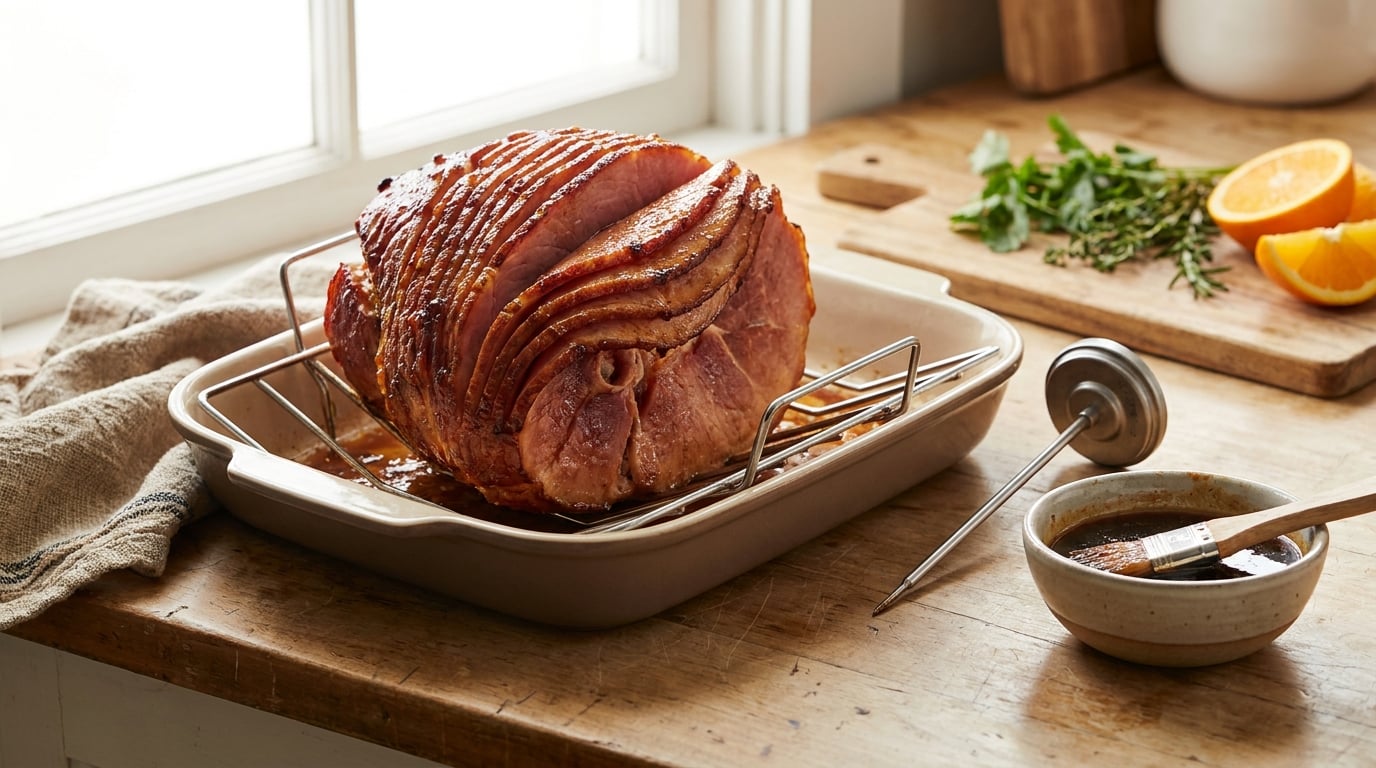
A fully cooked ham needs 10 to 15 minutes per pound at 325°F until it reaches 140°F inside. An uncooked or fresh ham needs 18 to 25 minutes per pound to hit 145°F with a 3-minute rest. Those are planning numbers for the oven door, not the finish line. An instant-read thermometer in the thickest part of the meat decides when dinner is ready.
The single biggest reason ham disappoints is that people treat the label number as a promise. Brands print different rates for the same cut, the oven on your dial is not always the oven on your dial, and a bone-in ham heats unevenly. Plan with a table. Finish with a thermometer.
Table of Contents
How Long to Cook a Ham Per Pound: Quick Guide
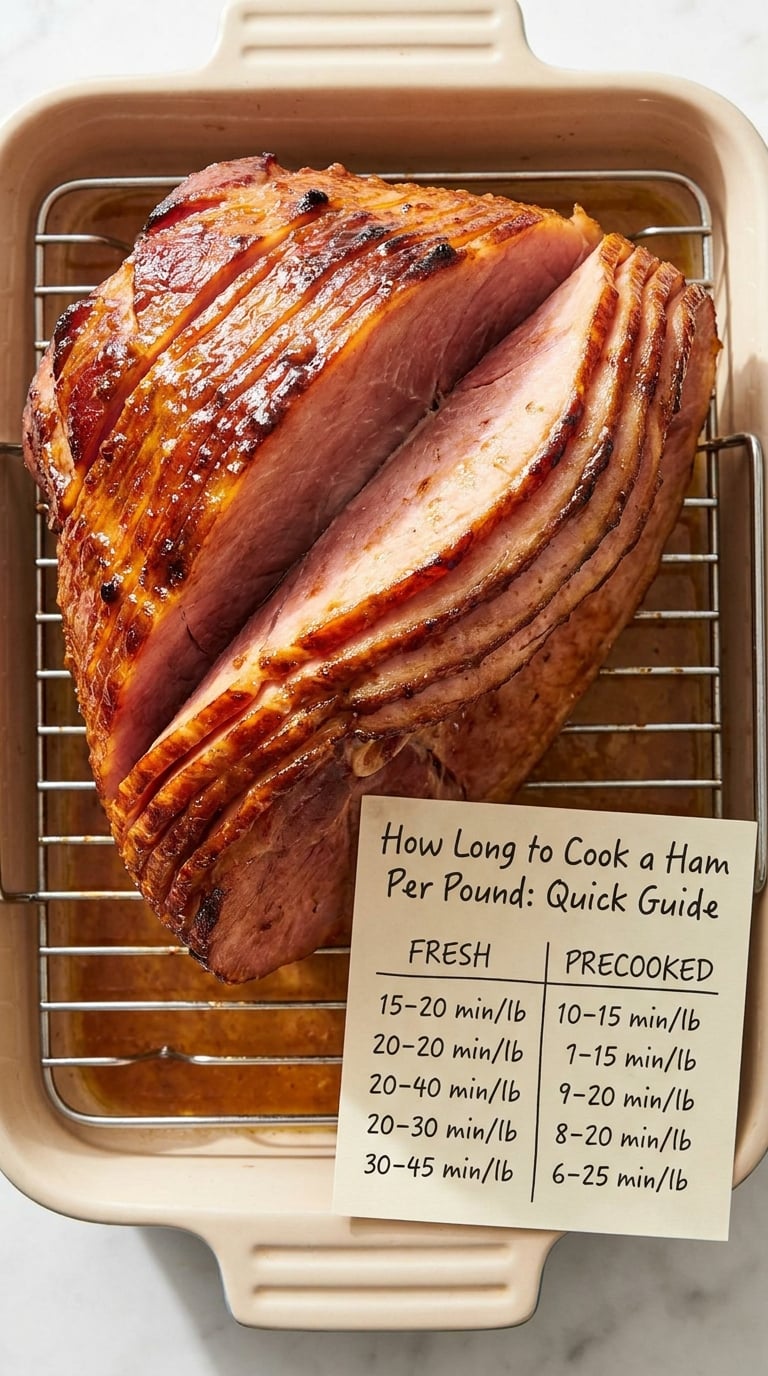
Here is how long to cook a ham per pound, by type, with the safe internal temperature attached to every row. Use the row that matches the label on your ham.
| Ham type | Minutes per pound at 325°F | Internal temperature target | Total time for a 10 lb ham |
|---|---|---|---|
| Fully cooked, bone-in | 10 to 15 | 140°F (60°C) | 1 hour 40 min to 2 hours 30 min |
| Fully cooked, spiral-cut | 10 to 12 | 140°F (60°C) | 1 hour 40 min to 2 hours |
| Fully cooked, boneless | 8 to 12 | 140°F (60°C) | 1 hour 20 min to 2 hours |
| Smoked, cook-before-eating, bone-in | 18 to 20 | 145°F (63°C) plus 3-minute rest | 3 hours to 3 hours 20 min |
| Fresh or raw, bone-in | 20 to 25 | 145°F (63°C) plus 3-minute rest | 3 hours 20 min to 4 hours 10 min |
| Fresh or raw, boneless | 18 to 22 | 145°F (63°C) plus 3-minute rest | 3 hours to 3 hours 40 min |
| Country ham, cured and soaked | About 25 | 145°F (63°C) plus 3-minute rest | About 4 hours 10 min |
| Leftover ham slices, reheating | Not weight based | 165°F (74°C) | 10 to 15 min in a covered dish |
Pre-cooked hams sit low in a range like that because you are reheating meat that was already cooked once. Every extra 10 minutes past 140°F pulls moisture out of a lean, cured ham, and the outer slices turn leathery while the center is still warming.
Now convert that rate into a real clock time for a fully cooked, bone-in ham at 325°F.
| Weight | At 10 min/lb | At 12 min/lb | At 15 min/lb |
|---|---|---|---|
| 5 lb | 50 minutes | 1 hour | 1 hour 15 min |
| 8 lb | 1 hour 20 min | 1 hour 36 min | 2 hours |
| 10 lb | 1 hour 40 min | 2 hours | 2 hours 30 min |
| 12 lb | 2 hours | 2 hours 24 min | 3 hours |
| 14 lb | 2 hours 20 min | 2 hours 48 min | 3 hours 30 min |
| 16 lb | 2 hours 40 min | 3 hours 12 min | 4 hours |
| 18 lb | 3 hours | 3 hours 36 min | 4 hours 30 min |
For a 5 lb ham at 350°F, expect about 50 to 75 minutes, and start checking the temperature 20 minutes early. A 3.5 lb ham fits the same math at 35 to 55 minutes.
How long to cook a ham per pound by cut?
Five things move the number, and only one of them is on the label.
- Bone-in versus boneless. The bone conducts heat into the center, but it also leaves thick meat zones around the hock and shoulder. Bone-in hams get the higher end of the range even though the bone helps.
- Thickness and shape. A tall round ham is thicker than a flat boneless one, and a thick ham needs more time per pound than a thin one at the same temperature.
- Starting temperature. A ham straight from the fridge needs the full listed time. Sitting out 30 to 45 minutes shaves 10 to 20 minutes off the finish.
- Oven type. Convection cooks about 25 percent faster at the same 325°F setting, so use the low end of the range and check early.
- Oven accuracy. An inexpensive oven thermometer on the middle rack tells you whether your dial lies. Plenty of ovens run 25 degrees off.
Rule of thumb from cooking forums: nobody has ever regretted checking the ham 15 minutes early. Undercooking is fixed with more time. Overcooked ham is gone.
Fresh, Smoked, Precooked, or Spiral-Cut Ham: Which Method to Use
Three retail labels decide your method, and they live in different parts of the store.
Fully cooked ham means it was cooked and smoked in a USDA-inspected plant. It is sold ready to eat, so all you do is reheat it to 140°F and apply heat for a shorter time. This covers spiral-cut, chunked and canned hams, and it is the most common holiday ham in the country.
Cook-before-eating ham is smoked but raw. It looks and smells cooked, which is exactly the trap. Smoked does not mean safe. It must reach 145°F with a 3-minute rest, and it needs 18 to 20 minutes per pound.
Fresh ham is uncured, unsmoked pork. In the Northeast and South people call this a city ham, and the label may say fresh or green. It needs the longest cook of any grocery ham, 20 to 25 minutes per pound to 145°F.
Spiral-cut is not a separate safety category. It describes the cut, and it is almost always a fully cooked ham sliced in a continuous ribbon. Spiral slices dry faster because the cut faces are exposed, so keep it wrapped and foil-covered longer than a solid roast.
Country ham is cured, often with salt and sometimes with sugar, and may carry a rind. Soak it in cold water for 4 to 8 hours and change the water a few times before cooking.
When the package says cook before eating, that instruction outranks any table on this page. When the package gives its own minutes per pound, use that rate and use the thermometer for the finish.
What Temperature Should You Cook a Ham at?
Cook at 325°F. That is the default for every ham type and it is the number most package labels are built around. At 350°F the outside browns faster and the inside catches up less, so a large ham can scorch before the center hits temperature. At 275°F the cook is gentler and drier, and you spend 40 percent longer to get there.
Some readers ask about 250°F for spiral hams. It works, but a 10 lb ham then needs closer to 3 hours and you should start checking an hour in. The lower temperature buys a slower render of the fat cap, nothing more.
Should you bake a ham covered or uncovered? Covered in foil for the first two thirds of the estimated time, then uncovered for the last 20 to 30 minutes to brown. Foil traps steam, and steam is what keeps a pre-cooked ham from going dry.
Do you put water in the pan? A cup of water, stock or apple juice in a shallow roasting pan keeps the drippings from scorching and stops the pan from smoking. Fresh hams benefit more from a covered pan. Pre-cooked hams need less liquid because the meat has already given up most of its own.
Glaze timing is the whole game. Brown sugar, honey mustard and pineapple glazes all go on in the final 20 to 30 minutes, with the ham out of the foil. Sugar added at the start burns to a bitter crust long before the meat is done.
In a convection oven, drop the setting to 325°F, use the low end of the minutes-per-pound range, and check the temperature a half hour earlier than the table suggests.
How to Cook a Ham Step by Step
This is the method I use for a fully cooked, bone-in ham, and it works the same way for a fresh ham with a longer cook time.
- Take it out of the packaging. Remove the plastic, the foam tray and the glaze packet if there is one. Keep the packet, you will want it later. Pat the ham dry.
- Heat the oven to 325°F. Do this before you prep the ham so you are not waiting on a cold oven with raw pork on the counter.
- Score the fat cap. Shallow cuts about a quarter inch deep, in a diamond pattern, let the heat reach the meat under the fat.
- Set up the pan. Place the ham cut-side down on a roasting rack in a shallow roasting pan, shank end up. Add a cup of water, stock or juice to the pan.
- Wrap it tight. Cover the ham completely in aluminum foil, crimping the edges. The foil is the difference between a juicy ham and a dry one.
- Cook to temperature, not to the clock. Start checking at the low end of the table estimate. A 10 lb fully cooked ham at 325°F is usually there between 1 hour 40 min and 2 hours 30 min.
- Uncover and glaze. Peel the foil back, brush on the glaze, and return the ham to the oven for 20 to 30 min, basting once or twice.
- Rest it. Pull the ham when the center reads its target temperature. Rest 15 to 20 min before carving so the juices settle into the meat.
- Carve and serve. For a bone-in ham, cut the slices off the flat of the bone first, then turn the shank on its side and slice down toward the bone.
A make-ahead timeline that has saved me more than once: take the ham out of the fridge the night before for overnight thawing if it is frozen, set the oven the next morning, and start the cook about 4 hours before dinner. Nine times out of ten it is ready 30 minutes early, and 30 minutes early is a much better problem than 30 minutes late.
Where to Put the Thermometer in a Ham
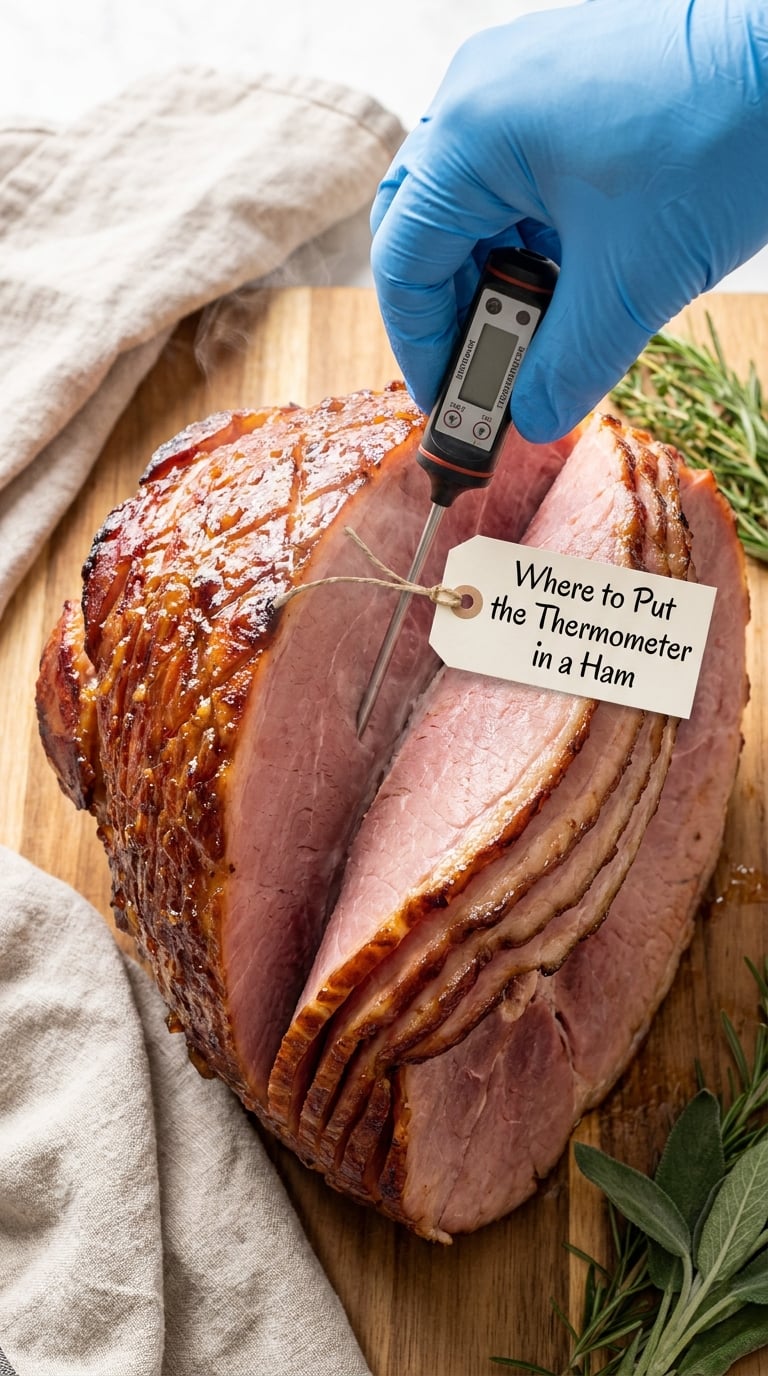
Push the probe into the thickest part of the meat, away from bone, from the side of the ham rather than the top. A clean reading is about the thickness of two stacked quarters.
For a bone-in ham, check two spots: the thickest meat near the shank end, and the thickest meat near the center of the cut face. Bone pulls the reading down and can make underdone meat look done.
For a boneless ham, the center of the longest axis is the target. A rolled boneless ham is even all the way through, so one reading tells you what you need.
For a spiral-cut ham, slide the tip between two slices into the meat underneath, avoiding the exposed cut surfaces, which read hotter than the interior.
Wipe and re-insert the probe between checks. And if a reading comes back higher than you expect, trust the higher number, not the number you hoped for.
How to Tell When a Ham Is Done
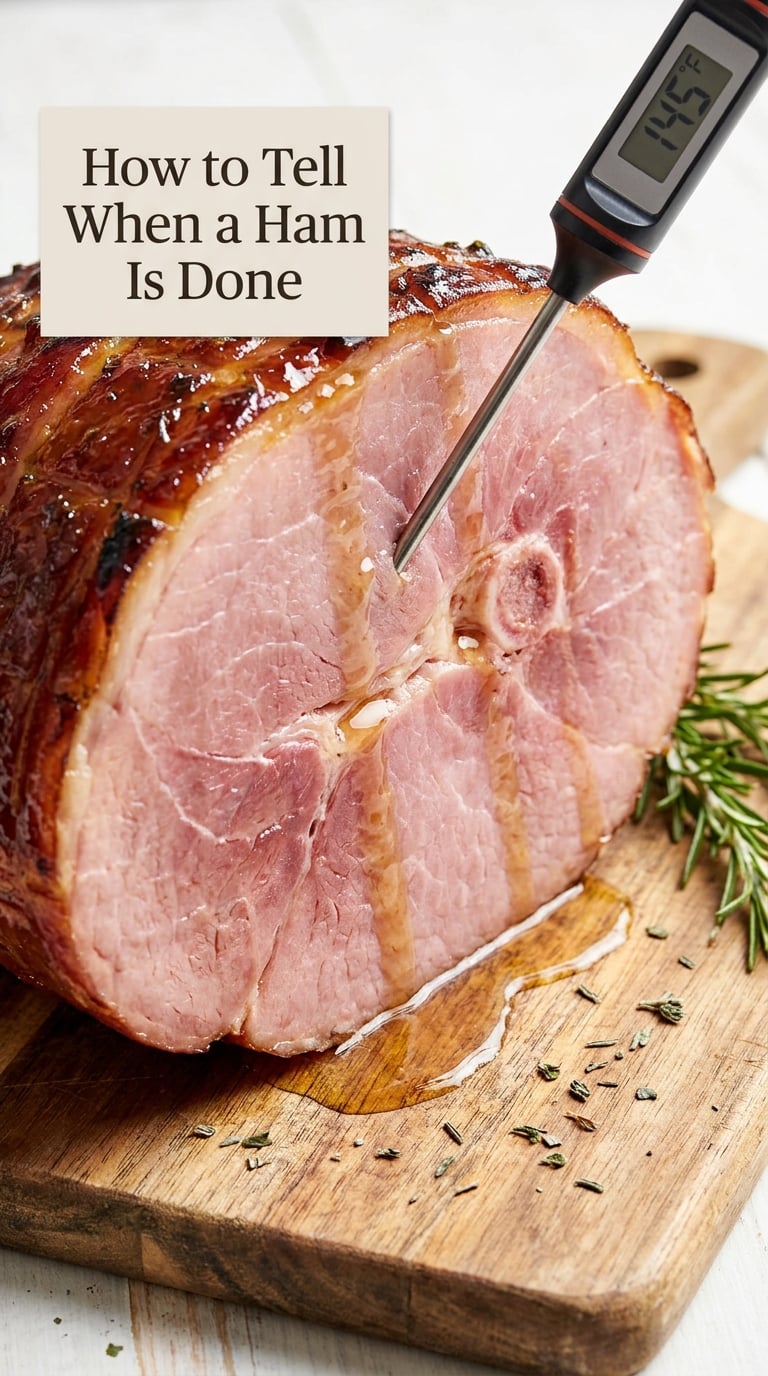
Temperature first, then the look. For raw pork, USDA guidance is 145°F with a 3-minute rest. For reheating a fully cooked ham, USDA guidance is 140°F. For reheating cooked ham from leftovers, bring it to 165°F.
Then read the ham itself. The cut face should be glossy with clear juice, not milky or pink-watery. The outside should be a deep brown with a lightly crisp fat cap. When you press the thickest part with a finger, it springs back slowly rather than feeling soft.
Time alone tells you nothing. A 10 lb ham can be done in 90 minutes or need 2 hours 30 min, depending on the oven and where it started. Check every 15 minutes in the last hour and stop the moment the thermometer says so.
How to Keep Ham Warm, Store It, and Reheat It
Hold a finished ham at 140°F or above. An oven set to 200°F with the door barely cracked works well for an hour or two, and a slow cooker on warm is better still. Do not leave it sitting on the counter, and do not let it fall below 140°F for more than two hours.
Refrigerate cooked ham within two hours. Sliced ham keeps 3 to 4 days in the fridge; a whole bone-in ham keeps 3 to 5 days because the bone and rind slow spoilage. Freeze it in portions, wrapped tightly, for 2 months in the freezer bag, and thaw overnight in the fridge rather than on the counter.
Reheating a spiral ham is the most common drying-out mistake in holiday cooking. Warm it covered, at a low temperature, with a splash of juice or a dampened paper towel. A 325°F oven for 20 to 30 min on covered slices beats three minutes on high in a microwave, every time. Bring leftovers to 165°F all the way through.
If you end up with a good amount of extra ham, the leftover ham recipe ideas and the ham and potato recipes on this site cover the day-two options.
Common Ham Cooking Mistakes and How to Fix Them
Almost every dry holiday ham traces back to one of these.
| Problem | Cause | Fix |
|---|---|---|
| Ham is dry and tough | Cooked by the clock, or left uncovered too long | Check the temperature 15 min early, keep it foiled for two thirds of the cook, and pull it the moment it hits 140°F or 145°F |
| Glaze burned to a bitter crust | Sugar added at the start of the cook | Glaze in the last 20 to 30 min with the foil off, and baste it more than once |
| Raw or rubbery patches near the bone | Probe touching bone, or one reading only | Take readings in two spots away from the bone and trust the lower number |
| Ham is too salty | Cured ham soaked for too long, or brine used instead of water | Soak country hams 4 to 8 hours before cooking, and skip the brine |
| Uneven cooking, one end done | Ham is a very uneven shape | Rotate the pan a quarter turn at the halfway mark and add a cup of liquid |
| Foam and smoke from the oven | An empty hot pan plus sugar | Keep a cup of liquid in the pan at all times |
| Slices fall apart when carving | Carved straight out of the oven | Rest 15 to 20 min, and sharpen the knife first |
One more that comes up on cooking forums: a package label that gives minutes per pound but no weight. Weigh the ham at the grocery scale, or estimate from the bag size, then run the math and start checking early. A brand printing 18 to 20 minutes per pound is planning for a cold ham in a cool oven, which is why the numbers differ between labels.
Frequently Asked Questions
How long should I cook an 8-pound ham?
A fully cooked 8 lb ham needs about 1 hour 20 min to 2 hours at 325°F, until the thickest part reads 140°F. An uncooked 8 lb ham needs roughly 2 hours 40 min to 3 hours 20 min to reach 145°F with a 3-minute rest. Start checking the thermometer 20 minutes before the low end of the range.
Does the cooking time double for every extra pound of ham?
It adds, it does not double. Doubling would make a 10 lb ham take six times as long as a 5 lb ham, which is not how heat works. Cooking time scales roughly with weight, so a 10 lb fully cooked ham takes about twice as long as a 5 lb one. Shape, starting temperature and oven accuracy shift the finish either way.
What temperature should a ham be cooked to for food safety?
For raw pork, USDA guidance is 145°F with a 3-minute rest. For reheating a fully cooked ham, bring it to 140°F. For cooked ham being reheated as leftovers, reach 165°F throughout. Check the thickest part of the meat with an instant-read thermometer, away from bone, and measure before slicing.
Can I cook a fully cooked spiral ham straight from the package?
Yes, after removing the plastic and foam tray. Preheat the oven to 325°F, set the spiral ham cut-side down in a shallow pan, add a cup of juice or water, and cover tightly with foil. Bake for 10 to 12 minutes per pound, then uncover for the last 20 to 30 min if you are adding a glaze.
Why does my ham take longer to cook than the label says?
Usually one of four things: the ham came straight from the fridge, your oven runs cooler than the dial says, or the label assumes a different ham shape and cut than what is in your pan. Bone-in hams also have thick zones the rate does not describe. Set an oven thermometer and start checking 20 minutes early.
How do I keep a cooked ham from drying out?
Keep it wrapped in foil for the first two thirds of the estimated cook time, add a cup of liquid to the roasting pan, and pull the ham the moment the thermometer reads 140°F or 145°F. Spiral hams dry fastest, so leave the foil on longer. Reheat leftovers covered in a low oven, never uncovered on high.
Start With the Package and Check the Temperature
Read the label first. It tells you whether the ham is fully cooked or cook-before-eating, and that single fact sets the safe temperature and the minutes per pound. Then pick your row from the quick guide table above and set a start time about four hours before you plan to carve.
When the timer goes off, ignore it and probe the thickest part of the meat, away from bone. That single habit is the whole answer to how long to cook a ham per pound, and it is the difference between a ham that people ask for again and one that ends up in the leftover bin.
Planning the meal around it? The Easter dinner ham recipes cover glazes, sides and a full table plan.