
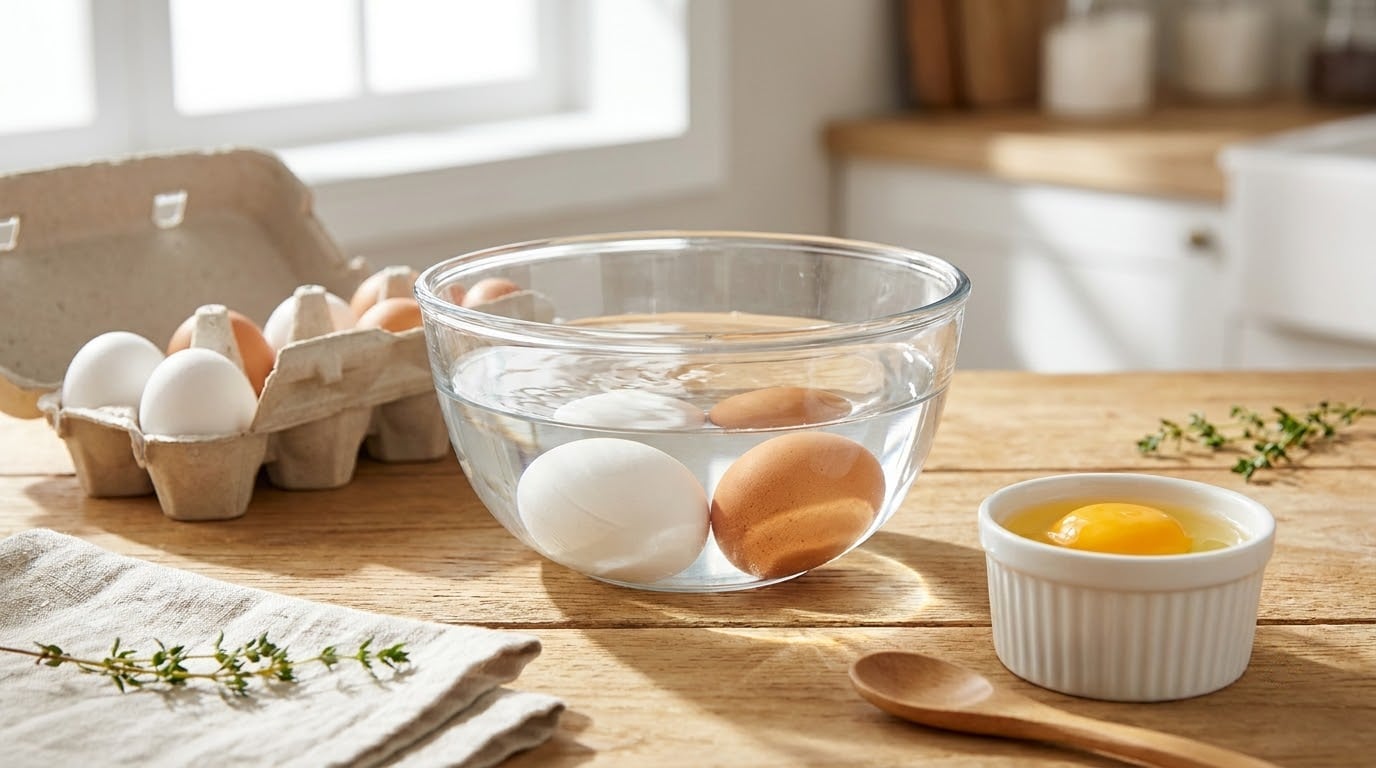
To tell if eggs are still good, use the float test, then crack one into a separate bowl and smell it, then check the carton date. A fresh egg sinks and lies flat in cold water. An older egg stands upright on the bottom, and one that floats has a large air cell. None of that proves safety. Smell decides.
The carton date is a guide, not a countdown. A floating egg is old, which is not the same thing as bad, and I have thrown away plenty of eggs that were still fine because I trusted the printed date instead of the water. Read on and you will know which test to run first and what to do with each answer.
Last updated in 2026. Everything below comes from my own kitchen, with store-bought eggs and eggs from a small backyard flock, over more egg-brunches than I care to admit.
Table of Contents
How to Tell if Eggs Are Still Good: Quick Guide
Three checks, in this order. The float test tells you how much air the egg has lost and how old it is. The crack test tells you what is actually inside. The carton date tells you what the store thinks it sold you.
- Float the egg in a bowl of cold water and read where it stops.
- Crack the egg into a separate bowl, look at the yolk and white, then smell it.
- Check the pack date and sell-by date on the carton for context.
Here is the verdict table every listicle on this topic is built around, including the fourth position most of them skip.
| Where the egg stops | What it means | What to do |
|---|---|---|
| Sinks and lies flat on the bottom | Very fresh, days to a few weeks old | Use it. Yolk will be domed and the white thick. |
| Sinks but stands upright on one end | Aged but perfectly usable | Use it soon. Boiling gives a better result than frying. |
| Hovers in the middle, not touching bottom or top | Borderline, often a very large egg or a cold-to-warm temperature swing | Crack it into a bowl and smell it before it goes anywhere near a pan. |
| Floats on the surface | Old, with a large air cell and lost moisture | Set it aside, crack it, and smell it. If there is any sulfur odor at all, bin it. |
One correction before you go further, because it is the thing most articles get wrong. Floating means old. It does not mean spoiled, and it does not mean dangerous. Age and safety are two separate questions, and only one of them can be tested in your kitchen.
What Does an Egg Going Bad Look Like?
Start outside the egg. Some problems are visible on the shell or the carton, and you can spot them before any water gets involved. Spoiled eggs usually give off hydrogen sulfide, which is the smell of rotten eggs, and bacteria can also move through the shell pores and spoil the contents from the inside, so a clean shell is not a guarantee either way.
| What you see | What it likely means |
|---|---|
| A crack, chip or hairline break in the shell | Bacteria have had a way in. Safe if you cook the egg thoroughly, discard if the crack is large or the shell feels slimy. |
| A slimy or greasy-feeling shell | The bloom has broken down. Treat as suspect and smell it after cracking. |
| A white powdery or flour-like coating | Usually a dry, scaly bloom from a long dry storage, harmless. Thick mold patches are not. |
| Fuzzy black, green or blue patches on the shell | Mold. Discard the egg. |
| A cracked shell with liquid seeping out | Contents are escaping and taking in air. Discard. |
| A wet or stained cardboard carton, or one with a bulge | Something leaked. Check every egg inside before you check a single one in water. |
On the carton, the sell-by date is the store telling you when they would like to sell that carton. The Julian date, printed as three digits like 128, is the day of the year the eggs were packed, counting from January as 001. A Julian date reads as a freshness indicator, not an expiry.
Here is the honest answer to the anxiety people feel about those dates: eggs are usually thrown out well before they need to be. The USDA guidance is 3 to 5 weeks in the refrigerator for raw eggs in the shell, and that is a conservative quality window, not a cliff edge on day 35.
3 Ways to Check Whether Eggs Are Good
Not all three checks are equal, and it helps to know which is which. Ranked by how definitive they are, from most to least.
1. The smell test. This is the only home check that reliably detects spoilage. Crack into a separate bowl so one bad egg cannot take out a whole cake batter. A good egg smells neutral, maybe faintly grassy. A spoiled egg smells unmistakably sulfur, like a rotten egg, and it hits your nose before your tongue does.
2. The float test. Very good at telling you the age of the egg and useful as a quick screen on a whole carton. It tells you nothing about bacteria, which is why a floating egg deserves a sniff rather than an automatic trip to the compost.
3. The carton date. Context only. It tells you roughly when the eggs were packed and what the store considers their selling window. It ignores temperature, handling and how long the carton sat in a warm car.
There is a fourth, unofficial one worth knowing: the shake. Hold the egg to your ear and move it gently. A fresh egg barely makes a sound. A distinct sloshing sound means the contents have thinned out as water left through the pores, so the egg is old. It is another age signal, not a spoilage signal.
How to Do the Egg Float Test
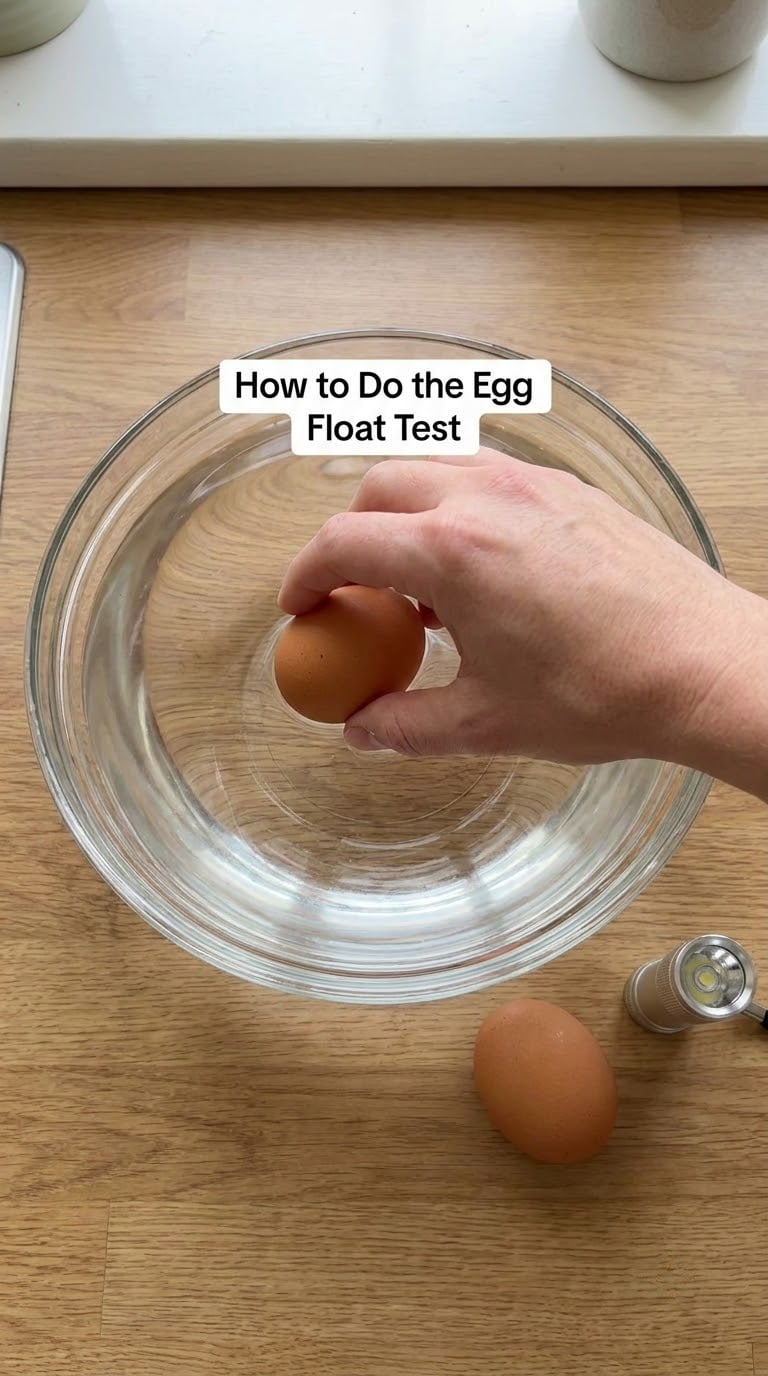
How to tell if eggs are still good without cracking them
- Fill a bowl or glass with cool water deep enough that the egg floats freely if it is going to. Cold tap water works fine.
- Lower the egg in gently with a spoon or your fingers. Dropping it in can crack it and cost you the test.
- Watch for five seconds. Note whether it lies flat, stands upright, hangs in the middle, or rides on the surface.
- Read it against the verdict table above and move on to the next egg.
- Test several eggs at once in a wide bowl if you have a whole carton to check, but separate them afterward and float-test individually if any of them behaves oddly.
Use a wide bowl rather than a tall glass when you are checking a full carton. The results are easier to read from above, and you can do the whole carton in one pass instead of one egg at a time.
Why eggs float: the air cell explained
An eggshell has roughly 7,000 tiny pores. From the moment it is laid, water and carbon dioxide escape through those pores while the egg breathes. The air that replaces them gathers in a pocket at the wide end, and that pocket is called the air cell. A newly laid egg has an air cell about 1/8 inch deep. It grows for the life of the egg.
As the air cell grows, the egg loses density. A very fresh egg is dense enough to sink and lie flat. An older one is still heavier than water but light enough to stand on its end. A really old one has lost enough mass to be lighter than water, so it floats. That is the whole test in one sentence: floating is buoyancy doing its job, and buoyancy is reading age.
Two conditions skew the reading. At high altitude, air is thinner and the egg reaches its floating point sooner, so a good egg floats sooner than you expect. In a very warm kitchen, water is less dense and eggs sit more upright, which reads older than they are. Neither is a reason to ignore the test, but both are reasons to confirm with a smell before serving.
At-home candling is the commercial version of the same read. Hold a raw egg against a bright flashlight in a dark room and you can see the shadow of the yolk and the size of the air cell. It takes practice, and it is worth doing if you keep backyard chickens where a single bad egg can be worth the whole carton.
How to Check Eggs by Cracking Them
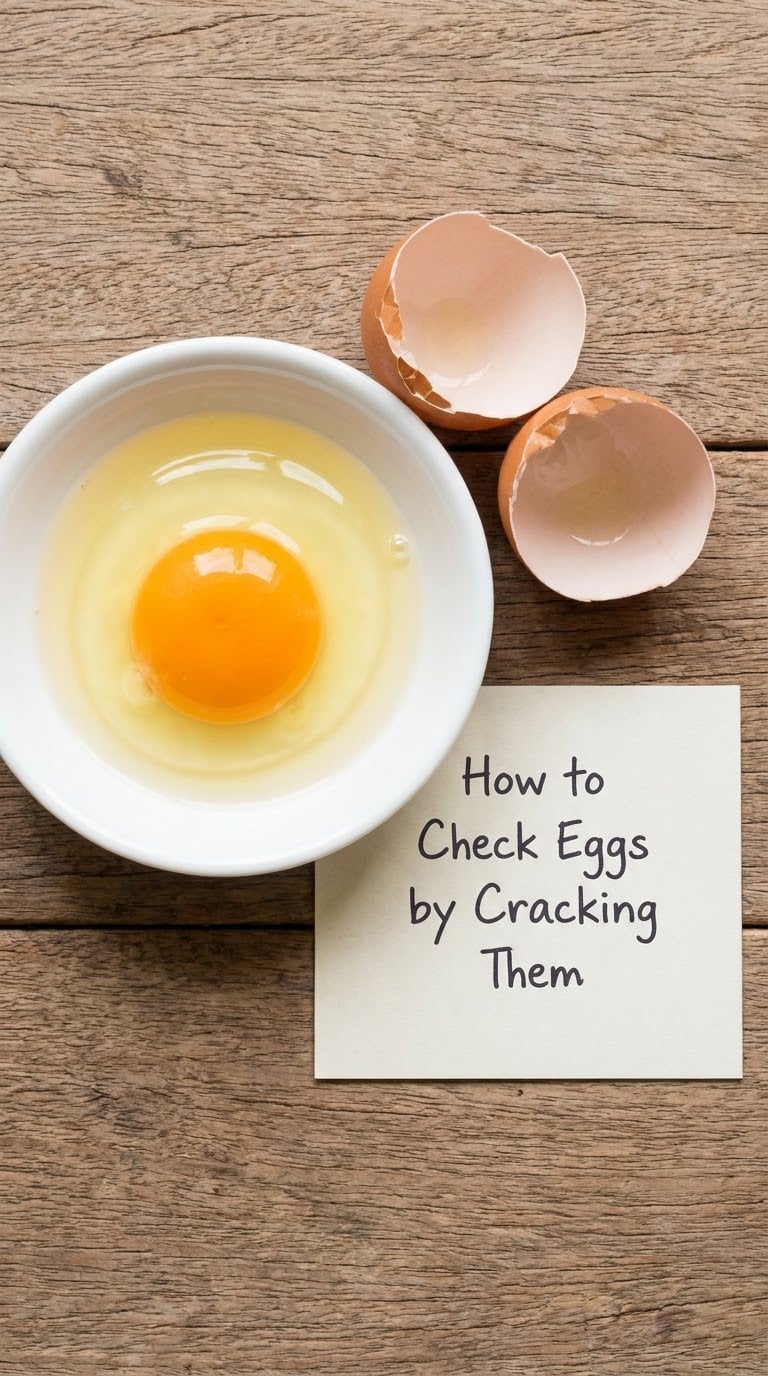
Crack into a separate bowl, always. This one habit answers the most common kitchen complaint I see: a single bad egg wasted an entire batch of muffins or a whole pan of cookies. A minute of cracking-and-sniffing saves that.
Look at the egg before you cook it. A fresh egg has a tall, domed yolk that sits up in a thick white that holds its shape. An older egg has a flatter yolk and a white that spreads thin and watery across the bowl. That spread is a quality issue, not a safety one. Older eggs are actually easier to peel after boiling.
| What you see when it cracks | What it means |
|---|---|
| Domed yolk, thick white that clings to itself | Fresh |
| Flat yolk, watery white spreading out | Older, past the peak of quality, still usually fine |
| Cloudy, milky-white white | Very fresh. Dissolved carbon dioxide makes it cloudy, and it clears as the egg ages. Not spoilage. |
| Pink, greenish or iridescent streaks in the white | Usually harmless, from minerals, especially in soft water. Smell it to be sure. |
| Thick, ropy, gelatinous white with a rotten smell | Spoiled. Discard immediately. |
| Yolk with a dark green ring around it | Overcooked. Safe to eat, just not pretty. |
Then smell it. Not a polite sniff, a real one, close to the bowl. Fresh eggs smell clean and faintly grassy. Sour, sulfurous or ammonia-sharp means the egg has been decomposing and the smell comes from hydrogen sulfide and other breakdown gases. No cooking method fixes that, so it goes in the bin.
If you need cooked eggs specifically, learn how to make hard boiled eggs easy and cook yours to 160°F (71°C) until the white and yolk are firm. Pregnant readers, anyone feeding young children, elderly family members or anyone immunocompromised should use pasteurized eggs and cook them fully.
How Long Do Eggs Keep?
These are realistic refrigerator windows at 40°F (4°C) or below, assuming the eggs arrived chilled and were not left out for hours.
| Egg form | Refrigerator | Freezer |
|---|---|---|
| Raw in the shell, store-bought | 3 to 5 weeks per USDA, often good well past that | Not recommended in the shell; freeze the beaten contents instead |
| Raw in the shell, unwashed backyard or farm eggs | Often 2 to 3 months refrigerated | Not recommended |
| Hard-boiled in the shell | About 1 week | About 2 to 3 months, texture suffers |
| Raw, cracked into a bowl | 2 to 3 days, tightly covered | Beat with a little salt or sugar, then 12 months is realistic |
| Cooked dishes using eggs, like egg salad or quiche | 3 to 4 days | 2 to 3 months for cooked dishes |
To freeze raw eggs, break them into a bowl, beat them with a teaspoon of salt or sugar per cup to stop the yolks from setting separately, then pour them into a freezer container leaving a half inch of headroom. Thaw in the fridge. If you are chasing a freezer rule of thumb, it is 40°F (4°C) or colder in the fridge, 0°F (-18°C) or colder in the freezer, and 3 to 5 weeks for shell eggs.
Two storage habits do more than any test. Keep eggs in the original carton on a shelf inside the door rather than back in the cold, because the carton insulates them and the door is the warmest spot in the fridge. And keep the pointed end down so the air cell sits at the wide end and the yolk stays centered.
Store-bought eggs in the US are washed and refrigerated, which removes the natural shell coating called the bloom or cuticle, so the egg can breathe and lose moisture. Unwashed eggs from your own backyard flock keep that coating, which is why many countries store them on a counter and why they often outlast store-bought eggs in a cold fridge.
Shell eggs are fine on the counter for a short spell, but not in a warm kitchen. Keep strong-smelling foods away from the egg shelf, since eggs absorb odors through those same pores. When a boiled egg goes past its week, do not cook it to hide a smell, just because you are thinking about leftover boiled egg recipe ideas.
Common Egg-Testing Mistakes
These are the errors I see most often, and each one has a simple fix.
- Trusting the date over the water. The print is a store convention, not a lab result. Run the float test and trust the smell.
- Shaking eggs hard. The shake is a gentle ear test, not a rattle. A hard shake can damage the shell and the membranes inside.
- Confusing air-cell movement with spoilage. The shifting contents you feel when you move an egg are normal. Only the smell indicates spoilage.
- Treating a float as a death sentence. A floating egg is old. Crack it, smell it, and make your call from there.
- Treating a pass as a guarantee. No visual test detects Salmonella Enteritidis. An egg that sinks perfectly can still carry it, which is why cooking to 160°F (71°C) is the real safety step.
- Reading a cloudy white as spoiled. A cloudy white means a very fresh egg, because the carbon dioxide has not escaped yet.
- Skipping the separate bowl. Cracking straight into batter is how one bad egg ruins twelve good ones.
| Myth | Fact |
|---|---|
| A floating egg is rotten. | A floating egg is old. The air cell grew and the egg lost mass. Smell decides whether it is spoiled. |
| If it sinks, it is safe. | Sinking measures age. It cannot detect Salmonella. |
| You cannot eat an egg past the carton date. | Refrigerated shell eggs often last well past the sell-by date. Test and smell instead. |
| A cloudy white means the egg is bad. | A cloudy white is a sign of freshness. |
| Farm eggs last two weeks in the fridge. | Unwashed farm and backyard eggs keep their cuticle and frequently last 2 to 3 months refrigerated. |
If you are cooking without eggs at all, I keep a running list of low carb breakfast ideas without eggs for the weeks when the carton goes bad all at once.
Frequently Asked Questions
Do eggs really float when they go bad?
Not exactly. Floating means an egg is old, not that it is spoiled. As an egg ages, it loses moisture and carbon dioxide through the tiny pores in the shell, and the air cell at the wide end grows. Once the egg is lighter than water, it floats. A fresh egg sinks and lies flat, an older one stands upright, and a floating one has a large air cell. Crack it into a bowl and smell it to decide whether it is actually bad.
Can I eat an egg if it floats in water?
You can, and many people do. The float test measures age, not safety. If the egg floats but smells clean and neutral once cracked into a separate bowl, it is old rather than spoiled, and cooking it to 160F (71C) is what makes it safe. If it smells sulfurous or sour, discard it no matter where it sat in the water.
What does a bad egg smell like?
A bad egg smells sharply sulfurous, like a rotten egg, sometimes with a sour or ammonia-like edge. The smell comes from hydrogen sulfide and other gases released as the contents break down, and it arrives before any visual change. Fresh eggs smell neutral or faintly grassy. Trust your nose over appearance, since a spoiled egg can look completely normal from the outside.
Is it safe to eat an egg with a cracked shell?
Usually, if you cook it thoroughly. A small crack in the shell lets bacteria in, so cook the egg until the white and yolk are firm, which is 160F (71C). Discard the egg if the crack is large, the shell feels slimy, or liquid is seeping from it. A hairline crack on an otherwise normal egg is usually fine once it is cooked hard.
How long do raw eggs last in the refrigerator?
The USDA gives 3 to 5 weeks for raw eggs in the shell kept at 40F (4C) or below. In practice, many eggs stay good well past that window, and unwashed farm or backyard eggs often last 2 to 3 months because they keep their natural cuticle. Cracked raw eggs last only 2 to 3 days in a covered container in the fridge, and hard-boiled eggs last about a week.
Are eggs with a past sell-by date still good?
Often yes. The sell-by date is a store guideline for when it would like to sell a carton, and the Julian pack date just records the day of the year the eggs were packed. Storage temperature matters far more than the print. Float the egg, crack it into a separate bowl, and if it smells clean, cook it thoroughly and eat it.
What to Do First
Check the carton and the shells first, then float the egg in cold water, then crack it into a separate bowl and smell it. That sequence takes about a minute and it is the same one I use every time.
Discard an egg if it smells sulfurous, if the shell is moldy or slimy, or if the white is thick and ropy. Everything else, including a floating egg, is a quality question rather than a safety one, and cooking to 160°F (71°C) settles it. That is how to tell if eggs are still good without throwing away a good dozen.