
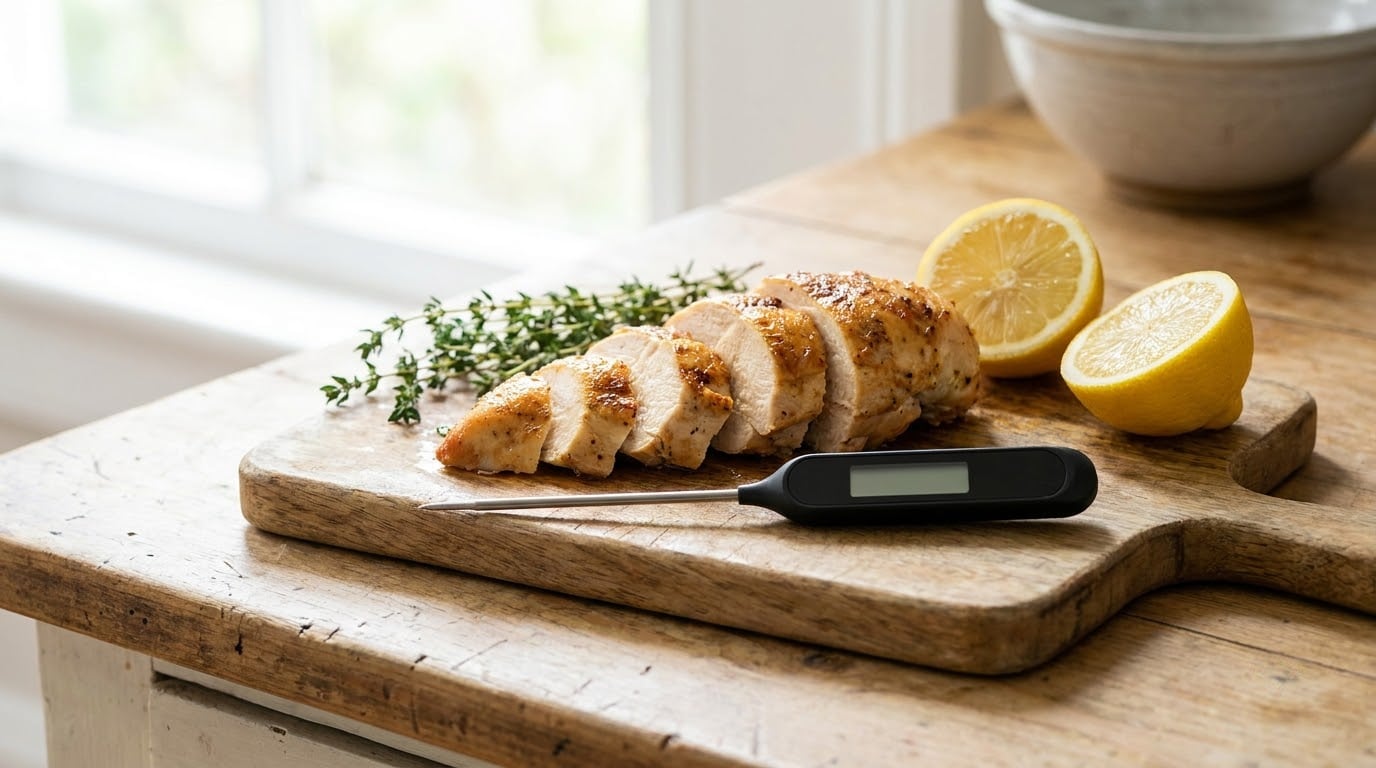
What temperature is chicken done at? Chicken is done when the thickest part of the meat reaches 165°F (74°C), measured with a food thermometer. That is the USDA safe minimum for every chicken cut, including ground chicken and stuffed chicken. Time on the clock is only a guess; the number in the thickest part is the answer.
Most home cooks do not have a bad recipe. They have a bad method, which means poking, slicing, and squeezing the meat until the juices run clear. A decent instant-read thermometer ends all of that, but only if you put it in the right place. That detail is where most readings go wrong, and it is why a chicken can read 140°F in a pan and still be safe.
Below is the whole picture: a per-cut chart separating safety from best texture, where to put the probe in each cut, realistic starting times by cooking method, why pink chicken is often fine, and how carryover cooking changes when you should take chicken off the heat. Last reviewed October 2026.
If you cook more than one kind of meat, you may also want what temperature is pork done at. The answer is a different number for a good reason, and I explain it there.
Table of Contents
What Temperature Is Chicken Done At? Quick Guide
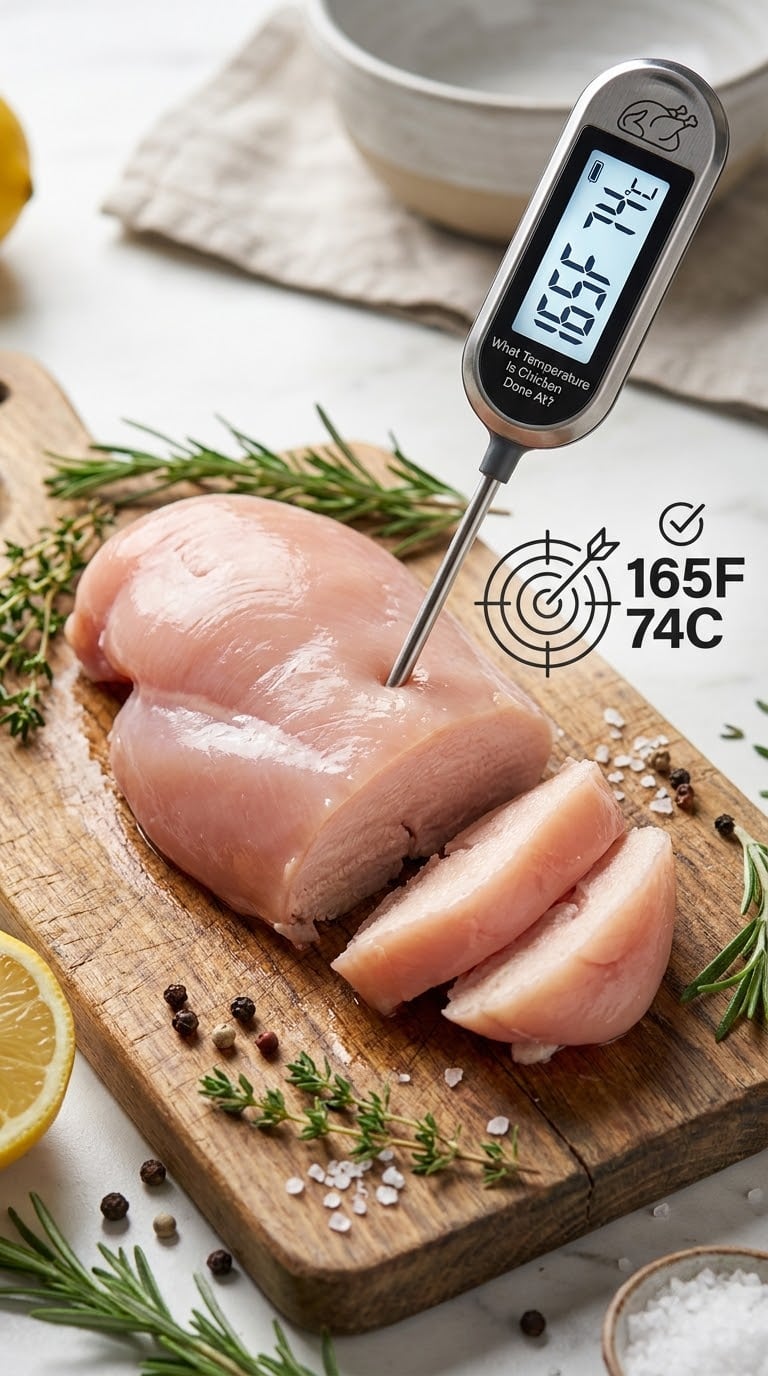
The short version: 165°F (74°C) is the safe minimum, and it is the only number that guarantees safety. Read it in the thickest part of the meat, away from bone, and away from the thin tip.
Everything else people argue about is about quality, not safety. Thighs, drumsticks, and wings taste better at 170°F to 175°F (77°C to 79°C) because collagen and connective tissue need that extra heat to turn tender. A breast is lean with almost no connective tissue, so pushing it past 165°F (74°C) just dries it out.
One conversion note, because this comes up constantly. 165°F is 74°C, not 160°C and not 165°C. If your oven has a Celsius setting, 160°C is a low, slow roasting temperature, not a safe internal temperature. It is also completely raw-safe-looking inside a thick breast, because the centre of a thick piece warms far more slowly than the outside.
Why is chicken held to a higher number than beef or pork? Salmonella and Campylobacter live in raw poultry, and 165°F (74°C) is the point where studies show those bacteria are inactivated almost immediately. Beef, pork, veal, and lamb steaks, chops, and roasts only need 145°F (63°C) with a three-minute rest. Poultry does not get that option, so the number is higher and the clock is less forgiving.
One more thing worth knowing before you start: the USDA also lists lower temperature-and-time combinations, such as 165°F (74°C) held for 15 seconds or 155°F (68°C) held for about 17 minutes. Those apply to commercial cooking, where equipment holds temperature precisely. At home with a pan in a home oven, cook to 165°F (74°C).
Safe Chicken Temperatures by Cut
This is the chart to bookmark. The middle column is the safety minimum from the USDA. The third column is where the texture is at its best, which is usually a few degrees higher for dark meat.
| Chicken cut | Minimum safe internal temperature | Best texture target | What it looks like when done |
|---|---|---|---|
| Boneless skinless breast | 165°F (74°C) | 165°F (74°C) | Opaque white, firm, springs back, clear juices |
| Bone-in breast | 165°F (74°C) | 165°F (74°C) | Careful, the bone runs hot and lies close to the surface |
| Boneless thigh | 165°F (74°C) | 170-175°F (77-79°C) | Juices run clear, meat slips off the bone |
| Bone-in thigh | 165°F (74°C) | 175-180°F (79-82°C) | Bones wiggle slightly, skin crisp if grilled |
| Drumsticks | 165°F (74°C) | 175-180°F (79-82°C) | Meat pulls away from the bone easily |
| Wings | 165°F (74°C) | 175-180°F (79-82°C) | Joint flexes, skin golden or crisp |
| Whole chicken, unstuffed | 165°F (74°C) | 165°F (74°C) in the breast, 170-175°F (77-79°C) in the thigh | Thigh joints move when wiggled, thickest breast reads 165°F (74°C) |
| Stuffed chicken or turkey | 165°F (74°C) in the centre of the stuffing AND the thickest part of the meat | Same | Both the stuffing centre and the breast read 165°F (74°C) |
| Nuggets, strips, tenders, poppers | 165°F (74°C) | 165°F (74°C) | Crisp outside, no translucent patches |
| Ground chicken, meatballs, patties | 165°F (74°C) | 165°F (74°C) | No pink at all, firm enough to hold together on a skewer |
| Giblets, hearts, livers, gizzards | 165°F (74°C) | 165°F (74°C) | Firm, grey-brown inside, juices run clear |
Boneless and bone-in pieces of the same cut cook at different speeds even at the same oven setting, because bone and skin hold heat and slow the centre. That is why the chart is your finish line, not the recipe timer.
How to Check Chicken Doneness
A thermometer only works if the instrument is working and you are holding it correctly. Two quick habits fix most of the wrong readings people get.
What temperature is chicken done at, which thermometer to use
An instant-read digital thermometer is the tool I use for nearly everything, because I can pull chicken off the heat and check within seconds. A leave-in probe thermometer is better for thick roasts and whole birds, since it stays in place through the cooking and you can watch the climb.
Check cheap thermometers against boiling water once a month. Boiling water adjusted for altitude should read 212°F (100°C), and most units land within 2°F (1°C) of that if they are working. A thermometer that is off by 10°F to 20°F will convince you that a well-done chicken is raw, and that is exactly the panic that makes people dry out their dinner.
Digital beats dial for thin cuts. An analog dial has a large dial face, short stem, and usually a 1°F to 2°F (0.5°C to 1°C) margin of error, and it is hard to read while the meat is steaming. If you own a dial thermometer, keep it for thick roasts where the large face helps.
How to measure the internal temperature step by step
Measure the thickest part of the meat, away from bone. Push the probe in so the tip sits in the centre, then take the reading immediately. These are the six steps that give a reading you can trust.
- Take the chicken off the heat if you want a true reading, since a hot pan keeps cooking the meat while you work.
- Find the thickest section. On a breast, that is the wide end. On a thigh, it is the meaty part just above the bone.
- Push the probe tip into the centre of that section. Aim for about half the depth of the meat.
- Keep the probe off bone, off the pan, and out of any fat pocket under the skin.
- Pull it out and read the number on the display. On a leave-in probe, read the base of the unit.
- Check a second spot. For a whole bird, check the thickest breast and one thigh.
If you are marinating, acidic marinades with lemon, vinegar, or yogurt can raise the reading slightly, so measure the plain breast area rather than right where the marinade pooled. A tiny amount of pink from a marinade is normal, and I cover that in the section on colour below.
Where to Put the Thermometer in Chicken
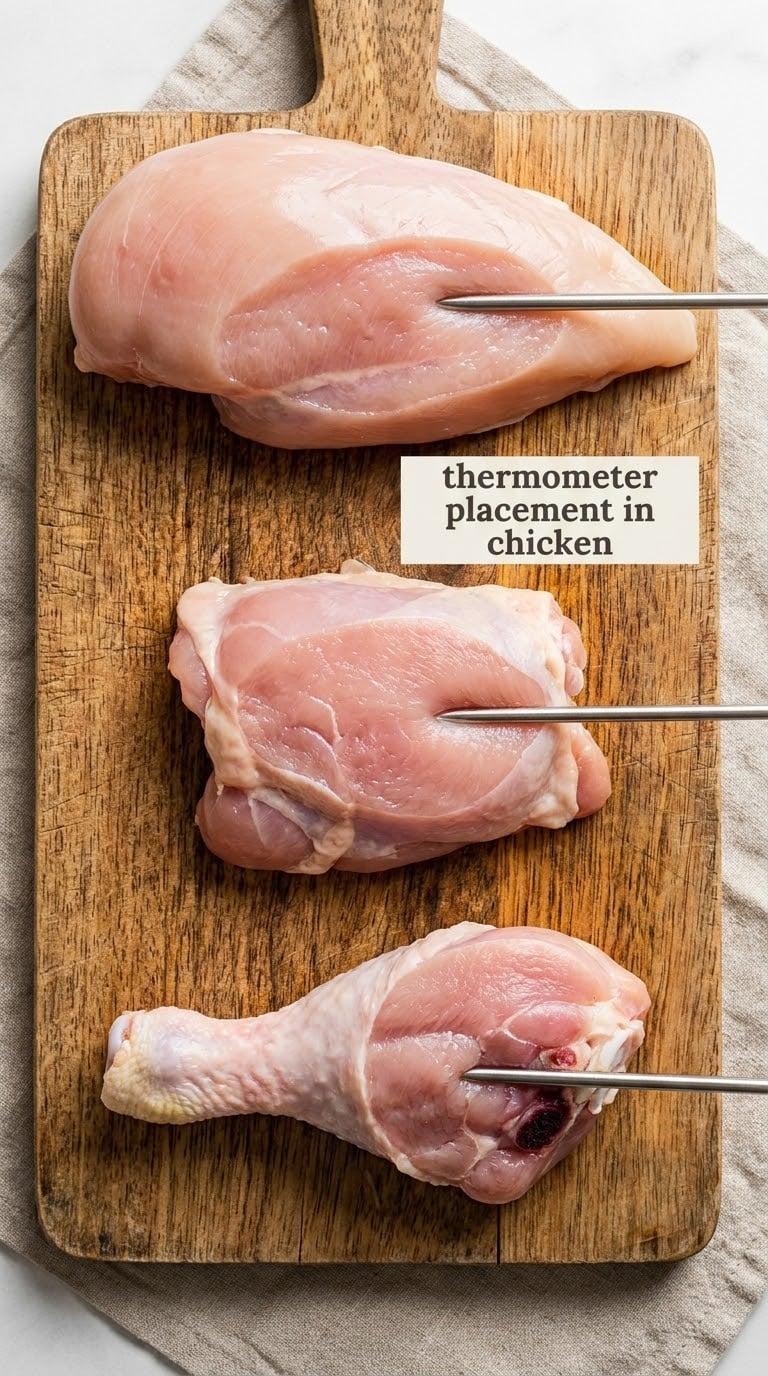
Placement decides whether your reading means anything. The probe tip needs to sit in the part of the meat that heats last, which is the thermal centre. Miss that and you are measuring an outer edge that has already been sitting next to a hot pan.
Boneless chicken breasts
Enter from the side, at the thick end of the breast, and push straight in until the tip is in the middle. The thin tail of a butterflyed breast cooks in minutes and will read done while the centre is still cold, which is how you get a pink middle with white edges.
For a very thick breast, insert horizontally from the side rather than angling in from the top, so the tip reaches the centre. A technique I like is butterflying or pounding the breast to an even 3/4 inch (2 cm), which makes one straight reading trustworthy.
Boneless chicken thighs
Thighs are rounder and easier to read. Insert the probe into the fat cap and keep going until the tip comes out the other side, then slide it back so the tip rests in the centre. Take the reading at the exact moment the probe exits to catch the true middle.
Thighs also hide a bone, so feel first. If the probe meets resistance, redirect it. A reading taken on bone can be 10°F to 20°F (5°C to 11°C) high, and a reading in the fat cap can be high for a different reason.
Bone-in pieces
Insert the probe into the thickest meat beside the bone, not into the bone and not scraping against it. Bones conduct heat, so a bone contact reading will tell you it is time to serve long before the meat is safe.
For a whole roasted chicken, measure in two places: the thickest part of the breast, where 165°F (74°C) is the target, and the thigh, where 165°F (74°C) is the minimum but 170°F to 175°F (77°C to 79°C) is better. Wiggling the drumstick bone is a useful backup, but it is a backup, not the measurement.
For a stuffed bird, the probe goes into the centre of the stuffing as well as the breast, because the stuffing is raw and dense. Check it in at least two spots since the filling is uneven.
Chicken Cooking Times by Cut and Method
These are starting points for a 375°F (190°C) oven unless the row says otherwise. They are estimates, not guarantees. Oven size, pan depth, how cold the chicken came out of the fridge, and how full the pan is all change the clock. When the time runs out, the thermometer decides, and if the reading is short, give it another three to five minutes.
| Method and cut | Starting time | Notes |
|---|---|---|
| Oven roast, whole chicken, 4-5 pounds | 75-90 minutes at 425°F (220°C) | Stuffed birds need about 20 minutes longer |
| Oven bake, boneless skinless breast | 20-25 minutes at 400°F (205°C) | Do not let the pan get dry at the end |
| Oven bake, bone-in thighs and drumsticks | 35-45 minutes at 400°F (205°C) | Turn once, halfway |
| Roasting pan, whole bird, 350°F (175°C) | 2.5-3 hours for a 6-7 pound bird | The slow-and-low classic; breast and thigh will not finish together |
| Air fryer, boneless breast | 10-14 minutes at 380°F (195°C) | Flip at 6 minutes, check at 10 |
| Air fryer, bone-in thighs | 18-25 minutes at 380°F (195°C) | Single layer, no crowding |
| Grill, boneless breast, medium heat | 5-7 minutes per side | Close the lid for the last minute to use carryover heat |
| Grill or grill pan, bone-in thighs | 8-12 minutes per side, then 10-15 minutes indirect | Bone-in pieces need the longer, slower finish |
| Skillet, boneless breast | 6-8 minutes per side on medium | Use a lid for the last 2-3 minutes |
| Poach, boneless breast | 10-15 minutes at a gentle simmer | Barely moving water, keep at 165°F (74°C) |
| Slow cooker, bone-in thighs | 3-4 hours on low | High heat does not speed up a thick piece much |
| Pressure cooker, bone-in thighs or breast | 8-12 minutes at high pressure, plus natural release | Check after the pressure release, not before |
Thick breasts are the ones worth protecting. If the breast is thicker than 1 inch (2.5 cm), many cooks use a lower oven, around 325°F to 350°F (165°C to 175°C), so the outside does not race ahead of the middle. It takes longer and gives a better breast.
Once the chicken is cooked, I like a chicken enchilada casserole or rotisserie chicken casserole for the next night, which is the practical reason to cook more than you need at once.
Can You Tell if Chicken Is Done Without a Thermometer?
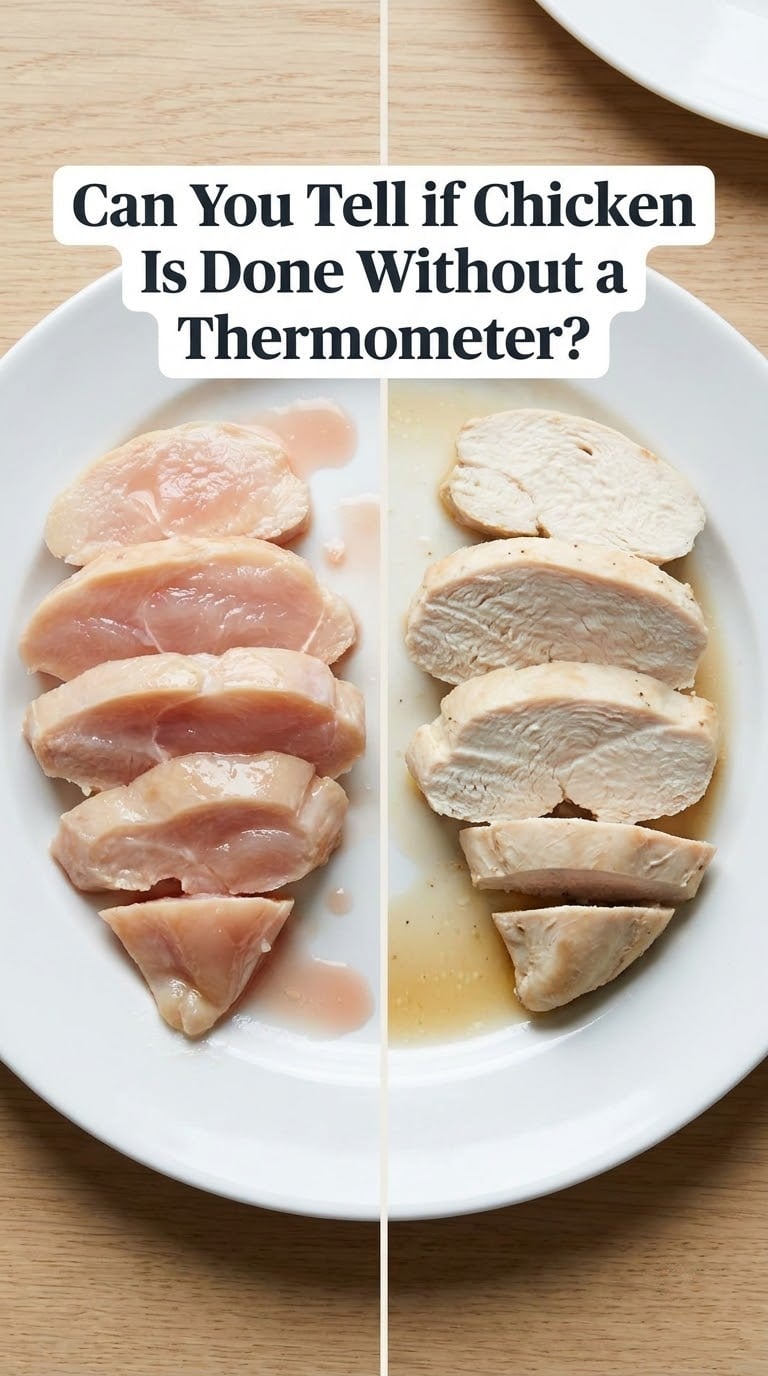
You can guess, and sometimes the guess will be right. But a guess is not a safety check, and colour is the least reliable signal you have.
Here is what the old cues actually mean, honestly:
- Colour. Raw chicken is translucent and glossy. Cooked chicken is opaque and white. But myoglobin, the protein that gives raw meat its colour, does not fully break down at 165°F (74°C), so a piece can be perfectly safe and still faintly pink.
- Juices. Clear juices are a decent sign and cloudy juices are a warning, but juices run clear from pressure alone. A cut chicken releases liquid whether it is done or not.
- Firmness. A done breast springs back when pressed. A piece that dents is not done. This is one of the better clues because it reflects the proteins setting.
- Texture. Sliced meat that is white all the way through, with no translucent rubbery bits, is cooked. This requires cutting, which drains the meat and is why cooks dislike it.
- The wiggle test. Whole birds and drumsticks are done when the bone at the joint moves freely, or the leg pulls out of the socket. It works on a roast chicken and fails on a small boneless piece.
What colour cannot tell you is whether bacteria are alive. That is the whole point of the thermometer. And if you use acidic marinades, yogurt brines, or a lot of salt, the surface can look cooked while the middle lags behind, which is another reason to trust the reading over your eyes.
On the other side, you have probably heard the opposite claim, that pink meat is dangerous at any temperature. That is not how it works either. Either the thermometer reads what it says it reads, or the measurement itself has a problem, and at that point the fix is a second reading in a different spot rather than more panic about the colour.
Does Chicken Temperature Keep Rising While Resting?
Yes. Residual heat moves from the hotter outside into the cooler centre after the chicken comes off the heat, and the internal temperature can climb another 5°F to 10°F (3°C to 6°C) on a large roast. Small breasts gain almost nothing, while whole birds and bone-in thighs gain the most.
That is carryover cooking, and it is why a breast pulled at 160°F (71°C) can rest up to 165°F (74°C). Most of the time the rise is small, so treat it as a bonus rather than a plan, and never pull a breast at 150°F (66°C) hoping the rest will save it.
| Cut | Pull from heat | Expected after resting | Rest before slicing |
|---|---|---|---|
| Boneless breast | 160-163°F (71-73°C) | 163-165°F (73-74°C) | 3-5 minutes |
| Bone-in breast | 160-162°F (71-72°C) | 163-165°F (73-74°C) | 5 minutes |
| Whole chicken | Breast 160°F (71°C), thigh 170°F (77°C) | Breast 163-165°F (73-74°C) | 10-15 minutes |
| Bone-in thighs and drumsticks | 170-172°F (77-78°C) | 175-180°F (79-82°C) | 5-10 minutes |
| Boneless thighs | 168-170°F (76-77°C) | 170-175°F (77-79°C) | 3-5 minutes |
| Ground chicken patties | 160-162°F (71-72°C) | 165°F (74°C) | 3 minutes |
On a backyard grill, taking the bird off the heat when the white meat hits 160°F (71°C) and letting it climb to 165°F (74°C) during the rest, while the legs and thighs run hotter, is a well-worn technique. The table above is the same idea with numbers attached, so you can pull at a set point instead of a feeling.
Resting is about moisture, not safety. Letting a breast sit 5 minutes keeps the juices in the meat when you slice it. Resting does not substitute for hitting the number in the first place, so check before the chicken sits, not after.
Common Chicken Cooking Mistakes
Almost every dry chicken I have eaten failed for one of these reasons, and most of them happen before the chicken is even finished cooking.
- Checking too early. Opening the oven, poking, squeezing, and slicing a breast adds minutes and drains it. Take a reading once, at the earliest plausible time, and trust it.
- Measuring against bone. A probe touching bone reads high and makes you overcook. A probe in the thin tail reads low and makes you undercook. Both produce chicken you do not want.
- Cutting into the breast to peek. Every cut lets out juice and heat. Squeeze or flex the breast instead, and confirm the reading with the probe.
- Crowding the pan. Pieces touching each other steam each other instead of browning, and the middle of the tray can sit 30°F (17°C) cooler than the edge. Give every piece space.
- A low oven with a long cook. Chicken in a 325°F (165°C) oven for 90 minutes dries out and then reaches 165°F anyway. Lower and slower is forgiving for a whole bird, less so for a breast.
- Thin slices at the end. Cut chicken thinner than 1/4 inch (6 mm) dries fast. Leftover chicken can be sliced thin, but slices taken straight out of the pan need a quick splash of sauce or butter.
- Cold chicken in a hot pan. Straight-from-the-fridge breast sticks, tears, and cooks unevenly. Thirty minutes on the counter before searing fixes most of that.
- Flipping a breast. If it is sticking, the pan is not hot enough or the piece is too cold. Press it flat with a spatula and leave it alone until the underside releases.
- Boiling marinated chicken and trusting the marinade. Sugar and acid scorch long before the centre cooks through. Roast or sear instead.
If a reading comes back low, the answer is simple: give it more time and check again. There is no fix for undercooked chicken other than more heat, and a probe in the right place turns that into a thirty-second problem instead of a guess.
How to Store Cooked Chicken Safely
Cooked chicken keeps in the refrigerator for 3 to 4 days at or below 40°F (4°C), and 2 hours is the maximum at room temperature. Anything beyond that belongs in the freezer, where it keeps 3 to 4 months for best quality.
The clock starts when the chicken leaves the heat, so cool it fast. Put it in shallow containers, cut large pieces and separate the meat from the bone, and do not seal a deep pile of hot meat tightly. If the meat is still steaming, loosely cover it; once it stops steaming, cover it and refrigerate.
A whole roasted chicken needs a little more care than a bag of nuggets. Carve it off the bone, store the meat in shallow containers, and keep the skin and bones separate. Bones and skin trap heat, and a whole bird cooled whole can sit in the warm centre for hours. My rule is to carve while it is still hot, cool the pieces flat, then cover.
For reheating, microwave on high in a covered container until steaming hot all the way through, stirring once halfway, or set the pieces on a plate in a 350°F (175°C) oven for about 20 minutes. Reheated chicken should reach 165°F (74°C), the same number as the original cook. Use a shallow tray rather than a pile, and let it sit for a minute before eating.
Frequently Asked Questions
Is chicken safe at 160F (71C)?
160F (71C) is below the USDA minimum of 165F (74C) for instant safety, so cook a little longer and take another reading. It is how most backyard grillers pull a breast or a whole bird, and carryover cooking carries the centre the rest of the way to 165F (74C) during a rest. Treat that as a skilled technique on a large cut, not as permission to stop early on a thick piece, and never skip the reading to confirm it.
Why does my chicken breast have pink spots after reaching 165F?
Pink spots at 165F (74C) are usually harmless. Myoglobin, the protein that colours raw meat, does not break down completely at that temperature, and acidic marinades, salt, and some wood smoke can tint the surface further. Check the reading once more in a different spot, away from the marinade, and look for translucent rubbery patches rather than pink. If the meat is firm, opaque white overall, and the thermometer confirms 165F, it is safe to eat.
Can I use an oven thermometer instead of a food thermometer?
No. An oven thermometer measures the temperature inside your oven, which tells you nothing about the meat. You need a food thermometer with a probe, either instant-read for breasts and thighs or leave-in for a whole roast. A leave-in probe wired to a base unit is a good compromise, since it stays in the thickest part of the bird and you can read the temperature from across the kitchen.
What temperature should reheated chicken reach?
Reheated chicken and leftovers should reach 165F (74C) internally, the same as the original cook. Reheating is a second kill step for bacteria that grew while the food cooled, and leftovers are one of the riskier foods in the kitchen. Check the thickest part of the piece, not the sauce or the plate, and use a microwave on high with a cover or a 350F (175C) oven until steaming hot all the way through.
Does checking chicken release juices prove that it is fully cooked?
No, and this one confuses a lot of people. Juices run clear from pressure alone, so a cut or squeezed piece can push out clear liquid while the centre is still undercooked. Clear juices are a supporting clue worth noticing, not proof. The same goes for colour. A probe in the thickest part of the meat is what settles the question, and it takes five seconds.
How much does chicken temperature rise while it rests?
Expect the internal temperature to climb another 5F to 10F (3C to 6C) on a large roast or a whole bird, and almost nothing on a thin boneless breast. That carryover rise is why a breast pulled at 160F (71C) can reach 165F (74C) over a 5-minute rest. Measure before the chicken rests, and if the reading is well under 165F (74C), give it more heat rather than more hope.
The Number That Ends the Guessing
So, what temperature is chicken done at? Take a food thermometer, push the probe into the thickest part of the meat away from bone, and wait for 165°F (74°C). Add a few more degrees for dark meat if you want the best texture.
Everything else on this page is detail around that one reading. Buy a thermometer, check it once a month against boiling water, and stop cutting open your dinner to check. That one habit change is worth more than every trick in the no-thermometer section.