
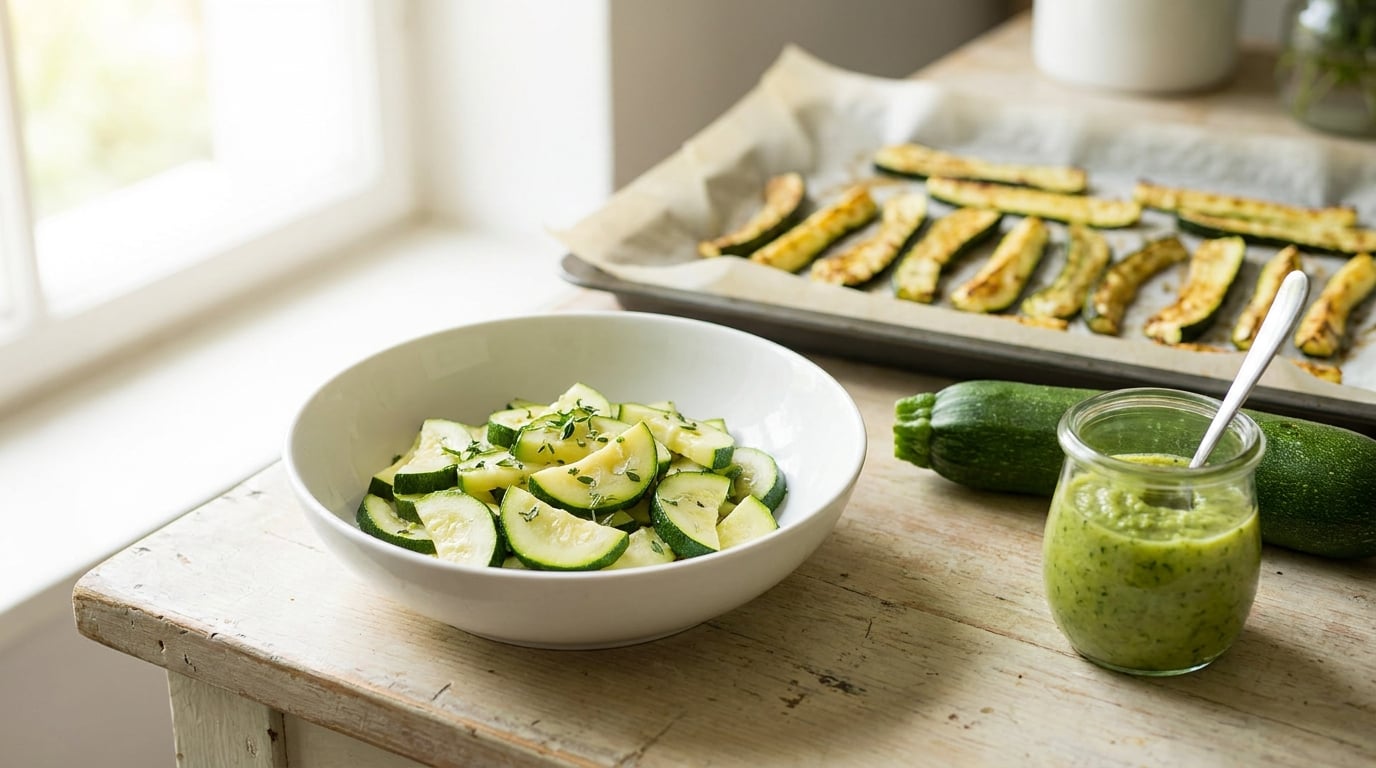
Yes, you can freeze zucchini, and the method you choose decides how it behaves months later. Blanch slices or cubes for 3 minutes, shock them in ice water, then pack them airtight for soups, stews, and sautés. Shredded zucchini skips the blanch entirely and is the best choice for bread and muffins, while puree handles smoothies and sauces.
Most of the soggy zucchini complaints I have heard come from one thing: water. Zucchini is roughly 95 percent water, and freezing ruptures the cells that hold it. Whatever you do, the water has to go somewhere, and how you prepare the vegetable decides whether it lands in your pasta sauce or in the bottom of your baking sheet.
I freeze two or three pounds every August and label every bag with the date and the recipe it is for. That habit alone has saved more zucchini than any technique. If you are working through a garden glut right now, start with the blanched method below, since it is the most dependable all-purpose option.
Table of Contents
How to Freeze Zucchini for Later Use: Which Method Fits Your Recipe?
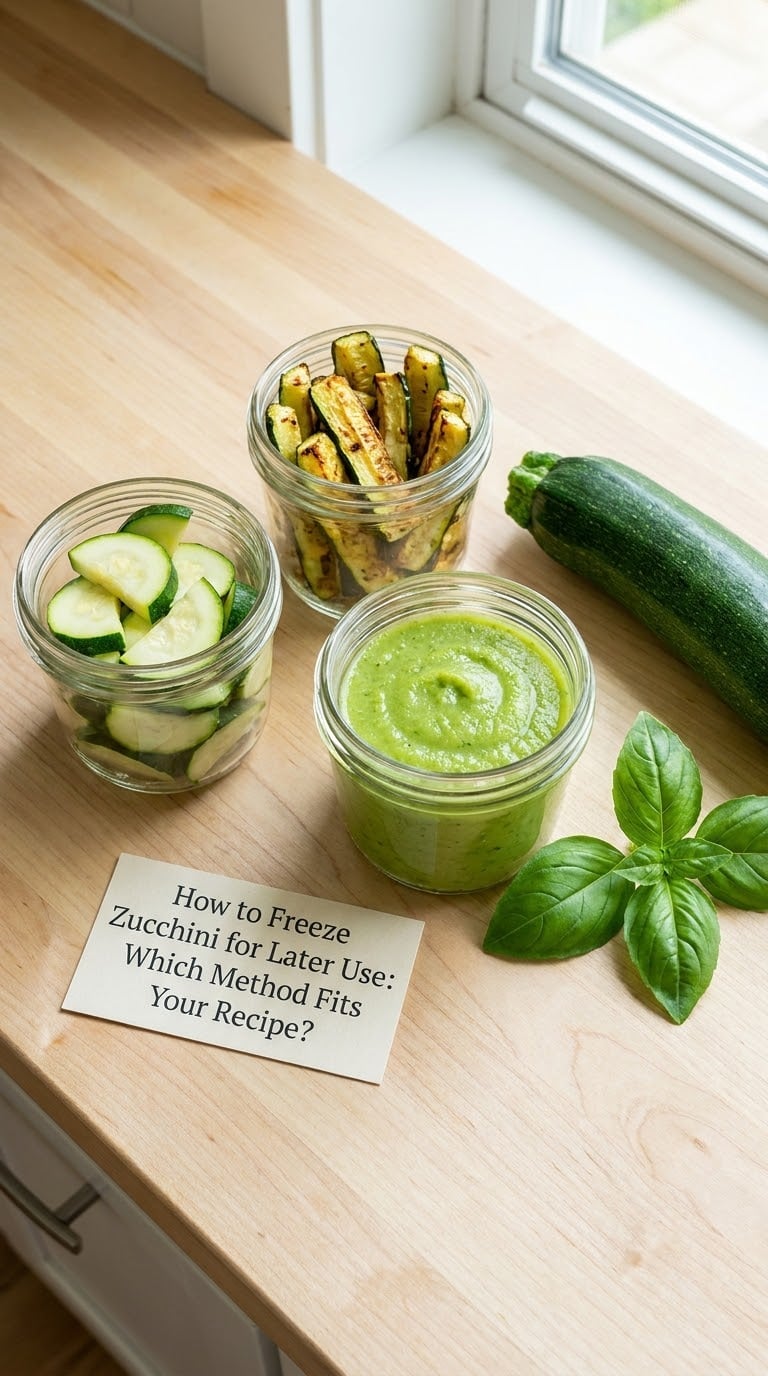
Pick the method by how you plan to cook the zucchini, not by how much time you have. Three methods cover almost everything a home kitchen needs.
- Blanched slices and cubes for soups, stews, sautés, gratins, and anything where the vegetable is cooked again. This is the all-purpose answer and the one most extension services recommend.
- Roasted zucchini for salads, grain bowls, pasta, and snacking. Roasting drives off water before freezing, so the texture holds up better than raw slices.
- Shredded and puree for baking, smoothies, sauces, and baby food. Both are best frozen flat or in measured portions, and neither needs blanching.
Skip whole stuffed zucchini, spiralized noodles, and pickles. The spirals collapse into a wet tangle the moment they thaw, and anything destined for pickling belongs in a brine, not a freezer bag.
What You Need Before Freezing Zucchini
You do not need special equipment, but a couple of tools make the job faster and the results more consistent.
- Fresh zucchini that feels heavy for its size, with skin that is glossy and free of soft spots.
- A sharp knife or a spiralizer for consistent cuts. Uneven cuts mean uneven blanching.
- A large pot, a slotted spoon, and a bowl of ice water for blanching.
- A box grater or the shredding disc of a food processor for the baking method.
- Parchment-lined baking sheets for flash freezing before bagging.
- Freezer-safe bags or rigid airtight containers, plus a permanent marker for dating.
Skip any zucchini that is oversized, spongy, or seedy. If the skin dents under your thumb and the core is full of hard seeds, the flesh is past its freezing prime and better suited to the compost pile.
Blanching Times for Different Zucchini Cuts
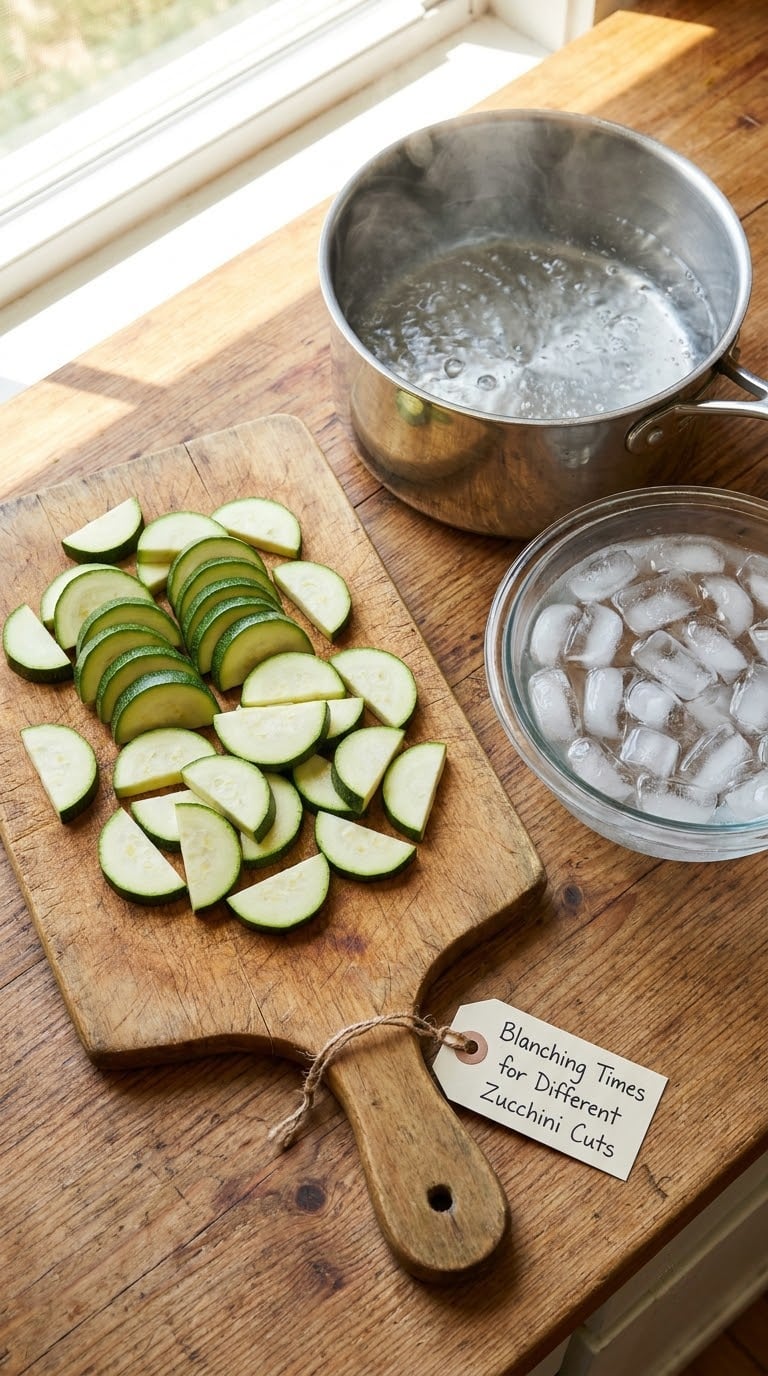
Blanching times stay short because zucchini is thin and watery. Longer blanching cooks the vegetable to mush before you ever reach the freezer.
| Cut | Boiling water | Steaming | Texture after thawing | Best for |
|---|---|---|---|---|
| Whole small zucchini, under 2 inches wide | 2 to 3 minutes | 4 to 5 minutes | Firm, holds shape | Stuffing, small-batch pickling, grilling |
| 1/4-inch rounds | 3 minutes | 4 to 5 minutes | Soft edges, holds shape | Frying, chips, gratin |
| 1/2-inch slices or half-moons | 3 minutes | 4 to 5 minutes | Firm, versatile | Soups, stews, sautés, pasta |
| 1-inch cubes | 3 minutes | 5 minutes | Firm | Soups, curries, casseroles |
| Shredded, for baking | No blanch needed | Not needed | Soft, moist | Bread, muffins, brownies |
Steam-blanching when you do not want to boil
Set the cut zucchini in a steamer basket over simmering water with the lid on. The times run 4 to 5 minutes rather than 3, and you avoid a pot of cooling water for a small batch. Treat blanching as the step that decides whether frozen vegetables turn to mush, so it is worth doing whether the zucchini goes in a pot or a steamer.
How to Freeze Zucchini for Later Use
This is the blanch-and-freeze method, and it is the one to learn. It takes about 20 minutes of active work and gives you zucchini that still tastes like zucchini in February.
- Wash and trim. Rinse under cool water, cut off both ends, and leave the peel on for anything under about 8 inches long. Cut into even 1/2-inch slices, half-moons, or 1-inch cubes.
- Bring a large pot of water to a rolling boil. Set a bowl of ice water beside it so you can move fast.
- Blanch in small batches. Drop the zucchini in for 3 minutes, or 4 to 5 minutes if you are steaming. Work in batches so the water stays hot, and keep the pot at a boil the whole time.
- Shock immediately. Lift the zucchini straight into the ice water and leave it for 3 minutes. This stops the cooking and is the step that keeps the color and texture.
- Drain thoroughly. Spread it on a clean towel or a colander and let it drip for 5 to 10 minutes. Water that goes into the bag comes out later as puddle.
- Flash freeze in a single layer. Spread the pieces on a parchment-lined baking sheet, freeze 1 to 2 hours until solid, then transfer them to bags or containers. Skip this and you will pull out one solid brick.
- Bag, seal, and label. Press the air out of each bag before sealing, write the date and the cut size on it, and stack it flat in the freezer.
For a continuous supply, freeze several sheets at once. A sheet of half-moons takes minutes to bag, and the whole batch can be portioned in one sitting on a clean counter.
How to Freeze Zucchini Without Blanching
You can freeze zucchini raw, and for shredded zucchini destined for baking it is the better choice. The tradeoff is texture: raw-frozen slices come out softer and wetter than blanched ones, and they suit cooked dishes more than anything you plan to serve cold.
How to freeze zucchini without blanching for the best texture
- Cut thin. Anything 1/2 inch thick or thinner freezes better than chunky cubes, which stay watery in the center.
- Salty trick for shredded zucchini. Grate, sprinkle with a teaspoon of salt, wait 10 minutes, then press it hard in a clean kitchen towel. You will be shocked at the liquid that comes out.
- Spread in a single layer. Freeze on a parchment-lined sheet for 1 to 2 hours, then bag it.
- Portion by the cup. Flatten each bag into a 1-cup or 2-cup block so you can break off exactly what a recipe calls for.
Raw frozen zucchini works best in smoothies, quick breads, sauces, and soups. Anything that gets cooked in liquid forgives the softness. What to avoid is anything served raw or crisp, since freezing has already taken the crack out of the cell walls.
How to Freeze Roasted Zucchini for Snacks and Sides
Roasting first is the shortcut to zucchini that does not taste like a freezer container thawed in the dark. Moisture leaves in the oven instead of in your salad bowl.
- Heat the oven to 425°F (220°C) and line two sheet pans.
- Slice 1/2 inch thick and toss with olive oil and a pinch of salt. Oil is what keeps the edges from turning leathery in the freezer.
- Roast 20 to 25 minutes, flipping once, until the edges are browned and the centers look dry rather than glossy.
- Cool completely on the pan before touching them. Trapping warm steam in a container is the fastest way to a freezer full of soft zucchini.
- Freeze in a single layer first, then bag or box. Label with the date and whether you seasoned with salt.
Frozen roasted zucchini drops straight into a grain bowl, a pasta, or a salad once it has thawed in the fridge for a couple of hours. It also works as a salty snack on its own, which is how most of mine disappear.
How to Freeze Zucchini Puree
Puree is the most forgiving method. It hides texture completely, so it is a good home for the odd-shaped and slightly seamed squash that is not pretty enough to slice.
- Chop the zucchini and steam or blanch until a fork slides in with no resistance, about 6 to 8 minutes.
- Blend until completely smooth, adding a tablespoon of water if the blender struggles.
- Cool it down to room temperature, or the containers will swell in the freezer.
- Portion it. Freeze 1/2-cup blocks in a silicone ice cube tray, then pop the cubes into a bag, or spoon 1-cup and 2-cup portions into freezer containers with 1/2-inch of headspace.
- Label and freeze flat with the date and the count of portions per bag.
A single zucchini makes roughly 1 to 1.5 cups of puree. That is about one loaf of zucchini bread, so freeze in the count your recipes need rather than in a big block.
How to Thaw Frozen Zucchini Without Making It Soggy
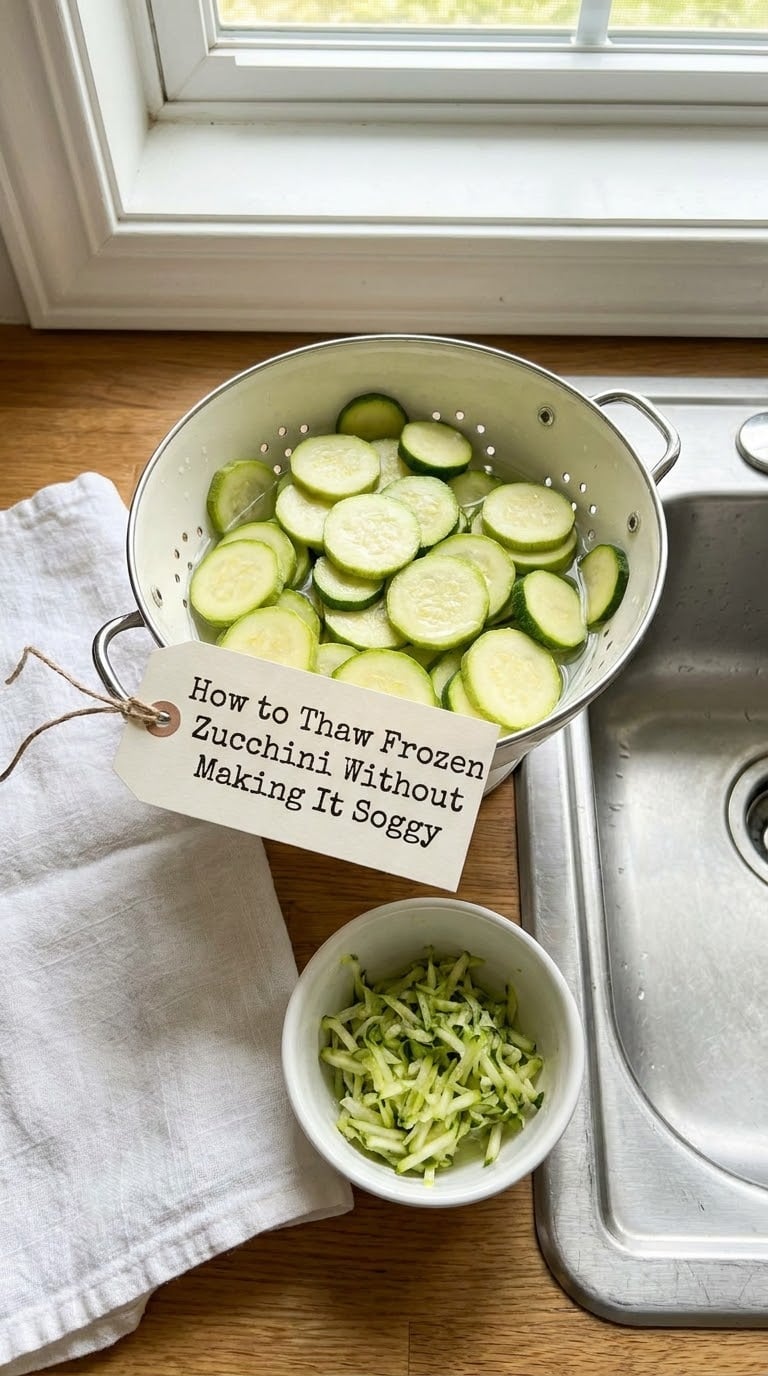
Thawing method matters as much as freezing method. Thawing slowly and separately gives the ice crystals time to melt and drain away, which is what keeps the vegetable from turning to mush in the pan.
- Refrigerator overnight is the safest and best choice for sliced, roasted, and shredded zucchini. Put the container on a plate or in a bowl to catch the liquid that collects.
- Cold water works when you need it in under an hour. Seal the zucchini in a leakproof bag, submerge it, and change the water every 30 minutes.
- Straight from the freezer into the pan is fine for soups, stews, and curries. Add frozen pieces directly to hot liquid and add a few extra minutes to the cooking time.
For baking, press the thawed shreds out a second time. Re-squeezing removes the water that thawed out of the cells, and it is the difference between a moist loaf and one that leaks into the tin.
Storage Times and Best Containers
The numbers that circulate online conflict because they describe different things: peak quality and safe storage are not the same window. Here is the honest version, drawn from standard extension-service guidance and what has held up in my own freezer.
| Method | At peak quality | Usable beyond that | Note |
|---|---|---|---|
| Blanched slices and cubes | 3 months | 6 to 9 months | Texture softens noticeably after 3 months |
| Raw sliced | 2 to 3 months | 6 months | Softest of the lot, best in cooked dishes |
| Roasted | 3 to 4 months | 8 months | Roasting removes water first, so it holds up well |
| Shredded for baking | 8 to 12 months | 12 months | Baking is forgiving; the shreds keep working |
| Puree | 3 to 6 months | 10 months | Fully smooth, so age shows mostly in flavor |
| Zucchini bread, baked | 2 to 3 months | 4 months | Wrap tightly in plastic wrap, then foil |
Any frozen food that thaws slowly in the refrigerator is safe for 3 to 4 days before you cook it, which covers most cooked dishes and soups.
Airtight is the goal. Zip-top freezer bags are the most space-efficient option, and pressing the bag flat on a counter before sealing squeezes out the air that causes freezer burn. Rigid containers hold their shape and stack better, but their gaskets rarely seal as well as a zip bag, so double-bag anything going in one. For long storage, a vacuum sealer removes the air more completely than any zip seal and measurably slows quality loss.
Write three things on the label: the date, the cut or form, and the recipe you meant for it. Six months from now, that third item is the one you will not be able to work out from a frozen brick.
Common Mistakes When Freezing Zucchini
Nearly every soggy result traces back to one of these. Each fix takes under a minute the next time round.
- Skipping the ice bath. Blanching without shocking lets the vegetable keep cooking from residual heat. Fix: 3 minutes in ice water, no exceptions.
- Freezing wet zucchini. Surface water turns into ice crystals and squeezes the texture flat. Fix: drain on a towel for 5 to 10 minutes before packing.
- Piling pieces into the bag. They freeze into a clump you have to break apart with a hammer. Fix: flash freeze in a single layer for 1 to 2 hours first.
- Portioning by guess. A loose cup of shreds is not a cup. Fix: press each bag flat and mark the level, or use a 1-cup measure to fill.
- Thawing in warm water or on the counter. The outside goes soft while the center is still frozen. Fix: refrigerate overnight or use cold water and change it twice.
- Packing warm puree into sealed cups. It cools in the freezer, the air inside contracts, and the lid leaks. Fix: cool to room temperature first and leave headspace.
Signs your frozen zucchini has gone bad are visual rather than mysterious: heavy ice crystals on individual slices, a dull gray-brown color instead of pale green, and an off smell once the bag is open. Freezer burn on zucchini looks like white, dry, papery patches. It is safe but tastes flat, and it happens when air reaches the food, so discard anything with a rubbery or off odor rather than trying to cook through it.
Ways to Use Frozen Zucchini Later
Once the freezer is stocked, the next question is what to do with it. Frozen zucchini behaves differently depending on the form, so match the form to the dish.
- Baking: thawed shredded zucchini for quick breads, muffins, brownies, and cakes. Re-squeeze before mixing.
- Soups and stews: blanched cubes straight from the freezer, cooked 10 minutes longer than fresh to make up for the texture.
- Sauces and salsas: puree cubes blended with roasted peppers, garlic, and a squeeze of lime.
- Smoothies: a half-cup puree block disappears completely and adds no wateriness at all.
- Gratin and casseroles: blanched half-moons layered with potatoes and cheese, baked until the top browns.
- Fried sides: blanched 1/4-inch rounds, battered and fried straight from frozen with no thawing.
- Grain bowls and salads: thawed roasted zucchini with feta, lemon, and herbs.
Once the zucchini is out of the way, dinner plans get easier. These 20 easy zucchini recipes for summer dinners lean heavily on slices and chunks, and the zucchini bread recipes with chocolate chips are exactly what your 2-cup bags of shredded squash are for. If you are already freezing soup for the winter, the cozy fall soups that freeze well pair naturally with a bag of blanched cubes.
Frequently Asked Questions
Do you have to blanch zucchini before freezing it?
For sliced or cubed zucchini, blanching is strongly recommended. Three minutes in boiling water followed by a 3-minute ice bath sets the texture, and blanched slices stay firm for about 3 months. Raw-frozen slices are safe and edible but softer, wetter, and shorter-lived. Shredded zucchini for baking does not need blanching at all.
Can I freeze zucchini without blanching it first?
Yes. Raw-frozen zucchini is fine for smoothies, sauces, soups, and quick breads, especially when it is grated and squeezed dry first. Keep cuts to 1/2 inch or thinner, freeze them in a single layer, and expect a softer result. Raw freezing shortens the shelf life to roughly 2 to 3 months at peak quality.
How long does frozen zucchini last in the freezer?
Blanched slices and cubes keep their best texture for about 3 months and stay usable for 6 to 9. Shredded zucchini for baking holds up 8 to 12 months because it is mixed into batter. Puree keeps 3 to 6 months at peak quality. At 0°F (minus 18°C) the food stays safe far longer, but texture and flavor fade well before that.
Should I thaw zucchini before using it in a recipe?
It depends on the dish. Thaw sliced and roasted zucchini in the refrigerator overnight or in cold water, then drain and pat dry. Shredded zucchini for baking must thaw so you can squeeze out the water, or the batter turns soggy. Soups, stews, and curries take frozen pieces straight into the pot with a few extra minutes of cooking.
What is the best container for freezing zucchini?
Freezer-safe zip-top bags are the most space-efficient and let you press out air before sealing, which is what prevents freezer burn. Rigid airtight containers stack better and survive a move, but most lids seal poorly, so double-bag anything stored in one. Silicone ice cube trays work well for puree, then the cubes move into a labeled bag.
Why does my frozen zucchini become watery after thawing?
Zucchini is about 95 percent water, and freezing ruptures the cell walls that hold it. On thawing, that water leaves the cells and pools at the bottom of the bag, which is normal. You can limit it by blanching, draining well before packing, freezing in a single layer, and thawing in the refrigerator over a bowl so the liquid drips away instead of sitting in the food.
Conclusion
Start with the blanch-and-freeze method if you have only one kind of zucchini to save. Three minutes in boiling water, three minutes in ice water, a flash freeze on a lined sheet, and you have a bag of slices that behaves like a vegetable in a soup six months from now.
After that, freeze a batch of shredded squash in 1-cup and 2-cup portions for baking, and skip the blanch. Once you know how to freeze zucchini for later use properly, that August glut stops being a problem and turns into a winter supply you will be glad you labeled.