
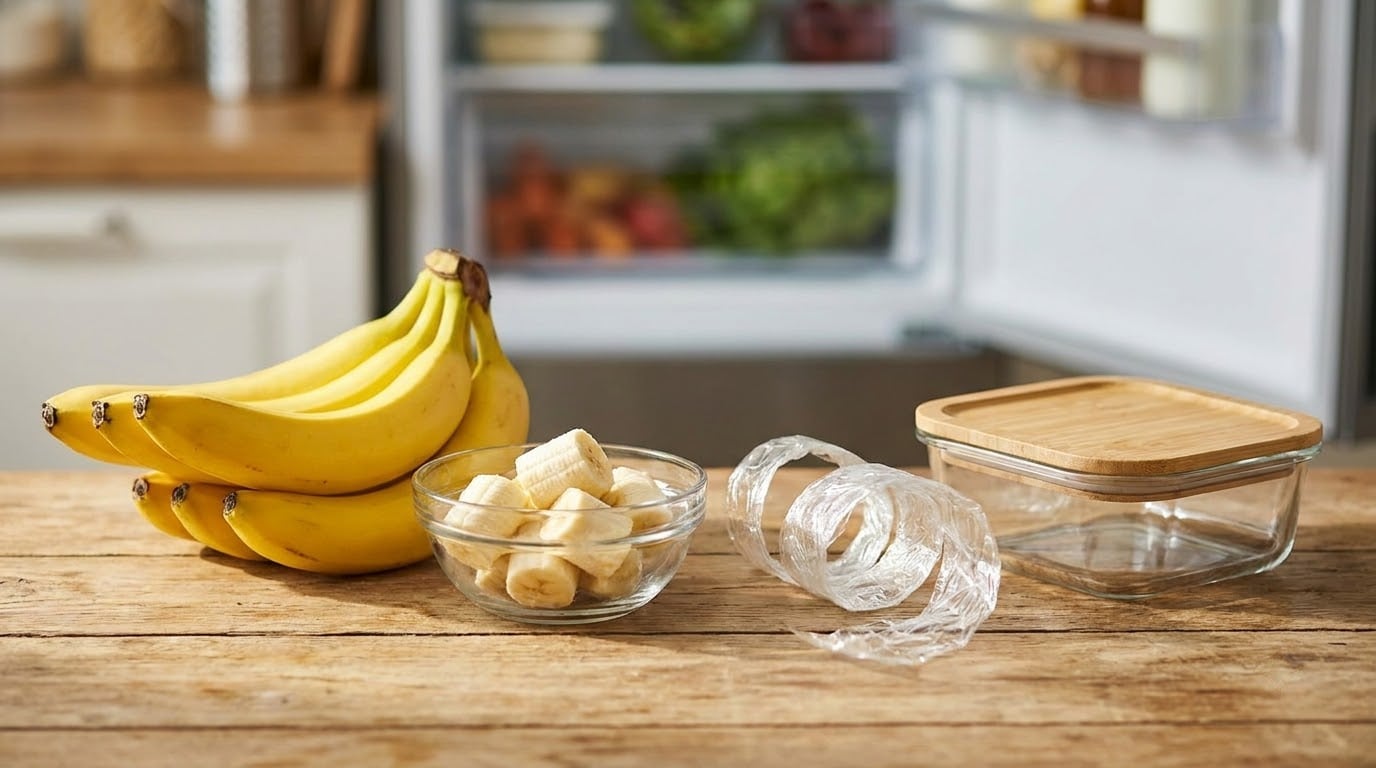
To store bananas so they last longer, pull the bunch apart into single bananas, wrap each stem tightly in plastic wrap, and hang it somewhere away from direct heat. Leave green bananas on the counter until they turn yellow, then move the whole bunch to the refrigerator, where the peel darkens but the fruit stays firm for another five to seven days. Anything past that gets peeled and frozen.
I lose bananas the same way most people do. I buy a bunch on Sunday, plan to eat one a day, and by Thursday half of them are sitting in the fruit bowl leaking sticky juice. It took me a while to accept that the peel is the least useful part of the equation.
This guide covers every stage, from green to freezer. Pick the row in the quick guide table that matches your bananas right now, read that section, and come back when the color changes.
Table of Contents
How to Store Bananas So They Last Longer: Quick Guide
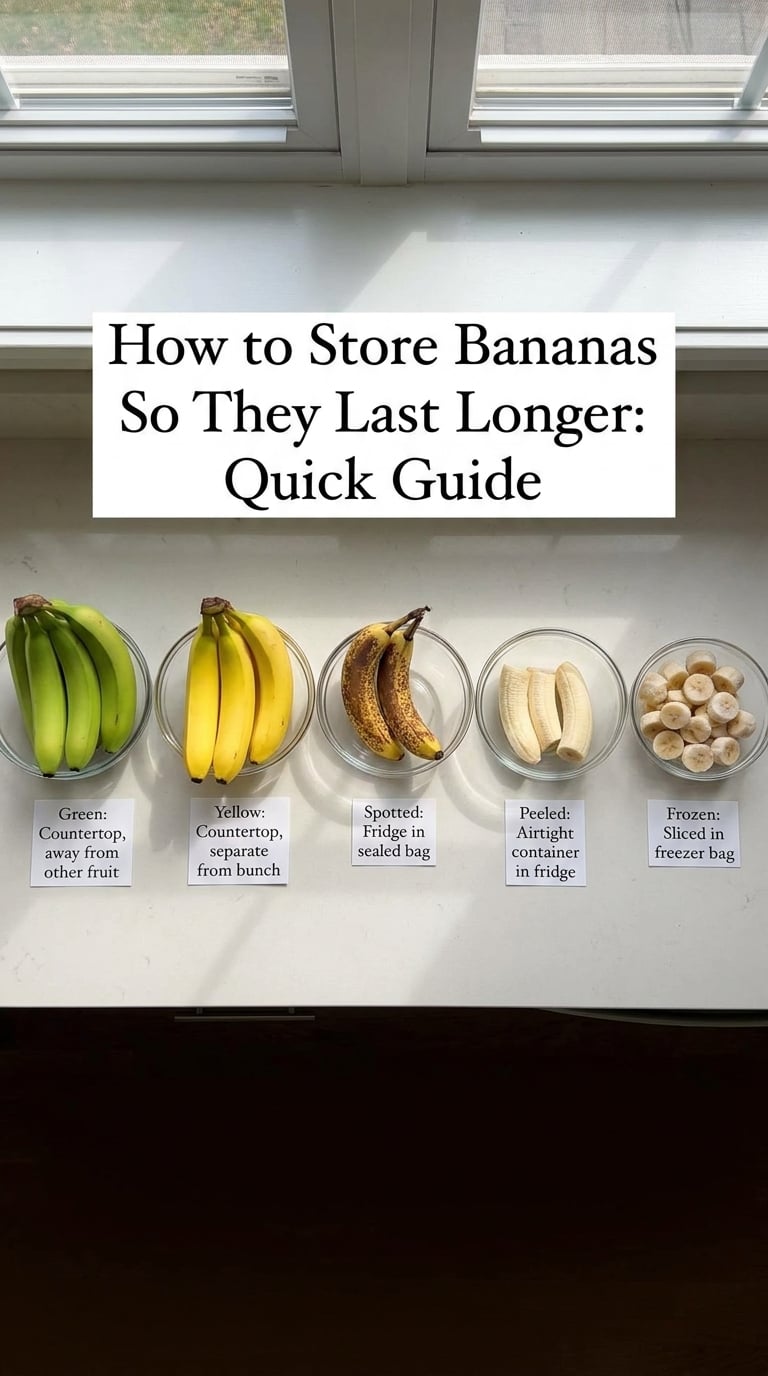
Different ripeness stages need opposite treatment, and mixing them up is what makes most bunches go to waste. This is the method, the time it buys you, and what you should do with each stage.
| Banana stage | Best method | How long it lasts | What to expect | Best use |
|---|---|---|---|---|
| Green and firm | Counter, stems wrapped, away from heat | 4 to 7 days before it is eating-ready | Color climbs slowly and evenly | Baking, or holding for later in the week |
| Yellow with no spots | Counter until fully yellow, then fridge | 1 to 3 more days on the counter | Pale yellow, no peel change | Eating this week |
| Yellow with brown flecks | Refrigerator, unpeeled | 3 to 5 more days | Speckles spread, peel blackens | Eating straight away, smoothies |
| Deep brown, very soft | Peel and freeze | 2 to 3 months frozen | Freezer-burn on the fruit, not the mold | Smoothies, nice cream, banana bread |
| Peeled, cut or whole | Airtight container, fridge, acidulated water | 1 to 2 days | Flesh pales and softens | Eating within a day, lunchboxes |
| Frozen slices | Airtight freezer bag or tub | 3 to 6 months at best quality | Soft and slightly dull once thawed | Baking and blending |
Cold wins for the fruit, never for the peel. Remember that line and almost every question about this topic gets easier.
How to Store Bananas So They Last Longer at Room Temperature
A bunch of bananas on an ordinary kitchen counter gives you roughly three to seven days before it turns to mush, depending on how green it was when you bought it. Warmer kitchens and direct sun on the counter shorten that window sharply.
For green bananas, split the bunch into single bananas, leave about an inch of stem on each, and set them in a single layer rather than a pile. Crowding bruises the fruit, and bruised spots turn to mush days before the rest of the bunch is ready.
For ripening bananas, wrap the stems. Tear off a square of plastic wrap, twist it around each crown, and press it closed. The crown is where most of the ethylene gas escapes, so sealing it slows the whole cluster down without touching the fruit.
For ready-to-eat bananas, eat them off the counter for a day or two, then move the rest to the fridge. Counter storage only helps while the fruit is still firm; once it is soft, the clock is already running down.
Keep bananas away from apples, avocados, ripe tomatoes and pears, all of which release ethylene gas too. A bowl of bananas next to a bowl of apples is a ripening chamber, whether you meant it or not.
Should You Refrigerate Bananas?
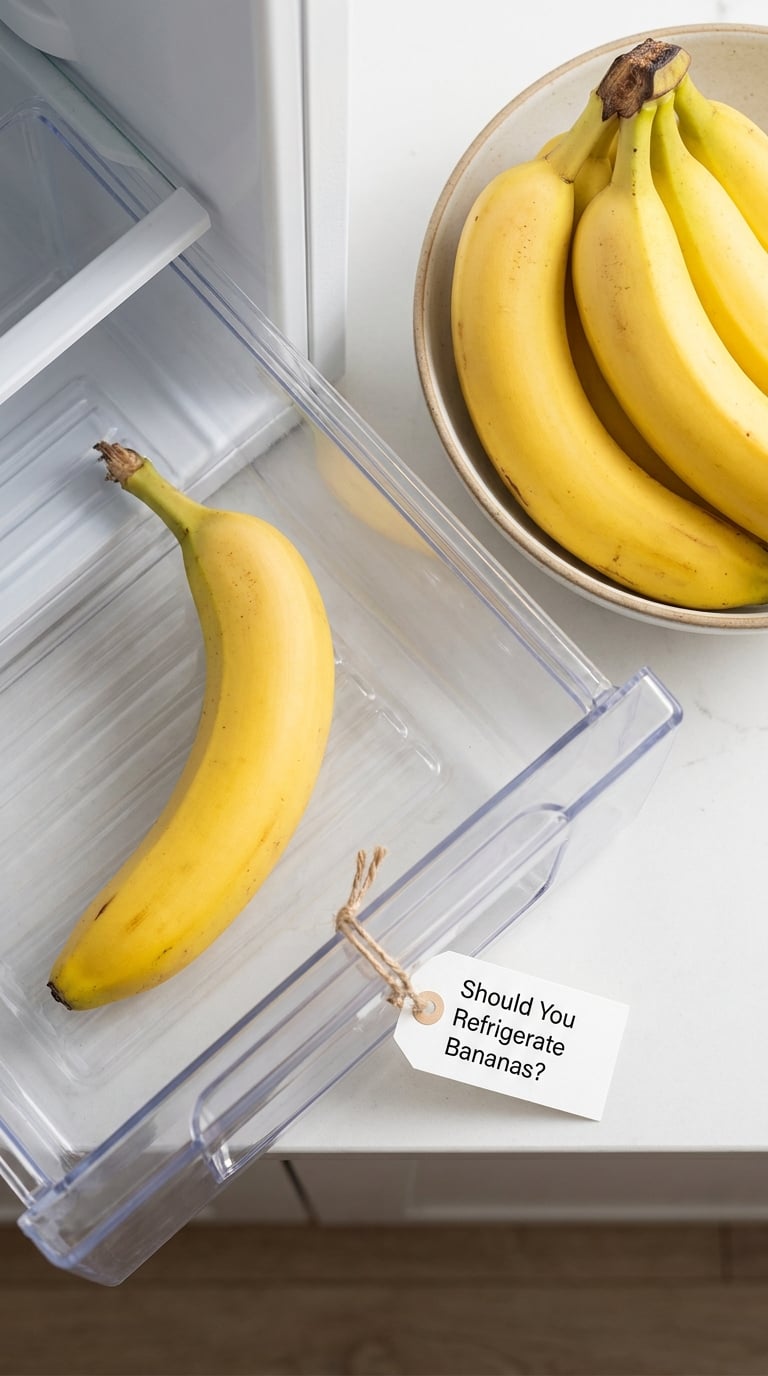
Yes, for unpeeled ripe bananas, and no, the peel going black is not a sign of spoilage. Refrigeration drops the temperature enough to stall the ripening reactions inside the fruit while the peel, which is damaged by cold in a completely different way, turns dark and leathery.
The trade-off is worth making because the flesh is what you eat. A banana that looks terrible in the drawer can be cut open to firm, pale, perfectly good fruit. Several long-running forum users describe the fridge as suspended animation for the flesh, and it is the closest thing to a pause button a banana has.
Realistic timing: a fully ripe yellow banana gains about five to seven days in the refrigerator. Fruit that was still green loses more than it gains, because cold stalling and normal ripening do not cancel each other out cleanly, so do not refrigerate bananas you still want to ripen.
Refrigerated bananas are perfectly safe to eat. The fear that cooling fruit makes you ill has no basis, and the black peel is purely cosmetic, though peel and flesh can darken at different speeds, so peel a black banana and check the fruit before you commit to it.
Food safety experts at the University of Nebraska point to about 54°F (12°C) as the ideal banana storage temperature, a cooler range than a typical refrigerator reaches. That is why a pantry or cellar in a mild climate sometimes keeps fruit better than the kitchen counter, and why cool, dark, ventilated storage matters more than the container you pick.
Shelf-life thinking carries over to everything else in the fridge. My guides to how long hard boiled eggs last in the fridge and how long cooked chicken lasts in the fridge use the same separation-and-labeling logic that works on produce.
How to Keep Bananas Fresh for a Week
This routine is built for a household that eats one or two a day and keeps losing the rest of the bunch. Work through it once and the whole week takes care of itself.
- Buy at mixed ripeness. Pick one or two yellow bananas to eat now and let the rest stay green. Most shops sell greener fruit than people actually buy, and greener fruit buys you several extra days at no cost.
- Inspect before you leave the store. Squeeze each banana gently. Skip anything with a split stem, leaking spots, or a soft sunken patch on the peel.
- Split the bunch at home. Break the crown apart so you are not pulling one banana off the cluster every time you want a piece. Ripeness spreads through touching fruit.
- Wrap the stems. A small square of plastic wrap twisted around each crown buys several days on a warm counter.
- Choose the location. Hang the bananas on a hook or an under-cabinet rail if you have one, or set them in a single layer on a cool counter away from the stove, the oven, and the coffee maker.
- Check every other day. Move anything with a soft neck and yellow peel into the fridge. Freeze anything already spotted, before you forget about it.
What to Wrap Bananas In
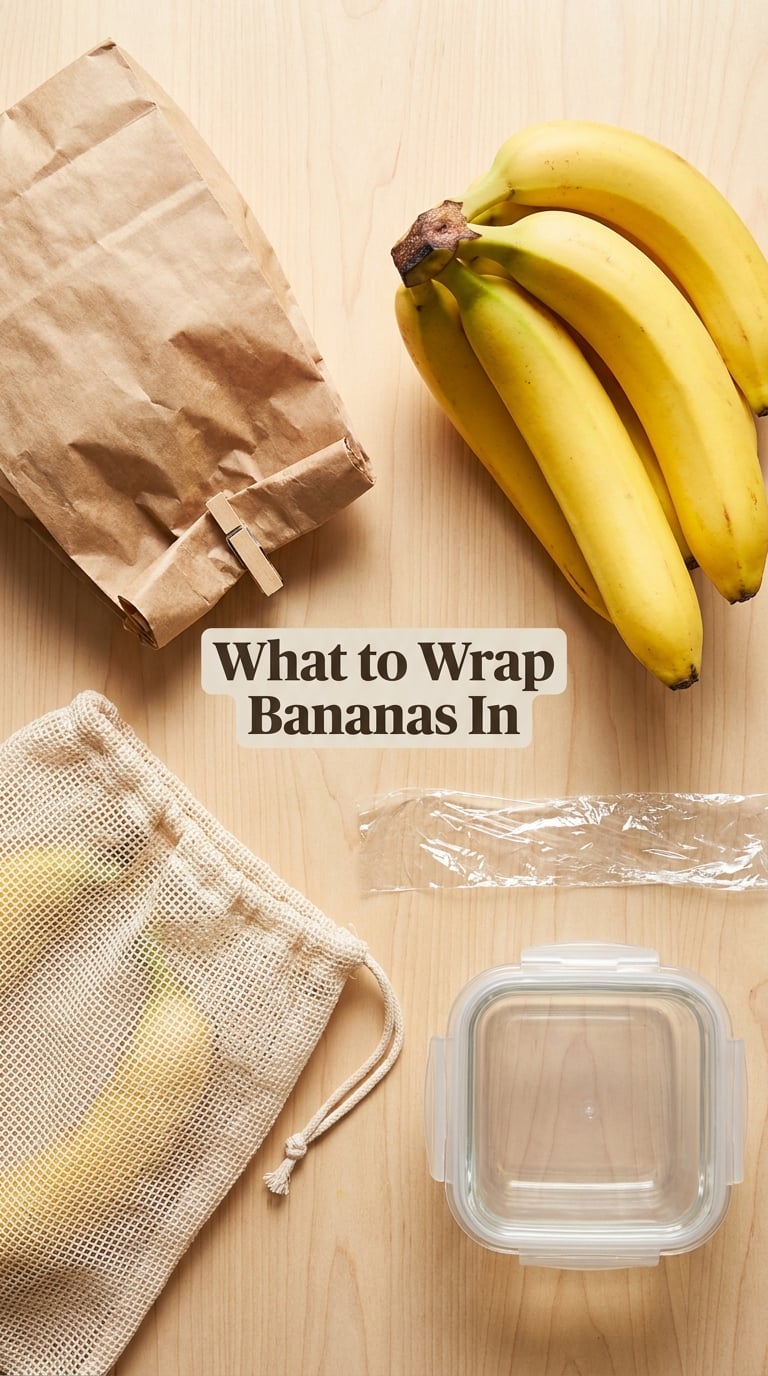
Each wrapping method solves a different problem, and two of the most common ones are recommended for the opposite of what people expect.
Plastic wrap on the stems is the single most effective trick. It traps the ethylene escaping from the crown and buys several days, and it costs nothing beyond a square of film from the drawer.
Aluminum foil works on the same principle, and it does a better job if the bunch is already partly green. Wrap the whole crown, not each stem separately.
A closed paper bag does the opposite of what most people hope. Paper traps ethylene gas exactly like plastic wrap, but across the whole bunch, so it speeds ripening up. It is a ripening method, not a storage method, and a good trick when you want green bananas yellow for baking by tomorrow.
Breathable produce bags, the green or perforated reusable kind, slow ripening modestly by letting gas escape. Several forum users report a full week of shelf life, though that is anecdotal rather than something to plan around. Treat them as a nice-to-have, not a fix.
Airtight containers are only right for peeled or cut fruit, where sealing out air and moisture is the whole point. Never seal unpeeled bananas in a closed container or a sealed plastic bag, because trapped gas and condensation both accelerate decay and encourage mold at the stem.
Cloth or a paper towel under the bananas keeps fruit off a wet or dirty surface, which is a smaller win than people expect but costs nothing.
How to Store Green Bananas for Later
Green bananas are the easiest to slow down, and the easiest to ruin by being impatient. They have weeks of runway if you treat them right and about two days if you stash them in the fridge.
- Keep them apart and unwrapped at first. A single layer on the counter, out of sunlight, is the baseline. A sealed bag speeds things up rather than slowing them.
- Add an ethylene-producing fruit only when you want speed. Put one ripe apple or banana in with them and the cluster will speed up noticeably. This is how you get firm green bananas to baking-ready in about two days.
- Move them to the fridge only at the very end. Once they are yellow with a trace of green at the tips, cold slows the last stretch without stopping it.
- Freeze for long holds. Peel and freeze green or barely yellow bananas if you will not cook with them within a week. The texture is wrong for eating raw but fine for baking and blending.
How to Store Peeled Bananas
A peeled banana has no peel doing its job, and exposed banana flesh browns fast from enzymes reacting with air. Cut or peeled fruit is a two-day problem at most, so treat it that way.
- Coat the cut faces. Brush or dip the exposed flesh in lemon or lime juice, and a thin layer of water works too, so the acid sits right where the browning starts.
- Wrap the cut face tightly. Press plastic wrap directly onto the cut surface with no air pocket, or push the pieces into a jar and press the wrap down on top.
- Use an airtight container. A rigid container with a tight lid, or a freezer bag with the air squeezed out, keeps more moisture in than a loose bag.
- Refrigerate immediately. Expect one to two days of usable time, and check the cut face each morning because it darkens before it goes bad.
- Freeze instead of refrigerating if you will not eat it within a day. This is the practical route for lunchboxes and smoothies.
How to Freeze Bananas
Freezing is the fallback that saves the most food, and forum cooks reach for it constantly once fruit turns. Frozen banana goes into smoothies, nice cream, muffins and banana bread, and it takes the ice out of a smoothie entirely.
- Use ripe fruit. Very green bananas freeze into something hard and starchy, so wait for at least deep yellow, ideally with spots.
- Peel first. A peel left on holds onto the fruit and dries it out, and it takes twice as long to thaw.
- Slice or chunk. Cut crosswise into coins or lengthwise into halves, whichever matches what you bake with.
- Flash freeze first. Spread the pieces in a single layer on a parchment-lined baking sheet, freeze for one to two hours until solid, then transfer them to an airtight freezer bag or tub.
- Squeeze out air and label. Push the air out of the bag before sealing, and write the date on it. Write the date, because freezer bags of banana are not identifiable later by color alone.
- Thaw gently. Move the container to the fridge the night before, or leave it out for an hour or two. Frozen banana is soft enough to blend from partially thawed and should not be microwaved, which turns it to paste.
Banana bread and muffins are the best home for frozen fruit, since the thawed texture disappears entirely into the batter. Smoothies and nice cream come next, with mashed frozen banana working better than chunks.
Bananas That Are Already Brown or Bruised
A black peel almost never means the fruit is ruined. Cut the stem end off and look inside, because the flesh is usually cream-colored, firm, and fine to eat, and the peel simply reacts to cold or to ethylene far faster than the fruit does.
Signs that the fruit itself has gone: a fermented or boozy smell, liquid pooling in the skin, visible mold especially at the stem, and flesh that is slimy, stringy, or leaking when you cut it. Mold on the peel alone can be cut away by peeling in strips, but mold on the flesh is the end of it.
For a bunch that is half brown, split the batch rather than choosing. Freeze the spotted ones today, move the good yellow ones to the fridge, and leave any still-green banana on the counter to finish its own slower trip. That way nothing sits waiting for a decision you forget to make.
Bruised spots on an otherwise firm banana are a freezer job too. Slice off the bruise, peel the rest, and freeze. Embarrassing but entirely recoverable.
Common Mistakes
Sealing unpeeled bananas in a plastic bag or closed container. Trapped ethylene and condensation speed ripening and grow mold at the crown. Correction: leave them loose on the counter, and reserve airtight containers for peeled fruit only.
Using a closed paper bag to preserve. The bag is a ripening tool, not a storage tool, and it is the most misapplied tip in this whole subject. Correction: use it when you want green bananas yellow by morning, and keep it away from the counter during normal storage.
Refrigerating bananas that are still green. Cold stalling and ripening do not simply cancel out, and you usually end up with fruit that is neither ripe nor good. Correction: fridge only once the peel is fully yellow.
Crowding the fruit bowl. Bruises on the underside turn soft and weep days ahead of the rest. Correction: one layer, or hung off a rail so nothing rests on a hard surface.
Discarding one softened banana. A single soft banana at the top of a bunch usually means the whole cluster turns within a day, which is when the waste happens. Correction: peel and freeze the soft one every time, without waiting for permission.
Leaving bananas next to the stove or in a sunlit spot. Heat is the fastest ripening trigger there is, and most kitchens have a counter that is warmer than the room. Correction: move them to the far side of the kitchen or a hook under the cabinet.
Frequently Asked Questions
How long do bananas last at room temperature?
Three to seven days on an ordinary counter, depending on how green they were at purchase and how warm the kitchen is. Wrapping the stems in plastic wrap and keeping the fruit out of direct sun and away from the stove stretches that window by several days. The last few bananas on a bunch tend to go at the soft, spotted stage, so plan to move those to the fridge rather than expecting the whole bunch to hold.
Do bananas go bad if the peel turns black?
Usually not. Cold damage and ethylene both darken the peel long before they affect the flesh, so a black banana is often fine inside. Cut the stem end off and look. Discard the fruit if it smells fermented, is slimy or stringy, or has mold on the flesh. Mold on the peel by itself can be removed by peeling in strips.
Why do my bananas ripen too fast after wrapping the stems?
Most often the wrap is covering the whole bunch rather than just the crowns, or the bananas are sharing a bowl with apples, avocados, ripe tomatoes or pears, all of which release ethylene gas. Paper bags and sealed produce bags have the same accelerating effect. Check what the bananas are touching before assuming the wrap failed.
Can I refrigerate bananas that are still green?
You can, but it is usually a mistake. Cold slows ripening rather than stopping it, so green fruit in the fridge can sit for days without getting yellow and sweet, and the peel may darken before the flesh is ready. Counter storage is the better choice until the peel is fully yellow, then move them to the fridge.
How long do peeled bananas last in the fridge?
One to two days when the exposed cut face is coated with lemon or lime juice, pressed against plastic wrap, and sealed in an airtight container. Without that care, peeled bananas pale and soften within a day, and a sliced banana is best used within hours. If you will not eat them that quickly, freeze them instead.
What is the best way to thaw frozen bananas?
Move the container to the fridge the night before for a slow thaw that keeps some texture, or leave it on the counter for an hour or two if you are blending. Do not microwave them, which turns the fruit to paste. Partially thawed chunks blend smoothly and are the best texture for smoothies, while fully thawed mush works best in banana bread.
Conclusion
Start tonight, not tomorrow. Pull the bunch apart, wrap each stem in a square of plastic wrap, and set the bananas in a single layer away from the stove, then check them every other day.
Once the peel is fully yellow, move the bunch to the fridge and accept the black skin. The fruit inside stays good for close to a week, and anything spotted past that point gets peeled and frozen rather than wasted. That is the whole trick behind how to store bananas so they last longer: cool fruit, sealed stems, and no plastic bag.