
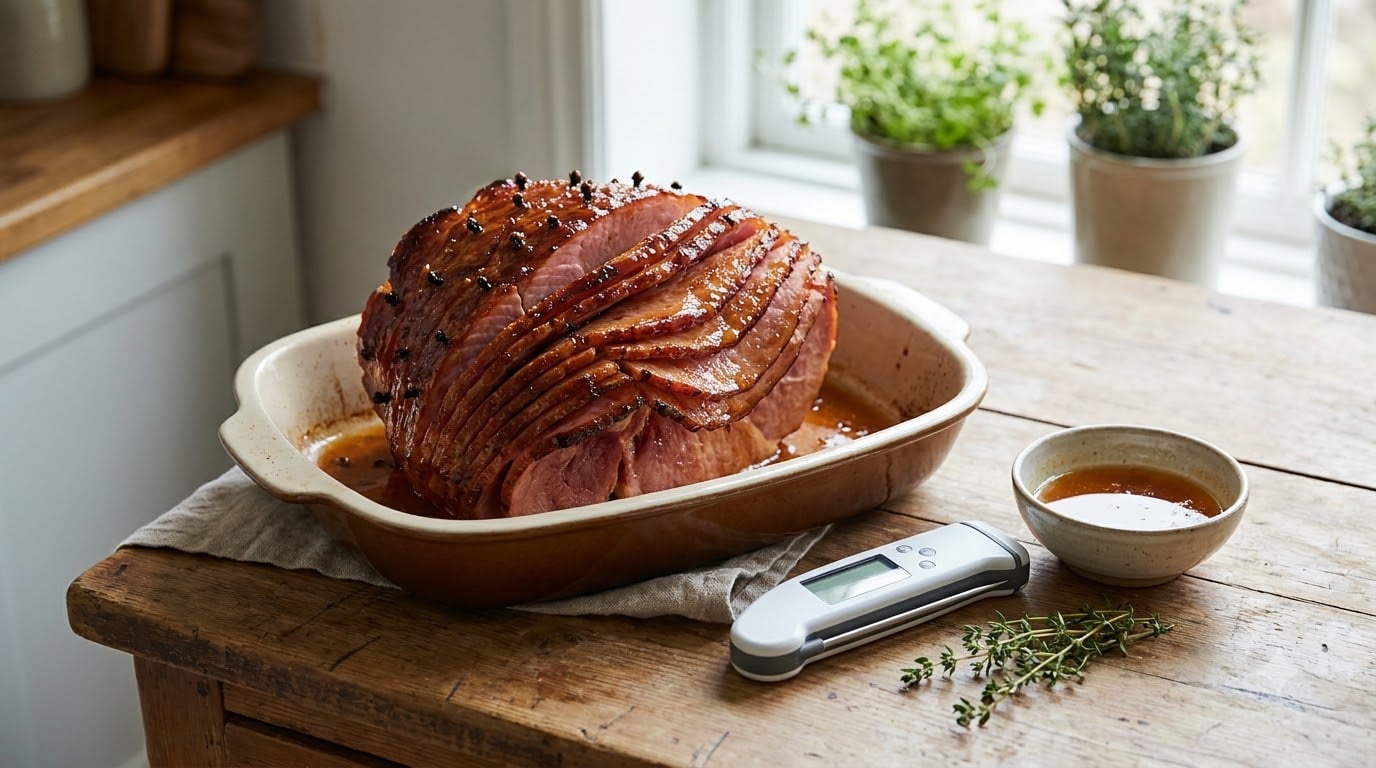
Most spiral hams go in at 325°F (163°C) for about 10 to 15 minutes per pound, and they are done when a thermometer in the thickest part reads 145°F (63°C) with a 3-minute rest. The clock is only an estimate, and most spiral hams are already fully cooked, so you are reheating rather than roasting raw meat.
I cook a spiral ham every Christmas, and the first thing I tell anyone who asks is to ignore the box until you have a thermometer in your hand. Timing printed on packaging assumes a commercial oven, a different pan, and usually a whole ham rather than a section.
Table of Contents
How Long to Cook a Spiral Ham in the Oven: Quick Guide
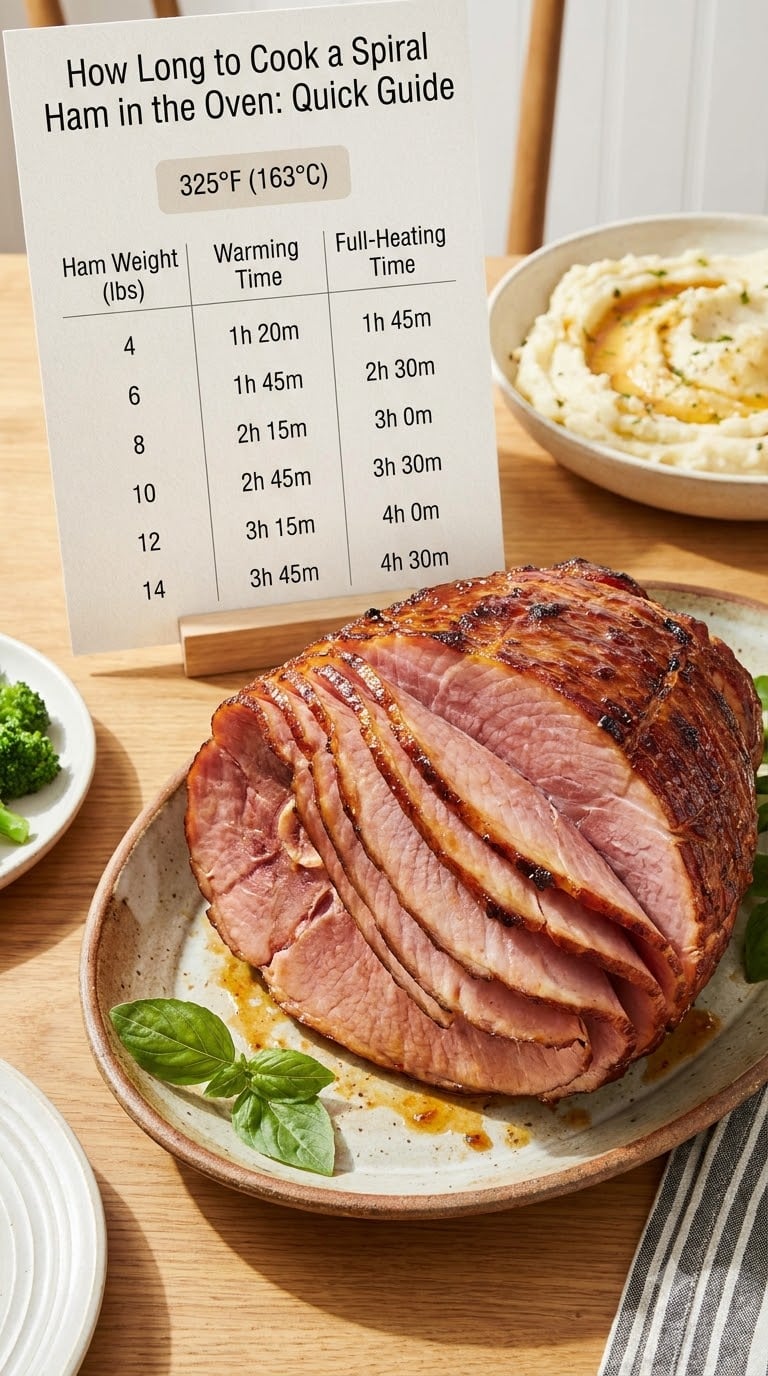
Set the oven to 325°F (163°C), plan 10 to 15 minutes per pound, and start checking the temperature well before the clock runs out.
There are two jobs here and they take very different amounts of time. Warming an already fully cooked ham to serving temperature is the shorter job, usually under two hours for most sizes. Heating a ham that is labelled as needing further cooking takes considerably longer, and the temperature still has to reach the same 145°F (63°C) finish.
Whichever job you are doing, the temperature is the answer and the timer is the suggestion.
Spiral Ham Cooking Times by Weight
Here is the weight chart to look up. The left column gives the ham, the middle column is for a fully cooked ham you are reheating, and the right column is for a refrigerated or frozen ham that still needs cooking.
| Ham weight | Reheat a fully cooked ham at 325°F (163°C) | Heat a ham that still needs cooking at 325°F (163°C) |
|---|---|---|
| 4 lb | 40 to 60 minutes | 1 hour 30 minutes to 2 hours |
| 5 lb | 50 to 75 minutes | 1 hour 45 minutes to 2 hours 15 minutes |
| 6 lb | 60 to 90 minutes | 2 to 2 hours 30 minutes |
| 7 lb | 1 hour 10 minutes to 1 hour 25 minutes | 2 hours 15 minutes to 2 hours 45 minutes |
| 8 lb | 1 hour 20 minutes to 2 hours | 2 hours 30 minutes to 3 hours |
| 9 lb | 1 hour 30 minutes to 2 hours 15 minutes | 2 hours 45 minutes to 3 hours 15 minutes |
| 10 lb | 1 hour 40 minutes to 2 hours 30 minutes | 3 to 3 hours 30 minutes |
| 11 lb | 1 hour 50 minutes to 2 hours 45 minutes | 3 hours 15 minutes to 3 hours 45 minutes |
| 12 lb | 2 hours to 3 hours | 3 hours 30 minutes to 4 hours |
| 13 lb | 2 hours 10 minutes to 3 hours 15 minutes | 3 hours 45 minutes to 4 hours 15 minutes |
| 14 lb | 2 hours 20 minutes to 3 hours 30 minutes | 4 to 4 hours 30 minutes |
Two things push a ham toward the longer end of its range. A tall, narrow ham heats more slowly than a short, round one of the same weight, and a disposable foil roaster or a deep covered pan traps more heat than a shallow dish, which is the opposite problem.
These estimates end at 145°F (63°C). Once the thermometer says you are there, the cooking is finished regardless of what the clock said.
Do You Need to Cook a Spiral Ham?
Most of the time, no. A spiral cut tells you how the ham was sliced, not how it was cooked, so the shape of the meat tells you nothing about whether it is safe to eat straight from the box.
Look at the label. A shelf-stable ham marked ready to eat or fully cooked needs reheating only for comfort and for the glaze to caramelize. A ham marked refrigerated, frozen, precooked, or not ready to eat needs to reach the safe minimum internal temperature of 145°F (63°C) before you serve it.
When a ham does need cooking, follow the directions on the package if you have them. Manufacturers test those times for their own product, and they take precedence over any chart you find online, including mine.
How to Cook a Spiral Ham in the Oven
- Take the ham out of its box and remove every bit of packaging. Cut away the plastic hock lock disc that sits on the bone, plus any netting.
- Score the surface lightly with a sharp knife if the ham has a thick skin you want to open up, cutting only through the outer layer.
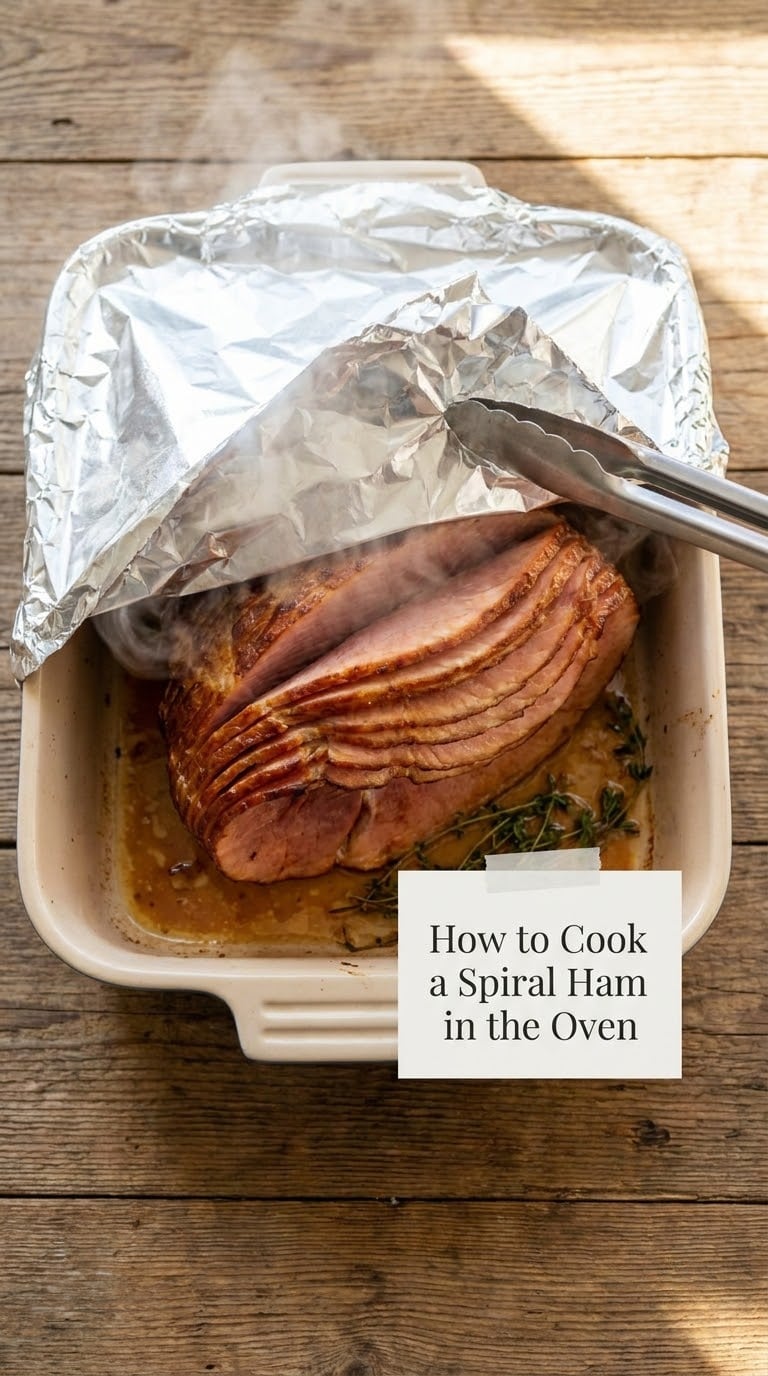
- Place the ham cut-side down in a shallow roasting pan. Add about half a cup of water, broth, or apple juice to the bottom of the pan.
- Cover the pan tightly with aluminum foil, tucking it down the sides so steam stays in.
- Cook at 325°F (163°C) until a thermometer reads 145°F (63°C), checking at the two-thirds point of the estimated time.
- Uncover the ham and raise the oven to 400°F (204°C) for the last 10 to 15 minutes if you want the surface browned and the glaze sticky.
- Rest the ham for 3 minutes before carving, and up to 20 minutes if you want the slices to hold together when you pull them apart.
The foil is not optional in my kitchen. Spiral slicing exposes a huge amount of surface, and that exposed surface is exactly where a ham goes dry.
How to Tell When a Spiral Ham Is Done
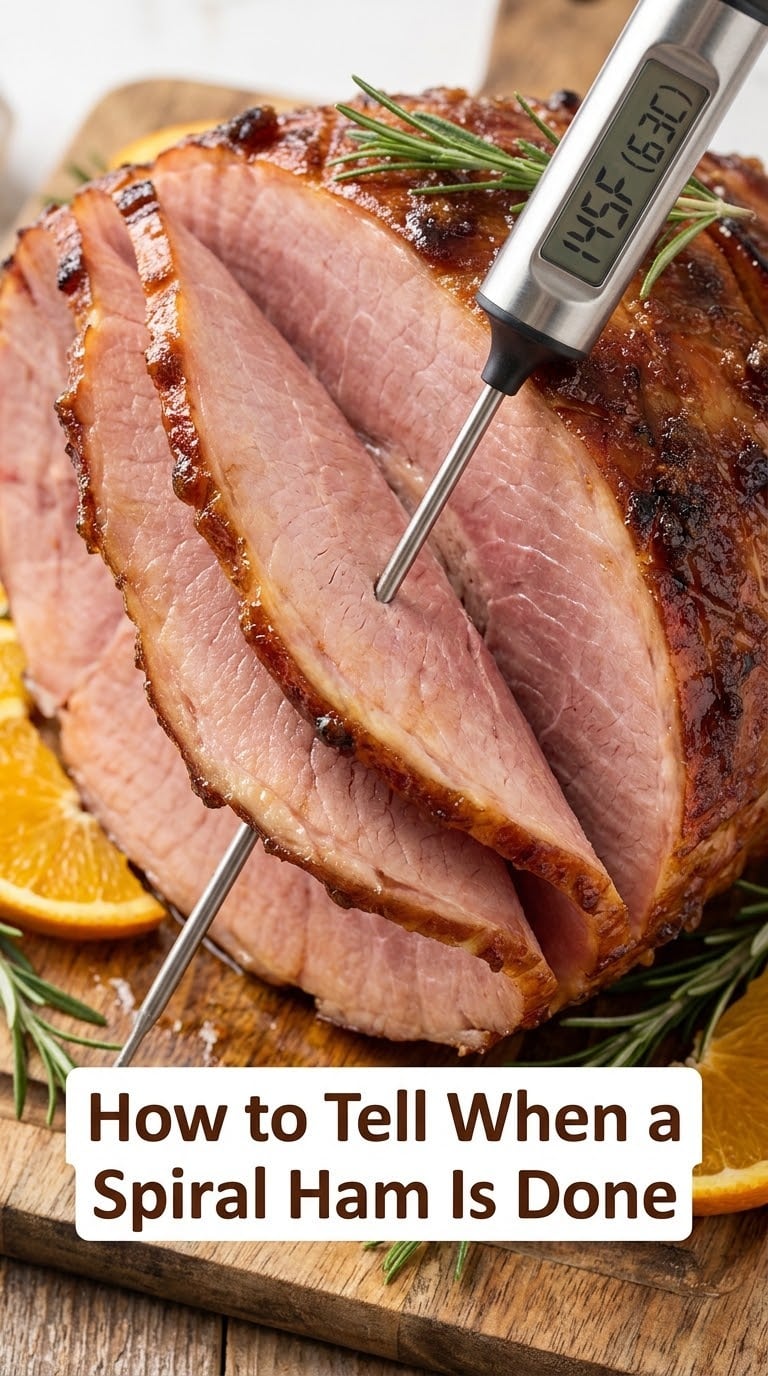
Check with a digital thermometer in the thickest part of the ham, away from bone and away from the pan wall, until it reads 145°F (63°C). Then let it rest 3 minutes before serving.
That is the USDA safe minimum internal temperature for pork roasts, and it applies whether the ham was raw or precooked. A thermometer left in a spiral cut tells you very little, because the cut exposes the thin edge of a slice rather than the dense center of the meat.
Color and aroma are useful only as backup cues. Underdone ham looks pale and glossy at the cut edges, and properly heated ham gives a little when prodded but still springs back.
How to Keep a Spiral Ham Moist and Flavorful
- Keep the pan covered in foil for most of the cooking, and only uncover for the last stretch when you want browning.
- Put a shallow layer of water, broth, apple juice, or pineapple juice in the roasting pan so the drippings do not scorch.
- Baste during the uncovered portion only. Frequent basting pulls salt and moisture out of the meat across that large cut surface, which is why a spiral ham that is repeatedly opened and brushed tends to dry out faster.
- Use a roasting pan that holds the ham in a low, stable shape. A tall ham standing on end cooks unevenly and its top slices dry before the center heats through.
- Let the ham rest before carving, so the juices settle back into the meat instead of running onto the board.
A glaze is flavor, not safety. Skip it if you want to and the ham is still perfectly done at 145°F (63°C).
Spiral Ham Temperature, Smoking, and Cooking Method Differences
Ham labels often list added water and sometimes added solution, and that is why two hams of the same weight can behave differently in the same oven.
Smoked, honey glazed, uncured, and bone-in varieties also vary in flavor and texture. Uncured ham is closer to fresh pork in texture and can be noticeably firmer, while a cured hock and shank section holds heat longer than a boneless section of the same weight.
So trust the combination of package instructions, oven temperature, and a measured internal temperature rather than any fixed number of minutes. If the ham is raw or was not fully cooked, 145°F (63°C) is the floor and there is no shortcut around it.
How to Reheat a Spiral Ham
For a leftover slice, set it on a plate, cover it loosely with foil or a damp paper towel, and warm it in a 325°F (163°C) oven for about 10 to 15 minutes, or until it reaches 145°F (63°C).
The microwave works too, but cover the slice first and use short bursts of 30 seconds, checking between each one. A dry, uncovered slice reheats unevenly and toughens at the edges long before the middle is hot.
Do not crowd the pan. If slices are touching, the outside ones dry while the middle of the pile stays cold, so spread them in a single layer with space between them.
Leftovers keep 3 to 4 days in the fridge in a covered container. Once you have leftovers, that is a good reason to plan dinner around them.
Common Spiral Ham Mistakes and How to Fix Them
| Problem | Cause | Fix |
|---|---|---|
| Ham finished earlier than the box said | Home ovens often run hotter than commercial ones, and a covered pan speeds things up | Start checking the thermometer earlier and trust it over the box |
| Outer slices dry out | Large spiral cut surface exposed to dry heat | Keep the pan covered in foil and add liquid to the roasting pan |
| Glaze burned or bitter | Glaze added too early at too high a temperature | Glaze only in the last 10 to 15 minutes, or reduce it with a little water |
| Center still cool | Probe landed in a spiral cut or the probe was too thin | Probe the thick center between slices with a digital thermometer |
| Greasy pan juices | Too much liquid, or ham sits in its own drippings | Use about half a cup and use a rack if the ham sits in liquid |
| Slices fall apart when serving | Carved before the ham rested | Rest at least 3 minutes, longer for a large bone-in ham |
| Uneven cooking, top browned first | Tall ham shape in a deep pan | Lay the ham on its side in a shallow pan |
If the thermometer hits 145°F (63°C) well ahead of the estimate, take it out. Extra time in a hot oven only costs you moisture.
Frequently Asked Questions
How long does a spiral ham take to cook at 325°F?
At 325°F (163°C), allow about 10 to 15 minutes per pound for a fully cooked spiral ham you are reheating, and roughly twice that for a refrigerated or frozen ham that still needs cooking. Most 8 to 10 pound hams land between one hour 20 minutes and two and a half hours. The internal temperature of 145°F (63°C) with a 3-minute rest is the real finish line, not the clock.
How long do you cook a 10-pound spiral ham?
A 10-pound spiral ham that is fully cooked takes about 1 hour 40 minutes to 2 hours 30 minutes at 325°F (163°C) when it is covered in foil. If the ham is labelled as needing cooking, give it 3 to 3 and a half hours instead. Start probing the thermometer about 30 minutes before the low end of the range so you catch it before it dries out.
Should you cover a spiral ham with foil while cooking?
Yes, cover it tightly with aluminum foil for most of the cook time. The spiral cut exposes a large surface area, and foil traps the steam that keeps the surface from drying out. Uncover only for the last 10 to 15 minutes at 400°F (204°C) when you want browning or a sticky caramelized glaze.
Can you bake a spiral ham from frozen?
You can, but add 30 to 60 minutes to the chart and cover the pan in foil so the frozen outside steams rather than dries. Cooking from frozen on a cut surface tends to dry the outer slices, so thawing in the fridge overnight gives a more even result. Check the label first, because a ham marked not ready to eat must still reach 145°F (63°C).
How do you know when a spiral ham is fully cooked?
Insert a digital thermometer into the thickest part of the ham, away from bone and away from the pan wall. It should read 145°F (63°C), which is the USDA safe minimum internal temperature for pork, followed by a 3-minute rest. A probe pushed through a spiral cut only measures a thin edge and will read high too early.
Can you reheat a spiral ham with the glaze on it?
Yes, and it usually tastes better glazed. Reheat covered at 325°F (163°C) for 10 to 15 minutes per few slices until it reaches 145°F (63°C). A sugary glaze can scorch in a microwave, so warm it in short bursts and watch it, or use the oven for anything you want to caramelize.
Cook the Ham to Temperature, Not Just the Clock
Start at 325°F (163°C), use the weight chart as a rough estimate, and pull the ham when the thermometer in the thick center reads 145°F (63°C) with a 3-minute rest. That is how long to cook a spiral ham in the oven, whatever the box says.
Keep the pan covered, keep liquid in the bottom, and resist the urge to chase the full estimated time. A ham that hits temperature early is a ham that stays juicy.
Planning a big meal around the same oven? Our bacon in the oven guide uses the same covered-then-uncovered logic, and warm weather calls for no-cook dinners that leave the oven free. Whatever you do with the leftovers, I keep a short list of leftover ham recipes ready to go the day after.