
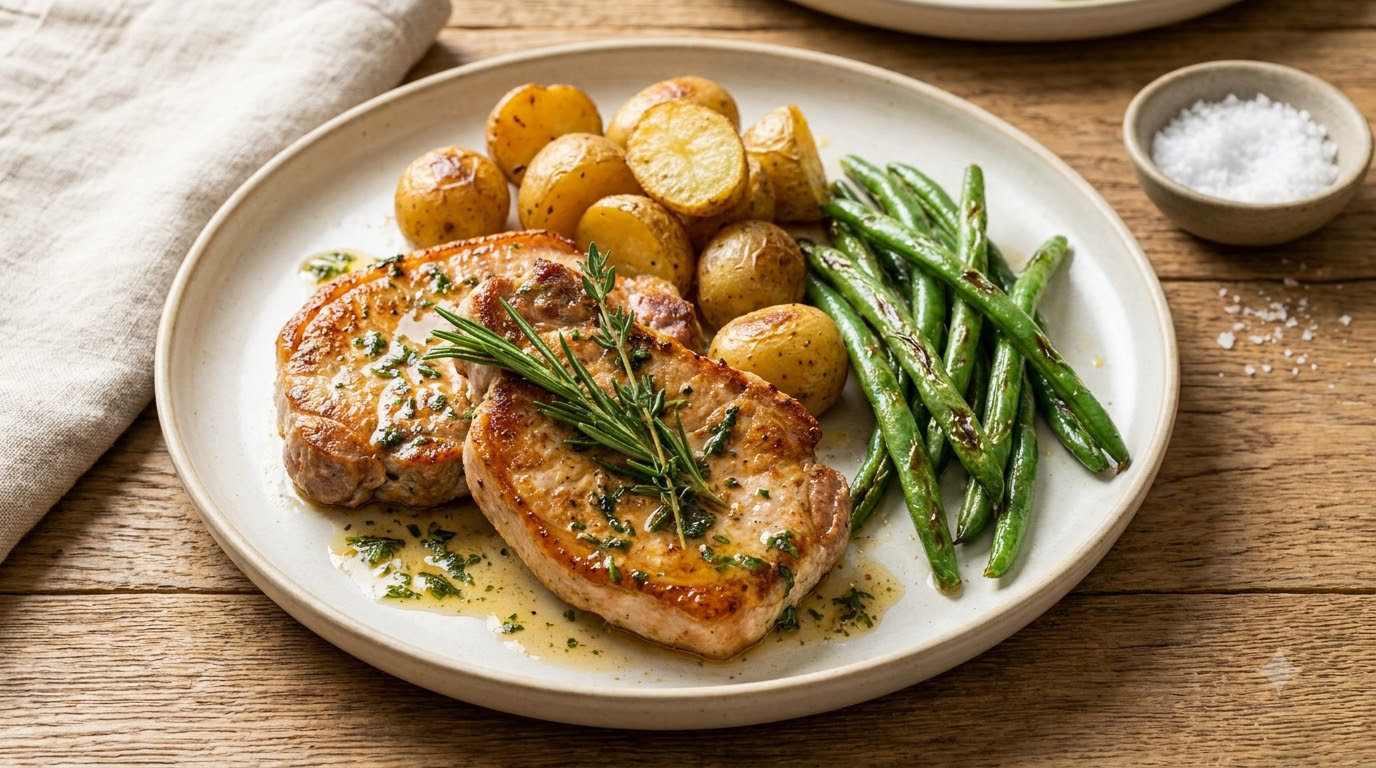
What temperature to bake pork chops at? Most home cooks do well with 400°F (204°C) for bone-in chops and 425°F (220°C) for thick boneless ones, then pull the pan the moment a thermometer reads 145°F (63°C). That is the safe minimum internal temperature the USDA recommends for pork, followed by a 3-minute rest.
Most people get into trouble with the two ends of the range. A 350°F (177°C) oven is gentle and forgiving but slow, and it leaves the exterior pale. A screaming-hot oven browns beautifully and then burns the sugar in your rub while the centre is still pink.
The oven temperature matters less than the thermometer in your hand. Time is a guess, thickness is a variable, and your oven may run 25°F (14°C) hot or cold without telling you. Temperature is the only test that works. If you want a recipe rather than a lecture, start with my easy oven method for baked pork chops.
Table of Contents
What Temperature to Bake Pork Chops At? Quick Guide
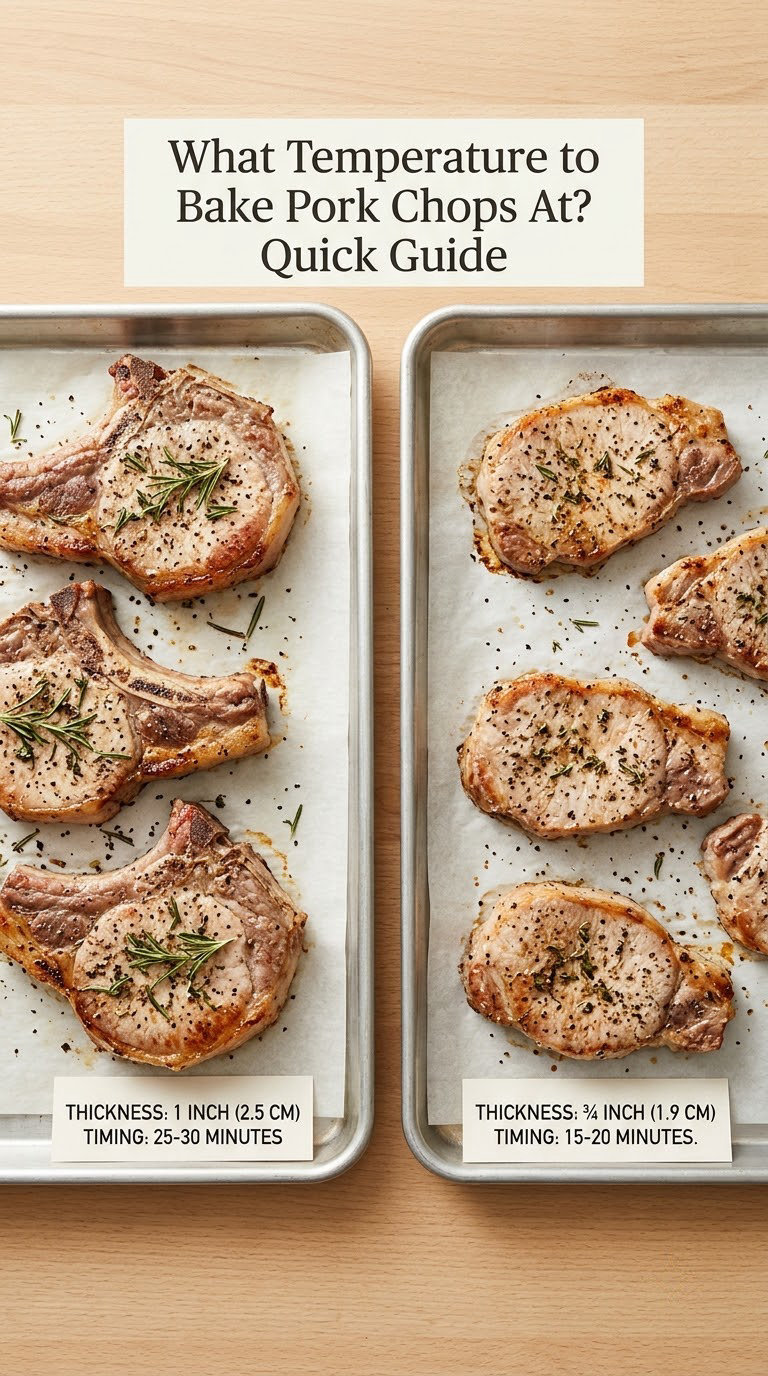
Here is the short version. Bone-in chops go in at 400°F (204°C). Boneless chops that are thicker than 1 inch go in at 425°F (220°C). Anything 1½ inches thick or thicker drops to 375°F (190°C) and gets more time, ideally tented with foil for the first part.
| Oven temperature | Best for | 1/2 inch | 3/4 inch | 1 inch | 1¼ inch | 1½ inch |
|---|---|---|---|---|---|---|
| 350°F (177°C) | Thick bone-in chops, covered bakes | 22–26 min | 28–32 min | 35–40 min | 42–47 min | 50–55 min |
| 375°F (190°C) | Thick chops, gentle finish | 18–22 min | 24–28 min | 30–34 min | 36–40 min | 44–48 min |
| 400°F (204°C) | Bone-in chops and average cuts | 14–18 min | 18–22 min | 24–28 min | 30–34 min | 36–40 min |
| 425°F (220°C) | Boneless chops, breaded coatings | 12–15 min | 15–18 min | 20–24 min | 26–30 min | 30–34 min |
All times are estimates for bone-in style chops. Boneless chops run roughly 10 to 20 percent faster. Check with a thermometer, never with the clock alone.
Four rules hold up across every cut. Let the chops sit out 20 to 30 minutes if you have time. Pat them dry. Give each chop an inch of space on the pan. Pull at 145°F (63°C) and rest three minutes before cutting.
Which Oven Temperature Gives the Juiciest Pork Chops?
The juiciest chop is not always the one at the highest temperature. It is the one where the middle reaches 145°F before the outside has a chance to catch fire.
350–375°F (177–190°C) heats the centre slowly over a longer stretch. That slow climb is kinder to a thick bone-in chop, and it is the right band if you plan to cover the pan or bake a big batch on two sheets. The trade-off is browning: nothing crisps at 350°F unless you finish under the broiler for a couple of minutes.
400°F (204°C) is the sweet spot for most home ovens. It browns well in the time a 1-inch chop needs to reach temperature, and it is forgiving enough that a slightly thinner chop still lands close to done. If you only ever set one number, set this one.
425–450°F (220–232°C) pushes the crust fast and gives breaded or shake-and-bake chops the crisp coating they need to survive the oven. It is a poor fit for chops under ¾ inch thick, which will burn outside while the middle is still cool, and it punishes a brown sugar or honey rub that caramelizes early.
My own preference for a weeknight is 400°F, chops about 1¼ inches thick, and a two-minute broil at the end if the edges look pale. If you like breading, go to 425°F and skip the broiler.
How Long Should You Bake Pork Chops by Thickness?
Thickness is the single biggest variable, because heat has to travel from the surface all the way to the middle. A ½-inch chop crosses that distance in a fraction of the time a 1½-inch chop does, which is why thin chops so often arrive at the table overcooked on the outside and raw in the middle.
| Chop thickness | At 400°F (204°C) | At 425°F (220°C) | When to start checking |
|---|---|---|---|
| ½ inch | 14–18 min | 12–15 min | 9 minutes |
| ¾ inch | 18–22 min | 15–18 min | 12 minutes |
| 1 inch | 24–28 min | 20–24 min | 16 minutes |
| 1¼ inch | 30–34 min | 26–30 min | 20 minutes |
| 1½ inch | 36–40 min | 30–34 min | 26 minutes |
These are boneless estimates. Add 10 to 20 percent for bone-in chops, or just move your thermometer check forward by a few minutes. If you want more than one way to cook them, my 11 juicy baked pork chops recipes covers glazes, rubs and breaded versions.
What Temperature to Bake Pork Chops At by Thickness?
For chops under ¾ inch, use 400°F and start checking at 9 minutes. There is no point going higher; the exterior will be well past done long before the centre catches up.
For 1 to 1¼ inch chops, 400°F for bone-in and 425°F for boneless both work well. Check at 16 minutes and again every two minutes after that.
For chops 1½ inches thick or thicker, drop to 375°F. The extra time at a lower temperature lets the middle cook through before the outside darkens. Start checking at 26 minutes.
Bone-in chops need longer because the bone acts as a heat sink and the surrounding meat is often unevenly thick where it meets the bone. That is the whole reason the bone-in row reads slower than the boneless row. If a chop is bone-in and thicker than 1½ inches, tent it with foil and leave the thermometer in place through the foil.
Dropping the temperature or adding foil mid-bake is the fix whenever the edges colour faster than the centre rises. It is not a failure. It is just the pan telling you the heat is unbalanced.
How to Bake Pork Chops So They Stay Juicy
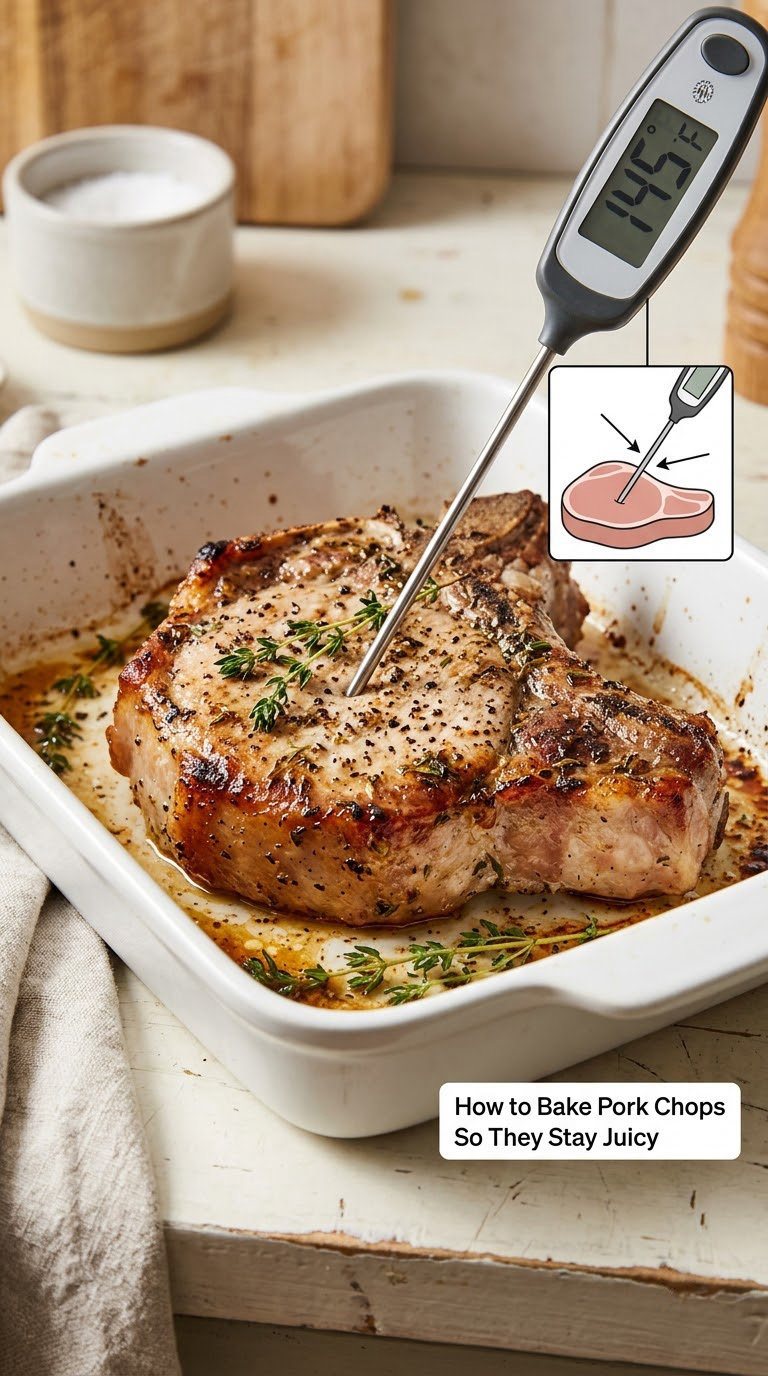
Dryness comes from three places: too much heat, too much time, and no rest. The method below handles all three.
- Preheat properly. Set the oven to your chosen temperature and give it a full 10 to 15 minutes. An oven that has not recovered yet drops 20 to 30°F on the door opening, and that delay lands on your cook time.
- Dry the surface. Blot each chop with paper towels until the top and edges look matte. A wet surface steams instead of browning, and it will never take a rub or breading properly.
- Oil and season. Light drizzle of olive oil, salt, black pepper, and whatever rub you like. Oil on the surface is what turns heat into a browned crust rather than a pale one.
- Give them space. Space chops at least an inch apart on a rimmed baking sheet. Touching chops steam each other, and a crowded sheet drops the effective temperature around the meat.
- Bake uncovered. Start with the pan uncovered so the top browns. Check the thermometer at the time listed in the thickness table, then every two minutes.
- Pull at 145°F (63°C). The USDA safe minimum internal temperature for pork chops is 145°F with a 3-minute rest. If you prefer a little more leeway, 150 to 155°F lands medium and stays moist.
- Rest three minutes, then serve. Move the chops to a plate, cover loosely with foil if you are holding them more than a few minutes, and wait. The juices redistribute back into the muscle instead of running onto the cutting board.
A knob of butter stirred into the pan juices right after the chops come out is a small thing that makes a real difference, especially on a lean loin chop.
How Do You Know Pork Chops Are Fully Cooked?
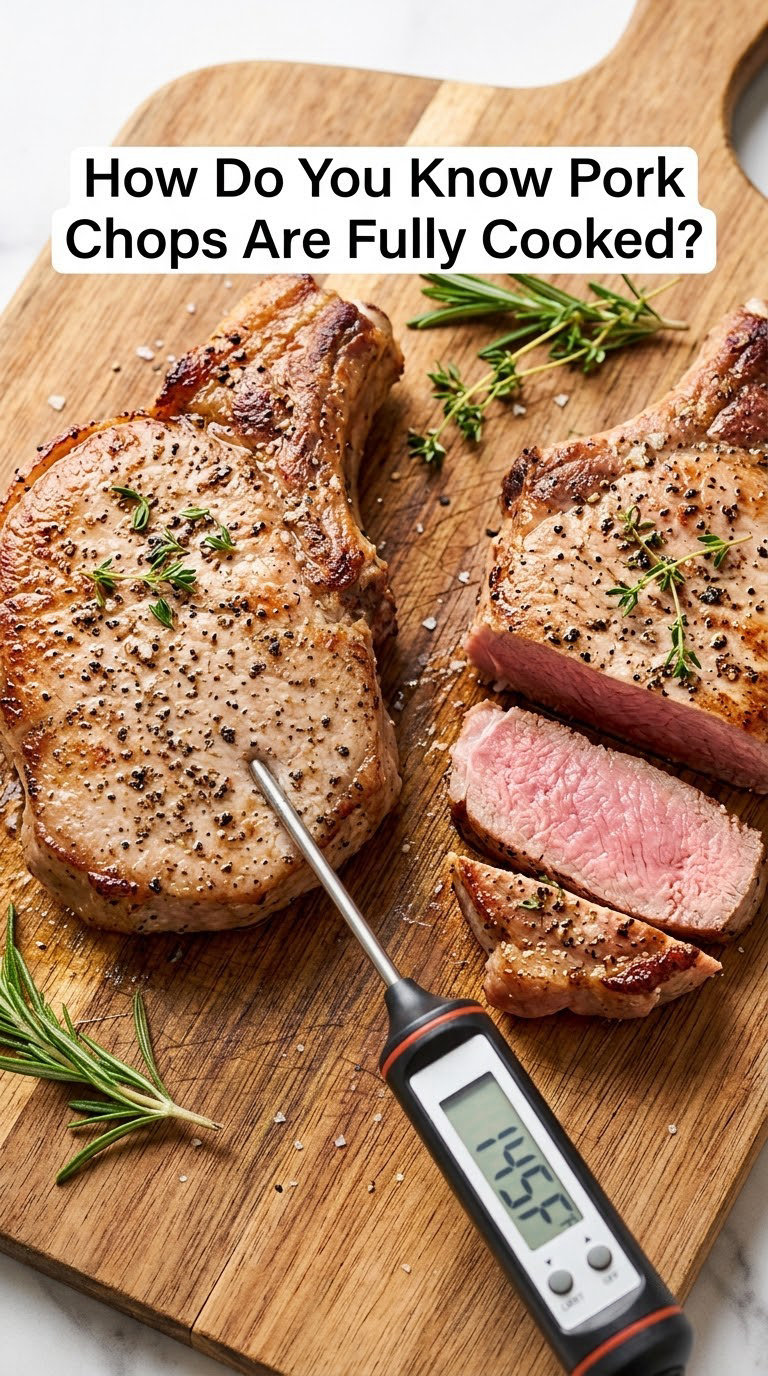
Colour is not a doneness test. The USDA safe minimum internal temperature for pork chops is 145°F (63°C) followed by a 3-minute rest, and everything past that is a choice you make about texture, not a safety requirement.
| Internal temperature | How it looks | What you get |
|---|---|---|
| 145°F (63°C) | Faint pink to light blush, clear juices | The USDA minimum, moist and tender |
| 150–155°F (66–68°C) | Solid pink, no visible blood | Medium, a touch firmer, still juicy |
| 160°F (71°C) | Beige to very light tan | Medium-well, noticeably drier |
| 170°F (77°C) and up | Uniformly pale and firm | Well done, chalky and chewy |
Insert an instant-read thermometer into the thickest part of the chop, aiming sideways, and make sure the probe does not touch bone. Contact with bone reads low and will have you pulling a chop that is still raw in the middle.
Without a thermometer, three checks help. Press the surface gently: soft and spongy means underdone, springy like the back of your knuckles means medium, firm with no give means overdone. Cut into the thickest part and look: the juice should run clear, not pink. Tenting one chop with foil and cutting into it costs you thirty seconds and gives you a real answer.
None of these beat a $10 thermometer, which is the only tool in this whole guide I would call non-negotiable. Our pork temperature guide has the full picture across the whole animal.
Should You Cover Pork Chops While Baking?
Bake pork chops uncovered when you want browning, and tent them with foil when you are cooking thick chops for a long time at a low temperature. Foil traps steam, which keeps the meat moist but softens the crust and slows browning.
Uncovered at 400°F or higher gives you the Maillard browning on the edges that most people are actually chasing. Covered at 350°F suits a 2-inch chop that would otherwise spend 50 minutes losing moisture. If you cover from the start, pull the foil off for the final 5 minutes so the top colours.
What you want to avoid is foil sealed tight over a chop sitting in its own trapped steam for the whole cook. That is a recipe for a pale, soft exterior and a wet crust.
How to Tell When Thick Pork Chops Need Foil
Three signals mean it is time to tent. The edges are visibly dark while the centre still looks raw when you press. The butter or oil you added has gone quiet and stopped sizzling. Or a chop thicker than 1½ inches is already past 30 minutes and still reads under 140°F.
For a thin chop, tent loosely. Loosely means the foil sits over the top like a tent, not sealed against the meat, so steam can still escape. For a chop over 2 inches thick, wrap it completely and lower the oven by 25°F (14°C). The chop then finishes gently instead of finishing in a panic.
Leave the thermometer in place through the foil. Tenting changes the cooking environment and there is no way to tell what is happening inside without checking.
Common Mistakes When Baking Pork Chops
Crowding the pan. Chops touching each other steam instead of brown, and the pan temperature drops. Use two sheet pans for a large batch rather than one loaded one.
Baking straight from the fridge. Cold chops take longer to reach the pan temperature, so the outside overcooks before the centre responds. Twenty to 30 minutes on the counter fixes most of it.
Trusting colour. A chop can look cooked and still be pink inside, or look pale and be done. The thermometer is the only reliable answer.
Using a dark or oversized pan. A heavy dark sheet browns the underside before the top catches up. A pale rimmed sheet is the better tool here.
Overcooking out of habit. Plenty of people were raised cooking pork to 160°F or higher. It is safe, but the loin has nothing left to give by then. 145°F is the number the USDA publishes.
Skipping the rest. Chopping straight out of the oven dumps the juice onto the board. Three minutes fixes it, and the meat tastes noticeably better for the pause.
Ignoring your oven. An oven that runs 25°F hot will take a chop from perfect to dry in a single bake. If chops keep disappointing, get it calibrated before you change anything else.
Frequently Asked Questions
What temperature should pork chops be baked at?
Most pork chops do best at 400F (204C) for bone-in cuts or 425F (220C) for thick boneless chops. Drop to 375F (190C) for anything 1.5 inches thick or thicker, since the extra time lets the centre cook before the outside darkens. Ignore the clock once they are in the oven and pull at 145F (63C).
Do bone-in pork chops take longer than boneless chops?
Yes, generally 10 to 20 percent longer. The bone absorbs heat and then releases it into the meat beside it, and the cut is usually uneven where it meets the bone. That is why a bone-in chop at the same temperature and thickness finishes later than a boneless one pulled from the same pan.
How long do you bake 1-inch pork chops?
At 400F (204C) allow about 24 to 28 minutes, or roughly 20 to 24 minutes at 425F (220C). Start checking at 16 minutes and pull the moment an instant-read thermometer hits 145F (63C). The time varies with your pan, your oven, and whether the chops are bone-in or boneless.
Can I bake frozen pork chops without thawing them?
You can, but add 10 to 15 minutes and start checking the temperature early rather than late. Frozen chops often have an icy centre that finishes at a different rate than the thawed outside, so give yourself more checking intervals than usual. Thawing overnight in the fridge gives you far more even cooking and is worth the wait when you have it.
Why are my baked pork chops dry?
The usual causes are cooking well past 145F (63C), chops under 1 inch thick, skipping the 3-minute rest, crowding the pan, and starting with cold meat. Switch to 400F, buy chops at least 1 inch thick, leave room between them, and pull on the thermometer rather than on a timer. An oven that runs hot is also a common hidden cause.
Choose Your Temperature and Start Checking Early
Set 400°F (204°C) for bone-in chops and 425°F (220°C) for thick boneless ones, then forget the timer and watch the thermometer. Check earlier than the table says you need to, because your pan and your oven are not the same as anyone else’s.
When the probe reads 145°F (63°C), take the pan out and wait three minutes. Those three minutes are the difference between chops that stay juicy on the plate and chops that dry out while you slice them.